Wednesday, October 27, 2010

Lanslebourg, 3: the walk from Bonneval to Bessans

Lanslebourg, Savoie, October 27, 2010—
I BROUGHT LINDSEY HERE to show her the valley I'd walked a couple of years ago, when Henry and Mac and I walked the GR5 from near Geneva to Nice. (You can read my running blog from that trip at Alpwalk, or, more conveniently, in my book Walking the French Alps.)

My idea was to introduce her to the valley via one or two stages of the walk, not at all strenuous here, basically flat, in the hopes she'll acquiesce later to further stages. It's such a beautiful walk, so varied, through calm, splendid landscape, and dotted with interesting villages, good restaurants, and comfortable hotels.

Alas, Mother Nature chose this week for the first snowfall of the year. It wasn't all that heavy, though it made crossing the Moncenisio a little hairy the other day. But it did cover the walkingpath with a good three or four inches of snow, and we waited until this morning to try the first step of the walk, from Bonneval sur Arc to Bessans, a short walk of six or seven kilometers — less than five miles, on country road, then footpaths, along the northern bank of the Arc, at the foot of massive rock cliffs, where I figured the sun would soonest melt off the snow. (Other stages of the walk hereabouts are on the south side of the river, in the shadow of high mountains and through forest.)

We drove up to the little town of Bonneval and left the car there. Bonneval's more or less a vacation community of ancient stone houses, most of them with new or recent roofs and fitted out inside, no doubt, with all the comforts. The town was quiet; hardly a person to be seen; the houses not yet occupied for the season; few other cars in the car park.

(Bonneval prefers that you not bring a car into the village, and provides a good-sized parking lot on the outskirts. The two or three hotels are also on the outskirts, leaving the village free to imitate the middle ages whenever it likes — or, if I'm not being too cynical, whenever it's to its advantage, say for a photo shoot.)


Following my trail guide, La Vanoise (FFRandonnée, 2008), we walked through town, past the ancient stone church, and out a country road. Bonneval is at 1800 meters, just under 6,000 feet. I'd put on my long underwear and layered up for the morning, but though there was thankfully no wind and the few clouds were high cirrus it was still a little chilly. Nor had the snow melted: only in the tracks left by a few farm-trucks was there bare ground to be seen, and it was often treacherous with black ice.

Another point, one I hadn't though of though I'd run into it before: often the balissage marking the route, a white strip over a red one, is painted directly onto a low rock by the side of the path. Snow covers these marks, of course. Still, we had the trail map in the guide, and I'd walked here only two years ago; besides, the direction is obvious, you keep walking downstream holding to the right side of the river. There's no way you can get lost.


It was a beautiful walk. First you walk through open farmland, all of it snow-covered today, with only a couple of nearly invisible white horses and, later on, a small herd of cows to animate the countryside. I heard an occasional rook up in the cliffs, and once a more melodic birdsong. There was the occasional crunch on frozen snow, or the more amusing squeaky crunch on partially thawed snow; otherwise our footsteps were pretty well muffled, and the morning was blissfully silent.

At one point I mistook the way, not remembering that it climbed after passing a few scattered stone barns, and floundered down through soft snow toward the river, turning then through a small forest. Soon enough this proved a mistake; it was hard to work our way through the branches; we turned back up to resume the trail. Almost immediately we met a French couple coming up trail from Bessans, confirming the route. (They were the only other people we saw on the walk.)


Then we crossed a little brook, the Vallon, on a footbridge, at a spot I remembered feeling quite special in the summertime — one of those pools where you just know a naiad hangs out to help or hinder passersby, depending on the respect they show the site. And then, just ahead, there was what I'd wanted Lindsey to see, the Rocher Château, immensely high, black and gleaming with ice and icy water, streaked with grey-blue lichen and red iron oxide.

This rock was something of a village six or eight thousand years ago, offering shelter to Neolithic community and raw material to their economy, which centered on (besides hunting and gathering, of course) the manufacture of spear and arrow-points. The stone here is perfect for the purpose, apparently, and items manufactured here have turned up hundreds of miles away, apparently eagerly traded in those days.


The area was quarried as recently as fifty years ago, and one or two huge cubes of stone lie at the foot of the cliff from that time. But this is too important an archaeological site to succumb to commerce, and the State has set it aside. There are petroglyphs here, too; eight running stags, painted in the style of the cave painters of soutwestern France, but almost invisible now after so many years facing south into the sun. Four or five explanatory panels give the history, and a helpful empty frame on a standard is placed to help the visitor see what's left of the paintings.

By now I'd begun to get hungry, and half the baguette in my backpack disappeared as we resumed the trail. A farm road took us on into the hamlet of Villaron, where a tiny stone chapel stood at a crossroads, utterly dark inside but with one missing pane of opaque glass allowing a flash photo. Further on was a curiously rustic crucifix in a shrine set into the low stone wall: this is a devout area, this Arc valley, or at least a careful one.


Then in half an hour we were at the bridge crossing the Arc into the town of Bessans. By the guide we should have been here in ninety minutes without stops; two summers ago it took us two hours and a quarter. Today it took two hours and a half: we took longer at Rocher Ch âteau, and the slick ice had probably slowed us down, not to mention the little detour in the woods.

Bessans was quiet; not a thing open. No place for a hot cup of tea. The church and the impressive chapel were locked up tight as a tick, so the only frescos we could see were those on the outside wall of the St. Anthony chapel, whose interior boasts sixty of the most impressive frescos I've seen anywhere. The little churchyard sat poignant in the snow, the photographs of its more recent citizens speaking mutely of evanescence.

We found a bench outside a closed hotel-restaurant and sat down to eat our sausage, bread, apple, and chocolate. A black cat minced carefully over the snow. Someone unlocked the closed Mairie, went in, brought out four enormous pots of crysanthemums, and disappeared. A stout middle-aged woman waddled past, eyeing the ice suspiciously. An old couple, older even than us, walked past quietly: we spoke briefly: no, there was nothing open; no, there was no transportation back to Bonneval.


Bessans lay dead-silent under its snowcovered roofs. There was a very nice public restroom at the Mairie, though, so after our lunch, after listening to the church strike one-thirty, then two o'clock, we shouldered our packs and took the Departemental road back to Bonneval. Immediately a car drove past us: I put out my hand, he stopped, and we rode into Bonneval to drive back to the hotel.

Tuesday, October 26, 2010

Lanslebourg, 2: le plus beau pays

Lanslebourg, Savoie, October 26—
THE LAST TIMEI was here I was unimpressed with the area. Not this town, with its comfortable old-fashioned hotel, but the area, stretching from Bonneval at the upper end of the valley to Modane at the lower end. I was on foot, with my friend Mac and my grandson Henry; we'd been walking two weeks, having started at Evian-les-Bains on Lake Geneva, and were headed to Nice. We were a couple of days behind schedule; worse, we were down in what seemed like low country.

Worst, we were in civilization, after days in the high mountains. People, cars, machinery, noise.

This time, though, we've come here from the city. Same people, cars, machinery, noise: but so much less than in Torino, never mind the crowded Salone di Gusto. There's snow all around, which of course mutes sound; and we're not on a tight schedule; and we have a car, which covers the boring stretches so much faster, theoretically allowing more time for the interesting ones.

But we're between seasons, and many things are closed, or apparently closed. I wanted especially to take another look at the marvelous frescos in Bessans, but they're off limits for some reason. We drove into Modane this afternoon to see about its interesting museum, but it's closed until Thursday morning. We'll go back then, or maybe Friday.


It is so incredibly beautiful here. We keep stopping to snap photos, or sometimes we don't stop, Lindsey lifts her iPhone to the windshield — on the road it's not often easy or safe to stop. The mountains hereabout rise to nearly 4000 meters, 13,000 feet; and there are a good many of them, rising in blinding white above the dark forests, the bare stretches of dark grey rock.

The light slants in from the south, sometimes filtered to extraordinary effect by the yellow-gold needles of the larches — mégèves in French, what I've always called spanieltails because of their characteristic branches.

This morning we did manage to visit the chapel to St. Sebastian in the next village upstream, Lanslevillard. Our hostess called the mairie there and arranged our visit: like the chapel in Bessans, this one is a national treasure; you can't visit it without accompaniment.


Extraordinary. Three walls are covered with frescos painted by an anonymous itinerant, probably Piemontese, in the Fifteenth Century: two bands on one long wall, three on the other, broken comic-strip-style into rectangular frames illustrating the lives of Jesus and St. Sebastian. It's known the Sebastian mystery-play was given here in May 1567, performed by the villagers; and that a company of archers was stationed here at that time; Sebastian is an important patron saint here.

The frescos are remarkably fresh and realistic; you'd recognize these faces if you ran into them on the street — though they aren't particularly Savoyard: to my eye, the faces are Italian. Of course there was no Italy in those days, nor did France really have much presence hereabouts. We are in fact in Savoy, as the white cross on the red escutcheon reminds us on road-signs. Savoi, the Kingdom of Two Sicilies before that; France only since 1870 or so (and some territory hereabouts was ceded by Italy within my own lifetime).

This morning our hotelkeeper, the birdlike woman I wrote about in the book about our Long Walk of two summers ago, looked out the window at the snow-covered mountains and said C'est le plus beau pays dans le monde, the most beautiful countryside in the world. Then she started, and put her hand to her mouth and looked at us guiltily. They're all the plus beau, I responded, my country also: but this is extraordinaire.

It's also a bit foreboding. The edge of the cisalpine world, it's been defended from invaders — or armies merely passing through, but doing damage en route — for millenia. Hannibal brought his elephants through one of these passes (many claim him); the Maginot line ran across these mountains as recently as the 1930s. Huge fortresses dominate the skyline down around Modane; another fort is a tourist destination at Exilles, the other side of the Italian boundary.


It's a hard country, hard with rock, sharp with cold and wind, sudden with avalanche and flood. The summers are seductive, with endless miles of flowers among the sweet grasses that give Beaufort its unique savor. These days even the winters are deceptively playful, with ski-lifts and vacation chalets on all sides.

But down the street a monument to a dog reminds passersby of he danger in these mountains. He worked nearly a decade finding and assisting the victims of blizzards and avalanches; when he was ten, worn out with work and loyalty, he took a last walk into the mountains to die where he had served. His monument reads
Passant je suis autre chose qu'un monument
peut-etre plus qu'un symbole
je suis un example
Passerby I'm not a monument
perhaps more than a symbol
I am an example.

Monday, October 25, 2010

Catching up in Lanslebourg

WE'VE BEEN ON THE ROAD almost a week, but the first couple of days don't really count, of course; you're in the air, your mind is out of sync with everything else; then you land, rent your car, drive to an unfamiliar hotel in an unfamiliar city. That same night, last Wednesday, after 24 hours or so traveling, we went out to dinner with friends — I've written about that on Eating Every Day, of course.

Then we spent three days in the Salone del Gusto. Some reports from that leaked into the eatingblog too, but others will provide food for thought — heh heh — for comments on this site, later on, perhaps. Let's see:
Immigration
Quality of Life
Enjoyment
Disappearing apples
Sardegna, not Toscana


Today we drove from our Chivasso hotel, where we've slept the last four nights, over the Montcenisio pass and down into Lanslebourg. I wanted to bring Lindsey here to see this valley along the river Arc, from Bonneval south to Modane. I walked it two years ago, with Mac and Henry, when we took the Long Walk from Geneva to NIce. At that time I didn't really like it, but the more I thought about it afterward the more I realized I'd missed something.

I'd hoped Lindsey and I would be walking here, but the year's first snowfall coincided with our arrival. Driving the pass was a little hairy: the road was often covered in snow and sometimes icy, and toward the top we drove into cloudy air that tended toward snowblindness. It's a special road: we've taken it two or three times before, but never in this kind of weather. I remember the first time, when, at the top, we drove past the lake and saw a couple of girls, twelve years old or so, sitting in the grass, ostensbily watching their herd of cows, weaving daisies into a chain, right out of Heidi. They weren't out today.

We arrived at our hotel in Lanslebourg, the one Henry and Mac and I stayed in in the summer of '08, about three o'clock. We were cold. There was snow on the street. A fire burned in the hearth. The same birdlike woman met us, and was cheerful, and showed us to a room, and brought us tea back at the hearth in the lobby.

After a bit we drove up through Lanslevillard — yes, there were apparently two settlements named "Lans," one the bourg, one the villard — to Bessans, where I'd hoped to show Lindsey the amazing frescos. These are in a 15th-century chapel; Henry and I saw them on that walk: they depict the Life of Christ, and are amazingly concentrated paintings. But the chapel is off limits; we're not going to be able to see these frescos, not on this trip in any case.

Too bad. But we stopped in at the library, excuse me, "Media Center," here in Lanslebourg, and looked at photographs of the frescos in a couple of books. They were painted by an anonymous itinerant at the beginning of the 16th century, we read. Migration, again. Local saints are very important in these chapels, often protecting domestic animals as they were herded up and down the Alps. Another saint, St. Landry, was sent to Bonneval a thousand years ago or so, and drowned in the Arc river on his journey; his body washed downstream to Lanslevillard, where all the bells began tolling on their own initiative. A miracle: so he's preserved in the church there, and became the saint in charge of droughts.

Makes sense: a drowned man would know something about irrigation. I think the cult of saints replaced the local cults of local deities, lesser deities of course, dryads and such, spirits of springs and torrents, forests and bogs; protectors of virgins, widows, drunks, and domestic animals.

Yesterday at Terra Madre I heard a woman from an immigrants' rights organization say that "immigrants are the bearers of competence." I believe that; but I also believe that other migrants bear foreign authorities. Perhaps it only depends on from which end you view the spectrum.

Sunday, October 03, 2010

Epic, Comic, Lyric: Mark Morris in Berkeley; Molière in San Francisco

WHAT AN INTERESTING, classically absorbing evening of dance the other night in Zellerbach Auditorium, UC Berkeley. Mark Morris presented three big pieces neatly triangulating his view of the human condition: a formal, geometric, abstract suite of dances in total silence called Behemoth; a funny, inventive, dashing suite to Kyle Gann's Studies for Disklavier called Looky; a moving, descriptive, lyrical three-movement dance setting of Erik Satie's Socrate.

It was a carefully thought-out triangulation, even though the bookends are twenty years apart in their composition. Behemoth (1990), which seemed to run a good three quarters of an hour, breaks the fifteen-dancer ensemble into three fives much of the time, running them — sometimes literally — through the repertory of Morris steps and freezes, punctuated occasionally by slaps, claps, or stampings but otherwise perfectly silent, demanding a similar silence and thus attentiveness from the audience.

And this year's Socrates returns to the triple quintets, sometimes but not consistently assigning them to unison portrayals of the philosopher or one or another of his student-friends (Alcibiades in the first movement, Phaedrus in the second, Phaedo in the third), again in symmetrical groupings moving either squarely or diagonally to the stage.

Looky, on the other hand, is all comedy and grace. Gann's score is mechanical piano gone crazy, always firmly rooted in classic piano repertoire, from Schumann and Chopin through Liszt and Gottschalk to Shostakovich and Art Tatum. The piano, bereft of human performer, stands upstage right; the dancers enter by ones, twos, and larger groups in what looks sometimes like party clothes, sometimes evening pajamas, silently miming conversation, arguments, puzzlement, joking, often dancing in response to the crazy waltz or boogie or incipient tango that ultimately dissolves in roulades of high-speed mechanical virtuosity.

I liked Gann's music very much; enough in fact to want to get a copy and listen to it again and again. But Satie's Socrate — now there's a timeless masterpiece, in more ways than one. It's so artless, understated, beautifully balanced and scaled; so moving in its modest self-abnegation to the pathos of its subject, that it overwhelms me to think about it. There wasn't even that much Mark Morris could do, other than move gracefully, repetitively, submissively to the meter and cadences. The costumes were lovely; the dancing itself superb.
WE DON'T LIKE TO MISS a production of a Molière play if we can avoid it, so even though it isn't considered one of his best, we drove down to see Scapin at San Francisco's American Conservatory Theatre yesterday. We had very fond memories of an earlier production, probably twenty years ago or more, also in the Geary Theatre, perhaps starring Réné Auberjonois in the title role, in a translation/adaptation called Scapino; memories which may have lessened the current version a bit, as it seemed a little more formulaic, a little less spontaneous.

But that's the nature of the play, whose adaptation of commedia dell'arte into proscenium-stage comic theater depends on formulae. Bill Irwin was a first-rate Scapin; Jud Williford was his match as the other clown/servant Sylvestre; Geoff Hoyle and Steven Anthony Jones were their matches as Geronte and Argante, and the rest of the cast fell easily into place. Great costumes and set; satisfactory musical accompaniment.

I complained a week or so ago about a production of Twelfth Night that too evenly distributed comedy throughout the three levels of society Shakespeare portrays: nobility, clowns, young lovers. It's wrong to do that, I insist, in Shakespeare, particularly Twelfth Night. It's entirely appropriate to treat Scapin that way, and I thought this was a very entertaining production — though the translation I remembered from so long ago, with its recurring
But what the devil was he doing aboard that boat
seemed a much funnier, not to say more memorable, version of Molière's
mais que diable allait-il faire dans cette galère
than did the present rather whiny
but — why did he get on that boat?
  • Molière: Scapin, running through October 23; ACT, 415 Geary St., San Francisco
  • Restaurant dining: a social contract

    COMMENTS POSTED RECENTLY to my post of a few days ago, over at Eating Every Day, about a dinner at Oliveto in Oakland, bring to mind a matter I've given a fair amount of thought to: the extent to which we all get the treatment, in restaurants and elsewhere, that we somehow suggest we want or expect. I was struck forcibly by this idea years ago when dining in a restaurant with a couple of friends who told the host, immediately we were seated, that they wanted ice water with no ice in it.

    To dine in a restaurant is to appear in public. Most of us, these friends included, clearly understand the forms involved in going to a restaurant. You're greeted by the host, who leads you to your table; a waiter appears, either with menus or with a greeting and query as to whether you want a drink before dinner; a busser appears to handle the water, bread and butter, and such things.

    You don't expect to see the host again, though he may appear at some point to verify things are going well. Your transactions with the restaurant will all be conducted through the waiter. The busser will continue to serve you silently, taking dishes away, filling the water glasses, perhaps replenishing the bread.

    Diners and service staff rely on these forms as a social convention facilitating the dining experience; diners and service staff interfering with the convention risk interrupting the smooth flow of the meal. The diner needs to be aware of the extraordinarily demanding nature of the waiter's job, the complexity of the host's (he functions as manager and spokesman for the restaurant as well as greeter and conductor-to-table), the numbing repetitiveness of the busser's endless pursuit of silent perfection.

    The service staff, on the other hand, needs to be aware of the desires, even the demands, of the customers, not only for their table but also for its effect on the floor as a whole, the many tables, each aware to one degree or another of its neighbors. For this reason the customer's demands must be given highest attention — even anticipated when possible. When a diner makes the first demand, requesting a certain table, say, or volunteering without question a preference for ice water without ice, he's all but hoisting a flag: difficult patron here.

    Over and over I've noticed three kinds of response to this. The optimal one of course is immediate understanding. This involves deference on the part of the service staff, but I suppose that's what "service" ultimately means; a professional host or waiter or busser realizes that there is nothing demeaning or servile in his metier — on the contrary: if unusual service is demanded, fault, if any exist, lies with the customer.

    The second is a deference to the patron that's accompanied by some expression of criticism on the part of the server. This is unfortunate. The customer notices it more often than the server perhaps realizes, and an unsatisfactory relationship develops which, since it's never really expressed, can't really be resolved.

    The third is the worst of all: everything goes to hell. Each side of the transaction takes deliberate steps to make the other side's participation more difficult, raising the ante. Voices may be even be raised; nearby diners are affected; dissatisfied patrons go away sulking and perhaps publish their discontent. (This is exacerbated by the prevalence of blogs and of "reviews" on restaurant-finding computer applications.)

    I've listed two demands triggering this sort of situation: table request; ice water without ice. There are many others:
  • "allergies" (many or most of which are in fact simply food dislikes)
  • split or shared plates
  • courses desired out of sequence
  • corrections of dishes implicating the kitchen's competence (salt, etc.)
  • inappropriate expectations (espresso machine in a Chinese restaurant)
  • and I'm sure others could be added.

    Friday, September 24, 2010

    Theater in Ashland, 4: Twelfth Night; American Night

    Ashland, Oregon—
    WE FINISHED THIS SEASON of the Oregon Shakespeare Festival last night with a satisfying production of Twelfth Night. It doesn't make a lot of sense to have a favorite Shakespeare play, but there it is, Twelfth Night, about as perfect a play as you can get. The familiar devices: three social classes (nobility, fools, young lovers); slapstick; girl-masked-as-boy; shipwreck; separated souls reunited: and all in perfect balance as well as symmetry. And some of Shakespeare's most lyrical and poetic lines, from the opening
    If music be the food of love, play on,
    Give me excess of it; that surfeiting,
    The appetite may sicken, and so die…
    to Viola's final
    And all those sayings will I over swear,
    And all those swearings keep as true in soul
    As doth that orbed continent the fire
    That severs day from night.
    and, of course, Feste's final song with its "hey ho, the wind and the rain."

    Darko Tresnjak conceived this production with Mozart in mind. I've always lamented that Mozart and Da Ponte never got around to making an opera out of Twelfth Night; it would have been a natural for them — perhaps if Mozart had lived another ten years. Alas, the Mozart Tresnjak had in mind seemed to be Tom Hulce's version in the movie Amadeus: virtually all comic, hardly any serious. The comic level Shakespeare intends was nively done indeed; OSF excels at Shakespearian fools and clowns, and instead of naming them I'll just refer you to the online cast list. But Orsino and Olivia are, I think, serious and troubled characters; their situations and pains are real, unless profound emotions are too much a bother — or perhaps too private — to be taken seriously these days (as I fear may be the case). And Olivia is partly of their quality, but partly too magician, a profound representation of the playwright himself. Kenajuan Bentley, Miriam Laube, and Brooke Parks were often very satisfying in these roles (respectively), but they were directed to mug and clown too often, throwing off the play's delicate but effective mechanism. Still, the play ended on a note of quiet beauty: Michael Elich's wonderful singing of the final song
    When that I was and a little tiny boy,
    With hey, ho, the wind and the rain,
    A foolish thing was but a toy,
    For the rain it raineth every day.
    …
    A great while ago the world begun,
    With hey, ho, the wind and the rain,
    But that's all one, our play is done,
    And we'll strive to please you every day.
    and the play wasdone, roundly and beautifully, as had been done The Merchant of Venice the previous evening, musically and transcendently.
    The previous afternoon we saw American Night: The Ballad of Juan José, the first of a projected 37 plays OSF projects commissioning to recount the American historical experience. Scripted by Richard Montoya for development by the Los Angeles company Culture Clash, it was an intriguing, evocative, resourceful, entertaining ninety minutes of theater. Three big sections are based on three factual characters: Sacajawea, Harry Bridges, and Viola Pettus (look them up if you don't know them): they're met by the title character (René Millán) as he dreams in troubled sleep on the eve of a citizenship exam.

    Another section, perhaps the most troubling and evocative of the show, concerns a zoot-suited Johnny (Daisuke Tsuji), a poetic, rebellious youth caught in the Manzanar "relocation camp" during World War II. Somehow Montoya manages to balance broad comedy, poignancy, and political outrage in a persuasively realistic character here. American Night seemed to me the closest approximation to the Shakespearian humanization of social and political history of any of the many such attempts we've seen in Ashland over the years.
    •Twelfth Night, through Oct. 8; American Night: the Ballad of Juan José (Montoya), through October 31; Oregon Shakespeare Festival, Ashland; tel. (541) 482-4331

    Thursday, September 23, 2010

    Theater in Ashland, 3: The Merchant of Venice

    Ashland, Oregon—
    SO MUCH JUSTIFICATION for producing The Merchant of Venice was trotted out by the direction here at Oregon Shakespeare Festival that I was worried about what would be done to Shakespeare's marvelous, problematic comedy. It's directed by Bill Rauch, the company's creative director, who in this year's Hamlet uses hip-hop and technology to make Shakespeare "relevant" to a hoped-for younger audience. Of course one understands the company's nervousness in this epoch of political correctness: still, it's Shakespeare's play, written in his time, and reflecting (I say) an essentially evenhanded dissent from the complacent righteousness of both Christianity and Judaism: merely producing it today, faithfully to the text, shouldn't really offend any thinking playgoer.

    And it turned out the production, on the outdoor "Elizabethan Stage," was pretty straightforward. Like the previous night's Henry IV, Merchant began with a little vignette snipped from the trial scene, spotlit and amplified, as if the audience needs to be put in the mood, or told what the nut of the play is: this is dispensable, but essentially harmless.

    From there on it was an unremarkable production, unexceptionably cast for the most part, thoughtful, never strident, the currently fashionable latent-homosexuality theme nudged but not boldfaced, Shylock's hatred of the Christians clearly motivated.

    I was troubled throughout by the diction. Some of Shakespeare's most poetic language is in this play; too often it was spoken as if it were doggerel. It's one thing to portray Portia's exotic suitors — the Princes of Morocco and "Arragon" — as clowns; it's another to make Gratiano out a fool. Far too much of the expository first three acts suffered from off-hand diction, often nearly inaudible even only ten rows from the stage.

    The famous courtroom scene opening Act 4, though, brought the whole play to life. Anthony Heald's Shylock was ultimately outrageous in his demand, but never hateful. Jonathan Haugen's Antonio was dignified in his helpless resignation. And Vilma Silva, whose Portia seemed out of kilter in earlier scenes, was eloquent, her timing nicely calculated.

    For me the proof of The Merchant of Venice is the opening of the last act. Even here the opening lines —
    The moon shines bright. In such a night as this,
    When the sweet wind did gently kiss the trees,
    And they did make no noise…
    were delivered as trivial singsong; Lorenzo and Jessica never had seemed aware of the magic of either their romance or the language expressing it. But when the irresistible continuation began to unfold —
    How sweet the moonlight sleeps upon this bank!
    Here will we sit, and let the sounds of music
    Creep in our ears. Soft stillness and the night
    Become the touches of sweet harmony.
    Sit, Jessica. Look how the floor of heaven
    Is thick inlaid with patens of bright gold.
    There's not the smallest orb which thou behold'st
    but in his motion like an angel sings,
    Still quiring to the young-eye'd cherubins;
    Such harmony is in immortal souls,
    But whilst this muddy vesture of decay
    Doth grossly closed it in, we cannot hear it…
    Even here, Lorenzo punctuates "muddy vesture of decay" with a distracting mimed reference to physical love-making. But soon enough the musicians began to provide a soft, lyrical background; Roberta Burke (Fatima) singing softly to guitar and lute, Portia and Nerissa (Dawn-Lyen Gardner) quietly counterpointing their own lines in the distance house left. The effect was magical, even persuading Daniel Marmon's Lorenzo and Emily Knapp's Jessica. And me.

    •The Merchant of Venice, through Oct. 10; Oregon Shakespeare Festival, Ashland; tel. (541) 482-4331

    Wednesday, September 22, 2010

    Theater in Ashland, 2: Henry IV; questions of taste

    Ashland, Oregon—
    THE REPERTORY HERE leans heavily to Shakespeare: after all, this is the Oregon Shakespeare Festival. Every year we see at least three, sometimes five of his plays; if you return year after year, as we do, you'll see the entire cycle of history plays, presented not in order of their writing but in chronological order of their subjects.

    And while the Comedies, "Problem" plays, and Tragedies are often presented in one or another of the indoor theaters, the Histories seem nearly always to be presented in the semi-outdoors theater built in homage to London's (and Shakespeare's) Globe Theater. Last night, then, we sat in the chill of night to watch Henry IV, Part One. Perhaps it was simply an off night, but the performance seemed to me inert, with only Kevin Kenerly's portrayal of Hotspur redeeming a production that veered between overly fussy (but often funny) scenes with Falstaff (David Kelly, effective) and pageant-like, unconvincing scenes with the rebels and the royalty.

    Six of us had been discussing another play, Lynn Nottage's Ruined — two other couples had just seen it, and we'd seen it almost six months ago — and we'd agreed that while strong and well done in every way the play ultimately left us depressed and uninvolved: the human condition can be terrible, humans do horrible things to one another, but what's to be done about it? This Henry IV left me similarly uninvolved, though not sad or depressed. Young Prince Hal's sudden reversal of character wasn't persuasive; the Scottish and Welsh rebels seemed merely loutish; King Henry kept reminding me of a playing card. I have to note Judith-Marie Bergan's vivacious account of Mistress Quickly; her opening scene was marvelous. Otherwise, not an impressive account of a pivotal Shakespeare history.
    I MENTIONED ABOVE our discussion of Ruined. This of course is one of the major pleasures of our annual week in Ashland with three other couples: conversations about agreement and disagreement of tastes. Eight of us sometimes seem to see eight different productions, all at the same time in the same theater. (Well, seven: one of us — and it ain't me — is rarely expressive of his views, unless directly asked.)

    And it's not only the theater that brings out these interesting differences of taste: there's the daily discussion of Where To Eat. This town's not particularly an Eating Town; there are to my mind only two good restaurants — though one of those, New Sammy's Cowboy Bistro, is world-class, as all of us seem to agree. Lindsey says that Ashland's restaurants have a captive clientele, so don't need to excel at their metier; perhaps she's right.

    But among the available restaurants, as among the available theater, there's more than enough difference to provoke discussion, agreement, reservation, diffidence, disagreement. We're similar people, we eight; educated, well read, liberal, professional, experienced travelers. But apparently we come to our daily negotiations with daily decisions with different sets of experience-and-enthusiasms, and the result is different, um, postures toward arriving at those decisions — or, in the case of discussions of theater seen, conclusions.

    Example: the stage adaptation of Pride and Prejudice directed here by Libby Appel, which we saw and absolutely enjoyed last March, was roundly condemned by the other three couples in our house as long and talky. It's a novel, not a play, G. points out. But one of the things that intrigued and pleased me the most about that evening was the success of the adaptation, and the fidelity of its dialogue to Austen's book.

    Perhaps the primary consideration in discussions of taste is engagement, the extent to which we're involved in a two-way relationship with the play we're seeing, the meal we're eating, the conversation we're joining, the decision we're approaching. God knows it can be difficult when eight individuals, equally strong-willed but variably willing to express those wills, negotiate toward a common activity. This seems to me to be precisely the subject of Austen's novel: pride and prejudice as motivating, expressing, ultimately confounding the successful outcome of negotiations between individual desires (or urges) and social context (or permission or repression).

    One of us mentioned John Steinbeck's The Wayward Bus earlier today. It represents a genre that must be somewhere in mind in all eight of us, though it hasn't been discussed directly (yet): the thrown-together-by-fate group of (usually) travelers whose differences somehow have to be dealt with in a moment of social crisis extremis. The only Ashland productions of this genre that come to mind just now are William Inge's Bus Stop, which we saw in 2006 (and in Glendale in 2002, I think), and Robert Sherwood's comedy Idiot's Delight, which most of us saw back in 2002.

    (The classic representation of the genre in literature was for a long time Thornton Wilder's 1927 The Bridge of San Luis Rey, memorably parodied by Marc Brandel's 1945 novel Rain Before Seven, which I re-read every couple of years for decades and must take up again one of these days).

    But I've been distracted: sorry. The subject was only one aspect of the transactions among strong individuals thrown together in social moments: taste, and what it is in our experiences that determines taste, or expresses itself as personal taste. Taste especially as it contributes to what we used to call discrimination, before that noun became inextricably (and wrongly) connected to "racial". (Discrimination has to do with specific choices, not categorical ones.) It's a matter for individual contemplation and social conversation, I think; and to the extent that it is missing as a subject, such contemplation and conversation is impoverished.

    To be continued, I'm sure…

    Sunday, September 19, 2010

    Theater in Ashland, 1: She Loves Me; Throne of Blood

    Ashland, Oregon—
    WE'RE BACK AT the Oregon Shakespeare Festival for six more plays, having seen the other five of the season last March. (Eastside View discussed those plays — Cat on a Hot Tin Roof, Hamlet, Lynn Natage's Ruined, and Lisa Kron's Well here, here, and here.) This installment opened with a study in contrasts: the nostalgic musical She Loves Me and the sober drama Throne of Blood.

    The musical was a constant delight, marred only by the amplification of the very good, versatile seven-piece band placed out of sight upstage center, behind the impressive set. Joe Masteroff's book is based on the Miklos Laszlo play Illatszertar, whose fascinating history is laid out in a Wikipedia article tracing its various stage and screen treatments. Jerry Bock and Sheldon Harnick provided music and lyrics, and if they occasionally rely heavily on Cole Porter, well, that's not a bad doorway to lean against.

    The play was written in Hungarian in the late 1930s, apparently first produced around 1937 in Budapest, and is typical of the romantic comedy of the time: an aging shopkeeper who suspects his wife is involved in an affair with one of his clerks; the suspect is in fact so shy his only love-life is carried on anonymously in letters to a lonely-hearts agency; another clerk… well, you get the idea. Odds are you've seen at least one film adaptation: The Shop Around the Corner (Stewart, Morgan, Sullavan); In the Good Old Summertime (Garland, Van Johnson); and You've Got Mail (Hanks, Ryan). The musical appeared in 1963, when this kind of nostalgia was on its last legs for several decades: the post-1964 sexual revolution rendered it no more than merely quaint.

    Now, though, it seems old enough to have developed some respectability. Nostalgia has its place, awakening us to the lack of romance in our own time, possibly enabling a return to grace and whimsy. Here at OSF Rebecca Taichman's direction seemed both detailed and light-footed; Scott Bradley's sets and Miranda Hoffman's costumes found the best of the slightly vague period in play; and Darcy Danielson's musical direction was spirited and idiosyncratic. (If only the band had been in a pit, and unamplified.)

    Lisa McCormick was a knockout as Amalia Balash: a singing actress with a fine musical sense and a total command of physical comedy. Mark Bedard was complex and thoughtful as her foil Georg Nowack, and the rest of the cast were quite well matched to the principals. (Dan Donohue, who spends the rest of his time here as a magnificent Hamlet, takes on an athletic, acrobatic turn as a clumsy waiter.)
    THRONE OF BLOOD is a very different adaptation also involving both theater and film: a stage play by Ping Chong adapted from the 1957 Akira Kurosawa film adaptation of Macbeth. It seemed to me a fine piece of theater on its own terms, constantly referring to the Shakespeare play through Kurosawa's visual imagery but without relying on a familiarity with the film.

    Christopher Acebo's setting is stratified, with projections thrown against a stage-wide, narrow scrim at the top of the proscenium, distant and often silent action at rooftop level below that, and the main action beautifully centered on the stage level. All three sections balance well; the action is never distracting. (I thought, too, that this staging concept was quite reminiscent of that of last season's Macbeth.)

    Stefani Mar's costumes were magnificent — tributes to the complex, handsome, sometimes surreal helmets and armor of the samurai period. And Todd Barton, apparently himself a player of the shakuhachi, turned in what seems to me his very best work in the music and sound design: this is a play for ears as much as for eyes.

    Kevin Kenerly was marvelous as Washizu (the Macbeth), and Ako was every bit his match as Lady Asaji (Lady Macbeth): they gave deep, complex, intense portrayals of these roles, a little outside the ensemble I suppose, but justifiably so. Cristofer Jean seemed just as beautifully cast as the Forest Spirit, Kurosawa's version of Shakespeare's three weird sisters. The rest of the cast, however, seemed a step behind these leads, perhaps deliberately, as if to flatten out the drama behind the intensity of the major protagonists.

    I found the piece absorbing yet oddly inert and formal — again, perhaps the intention. I suppose there were deliberate references to Noh and Kabuki theatrical traditions, as well as to Kurosawa's film: but I found myself often thinking of manga, too, the Japanese comic-strip style that flattens narrative behind the two dimensions of printed paper. I don't mean this negatively: Ping Chong's work is engaging as well as intelligent. It'll be interesting to see how it plays the Brooklyn Academy of Music, this November.
    •She Loves Me (Masteroff-Bock-Harnick), through Oct. 30;
    •Throne of Blood
    (Ping Chong), through Oct. 31; Oregon Shakespeare Festival, Ashland; tel. (541) 482-4331

    Wednesday, September 08, 2010

    Social capitalism

    WE DON'T TAKE that many magazines here; perhaps the only one I read more or less consistently is The Nation. Lindsey's father subscribed to it for years, after he gave up on The New Republic which had been his favorite into the 1960s. So we subscribe to it too, partly to keep his commitment to it alive. (I owe him so much, including the little political interest and liberal sentiment I have.)

    I read The Nation irregularly, though, tending to catch up on a number of issues at a time (taking "a time" flexibly, of course). Just now I'm working my way through last May, when the newsmagazine continued to arrive weekly while we continued to move through Sicily weakly. And most recently I've found Steven Hill's fine article "Europe's Answer to Wall Street," published in the May 10 issue and republished online here.

    Hill writes about "co-determination," briefly the involvment (not merely representation) of workers in the direction of the (necessarily capitalist) corporations for which they work. "In Germany," he writes,
    fully half of the boards of directors of the largest corporations--Siemens, BMW, Daimler, Deutsche Telekom and others--are elected by workers. In Sweden, one-third of a company's directors are worker-elected. To understand the significance of this, imagine if Wal-Mart were legally required to allow its workers to elect a third to half of its board, who would then oversee the CEO. Imagine how much that would change Wal-Mart's behavior toward its workers and supply chain.
    Americans are generally speaking parochial creatures, unaware of the currents of political and social beyond their borders. They — we — tend to think of Europe as broke and mired in the past, when in fact
    Europe has the largest economy in the world, producing nearly a third of the world's GDP. Indeed, its economy is almost as large as those of the United States and China combined. Europe has more Fortune 500 companies than the United States and China together, and Europe had a higher per capita growth rate from 1998 to 2008 than the United States. Long denigrated by US pundits as the land of high unemployment, the EU currently even has a slightly lower unemployment rate than the United States.

    Hill describes the irony of the American influence on the development of co-determination in Europe:
    The Allied powers encouraged this line of thinking, since it decentralized economic power, shifting it away from the German industrialists who had supported the Nazi war effort. In effect, US planners "punished" postwar Germany with economic democracy as a way of handicapping concentrated wealth and power, helping to birth the most democratic corporate governance structure the world had ever seen.
    A major result of co-determination, of course, is its contribution to the well-being of workers, and thereby to the quality of daily life in society in general.
    [T]he World Economic Forum in 2008-09 ranked Denmark, Sweden, Finland, Germany and the Netherlands--all of which employ some degree of co-determination--among the top ten most competitive economies in the world. They are also ranked at or near the top of most lists for quality of life, healthcare and social benefits. That's not a coincidence, since co-determination allows for both economic vibrancy and more egalitarian social policy. And while the United States also ranks high in competitiveness, it is near the bottom among most-developed countries in healthcare, social benefits and quality of life.
    Hill's argument has perhaps been veiled by two distractions in recent American media coverage of the European economy: the Euro crisis brought on by social-welfare bubbles in Greece (and, potentially, other Mediterranean nations); and the strikes and protests now going on in re. the proposed delays of retirement.

    That last issue is an interesting one: in a period of considerable unemployment, early retirement, like shorter work hours, seems a logical social policy. It's too bad there seems no way of encouraging mass media in our country to present these discussions clearly (and prominently!) to their audiences.

    Sunday, September 05, 2010

    Michael Milani: It Happens Every Morning

    I'VE BEEN READING three books simultaneously: James Joyce's Ulysses, Victor Navasky's A Matter of Opinion, and Michael Milani's It Happens Every Morning. A modernist classic of fiction; a liberal journalist's memoir; a self-published account of the history and actors in the wholesale produce business in San Francisco.

    Damned if there isn't a common theme: the bonhomie — is there an English term for it? — of convivial men (alas not too many women here) united in an overwhelming subculture. And each author's book finds in the theme a common narrative quality, however differently expressed: overridingly entertaining, comic exuberance out of a context of (and here the books diverge a bit) privation, or disillusion, or hard work.

    As you might suspect, Milani's is the quickest read: 28 chapters and an epilogue in 325 pages of loose prose, not much edited, more enthusiastic than literary. Some of the pages may find your attention flagging; the accounts of the many produce-brokerage companies occasionally recall the Book of Numbers in their compulsion to include every begat, consequential or not. But there are so many practical jokes, drinking stories, funny asides, and improbable nicknames you don't dare skim over such passages.

    More seriously, Milani describes the changing character of the business, from the late 19th century when produce was brought by horse-drawn wagons from San Mateo county to the city (only the lead wagoneer awake, the others dozing behind him, trusting their horses to follow the familiar route) to the days of shrinkwrap and standardization. He records the in-fighting resulting from city redevelopment's forced relocation of the business, meticulously examining motives and methods. And implicit in the book is the Italian-American theme of family, extended family, and business, with occasional appearances of goons and thugs.

    Milani was born in 1937. In his teens he worked summers in his father's wholesale business, and it's easy to see why the camaraderie, coupled with a strong sense of family, led him into the business in his turn — after college, where he studied modern American literature, of all things. (I wonder if he read Pietro di Donato, or Frank Norris. Probably.) It Happens Every Morning — the title is no doubt intentionally a little risqué — certainly doesn't look like a Stanford literature student's writing: it's about as proletarian as you can get. But its portrayals of a century of change in a vital but largely invisible industry, and of the very human, smart, funny, fiercely competitive yet often surprisingly sentimental men who compose that industry, are truly memorable, in my opinion.

    Of course I have a fondness for this sort of thing. This book will go next to The First Forty Years, Dieter Tede's account of his own San Francisco-based Marine Chartering Company, and The Flying Cloud and Her First Passengers, an account of the first voyage of the clipper ship The Flying Cloud around Cape Horn, written by Margaret Lyon and Flora Reynolds. Very small editions, completely uncommercial, these books preserve both small but significant slices of history while celebrating the humanity and intelligence of amateur writing in the best sense.
  • It Happens Every Morning and The First Forty Years can be found, in short supply, at Amazon.com; The Flying Cloud remains in print and is available from Center for the Book at Mills College.
  • Monday, August 02, 2010

    Mitch Miller July 4, 1911 – July 31, 2010

    BECAUSE THE BASSOON was my instrument through high school, and my best friend Merton played oboe, a fascination for the double-reed instruments pursued me, or I it, for a number of years afterward. One of the first LPs I bought — second-hand, needless to say, there was never a lot of money around in those days — was a ten-inch Mercury disc featuring Mitch Miller playing the Vaughan Williams Oboe Concerto and a Pavane and Gigue arranged from vihuela music, I suppose, by Luis Milan. Miller was A&R man for Mercury and this must have been one of their first LPs; the serial number is 10003.

    Miller died three days ago, not quite a month after his 99th birthday. He must have been a marvelous conversationalist, and he knew his way around all sorts of music — the "Sing Along with Mitch" tv series eclipsed what were, to me, finer aspects of his musicianship. My copy of the Vaughan Williams is scratchy and hazy; I played it a lot in the 1950s and '60s. I think the Oboe Concerto is one of VW's best scores, neoclassical, not the romantic-English-pastoral vein too often mined by this curious composer. Miller's playing is clear, in tune, beautifully expressive. How I wish he'd recorded the Strauss concerto!

    You can download a copy of the VW concerto, how legally I do not know, here; there must be a slew of obituaries online by now, and of course there's always Wikipedia. I wish I'd known Mitch Miller; I bet he was a much more interesting and rewarding acquaintance than any of these references suggest.

    Tuesday, July 13, 2010

    Another bad taste in the mouth

    DON'T TALK TO ME about superstitions; I find them too useful to abandon them to the embrace of science. No sooner did I write about Harry's memorial service than I have another brush myself. Mortality's in the air.

    A blog is no place for intimate personal details: enough to say that massive chills and high fever sent me to hospital, where the service was wonderful though the food not quite inspired; after six nights, including a last bounce-back following too optimistic a release, I was back on Eastside Road a week ago. I'm on the mend, but warned: seventy-five has more physical limitations
    than sixty-five.

    So why bring the matter up publicly at all? Because it turns out some of you readers care about these things. I appreciate that. There were long nights when I contemplated all sorts of things -- night thoughts after hearing Mahler, someone wrote once somewhere, the title of a book I think. I saw Goyas behind my closed eyelids; that damn dog gazing up out of his pit. Oddly, no aural hallucinations that I can recall. Much thought of Montaigne: how I'd love to converse with him, in his tower of books. 

    I thought of the ghost community of readers of this blog, and I thought about freinds and family. Community means more and more. I think of those citizens of Paestum, 2500 years ago, and what their life must have been like, mediating between agriculture and trade; negotiating class and economic differences; attending, often privately, to the public shrines of the gods who meant the most to them; meeting in the market place and the temple; citizens, family members, individuals.

    We feel too often, I think, that we aren't subject to similar preoccupations; but for me another look at death, even though not all that close, brings out the universality of life -- universality and continuity. Modern man thinks he's a private individual, and to an extent he succeeds at that. But before and behind that we've been governed by the same instincts and desires for thousands of years; strip away technological advances and not that much changes. 

    (And we're also not individuals at all, of course, but immense populations of cells many of whom act as little sub-units of their own: but that's another story.)

    Thanks for the good wishes, everyone. I hope to get back to Sicily soon.

    Monday, June 28, 2010

    Harry Weininger 1933-2010

    IT'S NATURAL AND NECESSARY that we die in appropriate circumstances, therefore no cause for lamentation. When an exceptionally good man dies, though, even after an incomparably full and useful life, we can't help but mourn the loss while celebrating the man.

    Yesterday a large and interesting group met to review the life of Harry Weininger, who died May 31, a few days after a cardiac arrest. Lindsey and I were there; we knew Harry "in the old days," back in the 1960s and '70s, when his business The Carpet Center was across the street from David Goines's shop on Grove Street, as I will always call it.*

    Harry and David were fast friends; David and we were also; somehow Harry and we never fully completed the triangle. We had few close friends in those days; our lives were too full of immediate family, work, and selfishly intellectual pursuits to accommodate many — one of the few things I'd change about my life, given the opportunity. But we knew Harry, that is were acquainted with him and his interests, and were always happy to see him when he popped up, as he so often did, at a concert, or the restaurant, or, very occasionally, a social gathering of one kind or another.

    In the late 1990s I ran into him somewhere for the first time in a number of years, and was shocked to find him badly gripped by Parkinson's Disease. I think this was upstairs in the café at Chez Panisse: he had lunched and was on his way to the stairs, accompanied by his loyal and loving Yvette, whom we'd never really met. I think I only saw him once or twice after that, and then in large groups, at intermissions I suppose, and not to talk to.

    Yet when he caught our eyes on these occasions the flash was always there; that curious, direct engagement of eyes, both observational and inquisitive, not really challenging, but as if asking Shall we not talk? Don't we have things to discuss together? And among the many regrets that begin to pile up neatly in a corner of my aging mind there's this one: that among so few opportunities, on even fewer occasions — much fewer — was I able to or ready to respond.

    Harry was born, I learn on reading the obituary,
    in the Carpathian Mountains, a region in the Ukraine that has at various times been in Austria, Romania, and Moldavia. He emigrated to the U.S. with his parents in 1950. They initially settled in Chicago, and in 1963, Harry moved to Berkeley where he lived for the next 47 years.
    He was sixteen or so when he came to this country, that means; he'd grown up Jewish in Soviet or Soviet-influenced society during the worst of Stalinist-Fascist times. Grown up rural, too, I think, or at most a villager, though we never talked about such things; how I wish I could now!

    There were nearly twenty speakers at yesterday's memorial service, testifying to Harry's many facets: a second lieutenant in the U.S. Army; a matchmaker; a chess player; a businessman; a loyal follower and generous supporter of such local cultural institutions as Berkeley Repertory Theater and the Berkeley Symphony; a trencherman with taste; a traveler; a politician; a walker; a conversationalist, bon vivant, friend, father, grandfather, mensch. His overwhelming enthusiasms seem to have been community, culture, and the cultivation of intelligent and informed conversation. (Come to think of it, that last item includes the previous two.)

    In a town where, as Narsai David put it in a final toast, all the men are intelligent, the women inarguable, and the conservatives vote progressive, Harry was able to listen to every side of an argument, then contribute his own view. The others always listened; they knew he would have something to say worth hearing. He was interested in every aspect of any subject, but he was dedicated to the possible, particularly to the perhaps previously unsuspected possible. He was a very graceful, witty, engaging, friendly, cheerful, uncomplaining, generous, enthusiastic, and grateful man; I wish I'd known him better.


    *Not out of disrespect for Martin Luther King jr., but out of respect for the Berkeley I was born and spent much of my childhood in, and its Grove Street, whose name still resonates with the prewar tranquillity of the town. The Berkeley I knew, in those days, was Republican, dry, and churchgoing; its mayor, Laurence L. Cross, was also the minister of a local Presbyterian church. He and his immediate predecessors were politically conservative but socially liberal, concerned about and active in the defense of rights for then marginalized groups of people.

    Perhaps they would not object to the re-naming of Grove Street: but my opinion was and is that it was more a politically expedient manner of honoring the martyred activist than a true commitment to a continued honoring of his goals. But then, I went to a school whose name memorialized James A. Garfield, the second president to fall to a murderer's gun, but was then re-named in honor of Dr. Martin Luther King jr. This may have influenced my view of what seems to me the casual re-naming of public things for political expediency.

    Wednesday, June 23, 2010

    Ilya Mouromets


    PROBABLY BECAUSE MY FIRST hands-on experience with music was in my high school band, where I concentrated on bassoon but learned most other woodwinds (and French horn and tuba), I've always loved orchestration. The art of assigning musical material to musical instruments, most often in combinations, with an eye (ear) for fresh, surprising, or (best of all) absolutely appropriate sound, given the pitch and the moment, the loudness, the context.

    And so I was early drawn to the Russian masters. Rimsky-Korsakov is of course the locus classicus of Russian orchestration (or instrumentation, the other word used for the art). His predecessor was a Frenchman, Hector Berlioz, truly a genius; Rimsky leans on him heavily. But it was Rimsky who transmitted Berlioz's 19th-century genius for the art and science of combining musical sounds — instrumental sounds — on to the twentieth century, first and most notably to Stravinsky, but also to Debussy (who traveled and worked in Russia, if memory serves) and Ravel.

    What is (or was) it about the Russian temperament that made orchestration — which depends so heavily on wind instruments and percussion — so congenial? I don't know, of course; I'm sure a cultural historian somewhere does, but I don't. I'm merely asking.

    NewImage.jpg

    In any case I love them, those Russian wind-heavy composers. Much — too much — of my musical education (like all the rest of my education) is, or was, simply accidental; much of it arrived through second-hand recordings (all I could afford at the time, but with the added advantage of being frequently out of print, or somehow odd). There was a used-record store on Ninth Street in San Francisco that I patronized heavily. Among the bins there was a statistically unlikely number of eastern-European items, probably because the copyright and licensing laws in those days didn't extend across the Iron Curtain: and I found there such things as Glazunov's Fourth Symphony, in the wonderful recording by Jaques Rachmilovich with the Orchestra of the Accademia Santa Cecilia; and — what prompts me to writing tonight — Reinhold Gliere's Third Symphony, "Ilya Mouromets." Seventy-nine minutes, or thereabouts, of striving French horns, trilling flutes and piccolos, thundering kettledrums, glorious trumpets.

    Gliere as a young man

    This Russian music obviously descends from a German source, and I'm a little embarrassed to acknowledge it. I loathe Wagner's music: too long, big, strenuous, sensuous, slippery. But Gliere spent a lot of time in Siegfried's forest, listening to those murmurs, and he learned a lot there. He learned from Mahler, too: narrative drama above all. And he brought those influences to the fundamental Russian artistic drive of his time, the twenty or thirty years before the Revolution (though he lived many years after): the drive to declare independence from Europe, to portray (or, better, declare) Russia, its scale, its centrality between Europe and Asia, its complex of cultural and ethnic sources. And, in this Third Symphony, its mythos.

    There's something about summer, too, that makes me yearn to hear this music. There are other summer musics: I think of Gottschalk's liereNight in the Tropics, for example, another exotic programmatic symphony. Late at night, the Chopin nocturnes. Berlioz's Nuits d'Eté, of course; and most Ravel. But especially the Russians: Borodin, Glazunov, and this Gliere.

    I think I actually heard "Ilya Mouromets" live once, but I'm not sure. Talk about embarrassment! How could I be unsure of that? If I did, it was with Harold Farberman conducting the Oakland Symphony, many years ago. He cut the piece, of course; most conductors do. (He cut "Night in the Tropics," too, even less forgivable.) I think my first hearing of the piece, though, was via a recording by the Philadelphia Orchestra, Leopold Stokowski conducting. It too was cut.

    Today when I got to thinking about the piece I looked online, first in the iTunes store, then at Emusic.com, which I'd forgotten to resubscribe to on return from the most recent trip. Just before leaving, two months ago nearly, I downloaded there the last music I wrote about here, Ippolitov-Ivanov's "Caucasian Sketches" (another piece of Russian orchestration-heavy kitsch). I was surprised and gratified to find four or five different recordings of "Ilya Mouromets," most apparently uncut (since they ran 75 minutes long or so).

    I listened to samples of all of them, and chose Donald Johanos's recording, with the Czech-Slovak Radio Orchestra, mostly because of the fine contrabassoon solo at the beginning of the second movement — the other recordings, by Russian orchestras, double contrabassoon with tubas, dubious orchestration to my way of thinking.


    Wednesday, June 09, 2010

    Italian journal, 19: last day in Paris

    rue des Petits Ecuries, Paris, June 10, 2010—
    SO MUCH WRITTEN (so much ephemera) so quickly; then so long a hiatus. From Enna we descended to the north coast, touching Cefalù long enough to admire the coastline, dodge the tourists, and grab a bite of lunch; then checked into a little hotel a few miles east for the night. (In a few days I'll post a list of all the hotels for this trip; many were quite nice.)

    Then we drove inland, across the mountains, skirting Etna, always sullen under covered skies, and dropped into busy Taormina, a solid traffic jam threading a crowded street climbing from the sea into the hills — where we turned around, crawled back downhill, and got the hell out of town.

    We drove on to Messina, which I'd always thought would be busy, urban, and dull, much like Catania; but which turned out to look promising and promisingly easy in its style, fairly quiet, broad-streeted; and then we took the ferry across her famous Straits and began the long drive north.

    What a trip! Nearly 1400 kilometers (850 miles), as far as San Diego to Grants Pass; even without Sicily Italy's as long as California and Oregon combined. We did the trip in eight days, stopping for the night in Mileto, Caserta (where we picked up our granddaughter Francesca), San Gimignano, Reggio Emiglia, Milan (two nights), and outside Asti, finally turning in our car in Torino and taking the train to Paris.

    What a trip! We introduced Francesca to Hadrian's Villa in Tivoli, the cathedrals in Orvieto, San Gimignano, Firenze, and Parma (also the Baptistery, of course, and the amazing Farnese theater); we spent a day with Fran's father in Milan and another day with Dominique and Chuck at our friends the Rampis in their agriturismo; we enjoyed Italy's endlessly varied landscapes and her city's sidewalk pleasures. It's an absurd way of traveling, of course, particularly once you've spent a month walking from place to place: but it's left many impressions.

    None to be dealt with here. We've spent the last four days in Paris with another couple of friends, Hans and Anneke, in a curious apartment rented blind on the Internet, on a small street in the 10th arrondissement, a part of Paris I know not at all. (In the past we've always stayed on the left bank.)

    Sharing our stay with friends, we temper our own enthusiasms. I haven't done all my usual Paris things: haven't looked in at St. Medard, checked the old tree at St. Julien le Pauvre, visited the Place Georges Pompidou or (more grievous oversight) the Place Dauphine, eaten at L'Ecurie. Some of those oversights will be corrected later today, I hope.

    What we have done is walk a hell of a lot, as one always does here, and take a few Metro trips, which I find even more fatiguing for the noise and crowds. It's been fascinating to contrast Paris with Milan, and one day soon I hope to expound on that, and see where that leads me: the quick impression is that Italy continues to present the more gratifying daily street life, however richer Paris's intellectual and cultural offerings may be.

    Life in the apartment is interesting, too. It's nearly eight in the morning; I sit at the kitchen window on the fourth floor overlooking the central court; it rained in the night and is damp and cool (thankfully); the soft clouded day stifles noises, though water is running in the pipes, I notice, and a sparrow's chirping away somewhere, and a crow calls.

    From time to time you're aware of neighbors, who stand at windows where the reception's better, discussing business or social affairs, waving one hand while holding cell phones to their ears. One's aware, too, in this apartment, of the fascinatingly compulsive, sensual, private, thing-oriented life so often celebrated by fictional accounts of Paris: Balzac, Maupassant, Proust, Ponge, Perec, Patrick Susskind.
    #alttext#
    Our apartment is furnished from the flea market, with heads of gazelles looking out over the rooms, antlers serving as hat-racks, a mannequin's leg emerging from the fireplace, improbably couches, chairs, footstools, side tables, and lamps. There are books everywhere, and magazines; the owner apparently simply moves in with a friend for a few days, leaving most of his things lying scattered about, when he wants to earn a few extra euros by accommodating the likes of us.

    The human animal continues to fascinate us, whether the invisible owner of this apartment or the Africans and Turks in our quartier, friends seen every few years in Europe or grandchildren, cooks or cab-drivers. The Seine flows tranquilly on. The grain of life is incredibly fine. We're crowded by contemplation.
    Photos:

    Campania, including Caserta, Herculaneum, Amalfi, and Paestum:gallery.me.com/cshere#100239

    Palermo: gallery.me.com/cshere/100241

    Tràpani, Erice, Segesta and environs: gallery.me.com/cshere/100275

    Mozia: gallery.me.com/cshere#100283

    Sicily: south coast: gallery.me.com/cshere/100291

    Syracuse, including the Hippolytus photos: gallery.me.com/cshere#100299

    Leaving Sicily: gallery.me.com/cshere#100307;

    Messina to Milan: gallery.me.com/cshere#100315;

    Milan and Paris: gallery.me.com/cshere#100323;

    As always, our meals are recorded at Eating Every Day

    Sunday, May 30, 2010

    Italian journal, 18: conversation in Enna

    Piazza Vanvitelli, Caserta, May 29, 2010—
    IN ENNA A FEW days ago I had an interesting conversation with the moody young man at the "Infopoint," as are now called the tourist information offices in the various cities here. Enna is a fascinating place; I want to go back there and stay a couple of days — this time we were just driving through, though we did take time to visit the rock said to be Demeter's tomb.

    (Though I find it hard to understand why the entrance to the underworld would be perched hundreds of meters above the surrounding plain. Just one of the things to find out next time I'm in Enna.)

    Anyhow: As well as being the geographical center of Sicily, which already fascinates me (nice to think of Enna having something in common with Wausau), Enna has been an important literary center. Stupor Mundi Frederic II was interested in such things: he had a mysterious tower built to mark the geographical oddity; and, according to the handsome young man at the Infopoint, he caused the organization of a kind of poetry cenacle.

    As I understood it — my Italian's never up to conversational subtleties — the Italian ministry of culture is seeing to it that these Infopoints cover the literary points of interest in each locality as well as the archaeological, historical, architectural and artistic ones. This serves a dual purpose, of course; it promotes tourism, both international and national tourism (for as many Italians tour these sites as Dutch, German, French, English, and so on); and it raises awareness and I hope even consciousness among local residents of the riches of their own heritage, their own cultural milieu.

    The Enna office (via Roma 464/466, Enna; tel. +39 0935.502214) is as much bookshop as tourist bureau. The ceiling was festooned with proof pages of a beautifully designed folio-size volume of writings by, I think (again, I failed to take notes), Nino Savarese, an Enna writer of the first half of the 20th century. My young man — the name Sergio Buscemi is on a receipt from the Infopoint; let's call him that — described Savarese as a neglected writer roughly on a par with, though writing in quite a different style, Luigi Pirandello, another Sicilian.

    Buscemi (if it was indeed Buscemi) had studied modern languages in school with an eye toward a career in translation, but he seems to have come to the conclusion that, as the Italians say, tradurre, tradire; translation is betrayal. Take Goethe, for instance, he said, When I read Goethe in German I realized there was no way to translate him; he writes for the German ear. And the German mentalità, I suggested. Yes, mentalità, Buscemi replied; that's exactly the point, we live in our mentalità, it's like our terreno.

    That word again: "terrain" in French and, now more profoundly because more focussed than before, in English.

    I told Buscemi that we'd always been impressed with Italy for its literacy. There are bookshops in every village, it seems; not only bookshops, but good bookshops, with interesting titles. Even the Autogrill bar-café-souvenir-and-road-needs joints along the autostrada stock interesting titles among the bodice-rippers and detective and fantasy books. (And, of course, CDs and DVDs.)

    Yes, Buscemi said, but not many people buy the books and read them. He became wistful. Writing is like cooking, I suggested; you don't do it for gratitude, you don't get many thanks; when you do, you're never sure the diner or the reader really gets the point; the thanks are sincere enough but perhaps a little off the mark. It's like writing string quartets.

    Buscemi looked at me a little analytically. I think you're a writer, yes? I had to confess that I was, a little, and gave him a business card; perhaps he'll read this. If so he'll know that his work is important to at least one traveler, and because of him Nino Savarese is about to reach one more reader.

    Monday, May 24, 2010

    Italian journal, 17: further comments on Hippolytus


    via Eumelo, Siracusa, May 24 —

    LOOKING OVER THE PHOTOS we took last night in the Greek Theater of the performance of Euripides's Hippolytus — I've just posted a selection of those photos online — makes me realize I have further things to say about the production. First, though there was no program distributed, and thus no credits at all, I've learned subsequently that the translation into Italian was by the poet Edoardo Sanguineti, who died only last week. (There's a considerable article about him, in Italian, here.)

    At breakfast this morning a woman staying in our B&B mentioned that she'd heard complaints within the audience that some of Sanguineti's text seemed anachronistic: for example, he'd used the word "tsunami," presumably in the messenger's account of the seafront accident that kills Hippolytus. Of course I don't have Sanguineti's text at hand — it's apparently his last work — and the English translation I do have of his translation is utterly unreliable. It seems reasonable to use that word, at least to me, if within the context of Poseidon's attack on Hippolytus. I feel Euripides was trying to explain already outdated (though I believe eternally true) accounts of such events to his audience; why shouldn't Sanguineti do the same?

    P1080179.JPG

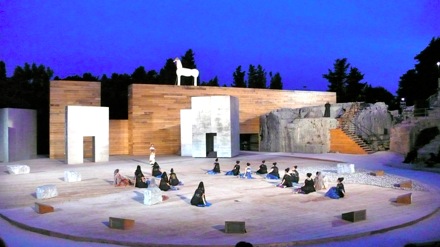
    The photos remind me of the considerable force of the production, first simply visually, second emotionally. The visual production is poised between realism (the dead stags, the costumes, the detail of Phaedra's tablet) and abstraction. It uses the vast scale of the stage to great effect, often putting actors, even at key points in the drama, high on the backdrop, or off in what would be the wings in a conventional theater. The lighting was extraordinarily effective, coming on so subtly at twilight one wasn't aware of it at first; and the constant presence of Nature around and beyond the stage underlined the force Nature plays in Euripides's plot.

    (At the end, while gloating over her moral victory over Aphrodite, Artemis lifts her right arm, pointing to the waxing moon that hung exactly overhead.)

    The acting was passionate; I thought it utterly convincing in portraying noble individuals completely overcome by their passions. In the photographs you see Ilaria Genatiempo as Aphrodite, Elsabetta Pozzi as Phaedra, Guia Jelo as the Nurse, Massimo Nicolini as Hippolytus, Maurizio Donadoni as Theseus. (I find these credits in a review online, the only one I've found so far. Alas it doesn't mention the very able actor who played the Messenger, and I don't have a photo of the fine actress who played Artemis.)

    The play continues to preoccupy me. You know the story: Hippolytus has vowed chastity (and is a vegetarian to boot); Aphrodite, angered by this insult, makes his stepmother Phaedra fall in love with him; she is dying of love and tells her Nurse, who in turn informs Hippolytus, who spurns her; in revenge Phaedra, who kills herself in despair, leaves a suicide note (the tablet) informing her husband Theseus that his son Hippolytus has raped her; Theseus curses his son, who is then attacked by Poseidon, but who lives long enough to forgive his father when Artemis reveals what has happened.

    A tragedy born of a vow to live unnaturally; a physical passion that unseats reason; a father who kills his beloved son but is forgiven — it's all there. Today at lunch I said to Lindsey: but what about Hippolytus. It's just so inescapable, so overwhelming. What about Hippolytus?

    Well, Lindsey said, there's always Jesus. I hadn't thought of it before: Jesus and Hippolytus have a lot in common. (I don't know if Hippolytus ate fish; I suppose he did.) We've seen enough bleeding Jesuses lately, and sorrowing Marys, in this Mediterranean setting, to make us begin to think about the continuity between the pagan and the Christian "explanation" of things. Today we saw, even, a cathedral installed within a Greek temple; you don't get much more literal a continuity than that.

    Photos: Campania, including Caserta, Herculaneum, Amalfi, and Paestum:gallery.me.com/cshere#100239

    Palermo: gallery.me.com/cshere/100241

    Tràpani, Erice, Segesta and environs: gallery.me.com/cshere/100275

    Mozia: gallery.me.com/cshere#100283

    Sicily: south coast: gallery.me.com/cshere/100291

    Syracuse, including the Hippolytus photos: gallery.me.com/cshere#100299

    As always, our meals are recorded at Eating Every Day


    Italian journal, 16: Driving in Europe

    via Eumelo, Siracusa, May 24
    —
    CURTIS REMINDS ME of a few driving-in-Europe stories. My favorite was told by an acquaintance who'd got a job in Rome where he'd be posted a couple of years at least. His wife hated Rome and said she didn't think she could stay. He was terribly upset. After a couple of months the container arrived with their furnishings, books, and other things, including their car.

    She immediately went out for a drive and was gone a few hours. He was afraid she'd left, driven off for France or, more likely, England. At length she came back, though, beaming. I love it here, she said. I love the way they drive here in Rome, it's like being in a boat, everyone goes the same way, when necessary traffic parts, then flows back together again. Now I understand.

    This is exactly what I like about driving in Italy: you always know what's going to happen next, at least in the cities. You never look behind; you only look a little bit alongside, primarily you look forward, and drive ahead into the space that's there, until you've got to where you're going, and then you stop in such a way that people behind you can get around you.

    I think I've only had two little accidents, er, incidents, while driving in Europe. Once, years ago, we were driving through France in a bit of a hurry. A frenchman was right on our tail, never able to pass because there was never enough road ahead to see if anyone was coming. We'd come to a town, slow down, drive through it or rather around it following the toutes directions signs that lead you around the center of town, come out the other side, and continue; he'd still be on my tail.

    Once I decided to gain on him by ignoring the toutes directions and cut right through the center. When I came out, there he was, right behind me.

    Finally he passed me at an intersection in the open country, just when I decided at the last minute to turn left. He clipped my fender and we both stopped and jumped out of our cars. You must be in a hurry, msieu, I said, you're driving pretty fast. Exactly as fast as you, he responded, and you're always in front. No great damage was done; we jumped back in our cars and went our ways.

    The other time was in Spain. I'd stopped at a gas station, realized I was at the diesel pump instead of a gasoline pump, and backed up to the other pump, not realizing someone had pulled in behind me in a brand new Alfa Romeo. I hit the car pretty hard. I jumped out to look: no damage to my car, some dents to the other.

    Oh my god, the woman who was driving the car said in English, my husband is a Spaniard, he's rich, he loves his cars, he'll kill me, I don't know what to do, I'm so sorry about this. Relax, lady, I said, there's not much damage to my car, things like this happen every day, I'm sure it'll all work out. And I continued on to another gas station.

    The main thing about driving in Italy is that you not stop, and you slow down only as much as you really need to. When pedestrians cross, for example, even at zebra crossings, you don't stop for them, instead you drive around them. Pedestrians follow the same rule: they step out into the street, gauge the speed of the oncoming cars and the amount of room the cars have to veer into, and walk briskly forward.

    On the other hand, if you're driving up a narrow street and a car has stopped in front of you to let a passenger off, or readjust the straps holding a mattress to the top of the car, or check something under the hood, or simply to have a conversation with someone walking by, then of course you stop and wait for him to finish whatever he's doing and resume his own journey. After all you're likely to be in the same situation yourself, you wouldn't want anyone getting impatient with you.

    It is true that in the country Italians (and not only Italians, viz. my Frenchman at the intersection) do tend to pass in circumstances Americans think of as risky. If they can't tell whether someone is coming from the other direction, at a hill or a curve for example, they assume there isn't anyone coming from the other direction, and the odds seem to be with them. If they pass without enough distance to cut back into their own lane when traffic is headed for them, three lanes magically and immediately appear where before there were only two.

    On country roads everyone clips curves in order to minimize distance; you can count on it. I adjust to this by keeping well to the right on curves, even if it means down-shifting; it keeps peace in the family.

    Photos: Campania, including Caserta, Herculaneum, Amalfi, and Paestum:gallery.me.com/cshere#100239

    Palermo: gallery.me.com/cshere/100241

    Tràpani, Erice, Segesta and environs: gallery.me.com/cshere/100275

    Mozia: gallery.me.com/cshere#100283

    Sicily: south coast: gallery.me.com/cshere/100291

    As always, our meals are recorded at Eating Every Day


    Sunday, May 23, 2010

    Italian journal, 15: to the theater


    via Eumelo, Siracusa, May 23

    WE LEFT RAGUSA with a little bit of regret. At least I did. The hotel had been comfortable, the technology all worked, I got a great haircut, the meals had been fine, and there hadn't been too many new things to think about. No temples, ruins, museums.

    But you can't stay in one place forever, so we set the GPS to Modica, center of town, because Lindsey wanted to visit a cioccolateria there, and drove readily out of Ragusa, through maquis country, listening to Our Lady of the Dashboard with half an ear as she guided us through roundabouts and back roads.

    At Modica, though, she went a little crazy, directing us down steadily narrowing streets until finally, even with both side-view mirrors tucked in, I was negotiating straightaways with only a couple of inches clearance on each side. Sharp turns were even worse, and you had to look out for stray dogs, old ladies scrubbing doorsteps, wrong turns leading to flights of stairs, and the like. I'd put a fresh shirt on this morning, but it was soon drenched.

    At length, though, the chioccolateria, which proved to be worth it; and a very pretty little theater; and the odd old beige city plastered against its hillside, ugly new apartment buildings rising out of the 18th-century. And then a twenty-minute tour of Frigintini, where we knew there was a restaurant we wanted to try if we could only find it; and conversations with strangers as to where un ristorante da Maria Fidone might be; one guy says left, another says right, and finally there it is, but we can't eat for another hour, so we have to kill time in a small-town café listening to conversations among adolescents with loud voices.

    After lunch Our Lady guided us through more back roads — sometimes I'm not so sure she's as efficient as she might be, but she always knows where she is, and never seems uncertain when giving directions: Turn left. Then turn right. Make a u-turn. Make a sharp right.

    Today's destination was Syracuse, and we had tickets to the theater: Euripides' Hippolytus was being given, in an Italian translation, in the 4th-century (BC) Greek theater in which a number of Aeschylus's plays had been premiered. So the mind got a workout again.

    I thought the play very effective, barring a couple of details easily overlooked (irrelevant score; unfortunate body-mikes). The staging was Robert Wilson-esque, bold, abstract, minimal. Costumes seemed appropriate. The chorus, of women for most of the play, was effective: uniformly (and beautifully) dressed and coiffed, well choreographed, effective singers and, when individuals stepped out for specific lines, effective actors.

    The leads were effective, too: marvelous Phaedra and Nurse; impressive Hippolytus and Theseus; effective Messenger; dominant Aphrodite and Artemis. We've seen Racine's version of the play twice in recent years so the text was well in mind; the Italian translation seemed heightened but not overly so. (I followed along with an English translation of the Italian translation, provided in a handsome libretto; unfortunately the translation, apparently computer-generated, was ludicrous at best.)

    The play lasted a little over two hours without a break, and our attention never wandered. The acting style was formal and histrionic but balanced and consistent; I thought it suited both setting and text. I come away from this text, though, wondering what Euripides had in mind. The story is immensely profound and its truths, it seems to me, hard to deal with. I think Euripides must have been aware of the inadequacy of the conventional apparatus his culture had developed to deal with psychology, sexual attraction, the meaninglessness of death, and the like; and that in plays like Hippolytus he's hoping to prepare his audience for the questioning they too will soon no longer be able to avoid.

    Of course it's particularly though-provoking to see this play, and think about its "meaning," in the context of the last few days with their constant history lessons. We're so programmed, we humans, to think of our own time as being a norm of some kind, and even a constant norm; being reminded of the relatively frequent and sudden historical shifts attested to by these ruins we've wandered, we're that much more aware of the futility of this fallacy. So we're back to work, thinking again. I have to say, it feels good.

    Photos: Campania, including Caserta, Herculaneum, Amalfi, and Paestum:gallery.me.com/cshere#100239

    Palermo: gallery.me.com/cshere/100241

    Tràpani, Erice, Segesta and environs: gallery.me.com/cshere/100275

    Mozia: gallery.me.com/cshere#100283

    Sicily: south coast: gallery.me.com/cshere/100291

    As always, our meals are recorded at Eating Every Day