Sunday, July 24, 2005
Well, of course it’s not that simple...
THE DISCUSSION CONTINUES re. food costs, quality, and quantity.
The issues raised Friday by Julie Powell (see below for web citation) were two: that organic food costs more than many can or want to pay; and that cuisine, both haute and peasant, evolved to make the best of available materials, even when less than ideal.
Let’s concentrate on the first issue, often floated these days in the press. Here too there are two things to consider: the relative cost, to both consumer and society as a whole, of the raw materials of food; and the relative amount we pay these days for our food.
It’s not news that a significantly greater amount of food consumed by today’s typical city-dweller is eaten in restaurants or as “take-out”: this enormously increases the cost of the food consumed. Unfortunately for the clarity of our discussion, much of this cost is hidden, subsidized, or simply ignored -- the direct costs of manufacturing, wrapping, shipping, and preparation; the indirect costs of advertising and marketing; the resultant costs (to society, primarily) relating to medical problems, many of these no doubt yet to be discovered — though the increase in obesity is clearly among them.
The same observations apply to the great increase in the consumption, at home, of food prepared from packaged mixes and the like. Beginning with the end of World War II these “convenience” items have quite changed the daily approach of most citizens of developed societies toward just what constitutes cooking and dining. It has finally resulted, of course, in the rise of a considerable backlash, and the return of cuisine — whether “traditional” or haute — to the household kitchen. But this backlash has yet to reach the mainstream, though its adherents have gained considerable attention — enough, in fact, to precipitate backlashes of their own: witness Powell’s piece in Friday’s New York Times.
Discussion of comparative costs of provender raised sustainably and not, and of conventional and pre-packaged food, generally ignores a larger question more directly important, I think. I have in mind the considerable shift of values represented by the rise of convenience as a factor of daily life. Food used to represent roughly a third of our household budget, shelter another third, everything else bundled into the remainder. This was the case in my parents’s household, and in my own in the 1950s.
In those days a good percentage of households employed one partner at home, preparing food, maintaining shelter and clothing, and supervising the education and well-being of the next generation. The other partner was employed outside the home, winning the money needed to maintain the entire system.
An interesting change in the social system developed in the generations before World War I, when the middle classes gained considerably in numbers. The labor of maintaining the wealthy or upper-class household involved a servant class. This was out of the question for the middle classes, for a number of reasons, and an entire industry evolved to solve the problem. You can follow it in advertisements in old issues of household magazines, not to mention ancient mail-order catalogues: electric lights, toasters, washing machines, vacuum cleaners, mangles all promised to replace expensive and intrusive and, finally, unavailable servants -- and in fact to rescue the middle-class housewife from being a servant herself, her own servant.
After World War II another significant step was taken in this evolution, when Industry promised the housewife she need never again be slave to her kitchen. Frozen food, cake mixes, and ultimately TV dinners were her liberation. At the same time, of course, women in increasing numbers went to work, and in our society the dual-income family has become the norm, necessary because of the increased cost of maintaining this kind of a life.
The costs, both direct and indirect, of this inherently inefficient and (to my way of thinking) over-industrialized urban lifestyle have changed our very perception of something as apparently simple as the cost of food. It's all very well to return to the argument that this discussion is irrelevant to the poor bloke faced with the cost of his radish or his artichoke: clearly the cause and correction of the social shift in food economy is beyond him.
But I think we must consider the injustice of continuing to promise cheap and wholesome life in an increasingly expensive and unwholesome economy, remembering the root meaning of the word “economy”: household management.
All of these problems, in my view, and a good many others (transportation, for instance, and education, and land use...) are interrelated, and have to do with the human animal’s proclivity toward irresponsibility, toward putting cost and labor off on someone else, inferior in social position, or not yet even born, or preferably both. In our present big democratic classless societies the average guy with his supermarket pushcart can’t or won’t think about these things.
It’s that much more important that others of us do, and that we continue this discussion.

Saturday, July 23, 2005
The ethics of organic food
A FEW FRIENDS ASK what I think of an op-ed by Julie Powell in yesterday’s New York Times, “Don't Get Fresh With Me!”.
Not much, really. She makes two points in her column, both of them simplistic; straw men set up as subjects for a newspaper entertainment. One has to do with the economies involved: here her memorable line is “When you wed money to decency, you come perilously close to equating penury with immorality”.
But the organic (or, I would prefer, sustainable) food movement does not wed money to decency. It’s a specious argument that organically or sustainably produced food is more expensive than the product of what has presumptiously come to be called “conventional” agriculture, for at least two reasons.
First, much of the cost of modern chemical- and petroleum-dependent agriculture is simply ignored and deferred — not paid at all (yet), or posted to accounts conveniently kept elsewhere. Second, much of what is invented, produced, sold, and eaten as “food” in today’s society is and has been developed as deliberately expensive alternatives to real food. When by far the majority of the potato crop is bred (or gene-manipulated), raised, harvested, and tooled expressly for potato chips and french-fries, it’s essentially meaningless to compare the cost of organic potatoes in the farmer’s market with giant russets or boilers in the supermarket.
Her other point is more interesting, though less arresting: that cooking is not (and is more than) shopping. But this too is set up with specious reasoning and outlandish generalization:
“For the newer generation, a love for traditional fine cuisine is cast as fussy and snobbish, while spending lots of money is, curiously, considered egalitarian and wise”.
“I object to this equation,” she goes on, and well she might, and so do I — both because it is false, and because it is a rhetorical distraction in her column. Good cuisine will always be a matter of finding the best provender you can and doing the most appropriate thing with it, depending on the cultural context you’re operating in.
It’s an art, like any other: it represents the intersection of material, method, and mores. All else is simply entertainment, and often entertainment whose expense, finally, can no longer be justified.
Not much, really. She makes two points in her column, both of them simplistic; straw men set up as subjects for a newspaper entertainment. One has to do with the economies involved: here her memorable line is “When you wed money to decency, you come perilously close to equating penury with immorality”.
But the organic (or, I would prefer, sustainable) food movement does not wed money to decency. It’s a specious argument that organically or sustainably produced food is more expensive than the product of what has presumptiously come to be called “conventional” agriculture, for at least two reasons.
First, much of the cost of modern chemical- and petroleum-dependent agriculture is simply ignored and deferred — not paid at all (yet), or posted to accounts conveniently kept elsewhere. Second, much of what is invented, produced, sold, and eaten as “food” in today’s society is and has been developed as deliberately expensive alternatives to real food. When by far the majority of the potato crop is bred (or gene-manipulated), raised, harvested, and tooled expressly for potato chips and french-fries, it’s essentially meaningless to compare the cost of organic potatoes in the farmer’s market with giant russets or boilers in the supermarket.
Her other point is more interesting, though less arresting: that cooking is not (and is more than) shopping. But this too is set up with specious reasoning and outlandish generalization:
“For the newer generation, a love for traditional fine cuisine is cast as fussy and snobbish, while spending lots of money is, curiously, considered egalitarian and wise”.
“I object to this equation,” she goes on, and well she might, and so do I — both because it is false, and because it is a rhetorical distraction in her column. Good cuisine will always be a matter of finding the best provender you can and doing the most appropriate thing with it, depending on the cultural context you’re operating in.
It’s an art, like any other: it represents the intersection of material, method, and mores. All else is simply entertainment, and often entertainment whose expense, finally, can no longer be justified.
Two more plays
Ashland, Oregon
TWO MORE PLAYS to report on here from the Oregon Shakespeare Festival. We saw Love’s Labour’s Lost night before last, in the outdoor Elizabethan Theater, not an ideal theater I’ve decided for the performance of Shakespearean comedy, with last year’s As You Like It and the previous year’s Midsummer Night’s Dream in mind: it’s too hard for these aging ears to follow Shakespeare’s delicious lines tumbling about this huge, imposing stagehouse; especially when seated at almost the exact center of the audience, with maximal reverberation from every angle.
Love’s Labour’s Lost was by no means all lost, though. For one thing, it was a visual delight, as every play here this season has been (so far: we have two yet to see, and a third will not open until after we leave). Kenneth Albers, a magnificent Malvolio a couple of nights earlier in Twelfth Night, directed this play, setting it in an unspecified 1920s location while keeping all the original references to Navarre and Brabant and all that; Marjorie Kellogg provided stylish stage furnishings; and Susan Mickey invented costumes so delightful and astonishing they almost upstaged the cast.
Added to this eye feast was the slightly larger than life posturing, prancing, and positioning. Ferdinand and his three lords Berowne, Longaville, and Dumaine (Brent Harris, Jeff Cummings, Jose Luis Sanchez, and Christopher DuVal) were beautifully counterpoised by the French princess and her ladies (Catherine Lynn Davis, Tyler Layton, André Ferraz, Sarah Rutan): when Berowne asks Rosaline Did I not dance with you in Brabant once? he precipitates a verbal gavotte of a banter that typifies the entire play.
The production does perhaps go over the top with John Pribyl’s portrayal of the absurd Spaniard Don Adriano de Armado, assisted by the squeaking spritely Julie Oda as Moth; and by their counterpoise, the pedant Holofernes (played here by the hilarious Eileen DeSandre) and the curate Sir Nathaniel (James Edmondson). Armado is all but impossible to understand, but then he’s a Spaniard; Holorernes ditto, but then (s)he’s talking bad pedantic Latin much of the time.
Once again, Shakespeare represents we uncomprehending audients with clowns and dullards on the stage, Costard, Dull, and Jaquenetta (Ray Porter, Jeffrey King, Jaclyn Williams), and they represent us perfectly, following the action occasionally, understanding it infrequently, enjoying it always.
Then there’s the fascinating role of Boyet, the usher to the Princess — a role recalling Don Alfonso in Così fan tutte. Boyet’s a practical skeptic and a nearly neutral onlooker, the Audience as comprehending if you like, and Derrick Lee Weeden, who is always suave, intelligent, and stylish, was the perfect man for the role.
It’s a wonderful play, beautifully conceived, masterfully directed and produced, and often brilliantly acted, and I’d see it again in a minute. Next time, perhaps, with the infrared listening device.
OSF CONTINUES ITS INVESTIGATION of the important mid-20th century Italian playwright Eduardo De Filippo with his Napoli Milionaria!, a drama with comedy and poignancy set in Naples during World War II. In the first act, in 1942, an extended family gets by on dealings in the black market, in spite of the father's disapproval. After the intermission it is 1944; Naples has been liberated; the father has escaped from a German labor camp to find his wife apparently rich, their squalid apartment made magnificent.
This is a complex play easily approached. A big cast, a detailed set, authentic-looking props, costumes, and gestures propel a vehicle that quickly steers among madness, disease, high comedy, ordinary poignancy, and moral imperatives. Richard Elmore was memorable as the father Gennaro; Linda Alper (a co-translator of the play) as his wife Amalia; the rest of the cast just as solid, idiomatic, pointed, often moving in their keenly balanced roles.
We saw De Filippo’s hilarious Saturday, Sunday, Monday here three years ago (can it be that long?), and Napoli Milionaria! offered an enticing further glimpse of his wit and sympathy, so specific to his beloved Naples but so transferable to our own time and place. We need these plays; I’m grateful to OSF for producing them, and I hope they catch on elsewhere.
Friday, July 22, 2005
Sclerotic
A LITTLE PROBLEM WITH THE EYE puts me in mind of mortality. (Excuse the exaggeration: I’ve been seeing Shakespeare plays.) And then I find, in the to-do pile, this poem, written a few years ago for Carl Rakosi:
SO, Carl, a friend,
another Charles, writes of your impending
birthday — a centennial!
And I’ve dreamed
this morning of Symphony and Book,
thinking there must be something that relates them,
distinguishes them from casual collections,
leverages, as investors use the word,
their Meaning into greater Meaningfulness.
Well, life’s like that.
The life well lived, in interesting times —
no Chinese curse!
Observing, mulling it over,
coming to no conclusions, just collecting.
You do one thing, and then you do another,
The words and lines pile up. Or else they don’t.
With any luck we’ll get it figured out,
or some of it, in time. Or else we won’t.
You say it well:
the larger, perhaps different meaning
these poems have (newly strewn), is to be found,
when it is there,
in the arrangement.
“What will not be found is the coherence
of a composition.”
We aren’t composed.
Like books and symphonies we take our shape
as other eyes and ears encounter us.
Meaning is basic.
I’ve learned from you.
Intention is my biggest enemy,
As you know well!
And with him comes
Remorse,
Intention’s lapdog. Slam the doors on both!
That’s what I think I’ve heard you telling me;
Our Book evolves with us, thinking, feeling,
discarding when it must, or falling silent,
And none of us can tell where it will end.
July 7 2003
Thursday, July 21, 2005
The Hell you say!
Ashland, Oregon
EIGHT OF US STAY in this house for a week, seeing plays. We don’t always see eye to eye, and yesterday was one of those days. We saw two plays: a very new one called Gibraltar in the afternoon, a very old one — well, maybe not all that new — in the evening.
Thing is, many of the objections to the new play could have been lodged against the old one. Narrator kept getting between play and audience. Events seemed contrived. Characters spoke in language not entirely convincing. Playwright seemed concerned with abstractions, not real issues.
And of course it’s not entirely fair to blame Octavio Solis, born in El Paso say forty years ago, for not writing like Christopher Marlowe, born in London say four hundred years earlier. Languages, cultures, milieux, the states of their art — all are immeasurably different. Yet the similarities of their plays invite, nearly demand the comparison.
The Tragical History of Doctor Faustus is of course a cultural icon, precisely because its story centers on a character who stands as a metaphor for a central issue as alive today as it was in the first Elizabeth’s reign — the arrogance of the individual intelligence demanding to pursue knowledge however far it takes him from the ethical, even moral issue of human existence as it grows organically out of its natural context.
The issue is perhaps more meaningful, more dire today than even in Marlowe’s day, when Europe was poised to “discover,” subdue, and exploit a full half of Earth, made available only a lifetime earlier through unimaginable developments in human knowledge and technology.
Marlowe’s genius lay in his lucky opportunity to bring the new flourish of the modern English language — and the metropolitan conventions and resources of London’s theater — to this utterly new situation, at the same time close enough to the religious wars of the Reformation and Counter-Reformation — and the final flowering of medieval alchemy — to weave elements of those immense issues into his narrative.
Solis’s problem lies in the near-impossibility of bring the very similar ingredients of his own heritage — born in El Paso, witness to the culture clashes of Latino and mainstream white American “values,” not to mention the essential triviality of social-status and -class signifiers — to life in a play contrived, essentially, I think, in order to develop a concept: namely, that a significant evening of theater — one with relevance to similarly big cultural issues in a society undergoing similarly critical change and collisions — can be generated out of an ongoing interaction between playwright and actors, with the facilitation of what is arguably the most important repertory theater company in the country.
WE SAW GIBRALTAR in the small “New Theater,” which seats only a couple of hundred people in a very flexible house set, this time, in a very deep three-sided thrust configuration. The set was striking: a loft apartment in San Francisco, with only a double mattress and a couple of chairs to furnish it; at the back a huge window looking across the dark night San Francisco Bay toward the lights of the East Bay hills. On the floor, curving lines making a grid connecting with the mullions of that huge window, which opened like a garage door from time to time to facilitate the intrusion of the next scene.
For Gibraltar is an episodic play, held together by a framing story for two actors: a Latino man following his runaway bride up the sandy coast from Mexico; a Chicana woman mourns the apparently meaningless suicide of her husband. The central issue is rebellion against these meaningless deaths and departures: what might we have done to prevent them.
The narrative is fleshed out by three skits, I would call them, or one-act narratives, a drama prof might say: an aging sculptor and her handsome model (the son of a man she’d not had nerve to commit to years before); a normal-guy cop and his wife-turned-Lesbian; a wildlife journalist caring for a wife with Alzheimer’s irresistibly tempted by the artist he hires to help her through art therapy.
The result is a disappointment, another exercise in What-If. The play could conceivably be saved, be developed into an integrated, fully achieved study in parallel lives, something like that recent movie/book that brought Virginia Woolf’s Mrs. Dalloway into early-21st-century American life, for those unable to accept and enjoy it on its own terms.
But it is terminally frustrated by two flaws. First, instead of showing us a theatrical series of events, it continually gives us someone telling us about them, then only apparently grudgingly illustrating the story with two-dimensional characters.
Second, and more fatally perhaps, the language is banal, overblown, and off-kilter. No one talks as anyone would. A friend said the whole thing sounded translated from the Romanian.
Worst of all, another friend said it was a play that hadn’t needed to be written.
BUT THEN, YESTERDAY EVENING, we took our seats in the Elizabethan Theater for The Tragical History of Doctor Faustus. I admit that given the heat, the lack of sleep, the quantity of food and drink, I dozed off from time to time in the first act — in spite of the brilliant acting, the costumes, the poetry. In Act II, though, there was little chance for sleep. Try as I might I was distracted by the gathering weight of Marlowe’s theater, of James Edmondson’s directing, of Richard Hay’s scenic design, of Robert Peterson’s lighting, of Marie Chiment’s costumes — most of all, of the amazing power, pace, subtlety, and persuasion of Jonathan Haugen’s acting in the title role.
Some friends complained of repetitiousness. I don’t buy that. Marlowe’s pace is not that of the American 21st century, any more than is Bruckner’s. The nearest contemporary American equivalents I can think of, off the top of my head, to Marlowe’s theatrical genius, are Robert Wilson and, before him, Gertrude Stein. There was a moment toward the end of the play when all Hell was breaking loose on stage — quite literally — and Ray Porter, as Mephistophilis, was sitting motionless downstage right, in profile, the left side of his face picked out by a subtle spotlight. You could see one play beyond him, another epitomized by, centered on, that amazing meaningless fascinating inexpressive face.
All my own ego was drawn out of my body; I was beyond sympathy and terror. Marlowe was simply saying WHAT IT IS. When mankind reaches too far beyond his own position within the natural order of things, when he goes beyond what he knows organically and intuitively as you might say, when he dares to reach for things he can only know through artificial technology and the paranatural knowledge those tools reveal to him, he's in deep trouble. Marlowe wrote this, and the entire Oregon Shakespeare Festival had understood it, and relayed it on to us.
I wouldn’t mind seeing this a second time.
EIGHT OF US STAY in this house for a week, seeing plays. We don’t always see eye to eye, and yesterday was one of those days. We saw two plays: a very new one called Gibraltar in the afternoon, a very old one — well, maybe not all that new — in the evening.
Thing is, many of the objections to the new play could have been lodged against the old one. Narrator kept getting between play and audience. Events seemed contrived. Characters spoke in language not entirely convincing. Playwright seemed concerned with abstractions, not real issues.
And of course it’s not entirely fair to blame Octavio Solis, born in El Paso say forty years ago, for not writing like Christopher Marlowe, born in London say four hundred years earlier. Languages, cultures, milieux, the states of their art — all are immeasurably different. Yet the similarities of their plays invite, nearly demand the comparison.
The Tragical History of Doctor Faustus is of course a cultural icon, precisely because its story centers on a character who stands as a metaphor for a central issue as alive today as it was in the first Elizabeth’s reign — the arrogance of the individual intelligence demanding to pursue knowledge however far it takes him from the ethical, even moral issue of human existence as it grows organically out of its natural context.
The issue is perhaps more meaningful, more dire today than even in Marlowe’s day, when Europe was poised to “discover,” subdue, and exploit a full half of Earth, made available only a lifetime earlier through unimaginable developments in human knowledge and technology.
Marlowe’s genius lay in his lucky opportunity to bring the new flourish of the modern English language — and the metropolitan conventions and resources of London’s theater — to this utterly new situation, at the same time close enough to the religious wars of the Reformation and Counter-Reformation — and the final flowering of medieval alchemy — to weave elements of those immense issues into his narrative.
Solis’s problem lies in the near-impossibility of bring the very similar ingredients of his own heritage — born in El Paso, witness to the culture clashes of Latino and mainstream white American “values,” not to mention the essential triviality of social-status and -class signifiers — to life in a play contrived, essentially, I think, in order to develop a concept: namely, that a significant evening of theater — one with relevance to similarly big cultural issues in a society undergoing similarly critical change and collisions — can be generated out of an ongoing interaction between playwright and actors, with the facilitation of what is arguably the most important repertory theater company in the country.
WE SAW GIBRALTAR in the small “New Theater,” which seats only a couple of hundred people in a very flexible house set, this time, in a very deep three-sided thrust configuration. The set was striking: a loft apartment in San Francisco, with only a double mattress and a couple of chairs to furnish it; at the back a huge window looking across the dark night San Francisco Bay toward the lights of the East Bay hills. On the floor, curving lines making a grid connecting with the mullions of that huge window, which opened like a garage door from time to time to facilitate the intrusion of the next scene.
For Gibraltar is an episodic play, held together by a framing story for two actors: a Latino man following his runaway bride up the sandy coast from Mexico; a Chicana woman mourns the apparently meaningless suicide of her husband. The central issue is rebellion against these meaningless deaths and departures: what might we have done to prevent them.
The narrative is fleshed out by three skits, I would call them, or one-act narratives, a drama prof might say: an aging sculptor and her handsome model (the son of a man she’d not had nerve to commit to years before); a normal-guy cop and his wife-turned-Lesbian; a wildlife journalist caring for a wife with Alzheimer’s irresistibly tempted by the artist he hires to help her through art therapy.
The result is a disappointment, another exercise in What-If. The play could conceivably be saved, be developed into an integrated, fully achieved study in parallel lives, something like that recent movie/book that brought Virginia Woolf’s Mrs. Dalloway into early-21st-century American life, for those unable to accept and enjoy it on its own terms.
But it is terminally frustrated by two flaws. First, instead of showing us a theatrical series of events, it continually gives us someone telling us about them, then only apparently grudgingly illustrating the story with two-dimensional characters.
Second, and more fatally perhaps, the language is banal, overblown, and off-kilter. No one talks as anyone would. A friend said the whole thing sounded translated from the Romanian.
Worst of all, another friend said it was a play that hadn’t needed to be written.
BUT THEN, YESTERDAY EVENING, we took our seats in the Elizabethan Theater for The Tragical History of Doctor Faustus. I admit that given the heat, the lack of sleep, the quantity of food and drink, I dozed off from time to time in the first act — in spite of the brilliant acting, the costumes, the poetry. In Act II, though, there was little chance for sleep. Try as I might I was distracted by the gathering weight of Marlowe’s theater, of James Edmondson’s directing, of Richard Hay’s scenic design, of Robert Peterson’s lighting, of Marie Chiment’s costumes — most of all, of the amazing power, pace, subtlety, and persuasion of Jonathan Haugen’s acting in the title role.
Some friends complained of repetitiousness. I don’t buy that. Marlowe’s pace is not that of the American 21st century, any more than is Bruckner’s. The nearest contemporary American equivalents I can think of, off the top of my head, to Marlowe’s theatrical genius, are Robert Wilson and, before him, Gertrude Stein. There was a moment toward the end of the play when all Hell was breaking loose on stage — quite literally — and Ray Porter, as Mephistophilis, was sitting motionless downstage right, in profile, the left side of his face picked out by a subtle spotlight. You could see one play beyond him, another epitomized by, centered on, that amazing meaningless fascinating inexpressive face.
All my own ego was drawn out of my body; I was beyond sympathy and terror. Marlowe was simply saying WHAT IT IS. When mankind reaches too far beyond his own position within the natural order of things, when he goes beyond what he knows organically and intuitively as you might say, when he dares to reach for things he can only know through artificial technology and the paranatural knowledge those tools reveal to him, he's in deep trouble. Marlowe wrote this, and the entire Oregon Shakespeare Festival had understood it, and relayed it on to us.
I wouldn’t mind seeing this a second time.
Wednesday, July 20, 2005
Amusing deluded glove, rayon
Ashland, Oregon
SO BEGINS — not quite — just about my favorite Shakespeare play, which we saw last night. We saw it a little over a year ago, done by the Los Angeles company A Noise Within in their small deep-thrust theater in Glendale: there it was poetic and romantic, the director’s attention concentrating on Shakespeare’s marvelous text.
Here in Ashland in the much larger Elizabethan Theater, open to the night sky and seating a much larger audience confronting a more conventional stage (though lacking curtain and proscenium), Peter Amster’s direction focussed on another aspect, almost an opposite one, of this rich and complex play: its clowning. Linda Morris was a fine, brash, good-hearted Viola, and Robin Nordli — last year’s Hedda Gabler! — was winning if sometimes ditzy as Olivia. But it is when Shakespeare (and Amster) send in the clowns that this production comes completely to life, reaching out into the big audience whose laughter often drowned out the cast.
Oddly, this was set up at the very beginning, when Michael Elich, as Orsino, speaks that marvelous line: If music be the food of love, play on... The line was overstated, loud, round, and slow, amusing Orsino’s attendants as much as the audience. Orsino is a difficult role to play, I think, central to the play, but not promiinently present; engaging, but not always sympathetic; romantic, but rarely convincingly so. If Mozart and da Ponte had made an opera of this play (oh how I wish they had) his role would have gone to the baritone who sings Don Giovanni. Michael Elich played the role here, and very well indeed (helped immensely, as was everyone, by Shigeru Yaji’s costumes), but in this production he directed your attention not to Olivia but to Sir Toby Belch, somewhat his counterpart at Olivia’s end of town. (For this play, like so many of Shakespeare’s, divides its setting into two camps.)
Robert Sicular was Sir Toby, and he elevated what is often an accessory role into a central one. I think Sir Toby stands often for the playwright himself — commenting on the other characters, the action, even referring, especially in this setting, to other plays in the canon. Dost think because thou art virtuous there’ll be no more cakes and ale? In which case Sir Andrew Aguecheek, wonderfully idiotic in Christopher DuVal’s performance, is perhaps many of us in the audience, standing on uncomprehendingly, blankly repeating bits of text back when spoken to, bumbling in foreign French, giving up, hiding from the constant onslaught of wit and repartee, which goes on whether he comprehends or not. And poor put-upon Malvolio, in Kenneth Albers’ rendition (which recalled his recent Lear from time to time), is of course Shakespeare’s satirical portrait of his rival Ben Jonson.
Altogether it’s a production of Twelfth Night to contemplate, consider, and enjoy. Not by any means the definitive production — but can there ever be an exhaustive interpretation of this play?
IN THE AFTERNOON we had seen quite a different play, August Wilson’s Ma Rainey’s Black Bottom. Perhaps you know the argument: four musicians gather in a 1920s recording studio in Chicago, where they will back a blues singer, Ma Rainey. She’s late, held up by a traffic incident that’s escalated into a minor skirmish in the constantly present race war. Cracker recording engineer, Jewish agent, imperious blues diva, Amos and Andy trombonist and bassist, cynical and self-educated pianist. Most of all, Levee, the young trumpeter whose own music is in the future, as definitively as his hatreds have been formed by the violent incidents of his past.
Timothy Bond’s direction was marvelously taut, linear, detailed, and his cast perfectly assembled. I’ll refer you to the program for all the names, but I can’t fail to cite Kevin Kenerly, always memorable here (a brilliant sullen Romeo; a complex, near-pathological kid brother in Topdog/Underdog): his portrayal of Levee was funny, louche, driving, brittle, and finally eruptive. Ma Rainey’s Black Bottom could slide into melodrama: his intelligence, which contains in addition the collective intelligence of the director and the entire cast, sends the play instead into the rank of great tragedy.
SO BEGINS — not quite — just about my favorite Shakespeare play, which we saw last night. We saw it a little over a year ago, done by the Los Angeles company A Noise Within in their small deep-thrust theater in Glendale: there it was poetic and romantic, the director’s attention concentrating on Shakespeare’s marvelous text.
Here in Ashland in the much larger Elizabethan Theater, open to the night sky and seating a much larger audience confronting a more conventional stage (though lacking curtain and proscenium), Peter Amster’s direction focussed on another aspect, almost an opposite one, of this rich and complex play: its clowning. Linda Morris was a fine, brash, good-hearted Viola, and Robin Nordli — last year’s Hedda Gabler! — was winning if sometimes ditzy as Olivia. But it is when Shakespeare (and Amster) send in the clowns that this production comes completely to life, reaching out into the big audience whose laughter often drowned out the cast.
Oddly, this was set up at the very beginning, when Michael Elich, as Orsino, speaks that marvelous line: If music be the food of love, play on... The line was overstated, loud, round, and slow, amusing Orsino’s attendants as much as the audience. Orsino is a difficult role to play, I think, central to the play, but not promiinently present; engaging, but not always sympathetic; romantic, but rarely convincingly so. If Mozart and da Ponte had made an opera of this play (oh how I wish they had) his role would have gone to the baritone who sings Don Giovanni. Michael Elich played the role here, and very well indeed (helped immensely, as was everyone, by Shigeru Yaji’s costumes), but in this production he directed your attention not to Olivia but to Sir Toby Belch, somewhat his counterpart at Olivia’s end of town. (For this play, like so many of Shakespeare’s, divides its setting into two camps.)
Robert Sicular was Sir Toby, and he elevated what is often an accessory role into a central one. I think Sir Toby stands often for the playwright himself — commenting on the other characters, the action, even referring, especially in this setting, to other plays in the canon. Dost think because thou art virtuous there’ll be no more cakes and ale? In which case Sir Andrew Aguecheek, wonderfully idiotic in Christopher DuVal’s performance, is perhaps many of us in the audience, standing on uncomprehendingly, blankly repeating bits of text back when spoken to, bumbling in foreign French, giving up, hiding from the constant onslaught of wit and repartee, which goes on whether he comprehends or not. And poor put-upon Malvolio, in Kenneth Albers’ rendition (which recalled his recent Lear from time to time), is of course Shakespeare’s satirical portrait of his rival Ben Jonson.
Altogether it’s a production of Twelfth Night to contemplate, consider, and enjoy. Not by any means the definitive production — but can there ever be an exhaustive interpretation of this play?
IN THE AFTERNOON we had seen quite a different play, August Wilson’s Ma Rainey’s Black Bottom. Perhaps you know the argument: four musicians gather in a 1920s recording studio in Chicago, where they will back a blues singer, Ma Rainey. She’s late, held up by a traffic incident that’s escalated into a minor skirmish in the constantly present race war. Cracker recording engineer, Jewish agent, imperious blues diva, Amos and Andy trombonist and bassist, cynical and self-educated pianist. Most of all, Levee, the young trumpeter whose own music is in the future, as definitively as his hatreds have been formed by the violent incidents of his past.
Timothy Bond’s direction was marvelously taut, linear, detailed, and his cast perfectly assembled. I’ll refer you to the program for all the names, but I can’t fail to cite Kevin Kenerly, always memorable here (a brilliant sullen Romeo; a complex, near-pathological kid brother in Topdog/Underdog): his portrayal of Levee was funny, louche, driving, brittle, and finally eruptive. Ma Rainey’s Black Bottom could slide into melodrama: his intelligence, which contains in addition the collective intelligence of the director and the entire cast, sends the play instead into the rank of great tragedy.
Tuesday, July 19, 2005
Cannelini, or however you spell it

A can of Italian white beans, a can of good tuna, a red onion sliced thin, a drizzle of olive oil, sage leaves if you remember them. One of the Hundred Great Recipes, and don't forget a glass of Pinot grigio.
Otherwise, it's just been too hot -- 115 degrees yesterday as we drove through Redding! -- and the international news too depressing. A week in Ashland should set things right.
Sunday, July 03, 2005
INDEPENDENCE!
THANKS TO ALL those heroic farmers, tradesmen, bankers, writers, and seamen who fought and argued and thought so passionately to win our independence, two hundred twentynine years ago, from the hated tyrants five thousand miles across the Atlantic.
How sad it is to see our own nation evolved through those two and a quarter centuries to be so like the empire we had to fight to gain our independence.
We watched interviews on the McNeill News Hour, Friday night, with Americans who were very recently fighting in Iraq. They spoke of the insurgents there in the same terms that the Redcoats used to complain of their enemies in the French and Indian War: they wear no uniforms, they strike and disappear back into their undistinguished context.
I don’t know if the News Hour will observe its usual schedule on Monday, that being July 4: if so, you can see that interview in full on that day; if not, perhaps the next. It’s provocative.
ON ANOTHER NOTE, there’s a significant piece in the current issue of Sierra, the magazine of the Sierra Club, in which Jonathan Rowe, director of the Tomales Bay Institute (http://www.earthisland.org/tbi) discusses the concept of the Commons. He writes about “The Common Good.” The idea began in the universal awareness that certain things, because of their transcendant importance to human life, could not be privately owned: at first, notably, pasturage and the spaces needed for publc gathering and communication — “the realm of life that is distinct from both the market and the state and is the shared heritage of us all.”
The concept of private ownership has been extended so far, in recent decades, that the concept of Commons has had to be extended as well: it now includes water, seeds, the atmosphere. In future years I believe the concept will extend to include what is now called “intellectual property,” that is, the universe of human thought, whether creative or analytical, that is necessary to produce both the technology and the wisdom that will be needed to deal with crises, both environmental and political-militaristic, that will otherwise threaten the very continuance of our species.
I recommend this article. As our forebears fought to maintain independence and self-suffiiciency and to protect them from distant imperiialists, our children and grandchildren are likely to find in tecessary to fight to reaffirm basic practical moral positions in the face of imperious profiteers at home. Jonathan Rowe’s article puts this in very clear perspective.
How sad it is to see our own nation evolved through those two and a quarter centuries to be so like the empire we had to fight to gain our independence.
We watched interviews on the McNeill News Hour, Friday night, with Americans who were very recently fighting in Iraq. They spoke of the insurgents there in the same terms that the Redcoats used to complain of their enemies in the French and Indian War: they wear no uniforms, they strike and disappear back into their undistinguished context.
I don’t know if the News Hour will observe its usual schedule on Monday, that being July 4: if so, you can see that interview in full on that day; if not, perhaps the next. It’s provocative.
ON ANOTHER NOTE, there’s a significant piece in the current issue of Sierra, the magazine of the Sierra Club, in which Jonathan Rowe, director of the Tomales Bay Institute (http://www.earthisland.org/tbi) discusses the concept of the Commons. He writes about “The Common Good.” The idea began in the universal awareness that certain things, because of their transcendant importance to human life, could not be privately owned: at first, notably, pasturage and the spaces needed for publc gathering and communication — “the realm of life that is distinct from both the market and the state and is the shared heritage of us all.”
The concept of private ownership has been extended so far, in recent decades, that the concept of Commons has had to be extended as well: it now includes water, seeds, the atmosphere. In future years I believe the concept will extend to include what is now called “intellectual property,” that is, the universe of human thought, whether creative or analytical, that is necessary to produce both the technology and the wisdom that will be needed to deal with crises, both environmental and political-militaristic, that will otherwise threaten the very continuance of our species.
I recommend this article. As our forebears fought to maintain independence and self-suffiiciency and to protect them from distant imperiialists, our children and grandchildren are likely to find in tecessary to fight to reaffirm basic practical moral positions in the face of imperious profiteers at home. Jonathan Rowe’s article puts this in very clear perspective.
Thursday, June 30, 2005
Authentic Argo
A friend sends the draft of a paper on authenticity. It relates to something that’s been preoccupying me for a while; let’s call it Separation Anxiety. I’ve been noticing that increasingly in the last few months; I suppose it’s an inevitable part of aging.
Equanimity is better than anxiety, don’t you think? But maintaining equanimity in the face of approaching death is a difficult matter. (Don’t get me wrong: I don’t think my own death is right around the corner. But all around me there are friends and acquaintances brushing up against it, and it can’t help but be on my mind.)
The human preoccupation with Death — or, more often in our culture, evasion of it — is a logical result of the preoccupation with Individuality. I think this may be a key factor in our puzzlement at the willingness of religious fanatics to die for their various causes. We Americans cannot really comprehend the minds of suicide bombers, as I imagine the ancient Romans must have been perplexed at the complacency of many early Christians as they went to martyrdom (though self-death in battle was, I’m told, part of The Roman Way).
But I digress, as blogs so often do. What I’m thinking about this morning is Authenticity, which has always seemed to me a function of Place. Separation anxiety has to do with losing our place, because we identify with our place — our extended Place, which includes our family and friends, our home and things, our ideas and opinions.
Authenticity has to do with our objectification of Place, our hope, probably sentimental, that an expression of Place can continue even from one generation to the next.
This brings us to Sustainability, which is the gathering of attention and use toward the realization of that hope.
On the social level, now famously global, Sustainability requires heroic political measures. I’ve argued that these measures must begin locally and ripple outward.
And I think the social and political drive toward Sustainability is an outward counterpart to an equally desirable inward drive: toward Equanimity.
Authenticity and sustainability and equanimity are three faces of a single thing, and have to do with equilibrium. There are two constants whose tension defines the public or political neurosis of our time, and the individual separation anxieties bedeviling so many of us. One is the apparently universal human desire for Individuality and with it security. The other is Heraklitus’s famous statement: The only constant is change.
Equanimity, on a personal scale, must have something to do with willingness to modify individuality to accept the inevitability of change. Sustainability, on a political scale, requires a similar discipline when dealing with environmental factors.
The result is authenticity, a human expression of Place as it responds to Change. It occurs to me that the ancient expession of this riddle is Jason’s boat, the Argo, which remains always the same boat though over the years every one of its parts has been replaced.
Equanimity is better than anxiety, don’t you think? But maintaining equanimity in the face of approaching death is a difficult matter. (Don’t get me wrong: I don’t think my own death is right around the corner. But all around me there are friends and acquaintances brushing up against it, and it can’t help but be on my mind.)
The human preoccupation with Death — or, more often in our culture, evasion of it — is a logical result of the preoccupation with Individuality. I think this may be a key factor in our puzzlement at the willingness of religious fanatics to die for their various causes. We Americans cannot really comprehend the minds of suicide bombers, as I imagine the ancient Romans must have been perplexed at the complacency of many early Christians as they went to martyrdom (though self-death in battle was, I’m told, part of The Roman Way).
But I digress, as blogs so often do. What I’m thinking about this morning is Authenticity, which has always seemed to me a function of Place. Separation anxiety has to do with losing our place, because we identify with our place — our extended Place, which includes our family and friends, our home and things, our ideas and opinions.
Authenticity has to do with our objectification of Place, our hope, probably sentimental, that an expression of Place can continue even from one generation to the next.
This brings us to Sustainability, which is the gathering of attention and use toward the realization of that hope.
On the social level, now famously global, Sustainability requires heroic political measures. I’ve argued that these measures must begin locally and ripple outward.
And I think the social and political drive toward Sustainability is an outward counterpart to an equally desirable inward drive: toward Equanimity.
Authenticity and sustainability and equanimity are three faces of a single thing, and have to do with equilibrium. There are two constants whose tension defines the public or political neurosis of our time, and the individual separation anxieties bedeviling so many of us. One is the apparently universal human desire for Individuality and with it security. The other is Heraklitus’s famous statement: The only constant is change.
Equanimity, on a personal scale, must have something to do with willingness to modify individuality to accept the inevitability of change. Sustainability, on a political scale, requires a similar discipline when dealing with environmental factors.
The result is authenticity, a human expression of Place as it responds to Change. It occurs to me that the ancient expession of this riddle is Jason’s boat, the Argo, which remains always the same boat though over the years every one of its parts has been replaced.
Monday, June 27, 2005
Ascraeumque cano...
...Romana per oppida carmen. (Georgics, II, 176)
A dear friend urges me, now that I’ve read Cato and Varro, to turn again to Virgil and the Georgics. I know I have the Slavitt translation around here somewhere... where? Where do the damn books go, the favorite ones, the ones you’d never lend or sell? Hesiod’s Works and Days, and Virgil’s Georgics and Eclogues, both in the Slavett translation... nothing easier to find on the shelf .. I see how big they are, their white spines with the “handwritten” lettering: where the hell are they?
What does turn up, at least, is the C. Day Lewis translation, in the bilingual edition (Doubleday Anchor Original paperback): and when I open it, at random, that’s the line that jumps out at me:
Ascraeumque cano Romana per oppida carmen...
And I see it again on the blackboard where my enthusiastic TA in Latin wrote it out, with the strokes and horseshoes marking long and short syllables, and I remember his excitement at the line, long, long short short longshort /
- - uu - u / u - u u - uu - u
I’ll sing of farm things throughout Rome and her towns and her cities
C. Day, writing twenty years after the end of World War II, says:
How idealistic; how quaint. How very English, recalling Prince Charles’s speech to the assembled farmers and stockbreeders last October at the Slow Food-produced conference of smallholders from around the globe, when he addressed this very topic — though in a tone not quite so optimistic, closer in fact to despair.
Since Lewis wrote those lines industry, agriculture, indeed virtually all of modern civilization has become not rural-urban but urban-global. And if China can think of buying Unocal today, there’s no reason to believe she won’t soon be offering to buy General Foods, Monsanto, Archer Daniels Midland.
Is it just the Berkeleyan in me that thinks the only path of resistance is increased opting-out? I was encouraged a week ago to find, in Wisconsin, vital and apparently healthy producers of sustainably raised, chemical-free (or nearly so), seasonable products of local terroir eagerly sought by thousands of purchasers at Madison’s Sunday morning farm market. But of course this is a very special clientele: educated, discriminating, relatively prosperous. Privileged, in a word.
What must be done next is to extend these “values” beyond that circle: to the young, to the blue-collar, to people of color. I think such action must begin locally, starting in the rich suburban farms near college towns, demonstrating their economic viability, their healthfulness, and the joys of their flavors and fascinations to their own neighbors.
This is happening here in Healdsburg on Saturdays and Tuesdays; in Windsor on Sundays; in Sebastopol also on Sundays. There are farm markets in Santa Rosa and San Rafael and, famously, in San Francisco’s Ferry Building Such optimism can be contagious, I think. But then I’m perhaps as innocent as C. Day Lewis.
And I can’t find those Slavitt translations anywhere. Or my desk glasses either.
A dear friend urges me, now that I’ve read Cato and Varro, to turn again to Virgil and the Georgics. I know I have the Slavitt translation around here somewhere... where? Where do the damn books go, the favorite ones, the ones you’d never lend or sell? Hesiod’s Works and Days, and Virgil’s Georgics and Eclogues, both in the Slavett translation... nothing easier to find on the shelf .. I see how big they are, their white spines with the “handwritten” lettering: where the hell are they?
What does turn up, at least, is the C. Day Lewis translation, in the bilingual edition (Doubleday Anchor Original paperback): and when I open it, at random, that’s the line that jumps out at me:
Ascraeumque cano Romana per oppida carmen...
And I see it again on the blackboard where my enthusiastic TA in Latin wrote it out, with the strokes and horseshoes marking long and short syllables, and I remember his excitement at the line, long, long short short longshort /
- - uu - u / u - u u - uu - u
I’ll sing of farm things throughout Rome and her towns and her cities
C. Day, writing twenty years after the end of World War II, says:
The fascination of the Georgics for many generations of Englishmen is not difficult to explain. A century of urban civilization has not yet materially modified the instinct of a people once devoted to agriculture and stockbreeding, to the chase, to landscape gardening, to a practical love of Nature... It may, indeed, happen that this war, together with the spread of electrical power, will result in a decentralization of industry and the establishment of a new rural-urban civilization working through smaller social units. The factory in the fields need not remain a dream of poets and planners: it has more to commend it than the allotment in the slums.
How idealistic; how quaint. How very English, recalling Prince Charles’s speech to the assembled farmers and stockbreeders last October at the Slow Food-produced conference of smallholders from around the globe, when he addressed this very topic — though in a tone not quite so optimistic, closer in fact to despair.
Since Lewis wrote those lines industry, agriculture, indeed virtually all of modern civilization has become not rural-urban but urban-global. And if China can think of buying Unocal today, there’s no reason to believe she won’t soon be offering to buy General Foods, Monsanto, Archer Daniels Midland.
Is it just the Berkeleyan in me that thinks the only path of resistance is increased opting-out? I was encouraged a week ago to find, in Wisconsin, vital and apparently healthy producers of sustainably raised, chemical-free (or nearly so), seasonable products of local terroir eagerly sought by thousands of purchasers at Madison’s Sunday morning farm market. But of course this is a very special clientele: educated, discriminating, relatively prosperous. Privileged, in a word.
What must be done next is to extend these “values” beyond that circle: to the young, to the blue-collar, to people of color. I think such action must begin locally, starting in the rich suburban farms near college towns, demonstrating their economic viability, their healthfulness, and the joys of their flavors and fascinations to their own neighbors.
This is happening here in Healdsburg on Saturdays and Tuesdays; in Windsor on Sundays; in Sebastopol also on Sundays. There are farm markets in Santa Rosa and San Rafael and, famously, in San Francisco’s Ferry Building Such optimism can be contagious, I think. But then I’m perhaps as innocent as C. Day Lewis.
And I can’t find those Slavitt translations anywhere. Or my desk glasses either.
Friday, June 24, 2005
Frank Lloyd Wright Duplexes
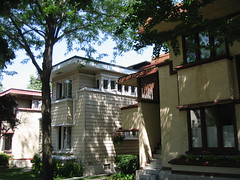
These duplexes, many now needing a little attention, were built in 1916 as low-income housing in what had until then been a celery farm on the outskirts of Milwaukee. Photo: C Shere, June 2005
Thursday, June 23, 2005
Mixed use urbanity
A friend asks me to think about town planning, knowing my enthusiasm for the villages and provincial cities in Holland, where we plan to spend two or three weeks again this fall, walking from one to the next. He lives in Healdsburg, and like us is concerned about the changes there.
He suggested I blog about town planning, and that I use last week’s trip to Chicago and Wisconsin as a sort of trial run. It didn’t work out quite that way, as you’ll have seen. Chicago and Milwaukee have little in common with Healdsburg. They may have things to teach San Francisco and San Jose, but the problems and opportunities of a town of 9,000 are a very different matter.
Still there were urban impressions on this trip that may be worth passing along, especially today, in the wake of what seems to me a truly horrendous decision by the Supreme Court in the New London decision. It’s painful to find Rehnquist, Scalia and Thomas on my side, for a change, but there it is: the “liberals” on the Court ruled that the city of New London may seize houses that have been occupied by a family for generations, pay the occupants market value, and turn the property over to private developers, because the resulting hotels, shops, and offices will contribute to “the public good.”
Milwaukee has been busy turning its Third Ward — sixteen or twenty blocks of crumbling brick warehouses, often of strikingly handsome design, built as much as 120 years ago — into a gentrified area of restaurants, art galleries, offices, and upscale shops. We had dinner at Coquette Cafe there Tuesday night, and while the sauce espagnole on my steak was a tad burned, I wouldn’t mind eating there again. After dinner we strolled a few blocks in the balmy romantic urban night, and the ambiance was delightful, though there were few other strollers to be seen.
The development here is much like that in Portland (Oregon)’s Pearl District, if smaller and so far lacking the residential component that would make it much livelier at night. And I suppose it’s much like what New London has in mind. I’m glad to see the old buildings saved and turned to good use, and I’m glad to see residential use folded into what was formerly a blight on the margin of the urban center.
This is Mixed Use at its best, and Mixed Use has become a mantra of contemporary urban planning. Mixed Use is in the air here in Healdsburg, even, and well it might be. I have nothing but good things to say about it.
But salutary as it is in its efficient and conservational address to the city, or the village — I find I can no longer use the word “conservative” in its true sense — Mixed Use does not address a fundamental problem in towns and cities of every size: the accelerating polarization of American society between the poor and the prosperous. There seems to be no place, any longer, for the materially poor. We don’t want to see them.
We don’t want to recognize their existence, perhaps because they remind us of a terrible failure of the last fifty years of relative national prosperity — bought at the price of caring for those who haven’t been able, for one or another of a million reasons, to participate in that prosperity.
In Milwaukee we were fascinated to see a block of pre-fabricated duplexes designed by Frank Lloyd Wright and built in 1916 and ’17. They’re in pretty sad shape at the moment, and a couple have succumbed to misguided re-sheathing since — shiplap siding over previous asbestos shingle in one case. But one, at least, is slowly being restored to its previous appearance, and even improved, I suppose, by being turned into a single-use residence.
We struck up a conversation with a young couple who lived downstairs in one of these duplexes. I asked about their history, and was told that in 1916 this area had been truck farms: a celery garden had given way to this series of apartments.
Wright designed units for low-income families at the same time that he built the impressive Bogk House, across town in an elite neighborhood, for a prominent local politician. Who is doing that today?
And why can’t New London’s developers build their malls and office complexes around the eight or ten houses whose owners simply want to finish out their days in the homes they’ve known all their lives? Surely they could be put in good shape, landscaped if necessary, and allowed to stand as a bit of history, an example of the kind of comfort and domesticity that can be achieved without needing three thousand square feet and a quarter acre of lawn.
It wouldn’t be a bad example, seems to me.
He suggested I blog about town planning, and that I use last week’s trip to Chicago and Wisconsin as a sort of trial run. It didn’t work out quite that way, as you’ll have seen. Chicago and Milwaukee have little in common with Healdsburg. They may have things to teach San Francisco and San Jose, but the problems and opportunities of a town of 9,000 are a very different matter.
Still there were urban impressions on this trip that may be worth passing along, especially today, in the wake of what seems to me a truly horrendous decision by the Supreme Court in the New London decision. It’s painful to find Rehnquist, Scalia and Thomas on my side, for a change, but there it is: the “liberals” on the Court ruled that the city of New London may seize houses that have been occupied by a family for generations, pay the occupants market value, and turn the property over to private developers, because the resulting hotels, shops, and offices will contribute to “the public good.”
Milwaukee has been busy turning its Third Ward — sixteen or twenty blocks of crumbling brick warehouses, often of strikingly handsome design, built as much as 120 years ago — into a gentrified area of restaurants, art galleries, offices, and upscale shops. We had dinner at Coquette Cafe there Tuesday night, and while the sauce espagnole on my steak was a tad burned, I wouldn’t mind eating there again. After dinner we strolled a few blocks in the balmy romantic urban night, and the ambiance was delightful, though there were few other strollers to be seen.
The development here is much like that in Portland (Oregon)’s Pearl District, if smaller and so far lacking the residential component that would make it much livelier at night. And I suppose it’s much like what New London has in mind. I’m glad to see the old buildings saved and turned to good use, and I’m glad to see residential use folded into what was formerly a blight on the margin of the urban center.
This is Mixed Use at its best, and Mixed Use has become a mantra of contemporary urban planning. Mixed Use is in the air here in Healdsburg, even, and well it might be. I have nothing but good things to say about it.
But salutary as it is in its efficient and conservational address to the city, or the village — I find I can no longer use the word “conservative” in its true sense — Mixed Use does not address a fundamental problem in towns and cities of every size: the accelerating polarization of American society between the poor and the prosperous. There seems to be no place, any longer, for the materially poor. We don’t want to see them.
We don’t want to recognize their existence, perhaps because they remind us of a terrible failure of the last fifty years of relative national prosperity — bought at the price of caring for those who haven’t been able, for one or another of a million reasons, to participate in that prosperity.
In Milwaukee we were fascinated to see a block of pre-fabricated duplexes designed by Frank Lloyd Wright and built in 1916 and ’17. They’re in pretty sad shape at the moment, and a couple have succumbed to misguided re-sheathing since — shiplap siding over previous asbestos shingle in one case. But one, at least, is slowly being restored to its previous appearance, and even improved, I suppose, by being turned into a single-use residence.
We struck up a conversation with a young couple who lived downstairs in one of these duplexes. I asked about their history, and was told that in 1916 this area had been truck farms: a celery garden had given way to this series of apartments.
Wright designed units for low-income families at the same time that he built the impressive Bogk House, across town in an elite neighborhood, for a prominent local politician. Who is doing that today?
And why can’t New London’s developers build their malls and office complexes around the eight or ten houses whose owners simply want to finish out their days in the homes they’ve known all their lives? Surely they could be put in good shape, landscaped if necessary, and allowed to stand as a bit of history, an example of the kind of comfort and domesticity that can be achieved without needing three thousand square feet and a quarter acre of lawn.
It wouldn’t be a bad example, seems to me.
Wisconsin architecture, 1
(Posted hurriedly. Maybe tomorrow or Saturday I’ll be able to finish this, and add some photos.)
Here’s the architecture we’ve looked at on the trip:
•Monona Terrace, Madison: perhaps Frank Lloyd Wright's last public design, this is a convention center and parking lot complex perched above Lake Monona, linking that beautiful lake with the equally beautiful capitol building that sits high above the isthmus separating Lakes Monona and Mendota. In Wright's late style, the building recalls the Marin Civic Center: Wright clearly was intent on his architecture mediating urban humanity with the natural environment.
In Marin County the form of his Civic center replicates the gentle dome-shaped hills, bridging between two of them; and his colors refer to the golden fields of summer and autumn and the clear blue sky. In Madison he layers the parking structure, the convention center, and the rooftop "garden" in terraces, referring now to the isthmus itself; and a broad terrace-mall links the streets in front of the Capitol to the Terrace. It's a striking and, I think, fitting adjunct to the Capitol itself, again mediating between conventional (but superb) Beaux-arts Federal style and his own idiosyncratic Modernism.
•Ely Place, Madison: This is an upscale residential quarter atop a hill overlooking the Madison campus and out onto Lake Mendota. We parked at the one Wright house here, got out, photographed and admired it; and then struck up a conversation with a woman out gardening in front of her house next door. Her house was also a beauty, also landmarked; and she went inside to find a brochure describing a walking tour of the area, and lent it to us so we could walk for half an hour admiring the homes built in the first twenty years of the 20th century for the early faculty of the university.
Near here, too, we saw a splendid big shingle house, dark under wide eaves and eccentric, elaborately projecting lookout beams: one of the very few residences designed by Louis Sullivan. This was built for a private owner, subsequently bought by a college fraternity, badly burned a decade or so ago, and very nicely restored. It is vaguely reminiscent of such Greene & Greene buildings as the Gamble House in Pasadena, but more eccentric and more visionary.
•Farmers and Merchants Bank, Columbus: an hour or so north of Madison the small farm-county seat of Columbus hosts one of Sullivan's eccentric bank designs, reminders of a time when the small-town bank took seriously its role of community idealist in substance. This was Sullivan's last such building, and he called it his "jewel box," and so it is -- a small twostorey brick building sitting at the northeast corner of a main intersection, across from a vaguely Gothic Victorian City Hall built in 1892.
An annex was built next to this bank a few decades ago, to my eye a fairly sympathetic one; but it's scheduled for demolition soon, to be replaced by another, supposed to be equally sensitive to the significance of the original Sullivan building on the corner. The entire block, both sides of the street, is handsome and (except for the annex-in-progress) all of its period. (One storefront houses an amazing collection of horse-drawn vehicles: coaches, gigs, buckboards, delivery vans, and sleighs, all as bright and spiffy as new.)
•Wausau, Wisconsin: Two buildings here: a fine, late, low, flat house with Japanese shoji influence, built as a private residence overlooking the artificial lake on the Wisconsin River south of town, now occupied by a broadcast media company; and a marvelous private house in an upscale residential neighborhood on a forested hilltop at the other end of town. We were in Wausau on a Sunday; the radio offices were closed and no one was about, so we walked around the building, peering through the windows, taking photos, and marvelling at the casual lack of "security" -- this would not be the case, I think, in California.
We were content to admire the private home from the sidewalk, listening to a pair of Scotties yapping at us -- friendly, their mistress assured us from her patio chaise-longue. This house might have been in the redwoods south (or north) of San Francisco, or the eucalyptus in the Berkeley Hills.
•Fox Point, Milwaukee: another long, low, elegant private residence, this one on a vast lawn on a shady road in an exclusive suburb north of the city and on the lake. The broad driveway led between low concrete-block walls with signature glass-block lanterns built into them on either side the drive, which made a dog-leg around a planting of trees screening a tennis court from the street. We couldn't get closer than say two hundred feet of the house, but could readily admire its low, Japanese-influenced form. It's amazing how similar these houses are to all those Sunset Magazine shake-roof ranch bungalows of the 1950s, and how different -- owing simply to Wright's sense of proportion, and the unity he imposes through decorative treatment and plays of symmetry and slight asymmetry, and his careful sense of scale.
•Milwaukee Art Museum: This building perched at the edge of Lake Michigan recalls, through its site, Frank Lloyd Wright's Monona Terrace in Madison. It too stands white and bold against the blue waters and sky; but its design is very different. There are in fact two equally fine buildings here, the older one by Eero Saarinen, boxy but wonderfully proportioned and ideal for its purpose: the exhibition of art. (And the collection is something to boast.)
Five years ago, in 2000, this was enlarged by the construction of an equal-sized hall designed by Santiago Calatrava, the Spanish architect. This is splendid enough inside, but particularly dazzling from the outside, topped by a symmetrical "brise-soleil" or sunshade, two enormous wings which close at the beginning of the day to shade the interior, then open at the end of day, like some fantastic bird methodically opening and closing its wings on a diurnal rhythm.
The building is linked to a plaza by an elevated stay-cable pedestrian bridge spanning a crosswise-oriented lawn and fountain, and it's hard not to imagine Calatrava's delight when he replicated this trick in the recently built pedestrian bridge in Redding, spanning the Sacramento River.
•The Blogk House, Milwaukee: One of the earliest of Wright's masonry residences, a big, vaguely Mayan, twostorey cube of a thing, with a low hip roof whose projecting eaves proclaim Prairie Style but whose vertical slits of windows look forward to the Imperial Hotel he would design a few years later for Tokyo. This sits among other fine if architecturally less emboldened neighbors: across the street there's an interesting Italianate Dutch-Colonial home, of all things, that manages to combine its loggias and its bell gables with a degree of integrity.
Here’s the architecture we’ve looked at on the trip:
•Monona Terrace, Madison: perhaps Frank Lloyd Wright's last public design, this is a convention center and parking lot complex perched above Lake Monona, linking that beautiful lake with the equally beautiful capitol building that sits high above the isthmus separating Lakes Monona and Mendota. In Wright's late style, the building recalls the Marin Civic Center: Wright clearly was intent on his architecture mediating urban humanity with the natural environment.
In Marin County the form of his Civic center replicates the gentle dome-shaped hills, bridging between two of them; and his colors refer to the golden fields of summer and autumn and the clear blue sky. In Madison he layers the parking structure, the convention center, and the rooftop "garden" in terraces, referring now to the isthmus itself; and a broad terrace-mall links the streets in front of the Capitol to the Terrace. It's a striking and, I think, fitting adjunct to the Capitol itself, again mediating between conventional (but superb) Beaux-arts Federal style and his own idiosyncratic Modernism.
•Ely Place, Madison: This is an upscale residential quarter atop a hill overlooking the Madison campus and out onto Lake Mendota. We parked at the one Wright house here, got out, photographed and admired it; and then struck up a conversation with a woman out gardening in front of her house next door. Her house was also a beauty, also landmarked; and she went inside to find a brochure describing a walking tour of the area, and lent it to us so we could walk for half an hour admiring the homes built in the first twenty years of the 20th century for the early faculty of the university.
Near here, too, we saw a splendid big shingle house, dark under wide eaves and eccentric, elaborately projecting lookout beams: one of the very few residences designed by Louis Sullivan. This was built for a private owner, subsequently bought by a college fraternity, badly burned a decade or so ago, and very nicely restored. It is vaguely reminiscent of such Greene & Greene buildings as the Gamble House in Pasadena, but more eccentric and more visionary.
•Farmers and Merchants Bank, Columbus: an hour or so north of Madison the small farm-county seat of Columbus hosts one of Sullivan's eccentric bank designs, reminders of a time when the small-town bank took seriously its role of community idealist in substance. This was Sullivan's last such building, and he called it his "jewel box," and so it is -- a small twostorey brick building sitting at the northeast corner of a main intersection, across from a vaguely Gothic Victorian City Hall built in 1892.
An annex was built next to this bank a few decades ago, to my eye a fairly sympathetic one; but it's scheduled for demolition soon, to be replaced by another, supposed to be equally sensitive to the significance of the original Sullivan building on the corner. The entire block, both sides of the street, is handsome and (except for the annex-in-progress) all of its period. (One storefront houses an amazing collection of horse-drawn vehicles: coaches, gigs, buckboards, delivery vans, and sleighs, all as bright and spiffy as new.)
•Wausau, Wisconsin: Two buildings here: a fine, late, low, flat house with Japanese shoji influence, built as a private residence overlooking the artificial lake on the Wisconsin River south of town, now occupied by a broadcast media company; and a marvelous private house in an upscale residential neighborhood on a forested hilltop at the other end of town. We were in Wausau on a Sunday; the radio offices were closed and no one was about, so we walked around the building, peering through the windows, taking photos, and marvelling at the casual lack of "security" -- this would not be the case, I think, in California.
We were content to admire the private home from the sidewalk, listening to a pair of Scotties yapping at us -- friendly, their mistress assured us from her patio chaise-longue. This house might have been in the redwoods south (or north) of San Francisco, or the eucalyptus in the Berkeley Hills.
•Fox Point, Milwaukee: another long, low, elegant private residence, this one on a vast lawn on a shady road in an exclusive suburb north of the city and on the lake. The broad driveway led between low concrete-block walls with signature glass-block lanterns built into them on either side the drive, which made a dog-leg around a planting of trees screening a tennis court from the street. We couldn't get closer than say two hundred feet of the house, but could readily admire its low, Japanese-influenced form. It's amazing how similar these houses are to all those Sunset Magazine shake-roof ranch bungalows of the 1950s, and how different -- owing simply to Wright's sense of proportion, and the unity he imposes through decorative treatment and plays of symmetry and slight asymmetry, and his careful sense of scale.
•Milwaukee Art Museum: This building perched at the edge of Lake Michigan recalls, through its site, Frank Lloyd Wright's Monona Terrace in Madison. It too stands white and bold against the blue waters and sky; but its design is very different. There are in fact two equally fine buildings here, the older one by Eero Saarinen, boxy but wonderfully proportioned and ideal for its purpose: the exhibition of art. (And the collection is something to boast.)
Five years ago, in 2000, this was enlarged by the construction of an equal-sized hall designed by Santiago Calatrava, the Spanish architect. This is splendid enough inside, but particularly dazzling from the outside, topped by a symmetrical "brise-soleil" or sunshade, two enormous wings which close at the beginning of the day to shade the interior, then open at the end of day, like some fantastic bird methodically opening and closing its wings on a diurnal rhythm.
The building is linked to a plaza by an elevated stay-cable pedestrian bridge spanning a crosswise-oriented lawn and fountain, and it's hard not to imagine Calatrava's delight when he replicated this trick in the recently built pedestrian bridge in Redding, spanning the Sacramento River.
•The Blogk House, Milwaukee: One of the earliest of Wright's masonry residences, a big, vaguely Mayan, twostorey cube of a thing, with a low hip roof whose projecting eaves proclaim Prairie Style but whose vertical slits of windows look forward to the Imperial Hotel he would design a few years later for Tokyo. This sits among other fine if architecturally less emboldened neighbors: across the street there's an interesting Italianate Dutch-Colonial home, of all things, that manages to combine its loggias and its bell gables with a degree of integrity.
Tuesday, June 21, 2005
Downing street in the internet cafe
It's funny: the cheaper the motel, the more likely to find free high-speed Internet access. Here in Milwaukee we're at a Hyatt, and the wi-fi costs ten bucks a day, so I said the hell with it.
This morning we're at the very fine Stone Creeek Cafe down on East Wisconsin St., where you park on the street at a meter for two hours and have a decent latte (and a power pastry, we all need power), and I finally get a little mail.
Much of the political stuff centers on the Downing Street Memo, and P. sends two stories that seem really important to me. The first concerns the recent meeting of the House Judiciary Committee, whose Democrats are apparently considering a Resolution of Inquiry. Don't get too excited, but that could be the first step in a pre-impeachment hearing. Wouldn't that be nice?
Steve Cobble writes about this at The Nation: Opinion
But an even more important link takes you to an article in The (online) Nation about the Washington Post's handling of this emerging story. It shows the Democratic congressmen still have some spunk: The Nation: report on Washington Post story
Speaking of the media, crucial reporting, and truth, Robert Parry has a provocative column on AfterDowningStreet.org which not only suggests what the Left needs to do to correct the sad state of press coverage of the Iraq war and its inception, but also analyzes clearly and efficiently the reasons for the present largely Rightist tilt of the mainstream media. It's worth reading.
I've been meaning to mention, too, a Washington Spectator column that ran a while back. (At the website you'll have to dig a little to find the original report; I left our hard copy back in the hotel.)
It's fascinating: it covers the panel of luminaries, including Jimmy Carter, James Baker, and Tom Daschle, into voting irregularities in Florida, Iowa, and Ohio, resulting in discrepancies between exit polls and the official count. Why is this interesting? Because they're just like the discrepancies that were discovered in the Ukraine and in Georgia, where election outcomes had to be reversed.
(Of course this raises, or "begs" as American English is beginning to say, a question: If a president is unseated because it's proved his election was fraudulent, what happens to the officers he appointed while in office?)
This morning we're at the very fine Stone Creeek Cafe down on East Wisconsin St., where you park on the street at a meter for two hours and have a decent latte (and a power pastry, we all need power), and I finally get a little mail.
Much of the political stuff centers on the Downing Street Memo, and P. sends two stories that seem really important to me. The first concerns the recent meeting of the House Judiciary Committee, whose Democrats are apparently considering a Resolution of Inquiry. Don't get too excited, but that could be the first step in a pre-impeachment hearing. Wouldn't that be nice?
Steve Cobble writes about this at The Nation: Opinion
But an even more important link takes you to an article in The (online) Nation about the Washington Post's handling of this emerging story. It shows the Democratic congressmen still have some spunk: The Nation: report on Washington Post story
Speaking of the media, crucial reporting, and truth, Robert Parry has a provocative column on AfterDowningStreet.org which not only suggests what the Left needs to do to correct the sad state of press coverage of the Iraq war and its inception, but also analyzes clearly and efficiently the reasons for the present largely Rightist tilt of the mainstream media. It's worth reading.
I've been meaning to mention, too, a Washington Spectator column that ran a while back. (At the website you'll have to dig a little to find the original report; I left our hard copy back in the hotel.)
It's fascinating: it covers the panel of luminaries, including Jimmy Carter, James Baker, and Tom Daschle, into voting irregularities in Florida, Iowa, and Ohio, resulting in discrepancies between exit polls and the official count. Why is this interesting? Because they're just like the discrepancies that were discovered in the Ukraine and in Georgia, where election outcomes had to be reversed.
(Of course this raises, or "begs" as American English is beginning to say, a question: If a president is unseated because it's proved his election was fraudulent, what happens to the officers he appointed while in office?)
Sunday, June 19, 2005
Barista at l'Etoile
This is the barista at the cafe-bakery at l'Etoile in Madison, pouring as good a head of foam as I've seen recently.
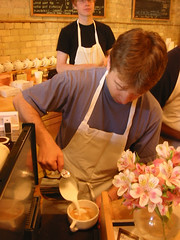
Friendly people
That's what they say you find here in Wisconsin, friendly people. And we have, and do.
Yesterday morning the bakery-cafe at l'Etoile, in Madison, had a good-sized line trailing out the door. The farm market was on, ringing the capitol building across the street, and I'd guess there were thousands of shoppers milling around. Some of them were bound to want the same coffee and croissants as us.
In line we struck up a conversation with a local woman, who was our first source for the information about Odessa Piper's recent sale of the restaurant to her chef Tory (see entry below). The line moved forward, bringing me to the barista at the espresso machine. I struck up a conversation with him, watching him pour a perfect heart shape into the head of a cappuccino. (That's his photo, just above this entry.) I told him about Starbuck's reported revision of foamed milk on cappuccinos. Oh, he said, well, there's two ways of doing it, the Starbuck's or California method, and the Italian method. Please, I said, don't equate California with Starbuck's; I'm from California. Oh, I'm sorry, he said, I didn't mean all Californians do it that way, it's just what we call it out here.
We got our lattes and croissants and took a table. At the next table another friendly woman said hello. She turned out to be from Palo Alto, and we kidded back and forth about Stanford and Cal. Lindsey was wearing a bright red dress, but I said that didn't mean she favored Stanford. We talked about kids and grandchildren and l'Etoile and the like, and then we packed up and hit the road for Lindsey's family reunion. I won't write about that; that's family stuff.
This morning we visited Columbus, Wisconsin, to see a building by my favorite architect, Louis Sullivan -- more about him another day. As we were photographing it a car drove up and double-parked. A woman got out to make a deposit in the old-fashioned brass pull-door beside the front door. I complimented her on her bank, and asked if there were a Starbuck's in town, using the word generically. No, she said, we don't have one. She actually apologized; then got in the car, which drove away.
We went on taking a few more photographs, and then the car pulled back up again, from anothe direction, and the driver, a man, rolled down his window. You're looking for a Starbuck's, he said, We don't have one, but there is Julie's Java, across from the train station.
We thanked him and headed for the train station. Julie and her assistant told us about the newspaper situation in Madison, where the conservative morning paper and the liberal evening paper are both published by the same outfit. Then they got started on Starbuck's, and we rehearsed all that all over again. The lattes at Julie's weren't as rich or strong as we generally like, but they had more presence, in a way, than Starbuck's.
And then we hit the trail again, to visit a couple of Frank Lloyd Wright houses further upstate, and visit a cousin and her husband on their dairy farm. And now we're in a Residence Inn in Green Bay, with kitchen, couches, desk, high-speed internet and all that, for sixty bucks. Thanks again, Priceline.
Yesterday morning the bakery-cafe at l'Etoile, in Madison, had a good-sized line trailing out the door. The farm market was on, ringing the capitol building across the street, and I'd guess there were thousands of shoppers milling around. Some of them were bound to want the same coffee and croissants as us.
In line we struck up a conversation with a local woman, who was our first source for the information about Odessa Piper's recent sale of the restaurant to her chef Tory (see entry below). The line moved forward, bringing me to the barista at the espresso machine. I struck up a conversation with him, watching him pour a perfect heart shape into the head of a cappuccino. (That's his photo, just above this entry.) I told him about Starbuck's reported revision of foamed milk on cappuccinos. Oh, he said, well, there's two ways of doing it, the Starbuck's or California method, and the Italian method. Please, I said, don't equate California with Starbuck's; I'm from California. Oh, I'm sorry, he said, I didn't mean all Californians do it that way, it's just what we call it out here.
We got our lattes and croissants and took a table. At the next table another friendly woman said hello. She turned out to be from Palo Alto, and we kidded back and forth about Stanford and Cal. Lindsey was wearing a bright red dress, but I said that didn't mean she favored Stanford. We talked about kids and grandchildren and l'Etoile and the like, and then we packed up and hit the road for Lindsey's family reunion. I won't write about that; that's family stuff.
This morning we visited Columbus, Wisconsin, to see a building by my favorite architect, Louis Sullivan -- more about him another day. As we were photographing it a car drove up and double-parked. A woman got out to make a deposit in the old-fashioned brass pull-door beside the front door. I complimented her on her bank, and asked if there were a Starbuck's in town, using the word generically. No, she said, we don't have one. She actually apologized; then got in the car, which drove away.
We went on taking a few more photographs, and then the car pulled back up again, from anothe direction, and the driver, a man, rolled down his window. You're looking for a Starbuck's, he said, We don't have one, but there is Julie's Java, across from the train station.
We thanked him and headed for the train station. Julie and her assistant told us about the newspaper situation in Madison, where the conservative morning paper and the liberal evening paper are both published by the same outfit. Then they got started on Starbuck's, and we rehearsed all that all over again. The lattes at Julie's weren't as rich or strong as we generally like, but they had more presence, in a way, than Starbuck's.
And then we hit the trail again, to visit a couple of Frank Lloyd Wright houses further upstate, and visit a cousin and her husband on their dairy farm. And now we're in a Residence Inn in Green Bay, with kitchen, couches, desk, high-speed internet and all that, for sixty bucks. Thanks again, Priceline.
Saturday, June 18, 2005
l'Etoile, Madison: still one of the best
Dinner last night at l'Etoile, that first-rate restaurant in Madison, Wisconsin. In fact l'Etoile was the reason for making the sizable detour between Chicago and Fond du Lac, where we're headed.
Odessa Piper started l'Etoile perhaps twenty years ago -- I'm writing this without checking facts, since it's so easy for the interested reader to do his own fact-checking these days (and I'll comment on that separately one of these days) -- inspired, I believe, by Alice Waters and Chez Panisse. There are differences, especially two: l'Etoile is a bit bigger (and has a hard-liquor bar), and it's in Madison, home of a very large university campus, rather as if UC Berkeley, Davis, and Los Angeles were all put in one city, the only city for miles around.
The two restaurants agree on food ethics, buying seasonal produce from local growers and preparing it with intelligence, cultural and historical awareness, and that unique taste that relies on the natural flavor of the raw material. And Odessa Piper, like Alice Waters, has extended this taste to her loyal clientele, who go on to look for it elsewhere, and so the ripples gradually extend.
And by supporting the farmers and gardeners and stockmen and dairy producers in her area Piper gave them a degree of assurance, of hope and perhaps confidence that since their work was appreciated an honored it would ultimately be supported.
Lindsey and I came through this way a couple of years ago -- almost the exact same trip: Chicago; Madison; Detroit. Last night and the night before duplicated a pair of nights in October 2003, when we ate at North Pond in Chicago and l'Etoile. Since then there have been changes at both restaurants, to judge by only these single experiences -- admittedly, not at all a fair basis from which to make a judgment. North Pond seems to have moved further in the direction of complicating its dishes, adding extra flavors as foils against their basic structure, accepting the prevailing taste for overly complex invention. Lindsey's salmon, for example, wild salmon with really nice flavor, poached gently to just the right texture, was oddly garnished with a scatter of shredded Parmesan cheese.
I don't want to overdo this criticism. North Pond is an excellent restaurant. The reception and service, the wine list, the selection of organic and local material -- all that is exemplary, in the tradition of Chez Panisse and l'Etoile. It's just that this one dinner suggested the chef may be losing confidence in the sufficiency of those virtues; may feel -- for all I know, justifiably -- that his clientele wants or needs something beyond them.
L'Etoile has undergone an even more radical change: Odessa Piper has sold the restaurant. But she sold it to Tory Miller, who had been her chef for over two years, and his sister Traci Miller; and it seems clear that he has no intention of compromising either the vision or the execution that had so distinguished her restaurant.
This morning we visited the Madison Farmer's Market, which completely rings the handsome State Capitol at the center of town, on the ridge above the resplendent Frank Lloyd Wright convention center. The market is perhaps awkwardly laid out, forcing shoppers into a tightly packed passeggiata circulating counter-clockwise on the narrow sidewalk around the Capitol. But it is immensely successful, with stands offering produce, bakery items, jams and jellies, honey and beeswax, smoked and frozen meats and fish, all apparently from relatively small local producers, much of it organic. There's Scottish beef and farmed venison, spring onions and asparagus, cut flowers and starter plants, ramps and mushrooms and wild greens, delicious strawberries, early tomatos -- all of it displayed beautifully, abundantly stacked up and moderately priced. It all makes you want to rent a kitchen and get to work.
We breakfasted at l'Etoile's bakery-cafe, on fine croissants slightly salty with their fresh delicious butter, and caffe-lattes whose froth was properly decorated in the Italian style, not dried and powdery in Starbuck's manner. And then we drove northeast through the green green rolling Wisconsin pastures, still thinking of the unforgettable twelve-year-old cheddar we'd had last night at l'Etoile, and could have bought at this morning's market, but which would have gone all oily and sullied in the car in this warm climate.
l'Etoile menu
North Pond menu
Odessa Piper started l'Etoile perhaps twenty years ago -- I'm writing this without checking facts, since it's so easy for the interested reader to do his own fact-checking these days (and I'll comment on that separately one of these days) -- inspired, I believe, by Alice Waters and Chez Panisse. There are differences, especially two: l'Etoile is a bit bigger (and has a hard-liquor bar), and it's in Madison, home of a very large university campus, rather as if UC Berkeley, Davis, and Los Angeles were all put in one city, the only city for miles around.
The two restaurants agree on food ethics, buying seasonal produce from local growers and preparing it with intelligence, cultural and historical awareness, and that unique taste that relies on the natural flavor of the raw material. And Odessa Piper, like Alice Waters, has extended this taste to her loyal clientele, who go on to look for it elsewhere, and so the ripples gradually extend.
And by supporting the farmers and gardeners and stockmen and dairy producers in her area Piper gave them a degree of assurance, of hope and perhaps confidence that since their work was appreciated an honored it would ultimately be supported.
Lindsey and I came through this way a couple of years ago -- almost the exact same trip: Chicago; Madison; Detroit. Last night and the night before duplicated a pair of nights in October 2003, when we ate at North Pond in Chicago and l'Etoile. Since then there have been changes at both restaurants, to judge by only these single experiences -- admittedly, not at all a fair basis from which to make a judgment. North Pond seems to have moved further in the direction of complicating its dishes, adding extra flavors as foils against their basic structure, accepting the prevailing taste for overly complex invention. Lindsey's salmon, for example, wild salmon with really nice flavor, poached gently to just the right texture, was oddly garnished with a scatter of shredded Parmesan cheese.
I don't want to overdo this criticism. North Pond is an excellent restaurant. The reception and service, the wine list, the selection of organic and local material -- all that is exemplary, in the tradition of Chez Panisse and l'Etoile. It's just that this one dinner suggested the chef may be losing confidence in the sufficiency of those virtues; may feel -- for all I know, justifiably -- that his clientele wants or needs something beyond them.
L'Etoile has undergone an even more radical change: Odessa Piper has sold the restaurant. But she sold it to Tory Miller, who had been her chef for over two years, and his sister Traci Miller; and it seems clear that he has no intention of compromising either the vision or the execution that had so distinguished her restaurant.
This morning we visited the Madison Farmer's Market, which completely rings the handsome State Capitol at the center of town, on the ridge above the resplendent Frank Lloyd Wright convention center. The market is perhaps awkwardly laid out, forcing shoppers into a tightly packed passeggiata circulating counter-clockwise on the narrow sidewalk around the Capitol. But it is immensely successful, with stands offering produce, bakery items, jams and jellies, honey and beeswax, smoked and frozen meats and fish, all apparently from relatively small local producers, much of it organic. There's Scottish beef and farmed venison, spring onions and asparagus, cut flowers and starter plants, ramps and mushrooms and wild greens, delicious strawberries, early tomatos -- all of it displayed beautifully, abundantly stacked up and moderately priced. It all makes you want to rent a kitchen and get to work.
We breakfasted at l'Etoile's bakery-cafe, on fine croissants slightly salty with their fresh delicious butter, and caffe-lattes whose froth was properly decorated in the Italian style, not dried and powdery in Starbuck's manner. And then we drove northeast through the green green rolling Wisconsin pastures, still thinking of the unforgettable twelve-year-old cheddar we'd had last night at l'Etoile, and could have bought at this morning's market, but which would have gone all oily and sullied in the car in this warm climate.
Friday, June 17, 2005
Coffee outrage
What is it with Starbuck's, anyway? What is it with "venti" and "grande"? We had breakfast at Starbuck's yesterday, and again today -- the first time I've been in a Starbuck's since February, and then we were in Madrid in a suburb where it seemed to be the only cafe. We had breakfast there because it was right across the street from our hotel, the Tremont, and we thought well, why not, who's going to see us.
Both mornings the orders got scrambled. I think it's partly because of those ridiculous names for the sizes -- no grown man wants to order a "venti" or a "grande." I order "medium" or "tall," and of course they hear "tall" as "small," and so it goes.
Giovanna tells us her favorite neighborhood cafe, the formerly excellent Torrefazione, is being closed. Torrefazione started in Seattle, as did Starbuck's for that matter, but distinguised itself on a number of points. The coffee, to begin with: excellent coffee blended and roasted in the Italian style, which seems to my taste not at all to be the case with Starbuck's.
Then too Torrefazione served their coffees in nice faence crockery imported from Deruta, which gave the eye and the touch as much pleasure as the coffee itself offered the nose and the tongue. And Torrefazione seemed to find Italians to work the machines, or, barring that, training American kids to pay attention to what they were doing.
Starbuck's bought Torrefazione, of course, as they have bought Peet's, and (I think) Seattle's Best. They seem to want to own it all. That would be okay with me, I guess, if they'd respect the differences obtaining among all these cafes. In Giovanna's neighborhood there were Peet's, Starbuck's, and Torrefaziones with a block of one another, and each seemed to find its own clientele. Viva pluralism!
But one morning the beautiful heart-shaped design was not traced on the top of Giovanna's cappuccino -- the baristas had been told to stop doing that, because it proved that the milk had not been foamed dry enough. Never mind that every decent cafe in Italy makes its cappuccinos thus.
Torrefazione had already been made to stop using Deruta. Too expensive, no doubt. And now the cafe is being closed altogether.
It's just another demonstration of what's wrong with globalism, with NAFTA, with international cartels. More LCD, and I don't mean liquid-crystal display: Least Common Denominator. I say, to hell with Starbuck's. I'm not going back.
Both mornings the orders got scrambled. I think it's partly because of those ridiculous names for the sizes -- no grown man wants to order a "venti" or a "grande." I order "medium" or "tall," and of course they hear "tall" as "small," and so it goes.
Giovanna tells us her favorite neighborhood cafe, the formerly excellent Torrefazione, is being closed. Torrefazione started in Seattle, as did Starbuck's for that matter, but distinguised itself on a number of points. The coffee, to begin with: excellent coffee blended and roasted in the Italian style, which seems to my taste not at all to be the case with Starbuck's.
Then too Torrefazione served their coffees in nice faence crockery imported from Deruta, which gave the eye and the touch as much pleasure as the coffee itself offered the nose and the tongue. And Torrefazione seemed to find Italians to work the machines, or, barring that, training American kids to pay attention to what they were doing.
Starbuck's bought Torrefazione, of course, as they have bought Peet's, and (I think) Seattle's Best. They seem to want to own it all. That would be okay with me, I guess, if they'd respect the differences obtaining among all these cafes. In Giovanna's neighborhood there were Peet's, Starbuck's, and Torrefaziones with a block of one another, and each seemed to find its own clientele. Viva pluralism!
But one morning the beautiful heart-shaped design was not traced on the top of Giovanna's cappuccino -- the baristas had been told to stop doing that, because it proved that the milk had not been foamed dry enough. Never mind that every decent cafe in Italy makes its cappuccinos thus.
Torrefazione had already been made to stop using Deruta. Too expensive, no doubt. And now the cafe is being closed altogether.
It's just another demonstration of what's wrong with globalism, with NAFTA, with international cartels. More LCD, and I don't mean liquid-crystal display: Least Common Denominator. I say, to hell with Starbuck's. I'm not going back.
Thursday, June 16, 2005
Another day in Chicago
Two girls playing bassoon duets on Michigan Avenue. I'd never expected to hear bassoon duets serendipitously, but now I think about it, how else would you hear them? Anyway there they were at the corner of Huron, I think it was, and Michigan, playing duets by not Mozart but an only slightly lesser composer (to judge only from this one piece: but of course it may have been the only piece he ever wrote) from about the same time, same place.
Of course I had to stop and listen. When they finished we struck up a conversation. The bassoon was my instrument, I told them, but that was over fifty years ago. I bet I still have some fingerings in hand. I sang the beginning of von Weber's Rondo alla ungarese, and they joined in, both of them.
One is a student at Eastman Conservatory here; the other is a high school student, only sixteen. But they pumped away at their bassoons like professionals, and more than one passerby stopped to listen. We dropped a buck in the open case and walked on up Michigan Avenue.
At the next corner three girls with identical skin color and hairstyles were playing string trios. Well, not only trios: we heard the end of a double violin concerto by Vivaldi, and the beginning of Mozart quartet minus the viola. They were very good indeed, and Yes, their sign said, We are sisters; help us through music school. So another dollar got redistributed.
I like Chicago. I like the youth, the architecture, the energy. I even like disliking the architecture, especially the incredibly ugly Gehry music shell at Millenium Park. We stopped there for a few minutes to listen to the Chicago Symphony rehearse Vaughan Williams's Sea Symphony. I suppose the performers were doing very well, but even when you sit only twenty rows or so from the stage -- as close as they'd let us approach during this rehearsal -- all you hear of course is music coming from loudspeakers.
The shell is at one end of a "pavilion," really an enormous lawn overarched by steel trusses bearing loudspeaker clusters. I imagine twenty thousand people would easily sit on that lawn listening to those loudspeakers: but why? If you want to hear "classical" music from loudspeakers, aren't you better off at home listening to CDs on a system you've chosen for your own taste? And if you want to sit on a lawn with twenty thousand other people, aren't you better off listening to something other than Vaughan Williams?
But of course I may be a grouch. I'm not at the moment: we're just home from dinner at North Pond. There are problems here, and I'll describe them (and, of course, the equally present virtues of the place) later on. It's late, and we leave tomorrow for Madison.
And rain and earthquakes at home. What a strange summer we're having.
Of course I had to stop and listen. When they finished we struck up a conversation. The bassoon was my instrument, I told them, but that was over fifty years ago. I bet I still have some fingerings in hand. I sang the beginning of von Weber's Rondo alla ungarese, and they joined in, both of them.
One is a student at Eastman Conservatory here; the other is a high school student, only sixteen. But they pumped away at their bassoons like professionals, and more than one passerby stopped to listen. We dropped a buck in the open case and walked on up Michigan Avenue.
At the next corner three girls with identical skin color and hairstyles were playing string trios. Well, not only trios: we heard the end of a double violin concerto by Vivaldi, and the beginning of Mozart quartet minus the viola. They were very good indeed, and Yes, their sign said, We are sisters; help us through music school. So another dollar got redistributed.
I like Chicago. I like the youth, the architecture, the energy. I even like disliking the architecture, especially the incredibly ugly Gehry music shell at Millenium Park. We stopped there for a few minutes to listen to the Chicago Symphony rehearse Vaughan Williams's Sea Symphony. I suppose the performers were doing very well, but even when you sit only twenty rows or so from the stage -- as close as they'd let us approach during this rehearsal -- all you hear of course is music coming from loudspeakers.
The shell is at one end of a "pavilion," really an enormous lawn overarched by steel trusses bearing loudspeaker clusters. I imagine twenty thousand people would easily sit on that lawn listening to those loudspeakers: but why? If you want to hear "classical" music from loudspeakers, aren't you better off at home listening to CDs on a system you've chosen for your own taste? And if you want to sit on a lawn with twenty thousand other people, aren't you better off listening to something other than Vaughan Williams?
But of course I may be a grouch. I'm not at the moment: we're just home from dinner at North Pond. There are problems here, and I'll describe them (and, of course, the equally present virtues of the place) later on. It's late, and we leave tomorrow for Madison.
And rain and earthquakes at home. What a strange summer we're having.
Wednesday, June 15, 2005
Meat and Tremont
Woffa woffa woffa, as we sometimes say when we are particularly satisfied, as having just been dealt a nice hand of cards in a game of hearts, or having been brought an unexpectedly pleasing plate of victuals.
What a simple-minded outlook we have on the world, to be sure.
After an unusually slow and ordinary breakfast at the Sheraton Midway we drove into Chicago. I was nursing a regret or two. Specifically: Why on earth did we book an airport motel for one night, and a rental car; and then a downtown Chicago hotel for two more nights? Now we're just going to have to park the car for two days -- no reason to drive in downtown Chicago -- and pay for two days of car rental, and two days of parking. We should have booked this hotel for the three days, and taken the car on Friday when we leave town.
Oh well.
The Tremont, where we are today and tomorrow, turns out to be a very nice hotel. It's called "quaint" in one of our Chicago guides -- a cut above "Romantic," a cut below "Chic." Well, that's us, somewhere between Chic and Romantic.
We spent the afternoon at Wrigley Field. I had trepidations: the Cubs beat the Marlins yesterday fourteen to nothing, and I expected today to be Retribution City. And it was, and I have photos of the scoreboard to prove it: 8-0 in the fourth; 10-0 in the fifth; 12-0 in the sixth; 15-0 in the seventh. But then the Cubs scored five runs, so the final score, while terrible and painful, was not a total disaster.
I was excited as we walked into the park. I like San Francisco's ball park, where we watched the Giants satisfactorily trimmed on Sunday afternoon (and where we saw an amazing lost saved home run when an outfielder's glove lost its webbing, and saw an even more amazing rundown between first and second). But however fine these new backward-looking baseball stadia are they do not compare with the two surviving old-school parks, Fenway in Boston -- okay, I confess, I've never been inside it -- and Wrigley Field here.
You get there by elevated. There's a Dixieland band, wearing Cubs uniforms, playing outside. Inside you walk past appetizing hot-dog stands and peanut vendors and up many ramps and out into a truly beautiful venue, no seat impossibly far from the field. There is no nosebleed "view terrace" here, unless it's on the rooftops across the street.
And wonder of wonder we had marvelous seats behind and slightly to the right of home plate, under the roof in case it rains (but it didn't) but not too far back. I could even believe the batter might actually hear me when I call out the new relief pitcher's ERA to him: don't take any guff from him: he's pitching 6.90 ball. But the Cubs lost anyway.
Dinner tonight at Fogo de Chao, recommended by Friend Who Eats Meat. It's a "churrascaria," specializing in the barbecued meats of southern Brazill -- a theme restaurant with a gimmick, one of a chain (other outlets in Dallas, Houston, Atlanta, Beverly Hills, Ssao Paulo (where there are three installations) and Porto Alegre in their native Brazil).
We had a reservation for nine o'clock -- I bet they simply don't take reservations earlier. The joint was jammed when we got there, and there were a couple of limos standing at the curb, one a good thirty feet long. I strode confidently to the podium and announced Shere. Two. Nine.
The hostess gave me a small pager and a slip of cardboard. Have a drink in the bar with this credit slip; it'll be transferred to your table. We'll page you when the table's ready.
We found stools at a table otherwise occupying three young men -- there was a surfeit of young men in the bar, most of them drinking Millers Lite and talking unnecessarily loud. I bellied up to the bar for two Caipirinhas, the national drink of Brazil, made I think with secondarily-distilled rum, limes, sugar, and lime juice. Julio, you'll correct me on that; you introduced me to this drink last year.
As we sipped them we were approached by a young man who had detached himself from a group at the bar. He seemed a little drunk, very young, quite polite, immensely engaging. What's that you're drinking, he asked. I told him. I told him a second time. We struck up a conversation. He turns out to be working for an accounting firm, keeping corporate America honest. We talked about Social Security, a little bit. He kept looking at our drinks and at Lindsey. I'm Chris, he said after a while. I'm Charles, I answered, and this is Lindsey.
Where are you from, he wanted to know; and, later, What are you doing here? We explained about the Cubs, and Lindsey's family reunion, and San Francisco, and all that. And then I added that this was a bit of a birthday present for Lindsey.
And how old are you, he asked, clearly aware he was pushing things a bit, but genuinely interested, Fifty-two? No, Lindsey said, I'm older than that, I'm seventy.
The poor kid suddenly looked just a little bit drunker, a little less capable of dealing with input. But he was sweet and congratulatory, and I explained that in fact Lindsey was a little unfair, she doesn't really go around looking like she's seventy. At least not to me.
We were paged. At table we were given the drill: go to the buffet, take whatever vegetation you want, when you're ready for meat turn this little disc green side up. We did so, starting with salads -- a phony Caesar for me, good but lacking anchovies and egg. And then we signaled the meat-bringers, and they brought one thing after another, all of them on skewers from the grill, beef and lamb and pork and chicken, tenderloin and flank and sausage. The Caipirinha gave way to a glass or two of Argentine Malbec. It was a lot of fun.
At the next table I noticed Chris was drinking a Caipirinha instead of the Miller's Lite I'd first seen him with. He was laughing and applauding and throwing his hands up into the air. He was having a lot of fun, seated there with three male friends his own age. They were in training, he'd mentioned at the bar, but training for what God only knows.
And we walked the ten or twelve blocks home through the balmy Chicago night, trees silhouetted against the sky, people still on the streets, and I thought how much I enjoy these romantic nocturnal cities, the ones on this scale, streets only a couple of lanes broad, the occasional stone church or vestpocket park or odd Victorian watertower suddenly singing their old, plain, but vibrant song against the iPods and boomboxes.
What a simple-minded outlook we have on the world, to be sure.
After an unusually slow and ordinary breakfast at the Sheraton Midway we drove into Chicago. I was nursing a regret or two. Specifically: Why on earth did we book an airport motel for one night, and a rental car; and then a downtown Chicago hotel for two more nights? Now we're just going to have to park the car for two days -- no reason to drive in downtown Chicago -- and pay for two days of car rental, and two days of parking. We should have booked this hotel for the three days, and taken the car on Friday when we leave town.
Oh well.
The Tremont, where we are today and tomorrow, turns out to be a very nice hotel. It's called "quaint" in one of our Chicago guides -- a cut above "Romantic," a cut below "Chic." Well, that's us, somewhere between Chic and Romantic.
We spent the afternoon at Wrigley Field. I had trepidations: the Cubs beat the Marlins yesterday fourteen to nothing, and I expected today to be Retribution City. And it was, and I have photos of the scoreboard to prove it: 8-0 in the fourth; 10-0 in the fifth; 12-0 in the sixth; 15-0 in the seventh. But then the Cubs scored five runs, so the final score, while terrible and painful, was not a total disaster.
I was excited as we walked into the park. I like San Francisco's ball park, where we watched the Giants satisfactorily trimmed on Sunday afternoon (and where we saw an amazing lost saved home run when an outfielder's glove lost its webbing, and saw an even more amazing rundown between first and second). But however fine these new backward-looking baseball stadia are they do not compare with the two surviving old-school parks, Fenway in Boston -- okay, I confess, I've never been inside it -- and Wrigley Field here.
You get there by elevated. There's a Dixieland band, wearing Cubs uniforms, playing outside. Inside you walk past appetizing hot-dog stands and peanut vendors and up many ramps and out into a truly beautiful venue, no seat impossibly far from the field. There is no nosebleed "view terrace" here, unless it's on the rooftops across the street.
And wonder of wonder we had marvelous seats behind and slightly to the right of home plate, under the roof in case it rains (but it didn't) but not too far back. I could even believe the batter might actually hear me when I call out the new relief pitcher's ERA to him: don't take any guff from him: he's pitching 6.90 ball. But the Cubs lost anyway.
Dinner tonight at Fogo de Chao, recommended by Friend Who Eats Meat. It's a "churrascaria," specializing in the barbecued meats of southern Brazill -- a theme restaurant with a gimmick, one of a chain (other outlets in Dallas, Houston, Atlanta, Beverly Hills, Ssao Paulo (where there are three installations) and Porto Alegre in their native Brazil).
We had a reservation for nine o'clock -- I bet they simply don't take reservations earlier. The joint was jammed when we got there, and there were a couple of limos standing at the curb, one a good thirty feet long. I strode confidently to the podium and announced Shere. Two. Nine.
The hostess gave me a small pager and a slip of cardboard. Have a drink in the bar with this credit slip; it'll be transferred to your table. We'll page you when the table's ready.
We found stools at a table otherwise occupying three young men -- there was a surfeit of young men in the bar, most of them drinking Millers Lite and talking unnecessarily loud. I bellied up to the bar for two Caipirinhas, the national drink of Brazil, made I think with secondarily-distilled rum, limes, sugar, and lime juice. Julio, you'll correct me on that; you introduced me to this drink last year.
As we sipped them we were approached by a young man who had detached himself from a group at the bar. He seemed a little drunk, very young, quite polite, immensely engaging. What's that you're drinking, he asked. I told him. I told him a second time. We struck up a conversation. He turns out to be working for an accounting firm, keeping corporate America honest. We talked about Social Security, a little bit. He kept looking at our drinks and at Lindsey. I'm Chris, he said after a while. I'm Charles, I answered, and this is Lindsey.
Where are you from, he wanted to know; and, later, What are you doing here? We explained about the Cubs, and Lindsey's family reunion, and San Francisco, and all that. And then I added that this was a bit of a birthday present for Lindsey.
And how old are you, he asked, clearly aware he was pushing things a bit, but genuinely interested, Fifty-two? No, Lindsey said, I'm older than that, I'm seventy.
The poor kid suddenly looked just a little bit drunker, a little less capable of dealing with input. But he was sweet and congratulatory, and I explained that in fact Lindsey was a little unfair, she doesn't really go around looking like she's seventy. At least not to me.
We were paged. At table we were given the drill: go to the buffet, take whatever vegetation you want, when you're ready for meat turn this little disc green side up. We did so, starting with salads -- a phony Caesar for me, good but lacking anchovies and egg. And then we signaled the meat-bringers, and they brought one thing after another, all of them on skewers from the grill, beef and lamb and pork and chicken, tenderloin and flank and sausage. The Caipirinha gave way to a glass or two of Argentine Malbec. It was a lot of fun.
At the next table I noticed Chris was drinking a Caipirinha instead of the Miller's Lite I'd first seen him with. He was laughing and applauding and throwing his hands up into the air. He was having a lot of fun, seated there with three male friends his own age. They were in training, he'd mentioned at the bar, but training for what God only knows.
And we walked the ten or twelve blocks home through the balmy Chicago night, trees silhouetted against the sky, people still on the streets, and I thought how much I enjoy these romantic nocturnal cities, the ones on this scale, streets only a couple of lanes broad, the occasional stone church or vestpocket park or odd Victorian watertower suddenly singing their old, plain, but vibrant song against the iPods and boomboxes.
Subscribe to:
Posts (Atom)