Monday, April 27, 2009

Four plays in Ashland

Portland, April 27—

I'VE BEEN REMISS: I should have told you about the plays we saw last week at the Oregon Shakespeare Festival in Ashland. We've been coming here to see the plays for nine years now, and have settled into a two-stage annual visit in order to see the entire season, since some plays run only half the year, others run only during the "summer" season when the outdoor theater is open.

Last week we saw four plays, an interesting, even intriguing group: two concept plays, two tragedies. We saw them, I think, in the best possible order, quite by chance.

The first was a new play, Equivocqtion, by Bill Cain. The nut: William Shakespeare is asked to provide dialogue for a play written by the recently crowned King James on the subject of the Gunpowder Plot — a tricky thing to deal with. One can't lie; neither can one simply write the truth: the answer is to "equivocate" by answering, not the questions raised, but those behind the questions. Along the way we see Shakespeare and four other members of The King's Men work out scenes from plays currently under construction, notably Macbeth and Lear.

There's a lot here to delight seasoned OSF audiences, of course: but Cain goes beyond simple play-about-plays, I think, to write a drama that deals intelligently with the layers and ramifications of his subject. Too many, perhaps; the subplot hinging on Shakespeare's relationship with his daughter Judith is one complication too many, in my book. But the play's insightful and provocative, the direction's inventive and propulsive, and the acting's first-rate. I wouldn't mind seeing it again.

Macbeth, which we saw the following night, was simply one of the finest performances I've seen in a theater. Staged in modern dress but faithful to the script and generally unspecific as to time, the production remains tightly focussed on Shakespeare's language, the emotional power of his drama, and the psychology of his characters. Peter Macon was exceptional in the title role; Robin Goodrin Nordli his equal as Lady Macbeth, and Kevin Kenerly a resourceful, complex Macduff. The scenes with the witches, even the porter's scenes, stayed quite within the serious scope of the play. I can't imagine the play done better.

Then there was Wole Soyinka's Death and the King's Horseman, written in 1975 — truly a great play, whose author detaches himself from his subject to allow a truly tragic circumstance to play itself through. It's easy to see the result as simply a culture clash between Yoruba spiritualism and British colonialism, but it's deeper and more universal than that. When we saw the play, last Thursday afternoon, Peter Macon, who'd played Macbeth stunningly the previous night, was pressed into service as the understudy to the lead role; though partly on book he was magnificent. The play was as detailed and timely as Equivocation and even more resonant, since addressed to a larger issue. In recent seasons OSF has been investigating the dramatic repertory beyond western Europe: this staging proves the vital importance of continuing to do this, as our understanding of both our own repertory and the universal human condition is thus enlarged.

Thursday night we ended this spring's visit to Ashland with, thankfully after three deep and serious plays, a divertissement: Sarah Ruhl's Dead Man's Cell Phone. The play opens with a cell phone ringing insistently in a restaurant; its owner, having just died, does not answer; the one other person in the dining room does; and the play goes on from there. The first act made me think of Wallace Stevens's plays; the second act, of those of Michael McClure. (Incidentally, it's high time McClure's plays were revived, and OSF is a logical company to undertake them.)

I'll write no more about Dead Man's Cell Phone except to say that the physical production is often quite strikingly beautiful, that though addressing poignant aspects of human life it's generally very funny, and that the entire cast, but especially Sarah Agnew and Brett Hinkley, are utterly wonderful. I'd see this production again in a minute.

Saturday, April 11, 2009

3/50

GIOVANNA WRITES a nice blog (as she always does) about an idea new to me, 3/50. The idea is to help the local economy by determining to spend fifty dollars a month total at the three locally-owned shops you'd miss most if they were to close.

it's a nice idea; I plan to put it into effect as soon as I get home. I've already started, in a way; some while ago I solved to buy a book a month at my local bookstore, Levin and Company (306 Center St, Healdsburg, tel. 707-433-1118). Quiet, pleasant, well stocked for a small local store, and ready to order special items.

Two more shops aren't hard to settle on: The Cheese Shop, for sure, and, let's see, why not The Gardener? True, both have websites; both are perhaps "upscale" in terms of both clientele and wares. But I would miss them were they to disappear.

What's the right protocol, though, I wonder, when on the road? I've been to two Starbuck's, I regret to say, in the last two days. I would be writing this in a third, except that Starbuck's closed its outlet in this hotel.

(Illy moved in. Little consolation: Illy is the Starbuck's of Italy.)

We were saddened to see thee number of empty storefronts on Charlottesville's pedestrianized main street the other evening. This may be partly the result of the great amount of construction going on, of course. I hope it wouldn't discourage other such projects. How nice it would be to see pedestrian streets around the Healdsburg square!

Wednesday, April 08, 2009

Washington D.C.

Washington, DC, April 8 2009—

LINDSEY TOOK IT in mind to fly out here for a week of mostly sightseeing, and why not: It's cherry-blossom time. Springtime, except that it's colder than, well, your cliché's as good as mine.
The flight was bare-bones except for the first-rate in-flight entertainment, on Virgin America; made interesting only once, when about halfway across Kansas a somewhat blowzy-looking young woman asked the flight attendant how much longer to landing, and, when told it would be another two and a half hours, checked into one of the restrooms and lit up a cigarette.
Since we were sitting in the last row, we overheard a bit of the action, beginning with the attendant knocking on the door and telling the woman to put it out. Twice she asked where the cigarette was, and apparently got two different answers. She ordered the woman out, to no avail. Finally the attendant opened the door and ordered the woman back to her seat. Apparently the cigarette butt was found; we didn't have to make an unscheduled landing. Nor, far as I know, was the woman ever put in handcuffs, though they were mentioned.

***

At the bus stop, next morning, two women were conversing quietly. I asked, as much to make conversation as for the information, if the bus we were waiting for would indeed take us to the Metro station. The seated woman assured me it would. Vous êtes française, I asked. Non, mais je parle français, she answered, je suis égyptienne, tous les égyptiens parle très bien beaucoup des langages. Tous les égyptiens, de toutes classes, I asked, Ah oui mussieu, she said, Je vous assure.

***

The Metro runs fast, frequent, and deep. I walked up ninety-seven steps at the Bethesda Metro station, and eighty-eight steps back at our Wardman Woodley Park station, and in both cases I was walking up an escalator that was moving uphill itself, otherwise Sisyphus only knows how many steps I'd have climbed. That and the bracing cold and the long urban walks should keep me in shape.

***

Dinner last night, as noted yesterday at Eating Every Day, at Obelisk, a favorite restaurant of mine. I think it was fifteen or twenty years ago I first ate there, when in town on an NEA panel. I ate there twice that trip, and at least once each of the remaining two years of the panel. It's an Italian restaurant with, in those days, a three-course format with a choice from two alternative appetizers, main courses, and desserts. The price is now double — $70 — and an antipasto and a cheese course added; we were also presented with three alternatives for each course (except antipasto and cheese). An interesting wine list (all Italian) and good grappas and other liquore round out the offerings. You can converse in the comfortably furnished dining room, and the service is attentive and friendly without the least intrusion.

I used to say I had five favorite restaurants. Three of them are now history, but Obelisk and Chez Panisse remain.

Thursday, March 12, 2009

gatharuda lapidis in memoriam

SYCHRONICITY is a fine thing; over at The Compass Rose Curtis Faville introduces a striking photograph of his with an equally striking opening paragraph about Gertrude Stein's lecture Composition as Explanation: perhaps he won't mind if I quote it here:
Gertrude Stein famously declared that composition is what every human being is doing all the time, just by being alive, in the present, perceiving, absorbing data, placing our apprehensions and movement (flow) within a context of the world we know and understand. We do not merely reproduce the world, we, all of us, constantly perform creative augmentations and arrangements of objects and feelings and senses, all the time. Composition, in this sense, isn't what only trained and gifted and inspired artists and writers do, but what everyone is capable of, what goes on continuously even on an unconscious level. The human mind is never still; it continuously shapes and orders and prioritizes data.

All this was at the back of my mind, I think, when I worked on my Second Piano Sonata, to give it its grand alternative name.

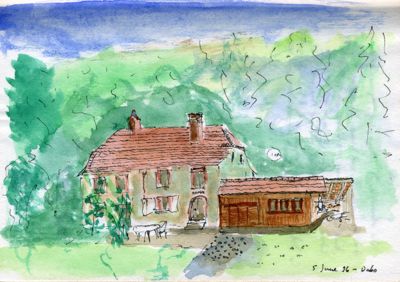
That's not the name by which I think of it: to me it's sonata ii: compositio ut explicatio, and it is dedicated gatharuda lapidis in memoriam. I began writing the piece in June 1996, in a house we rented for a couple of weeks just outside Dabo, a small town in the French Vosges not too far from Strasbourg. In my usual way in those days I worked at the desk in the morning and left the afternoons and evenings free for sightseeing and socializing.
dabo076.jpg
Dabo: watercolor, from my journal


I was working, I thought, on three compositions at once: the piano sonata, a trio for violin, piano, and percussion, and a musical setting of Carl Rakosi's The Old Poet's Tale. That last project continues to elude me, though I promised Carl many years ago I would complete it; and perhaps one day I will.

The sonata went easily at first, and after leaving Dabo it was far enough along for me to turn full attention to the trio — more pressing because promised for performance the following spring. The sonata, after all, was pure speculation; I had no reason at all to believe it would ever be played. It was conceived, in fact, as might be called piano accompaniment to a recitation of Gertrude Stein's magnificent lecture Composition as Explanation.

(It's only as I type this that I notice two contemporary projects both concerned musical depictions of the spoken word. Carl had requested no music be heard while the text of his poem was to be spoken; he wanted only interludes. Sonata 2, on the other hand, as I conceive it, would resound throughout the recitation of Stein's lecture. There are other items of contrast between Stein and Rakosi, the lecture and the poem, and my approaches to the two assignments, but this isn't the place to go into that.)

The Trio went well enough, too; it was composed, nearly all of it, in a couple of weeks at the other side of France, on the Ile de Ré; and one of these days I'll write about it here.

Back to sonata ii: I completed the composition itself in Portland in April 2006, ten years after its beginning, but waited until last year to put in dynamic indications and all that. I've almost always lost interest by the time such details have to be dealt with; there are more interesting things to do. It always seems to me that the notes themselve, as they're notated on the page, should convey to any eventual performer such things as how loud or soft, fast or slow, crisp or blurry a phrase should be. As John Cage said: composition's one thing, performing's another; what do they have to do with one another? (I paraphrase.)

So in January of this year I decided to go ahead, since it cost hardly anything, and publish sonata ii, with all the flaws any piece must retain before the editing that can follow the first public performance, incorporating lessons learned during the often laborious process of getting to that point.

What can I tell you about this piano sonata? It's been described as "a major work whose three movements, running nearly an hour long, gradually reveal an inner logic and a brittle clarity that can only be called phenomenological." I think of the music, I mean the sound of its music, as objective, abstract, prosaic, rhythmic, rather sculptural.

One composer said of the score that it looked startling -- quite unlike any other music. Another, whose judgment I particularly respect, is very fond of it. A pianist who listened to my synthesizer's performance thought of it as jazzy and humorous: neither of those qualities was particularly intended, but I'd be nuts to reject either of them.

You can look at the score by buying a copy; it's published at Lulu.com. You can hear it here.(The second movement, which is only five minutes long, can be heard here.)

Sunday, March 08, 2009

Ubu Roi

Eastside Road, Healdsburg, March 8, 2009

I DON'T RECALL when I first met Ubu Roi: probably sometime in the late 1950s, most likely through the Evergreen Review issue dedicated to 'Pataphysics. I've seen Alfred Jarry's play staged four or five times since, most recently and, I think, most successfully last night, in a raw, energetic, resourceful production by The Imaginists. Three performances remain in the schedule, and if you're within range you shouldn't miss it.
Ubu Roi is probably the oldest Absurdist play to hold the stage—though now that I type that I realize there's nothing Absurdist about it; it's simply a totally realistic, moralistic, objective updating of just about any Shakespeare historical play. Ubu, fat, stupid, and utterly without morals, overthrows the Polish king, converts the national phynancial system into pure personal gain, taxes the peasants to death, and ultimately takes on the Whole Russian Army. At one point he announces his agenda in the tersest of terms:
Avec ce système j'aurai vite fait fortune, alors je tuerai tout le monde et je m'en irai. (Thank you, Project Gutenberg.)

(With my system, I'll soon be rich, then I'm gonna kill everybody, then I'm going away).
You can see that, like Shakespeare, Ubu Roi has the misfortune always to be relevant.
The Imaginists have cross-cast the play: King Ubu is played by a woman, Amy Pinto; Mère Ubu by a man, Eliot Fintushel; and Captain Bordure by Brent Lindsay in an androgynous costume. (The small cast plays a great number of roles, ranging from a bear to The Whole Polish Army.)
The costumes are wonderfully inventive; props ditto; and the scenic flats are so beautifully conceived and executed I'd buy them to hang on my walls if I had a mansion or a winery.
Ubu Roi is scatological — the riot at its 1896 premiere was prompted by the very first word in its text, Merdre, translated in this production quite literally and without the extra "R". Still, I think any kid from ten up will love it, and any adult with a sense for politics, history, or the absurd (or is that redundant?) will too. I'm glad I went; I wouldn't mind going back.

Friday, February 20, 2009

As I Walked Out One Midsummer Morning

Eastside Road, Healdsburg, February 20, 2009

OVER ON HIS BLOG Renewable Music, Daniel Wolf writes
Not writing enough (i.e. almost no) songs. Why? A terrific fear of words (sounds, meanings of words, appropriate scansion, emphasis) and not being, myself, a singer.

In his fascinating (though to me unsatisfyingly negligent about the walking itself) memoir As I Walked Out One Midsummer Morning , Laurie Lee describes an evening in a peasant's hovel, when he broke out his violin — he was walking across Spain in 1935 with only his violin to support him — and played for his hosts. At first they listened in silence; then, we he played a "woozy fandango" he's picked up a few days earlier in Zamora, they came to life, the man and wife dancing savagely and powerfully, the two boys picking up spoons to accentuate the rhythm.
The sons asked me for another tune, and this time they danced together, with linked arms, rather sedate and formal. The daughter came quietly and sat on the floor beside me, watching my fingers as I played. the scent of her nearness swam troublesomely around me with a mixture of pig’s lard and sharp clean lavender.
The girl was asked to sing, and she did as she was told, in a flat unaffected voice. The songs were simple and moving, and probably local, anyway, I’ve never heard them since. She sang them innocently, without art, taking breath like a child, often in the middle of a word. Staring blankly before her, without movement or expression, she simply went through each one, the stopped -- as though she’d really no idea what the songs were about, only that they were using her to be heard.
With the singing over, we sat in silence for a while, hearing only the trembling sound of the lamp. Then the woman grunted and spoke, and the boys got up from the table and fetched the mattresses and laid them down by the wall.

This, I think, is what song should be, artless and spontaneous. Of course it's impossible to achieve in a salon or a concert hall, and impossible to compose. But when we attempt to compose it this is the thing to strive for. It's what I like in Ives and Scelsi.
Laurie Lee: As I Walked Out One Midsummer Morning

(New York: W.W. Norton, 1985, pp. 63-64)

Tuesday, February 17, 2009

Crisis and community

Eastside Road, Healdsburg, February 17, 2009

ONE THING ABOUT THE DEPRESSION, it may force us away from extreme individualism back toward a semblance of communitarianism.

From "Sowing For Apocalypse: the Quest for a Global Seed Bank" by John Seabrook (in Seed Savers Exchange, 2007 Harvest Edition):
I asked how his cancers had influenced his work in saving seeds. [Cary] Fowler replied, "The first one, I didn't handle it very gracefully. I was scared. Really scared. And the reason I was scared was that I hadn't done anything — I hadn't contributed constructively to society. And that was frightening."
From This Side of Paradise by F. Scott Fitzgerald (taken from the Project Gutenberg online edition):
Amory, even had he not been a selfish man, would have started all
inquiries with himself. He was his own best example--sitting in the
rain, a human creature of sex and pride, foiled by chance and his own
temperament of the balm of love and children, preserved to help in
building up the living consciousness of the race.
In self-reproach and loneliness and disillusion he came to the entrance
of the labyrinth.

...

Of Amory's attempted sacrifice had been born merely the full realization
of his disillusion, but of Monsignor's funeral was born the romantic
elf who was to enter the labyrinth with him. He found something that he
wanted, had always wanted and always would want--not to be admired, as
he had feared; not to be loved, as he had made himself believe; but to
be necessary to people, to be indispensable; he remembered the sense of
security he had found in Burne.
Life opened up in one of its amazing bursts of radiance and Amory
suddenly and permanently rejected an old epigram that had been playing
listlessly in his mind: "Very few things matter and nothing matters very
much."
On the contrary, Amory felt an immense desire to give people a sense of
security.

...

"I am selfish," he thought.

"This is not a quality that will change when I 'see human suffering' or
'lose my parents' or 'help others.'

"This selfishness is not only part of me. It is the most living part.

"It is by somehow transcending rather than by avoiding that selfishness
that I can bring poise and balance into my life.

"There is no virtue of unselfishness that I cannot use. I can make
sacrifices, be charitable, give to a friend, endure for a friend, lay
down my life for a friend--all because these things may be the best
possible expression of myself; yet I have not one drop of the milk of
human kindness."


OR, AS MY COUSIN Hazel once pointed out to me, there are only two things that really matter: Generosity and Gratitude. Neither works in the absence of the other; together, they make everything work.

Wednesday, February 04, 2009

Sinfonia Muta

Eastside Road, Healdsburg, February 4, 2009

SinfoniaMuta.jpg

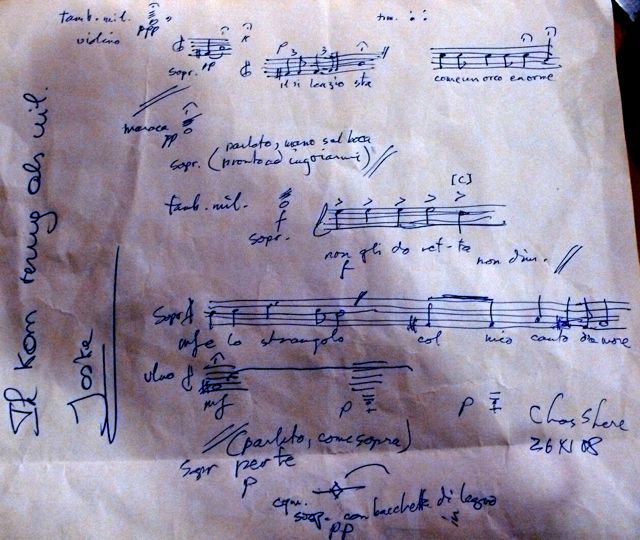
I POST THIS SONG here, not because it's particularly important, but because I hope thereby to get back in touch with the author of the poem, Nicu Lutan, who we met in a restaurant in Milan where he was waiting tables.

An engaging fellow, Nicu is anything but reticent. He saw to it that I had a broadsheet celebrating him and his poetry and, most of all it seemed, his connection to famous people. But I found him genuinely likable. And the more I looked at one of his short poems the more I liked it:
il silenzio sta
come un orco enorme
pronto ad ingoiarmi
non gli do retta
e lo strangolo
col mio canto d'amore per te
which my computer helpfully translates as
Hush it is like a orco enormous ready to swallow to me I do not take notice to it and I strangle it with my song of love for you
(I don't know why computer doesn't know that orco means "ogre, bogeyman".)

Well: Enjoying a grappa after dinner I sketched out a little musical setting of the piece on the table-paper. I left it for him, taking this photo with me. I've looked him up and found him here, but the e-mail link on the web page doesn't work any more. If anyone runs across him, will you put him in touch with me please?

Tuesday, January 27, 2009

Aimez-vous Brahms?

Eastside Road, Healdsburg, January 27, 2009

MOZART'S BIRTHDAY! And here I sit thinking about Brahms, because a friend asks me what it is about Brahms I don't like.

Well, not that it matters: it's, I think, his need to be Mozart after Beethoven, or his desire, which may be the same thing, somehow to mediate the two. Impossible, of course, since Mozart and Beethoven are antithetical.

There are Brahms pieces I genuinely like: meaning, pieces that give me great pleasure to hear. The two Serenades, certainly. The Variations on a Theme by Haydn, if not heard too often. The Liebeslieder Waltzes. The clarinet sonatas.

The Second Symphony, though here I am never sure whether it's truly Brahms that pleases me so much, or the fond memories of hearing Bruno Walter's recording of the Second so many times while courting.

Brahms seems to me an oddly uneasy commutation among Mozart, Beethoven, and Schumann. I smell the cigar in his heavier work, and the cigar is rarely lit. Don't even talk about his German Requiem.

It doesn't help that he's so often so badly played. String quartets tear into his music as if he'd written it for wire strings: cf. the Cleveland Quartet. Pianists smash away at his keyboard music, which is so often gentle and innig.

Conductors know that He. Is. Very. Important. and beat that into everyone nearby, beginning with the concertmaster. Only once have I really heard a satisfying orchestral interpretation live: when Niklaus Wyss accompanied I don't recall what violinist in the Violin Concerto, and led the [San Francisco Symphony] orchestra throughout in a gentle, conversational performance that let you see poor Brahms never really wanted to be Arnold Schwarzenegger.

I don't think the Mozart-after-Beethoven problem can ever be resolved, though perhaps it was most successfully evaded in the two Brahms pieces he didn't live to compose: Richard Strauss's Oboe Concerto and Duett-Concertino for clarinet and bassoon with string orchestra. Perhaps it's only in the final years that one learns to finesse such things.

Thursday, January 15, 2009

Mall Mozart

Eastside Road, Healdsburg, January 15, 2009
Originally written as a pre--blog sometime in 2003, re-posted in response to Whiting's comment to the previous entry…


HEALDSBURG, California del norte, 15 avril 2016 —

You remember what it was like driving down toward Susa from the Moncenisio pass — I always recall that when driving down from Mt. Shasta through Redding and onto the Central Valley, leaving the snow and mist behind, as if there were a choice in the matter, and coming out to a warmer day, further advanced in the season.

The mood was enhanced yesterday, when the radio finally found a noncommercial station amongst all the inter-station hiss it had coped with up in the mountains. What a lucky break the Chico campus wasn’t damaged during the attacks! Mozart was on. Not only Mozart; the Coronation Concerto, played with spirit and wit by Alfred Brendel. The sunlight-and-shadow effect of the minor-key passages in the finale exactly matched the skies below Redding, reminding me to stop at what’s left of the old outlet shops near Corning, to visit the Mozart Mall.

I’d been closing in on my complete collection while up in Portland, where there’s any number of used CD stores. At one of them I heard about the Mozart Mall. Who could believe it? A shop devoted to the greatest musical genius of all time, except perhaps for Cage...

The shop had begun in the town of Mt. Shasta ten years ago, before the Intensification, during the Mozart Semiquincentennial, or maybe the following year, I’m not sure. Someone ran it out of her living room for a few months, just as a hobby and to entertain a group of friends. It was one of them, I think, who had the idea of setting it up in the mall, when so many outlets and franchises went bust after the crash of 2010, leaving the malls with empty shops for years.

Anyway it seems to be thriving now, partly because of the economic recovery following the Reorganization, partly because of the discovery a couple of years ago of the missing pages of the Requiem, just in time for the funeral obsequies of President Bush III. It’s a curious place, with its old-fashioned espresso machines and its sofas. It even has a set of loudspeakers, which make it necessary to share your listening with other people, even total strangers. It isn’t obligatory, though, thank the muses, and we hooked ourselves up to headcaps.

It’s very comfortable. The woman who runs the shop was lucky to have both time and a decent computer back in 2006, when she cruised the Internet — how I miss it — and downloaded all the Mozart she could find, sound files, images, and text. She’s found old-style motherboards and memory and managed to re-create a hard-wired version of the Internet, or at least a lot of the Mozart part of it, right in her shop.

Her partner is a theater director, and she’s contributed a wonderful dimension to the shop — a virtual theater allowing you to sample old videodiscs of Mozart operas, as well as that one promising experiment in historical reconstruction, the one the Salzburg Festival produced in 2009, just before the Final Intensification. I’d forgotten how persuasive it was; I don’t see how musical performance can get more real, short of using real musicians and real instruments — unthinkable, of course, today.

Unfortunately the accelerated time mode is no longer available — technology like that is gone, along with all the weapons, and it’s probably a good thing — so we were content with just part of one of the quartets, but it was a pleasure to see Mozart on the viola and Haydn playing violin. I never did learn much German, let alone the 18th-century Vienna vernacular, so the joking went past me, but the winks and nudges between them during the “Dissonant” finale were pure pleasure.

MallMozart is part museum, too. They have almost the complete Collected Mozart Edition on shelves, real original paper copies. And they even sell DVDs of the scores, including the autographs, and searchable DVD versions of the Internet sites that used to be available through the airwaves. I don’t know how they got permission for all this.
I met Khalila, the woman who runs the place — the daughter, I think, of one of the founders. She said the idea came from the old coffeehouse concept; that’s why they still have that espresso machine. There’s even an idea to franchise a series of MallMozarts throughout the entire country, from Medford down to Carmel. It’s a great idea, of course: it’s time to begin developing a national cultural sense.

We’re back on the road; I’ll send this the next time I can make a connection, probably at the next hydrocell stop. Hope you’re well and having fun!

Monday, January 12, 2009

Oral history

Eastside Road, Healdsburg, January 12, 2009

JOHN WHITING'S COMMENT to the previous post here sent me an an egosurf to his My KPFA - an Historical Footnote , a repository of “Conversations, Coast to Coast" with a number of the workers in that vineyard we know as KPFA, the non-commercial radio station located in Berkeley, California.I was there as Music Director from 1964 to 1967 and stayed on a couple of years to work part-time. Since many of us tended to cover extra assignments, I was also the Folio Editor for a stretch, editing the program guide.

John has placed on his Historical Footnote interviews with Chris Koch, Phil Elwood, Robin Blaser, Henry Jacobs, Al Silbowitz, Richard Moore, Scott Keech, David Salniker, Marci Lockwood, Dick Bunce, Pat Scott, Larry Bensky, William Mandel, Erik Bauersfeld, Ernest Lowe, Peter Frank, Lawrence Ferlinghetti, Maria Gallardin, Charles Amirkhanian, Loren Rush, Alan Rich, Steve Bell, Ned Paynter, Wil Ogdon, Jack Nessel, Frank Sherman and me. Next time your’e laid up and want to listen to a few yours of intelligent conversation about an amazing institution, give this a try!

Two points here: First, on KPFA: SInce I was in the middle of it when I was there, I couldn't really see it from the outside; but I have the idea it was an extremely influential and instrumental agent in the formation of the uniquely energetic cultural atmosphere of the San Francisco Bay Area of those days, and what days they were.

Second, Whiting's work strikes me as an approach to a problem I've been noticing lately: lots of us oldtimers are dying off, and not much about our various work is on the record. We need a series of good, professional oral histories, but the big boys are out of cash and pick and choose very carefully their subjects. We should all begin to carry pocket recorders around with us at all times — I suspect many of us do — and make our own damn oral histories. I think I'll start doing this.

Saturday, January 10, 2009

Time Machine

Eastside Road, Healdsburg, January 10, 2009

I JUST SPENT TWO HOURS at the Exploratorium in San Francisco nearly twenty years ago — November 29, 1984, to be precise — listening to myself in an interview conducted by Charles Amirkhanian. I was discussing my opera, The Bride Stripped Bare by Her Bachelors, Even, half of which was then in production at Mills College in Oakland.
The audiotape of the interview has just been put up on the Other Minds Radiom, an internet archive of concerts and interviews: you can hear it streaming here — but be warned: it is two hours long, and it's a raw tape with a few of those awkward "Could you focus, please" and "Oh, do we have a tape of…" moments.
On the whole though I must say I'm terribly pleased the evening is now available to a wider audience. This is the kind of thing the Internet was made for: to make accessible those special moments that seem to explicate and represent, re-present, moments that are otherwise extremely fugitive, by their very nature.
The opera had been given its dress (public) rehearsal two days before and was to receive two more performances in the coming days; this interview was nicely timed for publicity purposes. Radiom's description:
Recorded on November 29, 1984 as part of the San Francico Exploratorium’s Speaking of Music series, Charles Amirkhanian interviews American composer, critic, and former musical director at KPFA, Charles Shere, about his opera “The Bride Stripped Bare by her Bachelors, Even “. The opera, which is inspired by the Marcel Duchamp painting of the same name uses Duchamp’s notes for much of the libretto. Shere, who was heavily influenced by the new music of John Cage and others, describes in detail Duchamp’s iconic work and talks about how he has tried to capture its spirit in his avant-garde opera. Shere highlights his remarks with slides and excerpts from the opera.
PerhapsUse.jpg
I will only add that the broadcast begins with Ces Desirs du Quatuor and includes two arias ("Perhaps use…" as sung by Linda Fulton and accompanied by Peter Winkler, in 1965; "B and C" as sung by Anna Carol Dudley and accompanied by the strings of the orchestra in the 1984 production, as well as the first movement of Tongues, a 1978 composition for poet speaking in tongues (Andrew Hoyem) and chamber orchestra — a piece quite unrelated to the Bride, but why not?
Thank you Charles Amirkhanian and Other Minds for the trip back so many years!
cavatina.jpg

Monday, January 05, 2009

Reading Mathews

Eastside Road, Healdsburg, January 5, 2009
NOTED WHILE READING The Way Home, by Harry Mathews (London: Atlas, 1999). Perhaps because a temporary indisposition has put me off my feed, I identify with the elegiac note running through the collection; even the entertaining lead piece, "Country Cooking," a pseudo-anthropologist's detailed and superbly annotated recipe for double-stuffed lamb shoulder, manages to pass a few clouds over the face of its Auvergnat sun.

There's a lovely cycle of short reminiscences of Georges Perec, in "The Orchard": 123 paragraphs of memories, some significant, some fleeting, all of them tender, none inconsequential — an elegy for modernist fiction, perhaps, as much as for the late maître of restricted writing (it's Perec who wrote La disparition, a very substantial novel lacking any presence of the letter "e").

"Translation and the Oulipo: the Case of the Persevering Maltese" is a talk given in London in 1996, at the French Institute, as one of the St. Jerome series of lectures on translation. It's remarkable, funny, accurate, far-ranging, and provocative. Mathews manages in his famously indirect way to present a solution to the problem of life and death by investigating the relationship of a work and its translation. One need never again complain of a book impossible to classify as fact or fiction. He writes
Facts are the score, not the game. Facts are lies. Not because they are false, but because facts belong to the past — to what was, never to what is. We love them, bacause once reality is safely lodged in the past, it becomes reassuring, reasonable, and easy to manage… There is no escaping this. It is not a Bad Thing. However, a reality we can call the truth must be looked for elsewhere.
This resonates with a line I noted in Jane Austen's Pride and Prejudice: Elizabeth says
We all look to instruct, though we can teach only what is not worth knowing
and, later
Think only of the past as its remembrance gives you pleasure
and while the lack of a comma after "past" is telling it is by inserting one that we mediate Austen and Mathews and, who knows, Jane Austen may have begun the ambiguation of fact and fiction, as if she were deliberately looking at an other, subtler, more fecund version of fictional reality than Daniel Defoe's.

Anyhow. What I sat down to give you are two quote from the long autobiographical piece ending The Way Home. First, on books,
Through [his wife Marie] I have been able to see that my parents, my children, my cousins and my cousins' cousins, and friends long unseen and those freshly made, are the substance of my life: that my life is what I have and what I can make of that, not some wishful hope of what may (and doesn't) happen. She has demonstrated what happiness is without ever telling me what it should be.
And then on books:
Just as a glutton desires more food than he needs, and eats more food than he desires, I heaped my life with books. Not only books to read but to own. Each new volume on my shelves added a brick to my defence works, the culture castle in which some day I hoped to live safely and alone…Eventually I came to realise that the prospect I was creating for my future (a lifetime of reading or of not reading, since one lifetime would hardly suffice) was more depressing than reassuring, and I gave up buying books systematically.
That last word is significant: he continues, of course, to buy books, as do we all.

Sunday, January 04, 2009

For Piano

Eastside Road, Healdsburg, January 4, 2009
ForPiano.jpg
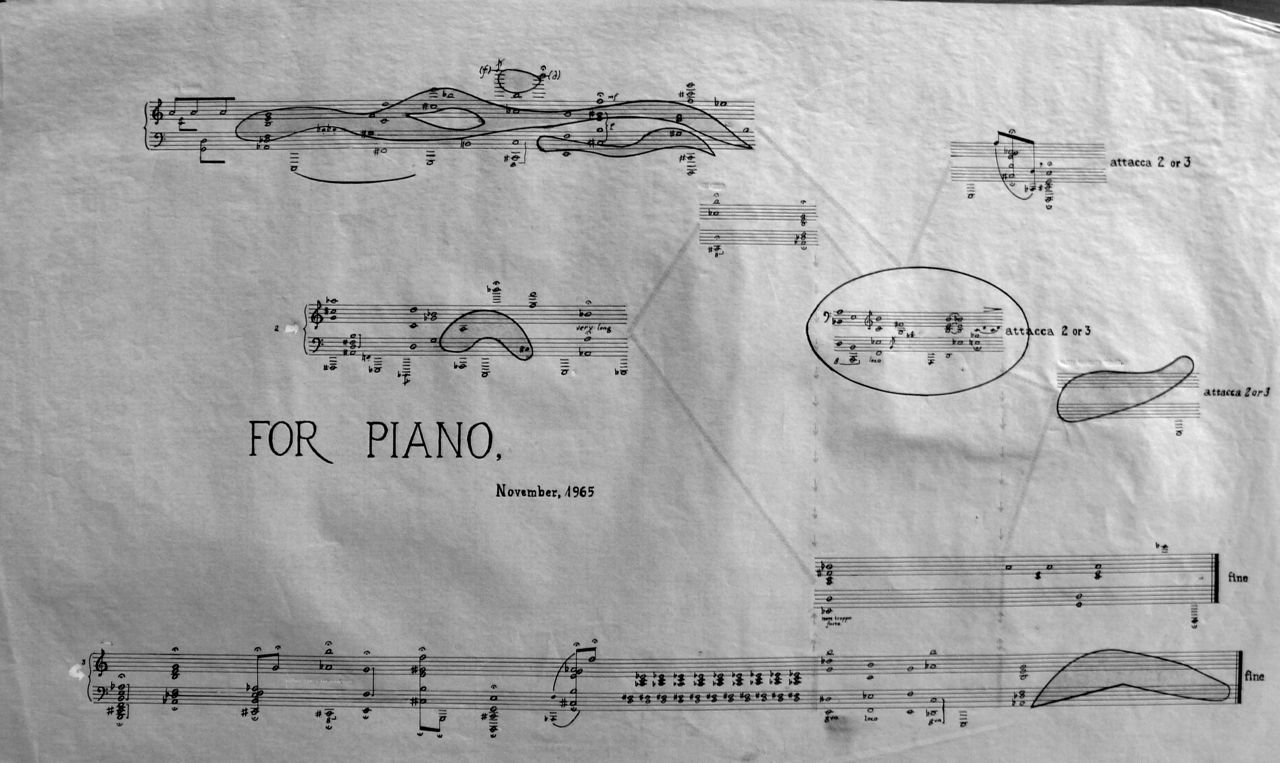
IT WAS MY SECOND piece for solo piano. (The first, Three Pieces for Piano, was composed about two years earlier, and later turned into a Small Concerto for Piano and Orchestra.) In those days one wrote one's music on semi-transparent paper; from these originals subsequent copies could be made using a blueprint process. Every composer over sixty must remember the ammonia scent that lingered among the music.

I taped a sheet of 14-by-24-inch paper down on the drafting table and drew eight systems in varying lengths, using a very fine Rapidograph and India ink. Oh, the pains we took in those days.

The piece is in "open form" but otherwise mainly fixed: the ptches definitely fixed, the durations and dynamics relatively so. I wanted a degree of improvisation, however, so I added six overlays of screen-dotted paper, determining their shapes with a French curve and intuition. Within those areas I would ask the pianist to add any material that might come to mind. Other overlays, of rows of dots, connected certain systems to indicate the pianist's route through the score.

Influences: Karlheinz Stockhausen's Refrain and various pieces by Earle Brown. Model railroads, now that I think of it, and gardens, on the concept of a pianist (and thereby his listeners) wandering a route through a piece of music, often returning to a central area, before finally ending the couse at a predetermined destination.

The premiere was played by the late Julian White, a very sensitive and wise pianist who went to the intrinsic humanity of whatever he played, refusing to worry about absolute fidelity to the score. I still have a recording from a subsequent performance, also Julian's; you can listen to it here.

Saturday, January 03, 2009

Names of Cats

Eastside Road, Healdsburg, January 3, 2009
THE FRENCH NOVELIST Georges Perec always named his current cat Duchat, I read in Harry Mathews's touching "The Orchard," a garland of short paragraphs each recounting a recollection of Perec, written one a day for a number of weeks following Perec's untimely death. (It is available in the collection The Way Home: Selected Longer Prose [London: Atlas Press, 1999].)

David Bellos describes the inception of this custom:
Once they had settled into their new flat in the summer of 1966 and acquired their first cat, called Duchat (or Duchat-Labelle, or Madame Duchat née Trump'hai or Troomp-faye or Troump-faille)…
Georges Perec: A Life in Words (Boston: David R. Godine, 1993), p. 340
Five years later, in August 1971,
At Saint-Félix Perec renewed his acquaintance with Duchat, out of Duduche, by Ducat I, the first of Perec's feline friends…
ibid.,483-4

I like cats; it's only because we travel so much, and would have to leave her to her own devices, that we don't have a current cat. We've been without a cat for ten years at least, since Blanche went to sleep for the last time underneath one of Lindsey's rosebushes. We'd had her almost twenty years; she and her brother Joe descended from sweet Sally, who I found among an abandoned litter in the Berkeley Hills. They were mostly outdoor cats: but if we ever stop traveling I will want an indoor cat. I agree with Guillaume Apollinaire:
Je souhaite dans ma maison:
Une femme ayant sa raison,
Un chat passant parmi les livres,
Des amis en toute saison
Sans lesquels je ne peux pas vivre.


[These things I want within my walls:
A woman who knows why she's there,
A cat who strolls among the books,
Friends on rainy days and fair,
Without them I can't live at all.]
—Bestiaire, ou, la parade d'Orphée (1911)

Giovanna's family has a new cat, and there was the question of naming him. I hadn't realized the full import of this, and when I saw the other day that Francesca was now grinning elk my first thought, having bought elk liver to cook while visiting them in Portland, that grinning was some new kitchen technique. I wrote her that I myself had never gran elk, and she replied
I don't think I have ever gran an elk before either... grinning elk is just the name my family has given me instead of naming the cat Roaring Thunder. Grace is talkative moss, mom is baking reindeer, dad is roasting oyster, and simon is cartwheeling rabbit.
So you see where cat-naming can get you (we won't even consider cat baptizing). Anyhow I'm glad the cat evaded Roaring Thunder: somehow the name seems more appropriate to a Kern County family. I'm not sure about any of these names, really, though Grace's and Simon's are apt.
There are other things to say about cats, but I'll leave you with just three words: Carl Van Vechten.

Oh. And an ultimate Duchat clawed poor Perec a few days before he died (though not of the scratches); just as the composer Robert Erickson succumbed, after years with a debilitating disease, apparently to consequences of treatment for a serious scratch from his cat, whose name I can't recall at the moment…

Wednesday, December 31, 2008

Why do I read?

Eastside Road, Healdsburg, December 31, 2008
NOT MUCH TO DO beyond read, these days, read and socialize. The party was over yesterday, so the reading resumed.

It was discouraging, as I've noted elsewhere, to finish reading Sense and Sensibility and find at the bottom of the last page the notation 12/29/95 — the date I'd previously finished reading it. I had no recollection of the book: neither the book itself, nor of the process of reading it.

I guess I'm not surprised: I read it that December while recovering from abdominal surgery. I probably should have picked something a little less — well, subtle, I suppose. Will I remember this reading in nine years? Who knows. That's not the reason to read, nor is it the reason to live.

Yesterday I read a very different book, John Muir's My First Summer in the Sierra (New York : Modern Library, 2003). Muir knew how to live, and this book, his first, celebrates The Moment. Having recently recovered from a serious eye injury, and having warmed up by walking a thousand miles from Indiana to Florida decided then, in 1868, thirty years old, to go to California, where the next summer he took a job following a flock of two thousand fifty sheep into the high Sierra, ostensibly to keep an eye on their shepherd.

He didn't like the sheep much. Some of the funniest and sharpest passages in the book record that judgement, one of the few negative judgements Muir was to make. But he fell in love, or rather was confirmed in his love, for the high Sierra. "Love" is not too strong a word; he uses it often himself; and although his father was a preacher, and he himself had memorized the New Testament and much of the Old, he doesn't hesitate to identify the whole of Nature as an expression of love:
How boundless the day seems as we revel in these storm-beaten sky gardens amid so vast a congregation of onlooking mountains! Strange and admirable it is that the more savage and chilly and storm-chafed the mountains, the finer the glow on their faces and the finer the plants they bear. The myriads of flowers tingeing the mountain-top do not seem to have grown out of the dry, rough gravel of disintegration, but rather they appear as visitors, a cloud of witnesses to Nature's love in what we in our timid ignorance and unbelief call howling desert.
As you can see, Muir's prose is ecstatic: but it is also aware, accurate, and detailed. Page after page records observations of botany, geology, the climate. And while Muir is alone much of the time his notes on the personalities he meets — Portuguese, Indian, tourists; and also squirrels, houseflies, bear, not to mention the tedious sheep — enliven the book and bring his ecstasy back to earth.

Having walked among alpage sheep-pastures last summer I was perhaps particularly enthralled with My First Summer in the Sierra: I would like to reconstruct Muir's journey, his book in one hand, a GPS in the other. It's the sort of thing you dream about in winter, on the last day of the year.


A VERY DIFFERENT MATTER is Willem Elsschot's Cheese (New York : Granta Books, 2002), today's read, also a Christmas gift. It paired well with Muir: urban rather than rural; centered on business, not Nature; resigned, not ecstatic; it's a novel that brings to mind Svevo and early Pirandello, even Queneau and Beckett.

The story is simple: a humdrum clerk in a shipyard falls into a cheese-distributing job; his personality swerves into quite a different world. The book may well be a parable: Elsschot's afterword (which artlessly spans literary criticism, surreal poetry, and philosophical speculation) warns
The reader should gradually be seized by a feeling of uneasiness, making him turn up his collar and think of his umbrella while the sun is still out in all its glory.
(I should add that the book first appeared in 1933, and that Elsschot, whose real name was Alfons-Jozef De Ridder, was a Belgian advertising man.)

Cheese is a very funny book, but a tender one, even moving. Very economical, it brings Depression-era Belgium to life, portraying a lower-class bourgeois family intimately and sympathetically with virtually no sentiment. An interesting achievement, it reminds me of how little we know about European literature: here's another Flemish-language writer to pursue in the year to come.

Friday, December 19, 2008

Screen with Variations

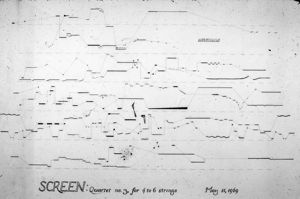
SCREEN WAS AMONG my first and remains, I think, my most successful “graphic” score: notation which relies completely on drawn elements, rather than conventional musican notation. It was one in a number of “quartets” conceived as a series of experimental pieces investigating the concept of string-quartet playing, not as the playing of stringed instruments, or even the interpretation of that marvelous repertory of music from Haydn down through Lutoslawski, but as the act of listening to others and one’s self, playing in the moment while considering the long span, hearing and being in several places simultaneously, focussing consciously while leaving the intuitively expressive gesture free.

scns002.jpg


I made the piece on May 11, 1969, on my drafting table, dividing the page into six horizontal bands demarcated with dashed lines; then drew thick lines to indicate sounds (placed high or low to indicate pitch, of varying thicknesses to indicate loudness, of varying length to indicate duration), and connected these with thin straight lines to indicate voice-leading, two melodic lines to each band.

The instrumentalists can play from left to right or from right to left; when any system is completed, they pause or do not before beginning any other. The performance begins and ends as seems right.

Screen is intended as a sound-curtain through which something else might be heard — another composition or two, or ambient sounds, or internal songs. Screen should therefore not be too insistant. It should be fairly slow and quiet. Not too much needs to be made to happen. It is unassertive, like any linear statement. It is cool, a little formal, rather conservative, but not plain or cold. The several systems can be played forward or backward, each taking about a minute. I prefer Screen played by three to six instruments, weighted more toward violas than violins, including contrabasses too if possible. (I would like to hear it performed by a capella chorus one day, or by an ensemble of trombones.)
scns003.jpg

Variations was composed six years later, in 1975, again a graphic score, this time based on a star map that had been used on a poster advertising an exhibition at the Oakland Art Museum. Here again I relied on an intuitively pleasing visual appearance to guide me to a pleasing sonic resolution; this time the size of the circles indicated loudness; the placement on the page indicated pitch; and since I was thinking of nonsustaining instruments like harp and percussion there was no reason to extend the lines to indicate duration.

I'm sorry the scores do not reproduce better here. You can hear Variations played on the harp, superimposed on a performance of Screen by a string quartet, here, as recorded in a live concert thirty-two years ago in San Francisco.

Thursday, December 18, 2008

The thing about the thing itself

SILLIMAN'S BLOG STEERS ME to a note (from five months ago) about Wallace Stevens's poem Not Ideas About the Thing But the Thing Itself. I've always admired Stevens, and I particularly respond to this poem; when my mother died I used it in a version of the Requiem that I wrote for chamber choir with solo oboe.

I've rarely read a discussion of a poem I disagree so strenuously with as Nada Gordon's discussion of this. She reproduces the text in full on her blog, freeing me from the temptation to do so here, and then she writes
It’s a confusing poem, probably deliberately so, and I felt after reading it and discussing it that it doesn’t transcend its own contradiction: the cry “seem[s] like a sound in [his] mind” but he maintains, in that weird conditional tense (and with a potentially ambiguous pronoun reference) “It would have been outside”.…
The poem seems perfectly clear to me; it's about the coming of death, the ultimate "thing itself"; death whether literally or as the embodiment of any realization of the complete whatness of something. The poem is no more "confusing" than the difference between seems and is; and "would have been" is not "conditional tense" [sic] but laconic spoken English. Wallace Stevens is so readily thought a mandarin that his most direct discourse is analyzed into opacity; it's an example of the danger of reading intellectual complexity into material that is, in fact, perfectly straightforward.

Wednesday, December 17, 2008

Reading Lolita in Tehran

THERE'S NOT A LOT I can write about this book that hasn't already been written many times over, I'm sure — it's among the top hundred most-read books on LibraryThing, where it's garnered nearly a hundred reader reviews; a Google search of the title yields 136,000 hits. Wikipedia notes that "it has been on the New York Times bestseller list for over one hundred weeks and has been translated into thirty-two languages."

And it was published in 2003, five years ago; and I'm late getting to it. (And I owe Lindsey thanks for recommending it highly: she knows what I will wind up liking.)

The book recounts conversations among teacher (the writer, Azar Nafisi) and students (all young women) during classes, at two Tehran universities and in private, devoted to English-language literature. The four sections discuss Lolita, Pnin, and Invitation to a Beheading (Nabokov); The Great Gatsby (Fitzgerald); Daisy Miller and Washington Square (James), and Pride and Prejudice (Austen), always counterpointing the discussion of the texts against that of daily life in Iran as it developed during the classes (from the last year or so of the previous government through the revolution and well into the present theocracy).

Reading Lolita in Tehran has been roundly criticized as Orientalist, propaganda, not credible. I suppose the chief objections to the book voice two points of view: either that it misrepresents contemporary Iranian life (and government, and society, and religion); or that it irresponsibly conflates fantasy with realistic depictions of social reality. I can't speak to the former objection, except to note that both Reading Lolita in Tehran and, presumably, social life in present-day Iran are far too complex to be reduced to ideological argument.

To many the second objection will be the more disturbing, because it is less immediately evident. Nafisi subtitles her book "a memoir in books," and that's just what it is — in books and in discussions of books. She uses her class notes (and those of a student, it eventuates) and her thoughts on these novels to organize the development, as she lived it, of her awareness of the impact of life in Islamist Iran on her own personal life. Along the way she develops what seems to me to be a keenly perceived, close-held, and articulately expressed kind of literary criticism; she's made me think about The Novel as I haven't, really, since school days, since reading Forster and Wilson and such.

To reduce her ideas to a ridiculous skeleton, she finds Nabokov treating, in his books, of the theft of identity, or rather (and worse) of the possibility of ever developing an identity. Fitzgerald's theme is the asserted right to a life of the imagination. Jame's is courage. Austen's is precisely the denial of colonialism and imperialism, through the assertion of private life and private pleasure.

But as I say this is a reductionist presentation of Nafisi's achievement. Behind and above these four writers, and her analysis, and her cumulatively persuasive and troubling account of the repressive state, there is always Scheherazade. The graceful counterpoint of literature and conversation, private and public life, imagination and restriction is conveyed in a constantly forward-moving narrative.

Fiction, the novel, the act of reading — these are endlessly troubling matters to any authoritarian government. Yet one of the sources of that trouble must be precisely the temptation that imaginative narrative presents to the authority: in denying its freedom to others it must deny that freedom to itself; and the human urge to narrative expression is innate and irrepressible.

Sunday, December 14, 2008

Noise Within: fall 2008

Eastside Road, Healdsburg, Saturday, December 13, 2008—
WHAT? OH, YES, I should let you know about the plays we saw last week. It was the semiannual visit to Los Angeles to see productions at A Noise Within, a repertory company whose efficient programming allows us to see three plays within a week — or less: next May, for example, within three days.
Every season seems to offer a couple of Shakespeare plays, a 20th-century American standard, a play from the French repertory, and a couple of plays from odd corners of the literature. Last week we saw The Rainmaker, Hamlet, and an adaptation of Oliver Twist: in nearly every case, the last or near-last performance of the run.
  • The Rainmaker is not a very persuasive stage play. N. Richard Nash wrote it for television, as the jerky flow of the play suggests (you can almost hear the Philco commercials between the scenes). It's dated (1954) and it's hokey, relying on the familiar collisions between a romantic social outcast (title role) and dirt-plain everyday America (a farm family beset by drought, in more ways than one). Sure: Nash has in mind the tension between insular pre-WW2 America and the older, more sophisticated Europe it has just liberated. The theme's familiar and has been done better elsewhere.
    But The Rainmaker works; it still plays, at least it did in this NW production; and it's useful to see it to better appreciate the work of, for example, Tennessee Williams. In this production, too, Nash's characters managed to come to life, and if the play recalls others in this detail or that — plays ranging from Of Mice and Men to The Glass Menagerie — at least in doing so it contributes to a fuller understanding of the nature of 20th-century American theater. And, let's face it, it's an honest evening of entertainment. Foxworth and Flanery, the leads, were remarkable, I thought, for the detail and patience they brought to their characterizations.
    Cast and Crew:
    Bo Foxworth (Starbuck)
    Bridget Flanery (Lizzie Curry)
    Mitchell Edmonds (HC Curry)
    Scott Roberts (File)
    Ross Hellwig (Jim Curry)
    Leonard Kelly-Young (Sheriff Thomas)
    Steve Weingatner (Noah Curry)
    Andrew Traister, Director
    David O, Composer
    James P. Taylor, Set and Lighting Designer
    Julie Keen, Costume Designer
    Byron Batista, Hair/Make-up
    Dicapria Del Carpio, Props Master
    Rebecca Baillie, Production Manager
    Kate Barrett, Stage Manager
    Adam Lillibridge, Technical Director
    Michael Pukac, Scenic Artist
    Ronnie Clark, Master Electrician


  • This year's production of Shakespeare's Hamlet was, quite simply, one of the most telling evenings we've spent in this Glendale theater — and we've seen over thirty plays here. Much cut from the usual production, it was based, I heard, on the First Folio text. It was compressed and tight and very much focussed on the title role. Double-casting the two Hamlets — the Prince of Denmark and the ghost of his murdered father — may seem gimmicky, but it very much worked; it breathed new urgency into a very familiar play. I thought Freddy Douglas was fine in the role; Tony Abatemarco (a friend of ours) was a very credible, humane Polonius; Deborah Strang and Dorothea Harahan grew as Gertrude and Ophelia as the play progressed, Steve Cooms was a strong Horatio., Francois Giroday portrayed Claudius as tentative at the beginning, then witless and hesitant. The physical production was dark and intense.

    Freddy Douglas (Hamlet/Ghost)
    Tony Abatemarco (Polonius/Others)
    Deborah Strang (Gertrude)
    Dorothea Harahan (Ophelia)
    Jacob Sidney (Guildenstern/Osric/Others)
    Steve Cooms (Horatio)
    Matthew Jaeger (Laertes/Rosencrantz)
    Francois Giroday (Claudius)
    Mark Bramhall (1st Player/Gravedigger/Others)
    Michael Michetti, Director
    John Pennington, Choreographer
    Sara Clement, Set/Costume Designer
    Peter Gottlieb, Lighting Designer
    Kari Seekins, Composer/Sound Designer
    Monica Sabedra, Hair/Make-up
    Ken Merckx, Fight Choreographer
    Rebecca Baillie, Production Manager
    Susan Coulter, Stage Manager
    Adam Lillibridge, Technical Director
    Jennifer Inglis, Scenic Artist
    Ronnie Clark, Master Electrician


  • Oliver Twist is one of the many classics of English literature this English Lit major has managed to avoid; the only Dickens I've read is A Tale of Two Cities, and that nearly sixty years ago. If only the novel were like the Noise Within production I'd run out and buy a copy. (Well, maybe not.) This version, adapted from the novel by Neil Bartlett, was funny and schematic, with production values recalling Brecht and Weill, sets and situations recalling Hogarth, and spoof-the-classics irony out of Mad Magazine.
    Brian Dare debuted with Noise Within in the title role, playing it straight and sympathetically. Tom Fitzpatrick was a reedy, sinister, creepy Fagan; Apollo Dukakis brought real presence to the role of Bumble; Geoff Elliott had fun with that of Sikes; Shaun Anthony fleshed out the warm minor role of the Artful Dodger. Jessica Berman and Jill Hill had fun as Rose and Nancy, individuating them nicely; Julia Rodriguez-Elliott directed.
    The more I think about it, the more I like it. It was a good half-season; I'm sorry it's over, and you can't see it too. (But do consider Noise Within's Waiting for Godot, running January 15-25; we saw it last season, and the production deserves this special revival.)