THE TIMES ARE NOT good. The nice Greengrocer in the nearby town of Windsor is closing at the end of the month. It was too good to make it, I suppose, in this bedroom community of nearly 30,000 souls, few of whom probably cared enough about what they were eating. The Greengrocer was a locavore's shop: wine, meats, dairy, and produce all came from within 150 miles. It was the only place in Windsor where we could buy local organic milk. We'll still get it, but we'll have to go to Healdsburg, two or three miles farther away. And I don't know where we'll be able to get dependable meat, except at the farm market.
Even worse in a way, Sawyer's News Agency in Santa Rosa is closing. When I was in the sixth grade and spent an occasional day in town, riding in with Dad but spending the day not at his sheet-metal shop but strolling the streets and parks, Sawyer's was one of the first places I'd enter. There I'd gawk at forbidden comic books and mysterious paperbacks and maybe, if I had a quarter, pick up a copy of Model Railroading.
A few years later I was buying New World Writing and Discover and novels by William Faulkner and pop-science books by George Gamow. Sawyer's was, quite literally, my first bookstore. It was so good, and so early, that when I got to Berkeley and saw the openings of Moe's Books and then Cody's Books, neither was much of a surprise to me.
Sawyer's is closing, I read in the local paper, for the same reason that Cody's did: the double whammy of high rent and competition from big-box stores and the Internet. Here's what we need: town and city governments must provide legislation for low-income retail space, analogous to low-income housing. Our civil system depends on an informed citizenry, just as our economy requires frugality; and neither newsstands nor shoe-repair shops can survive landlords concerned only for short-term bottom lines.
And if you think you can console yourself with a decent drink, don't get too complacent about that either: the popular Upper Fourth bar, near Sawyer's, is another recent shut-down. This story seems a little more complicated, though, to judge by some hilarious but also sad and pathetic accounts here. Ah, Internet, how cruel you can be at times.
Sunday, September 27, 2009

Saturday, September 19, 2009
Exposition, Development, Recapitulation
I think there's something to be said for the idea that Modernism stands at the beginning of the third of three great ages of human existence: the one preceding the awareness of consciousness, which Julian Jaynes puts at about the time of Homer; then a long age which is characterized by the long slow crescendo of human consciousness; and then a third age that begins with the awareness of the awareness of consciousness.
Well, perhaps Modernism is really best understood as a logical development of the Renaissance, whose “moment” is the true beginning (as if a single moment can define it) of this third age. But if you draw a rough analogy to the development of an individual human, maybe it would be:
This looks like college-student late-night talk, I know. And it’s influenced by a book many think of as dubious, Julian Jaynes’s The Origin of Consciousness in the Breakdown of the Bicameral Mind (Houghton Mifflin Company, 1977). Jaynes, an American psychologist who published no other book, held consciousness to be a cultural construct, not an autonomous function of the individual human “mind.” (Those are precautionary quotes; let’s not take up the question of “mind” here.) As I recall — I read the book a long time ago, and haven’t revisited it — he takes care not to fix an exact date or cultural “moment” at which this construct appears; but he does identify it, in the Mediterranean context, with the Homeric age, arising between the composition of the Iliad and the Odyssey.
Jaynes cites evidence for his hypothesis in linguistic and economic models, among others, and finds in psychological evidence of our own time parallels to the historical (and prehistorical) patterns of unconsciousness, consciousness, and their interfaces. I found his discussions persuasive; and am particularly interested now to read scientists arguing for the abrupt big changes that can determine human behavior, collectively (politically) as well as individually. Nassim Taleb, in The Black Swan, discusses such cataclysms in the economic sphere; the research geologist Dave Wahl, in the current issue of Terrain, discusses them with respect to climatological changes. (Taleb; my earlier blog on Taleb ; Wahl.)
Historicism is inevitably recursive. I’ve always loved Francis Ponge’s description of recursive irony — he cites Maurice Ravel's La Valse — as typical of periods "when rhetoric, dying, examines itself.” (Lane Dunlop's translation, in Soap [London: Jonathan Cape, 1969]; in the original Ce genre est particulier aux epoques ou la rhetorique est perdue, se cherche: [Le Savon: Paris: Gallimard, 1967]). [Cited in my article “What's the Matter with Today's Experimental Music? Organized Sound Too Rarely Heard,” Notes, December, 1993.]
To continue woolgathering: there may be a parallel between all this and the inevitable process which finds "art" declining from Religion to Art to Entertainment. (See Walter Benjamin: The Work of Art in the Age of Mechanical Reproduction ; and see also Wikipedia on Walter Benjamin. Come to think of it, Benjamin himself should be added to Jaynes, Cage, Duchamp, and many others as a seminal organizer of aware-or-consciousness consciousness.)
Well, perhaps Modernism is really best understood as a logical development of the Renaissance, whose “moment” is the true beginning (as if a single moment can define it) of this third age. But if you draw a rough analogy to the development of an individual human, maybe it would be:
1: Human life unaware of consciousness. Infancy-childhood: human history up to the Renaissance. (Sorry, Age of Pericles; I know you really belong later; you jumped the gun.) Prehistory.
2: Human life aware of consciousness. Adolescence: human history Age of Pericles-Modernism. History.
3: Human life aware of the consequences of the awareness of consciousness. Adulthood: Modernism on. Will there be an early senescence? Probably. Metahistory, or Historicism.
This looks like college-student late-night talk, I know. And it’s influenced by a book many think of as dubious, Julian Jaynes’s The Origin of Consciousness in the Breakdown of the Bicameral Mind (Houghton Mifflin Company, 1977). Jaynes, an American psychologist who published no other book, held consciousness to be a cultural construct, not an autonomous function of the individual human “mind.” (Those are precautionary quotes; let’s not take up the question of “mind” here.) As I recall — I read the book a long time ago, and haven’t revisited it — he takes care not to fix an exact date or cultural “moment” at which this construct appears; but he does identify it, in the Mediterranean context, with the Homeric age, arising between the composition of the Iliad and the Odyssey.
Jaynes cites evidence for his hypothesis in linguistic and economic models, among others, and finds in psychological evidence of our own time parallels to the historical (and prehistorical) patterns of unconsciousness, consciousness, and their interfaces. I found his discussions persuasive; and am particularly interested now to read scientists arguing for the abrupt big changes that can determine human behavior, collectively (politically) as well as individually. Nassim Taleb, in The Black Swan, discusses such cataclysms in the economic sphere; the research geologist Dave Wahl, in the current issue of Terrain, discusses them with respect to climatological changes. (Taleb; my earlier blog on Taleb ; Wahl.)
Historicism is inevitably recursive. I’ve always loved Francis Ponge’s description of recursive irony — he cites Maurice Ravel's La Valse — as typical of periods "when rhetoric, dying, examines itself.” (Lane Dunlop's translation, in Soap [London: Jonathan Cape, 1969]; in the original Ce genre est particulier aux epoques ou la rhetorique est perdue, se cherche: [Le Savon: Paris: Gallimard, 1967]). [Cited in my article “What's the Matter with Today's Experimental Music? Organized Sound Too Rarely Heard,” Notes, December, 1993.]
To continue woolgathering: there may be a parallel between all this and the inevitable process which finds "art" declining from Religion to Art to Entertainment. (See Walter Benjamin: The Work of Art in the Age of Mechanical Reproduction ; and see also Wikipedia on Walter Benjamin. Come to think of it, Benjamin himself should be added to Jaynes, Cage, Duchamp, and many others as a seminal organizer of aware-or-consciousness consciousness.)
Wednesday, September 16, 2009
Duchamp: Étant donnés…
JUST FOR THE hell of it, and because Marcel Duchamp's final work Given: 1st the waterfall; 2nd the illuminating gas is in the news these days, and because I'm working up thoughts on Duchamp for an exhibition to open next month at the Slaughterhouse in Healdsburg,
here's a short piece I wrote about after seeing the Duchamp centennial exhibition in Philadelphia in 1987. I apologize to those who know all this perfectly well. This is, after all, only journalism.
[first published in the Oakland Tribune, Dec. 13, 1987]
Marcel Duchamp: Centennial Exhibition
By Charles Shere
PHILADELPHIA— The two indispensable masters of 20th-century art were Pablo Picasso and Marcel Duchamp. The Picasso centennial, in 1981, was marked by festivities around the world, including an epochal exhibition at the Museum of Modern Art in New York.
The Duchamp centennial was observed this year — in a low-keyed manner that would doubtless have pleased the iconoclastic, relatively egoless master. The only notice taken among the larger American museums is on view in Philadelphia, where his three great masterpieces are on permanent exhibition.
The big news for Duchamp fans is Philadelphia’s publication of the last remaining major Duchamp text, the “manual’" he provided for the installation of his controversial posthumous masterpiece, Given: 1st the Waterfall; 2nd the illuminating gas.
This is a sculptural installation, dramatically lit, viewable (by only one onlooker at a time) through a pair of peepholes in a weathered wooden door in a dim alcove in the Philadelphia Museum of Art.
In the 45 years before his unexpected death in 1968, Duchamp had been assumed to have given up all art activity. His greatest work was the unfinished painting on glass, accompanied by a collection of written notes and memoranda, The Bride Stripped Bare by Her Bachelors, Even (the “Large Glass"), abandoned in 1923, broken in 1926, laboriously pieced back together in the mid-1930s.
But from 1946 to 1966 he worked secretly on his last grand project, a shockingly erotic yet characteristically enigmatic installation about which opinion is still divided.
Duchamp’s relatively small output — a handful of mature paintings, the Bride, Given... — has been held up as a reproach to the endlessly prolific Picasso. The two artists were opposites in many ways, though they agreed on the central role of the libido in their creative and personal lives.
The third son in a family of six children, four of whom became artists, Duchamp was born in a small town in Brittany. He moved in with his older brothers, in their Paris studio, when he was old enough to leave home.
At 25 he painted his masterpiece, Nude Descending a Staircase. The Cubist establishment in Paris objected to its title and he withdrew it from that year’s exhibition, but the following year it created a scandalous success in the famous Armory show of modern art in New York.
Ironically, he had already abandoned painting. For a few months he worked as a librarian in Paris; then he evaded World War I by traveling to New York, where he joined a brilliant circle of eccentrics and modernists gathered around the pioneering photographer Alfred Stieglitz.
Here he continued work on the “Large Glass,’" the tantalizing depiction in abstract shapes of an arcane mechanical tableau on two sheets of glass totaling nearly six feet wide by nine feet high.
The “Large Glass’" is analogous to James Joyce’s final novel Finnegans Wake as a monument of extreme modernism. Together with the prose notes Duchamp took during its elaboration — a body of texts that assume poetic depth and dimension — it provides a bottomless source of philosophical and esthetic speculation and commentary by subsequent generations of artists and critics.
Whether deliberately or not, by 1923 — his 36th year — Duchamp had forged a modern mythology. Its significance has yet to reach the man in the street, but it has influenced generations of fellow artists, from the Surrealists of the 1920s through the conceptualists of 50 years later.
It’s hardly surprising that Duchamp went underground after this startling achievement: how could he follow it? Yet the posthumous installation, whose realistic theatrics achieve the promise of the full title of the “Large Glass" in what amounts to a continuation and inversion of that earlier work, is hardly less complex, resonant and challenging.
Except that it is a closing parenthesis, a work that completes rather than commences a great individual creative gesture.
The ironic secrecy of its conception and execution, the lurid realism of its situation, above all its willful stylistic irrelevance in the context of late-20th-century art — these put Given... outside the realm of the art of its time, again challenging conventional assumptions of the methods and the meanings of 20th-century art.
Duchamp’s centennial is hard to do justice to. Most of his work is in the one museum, and two of his greatest works are unmovable by their very nature. The critical world continues to be embarrassed by his laconic open-mindedness, his challenging intellect, mis deft, virtuosic modesty.
Philadelphia was right to honor the occasion with a deceptively low-keyed celebration: a tidying of its Duchamp gallery and a gathering of significant sketches, maquettes and notes for the “Large Glass" and Given....
Duchamp’s honor and celebration belong to the future. A mainstay of modernism, he is yet to be fully comprehended even by postmodernists. His work will always stand somewhere off the center of the long tradition of visual art, from cave painting through Leonardo to our own time.
But it will continue to challenge and stimulate the best artists and thinkers, propelling new work that gradually filters its bright spirit down into the common culture. It is particularly appropriate that his work should be housed, and his centennial observed, in Philadelphia, the city that gave birth to the United States in a superb merging of reason and revolution.
here's a short piece I wrote about after seeing the Duchamp centennial exhibition in Philadelphia in 1987. I apologize to those who know all this perfectly well. This is, after all, only journalism.
[first published in the Oakland Tribune, Dec. 13, 1987]
Marcel Duchamp: Centennial Exhibition
By Charles Shere
PHILADELPHIA— The two indispensable masters of 20th-century art were Pablo Picasso and Marcel Duchamp. The Picasso centennial, in 1981, was marked by festivities around the world, including an epochal exhibition at the Museum of Modern Art in New York.
The Duchamp centennial was observed this year — in a low-keyed manner that would doubtless have pleased the iconoclastic, relatively egoless master. The only notice taken among the larger American museums is on view in Philadelphia, where his three great masterpieces are on permanent exhibition.
The big news for Duchamp fans is Philadelphia’s publication of the last remaining major Duchamp text, the “manual’" he provided for the installation of his controversial posthumous masterpiece, Given: 1st the Waterfall; 2nd the illuminating gas.
This is a sculptural installation, dramatically lit, viewable (by only one onlooker at a time) through a pair of peepholes in a weathered wooden door in a dim alcove in the Philadelphia Museum of Art.
In the 45 years before his unexpected death in 1968, Duchamp had been assumed to have given up all art activity. His greatest work was the unfinished painting on glass, accompanied by a collection of written notes and memoranda, The Bride Stripped Bare by Her Bachelors, Even (the “Large Glass"), abandoned in 1923, broken in 1926, laboriously pieced back together in the mid-1930s.
But from 1946 to 1966 he worked secretly on his last grand project, a shockingly erotic yet characteristically enigmatic installation about which opinion is still divided.
Duchamp’s relatively small output — a handful of mature paintings, the Bride, Given... — has been held up as a reproach to the endlessly prolific Picasso. The two artists were opposites in many ways, though they agreed on the central role of the libido in their creative and personal lives.
• • •
The third son in a family of six children, four of whom became artists, Duchamp was born in a small town in Brittany. He moved in with his older brothers, in their Paris studio, when he was old enough to leave home.
At 25 he painted his masterpiece, Nude Descending a Staircase. The Cubist establishment in Paris objected to its title and he withdrew it from that year’s exhibition, but the following year it created a scandalous success in the famous Armory show of modern art in New York.
Ironically, he had already abandoned painting. For a few months he worked as a librarian in Paris; then he evaded World War I by traveling to New York, where he joined a brilliant circle of eccentrics and modernists gathered around the pioneering photographer Alfred Stieglitz.
Here he continued work on the “Large Glass,’" the tantalizing depiction in abstract shapes of an arcane mechanical tableau on two sheets of glass totaling nearly six feet wide by nine feet high.
The “Large Glass’" is analogous to James Joyce’s final novel Finnegans Wake as a monument of extreme modernism. Together with the prose notes Duchamp took during its elaboration — a body of texts that assume poetic depth and dimension — it provides a bottomless source of philosophical and esthetic speculation and commentary by subsequent generations of artists and critics.
Whether deliberately or not, by 1923 — his 36th year — Duchamp had forged a modern mythology. Its significance has yet to reach the man in the street, but it has influenced generations of fellow artists, from the Surrealists of the 1920s through the conceptualists of 50 years later.
It’s hardly surprising that Duchamp went underground after this startling achievement: how could he follow it? Yet the posthumous installation, whose realistic theatrics achieve the promise of the full title of the “Large Glass" in what amounts to a continuation and inversion of that earlier work, is hardly less complex, resonant and challenging.
Except that it is a closing parenthesis, a work that completes rather than commences a great individual creative gesture.
The ironic secrecy of its conception and execution, the lurid realism of its situation, above all its willful stylistic irrelevance in the context of late-20th-century art — these put Given... outside the realm of the art of its time, again challenging conventional assumptions of the methods and the meanings of 20th-century art.
Duchamp’s centennial is hard to do justice to. Most of his work is in the one museum, and two of his greatest works are unmovable by their very nature. The critical world continues to be embarrassed by his laconic open-mindedness, his challenging intellect, mis deft, virtuosic modesty.
Philadelphia was right to honor the occasion with a deceptively low-keyed celebration: a tidying of its Duchamp gallery and a gathering of significant sketches, maquettes and notes for the “Large Glass" and Given....
Duchamp’s honor and celebration belong to the future. A mainstay of modernism, he is yet to be fully comprehended even by postmodernists. His work will always stand somewhere off the center of the long tradition of visual art, from cave painting through Leonardo to our own time.
But it will continue to challenge and stimulate the best artists and thinkers, propelling new work that gradually filters its bright spirit down into the common culture. It is particularly appropriate that his work should be housed, and his centennial observed, in Philadelphia, the city that gave birth to the United States in a superb merging of reason and revolution.
Monday, August 17, 2009
Handler of Gravity
In 1971 I wrote a piece of music called Handler of Gravity as the centerpiece of a concert of instrumental music from an opera, then in progress, based on Marcel Duchamp's painting La Mariée mise à nu par ses célibataires, même (usually translated as The Bride Stripped Bare by Her Bachelors, Even). Duchamp provided his painting with an extensive "commentary" in the form of notes, sketches and memos; and Handler of Gravity is based on one of these.
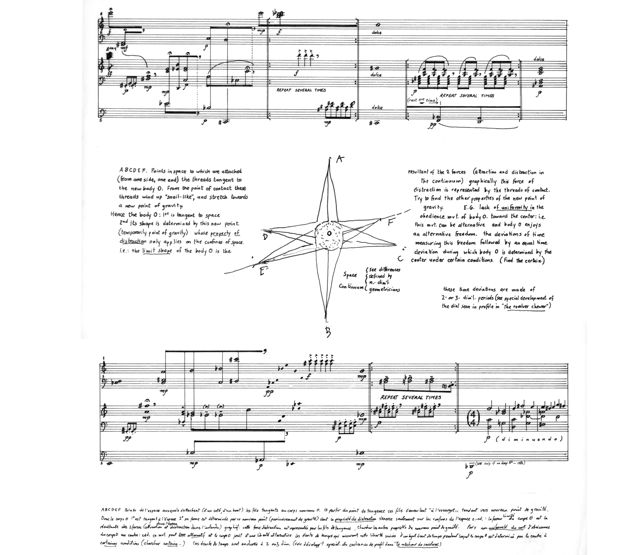
The "handler" was to influence the Bride's decisions by responding to changes in a sort of gravitational field — the details are unclear, and in any case the handler was ultimately left out of the painting. Duchamp's note is accompanied by a sketch of a six-pointed star-shape surrounding a spheroid body; the six points represent points from which threads would stretch toward the central body, defining its location and shape by their tension.
Six systems of music, each lasting about a minute, were conceived as both linear and textural analogues of these threads. The unsynchronized repetitions and reinforcements in the music was meant to represent the variations and displacements of physical bodies caused by gravitational disturbances.
Much of this was suggested by the curious rhythmic disturbances which frequently characterize organists — or, rather, their performances. The result is a rather different kind of organ writing, a sort of comporomise between standard notation and a kind of tablature; the hope is to ensure an idiomatic organ character by harnessing the little clumsinesses of the instrument.
The organist must be the central body who determines but also is subject to these disturbances — by realizing the music as accurately as possible (with respect to dynamics and pitch) while altering "rhythm" by responding to the difficulty of fingering (and footing), to the acoustical circumstances of the room, to the registration possibilities (themselves determined by octave location and dynamic), etc., etc.
Handler of Gravity was premiered in the Chapel on the campus of Mills College on March 13, 1971. I think the organist's name was Ted Ashford; I can't find any of my concert programs at the moment. (When I looked for them just now, though, I did find my good pair of glasses, missing a number of months.) I wish I had a recording of the concert: it lasted an hour or so, and involved simultaneous performances of Handler of Gravity (with someone — David Smith, I see, now I look at the score, and, yes, it was Ashford — playing the optional chimes and glockenspiel), three graphic pieces for string quartet; and occasional overlays of Bachelor Apparatus, for four pairs of trumpets and trombones (they were stationed outside the chapel).
There have been three quite different adaptations of the original score, each about eight minutes in duration:
Five Pieces after Handler of Gravity, for solo piano (premiere: Nathan Schwartz; Jan. 17 1976, Oakland Museum). Each of these pieces was provisionally dedicated to one or another of the five music critics on the three major daily newspapers in the San Francisco area at the time, since Duchamp sometimes referred to his Handler as a "Juggler of Gravity."
score: FP she03, 12 pp., available from Frog Peak Music
Tender of Gravity, for nine instruments (fl-pic, o-eh, cl-bass cl, bn, harmonium, vn, vla, vc, cb) (premiere: Irene Pruzan, Lenore Sleeter, Tom Rose, Cyrle Perry, Beth Anderson, Nathan Rubin, Ron Erickson, Teressa Adams, Jedediah Denman; 9 May 1974; 1750 Arch Street, Berkeley)
score: FP she04, 14 pp., available from Frog Peak Music
Ballet: Handler of Gravity, for full orchestra (3-2(eh)-2-2(cbn)/4-2-3-1/pno/hrp/1perc/timp/strings) (premiere: Shere, Contra Costa Symphony, Kensington, Calif., 28 Oct. 1976), as part of a compilation provisionally called Music for Orchestra). This version also stands at the end of the second act of the full-length opera The Bride Stripped Bare by Her Bachelors, Even.
score: Ear Press, 14 pp.,available from Frog Peak Music
The complete score is available as a PDF on my website, but it'll take a long time to load!
The "handler" was to influence the Bride's decisions by responding to changes in a sort of gravitational field — the details are unclear, and in any case the handler was ultimately left out of the painting. Duchamp's note is accompanied by a sketch of a six-pointed star-shape surrounding a spheroid body; the six points represent points from which threads would stretch toward the central body, defining its location and shape by their tension.
Six systems of music, each lasting about a minute, were conceived as both linear and textural analogues of these threads. The unsynchronized repetitions and reinforcements in the music was meant to represent the variations and displacements of physical bodies caused by gravitational disturbances.
Much of this was suggested by the curious rhythmic disturbances which frequently characterize organists — or, rather, their performances. The result is a rather different kind of organ writing, a sort of comporomise between standard notation and a kind of tablature; the hope is to ensure an idiomatic organ character by harnessing the little clumsinesses of the instrument.
The organist must be the central body who determines but also is subject to these disturbances — by realizing the music as accurately as possible (with respect to dynamics and pitch) while altering "rhythm" by responding to the difficulty of fingering (and footing), to the acoustical circumstances of the room, to the registration possibilities (themselves determined by octave location and dynamic), etc., etc.
Handler of Gravity was premiered in the Chapel on the campus of Mills College on March 13, 1971. I think the organist's name was Ted Ashford; I can't find any of my concert programs at the moment. (When I looked for them just now, though, I did find my good pair of glasses, missing a number of months.) I wish I had a recording of the concert: it lasted an hour or so, and involved simultaneous performances of Handler of Gravity (with someone — David Smith, I see, now I look at the score, and, yes, it was Ashford — playing the optional chimes and glockenspiel), three graphic pieces for string quartet; and occasional overlays of Bachelor Apparatus, for four pairs of trumpets and trombones (they were stationed outside the chapel).
There have been three quite different adaptations of the original score, each about eight minutes in duration:
Five Pieces after Handler of Gravity, for solo piano (premiere: Nathan Schwartz; Jan. 17 1976, Oakland Museum). Each of these pieces was provisionally dedicated to one or another of the five music critics on the three major daily newspapers in the San Francisco area at the time, since Duchamp sometimes referred to his Handler as a "Juggler of Gravity."
score: FP she03, 12 pp., available from Frog Peak Music
Tender of Gravity, for nine instruments (fl-pic, o-eh, cl-bass cl, bn, harmonium, vn, vla, vc, cb) (premiere: Irene Pruzan, Lenore Sleeter, Tom Rose, Cyrle Perry, Beth Anderson, Nathan Rubin, Ron Erickson, Teressa Adams, Jedediah Denman; 9 May 1974; 1750 Arch Street, Berkeley)
score: FP she04, 14 pp., available from Frog Peak Music
Ballet: Handler of Gravity, for full orchestra (3-2(eh)-2-2(cbn)/4-2-3-1/pno/hrp/1perc/timp/strings) (premiere: Shere, Contra Costa Symphony, Kensington, Calif., 28 Oct. 1976), as part of a compilation provisionally called Music for Orchestra). This version also stands at the end of the second act of the full-length opera The Bride Stripped Bare by Her Bachelors, Even.
score: Ear Press, 14 pp.,available from Frog Peak Music
Thursday, August 06, 2009
Recently read… four quick summertime books
The novel unrolls through the central intelligences of seven of these women, beginning with Evelyn, the only one to speak in the first person:
Mum starved herself for suffrage, Grandmother claiming it was just like Mum to take a cause too far.Immediately the reader's thrown into a group of interesting people, the more interesting because slow to be developed. Walbert's particularly good, I think, at balancing her characters and their settings — local, political, historical, psychological. Some of the characters, particularly the males, are shadowy indeed: but that doesn't make them the less present. Grandmother, particularly, while virtually never present on the scene, emerges as a strong, laconic, iconic presence.
I thought occasionally of Dorothy Richardson while reading this Short History, but I thought very often of Virginia Woolf, particularly of The Waves and The Years. (Amusingly, Dora mentions those of "V. Woolf" among her favorite books, "even the last two indecipherable ones." One of these days I must get to Between the Acts.) Walbert learned a lot from Woolf's discursive yet curiously elliptical way of covering long years of human lives, even generations, in expressive yet teasingly veiled pages.
I found the characters and the events of their lives absorbing, both for themselves and (perhaps especially) for their role in Walbert's artful historical allusions. Whether describing a late Victorian lecture hall or a beginning blogger a century later, her eye and ear seem sensitive and accurate. And there's an undercurrent of good humor here; everyone's too well grounded in the grain of daily life, privileged or not, to cultivate a drily doctrinaire view of the human condition.
There are plenty of reviews online: here, here, here, and here. All four of these correctly note the double value of the novel: as it is written, evolving through a complex of characters, settings, locales, and points of view; and for what it considers: "the woman question." That latter aspect is responsible for the online review I most enjoyed, here, because it most misses the point, ignoring the more basic matter: the novel for what it is.
Linda Hirshman writes
What happens when a history of women gets presented as a novel? Well, it finally gets such a history onto the cover of the Times Book Review. But, I would argue, something is lost. Presenting history as fiction immunizes it from just the kind of analysis and criticism women’s history desperately requires. …Though Hirshman does not really explain just what the stance is fraught with, she refers to Plato, and seems to be complaining that, being a novel, A Short History of Women cannot function honestly as history. Of course that was never Walburg's intention. Novels are not history; they simply enable us to understand the human condition within historical events.
To tell a story of five generations of women, from the hunger striking vote-seeker to the bisexual Yale freshman, is to stand next to historians of the social and political movement we call feminism, unmodified.
It is a fraught stance.
Why had I never read this before? I heard someone raving about the book on NPR a month or so ago, while driving up to Portland, and determined to read it as soon as possible. The very next day this ancient Signet paperback jumped into my hands in a used book store, and I read it the day after that, and re-read it a week or so later.
It's an amazingly beautiful book, full of striking physical description of both natural and human actions and events. Children from two families, of rather different classes, are sent home to England following terrific storms in Jamaica; they fall into the hands of pirates; ultimately they arrive safely to participate in a horrific trial.
Hughes seems to me to have discovered exactly the nature of the child's mind. Not the adolescent's: the child's. It is a strange and scary thing, strange because we rarely think much about it, scary because it is the kernel of our adult mind. I won't say more about this, except that it would be very nice indeed to spend an evening in the company of Richard Hughes and Robert Louis Stevenson.
Here's a delight, a sparkling, breezy book full of wisdom and humor, in a nice small package, with Pat McFarlin's hilariously accurate and insouciant drawings. The author's voice comes through so true and characteristic that you never doubt the accuracy of her interviews and quotes, and she records the confessions of a fascinating number of people.
They simply tell us what they eat when they eat alone. It's not what you might think. True, some — especially men — seem to take the easy way out: a sardine sandwich, say, accented with a bit of lemon juice; or fried polenta and cheese. Or fried cheese without the polenta. Others, though, cook imaginative and sometimes fairly complex dishes, perhaps returning to them for several consecutive meals.
Madison has two agendas here: to entertain and instruct her readers with workable recipes for dishes one might not think of otherwise; but also to investigate the resourcefulness and, through that, the human nature of the lucky friends who warm to her queries. There's more than a little philosophy and psychology here, but there's nothing dry or theoretical. As I said: a delight.
I'll call him David: like Deborah Madison and Patrick McFarlin, he's a friend, and it's hard to stick to the professional surname style. David is a very funny man, and has grown over the years, through a number of books, to be an admirable writer. In this book he deals with more than just the food, though he does that very well indeed: he investigates his adopted city and its natives, their manners and methods, above all the insights into things more profound or complex that develop out of chance and trivial encounters.
There's a bit of Connecticut Yankee as Innocent Abroad here, though you'd never think of Mark Twain while actually reading Lebovitz. The history-fraught layers Paris imposes on the simplest transactions, so foreign and "indecipherable" to the caricature American tourist, really begin to divulge themselves on closer (and longer) acquaintance, and this book gives Paris and Parisians credit and respect for the subtlety, complexity, and above all pure quality of the delights they offer.
In short, more to this book than appears on its surface — yet a quick and very entertaining read. Everyone I know who's read it has been delighted with it. Me too.
Monday, July 27, 2009
Yet another obituary
MICHAEL STEINBERG 1929-2009 Michael Steinberg, music critic and musicologist, died yesterday, peacefully a mutual friend tells me, in hospice, in Edina, Minnesota, of cancer; he was eighty years old. He was a thoughtful, intelligent, rather good-humored man, was my impression. I didn't know him well.
I have seen only two obituaries so far, one by Mark Swed in the Los Angeles Times, available online here; the other by Keith Powers, in the Boston Herald, here.
Born in Breslau, Steinberg came to the United States by way of England, one of the fortunate Jewish children saved from the Third Reich by the Kindertransport. To me he was a New Englander with a core that was consummately European, even German. He was careful, even impeccable in thought and speech, quick to observe, eager to consider, a little slower to conclude, almost reluctant to announce the inevitably resulting opinion.
Mark Swed mentions me in his obituary, and I want to set his mention in context. I met Steinberg in August 1975 at Tanglewood, where I was participating in a workshop got up by the Music Critics Association for the improvement of young critics. Just a couple weeks shy of my fortieth birthday, I shouldn't have been there, though I had in fact been writing daily music criticism only a couple of years at the time. The workshop was run by Bernard Rosenberg, who writes about it a little bit here; it was only when I find his citation online while writing this that I recall other "teachers" in the conference included Robert Morgan, David Hamilton, and Ray Blount.
After the sessions we generally repaired to a local bar to continue talk in a less formal setting, and there I felt free to converse on equal footings over brandy-and-sodas. (It was very warm; but I've never liked gin-and-tonics after sundown.) And it was at one of those sessions that … but let Steinberg tell the story himself:
I liked Michael Steinberg as a person and respected him as a scholar and a writer. The paragraph I quote above is characteristic. His intelligence, thoughtfulness, and intuitive fair-mindedness were always present in his work, and he was always able to grow beyond his formative "normatives," and that is rare and admirable.
I have seen only two obituaries so far, one by Mark Swed in the Los Angeles Times, available online here; the other by Keith Powers, in the Boston Herald, here.
Born in Breslau, Steinberg came to the United States by way of England, one of the fortunate Jewish children saved from the Third Reich by the Kindertransport. To me he was a New Englander with a core that was consummately European, even German. He was careful, even impeccable in thought and speech, quick to observe, eager to consider, a little slower to conclude, almost reluctant to announce the inevitably resulting opinion.
Mark Swed mentions me in his obituary, and I want to set his mention in context. I met Steinberg in August 1975 at Tanglewood, where I was participating in a workshop got up by the Music Critics Association for the improvement of young critics. Just a couple weeks shy of my fortieth birthday, I shouldn't have been there, though I had in fact been writing daily music criticism only a couple of years at the time. The workshop was run by Bernard Rosenberg, who writes about it a little bit here; it was only when I find his citation online while writing this that I recall other "teachers" in the conference included Robert Morgan, David Hamilton, and Ray Blount.
After the sessions we generally repaired to a local bar to continue talk in a less formal setting, and there I felt free to converse on equal footings over brandy-and-sodas. (It was very warm; but I've never liked gin-and-tonics after sundown.) And it was at one of those sessions that … but let Steinberg tell the story himself:
That's an awfully damn East Coast thing to say!" That scornful remark was addressed to me by the composer and writer Charles Shere. I no longer remember what terrible thing I had said that elicited Shere's words. I do remember that he spoke them at Tanglewood in the summer of 1974 [sic] at a workshop on music criticism and that it came as a shock to me that there could be an "East Coast thing to say" or, by obvious inference, a "West Coast thing." I was the Boston Globe's music critic then, and we on the East Coast though of our "thing" as central and normative, and of everything else as eccentric and peripheral.Steinberg printed that as the lead paragraph in a program note to performances of music by Lou Harrison by the San Francisco Symphony; it is reprinted in the compilation For the Love of Music, available here. Presumably this is where Mark Swed found the reference he alludes to in his obituary. The error of date — "1974" for "1975" — is Steinberg's error, uncharacteristic but significant, for by 1975 he was no longer a music critic for the Boston Globe.
I liked Michael Steinberg as a person and respected him as a scholar and a writer. The paragraph I quote above is characteristic. His intelligence, thoughtfulness, and intuitive fair-mindedness were always present in his work, and he was always able to grow beyond his formative "normatives," and that is rare and admirable.
Merce Cunningham 1919-2009
IT IS VERY SAD to hear about the death of Merce Cunningham, surely one of the most remarkable men I ever had the pleasure to meet. What I associate with him, what characterized him most of all to my eye, was the best qualities of humanity: Intelligence, Strength, Grace, Humor, and Invention. He was observant, quick, disciplined, and dedicated. He made great demands, seemed unfailingly courteous, and had that strange ego that is fundamentally egoless, because while aware of his own agenda and skills in meeting that agenda he could simultaneously stand outside it looking on.
I only met him a few times over the last twenty years or so, but he always seemed to recognize me and to be ready, even willing I hope, to continue a conversation. I was drawn to him of course via his companion John Cage, who I knew somewhat better because we were both interested in sounds and silences, a musician's parallel to the movements and stillnesses of a dancer. My memories of their apartment in New York fasten on a number of details: Merce's drawings are among the most persistent.
We were lucky to see a number of pieces of Merce's, mostly thanks to his many appearances in Berkeley, sponsored by Cal Performances. Biped, premiered ten years ago (how can it have been so long ago?), was a superb late piece, both nostalgic and forward-looking. Even more lasting is the impression of Ocean, which we saw in its Berkeley premiere in 1994, and which I then had the privilege of seeing three times running in New York the following year: a two-hour piece full of surprise, familiarity, certainty and unpredictability.
His choreography always seemed to me to duplicate the ultimately unknowable motion of Life. Unknowable, I mean, in that while the physical qualities that facilitate that motion can be seen, studied, understood, and discussed, the inherent questions of purpose and origin and meaning always remain both ineffable and enigmatic.
To that extent Cunningham was, like so many of the great Modernists of the 20th century, a moral philosopher. I see in both the man and his work a Modernist, but also a Romantic and a Classicist. The cliché is always that there are not many left like him: but then, there never were.
I only met him a few times over the last twenty years or so, but he always seemed to recognize me and to be ready, even willing I hope, to continue a conversation. I was drawn to him of course via his companion John Cage, who I knew somewhat better because we were both interested in sounds and silences, a musician's parallel to the movements and stillnesses of a dancer. My memories of their apartment in New York fasten on a number of details: Merce's drawings are among the most persistent.
We were lucky to see a number of pieces of Merce's, mostly thanks to his many appearances in Berkeley, sponsored by Cal Performances. Biped, premiered ten years ago (how can it have been so long ago?), was a superb late piece, both nostalgic and forward-looking. Even more lasting is the impression of Ocean, which we saw in its Berkeley premiere in 1994, and which I then had the privilege of seeing three times running in New York the following year: a two-hour piece full of surprise, familiarity, certainty and unpredictability.
His choreography always seemed to me to duplicate the ultimately unknowable motion of Life. Unknowable, I mean, in that while the physical qualities that facilitate that motion can be seen, studied, understood, and discussed, the inherent questions of purpose and origin and meaning always remain both ineffable and enigmatic.
To that extent Cunningham was, like so many of the great Modernists of the 20th century, a moral philosopher. I see in both the man and his work a Modernist, but also a Romantic and a Classicist. The cliché is always that there are not many left like him: but then, there never were.
Sunday, July 12, 2009
Farm in town
Portland, July 10—
I DON'T KNOW WHEN I've enjoyed meeting a new writer so much. Novella Carpenter's book Farm City is a complete success on so many levels. Carpenter's a born writer: fast and accurate eyes, ears, fingers; well-read; a great sense of prose rhythm and structural rhythm; smart and sassy. Her book is very funny, talks straight, and gathers as it goes.
She started gardening on a vacant lot in Oakland, California, thankful for the benign climate after moving down from Seattle, and one thing led to another. The progression's outlined in the titles of the three sections of this book: Turkeys. Rabbits. Pigs.
With livestock, and one other thing, a garden moves into a farm. Not effortlessly: the effort's a big part of the story. But, apparently, inevitably. The one other thing is transactions: it's not really a farm until the produce leaves the property. One gardens for one's own self and famiily; one farms for others, for barter or possibly profit.
Or, perhaps, out of a kind of mania, a benign mania, an obsession with the ethic of Right Living. Her story unfolds artfully and easily in this oddly graceful book, graceful in spite of plain language my grandmother would have found quite offensive. One of the themes of the book is the author's relationship with her mother, a hippie who'd dropped out with her boyfriend and lived the country life a few years. Novella Carpenter hadn't planned on following those footsteps at all, but early influences are deep.
Another theme is the unlikely setting of this city farm: the Oakland "ghetto." The reader meets dopers, Buddhist monks, the homeless, and poor folks of various ethnic backgrounds just getting by. There are times this book makes you think of John Steinbeck's Cannery Row or Robert Nathan's One More Spring: there's the same curious optimism, even light-heartedness, that can emerge from urban poverty, which develops its own community, even courtesy and mutual assistance.
I read this morning in Robert Reich's blog that there will be no recovery from the present recession will never come:
All we know is the current economy can't "recover" because it can't go back to where it was before the crash. So instead of asking when the recovery will start, we should be asking when and how the new economy will begin.Part of the new economy will undoubtedly look like what Carpenter develops on her urban farm. I see this already in my own family: a son with a feed store, raising cattle, helping his community with lumbering and such; a daughter whose neighbors are trading vegetables and raising chickens.
The best thing about Farm City is precisely this optimism growing out of despair, the strength of human competence when the cultural assumptions that have made so much go wrong are simply ignored or circumvented. It's all so damn reasonable, raising chickens and rabbits and carrots and beans, getting on with basic matters and ignoring commercial snares and temptations.
The next best things about the book are its boundless humor and teeming texture. There's so much happening in this life, so many details, so much to interest us, to intrigue the eye that suddenly observes an unexpected or incongruous detail. Carpenter celebrates urban life while reclaiming it for daily pleasures.
The reader gets the feeling that she has grown, matured, and achieved a kind of grace not only from her farming but also from her writing. The final chapters are quite moving: she observes the workings of a Berkeley restaurant which, earlier in the book, she might have written off as simply precious.
Maybe I've read too much Anthony Bourdain, but I had imagined that the back of a restaurant would be a crude, uncivilized place. I expected to get groped, not high-fived. Everyone who passed through this kitchen seemed intelligent and kind.Vegetarians will likely be unhappy with Farm City. The education of Novella Carpenter, as an urban farmer but beyond that too, involved her coming to terms with the necessary killing of the meat she eats. She's not unrespectful of vegetarians; she describes a number of encounters with them in perfectly sympathetic terms. But it is not her way, and it has not been the normal way of human activity. A critical part of her book, a running theme, concerns the conscious, conscientious address to the ethical problem of killing and eating animals.
I think it's the focus, respect, and dedication she finds in Christopher Lee's kitchen that finally nails down these ethical questions.
In his book About Looking, John Berger wrote, "A peasant becomes fond of his pig and is glad to salt away its pork. What is significant, and is so difficult for the urban stranger to understand, is that the two statements in that sentence are connected by an 'and' and not by a 'but'." I felt well on my way to peasantdom. But I needed Chris to teach me more…Chris did indeed teach her more. I myself know Chris Lee well enough to know how remarkably well Novella Carpenter observes, grasps, understands, and describes him: it isn't easy to capture the looks, sound, and character of a living person this accurately and sympathetically.
But the thing is, Novella Carpenter is patient, well read, and thoughtful. She gardens her mind and history the way she farms, with the kind of passion that springs as much from dedication as desire. She writes, toward the end of her book,
While rooting around the history of prosciutto making, I had stumbled upon this quote from Pliny the Elder… about Epicurus, the famous Greek hedonist: "That connoisseur in the enjoyment of life of ease was the first to lay out a garden at Athens; up to his time it had never been though of to dwell in the country in the middle of town." … That an urban farmer existed before Christ made me feel like I was—that we all were—merely repeating the same motions that all humans had gone through, that nothing was truly new. This insight gave me a sense of peace.Epicurus of course was no mere hedonist; he was a philosopher, profound because realistically involved with the pleasures and problems of daily life. Novella Carpenter is much the same.
Farm City: The Education of an Urban Farmer
By Novella Carpenter.
276 pages. The Penguin Press. $25.95.
Friday, June 26, 2009
Phèdre
Eastside Road, Healdsburg, June 25, 2009—
NEARLY THREE YEARS AGO I wrote here about a production of Jean Racine's magnificent tragedy Phèdre, which we'd just seen in Glendale, performed by the repertory company A Noise Within. Tonight we saw a very different edition, a performance by London's National Theatre, filmed for "live" broadcast into cinemas. (In fact it was billed as "live capture": the actual performance was given in London earlier today.)This was a very different take on the play, using a rather talky, prose translation by Ted Hughes where NW had given it in Richard Wilbur's remarkable poetic translation, more faithful to Racine's French I think and certainly more evocative. Leaving aside for the moment the differences between live theater in a house and filmed theater on a screen, the NT production seemed not Greek or French but English; not fateful but relentless; not tragic but dramatic.
It is a favorite play of mine: but it is disgusting. Disgusting not so much because of its subject, incest, but because of its vehicle, maniacal obsession. Disgusting and extremely troubling, because Racine doubles the stark immediacy inherent in the original Euripides tragedy. This play is about the extent to which our human lives can be overtaken by the emotions we're all prey to. Euripides was arguably among the first generations of humans consciously aware of these matters, not merely existentially inflamed by them. If Myth has among its sources and utilities the explanation of perplexing phenomena, Greek tragedy is the poetic elevation of Myth, through individual creative (and intuitive) genius.
Euripides was First Generation, you might say. (Well, Aeschylus was a little ahead of him.) His tragedy Hippolytus, which I confess I don't know, is about the title character's unnatural commitment to chastity; his stepmother Phaedra plays a relatively small role in the action, if not in the subject of the play. Racine's version reverses this authorial position, fixing on Phedre's obsession as the real center of the tragedy.
You can argue that the central theme of the Greek mythology as we know it is concerned with reproduction, with the urge and the need of individuals to obey a natural commandment to reproduce the species. The issue is issue, you might say; the individual will to defeat death by living on in subsequent generations; and in the case of the excessively egomaniacal (as we would say today) the drive extends not only progressively, into the future, but also laterally, spilling beyond the confines of the individual to assert dominion within all of society.
At the time of Pericles this drive was being examined primarily as it involves a social (and, inescapably, historical) context, beginning tribally, then moving into a more complex and codified political structure. To attend to the Theseus story-line is to study uneasy neighbor kingdoms: Troezen, Crete, Athens. By Racine's time the political implications cannot be questioned outright; Racine's king, Louis XIV, was divinely ordained. (Phedre's grandfather was the Sun; Louis XIV was the Sun King.) Racine examines the Theseus-Phaedra-Hippolytus story from the point of view of individual obsession, not familial succession.
Racine's play squarely mediates, I think, between an almost archaic classicism, fully aware and respectful of his ancient Greek sources, and the incipient romanticism of his own day, a century before the French Revolution. We don't yet see, in Racine's play, the possible sources and resolutions of Phedre's severe psychological disturbance, but we are continually assaulted by its presence. And in this Racine puts his audience squarely within his heroine's quandary: in good hands — translation, direction, and acting — we are inevitably thrust into identification with her.
This is Racine's violation of Aristotle's outline of tragedy: identifying with Phedre, we find no catharsis. We don't leave the play purged of tragic flaw; we leave still reeling from the injustice (to use a pathetic term) of the tragic situation inevitably accompanying Phedre's obsession. The Greeks of Phaedra's day were right, in a sense, to give up the attempt to understand these things, whose sources were simply attributed to willful and inherently ineffable natural urges, tides one might say, personified as Aphrodite or Poseidon or Zeus.
All this said, what of the National Theatre production?
I came away of two minds — three, actually. As to acting, direction, and physical production, with one important reservation, I was quite persuaded. Helen Mirren is a remarkable Phedre, somehow (partly perhaps through Nicholas Hytner's direction), bringing Racine's tragic heroine somehow closer to one of Ingmar Bergman's. I wasn't quite so persuaded by Margaret Tyzack's performance as Phedre's nurse, Oenone; there was something a little too automatic in it, too much residue of Juliet's nurse, let's say. Dominic Cooper managed to personify the young, strong, proud Hippolytus, especially as bewildered by the first pangs of love; and Ruth Negga was his equal as Aricia: this was a beautifully balanced pair of tragic young lovers; one wants to see their Romeo and Juliet.
John Shrapnel played Theramene; he should have been cast as Theseus. He was complex, interesting, subtle, as remarkable in his silences as in his lines. Stanley Townsend, who did play Theseus, seemed to me all bluster and boredom by comparison. But with his single exception the cast rallied to what may have been an exceptional challenge, playing simultaneously to the 900-seat National Theater and to the cameras and microphones bringing them much larger than life to the international closed-circuit audiences.
In the end, I don't think I saw legitimate theater. The performance may have been real-time, but on the screen, whether in close-up or depicted on the full stage, the look of the characters is flat. Further, there's a confused sense of audience: you're aware of the live theater audience, but much more aware of the real people around you in the cinema. Worse yet, you're aware the actors are completely unaware of you: you're eavesdropping on a theatrical dialogue between actors and their own, real audience, more privileged because actually present before the stage.
(This quality is exacerbated by certain sonic problems: the microphones drop away when charactes turn their backs; and the actors' suppression of sibilants, especially final sibilants, occasionally produces a curious lisp probably unnoticed by the live audience. "Theseuth," one hears, too often.)
Worst of all, to my mind, was the effect of Ted Hughes's free-verse translation. It had two negative results: bringing the vocabulary and vocal expression to an informal (though relatively heightened) contemporary context, it simplified and even trivialized Racine's intent, sometimes producing inappropriate laughter in the audience.
It also made the production uniquely British. The English language is now universal, and in our time if Greek or French is to be translated into English it seems to me the reason should be to render it accessible internationally. I suppose you could argue that Racine frenchifies Euripides, but I don't believe it: and to the extent that he does, he does in order to point out the parallels and dissonances between the Greek and French contexts of his story. Hughes seems simply to make a naturalized British subject of his Phedre, though he retains the French spelling of her name — minus, in more ways than one, her accent grave.
Thursday, June 25, 2009
Squeak Carnwath
Eastside Road, Healdsburg, June 25, 2009—
FOR A NUMBER OF YEARS now I've been enjoying (inadequate word, that) the painting of the Oakland artist Squeak Carnwath. She's squarely within the Bay Area tradition of painting; if you know that painting over the last forty years you'll see how she fits in. 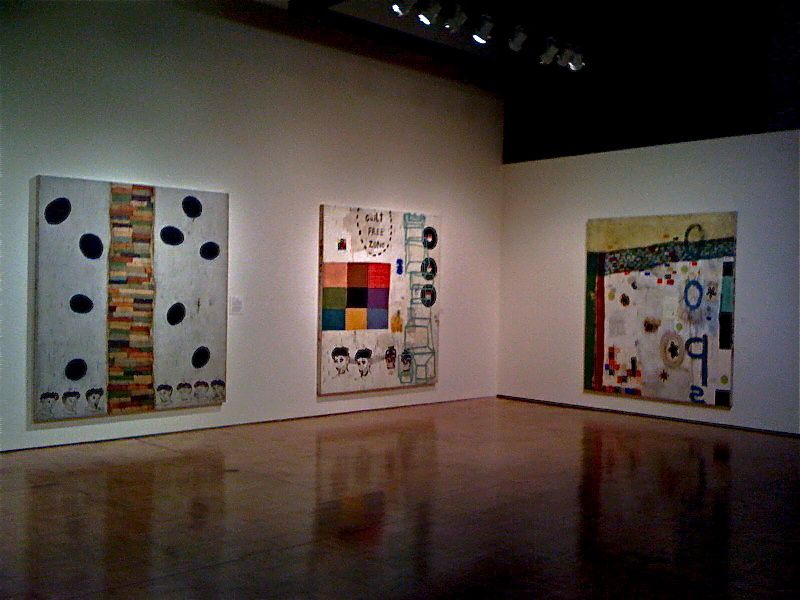
Right now she has a big show up at the Oakland Museum of California, forty big paintings or so, beautifully installed in the capacious Great Hall, handsomely lit, well separated from one another but close enough to converse.
At lunch after seeing the show we mentioned it to a friend, who asked, reasonably enough, what Squeak's painting is like. Um, well. Like all good mature painters she has her recognizable style: you can't miss it. But what is it? You can place her in that tradition I mention above, narrowing in by calling the roll of the Bay Area painters she clearly has affinities with, some well known, others not: William Wiley, Ciel Bergman, Pia Stern, Inez Storer, Phil Linhares, …
She has a repertory of visual devices that recur from canvas to canvas: an outline standing rabbit, a Greek urn, black LP records, tally-marks, color samples. The paintings are big, five feet square and bigger; and many have light-colored grounds, whites inflected more by texture than shading, with these devices pushing forward, sometimes small, sometimes dominating almost the entire painting.

Squeak Carnwath, Stolen Borrowed, 2004. Oil and alkyd on canvas over panel, 195.6 x 195.6 cm (77 x 77 in.).
Collection of the artist, courtesy of Nielsen Gallery, Boston, MA. © Squeak Carnwath/Licensed by VAGA, New York, NY.
Collection of the artist, courtesy of Nielsen Gallery, Boston, MA. © Squeak Carnwath/Licensed by VAGA, New York, NY.
Above all her canvases tend to incorporate counted numerals — 1, 2, 3, 4, … — and the (hand-)written word, often phrases or titles or whole sentences, sometimes perhaps overheard from a radio program playing in the studio as she works, or jumping off the page of a newspaper.
Now and then a painting will be muted, in grays or grayed beiges; but most often the colors are bold: primaries, secondaries.
She sounds like Ray Saunders, our friend said over her lunch. Well, yes, I can see that, Saunders belongs to this group too: but Squeak Carnwath paints, I think, though I know it's politically incorrect to say so, with a woman's intelligence and sensibility. This is dangerous ground because so often we react to the classification implied by the statement, rather than the characterization that I mean.
What I like about Squeak's painting is its contemplativeness, the depth of its understanding, the range of its vision, the faithfulness of its address. I feel comfortable with her and her work, both because and in a way despite its depth and intelligence and immense sympathy. I continually refer to her here by her first name precisely because I am comfortable with her; and while I know she sees more, probably knows more, and certainly paints better than I ever could, there's nothing daunting in that.
Painting like hers goes beyond the question of Abstraction or Representation. Her canvases are arrangements of emblems, two-dimensional visible things that stand for something or suggest or recall something. It fascinates me that among the earliest modern paintings of this sort is Marcel Duchamp's enigmatic Tu m’; much of the apparently philosophical content of Dada grows out of this approach.
(Though the 19th-century fool-the-eye paintings of, for example, John Peto announce this development in visual art; and I suppose certain elements of Dutch still-life painting play into it.)
You pour yourself into these paintings of Squeak's, taking them in entire in their balanced compositions, inflected as they are by apparently quick gestures and decisions. You count off their numerals and tallies, read their words and phrases. (Many of them have their titles painted on their thick edges, which advertise them, in a way, as you approach them.)
Then you move in if you like, examining the surfaces close too; I like to do this looking with one eye through a cupped-hand framer, as if I were flying close over an absorbing terrain, enjoying improbable juxtapositions of isolated complex colors. At one point I found myself dancing backward away from a canvas, still looking at it with one eye, whirling slowly to find the other canvases moving into view, assuming new relationships. This gallery should be a ballroom; the music would be profound and enchanting, and the dance exhilarating and refreshing.
Squeak's paintings are important. They carry meaning and experience. Seeing them, imagining the dedication and skill and humility that creates them, you're reassured: none of us experience our Human Condition alone; we all confront life and death, joy and sorrow, awareness and perplexity. When one of us, doing all that, can record those confrontations with such humor, intelligence, and beauty, she does it for each of us, for all of us. I for one am profoundly grateful.
• Squeak Carnwath: Painting Is No Ordinary Object :
The Oakland Museum of California, 1000 Oak St.; tel. 510/238-2022
Wednesday through Saturday, 10 a.m. to 5 p.m; Sunday, noon to 5 p.m.,
through Aug. 23
Sunday, June 21, 2009
Chekhov
THE MODERN THEATER BEGINS with Chekhov, say I. By Modern Theater I mean theater that primarily addresses the modern condition, which puts us in a constant triangulation of self, society, and history. Well, The Modern Theater begins with The Winter's Tale, of course; it only resumes with Chekhov: but it resumes after so long a stretch — since the French Baroque theater, writing and thinking here off the top of my head — that it's virtually a new beginning.
Last night we went to Santa Rosa, a twenty-minute drive, to see three one-act plays of Chekhov's: On the Injuriousness of Tobacco; A Tragic Man Despite Himself; The Proposal, produced by The Imaginists in their loft-style theater — no proscenium, wings, or backstage.
These short plays make me think of so much early-20th-century work: Gertrude Stein's chamber plays, the short stories of Saki, the experimental one- and two-page fictions of Virginia Woolf. Chekhov positions himself between the concrete realism of narrative and the abstract pointlessness — well, apparent pointlessness — of the Theater of the Absurd.
I love his great full-length plays: The Sea-gull; The Three Sisters; Uncle Vanya; The Cherry Orchard. They are marvelous examples of scale and proportion. But these shorter plays are just as carefully proportioned, but tense and alarming in their quick jumps and alternations. They're extremely psychological, of course; more so perhaps than the more extensive, conversational three-act plays.
A curiously determinate, even fateful number-scheme underlay the Imaginists' presentation On the Injuriousness of Tobacco is a monologue portraying an anxious lecturer; A Tragic Man Despite Himself is a two-man play; The Proposal adds an actress to the number.
Brent Lindsay was brilliant in all three vehicles, with perfect control of pitch, facial expression, body language, timing, and voice: I don't see how anyone could have done any of it better.
Eliot Fintushel was nearly his match in the supporting roles in the other two plays, and Tessa Rissacher was marvelous as the canny, down-to-earth would-be bride of The Proposal, an early play (1889) that lifts farce toward the 20th-century Absurdists.
Staged in a neutral space, directed with style and enterprise by Amy Pinto, the production repeats June 25, 26, and 27 at 8 pm, and we're going back: it was that good.
The Imaginists Theatre Collective , 461 Sebastopol Ave., Santa Rosa; tel. 707-528-7554; www.theimaginists.org
Green Integer has published these texts in George Malko's translation, which is the version used by The Imaginists; the web page linked here describes the publication and offers a review, by John Stokes (originally run in TLS), with interesting comments on On the Injuriousness of Tobacco, which Chekhov revised five times and completed only in 1902, the year of Uncle Vanya.
Last night we went to Santa Rosa, a twenty-minute drive, to see three one-act plays of Chekhov's: On the Injuriousness of Tobacco; A Tragic Man Despite Himself; The Proposal, produced by The Imaginists in their loft-style theater — no proscenium, wings, or backstage.
These short plays make me think of so much early-20th-century work: Gertrude Stein's chamber plays, the short stories of Saki, the experimental one- and two-page fictions of Virginia Woolf. Chekhov positions himself between the concrete realism of narrative and the abstract pointlessness — well, apparent pointlessness — of the Theater of the Absurd.
I love his great full-length plays: The Sea-gull; The Three Sisters; Uncle Vanya; The Cherry Orchard. They are marvelous examples of scale and proportion. But these shorter plays are just as carefully proportioned, but tense and alarming in their quick jumps and alternations. They're extremely psychological, of course; more so perhaps than the more extensive, conversational three-act plays.
A curiously determinate, even fateful number-scheme underlay the Imaginists' presentation On the Injuriousness of Tobacco is a monologue portraying an anxious lecturer; A Tragic Man Despite Himself is a two-man play; The Proposal adds an actress to the number.
Brent Lindsay was brilliant in all three vehicles, with perfect control of pitch, facial expression, body language, timing, and voice: I don't see how anyone could have done any of it better.
Eliot Fintushel was nearly his match in the supporting roles in the other two plays, and Tessa Rissacher was marvelous as the canny, down-to-earth would-be bride of The Proposal, an early play (1889) that lifts farce toward the 20th-century Absurdists.
Staged in a neutral space, directed with style and enterprise by Amy Pinto, the production repeats June 25, 26, and 27 at 8 pm, and we're going back: it was that good.
Green Integer has published these texts in George Malko's translation, which is the version used by The Imaginists; the web page linked here describes the publication and offers a review, by John Stokes (originally run in TLS), with interesting comments on On the Injuriousness of Tobacco, which Chekhov revised five times and completed only in 1902, the year of Uncle Vanya.
Tuesday, May 05, 2009
Taming the Shrew
Eastside Road, Healdsburg, May 5—
AND WHAT OF the last of the three plays we saw over the weekend in Glendale? Well, treated reasonably decently, Shakespeare's Shrew-taming can't really fail, and while Geof Elliott's direction went over the top now and then, and while the vocal delivery annoyed me if not the rest of the audience with its occasional alternation of chant, shout, and whisper, there was a lot to like about this production.
Elliott transposed the time to the mid-20th century, leaving the action in Padua. There were bicycles, radios, and the chewing of gum. Costumes were what-you-can-find and hilarious: when Vincentio turns up, in the reasonable, comprehending person of William Dennis Hunt, he's wearing plus fours, as if he'd gone golfing in the 1930s and hadn't been able to change clothes since.
The play rides or falls from its lead couple, of course, and they were fine: Steve Weingartner a resourceful, mercurial Petruchio; Allegra Fulton a mean-tempered, lanternjawed Kate. Both seemed to me more fully thought-out individuals than is often the case: these were people you cared about and were interested in, not simply funny characters in a predictable tussle. The rest of the cast was quite sound, well up to the principals; I particularly liked Jane Noseworthy's fleshed-out, put-upon Bianca; but the speed of the action and the occasional indistinctness of the lines made them more of a jumble than is necessarily the case.
What I particularly liked about Elliott's direction was the parallels it drew between Shakespeare and commedia dell'arte, suggested but never belabored; and occasonal flashes of revelation — Vincentio foretells Prospero: who'd ever noticed that before?
A Noise Within has one season left in its present theater; then, if all goes well, it moves into a brand-new installation in Pasadena. It's been in its present location for a number of years; we've been seeing nearly all its plays since 2001. Over those seasons it's reminded me of the Michael Leibert's Berkeley Repertory Theater, the company that played in improvised digs up on College Avenue, making marvelous theater out of poverty and enthusiasm and intelligence.
This season was, I think, the best yet for NW. Hamlet, The Rainmaker, Oliver Twist; Ghosts, The Rehearsal, The Taming of the Shrew: fine balance between familiar and unusual but all classical, tested, beautifully thought-out and developed, and presented by casts with real sense of ensemble. I look forward to next season.
The Taming of the Shrew, by William Shakespeare, directed by Geoff Elliott. Lucentio: Antonie Knoppers; Tranio: Jeremy Rabb; Baptista: Apollo Dukakis; Gremio: Tom Fitzpatrick; Kate: Allegra Fulton; Bianca: Jane Noseworthy; Hortensio: Stephen Rockwell; Biondello: Tim Venable; Petruchio: Steve Weingartner; Grumio: Alan Blumenfeld; Curtis: Andy Steadman; Pedant: Mitchell Edmonds; Vincentio: William Dennis Hunt (also a hilarious Tailor). Repeats May 6, 7, 16, 17.
Sunday, May 03, 2009
Anouilh: The Rehearsal
Glendale, May 3—
I'VE BEEN THINKING all day about last night's play, The Rehearsal, translated from Jean Anouilh's La Répétition ou l'Amour puni by Pamela Johnson and Kitty Black and produced, very well indeed, at A Noise Within.
As I mentioned yesterday, that company, resident here, doesn't ignore the French classics: I think we've seen one every year for the last nine years. I'm extremely grateful for that: in ignoring the theater of other languages we Americans reinforce our tendency to cultural insularity. And these plays are important, not only for themselves but also for the conversation they strike up with other pieces. I've been thinking today of the conversation between The Rehearsal and Friday night's play, Ibsen's Ghosts. I'm sure they were chosen for that complementarity; it even fits Anouilh's basic concept in The Rehearsal, a concept I think of as characteristically French, that of double.
Anouilh himself plays off a much earlier theater piece, Marivaux's La Double Inconstance, which concerns a clash of classes more familiar to Americans perhaps via the Zerlina-Masetto subplot in Mozart's opera Don Giovanni. In all these vehicles a girl from the lower classes is toyed with by a nobleman: by the time the story reaches Anouilh, the Count, "Tiger," actually falls in love with his Lucile, hired to look after a dozen orphans (mercifully never on stage), precipitating serious consequences for his wife, his mistress, and most seriously of all his old friend Hero.
The play is long, talky, and complex, with the characters always in 18th-century French costume (since they're preparing an amateur production of the Marivaux play) and alternating between being themselves — wooden and arch enough, since they're mostly unoccupied and decadent anciens riches — and acting the Marivaux roles. But Julia Rodriguez-Elliott's direction is patient and thoughtful, guiding the audience as well as her cast through Anouilh's difficulties, and the cast is splendid.
The play is full of symmetries: the Countess and the Count's mistress are doubles; the Count and his friend Hero are doubles; and the relationships cross and parallel in delightfully complicated ways. It wasn't until today, though, that I saw that the ingenue Lucile, who seems to have no counterpart in the play, is the double of Regina, the maid in Ibsen's Ghosts. This made me see the similarity of Hero and Engstrand, both of whom cynically drive the action of their respective plots; and of Tiger and Pastor Manders, both of whom have to confront sudden awareness of hitherto repressed or unsuspected emotions.
Seeing plays in repertory like this provides unsuspected insights; we're lucky there are companies like A Noise Within and the Oregon Shakespeare Festival to provide them.
The Rehearsal, by Jean Anouilh, directed by Julia Rodriguez-Eliot. Damiens: Mitchell Edmonds; Countess: Susan Angelo; Tiger: Robertson Dean; Hortensia: Jill Hill; Hero: Geoff Elliott; Villebosse: Steve Coombs; Lucile: Lenne Klingaman.
Repeats through May 24.
Saturday, May 02, 2009
The Relevance of Ibsen
Glendale, May 2—
HERE WE ARE in Glendale again, on a semiannual visit to see theater. The resident repertory company, A Noise Within, is worth the daylong drive; if you time it right, as we try always to do, you can see half the season's offerings in just a few days. There are plenty of cheap motels to stay in, and the food, well, see Eating Every Day.
A Noise Within sticks pretty well to the classics, which doesn't mean necessarily the predictable: these classics include French and Italian plays as well as Russian and Norwegian and, of course, English; and American "classics" extend as far as The Rainmaker (N. Richard Nash), seen last fall (along with Hamlet and Neil Bartlett's adaptation of Oliver Twist. Comments on those plays here).
Last night we saw Henrik Ibsen's Ghosts in a remarkable production. Even after having seen four exceptionally good productions a couple of weeks ago in Ashland, Ghosts was outstanding. The cast was beautifully balanced, exceptionally even, bringing depth and detail to the characters; the physical production was thoughtful and evocative; and Michael Murray's direction was straightforward but aware of the extended layers of the play.
(Murray adapted the text, according to the program; I haven't checked against the standard Archer translation (available online here); but the lines were convincing and the narrative clear.)
The "extended layers" just mentioned seem often to escape reviewers and even actors, to judge by online reviews and the comments of the cast and audience in a productive Q&A following last night's performance. Ghosts is "about" the usual Ibsen catalog: social hypocrisy, the oppression of women, the injustice of social classes, anomie, repression and rebellion. How could such a catalog not be relevant today?
And in Ghosts the narrative is driven by a disease (never specified) inherited by a young artist from his debauched father, dead these ten years: how could that not be relevant?
The genius of the classical theater is its embodiment of universal situations — the human condition — in individuated characters so detailed and interesting as to seem familiar, as if recreations of people we might know personally in our own daily life. Ibsen is often called the father of modern theater but he seems to me a better candidate for one of the last of the classics as well: a transitional figure, in fact, who recognizes the changes of his own time, toward the end of the 19th century — the dawn of Modernism — as a legitimate, understated, collective and invisible character in the cast of every play he wrote. (Peer Gynt excepted, perhaps, as his one truly modern play.)
It's unjust to single out any one actor from this unusually strong cast: they all bring physicality, voice, and intelligence to their roles. Their brilliance, technical and intellectual, individually and in ensemble, reveals the depth and complexity of Ibsen's play. This was an exceptional evening in the theater.
Ghosts, by Henrik Ibsen, adapted and directed by Michael Murray. Regina: Jaimi Paige; Engstrand: Mark Bramhall; Pastor Manders: Joel Swetow; Mrs. Alving: Deborah Strang; Oswald: J. Todd Adams.
Repeats May 8 and 9 at 8 pm; May 9 at 2 pm.
Monday, April 27, 2009
Four plays in Ashland
Portland, April 27—
I'VE BEEN REMISS: I should have told you about the plays we saw last week at the Oregon Shakespeare Festival in Ashland. We've been coming here to see the plays for nine years now, and have settled into a two-stage annual visit in order to see the entire season, since some plays run only half the year, others run only during the "summer" season when the outdoor theater is open.
Last week we saw four plays, an interesting, even intriguing group: two concept plays, two tragedies. We saw them, I think, in the best possible order, quite by chance.
The first was a new play, Equivocqtion, by Bill Cain. The nut: William Shakespeare is asked to provide dialogue for a play written by the recently crowned King James on the subject of the Gunpowder Plot — a tricky thing to deal with. One can't lie; neither can one simply write the truth: the answer is to "equivocate" by answering, not the questions raised, but those behind the questions. Along the way we see Shakespeare and four other members of The King's Men work out scenes from plays currently under construction, notably Macbeth and Lear.
There's a lot here to delight seasoned OSF audiences, of course: but Cain goes beyond simple play-about-plays, I think, to write a drama that deals intelligently with the layers and ramifications of his subject. Too many, perhaps; the subplot hinging on Shakespeare's relationship with his daughter Judith is one complication too many, in my book. But the play's insightful and provocative, the direction's inventive and propulsive, and the acting's first-rate. I wouldn't mind seeing it again.
Macbeth, which we saw the following night, was simply one of the finest performances I've seen in a theater. Staged in modern dress but faithful to the script and generally unspecific as to time, the production remains tightly focussed on Shakespeare's language, the emotional power of his drama, and the psychology of his characters. Peter Macon was exceptional in the title role; Robin Goodrin Nordli his equal as Lady Macbeth, and Kevin Kenerly a resourceful, complex Macduff. The scenes with the witches, even the porter's scenes, stayed quite within the serious scope of the play. I can't imagine the play done better.
Then there was Wole Soyinka's Death and the King's Horseman, written in 1975 — truly a great play, whose author detaches himself from his subject to allow a truly tragic circumstance to play itself through. It's easy to see the result as simply a culture clash between Yoruba spiritualism and British colonialism, but it's deeper and more universal than that. When we saw the play, last Thursday afternoon, Peter Macon, who'd played Macbeth stunningly the previous night, was pressed into service as the understudy to the lead role; though partly on book he was magnificent. The play was as detailed and timely as Equivocation and even more resonant, since addressed to a larger issue. In recent seasons OSF has been investigating the dramatic repertory beyond western Europe: this staging proves the vital importance of continuing to do this, as our understanding of both our own repertory and the universal human condition is thus enlarged.
Thursday night we ended this spring's visit to Ashland with, thankfully after three deep and serious plays, a divertissement: Sarah Ruhl's Dead Man's Cell Phone. The play opens with a cell phone ringing insistently in a restaurant; its owner, having just died, does not answer; the one other person in the dining room does; and the play goes on from there. The first act made me think of Wallace Stevens's plays; the second act, of those of Michael McClure. (Incidentally, it's high time McClure's plays were revived, and OSF is a logical company to undertake them.)
I'll write no more about Dead Man's Cell Phone except to say that the physical production is often quite strikingly beautiful, that though addressing poignant aspects of human life it's generally very funny, and that the entire cast, but especially Sarah Agnew and Brett Hinkley, are utterly wonderful. I'd see this production again in a minute.
Saturday, April 11, 2009
3/50
GIOVANNA WRITES a nice blog (as she always does) about an idea new to me, 3/50. The idea is to help the local economy by determining to spend fifty dollars a month total at the three locally-owned shops you'd miss most if they were to close.
it's a nice idea; I plan to put it into effect as soon as I get home. I've already started, in a way; some while ago I solved to buy a book a month at my local bookstore, Levin and Company (306 Center St, Healdsburg, tel. 707-433-1118). Quiet, pleasant, well stocked for a small local store, and ready to order special items.
Two more shops aren't hard to settle on: The Cheese Shop, for sure, and, let's see, why not The Gardener? True, both have websites; both are perhaps "upscale" in terms of both clientele and wares. But I would miss them were they to disappear.
What's the right protocol, though, I wonder, when on the road? I've been to two Starbuck's, I regret to say, in the last two days. I would be writing this in a third, except that Starbuck's closed its outlet in this hotel.
(Illy moved in. Little consolation: Illy is the Starbuck's of Italy.)
We were saddened to see thee number of empty storefronts on Charlottesville's pedestrianized main street the other evening. This may be partly the result of the great amount of construction going on, of course. I hope it wouldn't discourage other such projects. How nice it would be to see pedestrian streets around the Healdsburg square!
it's a nice idea; I plan to put it into effect as soon as I get home. I've already started, in a way; some while ago I solved to buy a book a month at my local bookstore, Levin and Company (306 Center St, Healdsburg, tel. 707-433-1118). Quiet, pleasant, well stocked for a small local store, and ready to order special items.
Two more shops aren't hard to settle on: The Cheese Shop, for sure, and, let's see, why not The Gardener? True, both have websites; both are perhaps "upscale" in terms of both clientele and wares. But I would miss them were they to disappear.
What's the right protocol, though, I wonder, when on the road? I've been to two Starbuck's, I regret to say, in the last two days. I would be writing this in a third, except that Starbuck's closed its outlet in this hotel.
(Illy moved in. Little consolation: Illy is the Starbuck's of Italy.)
We were saddened to see thee number of empty storefronts on Charlottesville's pedestrianized main street the other evening. This may be partly the result of the great amount of construction going on, of course. I hope it wouldn't discourage other such projects. How nice it would be to see pedestrian streets around the Healdsburg square!
Wednesday, April 08, 2009
Washington D.C.
Washington, DC, April 8 2009—
LINDSEY TOOK IT in mind to fly out here for a week of mostly sightseeing, and why not: It's cherry-blossom time. Springtime, except that it's colder than, well, your cliché's as good as mine.
The flight was bare-bones except for the first-rate in-flight entertainment, on Virgin America; made interesting only once, when about halfway across Kansas a somewhat blowzy-looking young woman asked the flight attendant how much longer to landing, and, when told it would be another two and a half hours, checked into one of the restrooms and lit up a cigarette.
Since we were sitting in the last row, we overheard a bit of the action, beginning with the attendant knocking on the door and telling the woman to put it out. Twice she asked where the cigarette was, and apparently got two different answers. She ordered the woman out, to no avail. Finally the attendant opened the door and ordered the woman back to her seat. Apparently the cigarette butt was found; we didn't have to make an unscheduled landing. Nor, far as I know, was the woman ever put in handcuffs, though they were mentioned.
***
***
***
I used to say I had five favorite restaurants. Three of them are now history, but Obelisk and Chez Panisse remain.
Thursday, March 12, 2009
gatharuda lapidis in memoriam
SYCHRONICITY is a fine thing; over at The Compass Rose Curtis Faville introduces a striking photograph of his with an equally striking opening paragraph about Gertrude Stein's lecture Composition as Explanation: perhaps he won't mind if I quote it here:
That's not the name by which I think of it: to me it's sonata ii: compositio ut explicatio, and it is dedicated gatharuda lapidis in memoriam. I began writing the piece in June 1996, in a house we rented for a couple of weeks just outside Dabo, a small town in the French Vosges not too far from Strasbourg. In my usual way in those days I worked at the desk in the morning and left the afternoons and evenings free for sightseeing and socializing.
Dabo: watercolor, from my journal
I was working, I thought, on three compositions at once: the piano sonata, a trio for violin, piano, and percussion, and a musical setting of Carl Rakosi's The Old Poet's Tale. That last project continues to elude me, though I promised Carl many years ago I would complete it; and perhaps one day I will.
The sonata went easily at first, and after leaving Dabo it was far enough along for me to turn full attention to the trio — more pressing because promised for performance the following spring. The sonata, after all, was pure speculation; I had no reason at all to believe it would ever be played. It was conceived, in fact, as might be called piano accompaniment to a recitation of Gertrude Stein's magnificent lecture Composition as Explanation.
(It's only as I type this that I notice two contemporary projects both concerned musical depictions of the spoken word. Carl had requested no music be heard while the text of his poem was to be spoken; he wanted only interludes. Sonata 2, on the other hand, as I conceive it, would resound throughout the recitation of Stein's lecture. There are other items of contrast between Stein and Rakosi, the lecture and the poem, and my approaches to the two assignments, but this isn't the place to go into that.)
The Trio went well enough, too; it was composed, nearly all of it, in a couple of weeks at the other side of France, on the Ile de Ré; and one of these days I'll write about it here.
Back to sonata ii: I completed the composition itself in Portland in April 2006, ten years after its beginning, but waited until last year to put in dynamic indications and all that. I've almost always lost interest by the time such details have to be dealt with; there are more interesting things to do. It always seems to me that the notes themselve, as they're notated on the page, should convey to any eventual performer such things as how loud or soft, fast or slow, crisp or blurry a phrase should be. As John Cage said: composition's one thing, performing's another; what do they have to do with one another? (I paraphrase.)
So in January of this year I decided to go ahead, since it cost hardly anything, and publish sonata ii, with all the flaws any piece must retain before the editing that can follow the first public performance, incorporating lessons learned during the often laborious process of getting to that point.
What can I tell you about this piano sonata? It's been described as "a major work whose three movements, running nearly an hour long, gradually reveal an inner logic and a brittle clarity that can only be called phenomenological." I think of the music, I mean the sound of its music, as objective, abstract, prosaic, rhythmic, rather sculptural.
One composer said of the score that it looked startling -- quite unlike any other music. Another, whose judgment I particularly respect, is very fond of it. A pianist who listened to my synthesizer's performance thought of it as jazzy and humorous: neither of those qualities was particularly intended, but I'd be nuts to reject either of them.
You can look at the score by buying a copy; it's published at Lulu.com. You can hear it here.(The second movement, which is only five minutes long, can be heard here.)
Gertrude Stein famously declared that composition is what every human being is doing all the time, just by being alive, in the present, perceiving, absorbing data, placing our apprehensions and movement (flow) within a context of the world we know and understand. We do not merely reproduce the world, we, all of us, constantly perform creative augmentations and arrangements of objects and feelings and senses, all the time. Composition, in this sense, isn't what only trained and gifted and inspired artists and writers do, but what everyone is capable of, what goes on continuously even on an unconscious level. The human mind is never still; it continuously shapes and orders and prioritizes data.All this was at the back of my mind, I think, when I worked on my Second Piano Sonata, to give it its grand alternative name.
That's not the name by which I think of it: to me it's sonata ii: compositio ut explicatio, and it is dedicated gatharuda lapidis in memoriam. I began writing the piece in June 1996, in a house we rented for a couple of weeks just outside Dabo, a small town in the French Vosges not too far from Strasbourg. In my usual way in those days I worked at the desk in the morning and left the afternoons and evenings free for sightseeing and socializing.
I was working, I thought, on three compositions at once: the piano sonata, a trio for violin, piano, and percussion, and a musical setting of Carl Rakosi's The Old Poet's Tale. That last project continues to elude me, though I promised Carl many years ago I would complete it; and perhaps one day I will.
The sonata went easily at first, and after leaving Dabo it was far enough along for me to turn full attention to the trio — more pressing because promised for performance the following spring. The sonata, after all, was pure speculation; I had no reason at all to believe it would ever be played. It was conceived, in fact, as might be called piano accompaniment to a recitation of Gertrude Stein's magnificent lecture Composition as Explanation.
(It's only as I type this that I notice two contemporary projects both concerned musical depictions of the spoken word. Carl had requested no music be heard while the text of his poem was to be spoken; he wanted only interludes. Sonata 2, on the other hand, as I conceive it, would resound throughout the recitation of Stein's lecture. There are other items of contrast between Stein and Rakosi, the lecture and the poem, and my approaches to the two assignments, but this isn't the place to go into that.)
The Trio went well enough, too; it was composed, nearly all of it, in a couple of weeks at the other side of France, on the Ile de Ré; and one of these days I'll write about it here.
Back to sonata ii: I completed the composition itself in Portland in April 2006, ten years after its beginning, but waited until last year to put in dynamic indications and all that. I've almost always lost interest by the time such details have to be dealt with; there are more interesting things to do. It always seems to me that the notes themselve, as they're notated on the page, should convey to any eventual performer such things as how loud or soft, fast or slow, crisp or blurry a phrase should be. As John Cage said: composition's one thing, performing's another; what do they have to do with one another? (I paraphrase.)
So in January of this year I decided to go ahead, since it cost hardly anything, and publish sonata ii, with all the flaws any piece must retain before the editing that can follow the first public performance, incorporating lessons learned during the often laborious process of getting to that point.
What can I tell you about this piano sonata? It's been described as "a major work whose three movements, running nearly an hour long, gradually reveal an inner logic and a brittle clarity that can only be called phenomenological." I think of the music, I mean the sound of its music, as objective, abstract, prosaic, rhythmic, rather sculptural.
One composer said of the score that it looked startling -- quite unlike any other music. Another, whose judgment I particularly respect, is very fond of it. A pianist who listened to my synthesizer's performance thought of it as jazzy and humorous: neither of those qualities was particularly intended, but I'd be nuts to reject either of them.
You can look at the score by buying a copy; it's published at Lulu.com. You can hear it here.(The second movement, which is only five minutes long, can be heard here.)
Sunday, March 08, 2009
Ubu Roi
Eastside Road, Healdsburg, March 8, 2009
I DON'T RECALL when I first met Ubu Roi: probably sometime in the late 1950s, most likely through the Evergreen Review issue dedicated to 'Pataphysics. I've seen Alfred Jarry's play staged four or five times since, most recently and, I think, most successfully last night, in a raw, energetic, resourceful production by The Imaginists. Three performances remain in the schedule, and if you're within range you shouldn't miss it.
Ubu Roi is probably the oldest Absurdist play to hold the stage—though now that I type that I realize there's nothing Absurdist about it; it's simply a totally realistic, moralistic, objective updating of just about any Shakespeare historical play. Ubu, fat, stupid, and utterly without morals, overthrows the Polish king, converts the national phynancial system into pure personal gain, taxes the peasants to death, and ultimately takes on the Whole Russian Army. At one point he announces his agenda in the tersest of terms:
Avec ce système j'aurai vite fait fortune, alors je tuerai tout le monde et je m'en irai. (Thank you, Project Gutenberg.)You can see that, like Shakespeare, Ubu Roi has the misfortune always to be relevant.
(With my system, I'll soon be rich, then I'm gonna kill everybody, then I'm going away).
The Imaginists have cross-cast the play: King Ubu is played by a woman, Amy Pinto; Mère Ubu by a man, Eliot Fintushel; and Captain Bordure by Brent Lindsay in an androgynous costume. (The small cast plays a great number of roles, ranging from a bear to The Whole Polish Army.)
The costumes are wonderfully inventive; props ditto; and the scenic flats are so beautifully conceived and executed I'd buy them to hang on my walls if I had a mansion or a winery.
Ubu Roi is scatological — the riot at its 1896 premiere was prompted by the very first word in its text, Merdre, translated in this production quite literally and without the extra "R". Still, I think any kid from ten up will love it, and any adult with a sense for politics, history, or the absurd (or is that redundant?) will too. I'm glad I went; I wouldn't mind going back.
Friday, February 20, 2009
As I Walked Out One Midsummer Morning
Eastside Road, Healdsburg, February 20, 2009
OVER ON HIS BLOG Renewable Music, Daniel Wolf writes
Not writing enough (i.e. almost no) songs. Why? A terrific fear of words (sounds, meanings of words, appropriate scansion, emphasis) and not being, myself, a singer.
In his fascinating (though to me unsatisfyingly negligent about the walking itself) memoir As I Walked Out One Midsummer Morning , Laurie Lee describes an evening in a peasant's hovel, when he broke out his violin — he was walking across Spain in 1935 with only his violin to support him — and played for his hosts. At first they listened in silence; then, we he played a "woozy fandango" he's picked up a few days earlier in Zamora, they came to life, the man and wife dancing savagely and powerfully, the two boys picking up spoons to accentuate the rhythm.
The sons asked me for another tune, and this time they danced together, with linked arms, rather sedate and formal. The daughter came quietly and sat on the floor beside me, watching my fingers as I played. the scent of her nearness swam troublesomely around me with a mixture of pig’s lard and sharp clean lavender.
The girl was asked to sing, and she did as she was told, in a flat unaffected voice. The songs were simple and moving, and probably local, anyway, I’ve never heard them since. She sang them innocently, without art, taking breath like a child, often in the middle of a word. Staring blankly before her, without movement or expression, she simply went through each one, the stopped -- as though she’d really no idea what the songs were about, only that they were using her to be heard.
With the singing over, we sat in silence for a while, hearing only the trembling sound of the lamp. Then the woman grunted and spoke, and the boys got up from the table and fetched the mattresses and laid them down by the wall.
This, I think, is what song should be, artless and spontaneous. Of course it's impossible to achieve in a salon or a concert hall, and impossible to compose. But when we attempt to compose it this is the thing to strive for. It's what I like in Ives and Scelsi.
Laurie Lee: As I Walked Out One Midsummer Morning
(New York: W.W. Norton, 1985, pp. 63-64)
(New York: W.W. Norton, 1985, pp. 63-64)
Subscribe to:
Posts (Atom)