BECAUSE THE BASSOON was my instrument through high school, and my best friend Merton played oboe, a fascination for the double-reed instruments pursued me, or I it, for a number of years afterward. One of the first LPs I bought — second-hand, needless to say, there was never a lot of money around in those days — was a ten-inch Mercury disc featuring Mitch Miller playing the Vaughan Williams Oboe Concerto and a Pavane and Gigue arranged from vihuela music, I suppose, by Luis Milan. Miller was A&R man for Mercury and this must have been one of their first LPs; the serial number is 10003.
Miller died three days ago, not quite a month after his 99th birthday. He must have been a marvelous conversationalist, and he knew his way around all sorts of music — the "Sing Along with Mitch" tv series eclipsed what were, to me, finer aspects of his musicianship. My copy of the Vaughan Williams is scratchy and hazy; I played it a lot in the 1950s and '60s. I think the Oboe Concerto is one of VW's best scores, neoclassical, not the romantic-English-pastoral vein too often mined by this curious composer. Miller's playing is clear, in tune, beautifully expressive. How I wish he'd recorded the Strauss concerto!
You can download a copy of the VW concerto, how legally I do not know, here; there must be a slew of obituaries online by now, and of course there's always Wikipedia. I wish I'd known Mitch Miller; I bet he was a much more interesting and rewarding acquaintance than any of these references suggest.
Monday, August 02, 2010

Tuesday, July 13, 2010
Another bad taste in the mouth
DON'T TALK TO ME about superstitions; I find them too useful to abandon them to the embrace of science. No sooner did I write about Harry's memorial service than I have another brush myself. Mortality's in the air.
A blog is no place for intimate personal details: enough to say that massive chills and high fever sent me to hospital, where the service was wonderful though the food not quite inspired; after six nights, including a last bounce-back following too optimistic a release, I was back on Eastside Road a week ago. I'm on the mend, but warned: seventy-five has more physical limitations
than sixty-five.
So why bring the matter up publicly at all? Because it turns out some of you readers care about these things. I appreciate that. There were long nights when I contemplated all sorts of things -- night thoughts after hearing Mahler, someone wrote once somewhere, the title of a book I think. I saw Goyas behind my closed eyelids; that damn dog gazing up out of his pit. Oddly, no aural hallucinations that I can recall. Much thought of Montaigne: how I'd love to converse with him, in his tower of books.
I thought of the ghost community of readers of this blog, and I thought about freinds and family. Community means more and more. I think of those citizens of Paestum, 2500 years ago, and what their life must have been like, mediating between agriculture and trade; negotiating class and economic differences; attending, often privately, to the public shrines of the gods who meant the most to them; meeting in the market place and the temple; citizens, family members, individuals.
We feel too often, I think, that we aren't subject to similar preoccupations; but for me another look at death, even though not all that close, brings out the universality of life -- universality and continuity. Modern man thinks he's a private individual, and to an extent he succeeds at that. But before and behind that we've been governed by the same instincts and desires for thousands of years; strip away technological advances and not that much changes.
(And we're also not individuals at all, of course, but immense populations of cells many of whom act as little sub-units of their own: but that's another story.)
Thanks for the good wishes, everyone. I hope to get back to Sicily soon.
A blog is no place for intimate personal details: enough to say that massive chills and high fever sent me to hospital, where the service was wonderful though the food not quite inspired; after six nights, including a last bounce-back following too optimistic a release, I was back on Eastside Road a week ago. I'm on the mend, but warned: seventy-five has more physical limitations
than sixty-five.
So why bring the matter up publicly at all? Because it turns out some of you readers care about these things. I appreciate that. There were long nights when I contemplated all sorts of things -- night thoughts after hearing Mahler, someone wrote once somewhere, the title of a book I think. I saw Goyas behind my closed eyelids; that damn dog gazing up out of his pit. Oddly, no aural hallucinations that I can recall. Much thought of Montaigne: how I'd love to converse with him, in his tower of books.
I thought of the ghost community of readers of this blog, and I thought about freinds and family. Community means more and more. I think of those citizens of Paestum, 2500 years ago, and what their life must have been like, mediating between agriculture and trade; negotiating class and economic differences; attending, often privately, to the public shrines of the gods who meant the most to them; meeting in the market place and the temple; citizens, family members, individuals.
We feel too often, I think, that we aren't subject to similar preoccupations; but for me another look at death, even though not all that close, brings out the universality of life -- universality and continuity. Modern man thinks he's a private individual, and to an extent he succeeds at that. But before and behind that we've been governed by the same instincts and desires for thousands of years; strip away technological advances and not that much changes.
(And we're also not individuals at all, of course, but immense populations of cells many of whom act as little sub-units of their own: but that's another story.)
Thanks for the good wishes, everyone. I hope to get back to Sicily soon.
Monday, June 28, 2010
Harry Weininger 1933-2010
IT'S NATURAL AND NECESSARY that we die in appropriate circumstances, therefore no cause for lamentation. When an exceptionally good man dies, though, even after an incomparably full and useful life, we can't help but mourn the loss while celebrating the man.
Yesterday a large and interesting group met to review the life of Harry Weininger, who died May 31, a few days after a cardiac arrest. Lindsey and I were there; we knew Harry "in the old days," back in the 1960s and '70s, when his business The Carpet Center was across the street from David Goines's shop on Grove Street, as I will always call it.*
Harry and David were fast friends; David and we were also; somehow Harry and we never fully completed the triangle. We had few close friends in those days; our lives were too full of immediate family, work, and selfishly intellectual pursuits to accommodate many — one of the few things I'd change about my life, given the opportunity. But we knew Harry, that is were acquainted with him and his interests, and were always happy to see him when he popped up, as he so often did, at a concert, or the restaurant, or, very occasionally, a social gathering of one kind or another.
In the late 1990s I ran into him somewhere for the first time in a number of years, and was shocked to find him badly gripped by Parkinson's Disease. I think this was upstairs in the café at Chez Panisse: he had lunched and was on his way to the stairs, accompanied by his loyal and loving Yvette, whom we'd never really met. I think I only saw him once or twice after that, and then in large groups, at intermissions I suppose, and not to talk to.
Yet when he caught our eyes on these occasions the flash was always there; that curious, direct engagement of eyes, both observational and inquisitive, not really challenging, but as if asking Shall we not talk? Don't we have things to discuss together? And among the many regrets that begin to pile up neatly in a corner of my aging mind there's this one: that among so few opportunities, on even fewer occasions — much fewer — was I able to or ready to respond.
Harry was born, I learn on reading the obituary,
There were nearly twenty speakers at yesterday's memorial service, testifying to Harry's many facets: a second lieutenant in the U.S. Army; a matchmaker; a chess player; a businessman; a loyal follower and generous supporter of such local cultural institutions as Berkeley Repertory Theater and the Berkeley Symphony; a trencherman with taste; a traveler; a politician; a walker; a conversationalist, bon vivant, friend, father, grandfather, mensch. His overwhelming enthusiasms seem to have been community, culture, and the cultivation of intelligent and informed conversation. (Come to think of it, that last item includes the previous two.)
In a town where, as Narsai David put it in a final toast, all the men are intelligent, the women inarguable, and the conservatives vote progressive, Harry was able to listen to every side of an argument, then contribute his own view. The others always listened; they knew he would have something to say worth hearing. He was interested in every aspect of any subject, but he was dedicated to the possible, particularly to the perhaps previously unsuspected possible. He was a very graceful, witty, engaging, friendly, cheerful, uncomplaining, generous, enthusiastic, and grateful man; I wish I'd known him better.
Yesterday a large and interesting group met to review the life of Harry Weininger, who died May 31, a few days after a cardiac arrest. Lindsey and I were there; we knew Harry "in the old days," back in the 1960s and '70s, when his business The Carpet Center was across the street from David Goines's shop on Grove Street, as I will always call it.*
Harry and David were fast friends; David and we were also; somehow Harry and we never fully completed the triangle. We had few close friends in those days; our lives were too full of immediate family, work, and selfishly intellectual pursuits to accommodate many — one of the few things I'd change about my life, given the opportunity. But we knew Harry, that is were acquainted with him and his interests, and were always happy to see him when he popped up, as he so often did, at a concert, or the restaurant, or, very occasionally, a social gathering of one kind or another.
In the late 1990s I ran into him somewhere for the first time in a number of years, and was shocked to find him badly gripped by Parkinson's Disease. I think this was upstairs in the café at Chez Panisse: he had lunched and was on his way to the stairs, accompanied by his loyal and loving Yvette, whom we'd never really met. I think I only saw him once or twice after that, and then in large groups, at intermissions I suppose, and not to talk to.
Yet when he caught our eyes on these occasions the flash was always there; that curious, direct engagement of eyes, both observational and inquisitive, not really challenging, but as if asking Shall we not talk? Don't we have things to discuss together? And among the many regrets that begin to pile up neatly in a corner of my aging mind there's this one: that among so few opportunities, on even fewer occasions — much fewer — was I able to or ready to respond.
Harry was born, I learn on reading the obituary,
in the Carpathian Mountains, a region in the Ukraine that has at various times been in Austria, Romania, and Moldavia. He emigrated to the U.S. with his parents in 1950. They initially settled in Chicago, and in 1963, Harry moved to Berkeley where he lived for the next 47 years.He was sixteen or so when he came to this country, that means; he'd grown up Jewish in Soviet or Soviet-influenced society during the worst of Stalinist-Fascist times. Grown up rural, too, I think, or at most a villager, though we never talked about such things; how I wish I could now!
There were nearly twenty speakers at yesterday's memorial service, testifying to Harry's many facets: a second lieutenant in the U.S. Army; a matchmaker; a chess player; a businessman; a loyal follower and generous supporter of such local cultural institutions as Berkeley Repertory Theater and the Berkeley Symphony; a trencherman with taste; a traveler; a politician; a walker; a conversationalist, bon vivant, friend, father, grandfather, mensch. His overwhelming enthusiasms seem to have been community, culture, and the cultivation of intelligent and informed conversation. (Come to think of it, that last item includes the previous two.)
In a town where, as Narsai David put it in a final toast, all the men are intelligent, the women inarguable, and the conservatives vote progressive, Harry was able to listen to every side of an argument, then contribute his own view. The others always listened; they knew he would have something to say worth hearing. He was interested in every aspect of any subject, but he was dedicated to the possible, particularly to the perhaps previously unsuspected possible. He was a very graceful, witty, engaging, friendly, cheerful, uncomplaining, generous, enthusiastic, and grateful man; I wish I'd known him better.
*Not out of disrespect for Martin Luther King jr., but out of respect for the Berkeley I was born and spent much of my childhood in, and its Grove Street, whose name still resonates with the prewar tranquillity of the town. The Berkeley I knew, in those days, was Republican, dry, and churchgoing; its mayor, Laurence L. Cross, was also the minister of a local Presbyterian church. He and his immediate predecessors were politically conservative but socially liberal, concerned about and active in the defense of rights for then marginalized groups of people.
Perhaps they would not object to the re-naming of Grove Street: but my opinion was and is that it was more a politically expedient manner of honoring the martyred activist than a true commitment to a continued honoring of his goals. But then, I went to a school whose name memorialized James A. Garfield, the second president to fall to a murderer's gun, but was then re-named in honor of Dr. Martin Luther King jr. This may have influenced my view of what seems to me the casual re-naming of public things for political expediency.
Wednesday, June 23, 2010
Ilya Mouromets
PROBABLY BECAUSE MY FIRST hands-on experience with music was in my high school band, where I concentrated on bassoon but learned most other woodwinds (and French horn and tuba), I've always loved orchestration. The art of assigning musical material to musical instruments, most often in combinations, with an eye (ear) for fresh, surprising, or (best of all) absolutely appropriate sound, given the pitch and the moment, the loudness, the context.
And so I was early drawn to the Russian masters. Rimsky-Korsakov is of course the locus classicus of Russian orchestration (or instrumentation, the other word used for the art). His predecessor was a Frenchman, Hector Berlioz, truly a genius; Rimsky leans on him heavily. But it was Rimsky who transmitted Berlioz's 19th-century genius for the art and science of combining musical sounds — instrumental sounds — on to the twentieth century, first and most notably to Stravinsky, but also to Debussy (who traveled and worked in Russia, if memory serves) and Ravel.
What is (or was) it about the Russian temperament that made orchestration — which depends so heavily on wind instruments and percussion — so congenial? I don't know, of course; I'm sure a cultural historian somewhere does, but I don't. I'm merely asking.

In any case I love them, those Russian wind-heavy composers. Much — too much — of my musical education (like all the rest of my education) is, or was, simply accidental; much of it arrived through second-hand recordings (all I could afford at the time, but with the added advantage of being frequently out of print, or somehow odd). There was a used-record store on Ninth Street in San Francisco that I patronized heavily. Among the bins there was a statistically unlikely number of eastern-European items, probably because the copyright and licensing laws in those days didn't extend across the Iron Curtain: and I found there such things as Glazunov's Fourth Symphony, in the wonderful recording by Jaques Rachmilovich with the Orchestra of the Accademia Santa Cecilia; and — what prompts me to writing tonight — Reinhold Gliere's Third Symphony, "Ilya Mouromets." Seventy-nine minutes, or thereabouts, of striving French horns, trilling flutes and piccolos, thundering kettledrums, glorious trumpets.
Gliere as a young man
This Russian music obviously descends from a German source, and I'm a little embarrassed to acknowledge it. I loathe Wagner's music: too long, big, strenuous, sensuous, slippery. But Gliere spent a lot of time in Siegfried's forest, listening to those murmurs, and he learned a lot there. He learned from Mahler, too: narrative drama above all. And he brought those influences to the fundamental Russian artistic drive of his time, the twenty or thirty years before the Revolution (though he lived many years after): the drive to declare independence from Europe, to portray (or, better, declare) Russia, its scale, its centrality between Europe and Asia, its complex of cultural and ethnic sources. And, in this Third Symphony, its mythos.
There's something about summer, too, that makes me yearn to hear this music. There are other summer musics: I think of Gottschalk's liereNight in the Tropics, for example, another exotic programmatic symphony. Late at night, the Chopin nocturnes. Berlioz's Nuits d'Eté, of course; and most Ravel. But especially the Russians: Borodin, Glazunov, and this Gliere.
I think I actually heard "Ilya Mouromets" live once, but I'm not sure. Talk about embarrassment! How could I be unsure of that? If I did, it was with Harold Farberman conducting the Oakland Symphony, many years ago. He cut the piece, of course; most conductors do. (He cut "Night in the Tropics," too, even less forgivable.) I think my first hearing of the piece, though, was via a recording by the Philadelphia Orchestra, Leopold Stokowski conducting. It too was cut.
Today when I got to thinking about the piece I looked online, first in the iTunes store, then at Emusic.com, which I'd forgotten to resubscribe to on return from the most recent trip. Just before leaving, two months ago nearly, I downloaded there the last music I wrote about here, Ippolitov-Ivanov's "Caucasian Sketches" (another piece of Russian orchestration-heavy kitsch). I was surprised and gratified to find four or five different recordings of "Ilya Mouromets," most apparently uncut (since they ran 75 minutes long or so).
I listened to samples of all of them, and chose Donald Johanos's recording, with the Czech-Slovak Radio Orchestra, mostly because of the fine contrabassoon solo at the beginning of the second movement — the other recordings, by Russian orchestras, double contrabassoon with tubas, dubious orchestration to my way of thinking.
Wednesday, June 09, 2010
Italian journal, 19: last day in Paris
rue des Petits Ecuries, Paris, June 10, 2010—
SO MUCH WRITTEN (so much ephemera) so quickly; then so long a hiatus. From Enna we descended to the north coast, touching Cefalù long enough to admire the coastline, dodge the tourists, and grab a bite of lunch; then checked into a little hotel a few miles east for the night. (In a few days I'll post a list of all the hotels for this trip; many were quite nice.)Then we drove inland, across the mountains, skirting Etna, always sullen under covered skies, and dropped into busy Taormina, a solid traffic jam threading a crowded street climbing from the sea into the hills — where we turned around, crawled back downhill, and got the hell out of town.
We drove on to Messina, which I'd always thought would be busy, urban, and dull, much like Catania; but which turned out to look promising and promisingly easy in its style, fairly quiet, broad-streeted; and then we took the ferry across her famous Straits and began the long drive north.
What a trip! Nearly 1400 kilometers (850 miles), as far as San Diego to Grants Pass; even without Sicily Italy's as long as California and Oregon combined. We did the trip in eight days, stopping for the night in Mileto, Caserta (where we picked up our granddaughter Francesca), San Gimignano, Reggio Emiglia, Milan (two nights), and outside Asti, finally turning in our car in Torino and taking the train to Paris.
What a trip! We introduced Francesca to Hadrian's Villa in Tivoli, the cathedrals in Orvieto, San Gimignano, Firenze, and Parma (also the Baptistery, of course, and the amazing Farnese theater); we spent a day with Fran's father in Milan and another day with Dominique and Chuck at our friends the Rampis in their agriturismo; we enjoyed Italy's endlessly varied landscapes and her city's sidewalk pleasures. It's an absurd way of traveling, of course, particularly once you've spent a month walking from place to place: but it's left many impressions.
None to be dealt with here. We've spent the last four days in Paris with another couple of friends, Hans and Anneke, in a curious apartment rented blind on the Internet, on a small street in the 10th arrondissement, a part of Paris I know not at all. (In the past we've always stayed on the left bank.)
Sharing our stay with friends, we temper our own enthusiasms. I haven't done all my usual Paris things: haven't looked in at St. Medard, checked the old tree at St. Julien le Pauvre, visited the Place Georges Pompidou or (more grievous oversight) the Place Dauphine, eaten at L'Ecurie. Some of those oversights will be corrected later today, I hope.
What we have done is walk a hell of a lot, as one always does here, and take a few Metro trips, which I find even more fatiguing for the noise and crowds. It's been fascinating to contrast Paris with Milan, and one day soon I hope to expound on that, and see where that leads me: the quick impression is that Italy continues to present the more gratifying daily street life, however richer Paris's intellectual and cultural offerings may be.
Life in the apartment is interesting, too. It's nearly eight in the morning; I sit at the kitchen window on the fourth floor overlooking the central court; it rained in the night and is damp and cool (thankfully); the soft clouded day stifles noises, though water is running in the pipes, I notice, and a sparrow's chirping away somewhere, and a crow calls.
From time to time you're aware of neighbors, who stand at windows where the reception's better, discussing business or social affairs, waving one hand while holding cell phones to their ears. One's aware, too, in this apartment, of the fascinatingly compulsive, sensual, private, thing-oriented life so often celebrated by fictional accounts of Paris: Balzac, Maupassant, Proust, Ponge, Perec, Patrick Susskind.

Our apartment is furnished from the flea market, with heads of gazelles looking out over the rooms, antlers serving as hat-racks, a mannequin's leg emerging from the fireplace, improbably couches, chairs, footstools, side tables, and lamps. There are books everywhere, and magazines; the owner apparently simply moves in with a friend for a few days, leaving most of his things lying scattered about, when he wants to earn a few extra euros by accommodating the likes of us.
The human animal continues to fascinate us, whether the invisible owner of this apartment or the Africans and Turks in our quartier, friends seen every few years in Europe or grandchildren, cooks or cab-drivers. The Seine flows tranquilly on. The grain of life is incredibly fine. We're crowded by contemplation.
Photos:
As always, our meals are recorded at Eating Every Day
Campania, including Caserta, Herculaneum, Amalfi, and Paestum:gallery.me.com/cshere#100239
Palermo: gallery.me.com/cshere/100241
Tràpani, Erice, Segesta and environs: gallery.me.com/cshere/100275
Mozia: gallery.me.com/cshere#100283
Sicily: south coast: gallery.me.com/cshere/100291
Syracuse, including the Hippolytus photos: gallery.me.com/cshere#100299
Leaving Sicily: gallery.me.com/cshere#100307;
Messina to Milan: gallery.me.com/cshere#100315;
Milan and Paris: gallery.me.com/cshere#100323;
Sunday, May 30, 2010
Italian journal, 18: conversation in Enna
Piazza Vanvitelli, Caserta, May 29, 2010—
IN ENNA A FEW days ago I had an interesting conversation with the moody young man at the "Infopoint," as are now called the tourist information offices in the various cities here. Enna is a fascinating place; I want to go back there and stay a couple of days — this time we were just driving through, though we did take time to visit the rock said to be Demeter's tomb.(Though I find it hard to understand why the entrance to the underworld would be perched hundreds of meters above the surrounding plain. Just one of the things to find out next time I'm in Enna.)
Anyhow: As well as being the geographical center of Sicily, which already fascinates me (nice to think of Enna having something in common with Wausau), Enna has been an important literary center. Stupor Mundi Frederic II was interested in such things: he had a mysterious tower built to mark the geographical oddity; and, according to the handsome young man at the Infopoint, he caused the organization of a kind of poetry cenacle.
As I understood it — my Italian's never up to conversational subtleties — the Italian ministry of culture is seeing to it that these Infopoints cover the literary points of interest in each locality as well as the archaeological, historical, architectural and artistic ones. This serves a dual purpose, of course; it promotes tourism, both international and national tourism (for as many Italians tour these sites as Dutch, German, French, English, and so on); and it raises awareness and I hope even consciousness among local residents of the riches of their own heritage, their own cultural milieu.
The Enna office (via Roma 464/466, Enna; tel. +39 0935.502214) is as much bookshop as tourist bureau. The ceiling was festooned with proof pages of a beautifully designed folio-size volume of writings by, I think (again, I failed to take notes), Nino Savarese, an Enna writer of the first half of the 20th century. My young man — the name Sergio Buscemi is on a receipt from the Infopoint; let's call him that — described Savarese as a neglected writer roughly on a par with, though writing in quite a different style, Luigi Pirandello, another Sicilian.
Buscemi (if it was indeed Buscemi) had studied modern languages in school with an eye toward a career in translation, but he seems to have come to the conclusion that, as the Italians say, tradurre, tradire; translation is betrayal. Take Goethe, for instance, he said, When I read Goethe in German I realized there was no way to translate him; he writes for the German ear. And the German mentalità, I suggested. Yes, mentalità, Buscemi replied; that's exactly the point, we live in our mentalità, it's like our terreno.
That word again: "terrain" in French and, now more profoundly because more focussed than before, in English.
I told Buscemi that we'd always been impressed with Italy for its literacy. There are bookshops in every village, it seems; not only bookshops, but good bookshops, with interesting titles. Even the Autogrill bar-café-souvenir-and-road-needs joints along the autostrada stock interesting titles among the bodice-rippers and detective and fantasy books. (And, of course, CDs and DVDs.)
Yes, Buscemi said, but not many people buy the books and read them. He became wistful. Writing is like cooking, I suggested; you don't do it for gratitude, you don't get many thanks; when you do, you're never sure the diner or the reader really gets the point; the thanks are sincere enough but perhaps a little off the mark. It's like writing string quartets.
Buscemi looked at me a little analytically. I think you're a writer, yes? I had to confess that I was, a little, and gave him a business card; perhaps he'll read this. If so he'll know that his work is important to at least one traveler, and because of him Nino Savarese is about to reach one more reader.
Monday, May 24, 2010
Italian journal, 17: further comments on Hippolytus
via Eumelo, Siracusa, May 24 —
LOOKING OVER THE PHOTOS we took last night in the Greek Theater of the performance of Euripides's Hippolytus — I've just posted a selection of those photos online — makes me realize I have further things to say about the production. First, though there was no program distributed, and thus no credits at all, I've learned subsequently that the translation into Italian was by the poet Edoardo Sanguineti, who died only last week. (There's a considerable article about him, in Italian, here.)
At breakfast this morning a woman staying in our B&B mentioned that she'd heard complaints within the audience that some of Sanguineti's text seemed anachronistic: for example, he'd used the word "tsunami," presumably in the messenger's account of the seafront accident that kills Hippolytus. Of course I don't have Sanguineti's text at hand — it's apparently his last work — and the English translation I do have of his translation is utterly unreliable. It seems reasonable to use that word, at least to me, if within the context of Poseidon's attack on Hippolytus. I feel Euripides was trying to explain already outdated (though I believe eternally true) accounts of such events to his audience; why shouldn't Sanguineti do the same?
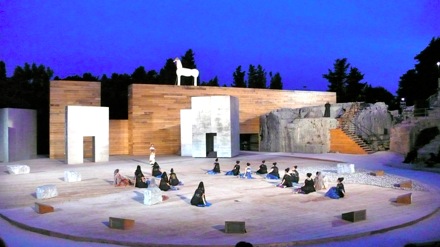
The photos remind me of the considerable force of the production, first simply visually, second emotionally. The visual production is poised between realism (the dead stags, the costumes, the detail of Phaedra's tablet) and abstraction. It uses the vast scale of the stage to great effect, often putting actors, even at key points in the drama, high on the backdrop, or off in what would be the wings in a conventional theater. The lighting was extraordinarily effective, coming on so subtly at twilight one wasn't aware of it at first; and the constant presence of Nature around and beyond the stage underlined the force Nature plays in Euripides's plot.
(At the end, while gloating over her moral victory over Aphrodite, Artemis lifts her right arm, pointing to the waxing moon that hung exactly overhead.)
The acting was passionate; I thought it utterly convincing in portraying noble individuals completely overcome by their passions. In the photographs you see Ilaria Genatiempo as Aphrodite, Elsabetta Pozzi as Phaedra, Guia Jelo as the Nurse, Massimo Nicolini as Hippolytus, Maurizio Donadoni as Theseus. (I find these credits in a review online, the only one I've found so far. Alas it doesn't mention the very able actor who played the Messenger, and I don't have a photo of the fine actress who played Artemis.)
The play continues to preoccupy me. You know the story: Hippolytus has vowed chastity (and is a vegetarian to boot); Aphrodite, angered by this insult, makes his stepmother Phaedra fall in love with him; she is dying of love and tells her Nurse, who in turn informs Hippolytus, who spurns her; in revenge Phaedra, who kills herself in despair, leaves a suicide note (the tablet) informing her husband Theseus that his son Hippolytus has raped her; Theseus curses his son, who is then attacked by Poseidon, but who lives long enough to forgive his father when Artemis reveals what has happened.
A tragedy born of a vow to live unnaturally; a physical passion that unseats reason; a father who kills his beloved son but is forgiven — it's all there. Today at lunch I said to Lindsey: but what about Hippolytus. It's just so inescapable, so overwhelming. What about Hippolytus?
Well, Lindsey said, there's always Jesus. I hadn't thought of it before: Jesus and Hippolytus have a lot in common. (I don't know if Hippolytus ate fish; I suppose he did.) We've seen enough bleeding Jesuses lately, and sorrowing Marys, in this Mediterranean setting, to make us begin to think about the continuity between the pagan and the Christian "explanation" of things. Today we saw, even, a cathedral installed within a Greek temple; you don't get much more literal a continuity than that.
Photos: Campania, including Caserta, Herculaneum, Amalfi, and Paestum:gallery.me.com/cshere#100239
Palermo: gallery.me.com/cshere/100241 Tràpani, Erice, Segesta and environs: gallery.me.com/cshere/100275 Mozia: gallery.me.com/cshere#100283 Sicily: south coast: gallery.me.com/cshere/100291 Syracuse, including the Hippolytus photos: gallery.me.com/cshere#100299 As always, our meals are recorded at Eating Every Day
Italian journal, 16: Driving in Europe
via Eumelo, Siracusa, May 24
—
CURTIS REMINDS ME of a few driving-in-Europe stories. My favorite was told by an acquaintance who'd got a job in Rome where he'd be posted a couple of years at least. His wife hated Rome and said she didn't think she could stay. He was terribly upset. After a couple of months the container arrived with their furnishings, books, and other things, including their car.—
She immediately went out for a drive and was gone a few hours. He was afraid she'd left, driven off for France or, more likely, England. At length she came back, though, beaming. I love it here, she said. I love the way they drive here in Rome, it's like being in a boat, everyone goes the same way, when necessary traffic parts, then flows back together again. Now I understand.
This is exactly what I like about driving in Italy: you always know what's going to happen next, at least in the cities. You never look behind; you only look a little bit alongside, primarily you look forward, and drive ahead into the space that's there, until you've got to where you're going, and then you stop in such a way that people behind you can get around you.
I think I've only had two little accidents, er, incidents, while driving in Europe. Once, years ago, we were driving through France in a bit of a hurry. A frenchman was right on our tail, never able to pass because there was never enough road ahead to see if anyone was coming. We'd come to a town, slow down, drive through it or rather around it following the toutes directions signs that lead you around the center of town, come out the other side, and continue; he'd still be on my tail.
Once I decided to gain on him by ignoring the toutes directions and cut right through the center. When I came out, there he was, right behind me.
Finally he passed me at an intersection in the open country, just when I decided at the last minute to turn left. He clipped my fender and we both stopped and jumped out of our cars. You must be in a hurry, msieu, I said, you're driving pretty fast. Exactly as fast as you, he responded, and you're always in front. No great damage was done; we jumped back in our cars and went our ways.
The other time was in Spain. I'd stopped at a gas station, realized I was at the diesel pump instead of a gasoline pump, and backed up to the other pump, not realizing someone had pulled in behind me in a brand new Alfa Romeo. I hit the car pretty hard. I jumped out to look: no damage to my car, some dents to the other.
Oh my god, the woman who was driving the car said in English, my husband is a Spaniard, he's rich, he loves his cars, he'll kill me, I don't know what to do, I'm so sorry about this. Relax, lady, I said, there's not much damage to my car, things like this happen every day, I'm sure it'll all work out. And I continued on to another gas station.
The main thing about driving in Italy is that you not stop, and you slow down only as much as you really need to. When pedestrians cross, for example, even at zebra crossings, you don't stop for them, instead you drive around them. Pedestrians follow the same rule: they step out into the street, gauge the speed of the oncoming cars and the amount of room the cars have to veer into, and walk briskly forward.
On the other hand, if you're driving up a narrow street and a car has stopped in front of you to let a passenger off, or readjust the straps holding a mattress to the top of the car, or check something under the hood, or simply to have a conversation with someone walking by, then of course you stop and wait for him to finish whatever he's doing and resume his own journey. After all you're likely to be in the same situation yourself, you wouldn't want anyone getting impatient with you.
It is true that in the country Italians (and not only Italians, viz. my Frenchman at the intersection) do tend to pass in circumstances Americans think of as risky. If they can't tell whether someone is coming from the other direction, at a hill or a curve for example, they assume there isn't anyone coming from the other direction, and the odds seem to be with them. If they pass without enough distance to cut back into their own lane when traffic is headed for them, three lanes magically and immediately appear where before there were only two.
On country roads everyone clips curves in order to minimize distance; you can count on it. I adjust to this by keeping well to the right on curves, even if it means down-shifting; it keeps peace in the family.
Photos: Campania, including Caserta, Herculaneum, Amalfi, and Paestum:gallery.me.com/cshere#100239
Palermo: gallery.me.com/cshere/100241
Tràpani, Erice, Segesta and environs: gallery.me.com/cshere/100275
Mozia: gallery.me.com/cshere#100283
Sicily: south coast: gallery.me.com/cshere/100291
As always, our meals are recorded at Eating Every Day
Sunday, May 23, 2010
Italian journal, 15: to the theater
via Eumelo, Siracusa, May 23
WE LEFT RAGUSA with a little bit of regret. At least I did. The hotel had been comfortable, the technology all worked, I got a great haircut, the meals had been fine, and there hadn't been too many new things to think about. No temples, ruins, museums.
But you can't stay in one place forever, so we set the GPS to Modica, center of town, because Lindsey wanted to visit a cioccolateria there, and drove readily out of Ragusa, through maquis country, listening to Our Lady of the Dashboard with half an ear as she guided us through roundabouts and back roads.
At Modica, though, she went a little crazy, directing us down steadily narrowing streets until finally, even with both side-view mirrors tucked in, I was negotiating straightaways with only a couple of inches clearance on each side. Sharp turns were even worse, and you had to look out for stray dogs, old ladies scrubbing doorsteps, wrong turns leading to flights of stairs, and the like. I'd put a fresh shirt on this morning, but it was soon drenched.
At length, though, the chioccolateria, which proved to be worth it; and a very pretty little theater; and the odd old beige city plastered against its hillside, ugly new apartment buildings rising out of the 18th-century. And then a twenty-minute tour of Frigintini, where we knew there was a restaurant we wanted to try if we could only find it; and conversations with strangers as to where un ristorante da Maria Fidone might be; one guy says left, another says right, and finally there it is, but we can't eat for another hour, so we have to kill time in a small-town café listening to conversations among adolescents with loud voices.
After lunch Our Lady guided us through more back roads — sometimes I'm not so sure she's as efficient as she might be, but she always knows where she is, and never seems uncertain when giving directions: Turn left. Then turn right. Make a u-turn. Make a sharp right.
Today's destination was Syracuse, and we had tickets to the theater: Euripides' Hippolytus was being given, in an Italian translation, in the 4th-century (BC) Greek theater in which a number of Aeschylus's plays had been premiered. So the mind got a workout again.
I thought the play very effective, barring a couple of details easily overlooked (irrelevant score; unfortunate body-mikes). The staging was Robert Wilson-esque, bold, abstract, minimal. Costumes seemed appropriate. The chorus, of women for most of the play, was effective: uniformly (and beautifully) dressed and coiffed, well choreographed, effective singers and, when individuals stepped out for specific lines, effective actors.
The leads were effective, too: marvelous Phaedra and Nurse; impressive Hippolytus and Theseus; effective Messenger; dominant Aphrodite and Artemis. We've seen Racine's version of the play twice in recent years so the text was well in mind; the Italian translation seemed heightened but not overly so. (I followed along with an English translation of the Italian translation, provided in a handsome libretto; unfortunately the translation, apparently computer-generated, was ludicrous at best.)
The play lasted a little over two hours without a break, and our attention never wandered. The acting style was formal and histrionic but balanced and consistent; I thought it suited both setting and text. I come away from this text, though, wondering what Euripides had in mind. The story is immensely profound and its truths, it seems to me, hard to deal with. I think Euripides must have been aware of the inadequacy of the conventional apparatus his culture had developed to deal with psychology, sexual attraction, the meaninglessness of death, and the like; and that in plays like Hippolytus he's hoping to prepare his audience for the questioning they too will soon no longer be able to avoid.
Of course it's particularly though-provoking to see this play, and think about its "meaning," in the context of the last few days with their constant history lessons. We're so programmed, we humans, to think of our own time as being a norm of some kind, and even a constant norm; being reminded of the relatively frequent and sudden historical shifts attested to by these ruins we've wandered, we're that much more aware of the futility of this fallacy. So we're back to work, thinking again. I have to say, it feels good.
Photos: Campania, including Caserta, Herculaneum, Amalfi, and Paestum:gallery.me.com/cshere#100239
Palermo: gallery.me.com/cshere/100241
Tràpani, Erice, Segesta and environs: gallery.me.com/cshere/100275
Mozia: gallery.me.com/cshere#100283
Sicily: south coast: gallery.me.com/cshere/100291
As always, our meals are recorded at Eating Every Day
Saturday, May 22, 2010
Italian journal, 14: random thoughts
SO MANY THINGS going through my mind, it was difficult to sleep last night. Shortly before turning in I received a message from an acquaintance of forty years ago, lost track of since, not even sure where he is or what he does with himself; he published a book of poetry that greatly impressed me back then, and recently through the magic of the Internet and of second-hand bookshops someone found a copy, read it, and commented on it at length.
He wrote me:
i recently was contacted by a young lady who writes and teaches in France. She discovered a copy of Tesseract in a bookstore last year and wrote a review, posted to her website:http://spindrifter.webs.com/apps/blog/entries/show/1523079-the-scattered-sea-of-james-monday-s-poetry
i thought you would enjoy reading it.
and he is right, I do enjoy reading it. His book, Tesseract, comes back to me; I see it on the bookshelf in the study and wish it were at hand, a little, though instead of reading it I am about to download Euripides' play Hippolytus because we are seeing it, or an adaptation of it, in Syracuse tomorrow night.
What Spindrifter writes about Tesseract is interesting; Monday's had the luck, good or otherwise, to see his book — written and self-published, I believe, back in the day when you had to be a typesetter to self-publish honorably — fall into the hands of someone programmed to respond to its central conceit, the fourth dimension.
(It enchanted me, back then, for the same reason; at the time I was busy constructing three=dimensional models of the regular polyhedrons, and wishing I could somehow project them into another dimension. I suppose it was writing music that resolved that urge.)
I was thinking about this last night as I was trying to sleep, or rather my mind was thinking about it, I was trying not to think about it, when another thing came into mind: speculation. Spindrifter is a speculator, and so am I. Speculators are thought of as people who take risks with money or property, but what they really do, and by "really" I mean etymologically, is look at things, look at themselves looking at things. And this is what this Italian journey has led to.
I mean, look: There were people living in the neighborhood of Agrigento perfectly successfully, eating fish mostly, making what we'd call rather crude pots and little votive sculptures out of clay, worrying about the weather and the kids; and then the Greeks decided they liked the place, and moved in, shouldered the natives aside (while apparently respecting their spiritual sites), built houses, then temples, then museums I think; before long there was a real "civilization", then international trade, then disagreements and uprisings and war and probably domestic discontent; finally a cataclysmic earthquake as if Nature wanted to put the brakes on the whole thing.
Now let's think about my country, California, where there were people living in the neighborhood of San Francisco perfectly successfully, eating fish mostly, making what we'd call rather crude pots and baskets and things…
You get the point.
<hr>
THIS MORNING AT breakfast in our hotel we were discussing the day's activities, and next week's, and I was looking at the notes I'd prepared on my iPad, when the deskclerk came over to the table, as well as the barista who'd made my cappuccino, and excused themselves, and asked Is that an iPad? We don't have them here yet… and I said Yes, it's an iPad, and showed them its tricks, and handed it to them; the deskclerk took it gingerly and touched a couple of icons and showed the barista how little it weighed, they stood there hefting it and commenting on it; even Lindsey was entertained by how cute the scene was.
A week or so ago in Palermo we were having a cappuccino for breakfast at a bar while our clothes were whirling about in the lavanderia Self; the barista had gone off somewhere, and an extremely handsome young man came in and said to me fammi un cappuccino così per favore, make me a cappuccino like that one please. I looked at him blankly: Scusa? He repeated himself; then when the barista showed up excused himself with great embarrassment, saying he'd thought I was the barista, I who look not at all Italian as far as I can tell.
The young man turned out to be a Romanian from Bucharest, here to better his life, and if good looks and careful dressing have anything to do with it he need only improve his observational skills to go places. We shared a laugh over his mistake, and I told him I'd traveled through his country nearly thirty years ago, before he was born, It was very different then, he said, But it has a long way to go.
<hr>
Yesterday on the drive here from Agrigento we took the two-lane country road, SS 115 I think it is, with lots of hairpins even along the coast; passing is extremely difficult because the road is so narrow and the visibility often so poor. Cars here tend to go as quickly as possible; no one respects the frequent 50 km/h signs (just as no one stops at stop signs; they're only there as counsel, not imperatives). What slows you down? Big trucks, little trucks, the occasional maddeningly slow old man in a cinquecento, a German tourist in an RV with a motorcycle on the rear bumper (that's how you know he's German, the Dutch have bikes), an occasional longdistance cyclist, the inevitable three-wheel pickup-like vehicles.
And at one point an old man was walking along the shoulder, if there'd only been a shoulder, bent a little at the waist, reading something held in his two hands before him, around his belly a strap going back on either side and attached to what seemed to be one of those suitcases on wheels that people roll through airports.
We've seen more than one peddler. In paintings in the Prado you see them in former centuries, with pushcarts or simply baskets, selling ribbons, candies, handkerchieves, fruits, little birds, God knows what. Today they offer telephone batteries, lottery tickets, fruits, wind-up toys, God knows what. They sometimes even come through restaurants when you're trying to relax over supper, though we've only seen that once or twice, and then in Palermo.
Italian bathrooms continue to interest me. Today's hotel is the first to have provided a label over the pull-string in the shower: EMERGENCY. (You no longer see those strings over the bedstead; probably too many tourists pulled on them thinking to turn off a light rather than arouse the emergency staff. Nor for that matter are there any crucifixes over the bed any more. We live in liberal times.)
Virtually every toilet we've seen has had its own idiosyncratic method of triggering a flush mechanism, and most, no matter how luxurious the appointments otherwise, have had loose, mismatched, or broken seats. In the cafés of course there are rarely any seats at all, and I always think of my friend Mac who was surprised that anyone would want one, since as he thinks they are all only a source of dread disease.
Today we had a fine lunch; you'll be able to read about it, I think, over at Eating Every Day. When I asked for the check, though, very uncharacteristically it was not forthcoming. Instead, after a few minutes, the waiter asked if I wouldn't like a coffee. No, I said, the check. Non vuole un caffè? Oh, okay, yes, why not, I'll have a coffee first. And the coffee was absolutely excellent, as has generally been the case here in Sicily. Afterward, though, I still couldn't get the check.
When I stopped at the cash register on my way back from some research in a back room I asked for it again, and the waiter — who was also the cook — pointed at his computer display and said that non funziona. Ah. Computer's down; can't print out a check. Even a tiny trattoria depends on these things these days. (The government practically requires it, since by law you must be given a detailed receipt, and you must carry it with you from the restaurant a given and not unsubstantial distance, in case you have to prove to someone that you have indeed paid for your meal.)
In the end the poor fellow had to consult his menu to find out how much each item cost, write them down laboriously on a notepad, add up the figures, and then announce: Twenty. I had only a fifty. Però, signor, non ha un di venti? Waving his hands together and apart as if smoothing out an unruly invisible sheet. Fortunately Lindsey had one, and we escaped.
Photos: Campania, including Caserta, Herculaneum, Amalfi, and Paestum:gallery.me.com/cshere#100239
Palermo: gallery.me.com/cshere/100241
Tràpani, Erice, Segesta and environs: gallery.me.com/cshere/100275
Mozia: gallery.me.com/cshere#100283
As always, our meals are recorded at Eating Every Day
Friday, May 21, 2010
Italian journal, 13: Moving inland
Ragusa, Friday, May 21—
TODAY REPRESENTS THE center day of our Sicilian journey: we arrived in Palermo the 11th; we propose to leave the island the last day of May. And today, after a week on the road (we spent five nights in Palermo), we've driven around about half the coastline, from Palermo to Tràpani, Marsala, Sciacca, Agrigento, Licati. The western half of the south coast is unremarkable from the car: at its best reminiscent (to me) of the California coast from say San Luis Obispo to Santa Barbara, at its less interesting reminiscent of the Baja California coast.
What's different, of course, is the architecture, the town layout, the system of roads, the people, the food — pretty much everything but the climate. I haven't written anything yet about the ruins we've visited, Selinunte and Agrigento's Valley of the Temples: what I've written about Herculaneum and Paestum will compensate for that, perhaps. We've visited few museums, really only three: Mozia, Mazara, and Agrigento, whose Museum of Archaeology required half a day and then was barely seen.

The pride of the museum… well, that's a silly way to begin this sentence: one of the many breathtaking aspects of this museum is the many Greek ceramics, painted ones, mostly Attic, brought to the Greek colony here in the 5th century (BC, of course), very soon after it was founded. I wonder if the Greeks didn't establish a museum here; the pieces seem absolutely splendid: could there have been that many collectors living in this town?
But I lingered too over smaller items, like this fragment of a seated Venus who had probably been wringing out her hair after the bath (perhaps she twisted her head clean off): hardly bigger than my hand, it's perfectly carved, soft and insinuating and altogether lovely.
Agrigento is of course famous for its temples, of which one stands nearly complete (fittingly, that presumed dedicated to Concord). Of these the largest was dedicated to Zeus: it stood something like ten stories tall, was big in proportion, and is today a mess of fallen stone. Column-sections and capitals eight feet in diameter lie strewn about; it must have been a terrible racket when it collapsed. I'm glad I wasn't there.
Impressive as the ruins are, and delicious as the vases and sculpture are, it was the Kolymbetra Garden alongside the ruins that provided the pleasantest part of the visit, even though we strolled it in a shower of rain. Planted in a gorge alongside the ruined Tempio di Giove, where 2500 years ago apparently pools and parks prevailed, it offers rectangular grids like those of the ancient city but delineated with citrus groves rather than ruined stone buildings. Everything is living, fragrant, productive, and beautiful. Strolling the ruins, your mind is preoccupied it; strolling this garden, your senses are delighted. There's a place for each of these activities, but I like to keep them skewed a little out of balance toward the pleasurable and sensual side.
Today's drive took us not only inland but well up into the hills; we're probably at 2500 feet — I haven't checked the altimeter. We're in a comfortable hotel in Ragusa, and we have wi-fi, which is why I write just now — though I see it's time to stop, as we have to get out for dinner. More, perhaps, about the drive, and the topography, next time…
Photos:
Campania, including Caserta, Herculaneum, Amalfi, and Paestum:gallery.me.com/cshere#100239
Palermo: gallery.me.com/cshere/100241
Tràpani, Erice, Segesta and environs: gallery.me.com/cshere/100275
Mozia: gallery.me.com/cshere#100283
As always, our meals are recorded at Eating Every Day
Wednesday, May 19, 2010
Italian journal, 12: Dancing Satyr
Sciacca, Wednesday, May 19—
IMAGINE AN EQUILATERAL triangle. Put yourself at one corner; Nature at another; Society at the third. Well, I've been married so long, I put Lindsey and myself at one corner, and our kids and grandchildren not very far away. Friends, of course, group nearby as well.
Now skew the triangle to your taste. I put Nature closer to me than Society, but the extent of skew changes continuously, subject to forces I don't really understand.
Now let's complicate things a little and add another dimension: Time. And to make things really complicated we won't simply lift the triangle into a pyramid, the triangular base representing say the Past, the vertex pulled upward to the Present: we'll stretch two pyramids out in opposing directions from the orginal triangle; one will be the distant Future, the other the distant Past.
I'm sorry I can't draw you a figure here, but I'm on the road, you'll just have to use your imagination.
Okay. The reason some things resonate more for me than others do, among the many things we've found on this trip so far, has to do with where they fall on this schematic drawing. I try for Objectivity, I really do. For years I worked as a critic, and I thought it a given that my work had to be objective: that is, while my thinking and writing would inevitably reflect my own experience, it mustn't project any bias of personal taste. I thought and still think that that is possible, though it's immensely fatiguing.
However I try, though, my own mentality, formed by nearly seventy-five years of training, parental imprint, education, trial-and-error, stupid mistakes, pleasures, deprivations, enlightenment, and the advice of others — all that nudges me more unresistingly in one direction than it does in another. And so that triangle:
I gravitate toward Nature, not Society; and toward Past, not Future. So far, then, the most impressive experiences on this trip have been the views from the Amalfi coast, the landscape at Paestum, the agaves between me and the temple at Segesta.
But at various places in the middle of that triangle lie Works Of Art. Other people have left them there in their own triangulations of Self, Others, and Nature, between Past (or tradition) and Future (or the unknown). And they are, to varying degrees to be sure, resonant and haunting, both unexpected and curiously always-intuitively-known-therefore-reassuring. Signposts, you could say, within the inescapable triangulation that is the considered life.
So far there have been two of them above all, both sculptures: that youth in Mozia that I wrote about yesterday and the bronze "Dancing Satyr" we saw today in an eloquent small museum in Mazara, a few miles west of here.
Both are immensely old, 2200 years at least; both were reclaimed nearby from the sea recently; each is, I think, a reminder that we never know enough to generalize much of anything. This "Dancing Satyr" is larger than life and more lively than life. It's a Bacchante, I suppose, caught in the moment of frenzied supreme pleasure, having whirled himself into a trance; his hair records the animation of that dance, even though his arms are missing and so the cup and the staff are absent. His eyes are alabaster, curiously both alive in their sightedness and blind to our uncomprehending gaze.
I'm sure there are representations on the Internet. We saw a fascinating film documenting the find, not fifteen years ago; the restoration; and the mounting of the work. It's good to see it in Mazara, the port from which the trawler shipped out that found it between Sicily and Africa; and it's fitting that it's shown in a museum on a former Sant'Egidio church, since that saint is so firmly connected to international peace movements.
I'd go on about this more, but I'm still overwhelmed. I thought the Mozia Youth was a climactic masterpiece; this Satyr is in that league and perhaps an even greater achievement. I don't understand at all what we've seen today; it takes my breath away even to think about it.
I'm sorry: no photos. They were absolutely forbidden. You'll have to research this yourself for the moment.
Photos:
Campania, including Caserta, Herculaneum, Amalfi, and Paestum: gallery.me.com/cshere#100239
Palermo: gallery.me.com/cshere/100241
Tràpani, Erice, Segesta and environs: gallery.me.com/cshere/100275
Mozia: gallery.me.com/cshere#100283
As always, our meals are recorded at Eating Every Day
Tuesday, May 18, 2010
Italian journey, 11: Mozia
Tuesday, May 18—
SORRY TO LEAVE Tràpani, but eager to get on to the next sights, we drove out of town south today toward Marsala — but did not get very far. We were heeding our dear friend Richard:
…you must go to the isle of Mozia, to the Whitaker Museum, which has one of the most phenomenal sculptures I have ever seen, 5th century BC. It's a short boat ride and I think you will agree that this is simply an amazing accomplishment, perhaps the most original piece ever produced in ancient Greece.Since Richard's a sculptor himself this meant something, and though I'd already meant to visit the island my curiosity was redoubled.
We had no trouble finding the place; the GPS we rented with the car took us right to the boat landing on the Stagnone, a good-sized lagoon that made a fine protected port for the Phoenicians. We left the car by the side of the road and waited ten minutes or so, across a narrow canal from the extensive salt ponds with their characteristic windmills; then sailed another ten minutes or so across the lagoon and walked up a short road hedged with agaves to Mister Whitaker's Museum.
The son of an English wine-merchant with little taste for the business himself, Whitaker bought this whole little island in the late 19th century simply to indulge his enthusiasm for archaeology. It quickly became clear that the 19th-century wine warehouses had been built on top of the remains of settlements going back millenia; Motya had been an important Phoenician city six hundred years before the fall of the Roman Republic. (It goes back well beyond Phoenician days, in fact, into the Bronze Age; but that's not yet as well researched; to dig back that far would involve destroying a great amount of more interesting stuff.)
(Motya is apparently the preferred transcription of the Phoenicia name; Mòzia is the Italian equivalent; the ruins are on the island of San Pantaleone.)
Alas, Whitaker didn't live to see the sculpture that so impresses Richard, the so-called Mozia Youth, a life-sized standing young man carved in marble in the 5th century BC, found only 40 or 50 years ago — I'm not able to get the facts just at the moment. It is indeed a glorious work of art, lacking only its arms, feet, and hat. There's a hint of contrapposto to the figure, an intense realism invigorating the idealism of the youth's beauty, an absolutely masterly achievement in the slight depression of the fingers of the left hand in the soft flesh of the hip, in the details of the folds of the tunic, in the slight lift of the right shoulder. No Italian renaissance or baroque sculpture manages this degree of mastery, I think, not even Michelangelo.
The sculpture was found near the north gate to the city, itself an impressive achievement. A double street leads down to the water; perhaps traffic was directed to one-way lanes even then. The city walls were reinforced a number of times over the years; by the 5th c. BC they were a couple of meters thick, made of huge stones taken, I'd bet, from buildings already present on the Sicilian mainland — some show mortise-and-tenon details that seem to serve no purpose in their use as wall material.
San Pantaleone is a small island; we walked around it in an hour, even stopping to look at ruins like this — you can actually stroll among these stones in places — and to take innumerable photographs. (I've posted some of them at gallery.me.com/cshere#100283.) The island is still farmed: olives and grapes, principally the Grillo varietal; and around the museum it's nicely landscaped, chiefly in agaves and pines.
The entire island was walled by the Phoenicians, mostly in loose stone and rubble; these walls have been overtaken for the most part by wild fennel, pomegranates, thistles and such. Walking the sandy road between these walls and the lagoon, even on a warm, windy day, was a great pleasure after the last few days of walking on stone streets.
But then it was time to move on. We stay tonight in an Agriturismo, recommended by more than one of our guidebooks though with the warning that it might be hard to find. Understatement. Even the GPS was no help, as the listings place the establishment in a suburb of Marsala whose name is variously spelled Spagnola, Spagnolo, Spagnuolo, Spagnuola, none of which the GPS allowed to have a street by the name of Via Vajarassa.
We drove up and down looking for the street; then finally began asking people. No one we spoke to spoke English, and some seemed to have trouble with Italian. One of my favorite guidebooks tries to encourage its readers to learn a little Sicilian, but I haven't managed to do that — I lack the discipline. In the end I found a souvenir-peddler near the Mozia boat-landing who set me off in the right general direction, and after driving up and down there I found another man who said he'd take us to the street, follow him. He even telephoned the place to find out exactly where it was.
Even that didn't resolve everything, though; it was unclear exactly which of several farmhouses would be the right one — none seemed to have signs or number-plates. Finally we came to a farmhouse with a woman standing in the driveway looking expectantly down the road, blocking a minuscule sign to Baglia Vajarassa, and we were home. Only then did I look again at the GPS and discover that it knew exactly where we were — Contrada Spagnola 176, Marsala.
Not however until I'd listened to a long discussion of the shortcomings of the Sicilian peasantry from my helpful guide, who turned out to be a retired thoracic surgeon from Palermo, retired to the west coast of Sicily where it was more tranquil — perhaps precisely owing to the absence of commercial signs and the traffic they encourage.
Baglia Vajarassa is a beautiful place. The exterior is plain and unpromising, but the large, nearly cubical bedrooms are nicely furnished with period beds, armoires, and dressing-tables; you have the feeling you've stepped back ninety years in time. We're completely in the country, surrounded by pines, grapevines, and the wind from the lagoon. If dinner is half as good as the rooms and the setting, I'll be very happy indeed.
Photos:
Campania, including Caserta, Herculaneum, Amalfi, and Paestum: gallery.me.com/cshere#100239
Palermo: gallery.me.com/cshere/100241
Tràpani, Erice, Segesta and environs: gallery.me.com/cshere/100275
Mozia: gallery.me.com/cshere#100283
As always, our meals are recorded at Eating Every Day
Monday, May 17, 2010
Italian journey, 10: Tràpani
Monday, May 17—
YESTERDAY WE PICKED UP our little Panda and drove by way of Monreale to Tràpani, a town I've always wanted to see, at the northwest corner of Sicily. After the noise and crowds of Palermo it's a pleasant respite. Our hotel, comfortable and old-fashioned (and cheap), is in the heart of the old town, whose streets are laid out in a grid but are narrow, faced with 18th-century buildings all the same height and mostly with marvelous façades, and are generally devoid of traffic.
The wider streets in the heart of the old city are in fact entirely devoid of vehicular traffic. What a pleasure to walk about in a city dedicated to its human inhabitants! Everything is calmer, quieter, cleaner. The sounds are those of human voices for the most part; the scents those of comestibles. Even time seems returned to a human scale: there's plenty of it, or at least there's enough of it; one doesn't feel rushed, or that one's missing something for attending to something else.
Today, though, we drove out of town for much of the day, first to the old hill town Erice, then to Segesta. Erice was dedicated, three millennia or so ago, to Venus, or Aphrodite, or Astarte, whomever you prefer: the goddess of love, born from the sea, from the blood, some say, of the genitals Zeus sickled from his father in a fit of pique. (The sickle became the spit on which Tràpani stands.)
Erice may have been a spiritual site in the past, but it does not currently seem so to me: recent domination by one of the late Roman cults, still much practiced in Italy, has insisted on stamping the town with churches dedicated to this saint and that; the only remnants of pagan times are the names of bars and hotels, Venere this, Ulysses that. I like the town for what it is, though, very much a tourist town, full of souvenir stands, ceramics shops, little patisseries and cafés, and a fine ruin of a fort on one corner, and fine views out over the landscape.
But if Erice has lost much sense of antiquity, Segesta has it in, um, spades. We cheated and rode a bus up from the entrance to the forum atop the hill, where we saw a number of archaeologists patiently scratching the dirt with their trowels. One fellow walked past with an electronic device suitable for finding car keys buried at the beach: when I asked if he'd found anything, No, he said, There's lots of walls, not much metal.
Erice is noted for its Greek theater, which would have seated about 4,000, with a marvelous view of the gulf to the north. It was apparently an extensive city in its day, 2500 years ago: first a local tribe's, then Greek, then Roman, then Swabian and Norman, then Muslim, then back to the pastoral folk who lived here during the Dark Ages. There's no telling how big the town was, or how many layers it may have.
The other noteworthy site in Erice is the unfinished Greek temple, huge and beautiful, isolated on a hillside outside of what would have been town. No one seems to know why it was built, or rather begun; perhaps, the most ingenious commentators say, to decoy the Greeks into thinking they'd be welcome here, in the hopes of laying an ambush. It would have been a colossal undertaking requiring all sorts of labor, but the ancients had ways of approaching such tasks.
I'm not sure we were wise to visit Paestum before coming to Sicily. Beautiful as the Segesta temple is, there's something disturbing about it; it's too detached from any human activity. Seeing it in the distance has the effect of a Chirico painting, a little mournful, a little disturbing. The quiet streets of Tràpani, contemporary though they be, have a reassuring tranquility that connects to the ruined ones of Paestum; Segesta is, for me, at least today, too much of an enigma. But a beautiful one.
Photos of Tràpani, Erice, Segesta and environs can be seen on this webpage. Notes on our meals during this trip can be found, as always, at Eating Every Day; photos of Campania can be seen at this webpage; photos of Palermo can be seen here.
Saturday, May 15, 2010
Italian journey, 9: Orlando Furioso
Saturday, May 15—
ONE OF THE BEST books I've read preparing for this sojourn in Sicily has been Henry Festing Jones's Diversions in Sicily, published I think in 1908. (I downloaded it from Project Gutenberg and read it on my iPad.) I don't know anything about Jones, except that he was English, apparently wealthy enough to travel at leisure, and well educated in the liberal arts.
In addition he was very good-hearted, keenly observant, intellectually curious, enthusiastic, and patient. He must have made a wonderful traveling companion.
Of course the Sicily he writes about has vanished, at least from Palermo, the only part of Sicily we've yet experienced. His Sicily is incredibly poor, travels on foot or by donkey, lives in what most of us would call squalor. But the people he describes — soldiers, hotelkeepers, little boys, facchini, coachmen — mostly share his intelligence, patience, and amusement, if not always his literacy and the experiences of his travels. Some of them may be ignorant, superstitious, and gullible; but all seem to be reasonable, courteous, and good-humored.
His descriptions — of towns, landscape, conversations, the visual appearance of the people he meets — are detailed without being tedious, evocative without sensationalism. The conversations he records seem accurate and always interesting, and when he retreats into his own thoughts they're generally fascinating. He describes, for example, remembering how migrating birds do or do not skip over an island before lighting on the next by making an analogy with singers who make a wider major second when singing up the scale, a narrower one when singing back down; and his description will make sense, I think, to a musical dillettante as well as to a professional, and teach something about music to the tyro along the way.
Much of Diversions in Italy involves Sicily's traditional puppet theater, and Jones's descriptions made me long to see an example. Today we finally got to one, and it was just as he described it. We had a hell of a time finding it, because we stupidly never did buy a street map to this city. (Too late now: we leave tomorrow morning.) It turned out to be down by the waterfront behind a street market in a broken-down part of town.
(There are many of these; we've been living in one. Streets are narrow and far from straight; many if not most lack any sign of name; the streets are full of garbage; a number of buildings are still bombed-out, lacking roof and interior walls.)
A discreet signboard stood in the street outside the door to the Teatro Carlo Magno. The door stood open; there was no one in the ticket office. A young man sat on a chair toward the front of the otherwise empty auditorium which contained nine rows of benches, just as Jones describes. I couldn't understand his explanation of when the spettacolo would begin; he spoke mostly Sicilian. After a while another fellow turned up; he said the show would start in five minutes. We stepped outside for a moment; when we returned a young couple had turned up with a little boy maybe five years old.
We sat in the second row, behind them, and wondered what would happen next. An elderly man, a little lopsided and wearing the ubiquitous cap, who we'd noticed lounging about outside, walked up toward the stage, sat down at a little pianolike instrument, and began turning its crank: an out-of-tune mechanical piano it was, and it ground out the overture. I noticed suddenly that both the young men I'd spoken to had disappeared behind the scenes.
The curtain went up and a master-of-ceremonies puppet greeted us, explaining what the evening's program would be. The little boy had gone up to the edge of the stage and began asking questions of the pianist, who lifted him onto his knee, holding him aboard with one arm while turning the crank with the other.
Then the action itself began. Orlando, splendid in his armor and his bright green plume, met the bealtiful Angelica. He dispatches her infidel kidnapper, then duels and almost kills his cousin — Rinaldo, is it? — before recognizing him. He travels, for some reason, to Hell and back, slaying the Hippogriff, withstanding temptresses, bargaining with a devil. Then he kills a number of infidels, decapitating a number of them, splitting one.s head vertically, completely cutting another in half.
All the while the action is described and the puppet actors speak, in a number of passionate voices. Horses neigh; terrible birds squawk. The temptress's head suddenly turns into a skull before our very eyes. The bodies pile up. Knights, Angelica, the Priest, giants (one with one eye, a Cyclops), monsters, all pace, strike attitudes, converse, above all battle.
We were utterly captivated, both delighted and absorbed. It was funny and it was profound. And it was very very old: you could see why this narrative mode would survive.
Afterward we talked a little with the second fellow, who turned out to be the reciter as well as the chief puppeteer. I do all the voices, he told me. Who wrote the words, I asked. It's all improvised, he answered, but the subject is always Orlando Furioso, from Tasso, you know, Tasso and a few others. (He specified their names, which struck bells, but don't stay with me.)
The little boy turned out to be his son: he had in the meantime crawled up onto the stage and was sorting out the pile of dead and decapitated Saracens. It's a family affair: the man at the piano was apparently Signor Puppeteer's father, and his father had painted the scenes.
We were allowed to handle one of the puppets: it weighed a good twenty pounds. Ingenious wires and strings make it possible for them to draw swords, ride devils, lift their visors; above all to adopt lifelike attitudes while conversing. We went next door to the laboratorio, the "ospedale delle pupi," where puppets are repaired and repainted when battles have got out of hand; it was an impressive operation, though housed in what might have been a shabby (and dodgy) body-and-fender shop.
What it all amounted to, I thought to myself as we walked home, was pride, resourcefulness, literacy, imagination, respect for tradition, dedication, poetry, magic. It was exactly what Henry Festing Jones had described, a hundred years ago. I hope it goes on forever. Some things, I think, do.
Notes on our meals during this trip can be found, as always, at Eating Every Day; photos of Campania can be seen at this webpage; photos of Palermo can be seen here.
Italian journey, 8: Technology
Saturday, May 15—
YEARS AGO IN simpler times my technology, on these trips in Europe, amounted to a notebook, a triple-aught Rapidograph, a spare bottle of ink, and a camera. Communications back home were via postcards, not many of them, often mailed days or even weeks (not to mention miles or even whole countries) away from their writing.
I wrote largely (and still do, you'll have noticed) for myself; it's how I process my thoughts. (It's also how I remember things these days, but that's another story, a sadder one.) I treasure — well, the word's a bit strong — I'm glad I have those old journals full of tiny writing and the occasional sketch; I page through them and re-live, often vividly, the hotels and the dinners, the mountains and the villages; I return to thoughts about painting, landscape, food, music, national character — subjects that continue to absorb me.
Things have changed. I gradually gave up the notebooks for the same reason I gave up smoking a pipe: there were just too many damn things to juggle, too much clutter in the pocket. The advent of what Simon calls the murse, short for man-purse, didn't really help: in addition to the juggling you had to deal with the zipper. And then there was the constant danger you'd leave the murse somewhere. One fell off the back of my motorcycle, in fact, and I'll never know what happened on that year's travels.
A few years ago I enthusiastically adopted the Palm handheld computer. It's still something in the pocket, and you have to juggle it and its stylus to take notes, but it doesn't leak. Technology developed further; the Palm gave way a year ago to the iPhone: no stylus, alas, but it does take photos. One less item absolutely needed: the real camera — which in the meantime has moved from film to digital technology — is broken out only for 'important' subjects and when flash is needed. (Look at the recent photos, URL below, and see if you can tell which apparatus took which.)
Two years ago I walked five weeks in the Alps, and took almost no notes at all — I won't go into the reasons for that just now, maybe later. I did take 2500 photos: with camera; that was in pre-iPhone days. It was the last trip with the Palm, which still managed to keep up with e-mail from time to time, when I found a connection.
On that walk I did not carry my laptop, which at the time weighted five pounds. I did carry it on the previous walk, a hundred miles along the Lingepad in Netherlands; and I've always brought one along, ever since I first had one (1995, I think), because the advent of e-mail changed everything. One now could receive mail as well as send it; one no longer counted on Poste Restante or American Express for the occasional reassurance from back home.
Then too there came the Travel Dispatch, later to become this blog. Various friends said they enjoyed reading my travel notes and wanted them sent by e-mail. The number of readers grew to over a hundred, and it became increasingly difficult to send out batch e-mails in that number; many hotel internet hookups flatly refused to do it. I think they thought I was that Nigerian fellow with the temporary money problem.
For this trip, which I thought would involve a fair amount of foot-trekking (I don't now think it will), a new jump in technology looked promising: the iPad. I bought one a few days after they hit the market, and bought also a small lightweight Bluetooth keyboard. On the laptop I use MarsEdit for my blogging software, which simplifies formatting and the addition of photos; similar software (though not as good) has turned up for both iPhone and iPad.
I'm enthusiastic about the iPad; it worked beautifully for me on last month's shakedown trips to Ashland and Los Angeles. It doesn't hurt that as well as a writing instrument it is a library, carrying more e-books than you need, and crossword puzzles, and language dictionaries, and all that; and it's lightweight, and displays photos beautifully (though it has no camera of its own), and and and.
BUT. It depends on wi-fi for its internet connectivity (the AT&T-configured model wasn't yet available, and wouldn't work in Europe anyway). I though that would be no problem, there'd be lots of wi-fi here. But so far that hasn't been the case in Sicily, and it's not likely to improve as we start driving into more remote parts of the island.
Fortunately we brought the laptop along. On Wednesday, our first full day here in Palermo, I bought a USB modem with a prepaid hundred hours of connection time; it's worked beautifully so far. Our e-mail accounts won't send anything; I don't know why; but they receive, and we can write (as well as read) webmail, so we're in touch at the moment.
Tomorrow we pick up a rental car and drive away from this crowded, noisy, dirty, fascinating city. I'm assured the TIM network will reach my modem all over Italy: we'll see. In the meantime, pen and notebook are still in my shoulder-bag, and occasionally still see action.
Notes on our meals during this trip can be found, as always, at Eating Every Day; photos of Campania can be seen at this webpage; photos of Palermo can be seen here.
Friday, May 14, 2010
Italian journey, 7: Palermo
Friday, May 14—
WE HAVE SPENT two full days and halves of two others in this city so far, and I have a few impressions, set forth here in no particular order:
Yesterday we took our morning coffee in the Piazza Bologni, on an outside terrace, at the Bar Liberty (not very good coffee). A line of potted plants separated us from the piazza, and its statue, and clusters of tourists listening to tourguides telling them about all that; we saw only their heads above the foliage. We did not see the dogs, who were standing just the other side the foliage, conducting their own conversation. Yap! said one of them, a small dog I think; Yap! Yep! Yap!
Whereupon another, probably a little larger but not much, replied Roggawogga! Wow!
And so it continued. Yap! Yep! Roggawogga! Yap! Wow! while we had our coffee; and no one seemed to pay any attention.
It doesn't seem to me anyone owns any of these dogs. There are dogs that are owned, clearly, often carried, or strutting along in front of their humans, off the leash. (The dogs I mean, not the humans, who carry the leashes dutifully just in case.)
We've seen very few cats, and they have been miserable-looking things — scruffy, lean, wary. But, being feline, apparently quite proud of themselves, even as they sort through the garbage.
The young natives, like all young Italians, seem slim, fashionable, plugged-in (they talk into their telefoninos while riding motorbikes), immensely sure of themselves, and unafraid of noise. The old people, those with money, seem very attractive. We struck up a conversation with a couple in their eighties yesterday; I was curious about an apparently abandoned building, an elegant villa in the Art Nouveau style out on the via Dante. The couple had been strolling arm in arm toward us, neatly dressed, probably tracing a course they walked every evening. They were short, of course; most southern Italians who grew up before say 1960 are short; there wasn't a lot of nutrient in those days.
The man deferred to his wife about certain aspects of the the building's history, but then became more and more forthright, blaming its current condition on disorganization and failure of follow-through on the part of the local government. Sicily is full of stories, he said — the Italian word for "stories" and "histories" is the same — there's so much beauty and so much richness, and so much is wasted and thrown away and neglected.
We rarely speak English here except between ourselves; there aren't that many who understand it. Waiters and shop-attendants clearly don't know English; even information-kiosk workers are unsure of it; it's as if it were not a language but some kind of cultish set of instructions for assembling something one would rather not have to deal with. So we get by in bad Italian.
Most of the produce stands also sell lumache, snails. These are very small, you could put three of them on the surface of a twenty-five cent piece, and they're quite elegant. They're sold live: they live in steep-walled basins for the most part, often with a stick or perhaps a braid of garlic at the center, which they crawl up hopelessly to demonstrate their vitality and urge toward liberty. We haven't tried them.
We did buy a bottle of white wine for one euro, because it was bio or organic, and, well, only one euro; it was undrinkable and I poured it down the drain. We've bought delicious little almonds, and fennel, and tomatoes; and another bottle of better wine; but mostly we're eating out, as a look at Eating Every Day will show, though we do have an apple and some bread sticks at home for breakfast, before going out for our coffee.
Yesterday we took a walk up the 22 September, I think it was, looking for "Liberty Style" architecture — that Italian style that grew out of Art Nouveau. We found three really quite wonderful buildings, a little run down I'm afraid but still showing their pedigree. There remain some wonderful Baroque and Renaissance façades, and I find the prevailing late-19th-century style of six-story palazzo lining the avenues attractive enough. It's the new buildings, designed without ornamentation, that I find dismaying; they sit dumbly among all this older attractiveness, with perfectly blank exteriors emblematic, I'd say, of the shallow, blank character of the last forty years.
Like the rest of Sicily, Palermo has known Phoenician, Greek, Roman, Arabic, Saracen, Norman, Spanish, Italian, and even British occupation, and there are architectural references to most of that. Sometimes the mix is really quite harmonious, as at the Capella Paletina. At other times you'll be walking a narrow street, come out into a piazzetta, and find a Norman tower left over from something demolished long ago standing lonely among slums. No one seems alarmed at this, so perhaps it's as it's meant to be. For what it's worth, my favorite places so far are S. Giovanni degli Erimiti and the Chiesa di S. Cataldo, which the Lonely Planet guide finds too plain.
Cars avoid those streets, of course; even the motorbikes seem leery. But there's plenty of traffic in our quarter on the wider streets, which may even allow room for parking as well as the single lane of traffic. There are no sidewalks, needless to say, and you're grateful for the noise these cars and motorbikes make when you're walking with the traffic rather than against it; you quickly learn to hug the wall when you hear an engine.
In the newer part of town of course there are sidewalks, but they're rarely wide enough for a couple to stroll comfortably, and there are often knots of people, usually young and inconsiderate, standing outside café doorways, so you're continually stepping off into the street, hoping a bus isn't silently bearing down from behind. Cars park where they can, often across the few zebra crossings whose stripes in any case have generally faded almost completely from view.
(Though it's true that when you cross a busy street in one of these zebra crossings all vehicular traffic respects you, even stopping if they can't somehow slip around in front of you or behind.)
The traffic is complicated by a number of horse-drawn carriages for hire. I rarely see any paying customers riding them, but there are plenty of them on the streets, perhaps practicing for better times to come. One tried hard to inveigle us into a ride: forty euros it would have cost; I didn't ask for how long. We'll continue walking, as long as we can.
Notes on our meals during this trip can be found, as always, at Eating Every Day; photos of Campania can be seen at this webpage; photos of Palermo can be seen here.
Subscribe to:
Posts (Atom)