Thursday, November 29, 2012

Commonplace: the significance of local nations

“

THE THREE DOMINANT statesmen in the main member states [of the European Coal and Steel Community, the early predecessor formed in May 1950, which led ultimately to the European Union] — Alcide De Gasperi, Konrad Adenauer and Robert Schuman — were all from the margins of their countries: De Gasperi from the Trentino, in north-east Italy; Adenauer from the Rhineland; Schuman efrom Lorraine. When De Gasperi was born — and well into his adult life — the Trentino was part of the Austro- Hungarian Empire and he studied in Vienna. Schuman grew up in a Lorraine that had been incorporated into the German Empire. As a young man, like Adenauer, he joined Catholic associations — indeed the same ones that the Rhinelander had belonged to ten years earlier. When they met, the three men conversed in German, their common language.


For all three, as for their Christian Democrat colleagues from bi-lingual Luxembourg, bi-lingual and bi-cultural Belgium, and the Netherlands, a project for European cooperation made cultural as well as economic sense: they could reasonably see it as a contribution to overcoming the crisis of civilization that had shattered the cosmopolitan Europe of their youth. Hailing from the fringes of their own countries, where identities had long been multiple and boundaries fungible, Schuman and his colleagues were not especially troubled at the prospect of some merging of national sovereignty. All six member countries of the new ECSC had only recently seen their sovereignty ignored and trampled on, in war and occupation: they had little enough sovereignty left to lose. And their common Christian Democratic concern for social cohesion and collective responsibility disposed all of them to feel comfortable with the notion of a trans-national 'High Authority' exercising executive power for the common good.
—Tony Judt, Postwar, pp. 15-58

”

WE VISITED RATHER A TOUCHING memorial to the six founders of the ECSC last March, as we were walking through Belgium and Luxembourg. It's set in a small field on the Meuse, where Belgium, Germany, and Luxembourg meet at Trois-Frontières, as I recall. The ECSC was significant principally for being the breakthrough cooperative moment between France and (then West) Germany, and since it also included the Benelux countries and Italy it was truly international. It had been the brainchild of Jean Monnet, who was a Luxembourger, and brought to fruition primarily by Robert Schuman.

What I hadn't realized, until tonight in my return to Judt's magnificent history, was that Britain and Scandinavia's refusal to join the agreement was prompted in part by their mistrust of an accord that had been forged, after all, by Catholic political leaders. (Netherlands had also had its reservations, but was pulled along by Belgium and Luxembourg.) I suppose they were afraid of the possible return of the Holy Roman Empire.

There are lessons here. First: trust men from border regions, whose instinct it is to accommodate, not impose. Second: that Catholic-Protestant disagreement, which has spilled so much blood, just doesn't seem to want to go away. Are you listening, Shiites and Sunnis?

Wednesday, November 21, 2012

van der Post

bookshop.jpg
Eastside Road, November 21, 2012—
I AM NOT READING enough these days; no question about it. It's mostly because I have been writing and traveling. Both occupations require more energy than they used to, both physical and mental energy; and lately both occupations have also more busily filled those parts of the mind that seem increasingly necessarily at rest, or at least relatively untroubled, if I'm to attend to reading.

Like too many of us I typically read a few minutes at bedtime, when one's least likely to profit from it. Bedtime reading is an exercise in winding down. I'm tempted, in fact, to liken it to end of life, a time for relinquishing mental and physical exercise in preparation for the long sleep. Lately I've adopted the habit of reading in a foreign language at bedtime, and reading without a dictionary. I don't care if I don't fully understand the material; I'm reading for a different purpose. That's an injustice to the book and its author, of course, but I can always return to it with attentions more fully awake, perhaps in translation. Currently I'm reading a biography of one of my childhood favorite authors, Hendrik Willem van Loon. I've learned a few things from it, and one of these days I may even report on them here. But that's not today's purpose.

Instead, let me report on a book read last week, half of it on the flight from Melbourne to Los Angeles. Reading on airplanes, for me, is akin to reading in bed: I tend to forget completely what I've read as soon as the plane has landed. Sometimes, as soon as I've turned a page or two. Not this time, though, partly because I'd begun the book — at bedtime — a day or two before.

I found the book, Laurens van der Post's Venture to the Interior, at Yarra Cottage Books, a small promising used-book shop in Warrandyte, a bucolic suburb of Melbourne on the banks of the Yarra River. A trail runs along the bank there, several miles long. In mid-spring the trees are in full foliage, eucalypts, oaks, Monterey pines, shading the decomposed granite sandy path. The countryside here is so pretty it's been the subject of a number of landscape painters: at one point a stele commemorates one of them, Clara Southern, with a reproduction of one of her paintings.


Evensong.jpgClara Southern: Evensong, ca. 1900-1914, oil on canvas
The stele reads
Clara Southern, or 'Panther' as she was known, was described as a tall lithe beauty, with reddish fair hair. In 1905, she married local miner, John Arthur Flinn and settled at 'Blythe Bank', North Warrandyte on The Hill' above the Warrandyte township.
This work was painted from the high vantage point of 'The Hill', and depicts a number of the buildings along Yarra Street, including on the far left, the old bakery, which is still operational today. The view is westward across the Yarra River towards the hills of Templestowe.


That bakery — you'll have to take my word for it; my photo of the painting, reproduced in enameled steel or aluminum on the stele, and suffering from lens flare here — is to the left of the two sharply pitched shed roofs, which mark the location of Yarra Cottage Books.

The shop reminded me of those of fifty years ago, a series of small rooms with crowded shelves, well enough organized but better suited to browsing than go-and-get shopping (except that my age and size make the necessary floor-crouching difficult between close-set bookshelves). I looked for a copy of something by Patrick Leigh Fermor to give to my brother, who's done his share of global wandering, but found only the new biography, which I must hasten to obtain. (It was far too large to carry on the airplane). What I did find was Venture to the Interior, in a dog-eared Penguin paperbound that must be thirty years old.

What a book! The country it describes is a long way from the green Yarra valley in Victoria, as the "Interior" of the title is Nyasaland, in central Africa. And the "venture" — whose exact purpose is a little mysterious (causing me to wonder at times just who van der Post may have actually been venturing for) — involved flights very different from mine. I have made one long flight on a propellor-driven passenger airplane, from Bucharest to Moscow thirty years ago, and I know the wallow and the drone: but the flight van der Post describes, through Sahara sandstorms in the late 1940s, was a very different matter. Reading about it made today's flights seem comfortable, even though the food and drinks are considerably more Spartan.

At the bookshop the first sentence to catch my eye sold me the book:
One of the most striking features of the desperate age in which we live is its genius for finding good reasons for doing bad things.
Fourteen or fifteen times, in the course of reading these two hundred pages, I found myself ticking off paragraphs in the margins. Van der Post is writing about the end of colonialism, the tension between the "races," the recovery from the brutalities of World War II, the difference between the sexes; about revenge and forgiveness, the nature of Time, the fugitive transactionality of morality, the melancholia resulting from "education."

He writes about the nature of the nomad and the tyranny of place. He writes about consciousness and knowledge:
And yet there is a way of knowing which is at once underneath and above consciousness of knowing. There is a way in which the collective knowledge of mankind expresses itself, for the finite individual, through mere daily living: a way in which life itself is sheer knowing. So life is to me, anyway; a mystery in all its essentials, a complete and utter mystery. I accept it even gladly as such because the acceptance keeps me humble, keeps me in my little place; prevents me, as we used to say in the recent war, from being caught too far out of position.
Venture to the Interior is narrative and suspense narrative; it is travel and historical travel; it is psychology and social philosophy. It seems to me to be imperative reading for our time, for the age of Taliban and American Exceptionalism, as it was the product of its time, the age of fascism and the Third Reich. What a rich and confounding world this is, that offers such collective organized dismay, in the embrace of such transcendent natural beauty!


Yarra.jpgThe Yarra at Warrandyte

Wednesday, November 14, 2012

Commonplace: Leunig

…I want to be rid of it! Please!
You seem ashamed of your inner book?
Not at all. It's just that I don't want to become a… a… …I don't want to become — a WRITER!
There, there — it's not so bad. We all have to become writers sooner or later. We must learn acceptance. We are born, we live and then, sadly, we must write.

(hanging his head) It seems so unfair. Life is so cruel. I thought I could escape.
Michael Leunig, Goatperson and other tales

- Posted using BlogPress from my iPad

Monday, November 05, 2012

Theater down south

In flight, november 6, 2012—

TWO DAYS, THREE PLAYS. Three very different plays, in two quite different venues. We began Friday night with Shaw's The Doctor's Dilemma, thoughtful, still apt after its hundred years, but talky and, especially in its exposition, discursive. The action centers on a doctor whose new treatment will cure otherwise terminal tuberculosis, but who has only a very much limited supply of medicine. In order to save a brilliant young artist another patient, already selected for the cure, will have to be allowed to die.

There are plot complications, of course, and considerable mockery of rival doctors, all cynical to one degree or another and all ultimately ineffective (for Shaw loathed the medical profession). In the end, though, the play 's a stand-off between fixed morality and social convention, represented by the doctors, and personal freedom — license, in fact — as lived by the dying painter.

I've always had my problems with Shaw, who seems to me to have spent his career wanting to merge or at least mediate Wilde and Ibsen. His greatest flaw is forgivable: he can't resist bringing in side issues. Like many over-intelligent writers he knows that everything is quite complex, and he wants his audience to know that too. Prolixity was rampant in his era: if only he'd satirized that.

I liked virtually everything about the cast and the production; only problems with British accents distracted from the effect. (If we can have American voices in Shakespeare, why not also in Shaw?) An audience-cast discussion after the performance revealed the seriousness of the company's approach and left me impressed with the degree to which they evaded traps Shaw himself doesn't always escape. I still think, though, a little (more?) judicious cutting, especially in the first act, wouldn't have hurt. Surgery has its value, pace Shaw.
ODDLY, THE VERY DIFFERENTLY conceived comedy You Can't Take It With You, with its slapstick and sight gags, delivers the same sermon: lighten up, have fun, live free, escape the tiresome social conventions — especially the drive to work and wealth. After all, you can't take it with you.

The stand-off in this play is between the Sycamore (extended) family, screwball bohemians who write plays because a typewriter was mistakenly delivered, who play the xylophone, dance ballet, make candies for the neighborhood, read Trotsky, and keep a pet snake; and the pompous, priggish businessman whose handsome son has fallen, of course, for the one Sycamore who yearns for a simpler — well, more normal — life.

The Antaeus space, in a storefront, is very different from A Noise Within's, with its lights, rigging, traps, amd sound system. The contrast was pushed further by the curious distance between the playwrights' own stances to their subjects: Shaw can't help being as moralistic as the prigs he satirizes, in insisting on the illogic and inconsistency of their "values," while Kaufman anf Hart are content with Marx Brothers zaniness, preaching by example rather than argument.

The Antaeus production was a delightful jumble of props, costumes, voices, attitudes, and gags, delightfully in your face; the Dilemma kept its place, separated from its audience, presenting itself rather soberly. Each approach has its place; both were appropriately used. An instructive polarity, instructive, as Horace requires, and delightful.
AND NOW FOR SOMETHING completely different: a late Shakespeare play, completely new to me. I've read Timon of Athens and Pericles, at least, though it was getting om sixty years ago and I have no recollectioon of them now; but until Saturday I was completely innocent of Cymbeline. O ye Muses, what a magnificent play!

Devices familiar from many other plays in the Canon — sleeping potions thought fatal, long-lost brothers, a disobedient daughter waking to love, the aging benevolent tyrant, rustic horseplay, among others — are reworked here to what seems to me a completely new and finally completely total resolution. There seems no doubt Shakespeare wrote this, the characters and the lines are unmistakable; but the result doesn't feel like a Shakespeare play, its feet in the 16th century. This is modern, new, Baroque. What a pleasure that Noise Within gives us this play in the wake of the Corneille romance The Illusion,, mounted last spring. They make a splendid case, these two productions, for the idea that a sort of Pirandellian Modernism was going on three centuries avant la lettre.

Bart DeLorenzo's direction places Cymbeline in legendary Rome-threatened Britain, appropriately, but softens the place-time specificity to underline its abstraction of universality and fantasy. The play's also intelligently framed by a Prologue in modern dress, divided into a pair of compères in formal suits, telegraphing the theme of counterparts, syzygy and resolution. Given the close proximity of the plays I couldn't help seeing Kaufman and Hart's Grandpa Sycamore in this Cymbeline, Alice Sycamore in Imogen; I don't think anyone would have minded.

I was distracted by a young audience whose laughter seemed inappropriate at times, but there I go moralizing; The Bard clearly enjoys my discomfort, and continues his puzzling and disorienting seriocomic lurching. Even in spite of the intrusive canned music I left the theater enthusiastic, excited, transported; this was truly a memorable night. Why on earth is Cymbeline so rarely produced?

•The Doctor's Dilemma, by George Bernard Shaw, directed by Bart DeLorenzo: A Noise Within, 3353 E. Foothill Blvd., Pasadena, through November 25, 2012;
•You Can't Take It With You, by George Kaufman and Moss Hart, directed by Gigi Bermingham: Antaeus, 5112 Lankershim Blvd., North Hollywood, through December 9, 2012
•Cymbeline, by William Shakespeare, directed by Dámaso Rodriguez: A Noise Within, through November 18, 2012


- Posted using BlogPress from my iPad

Friday, November 02, 2012

Commonplace: aesthetic experience


… THE NOTION THAT art and life are somehow separate has worn out. Dewey argued, and the Barnes demonstrates, that art focusses and intensifies life in the present, invigorating memories of the past and whetting appetites for the future. Aesthetic experience differs from other kinds only in being dramatically cogent. It may happen even in conventional museums, though against the grain of their foregone conclusions. The Pharisees of proper taste deemed Barnes weird for his fanatical orchestration of artistic stimuli. In truth, he was crazy like a prophet.

—Peter Schjeldahl on the relocated Barnes collection, in The New Yorker, May 28, 2012, p. 80.

Thursday, November 01, 2012

Back to Einstein

Los Angeles, November 1, 2012—
WE RETURNED ON SUNDAY to Einstein on the Beach, and I have no reason to write much beyond my earlier enthusiastic report, posted here last March. It remains an epochal experience, even a second time within eight months — in fact, we have our tickets for a third performance next January, in Amsterdam. When asked what the opera is about I have no hesitation n answering: it's about the Twentieth Century, and its progress from the age of mechanics and optics at the close of the Nineteenth to that of space and cybernetics at the dawn of the Twenty-first.

There were considerable differences in the effect of the opera, I thought. The Zellerbach stage, in Berkeley, was both smaller and closer than that of the Berlioz Theater in Montpellier. It seemed to me there were fewer dancers as a result — weren't there a dozen on the Berlioz stage? — and the Building scene, Act IV scene 1, was pressed toward the apron, and left less room for individuation among the members of the gathering cast.

More striking, the trial scenes seemed blander, less threatening; and Act II scene 1, the observation car of the train, with its isolated romantic couple, was on the other hand somewhat more ominous. On the other hand the soloists were closer, relating more closely to the audience, or at least to me.

Once again, we did not take any "breaks" from the four and a half hours: the opera is mesmerizing. Zellerbach was absolutely full, for the third performance running as I understand, and the house was quiet and attentive throughout, and tremendously responsive at the end. It was good to look at this audience, young and older, and reflect that while they have been deprived of their immediate cultural heritage by the Establishment theaters, opera houses, and performance organizations, who steadfastly refuse to produce the breakthrough work of the 1960s and '70s, they are receptive and responsive to the few exceptions to that rule. Again, many profound thanks to the generosity of this amazing cast and crew, and to the enterprise of Cal Performances and its partners in presenting this great landmark.

Tuesday, October 16, 2012

Donald Cobb


20121003__obit01_GALLERY.jpg
photo: The Willits News
I met Don Cobb in 1967, when the soprano Carole Bogard sang his Crazy Jane Songs at the Cabrillo Music Festival on August 26, with Gerhard Samuel conducting a chamber orchestra. Over the years since he drifted across my sight very occasionally and I never got to know him well — he always seemed a little guarded. He wasn't the only one; I'd found that a number of composers — artists too — seemed a little guarded in conversation. I worked as a critic at the time, on the Oakland (California) Tribune, and people don't always trust newspaper critics. Nor is there any reason they should.

He and I shared a few enthusiasms, but were divided by others. I'm a committed Modernist; he wasn't. He like the poetry of Edgar Lee Masters and James Whitcomb Riley and Vachel Lindsay; I preferred Wallace Stevens and Marianne Moore. He was particularly fond of the symphonies of Roy Harris; I was never interested in them. We were both dedicated Regionalists, I think; but for me Regionalism is a matter of terroir, genius loci; for him it had to do with vernacular.

What we had in common, I think, was preference of one's own way, whatever that was and wherever it might lead, to conformity to successful conventions. That, and a fondness for conversation.

Don taught at various places, always rather on the margin I thought. He seemed rootless to me: you never knew when he might turn up. He liked to spend weeks on the road, when he'd crash with friends, I think, or camp out, or perhaps sleep in the car in bad weather.

A year ago a score arrived in the mail: his Crazy Jane Songs, the accompaniment arranged for piano, in a beautifully printed edition. I wrote him congratulating him on the publication, and told him how much I liked the songs; and I sent him four little songs of mine, to poems of Lou Harrison's — I thought he'd like their style, and Lou's poems. But I never heard from him, and thought perhaps I'd offended him by suggesting, inadvertently, that they might somehow stand comparison to his songs.

Poor Don complained of feeling tired last summer. When he visited a doctor — unusual for him — he was diagnosed with acute leukemia. The end came quickly, and he didn't complain. A friend e-mailed me about his death, and then a couple of weeks ago, at the Milhaud concert at Mills, I learned of a memorial service that was planned.

A couple of days before the service I was working through a stack of long delayed paperwork at my desk and ran across the envelope with my songs and letter to Don: I'd neglected to mail it. He never received it; never knew how much I'd appreciated his letter and his songs.

The memorial service was held in a community church in the Mendocino County town he's settled in. It was jammed. A number of his childhood friends from San Leandro were there, with fond and funny reminiscences. An even larger number of recent friends from Willits, where until nearly the end he was used to singing, teaching, playing his various instruments, delighting in folk music, old songs, bluegrass. He was a true Gebrauchmusiker, a maker of music for any kind of occasion, but above all for social occasions, where music provides a lubricant, a glue, a medium whose purpose it is to bind people into a community.

As I've posted on the website that's being prepared in his memory: I liked Don. He seemed like a man who knew how to be boisterously gentle, or gently enthusiastic, while still maintaining a critical and analytical mind. Above all he seemed honest and forthright, in his opinions, his music, and his conversation. He was in every sense authentic. I’m sorry we fell out of touch — my fault — and I'm sorry he’s gone.

An obituary appeared in The Willits News, posted to the Internet on Oct. 3.

Sunday, October 07, 2012

Pauline Oliveros at Mills


Canfield.jpg
Canfield in Mills Pavilion. (Pauline's white head in audience, lower right.)        Photo: Lindsey Shere
Eastside Road, October 7, 2012—
ANOTHER QUICK REPORT from Mills College: we returned last night for the second, concluding concert celebrating Pauline Oliveros's eightieth birthday. The program began with Jonas Braasch, a sound artist and acoustician whose work, new to me, is apparently centered on that area involving the physical neurology, you might say, of sound, as it informs and is informed by essentially musical considerations.

In the old days it was enough to be a musician, to sing and play instruments, to know and respect the repertory, and perhaps to add to that repertory, thereby becoming a composer. If instead — or, in some cases, if as well — you also thought about all this, and perhaps studied its history and speculated on its present and maybe even (though this is essentially stupid) its future, why then you were a critic. That was what I did, in a simple-minded, journalistic way, for a number of years.

In or about the 1970s a relatively small number of avant-gardists began to move everything into a much more advanced, complex, even rarified atmosphere, intrigued by the new discoveries being made, largely due to increasingly fine and quickened tools, into what I think of as physics. The physics of natural things may help us consider this: with better rules, lighting, and arithmetical processing we can learn more about, say, the way sound bounces between walls. Clear enough. If you apply the results you may be able to build better concert halls, meaning halls whose surfaces interfere with the hearing of performances in more beneficial ways than disadvantageous ones — particularly if you analyze already present halls, like say the Concertgebouw or Boston's concert hall, already known to be effective.

So far we're dealing with engineering. A generation of musicians became entranced with such matters, thanks no doubt to modern education and increased intercommunication between artists and technicians generally — the "Experiments in Art and Technology," pioneered in the 1960s, were only one of many investigations into such fields — and where in centuries before musicians were primarily mediating between their personal expressive needs and desires and the delights and rewards of dealing with those desires in such social situations as chapels, court orchestras, dance bands, and parlor musicales (or their equivalents in cultural contexts other than European ones), it was now becoming possible to deal with them in laboratories.

At about the same time the grammar of western music had begun to give way. It's something like what happened to language during the Dark Ages: as the complexities and subtleties of Latin fell into disuse, because of geographically widespread centers replacing the monolithic center that had been Rome, other kinds of complexities and subtleties replaced them, largely expressive ones, in the new Romance languages, and entirely new poetic forms and techniques evolved, many of which were adopted over the years.

So the late Twentieth Century: and the wonder is that the process, and the events marking its progression, and the marvelously gifted and disciplined men and women involved, were so little noticed by the general public — including the critical establishment and the press, among whom only their own similar subset seemed either interested or, more significant, provided with platforms from which to announce their interest, to present and celebrate the activity they were lucky enough to witness in so historic a moment.
The San Francisco Bay Area was at the center of one of these moments, and at the center of one Bay Area phenomenon of the time stood the San Francisco Tape Music Center, which itself centered, at first, on Pauline Oliveros, Ramon Sender, and Mort Subotnick. A few years after its inception at the San Francisco Conservatory of Music (though without much support from that institution at the time) the SFTMC set up shop at 321 Divisadero Street in San Francisco, sharing the rented building with the Ann Halprin Dance Workshop and radio KPFA. (I was music director at KPFA shortly after this took place, and am writing most of this out of my memory; I may get a few names and dates wrong.)

A few years later the Tape Music Center received a sizable grant from the Rockefeller Foundation, which required them to have some affiliation with an accredited educational institution, and Mort Subotnick, who was then on faculty at Mills College, helped finesse the installation of the TMC there, with Pauline Oliveros as the director. The centrality of Mills College and especially its music department to the significant history of musical progress in the Twentieth Century can hardly be overstated.

Well: This is why Pauline Oliveros was recognized on this significant occasion, on the same terms as was John Cage whose centennial shared the bill Friday night. Last night's concert began, as I say, with Jonas Braasch, who walked onto a nearly bare stage carrying a soprano saxophone. To his right was a chair next to a trombone on its stand; to his left another chair held a red accordion. He ignored them, standing well upstage, and began to play, his sound picked up and processed electronically.

It's a long time since I've listened to live electronic music — a medium, by the way, with which I first became familiar in this very concert hall, when a group visiting from the University of California at Davis presented its First Festival of Live Electronic Music here in the late 1960s. (In those years UC Davis was one of the few other establishment Bay Area institutions willing to grant such music the time of day.) I found Braasch's performance fascinating, rich, subtle. His tone is very pure and clear, and the processing did not interfere with it. We heard what seemed a perfect balance of acoustical and electronic sound, the latter at the service really of the former. The texture was even, rarely busy, rarely loud. Braasch called this performance System Test, and perhaps systems of some kind — whether technological or compositional — were being tested: but we in the audience were not; we were being rewarded.

Shortly before the end of this Test Pauline Oliveros entered from stage left, Stuart Dempster from stage right; they walked in quietly and gracefully, took their seats, and took up their instruments, listening to Braasch and entering, I think, the "spirit" of the moment — the spirit, or the method, or the quality; I hardly know what kind of word to use.

This is what music is about, among other things; the neurological and psychological network of perceived and remembered and imagined sounds and the "meanings" we attribute to them as they evolve, privately or through the fiction of shared cultural significances. At some moment Braasch was silent; Stu and Pauline had begun their work; he left the stage as quietly and respectfully as they had entered; and the sound of his saxophone was replaced by those of the trombone and the accordion, again processed, quite subtly and magically, by software Braasch had developed for them.

The result, called Returning, allows them to adapt whatever concert venue they are playing in to a simulation of a unique sonic environment they first visited over twenty years ago, the Dan Harpole Cistern in Port Townsend, Washington, whose 45-second reverberation had inspired their recording Deep Listening in 1989. Long, quiet, flawlessly sustained tones on trombone and occasionally accordion provide the structure of this music, articulated or modulated by fluttering gestures in which Pauline's right hand, flicking buttons on her accordion, trigger changes in the computerized sound-processing, sometimes answered by mouthpiece percussive effects from Dempster.

I could have listened to the result twice as long. I turned my head quietly from side to side, cupped an ear now and then, and remarked internally the acoustical responses of the hall itself to this serene, meditative celebration of sound and its physical and mental presence and effectiveness. You don't want to treat an occasion like this without respect and almost reverence, and I don't want to examine it verbally any further.
From there it was across the road to the Pavilion again, as it had been the previous evening, for a repeat performance of Event with Canfield, choreography by the late Merce Cunningham danced by the Mills Repertory Dance Company, with In Memoriam Nikola Tesla, Cosmic Engineer, the score Pauline Oliveros provided for the 1969 collaboration.

Again, we sat relatively high in the bleachers fronting the performance, this time in the last row audience left. The performance seemed quite different from the previous evening's. The comments among themselves by the sound engineers — John Bischoff, Chris Brown, James Fei, and Maggi Payne — were clearer, more present than they had been as they went about their work of analyzing the pavilion's acoustics with speech, sweep-tones from a slide whistle or the sweep generator, and percussive noises from clapsticks or the popping of balloons. (That latter apparently replaced an intended use of a cap pistol.)

At the same time, the dancers seemed both more relaxed and assured than the previous night but also less precise and crisply effective. The familiar Cunningham repertory of suddenly unpredictable and unconventional gesture and attitude needs objectivity, sureness, and abstraction, I think, even when its "meaning" is inescapably involved with human emotion and social (or couple-based) significance.

Still, the even brought life and energy to Cunningham's bequest. The range of body type, the adaptation of late-Sixties concept to facilities of nearly fifty years later, perhaps above all the new, younger audience — all that seems to restore the bright surprise and awareness of the dance, of Robert Morris's brilliant mechanistic travelling light beam (literally), of Jasper Johns's costumes which reinforce the Degas Spartan Games quality I often associate with Cunningham's work.

The interaction between an artist's privately imagined or conceived visions, the tools and techniques provided him by his art form and its history and repertory, the implications brought to his work by the social and natural context of his life, and the meaning imposed on it by his colleagues and audiences — this is what is at the core of Merce Cunningham's work, and that of the artists and musicians with whom he collaborated. All this remains, for me, the most important, significant aspect of creative art; it explains its function and its relevance, its necessity even, in our time. And I thank Mills College, and its staff and faculty and trustees, for recognizing this and persisting in this important work.

Saturday, October 06, 2012

John Cage, Pauline Oliveros

ANOTHER QUICK REPORT: another concert last night at Mills College, this one celebrating two epochal birthdays: John Cage's hundredth; Pauline Oliveros's eightieth. John, of course, was not in attendance; Pauline was, pretty as a button, full of health and quickness.

We heard a fine performance of a pivotal piece of Cage's, the Sixteen Dances he composed in 1951, at exactly the time he was giving up writing music that was "about things," as he explained, and was turning toward music that simply allowed — encouraged, I would say — the sounds to be sounds, to be free to express the sounds they felt like being, rather than something a composer felt they ought, or might, or could be.

These Dances were composed to accompany, and for once this is exactly the correct word, choreography by Merce Cunningham; set for an intelligently chosen instrumental ensemble of piano, four percussionists, and four melodic instruments (flute and trumpet, violin and cello); and made with the help of an elaborate chart generating 64 cells each containing "aggregates" of pitches, intervals, or chords. Sometimes he overrode this precompositional machine, sometimes not. Clearly he was in transition between taste and egolessness, the egolessness that would come to depend on increasing degrees of evasive methodologies — chance, the I Ching, computer routines.

Twenty-five years ago I engaged to write a little book about Cage; it is one of my many major failings that I abandoned the assignment — at the time it seemed unnecessary; plenty of books were appearing about him; another would hardly be missed. I do think there are things still to be contemplated, and one of them is precisely this point, when he moved from "music that is about things" to music that is not. (The phrase set in quotes is taken from a letter he sent me responding to a query: maybe I should simply find that letter, reconstruct its context, post the result here, and let it go at that.)

The Mills Performing Group performed these Sixteen Dances admirably, I thought, dancing around their title-subjects — Anger, Humor, Sorrow, the Heroic, the Odious, the Wondrous, Fear, and the Erotic, the Hindu "eight permanent emotions" that seized Cage's mind in those days, and Tranquility, the fixed center to which they all tend. (The remaining seven dances are Interludes: this composition has affinities with the Sonatas and Interludes for prepared piano, as well as the String Quartet in Four Parts; and an ideal concert program would present all three works, preferably on a warm afternoon and evening, with good Indian food and beverage at appropriate moments.)

After the Dances the audience, which had completely filled the Mills concert hall, moved across the road to the Dance Pavilion to see a performance by the Mills Repertory Dance Company, who made a persuasive case for Merce Cunningham's Event with Canfield, for which Pauline Oliveros had provided, in 1969, her score In Memoriam: Nikola Tesla, Cosmic Engineer.

Well: the event was to celebrate the composers, after all, and my attention was fixed first on the sound. John Bischoff, Chris Brown, James Fei, and Maggi Payne managed the electronics, the casual speaking, the balloon-inflation-and-popping, the clapping — and, most importantly, researching the resonant capacity of the geometrically interesting pavilion, whose acoustics provided Pauline's equivalent of John's charts.

Within that sound, and alongside the slowly moving lighting sculpture Ethan Worden provided to Robert Morris's original design, the Mills dancers gave a credible account of Merce's unforgettable moves. Sixteen dancers were credited on the program, and I don't know which of them were the two whose duet was the highlight of the evening. It was fascinating to see a company of students and, I suppose, journeyman dancers taking on choreography familiar from the highly disciplined Cunningham Dance Company. It was a particular pleasure to see that the choreography survives the death of the master.

The program repeats tonight, Saturday, October 6, with Jonas Braasch's System Test and Returning by Oliveros and Stuart Dempster replacing the Sixteen Dances, along with a performance of Cage's Variations IV. I don't know if I can make it; it's a busy day today. I will if I can; it's an event that shouldn't be missed.

Friday, October 05, 2012

Other People's Money

JUST A QUICK COMMENT on the play seen last night, Other People's Money, a comic oleo, I think you could call it, on a very topical subject, by Jerry Sterner, about whom I know only what Wikipedia tells me, which is little beyond the epitaph on his headstone: "Finally, a plot."

The play is equally sardonic. You may know it from its 1991 film version, which starred Danny DeVito, Gregory Peck, and Piper Laurie — strange, how long ago that all seems now! I haven't seen the film, but last night's performance makes me curious to.

Not that the production we saw was deficient, crying out for Hollywood's more lavish resources. This was community theater, though one member of the cast is Equity; but the casting was good, the acting persuasive, the production resourceful given the small house and crowded stage facility.

The play's about a villainous New York corporate raider who's after a midsized Rhode Island factory, publicly held but tightly controlled by the family that founded it many years before. The company's small-town owner, whose father had founded the factory, yields to his second wife's pleas to let her daughter, at the beginning of her law career — his stepdaughter — to try to prevent the takeover.

Further complications involve the family dynamics and various interferences by employees, but the main action is in the emerging duel between the smart and idealistic young lawyer, Kate, and the villain, Lawrence Garfinkle. (Interestingly, his surname was changed in the film to "Garfield.") They are played here by Laura Lowry and Keith Baker, and I thought both were superb.

We went to the play at the suggestion of a couple of friends, with whom we often see theater; they'd heard this was very funny, and after the previous night's presidential debate a funny play was in order. Well, of course, corporate raiders are very much in play these days, and it was perhaps too bad that the one in this production is as funny, as darkly attractive, as he is. Oily, rancid, yes; you can almost see him twisting a Simon Legree mustache as he eyes the sweet young daughter. But his frankness, as he discusses the nasty business he goes about, is refreshing, particularly after the less "transparent" explanations Mr. Romney gave the other night.

• Other People's Money, a comedy by Jerry Sterner. With Larry Williams, John Craven, Joan Hawley, Keith Baker, and Laura Lowry, directed by Elizabeth Craven. Main Stage West, Sebastopol, through October 6.

Monday, October 01, 2012

Darius Milhaud

Eastside Road, October 1, 2012—
FOUR AND A HALF years ago I abandoned a project here, a little survey of the eighteen string quartets composed by the 20th-century French composer Darius Milhaud. Just one of a number of half-finished — or, more often, let's be frank, half-begun — projects around here. The Drafts folder in this blogging application (MarsEdit, if you want to know) contains a couple of dozen abandoned posts, and perhaps ten times that many never even make it to the Drafts category. Oh well.

Milhaud was French, Provençal, Aixois, and Jewish, strong of mind and temperament, brisk and alert — deceptively so, for he was confined to a wheelchair for nearly his last thirty years, the victim of brutal arthritis.

Born in 1892, his life coincided with Modernism; but he studied at the Paris Conservatory, where he received solid grounding in conventional harmony and counterpoint. He was greatly influenced by exotic materials, though: from 1917 to 1919 he was in Rio de Janeiro, where he served as secretary to the French Ambassador; in Harlem in 1922, he was overwhelmed by the jazz he heard there.

Milhaud is famous for his polytonal counterpoint. His 14th and 15th string quartets, which though of equal lengths are otherwise quite different from one another, can be played simultaneously as an octet, whose effect is again very different from either of the quartets.

In 1940 he emigrated to the United States, fleeing Nazi-occupied France. He found refuge at Mills College in Oakland, where he joined the music faculty, remaining until 1971, teaching alternate years after his 1947 return to France.

I met Milhaud once or twice, though I can't say we ever had a proper conversation. I participated in a television interview with him on the occasion of his retirement from Mills College — that was in 1970, I think. I recall very little of the interview, conducted principally by Bill Triest, recorded on film, and probably now lost.

In 1995 the Class of 1945 of Mills College established the Darius Milhaud Performance Endowment to mark its fiftieth Class Reunion, and the college continues to produce annual concerts of Milhaud's music. Milhaud was nothing if not fecund: his opus list comprises 443 titles. Further, he composed for every medium, including a number of interestingly configured chamber ensembles. Further than that, his œuvre is remarkably consistent. You get the feeling, listening to his music, that his hand slid effortlessly across the paper, his pen leaving quantities of notes in its wake, each in the right place, though none in a place you'd have predicted.
Last Friday we heard the most recent of these concerts, with faculty, alumnae and alumni, and students of Mills College performing four compositions and excerpts from four others. I was particularly impressed with the relatively early Sonata for Flute, Oboe, Clarinet, and Piano, op. 47, composed in Brazil in 1918.

What an interesting piece! It opens with a typical Milhaud pastorale: marked "Tranquil," it begins with a foursquare tune over a droning accompaniment; but in a couple of minutes the three wind instruments begin each to go his own way, staking out aural personalities that will become more sharply individuated as the piece proceeds.

I've read somewhere that Milhaud did not care for the music of Maurice Ravel, preferring that of Debussy: but this opening movement occasionally brings the Ravel of L'Enfant et les sortilèges to mind; clearly each composer processes the influence of Debussy, Ravel perhaps in a more urbane manner, Milhaud — here, at least — in a more pastoral vein.

The second movement, "Joyeux," is busier, full of trills and roulades; even the middle section, with longer note-values in the theme, seems driven, until at the end a quieter, darker element seems to wander past, sucking the energy away. Then comes an amazing two minutes, the third movement, "Emporté," a dense exercise in discord. (Milhaud's "tempo" markings are often interestingly idiomatic: this one is best translated "Carried away."

Polytonal in the extreme, each instrument takes the texture of the movement into his own key in a joyous cacophony that suggests not Ravel but the Rova Saxophone Quartet.

If the opening movement was a pastorale, the finale, "Douloureux," is a nocturne, the steady piano's rhythms occasionally suggesting a funeral march, though the sinuous chromatic voice-leading also pays tribute, I think, to the close dark Brazilian night. (And to Milhaud's best-known piece, La Création du monde.)

Looking back over the eighteen minutes of so of the piece you have the feeling you've been somewhere, a meaningful event of some kind has taken place; you're not sure what it was, what it means, but it has substance and purpose, and things are not what they were before you heard it.

I've typed the preceding six paragraphs while listening to the recording of the Sonata for Flute, Oboe, Clarinet, and Piano by the Ensemble Polytonaal (Channel Classics CCS 13998, available at iTunes); and it's a pleasant recording, a useful reminder of the effect of the piece. But what we heard at Mills on Friday was more intense, stronger, edgier. It was driven, you might say, by the piano work of Lois Brandwynne, who never held back, even when touching the softest of notes (those at the ends of the outside movements, for example).

There was more than power in this performance: there was also a great deal of intelligence, of the sort that can only come from performers who know a wide repertory, and somehow let its sounds, probably subconsciously rather than intentionally, speak through the piece at hand. So I heard Stravinsky, Ives, and Messaien in this performance, not only (or not so much) because Milhaud's instrumentation, rhythms, and aural imagination suggests similar qualities in those other composers, but because their sounds are in these instruments, the instruments being played by these musicians.
There were other fine moments on the program. Cheryl Seltzer plunged into the marvelous Trois Rag-Caprices, op. 78, of 1922, with the dry muscle, the romance, and the nervous precision Milhaud asks for directly in the indications at the head of the three movements. The Wong sisters, Betty and Shirley, found and transmitted the simple pleasure contained in piano transcriptions of occasional pieces: a scherzo and waltz from Les Songes, arranged from workaday ballet accompaniments, and the "Modéré" from Scaramouche, characteristically saucy and Gallic.

Lesser moments, because of weaker performances, I suppose, in the Élégie for cello and piano; seven movements from the piano suite La muse ménagère; and three songs from Rêves. But how nice to hear songs by Darius Milhaud! I've been too much bent toward instrumental chamber music; studying the French chanson, say from Debussy through Milhaud, would be as rewarding as concentrating on the stupendous 20th-century cordillera of string-quartet masterworks.

The Milhaud concert ended with the Suite for Clarinet, Violin, and Piano, op. 157b, from 1936. Again, a suite arranged from occasional pieces, incidental music for the play Le Voyageur sans bagages, by Jean Anouilh. The Suite was composed almost twenty years later than the Sonata that had opened the concert program, and perhaps for that reason too, and not only because of its occasional nature, it seems less impactful, less historic. I don't know the nature of Anouilh's play; its title suggests something blithe*. The four movements — Vif et gai; Animé; Vif; Modéré, Vif — often sound, especially the quicker ones, like music for a travelogue, one taking us to America as seen by the French. (It's a reminder that Milhaud was commissioned at some point to write an orchestral A Frenchman in New York, to respond to Gershwin's An American in Paris.)

The Suite was played, beautifully, by Tom Rose (clarinet), Christina Stanley (violin), and Betty Woo (piano); and the nature of the occasion was underlined by the observation, in Tom Rose's intelligent program note, that the Suite was played at a dinner tribute to the composer, forty years ago or so, by Rose, Woo, and the late (and lamented) Nathan Rubin. Christina Stanley was a worthy successor to Rubin: the entire evening was a testament to the endurance of music, which overcomes the mortality of its makers.


The Milhaud quartet survey, as far as it got:
Part 1: Introduction, and Quartet No. 1, Op. 5

Part 2
: Quartet No. 2, op. 18

Part 3: Quartets No. 3, op. 32; no. 4, op. 48

Part 4: Quartets No. 5, op. 64; no. 6, op. 77; no. 7, op. 87
*Since writing that, I've looked it up. Boy was I wrong. What was Milhaud thinking of?

Saturday, September 22, 2012

Commonplace: the sounds of forging (Dunham)

“

THE SOUNDS OF FORGING could be heard coming from every corner of the village — the three-beat rhythm of the hammer swingers striking metal on metal, the "light counterpoint" of the master smith tapping instructions on the anvil, "the muffled plops of the bellows," the scraping sound of the filing and polishing of tools.
—S. Ann Dunham, "Peasant Blacksmithing in Indonesia: Surviving and Thriving Against All Odds," p.499,
as quoted in Janny Scott, A Singular Woman: The Untold Story of Barack Obama's Mother (New York: Riverhead Books, 2011), p. 176

”

Commonplace: rural generalists (Dunham)

“

TYPICALLY AN ETHNOGRAPHY of a peasant group will devote a hundred pages or more to describing the agricultural sector in great detail, and then dismiss peasant industries in a few throwaway lines. Peasant industries are frequently characterized as "spare time" activities, low in productivity and profitability, which are carried out mainly by poor women and children, and then only when they can find no agricultural work to do…

[Peasant society] produces rural generalists rather than specialists. By this I mean that nearly every peasant has a repertoire of various skills which can be utilized for productive or income-generating purposes. A Javanese man, for example, may have skills in plowing and land preparation which are related to rice agriculture, but he may also know how to repair bicycles, make bricks, drive a pedicab (becak), raise fish or eels in ponds, make noodle soup and hawk it around the streets of a nearby town, etc.

Similarly, a Javanese woman may have agricultural skills in transplanting, weeding and harvesting rice, but she may also know how to make batik cloth, operate a roadside stall or coffee shop (warung), collect teak leaves from a nearby forest for sale as food wrappers, trade vegetables or spices in a nearby marketplace, deliver babies for her neighbors, make palm sugar or cassava chips, etc."

—Stanley Ann Dunham, "Occupational Multiplicity as a Peasant Strategy," as quoted in Janny Scott, A Singular Woman: The Untold Story of Barack Obama's Mother (New York: Riverhead Books, 2011), pp. 174-75

”

Commonplace: "where the poetic and the prosaic share space" (Soetoro-Ng)

“

[SHE] WAS INTERESTED in the place where vision meets execution, and where the poetic and the prosaic share space. She loved the way something beautiful could speak about the spirit of both the maker and the owner; the skill and soul of the blacksmith are revealed in the keris, but so too is the desire and perspective of the buyer.
—Maya Soetoro-Ng, foreword to S. Ann Dunham, Surviving Against the Odds: Village Industry in Indonesia, ix-x,
as quoted in Janny Scott, A Singular Woman: The Untold Story of Barack Obama's Mother (New York: Riverhead Books, 2011), p. 155

”

Wednesday, September 19, 2012

A Singular Woman

Eastside Road, September 19, 2012—
WHAT AN APT title: A Singular Woman, a biography of Stanley Ann Dunham, the mother of Barack Obama. Janny Scott has given us a detailed, concise overview of Dunham's formative childhood, her career, and her character: taken together they provide a portrait not only of the woman, but of one important aspect of the times she flourished in, roughly the mid-sixties to the end of the century.

Brought up peripatetically — her father alternated between salesman and student, moving his household from El Dorado (Kansas) to Berkeley to Wichita to Ponca City (Oklahoma) to Seattle during her grammar-school years — Dunham went to high school on Mercer Island, a suburb of Seattle; then moved with her parents to Honolulu, where she attended college, majoring in anthropology.

Scott's biography begins wisely with a full portrait of Dunham's mother, née Madelyn Payne, and even of her mother, Leona McCurry. Indeed one of the unstated subtexts of the book is the persistence of the maternal strain through these generations, the power and influence of the character traits, the "values," formed and transmitted through the maternal side of the family. This gives considerable insight into the personally held values informing President Obama's political agenda: indeed, an important aspect of Scott's book is its identification of the liberal agenda of contemporary social democracy with the timeless values of communitarian society.

The subtitle of the book seems at first unfortunate, purely a marketing ploy: but it reveals the immediate journalistic value of Scott's achievement, which began in the first place with an article she wrote for the New York Times during the 2008 presidential campaign.

But the lasting value of her book will be its double portrait of Dunham herself and the unique moment of her career: Indonesia (and specifically Java), roughly 1970-2000, where she first pursued anthropological field-work, concentrating on small village industry (metalworking, basketry, ceramics, textiles); later worked with NGOs administering microbanking activities.

If the belligerent aspects of the twentieth century could be set aside, another side of it could be seen with greater clarity: its flowering of the intercultural encounters that had begun with the voyages of the fifteenth century, had gone wrong with European colonialism, had further deteriorated with global commercial exploitation, and had reached a climax with World War II. Janny Scott depicts the best possible view of this encounter, when the humanistic aspirations of cultural anthropology join village pragmatism to modern but local technology, whether physical or — as in the case of microfinance — administrative.

Further, her description not only of Ann Dunham but of her parents reveals the presence, during that moment — from the mid-sixties on — of a personal attitude, or orientation, that may be held by only a minority but that has nevertheless significant implications for the future of our society: an attitude that the dollar is not important for itself but as a means of living, working, and effecting personal and societal progress and justice.

Ann Dunham made a number of decisions most would find unwise or rash — if, that is, they were "decisions" in any useful sense of the word. She was apparently swept off her feet by her first romance, with a foreign student from Kenya who she met in Honolulu: the result was her son Barack and her first marriage.

Later, a similar romance led to her second marriage, to Lolo Soetoro, who she met at an "Indonesian Night" reception at the East-West Center, also in Honolulu. Intercultural encounter can be literally generative: this produced her second child, her daughter Maya, now, since her marriage to a Chinese-Canadian, Maya Soetoro-Ng.

Neither of Dunham's marriages worked out in the conventional sense: Obama senior left Honolulu for graduate work on the East Coast, then returned to Kenya; Lolo Soetoro, after his and Dunham's divorce, ultimately remarried an Indonesian woman with whom he had apparently been long involved. Scott's treatment of these narratives is matter-of-fact, illuminating, and sympathetic. In fact the marriages did work out; they worked themselves out, or the partners out of the marriages. Dunham was meant to follow her own way, to pursue her interests and her work.

A Singular Woman is I think a uniquely American story; but America is divided. The liberal side of Kansas; Berkeley and Honolulu; the liberal arts; the world of international NGOs form Blue American: Red America — ironic that a color once associated with Communism now characterizes conservative Republicanism — will hardly approve Ann Dunham's "decisions."

The book has its production problems. There is no index, though the pages teem with people, places, institutions, and ideas. The photographs are for the most part badly reproduced and far too small on the page.

Scott narrates the book as a journalist, not a scholar. This is mostly a good thing: the prose moves forward with considerable momentum, even though outcomes are telegraphed; and the vagueness or, more often, ambiguities of her sources are met honestly with the author's own voice present in her accounts. The tone is often conversational, as friends, lovers, associates of Dunham's step forward either in person or through allusion to offer insights into the motives and interests of this remarkable and, yes, singular woman.

• Janny Scott: A Singular Woman: The Untold Story of Barack Obama's Mother. 376 pages. New York: Riverhead Books, 2011

Thursday, September 13, 2012

Mount Shasta


Image.jpg
Pavel and I traverse the scree (photo: Simon Živny)
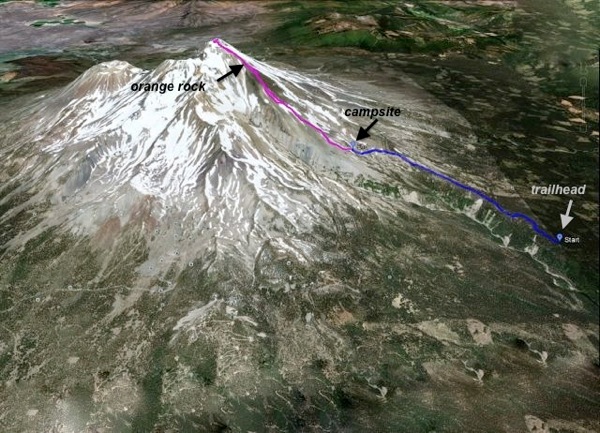
I'VE ALWAYS WANTED to climb Mt. Shasta. We drive past it so often; it's so majestic; so serene. In the last couple of years one of my grandsons has taken to mountaineering with a lot of enthusiasm, so this summer I suggested he accompany me — actually the other way round — and last week, on Labor Day weekend, we did it.

It was a strenuous hike, and to tell the truth I didn't make it to the summit, but I'm satisfied. I thought about putting a description of the two days here, but it doesn't quite seem like Eastside View material (correct me if I'm wrong), so you can visit three webpages describing the hike in some detail, with photos, starting HERE.

Shastatrail.jpg

Monday, August 27, 2012

Commonplace: Judt (Postwar)

“

ON ONE THING, however, all [in Europe at the end of World War II] were agreed—resisters and politicians alike: 'planning'. The disasters of the inter-war decades—the missed opportunities after 1918, the great depression that followed the stock-market crash of 1929, the waste of unemployment, the inequalities, injustices and inefficiencies of laissez-faire capitalism that had led so many into authoritarian temptation, the brazen indifference of an arrogant ruling elite and the incompetence of an inadequate political class—all seemed to be connected by the utter failure to organize society better. If democracy was to work, if it was to recover its appeal, it would have to be planned.
—Tony Judt, Postwar, p. 67 [my italics]

”

Sunday, August 26, 2012

Commonplace: Judt, Postwar

“

ABOVE ALL, VIOLENCE became part of daily life. The ultimate authority of the modern state has always rested in extremis on its monopoly of violence and its willingness to deploy force if necessary. But in occupied Europe authority was a function of force alone, deployed without inhibition. Curiously enough, it was precisely in these circumstances that the state lost its monopoly of violence. Partisan groups and armies competed for a legitimacy determined by their capacity to enforce their writ in a given territory. This was most obviously true in the more remote regions of Greece, Montenegro and the eastern marches of Poland where the authority of modern states had never been very firm. But by the end of World War Two it also applied in parts of France and Italy.

Violence bred cynicism…
—Tony Judt, Postwar, p. 37

”

Farewell, my lovely…

MY LOVELY QUEEN, that is: we saw Benoît Jacquot's film Les adieux à la reine yesterday, a very beautiful and quite intelligent film based on the historical novel of the same title by Chantal Thomas.

(I haven't read the novel, which won the Prix Femina when it was published in 2002; it's available translated into English. Another title of Thomas's, The Wicked Queen: The origins of the myth of Marie-Antoinette, sounds quite fascinating and is criticism, not fiction: perhaps I'll look into it.)


The story concerns Sidonie Laborde, an apparently fictional Reader to Marie-Antoinette — a servant, well below the various ladies-in-waiting on the pecking order, but intelligent and observant; and the plot rests on the apparently equally fictional sexual attraction Marie-Antoinette felt to her confidante the Duchesse de Polignac (and, by implication, Sidonie).

(If you read French, the historian Evelyne Lever comments interestingly on the fictional and the historically accurate aspects of the events in an interview with Le Figarohere.)

All this spools along very nicely, ruffled by little subplots involving a larcenous lady-in-waiting, a couple of clerics with healthy appetites, a marvelous librarian, and a randy, handsome young man. But what really animates this film and its hundred quick minutes is the depiction of the claustrophobic Versailles palace in July 1789, as news of the fall of the Bastille arrives, the King is forced to confront history, and preparations must be made to escape.

I haven't seen the inside of Versailles (and haven't until now wanted to), but Jacquot's cinematography seems pretty persuasive. Architectural details, servant's quarters, the courtyard seen alternatingly from the viewpoints of servants and of courtiers — all this, visually, accompanies a sense of accelerating and impending catastrophe. It's a striking and even a memorable movie, well written and acted, beautifully filmed and edited; I could imagine seeing it again.

Wednesday, August 22, 2012

Commonplace: Judt on collective vs individual rights

“

THE ATTRACTION of the notion that the ethical resides in the individual is that it reduces it to a decision-making process or a set of evaluations of interest, or whatever it might be, that cannot be collectivized and therefore imposed.

But it can lead to another problem, the magnifying upwards of ethical categories from individuals to collectives. We think that we understand quite clearly what we mean when we say that liberty is a universal human value, that the rights to freedom of speech, freedom of movement, freedom of choice inhere in individual people. But I think, ever since the nineteenth century, we have moved rather too easily from one man's freedom to speak of collective freedoms, as though these were the same kind of things.


But once you start talking about liberating a people, or bringing liberty as an abstraction, very different things begin to happen. One of the problems with Western political thought since the Enlightenment has been this movement back and forth between Kantian ethical evaluations and abstract political categories.
—Tony Judt with Timothy Snyder, Thinking the Twentieth Century, p. 291

”