| •Molière:Tartuffe, translated by Richard Wilbur. In repertory through May 24 •Shakespeare: Macbeth. In repertory through May 11 •William Inge: Come Back, Little Sheba In repertory through May 17 A Noise Within, 3352 E. Foothill Blvd., Pasadena, California; 626.356.3100 | 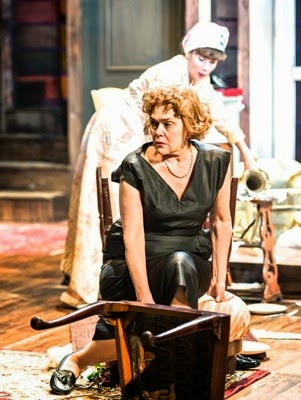 |
|---|---|
| Front: Deborah Strang (Lola); Back: Jill Hill (Mrs. Coffman) in Come Back, Little Sheba at A Noise Within |
Eastside Road, April 15, 2014—
THE THREE PLAYS currently in repertory at A Noise Within, the Pasadena theater company we've attended for the last ten years or so, make a strange trifecta on paper, I think: but taken together they are probably the most consistently successful half-season we've seen here, and that's saying quite a bit.We like the company, partly for its casting, direction, and productions, partly for its enterprising choice of repertory. Shakespeare, of course, on every season, usually with two vehicles. A classic from the European theater, usually French. And a classic from the American stage, often a neglected one. New plays are rarely produced; there are plenty of other theater companies working at that.
Molière's Tartuffe isn't exactly neglected — without going out of our way, we've seen four productions in the last nine years, as I wrote on this blog back in 2010:
The country's second-favorite playOtherwise, I've written enough about the play I don't want to repeat myself here. This production is a little zany, with over-the-top costumes (though often quite elegant) and some fine comic acting (Deborah Strang's Dorine especially) interestingly balanced by the sometimes soberly befuddled Orgon (Geoff Elliott) and the very sympathetic, sensible Cléante (Stephen Rockwell).
This year? Moliere's Tartuffe, they say.
Second most frequently produced,
That is, and now its wit is loosed
On Ashland's public, and they see
That lust and greed, hypocrisy,
And false religion can be fun.
Depends on where and when they're done.
Heroic couplets, stylish sets,
Elegant costumes—no regrets
At seeing Moliere's play once more.
Trenchant satire's never a bore.
The title character was unusually sinister in Freddy Douglas's creepy impersonation of a Caravaggio sensualist, and the direction, by Julia Rodriguez-Elliott, sped along with clarity and good humor.
THE SCOTTISH PLAY — twice now I've made the horrendous mistake of speaking its real title aloud in Noise Within's classy Pasadena theater — received a streamlined, effective, often gripping production, thoughtfully directed by Larry Carpenter, who explained, in a talkback after the show, that he wanted to present it as ritual, removed from its legendary setting, timeless and immediately relevant.
Apart from cuts, the only novelty was the setting of the three weird sisters on male actors, whose black featureless costumes combined with heightened gestures and vocal delivery and with effectively manipulated puppetlike props to bring a Kabukilike quality to the show. Elijah Alexander was an interesting, often powerful Macbeth, and Jules Willcox surprisingly both hypnotic and retiring as his Lady; the rest of the numerous cast were quite up to their assignments. Only Feodor Chin, as Malcolm, gave me a moment's pause; his catalog of self-deprecation interrupts the action toward the close of this play: but that's the fault of the text, which always gives editors and directors a lot to chew on.
It's a disgusting, ghastly, ghostly, powerful play. You pretty much have to believe in the existence of unmotivated Evil as a concrete presence to buy its thesis, and Shakespeare is pretty persuasive on that score. It's not a play I like to see often. But it should and must be performed, and this is one of the best productions I've ever seen.
COME BACK, LITTLE SHEBA is another play that deserves a place in the repertory, though it's probably better known as the movie adapted from it lo these many years ago. It can be bleak and depressing in its treatment of a sad narrative — the lapse back into drunkenness of a reformed alcoholic, tipped past his margin when his idealized view of youth inevitably meets reality.
Geoff Elliott was really magnificent as the doomed Doc, tightly buttoning up his repressions through the first act, alarmingly releasing them in the second. The Lunt-like precision of his technique as an actor, especially his vocal technique, which can be distracting when he works with a verse play (though this was not the case in Tartuffe), was beautifully focussed on his character — both in itself, and in its relationship to his wife Lola and their roomer, the young Marie.
Whether speaking or silent, active or hesitant, Deborah Strang was a fabulous Lola. Face, voice, body, gesture — all seemed perfectly integrated in this characterization. Best of all, the role grew throughout the two hours of the play, finally overwhelming this member of the audience. It is her humanity, in its vulnerability, its insights, its hope and fear, that makes the production so telling.
I liked Maya Erskine's depiction of the flighty little Marie; Miles Gaston Villanueva did what he could as her boyfriend Turk, and Paul Culos similarly dealt with the role of her fiancé Bruce — but Inge is clearly out of his range trying to depict their affairs. Fortunately, that's not important. Perhaps it even underlines the major quality of the play, its portrait of the terribly repressed atmosphere of postwar America.
Ed Anderson, Doc's sponsor at Alcoholics Anonymous, is the focus of this portrait; and Mitchell Edmonds played the part beautifully. The character is patient, sympathetic, somewhat patronizing, ultimately futile, just like the American desire to return to some kind of sheltered small-town homogenous quiet after the tumult of World War II, after learning of the dangers and desires of sex, drink, and foreign ideas.
I think Edward Albee wrote a gloss on Come Back, Little Sheba in his (currently) better-known play Who's Afraid of Virginia Woolf. By then, though, the bittersweet innocence and the explosive loss of that innocence that Inge deals with has become utterly unthinkable. Come Back, Little Sheba, like Inge's other plays Bus Stop and Picnic — both of which Noise Within has produced recently — is pivotal in the history of 20th-century American theater, significant for its position between O'Neill, say, and Albee; but important beyond that for its accurate portrayal of what we were, where we've come from.
And, as directed by Geoff Elliott and Julia Rodriguez-Elliott and performed by this admirable cast, in an evocative setting by Stephen Gifford and costumes by Leah Piehl, Come Back, Little Sheba is gripping, exciting theater. If it weren't hundreds of miles away I'd go back to see it again. Bravo to all involved!
