In the next few weeks this site will become a travel journal, if you don't mind — notes more or less chronological, otherwise random. For the moment we skip past a day in Madrid, and arrive in...
Friday May 7: CASERTA
The chief tourist attraction of this provincial city is its amazing Reggia, the Italian equivalnt of France's Versailles or the Dutch Het Loo, built in the middle of the eighteenth century by Charles III, designed by Luigi Vanvitelli. We didn't investigate its interior, having really only one day to spend, and that a nice one. Instead we walked slowly up the central axis of its amazing series of lawns, pools, and fountains, a mile and a quarter as my pocket computer counted it. Water cascades from a source high above the Reggio, at an elevation of about 200 meters above sea level, to a basin at the top of the formal garden; this basin contains two sculpture groups representing Diana and Acteon at the moment the latter is being transformed into a stag and set upon by his own hounds.
Here is an entrance to an English garden, really a park, laid out alongside the formal garden, hidden from it by the very high hornbeam hedges themselves carved out of a dense canopy probably sixty feet high composed primariily of lime-trees.
The English garden features its own pools and fountains but is domianted by stately beeches, elms, oaks, and magnolia trees set about on huge gently sloping lawns. Halfway down the park, occupying perhaps a third its width and only a tenth or so its length, are the 17th-century greenhouses and sheds, a couple of huge staging-areas for working with bedding plants and small pots, a good-sized kitchen garden, and a very nice formal rose garden within its own walls.
It took nearly six hours to enjoy these gardens and eat a couple of sandwiches we'd brought along with us.
Monday, May 10, 2010

Wednesday, May 05, 2010
Music in the air
Madrid—
MIKHAIL MIKHAJLOVITCHIPPOLITOV-IVANOV is one of those "minor" composers known for only one piece, the colorful Caucasian Sketches*. It's a piece that means a lot to me, as it was on the winter concert played by the college orchestra when I was a freshman and still nominally a music major. I was seventeen and had just graduated from high school, where I played bassoon in the concert band — there was no orchestra in our small country high school.
I didn't have a bassoon, so when I got to Chapman College, in those days a small Christian school on Vermont Avenue in Los Angeles, they provided me with a French horn on which I was asked to play the first bassoon parts. My band teacher had encouraged me to learn all the wind instruments (all but flute, which never worked for me, and trumpet, which I didn't like), and to learn to transpose at sight, so while a little demeaning this wasn't too hard.
What was annoying, though, was that at the dress rehearsal a ringer showed up with a bassoon, and I was moved from hornoon or whatever you'd call it to triangle.
I've always been a sucker for Russian descriptive music, perhaps because of my concert band background. Ippolitov-Ivanov studied with Rimsky-Korsakov, whose influence is as strong in orchestration as hyphenation. I-I writes beautifully for horns and trombones. I have no idea who played oboe and English horn at Chapman; they get some pretty extensive solos.
There are four sections, as I recall: "In the Mountains" — maybe this is another attraction to me — "In the Village"; "In a Mosque"; and a long, wonderfully local-colorful "Procession of the Sardar." There's hardly any melodic material at all, just noodling, broken chords, and scale passages; but the sonorities are fabulous and the rhythmic drive, even in the lengthy slow-tempo sections, compelling.
The piece is sizable, maybe twenty minutes long — I listened to it on headphones on the way over here, in the airplane; it's perfect airplane music, mindless and attractive. Maybe next time I'll load Reinhold Gliere's Ilya Mourometz Symphony onto the iPod; it's four times as long and even more colorful. Then there's the Borodin symphonies…
*Wikipedia is right to quibble that Caucasian Sketches is a silly title and probably a poor translation; Ippolitov-Ivanov means "Sketches from the Caucasus," but that inescapably brings Miles Davis to mind.
The whole thing reminds me of visiting the French lawyer with my friend George's death certificate, so the estate could be put into motion. The lawyer sat gravely in his serious, formal, provincial French office and silently read over the certificate. After a few minutes he smiled: this was odd, it was a sober occasion. The smile grew into a chuckle. He peered up over his glasses and explained, in French — he spoke no English — But look, it says here George was a Caucasian; I knew George, he wasn't Caucasian, he was born in Canada but he was an American; they've made a silly mistake; he wasn't anything like a Caucasian.
Wednesday, April 28, 2010
The Carrizo Plain
YOU CAN DRIVE from Los Angeles — well, Glendale, next thing — to Berkeley in nine hours and still take in the Carrizo Plain. I shouldn't tell you this. One of the great attractions of the Carrizo Plain is its emptiness: if all subscribers to The Eastside View decide to drive there next weekend there'll be a traffic jam. 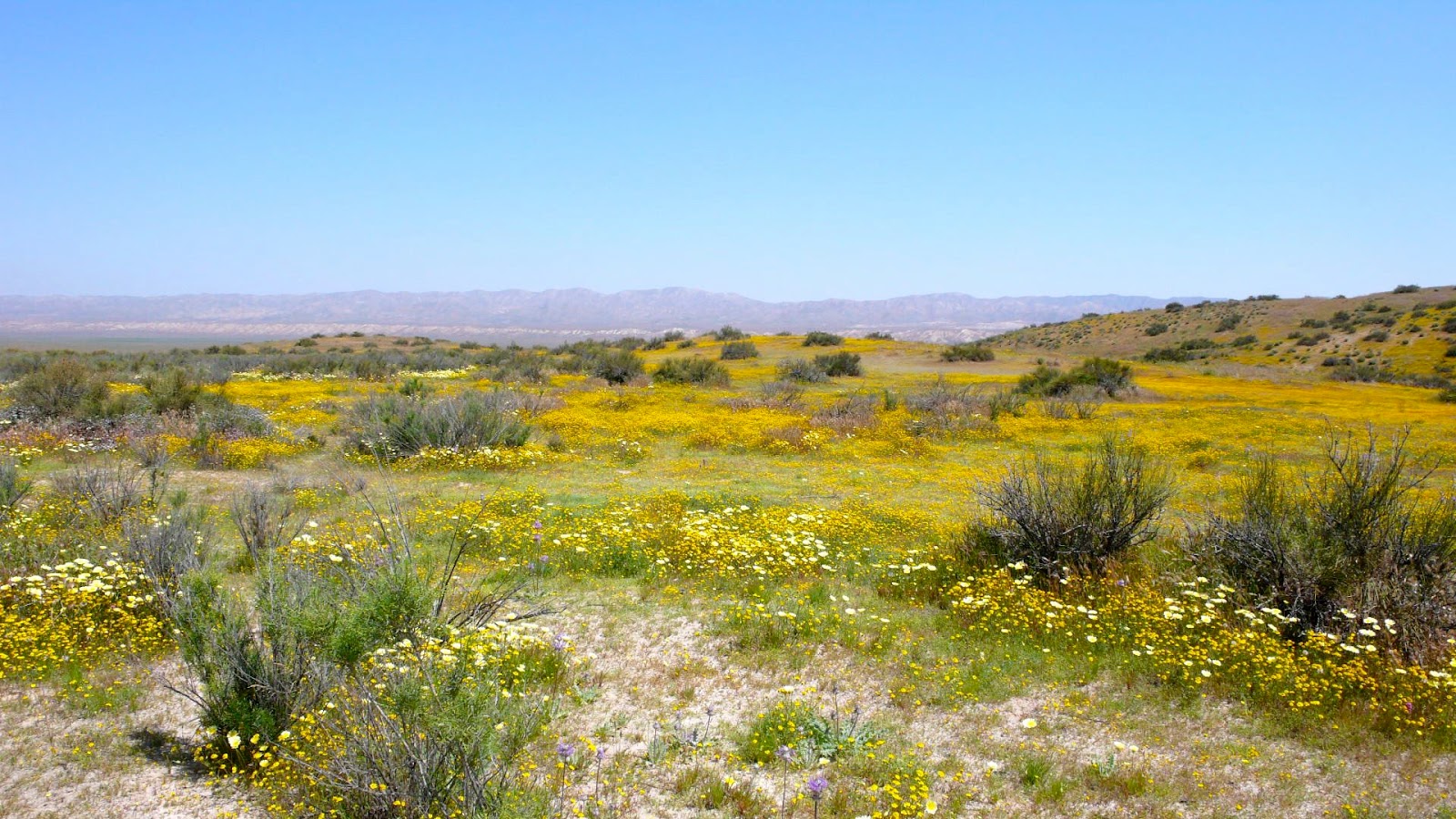
I've put a web gallery of photos up here; in the meantime you can make do with this shot — click on it and I think you'll get a bigger version. We were there perhaps a week too late for the peak of the wildflowers, but what we saw was well worth the drive.
We took the road south to north, driving up to the first ramp off Highway 5 north of the split from 99, then the long dreary road toMariposa Maricopa, then on twelve miles through amazing country to the an abandoned gas station at a junction. There you turn north on Soda Lake Road, driving twelve or fifteen miles on unpaved road, through dry cattle ranches, miles of beautiful empty wide valley between low hills, finally coming to the federally protected National Monument lands.
We first drove through here quite a number of years ago, from north to south that time, also looking for wildflowers. Seems to me that was the time we caught them at their peak: the west-facing slopes of the hills above the San Andreas Fault, along the east side of the valley, looked like a Persian carpet of lavenders, roses, reds, yellows, and blues. What you see in the photo above is only a hint of what can happen here in exceptional years.
We took our time but covered the ground, driving 35 or 40 miles an hour up the road, stopping at the observation point on a low hill west of the road. We continued past the ghost town — actually the never developed town — of California Valley; then west on Highway 58 and up Shelby and O'DOnovan Roads toward Creston, and up Creston Road into Paso Robles where we joined 101 for the drive up to Berkeley. I'd never taken thoset 58-Paso Robles roads before; it's a beautiful drive, first through more empty wildflower country, then through vineyards, finally the unfortunate suburbs. Well, folks have to live somewhere, I guess. I'm glad they don't live on the Carrizo Plain.
I've put a web gallery of photos up here; in the meantime you can make do with this shot — click on it and I think you'll get a bigger version. We were there perhaps a week too late for the peak of the wildflowers, but what we saw was well worth the drive.
We took the road south to north, driving up to the first ramp off Highway 5 north of the split from 99, then the long dreary road to
We first drove through here quite a number of years ago, from north to south that time, also looking for wildflowers. Seems to me that was the time we caught them at their peak: the west-facing slopes of the hills above the San Andreas Fault, along the east side of the valley, looked like a Persian carpet of lavenders, roses, reds, yellows, and blues. What you see in the photo above is only a hint of what can happen here in exceptional years.
We took our time but covered the ground, driving 35 or 40 miles an hour up the road, stopping at the observation point on a low hill west of the road. We continued past the ghost town — actually the never developed town — of California Valley; then west on Highway 58 and up Shelby and O'DOnovan Roads toward Creston, and up Creston Road into Paso Robles where we joined 101 for the drive up to Berkeley. I'd never taken thoset 58-Paso Robles roads before; it's a beautiful drive, first through more empty wildflower country, then through vineyards, finally the unfortunate suburbs. Well, folks have to live somewhere, I guess. I'm glad they don't live on the Carrizo Plain.
Sunday, April 25, 2010
The Playboy of the Western World
Glendale, April 25—
A FINE CLOSE TO a fine season tonight at A Noise Within: John Millicent Synge's The Playboy of the Western World in a devoted, straight-ahead production, idiomatically directed by Geoff Elliott on a cluttered, atmospheric set by Stephen Gifford, set on a superb cast: a true ensemble theater with stellar performances by Michael Newcomer as Christy and Lindsay Gould as Pegeen.It's such a wonderful play, quickly alternating among raucous humor, wry irony, and sudden pathos. There's no easy way to categorize it: from the distance of a century you can see Synge's relationship to Chekhov and even Ibsen, you can see Eugene O'Neil's connection later to Synge. I think I can even see a connection to the Tennessee Williams of Camino Real and The Night of the Iguana. But truly he's his own playwright, and Playboy is alone in its category.
It would take five minutes to tell the story plainly; it's not much more than a shaggy dog story.But Synge's dialogue is Irish poetry at its best, with far-flung, fanciful imagery, and he uses language to flesh out his characters; you get to know them, to become fond of them. Some — Widow Quin, Shawn Keogh — clearly are borrowed from commedia dell'arte; others are stock Irish comics; but all find individuality, dimension, and dignity through Synge's genius, based on keen observation, channeled through fondness for humanity, sharpened by awareness of the pathetic position of those whose place is below both their aspiration and their deserts.
Thursday night we saw a remarkably fine Much Ado About Nothing; Friday night a splendid Awake and Sing; tonight this marvelous Playboy. A Noise Within has grown over the years to become a truly inspired repertory company, with a stable of actors who seem able to turn on a dime, a team of directors who respect the scripts they're given yet bring them to life, and artistic direction that chooses repertory wisely, investigating the classics, foreign-language rep (in translation, of course), and neglected corners of the 20th century.
Best of all, you can see these three endlessly entertaining plays in a short visit to Los Angeles. The season continues through May 25, and I don't know when I've been more enthusiastic about a recommendation.
Saturday, April 24, 2010
Curiosities
Glendale, April 24—
A FEW YEARS BACK our friends Jim and Lisa told us about a curious place down here in Los Angles, the Museum of Jurassic Technology. Words don't do the place justice, though many have attempted the task — me included, of course. We stopped off at Jim and Lisa's the other night, as we often do on our semiannual drives down here for plays at A Noise Within, and they told us about a special presentation held today at Occidental College: A Wonder Cabinet, a series of presentations of arcane matters by curious specialists, all curated by Lawrence Weschler. Since I think of Weschler's book Seeing is Forgetting the Name of the Thing One Sees as one of the great books of the twentieth century, and respect his judgement as much as his writing skills, I could hardly turn down the opportunity. We didn't get to campus in time for the opening presentations, but did manage to take in five events. And this is what they were:
Ricky Jay, slight-of-hand master and archivist on arcana, magic, and entertainments, discussed 18th and 19th-c. English books on Illustrious Persons, special attention to those compiled by James Granger and, later, James Caulfield. Jay concentrated on persons classified by those authors as persons famous for one thing having happened to them — a fellow, for example, who, on the death of his fiancée, never washed either himself or any of his clothing again until the day he died. He mentioned a number of other persons of fleeting fame, however; among them Nikolai Fyodorov, who believed that to attain perfect brotherhood among humanity man's "Common Task" was the resurrection of all humans who have died, and Konstantin Tsiolkovsky, who, by taking the idea the next step to propose space travel in order to accommodate the vast numbers of persons who would result, inspired the Soviet space program.

Walter Murch then discussed, elegantly and clearly, the Titus-Bode Law describing (and predicting) the positions of orbits, whether of planets within the solar system, the moons of the various planets, or the electrons in atomic structure. This was an extraordinarily fascinating presentation; its complexity was greatly resolved by superb graphic presentation and, of course, Murch's calm, reasoned, persuasive voice. I wouldn't have missed this for anything.
Ken Libbrecht, chair of the department of Physics at Cal Tech, discussed the geometry and formation of snowflakes, showing a number of photographs he's taken with an impressive apparatus of his own design.
And Matt Shlian gave a summary of his brilliant career as a paper engineer, specializing in the transformation of single flat sheets of paper into incredible sculptures involving cuts, folds, and curves resulting in elaborate, often kinetic, elegant sculpture.
Weschler's model for these presentations, like Wilson's model for his Museum of Jurassic Technology, is the Cabinet of Wonders, the omnium-gatherum of specimens, drawings, books, and curiosities assembled by collectors to gratify their own urges but also to instruct their communities; these gradually evolved into the museums familiar in our own culture, whether of art or natural history or technology.
It was interesting witnessing all this the day after a hasty visit, at the Getty Center, of a display of drawings of Leonardo da Vinci. Clearly the same convergence of love of aesthetic and urge to knowledge animates all this activity: it's a great pleasure to see it in operation.
Awake and Sing
Glendale, April 23—
For our second night of theater here Noise Within gave us a stunning performance of Clifford Odets's Depression-era Awake and Sing, a solid, often poetic, tense, deep drama set within a Jewish family in the Bronx, with three generations of immigrants and first-generation Americans squaring off against one another, Capitalism, ungrateful employees, hard times, repressed strivings, bitterness, and the human condition in general.It was like Chekhov with a seriously nasty case of heartburn, I thought after the first act; not long into the second I realized it was much more than that: it was like a Mahler symphony. Humor, grief, anger, transcendent yearning all flow into and out of one another. There's a story, of course, and it's well conceived and well developed; but it's the matter beyond the story that held the near-capacity audience in a grip. I'm on the road, not at my computer where I have facts at hand, so I can't list the plays I've seen over the last few years this resonated with, Italian and English and American plays, many of them set in the same general period, when totally desperate situations forced families and individuals to totally desperate actions.
One play that it particularly resonated with was last fall's adaptation of Dostoevsky's Crime and Punishment, also produced by A Noise Within. They have in common the drama of intense socio-politico-economic moments impacting desperate, sensitive, intelligent characters, of course. Beyond that, though, they even share the idea of a physical set influencing, or at any rate underlining, the way those tensions are achieved on the stage.
We like this Glendale company for the same reason we like the Oregon Shakespeare Festival; both are repertory companies, developing and performing a number of productions simultaneously. Shakespeare's Globe Theater, Odets's Group Theater, Molière's Comédie, Chekhov's Moscow Art Theater — all, if I'm not mistaken (and I repeat: facts are not readily at hand), were repertory companies centered on the players, strong companies with strong ensembles.
Players lucky enough to work within such ensembles can trust one another, share ideas, probe the depths of the works they interpret. Further, they inescapably grow from one production to the next — not becoming better actors; they're already enormously skillful — but developing greater depth and complexity, just as do the audiences lucky enough to follow them through Shakespeare, Racine, Molière, Ibsen, Chekhov, Synge, O'Neill, and so on.
Tonight's performance was draining. The entire cast turned out on stage a few minutes after the final curtain to field questions from the audience, and it was immediately clear that the audience was exhausted, the cast exhilarated. I think that's as it should be: Aristotle's catharsis reversed, perhaps; but we'll have time and matter to think this over in the weeks to come.
Friday, April 23, 2010
Much Ado About Nothing
Glendale, April 23—
We're in Glendale to see the spring season of A Noise Within, the Equity repertory company we've subscribed to for the last several years. In four days you can catch three plays, the first half of the season in November, the second about this time of year. Shakespeare, recent American plays, European standards (Ibsen, Chekhov), most years a French classic (Molière, Racine), often an American standard. This time it's Shakespeare, Odets, and Synge. I'll write in more detail after having seen all three: tonight we saw Much Ado About Nothing in a very entertaining production, set in turn-of-the-twentieth-century Sicily, with a Katherine Hepburny Beatrice (Torri Higginson) and a curiously Ray Millandish Benedick (JD Cullum) and a fine supporting cast, neatly directed by Michael W. Murray.
It's late and I don't want to look up the links or write in detail about the performance. Or, for that matter, the play: I've always had trouble with it before, and it occurs to me that's because most productions I've seen have been overladen with shtick and/or concept. This was a nice clean interpretation, speaking the lines clearly without apology. Oh: and the clowns were wonderful, especially Mark Bramhall's Dogberry and Mitchell Edmonds's Verges. I'm glad we saw it.
Monday, April 19, 2010
Books, wine, war, talk
TAKING A BREAK from reading about Sicily, on Lindsey's advice, I've just read two books touching on World War II, a subject that's never really attracted me. (Lindsey's mother was a WWII buff, watching all the documentaries, reading all the books; and Lindsey herself recently read William Shirer's mammoth The Rise and Fall of the Third Reich.)
The Twentieth Century was a violent one. Militarily I suppose it began in 1870 with the Franco-Prussian War; Central and Western Europe wasn't to see much peace from then until 1945, and the reconstruction of Western Europe was hardly complete until the 1960s. I used to think of World War II as a terrible interruption in the century; in fact, it was a termination.
(A termination of one kind of terror, perhaps followed by the beginning of another kind — not military but economic. Jury's out on that; we're in the midst of it, and can't see the forest for the trees.)
Lately World War II has been too much in mind, as if we knew, somehow, that we were on the cusp of another such trial. There's been a lot of discussion, for example, of honor and culpability, a lot of blame thrown at people whose own trials we can never really know. I'm thinking, for example, of Janet Malcolm's treatment of Gertrude Stein and Alice B. Toklas, in Two Lives: Gertrude and Alice (2007), a book that annoyed me considerably when it appeared. We must investigate; we must document; we must discuss: but we must never cast judgment backward on the past; it's hard enough to practice it on the present.
We can, however, learn. This is what Robert Mnookin does in his book Bargaining with the Devil. It's written as an argument for negotiation, even at times negotiation with enemies, even those one might think of as evil (or at least as having done evil things); but in support of that thesis Mnookin recounts two examples drawn from the period of World War II: Winston Churchill's refusal to negotiate with Hitler in May 1940 — there are times when even Mnookin agrees it's wrong to negotiate — and Rudolf Kasztner's decision to negotiate with Adolf Eichmann over the release of Jews from Hungary in the waning days of the war.
A third example, the Soviet dissident Natan Sharansky and his refusal to negotiate with the KGB, contrasts vividly with Nelson Mandela's negotiations with F.W. de Klerk — negotiations that contributed to the end of apartheid in the Union of South Africa. (De Klerk himself is not examined in any great length, but appears as a sympathetic character emerging from an evil system: it would be interesting to hear a conversation between him and Mikhail Gorbachev.)
Mnookin's book appears at the right historical moment, when some of the American Right is vilifying the State Department's evident embrace of negotiation and diplomacy as the right course, even with potential enemies. Beyond its immediate political value, though, Bargaining With the Devil is an interesting book and one offering useful application to everyday life: I'm glad I read it. Bargaining With the Devil : Simon & Schuster, 2010
The Twentieth Century was a violent one. Militarily I suppose it began in 1870 with the Franco-Prussian War; Central and Western Europe wasn't to see much peace from then until 1945, and the reconstruction of Western Europe was hardly complete until the 1960s. I used to think of World War II as a terrible interruption in the century; in fact, it was a termination.
(A termination of one kind of terror, perhaps followed by the beginning of another kind — not military but economic. Jury's out on that; we're in the midst of it, and can't see the forest for the trees.)
Lately World War II has been too much in mind, as if we knew, somehow, that we were on the cusp of another such trial. There's been a lot of discussion, for example, of honor and culpability, a lot of blame thrown at people whose own trials we can never really know. I'm thinking, for example, of Janet Malcolm's treatment of Gertrude Stein and Alice B. Toklas, in Two Lives: Gertrude and Alice (2007), a book that annoyed me considerably when it appeared. We must investigate; we must document; we must discuss: but we must never cast judgment backward on the past; it's hard enough to practice it on the present.
We can, however, learn. This is what Robert Mnookin does in his book Bargaining with the Devil. It's written as an argument for negotiation, even at times negotiation with enemies, even those one might think of as evil (or at least as having done evil things); but in support of that thesis Mnookin recounts two examples drawn from the period of World War II: Winston Churchill's refusal to negotiate with Hitler in May 1940 — there are times when even Mnookin agrees it's wrong to negotiate — and Rudolf Kasztner's decision to negotiate with Adolf Eichmann over the release of Jews from Hungary in the waning days of the war.
A third example, the Soviet dissident Natan Sharansky and his refusal to negotiate with the KGB, contrasts vividly with Nelson Mandela's negotiations with F.W. de Klerk — negotiations that contributed to the end of apartheid in the Union of South Africa. (De Klerk himself is not examined in any great length, but appears as a sympathetic character emerging from an evil system: it would be interesting to hear a conversation between him and Mikhail Gorbachev.)
Mnookin's book appears at the right historical moment, when some of the American Right is vilifying the State Department's evident embrace of negotiation and diplomacy as the right course, even with potential enemies. Beyond its immediate political value, though, Bargaining With the Devil is an interesting book and one offering useful application to everyday life: I'm glad I read it.
A COMPLETELY DIFFERENT DESCRIPTION of World War II experiences informs Wine and War: The French, the Nazis, and the Battle for France's Greatest Treasure, by Donald and Petie Kladstrup. I like "delphica"'s review of it on Librarything.com:
This is a collection of personal stories about the French wine makers and their experiences during Vichy, and many of them are simply remarkable, such as Jean Huet's (Clos du Bourg) time as a POW, Bernard de Nonancourt (Laurent-Perrier) joining the Resistance, and the Miailhe family (Pichon-Lalande) indeed harboring Jewish families in a hidden annex. And for wine-lovers, there are still plenty of anecdotes about French wine culture. It's a very patriotic book, from reading it one would get the impression that every man, woman and child in France was actively and cheerfully involved in sabotaging the Reich -- it's a little light on the complexity and ambiguity of the occupied France.It's not meant to cover that complexity, of course, though it does touch enough on the ambiguities — of the sort that exonerate Stein and Toklas, I feel — to set any intelligent reader to thinking.
Even more, it makes me think about the difference between the wealthy French vintners of the period before World War II — men (and women!) who farmed, maintained their books, supervised the winemaking, and dealt with marketing — and the corporate structure of specialized management and globalized ownership of our own time. Much has grown Too Big Not to Fail, I think: and how would today's counterparts deal with an encompassing evil like Nazism?
(And to what extent is Nationalism, with all its dubious accoutrements, a requisite to any Resistance of such an evil? Hmmm. Think on José Bové; think on the Slow Food movement.)
Sunday, April 18, 2010
Tartuffe, again
WE'VE SEEN MOLIERE'S classic Tartuffe four times in five years now, and what I wrote about it the last time, nearly three years ago, still holds:
It's community theater. Many of the actors teach drama in various schools in the area; their students are lucky. I was particularly struck by the way the director, Sheri Lee Miller, allowed individual takes on the roles, even the lines, while making a real ensemble of the cast.
Keith Baker was a marvelous slimy Tartuffe, the religious zealot-hypocrite who lusts after his protector's wife. As Orgon, the wealthy fool who takes Tartuffe into his family, Eric Thompson was solid, subtle, and very likeable. Jenifer Cote held center stage well as Elmire, Orgon's wife, and Kendall Carroll was a perfect, leggy Marianne, the petulant daughter.
Both John Craven, as Cléante, and Joan Felciano, as Mme Pernelle, were particularly effective in their long introductory speeches setting up the action. Jimmy Gagarin played the young romantic Valere (Marianne's suitor) nicely, and Freddie Lambert was effective as Orgon's son Damis. Mary Gannon Graham ran away with the role of Dorine, and Laura Tennyson was as funny a clowning Flipote as you could ask.
Tartuffe will probably never lack relevance, alas; if you don't know the play, a look at Wikipedia's entry will suggest the reasons. If you're nearby, give this production a look: it's really good.
Sixth Street Playhouse , 52 W 6th Street, Santa Rosa CA; tel. 707 523-4185; performances Thursday-Sunday through May 2, 2010.
The country's second-favorite playWe saw it again last night, in Santa Rosa's Sixth Street Playhouse, in a good-looking production with no-particular-period set and costumes (but very interesting and often funny costumes, suiting — sorry about that — the characters) and a fine cast having fun with Richard Wilbur's apt and entertaining verse translation.
This year? Moliere's Tartuffe, they say.
Second most frequently produced,
That is, and now its wit is loosed
On Ashland's public, and they see
That lust and greed, hypocrisy,
And false religion can be fun.
Depends on where and when they're done.
Heroic couplets, stylish sets,
Elegant costumes—no regrets
At seeing Moliere's play once more.
Trenchant satire's never a bore.
It's community theater. Many of the actors teach drama in various schools in the area; their students are lucky. I was particularly struck by the way the director, Sheri Lee Miller, allowed individual takes on the roles, even the lines, while making a real ensemble of the cast.
Keith Baker was a marvelous slimy Tartuffe, the religious zealot-hypocrite who lusts after his protector's wife. As Orgon, the wealthy fool who takes Tartuffe into his family, Eric Thompson was solid, subtle, and very likeable. Jenifer Cote held center stage well as Elmire, Orgon's wife, and Kendall Carroll was a perfect, leggy Marianne, the petulant daughter.
Both John Craven, as Cléante, and Joan Felciano, as Mme Pernelle, were particularly effective in their long introductory speeches setting up the action. Jimmy Gagarin played the young romantic Valere (Marianne's suitor) nicely, and Freddie Lambert was effective as Orgon's son Damis. Mary Gannon Graham ran away with the role of Dorine, and Laura Tennyson was as funny a clowning Flipote as you could ask.
Tartuffe will probably never lack relevance, alas; if you don't know the play, a look at Wikipedia's entry will suggest the reasons. If you're nearby, give this production a look: it's really good.
Saturday, April 17, 2010
Aaron Copland: The Tender Land
A FRIEND WHO'S INVOLVED with opera called the other day, asking if I planned to go to Berkeley Opera that week. No, I said, I didn't, why? What were they doing?
The Tender Land, he said.
Why on earth, I asked. He didn't respond immediately, but it was clear something was up. It isn't going to be reviewed, he said, And I thought maybe you'd like to go, and write something about it.
I don't do that any more, I pointed out. I'm retired. I don't write criticism.
But you blog, he said, You write about things you see, people read what you write. I just thought you might like to see this.
To make a long story short, what with one thing and another, against my better judgement, I said Okay, we have to be in Berkeley on Friday anyway, why not. I'm not fond of Copland's music of that period — his earliest music is his best, in my opinion — and I'm certainly not fond of his sense of theater. But I usually make it a point to see an opera I haven't seen before.
Then too, I have a kind of history with Berkeley Opera: I've narrated productions of theirs — in Beethoven's Leonore in 1997; in E.T.A. Hoffman's Undine (a much more interesting assignement) in 1999. I hadn't seen anything of theirs in years, and they'd moved into a new hall: it seemed like time to give it a try. So yesterday we stopped off in El Cerrito to see The Tender Land.
El Cerrito High School has a new complex of buildings, one of them rather an attractive auditorium, seating perhaps a thousand or so in a wide, no-central-aisle fan-shaped house, with a good orchestra pit and a good-sized stage. This is the new home of Berkeley Opera, which has been making do with the Julia Morgan Center for many years. (Before, it had played Berkeley's Hillside Club on Cedar Street and Martin Luther King Jr. Middle School, where I remember seeing a fine Leonore in the 1980s.)
I'm not going to review the production: first, as I've said, I don't do that any more; second, it's been done by Musical America online, where Georgia Rowe writes production and performance notes I mainly agree with (except that I thought tenor Lee Steward perfectly acceptable in his higher range). (You can read Miss Rowe's review on the Berkeley Opera site.)
I thought the production — stage direction, sets, lighting and video projections, costumes — was perfectly appropriate to the piece, the theater, and the company. And the performances — both on stage and in the pit — were more than adequate, often nearly persuading me of the musical (though not the dramatic or literary) value of the work.
But The Tender Land seems to me hardly worth all this attention. In fact the opera seems bankrupt and bogus, an urban New York symbol-ridden view of a kitschy Steinbeck-flavored middle-American farm society; patronizing in its "tenderness" and boring both for its predictability and its emptiness.
The libretto is laughable, with lines like "Stomp your feet upon the floor" in a barn-dance scene. Much of the time it seems influenced by Gertrude Stein's writing for children:
Then there's Copland's music, mostly in his open, consonant, bare-octaves-and-fifths manner of the 1940s, of Appalachian Spring and after. Berkeley Opera used thirteen instrumentalists: double string quartet, contrabass, flute-piccolo, clarinet, bassoon, piano. The result was transparent, hard-edged, mostly well in tune; but Copland's music, especially in the first act, is so unvarying, has so little rhythmic interest, that it's fatiguing to the ear. (I suspect that the tension between his open harmonies and the equal temperament the piano insists on is greatly responsible for this fatigue, but that's a technical matter.)
I've always thought of Copland, Britten, and Shostakovich as an interesting triad. Each was immensely gifted and intelligent; caught in an uneasy relationship to the prevailing Modernism-Reactionism duality of the early 20th century; apparently self-assigned to a position of National Spokesman for his art. Each composed masterpieces, particularly early masterpieces, then went on to an uneven output often troubled by indecision as to whether to be Popular or Principled (with respect to personal musical style).
Some of Copland's best scores are "abstract": the Sextet, the Piano Variations, the Clarinet Concerto. More are populist and narrative or at least pictorial: El Salon Mexico is my favorite, but of course Appalachian Spring and Billy the Kid are major works. Too often, to my taste, he goes way over the top toward courting a wider audience: A Lincoln Portrait, Fanfare for the Common Man.
This opera, commissioned by Richard Rodgers and Oscar Hammerstein II for a television production (but ultimately rejected by NBC's Television Opera Workshop), seems to have been written with Rodgers and Hammerstein's Oklahoma! in mind. That piece, produced ten years earlier in 1943, is brilliant and original; The Tender Land is hokey and pretentious. I'm glad I've seen it, but it's now crossed off the list.
The Tender Land, he said.
Why on earth, I asked. He didn't respond immediately, but it was clear something was up. It isn't going to be reviewed, he said, And I thought maybe you'd like to go, and write something about it.
I don't do that any more, I pointed out. I'm retired. I don't write criticism.
But you blog, he said, You write about things you see, people read what you write. I just thought you might like to see this.
To make a long story short, what with one thing and another, against my better judgement, I said Okay, we have to be in Berkeley on Friday anyway, why not. I'm not fond of Copland's music of that period — his earliest music is his best, in my opinion — and I'm certainly not fond of his sense of theater. But I usually make it a point to see an opera I haven't seen before.
Then too, I have a kind of history with Berkeley Opera: I've narrated productions of theirs — in Beethoven's Leonore in 1997; in E.T.A. Hoffman's Undine (a much more interesting assignement) in 1999. I hadn't seen anything of theirs in years, and they'd moved into a new hall: it seemed like time to give it a try. So yesterday we stopped off in El Cerrito to see The Tender Land.
El Cerrito High School has a new complex of buildings, one of them rather an attractive auditorium, seating perhaps a thousand or so in a wide, no-central-aisle fan-shaped house, with a good orchestra pit and a good-sized stage. This is the new home of Berkeley Opera, which has been making do with the Julia Morgan Center for many years. (Before, it had played Berkeley's Hillside Club on Cedar Street and Martin Luther King Jr. Middle School, where I remember seeing a fine Leonore in the 1980s.)
I'm not going to review the production: first, as I've said, I don't do that any more; second, it's been done by Musical America online, where Georgia Rowe writes production and performance notes I mainly agree with (except that I thought tenor Lee Steward perfectly acceptable in his higher range). (You can read Miss Rowe's review on the Berkeley Opera site.)
I thought the production — stage direction, sets, lighting and video projections, costumes — was perfectly appropriate to the piece, the theater, and the company. And the performances — both on stage and in the pit — were more than adequate, often nearly persuading me of the musical (though not the dramatic or literary) value of the work.
But The Tender Land seems to me hardly worth all this attention. In fact the opera seems bankrupt and bogus, an urban New York symbol-ridden view of a kitschy Steinbeck-flavored middle-American farm society; patronizing in its "tenderness" and boring both for its predictability and its emptiness.
The libretto is laughable, with lines like "Stomp your feet upon the floor" in a barn-dance scene. Much of the time it seems influenced by Gertrude Stein's writing for children:
Ma (Act I): Two little bits of metal, my needle and my thimble, a woman has to sew her family’s clothes against the cold cold weather. Two larger bits of metal, my woodstove and my kettle, a woman has to stew her family’s food against the cold cold weather.Often the English is so stilted it sounds like a poor translation from another language: My own sweet child, my own sweet child, her face is like my mirror long ago.
Martin (Act II): I’m getting tired of travelin through. My shoes are wearing thin. I’m getting tired of wand’rin, wand’rin, not caring where I’ve been. I want to stay in a place for a while and see a seedling grow. I want to come to know special skies, special rain and snow.
Then there's Copland's music, mostly in his open, consonant, bare-octaves-and-fifths manner of the 1940s, of Appalachian Spring and after. Berkeley Opera used thirteen instrumentalists: double string quartet, contrabass, flute-piccolo, clarinet, bassoon, piano. The result was transparent, hard-edged, mostly well in tune; but Copland's music, especially in the first act, is so unvarying, has so little rhythmic interest, that it's fatiguing to the ear. (I suspect that the tension between his open harmonies and the equal temperament the piano insists on is greatly responsible for this fatigue, but that's a technical matter.)
I've always thought of Copland, Britten, and Shostakovich as an interesting triad. Each was immensely gifted and intelligent; caught in an uneasy relationship to the prevailing Modernism-Reactionism duality of the early 20th century; apparently self-assigned to a position of National Spokesman for his art. Each composed masterpieces, particularly early masterpieces, then went on to an uneven output often troubled by indecision as to whether to be Popular or Principled (with respect to personal musical style).
Some of Copland's best scores are "abstract": the Sextet, the Piano Variations, the Clarinet Concerto. More are populist and narrative or at least pictorial: El Salon Mexico is my favorite, but of course Appalachian Spring and Billy the Kid are major works. Too often, to my taste, he goes way over the top toward courting a wider audience: A Lincoln Portrait, Fanfare for the Common Man.
This opera, commissioned by Richard Rodgers and Oscar Hammerstein II for a television production (but ultimately rejected by NBC's Television Opera Workshop), seems to have been written with Rodgers and Hammerstein's Oklahoma! in mind. That piece, produced ten years earlier in 1943, is brilliant and original; The Tender Land is hokey and pretentious. I'm glad I've seen it, but it's now crossed off the list.
Monday, April 12, 2010
Ponge
JUST A QUICK NOTE to recall Francis Ponge, the great French poet and homme des lettres. In the mail today a letter from an assistant to his daughter, asking if I have a letter from him. Well, yes, I do, somewhere, but who knows where.
In the late 1960s I became besotted with his limpid, crystalline, captivating writing through the medium of his Le savon, which appeared in Lane Dunlop's translation (Soap) in a small, elegant book published by Grossman/Cape Goliard. I found it in Robert Yamada's excellently stocked Co-op Bookstore on Shattuck Avenue in Berkeley, and before long I was on the store's board of directors, so besotted was I.
I bought every edition I could find of Ponge, and in 1970 wrote out a translation of his Douze petits écrits, working in the announce booth at KQED with my kit of colored inks and Brause penpoints (and a Rapidograph or two). A few years later my good friend (whom I see perhaps decennially) Rolando Castellon decided to publish a selection in his occasional periodical Cenizas, and then printed out a number of copies in facsimile. I thought I'd bind them all, by hand of course, in facsimiles of my original notebook, itself bound in cardboard and passepartout-tape. It's one of several, many, too many unfinished projects.
I wrote Ponge asking permission, of course, and received a generous and gracious reply, which furnished an end-paper to the projected edition.
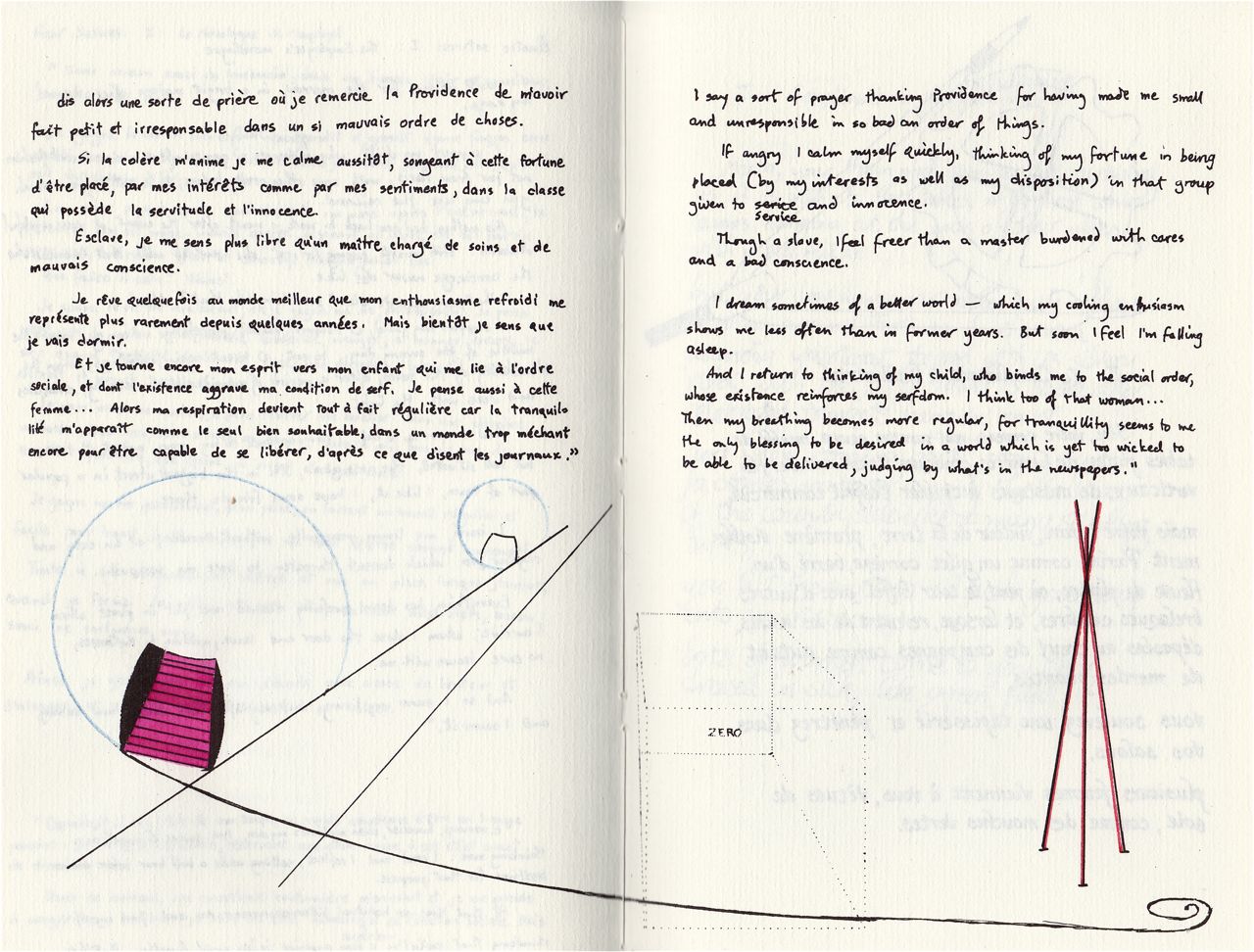
Here's a teaser (control-click on it for a bigger view), a two-page spread, ending the first of Ponge's Quatre satires: i: le monologue d'employé. Much of the original is too delicate to survive scanning, but you'll get the idea. The idea was to present the original French text and progressive translation attempts, correcting and revising as they go, with illustrations meant to set the mind loose.
Read Ponge; read about him. Google "ponge soap grossman" and read the first six or seven results. I put him squarely at the center of 20th-century literature; the literature of the present century would profit from knowing him, and his place.
In the late 1960s I became besotted with his limpid, crystalline, captivating writing through the medium of his Le savon, which appeared in Lane Dunlop's translation (Soap) in a small, elegant book published by Grossman/Cape Goliard. I found it in Robert Yamada's excellently stocked Co-op Bookstore on Shattuck Avenue in Berkeley, and before long I was on the store's board of directors, so besotted was I.
I bought every edition I could find of Ponge, and in 1970 wrote out a translation of his Douze petits écrits, working in the announce booth at KQED with my kit of colored inks and Brause penpoints (and a Rapidograph or two). A few years later my good friend (whom I see perhaps decennially) Rolando Castellon decided to publish a selection in his occasional periodical Cenizas, and then printed out a number of copies in facsimile. I thought I'd bind them all, by hand of course, in facsimiles of my original notebook, itself bound in cardboard and passepartout-tape. It's one of several, many, too many unfinished projects.
I wrote Ponge asking permission, of course, and received a generous and gracious reply, which furnished an end-paper to the projected edition.
Here's a teaser (control-click on it for a bigger view), a two-page spread, ending the first of Ponge's Quatre satires: i: le monologue d'employé. Much of the original is too delicate to survive scanning, but you'll get the idea. The idea was to present the original French text and progressive translation attempts, correcting and revising as they go, with illustrations meant to set the mind loose.
Read Ponge; read about him. Google "ponge soap grossman" and read the first six or seven results. I put him squarely at the center of 20th-century literature; the literature of the present century would profit from knowing him, and his place.
Friday, April 09, 2010
Blogging from the road
ON THE ROAD: PORTLAND. A couple of days ago I bought an iPad, thinking it would be the answer to writing, even blogging, while on the road. I've been on the road for two weeks now, and after a few days at home we go on another theater trip to Los Angeles; and then after a few more days on a more extended tour. I'll want to write, of course, and the laptop, small and efficient as it is, is a little too big (and valuable!) to carry around. The iPad seemed the perfect answer.
Buying it was a bit adventurous. I waited until Monday to look at it — it had come out on the previous Saturday — but when I went to Portland's downtown Apple Store there was a very long line. I passed the time with a long telephone call, then spent an hour looking at the device, trying out various applications. I went back two days later and took the plunge, but it wasn't easy. To buy it, I had to step outside the door — "there's a line waiting for salespeople" — and immediately stepped back into the store, accompanied by an enthusiastic young man who made the sale.
Alas, they were sold out of cases. Apple makes a neat little case, Neoprene I think; I wanted one; but they were out of stock. Haven't you got a demo you could sell me, I asked. No, we can't sell it; anyway there're scratched up, you wouldn't want that, would you. Doesn't matter to me, I said; it'll get scratched up anyway; that's what it's for. You should sell me one of your demos; why do you want to have them, when you don't have available for sale the thing it demonstrates?
Oh, but we will have them next week, and then we'll need the demos; we won't want to scratch up another new one to use for a demo. Why not, if you've sold the previous demo? Or, since demos don't do anything for you until you have new ones in stock, why not lend me one, I'll return it when I buy the new one that you'll have available next week? (By now I was into it for the fun of the discussion; I didn't mention that I wouldn't be here next week.)
I had to get a different kind of case, of course; but it has the advantage of storing also the Bluetooth keyboard I bought. The iPad is a nice little machine; it does about everything I'd want a laptop to do on a trip; but I can't really type on it. Touch-typers keep their fingertips in contact with the keyboard at all times; that confuses hell out of a virtual keyboard like the iPad's. (It's less a problem with the iPhone, too, whose keyboard's so small one doesn't attempt touch-typing.)
The case — "InCase" it's called, cutely — comes with a little plastic easel thingy to stand the iPad in. With this and the wireless keyboard you pretty well have a laptop weighing less than two pounds, taking up about as much room as a copy of The National Geographic, capable of storing a lot of text files (currently, all of Homer, Orlando furioso, and James Joyce's Ulysses as well as my journal, blog, and so on); and keeping track of address book, calendar, and the like. The web browser's pretty good, too.
I typed this using Apple's word-processing-and-page-layout application Pages; now I'll copy the whole thing and paste it into the web-based Blogspot Dashboard. The only think I can't do right here that I easily do on my laptop is include a photo: I'll have to work on that problem.

later: found an app, BlogPress, that makes everything much simpler, including photos.
Buying it was a bit adventurous. I waited until Monday to look at it — it had come out on the previous Saturday — but when I went to Portland's downtown Apple Store there was a very long line. I passed the time with a long telephone call, then spent an hour looking at the device, trying out various applications. I went back two days later and took the plunge, but it wasn't easy. To buy it, I had to step outside the door — "there's a line waiting for salespeople" — and immediately stepped back into the store, accompanied by an enthusiastic young man who made the sale.
Alas, they were sold out of cases. Apple makes a neat little case, Neoprene I think; I wanted one; but they were out of stock. Haven't you got a demo you could sell me, I asked. No, we can't sell it; anyway there're scratched up, you wouldn't want that, would you. Doesn't matter to me, I said; it'll get scratched up anyway; that's what it's for. You should sell me one of your demos; why do you want to have them, when you don't have available for sale the thing it demonstrates?
Oh, but we will have them next week, and then we'll need the demos; we won't want to scratch up another new one to use for a demo. Why not, if you've sold the previous demo? Or, since demos don't do anything for you until you have new ones in stock, why not lend me one, I'll return it when I buy the new one that you'll have available next week? (By now I was into it for the fun of the discussion; I didn't mention that I wouldn't be here next week.)
I had to get a different kind of case, of course; but it has the advantage of storing also the Bluetooth keyboard I bought. The iPad is a nice little machine; it does about everything I'd want a laptop to do on a trip; but I can't really type on it. Touch-typers keep their fingertips in contact with the keyboard at all times; that confuses hell out of a virtual keyboard like the iPad's. (It's less a problem with the iPhone, too, whose keyboard's so small one doesn't attempt touch-typing.)
The case — "InCase" it's called, cutely — comes with a little plastic easel thingy to stand the iPad in. With this and the wireless keyboard you pretty well have a laptop weighing less than two pounds, taking up about as much room as a copy of The National Geographic, capable of storing a lot of text files (currently, all of Homer, Orlando furioso, and James Joyce's Ulysses as well as my journal, blog, and so on); and keeping track of address book, calendar, and the like. The web browser's pretty good, too.
I typed this using Apple's word-processing-and-page-layout application Pages; now I'll copy the whole thing and paste it into the web-based Blogspot Dashboard. The only think I can't do right here that I easily do on my laptop is include a photo: I'll have to work on that problem.

later: found an app, BlogPress, that makes everything much simpler, including photos.
Thursday, April 01, 2010
Two more plays
Ashland, Oregon, April 1—
TWO NEW PLAYS, seen last night and tonight, bring our spring visit to the Oregon Shakespeare Festival to its close. Not a moment too soon: after three really first-rate productions, any of which I'd love to see again, these were disappointments.(I suddenly realize I haven't written here about Joseph Hanreddy and J.R. Sullivan's stage adaptation of Pride and Prejudice. Sorry about that: we saw it yesterday afternoon, and I'll simply say we all thought it absolutely wonderful — fine directing, acting, costumes, dancing, set; intelligent adaptation; immortal book. See it.)
Last night we saw Lynn Nottage's play Ruined, again very effectively acted and directed. The play, though, let me down: a long first act plugs along, always promising tension and excitement but never quite delivering; the second act almost breaks through, but settles back into a sentimental close. Nottage's play is a take on Bertolt Brecht's Mother Courage, but lacks the sinew of his irony. I'll say no more; Bill Varble's review online says at much greater length virtually everything you need to know.
Then tonight we saw Well, a messy mashup of solo performance, group improvisation, and scripted "metatheater" by Lisa Kron. The acting, again, was outstanding; but here I think the direction let the playwright down — by failing to rescue her from her own ultimate collapse.
There are historical reasons that a play like this gets a Pulitzer Prize, but I'm not going into that here. It's too depressing. Instead, I'll send you to another review of Mr. Varble's: he's an intelligent critic, worth reading.
But, you know, three out of five ain't bad, and those first three plays — Cat, Hamlet, Pride & Prejudice — are really, really good.
Cat on a Hot Tin Roof , Bowmer Theatre, Oregon Shakespeare Festival; Ashland, Oregon, in repertory to July 4.Hamlet , Bowmer Theatre, Oregon Shakespeare Festival; Ashland, Oregon, in repertory to October 30.Pride and Prejudice , Bowmer Theatre, Oregon Shakespeare Festival; Ashland, Oregon, in repertory to October 31.Ruined , New Theatre, Oregon Shakespeare Festival; Ashland, Oregon, in repertory to October 31.Hamlet , New Theatre, Oregon Shakespeare Festival; Ashland, Oregon, in repertory to June 18.
Wednesday, March 31, 2010
Hamlet
Ashland, Oregon, March 31—
WHAT TO SAY about last night's production here of Hamlet? First, if you don't want to see it unprejudiced by my thoughts on the production, read no further.I'd looked forward to it with some concern, because I'd heard that it was in modern dress, informed by an overriding production concept or two, and was directed by Bill Rauch, the Artistic Director of the Oregon Shakespeare Festival. We'd seen his production of Romeo and Juliet a season or two ago and found it a failure, almost exclusively because of its "concept": the Romeo-Tybalt-Juliet generation in modern dress and devoted to contemporary pop culture; the generation of their parents in period dress. Would a similar approach ruin this Hamlet?
Quick answer: no: but only because the Polonius-Laertes-Ophelia subplot mattered so little in the context of an otherwise very powerful staging and performance, and because the play-within-the-play went by mercifully quickly.
Rauch's "concept" here is to accentuate communication as a keystone of Shakespeare's play, emphasizing the many failures of communication. So we get a Ghost who speaks in American Sign Language (Howie Seago, who plays the role very effectively, is in fact deaf.) We get prominently visible video cameras mounted on the castle walls. We get a body mike and transmitter on Ophelia in her interview-scene with Hamlet, Polonius and Claudius listening in via earphones from another room of the castle.
All this works effectively. At emotional high points in the scenes between Hamlet and Gertrude, for example, both punctuate their speech with ASL: apparently they'd habituated themselves to the language while Hamlet's father was yet alive.
I was distressed at the early depiction of Ophelia, an apparently vacuous twit of a teen-ager, and especially of Polonius, reduced to little more than a sententious clown. In retrospect, though, this emphasizes the youth of their generation and thereby one tragic aspect of the play (the loss of innocence, ultimately an entire national loss of youth and innocence).
I was a bit put off, too, by casting Rosencrantz and Guildenstern on women; by the reshuffling of certain soliloquies (as I recall the play); and by the throwaway treatment of the traveling Players (they've become a touring hip-hop ensemble, not a very convincing one, and their lines are very hard to get).
But what remains is a tense, intense, powerful production, one I'd see again. Dan Donohue was a wonderful Hamlet, sallow, keen, meditative, impulsive. His alternation of apparent madness and utter sanity was brilliant. Madness is key to the play and this production, and Susannah Flood's mad scene was magnificentas was Bill Geisslinger's portrayal of the Gravedigger, whose black humor neatly resolves madness and sanity: I've never seen this scene so perfectly represent the center of the play.
Other supporting roles — Claudius, Gertrude, Horatio, Laertes — were similarly strong, both as individual performances and in ensemble. Only Richard Elmore's portrayal of Polonius sagged, in my opinion, and that was because of direction, not acting. The physical production is strong, the ensemble tight, the play — which is after all the thing — magnificently complex and provocative. You've got plenty of time to schedule a visit.
Hamlet , Bowmer Theatre, Oregon Shakespeare Festival; Ashland, Oregon, in repertory to October 30.
Monday, March 29, 2010
Cat and Elephant
Ashland, Oregon, March 29—
WE SAW TENNESSEE WILLIAMS's Cat on a Hot Tin Roof here yesterday: a fine, complex, noble play; in a resourceful, efficient, moving production; set on an energetic, dedicated, gifted cast. We've seen a number of first-rate productions here at the Oregon Shakespeare Festival; this was one of the best.
Christopher Liam Moore directed. He made his directing debut here last year, in Dead Man's Cell Phone (also an excellent outing). Christopher Acebo's design was striking: a drum of a set enclosed within an enormous white scrim-cloth curtain, bed and bar the most prominent furnishings. It turns the stage into an arena, and Stephanie Beatriz's Maggie-Cat immediately owned it, sultry, restless, rapacious, yet completely sympathetic. She rightly dominated the first act, then stepped back, often literally behind the scenes, to watch Williams's cunningly constructed play evolve; then she returns at the close with her coup de théâtre and a final glowing, tender, fulfilling speech.
Moore uses the last of Williams's rewrites of the text, loosening language that had previously been confined by commercial prudishness but at the same time opening the play to a more ambivalent set of possibilities. And this was underlined by Danforth Comins's portrayal of Brick, Maggie's husband, the sensitive younger son of the family, until now unable to provide continuity to the family line. Among other things, Cat on a Hot Tin Roof portrays alcoholism — perhaps only Malcolm Lowry's novel Under the Volcano does it better — and Comins managed this aspect marvelously, slowly befogging himself throughout the Aristotelian time-unity of the play. But he is not merely weak; nor is he clearly gay: this production goes past the closet drama to get at the even more serious, more fundamental question our century always brings to an examination of true pure friendship among men.
Drink; sex; family. To these add the even more overreaching subject: Death. Michael Winters Is the Big Daddy here, and he's a perfect match to Beatriz and Comins, completing the primary triangle. (The more you think about this play, especially after seeing so fine a production as this, the more you're struck by the geometrical perfection Williams makes of its construction.) Winters easily moves through a wide range of emotional expression: the proud bluster of the dynastic planter; the now tender, now bullying father; the paterfamilias shackled by the conventions of marriage; the exhilaration of a condemned man suddenly given back his life; the poignant awareness of a death all too close after all.
The supporting cast was up to the leads, easily moving from comedy to drama. Only the opening music, too loud, for country fiddle, seemed to miss the mark in an otherwise keenly accurate, perfectly comprehensive, fully resolved production. I wouldn't mind seeing it a second time: alas, it closes before our next visit here in September.
Cat on a Hot Tin Roof , Bowmer Theatre, Oregon Shakespeare Festival; Ashland, Oregon, in repertory to July 4.
GETTING READY for a trip in May to Sicily, I've been reading Vittorini — Elio Vittorini, born in Syracuse in 1908, dead too early, politically disillusioned, in Milan in 1966. I picked up a used copy of A Vittorini Omnibus, a New Directions paperback with a striking black-and-white photo of the author on the cover and a slightly goofy and condescending introduction by Ernest Hemingway. It's stood for years unread on a shelf, but has turned out in the last week to contain three remarkably moving, memorable novellas.
The first, In Sicily (Conversazione in Sicilia, 1937) is haunting, laconic, cinematic; a Sicilian's return, after years working in the North, to the peasant reality of Sicilian poverty. The article in Italian-language Wikipedia calls it A romanzo onirico, an oneiric novel, to be read either as hallucination or as an allegorical attack on the Fascist government in power at the time of its writing. (Vittorini was expelled from the Fascist party in 1937 for having written in support of the Republicans in the Spanish Civil War; he joined the Communist party surreptitiously in 1943, and took part in the Resistenza.)
In Sicily is indeed a magical, poignant, evocative book, bringing to mind — to my mind anyway — the bleak urban landscapes of Giorgio de Chirico, the ironic intellectualism of Luigi Pirandello, and — strangely — the allusive, not-quite-Surrealist writing in Gertrude Stein's abstract plays. Maybe there's something like Wallace Stevens here too: the elegance, the precision: but far from mandarin.
The Twilight of the Elephant (Il Sempione strizza l'occhio al Frejus, 1947) takes the style of the earlier novella into an even more abstract place. An old man, once huge and powerful, a rock-blaster on the Frejus Tunnel project below the Simplon Pass in the old days, spends his time sitting stolid, silent, in the doorway. An Elephant, his daughter calls him, proudly but petulantly: she, her husband, their sons and daughters-in-law make do in abject poverty, half their income keeping the useless old man alive.
Enter a messenger from the gods, in the form of another laborer, from the present day, also cashiered, also apparently at the end of his days. Vittorini spins a pre-Calvino narrative along for pages, mesmerizing the reader with his bare vocabulary, his bleak narrative; finally the only possible meaning in this apparent meaninglessness is revealed.
Again, politically motivated critics find political allegory here: but is the Elephant the old peasant order, or the newly old petit-bourgeoise order, or the Party? All such readings seem to me off the mark, especially in the wake of Cat on a Hot Tin Roof, which forms an oddly satisfying counterpoint to Vittorini's novel.
What they have in common is their reasoned, poetic, accepting view of Death, Death whose monumentality prevails no matter how mortals try to dodge or mask it, no matter how they flinch from it. To insist on a trivial life beyond its reasonable time is to defy the gods: better to realize and adjust to the cosmic justice of its inevitablity. I'd like to think Vittorini and Williams have the chance to congratulate one another on the power of their poetry, somewhere there in the Elysian Fields, even if only in the shape of things utterly submerged in the rich soil beneath.
A Vittorini Omnibus : The Twilight of the Elephant and other novels. In Sicily (tr. Wilfred David); The Twilight of the Elephant (tr. Cinina Brescia); La Garibaldina (tr. Francis Keene). New York: New Directions Publishing Corp., 1973
Friday, March 26, 2010
Merce Cunningham
Berkeley, March 26—
Do not ask the following to be a true account of the facts concerning tonight's performance of Nearly Ninety, by the Merce Cunningham Dance Company, at Zellerbach Hall, in Berkeley.[Next day: well, actually, it doesn't seem that inaccurate at all.)
It begins on a bare stage, black back wall, loud electronic drone, then the octave, then a fifth, repeated, repeated. Dancers enter as they do in Merce Cunningham's choreography, purposefully, simply, with strength, mostly by ones. Skin tights, painted in whites and blacks. Strong graceful dancers.
Ninety minutes of solos, duets, trios, double duets, quartets, quintets, octets. Absolutely no "expression," "narrative," "meaning." Motion and stillness. Repeated gestures, steps, "routines": the skipping onto the scene, occasional back-kicks with one foot. The one-foot poise, arms extended, slowly turning. The crawls. The jumps.
Now and then, with great eloquence, two or three seated figures, looking at one another or not.
The backdrop surprisingly rising a foot to display a strip of bright orange light at the floor, side to side. Or rising, slowly or not; the light teal, or grey, or orange, or straw-gold-yellow. Or going black again.
Toward the end, recurring, a horizontal stripe, at the center a much brighter almost-square, on either side the stripe tending away in a dimmer light. I thought of Redon: this optical device was the eye of a god, or perhaps it was Merce watching his creation from beyond.
The choreography always absorbing, graceful, strong, accurate, true. Now and then a grouping recalls a passage in a Franz Kline painting, or a soloist suddenly freezes in an attitude recalling a detail in a Tanguy painting. Merce's work is so intelligent, so informed, so generous, so non-manipulative, that one's free, or rather almost impelled, to read in whatever experiences of one's own come first to mind — as long as there's no one-dimensional emotion, or expression, or narrative.
I watch this Nearly Ninety, and think of the previous big piece of his, Oceans. Same huge cosmic scale, again peopled, teeming, with detail and life. Oceans was perhaps meant to suggest the life-organisms that began in those teeming seas, then evolved to crawl out onto the mud, the sands, into the forests, into the air.
Nearly Ninety, then, suggests the Cosmos; the life organisms moving, skipping, quietly turning, hastily rushing through it range from the Brownian motion of atoms to the insanely wheeling galaxies of the Cosmos. Merce was nearly ninety years old when he made it; it runs nearly ninety minutes long. It made me think of B**th*v*n's greatest last pieces, the Bagatelles Op. 126. It is sad he's gone [Cunningham I mean], but it is right; the work is here. Irving Kolodin, I think it was, in writing of the Bonn Symphonist, said the artist's role is to experience more intensely than we can, and express that experience more tellingly than we can, for our benefit. Merce Cunningham was a towering master, doing exactly that.
Tuesday, March 23, 2010
cultiver le jardin…
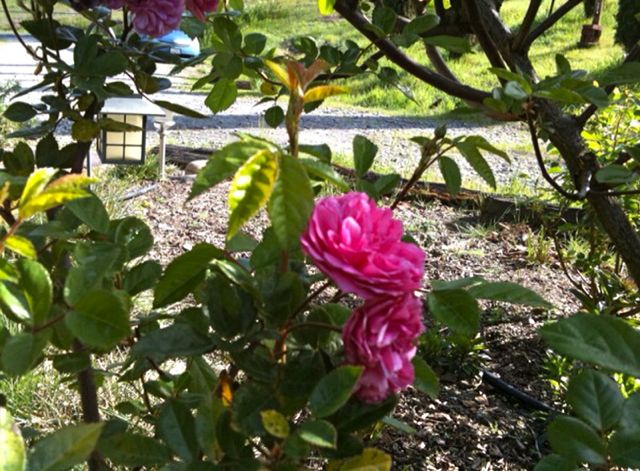
Excellenz von Schubert
YES, VOLTAIRE. It's from the close of Candide — now where did I put that book? — describing the moment when the eponymous hero of the book, finally disillusioned, gives up his quest for philosophy, turns his back on his tedious mentor Pangloss and his tedium… but let Voltaire tell it:
“Pangloss disait quelquefois à Candide: ‘Tous les événements sont enchaînés dans le meilleur des mondes possibles; car enfin, si vous n’aviez pas été chassé d’un beau château à grands coups de pied dans le derrière pour l’amour de Mlle Cunégonde, si vous n’aviez pas été mis à l’Inquisition, si vous n’aviez pas couru l’Amérique à pied, si vous n’aviez pas donné un bon coup d’épée au baron, si vous n’aviez pas perdu tous vos moutons du bon pays d’Eldorado, vous ne mangeriez pas ici des cédrats confits et des pistaches.’Voltaire wasn't talking about a garden of his own, whether in Switzerland or France. Wikipedia provides a pretty good take on the quote (I recommend the entire entry, and that on Voltaire):
‘Cela est bien dit,’ répondit Candide, ‘mais il faut cultiver notre jardin.’”
Pangloss frequently told Candide: 'everything's connected in this best of all possible worlds; for finally, if you hadn't been chased from a beautiful chateau with considerable kicks on your behind for the love of Mlle Cunégonde, if you hadn't been sent to the Inquisition, if you hadn't run through America on foot, if you hadn't given a good sword-slap to the baron, if you hadn't lost all your sheep in that fine country of Eldorado, you wouldn't be here eating pistachios and candied citron.'
'All very well said,' replied Candide, 'but we must cultivate our garden.'
The conclusion of the novella, in which Candide finally dismisses his tutor's optimism, leaves unresolved what philosophy the protagonist is to accept in its stead. This element of Candide has been written about voluminously, perhaps above all others. The conclusion is enigmatic and its analysis is contentious.
self-portrait, San José
WE SPENT THE WEEKEND in the improbable city of San José, which is greatly changed in the last forty years. (The addition of the acute accent to its name is one of those changes.) With over a million inhabitants it is now California's third city (after Los Angeles and San Diego), and the heart of the city, where we spent most of our time, is an odd survival of the old architecture and street-grid in the midst — well, there is no "midst" here; the city reminds me of Houston, where empty office-skyscrapers thrust up from blocks of bungalows in a wide-spread scatter fully dependent on the automobile.
We were there to attend the state finals in the mock trial competition organized by the Constitutional Rights Foundation. Our grandson Henry was participating, his high school (Laytonville) having won the Mendocino county competition.
We found the trials absorbing, Lindsey and I. We watched four of them, Laytonville arguing for the prosecution twice and the defense twice; and then a fifth one, in which Hillsdale High (San Mateo county) bested the San Francisco School of Performing Arts to win the state. (The national competition is set for May 6-8 in Philadelphia.)
Each high school fields two teams, for defense and prosecution, enacting a single murder case, the details of which are scripted but the arguments of which are apparently left to the teams. A real judge presides; the "jury" comprises a number of legal professionals who score each team member as to effectiveness. (The judge's decision is immaterial to the final rating of the student legal teams.)
There's a good deal of theater in all this, of course: the drama inherent in any courtroom scene, and that of the students as they learn, individually and as a team, from their mistakes and from their opponents; as they respond to completely different styles of questions from the judges; as they meet, best, or fail the crises developing from all these courtroom interactions.
To me, though, the greatest dimension of this theater was the dialectic of Laytonville and San José. Laytonville is an unincorporated community of a thousand souls, an hour's drive from the county seat of Ukiah. Our son and his wife run the local feed store, help out with the rodeo, and interact with much of the community. "I'm comfortable there," he says, "because it's the only place I've seen that's like Berkeley" — the Berkeley of the 1960s and '70s, he means — "all kinds of people, all of them interesting, all of them respecting one another's privacy."
Maybe that shouldn't be in attributive quotes; maybe I'm writing my own observation. Laytonville's citizens seem a deceptive lot, rustic and isolated but intelligent and quirky. The highschool kids are plugged into the world, of course, fiercely tap-tap-tapping at their cellphones, Facebooking and Tweeting. But the difference between their demeanor and that of their first opponents, from Marin county, seemed to speak a grand subject. Marin county per capita income is over $90,000; Mendocino's, and Laytonville's, is less than $20,000. The Marin kids, from Tamalpais High, came out strong, assertive, composed, confident; Laytonville, prosecuting a very weak case, struggled to find their footing.
Affluence, security, confidence: these are no doubt wonderful things, but I'm not sure they necessarily make good citizens, particularly in the context of a society that seems to overvalue individualism and commodity. The Laytonville kids can garden and hunt, ride and build. They use and enjoy the Internet, but for them I think real community trumps virtual community. They're competent and helpful, and my money's on them in case of catastrophe; I'm not sure the complex global community of banking, law, and marketing can survive as well.
RETURNED SUNDAY NIGHT to Eastside Road, we entertained eight or ten friends with white wine, Alsatian onion tarts, Lindsey's absolutely delicious Savarin, and sight-readings of two of Gertrude Stein's little plays: What Happened a Play and Ladies Voices. Stein's plays, as I've written elsewhere,
…are famously overheard conversation, but they have an integrity, stylistically and theatrically, that comes from a single observer's point of view (far-reachingly intelligent though it be), filtered through a single writer's editorial and expressive technique.I've always imagined those overheard conversations took place among settings exactly like Sunday evening's, gatherings of old friends and new, pleasingly fed and judiciously lubricated, comfortably seated and sheltered; and it doesn't hurt that we're in the country; it's quiet outside; and you can see the stars.
A gathering like this is something of a garden, I think. A courtroom is not; a courtroom is an arena. Stein writes somewhere that landscapes are useful settings for two purposes, battles and plays; but there are landscape plays and drawing-room plays, and I think her early short plays fall into the latter category. (Four Saints in Three Acts manages to contain drawing-room theater within a landscape play.) The comedy some of us first enjoy in Stein's theater comes from the apparent first-level non-consequence of these Cubistly juxtaposed overheard lines; the fascination some of us go on to enjoy, to contemplate and consider, comes from the resonance that arises from these lines and their very "meaninglessness," and that grows and enlarges, dissolving our linear and literal response to them in a greater, less specific, more timeless landscape of sound and society.
The landscape of downtown San José hesitates between old and new, always cluttered with wires, signs, and lines; it's almost unvaryingly hardend by pavement, glass, concrete; and the flow of its visible energies is herky-jerky, responding to the tyranny of stoplights for the motors first, pedestrians only secondly. There are of course a number of vacant storefronts. Restaurants, bars, and cafés tend toward the cheap and easy. The Peet's we found did make a decent, individualized cappuccino and was playing Mozart, but it took an humble place away from the main streets where the corporate-scaled faux-village St•rb•cks prevail.
There's a confusion in such a landscape, a disagreement of place and purpose, a disorder of clutter and irrelevance; a confusion that can't help but influence the sensibilities of its citizens. There's a lot of stuff there, but not that much There, as Stein might say. I think the natural, perhaps the normal mental response to such confusion is a shut-down, a turn-off, contrasting with the continual-onward, the opening-outward I feel on reading Stein, on conversing with friends, on hearing the birds and contemplating the stars and the garden.
A PHONE CALL from the north, yesterday, got me to thinking about the instrumental extensions at the end of sung phrases of Homer. The singing of Homer is perhaps an arcane subject, but it fed right into the weekend's contemplations. Homer, and the Greek poets who followed him, composed his work; there seems to have been no distinction between "poetry" and music. Ancient Greek was an inflected language in more ways than one: melody — the contrasts and connections of pitches articulated the lines as much as did rhythm — those of the quantities, the lengths, of the syllables.
As my Corvallis friend sings it, Homer's Greek is insinuating, mesmerizing, constantly forward-spinning. The mind can only deal with so much of this rich texture of voice, sound, language, meaning, narration. At the end of certain sections, then, the voice falls silent for a few moments, and the accompanying harp extends the line, giving the singer's voice and the listener's mind a bit of rest.
At least that's what I think the purpose of this extension is. But what is the resulting effect? It lies in what's meant by the expression "letting something sink in," allowing time for external functions, outside the intentionality of the singer and the hearer, to make their own little adjustments to context; to configure — sounds, rhythms, meanings — within a kind of perceptible landscape.
I believe that language, meaning, narration, and music were originally inseparable, like self and society. Homer's Iliad is tragic for its record of war, violence on both an individual and a societal level: but in that degree the tragedy's trivial, compared to that of its example of the devolution of thought and language from a position of prayer and praise toward one of argument and persuasion.
Well: all this in my garden this sunny Tuesday. I think when Candide turns to his garden it's to give his mind time to settle. I think you gentle reader for letting me wander here in mine.
Tuesday, March 16, 2010
Distant deaths
 I read this morning of the death of Wanda Tomczykowska, whom I met briefly in the 1060s. At the time I was working as music director at radio KPFA in Berkeley. When I first began there, as a volunteer, I was tested by being asked to wind a 12-inch reel of spilled audiotape onto a reel; it took me quite a while. The tape turned out to be a song recital from Radio Poland, and in ended with an encore, Chopin's "The Maiden's Wish." When I took the job, and had a little authority, I changed the station's sign-off music from Stravinsky's early "Pastorale," which still strikes me as somehow wimpy, to the Chopin song.
Perhaps it was for that reason that Wanda Tomska, as I knew her, invited me to tea in her Alameda home. I remember it was a sunny day, much like today; that she lived modestly, but offered tea and cakes from very nice service, and that the conversation was warm and very gracious.
Distant deaths and seemingly random kindnesses and the memories they evoke.
A while back a friend wrote to complain that
One of the things I used to most look forward to on Eastside View was your occasional wise analysis of where America was going and what there was to salvage from the art of the past, particularly the avant-garde, that spoke loudly and relevantly to our present condition. Now that we’re on the verge of worldwide catastrophe, quite possibly within our own lifetimes, your attention seems to be going into your daily meals, with Eastside View devoted mostly to introspection and reminiscence.The comment touched me a bit; perhaps it even stalled my attention to this blog. If we're on the verge of catastrophe, though, perhaps it's forgivable to dwell now and then on the beauties of the world some fear we're about to lose. I thanked Nature, yesterday, for — quite unasked — wintering my chard and lettuce over, and I think Reminiscence that I know, a little, Wanda Tomska, and Chopin's lovely — there is no other word — song.
I'm very much aware that the previous entry, "Sites," is incomplete. Those Sites are a category much like Distant Deaths, I suppose. I'm sorry it's been on hold: it's been a difficult month (don't ask). I'll get back to it soon, but just now
il faut cultiver mon jardin
Friday, January 29, 2010
Sites
THERE ARE PLACES we have visited on various travels that have seemed very special, from a "medicine wheel" at 10,000 feet in Wyoming to the Fontaine de Vaucluse in Provence; from the stone-age city at Filitosa in Corsica to the Canyon de Chelley in Arizona. What all these places have in common is the not-verbally-articulable meaning they seem to offer to our visit: they speak to us, silently, about something we recognize without understanding, without even in any ordinary sense knowing.

I think about these places a lot, under any circumstances; but I've been thinking about them especially recently since I began transcribing my journal of a trip we took through Corsica and Sardinia over twenty years ago, in 1988. Here you have a photo of the spring at Su Gologone, in Sardinia. As these places go, the places I'm discussing I mean, it's pretty well manicured, turned almost into a park, with carefully planted willows and — hmm; what are those white-barked trees in a row? — and stone retaining walls and carefully graded walks contained by concrete curbs.
Turn away from this view, though, and look out across the pool toward a grassy clearing among the trees, and we feel we're looking at a site that's been here relatively uninflected by recent human attention. It might have looked much like this a thousand years ago, two thousand, ten. This may be merely sentimental: even so, the feeling's worth thinking about.

Why does the place seem familiar, though I've never been here before? There are sensations here common to other such places: the calm air within these trees; the sounds of the water; the soft feel of the calm air on my skin. The place conspires to distract me from more specific and immediate issues: the car I've left in the parking lot, the few…
to be continued
I think about these places a lot, under any circumstances; but I've been thinking about them especially recently since I began transcribing my journal of a trip we took through Corsica and Sardinia over twenty years ago, in 1988. Here you have a photo of the spring at Su Gologone, in Sardinia. As these places go, the places I'm discussing I mean, it's pretty well manicured, turned almost into a park, with carefully planted willows and — hmm; what are those white-barked trees in a row? — and stone retaining walls and carefully graded walks contained by concrete curbs.
Turn away from this view, though, and look out across the pool toward a grassy clearing among the trees, and we feel we're looking at a site that's been here relatively uninflected by recent human attention. It might have looked much like this a thousand years ago, two thousand, ten. This may be merely sentimental: even so, the feeling's worth thinking about.
Why does the place seem familiar, though I've never been here before? There are sensations here common to other such places: the calm air within these trees; the sounds of the water; the soft feel of the calm air on my skin. The place conspires to distract me from more specific and immediate issues: the car I've left in the parking lot, the few…
to be continued
Thursday, January 28, 2010
Small Concerto
THE EARLIEST PIECES of mine that I still like to think of, Three Pieces for Piano, were written in October and November, 1963, and February 1964. At the time we were living on a small grant from Edith Fitzell, a gentle, enthusiastic widow who took recorder lessons from me, and who volunteered at KPFA, the listener-supported radio station in Berkeley. She sensed my need to devote an unbroken year to musical study, and enabled me to quite my day job. (I was then a laborer for the City of Berkeley, working mostly on the sidewalk crew, breaking up old sidewalks and laying new ones.)
I spent that year studying composition with Robert Erickson and conducting with Gerhard Samuel, and listening to as much music as possible — much of it on the radio, for KPFA broadcast a great deal of new music in those days.
The first and last of the three pieces were written slowly and intuitively, at the piano. They are centered on soft dynamic levels and smoothly phrase lines, and meant to be played very softly. The middle piece was added later, for contrast, pitched on a much louder level, and alternates violent and rapid gestures with ringing sonorities. It uses only pitches omitted in the outer movements; otherwise the composition follows only intuitive principles of structure, not conventional tonal or serial concepts.
Much of the music is essentially unmeasured and meant to be played quite freely, and the third movement ends with a performer's choice between two possible approaches to the close.
In 1964 I orchestrated the music as a Small Concerto for Piano and Orchestra. No new material was added; I simply assigned some of the notes to rather large orchestra, including a harmonium in the wings, a pair of Wagner tubas, and alto flute among the more usual instrumentation. In this form the music was premiered in August 1965 at the Cabrillo Music Festival, with Nathan Schwartz as soloist and Gerhard Samuel conducting. It was the first time I heard my music played by an orchestra: a very delightful experience.
(The solo pieces waited for their premiere until March 1993, when the late Rae Imamura played them at Annie’s Hall, Berkeley, on an instrument tuned not in equal temperament but to Kirnberger 3.)
The orchestral score of the Small Concerto for Piano and Orchestra is available now, either in print (8.5x11, 8 pages, saddle-stapled) for $12 or as a free download, at Lulu.com. The Three Pieces for Piano are available at Frog Peak Music.
Listen to the second movement of the Small Concerto for piano and orchestra
Tuesday, January 19, 2010
Form is how memory works
FROM THE CODGER in Corvallis comes today an envelope with a number of clippings. He pretends it's his way of cleaning off his desk; I know it's his way of keeping me au courant. In a recent phone call I mentioned my appreciation of Peter Schjeldahl's art criticism in The New Yorker, one of a great number of magazines to which we do not subscribe; this envelope contains a number of recent ones.
Schjeldahl's such a fine, fine writer. A fine critic, of course; a man who really knows how to look at art with his eyes, and then attentively follow the information that travels along his optic nerves back into a brain clearly jammed with experience, trained to consider, and allowed to reflect. You feel, reading his reviews in a magazine my west-coast taste finds often a little frenetic, a little peremptory — a curious pairing perhaps available only to an insecure culture-capital, that he's somehow above and beyond that fray. There's a mandarin ease to his writing, drawing as much from his wide and not entirely uncritical reading as from his first-hand art-looking: in both cases, his own sensibility is speaking, but with authority he's earned by closely studying that of so many others.
His sentences are beautifully formed, tending to stop just a little sooner than you'd expected. Where it is descriptive it is breathlessly, ingratiatingly evocative, and amply detailed:
When it adduces hypothesis it is forthright:
I tend to read these reviews twice: once for their content; once for the sheer enjoyment of the writing. And I'm rewarded by any number of insights, usually at least one per review. The one at the head of today's blog is one of them:
One of the powerful engines of Schjeldahl's machinery is his insatiable curiosity as to what art is, how art works.
Oh: I want to add one thing to the comments on D.H. Lawrence, a delicious comment he makes in Etruscan Places, summing up all his attitude about the evils of Rationalist and Industrialist displacement of the vital, intuitive values of unrestrained humanity:
Schjeldahl's such a fine, fine writer. A fine critic, of course; a man who really knows how to look at art with his eyes, and then attentively follow the information that travels along his optic nerves back into a brain clearly jammed with experience, trained to consider, and allowed to reflect. You feel, reading his reviews in a magazine my west-coast taste finds often a little frenetic, a little peremptory — a curious pairing perhaps available only to an insecure culture-capital, that he's somehow above and beyond that fray. There's a mandarin ease to his writing, drawing as much from his wide and not entirely uncritical reading as from his first-hand art-looking: in both cases, his own sensibility is speaking, but with authority he's earned by closely studying that of so many others.
His sentences are beautifully formed, tending to stop just a little sooner than you'd expected. Where it is descriptive it is breathlessly, ingratiatingly evocative, and amply detailed:
Sensational colors, in particular, strain the scene of a husky young servant pouring milk, in a careful dribble, from an earthenware pitcher into an earthenware bowl on an odd-shaped table laden with a wicker basket, a loaf and fragments of crusty bread, and a stoneware beer jug.
When it adduces hypothesis it is forthright:
Echt biennial art is critic-proof, because it eschews formal engagement with past art, providing no basis for comparative evaluation.These sentences develope cogent paragraphs whose purpose is to consider the event of the moment — a Vermeer in New York, a biennial exhibition in Istanbul — within a complex context triangulated by the conflicting, urgent, mindless demands of our own time, the long slow cultural history unfolding since ancient time, and the ample contents and motives of the critical sensibility.
I tend to read these reviews twice: once for their content; once for the sheer enjoyment of the writing. And I'm rewarded by any number of insights, usually at least one per review. The one at the head of today's blog is one of them:
Form is how memory works.What clearer statement can there be, and what more beautifully self-illustrative? Will I ever forget how to explain the utility of form, the next time a grandchild asks?
One of the powerful engines of Schjeldahl's machinery is his insatiable curiosity as to what art is, how art works.
[Luc Tuymans] told Artnet that in his initial hours of work, "until I get to the middle of the process—it's horrific. It's like I don't know what I'm doing but I know how to do it, and it's very strange."A lesser critic would have heard this as a comment in passing, perhaps registered it, and moved on. Schjeldahl registers it, considers it, and sets it in parallel with a thought of his own, leading the reader to an insight:
Now, that — uncertain ends, confident means—is about as good a general definition of creativity as I know. It illuminates and justifies Tuymans's eccentric work rule, with its distant redolence of Jackson Pollock's odd decision to paint in the air above a canvas.In the air above a canvas. Schjeldahl deftly moves his paragraph away from the foreground, while keeping the foreground in view; he lifts the discussion above the present, while keeping it pertinent. His criticism fully achieves Joseph Kerman's memorable, terse definition of the practice: "the study of the meaning and the value of art works." (Contemplating Music: challenges to musicology , Harvard University Press, 1986). And it is elegant.
Oh: I want to add one thing to the comments on D.H. Lawrence, a delicious comment he makes in Etruscan Places, summing up all his attitude about the evils of Rationalist and Industrialist displacement of the vital, intuitive values of unrestrained humanity:
We have lost the art of living: and in the most important science of all, the science of daily life, the science of behaviour, we are complete ignoramuses. We have psychology instead.The science of daily life. What a great blog title that would make!
Monday, January 18, 2010
Lawrence on Italy
DAMN IT ALL, Richard, you’ve finally got me to read through D.H. Lawrence’s Twilight in Italy, and finally I see what you see in him — though I must say I see it only through the haze of my own close-held prejudices. Let’s begin with the easiest to overcome, the inadequacy of the book qua book. It’s a gathering of three travel books:
•Twilight in Italy, 1916, recording a trip made a few years earlier, mostly on foot, from somewhere south of Munich to Lake Garda, and impressions of the villages on that lake;
•Sea and Sardinia, 1921, recalling a trip that January from Taormina to Palermo, thence by boat to Cagliari, by train to Sorgono, bus to Terranova, boat to Civitavecchia, train to Naples, and boat back to Sicily; and
•Etruscan Places, 1932, a collection of musings on visits, in 1927, to the remains of Etruscan life found in Tarquinia, Volci, and Volterra.
In the course of those sixteen years Lawrence matured a bit, from the brash, often contemptuous, always opinionated young man curling his lip at the lack of intelligence he finds everywhere, to the informed, still opinionated, occasionally generous fellow who contemplates Etruscan antiquity. It is his judgmentalism, constant in the first book, frequent in the second, that gets under my skin: he’s so quick to insist on his own comfort — good English bacon and tea, for example, even in the mountains of Sardinia — that he only slowly, over the course of those sixteen years, comes to acknowledge the possible appropriateness of the beefsteak and red wine he’s offered in its place.
You’re a Joyce man or a Lawrence man, I decided fifty years ago (and then some), as you choose either Picasso or Matisse, Fitzgerald or Hemingway, Mozart or Beethoven: and I fall on the side of the first in each of those pairings. I can’t disagree with Lawrence’s fundamental points, that freedom and energy and instinct are superb qualities and that they’re in danger of utter destruction at the hand of the 20th century. But I can’t overlook the anger this arouses in the poor Englishman, caught in the misery of being a son of the society responsible for much of that destruction. Don’t take it personally, David Herbert!
I picked the book up to begin a four-month project of reading on Italy, wanting to read English for relaxation; but also in the spirit of New Year’s do-it-it’s-good-for-you resolution; and I’m glad I did. Even the first book, irritating as it mostly is, has its surprising flashes:
Sea and Sardinia was the only book of the three I’d read earlier, a little after our own travels through Sardinia, in November 1988. I’m thinking of this trip again, transcribing my own journal, partly to get into the mood of journal-keeping, partly to satisfy an acquaintance who’s contemplating her own tour of the island in May.
Some of you may know of my own travel musings, “dispatches” I call them; I used to e-mail them out from the road to a number of friends, and have published three collections of them — you can look them up here.
Alas in the last few years I’ve got out of the habit of journal-keeping, as various pocket computers have replaced the notebook and pen. I can re-read journals from the 1970s and ’80s with great pleasure, once again vividly seeing the places and people they describe: but more recent long walks — on the Pieterpad, the Lingepad, across the Alps — are much more sketchily recorded. We’re thinking of a walk in Sicily in a few months, and I’m dreaming of a long walk in Tuscany and Umbria: it’s time to get back to journaling!
Yet Anthony Burgess writes, in his Introduction to this Viking paperback, that
In this book Lawrence is at his best when he does describe the landscape:
Such is our antipathy, Lawrence and I, that he on his travels saw only that part of Sardinia that I on ours did not, and vice versa; and yet between us we saw nearly every corner of the island. Perhaps that explains Lawrence’s otherwise astonishing total lack of reference to the nuraghi, those timeless, enigmatic, powerful stone towers, some sixty feet high and more, that are scattered almost throughout the island. Many of them were perhaps not yet known at the time of Lawrence’s tour: a magnificent example, Su Nuraxi di Barumini, was only discovered in the 1940s, even though its three-storey nuraghe is attended by an entire village of circular foundations, whether of residences or merely storerooms is apparently not yet fully understood.
What would Lawrence have written about Barumini? He gives us an idea:
Etruscan Places is much the shortest of these three books, much the best. Lawrence’s anger, in the face of the destruction of humanity by the industrious society humanity has created, has given way to something more like bitter resignation. Contemplation of the evidence of the utterly vanished Etruscan culture, not to mention the stupidity of the greedy expropriation of the Etruscan remains by those Lawrence considers the chief villains — the British Museum, the Vatican — such contemplation can hardly avoid replacing anger with resignation. It’s there; there’s nothing to be done.
But there’s something engagingly lyrical about his bitterness, something graceful about the philosophy he's developed to replace, or at least succeed, the incessantly masculine body-worship that (to my mind) disfigures much of his earlier writing. The dialectic between the Etruscans and the Romans who defeated them — and the imperialist 20th-century powers that so readily bring Roman imperialism down to our own period — is the dialectic between a graceful living-in-the-moment, in a society evolved toward an essentially Epicurean adjustment of human life to natural needs and events, and a constant straining-for-the-ideal, in a society geared toward constant growth, development, control, and profit.
In a remarkable passage, Lawrence concedes that we moderns are no longer, like the Etruscans, capable of Etruscan innocence — rather, uniquely Etruscan expression of innocent awareness:
Etruscan Places is elegiac, because Lawrence contemplates the lost, and thinks it superior to the present. Throughout these three books he vacillates between admiring intelligence (or at least condemning stupidity) and lamenting consciousness. He attempts a resolution of this difficulty in his admiration for divination.
Lawrence has made me more curious than ever about the Etruscans: too bad, as I’ll never know much more than I do now. Further acquaintance with their towns and tombs will only increase this curiosity, not satisfy it. The day will perhaps come when my hunches are proved (or disproved): a fortunate race, they remembered in their cultural subconscious the journey out of Africa, through Asia Minor, to their home in one of the most fortunate climes ever settled, early enough to have escaped the disadvantages of conscious thought, late enough to have music and language and comfort and beauty. One could think of this as a true Golden Age, and a sustainable one too until the invaders came.
•Twilight in Italy, 1916, recording a trip made a few years earlier, mostly on foot, from somewhere south of Munich to Lake Garda, and impressions of the villages on that lake;
•Sea and Sardinia, 1921, recalling a trip that January from Taormina to Palermo, thence by boat to Cagliari, by train to Sorgono, bus to Terranova, boat to Civitavecchia, train to Naples, and boat back to Sicily; and
•Etruscan Places, 1932, a collection of musings on visits, in 1927, to the remains of Etruscan life found in Tarquinia, Volci, and Volterra.
In the course of those sixteen years Lawrence matured a bit, from the brash, often contemptuous, always opinionated young man curling his lip at the lack of intelligence he finds everywhere, to the informed, still opinionated, occasionally generous fellow who contemplates Etruscan antiquity. It is his judgmentalism, constant in the first book, frequent in the second, that gets under my skin: he’s so quick to insist on his own comfort — good English bacon and tea, for example, even in the mountains of Sardinia — that he only slowly, over the course of those sixteen years, comes to acknowledge the possible appropriateness of the beefsteak and red wine he’s offered in its place.
You’re a Joyce man or a Lawrence man, I decided fifty years ago (and then some), as you choose either Picasso or Matisse, Fitzgerald or Hemingway, Mozart or Beethoven: and I fall on the side of the first in each of those pairings. I can’t disagree with Lawrence’s fundamental points, that freedom and energy and instinct are superb qualities and that they’re in danger of utter destruction at the hand of the 20th century. But I can’t overlook the anger this arouses in the poor Englishman, caught in the misery of being a son of the society responsible for much of that destruction. Don’t take it personally, David Herbert!
I picked the book up to begin a four-month project of reading on Italy, wanting to read English for relaxation; but also in the spirit of New Year’s do-it-it’s-good-for-you resolution; and I’m glad I did. Even the first book, irritating as it mostly is, has its surprising flashes:
It is better to go forward in error than to stay fixed inextricably in the past. (p. 53)
…the cypress trees poise like flames of forgotten darkness, that should have been blown out at the end of the summer. For as we have candles to light the darkness of night, so the cypresses are candles to keep the darkness aflame in the full sunshine. (p. 81)
…the whole organism of life, the social organism, is slowly crumbling and caving in … is seems as though we should be left at last with a great system of roads and railways and industries, and a world of utter chaos seething upon these fabrications: as if we had created a steel framework, and the whole body of society were crumbling and rotting in between. (p. 165)
References to the paperback edition of 1972: New York: The Viking Press
Sea and Sardinia was the only book of the three I’d read earlier, a little after our own travels through Sardinia, in November 1988. I’m thinking of this trip again, transcribing my own journal, partly to get into the mood of journal-keeping, partly to satisfy an acquaintance who’s contemplating her own tour of the island in May.
Some of you may know of my own travel musings, “dispatches” I call them; I used to e-mail them out from the road to a number of friends, and have published three collections of them — you can look them up here.
Alas in the last few years I’ve got out of the habit of journal-keeping, as various pocket computers have replaced the notebook and pen. I can re-read journals from the 1970s and ’80s with great pleasure, once again vividly seeing the places and people they describe: but more recent long walks — on the Pieterpad, the Lingepad, across the Alps — are much more sketchily recorded. We’re thinking of a walk in Sicily in a few months, and I’m dreaming of a long walk in Tuscany and Umbria: it’s time to get back to journaling!
Yet Anthony Burgess writes, in his Introduction to this Viking paperback, that
A single week’s visit was enough for him to extract the very essence of the island and its people, and six weeks were enough to set it all down in words—without a single note as an aide-mémoire.This may explain the feeling I get that Lawrence saw, on his miserable ride across Sardinia, only what his prejudices put in front of him: that is, he continually looks to the people he meets — for he rarely mentions the landscape, only the people, the hotels, the dining-tables — for confirmation of opinions he’s already formed, attitudes he’s already struck.
Sardinian seems open and manly and downright. Sicilian is gluey and evasive, as if the Sicilian didn’t want to speak straight to you. As a matter of fact, he doesn’t. He is an over-cultured, sensitive ancient soul, and he has so many sides to his mind that he hasn’t got any definite one mind at all. He’s got a dozen minds, and uneasily he’s aware of it… The Sardinian, on the other hand, still seems to have one downright mind. (pp. 80-81)
In this book Lawrence is at his best when he does describe the landscape:
The hillsides tilt sharper and sharper… The oxen lift their noses to heaven, with a strange and beseeching snake-like movement, and taking tiny little step with their frail feet, move slantingly across the slope-face, between the rocks and tree-roots…
There is a stream: actually a long tress of a waterfall pouring into a little gorge, and a stream-bed hat opens a little, and shows a marvelous cluster of naked poplars away below. They are like ghosts. They have a ghostly, almost phosphorescent luminousness in the shadow of the valley… a grey, goldish-pale incandescence of naked limbs and myriad cold-glowing twigs, gleaming strangely. (p. 88)
Such is our antipathy, Lawrence and I, that he on his travels saw only that part of Sardinia that I on ours did not, and vice versa; and yet between us we saw nearly every corner of the island. Perhaps that explains Lawrence’s otherwise astonishing total lack of reference to the nuraghi, those timeless, enigmatic, powerful stone towers, some sixty feet high and more, that are scattered almost throughout the island. Many of them were perhaps not yet known at the time of Lawrence’s tour: a magnificent example, Su Nuraxi di Barumini, was only discovered in the 1940s, even though its three-storey nuraghe is attended by an entire village of circular foundations, whether of residences or merely storerooms is apparently not yet fully understood.
What would Lawrence have written about Barumini? He gives us an idea:
This is what is so attractive about the remote places, the Abruzzi, for example. Life is so primitive, so pagan, so strangely heathen and half-savage. And yet it is human life. And the wildest country is half humanised, half brought under. It is all conscious… Wherever one is, the place has its conscious genus. Man has lived there and brought forth his consciousness there and in some way brought that place to consciousness, given it its expression, and, really, finished it. The expression may be Proserpine, or Pan, or even the strange “shrouded gods” of the Etruscans or the Sikels, none the less it is an expression… Strange and wonderful chords awake in us, and vibrate again after many hundreds of years of complete forgetfulness. (p. 123)
Etruscan Places is much the shortest of these three books, much the best. Lawrence’s anger, in the face of the destruction of humanity by the industrious society humanity has created, has given way to something more like bitter resignation. Contemplation of the evidence of the utterly vanished Etruscan culture, not to mention the stupidity of the greedy expropriation of the Etruscan remains by those Lawrence considers the chief villains — the British Museum, the Vatican — such contemplation can hardly avoid replacing anger with resignation. It’s there; there’s nothing to be done.
If only we would realise it, and not tear things from their settings. Museums anyhow are wrong. But if one must have museums, let them be small, and above all, let the be local. (p.27)
But there’s something engagingly lyrical about his bitterness, something graceful about the philosophy he's developed to replace, or at least succeed, the incessantly masculine body-worship that (to my mind) disfigures much of his earlier writing. The dialectic between the Etruscans and the Romans who defeated them — and the imperialist 20th-century powers that so readily bring Roman imperialism down to our own period — is the dialectic between a graceful living-in-the-moment, in a society evolved toward an essentially Epicurean adjustment of human life to natural needs and events, and a constant straining-for-the-ideal, in a society geared toward constant growth, development, control, and profit.
In a remarkable passage, Lawrence concedes that we moderns are no longer, like the Etruscans, capable of Etruscan innocence — rather, uniquely Etruscan expression of innocent awareness:
But one radical thing the Etruscan people never forgot, because it was in their blood as well as in the blood of their masters: and that was the mystery of the journey out of life… Man moves naked and glowing through the universe. Then comes death: he dives into the sea, he departs into the underworld. (pp.52-53)In a striking figure Lawrence considers the dolphin, “a creature that suddenly exists, out of nowhere. He was not: and lo! there he is!” We, however, are merely ducks, warm-blooded, but with no “subaqueous nature”; we dive in, but return to preen. The Etruscans, the reader feels, lived at the moment of awareness of the difference.
Etruscan Places is elegiac, because Lawrence contemplates the lost, and thinks it superior to the present. Throughout these three books he vacillates between admiring intelligence (or at least condemning stupidity) and lamenting consciousness. He attempts a resolution of this difficulty in his admiration for divination.
An act of pure attention, if you are capable of it, will bring its own answer. And you choose that object to concentrate upon which will best focus your consciousness. Every real discovery made, every serious and significant decision ever reached, was reached and mae by divination. The soul stirs, and makes an act of pure attention, and that is a discovery.
The science of the augur and the haruspex was not so foolish as our modern science of political economy. (p.55)
Lawrence has made me more curious than ever about the Etruscans: too bad, as I’ll never know much more than I do now. Further acquaintance with their towns and tombs will only increase this curiosity, not satisfy it. The day will perhaps come when my hunches are proved (or disproved): a fortunate race, they remembered in their cultural subconscious the journey out of Africa, through Asia Minor, to their home in one of the most fortunate climes ever settled, early enough to have escaped the disadvantages of conscious thought, late enough to have music and language and comfort and beauty. One could think of this as a true Golden Age, and a sustainable one too until the invaders came.
Friday, January 08, 2010
Mercè Rodoreda
Christmas surprised me with a copy of Death in Spring, a poetic novel by the Catalan writer Mercè Rodoreda, a writer I'd not heard of until a couple of months ago, when I read a review by Natasha Wimmer in The Nation. It's not the kind of novel I'd normally be drawn to: a little too close to Magic Realism, perhaps. Yet now that I've read it I find much of it oddly staying with me. Wimmer's review will tell you much more than I will, here, about the content of the novel — plot, characters, setting and all that. I think she's a little unfair in calling the book "a clumsy expressionist painting" (in contrast to the Vermeer represented by Rodoreda's earlier novel The Time of the Doves).
Nor am I sure Wimmer's on point referring to Death in Spring as Symbolist. The pages are full of color, literally: birds, butterflies, aprons, leaves; the very dust with which the mouths of the dead are cemented closed; all these colors vibrate with an intensity that brings Rimbaud's vowels to mind. But the book is solidly grounded in elements: wind and water, wood and dirt. And throughout the book the reader's immersed in narrative, as the characters in the book are haunted by and compelled to their own narrative.
Rodoreda was born in Barcelona in 1908, married rather badly, wrote fairly early but retired from publication in her thirties, when she participated in the short-lived autonomous government of Catalonia until the Spanish Civil War ended with the Franco regime, which led to a self-exile in France and, later, Switzerland. She returned to Catalonia in the 1970s; just when, I'm not quite sure.
You won't find much about her in this Wikipedia article, but on a hunch I typed her full name — Mercè Rodoreda i Gurguí — into Google's search box and hit the much fuller article in the Catalan Viquipèdia. Here we read of the influence on her writing of such European psychological writers as Woolf, Proust, and Mann "except for the mytho-symbolic works of the last period of her life": but I think there's much of Woolf's most experimental kind of writing in Death in Spring — particularly such short prose pieces as "The Mark on the Wall."
In fact, Death in Spring seems to form a bridge springing from Woolf to Calvino, a span I'd never thought of before — how to characterize the stream below? Perhaps it's like the fatal, violent, necessary river running below the town in Rodoreda's novel, at once a Lethe and an Oceanus; a powerful yet essentially aloof stream Heraklitus would recognize. Perhaps she's a Symbolist after all.
Nor am I sure Wimmer's on point referring to Death in Spring as Symbolist. The pages are full of color, literally: birds, butterflies, aprons, leaves; the very dust with which the mouths of the dead are cemented closed; all these colors vibrate with an intensity that brings Rimbaud's vowels to mind. But the book is solidly grounded in elements: wind and water, wood and dirt. And throughout the book the reader's immersed in narrative, as the characters in the book are haunted by and compelled to their own narrative.
Rodoreda was born in Barcelona in 1908, married rather badly, wrote fairly early but retired from publication in her thirties, when she participated in the short-lived autonomous government of Catalonia until the Spanish Civil War ended with the Franco regime, which led to a self-exile in France and, later, Switzerland. She returned to Catalonia in the 1970s; just when, I'm not quite sure.
You won't find much about her in this Wikipedia article, but on a hunch I typed her full name — Mercè Rodoreda i Gurguí — into Google's search box and hit the much fuller article in the Catalan Viquipèdia. Here we read of the influence on her writing of such European psychological writers as Woolf, Proust, and Mann "except for the mytho-symbolic works of the last period of her life": but I think there's much of Woolf's most experimental kind of writing in Death in Spring — particularly such short prose pieces as "The Mark on the Wall."
In fact, Death in Spring seems to form a bridge springing from Woolf to Calvino, a span I'd never thought of before — how to characterize the stream below? Perhaps it's like the fatal, violent, necessary river running below the town in Rodoreda's novel, at once a Lethe and an Oceanus; a powerful yet essentially aloof stream Heraklitus would recognize. Perhaps she's a Symbolist after all.
Thursday, January 07, 2010
Michener: Caravans (The end of the world as we know it)
BHISHMA'S RECLUSIVE ACQUAINTANCE up in Oregon recently recommended to me James Michener’s novel Caravans, published in 1962 but set in the Afghanistan of the years immediately following World War II.
I read it in the days following New Year’s Eve, when another old friend announced his view — I’d heard it before — that the world as we know it was about to end, if not in our lifetimes, then in those of our children. “Our” children, I type: but this old friend has no children, and it was at first to that that I attributed his pessimism.
Soon, though, another idea occurred to me: “the world as we know it” has ended many times, and will end many times again. It’s always doing that, ending, then evolving into the world as another society knows it, only to end again. The world as the Roman Republic knew it ended, and the world as the Roman Empire. The world as Chief Joseph knew it. The world as two protagonists of this book, Nazrullah and Zulffiqar know it: Nazrullah, a civil engineer who believes in a future Westernized Afghanistan, enlightened and developed and comfortable; Zulffiqar, a nomadic chieftain who knows such an Afghanistan will be attempted, will destroy his way life, and must be prepared for.
I was impressed with another of Michener’s books, Iberia, and am equally so with this. Michener seems at ease alternating between fiction and philosophy, between active participation and objective contemplation. I suspect his books are very different to varied readers. I find reassurance, in the face of my friend’s pessimism, in the constancy Michener finds in human behavior, always alternating between instinct and education, reality and idealism, love (and jealousy) and reason, things as they always are and as they always, we are apparently doomed to feel (though differently, according to the values in fashion at the moment), should be.
Caravans makes me wish I were fifty (and the world eighty) years younger and a good horseman. It made me think, too, of my mother, who in her young and middle years wondered about Tashkent and Samarkand, and in her later years managed to visit them, which I shall almost surely not. And it makes me worry that perhaps my next read will be Frederick Prokosch's The Asiatics or Seven Who Fled — though either would be a real self-indulgence, for I read them over twenty years ago, and there are unread books to visit…
I read it in the days following New Year’s Eve, when another old friend announced his view — I’d heard it before — that the world as we know it was about to end, if not in our lifetimes, then in those of our children. “Our” children, I type: but this old friend has no children, and it was at first to that that I attributed his pessimism.
Soon, though, another idea occurred to me: “the world as we know it” has ended many times, and will end many times again. It’s always doing that, ending, then evolving into the world as another society knows it, only to end again. The world as the Roman Republic knew it ended, and the world as the Roman Empire. The world as Chief Joseph knew it. The world as two protagonists of this book, Nazrullah and Zulffiqar know it: Nazrullah, a civil engineer who believes in a future Westernized Afghanistan, enlightened and developed and comfortable; Zulffiqar, a nomadic chieftain who knows such an Afghanistan will be attempted, will destroy his way life, and must be prepared for.
I was impressed with another of Michener’s books, Iberia, and am equally so with this. Michener seems at ease alternating between fiction and philosophy, between active participation and objective contemplation. I suspect his books are very different to varied readers. I find reassurance, in the face of my friend’s pessimism, in the constancy Michener finds in human behavior, always alternating between instinct and education, reality and idealism, love (and jealousy) and reason, things as they always are and as they always, we are apparently doomed to feel (though differently, according to the values in fashion at the moment), should be.
Caravans makes me wish I were fifty (and the world eighty) years younger and a good horseman. It made me think, too, of my mother, who in her young and middle years wondered about Tashkent and Samarkand, and in her later years managed to visit them, which I shall almost surely not. And it makes me worry that perhaps my next read will be Frederick Prokosch's The Asiatics or Seven Who Fled — though either would be a real self-indulgence, for I read them over twenty years ago, and there are unread books to visit…
Subscribe to:
Posts (Atom)