Thursday, March 13, 2008

Amboy redux


BACK, AND NOT UNHAPPY TO BE SO — this is a pretty nice place too — from a three-day drive in search of wildflowers, as I mentioned the other day. Four quite memorable events crowd out a number of only slightly lesser ones, and I’ll revisit them here, one at a time, now that I’ve uploaded the two hundred photos I took.

Let’s begin with Amboy Crater, which we visited Tuesday (and which I wrote about here that evening). It appears first off to the northwest, as you approach it along Amboy Road driving north from Twentynine Palms. You cross a dry lake, Bristol Lake, and Amboy Road dead-ends into the old Highway 66, the town of Amboy just to the right (“town” is a bit grand, “settlement” might be better), the crater a few hundred yards to the left.

Here you see the cindercone from the turnoff onto the road leading to a parking lot a hundred yards or so in, out of sight off to the right. It’s about a mile and a quarter away, and rises about 250 feet above the desert floor. The footpath from the parking lot is also about a mile and a quarter long to the base of the cone, meandering a bit across sand and scree and taking you around to the other side of the cone, where there’s a natural opening.


Here there’s a bit of a scramble up some loose lava scree, and the footing’s not so easy. Then you’re inside the cone, with your choice of three more scrambles to get up to the rim. (All this is very clearly seen on Google Earth: do a search for “Amboy Crater” and put a slight tilt to the view.)

From the rim, looking north, this is what we saw: you can see the footpath leading north toward the parking lot, and the incredible fields of Desert Sunflowers.


What you don’t see are the other flowers: primroses, desert stars, dandelions, yellowcups, the infrequent stately lily, great expanses of sand verbena, and (perhaps my favorite) the desert fivespots.

You can see them, however, online; where you can download photos sized just right for your iPod or PDA, in case you don’t like carrying field guides. (We do.)

We arrived at the parking lot at one o’clock: the day wasn’t too warm, and there was a pleasant breeze: even with dozens of stops for photographs we were on the rim by 2:30, and the walk back was quick and, once down from the rim, easy. The morning had been eventful enough — I’ll post about that tomorrow or next day — but this was a real highlight. There was one disappointment: the town of Bagdad, six miles west on the “National Trails Highway” (as old 66 is apparently now officially known) has completely vanished, reclaimed by the desert as Wikipedia puts it. But Amboy Crater is one of those sights, and sites, that will always be in mind, from now on.

Tuesday, March 11, 2008

Amboy Crater


UP LATE, THE MOTEL CLOCK not having been reset for Standard Time; to a locally greatly admired coffee house for breakfast, only to find it closed and for lease between two adjacent (or nearly so) Starbuckses; then on through Apple Valley and to Joshua Tree.

We stopped at the Nat'l Park visitor center, then found Lou's house, a pretty little stucco building with a vaulted roof and the fine thick walls that come only from heavy cut stone or -- as in this case -- straw-bale construction.

I was a little surprised at the setting: the usual scramble of modest houses, too many cars and pickups, plastic bags blowing around, ambition, entitlement, an grit you associate with desert subdivisions.
It's dispiriting; but there it is.

On then to Twentynine Palms, not very interesting, and then the road up toward Amboy. And then, oh good heavens, the wildflowers. I'm not going to try to list them here: I'm writing this (partly as an experiment) on a folding keyboard, and sending it from my pocket Treo; I'm not easily able to consult references or provide links.

Let me just say there were lupins, poppies, five-spots, lilies, salvias, and dozens of things I can't identify. Whites, yellows, pinks, violets (I see I forgot to list the verbenas).

And the scent! You can't imagine the extent to which the scent fills your nostrils, and the car... the closest I can come to describing it is a just-opened honey-jar, sweet, complex, dry, floral, a bit exotic. (At one point I thought of the tree-blossoms in Tahiti.)

We drove on up the highway, over Sheep'sfoot Pass, across the Bristol Dry lake, and then turned west on the old Highway 66, now known locally as National Trails Highway. In less than a mile you come to a dirt road leading in to a trailhead to Amboy Crater, a cindercone we'd been looking at for the last ten miles or so.

At the parking lot we had lunch in one of the ramadas; then hit the trail for the Crater. It's a 3.5-mile round trip, and you climb 250 feet to the lip of the crater.

The entire trip was through fields of yellow and violet. I don't know when I've walked among so many flowers, or so many kinds of flowers. The scent, again, was nearly overwhelming; fortunately, there was a bit of a breeze. (It also helped offset the temperature, which crowded ninety degrees.)

The view from the top of the crater is memorable. Unfortunately my phone camera doesn't do it justice; you see here only a small part of the walk back to the car.

And then the drive up to the dread town of Ludlow, which I always associate with blown tires; and Barstow, and Highway 395, and then a new drive to us, the magnificent Walker Pass highway across the southern Sierra.

We're spending the night in Kernville. Dinner... Well, that will have to wait for a report on the other blog, when I'm home and have the proper software...

Monday, March 10, 2008

On the road again...

DOWN HIGHWAY 5, then, in search of wildflowers. We didn't get away until 10:30 or so, what with one thing and another, and didn't see any flowers to speak of -- excepting mustard, of course, those invasive but attractive fields of yellow -- until we'd rounded Altamount Pass and were heading due south toward Westley.

Then, there they were, west of the highway looking into the sun: subtle but beautiful washes of the California colors, blue and gold, lupin and poppy. They washed up the hillsides like delicate washes of watercolor, lending depth to the green convolutions of the hillsides.

Down past Santa Nella, Harris Ranch, Kettleman City with its stockyards; across to Wasco, through Bakersfield on its freeways, and up the memorable grade to Tehachapi. I always remember the day the Mercedes lost a fan belt, and I had to trudge for help to the Forestry station, and a trucker gave me a lift back, and somehow I contrived to fix the belt, and find some water for the radiator. Those days fortunately are gone.

(There were others: water pump in Barstow; tire in Ludlow; brake cable in the Santa Cruz Mountains... such things don't seem to happen any more. I don't mind.)

I love that country up the grade from Bakersfield to Tehachapi, and always look forward to it. Alas, a dividing wall has been installed between the directions of traffic, and you can no longer see that fine open wooded countryside off to the north, not if you're traveling east, that is. I contented myself, since Lindsey was driving, with watching the railroad as it made its unbelievable circles and spirals uphill to the pass. There was even a freight train, a very long one, tracing the route for me as if I couldn't reconstruct it from memory...

The highway bypasses Mojave now, and Boron, but there's still that awkward stop at Four Corners: and here we turned right, south, to drive down past the eastern edge of the Marine base, finally finding Adelanto (The City of Unlimited Possibilites, its gatepost proudly proclaimed), and then surprising miles of tracts of high-density condos and apartments and bungalows cheek by jowl. So much room here, in the Mojave Desert; yet these ticktacks are jammed together as if they were agoraphobe.

There was an athlete's equipment bag on the floor in the motel office, and a couple of cricket-bats leaning against the all. Cricket, I said, cricket, those are cricket-bats, I can't believe anyone plays cricket here.

I do, said the slender Indian boy behind the desk; I do, and we have three teams here.

Victorville is a city of ninety thousand, he told me; most of them work right here, though some work "downhill," which turns out to be a manufacturing center to the south, just where I'm not sure. Ninety thousand souls, and, according to the World Wide Web, 78 restaurants. We chose the one with the best reviews -- well, review; there was only one -- Steak and Stein. I suppose I was thinking of Gertrude. It could have been better.

No photos: this traveling laptop lacks iPhoto. No Eating Every Day for a few days: it also lacks iWeb. I thought I'd prepared everything. I hadn't.

Saturday, March 08, 2008

Melville and Dana on music

Having begun reading Herman Melville's White-Jacket, in the Library of America edition, I see a couple of notes taken while reading his Redburn, nine years ago, on the subject of, of all things, music. One doesn't think of Melville as an author interested in music. But such was the extent to which music was an integral part of ordinary daily life, 150 years ago, that even an author specializing in the South Sea islands, or ordinary seamen's lives on the main, found it both necessary and interesting to comment on it. From the LOA edition, page 273:
Now, music is a holy thing, and its instruments, however humble, are to be loved and revered. Whatever has made, or does make, or may make music, should be held sacred as the golden bridle-bit of the Shah o Persia's horse, and the golden hammer, with which his hoofs are shod. Musical instrumentts should be like the silver tongs, with which the high-priests tended the Jewish altars--never to be touched by a hand profane...

And there is no humble thing with music in it, not a fife, not a negro-fiddle, that is not to be reverenced as much as the grandest architectural organ that every rolled its flood-tide of harmony down a cathedral nave. For even a Jew's-harp may be so played, as to awaken all the fairies that are in us, and make them dance in our souls, as on a moon-lit sward of violets:
And he goes on to discuss the possible origins of music's power "that so enters, without knocking, into our inmost beings, and shows us all hidden things", and so on.

And, further on, p.303:
So one night, on the windlass, [Harry] sat and sang; and from the ribald jests so common to sailors, the men slid into silence at every verse. Hushed, and more hushed they grew, till at last Harry sat among them like Orpheus among the charmed leopards and tigers...


THERE'S A MARVELOUS PASSAGE in Two Years Before the Mast (which book incidentally Melville cites approvingly in White-Jacket, when he rounds Cape Horn) describing a songfest ashore, somewhere down near Pt. Mugu I think, with sailors singing their native songs, English and German, French and Spanish, and none so compellingly as the Italians, whose entire sensibility seems centered on song.

Two Years Before the Mast, chapter XX
Leisure--News From Home--"Burning the Water"

After we had been a few weeks on shore, and had begun to feel broken into the regularity of our life, its monotony was interrupted by the arrival of two vessels from the windward. We were sitting at dinner in our little room, when we heard the cry of "Sail ho!" This, we had learned, did not always signify a vessel, but was raised whenever a woman was seen coming down from the town; or a squaw, or an ox-cart, or anything unusual, hove in sight upon the road; so we took no notice of it. But it soon became so loud and general from all parts of the beach, that we were led to go to the door; and there, sure enough, were two sails coming round the point, and leaning over from the strong north-west wind, which blows down the coast every afternoon. The headmost was a ship, and the other, a brig. Everybody was alive on the beach, and all manner of conjectures were abroad. Some said it was the Pilgrim, with the Boston ship, which we were expecting; but we soon saw that the brig was not the Pilgrim, and the ship with her stump top-gallant masts and rusty sides, could not be a dandy Boston Indiaman. As they drew nearer, we soon discovered the high poop and top-gallant forecastle, and other marks of the Italian ship Rosa, and the brig proved to be the Catalina, which we saw at Santa Barbara, just arrived from Valparaiso. They came to anchor, moored ship, and commenced discharging hides and tallow. The Rosa had purchased the house occupied by the Lagoda, and the Catalina took the other spare one between ours and the Ayacucho's, so that, now, each one was occupied, and the beach, for several days, was all alive. The Catalina had several Kanakas on board, who were immediately besieged by the others, and carried up to the oven, where they had a long pow-wow, and a smoke. Two Frenchmen, who belonged to the Rosa's crew, came in, every evening, to see Nicholas; and from them we learned that the Pilgrim was at San Pedro, and was the only other vessel now on the coast. Several of the Italians slept on shore at their hide-house; and there, and at the tent in which the Fazio's crew lived, we had some very good singing almost every evening. The Italians sang a variety of songs--barcarollas, provincial airs, etc.; in several of which I recognized parts of our favorite operas and sentimental songs. They often joined in a song, taking all the different parts; which produced a fine effect, as many of them had good voices, and all seemed to sing with spirit and feeling. One young man, in particular, had a falsetto as clear as a clarionet.


The greater part of the crews of the vessels came ashore every evening, and we passed the time in going about from one house to another, and listening to all manner of languages. The Spanish was the common ground upon which we all met; for every one knew more or less of that. We had now, out of forty or fifty, representatives from almost every nation under the sun: two Englishmen, three Yankees, two Scotchmen, two Welshmen, one Irishman, three Frenchmen (two of whom were Normans, and the third from Gascony,) one Dutchman, one Austrian, two or three Spaniards, (from old Spain,) half a dozen Spanish-Americans and half-breeds, two native Indians from Chili and the Island of Chiloe, one Negro, one Mulatto, about twenty Italians, from all parts of Italy, as many more Sandwich Islanders, one Otaheitan, and one Kanaka from the Marquesas Islands.


The night before the vessels were ready to sail, all the Europeans united and had an entertainment at the Rosa's hide-house, and we had songs of every nation and tongue. A German gave us "Och! mein lieber Augustin!" the three Frenchmen roared through the Marseilles Hymn; the English and Scotchmen gave us "Rule Britannia," and "Wha'll be King but Charlie?" the Italians and Spaniards screamed through some national affairs, for which I was none the wiser; and we three Yankees made an attempt at the "Star-spangled Banner." After these national tributes had been paid, the Austrian gave us a very pretty little love-song, and the Frenchmen sang a spirited thing called "Sentinelle! O prenez garde a vous!" and then followed the melange which might have been expected. When I left them, the aguardiente and annisou was pretty well in their heads, and they were all singing and talking at once, and their peculiar national oaths were getting as plenty as pronouns.


I can't find my copy, so I set the above here from the Project Gutenberg edition. Reading it, I see that Dana goes on to a fascinating description of national types and their languages. All this was apparently interesting enough to strike Dana as worth writing about; but was also normal enough to have been apparent to him. It's odd to think that the United States was more open to this kind of contemplation in the 1830s than it is today, 180 years later, but there it is:
The next day, the two vessels got under weigh for the windward, and left us in quiet possession of the beach. Our numbers were somewhat enlarged by the opening of the new houses, and the society of the beach a little changed. In charge of the Catalina's house, was an old Scotchman, who, like most of his countrymen, had a pretty good education, and, like many of them, was rather pragmatical, and had a ludicrously solemn conceit. He employed his time in taking care of his pigs, chickens, turkeys, dogs, etc., and in smoking his long pipe. Everything was as neat as a pin in the house, and he was as regular in his hours as a chronometer, but as he kept very much by himself, was not a great addition to our society. He hardly spent a cent all the time he was on the beach, and the others said he was no shipmate. He had been a petty officer on board the British frigate Dublin, Capt. Lord James Townshend, and had great ideas of his own importance. The man in charge of the Rosa's house was an Austrian by birth, but spoke, read, and wrote four languages with ease and correctness. German was his native tongue, but being born near the borders of Italy, and having sailed out of Genoa, the Italian was almost as familiar to him as his own language. He was six years on board of an English man-of-war, where he learned to speak our language with ease, and also to read and write it. He had been several years in Spanish vessels, and had acquired that language so well, that he could read any books in it. He was between forty and fifty years of age, and was a singular mixture of the man-of-war's-man and Puritan. He talked a great deal about propriety and steadiness, and gave good advice to the youngsters and Kanakas, but seldom went up to the town, without coming down "three sheets in the wind." One holyday, he and old Robert (the Scotchman from the Catalina) went up to the town, and got so cozy, talking over old stories and giving one another good advice, that they came down double-backed, on a horse, and both rolled off into the sand as soon as the horse stopped. This put an end to their pretensions, and they never heard the last of it from the rest of the men. On the night of the entertainment at the Rosa's house, I saw old Schmidt, (that was the Austrian's name) standing up by a hogshead, holding on by both hands, and calling out to himself--"Hold on, Schmidt! hold on, my good fellow, or you'll be on your back!" Still, he was an intelligent, good-natured old fellow, and had a chest-full of books, which he willingly lent me to read. In the same house with him was a Frenchman and an Englishman; the latter a regular-built "man-of-war Jack;" a thorough seaman; a hearty, generous fellow; and, at the same time, a drunken, dissolute dog. He made it a point to get drunk once a fortnight, (when he always managed to sleep on the road, and have his money stolen from him,) and to battle the Frenchman once a week. These, with a Chilian, and a half a dozen Kanakas, formed the addition to our company.
(Kanaka was the usual name for Hawaiian natives in Dana's day.)

I'm reading White-Jacket now, and it, too, astonishes me with the intelligence — meaning both brain-power and quantity of information — and the sense of communality expressed by the most ordinary of seamen on a navy frigate a century and a half ago. That, and, of course, the durability, the strength and patience. What a long way we've come since then.

Thursday, March 06, 2008

Mount Analogue

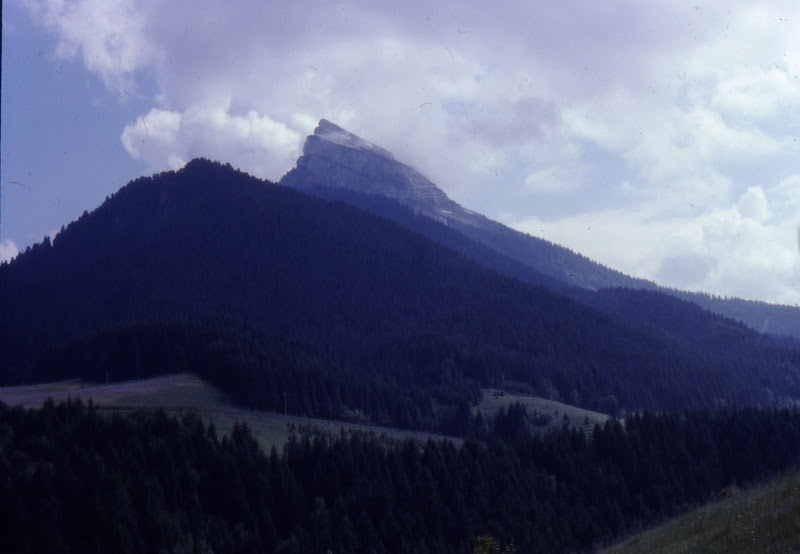
IN 1968 I BOUGHT, second-hand, spurred by what information I no longer recall, a copy of the Vincent Stuart edition of Roger Shattuck's translation of René Daumal's Mount Analogue: An Authentic Narrative. It came to mind again a few weeks ago in a conversation with grandson Simon, 18, who has been climbing mountains in Ecuador. I'm no mountain climber: the closest I've come to the sport was an ascent of Chamechaude, in the French pre-Alps, back in 1976: but mountains are in mind right now, as I'm contemplating a stroll in the Alps this summer.

Chamechaud.jpgChamechaud, seen from the north, 1976

So I took Mount Analogue down from the shelf the other night and read through it again. It's such a strong, brilliant, clear book that virtually every detail I'd recalled from 1968, as well as the general quality of the book, came right back into focus. Daumal was, some think, the finest French author of his time; certainly the most promising. Born in 1908, possessed of a brilliant mind, he was publishing by the time he was twenty. By then he'd experimented with all sorts of drugs, had internalized everything the Parnassiens and Symbolists could offer him, had begun serious study of Indian thought and literature. From then on his principal physical battles were with tuberculosis, and he died in 1944, only 36 years old, in mid-sentence: Mount Analogue is incomplete.

Perhaps it could never have been completed. The mountain of the title is enormous, dwarfing Everest, situated in the South Pacific, unknown because of its capacity of bending space, thus rendering it both invisible and insensible to instruments. It provides the link between Earth and what one could be forgiven for calling Heaven, and its difficult ascent, available only to superbly conditioned adepts, has a physical property of reinforcing an egoless desire for Transcendence.

The novel describes the plans of the author and, even more important, one Father Sogol to outfit an expedition to the mountain. Eight explorers meet to discuss its probably location, then set out, with four crewmen, on the yacht Impossible, to find it. Sogol combines science and logic to succeed in the search; we visit the island; we learn of the unique communities that have grown up on its shores; we begin the ascent — and then the manuscript fails us.

But it doesn't matter. Sogol is so striking, the descriptions so detailed and winning, and the mood and humor of the book so serene and, in a word, good, that in its imperfect state Mount Analogue is perfect enough.

Several online reviewers have mentioned Jules Verne in describing this book. Oddly, Verne never came to my mind, though I enjoyed Verne hugely when I was a boy. Instead I thought of Melville's Mardi, similarly philosophical and idealistic; and of Raymond Roussel's Locus Solus, whose central figure, Martial Canterel, may have inspired aspects of Daumal's Father Sogol.

I thought of Duchamp, too: the artist's language-play and absurd physics — think of infra-mince, the impossibly small values like the weight of sighs — prefigure Sogol. (And, of course, draw on Roussel.) Daumal was a ’pataphysicien, often a very amusing one; but he was also extraordinarily earnest, without ever lapsing into sermonizing.

My edition of Mount Analogue carries a fine introduction by its translator, who notes
[Daumal] had to struggle with the temptation to which poets are prone: the tendency to conceive of life and reality entirely through language. Mount Analogue, in its simplicy of expression and universality of meaning, probably represents Daumal's ultimate reckoning with the problem of language, vehicle and obstacle.
And in fact, early on, Daumal refers to the subject:
The different branches of symbol interpretation had for a long time been my favourite field of study… Furthermore, I had an alpinist's passionate love of mountains. The convergence of these two contrasting areas of interest on the same object, the mountain, had given certain passages of my article [a study of the symbolic significance of the mountain in ancient mythologies] a lyric tone. (Such conjunctions, incongruous as they may appear, play a large part in the genesis of what is commonly called poetry; I venture this remark as a suggestion ot critics and aestheticians who seek to illuminate the depths of that mysterious language.)
The description of Father Sogol's studio is meticulous and striking: it's festooned with hanging scraps of paper on which are written
a veritable encyclopedia of what we call "human knowledge". A diagram of a plant cell, Mendeleieff's periodic table…, the keys to Chinese writing, a cross-section of the human heart, Lorentz's transformation formulae,…
and so on for an entire paragraph. Sogol thinks and speaks while pacing among these pendant notes, with
an exceptional faculty for seeing ideas as external objects and for establishing new links between ideas which appeared totally unrelated.
Daumal reveals certain laws and principles: that of considering a problem as solved, in order to get sufficiently past the problem to be able to deduce its solution. And the "chameleon law," according to which behaviour is governed by "inner resonance to influences nearest at hand."

Daumal got up from his writing-desk, we're told, in the middle of that final incomplete sentence, to answer his door: a friend was visiting to encourage him (knowing of his illness and likely impending death) to draw up some notes describing his plans for the book's conclusion. They are included in this edition, and one of them answers the perennial question, Why climb?
Just this: what is above knows what is below, but what is below does not know what is above. In climbing, always take note of difficulties along the way; for as you go up, you can observe hem. Coming down, you will no longer see them, but you will know they are there if you have observed them well.

…

When you strike off on your own, leave some trace of your passage which will guide you coming back: one stone set on another, some grass weighted down by a stick. But if you come to an impasse or a dangerous spot, remember that the trail you have left could lead people coming after you into trouble. So go back along your trail and obliterate any traces you have left. This applies to anyone who wishes to leave some mark of his passage in the world.
A delicious book, firm and thoughtful and detailed, humorous and poignant (without intended poignancy, bien entendu!), exceptionally wise, aware of its antecedents and careless (and innocent, as far as I know) of followers. I can't imagine being without my copy.

Tuesday, March 04, 2008

toujours gai

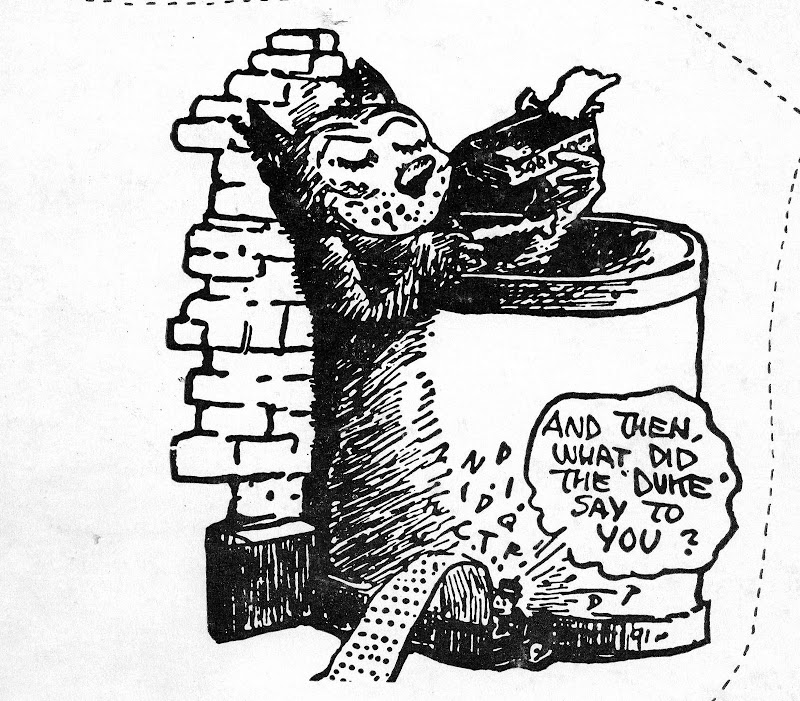
archy.jpg

drawing by George Herriman, from the book The Lives and Times of archy & mehitabel

TO THE LOCAL CAMP ROSE PLAYERS Saturday night, there to see archy & mehitabel in shinbone alley. I set the title in lower case in tribute to the lead character archy, the miserable cockroach hero of Don Marquis's collection of columns from the old New York Sun, who hurls himself headfirst to the typewriter keyboard every night, ghost-writing Marquis's column painfully (and unable to operate the shift key), because, as he says in his first missive,

expression is the need of my soul
The columns appeared in the months before the United States joined the First World War, at a time when vers libre and the Armory Show were introducing New York to Modenism, when New York was high on energy and pregnant with cynicism but still fraught with sentimentality.

In 1940 a collection of Marquis's work appeared as The Lives and Times of archy & mehitabel (Garden City: Doubleday Doran & Co.), to considerable success, and in 1954 (probably in the rush of enthusiasm following the emergence of the 12-inch "LP" record) Columbia Records released a "concept album" musical adaptation with a book by Joe Darion and Mel Brooks and music by George Kleinsinger. The cast featured Eddie Bracken as archy and Carol Channing as mehitabel: their songs and philosophical conversation was stitched together by continuity narrated by David Wayne.

I suppose the musical's place in history will be its priority to Andrew Lloyd Webber's Cats, which made the T.S. Eliot estate rich but did little, in my opinon, to further the musical as an art. I first heard the Darion-Kleinsinger recording shortly after it was released, and before it was expanded into the full-length musical that opened in 1957, with Eartha Kitt replacing Channing. The LP was a favorite of our friend Gaye's, and I must have heard it repeatedly in the apartment she shared with Lindsey and a couple of other girls in the year we were courting. It inspired me to give Lindsey a copy of Marquis's book on our first, poverty-struck Christmas, in a ratty edition printed during World War II:
This book is complete and unabridged, manufactured under wartime conditions in conformity with all government regulations controlling the use of paper and other materials
(those were times when society, through government, took its public activities seriously and respectfully.)

So we looked forward to hearing the musical, and Gaye lent us LP (somewhat worn, it must be said), and Kleinsinger's wonderful melodies and Marquis's sensitive if sometimes sentimental poetry have been in my ears these last few days. Mehitabel, for example:
i know that i am bound
for a journey down the sound
in the midst of a refuse mound
but wotthehell wotthehell
and then her tomcat Bill:
persian pussy from over the sea
demure and lazy and smug and fat
none of your ribbons and bells for me
ours is the zest of the alley cat…
we would rather be rowdy and gaunt and free
and dine on a diet of roach and rat
Well, it's nearly a hundred years since archy first hurled himself headfirst to that letter e, and the cynical Bohemianism, the insouciant big-city back-alley wotthehell is perhaps a little dated. Indeed The Lives and Times of archy & mehitabel closes with a few prescient lines in which archy relays what the ants are saying:
…america was once a paradise
of timberland and stream
but it is dying because of the greed
and money lust of a thousand little kings
who slashed the timber all to hell
and would not be controlled
and changed the climate
and stole the rainfall from posterity
and it wont be long now
it wont be long
till everything is desert
…

ants and scorpions and centipedes
shall inherit the earth
It was about the time that James Thurber released his illustrated book The Last Flower, the first book I remember reading, about an earth blasted by war and fatigue; and it was the time, the early 1940s, when the Limited Editions Club published a book-length poem by either William Rose Benét or his brother Stephen Vincent, a book whose bleak descriptions of insects and robots eradicating humanity scared hell out of me in my early adolescence.

Needless to say, Shinbone Alley lacks all element of scariness. The musical is I think necessarily more discursive, less focusse, than the original LP, but it sure is worth knowing. (I'm told a film version is pretty lame.) Camp Rose, on the river side of Healdsburg's Fitch Mountain, is a rambling frame building whose lowest floor — I don't want to call it a basement — houses a low-ceilinged theater seating thirty-six, with a wide, shallow stage perfect for revues and musicals.

There the Camp Rose Players have been putting on shows for over thirty years, if I read their website correctly. It's community theater with all its flaws and heroic features, and the features get the better by far. The night we went Cheryl Kopczynski, as mehitabel, was recovering from a bad cold, not up to speed, rewarding nevertheless for her laconic impersonation. Bill Garner was a fine, engaging, pathetic little cockroach; Warren Weston a perfect theater cat; John Guilfoy nicely threatening as Big Bill, and the minor characters and chorus well individuated and personable. And the costumes, by Anna Settle, were quite wonderful: no glitzy Cats stuff here, but believable back-alley enterprise.

We'd been looking forward to seeing this for a long time, and Camp Rose did not let us down. Gaye's LP is now safely on my iTunes, the book's down from the high shelves, and what with Geert Mak's In Europe, the return to Gertrude Stein, and last night's reading of Réné Daumal's Mount Analogue, I'm plunged back into the entre-les-guerres: may we all soon in fact enter another such period. (This "downturn" begins to look like a real Depression: maybe we will!)

spacing

If anyone can tell me why line-spacing squeezes up after blockquotes — and, more useful, if anyone can tell me how to avoid this, and how to force single-spacing in other places, like inside those very blockquote — I'd appreciate a comment to that effect!

Saturday, March 01, 2008

The Shock of Recognition


LOOKING IT UP ON THE INTERNET I find (as I should have known) that the phrase originated, apparently, with Herman Melville (which makes me think my next reading should be Melville: I'm gradually working my way toward Moby-Dick). Hugh Blackmer's website tells me that what Melville actually wrote, in his essay "Hawthorne and His Mosses" was
…genius all over the world stands hand in hand, and one shock of recognition runs the whole circle round
It's worth reproducing the entire paragraph, in fact, because it builds so beautifully to that final observation
And now, my countrymen, as an excellent author, of your own flesh and blood,--an unimitating, and perhaps, in his way, an inimitable man--whom better can I commend to you, in the first place, than Nathaniel Hawthorne. He is one of the new, and far better generation of your writer. The smell of your beeches and hemlocks is upon him; your own broad prairies are in his soul; and if you travel away inland into his deep and noble nature, you will hear the far roar of his Niagara. Give not over to future generations the glad duty of acknowledging him for what he is. Take that joy to yourself, in your own generation; and so shall he feel those grateful impulses in him, that may possibly prompt him to the full flower of some still greater achievement in your eyes. And by confessing him, you thereby confess others, you brace the whole brotherhood. For genius, all over the world, stands hand in hand, and one shock of recognition runs the whole circle round.
All this comes to me in the course of writing to a friend, Alvaro Cardona-Hine, in the wake of re-reading his childhood memoirs The Half-Eaten Angel and A History of Light. About the latter I wrote, on a website called Goodreads,
Continuing the lyrical poignancy of The Half-Eaten Angel, this slim collection of prose-poem love-letters by a precocious twelve-year-old boy reads like healthy Colette. Full of the wonder of awakening. An example: "The day you came through my door, my own private door, wearing the furiously white light of your certainty, I had no need for more world, all the world I ever wanted to taste I would taste through you."
(Goodreads seems to be a sort of Facebook for readers; it's my impression so far that it's visited mostly by intelligent and literate women, the sort we used to call "housewives," intent on enlarging their community of books. I'll get in trouble for having written this.)

I THINK ABOUT THAT WORD "shock" and wonder the extent to which Melville thought about it. The word always brings two things immediately to mind: the sensation of a pulse of electricity, as I felt it when, ten years old, I accidentally stuck an index finger into an empty light-bulb socket while scrambling around among the rafters of the communal laundry building in the small Oklahoma town we were spending that year in; and the sight and even more the smell of ricks of hay we'd cut in our pasture the following year, hay we'd mowed with scythes and raked by hand and stacked in sheaves to dry in the California sun.

I think Melville likely knew only the second of these senses in 1850; that and another sense, the disarray (itself really an orderly kind of disarray, for as my grandson likes to point out "nothing can be truly random") of a head of hair, or one's emotions on having been suddenly confronted with something. My Macintosh dictionary tells me the word is from the
mid 16th cent.: from French choc (noun), choquer (verb), of unknown origin. The original senses were [throw (troops) into confusion by charging at them] and [an encounter between charging forces,] giving rise to the notion of [sudden violent blow or impact.]
I'm sure Melville uses the word in all these senses; and they all arose in my consideration this morning of an imaginary conversation among Alvaro, another friend Henry Bridges, and myself, a conversation centering on Alvaro's paintings, which I wrote about here last Saturday. (That's Henry's portrait of me up at the top of this post.)

Henry visited last Saturday, when my mind was full of enthusiasm for Alvaro, and I read some passages from The Half-Eaten Angel to him, and when he was home again, Henry I mean, he looked up Alvaro's work on his website, and then wrote to me his feelings about Alvaro's work, and I forwarded that to Alvaro, who then wrote to me, which set me to thinking further about all this and trying to develop this imaginary conversation, a difficult one to transcribe here as I've not secured permissions from either Henry or Alvaro to reproduce their comments. So I can only repeat a few of my own, as I'd written them to Alvaro:
I am excited; excited by [Henry's] prose, by his re-statement in words of your statements in paint, and by a sudden "shock of recognition," to use Melville's phrase… recognition of my own feeling about your work explained to me as I had never "understood" it before. So your painting, and Henry's description of his reception of it, opens that little creaky door in that not-often-visited corner of my mind. But what does he mean?

I think he writes first of the spaces within your paintings (which are the spaces your paintings themselves enter in order to re-state them), spaces clearly defined by your color fields and their edges ("tiles," he calls them). He then mentions a sort of dialectic that appears between the literal images in your paintings, the animals or birds or what have you, and the quality of the paint-handling that presents those images, which (at least in Henry's mind, and in mine too) produce work in which not only the images are images, but the way those images are limned are also images, images that intensify by transcending the more literal images.

And then, best of all, that dialectic not only emerges clearly itself, but the clarity with which it emerges defines, in pictorial or painterly ways, a vision of clarity, what Henry calls "a heightened sense of clarity". This "opens up ... space to ... the imagining mind", which is your mind, and Henry's, and mine. And then, "to state it differently," he lapses into a kind of poetry… similar to your own poetry as I find it in The Half-Eaten Angel and A History of Light….


All this has to do with what Joan Retallack called continuity and contiguity, as I wrote about that a few days ago; I suppose Retallack's an unknowing participant in this conversation. And, come to think about it, this kind of imaginary conversation, web-based and disjunctive, is the kind of community that I was thinking of in response to Ron Silliman's thoughts on the Community of Poets.

I suppose in a century or two, if we're given them, the human consciousness will become a sort of meta-consciousness, the Jungian concept of racial memory will become a more evident and verifiable species awareness, originally facilitated by this Internet which may one day leave its present technological grounding behind and exist instead, and simply, in a neural network the humans of that day will take for granted, as we take language and gesture for granted.

And then there will be no more Continuity and Contiguity; all will be merged in one splendid Awareness, and with any luck we'll hardly need to talk about it any more, let alone think about it, and we can get back to simple pleasures of daily life.

Thursday, February 28, 2008

Blood on the Dining-Room Floor

DETECTIVE STORIES are not my favorite genre, though in remote antiquity I raced through the Dorothy Sayers list, and there was a time, forty years ago, when we enjoyed watching Perry Mason, god save us.

Going through the Stein shelves, though, I reflected that I'd never read Blood on the Dining-Room Floor, and got it down to look it over. It's a curious book, written in 1933 after a six-month writer's block, an extraordinarily rare even in Stein's life. I read it because I had just read Monique Truong's novel The Book of Salt, whose central figure is the Vietnamese cook Stein and Toklas employed for years at about that same time.

Blood on the Dining-Room Floor is "about" a couple of mysterious events, one involving the unexplained death of a local hotel-keeper, in and around the town of Bilignin, where Stein and Toklas had taken a country house for their summers. We visited that house in the summer of 1974, when it was empty. The gates were unlocked, so we simply walked into the property, not daring to enter the house of course, but walking around behind to a terrace overlooking a magnificent view west across the valley below; to the north in the distance a hilltop castle.

It's a quiet village, hardly more than a few farmsteads and a cemetery to the south, and here, in 1933, Stein and Toklas settled into the country summertime routine you may know best from Wars I Have Seen, which recounts daily life there. Recently the Bilignin house has taken on a darker side: Stein apparently obtained the lease through the assistance of Bernard FaĂ¿, later a collaborator in the Vichy government; somehow she and Toklas, hardly Aryan, were left alone there throughout World War II.

But that's in the future: at the time of Blood on the Dining-Room Floor Stein was undergoing a writer's crisis. Having begun writing relatively conventionally in 1903 and '04 with Q.E.D. and Fernhurst,, unpublished and unknown until 1950, she moved to her more ruminative style in her first early masterpiece, Three Lives, finished in 1906. In the next two years The Making of Americans finished off any conventional fictional narrative interest in her writer's mind, and her immersion in Cubism, as it was being evolved by her friend Pablo Picasso and his colleague Georges Braque, permanently influenced her own work. The first published examples of this were her portraits of Picasso and Matisse, in Alfred Stieglitz's review Camera Work, in 1912; Tender Buttons, written that year and published in 1914, is perhaps the early peak of this style.

Stein continued the style through the plays and portraits of the 'teens and '20s, gathered in Geography and Plays(1922) and Operas and Plays(1932), but continued to meditate in her writing on writing itself, in Useful Knowledge(1929) and How to Write(1931).

Then came the interruption of the celebrated Autobiography of Alice B. Toklas(1933), which made her popular and led to her return to a lecture tour of the United States in 1934 and 1935. I think this sudden fame and popularity combined with her dedication to her craft and her awareness of the lasting significance of the Cubist moment — which precipitated a deep divide between abstraction and representationalism among writers as well as painters and composers — had something to do with the crisis that resulted in Blood on the Dining-Room Floor.

In any case, in that book Stein returns to a Cubist sort of interpenetration of two planes: one of meditation on the act of writing; the other the observations, seen and overheard, of ordinary events of daily life — in this case, in a small village in the French countryside.

Blood on the Dining-Room Floor is probably best read twice: once quickly through, on its own terms; then again with thought given to various annotations. The edition I have was published by the Creative Arts Book Company (Berkeley) in 1982 in an edition with a helpful afterword by John Herbert Gill; it has been made available on the Internet. The first time through you'll perhaps be irritated and/or bored; this is a frequent response to Stein's writing. One reads a new book (new to the reader, I mean) burdened with the experience of all that prior reading, and most of that prior reading is pretty commonplace. Not the content of the texts, perhaps; but certainly the form or style. Even Henry James remains "difficult"; not that many readers go past, say, Mrs. Dalloway.

But I find Blood on the Dining-Room Floor a charming book, read not terribly closely, say in bed. The crime, if it was a crime, let alone its perpetrator, never really appears; the entire affair's presented as if a matter of village gossip, narrated through innuendo and arched eyebrow, certainly not laid out in at-first-and-then sequential narrative.

A closer reading introduces two major matters of interest: Stein's technique — what you might call composition as composition — and the significance of that technique as a witness to the intellectual revolution of her time, a revolution that is still proceeding and has yet to be noticed, let alone understood, by the vast majority of readers.

Among the other Internet annotations of Blood on the Dining-Room Floor, Craig Dworkin's Five Words In A Stein, addresses the first of these matters. I like it, partly because I'm drawn to language-play. Dworkin makes a case, and the pun's intended, for reading Blood as a text influenced by Stein's early family language, presumably as German as it was English; and he's alert, perhaps too alert, to subtle implications of the words and phrases that occupy Blood on the Dining-Room Floor, as restless guests occupy a country hotel. (Or refugees occupy an occupied zone.)

The second matter is the subject of Joan Retallack's Writers – Readers – Performers / Partners in Crime (published in How2, vol. 1 no. 6, Fall 2001), a paper given within a colloquy on "The Politics of Presence: Re-reading the Writing Subject in “Live” and Electronic Performance, Theatre and Film Poetry." Where Dworkin concentrates on a reading, even a deciphering of Blood on the Dining-Room Floor, though, Retallack goes much further, using Stein's book as a launch pad for an interesting sketch of a proposal, that while
…literature is an engagement with possible forms of life — as all language games (written or spoken or performed) must be
the fact remains that
…the explosion of forms that we've seen throughout the 20th century… poses difficulties for traditionalists — e.g., narrators of coherency, tidy story-tellers as guardians of logics of identity and convention.
The next sentence is crucial:
Ther narrator of continuity is (albeit often unawares) at odds in a world whose vulnerabilities have more to do with contiguity. Contiguity is the spatial dimension of coincidence.
Stein's crisis, in the months before Blood on the Dining-Room Floor, was born of the mutual incompatibility of "narrative coherence" and awareness of contiguity, particularly of the dislocating Cubist appearance of contiguity. Blood on the Dining-Room Floor is a meditation on the disruption of daily life that is a constant characteristic of daily life. (It's tempting to consider the dialectic between Toklas as daily life and Stein as meditation; Stein's nightly writing "miracle" as quotidian and Toklas's morning typing as a completion, almost a repair, of the interruption which is Stein's work.)

The Moment of Cubism, to use John Berger's apt and memorable formula, was a historical moment on the scale of the Enlightenment, the expression of a handful of visionaries who refused to let convention or authority (and the two are politically synonymous) cloud their eyes as they looked at a world of human consciousness (and subconsciousness) that had changed. Language, whether verbal, pictorial, or musical, always reflects the "interruptions" of such moments. ("Interruption" in quotes, because it's an interruption that connects.) A fascinating example of this was posted the other day on Mark Liberman's Language Log: time and distance themselves have changed in the human consciousness, as is testified by the history of our words.

I can't think of a more pleasant way of entering a contemplation of all these matters than a reading of Blood on the Dining-Room Floor. It's already led me to Useful Knowledge, and soon back via Geography and Plays, I suspect, to the Geographical History of America. In which case I'll report back here.


Monday, February 25, 2008

The Book of Salt

NO, NOT THAT KIND OF BOOK OF SALT. Years ago I did find somewhere a book in French called Le livre du sel; it's around here somewhere -- a fragile, old, small book; I think it's in an envelope somewhere -- and I mean to read it when it turns up. And in the meantime there have been books by Mark Kurlansky, whose Cod I found interesting, and Pierre Laszlo; both of them look worth digging into.

But The Book of Salt that I read last week was the novel by Monique Truong, which appeared five years or so ago. An acquaintance (the sister of a daughter's husband, if you want to know) brought it, along with a number of other books, to Christmas dinner -- apparently a habit she's developed over the years, and an ingratiating one: get rid of accumulating books you've read and don't particularly want hanging around by trading them around to your acquaintances. (I'm not likely to get rid of books, though, unfortunately.)

I hadn't been terribly interested in Truong's novel when it appeared, even though it is connected to a subject in which I am interested. The novel's in the first person, narrated by a Vietnamese cook who goes to work for Gertrude Stein and Alice B. Toklas in the late 1920s and stays with them for an unspecified but lengthy number of years; certainly up to their 1934 departure for the United States. The book's not in fact "about" the Stein-Toklas ménage, though that subject is treated sympathetically and interestingly; it's about Binh, his formative years in Saigon, the desires he seeks to satisfy on his Sundays off.

And it's especially about a rich confusion of Paris and the colonies, the Nineteen-Twenties and 'Thirties, households stable and fleeting. Virtually nothing here about cooking, alas; this isn't a book for foodies, any more than it's one for Stein adepts. A small, quiet, pensive kind of book, perhaps a woman's book, it reminds me irrelevantly of Tracy Chevalier's Girl with a Pearl Earring; perhaps it will one day make, as that novel did, a movie with a lingering impression of modest truth and beauty.

Saturday, February 23, 2008

The Half-Eaten Angel

I'VE WRITTEN ABOUT ALVARO CARDONA-HINE here before (most recently last August): an elegant, graceful man, an artist, writer, and composer, who we met some years back at his gallery in Truchas, New Mexico. Truchas is a small town on the fine old Taos road between Santa Fe and Ranchos de Taos; when I last saw it, ten years or so ago, it seemed just on the point of emerging from unchanged centuries, to become something of an artist colony. I hope it's not spoiled.

Alvaro's gallery was full of colorful paintings when we found it, fifteen years ago -- representational paintings, landscapes primarily, in Matisse-like areas of color of relatively flatly applied paint. Modernist they weren't, and aren't: at most, you could call them postimpressionist. I won't describe them further; you can see them at Alvaro's website. I will say that I like them very much; twenty years of retirement from daily art criticism has taught me to value paintings on their own terms, apart from any historical significance we might want to read into them.

When we met Alvaro he was keeping to a steady schedule, painting in the morning, then changing out of his painting clothes and writing or perhaps reading or composing in the afternoons. I admire that discipline; it's not my way, however tempted I am to try to adopt it. It's steady, undistracted, and it gets things done. According to a 2006 interview with Elizabeth Glixman he has published seventeen books, and I have heard more than one ambitious piece of music (most recently an impressive thirty-minute violin sonata): one doesn't produce like that without dedication.

I recently re-read his childhood memoir The Half-Eaten Angel (Minneapolis: Nodin Press, 1981), a pair of small (hundred-page) books the first of which, Agapito, was originally published in 1969. They record a blessed childhood in Costa Rica, a "memory of Paradise" in the author's words. The writing is full of wonder, very much from a child's point of view, although, again in the author's words,
the voice of the protagonist could never be the pure voice of a child. It is both child and childhood's memory, sun and shadow. The accent, or tone, comes from the man inherent in the child; the man this child will someday become and so, in a way, future impinges on the past. I would like this reverse enjambement to represent our triumph over time. Memory is nothing else.
Alvaro has let early reviews of Agapito stand on the back cover, and two of them collide delightfully, one suggesting the book be read in one sitting (though a sitting of "infinite enjoyment"), the other sating "This is not a book to breeze through..." but one to "be read in bits, meditated upon...". Both are correct, and I found myself reading in both modes simultaneously: it's a perfect bedside book.

The books are written in short chapters, a single page or only a few lines, each of them a poignant note, directed to one or the other of the two enigmatic older men who stand as both mysteries and familiars to the observant but constantly wondering child. Agapito is a peasant neighbor; Tuna, whose name provides the title of the second book, is a great-uncle. The reports describe a life teeming with detail, set among extended family; a childhood in nearly always pleasant and rustic surroundings, but full of reference to an unimaginably huge outer world, the world of adults, of Mozart, Quijote, Krishnamurti, distant wars and history.

And always the language: sentences marked by a painter's eye for texture, form, and color; a composer's ear for cadence, line, and sonority. One can only quote:
My father's mother, Agapito, that handful of wheel-chair silver, brittle and illustrious as a river-washed pebble, has come visiting with her jar of home-grown tobacco and her brown slips of paper with which she rolls her own little puffs of pleasure...

An ancient fragrance travels with her, a pressed aroma of petals and Mediterranean linen, of honey and figs, of forests of laurel and chests of oak. She sleeps with a classical book beneath her pillow and her death is a tall and stately girl about to marry.
Or:
In the evenings I sit by the brook listening to the speed with which it stays he same. The sky, almost solid with stars, pretends loose yardage and lets its print hang low...
Or:
And that deathless instant of Mozart, who is dead and didn't know us, Agapito, manages to come alive and invade our senses. We are mellowed and made wise through magic and astounding ways, without a word, in the midst of play.


This is what I learn once again from Alvaro's books and his painting: that observation, memory, and expression, combined with the skills that come from discipline (and, let's face it, innate talent) produce phrases and images whose immediacy and universality transcend time and history. Just as each petal of each blossom is new for the first time, every detail lovingly considered is another necessary reminder of the continual renewal that makes Time and History possible.

And I'm made to recall, once again, as so often happens, a line attributed (by Hendrik Willem van Loon, in his Lives) to Emily Dickinson:
beauty crowds me 'til I die…

Saturday, February 16, 2008

In Circles

show.jpg
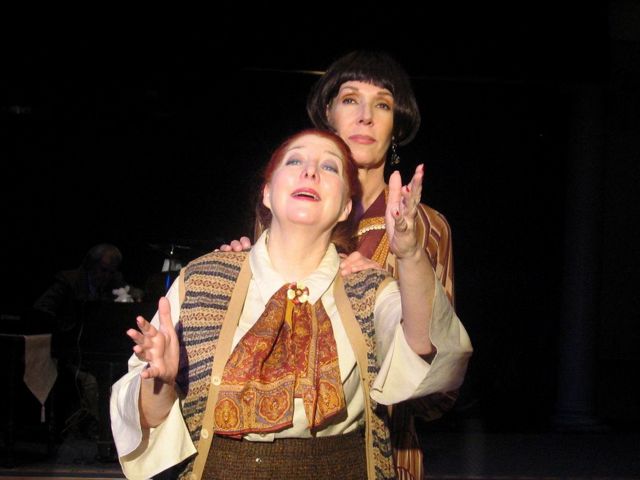
Noelle McGrath (Mildred), Robin Manning (Mabel) (looking very like Stein and Toklas)
in current production of
In Circles. Photo: John Sowle


A FRIEND, JOHN SOWLE, HAS DIRECTED a production of Al Carmines's musical setting of Gertrude Stein's A Circular Play (1920: and included in her Last Operas and Plays). In Circles is a marvelous piece of musical theater, full of entertainment and surprises, sentiment, humor, enterprising in the extreme in its musical mix of high art, klezmer, soft-shoe and show-tune.

And quite faithful to Stein. What do I mean by that. Well, her "play in circles," like almost everything else she wrote, is rooted in the real world and the domestic world, from its opening description of a moment in the Stein-Toklas household
Papa dozes mamma blows her noses.
to its close a dozen pages later, with the writer reflecting on the work just finished
Fourteen circles.

Fifteen circles.

I wonder if I have heard about those circles.
The way to read Stein is to hear Stein, and In Circles makes her audible, and thus provides a marvelous introduction. More than an introduction, though; In Circles is also an enlargement of Stein's original play. Carmines expands it to a full-evening production, weaving, yes, circles around Stein's motifs, lifting a once-only chance remark — Mrs de Monzy has adopted a child — into full-out production number; or assigning lines to one or another of the four boys and four girls in the cast ("boys" and "girls" in the theatrical sense) and returning to them, re-investigating them in new contexts and ensembles, and thus revealing new depth and meaning.
Can you say the page to-day can you say the pages.
In the original cast recording (I know it's around here somewhere) many of Stein's lines thus broken and assigned develop into approximations of the reasonably intoned dialogue Stein no doubt transcribes in her play
He was a disappointment to me. I could not understand the reason for the waiting.
We had our photographs taken, not intentionally but we happened to have seats in the front row near the arena and so when a photograph was taken we were in it.
The result is Cubism, the isolation and consideration of various apparently different aspects of a given event (phrase, character, face) in a manner to enlarge its meanings. This is criticism at its best. So many of the best examples of Criticism are, in fact, works of art themselves, and Theater is the public location of this par excellence.

I wish I could see this production. I can't: it's playing at Judson Church in New York, the place of the premiere of In Circles forty years ago; and it closes this next Friday, Feb. 22.. In the meantime I have to be content with reading the reviews and seeing the cast photos.

And looking forward to another intelligent literary musical, the 1954 Shinbone Alley (book by Joe Darion and Mel Brooks, lyrics by Darion, and music by George Kleinsinger). It's getting a local production by the Camp Rose Players, and I can hardly wait.

Friday, February 15, 2008

Self-promotion

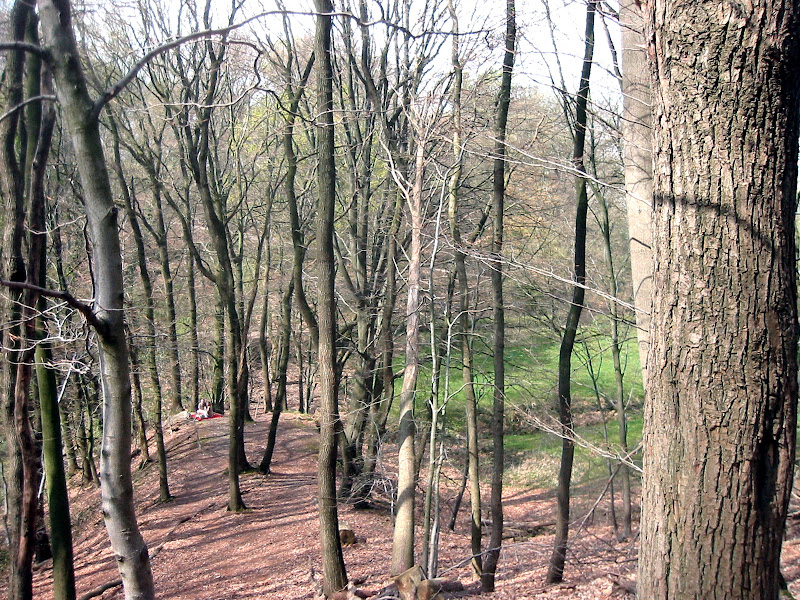
duivelsbos.JPG
Woods near Beek, Netherlands, from The Lingepad


STILL PREOCCUPIED WITH THE FLU and not ready to blog seriously, but I do want to mention two ongoing bits of business:

Walking in The Neth...
By Charles Shere

1) a new book, The Lingepad: Walking in The Netherlands, April 2007. Square format paperbound, 7x7 inches (18x18 cm), 176 pages, published February 10, 2008. Almost no text (surprise!), this is a sequence of photographs taken during our 100-mile walk across the center of The Netherlands last April.

2) my food blog Eating Every Day continues through thick and thin, sugar and salt, sickness and health...

Wednesday, February 13, 2008

The Fourth Symphony

orchestra.JPG

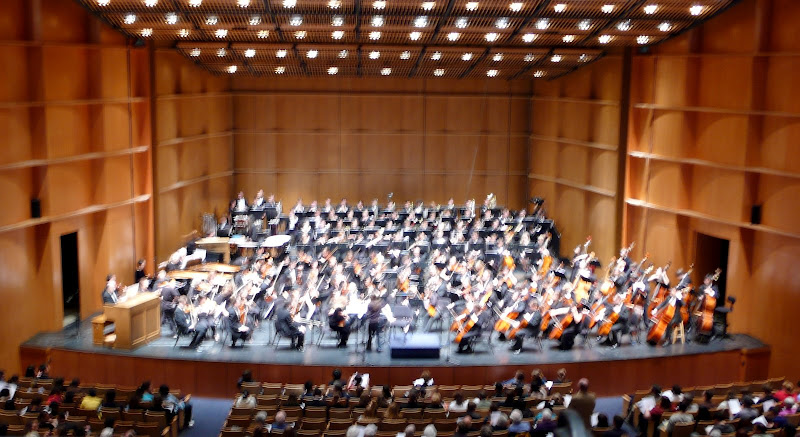
THAT'S A DOZEN DOUBLE-BASSES in that blurry photo (taken without flash), a dozen cellos, fourteen violas, thirty-six violins, fifty-four winds. I forgot to count the percussionists and keyboarders, and of course the photo doesn't show the extra instruments up balcony left, or the chorus behind us.

To me Fourth Symphony will always mean Ives, and I try not to miss a performance. I first heard it in December 1967, when the Oakland Symphony played it under Gerhard Samuel, whose programming in those days was remarkable — the standard repertory plus Ives, Stockhausen, Harrison, Terry Riley: a string of several years of enterprise which has never been given its due. (This performance of the Fourth Symphony, surely the west coast premiere, is undocumented on the Internet, as far as I've been able to determine.)

Whereas once the Fourth had been an impossible vision, unperformed until 1965 partly for its complexity and instrumental demands, it has now become more commonly heard. I've heard the San Francisco Symphony played it under Seiji Ozawa and its present music director Michael Tilson Thomas. There have been a number of recordings, amply described by Scott Mortensen here.

There are four movements, composed between 1910 and 1916 (but Ives dates are almost always very slippery), each of so idiosyncratic a character as to require rather different performing forces and, more important, different psychological approaches. The Prelude states the speculative, one can't avoid the word "spiritual" nature of the program, with a group of violins, a viola and a harp in the distance, and a chorus singing, in unison until the close, the old hymn Watchman ("tell us of the night...").

In 41 measures (for most of the orchestra: the "distant choir" travels at another pace) and about three minutes the Prelude runs through an almost ungraspable number of details which all weave together into an ultimately calming resolution. The genius of Charles Ives is his persuasive ability to display and demonstrate the power of music to contain at a given instant and in a given sonic event an enormous number of possible interrelationships and consequent meanings: this Prelude is a locus classicus .

The three remaining movements investigate various ways of responding to the speculative Prelude: a sprawling "Comedy" (this scherzo is not a joke), Allegretto, alternating among raucous brass-band marches, sentimental parlor-songs, hymn-tunes, and machine sounds; a stately Fugue again based on hymns, and the slow Finale, Largo, which returns to the idea of spatially separated instrumental forces, the addition of the chorus, and a quiet, speculative, appreciative mood.

Where the Prelude is less than four minutes long, the other three movements run about twelve, eight, and eight minutes. Recordings and performances vary, but the entire piece won't take more than thirty-five minutes: Ives is efficient, laconic, in his discursiveness.

Sunday's performance was by the combined orchestras of the University of California, Davis, and the University of the Pacific, whose conductor, Nicolas Waldvogel, presided over the affair, with assistants conducting the various outlying ensembles. The orchestra was a little too large for the Mondavi Center's Jackson Hall, but the acoustics were forgiving, and the music was revealed with considerable clarity.

Ives's music is always significant. Passages in the Fourth refer to the sinking of the Titanic, Pilgrim's Progress, Nathaniel Hawthorne, camp-meetings and church services, marching bands and public holidays, barroom and salon music, and other, earlier pieces of Ives's: the First Quartet, the Concord Sonata, and The Unanswered Question, among others.

More necessarily than most composers, and more successfully, Ives worked at the difference between public and private music. A symphony is public: which means, among other things, that it is not necessarily coherent, or resolved, or unified. Ives has his musicians playing at different speeds, in different places, some quietly, others drowning them out; some reflective or thoughtful, others assertive or brash.

A glance at the AMP version of the score, the only one yet published, suggests the confusion this complexity can produce. Only the second movement was set in type; the others are notated in hand, and in three different hands. Even the second movement, based on the New Music Edition (San Francisco) of 1929, is amended and annotated in handwriting. The instrumentation is uncertain: horn or trombone, piano if trumpet is unavailable, and so on.

Politics is the art of what is publicly possible, and the Fourth Symphony is politics, hence appropriate to the season. Ives himself was intensely involved with politics; he was later, after having composed the Fourth, to correspond with presidents, and to propose amending the Constitution to permit direct popular input to each year's Congressional agenda.

Listening to a public performance of the Fourth bears this out: one's attention moves from those string-players in the balcony to the unseen chorus behind to the enormous orchestra, and among the orchestra from the formidable double-basses to the many busy keyboard players (solo piano, piano four hands, celeste, organ, quarter-tone piano). Waldvogel conducted with long-armed sweeping gestures, maintaining the steady underlying pulse but allowing individual phrases their own version of line. The musicians concentrated intensely and performed stalwartly.

And then it was over. The concert had begun with what might be called the pocket-version of the Fourth, The Unanswered Question: a big string orchestra (from UOP) playing almost soundlessly, a lone trumpet in the upper right balcony plaintively repeating a single phrase over and over, four flutes in the upper left retorting with increasingly irritable flurries. Nick Antipa was the trumpeter; all played well.

Dan Flanagan was the soloist in the Sibelius Violin Concerto, with D. Kern Holoman leading the UC Davis orchestra: not finally a fully polished professional performance, perhaps, but a touching and fascinating one, with fine detail and drive. (Flanagan walked on in one movement of the Fourth for a cameo, to great effect).

The Fourth came last, as it should, and was over in what seemed a minute. So much to hear, so much to think about, so much to be grateful for, so little time to enjoy it. I asked one of the violinists afterward, seeing him mixing with the audience in the lobby, how many rehearsals there'd been: Oh, sixteen, I think, he replied. Well, it was a beautiful performance, I said; it's amazing that you did it at all, but that it was so beautiful...

Yes, he said, there were some misgivings among the orchestra about doing it, we never did really hear it all...

Impossible to "hear it all." That's the point. It's a major major piece; recordings are poor black-and-white still photos of it; even a live performance, while in color and motion, loses the impact of the Fourth in its transitoriness. Ives tries repeatedly to do the impossible, to mediate Quest and Arrival. His effort is ultimately both comic and tragic and always, always, human.

Northern California history, performances of Charles Ives's Fourth Symphony:

1967, Dec. 6,7,8; Gerhard Samuel, Oakland Symphony Orchestra
1968, Feb. 14, 15, 166: Seiji Ozawa, San Francisco Symphony Orchestra
1973, May 9,10,11: Seiji Ozawa, SFSym (subsequently on tour in Brussels, Florence, St. Petersburg, Vilnius, and Moscow)
1991, November 20,21,22,23: Michael Tilson Thomas, SF Sym
1999, Sept. 30, Oct. 1 (third movement only): Michael Tilson Thomas, SF Sym (recorded live for cd)
2000, June 9: MTT, SFSym (toured in September to Baden-Baden, Lucerne, Cologne, Dusseldorf)
2002, Jan. 31, Feb. 1,2,3: MTT, SFSym (toured in February to New York and Ann Arbor)

Saturday, February 09, 2008

Over at his blog, Ron Silliman has begun answering a questionnaire "intended to “inform discussion and debate at a Poetry Foundation-Aspen Institute conference' sometime in the future. It is very straightforward with six open-ended questions."

Thinking a similarly serious consideration of another neglected area might be useful, I'm prompted to invent a similar process re. the composition of music:

1. What is your connection with music (read, write, teach, buy recordings and scores, publish, etc.)?

I have composed music since the early 1950s, and began listening to it much earlier. Looking back, I seem to have listened to the landscape — having grown up as much in the country as in cities — as one listens to music. My first "real" job was running the music programming at KPFA, the Berkeley noncommercial radio station; by then, I'd already been giving recorder lessons to make an occasional dollar. I taught music (20th-century music history, Beethoven, John Cage) at Mills College for fifteen years, and I reviewed music for a daily newspaper, the old Oakland Trib une, at about the same time, 1973-1987.

2. What are the most pressing needs of music and the music community?

A) of music: first, to be allowed to sound; second, to be given its due as a basic and central component of human expression, more basic than verbal language even, more central than politics or economics. As such, music -- as both a process and a literature -- must be taught, both formally in the schools and informally in the home and the community.

Silliman writes "I am not at all certain that any MFA program should admit a student who cannot name a minimum of 100 books of contemporary poetry – published in the past 25 years – and say a little about each." Similarly, any college graduate should be familiar with a basic canon of music, and that canon should be carefully considered to include the past century, and music of other cultures.

B) of the music community: first, to be acknowledged, perhaps even to be created. To my ear the strongest pieces composed in the last thirty years have been those that are aware of the widest world of music: vernacular music, commercial music, "world music," and the leading edge of the music of the twentieth century. I wrote about such a piece the other day, Steven Mackey's Indigenous Instruments. Such music contributes to the coherent accumulation of repertory, an accumulation comparable to the great storehouses of literature and painting and sculpture and architecture. Those are pretty well taken for granted among the cultural observers of our society; the musical repertory is not. When considered at all it tends to be shamefully constricted: to recent commercial music, or to an absurdly narrow area of European history.

(Think of a society whose libraries and bookstores contented themselves with only those texts written in German between 1725 and 1900, and a few plays from the Italian theater of the nineteenth century!)

For an individual musician to develop and maintain this kind of broad awareness is rare and difficult and certainly unrewarding; for a number of such musicians to become acquainted, to discuss individual discoveries and common interests -- that is virtually unheard-of. Of course there are faculties and new-music organizations, chamber-music groups and orchestras: but generalized "music communities" are few and far between.
They exist, though; they exist in the blogosphere. I've only recently begun to understand the range of this community, through a few blogs which, web-like, lead occasionally to others:
Renewable Music
Boring Like a Drill (I particularly like his "Please Mister Please" compendium)
listen (new to me)
aworks (ditto)
Nico Muhly's blog, self-promotional but why not? Interesting beyond that…
Of Sound Mind, which actually gets into the practical mechanics of music
Roger Bourland
Sequenza 21/, a forum which in fact constitutes the kind of "musical community" that can exist on the blogosphere
Soho the dog
Tears of a clownsilly (the recent entry on Boulez and combover alone is worth the trip!)
New Music Reblog which is just what the name implies, a sort of digest of individual blogs, a form I've yet to investigate

and, finally,

blognoggle, which bills itself as "Shadowing the Top 100 Classical Music Blogs" and is therefore useful as a locus of such eveen though the emphasis seems to be on what is sometimes called dead white men's music.
The flu has struck, and I probably won't get around to finishing this before Tuesday.

Wednesday, February 06, 2008

Composition as Explanation


IN JUNE 1996 WE SPENT a couple of weeks in this house outside of Dabo, in the hills in Alsace, and there I worked on two compositions: a long piece for solo piano which managed to get completely sketched, then completely stalled; and, a more pressing concern, a trio for violin, piano, and percussion, which had been commissioned and was to be performed later that year. Over the years I've written much of my music in Europe; we used to spend a month or two there every other year in the years we were working, taking leaves of absence and dividing our time between touring and staying put.

This turned out to be my last European composing stay, however. The Trio seemed so valedictory when I heard it performed — so remote, objective, and phenomenological; so devoid of ego-expression, at least to me — that I couldn't turn from it to anything else. It seemed like a farewell piece.

But the piano piece nagged at me: it had its own right to existence, whether or not I wanted to associate with it. So I kept at it, getting it out from time to time, printing it out, shoving notes around, carving it up and pinning it down. I thought it had been finished in Portland two years ago, and I ran it through the synthesizer and put it on my iPod and listened to it a lot. But I knew I hadn't really come to terms with it.

Now, though, it's finished. I've been through it a final time, sprinkling the dynamics indications in, adjusting peculiarities of notation, trying to make the damn thing playable. It's a very strange piece, an hour long, eventful I think but not insistent. Like the slow movements of the Trio, it's music as landscape. For a long time western european music, the kind of music I deal with, was either song or dance, "lyric or choric," in Virgil Thomson's schema; the Romantic era added to this what he called, unfortunately, I think, 'spasmic," music whose human-body source of energy was not in the larynx or the feet but somewhere between.

The Twentieth Century found a fourth way, dissociating the musical process from those of the human body. My own music tends toward landscape, I think, though I could be wrong. There's a program to this long piano sonata — I've decided to call it my second Sonata; it's in three movements, so that qualifies it — but the program doesn't have to be revealed. It's pretty abstract, this piece. I hope it finds a performance.

Hooray! It's finished!

Tuesday, February 05, 2008

Contemporary Music in Evolution

THAT WAS THE TITLE of a series of radio programs prepared by Gunther Schuller back in the 1950's; I used to listen to it every week on KPFA — it was virtually my only exposure to any coherent view of the fascinating panorama of concert music that opened out after Brahms.

Schuller simply presented the major pieces as they'd been composed, year by year, in sequential order, using what recordings he could then find (and he was amazingly resourceful!), and talking, as I recall, very little about them. It was enough to hear each score in the context of its contemporaries. The rich awareness of this music of its antecedents and its context; the logic of continuity that survived even the temporary dislocations of reaction and "revolution"!

For Schuller was concerned to point out the evolution, not revolution, described by this brave repertory, stretching from Schoenberg's Second Quartet, as I recall, up to John Cage's String Quartet in Four Parts. What a fine string of monuments, living monuments, to the musical and intellectual activity of these composers; what a testament to the optimism and enterprise of their work!

I thought of this last night at a concert by the San Francisco Contemporary Music Players, where we heard a performance of Steven Mackey's Indigenous Instruments, a piece he wrote in 1989 (neary twenty years ago!) for the SFCMP, and which bowled me over then, and did again last night. Mackey wrote for the "Pierrot ensemble": flute, clarinet, violin, cello and piano, the instruments Schoenberg accompanies his Sprechstimme with in Pierrot Lunaire (1912).

Pierrot was a revelation, not a revolution, though it broke a number of social rules in its day, and resulted in considerable changes of attitude among the composers who listened to it closely (Ravel and Stravinsky among them). Indigenous Instruments is another, perhaps almost as startling, though it has its own sources in world-music explorations by such other composers as Kevin Volans and Peter Sculthorpe, whose music I know only from pieces recorded by the Kronos Quartet.

The Pierrot ensemble is in some ways the string quartet of the (late) twentieth century, but already Mackey was intent on nudging it into new territory, de-tuning the winds, extending the techniques of the strings. The intent, I think, and certainly the effect, to me at least, was of rediscovering the uses to which these instruments can be put: as if they'd been dropped into a society until then never aware of them, and had been picked up by gifted but "untaught" musicians who immediately set about exploring their potential.

This is by its nature anti-conservatory. I refer to the music-school, but "conservatory" has its bigger implication.

I listen to Indigenous Instruments with fresh ears and an open mind each time it comes along, which is infrequent, though I do have a recording around here somewhere. It puts me in the mood I associate with being somewhere where intelligent, interesting people speak an unknown language, freeing that part of the mind which conventionally is required to "understand."

I wondered, last night, if Mackey knew the music of NiccolĂ² Castiglioni, whose Tropi (1959) for Pierrot ensemble with added percussion fascinated me when I first heard it, at about the time of its composition. I wondered, briefly, if the radio were playing this chattering treble-clef piece at the correct speed, and I've heard it more than once taken down an octave and doubled in length: but one day I found the score, and that's right, nothing in it below middle C. (Here's the score: bought on Ground-hog's day 1963, while JFK was in the White House, for $3 new! Those were the days.)

I'm sure Mackey knows Castiglioni; certainly the indigenes who play the sounds in his mind know him. That's one of the things that Evolution revealed by Schuller, among others, reveals in turn to us: all these sounds, imaginings, and revelations are known in some mysterious way to one another.

To compose, as Stockhausen said, is to make the world one.

* * *


There were other things on the program, notably Morton Feldman's 1981 Bass Clarinet and Percussion, but I'll think about them more before reporting.

Friday, February 01, 2008

Mountains

a FRIEND WRITES (well, actually a grandson)
One of the things I love so much about mountains is how much character they have, even though they are just geological formations. It's so strange how we can recognize different mountains just by glancing at them, while it would be much harder to do so for rivers, deserts, plains...
Mountains are events; rivers, deserts, and plains are processes, I think. Of course when you're actually climbing the mountain it's a process: but when you see it from a distance it's an object, an event at most.

Rivers of course are fluid and dynamic; even an apparently quiet one has great force. (Think of Charles Ives's Housatonic at Stockbridge.) Deserts and plains and broad river-valleys, like the one here with Eastside Road at its margin, are processes; they invite our motion as participant; one wants to move within them, to explore or, better, experience. But mountains are ambivalent: to an extent (and an extent that varies from one person to the next!) they invite our active participation; at the same time they warn us of their difficulties and dangers.

I haven't explored (!) the history of mountaineering; it's never been a subject of great interest to me. But my understanding is that it's a relatively recent history, at least within my eurocentric concept of history. It seems to date from about the time of the Enlightenment, when the spirit of scientific exploration, the advent of greater leisure (for some), and the suspension of superstitions (formerly regarding mountains and deserts sinister) coincided.

My own interests have tended more to the ambulation than effort, and at this point I doubt I'd have either the strength or the endurance for true mountaineering. There's not much I like better than walking through a landscape; we've walked hundreds of miles, Lindsey and I, contentedly carrying our necessities on our backs while counting on civilization for beds and meals. Climbing seems to me like an imposition of the self on the terrain, though I'm sure the true climber finds it much more a collaboration than an imposition.

Walking is a way of losing ego and mindfulness. Well, that's not quite right: it's a way of being mindfully mindless, to paraphrase John Cage ("purposeful purposelessness"): walking in Dutch forests or the French garrigue conduces full alertness to the pleasures of the environment while enabling near-total suspension of alertness to the physical process. Climbing introduces a new note, the awareness of effort. Ca grimpe, say the French: That's a climb.

Time to go to the gym and prepare a bit more! And then to add one more book to the pile awaiting reading (or in this case re-reading): Réné Daumal's Mount Analogue.

Thursday, January 31, 2008

We shall never be able to do anything like that!

MOZART: CONCERTO IN C MINOR, K. 491.

James Keller repeats the old story in the program booklet of the San Francisco Symphony:
Once, walking with the pianist-composer Johann Baptist Cramer, [B**th*v*n] heard an outdoor performance of the Mozart concerto. He stopped, called attention to a particularly beautiful motif, and exclaimed, with a mixture of admiration and despondency, “Cramer, Cramer! We shall never be able to do anything like that!”
Many years ago my own first experience of the piece live was in a performance by the school orchestra at U.C. Berkeley under James Senturia: the soloist was, of all people, Ian Underwood, later of The Mothers of Invention. At the time he was a student at UC and a music assistant at radio KPFA, where I was then also on staff. He had prepared his own cadenzas for the concerto, and as I recall they were appropriate to Mozart's style while still probing and expressive of our own day; nothing academic at all about them.

Another time, at the Cabrillo Festival in August 1964, it was Ludwig Olshansky at the keyboard, and this was where I learned that it is in measure 329 (or thereabouts) that the greatest stress must be placed, on what seems an impossibly low note but is in fact only two octaves below middle C, a note that sounds and resounds and brooks no demurral. I don't recall whether it was Olshansky who did this, or Gerhard Samuel, who conducted; I only recall that it was the pivotal note of the movement, and has remained one of my favorite aural landmarks.

Friday, January 25, 2008

Initialisms

January 25, 2008

FROM THAT FASCINATING WEBLOG Language Log :
LOWER-CASED INITIALISMS
It is a small but not insignificant recent change in written English that in Britain the newspapers have started spelling acronyms in lower case with capital initial instead of all in caps. The Universities and Colleges Employers Association and the the Department for Environment, Food and Rural Affairs are not UCEA and DEFRA, but (at least fairly often) Ucea and Defra. And in Times Higher Education magazine, the Higher Education Funding Council for England is now Hefce. This only applies to one of the two subclasses of what The Cambridge Grammar of the English Language chapter on lexical word formation (chapter 19) calls initialisms: it applies to the acronyms, not the abbreviations. Nobody calls the Science and Technology Facilities Council "Sftc", because you don't say "sftc" (could anyone?), you say "S F T C". Acronyms are more like words than abbreviations are, and the developing convention recognizes that.

Posted by Geoffrey K. Pullum at January 25, 2008 10:38 AM
That's been the style in Italy for a number of years, and I have to say I like it. Strings of caps, even small caps, shout out too loud from the printed page.

(The last three sentences confuse me, though. Surely many, reading aloud a sentence like "Call the Sftc," would say call the sefftsee.)

In any case what's happening is a confusion of language seen and heard, and any such synesthesia can only be a good thing. Well, "synesthesia" isn't the right word, of course; that refers to sense impressions; what I mean is an intellectual impression formed by two fairly distinct sensory impressions working in tandem. There must be a word for such a concept...