Saturday, May 22, 2010

Italian journal, 14: random thoughts

SO MANY THINGS going through my mind, it was difficult to sleep last night. Shortly before turning in I received a message from an acquaintance of forty years ago, lost track of since, not even sure where he is or what he does with himself; he published a book of poetry that greatly impressed me back then, and recently through the magic of the Internet and of second-hand bookshops someone found a copy, read it, and commented on it at length.

He wrote me:

i recently was contacted by a young lady who writes and teaches in France. She discovered a copy of Tesseract in a bookstore last year and wrote a review, posted to her website:http://spindrifter.webs.com/apps/blog/entries/show/1523079-the-scattered-sea-of-james-monday-s-poetry

i thought you would enjoy reading it.

and he is right, I do enjoy reading it. His book, Tesseract, comes back to me; I see it on the bookshelf in the study and wish it were at hand, a little, though instead of reading it I am about to download Euripides' play Hippolytus because we are seeing it, or an adaptation of it, in Syracuse tomorrow night.

What Spindrifter writes about Tesseract is interesting; Monday's had the luck, good or otherwise, to see his book — written and self-published, I believe, back in the day when you had to be a typesetter to self-publish honorably — fall into the hands of someone programmed to respond to its central conceit, the fourth dimension.

(It enchanted me, back then, for the same reason; at the time I was busy constructing three=dimensional models of the regular polyhedrons, and wishing I could somehow project them into another dimension. I suppose it was writing music that resolved that urge.)

I was thinking about this last night as I was trying to sleep, or rather my mind was thinking about it, I was trying not to think about it, when another thing came into mind: speculation. Spindrifter is a speculator, and so am I. Speculators are thought of as people who take risks with money or property, but what they really do, and by "really" I mean etymologically, is look at things, look at themselves looking at things. And this is what this Italian journey has led to.

I mean, look: There were people living in the neighborhood of Agrigento perfectly successfully, eating fish mostly, making what we'd call rather crude pots and little votive sculptures out of clay, worrying about the weather and the kids; and then the Greeks decided they liked the place, and moved in, shouldered the natives aside (while apparently respecting their spiritual sites), built houses, then temples, then museums I think; before long there was a real "civilization", then international trade, then disagreements and uprisings and war and probably domestic discontent; finally a cataclysmic earthquake as if Nature wanted to put the brakes on the whole thing.

Now let's think about my country, California, where there were people living in the neighborhood of San Francisco perfectly successfully, eating fish mostly, making what we'd call rather crude pots and baskets and things…

You get the point.

<hr>

THIS MORNING AT breakfast in our hotel we were discussing the day's activities, and next week's, and I was looking at the notes I'd prepared on my iPad, when the deskclerk came over to the table, as well as the barista who'd made my cappuccino, and excused themselves, and asked Is that an iPad? We don't have them here yet… and I said Yes, it's an iPad, and showed them its tricks, and handed it to them; the deskclerk took it gingerly and touched a couple of icons and showed the barista how little it weighed, they stood there hefting it and commenting on it; even Lindsey was entertained by how cute the scene was.

A week or so ago in Palermo we were having a cappuccino for breakfast at a bar while our clothes were whirling about in the lavanderia Self; the barista had gone off somewhere, and an extremely handsome young man came in and said to me fammi un cappuccino così per favore, make me a cappuccino like that one please. I looked at him blankly: Scusa? He repeated himself; then when the barista showed up excused himself with great embarrassment, saying he'd thought I was the barista, I who look not at all Italian as far as I can tell.

The young man turned out to be a Romanian from Bucharest, here to better his life, and if good looks and careful dressing have anything to do with it he need only improve his observational skills to go places. We shared a laugh over his mistake, and I told him I'd traveled through his country nearly thirty years ago, before he was born, It was very different then, he said, But it has a long way to go.

<hr>

Yesterday on the drive here from Agrigento we took the two-lane country road, SS 115 I think it is, with lots of hairpins even along the coast; passing is extremely difficult because the road is so narrow and the visibility often so poor. Cars here tend to go as quickly as possible; no one respects the frequent 50 km/h signs (just as no one stops at stop signs; they're only there as counsel, not imperatives). What slows you down? Big trucks, little trucks, the occasional maddeningly slow old man in a cinquecento, a German tourist in an RV with a motorcycle on the rear bumper (that's how you know he's German, the Dutch have bikes), an occasional longdistance cyclist, the inevitable three-wheel pickup-like vehicles.

And at one point an old man was walking along the shoulder, if there'd only been a shoulder, bent a little at the waist, reading something held in his two hands before him, around his belly a strap going back on either side and attached to what seemed to be one of those suitcases on wheels that people roll through airports.

We've seen more than one peddler. In paintings in the Prado you see them in former centuries, with pushcarts or simply baskets, selling ribbons, candies, handkerchieves, fruits, little birds, God knows what. Today they offer telephone batteries, lottery tickets, fruits, wind-up toys, God knows what. They sometimes even come through restaurants when you're trying to relax over supper, though we've only seen that once or twice, and then in Palermo.

Italian bathrooms continue to interest me. Today's hotel is the first to have provided a label over the pull-string in the shower: EMERGENCY. (You no longer see those strings over the bedstead; probably too many tourists pulled on them thinking to turn off a light rather than arouse the emergency staff. Nor for that matter are there any crucifixes over the bed any more. We live in liberal times.)

Virtually every toilet we've seen has had its own idiosyncratic method of triggering a flush mechanism, and most, no matter how luxurious the appointments otherwise, have had loose, mismatched, or broken seats. In the cafés of course there are rarely any seats at all, and I always think of my friend Mac who was surprised that anyone would want one, since as he thinks they are all only a source of dread disease.

Today we had a fine lunch; you'll be able to read about it, I think, over at Eating Every Day. When I asked for the check, though, very uncharacteristically it was not forthcoming. Instead, after a few minutes, the waiter asked if I wouldn't like a coffee. No, I said, the check. Non vuole un caffè? Oh, okay, yes, why not, I'll have a coffee first. And the coffee was absolutely excellent, as has generally been the case here in Sicily. Afterward, though, I still couldn't get the check.

When I stopped at the cash register on my way back from some research in a back room I asked for it again, and the waiter — who was also the cook — pointed at his computer display and said that non funziona. Ah. Computer's down; can't print out a check. Even a tiny trattoria depends on these things these days. (The government practically requires it, since by law you must be given a detailed receipt, and you must carry it with you from the restaurant a given and not unsubstantial distance, in case you have to prove to someone that you have indeed paid for your meal.)

In the end the poor fellow had to consult his menu to find out how much each item cost, write them down laboriously on a notepad, add up the figures, and then announce: Twenty. I had only a fifty. Però, signor, non ha un di venti? Waving his hands together and apart as if smoothing out an unruly invisible sheet. Fortunately Lindsey had one, and we escaped.

Photos: Campania, including Caserta, Herculaneum, Amalfi, and Paestum:gallery.me.com/cshere#100239

Palermo: gallery.me.com/cshere/100241

Tràpani, Erice, Segesta and environs: gallery.me.com/cshere/100275

Mozia: gallery.me.com/cshere#100283

As always, our meals are recorded at Eating Every Day


Friday, May 21, 2010

Italian journal, 13: Moving inland

Ragusa, Friday, May 21—

TODAY REPRESENTS THE center day of our Sicilian journey: we arrived in Palermo the 11th; we propose to leave the island the last day of May. And today, after a week on the road (we spent five nights in Palermo), we've driven around about half the coastline, from Palermo to Tràpani, Marsala, Sciacca, Agrigento, Licati. The western half of the south coast is unremarkable from the car: at its best reminiscent (to me) of the California coast from say San Luis Obispo to Santa Barbara, at its less interesting reminiscent of the Baja California coast.

What's different, of course, is the architecture, the town layout, the system of roads, the people, the food — pretty much everything but the climate. I haven't written anything yet about the ruins we've visited, Selinunte and Agrigento's Valley of the Temples: what I've written about Herculaneum and Paestum will compensate for that, perhaps. We've visited few museums, really only three: Mozia, Mazara, and Agrigento, whose Museum of Archaeology required half a day and then was barely seen.

Seated Venus

The pride of the museum… well, that's a silly way to begin this sentence: one of the many breathtaking aspects of this museum is the many Greek ceramics, painted ones, mostly Attic, brought to the Greek colony here in the 5th century (BC, of course), very soon after it was founded. I wonder if the Greeks didn't establish a museum here; the pieces seem absolutely splendid: could there have been that many collectors living in this town?

But I lingered too over smaller items, like this fragment of a seated Venus who had probably been wringing out her hair after the bath (perhaps she twisted her head clean off): hardly bigger than my hand, it's perfectly carved, soft and insinuating and altogether lovely.

Agrigento is of course famous for its temples, of which one stands nearly complete (fittingly, that presumed dedicated to Concord). Of these the largest was dedicated to Zeus: it stood something like ten stories tall, was big in proportion, and is today a mess of fallen stone. Column-sections and capitals eight feet in diameter lie strewn about; it must have been a terrible racket when it collapsed. I'm glad I wasn't there.

Impressive as the ruins are, and delicious as the vases and sculpture are, it was the Kolymbetra Garden alongside the ruins that provided the pleasantest part of the visit, even though we strolled it in a shower of rain. Planted in a gorge alongside the ruined Tempio di Giove, where 2500 years ago apparently pools and parks prevailed, it offers rectangular grids like those of the ancient city but delineated with citrus groves rather than ruined stone buildings. Everything is living, fragrant, productive, and beautiful. Strolling the ruins, your mind is preoccupied it; strolling this garden, your senses are delighted. There's a place for each of these activities, but I like to keep them skewed a little out of balance toward the pleasurable and sensual side.

Today's drive took us not only inland but well up into the hills; we're probably at 2500 feet — I haven't checked the altimeter. We're in a comfortable hotel in Ragusa, and we have wi-fi, which is why I write just now — though I see it's time to stop, as we have to get out for dinner. More, perhaps, about the drive, and the topography, next time…

Photos:
Campania, including Caserta, Herculaneum, Amalfi, and Paestum:gallery.me.com/cshere#100239
Palermo: gallery.me.com/cshere/100241
Tràpani, Erice, Segesta and environs: gallery.me.com/cshere/100275
Mozia: gallery.me.com/cshere#100283

As always, our meals are recorded at Eating Every Day

Wednesday, May 19, 2010

Italian journal, 12: Dancing Satyr

Sciacca, Wednesday, May 19—

IMAGINE AN EQUILATERAL triangle. Put yourself at one corner; Nature at another; Society at the third. Well, I've been married so long, I put Lindsey and myself at one corner, and our kids and grandchildren not very far away. Friends, of course, group nearby as well.

Now skew the triangle to your taste. I put Nature closer to me than Society, but the extent of skew changes continuously, subject to forces I don't really understand.

Now let's complicate things a little and add another dimension: Time. And to make things really complicated we won't simply lift the triangle into a pyramid, the triangular base representing say the Past, the vertex pulled upward to the Present: we'll stretch two pyramids out in opposing directions from the orginal triangle; one will be the distant Future, the other the distant Past.

I'm sorry I can't draw you a figure here, but I'm on the road, you'll just have to use your imagination.

Okay. The reason some things resonate more for me than others do, among the many things we've found on this trip so far, has to do with where they fall on this schematic drawing. I try for Objectivity, I really do. For years I worked as a critic, and I thought it a given that my work had to be objective: that is, while my thinking and writing would inevitably reflect my own experience, it mustn't project any bias of personal taste. I thought and still think that that is possible, though it's immensely fatiguing.

However I try, though, my own mentality, formed by nearly seventy-five years of training, parental imprint, education, trial-and-error, stupid mistakes, pleasures, deprivations, enlightenment, and the advice of others — all that nudges me more unresistingly in one direction than it does in another. And so that triangle:

I gravitate toward Nature, not Society; and toward Past, not Future. So far, then, the most impressive experiences on this trip have been the views from the Amalfi coast, the landscape at Paestum, the agaves between me and the temple at Segesta.

But at various places in the middle of that triangle lie Works Of Art. Other people have left them there in their own triangulations of Self, Others, and Nature, between Past (or tradition) and Future (or the unknown). And they are, to varying degrees to be sure, resonant and haunting, both unexpected and curiously always-intuitively-known-therefore-reassuring. Signposts, you could say, within the inescapable triangulation that is the considered life.

So far there have been two of them above all, both sculptures: that youth in Mozia that I wrote about yesterday and the bronze "Dancing Satyr" we saw today in an eloquent small museum in Mazara, a few miles west of here.

Both are immensely old, 2200 years at least; both were reclaimed nearby from the sea recently; each is, I think, a reminder that we never know enough to generalize much of anything. This "Dancing Satyr" is larger than life and more lively than life. It's a Bacchante, I suppose, caught in the moment of frenzied supreme pleasure, having whirled himself into a trance; his hair records the animation of that dance, even though his arms are missing and so the cup and the staff are absent. His eyes are alabaster, curiously both alive in their sightedness and blind to our uncomprehending gaze.

I'm sure there are representations on the Internet. We saw a fascinating film documenting the find, not fifteen years ago; the restoration; and the mounting of the work. It's good to see it in Mazara, the port from which the trawler shipped out that found it between Sicily and Africa; and it's fitting that it's shown in a museum on a former Sant'Egidio church, since that saint is so firmly connected to international peace movements.

I'd go on about this more, but I'm still overwhelmed. I thought the Mozia Youth was a climactic masterpiece; this Satyr is in that league and perhaps an even greater achievement. I don't understand at all what we've seen today; it takes my breath away even to think about it.

I'm sorry: no photos. They were absolutely forbidden. You'll have to research this yourself for the moment.

Photos:
Campania, including Caserta, Herculaneum, Amalfi, and Paestum: gallery.me.com/cshere#100239
Palermo: gallery.me.com/cshere/100241
Tràpani, Erice, Segesta and environs: gallery.me.com/cshere/100275
Mozia: gallery.me.com/cshere#100283

As always, our meals are recorded at Eating Every Day

Tuesday, May 18, 2010

Italian journey, 11: Mozia

Tuesday, May 18—

SORRY TO LEAVE Tràpani, but eager to get on to the next sights, we drove out of town south today toward Marsala — but did not get very far. We were heeding our dear friend Richard:
…you must go to the isle of Mozia, to the Whitaker Museum, which has one of the most phenomenal sculptures I have ever seen, 5th century BC. It's a short boat ride and I think you will agree that this is simply an amazing accomplishment, perhaps the most original piece ever produced in ancient Greece.
Since Richard's a sculptor himself this meant something, and though I'd already meant to visit the island my curiosity was redoubled.

We had no trouble finding the place; the GPS we rented with the car took us right to the boat landing on the Stagnone, a good-sized lagoon that made a fine protected port for the Phoenicians. We left the car by the side of the road and waited ten minutes or so, across a narrow canal from the extensive salt ponds with their characteristic windmills; then sailed another ten minutes or so across the lagoon and walked up a short road hedged with agaves to Mister Whitaker's Museum.

The son of an English wine-merchant with little taste for the business himself, Whitaker bought this whole little island in the late 19th century simply to indulge his enthusiasm for archaeology. It quickly became clear that the 19th-century wine warehouses had been built on top of the remains of settlements going back millenia; Motya had been an important Phoenician city six hundred years before the fall of the Roman Republic. (It goes back well beyond Phoenician days, in fact, into the Bronze Age; but that's not yet as well researched; to dig back that far would involve destroying a great amount of more interesting stuff.)

(Motya is apparently the preferred transcription of the Phoenicia name; Mòzia is the Italian equivalent; the ruins are on the island of San Pantaleone.)

Alas, Whitaker didn't live to see the sculpture that so impresses Richard, the so-called Mozia Youth, a life-sized standing young man carved in marble in the 5th century BC, found only 40 or 50 years ago — I'm not able to get the facts just at the moment. It is indeed a glorious work of art, lacking only its arms, feet, and hat. There's a hint of contrapposto to the figure, an intense realism invigorating the idealism of the youth's beauty, an absolutely masterly achievement in the slight depression of the fingers of the left hand in the soft flesh of the hip, in the details of the folds of the tunic, in the slight lift of the right shoulder. No Italian renaissance or baroque sculpture manages this degree of mastery, I think, not even Michelangelo.

The sculpture was found near the north gate to the city, itself an impressive achievement. A double street leads down to the water; perhaps traffic was directed to one-way lanes even then. The city walls were reinforced a number of times over the years; by the 5th c. BC they were a couple of meters thick, made of huge stones taken, I'd bet, from buildings already present on the Sicilian mainland — some show mortise-and-tenon details that seem to serve no purpose in their use as wall material.

San Pantaleone is a small island; we walked around it in an hour, even stopping to look at ruins like this — you can actually stroll among these stones in places — and to take innumerable photographs. (I've posted some of them at gallery.me.com/cshere#100283.) The island is still farmed: olives and grapes, principally the Grillo varietal; and around the museum it's nicely landscaped, chiefly in agaves and pines.

The entire island was walled by the Phoenicians, mostly in loose stone and rubble; these walls have been overtaken for the most part by wild fennel, pomegranates, thistles and such. Walking the sandy road between these walls and the lagoon, even on a warm, windy day, was a great pleasure after the last few days of walking on stone streets.

But then it was time to move on. We stay tonight in an Agriturismo, recommended by more than one of our guidebooks though with the warning that it might be hard to find. Understatement. Even the GPS was no help, as the listings place the establishment in a suburb of Marsala whose name is variously spelled Spagnola, Spagnolo, Spagnuolo, Spagnuola, none of which the GPS allowed to have a street by the name of Via Vajarassa.

We drove up and down looking for the street; then finally began asking people. No one we spoke to spoke English, and some seemed to have trouble with Italian. One of my favorite guidebooks tries to encourage its readers to learn a little Sicilian, but I haven't managed to do that — I lack the discipline. In the end I found a souvenir-peddler near the Mozia boat-landing who set me off in the right general direction, and after driving up and down there I found another man who said he'd take us to the street, follow him. He even telephoned the place to find out exactly where it was.

Even that didn't resolve everything, though; it was unclear exactly which of several farmhouses would be the right one — none seemed to have signs or number-plates. Finally we came to a farmhouse with a woman standing in the driveway looking expectantly down the road, blocking a minuscule sign to Baglia Vajarassa, and we were home. Only then did I look again at the GPS and discover that it knew exactly where we were — Contrada Spagnola 176, Marsala.

Not however until I'd listened to a long discussion of the shortcomings of the Sicilian peasantry from my helpful guide, who turned out to be a retired thoracic surgeon from Palermo, retired to the west coast of Sicily where it was more tranquil — perhaps precisely owing to the absence of commercial signs and the traffic they encourage.

Baglia Vajarassa is a beautiful place. The exterior is plain and unpromising, but the large, nearly cubical bedrooms are nicely furnished with period beds, armoires, and dressing-tables; you have the feeling you've stepped back ninety years in time. We're completely in the country, surrounded by pines, grapevines, and the wind from the lagoon. If dinner is half as good as the rooms and the setting, I'll be very happy indeed.

Photos:
Campania, including Caserta, Herculaneum, Amalfi, and Paestum: gallery.me.com/cshere#100239
Palermo: gallery.me.com/cshere/100241
Tràpani, Erice, Segesta and environs: gallery.me.com/cshere/100275
Mozia: gallery.me.com/cshere#100283

As always, our meals are recorded at Eating Every Day

Monday, May 17, 2010

Italian journey, 10: Tràpani

Monday, May 17—

YESTERDAY WE PICKED UP our little Panda and drove by way of Monreale to Tràpani, a town I've always wanted to see, at the northwest corner of Sicily. After the noise and crowds of Palermo it's a pleasant respite. Our hotel, comfortable and old-fashioned (and cheap), is in the heart of the old town, whose streets are laid out in a grid but are narrow, faced with 18th-century buildings all the same height and mostly with marvelous façades, and are generally devoid of traffic.

The wider streets in the heart of the old city are in fact entirely devoid of vehicular traffic. What a pleasure to walk about in a city dedicated to its human inhabitants! Everything is calmer, quieter, cleaner. The sounds are those of human voices for the most part; the scents those of comestibles. Even time seems returned to a human scale: there's plenty of it, or at least there's enough of it; one doesn't feel rushed, or that one's missing something for attending to something else.

Today, though, we drove out of town for much of the day, first to the old hill town Erice, then to Segesta. Erice was dedicated, three millennia or so ago, to Venus, or Aphrodite, or Astarte, whomever you prefer: the goddess of love, born from the sea, from the blood, some say, of the genitals Zeus sickled from his father in a fit of pique. (The sickle became the spit on which Tràpani stands.)

Erice may have been a spiritual site in the past, but it does not currently seem so to me: recent domination by one of the late Roman cults, still much practiced in Italy, has insisted on stamping the town with churches dedicated to this saint and that; the only remnants of pagan times are the names of bars and hotels, Venere this, Ulysses that. I like the town for what it is, though, very much a tourist town, full of souvenir stands, ceramics shops, little patisseries and cafés, and a fine ruin of a fort on one corner, and fine views out over the landscape.

But if Erice has lost much sense of antiquity, Segesta has it in, um, spades. We cheated and rode a bus up from the entrance to the forum atop the hill, where we saw a number of archaeologists patiently scratching the dirt with their trowels. One fellow walked past with an electronic device suitable for finding car keys buried at the beach: when I asked if he'd found anything, No, he said, There's lots of walls, not much metal.

Erice is noted for its Greek theater, which would have seated about 4,000, with a marvelous view of the gulf to the north. It was apparently an extensive city in its day, 2500 years ago: first a local tribe's, then Greek, then Roman, then Swabian and Norman, then Muslim, then back to the pastoral folk who lived here during the Dark Ages. There's no telling how big the town was, or how many layers it may have.

The other noteworthy site in Erice is the unfinished Greek temple, huge and beautiful, isolated on a hillside outside of what would have been town. No one seems to know why it was built, or rather begun; perhaps, the most ingenious commentators say, to decoy the Greeks into thinking they'd be welcome here, in the hopes of laying an ambush. It would have been a colossal undertaking requiring all sorts of labor, but the ancients had ways of approaching such tasks.

I'm not sure we were wise to visit Paestum before coming to Sicily. Beautiful as the Segesta temple is, there's something disturbing about it; it's too detached from any human activity. Seeing it in the distance has the effect of a Chirico painting, a little mournful, a little disturbing. The quiet streets of Tràpani, contemporary though they be, have a reassuring tranquility that connects to the ruined ones of Paestum; Segesta is, for me, at least today, too much of an enigma. But a beautiful one.

Photos of Tràpani, Erice, Segesta and environs can be seen on this webpage. Notes on our meals during this trip can be found, as always, at Eating Every Day; photos of Campania can be seen at this webpage; photos of Palermo can be seen here.

Saturday, May 15, 2010

Italian journey, 9: Orlando Furioso

Saturday, May 15—

ONE OF THE BEST books I've read preparing for this sojourn in Sicily has been Henry Festing Jones's Diversions in Sicily, published I think in 1908. (I downloaded it from Project Gutenberg and read it on my iPad.) I don't know anything about Jones, except that he was English, apparently wealthy enough to travel at leisure, and well educated in the liberal arts.

In addition he was very good-hearted, keenly observant, intellectually curious, enthusiastic, and patient. He must have made a wonderful traveling companion.

Of course the Sicily he writes about has vanished, at least from Palermo, the only part of Sicily we've yet experienced. His Sicily is incredibly poor, travels on foot or by donkey, lives in what most of us would call squalor. But the people he describes — soldiers, hotelkeepers, little boys, facchini, coachmen — mostly share his intelligence, patience, and amusement, if not always his literacy and the experiences of his travels. Some of them may be ignorant, superstitious, and gullible; but all seem to be reasonable, courteous, and good-humored.

His descriptions — of towns, landscape, conversations, the visual appearance of the people he meets — are detailed without being tedious, evocative without sensationalism. The conversations he records seem accurate and always interesting, and when he retreats into his own thoughts they're generally fascinating. He describes, for example, remembering how migrating birds do or do not skip over an island before lighting on the next by making an analogy with singers who make a wider major second when singing up the scale, a narrower one when singing back down; and his description will make sense, I think, to a musical dillettante as well as to a professional, and teach something about music to the tyro along the way.

Much of Diversions in Italy involves Sicily's traditional puppet theater, and Jones's descriptions made me long to see an example. Today we finally got to one, and it was just as he described it. We had a hell of a time finding it, because we stupidly never did buy a street map to this city. (Too late now: we leave tomorrow morning.) It turned out to be down by the waterfront behind a street market in a broken-down part of town.

(There are many of these; we've been living in one. Streets are narrow and far from straight; many if not most lack any sign of name; the streets are full of garbage; a number of buildings are still bombed-out, lacking roof and interior walls.)

A discreet signboard stood in the street outside the door to the Teatro Carlo Magno. The door stood open; there was no one in the ticket office. A young man sat on a chair toward the front of the otherwise empty auditorium which contained nine rows of benches, just as Jones describes. I couldn't understand his explanation of when the spettacolo would begin; he spoke mostly Sicilian. After a while another fellow turned up; he said the show would start in five minutes. We stepped outside for a moment; when we returned a young couple had turned up with a little boy maybe five years old.

We sat in the second row, behind them, and wondered what would happen next. An elderly man, a little lopsided and wearing the ubiquitous cap, who we'd noticed lounging about outside, walked up toward the stage, sat down at a little pianolike instrument, and began turning its crank: an out-of-tune mechanical piano it was, and it ground out the overture. I noticed suddenly that both the young men I'd spoken to had disappeared behind the scenes.

The curtain went up and a master-of-ceremonies puppet greeted us, explaining what the evening's program would be. The little boy had gone up to the edge of the stage and began asking questions of the pianist, who lifted him onto his knee, holding him aboard with one arm while turning the crank with the other.

Then the action itself began. Orlando, splendid in his armor and his bright green plume, met the bealtiful Angelica. He dispatches her infidel kidnapper, then duels and almost kills his cousin — Rinaldo, is it? — before recognizing him. He travels, for some reason, to Hell and back, slaying the Hippogriff, withstanding temptresses, bargaining with a devil. Then he kills a number of infidels, decapitating a number of them, splitting one.s head vertically, completely cutting another in half.

All the while the action is described and the puppet actors speak, in a number of passionate voices. Horses neigh; terrible birds squawk. The temptress's head suddenly turns into a skull before our very eyes. The bodies pile up. Knights, Angelica, the Priest, giants (one with one eye, a Cyclops), monsters, all pace, strike attitudes, converse, above all battle.

We were utterly captivated, both delighted and absorbed. It was funny and it was profound. And it was very very old: you could see why this narrative mode would survive.

Afterward we talked a little with the second fellow, who turned out to be the reciter as well as the chief puppeteer. I do all the voices, he told me. Who wrote the words, I asked. It's all improvised, he answered, but the subject is always Orlando Furioso, from Tasso, you know, Tasso and a few others. (He specified their names, which struck bells, but don't stay with me.)

The little boy turned out to be his son: he had in the meantime crawled up onto the stage and was sorting out the pile of dead and decapitated Saracens. It's a family affair: the man at the piano was apparently Signor Puppeteer's father, and his father had painted the scenes.

We were allowed to handle one of the puppets: it weighed a good twenty pounds. Ingenious wires and strings make it possible for them to draw swords, ride devils, lift their visors; above all to adopt lifelike attitudes while conversing. We went next door to the laboratorio, the "ospedale delle pupi," where puppets are repaired and repainted when battles have got out of hand; it was an impressive operation, though housed in what might have been a shabby (and dodgy) body-and-fender shop.

What it all amounted to, I thought to myself as we walked home, was pride, resourcefulness, literacy, imagination, respect for tradition, dedication, poetry, magic. It was exactly what Henry Festing Jones had described, a hundred years ago. I hope it goes on forever. Some things, I think, do.

Notes on our meals during this trip can be found, as always, at Eating Every Day; photos of Campania can be seen at this webpage; photos of Palermo can be seen here.

Italian journey, 8: Technology

Saturday, May 15—

YEARS AGO IN simpler times my technology, on these trips in Europe, amounted to a notebook, a triple-aught Rapidograph, a spare bottle of ink, and a camera. Communications back home were via postcards, not many of them, often mailed days or even weeks (not to mention miles or even whole countries) away from their writing.

I wrote largely (and still do, you'll have noticed) for myself; it's how I process my thoughts. (It's also how I remember things these days, but that's another story, a sadder one.) I treasure — well, the word's a bit strong — I'm glad I have those old journals full of tiny writing and the occasional sketch; I page through them and re-live, often vividly, the hotels and the dinners, the mountains and the villages; I return to thoughts about painting, landscape, food, music, national character — subjects that continue to absorb me.

Things have changed. I gradually gave up the notebooks for the same reason I gave up smoking a pipe: there were just too many damn things to juggle, too much clutter in the pocket. The advent of what Simon calls the murse, short for man-purse, didn't really help: in addition to the juggling you had to deal with the zipper. And then there was the constant danger you'd leave the murse somewhere. One fell off the back of my motorcycle, in fact, and I'll never know what happened on that year's travels.

A few years ago I enthusiastically adopted the Palm handheld computer. It's still something in the pocket, and you have to juggle it and its stylus to take notes, but it doesn't leak. Technology developed further; the Palm gave way a year ago to the iPhone: no stylus, alas, but it does take photos. One less item absolutely needed: the real camera — which in the meantime has moved from film to digital technology — is broken out only for 'important' subjects and when flash is needed. (Look at the recent photos, URL below, and see if you can tell which apparatus took which.)

Two years ago I walked five weeks in the Alps, and took almost no notes at all — I won't go into the reasons for that just now, maybe later. I did take 2500 photos: with camera; that was in pre-iPhone days. It was the last trip with the Palm, which still managed to keep up with e-mail from time to time, when I found a connection.

On that walk I did not carry my laptop, which at the time weighted five pounds. I did carry it on the previous walk, a hundred miles along the Lingepad in Netherlands; and I've always brought one along, ever since I first had one (1995, I think), because the advent of e-mail changed everything. One now could receive mail as well as send it; one no longer counted on Poste Restante or American Express for the occasional reassurance from back home.

Then too there came the Travel Dispatch, later to become this blog. Various friends said they enjoyed reading my travel notes and wanted them sent by e-mail. The number of readers grew to over a hundred, and it became increasingly difficult to send out batch e-mails in that number; many hotel internet hookups flatly refused to do it. I think they thought I was that Nigerian fellow with the temporary money problem.

For this trip, which I thought would involve a fair amount of foot-trekking (I don't now think it will), a new jump in technology looked promising: the iPad. I bought one a few days after they hit the market, and bought also a small lightweight Bluetooth keyboard. On the laptop I use MarsEdit for my blogging software, which simplifies formatting and the addition of photos; similar software (though not as good) has turned up for both iPhone and iPad.

I'm enthusiastic about the iPad; it worked beautifully for me on last month's shakedown trips to Ashland and Los Angeles. It doesn't hurt that as well as a writing instrument it is a library, carrying more e-books than you need, and crossword puzzles, and language dictionaries, and all that; and it's lightweight, and displays photos beautifully (though it has no camera of its own), and and and.

BUT. It depends on wi-fi for its internet connectivity (the AT&T-configured model wasn't yet available, and wouldn't work in Europe anyway). I though that would be no problem, there'd be lots of wi-fi here. But so far that hasn't been the case in Sicily, and it's not likely to improve as we start driving into more remote parts of the island.

Fortunately we brought the laptop along. On Wednesday, our first full day here in Palermo, I bought a USB modem with a prepaid hundred hours of connection time; it's worked beautifully so far. Our e-mail accounts won't send anything; I don't know why; but they receive, and we can write (as well as read) webmail, so we're in touch at the moment.

Tomorrow we pick up a rental car and drive away from this crowded, noisy, dirty, fascinating city. I'm assured the TIM network will reach my modem all over Italy: we'll see. In the meantime, pen and notebook are still in my shoulder-bag, and occasionally still see action.

Notes on our meals during this trip can be found, as always, at Eating Every Day; photos of Campania can be seen at this webpage; photos of Palermo can be seen here.

Friday, May 14, 2010

Italian journey, 7: Palermo

Friday, May 14—

WE HAVE SPENT two full days and halves of two others in this city so far, and I have a few impressions, set forth here in no particular order:

  • Dogs: I haven't seen a great many, but they're part of the street furniture. Sometimes you'll see two at a time; once, near the Porta Nuova, we saw three. They seem to spend most of their time lying on their sides, eyes closed, legs out, motionless. If they dream, I don't know it.

    Yesterday we took our morning coffee in the Piazza Bologni, on an outside terrace, at the Bar Liberty (not very good coffee). A line of potted plants separated us from the piazza, and its statue, and clusters of tourists listening to tourguides telling them about all that; we saw only their heads above the foliage. We did not see the dogs, who were standing just the other side the foliage, conducting their own conversation. Yap! said one of them, a small dog I think; Yap! Yep! Yap!

    Whereupon another, probably a little larger but not much, replied Roggawogga! Wow!

    And so it continued. Yap! Yep! Roggawogga! Yap! Wow! while we had our coffee; and no one seemed to pay any attention.

    It doesn't seem to me anyone owns any of these dogs. There are dogs that are owned, clearly, often carried, or strutting along in front of their humans, off the leash. (The dogs I mean, not the humans, who carry the leashes dutifully just in case.)

    We've seen very few cats, and they have been miserable-looking things — scruffy, lean, wary. But, being feline, apparently quite proud of themselves, even as they sort through the garbage.

  • Garbage: it's piled up in streetcorners, doorways, abandoned buildings, and piazzettas, at least in our part of town, one of the oldest and poorest, still showing signs of the 1943 Allied bombardment. In 1943 I suppose the garbage would have been quicker to disappear, being mostly organic; now a lot of it is plastic. Metal, too: today we saw a couple of burned-out motorbike frames leaning up against buildings over in the northeast quarter. One of our guidebooks says a half alligator was noticed in that quarter last time the writer walked through. This may be an exaggeration; we haven't seen anything quite like that. I wonder which half it was, and how it had been halved, whether crosswise or lengthwise. It would be an interesting thing to see.

  • People: tourists and natives, of course; but a third layer, passers-through. I mentioned the other day the apparent lack of ethnic or racial clarity. There are Chinese shops, and you do see Arabic writing here and there. The internet parlors near the Via Maqueda seem to have a south Asian profile. Today at lunch most of the other diners were speaking French; we hear British English, too, and more than one dialect of Italian. Black Africans (we met one from Ghana) and Tunisians.

    The young natives, like all young Italians, seem slim, fashionable, plugged-in (they talk into their telefoninos while riding motorbikes), immensely sure of themselves, and unafraid of noise. The old people, those with money, seem very attractive. We struck up a conversation with a couple in their eighties yesterday; I was curious about an apparently abandoned building, an elegant villa in the Art Nouveau style out on the via Dante. The couple had been strolling arm in arm toward us, neatly dressed, probably tracing a course they walked every evening. They were short, of course; most southern Italians who grew up before say 1960 are short; there wasn't a lot of nutrient in those days.

    The man deferred to his wife about certain aspects of the the building's history, but then became more and more forthright, blaming its current condition on disorganization and failure of follow-through on the part of the local government. Sicily is full of stories, he said — the Italian word for "stories" and "histories" is the same — there's so much beauty and so much richness, and so much is wasted and thrown away and neglected.

    We rarely speak English here except between ourselves; there aren't that many who understand it. Waiters and shop-attendants clearly don't know English; even information-kiosk workers are unsure of it; it's as if it were not a language but some kind of cultish set of instructions for assembling something one would rather not have to deal with. So we get by in bad Italian.

  • Shopping: so far, a little food, a couple of bottles of wine, a USB modem for the laptop (more on that if I ever get around to Technology), a pair of shoes. The food came from the street market around the corner from our apartment, the Balarò. This market goes on a long way: lots of produce and fruit; a few cheesemongers; a butcher or two; people who sell dry goods: batteries, iPod cases, wrenches, shampoo, pots and pans, pens and pencils, socks and shoes, nearly anything you might need.

    Most of the produce stands also sell lumache, snails. These are very small, you could put three of them on the surface of a twenty-five cent piece, and they're quite elegant. They're sold live: they live in steep-walled basins for the most part, often with a stick or perhaps a braid of garlic at the center, which they crawl up hopelessly to demonstrate their vitality and urge toward liberty. We haven't tried them.

    We did buy a bottle of white wine for one euro, because it was bio or organic, and, well, only one euro; it was undrinkable and I poured it down the drain. We've bought delicious little almonds, and fennel, and tomatoes; and another bottle of better wine; but mostly we're eating out, as a look at Eating Every Day will show, though we do have an apple and some bread sticks at home for breakfast, before going out for our coffee.

  • Architecture: I've posted a few photos, link below. Palermo was badly bombed in 1943 (by the Allies, in advance of their landing), and some of the rubble has yet to be cleared away, nearly seventy years later. Most of it has, of course, and there are plenty of new buildings, few of them distinguished. There are also the occasional old façades with entirely new buildings behind them.

    Yesterday we took a walk up the 22 September, I think it was, looking for "Liberty Style" architecture — that Italian style that grew out of Art Nouveau. We found three really quite wonderful buildings, a little run down I'm afraid but still showing their pedigree. There remain some wonderful Baroque and Renaissance façades, and I find the prevailing late-19th-century style of six-story palazzo lining the avenues attractive enough. It's the new buildings, designed without ornamentation, that I find dismaying; they sit dumbly among all this older attractiveness, with perfectly blank exteriors emblematic, I'd say, of the shallow, blank character of the last forty years.

    Like the rest of Sicily, Palermo has known Phoenician, Greek, Roman, Arabic, Saracen, Norman, Spanish, Italian, and even British occupation, and there are architectural references to most of that. Sometimes the mix is really quite harmonious, as at the Capella Paletina. At other times you'll be walking a narrow street, come out into a piazzetta, and find a Norman tower left over from something demolished long ago standing lonely among slums. No one seems alarmed at this, so perhaps it's as it's meant to be. For what it's worth, my favorite places so far are S. Giovanni degli Erimiti and the Chiesa di S. Cataldo, which the Lonely Planet guide finds too plain.

  • Traffic: In our quarter the streets are narrow, crooked, and laid out apparently at random, probably millennia ago; and the buildings seem haphazard, stone or brick or concrete-block plastered over with stucco, with tin or terra-cotta roofs. This is true of the other three quarters of the old city, which remind me of the old town in Nice, or Seville. Some streets are barely wide enough to walk in; I measured one at two feet wide yesterday.

    Cars avoid those streets, of course; even the motorbikes seem leery. But there's plenty of traffic in our quarter on the wider streets, which may even allow room for parking as well as the single lane of traffic. There are no sidewalks, needless to say, and you're grateful for the noise these cars and motorbikes make when you're walking with the traffic rather than against it; you quickly learn to hug the wall when you hear an engine.

    In the newer part of town of course there are sidewalks, but they're rarely wide enough for a couple to stroll comfortably, and there are often knots of people, usually young and inconsiderate, standing outside café doorways, so you're continually stepping off into the street, hoping a bus isn't silently bearing down from behind. Cars park where they can, often across the few zebra crossings whose stripes in any case have generally faded almost completely from view.

    (Though it's true that when you cross a busy street in one of these zebra crossings all vehicular traffic respects you, even stopping if they can't somehow slip around in front of you or behind.)

    The traffic is complicated by a number of horse-drawn carriages for hire. I rarely see any paying customers riding them, but there are plenty of them on the streets, perhaps practicing for better times to come. One tried hard to inveigle us into a ride: forty euros it would have cost; I didn't ask for how long. We'll continue walking, as long as we can.

    Notes on our meals during this trip can be found, as always, at Eating Every Day; photos of Campania can be seen at this webpage; photos of Palermo can be seen here.
  • Thursday, May 13, 2010

    Italian journey, 6: By train to Palermo

    Thursday, May 13—

    BY LAND, AIR, or sea; that was the question: how to get from Naples to Palermo. I'm not sure why we rejected flying; there are low-cost flights, though they often have hidden extra costs, and generally have to be bought well ahead, and we don't like to commit ourselves too early in the game. Or it may be that we'd just flown as much as we wanted in the previous week or so.

    Then too I'd thought, back in the States, that we'd be spending a couple of days in Naples, and that we'd be walking past travel agencies with attractive posters advertising specials: Tunisia, €79; Bucharest, €119. But in the end we never got to Naples, preferring that drive to Amalfi and Paestum.

    In the end it was the baggage that tipped the scale, so to speak. We were comfortably in Caserta, and could take a train from there. Going by boat would have required a long schlep from the Naples station to the docks; going by rail would require only one change of trains. On the way to the car rental office, Saturday morning, I impulsively dropped into a travel agency and asked about the possibilities; rail seemed much easier and a little cheaper.

    So after an early supper in the Jolly Hotel, friendly enough but not really mirthful, we walked a block to the station and wrestled our stuff onto the nine o'clock train to Naples. This wasn't going to be so bad, I told myself; the shuttle-train is bare-bones, the seats are metal (what few there are: the cars are designed for standing), but there aren't many riding and there's plenty of room for our baggage.

    I carry a fairly small back=pack: four shirts, two polo shirts, two pair of pants, a pair of shoes and another of slippers, various socks and shorts, a couple of books. I carry also an attaché case full of the thirteen supplements and vitamins we insist on bringing along. (I'm not really complaining: I seem to keep a semblance of health and strength. Besides, since I grabbed the attaché case at the last minute when I realized the quantity of pills I'd be carrying, I slipped this laptop in as well; good thing, as a later post, on technology, will reveal.)

    Then there's my shoulder-bag: notebooks, hand-cleanser, eyeshade, flashlight, camera and batteries; and attached to it the small lightweight case for the iPad and its keyboard — again, more on that later.

    Like me, Lindsey's responsible for three items: the black cloth shopping-bag affair she always hauls around, a fairly small wheeled suitcase, and her purse. Also, tonight, a plastic shopping bag of various food items. One two three, four five six, I count them off as we get on the train to Naples, and again as we get off. Our arrival track's a long way from the waiting room, so I have plenty of time to recheck everything, as I compulsively do.

    Nothing open in the Naples train station; even the newsstand closes at ten. Our train leaves at 10:48; there's nothing to do but sit on one of the few, widely-separated benches — the station's apparently designed for commuters — and wait. Anyhow, it's late; we're sated from dinner; we're coming down a bit from a couple of days of wonder and delight.

    Finally our train backs into the station. Our car is the second from the front, a long haul from the waiting room. One two three four five six, we schlep along the grimy cars in the grimy night, sweaty and dirty, and haul aboard up the steps and find our compartment. We've reserved the two window seats, facing one another: but there's a guy sitting in one of them, and two other men in the six-seat compartment. God knows how long they've been on the train, maybe all the way from Rome, maybe further: the little garbage container is full; empty plastic water-bottles stand on the windowsill. I claim our seats; wrestle our stuff onto the overhead shelves; and we settle in for what's billed as a nine-hour trip.


    Many of the books I've recently read on Sicily seem to involve railroad trains. This is not surprising: Sicily seems to be a place you leave or return to; it's as if these books are not written for Sicilian readers but those who, like me, long for Sicily, or perhaps regret her. My favorite writer so far has been Elio Vittorini, as noted here six weeks back, though others come close — I'll try to get to some comments on H. Festing Jones's charming Diversions in Sicily one of these days. Vittorini's father worked on the railroad so it's logical he'd thread his stories on train travel: but then I worked on the railroad too, for a year or so, in the remote past.

    Vittorini refers to his fellow travelers not by name — introductions are never made — but by physical characteristic: Big Nose; The Man with the Hat; and the like. I'll do the same. White socks, let's call the guy who'd been in Lindsey's seat, is now sitting next to me; he's taken off his shoes and stretched across to rest his feet on the one empty seat in the compartment, next to Lindsey. I hope the feet smell better than the guy.

    Next to him, on the other side of me, is Dark Man, perhaps Indian, perhaps not. The easy racial and ethnic divisions we Americans make are much less clear on the road to Sicily, where centuries of immigration, trading, and war and occupation have left an amazingly complicated gene-pool soup. Dark Man sits motionless and expectantly; I never see more of his face than the right profile.

    Opposite him sits a young and slender, clearly Italian, neatly dressed in dark trousers and a rugby shirt with a gothic-script initial on the breast-pocket and a patch reading Rough To Go on his shoulder. Once we've settled in there is total silence in the compartment until the train starts, when White Socks lunges to close the window against the racket of steel wheels and rails.

    It's good for the soul, as my mother would have said, to make a long train trip from time to time. You're put in your place, in more ways than one. You're reminded of the sheer distances, for one thing. I'm not talking about high-speed trains here; they don't exist yet in Italy. (In fact protestors are trying to prevent it from happening up in Piemonte.) I'm talking about slow trains, intercity trains, locals. This long Naples-Palermo run slides past most stations without stopping, but now and then there's a long wait somewhere; finally a train rushes past in the other direction and our train regretfully strains into motion again.

    There's no leg room: Lindsey's black bag is at her feet, since it won't stand upright on the shelf. White Socks is asleep: fortunately he's short; his head won't tumble onto my shoulder; he lies suspended shoulders and feet by the two opposite poltroon, cushioned seats with tattered covers and head-rests. His socks are twice as long as his feet, and drape listlessly beyond them as if seeking to get away. I sleep seated, head thrown back most of the time, cradled in my hands on the pull-out table-shelf some of the time.

    We sleep forty minutes or so, then wake, whether from an unexplained stop or resumed motion. It's dark outside, of course, and often we're in tunnels, whether beneath mountains or cities, it's all the same. The light remains full on in our compartment, but we're too tired to stay awake, and the books are packed, I'm in no mood for the International Herald Tribune, and I don't want to display my iPad with its supply of electronic reading.

    Finally, at four o'clock in the morning, we arrive at a brightly lit, quite modern station where we stand for quite a while: Villa San Giovanni. I try to think where that might be and give it up. A parade of long-distance trucks files by on a narrow road next to the tracks; one by one they make a slow impossible right-angle turn into a tunnel built just big enough for them. After a long wait we move again, but only a quarter-mile or so: then a long stop: then we back into the station again.

    Ah: we must be breaking the train up to run its cars into the ferry; Villa San Giovanni must be across the straits from Messina. I have no map, unaccountably, and it's still dark out. Finally our car is moved into a huge steel room past three or four men who stand around holding things. We bang up against the end-stop. Out the window I see a garbage bin with three compartments; a coil of cable the size of a refrigerator, wrapped in plastic; a couple of ladders; a portable scaffold on wheels; various drums of oil and grease.

    Finally we hear the sound of a quiet motor, and a little later we detect the faintest of rolling motion: we must be on the water. It would be nice to leave the carriage and look for a café; there must be one on board somewhere; but I have no idea how long the crossing will take and don't want to risk it. Dark Man is standing in the doorway leaning against the edge, as he often has; he likes to stand in the passageway and look gloomily out the window into the night. He seems ready to speak. We must be near Messina, I say to him by way of invitation to conversation: Yes, he replies in a single word, and looks back out the blank window.

    White Socks has awakened, stretched, put his shoes on, and disappeared, I don't know where. Rough to Touch stands in the passageway. I don't know what he's thinking. Dark Man is prepared to leave; I'm sure he'll get off in Messina. It's seven o'clock now or so, and suddenly we feel a bump, we're connected to a locomotive, we're being pulled out of the ferry, we stop, we're pushed back again to couple on to the next car, we repeat the maneuver. It's a laborious ballet of huge apparatus and ponderous weights.

    Then I suppose we somehow reach Messina. The sky is beginning to show some light, but either it's not enough, or my eyes aren't working right. Dark Man has disappeared, ditto his baggage. Rough to Touch still stands in the passageway; White Socks is yet to be seen. A woman with a big suitcase looks in: Posso? May I? Yes, I say, of course, come in. She begins to sit in Rough to Touch's seat, and I point to Dark Man's: That one is free. She heaves into it with a sigh, a smile, a thank-you.

    We don't move for another hour. At eight o'clock we finally pull away from Messina; we can see tracks, rails, signals, lampposts, wires, gravel, all the familiar detritus of railyards. Then landscape: weeds, rusty outbuildings, then orchards, suburbs, hills, all interspersed with tunnels: the Italian loves tunneling.

    It took another four hours to reach Palermo. I nodded off between stations, then awoke: our train was now a local, and often waited in a station for an oncoming train: there must be a lot of single track between Messina and Palermo. At a place called Termine — it was not our terminus, of course — Posso and Rough to Touch get off. White Socks shows up, grabs his back-pack off the rack, and disappears. We go back to sleep, Lindsey and I, to awake a little before noon, as the train finally pulls into Palermo.

    Notes on our meals during this trip can be found, as always, at Eating Every Day; photos of Campania can be seen at this webpage; photos of Palermo can be seen here.

    Wednesday, May 12, 2010

    Italian journal, 5: Paestum

    Monday, May 10, 2010—


    I HAD ONLY ONE goal during this four-night stop in Campania, and that was Paestum. Well, two goals of course: the other was to visit our granddaughter who's spending a year as an exchange student in Caserta.

    The real goal of the trip is Sicily, and you can only do so much. (Years ago I told Lindsey that we could eat on these trips, or visit churches, or look at paintings, but we couldn't do all of them, or even any two of them. You can only really attend do so much, or you'll go crazy. Lindsey, of course, demurs, and is not crazy.)

    Naples is certainly worth a long visit, so we decided to do that later, next year, maybe, dedicating at least two weeks to it. We'll visit Pompeii then. Fran has been there a couple of times, but not to Herculaneum, so as I wrote the other day we stopped off there on our way to Paestum.

    Well, then, we really should have a look at the Amalfi coast, I'm told, so we stopped off there too on our way to Paestum, spending the night among steps, as I mentioned the other day. I also mentioned theater day the marvelous Villa Rufolo in Ravello: it dates back a thousand years, has been gardened maybe half that time; and presents an entrancing history of flux, each period thriving, decaying, contributing footprints (and sometimes more: witness the beautiful Moresque arches) to the next stage of use. It's now headquarters for a Centro Universitario Europeo per i Beni Culturali, which sounds like a very good idea; it wouldn't be a bad place to hang out.

    But my real curiosity this time was Paestum, so after a long peaceful night's sleep at La Vecchia Quercia we ate a nice breakfast of home-made pastries and jams and set out south, getting off the autostrada at Battipaglia — "Beat Straw": who makes up these names? — and continuing on through trashy suburbs and sprawl, then bucolic countryside, on a secondary road to Paestum.
    Paestum.jpg

    The Greeks made up that name, but they called it Poseidonia; it was the Latin-speaking Romans who came along and made it Paestum. The site is marvelous: you can see why they settled here, Lindsey said as we got out of the car; it's open to sea and sky, the lift is quite special, the breeze soft and gentle, the soil fertile and generous.

    They arrived about 600 BC, the Greeks did, and built a couple of temples, the chief one to Poseidon the god of the sea — better be nice to him when you depend so much on calm seas — and another to Hera. Just beyond her temple was a river; on the other side were the Etruscans, who were kept out by an imposing set of walls, still impressive. Another inland tribe, the Lucans, managed nonetheless to occupy the site in about 400 BC, changing the name to Paistom; then Alexander the Great's uncle took it back in 326, but the Romans finally moved in fifty years fate that, building their own empales, and a gymnasium of course, and all that.

    Then came a succession of reversals: malaria, Christianity, poverty, Saracen invaders and the like. It was finally pretty well destroyed by Frederic the Second, in 1246; and then it stood abandoned and forgotten for centuries, even though at least three monumental temples stood in remarkably good condition all that time. It took the Romantics — Goethe, Shelley, Piranesi — to make these ruins and their site fashionable; and for years every American bank and courthouse has owed them a great deal.

    All that information from the leaflet thoughtfully provided by the Azienda Autonoma Soggiorno e Turismo of Paestum, and I thank them for it, and for so well preserving the grounds of this hauntingly beautiful and strangely reassuring place. It would be best to spend at least one night in a hotel here: the museum offers a lot of absorbing information and some remarkable archaeological finds from the various levels of Paestum's history, and I'd want to visit the site as early in the day as possible, returning at twilight.

    This is a tour of discovery, though, not a tour of fill-in-the-details. We strolled the grounds for a long hour, had lunch at a very nice restaurant recommended by the woman at La Vecchia Quercia, then strolled back along the front side of the grounds, ending with a tour of only one floor of the museum — filled with wonderful Greek painted vases found in these ruins only fifty years or so ago.

    The most obvious attractions in Paestum are the three enormous temples, one dedicate to Ceres (this was a major agricultural colony) at the north end of the site, two about a kilometer south at the other end of the city as it's now been excavated: the "Tempio di Nettuno" (in fact probably dedicated to Zeus) and the "Basilica" (probably the temple to Hera).

    You can only look at these monumental buildings and wonder. The stones are enormous and incredibly old — these temples were built twenty-five hundred years ago — yet they seem intimate and familiar. Their color, ranging from a warm greyed white to a very pale apricot blush, and the soft-seeming texture of their surface (you cannot actually touch them; they're discreetly fenced away) make them friendly, reassuring, rather than forbidding and austere.

    The Greeks clearly built these architectural masterpieces to last. I have no idea where this stone came from, or how the columns were erected (let alone the immense stone blocks surmounting them!), or how the labor was organized and paid for, or what kind of training developed the architects involved; all this information will come when I'm home, and have access to books and the Internet. At the moment, both during the actual visit and while contemplating it next day, it's enough to see these buildings on what is now a tranquil, even pastoral site.

    Of course the temples dominate what would have been public space. We know that it became cluttered over the years with smaller temples and even smaller altars set up, even strewn about, in front of the temples; you can imagine that worship devolved from that public but essentially social and civic transaction with natural forces and spirits that need to be considered — springs, watercourses, seasons, winds, seas, sun and moon, fertility — all that attitude we used to dismiss as "pagan," but begin to honor again, more scientifically of course, under the umbrellas of Evolution and Ecology — devolved from that kind of transaction to a still publicly visible but essentially individually expressed ostentations display of moral rectitude or, worse, theocratic domination.

    The Romans didn't build as well, for whatever reason. Stone columns give way to assemblies of brick and stone plastered over to imitate the Greek ideal. Enough remains of the Roman city here to suggest the social structure familiar from Herculaneum and Pompeii: small sleeping rooms, larger reception rooms in houses owned by the upper classes. One wonders where the slaves slept.

    The Romans built in the familiar system of rectangular blocks of buildings — insole — gridded off by fairly narrow streets. I have the feeling excavation has only proceeded recently and, perhaps, haltingly; good thing: new technologies will likely make further research less intrusive and damaging. It was only in the 1920s and '30s that modern residences were cleared away form this site; clearly current curio stands and restaurants, even the nice on we lunched in, must stand atop things worth knowing about.
    CSpaestum.jpg
    We came away from Paestum reassured, as I've said — reassured that the Past, great and Aware as it undoubtedly was, did not simply stop or collapse or anise; its presence cntiued through lesser ages, was even forgotten entirely, and recurs today. Just so Paestum will prove to be for us, I think, a compelling introduction to the next few weeks as we visit similar sites in Sicily. Sicily is Persephone's Isle, consecrated to the goddess of agriculture and the seasons, who is forced to spend part of each year among the dead; for us to flourish we must be born, increase, weaken, and die; so must our cultures. But our cultures, like ourselves wish we face it, are rooted in Place, situ, terroir. Paestum and its temples and this country and its fruits are thoroughly integrated, and tat reassures me in times of apparent disintegration.

    Notes on our meals during this trip can be found, as always, at Eating Every Day; photos can be seen at this webpage

    Italian journal, 4: La Vecchia Quercia

    Sunday, May 9, 2010—


    I LIKE TO USE two European websites for planning driving trips, playing them against one another: ViaMichelin and Mappy. Both function something like Google Maps, allowing you to plug in departure, goal, and a few waypoints along the way; they then tell you distance, duration of the trip, and approximate cost for fuel and tolls — very useful information.

    Before leaving California I looked up something on ViaMichelin and found a little bonus, a short article describing a three-day gastronomic tour of Campania — just where we'd be. It involved a little more agricultural gastronomy than we'd really be up for, but it did suggest various accommodations, one of which was particularly intriguing. But how to find it?

    When I phoned to reserve a room the proprietor told me she was in Pontecagno, the next town beyond Salerno. After spending the morning in the fabulous Villa Rufolo in Ravello, and stopping for lunch at a typical Italian country Sunday-Dinner destination* on the road north to Angri (no kidding), we drove on to Salerno, then, to see the Cathedral, which was of course closed, and to walk the streets of the old city, which made me think a little of Nice, a little — improbably — of Torino because of the arcades. (But then, I suppose many Italian cities have arcades, to shelter shoppers and loungers from rain and sun alike.)

    Then I thought it would be a simple matter to find the via Montevetrano in Pontecagno, so we drove along the oceanfront road looking at each road leading off, finally gave up, drove inland, turned left at a sign to Pontecagno, came to a total block in the road where a bridge was being rebuilt, retraced our steps, continued toward the hills (after all Montevetrano must be in the mountains, I finally realized), found ourselves well south of Pontecagno (always thinking of Italy as running north and south when in fact it's closer to west and east); finally began hopelessly asking people almost at random for directions.

    No one spoke English, needless to say, and a surprising number preferred not to speak even Italian, choosing dialect instead. Add to that the fact, for it was certainly a fact, that many of the men I spoke to (there were no women) clearly knew nothing of what I would call the local geography — their sense of Locality being much more restricted than mine. Well, maybe I should ask on the other side of that bridge, I said once, for example, pointing out the bridge we'd just taken across a small river. Came the reply: Oh well, the other side of the river, you know, who knows what those people know, who knows what they'll say, I never go there.

    I drove up and down the main road between Salerno and Battipaglia probably four times, and finally came to a dead stop: all traffic was being stopped: a bicycle race was coming through. Ah, I thought, one of these traffic guardians will know. Sure enough one died: Ah, Monteveterano, you go back toward Salerno, just at the entrance to the autostrada follow the signs to Gruffone, it'll take you there.

    And sure enough a few kilometers up toward the Gruffone, whatever that might be, a little inconspicuous sign jumped out at me: Azienda Agriturismo Montevterano, pointing up a narrow road. It lead us through fields and vineyards to an unmarked manor-house, I'd call it, where a number of cars were parked about. A young man was pushing his little boy on a swing on a lawn ringed by stately oaks. I told him what I was looking for, mentioning that I'd spoken to a woman on the phone — that would be my aunt, he said, and went into a small cottagelike building to fetch her.

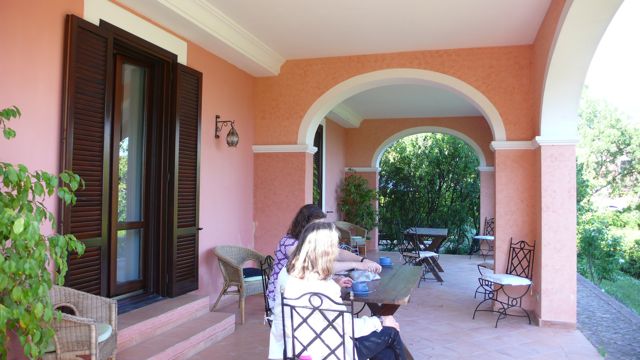
    La Vecchia Quercia turns out to be a pair of such manor-houses, each with two high-ceilinged stories containing I'd say at least four units. Ours was a huge room with a double bed and a single, and our own bath of course. It opens out onto a very pleasant covered porch set about with comfortable chairs. Next to that, a small grove of widely-spaced lemon trees, with tables and chairs; nearby, a covered outdoor kitchen with a pizza oven.
    Quercia.jpg

    There was a pool in front of our porch, with an invisibly resident bullfrog happily brekkek-kekking away; and mulberry and loquat trees, and roses, and rosemary. We made a pot of tea and looked over our photos and talked about Erculaneo and Amalfi and Ravello and congratulated ourselves on our dolce vita; and at eight o'clock we went in to dinner, just us three, and dined very pleasantly, and conversed with Signora the proprieties about many things but particularly about the South of Italy, of which she is fiercely proud, and Napoli which she says is exuberant and a dramma, and Salerno which she said is turned inward and chiuso, and her sister an important winemaker who is teaching the locals how to make wine that does not turn to vinegar in two years; and then we looked at the fireflies, and walked back through the night to our room, and slept beautifully.


  • Agriturismo la Vecchia Quercia, via Montevetrano 4, Cipriano Picentino; tel. +39 089 882285

    Notes on our meals during this trip can be found, as always, at Eating Every Day; photos can be seen at this webpage
  • Italian journal, 3: Amalfi

    Saturday, May 8, 2010—


    IT'S BETTER NOT to bring anything you don't really need, she warned us. She was standing in the driveway of the Hotel Excelsior, where she'd told us, when we telephoned, we could park the car. I shrugged and put the things we didn't really need back in the trunk — the attaché case and the little iPad cased — I slipped on my backpack, and looked at Lindsey's suitcase: but before I could pick it up the woman from the hotel had it.

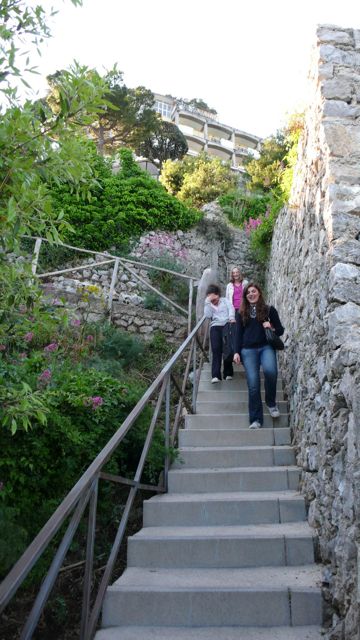
    I'm used to it, she said, I climb these stairs five times a day. There are three hundred of them, she said, rather proudly. We began the descent, carefully, for the steps were treacherous, and as usual I began counting, this time aloud and in Italian, which amused her.
    PalmeSteps.jpg
    The steps are steep, often of varying height, and shallow of tread. After a hundred or so the path leveled out and we strolled more gently downhill under lemon trees heavy with fruit; but then we came to more steps. At the bottom, only about a third of the way down to the shore, we arrived at our hotel, formerly I'm sure a vacation house, now converted into a B&B.

    It is really quite a wonderful place, silent but for the birdsong, cooled by soft breezes, endowed with spectacular views. Our room had a double bed and a single, as we had Fran with us, and tis own bathroom with shower. Curiously, once you closed the double door into the bathroom, it could only be opened from the other side, by someone pushing on it.

    I soon realized I'd want my jacket, which I'd left in the car. Iw alkyd through the reception lobby on my way to the three hundred steps. Where are you going, the woman asked. Why do you ask, I said. I'm going back to the car for my jacket. Give me the key, she said, I'll get it. Oh no you won't, I said; I need the exercise. This time I kept careful count: there were in fact three hundred eleven steps, five of which were in the contrary direction. Perhaps if you count them twice in order to cancel them out, and then subtract them from the total, that's how you arrive at three hundred.
    PalmeView.jpg

    We rested up a bit, then walked to the restaurant affiliated with the B&B. This involved at least six hundred more steps down from the hotel, a stroll through the town of Amalfi, then more steps down into the town of Atrana to the restaurant, right on the beach. Atrana is a much smaller town than Amalfi, I think, probably originally not much more than a small fishing village. Eat out or in, was the first question, hesitated over, discussed, while waiters stood by, amused. Inside. Dinner was very good, involving the tiniest clams we've seen.

    Afterward we took the bus back up the hill to Pogerola, arriving about eleven o'clock. We still had those 311 steps to descend. We slept well, but next day our calves were very sore. Breakfast was delicious and copious, and the day began softly, barely perceptible voices rising from a fishing-boat in the harbor far below.

  • Hotel Le Palme, via Salita della Spinale, 23, Pogerola 84011, Amalfi; tel. +39 0898304548

    Notes on our meals during this trip can be found, as always, at Eating Every Day; photos can be seen at this webpage
  • Monday, May 10, 2010

    Italian Journal, 2: Erculaneo

    Saturday May 8: Herculaneum, we call it in English; I don't know why. Since Fran had been to Pompeii two or three times we decided to skip it and visit Herculaneum instead: she was interested at how different it seemed from Pompeii.

    Erculaneo is quite below the level of the present town R________, a testament to the amount of detritus that's been piled on top of the ash and, perhaps, lava that buried it in the first place. It's a small city divided into insulae or large blocks containing a number of houses or shops of varying size, some of them rather grand villas, others clearly complexes of small crowded apartments or bedrooms, probably for the lower and working classes. My impression: excavated rather hastily in the 1930s for the most part, much of the plaster containing paintings broken away either for sale or for safekeeping; now being researched more carefully, much of the work apparently stalled, probably for lack of funds.

    A very interesting site for what it says about city planning and architecture. The insulae gridded off in orderly rectangles divided by one-lane streets whose large paving-stones are perhapstwo feet below the level of the sidewalks, the streets undoubtedly functioning also as drainage. Some houses — that of Argos, for example — quite palatial by my standards, with large salons, and pluvia, nicely proportioned cloister-like gardens, though sleeping rooms still rather small.

    A surprising amount of wood still in place here and there — screens, lintels, door-frames; blackened by the catastrophe but preserved somehow from decay. Most remaining décor geometrical motifs high on walls or on ceilings. A number of rooms clearly have been remodeled; marble tile is laid on earlier opus sextile (if that's what it's called); thin layers of fresco'd plaster laid on top of earlier similar decoration.

    The plaster covering the stone, brick, or rubble walls is generally a couple of inches thick; on it, the fesco coat is perhaps a quarter-inch thick; often you see incised lines in the thick plaster, showing the finish-plasterer where to lay in the final colors and linear design elements.

    The palestra or gymnasium clearly a very important element; as in our time and country, athletics and the gym have replaced worship and the church as the main focus of social life, at least architecturally. But what you see of the palestra suggests that by 79 BC city planning and construction had entered a historicist postmodern sort of era: the columns are not stone, but brick and tile covered with plaster treated to imitate Greek stone columns. As populations grew and inferior classes emulated those at the top, cheap construction (and fast construction) had to supplant the slower techniques and rarer materials. What had been Form was now Style.

    Too, the city grew vertically; residences piled atop residences, those below perhaps being moved into by poorer citizens, or used to house animals, or as storage. I thought of the huge "basement" under Arles, and of the remains of a many-storied apartment complex alongside the Palatine. (An American is reminded, too, of such cliff dwellings as those at Mesa Verde.)

    The entire Herculaneum site seems low-keyed and laid-back. There's a good-sized undergound parking garage; above and nearby, a ticket office with a few leaflets. There is no shop: instead, an open-air market with three or four booths selling guidebooks in many languages, cheap replicas, caps and T-shirts and the like; and a café offering unappealing fast food. A few men (I saw no women) stood near the entrance offering guide service, and there's a booth providing electronic guides. We had lunch in a curious restaurant next to the parking area: you go up a narrow, steep, spiral staircase to a dining room tented on the roof of a one-story building containing kitchen, reception and restrooms. The food was okay: I had a sort of pain bagnat; others had pizza, or pasta. And then onward to Amalfi…

    Italian journal, 1: Caserta: the Reggia

    In the next few weeks this site will become a travel journal, if you don't mind — notes more or less chronological, otherwise random. For the moment we skip past a day in Madrid, and arrive in...

    Friday May 7: CASERTA

    The chief tourist attraction of this provincial city is its amazing Reggia, the Italian equivalnt of France's Versailles or the Dutch Het Loo, built in the middle of the eighteenth century by Charles III, designed by Luigi Vanvitelli. We didn't investigate its interior, having really only one day to spend, and that a nice one. Instead we walked slowly up the central axis of its amazing series of lawns, pools, and fountains, a mile and a quarter as my pocket computer counted it. Water cascades from a source high above the Reggio, at an elevation of about 200 meters above sea level, to a basin at the top of the formal garden; this basin contains two sculpture groups representing Diana and Acteon at the moment the latter is being transformed into a stag and set upon by his own hounds.

    Here is an entrance to an English garden, really a park, laid out alongside the formal garden, hidden from it by the very high hornbeam hedges themselves carved out of a dense canopy probably sixty feet high composed primariily of lime-trees.

    The English garden features its own pools and fountains but is domianted by stately beeches, elms, oaks, and magnolia trees set about on huge gently sloping lawns. Halfway down the park, occupying perhaps a third its width and only a tenth or so its length, are the 17th-century greenhouses and sheds, a couple of huge staging-areas for working with bedding plants and small pots, a good-sized kitchen garden, and a very nice formal rose garden within its own walls.

    It took nearly six hours to enjoy these gardens and eat a couple of sandwiches we'd brought along with us.

    Wednesday, May 05, 2010

    Music in the air

    Madrid—


    MIKHAIL MIKHAJLOVITCHIPPOLITOV-IVANOV is one of those "minor" composers known for only one piece, the colorful Caucasian Sketches*. It's a piece that means a lot to me, as it was on the winter concert played by the college orchestra when I was a freshman and still nominally a music major. I was seventeen and had just graduated from high school, where I played bassoon in the concert band — there was no orchestra in our small country high school.

    I didn't have a bassoon, so when I got to Chapman College, in those days a small Christian school on Vermont Avenue in Los Angeles, they provided me with a French horn on which I was asked to play the first bassoon parts. My band teacher had encouraged me to learn all the wind instruments (all but flute, which never worked for me, and trumpet, which I didn't like), and to learn to transpose at sight, so while a little demeaning this wasn't too hard.

    What was annoying, though, was that at the dress rehearsal a ringer showed up with a bassoon, and I was moved from hornoon or whatever you'd call it to triangle.

    I've always been a sucker for Russian descriptive music, perhaps because of my concert band background. Ippolitov-Ivanov studied with Rimsky-Korsakov, whose influence is as strong in orchestration as hyphenation. I-I writes beautifully for horns and trombones. I have no idea who played oboe and English horn at Chapman; they get some pretty extensive solos.

    There are four sections, as I recall: "In the Mountains" — maybe this is another attraction to me — "In the Village"; "In a Mosque"; and a long, wonderfully local-colorful "Procession of the Sardar." There's hardly any melodic material at all, just noodling, broken chords, and scale passages; but the sonorities are fabulous and the rhythmic drive, even in the lengthy slow-tempo sections, compelling.

    The piece is sizable, maybe twenty minutes long — I listened to it on headphones on the way over here, in the airplane; it's perfect airplane music, mindless and attractive. Maybe next time I'll load Reinhold Gliere's Ilya Mourometz Symphony onto the iPod; it's four times as long and even more colorful. Then there's the Borodin symphonies…

    *Wikipedia is right to quibble that Caucasian Sketches is a silly title and probably a poor translation; Ippolitov-Ivanov means "Sketches from the Caucasus," but that inescapably brings Miles Davis to mind.
    The whole thing reminds me of visiting the French lawyer with my friend George's death certificate, so the estate could be put into motion. The lawyer sat gravely in his serious, formal, provincial French office and silently read over the certificate. After a few minutes he smiled: this was odd, it was a sober occasion. The smile grew into a chuckle. He peered up over his glasses and explained, in French — he spoke no English — But look, it says here George was a Caucasian; I knew George, he wasn't Caucasian, he was born in Canada but he was an American; they've made a silly mistake; he wasn't anything like a Caucasian.

    Wednesday, April 28, 2010

    The Carrizo Plain

    YOU CAN DRIVE from Los Angeles — well, Glendale, next thing — to Berkeley in nine hours and still take in the Carrizo Plain. I shouldn't tell you this. One of the great attractions of the Carrizo Plain is its emptiness: if all subscribers to The Eastside View decide to drive there next weekend there'll be a traffic jam.
    Carrizo.jpg

    I've put a web gallery of photos up here; in the meantime you can make do with this shot — click on it and I think you'll get a bigger version. We were there perhaps a week too late for the peak of the wildflowers, but what we saw was well worth the drive.

    We took the road south to north, driving up to the first ramp off Highway 5 north of the split from 99, then the long dreary road to Mariposa Maricopa, then on twelve miles through amazing country to the an abandoned gas station at a junction. There you turn north on Soda Lake Road, driving twelve or fifteen miles on unpaved road, through dry cattle ranches, miles of beautiful empty wide valley between low hills, finally coming to the federally protected National Monument lands.

    We first drove through here quite a number of years ago, from north to south that time, also looking for wildflowers. Seems to me that was the time we caught them at their peak: the west-facing slopes of the hills above the San Andreas Fault, along the east side of the valley, looked like a Persian carpet of lavenders, roses, reds, yellows, and blues. What you see in the photo above is only a hint of what can happen here in exceptional years.

    We took our time but covered the ground, driving 35 or 40 miles an hour up the road, stopping at the observation point on a low hill west of the road. We continued past the ghost town — actually the never developed town — of California Valley; then west on Highway 58 and up Shelby and O'DOnovan Roads toward Creston, and up Creston Road into Paso Robles where we joined 101 for the drive up to Berkeley. I'd never taken thoset 58-Paso Robles roads before; it's a beautiful drive, first through more empty wildflower country, then through vineyards, finally the unfortunate suburbs. Well, folks have to live somewhere, I guess. I'm glad they don't live on the Carrizo Plain.

    Sunday, April 25, 2010

    The Playboy of the Western World

    Glendale, April 25—
    A FINE CLOSE TO a fine season tonight at A Noise Within: John Millicent Synge's The Playboy of the Western World in a devoted, straight-ahead production, idiomatically directed by Geoff Elliott on a cluttered, atmospheric set by Stephen Gifford, set on a superb cast: a true ensemble theater with stellar performances by Michael Newcomer as Christy and Lindsay Gould as Pegeen.

    It's such a wonderful play, quickly alternating among raucous humor, wry irony, and sudden pathos. There's no easy way to categorize it: from the distance of a century you can see Synge's relationship to Chekhov and even Ibsen, you can see Eugene O'Neil's connection later to Synge. I think I can even see a connection to the Tennessee Williams of Camino Real and The Night of the Iguana. But truly he's his own playwright, and Playboy is alone in its category.

    It would take five minutes to tell the story plainly; it's not much more than a shaggy dog story.But Synge's dialogue is Irish poetry at its best, with far-flung, fanciful imagery, and he uses language to flesh out his characters; you get to know them, to become fond of them. Some — Widow Quin, Shawn Keogh — clearly are borrowed from commedia dell'arte; others are stock Irish comics; but all find individuality, dimension, and dignity through Synge's genius, based on keen observation, channeled through fondness for humanity, sharpened by awareness of the pathetic position of those whose place is below both their aspiration and their deserts.

    Thursday night we saw a remarkably fine Much Ado About Nothing; Friday night a splendid Awake and Sing; tonight this marvelous Playboy. A Noise Within has grown over the years to become a truly inspired repertory company, with a stable of actors who seem able to turn on a dime, a team of directors who respect the scripts they're given yet bring them to life, and artistic direction that chooses repertory wisely, investigating the classics, foreign-language rep (in translation, of course), and neglected corners of the 20th century.

    Best of all, you can see these three endlessly entertaining plays in a short visit to Los Angeles. The season continues through May 25, and I don't know when I've been more enthusiastic about a recommendation.

  • A Noise Within, 234 S. Brand Blvd., Glendale; tel. 818.240.0910; www.anoisewithin.org


  • Saturday, April 24, 2010

    Curiosities

    Glendale, April 24—
    A FEW YEARS BACK our friends Jim and Lisa told us about a curious place down here in Los Angles, the Museum of Jurassic Technology. Words don't do the place justice, though many have attempted the task — me included, of course.

    We stopped off at Jim and Lisa's the other night, as we often do on our semiannual drives down here for plays at A Noise Within, and they told us about a special presentation held today at Occidental College: A Wonder Cabinet, a series of presentations of arcane matters by curious specialists, all curated by Lawrence Weschler. Since I think of Weschler's book Seeing is Forgetting the Name of the Thing One Sees as one of the great books of the twentieth century, and respect his judgement as much as his writing skills, I could hardly turn down the opportunity. We didn't get to campus in time for the opening presentations, but did manage to take in five events. And this is what they were:

    Ricky Jay, slight-of-hand master and archivist on arcana, magic, and entertainments, discussed 18th and 19th-c. English books on Illustrious Persons, special attention to those compiled by James Granger and, later, James Caulfield. Jay concentrated on persons classified by those authors as persons famous for one thing having happened to them — a fellow, for example, who, on the death of his fiancée, never washed either himself or any of his clothing again until the day he died. He mentioned a number of other persons of fleeting fame, however; among them Nikolai Fyodorov, who believed that to attain perfect brotherhood among humanity man's "Common Task" was the resurrection of all humans who have died, and Konstantin Tsiolkovsky, who, by taking the idea the next step to propose space travel in order to accommodate the vast numbers of persons who would result, inspired the Soviet space program.


    Walter Murch then discussed, elegantly and clearly, the Titus-Bode Law describing (and predicting) the positions of orbits, whether of planets within the solar system, the moons of the various planets, or the electrons in atomic structure. This was an extraordinarily fascinating presentation; its complexity was greatly resolved by superb graphic presentation and, of course, Murch's calm, reasoned, persuasive voice. I wouldn't have missed this for anything.

    Ken Libbrecht, chair of the department of Physics at Cal Tech, discussed the geometry and formation of snowflakes, showing a number of photographs he's taken with an impressive apparatus of his own design.

    And Matt Shlian gave a summary of his brilliant career as a paper engineer, specializing in the transformation of single flat sheets of paper into incredible sculptures involving cuts, folds, and curves resulting in elaborate, often kinetic, elegant sculpture.

    Weschler's model for these presentations, like Wilson's model for his Museum of Jurassic Technology, is the Cabinet of Wonders, the omnium-gatherum of specimens, drawings, books, and curiosities assembled by collectors to gratify their own urges but also to instruct their communities; these gradually evolved into the museums familiar in our own culture, whether of art or natural history or technology.

    It was interesting witnessing all this the day after a hasty visit, at the Getty Center, of a display of drawings of Leonardo da Vinci. Clearly the same convergence of love of aesthetic and urge to knowledge animates all this activity: it's a great pleasure to see it in operation.

    Awake and Sing

    Glendale, April 23—
    For our second night of theater here Noise Within gave us a stunning performance of Clifford Odets's Depression-era Awake and Sing, a solid, often poetic, tense, deep drama set within a Jewish family in the Bronx, with three generations of immigrants and first-generation Americans squaring off against one another, Capitalism, ungrateful employees, hard times, repressed strivings, bitterness, and the human condition in general.

    It was like Chekhov with a seriously nasty case of heartburn, I thought after the first act; not long into the second I realized it was much more than that: it was like a Mahler symphony. Humor, grief, anger, transcendent yearning all flow into and out of one another. There's a story, of course, and it's well conceived and well developed; but it's the matter beyond the story that held the near-capacity audience in a grip. I'm on the road, not at my computer where I have facts at hand, so I can't list the plays I've seen over the last few years this resonated with, Italian and English and American plays, many of them set in the same general period, when totally desperate situations forced families and individuals to totally desperate actions.

    One play that it particularly resonated with was last fall's adaptation of Dostoevsky's Crime and Punishment, also produced by A Noise Within. They have in common the drama of intense socio-politico-economic moments impacting desperate, sensitive, intelligent characters, of course. Beyond that, though, they even share the idea of a physical set influencing, or at any rate underlining, the way those tensions are achieved on the stage.

    We like this Glendale company for the same reason we like the Oregon Shakespeare Festival; both are repertory companies, developing and performing a number of productions simultaneously. Shakespeare's Globe Theater, Odets's Group Theater, Molière's Comédie, Chekhov's Moscow Art Theater — all, if I'm not mistaken (and I repeat: facts are not readily at hand), were repertory companies centered on the players, strong companies with strong ensembles.

    Players lucky enough to work within such ensembles can trust one another, share ideas, probe the depths of the works they interpret. Further, they inescapably grow from one production to the next — not becoming better actors; they're already enormously skillful — but developing greater depth and complexity, just as do the audiences lucky enough to follow them through Shakespeare, Racine, Molière, Ibsen, Chekhov, Synge, O'Neill, and so on.

    Tonight's performance was draining. The entire cast turned out on stage a few minutes after the final curtain to field questions from the audience, and it was immediately clear that the audience was exhausted, the cast exhilarated. I think that's as it should be: Aristotle's catharsis reversed, perhaps; but we'll have time and matter to think this over in the weeks to come.