Saturday, April 08, 2017

Rome, 2: Frustrations and fatigue

Via Damaso Cerquetti, April 8, 2017—

FIVE DAYS we have been here with little done or seen. Little, I mean, of the things one intends to see or do. I have not been at the peak of my powers and my pace has adjusted accordingly, and the fourteen-year-old sleeps long and competentlly. So there’s not much to report.

We are in Monteverde, a quarter of eight-storey palazzi, condominiums. Our street is narrow, with cars parked alla spina on both sides; the traffic is one-way only; there are often double-parked cars or temporarily parked trucks. One walks in the street; it seems natural.

Across the street we have a convenient supermarket, Tuo Dî, but I prefer a slightly smaller minisupermarket, Tigre, at the other end of the block: it has a good bakery for bread, a good cheese and sausage counter, an adequate selection of staples. There’s a fine greengrocer another block away. Other than this we have not explored the neighborhood.

We’ve taken long bus and tram rides, as the goal of this first week was to secure a visa to Algeria, and the consulate is completely across town from us, in the Borghese district. Let me tell you about my first visit, on Thursday: we took the Tram 3 from Trastevere station, easily getting seats since it’s one end of the line, and listened in some outrage to a man shouting at the woman seated across the aisle from me that she should be speaking Italian. She was talking to someone, as discreetly as can be done, on her telephone; I couldn’t make out the language; she looked Southeast Asian and seemed very nice. We are in Italy, this is Italy, we are Italians, we speak Italian, he shouted. She said something quietly in return, in Italian.

This only encouraged him to enlarge his tirade. Finally a woman standing near him told him he was behaving uncivilly, that one has a right to speak whatever language one wants. The tram was getting more crowded as it continued down its course. Other passengers, seated and standing, looked on uneasily. The man began to include her in his tirade, of course, once or twice standing up, pulling off his dark glasses, then replacing them and sitting back down.

You have no business shouting at this woman, another man said. He’d been standing nearby, briefcase in one hand, the other gripping a stanchion. She has done nothing to you, nothing at all. You set a very poor example of what an Italian man should be.

Dark-glasses stood back up to confront this new adversary. Don’t talk to me; don’t tell me what to do; that woman has no business here.

Racism, the woman with the telephone said, it’s nothing but racism, it’s as good an example of racism as you can see. The passengers around her, seated and standing, shifted in their seats uneasily. The standing woman continued her advice, quietly but firmly, like a mother explaining civility to her eight-year-old boy. The man in the dark glasses erupted from time to time, then dropped back into sullenness. The man with the briefcase spoke quietly to the quiet woman. The woman with the telephone, sitting across from me, apparently quite composed, continued her telephone conversation. Perhaps she was used to this.


At the end of our long tram ride we had a few blocks to walk, fortunately slightly downhill, then one of those monumental staircases to climb, and then we were confronted with a locked door: the consulate was closed. Twelve thirty. I couldn’t prevent H. from coming to pick us up with his car, but the traffic was dreadful. He dropped us off at Eataly where we had our midday meal at 2:00, the returned home via bus and tram, this time without incident.

Next day, though, yesterday, was much the same: I took a delightful bus ride, no politics or razzismo marring it, around the dial encircling Rome from eight o’clock, where we are, up through the Janiculum hill vistas, the pines, the statues, the sense of endless space, down to the Vatican at roughly eleven o’clock let’s say, through the bourgeois residence-and-shopping quarter Prati, much like ours but earlier and more engaging architecturally, across the Tiber once, twice, yet a third time and through the quarter of new museums and concert hall at twelve o’clock on the clock, then up diagonally through the Borghese district where I got off at Euclidio.

I walked a few blocks gently uphill in an area of distinctly upperclass residences and consulates, arriving at my destination in plenty of time. I was denied a visa, though. As an American resident, I must request the visa at a consulate in the US. For my convenience the People’s Democracy of Algeria has not one but two consulate in the US, one in Washington D.C., the other in New York City.

This consulate can give visas only to people who reside in Italy, and prove it with the official Italian permit of residency. Even though I do live in Italy three months every year, with my granddaughter -- I don’t, of course, but it’s a reasonable idea -- and, residing less than three months plus a day, don’t need a residence permit, nevertheless for this visa that doesn’t count: I must have an Italian passport, or an Italian proof of residency.

By now the discussion, in rapid Italian, French, and English, was wearing me out, and I stepped out into the welcome clear air. Rome is in a valley: the city’s low, on the riverbanks; the best air is higher, in the Janiculum and the Borghese. I had to send an email home to explain what had happened and what I might do next. But a guard challenged me: You must go to the waiting room. The air is bad there, I said. Have your finished with your business? Yes, I said, I just have to send a text. You have no business sitting there, he said, you must go back to the waiting room or go away.

Well, that at least was an easy choice, so I went away, and walked down one of those immense staircases, and took the bus home to rest up.

Monday, April 03, 2017

Arrival in Rome

Via Damaso Cerquetti, April 4, 2017—
UNLESS DISTRACTED by something — a misguided sense of purpose, for example — stepping into an elevator usually brings poor Paolo and Francesca to mind. Not my son and granddaughter, but those unfortunate lovers consigned by Dante to an eternity of drifting up and down, up and down through the hot winds of Hell. As I recall the poet's idea was it was too difficult to decide which particular one of the seven floors of that unfortunate beyond to choose for their assignment. I'm not sure: I never have made my way through the infernal masterpiece. It seems an ingenious solution to a creative block and that is something I know something about.

After a long journey (by present-day standards) in far from the best of health we arrived at Rome's main airport on time from Oslo, flying three hours on what seemed to me a shabby 737 operated in the new bare-bones style by a cut-rate contractor to Norwegian Airlines, who had flown us competently from Oakland to Oslo. That first, longer leg — nine hours — had been delayed, however, by nearly three hours, partly because Passport Control had delayed the departure of passengers from the plane's previous flight Oslo-Oakland, apparently for lack of personnel to inspect their passports.

So while we managed to catch the Rome flight, having been whisked efficiently through passport control in Oslo, our bags were not so lucky, and we waited for them for an hour in vain, finally joining the group who, like us, had flown from Oakland via Oslo, and were filling out the forms for delivery of delayed baggage.

Hamza and Francesca waited patiently with a sainted Margherita pizza cooling in its cardboard box, then drove us to our home for the next three weeks. Four of us got into the elevator and it lurched happily upward, stopping six inches short of our sixth floor. The inner doors opened fine, but not the main doors on the sixth-floor landing. I pushed the button to go back down: nothing. I pushed every button but the alarm: nothing. Just as I was considering pushing that last button a face peered in through the windows providently set into both sets of doors.

Francesca's Italian is fluent and I was half dead from exhaustion and incredibly sore bones and muscles. She and the face, who might have been Dante, conducted a muffled conversation I followed with little comprehension or interest. It involved an iron thing outside our door and therefore accessible to us but not to him, some iron dinggetje, I know the Dutch word but not (yet) the Italian, fixed to the outside of the elevator car for just such emergencies. After some time we realized that not only did we have to nudge it, we had to push on the building's door at the same time. We climbed up out of the elevator car with our carry-ons and our pizza and welcomed release into a paradise of an apartment whose owners, grave with concern for us, explained everything about the place to Hamza and Francesca and my own poor beautiful and long-suffering Beatrice, while I sat stupidly, an old man suffering from ambition.


I AM HERE in Rome to contemplate my feelings about religion, and to see friends and relations, and to eat and drink and walk and think. Perhaps my own religion — and let's get this straight: in my opinion religion, whatever it is, must offer the choice of an individual address — my own religion perhaps centers on friends and relations, eating and drinking and walking and thinking. It's appropriate to come to Rome with this frame of mind. I was sorry to fly in, it's the worst way to travel, but time and the pocketbook decreed it. Had I walked into Rome I might have met someone to show me the way, but I don't have Peter's luck, or Dante's. No ghost of Christ, no evocation of Virgil. Hamza and Francesca will do for many things but I won't ask them to provide answers to meaning-of-life questions.

Yesterday was our first full day here and we did nothing but rest, explore the immediate area of our apartment in the Monteverde quarter, shop for dinner, and cook (see Eating Every Day). Well: We ate, drank, walked (not a lot), thought. And talked. Lovely technology: we could even have a long group video conversation with dear Grace in Portland on her birthday, which provided more relations to contemplate. I begin to think that the meaning of life is living it in the fullest, but I'll have more to say a little later.

A new day, clear and comfortable. Someone's at work outside with what sounds like a grinder, alternating at times with a power hammer of some kind. In Italian towns and cities you're always hearing the sounds of masonry at work. The earth is dug up elsewhere, ground into cement, made into bricks or blocks, sent to the cities, cemented together to make towering buildings. Rome was built on relatively boggy ground, unlike Paris whose underground is an extended basement from which limestone was quarried to build the six-storey overstructure. (I think I have that right.) But Rome has its catacombs and its towers, not very many tall ones of course, the curse of Babylon is still respected if only for esthetic reasons, and the architecture of Dante's poem, if not its substance, will be in my thoughts for a few days. I'll try not to let it obsess me. There's carbonara and gelato to attend to.

Thursday, March 30, 2017

Art exhibitions seen recently

Eastside Road, March 30, 2017—
VERY QUICKLY because there's much to do before the weekend, an account of some recent museum exhibitions seen:

Eye of the Beholder –
The Sculpture and Early Prints of Nathan Oliveira

to April 2, 2017
Sonoma Valley Museum of Art
551 Broadway Sonoma, CA 95476 707.939.7862
FullSizeRender

THIS IS A FINE tribute to a Bay Area painter, printmaker and sculptor who had a considerable influence on generations of artists, partly for his work on the faculty at Stanford University, partly for the many gallery exhibitions he had during his long career. With a few exceptions his work was remarkably consistent, centered on the human form, growing both more evanescent and more lyrical as Oliveira himself aged. The prints on view are mostly early ones, from the 1940s into the 1960s; the bronzes are later, in some cases much later.

It's easy to see the influences on the early prints: above all Northern European expressionism: it's also to see the community his work has with contemporaries like Manuel Neri and the early Joan Brown. Most remarkable, I think, is the tranquil, egoless quality of the work. Sculptures which might suggest vulnerability, even victimhood, seem to me rather to be transcendent, liberated. The installation is thoughtful and spacious: I'm sorry to be recommending the show so late in its run.


Picasso and Rivera: Conversations Across Time
to May 7, 2017
Los Angeles County Museum of Art
IMG 4512

AN INTRIGUING IDEA on paper, with less focus in the installation, pairs two artists of unequal vision (I think) to explore how they responded, in their work, to the work of their antiquity — Picasso to Greco-Roman classicism and Iberian primitivism; Rivera to the art of pre-Columbian Mexico. One of the most intriguing aspects of the show is the display of ancient objects from Picasso's and Diego Rivera's own collections.

The curatorial parallels wrestle with inequality — Picasso's Minotauromachia eclipses, I think, Rivera's cartoonish (yet powerful) adaptations of the Popul Veh. (One wants hours to inspect these two works, generously exhibited here.) And the interesting short film about Picasso's Guernica and Rivera's mural for the San Francisco City College auditorium (I think) reinforces the point: even when addressing an immediately contemporary event, the bombing of Guernica, Picasso's work seems to have an eternal significance, is not compromised by the representation of passing fashions in clothing and hair styling.

But the work is absorbing, all of it, and the installation is particularly spacious and handsome. What a pleasure to be able to move among these marvelous pieces at leisure, to contemplate their conversation at length!


Women of Abstract Expressionism
to May 28, 2017
Palm Springs Art Museum
IMG 4425

ANOTHER CURATORIAL IDEA that might seem reckless in today's politically overly conscious context, tucked away alas in a museum which however rewarding its architecture (and its permanent collection) is not exactly on the beaten track, this exhibition, organized by the Denver Art Museum, offers first-rate canvases by twelve painters from the San Francisco Bay Area and New York: Mary Abbott, Jay DeFeo, Elaine de Kooning, Perle Fine, Helen Frankenthaler, Sonia Gechtoff, Judith Godwin, Grace Hartigan, Lee Krasner, Joan Mitchell, Deborah Remington, and Ethel Schwabacher.

I, too, was unfamiliar with half these artists — and to tell the truth some of them, I think, at least as represented in this show, did not produce work of lasting interest. The familiar names, though, responded to the uncertainties of their time with power and energy, proving that the making of art need not be a gendered business.

The show includes well-written wall placards and useful videos in which the painters themselves speak to the issue of gender. One fascinating point: those active in the Bay Area — de Feo and Remington among them — state they had always felt completely accepted by the men of their community; the New Yorkers spoke of quite a different state of affairs.

This is a really important exhibition and it's a pity it doesn't travel further. It should certainly have been picked up by institutions in New York and the Bay Area; their failure to join the sponsorship is inexplicable. But Palm Springs has other attractions this time of year and isn't really that far from Los Angeles.

Monday, March 27, 2017

Contentment in the face of decline

17426181 10155141190612162 3135907696036097733 n Monday, March 27, 2017—

SO MANY RECENT experiences converging; time to awaken this Eastside View. The view outside is green green green as the unusual rains continue. It’s the time of year, early Spring, when I always recall Robert Nathan’s marvelous novel One More Spring , read alongside a dozen other books in a course I took on the 20th-century novel from one of my most influential teachers, Sidney Meller, at Santa Rosa Junior College, sixty years ago. It’s time to re-read it, I think; as I recall, it’s an optimistic view of life going on in spite of the Great Depression, aging, poor health, and poverty.

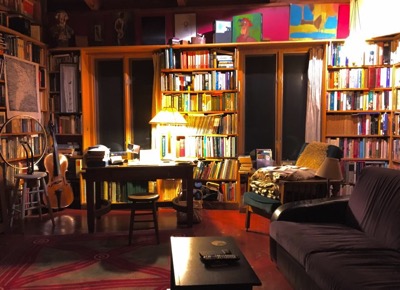
And this is where I read. I posted the photo to Facebook the other day, and drew an interesting comment from a Facebook friend living in Europe:

I must admit, Charles... I envy the construction of your later years; I sadly doubt I'll do anywhere near that well...
my response:
“the construction of your later years ": a felicitous phrase, Paul, giving me a thing to contemplate. Much of it has been luck and serendipity, of course, and nearly all owed to my wife's serenity and frugality. But to an extent it's been a deliberate choice over career, and intended as a lesson to the grandchildren …
his reply:
Of course one aspect of luck/serendipity is also knowing when to go with change and opportunity - I'm afraid I tended to be a bit pigheaded and uncertain, refusing to make decisions when unsure; some of those non-decisions avoided problems, others left me a bit in limbo. Of course I know there are still probably some years to move towards where I'd want to be...
(and I congratulate myself that one grandchild was quick with her response: “and a wonderful lesson it is.”)

Then there’s this:

I and Pangur Ban my cat
’Tis a like task we are at,
Hunting mice is his delight,
Hunting words I sit all night.

’Tis a merry thing to see,
At our tasks how glad are we
When at home we sit and find,
Entertainment to our mind.

‘Gainst the wall he sets his eye,
Full and fierce and sharp and sly.
‘Gainst the wall of knowledge, I
All my little wisdom try.

So in each our task we ply:
Pangur Ban my cat, and I
In our arts we find our bliss,
I have mine and he has his.

Four quatrains where the original has, I read on Wikipedia, has eight. We are told further that it is "an Old Irish poem, written about the 9th century at or around Reichenau Abbey. It was written by an Irish monk, and is about his cat. Pangur Bán, "White Pangur", is the cat's name, Pangur meaning a fuller."

I read the verses in Everyday Life in Medieval Times, by Marjorie Rowling. I like those Everyday Life titles; they're old-fashioned and probably pretty out of favor by now, but I like them. Just as, hokey as it is, I like the translation, which is no better than most of us would have done ourselves. (Thomas Fowler, a 19th-20th c. Irish cleric.) Doggerel, almost, saving the subject. And I particularly like that it was written in Irish, presumably by an Irish monk, in the ninth century, on an island in Lake Constance, where itinerant monks were keeping culture alive in a dark time. These are the things I contemplate, or among them.


A WEEK AGO we saw a performance of King Lear , put on by A Noise Within in Pasadena. It was one of the best Lears I've seen, beautifully balanced/ This Lear was not simply mad; he was apparently in the early stages of dementia, confused as to why he was behaving the way he was, trying to make sense of things. Among other things, language: trying to understand what he, and his daughters, meant by their various statements. Trying to bring heard statements (his own included) into conformation with remembered experience in its logical consistency, which is all we have to go on.

Lear, of course, growing old, decided to divide his realm into three equivalent parts and leave each to one of his three daughters, as our president has decided to put his business into trust and leave its management to his daughters and their husbands. In the Pasadena production the two older daughters were not evil from the beginning, but became corrupted by the sudden responsibilities they were faced with and maddened by the illogical and unpredictable turns their father takes as his own madness develops further. It's a vicious loop spiraling into a hellish descent in spite of Gloucester and Kent, who seem to understand the problem but are politically and socially unable to interfere with its process. You can see how this relates to our present political situation.

My brother wonders if this situation is material for an opera. No, I think; too big and sprawling even for a Ring-like cycle. But the choosing of the Cabinet might make a comedy. And a play about the descent of this presidency into chaotic incompetence, and its ultimate resolution into a caretaker administration, has a Shakespearian promise. It should be written quickly, before it actually takes place, so it will be seen as fiction certainly, and not alternative fact.

I've been silent here for months, benumbed like so many by the bizarre quality taken by the times we live in. I've been meditating on the differences between Knowledge, Awareness, Understanding, Belief, and Faith. Things are so much simpler for Pangur Bán. Were they really that simple for me, too, and for the rest of us? Possibly not. Certainly not now; not in the foreseeable future. I feel, at times, like Lear, and desire my quiet room. I hope to be as silent as that cello, as purposeless as that bicycle wheel.

The central problem of musical composition is the relation of the moment to the ongoing process. Of course not all composers know this. Many simply accept the norms of musical composition they are given and continue them. But I came to maturity as a composer (if ever) in the 1960s, when Time and Process and a skeptical address to Tradition were as natural as mother's milk. I had planned to spend the first four months of this year writing about those years, as some of you know, continuing my memoir Getting There into the next twenty-five years of my life: but I have been struck by the extent to which the qualities of those thirty years, 1964-1987 to be exact, seem to have been forgotten, or at least quite misunderstood, by those who've reached their maturity since.

I had thought the present morass was simply the result of failure of nerve and of the triumph of short-term greed over long-term enjoyment. But the sudden recent turn of political events has revealed, at least to me, a much bigger and more fundamental evolution. Everything goes along slowly; then everything hits a bump and crashes about. I think we've just hit such a bump, and the 1960s and '70s are as dead as the Bronze Age, as Cycladic sculpture, as Latin, as the liberal arts.

In the meantime Spring has returned, one more spring. The flowers have returned, as they always do. Today I walked with a daughter and a friend seven miles among the redwoods, climbing steeply at times, noting at various times iris, trillium, poppy, blue dick. The recent storms have smashed a number of trees, snapping them in half or blowing them completely out of their root zone — always an impressive thing to see. Other young trees will replace them. With luck, something like the Irish monks will maintain the liberal arts, and write delightful but oddly regretful poems in the margins in spare moments.

Wednesday, February 15, 2017

A Rare message from Nice

Nous français, nous avons notre Polynésie,
Ces Marquises qui ont terminé Gauguin-
Pris dans la porte provisoire des siècles et des cultures

Gardes-toi ces sables plus secs de l'Afrique
T'en auras besoin pour le buvardage final

                                                             —Ch Lunaire

(We French, we have our Polynesia,
Those Marquesas who finished off Gauguin—
Caught in the tentative doorway of Centuries and cultures

Keep the drier sands of Africa
You'll need them for the final blotting)

Friday, February 10, 2017

Moon 1059


Moon 1059
left eye clear: right, rainbow-ringed
February moon. 
they say there's a comet too
this moon is enough for me

Stamina

the Alps, late Schubert,
a lifetime: for the long haul —
after rain, summer

Photo: Curt Clingman

Wednesday, February 08, 2017

Provisional

Malaise, the word that comes to mind
everyone seems to feel about the same 
overlapping truths noised 24/7

two more friends gone
                                     uncertainty
getting as familiar as morning

got to get on with it

Wednesday, January 11, 2017

Perception, Good Taste, Quiet Music

Eastside Road, January 11, 2017 —

BECAUSE IT HAS BEEN so noisy lately let me encourage you to concentrate, for an hour, on small and quiet sounds.


Perception coverTHE INSTITUTE FOR ECOTECHNICS is an extremely interesting private organization that conducts researches into art, consciousness, and technology on a variety of platforms that has included a closed-environment center in Arizona, a seagoing ship of their own construction, a gallery and cultural center in London, and a conference center in Provence. There seems to be no limit to the energy and intellectual curiosity of its associates. It is or has been, however, rather closed, and I may be committing an indiscretion in writing about it here.

Almost twenty years ago I was asked to participate in one of their annual (or perhaps biennial) conferences in a marvelous old manor house in the countryside outside Aix-en-Provence. The conference theme was characteristically both general and sharp-focussed: Perception. Participants came from many different countries and represented many different areas of expertise. One woman spoke of perception as it related to botanical experiments conducted in space; another spoke of his work with the fragrances of plants growing in the Amazon forest canopy. Hard and soft sciences were represented; also engineering. But, it was explained to me, not arts and letters. Would I address them as they influence the way we come to perceive, and to perceive that we do perceive?

I have long been interested in the problem of writing about music, and was suddenly struck by the possibility that the nucleus of the problem likes in perception — in how we process our awareness of music, of being aware of sound vibrations: and this whether we are listeners or musicians. And, being a composer, I wanted to organize my investigation as itself a sonic event, in which the speaking voice — my own — would alternate with many kinds of music, in a sonically illustrated lecture meant to discuss but also express the possibility that we can organize sound waves in order to elicit both verbal and nonverbal understanding.

The choice of music would be crucial. It would have to be accessible to the layman — not only accessible, but interesting; meaningful; even moving. There should be several kinds of music, some of it involving words. The examples would have to be the right length, no more than a few minutes; and there should be a common thread, capable of being spun along throughout the lecture. In the end I settled on the Lament as my theme: one nearly all of us have had occasion to profit from. I gathered my musical examples and wrote the following text, delivering it to an attentive audience with the help of my sound engineer, John Whiting, whom I thank for having brought it back to my attention after all these years.

You can read the lecture as an e-book here. Alas, the sound examples will appear only as text: you'll have to find recordings of the examples yourself, perhaps on YouTube.

Thursday, December 29, 2016

Lullaby

Lullaby
                listen (mp3)                score (pdf)

Portland, Oregon, December 29, 2016—

WE WERE SITTING AROUND in the living-dining room of a big house we used to rent for a week with six friends, in Ashland, there to see five or six plays at the Oregon Shakespeare Festival. Tuesday through Sunday we went to the theater, both afternoon and evening performances many of the days: Shakespeare, classic American plays, new plays.

We rose at different times, colliding in the kitchen putting our breakfasts together; we lunched and dined together often, or broke up into smaller ensembles to accommodate maverick tastes.

We discussed the plays, occasionally played games, read aloud to one another. But we also dropped out from time to time for some individual work. Gaye worked at a newspaper column; Mac proofread a grad student paper; Stefan sketched at a musical idea of some kind.

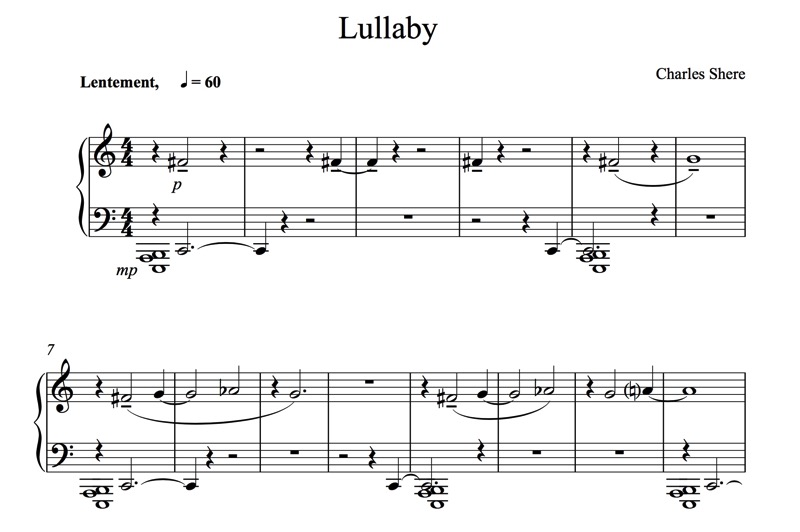
I checked my email: Eliane, a marvelous pianist who'd played my first sonata, was thinking of putting together a recital of lullabys. Would I write one for her? I gave it a little thought. What is a lullaby actually? The word has come to connote sentimentality… a pretty tune, meant to ingratiate a child into giving up consciousness yet again. I didn't need that: what I needed, in those days, was something that would put an adult to sleep. A soporific, not a lullaby.

I"d recently installed a music-notating application on my laptop, and thought I'd try it out. It didn't take more than a couple of hours to play my Lullaby into the laptop. The result, a little over four minutes long, seemed to need something to follow it, to get the blood moving again, so I added a Finale. That was a dozen years ago; now I'm beginning to think it needs another movement to come before the Lullaby. I'll keep you posted.

Eliane played the piece not long after it was completed, on a program of piano lullabys by a number of composers. It didn't have the desired effect; it seemed to me the audience listened rather intensely, as if expecting something to happen; no one fell asleep. The Finale broke the tension nicely.

Tuesday, December 20, 2016

That beast the piano

Pasadena, December 20, 2016—
MUSIC HAS BEGUN to interest me again – I mean actually listening to it, preferably live — and in the last two or three weeks we've gone to three concerts, all of them involving the piano.

I have a troubled history with the piano. My first lessons were in the basement of the church across the street from my grandparents' house in Berkeley, at the corner of Bancroft and McKinley Streets. This was before the war — world War II, I mean — and I have no recollection at all as to how the lessons went. My grandparents had an upright piano, a wedding gift to them I believe; we certainly never had one in our own home.

Perhaps that's why by the time the war began, when I was six years old, and we moved from the grandparents' neighborhood to the neighboring town Richmond, I was shifted from piano to violin. (Though that must have happened earlier, as I do recall playing violin in a children's orchestra on Treasure Island, during the World's Fair there, which was surely ended by the time the Japanese struck Pearl Harbor.)

When I went away to college, in 1952, I was immediately assigned to a piano teacher, for I'd indicated my preference to major in music. I hated practicing, mostly because I hated scales. The lessons ended after a few months, and I never studied piano again.

That didn't keep me from buying a piano, in 1961 or 1962, when the University of California in Berkeley tore down its practice rooms in order to build a new Student Union. A friend who was a real pianist told me I could get one for $100. He had to have it delivered to his house, and from there he, another friend, and I pushed it the several blocks down Channing Way to our house. I'd rented a piano dolly for the occasion, and somehow we managed the curbs and the steps up to our duplex.

For the next few years I was a self-taught pianist. My only interest in the thing was a composer's interest: checking the physical possibility of fingering, the voicing of chords, the lingering effect of overtones, the sound of staccato, sostenuto, and the like. And, of course, trying to learn to read orchestral scores at the keyboard, which I knew (from my reading) to be both important and routine among composers and conductors.

In those days, too, and for years afterward, I could afford only cheap used turntables, whose problems with flutter and wow were particularly cruel to recordings of piano music — so I rarely bought any. I was an instrumentalist; I'd specialized in bassoon in high school; the orchestral winds and strings spoke much more seductively to me than did the piano which was, it seemed to me, a soloist by its nature, offering no place to hide.

And yet over the years I've composed a few things for piano. My first professional performance was of a piano concerto, in fact; at the Cabrillo Music Festival in 1965, when I was already all of thirty years old. Since then there have been two sonatas and various little pieces, and I've learned over the years not to let my own shortcomings prejudice me against enjoying those of others.


SO IN THE LAST few weeks we've gone to those three concerts. The first was a recital of music by contemporary Italian composers, in San Francisco's Center for New Music. I'd heard about it from Facebook, of all things; one of my Facebook friends is an Italian composer and conductor, Marcello Panni, who I met when he was a visiting prof at Mills College where I used to teach. (He conducted my opera The Bride Stripped Bare by her Bachelors, Even, in 1984, and we enjoyed one another's company.)

On November 9 — I hadn't realized it was so long ago! — we went to the Center to hear a piece of Marcello's along with other music by a number of his Roman friends, played by Fausto Bongelli. I was particularly drawn by Marcello, of course, but also by the promise of music by Giacinto Scelsi, a favorite composer of mine. It promised to be an interesting survey.

Bongelli is a very big man. Not stout: big. He looks like he should be smoking a cigar with his right hand, drinking a whisky with his left. Instead he used those hands to assault the piano. He went after it without letup, barely pausing at the end of one piece before attacking the next. There was no way really of knowing what we were hearing when. I listened carefully as a result, forming ideas about the pieces — none of which I'd ever heard before (nor did I know of the other composers on the program) — as much in order to distinguish them from one another as to get to know them for themselves.

Half of my brain is a critic's brain. A critic, I think, leaning on Joseph Kerman's definition, is a person who studies works of art in order to try to find or assess or mostly simply to enjoy their meaning and value. Meaning within their own language and within the history of their art; value not as a rating or an approval (or disapproval) but as a degree of usefulness or beauty or simply interest.

So here I was forced by Fausto's odd approach to the piano recital to work particularly hard as a critic, with the result I think that the other half of my brain, which is shared by a composer and a writer, rarely was able to get involved in the evening. I did think I knew which of the six or seven pieces was Marcello's, and when I spoke for a few minutes to Fausto — so engaging and physically present a man I feel Im on first-name terms! — I turned out to have made the right guess, and had a glance at the score among the disorderly pile of papers from which he'd played this fascinating program.


A  MONTH LATER we were back at the CNM, in the heart of San Francisco's Tenderloin District, to hear another piano recital, similar in some respects though quite different in another. We heard a single composition, Dylan Mattingly's two-hours-plus Achilles Dreams of Ebbets Field, played by another pianist with striking presence.

Kathleen Supové approached the keyboard dressed as Alban Berg's Lulu, in a Louise Brooks hairstyle and a lace-trimmed leopard-print slip. An intrepid page-turner sat at her left, anticipating her sometimes sudden and rather imperious nods and glances. (You can read Patrick Vaz’s evocative description of the evening here.)

Mattingly is young, at the beginning of a career and the end of a serious college education which centered, it seems, on studies in classical antiquity. Achilles Dreams of Ebbets Field has a detailed program fastening its 24 sections, played with only one break serving as a short intermission, to the 24 books composing Homer's Iliad. I did not read the program, and have not yet: I wanted to listen to the music. I was infatuated with James Joyce in my own salad days, and spent a lot of time threading my way through the maze of his Ulysses, and Stuart Gilbert's trot, and all that; I don't particularly want to continue dealing with what I learned, as an English major, to call Secondary Sources.

I have the feeling Achilles Dreams… is in the tradition of Schumann's Davidsbündlertänze, inspired by the composer's acquaintances whether literary or historical or immediate, and as valuable (vide supra) as his expressive responses to these acquaintances can be to another sensibility (namely mine, or for that matter yours). I will say that in spite of the length of the work, and the relative lack of variety of mood, not to mention of tempo and texture, my attention never wandered; I was entranced, you might say, throughout.

This may have been greatly due to the performer. It must be a tremendous undertaking to get to know the details of so large a piece of music and then to find a way to embrace the long trajectory defining its structure. This was only the second time Supové had played the piece publicly, and I had the impression she was still approaching it from its outside, working at various doorways and windows to get into it. Perhaps the piece itself is Ebbets Field: she approached it as fiercely as an Achilles, fortunately without a vulnerable heel. (Unless that of her right hand, which frequently was held remarkably flat, slightly below the fingerboard, even though her fingers were strong and effective in Mattingly's frequently martellato style.)

The sound of the music, to me, lay between Charles Ives (I'm thinking of the Concord Sonata) and John Adams, (say, Phrygian Gates) without ever really being in the least derivative. Perhaps Ives was associated with the ancient Greeks — his New England transcendentalism would make that work — and the Adams style, to put it crudely knitting contrasted with Ives's carpentry, stood for Mattingly's view (or experience) of the contemporary world.

To know, I'd have to hear the piece again, preferably on a recording allowing me to stop and backtrack and so on, and with the score, and with, of course, the program. I am very much interested in the kind of thing Mattingly has attempted here, working with literature and music and history, merging the two halves of the brain, the critic’s and the composer’s.

I confess I went to each of these solo piano recitals with the score of my own second sonata, and shamelessly approached the pianists after their performances to put it into their hands. I hope this will be considered by way of a compliment to them: had I not enjoyed their approach to the instrument and the music, I wouldn’t want them to consider playing my own.


SATURDAY NIGHT we attended a third concert: Eliane Lust, a pianist I’ve known for some years, was playing a concerto with the Kensington Symphony. And it was an engaging program — lightweight, perhaps, but potentially fun: short excerpts from extended orchestral works by Manuel de Falla and Alberto Ginastera; a Concierto folklórico for piano and strings by John Carmichael; Morton Gould’s Latin-American Symphonette.

Carmichael, born in Australia in 1930 but now living in the United Kingdom, was the music director (and I suspect therefore rehearsal pianist) of a Spanish dance company, Eduardo Y Navarra, from 1958 to 1963; his Concierto, composed in 1965, reflects this experience, as the titles of its three movements show: La Siesta Interrumpida; La Noche; Fiestas. I found the piece entertaining but shallow, with much repetition and little development. Nor was the solo instrument given much to do. On the other hand Eliane played with her characteristically insouciant elegance, chiselling the rhythmic phrases, voicing the chordal writing imaginatively, cutting through the sometimes gluey string writing with edgy percussive attacks which never, however, seemed contrived as self-display: everything was for the music. I wished she had been playing a Milhaud concerto.

Gould’s “symphonette” — the last of four — was composed in 1941, I think (sources differ on this), and is a better piece than I’d expected. It is certainly light music, as the modest title suggests was intended. The four movements are based on, and titled, Rumba, Tango, Guaracha, and Conga. The writing frequently overwhelmed the community orchestra and its conductor, Geoffrey Gallegos; brass and percussion got out of hand now and then, and the small string sections were often overwhelmed. But there are some nice details in Gould’s scoring: I thought of Mahler now and then.

Marcello Panni, Dylan Mattingly’s parents, and Eliane Lust are all friends of mine — they’ve visited our house and we theirs; we’ve dined together; we all like one another. It can be difficult to write critically about the work of friends and associates, but I’ve always felt the potential gains from communities of interest outweigh the possible harms latent in what’s often called conflicts of interest. Besides, god knows there’s no money involved here…

Thursday, December 15, 2016

Three Songs from Tender Buttons

ThreeSongsCover
Eastside Road, December 15, 2016—

I MET THE WRITING of Gertrude Stein through the old RCA Victor recording of Virgil Thomson’s opera to her libretto Four Saints in Three Acts. That would have been in 1955 or thereabouts. What charmed me immediately was the innocence, clarity, fantasy, and good humor of both the words and the music. There were other examples of this sort of brittle, intelligent Modernism, notably William Walton’s setting of Edith Sitwell’s poems in Façade, but it was Stein who remained a constant favorite over the years.

It was not until 1972, though, that I thought to make my own musical settings of her work. This was Dates, a sort of chamber cantata for soprano, clarinetist, violinist, and percussionist. (The instrumentation includes clarinets in Eb and A, bass clarinet, violin and viola, marimba and vibraphone.)

Then in 1975 I turned to Tender Buttons, her collection of “cubist” prose poems, most of them short, and quickly set three of them: “Peeled Pencil. Choke,” “Dirt and Not Copper,” and “The White Hunter.” John Duykers sang the last two in one of those Bicentennial concerts nodding to American composers, but he will not remember this.

The wonderful soprano Judy Hubbell asked, I think, for some songs, and I thought of working my way slowly over the years through the whole of Tender Buttons, setting the texts to different performing forces. “A Carafe” was the first to appear, in 1983, and “Suppose an Eyes” and “Rhubarb” followed in 1989 for a recital she gave in San Francisco. It seemed logical to issue them as the present set.

In 1987 I got more serious about this and decided to begin setting the plays. I was learning to compose at the computer, and turned to Ladies Voices for inspiration, setting the play on three sopranos, woodwind quintet, and trap set. Two years later I made a complementary setting of I Like It to Be a Play, for three male voices (tenor, baritone, bass) and string quartet. (I would like one day to have the opportunity to set a finale to the trilogy, What Happened a Play, for the combined forces of the first two chamber operas.)

In 1997 I returned to Tender Buttons for a concert in Santa Cruz, setting “It Was Black, Black Took” and “Red Roses” for mezzo-soprano, violin, bass clarinet, and piano, and adding to them a setting of a fugitive Stein text, “You Can Only Say What You Know,” which I know only from Lew Welch’s quotation of it in his book How I Read Stein.

If you want to know more about my infatuation with Gertrude Stein I refer you to a little book I wrote in 2002, Why I Read Stein (thanks, Lew Welch): Oakland: Mills College Center for the Book, 2002. Foreword by Sumner Carnahan. 40 pages. ISBN 0-9648938-5-1

These Three Songs from Tender Buttons are meant to be light-hearted, though I do think “A Carafe” has rather a winsome quality, especially in Judy Hubbell's performance. I have added score and recording to my website: the score can be printed out, folded, and stapled in booklet form. The recording was made in live concert with amateur equipment, and there are little errors, but I am very fond of the performance, with Judy Hubbell, soprano; Roy Malan, violin; and the late Marvin Tartak, piano.

score (pdf; 16 page booklet; 446 KB)                 recording (mp3; 3:40; 3.5MB)

Sunday, December 11, 2016

The New SFMOMA

IMG 2963
Eastside Road, December 10, 2016—
I HAVEN'T YET REALLY explored it nearly enough, but I'm here to tell you I'm pretty happy with what they've done to San Francisco's Museum of Modern Art, which has felt like a troublesome member of my family for fifty years.

More, I suppose; I recall visiting it with a French class from my junior college days back in the middle 1950s, when the high point of our visit was Renoir's life-size bronze Venus Victorious, beautifully installed in a Beaux-Arts rotunda in the old SFMA.

I still think of this museum by that monogram. San Francisco Museum of Art. In those days it wasn't thought necessary to put the word "modern" in the name; pre-modern art was well known to live out in the Golden Gate Park. SFMA was installed on the top (fourth) floor of the Veterans' Memorial Building, the north twin of the San Francisco Opera House, in three long rectangular galleries surrounding a huge central rotunda, smaller rotundas supplying articulating knee-joints, handy for such items as Venus Victorious.

The northern gallery was devoted to the museum's permanent collection, pride of place going to perhaps the oldest piece in the collection, Matisse's Woman in a Hat, not only nailing down the institution's claim to Modernism but nodding to local biography: it had been in the collection of one of the Stein siblings. From there the permanent collection continued with an engaging series of canvases giving equal weight to Mexico, Germany, the United States, Russia, France, and England. Nor was the San Francisco Bay Area neglected, though I came to think, in the 1960s when I began to think (and write) more seriously about painting, that one could well fill the entire SFMA with local masters: Lobdell, Smith, Bischoff, Diebenkorn, Thiebaud, Brown, De Feo, Jefferson… and then later on the next generation.

About the time I retired from daily art reviewing the SFMA moved to a brand new building, and from the City Hall-Symphony-Opera nexus to the emerging arts-entertainment-convention center building up south of Market Street between Second Street, let's say, and Fourth. I hated the new building, designed by the Swiss architect Mario Botta, a big five-storey cube of a monolith crowned with a turret (the pretentiously named "oculus") whose stripes hinted at Giotto — a hint repeated in the enormous lobby. Botta was no Giotto. When I interviewed Botta at the time the museum opened he gestured proudly around himself in that lobby and said he'd given it to the community as an assembly point, like a cathedral; I said it reminded me more of an oversize Greyhound Bus station.

Now, however, the Third Street building has been reclaimed with the simple, efficient, relatively inexpensive (I'm writing ironically) application of a sort of overcoat against the back of the Botta building. The oculus remains; so does the bus station. Upstairs, though, the galleries are larger, more airy, better lit; and the paintings — and the objects seem to be mostly paintings; sculpture seems sequestered for the most part off in its own more marginal domains — the paintings are further apart.

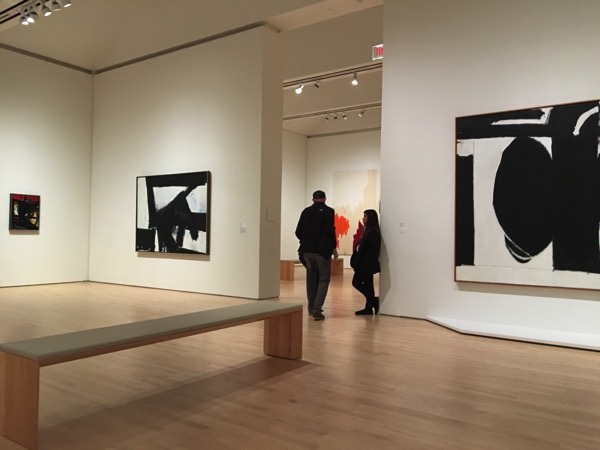
I do think these new galleries can tend too far toward the anodyne. I can't decide, for example, just how to respond to the juxtaposition you see above, of Franz Kline and Robert Motherwell, two of many powerhouses of postwar American abstractionism. The pairing is elegant, of course; the two canvases have much to say to one another. They stand like sentinels on either side of the passageway into a roomy gallery devoted to Clyfford Still's gifts, a number of his own paintings given with the stipulation they always be on view an never share space with competitors. Motherwell's elegy is protected from too close an inspection by an ingenious baseboard projection keeping intruding feet a proper at a distance; Kline's canvas, slightly smaller, slightly less intimidating, apparently needs no such device. (This in spite of its subtleties of color and texture, which invite close reading.) IMG 2961Motherwell is around the corner to the left from Mark Rothko, whose characteristic red-over-black has the requisite weight and mystery to hold its own among strong company — the Joan Mitchell and Jay DeFeo canvases to its left, and, across the gallery, equally strong work by Philip Guston.
The Rothko speaks especially to one of the friends with me; the Gustons speak to me. I don't visit this museum often; perhaps not often enough. I have such memories of the old SFMA on Van Ness Avenue: spending a magical half-hour talking to Guston, alone, in his retrospective, a few weeks before his death. Talking to Diebenkorn, to Thiebaud, to Jasper Johns. Talking to Georgia O'Keeffe, for God's sake, for nearly an hour, dodging her own questions about myself — what a master manipulator she was — in order to get into the immense cloud paintings she had been making, in her nineties.

Many of these paintings are old friends, friends who seem to know me as well as I know what I think I know of them. Arthur Dove's enigmatic, quietly exultant Silver Ball No. 2 ; Helen Torr's Windows and a Door ; Diego Rivera's The Flower Carrier ; all in the second gallery, just as they had been on Van Ness Avenue. I was astonished at seeing these paintings all holding their place just as they had half a century ago, and at the rush of familiarity, certainty, ease, and reassurance that attended my seeing them thus once again. And then the familiar strangeness within each of them individually, their air of challenging me, once again denying any possibility that I could finally know and understand them: their strength, their meaning lies in their ultimate impersonal and austere remoteness.

I have been retired nearly thirty years, and for nearly thirty years I've resisted going to galleries and concerts. In the old days I'd get to six a week, on average. Now in my eighties I seem to have got past the fatigue that had set in, the fatigue and the cynicism that had come with the rise of so much commercial fine art. There's that here at SFMOMA, of course; I can't get excited about the new German painting (sorry); most minimalism leaves me cold. I'm sure I'll get back to this museum sooner next time, and perhaps linger longer. I'll try to keep you informed, in case you're interested.

Friday, December 02, 2016

Coming to grips with a historical moment

•Gregor von Rezzori: The Snows of Yesteryear.
translated by H.F. Broch de Rothermann
Introduction by John Banville
New York: New York Review Books
IN A SENSE, I think, the history of our century has been writing its own autobiography. Decades of complacency following World War II — complacency founded on neglect, evasion and postponement — are ending at a precipice. There are so many problems, so many crimes, that it is too easy to attribute the moment to favorite causes. I am not given to political analysis; politics, like economics and molecular biology, is an area too intricate to attract my impatient mind. I have been distracted, seduced some might say, by an essentially literary view of the historical moment and the conditions that have led to it. But literature, like any art, has its utility beyond mere entertainment.

At the moment I'm reflecting on a book just read, Gregor von Rezzori's The Snows of Yesteryear, an extraordinary book. It is a memoir cast on a series of portraits: of the author's nursemaid, his mother, his father, his sister, his governess. Born in 1914 in what was then Czernowitz, the capital of the duchy of Bukovina, he lived to see historic changes, as Czernowitz moved from the Austro-Hungarian Empire to the Kingdom of Romania (when it was re-christened Cernăuți) to the Soviet republic of Ukraine (Чернівці [Chernovtsy], the current form). These twentieth-century political lurches had their precedents:

Czernowitz, where I was born, was the former capital of the former duchy of Bukovina, an easterly region of Carpathian forestland in the foothills of the Tatra Mountains, in 1775 ceded by the former Ottoman Empire to the former Imperial and Royal Austro-Hungarian realm as compensation for the latter's mediation in the Russo-Turkish War; the Bukovina was at first allocated to the former kingdom of Galicia, but after 1848 it became one of the autonomous former crown lands of the House of Habsburg.
—Gregor von Rezzori, The Snows of Yesteryear, p. 275

Simply on the level of entertaining reading the book is quite sufficient. Rezzori's writing, in this translation (from German) by H.F. Broch de Rothermann, is fascinating: lapidary, detailed, appealing to the visual and auditory senses, occasionally sending this reader to the dictionary. Beyond the writer's language, his characterizations, of city and landscape as well as people, is evocative, accurate, and often wryly humorous. Eccentricity and neurosis were the common coin of his childhood surroundings, of his family, their domestic life, and their settings, which range from Czernowitz to Vienna to Cairo.

Over and over, in the course of three days, I found myself posting quotations from the book to my Facebook feed:

The picture … epitomizes an irrevocably lost period in my sister's life. That childlike innocence, the existential oneness with all living creatures, the deep embeddedness in the ever astounding richness of all nature became a thing of the past and ceded its place to the realization of the complexity of being. [pp 10-11]

Among the experiences from which we learn nothing that we didn't know already, there is to be counted the insight that the reality we consider as all-dominating in truth consists mostly of fictions. [35]

The strange reciprocity between spirituality and daimon inherent in any enthusiasm—enthusiasm that often deteriorates into fanaticism and corrupts the original purity of great ideas (and, inversely, filters pure intentions and aspirations from what is foul, placing them in the service of the devil) —seems to emerge quite regularly with each new generation. And nothing seems more difficult for the young than to elude the currents of their time. [156]

…essentially, one can't quantify the degree by which the quality of life not only of the privileged but also of the disadvantaged has been cheapened and debased in our century. The tangible expression of this—depredation of nature, hybrid growth and chaos of cities, drowning of the world in junk, lack of orientation in Man—has been pointed out, and yet it does not address the substance and core of the loss. [201]

Well, you can see where this memoir is headed. Rezzori writes about a coming-of-age at a historically pivotal time and place. The family, German-speaking and Vienna-centered, seems to have been relatively comfortable. The father was usually away on trips combining business (government inspections of governmental buildings) and pleasure (hunting in the Carpathian forests); the mother was neurotically poised between artifice and exigency.

Gregor shared these parents with a sister four years older — her father's favorite. He grew up essentially alone, wondering about the world that had produced this family before his own birth and the society that existed outside the home, beyond his permitted range. In what is perhaps the center of the book Rezzori writes memorably, fantastically, of a moment defining the frozen tension at the center of this childhood: he is looking out a window, sees a swallow light on the end of the minute-hand of the town clock at quarter of three, hears

the cheerful noises of a bevy of boys — lost in the wind and as if shrunk and made transparent by the distance: a sound merely dreamed, possibly. And indeed, the reality it evoked for me was totally abstract. I imagined those boys as being lively, but they were also abstract to me… surely engaged in wild games, and I almost could feel their hot breath; at the same time a sense of being excluded from the rich stream of life cut deeply and painfully into me… I was overcome by a fear I had hitherto not experienced. The world around me split up into imaginings, illusions and lies — and I was no longer one with the world.…

The swallow sitting at the end of the minute hand of the tower clock did not move and the hand itself stood still. Time stood still. The sound of the children was lost in space. The tweeting of the swallows fused into a single piercingly high note lie a thread spinning away into the skies. … The whole world stood still.

"The whole world stood still," he recalls, and then "suddenly the swallow flew away and the minute hand snapped over to quarter past three… once again the sounds of the children could be heard from afar." [pp. 110-11] He was ten or eleven years old, in a boarding school in Kronstadt, now Brașov, Romania. He joined his now separated parents only during Christmas and summer holidays: in Vienna and nearby mountains with his mother, hunting in the Bukovina woods with his father.

Some of the most heart-warming pages describe his relationship with his father, oddly both elusive and attractive, given primarily to his pleasures, pragmatic, yet intelligent, even intellectual. Like many hunters, the father loved Nature; was truly alive perhaps only in the woods, which "had hardly ever been touched by human hand and only rarely were visited by some stray shepherd or by a Huzule poacher. To spot and scout stags, we sometimes lived for weeks in the open."

One might have believed that in these circumstances my father would be just as happy as I. Yet a shadow of melancholy often darkened the grave serenity of his comportment while hunting. He saw that such idyllically primeval conditions would soon be over. One day he told me: "remember this day. It will soon be impossible to spot within the span of a few hours a pair of ravens, two imperial eagles, a golden eagle and a peregrine falcon." He was right. [162]

Von Rezzori — the son, I mean, the writer — was gifted with one true talent, he tells us: drawing. But he was channelled into more "practical" areas, in those distant days well before "graphic arts" was to become the savior of talented but undisciplined youths — chemistry, architecture, medicine, mining. Finally he declared that he wanted to give up studies for good, whereupon he was considered "an ignoramus, a mere consumer of illustrated periodicals, a harbinger of the barbarians, who, he foresaw, would soon engulf all of Europe."

He perceived this barbaric invasion as advancing from two sides: from Bolshevik Russia as much as from an America dancing in worship around the Golden Calf. "To fashion present-day Americans from the Pilgrim Fathers, we sent them our human dregs," he was wont to say. "Jefferson's America was drowned in the flood of human riffraff flushed in from Ellis Island. With the conquest of the West by the immigrant rabble, the greed for possession has become epidemic. Any act of violence, any fraud, any whopping lie is all right as long as it serves the pursuit of money, success and power. And it infects us all." [175]

Inevitably The Snows of Yesteryear is about loss, erosion, disappearance. "We lived in Bukovina… as the flotsam of the European class struggle, which is what the two great wars really were. Our childhood was spent among slightly mad and dislocated personalities in a period that also was mad and dislocated and filled with unrest." [200-01] Rezzori muses often, both philosophically and poetically, on memory, nostalgia, irrelevance, and renunciation. I think nostalgia — taking refuge from an ugly or irritating present in a possibly misremembered but clearly preferable past — has a useful function: it prepares us to be less unhappy about the coming final goodbye.

It can also convey us, when we transcend mere personal nostalgia and adopt a more objective frame of mind, into a somewhat more distant place from which, perhaps, our more disinterested view of both past and present can more accurately discern historical relationships and processes. Periods of historical decline — I mean the decline of cultures and civilizations — are similar to the personal relinquishments that prepare one for death. "Among the theories I developed concerning the possible causes of my sister's premature death, there is one according to which the gradual loss or, more accurately, the renunciation of the poetic content in her life contributed to a psychosomatic preparation for death." [201]

Another book fell into my hands today at lunch, Julian Barnes's Nothing to Be Afraid Of, which I wrote about here five years ago. "Memory is identity," Barnes writes [p. 138], and recalls on the next page watching a friend successively losing her memory. "It was a terrifying example of what Lawrence Durrell in a poem called 'the slow disgracing of the mind': the mind's fall from grace." Further [p. 203], Barnes quotes the dying Jules Renard as having said "that writers had a better, truer sense of reality than doctors."

Writing of the dying Austro-Hungarian civilization, von Rezzori seems to me to have a better, truer sense of reality than do many of the historians I have read. He is not a teacher of history; he's an entertaining, witty, observant, cordial guide who accompanies us through those times and places, nudging us now and then when there's a little detail that we suddenly see for the first time as standing for an entire understanding, an aperçue lasting from quarter of three to quarter past.

I am a writer and as such I have not only the right but also the duty to raise the level of reality, as I see it, to the very point where it threatens to tip over into the unbelievable. But if one seeks to achieve this by drawing—as I do—on the autobiographical, paraphrasing and transforming it and inserting it into fictional and hypothetical happenings, then one runs the danger of falling into one's own trap, with the result that one no longer knows what is real and what is not. This exceeds the moral sphere and comes dangerously close to schizophrenia.
Our own American postwar moment has been writing its own autobiography, I think, and may have suddenly fallen into schizophrenia. Books like The Snows of Yesteryear can help us see this, and help some of us through the moment.

Saturday, November 19, 2016

Wandering among sound

Screen Shot 2016 11 18 at 9 14 41 AM
Eastside Road, November 19, 2016—
"Songs move through time, seeking their final form. What happens on that path is only partly up to the writer, the singer, the musicians. It may be partly up to the audience hearing the songs, watching them as they are performed, with the response of the audience, even of a single member of the audience, coming back to the performers…"
—Greil Marcus, writing of "Bob Dylan, Master of Change," in the New York Times, October 13, 2016

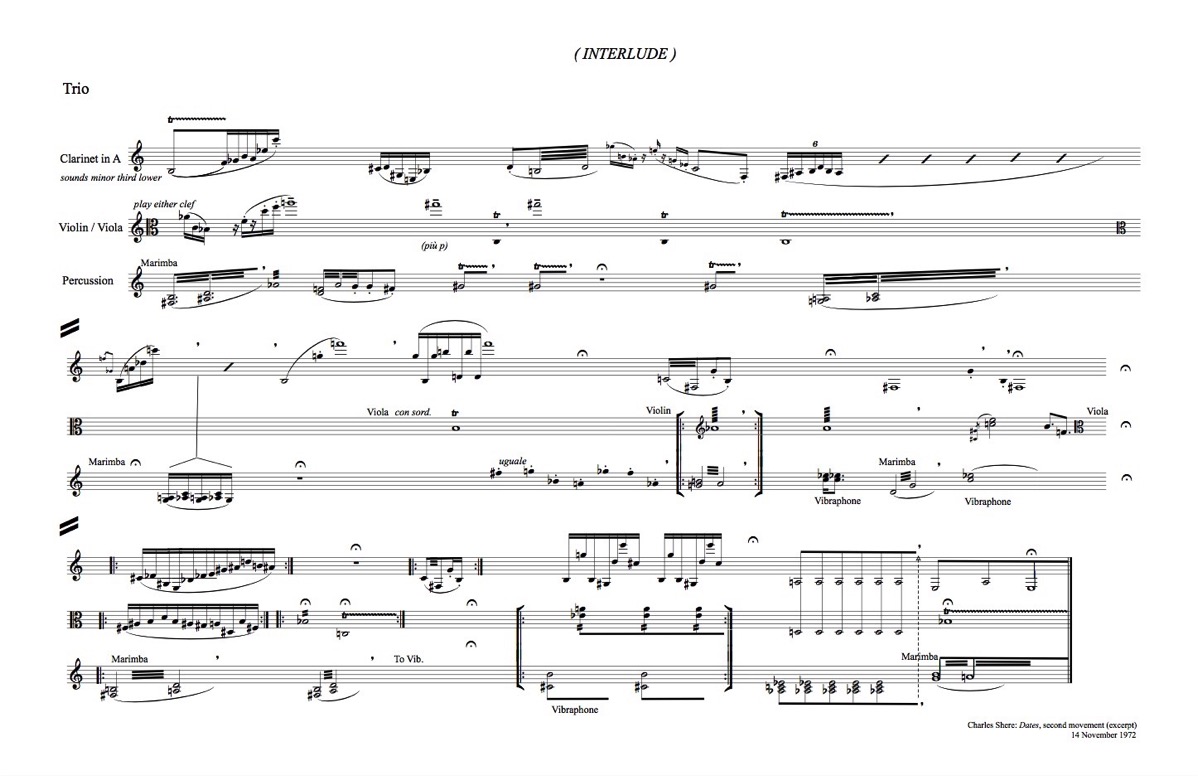
FOR A NUMBER of days I've been working a few hours at re-notating a piece I wrote in 1974: Dates, a sort of chamber cantata for soprano and three instrumentalists, to Gertrude Stein's poem collection of that name.

The notation has not been easy, because the original notation is not completely conventional. Much of the piece is in mobile form, meaning that the musicians are given a certain amount of latitude as to just when they play their notes. (The name comes from Alexander Calder's hanging sculptures, whose shapes take various overlapping configurations literally depending on which way the wind blows. Marcel Duchamp referred to these sculptures, when they first appeared, as "mobiles," and the name stuck.) The notes themselves are stipulated, as well as the order in which they are played; but I wanted to give them precisely the freedom Greil suggests "songs" themselves have, the freedom to seek their own final form. "Final," it must be added, only provisionally, for that one performance.

Mobile form, like the related "open form," is of course one of the conventions that developed in the 1950s and '60s, when musical composition was finding new energies in its dissatisfaction with the constraints of traditional musical forms and organization of pitches (whether tonal or serial). You might call it is a conservative view of the indeterminacy of sounds pioneered by John Cage. I think of it as a way for the composer to moderate his authority and perhaps suppress his ego.

Perhaps there's an analogy with the method Stein employed to write her poetry. She worked late at night, alone of course, in the silence of her apartment, at her writing desk; but I believe she recalled words she'd heard or overheard in the course of the day, letting them appear as they would among other words taken from previously published sources, or in the continual process of meditation.

Dates was written for a concert I helped organize in February 1974 on the occasion of Stein's centennial birthday; but also for my friend the clarinetist Tom Rose, who needed a new piece to play for his postgraduate degree at Mills College, where I was then teaching. I added two other instrumentalists to the mix, both then also teaching there, both now alas no longer with us: the marvelous violinist Nathan Rubin, who doubled easily on viola, and the engaging yet serious percussionist Jack van der Wyk.

The cantata is in three movements and runs to nearly fourteen minutes in the one recording I have. (Since it is in mobile form the possible duration of the piece can vary within limits.) Today I'm sharing only a minute and a half of the piece, to illustrate the mobile-form concept. The score is reproduced above; you can listen to the excerpt here. (This performance features the late Judy Nelson, soprano, and the instrumentalists for whom the music was intended: Tom Rose, Nathan Rubin, Jack van der Wyk.)

The recorded excerpt opens with the last words of the fifth poem in the cycle, then immediately moves into the Trio shown above, on which the soprano superimposes the sixth poem:

        5:
        Spaniard.
        Soiled pin.
        Soda soda.
        Soda soda.

        6:
        Wednesday.
        Not a particle wader
        Aider.
        Add send dishes.

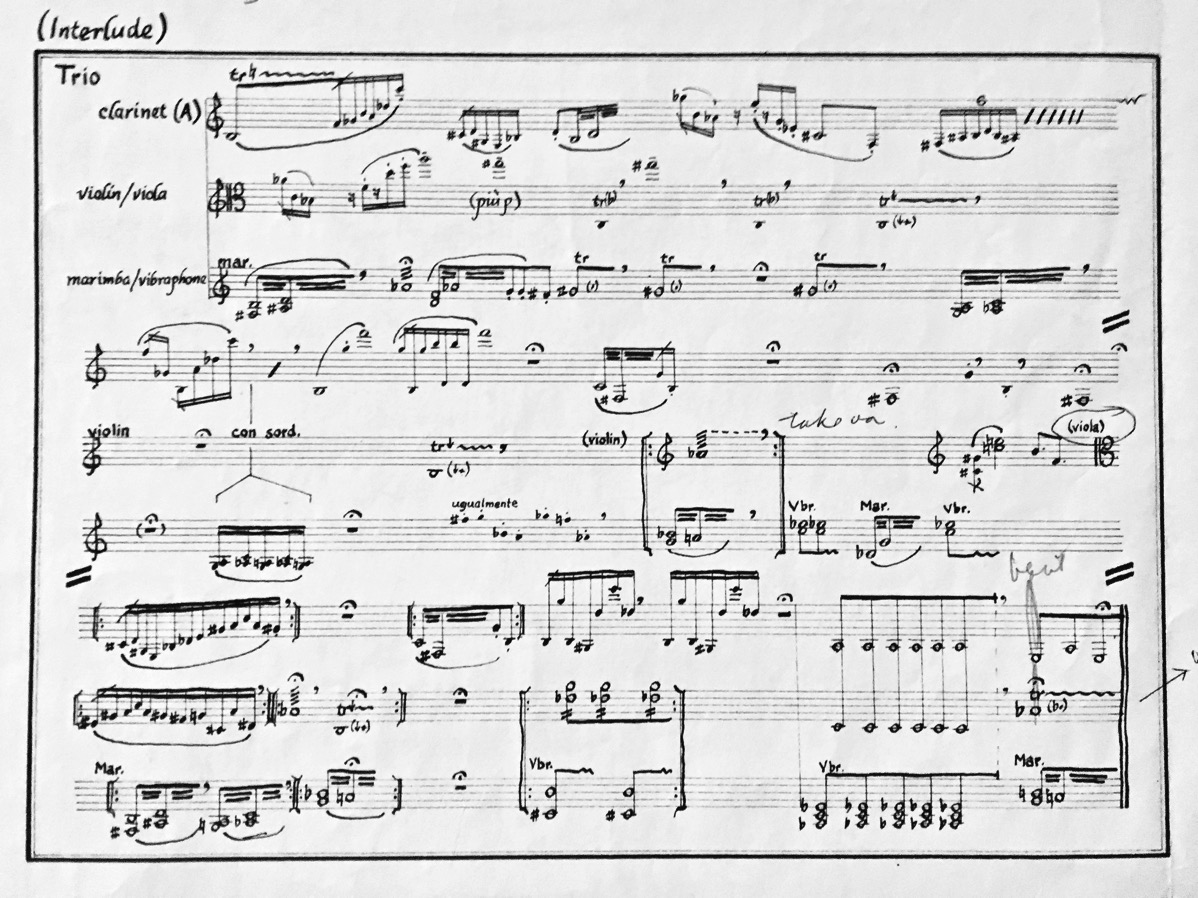
I'll have more to say about Dates, perhaps, when I've finished notating the entire score. I reproduce below the original manuscript of this excerpt…

IMG 2725

Friday, November 18, 2016

Against authority

Eastside Road, November 18, 2016—

FOR A COUPLE of weeks now I've been thinking, from time to time, of the production we saw on Sunday, November 6, of Jean Genet's play The Maids. It was the last of three plays we'd seen produced by A Noise Within, the Pasadena professional repertory company we have subscribed to for the last fifteen years. (I wrote previously about the other two plays: Molière's The Imaginary Invalid and Tom Stoppard's Arcadia: you can read those comments here and here.)

It was a very strong performance of a quite effective production of a neglected major play, cast on three tremendously effective actresses; and its narrative intensity, concerning the fantasies of two sisters who serve as maids-in-waiting to a rich bourgeoise, left me (and the rest of the audience, I'm sure) drained. Still it seemed to me the next day, as we drove the four hundred miles home, that it would be easy to write about it. I had two entries into the task. The benign one concerned an old lady we met twenty years ago, a well-to-do Frenchwoman, who lived in a 17th-century fort with her even older bonne, the maid who'd attended to her when she was a little girl, and who'd been given to her by her parents as a wedding present, and who was now so old and decrepit the roles had been reversed, and the old lady was waiting on her maid.

That's a much prettier story than the one Genet based his play on, a crime which in fact took place in France in the early 1930s, when two sisters from an unprivileged family, gone into service, developed over the years a fantasy life feeding apparently on their resentment for their employer, each in turn playing the part of Madame, acting out a fantasy in which they murder her.

That gave me my second insight into the play: it is, of course, I thought, a parable of the French Revolution. An orderly structure prevails, but it rests on the exploitation of the lower orders, who ultimately rebel — in this unfortunate case killing the master(s). That would be an interesting way to address this play, particularly on the eve of our national election, which threatened, I thought, to install an autocrat in the White House.

But then before I could find the time to sit down and write the election took place, the day after we returned home; and the returns came in, much more quickly than I'd expected, and here we are.

I had thought all along Trump would prevail. I thought so during the primary campaign, when everyone around me disagreed; and I thought so after the conventions, when everyone around me called me a pessimist. It's not much comfort in this case to be able to say "I told you so."

If The Maids is a parable of the French Revolution, it is also a parable of the Trump campaign. Much of the electorate seems to have been in the position of those poor sisters: working (or not) in a system that provides them employment and identity within a context they don't understand, don't appreciate, don't want, a system that has evolved mysteriously within economic and cultural conventions they don't fathom (nor do I, often); resenting the system, their dependency on it, their invisibility within it from the point of view of those who profit from it.

The sisters cope with all this by developing a rich fantasy life. When their mistress is away they take turns playing her role, each as mistress forcing the other as maid to ever more degrading and servile positions — this while at the same time conspiring to escape their situation by murdering their employer. You don't have to look far for an analogy with those unemployed and underemployed Trump supporters who aspire perhaps one day to be Trumps themselves, if not in terms of wealth at least in terms of self-certainty; and who in the process will likely wind up destroying the fabric that provides their pittance, unsatisfactory as it is.


The Noise Within production, designed by Frederica Nascimento and directed by Stephanie Shroyer, respected every intention of Genet's script, translated by Bernard Frechtman. The set distributed the casual artifice of an Art Deco apartment across a big stage; the cheap opulence suggested Madame's detached, airy yet somehow troubled persona well, important because the character does not actually appear until quite late in the one-act, ninety-minute play.

The two maids were well cast and splendidly acted. Donnla Hughes was Solange, the elder sister, withdrawn, furtive almost, observant, calculating. Jaimi Paige was Claire, the younger, emotional, distressed, nervously sensitive, impulsive. They were convincingly older and younger sisters, and Genet depends on that intimate relationship as he investigates the closeted nature of their position. But they went deep into the individual qualities of the personalities as well, suggesting distinct meanings of both the position and their responses to it.

Emily Kosloski played Madame, an interesting role that packs a lot of depth and detail into relatively infrequent and restricted stage presence. Here the production helped, for she is as present figuratively, through both stage decor and the sisters' fantasies, as she is physically when on stage.

It's not important at this point, with the entire Noise Within fall schedule now behind us, but I want to mention that the final two scheduled performances of The Maids were cancelled, in order to add two extra performances of Tom Stoppard's Arcadia. We have subscribed to the company for years both for the quality and range of the productions and for the convenience of seeing three plays within just a few days. We'd been planning to see the final weekend, which would have been just last week; in the event, we had to reschedule. At this point I think it's just as well: seeing Genet's play after the election might have been just too depressing. In any case the company did everything it could to facilitate our last-minute change.

I'm sorry, though, that they decided to sacrifice Genet to Stoppard. I suppose box office had a lot to do with this. If so, another indication of what's wrong these days: publicity, entertainment value, and vogue override investigation, thoughtful interpretation, and substance. That's how it is these days.

Sunday, November 06, 2016

Parallel narratives

Pasadena, California, November 6, 2016—


BEAR WITH ME: I am thinking at the keyboard: how to describe my reactions to two recent productions of Tom Stoppard plays.


I don't like to miss any chance of seeing a Stoppard play. For far too long I refused to see Travesties, his first big success, because I thought (from what I had read, always a poor way to approach an intellectual decision) he was infringing on the creative property of one of his subjects, James Joyce. 


(Joyce, Stein, Ives, Cage, Picasso, Duchamp: my double trio of heros in my formative youth.)


It was only the press and critical noise that attended Arcadia, many years later, that persuaded me finally to confront Stoppard on the boards, and I haven't really looked back since. I find his range, his characterization, his language quite fascinating. I rarely leave a performance of Stoppard without thinking, and usually thinking of writing. His work is literally inspiring.


Alas, it is also vulnerable. The two most recent productios we've seen — The Hard Problem at ACT in San Francisco, two or three weeks ago; Arcadia at A Noise Within here in Pasadena, yesterday — both suffered, in my view, from vocal delivery. To so distracting a degree that my mind, old and tired as it's been recently, simply shut down.


Stoppard's plays demand a certain mental effort from the viewer. His literary, historical, philosophical references come thick and fast; they are central to his plot and suffuse the atmosphere within which it moves.


Like most engaging plays, his move through dialogue, and his lines are often fast and brittle, like Noel Coward's, while also frequently evasive and elliptical. And more often than not a character momentarily sidelined and silent will be doing something — whether reacting facially or stroking a tortoise — that has to be noticed, even though another part of the stage seems to be the chief focus of the moment.


In both these productions the thick grainy material of Stoppard's play was lost, at least to me, in a swamp of extravagant English accent. American theater companies so frequently succumb to this. It's obvious that Stoppard's characters, like those in much of Shakespeare, are English: why must their vocal delivery wear highly colored St. Andrew's crosses? 


The Noise Within Arcadia was particularly offensive in this respect, taking both the 19th- and the 20th-century characters well over the top: meant I think merely to be occasionally arch, this production turns them into burlesques. That works in a play like The Imaginary Invalid, seen the previous evening: it doesn't work in a serious dramatic contempation.


On the other hand there was much to recommend here: the acting was subtle (apart from vocal delivery), the characters well developed, the pacing both measured and rhythmic (I would like two intermissions, not one), the physical staging both attractive and suggestive.


I'm not sure I felt ACT's The Hard Problem was as successful a staging. Like the Indian Ink of a few seasons ago, it relied on an excessively wide and generally shallow physical setting, which subconsciously invites a similar view of the play itself. But I write this weeks after seeing it, and out of sorts about these productions generally, and will stop here.


LAST NIGHT, across town at Firelight Theatre on Vermont Street, we saw a play of a completely different character: The Tragedy of JFK (as told by Wm. Shakespeare), by Daniel Henning.  


Henning, who told me after the performance that he had long been a student of the 1963 Kennedy assassination, had the ingenious idea of mapping that event — what is know, historically, and what has been hypothesized in endless speculations — on Shakespeare's Julius Caesar. JFK is of course Caesar; Brutus is Lyndon Johnson, Cassius is J. Edgar Hoover, and so on. (Giving the part of the Soothsayer to JFK's secretary, Evelyn Lincoln, is brilliant.)


The action begins with preparations for the Dallas motorcade, duriing which conspirators fear the president's overwhelming popularity will make him almost a king; it extends five years forward, ending in the assassination of Bobby Kennedy — who is, of course, Marc Anthony.


It sounds like a gimmick, but It really works. I've complained here, from time to time, about the unfortunate productions of Shakespeare that result from well-meaning attempts to "bring Shakespeare to the modern audience," when what's really needed is to bring the modern audience to Shakespeare. Ashland's Oregon Shakespeare Festival has even determined to commission 37 "translations" of Shakespeare into contemporary English.


They'd do well to consider mounting a production of Henning's play, preferably with a Julius Caesar using the same cast.  They could, in fact, hire the cast we saw last night: they were excellent.


Here the accents of individual characters was used to good effect. Time Winters, as LBJ, insinuated a soft Texan drawl into Shakespeare's "untranslated" English; Ford Austin's JFK and Chad Brannon's RFK ironically modulated a Boston accent, bringing the dimension of cultural distinction to the plot.


The play belongs to LBJ and J Edgar Hoover, the latter played magnificently by Tony Abatemarco. Their scenes were electric, whether exploding or barely contained. I will never be persuaded that LBJ was in any way complicit in the Dallas tragedy, but that's beside the point: this is a fascinating, important drama; it deserves to enter the repertory.


Saturday, November 05, 2016

Molière's Imaginary Invalid

Pasadena, California, November 5, 2016—


NO REASON TO BE too serious about this: Molière's The Imaginary Invalid is pure comedy, the child of commedia dell'arte and the classical French comédie, laced with satire against class-based social order and the medical profession, but driven by a lust for laughs. 


And yet. Molière's targets deserve his barbs as much as ever. And in the end Molière himself collapsed playing the Invalid on stage, and died within hours. "I told you I was sick," reads the joke epitaph; days before the possible death of American democracy, it's not entirely funny. 


We're here on the biannual visit to A Noise Within, the repertory company who will give us Tom Stoppatd's Arcadia today and Jean Genet's The Maids tomorrow. It's the right sequence, I think: Molière puts us in a take-a-cosmic-view perspective, from his three-century distant perch. 


ANW is playing a streamlined and updated adaptation (by Constance Congdon) which cuts three or four minor characters but preserves much of the detail — including the thunderclaps accompanying every reference to the evil stepmother. And I am particularly taken with the idea of casting the always remarkable Deborah Strang as the maid Toinette, a role usually given to an ingenue. 


Here, Toinette assumes a position equal to Argan, the title character. She is figuratively and literally behind and above it all, often perched on a ladder, shelving bottles of Argan's effusions, or trying to let a little light and air into his close and stifling world. 


Apollo Dukakis manages to round his character, often as appealing and sympathetic in his vulnerability as ludicrous in his gullible self-involvement. (I couldn't help finding Argan-Toinette reminiscent of Trump-Hillary.) And Dukakis, with the transformative assistance of Kelsy Carthew as his daughter Angélique, brings real nobility to the breakthrough moment when he realizes she indeed loves him. 


The moment almost parallels, in its poignancy, the ridiculous extravagance of the burlesque of this production: Rafael Goldstein as a chicken-crossed De Aria, Carolyn Ratteray as the wicked Béline, Angela Balogh Calin's superb sets and costumes.  


Molière collaborated with Marc-Antoine Charpentier on this play, originally a three-act comedy-ballet. I'd like to see a reconstruction of the original, with period instruments and choreography, but I understand the restrictions of the contemporary entertainment industry. 


New music was substituted for the final romp, as well as the opera-spoof pastourelle improvised ny Angélique and her swain Cléante (Josh Odsess-Rubin, very sympathetic snd capable). Julia Rodriguez-Elliott directed. I liked every aspect of her work while I was watching, and the more I think about it afterward the more impressed I am with it.