Einstein's Clocks, Poincaré's Maps: Empires of Time. By Peter Galison. New York: W.W. Norton & Co., 2003.
MOM ALWAYS LISTENED to a radio program on weekday mornings — some kind of news commentary, I think it was. It came on at nine o'clock sharp, and always began with the stentorious announcement that "It's High Noon In New York." Hearing that, I'd always look at our clock, which would read something between 8:45 and a few minutes past nine. It always fascinated me, this difference in times. I knew that anything said on the radio must be true, especially if it came from far away, yet my brain told me that it was nine o'clock, though our clock was rarely so sure.
Local time, Daylight Savings Time, Standard Time. Growing up in the country even a kid was aware of all these things, with that dim awareness kids have of such things. Except for school days, time was measured by sun and stomach: but school required promptness, and you wouldn't want to get there too early but you couldn't be late, and it was, oh, a good forty-minute walk.
These uncertainties prevailed even among urban adults until well into the 19th century. In spite of its title, chosen I think more for merchandising than for accuracy, Peter Galison's book is about the history of the synchonization of clocks in the Western World — as that history affected the gradual emergence of Einstein's theory of relativity, it is true. A photograph in this sometimes maddening book shows the Tower of the Island, in Geneva, which about 1880 had three prominent clocks indicating the time(s): 10:13 here in Geneva, 9:58 in Paris; 10:18 in Bern. Six years later two of the clocks had been taken down, as time was now sychornized all the way from Paris to Bern, and beyond.
The problem, of course, is that the earth rotates on its axis (which is on the whole a very good thing). I look up at noon: the sun's as high as it will climb today, though probably in the southern sky. In New York, though, that happened three hours ago.
There were a number of reasons the 19th century wanted to standardize time and synchronize clocks. It was a logical concomitant of the Industrial Revolution, of the Enlightenment. And therefore its history is grounded in that of England and France. Galison's hero, in this book, is certainly Henri Poincaré (1854-1912), the French polymath, graduate of the École Polytechnique, that quintessentially French institution born of the Revolution.
One forgets the essentially Rational nature of the Revolution, which replaced the superstition- and religion-obsessed Monarchy (which was positioned on the Great Chain of Being, leading between the lowest worm and God, just below God Himself) with a Republic grounded in the principles of Liberty, Equality, and Fraternity. One of the major points was to replace arbitrary verities emanating from divine revelation or regal whim with equally arbitrary verities determined by groups of scientist-philosophers. The Metric System, for example, was developed by the Polytechnique, for the practtical reason of facilitating trade throughout the nation through standared weights and measures: a bolt of cloth woven in Nîmes should be measured the same as one woven in, say, Paris.
(Another factor: the importance of bringing every corner of the nation under the administration of a central authority in Paris. The history of local-versus-capital tension is long, complex, and fascinating.)
Galison's story is significant and absorbing, but his editors and publisher have not done him many favors. There are odd lapses in grammar and even odd errors — in one case, for example, a confusion of starting and ending positions in an account of signaling between positions. The book is rich with detail, ranging from Poincaré's forensic investigation of a coal-mine explosion to the survey of meridians in Africa and the Andes. The poltics of scientific research would be a rich enough subject for a history all its own, and Galison valiantly brings it in, as well as the comic-opera argument between England and France over the decimalization of time measurement (France lost) and their joint research into the precise distance between the Greenwich meridian and that of Paris (England seems to have yielded).
Galison's study is a chapter in the history of ideas, and a measure of the difficulty of writing such a chapter is itself a central aspect of his book. Early on, he describes the nature of this complexity, calling it "critical opalescence." He is so fond of the metaphor, and the reader needs so much to keep it in mind, that it's worth a long quote to show his method:
Imagine an ocean covered by a confined atmosphere of water vapor. When this world is hot enough, the water evaporates; when the vapor cools, it condenses and rains down into the ocean. But if the pressure and heat are such that, as the water expands, the vapor is compressed, eventually the liquid and gas approach the same density. As that critical point nears, something quite extraordinary occurs. Water and vapor no longer remain stable; instead, all through this world, pockets of liquid and vapor begin to flash back and forth between the two phases, from vapor to liquid, from liquid to vapor—from tiny clusters of molecules to volumes nearly the size of the planet. At this critical point, light of different wavelengths begins reflecting off drops of different sizes—purple off smaller drops, red off larger ones. Soon, light is bouncing off at every possible wavelength. Every color of the visible spectrum is reflected as if from mother-of-pearl. Such wildly fluctuating phase changes reflect light with what is known as critical opalescence.
This is the metaphor we need for coordinated time. Once in a great while a scientific-technological shift occurs that cannot be understood in the cleanly separated domains of technology, science, or philosophy. The coordination of time in the half-century following 1860 simply does not sublime in a slow, even-paced process from the technological field upward into the more rarified realms of science and philosophy. Nor did ideas of time synchronization originate in a pure realm of thought and then condense into the objects and actions of machines and factories. In its fluctuations back and forth between the abstract and the concrete, in its variegated scales, time coordination emerges in the volatile phase changes of critical opalescence.
(Einstein's Clocks, Poincaré's Maps, pp. 39-40)
Galison's discussion traces the development of time standardization and coordination through a fascinating period, the century-plus leading from the French Revolution (1789) to the publication of Einstein's first papers on time and space — in the history of ideas, from the disastrous triumph of Rationalism to the cubist fragmentation of Relativity; from the displacement of divine and regal authority by that of republican committees to the eventual triumph (or disaster) of unbridled democratic individualism and the provisional, negotiable structures that follow.
The only hope for truth or certainty, given the "critical opalescence" of the philosophical, political, and even scientific landmarks along this historical path, lies in some kind of reasoned abstraction defining an intellectual framework within which to negotiate the numbers assignable to the objects we contemplate: time, distance, justice, value, administration. It's too much to hope for a clear presentation of this problem, let alone a clear discussion of the concepts and illuminations brought to the party by such minds as Poincaré and Einstein — and a number of others mentioned in passing in Galison's book.
I wish he'd had better copy editing. I wish someone had asked him to resolve repetitions, to clarify arguments, to provide timelines. I wish the index were more detailed. But I thank him for giving us a book worth setting next to Ken Alder's The Measure of All Things, and for including copious notes and drawings and photos and an extensive bibliography. Written toward a popular audience, it's a book worth keeping and ruminating over.

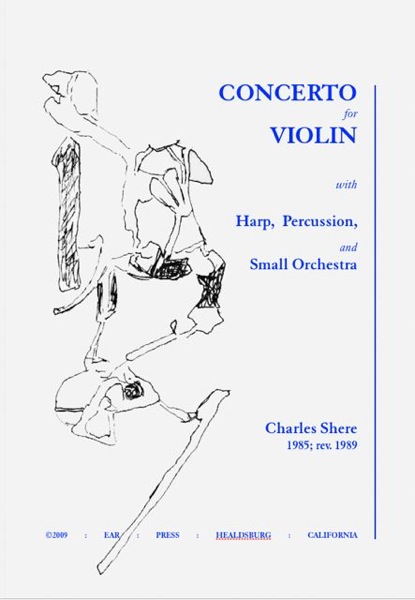 I HAVE ALWAYS LOVED eccentric violin concertos, by which I mean those somehow standing aside from the standard repertory. Mozart's, of course; and the Sinfonia Concertante. Harold in Italy. The neglected ones by Schumann, Dvorák, Goldmark, Stravinsky, Schoenberg, Lou Harrison; the familiar but still fascinating ones by Sibelius and Berg. In many of these concerti, it seems to me, the soloist stands somewhat apart from the orchestra, the composer's (and the performer's!) strategy for dealing with the differences between the collaborators in terms of dynamic and tonal range and, especially, potential weight. One doesn't like to attribute too much "meaning" to music, but it's hard to escape the thought that the soloist-orchestra dynamic recalls that between Self and Society, or — better, in my opinion, and certainly more representative of my own attitude — Self and Nature.