Showing posts with label walking. Show all posts

Wednesday, January 14, 2015

Strayed

•Cheryl Strayed: Wild: From Lost to Found on the Pacific Crest Trail..
New York: Vintage Books, 2013. 336 pages.
ISBN 978-0307-476074.
Eastside Road, January 14, 2015—
THIS BOOK has gathered decidedly mixed reviews, even in my own family: some of us dislike the author's tone and style; others are sympathetic with her story and her emerging character.

Abandoned by her father early, raised with a brother and sister, in poverty, by an unconventional mother and stepfather, Strayed reacted to her mother's early death (at 45) by falling to pieces, experimenting with drugs, seeking comfort too casually with too many men, until finally a chance encounter with a trail guide on the bookshelves of a sporting good store led her to an almost whimsical decision to hike the Pacific Crest Trail — or, at least, the section from Mojave, California, to Ashland, Oregon.

It's a mistake, I think, to believe she did not prepare. She clearly put in a fair amount of research as to equipment and planning. That contrasted, though, with an almost casual approach to physical preparation, in terms of preparing her own physique, rehearsing the pack, even carefully choosing the shoes. Further, she had the bad luck to pick a heavy snow year for her trek, requiring a bypass of the high Sierra (and consequently extending the original itinerary to the Columbia River).

This curious collision of preparation and impetuousness characterizes almost every aspect of the young Cheryl Strayed: intelligent, well read, thoughtful, but clueless about so many aspects of rational living. It's easy to explain this by her upbringing, not only her father's abandoning her but also her cheerfully impoverished mother and the unconventional childhood in a rural setting where material comforts were denied in favor of blithe free-spiritedness: but you can also read that upbringing, in the 1980s, as symptomatic of the times, of a fundamental schism in American society.

The book has been made into a film (which we saw the other night) that's been criticized for its irritating and frequent intercutting. The book itself proceeds by flashbacks, alternating between description of the trek and memories of the childhood and the crisis. Like others, I found this intercutting mannered at times. I'm not fond of the writer's prose rhythm, which alternates extended paragraphs with choppy single sentences; and like others, I found the book's final pages rushed.

But having done a little long-distance walking of my own, though without carrying tent or stove, I recognize the tedium, the meditation, the pain and what can only be called the transcendence of her experience.
…what mattered was utterly timeless. It was the thing that had compelled them to fight for the trail against all the odds, and it was the thing that drove me and every other long-distance hiker onward on the most miserable day. It had nothing to do with gear or footwear or the backpacking fads or philosophies of any particular era or even with getting from point A to point B.

It had only to do with how it felt to be in the wild. With what it was like to walk for miles for no reason other than to witness the accumulation of trees and meadows, mountains and deserts, streams and rocks, rivers and grasses, sunrises and sunsets. The experience was powerful and fundamental. It seemed to me that it had always felt like this to be a human in the wild, and as long as the wild existed it would always feel this way. That's what Montgomery knew, I supposed. And what Clarke knew and Rogers and what thousands of people who preceded and followed them knew. It was what Iknew before I even really did, before I could have known how truly hard and glorious the PCT would be, how profoundly the trail would both shatter and shelter me.
Wild, p. 207
Although she hiked alone, a good-looking young woman under a ridiculously big and heavy back-pack, Strayed apparently met with few really scary situations — although she was conscious of risks. She had very little money, and describes the hunger and thirst, in many senses, that accompanied her. She also describes, beautifully, the alternating desire for companionship and solace of solitude that comes to many on the trail — or, perhaps, drives them to it.

More than once I thought of Patti Smith's marvelous book Just Kids, describing her life with Robert Mapplethorpe. Whatever you may think of casual sex and drugs, there's a sweetness in both these accounts, a wistful innocence that I think expresses the awareness that something is seriously lacking in the mainstream contemporary American address to life; that in the absence of conventional family structures damaged adults, discontented with the cult of the individual, emerge craving affection, affirmation, companionship.

I think this is an important book in spite of its flaws, a provocative, dogged, generous narrative of things that go wrong, of damaged children and lost adults, but also of daily kindnesses and, ultimately, the lofty, uncaring, objective serenity of the Nature we must all confront, whether disease, privation, discipline, death, or sublime beauty. It makes me want to hit the trail again — finally, perhaps, alone, and with a tent and a stove.

Tuesday, June 05, 2012

Long walk to Fort Ross


IMG_3382.jpg
Fisk Mill Cove, Sonoma coast
FtRwalk.pngSATURDAY, JUNE 2: GLORIOUS weather, fine terrain, good company — only the pace, a little slow and far too often halted, detracted from a first-rate long day's walk.

The event was planned and organized, admirably, by Jeff Tobes, who has led similar history-oriented group walks on a number of previous occasions. This was in fact the eighth annual 25-mile walk produced for the Sonoma County Historical Society, and Jeff got more than he'd bargained for this time, as 130 people eventually signed up for the day.

Most of the walkers boarded big yellow school buses in Santa Rosa, but Thérèse and I opted for the closer departure point in Forestville. This allowed me to get up at 3:15 am rather than 2:30. I can't recall when I've got out of bed so early in the morning: but we were rewarded by a rare sight, the almost full moon about to set, huge and eerily apricot-colored, in an otherwise pitch-black sky.
IMG_3356.jpgAbout quarter past four the bus arrived for us. It took us out River Road, through Guerneville and Monte Rio and Jenner, then up Highway 1, Meyers Grade Road, and Seaview Road to the parking lot at Fort Ross School — about thirty miles from Forestville, but a slow slow grind; some of the roads were hardly wide enough for the bus, and the turns were tight, the drop-offs scary.

We arrived at the parking lot, still dark, about five-thirty, grouped for a count and instructions, did a few stretching exercises, and waited for our six o'clock departure time. I suddenly realized I'd forgotten to wear a hat: at 3:30 am, a hat was the last thing in my mind, and I'd neglected to set it out with my pack the night before. Oh well: I've done without before.

IMG_3361.jpgWe set off almost on schedule just a few minutes past six, daylight by now well on the way. The morning sun was glorious through the tall firs and redwoods, and we walked past a few dooryards surprisingly tucked behind fences — you never realize how many people live out here in so apparently remote a place.

When I was in high school, in the early 1950s, the few students whose families lived out here usually boarded in town — Sebastopol — during the winter months. My mother taught a few years at Fort Ross school, and after only a few weeks realized she'd have to live out near the school; the commute from Hessel, 45 miles away, would take a good two hours in fair weather, much longer in heavy fog or rain. (She always had a chain saw and a shovel in the car.)

We walked three and a half miles up Seaview Road, then turned onto Kruse Ranch Road for another half mile, to Plantation. I knew this from the old days; Mom and my two youngest brothers lived here for a few months — I think they were boarded by school families by turns during her tenure: Fort Ross School, Plantation, Salt Point, Timber Cove. (Finally she found a place of her own, near the north end of the bridge over the mouth of the Russian River near Jenner, in a little two-room shack that disappeared long ago.)

In those days Plantation was a rather run-down boarding school run by the Crittendon family. Now it's a much more polished looking farm camp; I can imagine it would make a fine summer experience for kids needing to learn the basic skills of hard work and healthy living.

IMG_3370.jpg


The sun was slanting down brightly over the gleaming white dormers of the main house, and we all gathered around outside the restored Druids Hall, where volunteers cooked a welcome breakfast for us — scrambled eggs and bacon, beans, rice and salsa, tortillas, and cases of fresh peaches and strawberries; best of all, plenty of good hot coffee — and, of course, the possibility of a pit stop.

I was impressed with Plantation. Improbable as it seems, it was a working resort a century or so ago; people rode up on stage coaches. By 1871 there was a saloon and a stage house nere and that same year a school was organized. The Druids Hall went up in the late 1870s — people needed their society in those days — and a post office followed at the turn of the century.

After half an hour or so we resumed the walk, continuing on Kruse Ranch Road, then on narrow trails through fairly dense forest in Kruse Rhododendron State Natural Reserve, where the native rhododendrons, lanky and a bit past their peak, still showed blue and purple high among firs and redwoods.

IMG_3376.jpg In the understory, at our feet at the edge of road and trail, among the ferns, we saw lilies, orchids, iris, and a number of other flowers — Khloris knows I am no botanical expert; I'm content to enjoy the imponderable generosity of their mere flowering existence.

By now, of course, we were descending at a pretty good clip; Plantation was about a thousand feet above sea level; we were headed for the coast. (Our starting point at Fort Ross School was the highest point of the day, at 1285 feet.)

In the dense forest my trail-mapping app lost sight of the GPS satellites it needs, but on a walk this long I think the resulting margin of error is acceptable. (You can download the .kmz file of waypoints for the entire walk from my website.)

After about three hours' walking, not including the breakfast break, we hit sea level at Stump Beach, downcoast from Fisk Mill Cove, which looked to me like about the one-third point on the walk. This part of the northern Sonoma coast, from Jenner at the mouth of the Russian River up to Sea Ranch or so, is studded with coves, most of which were used for loading lumber onto schooners in the sixty years or so after the Gold Rush.
IMG_3397.jpgFisk Mill Cove, Gerstle Cove, Ocean Cove, Stillwater Cove, Timber Cove: we skirted all of these, sometimes on trails in parks, sometimes bushwhacking across fields, a couple of times marching three or four abreast in one lane of Highway 1, when twice it was restricted to one-way car traffic just to accommodate us.

The flowers were truly extraordinary. Reds, orange, yellows, blues, most of the blooms quite small of course — these plants have to be thrifty on their windswept, salt-sprayed bluffs. At times we came to groves of low mounding beach cypress; our trail even entered these mounds at times, and we found ourselves in dark, fragrant caves.

At Gerstle Cove we headed inland, climbing through fairly thick forest to cross the highway and head for the picnic grounds at Woodside Campgrounds in Salt Point State Park. Sadly, because of the California state deficit, many of the state park facilities are closed; but these campgrounds are operating — though curiously empty at the moment. The Fort Ross Store provided sandwiches, milk, and juice, and we sat at a picnic table, Thérèse and I and an interesting woman who joined us.

552837_4050566940377_1093629684_n.jpg
photo: Thérèse Shere


Among these 130 people there were few solitaries. Most seemed to be in pairs, some in larger groups, families perhaps, or walking buddies. Most seemed pretty well geared, many with hiking sticks and backpack-canteens; and though Jeff had cautioned us against carrying backpacks — and offered "sag wagons," cars that convoyed along and met us at strategic locations, to carry any packs, coats, extra shoes and the like for us, still nearly everyone had a day pack or a fanny pack or something of the sort. (I wore my hiking bandolier, which carries a one-liter water bottle, my iPhone and a couple of external batteries, a handful or two of dried figs and another handful or two of salted nuts, a notebook, sunglasses, and the like.)

By now it was past two o'clock, and I began to wonder how we'd ever manage to arrive at Fort Ross by six. We headed back to the coast, skirting Ocean Cove by walking on the highway for a quarter-mile or so, then returning to the trail along the edge of the bluff, southeasterly to Stillwater Cove. Here we took a detour up the Stillwater Ranch driveway, past its handsome stone house and its annoying peacock, and into Stillwater Park, one of Sonoma County's regional parks, where I was surprised to find the one-room Fort Ross schoolhouse — so surprised that I didn't think to photograph it, even though it was the building my mother taught in half a century ago — before it was declared surplus property, given to the state, then abandoned to the county's care, occasioning its relocation in this historically irrelevant place.

Oh well. From Stillwater we head westerly, away from the coast, up a pretty steep trail and through a private homeowners' association reserve — the sort of thing that can only be done by special permission, one of the reasons it made sense to walk in this group. This being the county historical society, and our leader being a retired history teacher, we took a short detour to ring a historical bell.

Before long we reached Timber Cove Road, whose quite steep, dead straight descent south to the coast was probably my least favorite part of the walk. Downhill on asphalt, after twelve or fifteen miles on the trail, is hard on toes and calves. We kept to the soft edge alongside the road where possible, but it was pretty narrow.

But soon enough we were at Timber Cove. I stepped into the Timber Cove Inn and phoned home to arrange for a pickup at Fort Ross, as we'd decided not to ride the bus back — it was going back via our start-point at Fort Ross School, and would take a long time, on twisty roads in the dark, right after dinner: not an attractive prospect.

The other 129 walkers were out in the parking lot, where the sag wagons and the trailer with its two portable toilets were steadying the troops. We were within shouting distance, only three miles or so, of our destination. But first our leader wanted to show us Beniamino Bufano's Madonna of the Expanding Universe, a 93-foot obelisk in the sculptor's characteristic naive-deco style which often strikes me as simple-minded, but occasionally attains considerable strength.

This particular piece, probably unfinished, takes a lot of thought if it isn't to be dismissed (or for that matter accepted) too glibly. There's no denying its seriousness of intent, and any work of art with so much thought, work, and intention behind its creation deserves reflective appreciation.

I won't describe it; you can read about it here. You must know, though, that it is the property of the State, and placed in a state park, the second-smallest in California — just big enough, we were told in an interesting and very enthusiastic little lecture by the park ranger, to contain it should it topple, which Poseidon forbid.

(The smallest state park contains Simon Rodia's Watts Towers, in Los Angeles: the two parks, and the two works of art they contain, make an interesting symmetry: the product of compulsive idealist outsider artists during the peak of Modernism, with foreshadowings, ironically, of the most intellectual conceptual art that would seem to displace them utterly in the history of 20th century art.)
We single-filed away from the Madonna on what struck me the most dangerous part of the walk, a dozen feet on a tight path that skirted a drop of fifty feet or so to the rocks below. At one point I stumbled on my own shoe and caught hold a branch hanging over the void: it would never have held me, but it steadied me, and I didn't attract any attention that I noticed…
IMG_3424.jpgAfter a half-mile or so on the highway, again protected by flashing red lights at each end of the stretch, we turned once again toward the coast, walking through first a private campground, then someone's side yard — amazing, that people can privately own territory at the very edge of the continent. We stepped through a private gate, walked through another enchanting field of flowers, and then surprisingly trod a hundred feet or so of ice plant, the succulent leaves breaking and weeping underfoot.

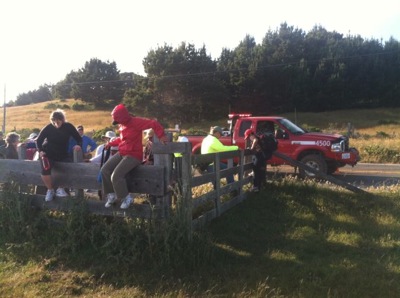
Another grove of cypress, another stretch of roadside trail, and then we came to a board gate at a fence. In a ludicrously clumsy ballet 130 of us laboriously hauled ourselves over the boards, our toilet-truck standing by in case of emergency I suppose; and then we set out again through a long final field, some of the most difficult footing of the day, a cow-pasture full of gopher holes, molehills, and hidden pools and runnels. This led to a second set of board gates, and here I actually had the sense, after watching a few people climb over them, to find the sliding bolt, draw it back, and open the gate for the others. (Of course, not being that smart, I'd already laboriously climbed it myself.)


600563_4050593741047_2049625454_n.jpg
photo: Thérèse Shere


By now the light was changing; the wind had come up; we were all ready to end the walk — and the fort still lay a mile or so off. All discipline was gone, 130 walkers were scattered across the cow-pasture, many toiling along a track, others of us heading on our own ideas of a more direct route to where we thought the fort must lie, teasingly out of view.

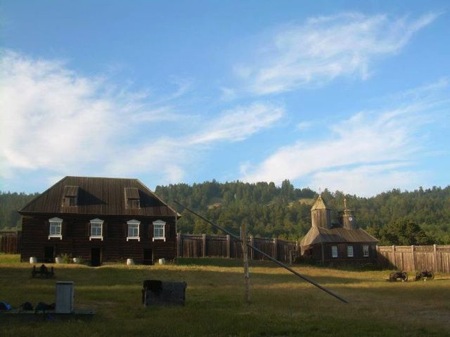
And then there we were. An asphalt road led underneath an overhanging cypress; beyond, the school buses were parked, and the sag wagons, and there was fragrant smoke in the air. We walked past the Call house, then through the stockade gate. I hadn't been here in years, not since the last big earthquake caused a lot of damage, and Highway 1 was routed away from the site, and the old Russian church was restored, and more recently a replica was built of the imposing Magazine, which I hadn't known about at all.
551080_4050603701296_1168093551_3784880_1883107313_n.jpg
photo: Thérèse Shere


Another crew of volunteers were cooking up rice, beans and chicken in huge iron pots over an open fire. There was an array of what I think of as Oklahoma funeral salads: potato salads, macaroni salads, olive-and-sweet pepper salads. The rolls had been donated by Franco American, and took me back sixty-five years when they were a family favorite in my childhood; and the butter was churned on the spot from cream donated by neighboring milk-cows. Plenty of coffee; plenty of fresh fruit; delicious Russian cookies. It was cold, an hour and a half later than we'd planned, and we hunched over our plates.

Then came our reward: a quick lecture on the history of the site, and a cannon salute. Walkers volunteered for the five-man crew: Tent the vent! Clear the piece! Fire in the hole! Our leader set a match to the fuse; we covered our ears; a fine loud satisfying POP! roared across the champs-de-Mars, and our day was over. IMG_3432.jpg

It was l'heure bleue, and the full moon had climbed to the tip of a windblown cypress east of the stockade. Lindsey was waiting for us in the parking lot, we thought; soon I'd be home, perhaps with a celebratory Martini.

Of course it wasn't quite so simple. Unsure of our exact location, and concerned that we hadn't shown up in the parking lot, she'd driven off — to Fort Ross School; to Plantation; to Timber Cove, where she messaged me. Alas, there is virtually no cell phone coverage out on that coast. Ultimately we found one another, of course, after we'd walked another mile or two between parking lot and stockade. A long day; a strange day; a tiring day; a glorious day. I realize, just now, typing these words, I'd do it again.

Thursday, May 31, 2012

The pleasure of walking


Oak tree.jpg

Lichen on a live oak on the Joe Rodota trail east of Sebastopol
ON SATURDAY NEXT — in only two days now! — I'm joining more than a hundred other walkers on a twenty-odd mile walk at the northern Sonoma coast, part of the bicentennial observations of the Russian colony at Fort Ross. It will be a curious departure from my normal walking style, which has never in the past involved more than three or four companions, has virtually always been in Europe, and, with one exception, has been more genteel than strenuous, more stroll than hike, usually only a few miles from one B&B or hotel to the next.

(The exception was the great walk across the French Alps, from Evian to Nice, the subject of my book Walking the French Alps (now available also as an e-Book) and the blog Alpwalk: this was a strenuous month-long hike of several hundred miles; I hope to repeat it next summer.)

Since we've hardly walked since early March, when we did eighty miles or so in Belgium and Luxembourg, I started getting in shape last Saturday, when I walked home from the farm market in Healdsburg. Wouldn't you know: I pulled up lame, and had to call the sag wagon hardly half a mile from home — the trick knee was killing me.

Monday, though, I walked five miles to the neighboring town of Forestville; and then after a leisurely lunch with friends walked the five miles back. I wore the old reliable Ace elastic bandage on the offending knee, and had no problems. And yesterday my daughter T. joined me on a longer outing, fourteen and a half miles, from Forestville along a county trail, paved in asphalt, south through Graton to Sebastopol, then east to Santa Rosa.

I've been using MotionX-GPS to track these walks — a free application that runs on the iPhone, constantly checking its location against whatever GPS satellites it can "see," recording the results, then returning the statistics: length, elevation change, speed. I'm not obsessive about this; I haven't taken advantage of a number of bells and whistles — adding photos, for example, or naming waypoints, or looking into the Facebook integration. I do e-mail the MotionX results to myself, so that I can look up these "tracks" on the MotionX website, whence you can even download the saved GPS waypoints to Google Earth and thereby revisit the walks in their geographical context.

(You can look at these websites too, but only for six months, after which they're taken down. Yesterday's Forestville-Santa Rosa walk is here.)

Walking is one of my greatest enthusiasms. For years I bicycled, and of course for years we've taken various kinds of car trips. In March we drove across France in three or four days; in April we drove to Pasadena and back, visiting wildflower areas and a few of the California Missions; just a week or two ago we drove up to Portland and back, a thousand miles, in only a few days. Cycling and driving have their virtues. (So do trains, for that matter.)

But walking — now there's the way to experience terrain; and cultural geography too. Because of the recent, uncharacteristically late rains, and because our trail took us along Atascadero Creek and a number of bogs and then into the great Laguna de Santa Rosa for a mile or so, the air was a little humid; under trees for the first four or five miles we heard birdsong; wildflowers peeped out at us from the trail margins, and the smells and the heavy air made me think of riverside walks we've taken in Netherlands.

wildflower.jpgThere's so much to see on a walk like this; so much to wonder about. What's that wildflower, for example, that sports both yellow and orange blossoms on a single plant? The leaves suggest some kind of pea, but what is it?
We often walked past fences guarding private yards and gardens; it's always surprising, the number of houses tucked away out of sight in these rural bedroom communities. In older sections — in north Sebastopol, for example, but in the run-down but charming Roseland area of Santa Rosa — old roses escape the gardens they've been planted in, sprawling among blackberries, climbing oaks.

We took a few nuts and some dried fruit; I had a slice of bread and some cheddar cheese in my lightweight daypack. We stopped in Sebastopol for a refreshing lemon sherbet —
gelato al limon; gelato al limon; gelato al limon…

and, a little further on, a macchiato; and then we turned our backs to the sun to walk easterly toward our destination in Santa Rosa, first across the bogs of the Laguna, then on a boring, straight stretch — nearly all this trail is on abandoned railroad right-of-way — in full sun, and within easy earshot of a busy road.

Even here, though, there were visual surprises. That glorious live oak photographed at the top of this post, its lichen-covered branches energized by sunlight now lower in the late afternoon. Later, as we enter the city of Santa Rosa, industrial outskirts: an abandoned gravel depot, its fascinating, forbidden machinery beckoning to the little boy still alert in a man nearing eighty. A cherry tree hung over a high board fence off to the right, the fruit still a week from perfection but for that reason unmolested by the birds: surely a handful won't give me a stomach-ache!

At the end of the walk the knees complain a bit when we sit at a sidewalk café to wait for our pickups; and at the end of the day I'm hungry and thirsty. This morning I feel great; no knee problems at all, though in truth I'm just a little stiff — and I lost two or three pounds yesterday, in spite of the quarts of water and glasses of wine I downed in the evening. We'll see how things to on the History Walk, day after tomorrow…

Monday, March 05, 2012

Painting and pannekoeken


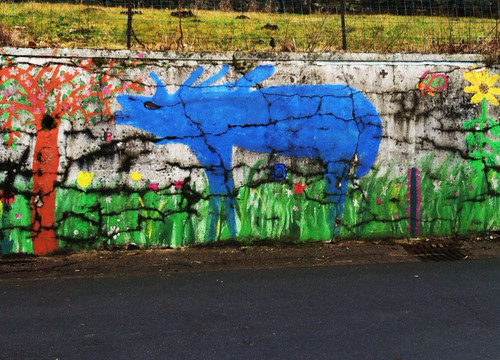
Evolution of stegosaur to elk:

Children's mural on retaining wall, Welchershausen, Germany

Oberhausen, Belgium, March 5, 2012—

WE STAYED IN today, for the most part. That's allowed: this game has no rules. I put on my coat at one point and sat outside the front door to clean the mud off my boots. The sky was light grey, as yesterday, and tiny snowflakes occasionally lit on my sleeves. A faint croaking turned my eyes skyward: scores of birds storks perhaps, quite distant and ungainly, flew determinedly north in three huge loose V's. it's cold: I quickly finish the boots and carry them back upstairs to wax them. 

Almost irrational, my fondness for these boots, bought four years ago for a trek across the French Alps, worn hundreds of miles, good as new. They treat me very well, so I respond in kind. Sharp rocks, persistent mud, even ankle-deep water don't faze them. Sometimes I think their cruelest assignment is to put up all day with my feet, and I often stuff them with cloth and leave them out overnight for air. Next morning, every morning, they're soft and supple in my hands, embracing and consoling on my feet, ready for another day of it, like a familiar animal, eager to ready me for another day of it.

After a late-lunch pannenkoek — these are among the best, perhaps the best, that I've eaten anywhere — we braved a cold wind to walk a kilometer into Germany, across a one-lane bridge over the fast, narrow ricer Oure, attracted by the promise of a unique museum. Welchenhausen is a tiny town, hardly more than four or five widely separated farmhouses, but its museum, advertised as the world's smallest, is open night and day, seven days a week. It's in a bus shelter, hardly needed for its original purpose since the bus doesn't come any more. 

The current show is a series of panels featuring engaging color photos and texts documenting the rebirth of village traditions attached to the calendar: Carnaval and Lent, Easter, May Day, Midsummer day, and so on. The texts and the installation are serious enough to persuade me that this is Anthropology, not merely Tourist Publicity: but of course everything was in German, which I do not read, so I may have been fooled. 

like the Germans, said Mevrouw van Steenbeeck the hotelkeep here yesterday, you have to admire their discipline. I'm sure you're right, I replied, but they seem to enjoy themselves, too. Oh they like to have a good time, she answered. They have their feasts and their holidays. An explanation struck me: They're Catholic, for the most part, no? Yes, she said, and they have their feast days. 

Mevrouw van Steenbeeck herself was born and grew up in Amsterdam, and bought this place with her husband thirty-five years ago, having fallen in love with both building and setting at first sight. Let's see: that would have been in 1977. I thought back to the Amsterdam I recall from those days, rather different from today's, and we agreed a little bit about the changes. Her own quarter, for example, was largely destroyed by the building of the huge theater complex at Waterlooplein, where the legendary flea market stood — I bought a wonderful serious raincoat there in 1974 for a mere five guilders, and it served well until a day when it rained in fact, and the coat dissolved into fistfuls of gooey wadding. 

As we were finishing our pannekoek this afternoon a fellow came in, looked around as if seeking someone… I told him Mevrouw van Steenbeeck was in the kitchen. (There's only her, today, and her husband, who seems to spend a lot of time reading the newspaper.) Ah so, he said, in German. Late sixties, I'd say, certainly Dutch, slim, rather muscular, balding, with curly white hair on each side. He was the only other person in the dining room tonight — yesterday there had been two other couples. 

He smiled at me encouragingly when I got up from table after the soup to stand a few minutes with my kidneys to the fire: I'm too old, I explained, in Dutch, He answered in German, and when I told him I didn't speak German said regretfully his only other language was Dutch — but said that in so thick a Limburgse accent it was very hard to understand. ultimately it began to lock in, or he reverted to the Dutch he'd learned in school.He was a painter, he said; he'd painted the three rather nice landscapes hanging in the dining room. A bit of van Gogh there, I said, in the geometry; I like them. 

He smiled in agreement: van Gogh, but not imitative. Painting like this, well done, shows not copying technique but learning from it, to turn it to something useful today. He's having a show of local landscapes in Reuland in April: I'll look for internet mentions. I come here for twenty years, he said, lapsing back into German. Has it changed in those twenty years, I asked; no, not at all. 

I asked Mevrouw van Steenbeeck later what his name is. Pierre Houden, she said, pronouncing it in the Limburgse manner, with a French "ou" making me misspell the name. That's now they talk in Roermond, she explained, resignedly. Yes, but "Pierre"? Not Piet? Well, she said, he's an artist, he's entitled. And he's nice, nose not in air.

Tomorrow, cold or not, we leave this wonderful spot foe a walk to Dasbourg. That's life, at least as I live it: find, enjoy, move on no regrets. Take the memories with you.


Friday, August 05, 2011

Mount Tamalpais

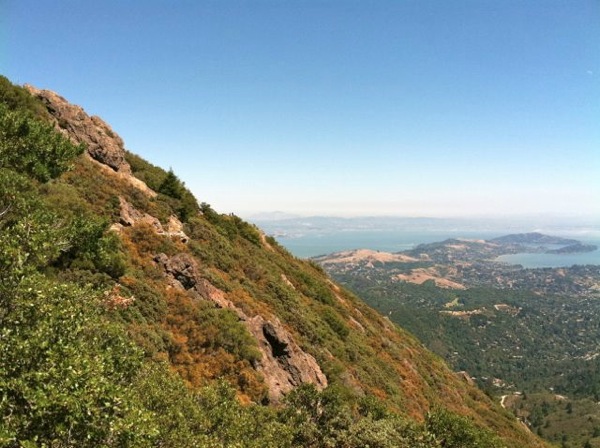
tam.jpg
Looking east from the Temelpa trail, Mt. Tamalpais
THE FIRST STRENUOUS WALK of the year, far too long delayed: from Mountain Home, on Panoramic Highway in Mill Valley, up the old railroad grade past West Point Inn and on up to the East Peak; then down through the garrigue on the Temelpa trail to various fire roads and so back to the starting point.

I think this took about four hours or so all told, plus a half hour nibbling and resting at the summit. Glorious views, but of course hardly any can really be photographed.

The fire roads, and the old railroad grade, are comfortable but not terribly interesting walking: but they give fine views, especially over the luminous greys of fog out toward sea. There was too much haze to see much distance: in this photo you can barely make out Mt. Diablo to the east. The narrow Temelpa trail reminded me often of walking in Alpes de Provence, except that the smell is completely different. Is the oregano and thyme and lavender in the Provençal garrigue, I wonder, feral escapees from Greek gardens of 2500 years ago? Will the same happen here, a thousand years hence?

Friday, September 19, 2008

Time-Based Art

LAST WEEK IN PORTLAND we attended three events in PICA's Time-Based Art festival. PICA is the Portland Institute for Contemporary Art; "time-based art" is, well, art whose perception requires the passing of time, I guess; what art would that not be?

Not to be snide: it is of course art whose point, or much of whose point, is the awareness of the passing of time. I think I first started thinking about this on learning about Japanese traditional art forms, especially the Noh theater; soon enough this was associated with the music of John Cage and, especially, Morton Feldman.
Well, anyway, PICA has been running a festival of Time-Based Art for a number of years now, and the festival was on last week while we were visiting that fascinating city. After more than twenty years of retirement I still prefer not to go to performances or galleries casually, and I hadn't planned on going to any of these. But three events were irresistible.

On Saturday we tagged along with Khris Soden on his Portland Tour of Tilburg. We and about thirty other people followed him as he led us, walking backward most of the time and holding a little paper Dutch flag aloft, along forty blocks or so through downtown Portland. Along the way he discussed the buildings, sculpture, fountains and streets we were "seeing" — "seeing" in quotes because while we were looking at Portland he was describing Tilburg, Netherlands.

Some of us had booklets of photos of the described places (some of them) in Tilburg. They were helpful, I suppose, but soon enough I was more interested in the cognitive dissonance between what I was actually seeing and what I was hearing being described. It helped, of course, that I'm quite familiar with the generic appearance of Dutch cities; their parks, traffic, cafés, shops, architecture, and the like — even though I am not at all familiar with Tilburg, a fairly large city in Brabant, the part of the Netherlands I know the least.

Today (Friday, Sept. 19) my granddaughter Grace is taking Soden's tour of Portland in Tilburg; I wish I could have been with her. What Soden does is part sculpture, part walking, part dance; wholly active, wholly contemplative. I'll be thinking about it for a while.

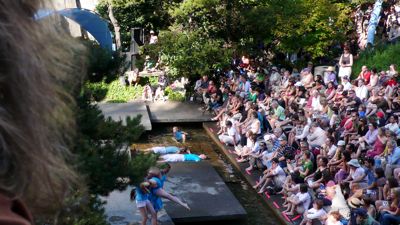
SUNDAY WE ATTENDED an event that was pure Dance, The City Dance of Lawrence and Anna Halprin, with choreographers Linda K. Johnson, Cydney Wilkes, Linda Austin, and Tere Mathern, writer Randy Gragg, and the Third Angle New Music Ensemble, a dozen or so musicians, playing music by Pauline Oliveros, Morton Subotnick, and Terry Riley.

P1040113.jpg
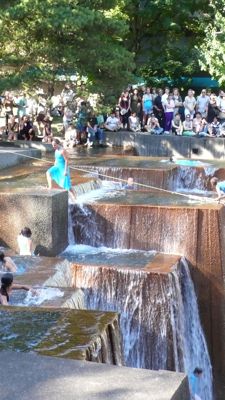
Probably a thousand people gathered at the first site to watch two corps of dancers in what amounted to a proscenium situation at Ira Keller Fountain Park. Morton Subotnick's electronic music surrounded the dancers and audience; many of us looked on from behind, or alongside. Toward P1040114.jpgthe end ropes were thrown down over the lips of the cascades and dancers climbed them to the lips of the upper fountains, where they threw themselves into the pools; dance and athletics have rarely been so beautifully, so strikingly combined — and in a setting that also includes terrain, plantings, and the audience awareness of itself as participant.
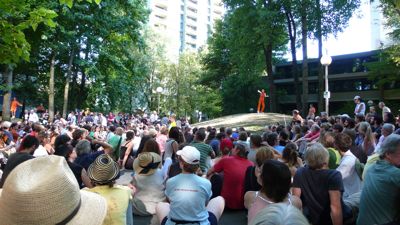
P1040118.jpg

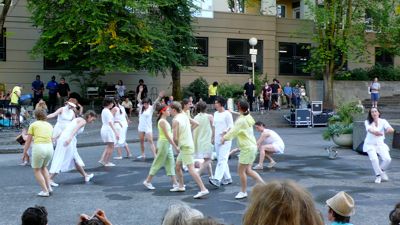
From here, a number of ushers quietly and tactfully guided the audience to the next stop, Pettygrove Park: three fairly small circular berms set among broad-leaved trees. No fountain; just quiet land and trees. Musicians — flute, clarinet, trumpet, French horn, violins, viola, cello, bass — were scattered widely within the landscape, and dancers appeared, holding positions, then coming to life. The music was by Pauline Oliveros, and it was delicious. Hearing unpredictable but logically appearing sounds, from conventional instruments conventionally played, in an outdoors public space, is one of the great pleasures of civic musical life: it binds the audience together with itself, its community, and the traditions of its culture. And seeing the music punctuated and "interpreted" — not only the music, but the park setting as well — knits all these factors together.

At Keller Fountain we'd been on the extreme margin of the audience, hardly able to see the dancers; here we were at the center, the dancers on their berms around us; Pauline's music, with occasional called-out words and phrases from writings of Lawrence Halprin, somehow both floating and focussing the audience into a gentle fabric of urban sound. Distant traffic and more local natural sound contributed, as did uncontrollable small motions within the audience.

P1040123.jpg
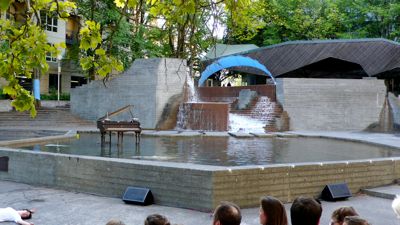
We were led next to Lovejoy park, where an ornate grand piano stood in water up to its ankles in a broad, flat pool. Once again the audience had moved into the arena before the dancers, but they soon appeared, by ones at first, then the entire company. As before, the choreography was an homage to Anna Halprin, the seminal San Francisco dancer whose "task" dances, like the great Parades and Changes, had rewritten dance history in the 1960s.

P1040127.jpg

The music here was Terry Riley's, and before it was over a musician had waded to that piano and begun to hammer out the familiar octave "C"'s that begin his equally groundbreaking In C. Before the act was over dancers had taken to the back wall of the fountain, methodically splashing cupfuls of water against the concrete wall, claiming Action Painting as just another part of the entire, integrated mise en scène.

I found the entire event absolutely exhilarating. The Modernism of the 1960s retains its vitality, its optimism, its freshness: it lacks utterly the cynicism and cool detachment of the postmodernism of the present day. I'm almost sorry I'm no longer reviewing art for a daily newspaper: but, since I'm not, let me refer you to this review online: I couldn't do it any better.

ONE EVENT REMAINED: a screening at the Portland Museum of Art of Zidane, un portrait du 21e siècle , the 2006 film by Douglas Gordon and Philippe Parreno. Ninety minutes long, it is nothing more nor less than the entirety of the soccer game between Real Madrid and Villareal of April 23, 2005, "entirely filmed from the perspective of soccer superstar Zinedine Zidane," in the description at imdb.com. I found the film utterly fascinating and somewhat frustrating: you never really see soccer; you focus entirely on the persona of Zidane, who naturally spends much of the game physically relatively inactive while mentally entirely focussed and committed. When he does move, of course, he's definitive. Athletics and Dance fuse completely in this film, as they did in the Halprin homage; and when we left the theater I couldn't help breaking and running. Gotta dance.

Friday, August 15, 2008

Further on the long walk

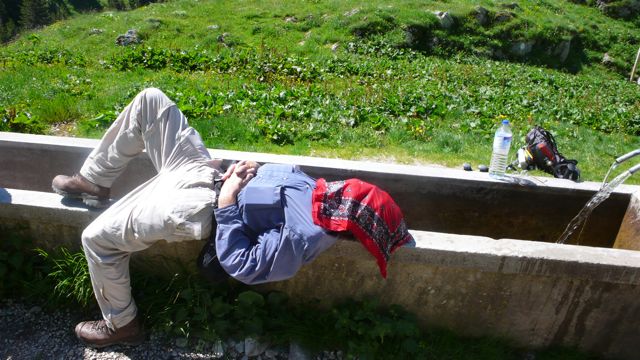
on the trough.jpg
photo: Henry Shere


PRELIMINARY STATISTICS, slightly revised:

Elevation change: 51,300 meters, roughly, or about 167,000 feet, which is about five and three-quarters Mt. Everests. But this is pretty rough, and could range up to 20% off either way. The average is 1,500 meters/day (4,760 feet/day) (Mt. St. Helena is 4,344 feet, 1,323 meters)

Distance: roughly 725 kilometers, or 450 miles. Averages: 21 km (13.6 miles) per day; 3 km (1.875 miles) per hour (rests included)

Time: about 245 hours on the trail (rests included) in 35 days of walking; five rest days.
Average: 7 hours/day; but some days were twelve hours long.

Weight lost: about 12 pounds.

Other oddity: One shoelace stretched two inches in length over the other (unless the other shrank two inches for some reason).

I'm writing about the trip, but doing it day by day, perhaps with a photo book in mind, like the one I did last year of our Dutch walk (The Lingepad). But it's tough writing; notes are scattered among a number of places; photo times are problematic; etc., etc.

Wednesday, June 11, 2008

Another day, another walk

eastside.jpg

IT'S SO BEAUTIFUL HERE. We think about that every day, of course. Gratitude is increasingly the most pressing order of the day's business, and we have much to be grateful for. Here you see, in the distance, the house Lindsey grew up in -- well: that she lived in from aetat. 14 to 22, not counting time out while attending college. It's on Eastside Road about three and a quarter miles north of our mailbox. (If you have Google Earth you can pinpoint it: 38°33'40.92" N 122°50'47.52" W; 95 ft. elevation.)

Fifty-odd years ago, when I first saw the place, it was in mixed production: 300 head of dairy cows or so; extensive prune orchards; hay fields and pasture. No grapevines. The vines in the middle right in this photo occupy the space of the family orchard: apples, plums, apricots, peaches. There were oranges near the house (that may be one there, now I think about it, below the gable).

Ten years before that there was the remains of a tennis court behind the house, beyond that huge satellite dish you can see: for at the turn of the century, the last century I mean, this was the Hotchkiss Ranch, the home of Helen Hotchkiss's parents. What? You haven't heard of her? She was perhaps the pioneering woman tennis player, the first, as I understand it from reading her memoir, to have thought of "playing like a man": that is, aggressively. She was a champ, and changed her world.

I walked past the old ranch, as we call it, today, on an eight-miler from our house in to Healdsburg. Eight miles = kilometers, two and a half hours walking, maybe fifteen minutes resting. Not bad for ninety-five-degree heat, but my feet hurt...

Sunday, June 01, 2008

Walking in the woods

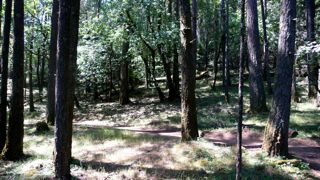
forest.jpg

ANOTHER SUNDAY HIKE, preparing for the long walk beginning later this month. Off we went, Mac and Henry and I, to a local state park, there to leave the car in a $4 parking lot and tackle a really nice hike. Much of it was among trees, Douglas fir for the most part. Since we were off in a distant end of the park, accessible easily only by paying to park, we had the trail pretty much to ourselves.

There was the occasional "mountain bike," which I confess to having gradually evolved a prejudice against; and two or three times we met a couple of equestrians. Somehow the horses, and their riders, are less irritating, less "unnatural," than the bikers. They're slower, for one thing, and considerably more visible.

We climbed and descended and strolled along fairly level stretches, among the forest, in open fields which would clearly have been marshland at other times, and conversed, and worked our feet. Lunch: bread, salami, apple, walnuts, dried apricots, cookies. Then more walking.

Turkeys, cougar scat, woodpeckers, Mariposa lilies, buttercups. Eight miles; four hours. A nice rehearsal.

Friday, February 15, 2008

Self-promotion

duivelsbos.JPG
Woods near Beek, Netherlands, from The Lingepad


STILL PREOCCUPIED WITH THE FLU and not ready to blog seriously, but I do want to mention two ongoing bits of business:

Walking in The Neth...
By Charles Shere

1) a new book, The Lingepad: Walking in The Netherlands, April 2007. Square format paperbound, 7x7 inches (18x18 cm), 176 pages, published February 10, 2008. Almost no text (surprise!), this is a sequence of photographs taken during our 100-mile walk across the center of The Netherlands last April.

2) my food blog Eating Every Day continues through thick and thin, sugar and salt, sickness and health...

Friday, February 01, 2008

Mountains

a FRIEND WRITES (well, actually a grandson)
One of the things I love so much about mountains is how much character they have, even though they are just geological formations. It's so strange how we can recognize different mountains just by glancing at them, while it would be much harder to do so for rivers, deserts, plains...
Mountains are events; rivers, deserts, and plains are processes, I think. Of course when you're actually climbing the mountain it's a process: but when you see it from a distance it's an object, an event at most.

Rivers of course are fluid and dynamic; even an apparently quiet one has great force. (Think of Charles Ives's Housatonic at Stockbridge.) Deserts and plains and broad river-valleys, like the one here with Eastside Road at its margin, are processes; they invite our motion as participant; one wants to move within them, to explore or, better, experience. But mountains are ambivalent: to an extent (and an extent that varies from one person to the next!) they invite our active participation; at the same time they warn us of their difficulties and dangers.

I haven't explored (!) the history of mountaineering; it's never been a subject of great interest to me. But my understanding is that it's a relatively recent history, at least within my eurocentric concept of history. It seems to date from about the time of the Enlightenment, when the spirit of scientific exploration, the advent of greater leisure (for some), and the suspension of superstitions (formerly regarding mountains and deserts sinister) coincided.

My own interests have tended more to the ambulation than effort, and at this point I doubt I'd have either the strength or the endurance for true mountaineering. There's not much I like better than walking through a landscape; we've walked hundreds of miles, Lindsey and I, contentedly carrying our necessities on our backs while counting on civilization for beds and meals. Climbing seems to me like an imposition of the self on the terrain, though I'm sure the true climber finds it much more a collaboration than an imposition.

Walking is a way of losing ego and mindfulness. Well, that's not quite right: it's a way of being mindfully mindless, to paraphrase John Cage ("purposeful purposelessness"): walking in Dutch forests or the French garrigue conduces full alertness to the pleasures of the environment while enabling near-total suspension of alertness to the physical process. Climbing introduces a new note, the awareness of effort. Ca grimpe, say the French: That's a climb.

Time to go to the gym and prepare a bit more! And then to add one more book to the pile awaiting reading (or in this case re-reading): Réné Daumal's Mount Analogue.