Wednesday, October 15, 2008

"Values," abstraction, accumulation, chaos

FOR SOME TIME NOW I've wanted to write about a fascinating book read last month, Nassim Nicholas Taleb's The Black Swan: the Impact of the Highly Improbable (New York: Random House, 2007). Alas, I read it from the library, and did not take notes; I won't write about it in any critical detail here. (There's an extended discussion of the book online.)
Briefly, it's Taleb's point that history is the litany of convulsive unexpected events punctuating daily predictability. (It occurs to me that The Blog is a convenient analogy.) The title refers to the scientific and philosophical certainty, going back to Aristotle, that swans are white, a black one being exceedingly improbable — a certainty convulsed by the discovery of black ones when Australia was "discovered" in the 17th century.
Taleb uses analogy and metaphor to propel his book, analogy and metaphor and above all humor; and he does this so well that one races through it where one should stop and consider, take note and perhaps demur.
Another bird metaphor intrudes: his Turkey Narrative. The turkey, according to Taleb, assumes that tomorrow will be just like today, someone will come and feed it as has happened every day of his life. The turkey does not suspect that final morning, when instead of being fed he'll be sent to slaughter.
As you might have suspected, The Black Swan is largely about Wall Street. It is also an assault on the idea of the Bell Curve, on the notion that Experts Are Infallible, on The narrative fallacy which, according to the Wikipedia discussion referenced above,
refers to our tendency to construct stories around facts, which … may serve a purpose, but when someone begins to believe the stories and accommodate facts into the stories, they are likely to err.

and on the division of information among the categories Known knowns, known unknowns, and unknown unknowns.
That last will sound familiar to those whose memories go back to the early days of the present Iraq war. I always thought in not amusing that Secretary Rumsfeld talked about "unknown unknowns"; it seemed a perfectly legitimate concept to me. Turns out that Nassim Taleb was a consultant, on occasion, to the Department of Defense. Indeed he writes, in The Black Swan, of a brainstorming session he attended in Las Vegas, of all places:
The symposium was a closed-doors, synod-style assembly of people who would never have mixed otherwise. My first surprise was to discover that the military people there thought, behaved, and ated like philosophers… I came out of the meeting realizing that only military people deal with randomness with genuine, introspective intellectual honesty—unlike academics and corporate executives using other people's money. … the military collected more genuine intellects and risk thinkers than most if not all other professions. Defense people wanted to understand the epistemology of risk. (p. 126)

TALEB REFERS TO HIMSELF as a "skeptical pragmatist," a phrase I like; and divides the world we live in into two mental constructs: Mediocristan, "the province dominated by the mediocre, with few extreme successes or failures," ruled by the bell curve; and Extremistan, "the province where the total can be conceivably impacted by a single observation," like that of the final arrival of the turkey-farmer. His book goes a long way to suggesting reasons for the institutional failure of the market this year, and indeed the statistical near-certainty that such failures will happen. Another publication, much smaller and less public, discusses a different philosophical approach to the problem: Money and the Crisis of Civilization, an essay by Charles Eisenstein published at Reality Sandwich, an online forum-magazine-construct so visually cluttered I haven't had the desire to explore it further.
I am impressed, though, with Eisenstein's essay (and thank Richard Burg for sending it to me). It explains the paper credit crisis very clearly (perhaps too simply, economists might object), and then comes to a startling conclusion. The entire affair is of course a gigantic Ponzi scheme (here again Wikipedia is entertaining): moreover, Eisenstein suggests, the entire history of capitalist economy is a Ponzi scheme, and the current crisis is another in what may be the death throes of capitalist economics as we've known it for the last century or so.
The startling conclusion is that Capitalism has very nearly eaten itself to death. The problem lies in the conversion of Things to Money. Money originated as a token of a pledge, an object to stand for the promise to pay in the future, with a service or a product, in return for a temporary loan symbolized by the token: a shell, gold, a slip of special paper, whatever.
Eisenstein recites the dismal litany of Things sacrificed, one after another in the several centuries of capitalist history, to the conversion into Money — which had gradually grown from token of delayed repayment to retained "Wealth":
Essentially, for the economy to continue growing and for the (interest-based) money system to remain viable, more and more of nature and human relationship must be monetized. …
The crisis we are facing today arises from the fact that there is almost no more social, cultural, natural, and spiritual capital left to convert into money. Centuries, millennia of near-continuous money creation has left us so destitute that we have nothing left to sell. Our forests are damaged beyond repair, our soil depleted and washed into the sea, our fisheries fished out, the rejuvenating capacity of the earth to recycle our waste saturated. Our cultural treasury of songs and stories, images and icons, has been looted and copyrighted. Any clever phrase you can think of is already a trademarked slogan. Our very human relationships and abilities have been taken away from us and sold back, so that we are now dependent on strangers, and therefore on money, for things few humans ever paid for until recently: food, shelter, clothing, entertainment, child care, cooking. Life itself has become a consumer item. Today we sell away the last vestiges of our divine bequeathment: our health, the biosphere and genome, even our own minds. This is the process that is culminating in our age. It is almost complete, especially in America and the "developed" world. In the developing world there still remain people who live substantially in gift cultures, where natural and social wealth is not yet the subject of property. Globalization is the process of stripping away these assets, to feed the money machine's insatiable, existential need to grow. Yet this stripmining of other lands is running up against its limits too, both because there is almost nothing left to take, and because of growing pockets of effective resistance.

WHICH LEADS ME TO the phrase in today's subject-line. I think of this latest crisis, the one centered on the Global Economy and its collapse (though no doubt to be set right temporarily by the infusion of money promised, yet again, by an unknowable Future), as more evidence that contemporary social life is accelerating itself to death. Matt Matsuda writes about this in his book The Memory of the Modern (Oxford University Press US, 1996):
One key, recurring word explains all: acceleration. Pierre Nora begins Les Lieux de mémoire under its sign: "The acceleration of History: let us try to gauge the significance, beyond metaphor, of this phrase. An increasingly rapid slippage of the present into a historical past that is gone for good, a general perception that anything and everything may disappear." As History accelerates, the "lieux de mémoire" are designated sites which defy time's destroyer, the places of commemoration where memory anchors the past. My studies, rooted in the biology, technologies, and political economy of the late nineteenth century are somewhat differently oriented: they attempt to approximate Henri Bergson's understanding of memory as action and transformation. In looking to shattered monuments, financial markets, high-seed machines, and the nervous system, my subjects are not the memories preserved from an accelerating history, but histories of accelerated memory, subjected to the dramatic rhythms of an age.

(Think of Francis Ponge's note, in Soap, that that (French) literary device the momon is typical of late historical eras in which rhetoric, dying, turns on itself; Ravel's La Valse is a good example.)
If we're indeed in a "downhill slide," acceleration is as inevitable as gravity; putting on Henry Paulson's brakes will generate a lot of heat, very little light, and only somewhat slow the collapse of the monetary economy. So what should we do? In Taleb's words,
Snub your destiny. … You stand above the rat race and the pecking ordere, not outside it, if you do so by choice.
Quiting a high-payiing position, if it is your decision, will seem a better payoff than the utility of the money involved… (p. 297)

And in Eisenstein's:
Individually and collectively, anything we do to resist or postpone the collapse will only make it worse. So stop resisting the revolution in human beingness. If you want to survive the multiple crises unfolding today, do not seek to survive them. That is the mindset of separation; that is resistance, a clinging to a dying past. Instead, allow your perspective to shift toward reunion, and think in terms of what you can give. What can you contribute to a more beautiful world? That is your only responsibility and your only security. The gifts you need to survive and enjoy will come to you easily, because what you do to the world, you do to yourself.

I THINK IT'S OUR endless tendency to evade the immediate that gets us into trouble, whether the evasion is prompted by boredom, distaste, laziness, or greed. It has something to do with our apparently also innate tendency to abstract and generalize, to categorize. Obviously it's useful to do that; it makes it possible to sort things out, to lay things aside for future use, to communicate concepts effectively (if not always truthfully) by using analogy and narrative. The problem is that it's so easy to forget that that's what you're doing, that you're dealing with not the thing but the idea of the thing. The Industrial and postindustrial ages have accelerated the extend to which the concept, the idea, has displaced the thing, the real. Profit-based economy is in a state of near-terminal confusion about this, generating commodities sold and bought for their code value, conceiving and generating services serving artificially generated needs.
When Senators Obama and McCain are asked what they will do about the economy they tend to talk about taxes, bailouts, jobs, mortgages: all of them very important politically. Lately Obama has also been talking about government kicking the economy by addressing infrastructure repair, which sounds a lot like a WPA effort: if so, good, say I: that was an triple effort aimed at improving the economy, employing the out of work, and providing for the community.
In the last analysis much of what I've been calling vaguely "the problem" results from the detachment of details from the context in which they exist. Money from an economy; concept from a reality; profit from an exchange; individuals from society. And, increasingly, it seems to me that this kind of detachment grows exponentially — accelerates, in fact — in a society whose numbers increase unsustainably, resulting in greater pressures of various kinds, and the temptation to turn against one's society, one's community, for sheer survival (as one thinks), rather than to trim one's individual sails, turn away from the accumulation of wealth, and take an appropriate place within the world as it is.
As the turbulence accompanying this process, and generated by it, continues, the things that truly matter to life, liberty, and the pursuit of happiness are overcome by an accelerating accumulation of complexity leading to chaos. I hope the next Administration will think about these things. Perhaps the Department of Defense can give the departments of the Treasury and of Health and Human Services some pointers.

Wednesday, October 08, 2008

The Late Mattia Pascal

LAST MONTH, CASTING ABOUT for a book to read while visiting in Portland I picked up an early novel by Luigi Pirandello, whose short stories entertained me fifty years ago or so, and whose plays have always fascinated me — though opportunities to see them actually produced have been far too rare.
(An important exception to that was The Imaginists's Tonight We Improvise, seen in January 2007 in a marvelous production.)
I hadn't read his novels, though, and was unprepared for this. Written in 1904, preceded by at least two earlier novels, The Late Mattia Pascal is clear, entertaining, thoughtful, nostalgic, as complex as you want to make it, accessible, and a quick read. I won't give you the plot; you can find it summarized here: it's enough to report that Mattia Pascal has the luck to be found dead even though he is in fact on what Algernon Moncrieff called a Bunbury. The novel concerns events as they play out during Pascal's second life, and climactically as he returns to the scene of his apparent suicide.
I suppose it's only because of the time and place their authorship shares, but The Late Mattia Pascal made me think of Italo Svevo's novels and plays, and of Alberto Moravia's novel Gli indifferenti; there's a similar meticulous lassitude, shared by Pirandello and his character I think. The precision of Pirandello's descriptions of Pascal's awareness is really quite wonderful; you might think of Henry James, but a very efficient James.
William Weaver's translation seems fluent and expressive, placing the novel in its time but holding the 21st-century reader's attention. I'm sorry I now have to return the book…
Luigi Pirandello: The Late Mattia Pascal. Translated and with an introduction by William Weaver. 1995: Marsilio Publishers, New York

Does he really want to win?

WATCHING THE PRESIDENTIAL DEBATE tonight, and thinking about it afterward, I suddenly begin to think it's possible McCain doesn't really want to win the election — or at least doesn't really care that much about losing. Do you remember his saying at one point that he'd rather lose an election than sacrifice a principle? (I paraphrase; I don't have an exact quote at hand.) Clearly he would have had to have gone on the attack in the debate to reverse his ebb in the recent polls, and he's stated at various times that he wasn't going to engage in that kind of campaign.
I think that statement was not disingenuous, even though his campaign, if not he himself personally, has turned to character attacks — certainly his vice-president pick, Sarah Palin, has done that. But in the debate tonight, McCain really didn't. I think he can't bring himself to that kind of conduct in live real time, and of course the physical presence of Obama would have had a sobering effect.
Don't get me wrong: I don't think McCain's any better a man than he needs to be, and I certainly don't give him points for consistency, let alone fidelity to principle. But I wonder if, faced with the recent polls, the overwhelming economic disasters, the difficulties shaping up on the international front, and his age and perhaps his physical condition, he doesn't really mind not winning. Perhaps his main point all along was to revise and reshape his party, not to be president. Perhaps he came to some kind of awareness when he told his party he wanted Joe Lieberman for vice president, and the party told him no. Perhaps the Palin choice was a challenge, not to the Democrats, but to the Republicans.

Monday, October 06, 2008

Further on flarf

FLARF IS A WORD new to me; I found it yesterday, in the course of reading further, among the many comments posted to Ron Silliman's blog, about Issue 1, the huge "anthology" of "poems" that included one attributed to me. One of Ron's commenters referred to it as a "fauxthology," a word I like.
"Flarf" apparently refers, originally, to a specific kind of writing: poems — let's beg that question for the moment — generated by a computer routine that trolls the Internet for source material and then, using various algorithms, chops up the material it finds and reconfigures it into lines with the appearance of poetry.
There's lots to like here, beginning with the neat trick by which the figurative "net" of the Internet is used to sieve material on the Internet.
Recursiveness. Matt Matsuda, I think it was, suggested that our culture like all previous cultures will die of acceleration: but our own culture's death will result, I think, from an accelerated recursiveness, and flarf may be a straw in the wind.
In any case it's a procedure with an honorable source going back to the cut-ins of William Burroughs and, beyond them, to the "random" generation of literature by Marcel Duchamp, of art by Hans Arp. It's inevitable that the literature of our time would be spelled with the double "l" of litter; Joyce got to that one in Finnegans Wake.


Flarf is automated Oulipo, and that's a contradiction in terms; surely any real Oulipo outcome must proceed from deliberateness. Perhaps the ouvroirs of potential literature — or should it be translated "literary potential"? — are taking over the consciousness of the workers within; perhaps that's what interconnected computers are doing to us all.
Fine with me: let bots do their mindless thankless work all they like; if some of the result is amusing, or poignant, or possibly even provocative, so much the better. But there's more to this affair than simply flarf.

Issue 1 has resulted in metaflarf by activating a sizable community; many of its 3,164 "contributors" are apparently readers of Ron's blog, or have been mentioned in it; and the sixty-odd comments that have appeared so far on his complaint about the fauxthology amount to flarf criticism, in both senses of the term.

While I've never been a fan of the concept "intellectual property," which sounds to me like a contradiction in terms, there are two things about a completely open public domain that bother me. One is the possibility of one's own work being forwarded or distributed inaccurately — with errors, whether deliberate or not, attributed to one's original work. The other is the possibility of one's own name being attached to things one has had nothing to do with, as is the case with Issue 1.

In this case, or at least in my own case, no harm done: no one would remotely think of me as a poet, or of the "poem" reproduced here yesterday as something I would or might have written. But if I were a poet, as Ron Silliman (to name only one of the thousands of "contributors") is a poet, then a casual reader may easily have made that mistake, and formed an opinion of the poet completely outside the poet's ability to influence. This, it seems to me, is an intolerable situation; it goes beyond hoax in the direction of fraud.
So I revise my feeling of yesterday that Ron goes too far in his anger with this event. His outrage is justified, and the perpetrators of the event can't be excused with the explanation that their work is art. I've never before been comfortable with the idea that artists, however outrageous their work may seem, are hoaxers. But then I've never before had to deal with anything quite as postmodern as this event seems to be.

Sunday, October 05, 2008

Charles Shere, poet

I have written a new poem, as follows:

An ardent point

Supernatural as a point, more supernatural than evolution
Natural as an organism, more natural than development
Natural as an access, more natural than disputation
Natural as a point, more natural than stage

Perturbation on a forest and rare
       science, fair in
            news and privacy
Rarely simplifying, condemning, tottering
       slowly at a kindly crumb
What if she should have
       known at night?

Approached and got
She reached for timidity
Ardent as point, more ardent
       than nightfall

She vanished the point
       and pointed to the approach

Knew and ignored
Came and went


Well: I didn't write this, of course; I suspect it was generated artificially; it doesn't look like a poem that a conscious human would have written.
It appears online in an "anthology" called Issue 1, a 3785-page .pdf file containing poems attributed to 3,164 different writers. I found out about this over at Ron Silliman's blog, a daily reading that has provided me quite a lot to think about over the months.
Ron's in a dudgeon over this, and I can see his point: he's a professional poet, and annoyed at seeing something attributed to him that he certainly never wrote. It's even more automatically synthesized than the one I've reproduced above. The first four lines:
Lost as food and won as a coast
Inefficient as a corner and efficient as a recess
Lost as balance, won as a time
Lost as a coast and found as a recess

You can see the similarity of form in the openings of these two "poems." I don't know if others in the anthology are similarly generated; I haven't looked. There are enough books around here I haven't read that I want to read that I don't have to spend more time on this anthology.
But it's interesting, I think, that someone has programmed a computer to do all this, and to post the result on the Internet, and as a .pdf file: why's he doing it? And where did he get those 3,164 names? And what made him think I'm a poet?

Friday, September 19, 2008

Time-Based Art

LAST WEEK IN PORTLAND we attended three events in PICA's Time-Based Art festival. PICA is the Portland Institute for Contemporary Art; "time-based art" is, well, art whose perception requires the passing of time, I guess; what art would that not be?

Not to be snide: it is of course art whose point, or much of whose point, is the awareness of the passing of time. I think I first started thinking about this on learning about Japanese traditional art forms, especially the Noh theater; soon enough this was associated with the music of John Cage and, especially, Morton Feldman.
Well, anyway, PICA has been running a festival of Time-Based Art for a number of years now, and the festival was on last week while we were visiting that fascinating city. After more than twenty years of retirement I still prefer not to go to performances or galleries casually, and I hadn't planned on going to any of these. But three events were irresistible.

On Saturday we tagged along with Khris Soden on his Portland Tour of Tilburg. We and about thirty other people followed him as he led us, walking backward most of the time and holding a little paper Dutch flag aloft, along forty blocks or so through downtown Portland. Along the way he discussed the buildings, sculpture, fountains and streets we were "seeing" — "seeing" in quotes because while we were looking at Portland he was describing Tilburg, Netherlands.

Some of us had booklets of photos of the described places (some of them) in Tilburg. They were helpful, I suppose, but soon enough I was more interested in the cognitive dissonance between what I was actually seeing and what I was hearing being described. It helped, of course, that I'm quite familiar with the generic appearance of Dutch cities; their parks, traffic, cafés, shops, architecture, and the like — even though I am not at all familiar with Tilburg, a fairly large city in Brabant, the part of the Netherlands I know the least.

Today (Friday, Sept. 19) my granddaughter Grace is taking Soden's tour of Portland in Tilburg; I wish I could have been with her. What Soden does is part sculpture, part walking, part dance; wholly active, wholly contemplative. I'll be thinking about it for a while.

SUNDAY WE ATTENDED an event that was pure Dance, The City Dance of Lawrence and Anna Halprin, with choreographers Linda K. Johnson, Cydney Wilkes, Linda Austin, and Tere Mathern, writer Randy Gragg, and the Third Angle New Music Ensemble, a dozen or so musicians, playing music by Pauline Oliveros, Morton Subotnick, and Terry Riley.

P1040113.jpg
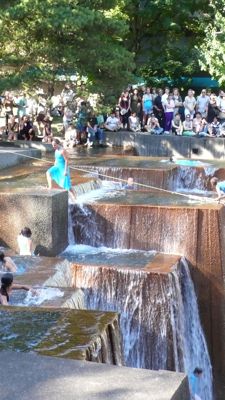
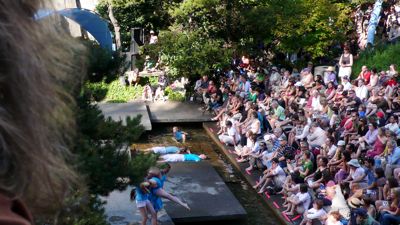
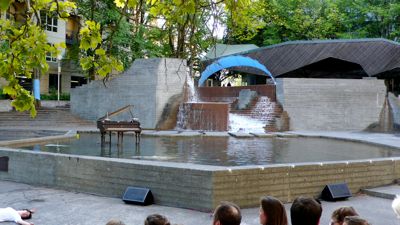
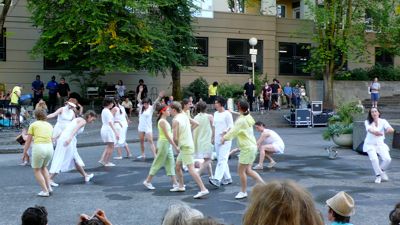
Probably a thousand people gathered at the first site to watch two corps of dancers in what amounted to a proscenium situation at Ira Keller Fountain Park. Morton Subotnick's electronic music surrounded the dancers and audience; many of us looked on from behind, or alongside. Toward P1040114.jpgthe end ropes were thrown down over the lips of the cascades and dancers climbed them to the lips of the upper fountains, where they threw themselves into the pools; dance and athletics have rarely been so beautifully, so strikingly combined — and in a setting that also includes terrain, plantings, and the audience awareness of itself as participant.

P1040118.jpg

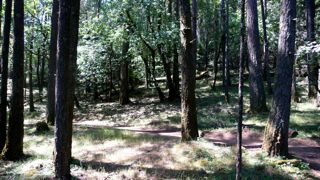
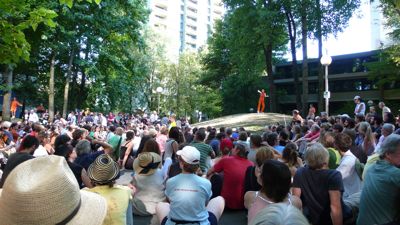
From here, a number of ushers quietly and tactfully guided the audience to the next stop, Pettygrove Park: three fairly small circular berms set among broad-leaved trees. No fountain; just quiet land and trees. Musicians — flute, clarinet, trumpet, French horn, violins, viola, cello, bass — were scattered widely within the landscape, and dancers appeared, holding positions, then coming to life. The music was by Pauline Oliveros, and it was delicious. Hearing unpredictable but logically appearing sounds, from conventional instruments conventionally played, in an outdoors public space, is one of the great pleasures of civic musical life: it binds the audience together with itself, its community, and the traditions of its culture. And seeing the music punctuated and "interpreted" — not only the music, but the park setting as well — knits all these factors together.

At Keller Fountain we'd been on the extreme margin of the audience, hardly able to see the dancers; here we were at the center, the dancers on their berms around us; Pauline's music, with occasional called-out words and phrases from writings of Lawrence Halprin, somehow both floating and focussing the audience into a gentle fabric of urban sound. Distant traffic and more local natural sound contributed, as did uncontrollable small motions within the audience.

P1040123.jpg
We were led next to Lovejoy park, where an ornate grand piano stood in water up to its ankles in a broad, flat pool. Once again the audience had moved into the arena before the dancers, but they soon appeared, by ones at first, then the entire company. As before, the choreography was an homage to Anna Halprin, the seminal San Francisco dancer whose "task" dances, like the great Parades and Changes, had rewritten dance history in the 1960s.

P1040127.jpg

The music here was Terry Riley's, and before it was over a musician had waded to that piano and begun to hammer out the familiar octave "C"'s that begin his equally groundbreaking In C. Before the act was over dancers had taken to the back wall of the fountain, methodically splashing cupfuls of water against the concrete wall, claiming Action Painting as just another part of the entire, integrated mise en scène.

I found the entire event absolutely exhilarating. The Modernism of the 1960s retains its vitality, its optimism, its freshness: it lacks utterly the cynicism and cool detachment of the postmodernism of the present day. I'm almost sorry I'm no longer reviewing art for a daily newspaper: but, since I'm not, let me refer you to this review online: I couldn't do it any better.

ONE EVENT REMAINED: a screening at the Portland Museum of Art of Zidane, un portrait du 21e siècle , the 2006 film by Douglas Gordon and Philippe Parreno. Ninety minutes long, it is nothing more nor less than the entirety of the soccer game between Real Madrid and Villareal of April 23, 2005, "entirely filmed from the perspective of soccer superstar Zinedine Zidane," in the description at imdb.com. I found the film utterly fascinating and somewhat frustrating: you never really see soccer; you focus entirely on the persona of Zidane, who naturally spends much of the game physically relatively inactive while mentally entirely focussed and committed. When he does move, of course, he's definitive. Athletics and Dance fuse completely in this film, as they did in the Halprin homage; and when we left the theater I couldn't help breaking and running. Gotta dance.

Shameless self-promotion

LISTENING TO CAGE, by way of his Thirty Pieces for Five Orchestras, made me think to check out Feldman, so I went to E-Music to download his Coptic Light. Hearing that made me think of my own Nightmusic, so I put it on next. I'd forgotten how nice it sounds.

Googling it I discover it's available from Audiophile, with the Oakland Symphony Youth Orchestra conducted by Kent Nagano — to my knowledge Kent's first recording. (It was released in 1982.)
07BBFF15-DDAA-4BFE-AEB8-CC31F41813DF.jpg


I wrote the piece forty-one years ago, I suddenly realize, on looking at my account of it over at shere.org. As recorded, it's a bit over 24 minutes long; quiet; mostly consonant.

Friday, September 12, 2008

Ashland 4: Two American Classics

Portland—

WE SAW SEVEN PLAYS in six days last week at the Oregon Shakespeare Festival in Ashland, only once having to squeeze in two performances on a single day. I've told you about the Shakespeare: here's a roundup of the remaining three. I won't go into details; click on the play-title links for OSF's webpages (casts are available there by clicking "Artists").

Thornton Wilder's Our Town is a classic, of course, stripping away all but the irreducible generic from its portrait of small town USA, turn of the previous century. There are those who no longer find it relevant; who think of it as simple-minded and sentimental. I'm not one of those; Chay Yew apparently was -- until he reread the play on being asked to direct it here in his OSF debut.

To my taste the overall success of this production is muted for much of its duration. Played in the outdoor Elizabethan Theater, it lacks two kinds of intimacy it would gain indoors: the stage is too apparent within its setting, but the audience, concentrating on that stage, loses contact among itself. I think Our Town is almost a community meeting; it profits from being shared by an audience aware of itself as part of the Grover's Corners community. Our Town, summoned up by its Stage Manager and playing almost entirely without props or sets, is meant to engage, even enter, the collective consciousness of its audience; for that to work, the audience needs to be aware of itself as a group. The darkness of the Elizabethan Theater audience makes that very difficult: the evening is like a nostalgic family snapshot, sixty years old, printed with far too much contrast, losing informative details in the dark.

But this production was evenly cast, beautifully narrated, nicely scaled; and it closes very effectively, melting away the specificity of individual life into the beautiful and reassuring inevitability and permanence of the future collective history that is death. I think it a magnificent play, and probably particularly one to see during a presidential campaign.

Arthur Miller's A View from the Bridge is another American classic, another essay on family and commmunity, another play with immediate political relevance. Staged in the (indoors) Angus Bowmer Theatre, it filled the wide stage with realism and action equally effective at presenting the exterior — dockside Brooklyn and its Italian-immigrant community in the late 1940s — and the interior — family life; psychological drama; challenge, defeat, and retribution.
Where Our Town is a philosophical romantic comedy, A View from the Bridge is a full-fledged Greek tragedy, lacking only the unity of time (it represents several months, not a single day, in the running its infernal machine).

For a number of years Miller's been consigned, I think, to a dusty corner of American theater. Setting his plays on specific American history — Italo-American Brooklyn, Puritan witch-hunt, middle-America traveling salesman — seemed to date him. But he wrote for his immediate present, couching the political issues that concerned him in parables his immediate audience would recognize. If the next generation lost interest, the one after that sees the universality, or rather the again timely, in this work. We continue to need it, alas.

Luis Alfaro's Breakfast, Lunch and Dinner is another matter. In Alfaro's words "a comedy about serious things," it concerns a woman who continues to eat, to inflate, finally to change utterly. Her own journey is set within the distractions of her family — a two-dimensional husband, a nymphomaniacal sister — and two rather undeveloped outsiders: her sister's cop boyfriend and an enigmatic Chinese woman met at a fat farm.

The production is well acted. (We saw an understudy, Kate Mulligan, in the lead role; she was absolutely first-rate.) In fact, I'd say the actors do more with the roles than the playwright has given them; credit has to go to Tracy Young's direction, too. But the production rides on a gimmick of stage mechanics* that ultimately becomes tiresome, turning Alfaro's "magic realism", I think, into bogus magic. I kept thinking there was a play here, somewhere, in fact; but that despite everyone's best intentions and efforts it never quite emerged; it floated away.

*Since writing this I've learned that the second act has been restaged and that "gimmick" — a flying harness — has been eliminated from the production. After two months, it became too much physical strain for the actress; presumably this is why we saw an understudy in the role.


at the Oregon Shakespeare Festival, Ashland:
Thornton Wilder: Our Town, running through Oct. 11
Arthur Miller: A View from the Bridge, through Nov. 1
Luis Alfaro: Breakfast, Lunch and Dinner, through Nov. 2

Thursday, September 11, 2008

That walk across the French Alps…

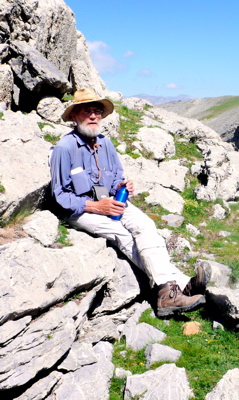
CS.jpgAS MANY OF YOU KNOW, I spent ten days in June and most of July walking from Evian-les-Bains to Nice with my grandson Henry and my friend Keith (Mac) Marshall. I'd intended to blog during that walk, but technology defeated me.
I have been writing about the walk, though, after the fact, in a third blog hidden until now. It's time to let it out: you can find it at Alpwalk.
It's a little rough around the edges, and like all blogs it has to be read from the most recent back to the beginning. Still, there it is, with a number of photos. Let me know if you like it.

Wednesday, September 10, 2008

Othello and Coriolanus in Ashland

Portland—

TWO DIFFICULT TRAGEDIES — difficult from the point of view of successful production, I mean, not posing intellectual difficulties for the audience — drew memorable stagings at the Oregon Shakespeare Festival this season. Unlike the two comedies this season, The Comedy of Errors and A Midsummer Night's Dream, Othello and Coriolanus were given fairly conventional, timeless and black-box settings; each served the text directly without overladen directorial interpretation, and each — like the comedies, for that matter — gained from quite strong casts.

Othello, staged in the outdoors Elizabethan Theater, was so powerful I decided, on leaving the performance, never to see it again. It just won't be necessary, not unless a personal friend's in the production. With no other stage décor than strip lights and an occasional prop (including Desdemona's all-important bed) the production seeemed to be nothing but situation and language: the text is truly brought to stage, to life.

I haven't been crediting actors on this blog recently, feeling your ability to consult the credits online is good enough (since the acting here, with minor exceptions I may get to, is consistently first-rate). But this Othello is so brilliantly set on its three principals, and they are so responsive to both Lisa Peterson's directing and Shakespeare's text, that it would be unusually irresponsible to omit them.

Peter Macon (another OSF debut) is utterly commanding in the title role, growing from the proud but engaging hero of the opening scene to the obsessed yet tragically and oddly sympathetic villain of the climax. Dan Donohue is unusually complex as Iago, thoroughly villainous yet oddly retaining a few misgivings, ultimately as tragic as Othello, because as trapped by his own decisions, by the workings-out of a situation spun completely out of control. And Sarah Rutan was interesting and engaging, not merely vulnerable and wronged, as Desdemona.

CORIOLANUS WAS EQUALLY effective (and affecting) at a different pitch. Staged in the round in the New Theater, lacking proscenium and distance, its production seemed to involve the audience more intimately: it didn't matter that the Roman tribunes and the Volscian army were so few; their ranks were swelled by the audience.

Remarkably, we saw an understudy (Brad Whitmore) in the role of Menenius; one can't imagine the regular player (Richard Elmore) would have owned the role any better. More to the point, Danforth Comins brought as much nuance and credibility as possible to the title role; Michael Elich scaled the antagonist Aufidius nicely, bringing out the parallels to the Iago-Othello opposition in that other tragedy.
Robynn Rodriguez was the Volumnia, and especially in the first act (and especially with help from Deborah Dryden's marvelous costume design) easily projected the obsessive pride and purposefulness that ultimately brings down both her son and the Roman Republic.

If I may never see another Othello, I certainly won't easily pass up another Coriolanus. I've seen two others relatively recently: a weak production, four years ago, at A Noise Within, down in Glendale; and a remarkably good production, by an all-female cast, in the Healdsburg Plaza a few summers back. The play is remarkably resilient: perhaps it's a mark of its imperfectness that a "definitive" production is less conceivable for it than for Othello.

Shakespeare: Othello and Coriolanus, running at the Oregon Shakespeare Festival, Ashland, through Oct. 10 and Nov. 2.

Ashland: A Midsummer Night's Dream

Portland—
WE ENDED OUR WEEK at the Oregon Shakespeare Festival in Ashland with an aftenoon performance of A Midsummer Night's Dream, one of four Shakespeare plays we saw last week. I wish I could say this was one of the best productions I've seen: it wasn't. Like The Comedy of Errors it was a "concept" production, and it suffered more: where Errors was an out-and-out adaptation, this was simply relocated to unspecified but post-Hippie America, nudged over the top by its director (Mark Rucker, in his OSF debut), and thrown out of balance by reducing the central romantic quartet to nearly the clown status of the rude mechanicals.

But, hey, there's lots to like here, once you accept the director's premise. It's silly to grouse about such things; we in the audience aren't seeing Shakespeare, we're seeing this one production of one of his plays; and there's no point complaining that this production isn't another.

The play opens with a coup de theâtre: the fairies are Cockettes, their familiar Shakespeare songs thrown defiantly across the footlights (when they're not in fact within the audience itself) in Punk attitude. Theseus is a rich bored dude, vaguely between arriviste Trump and Vegas operator; Hippolyta is amused and only slightly resentful. Egeus is Hermia's mother, not father, but one can get past that easily enough.

It's the quartet that's constantly annoying. The roles are well taken — I refer you to the cast roster — but they're directed to clown it up. This minimizes the distance between them and the genuinely funny Pyramus-and-Thisbe troupe, which is bad enough: Shakespeare has invented a brilliant four-layer world in this play, and to my mind each layer needs its own distinct landscape.

And particularly the lovers. Their lines are among Shakespeare's most poignant, most poetic; and far too many of those lines are distorted by oddly pitched accent, uneven dynamics, and pointedly contradictory sight-gags. Hermia is funny, no doubt, as an upscale valley girl, but that doesn't mean Helena has to be loutish.

The result of all this is a Dream that succeeds completely with Oberon and Titania (and Puck); with Peter Quince, Flute, Snout, Snug, Starveling, and a fine funny Bottom. Maybe that's enough: the audience loved it.
Shakespeare:A Midsummer Night's Dream, running at the Oregon Shakespeare Festival, Ashland, through Nov. 2.

Sunday, September 07, 2008

The Comedy of Errors in Ashland

Ashland, Oregon—

SATURDAY: TWO PLAYS yet to see, one of them a Midsummer Night's Dream to which I don't quite look forward, having heard it's a bit too, well, revisionist in its "concept" production — we'll see tomorrow.

We've already seen one concept production, but it was so "conceptual" — that is, dominated by the producers' determination to impose their own extraneous unifying perspective onto Shakespeare's text — that it is in fact and proclaimedly an adaptation, and to my mind a successful one: a musical version of The Comedy of Errors set in "a town west of the Pecos" in a vaguely late-19th-century period.

Adapted by Penny Metropulos (who also directed) and with a score by Sterling Tinsley and lyrics by both (and additionally by Linda Alper, who also takes an important supporting role), the result seems laid onto the Shakespeare Festival repertory like a glove on a hand. It draws on the Festival's acting ensemble, its outdoor theater, even its history of Shakespeare productions (both "traditional" and revisionist), plays with them, profits from them, in a complex and rewarding way I haven't seen in a theater company since Berkeley Rep's self-examination Rep which ran its course back in the early 1980s, in the then-new thrust-stage theater on Addison Street, and then unfortunately disappeared so successfully I can't now find its author or production history.

This Comedy of Errors is so engaging and energetic it's impossible to complain about it. Tinsley's score, like much else in the production, pokes fun at itself as much as at other musicals; it incoporates familiar old hymns and folk-songs seamlessly with occasional Broadway-type ballads.

The text is basically Shakespeare; the lyrics of some songs are apparently right out of the Folio. (Cole Porter's "I Am Ashamed That Women Are So Simple", from his Kiss Me Kate adaptation of The Taming of the Shrew, came often to mind; this Comedy of Errors was probably inspired partly by that example.) The plot remains Shakespeare's, too, though it's delivered in a raucous, movie-influenced Wild West setting.

I won't "review" the performances or cite the cast; OSF's webpage does that well enough: the cast was evenly matched, the two sets of twins remarkably persuasive physically; and even the addition of a sort of interlocutor, in the form of a Mexican troubador, and a Chinese merchant so stereotypical that any concern with political correctness is overcome by kitsch comedy — even these elements do much more to serve Shakespeare than to betray him. I'd see this production again.
Shakespeare:The Comedy of Errors, running at the Oregon Shakespeare Festival, Ashland, through Oct. 12.

Friday, August 15, 2008

Further on the long walk

on the trough.jpg
photo: Henry Shere


PRELIMINARY STATISTICS, slightly revised:

Elevation change: 51,300 meters, roughly, or about 167,000 feet, which is about five and three-quarters Mt. Everests. But this is pretty rough, and could range up to 20% off either way. The average is 1,500 meters/day (4,760 feet/day) (Mt. St. Helena is 4,344 feet, 1,323 meters)

Distance: roughly 725 kilometers, or 450 miles. Averages: 21 km (13.6 miles) per day; 3 km (1.875 miles) per hour (rests included)

Time: about 245 hours on the trail (rests included) in 35 days of walking; five rest days.
Average: 7 hours/day; but some days were twelve hours long.

Weight lost: about 12 pounds.

Other oddity: One shoelace stretched two inches in length over the other (unless the other shrank two inches for some reason).

I'm writing about the trip, but doing it day by day, perhaps with a photo book in mind, like the one I did last year of our Dutch walk (The Lingepad). But it's tough writing; notes are scattered among a number of places; photo times are problematic; etc., etc.

Thursday, August 14, 2008

Eating every one of those days

A TENTATIVE LISTING of the meals (chiefly dinners) eaten during our Long Walk, June 20-July 28, and the week or so following while on vacation in Nice and the Netherlands; and then, to bring us up to date, the last few days here at home:
June 19 Amsterdam dinner at Marius: vitello tonnato, duck breast with vegetables, fruit and ice cream
June 20 Creusaz hotel l’Alpage: trout, pommes frites, salad
21 Dent d'Oche refuge: soup, grey beef, chocolate pudding
22 Chalet de Bise restaurant: soup, biot (Savoie sausage) and polenta
23 La Chapelle d'Abondance hotel: guinea fowl
24 La Chapelle d'Abondance tartaflette
25 Bassachaux refuge: chicken soup, tartaflette, tarte à myrtilles
26 Mines d'Or gite: gazpacho, poulet Basquaise
27 Samoëns restaurant: tartaflette
28 Samoëns restaurant: salad, lamb, crème brulée
29 Chalet d'Anterne refuge: nettle soup, pork loin, mashed potatoes
30 Chamonix restaurant: salade Niçoise
July 1 Chamonix restaurant: grilled lamb chops, peppers, tomato
2 les Contamines restaurant: bad unmemorable “Italian” food
3 Croix de Bonhomme refuge: soup, polenta Bolognese
4 la Balme refuge: spare ribs Coca-cola
5 Landry hotel: paté, boeuf Bourgignon
6 Col du Palet refuge: soup, biot and polenta
7 Val d'Isère restaurant: biot and polenta
8 Bonneval gite: stuffed zucchini, steak
9 Lanlesbourg hotel: Savoyard dalad, blancs de volaille
10 Bramans hotel: rabbit
11 Modane hotel: pork loin, crudités
12 Susa, Bardonecchia lunch: Canitna del Ponte, Susa: what? restaurant, Bardonecchia: gnocchi
13 Thabor refuge: lasagne
14 Plampinet gite: jambon melon, tartiflette
15 Briançon hotel: Caprese, boeuf brochette, salad
16 Villar-San. Pancrace gite crudités, chicken, rice, cheeses
17 La Chalp refuge: "Niçoise" salad, chicken, potatoes Dauphinois
18 Ceillac refuge: soup, poulet Basquaise, cheese, salad, strudel
19 Fouillouse refjuge: soup, chicken, mixed vegetables, salad, linzertart
20 Larche hotel: quiche, salad, chicken tagine, cheese, fruit
21 St. Dalmas hotel: Maigret de canard, cote de porc
22 Roya refuge: potato-pea soup, boeuf daube with pasta
23 Vacherie de Roure thick vegetable soup, ham with pineapple, risotto with eggplant, cheese, flan
24 St. Dalmas en Valbore restaurant:cheese feuilleté, colin, white rice with pistou, salad
25 Utelle apartment-residence: rissoles, salmon steak, crème caramel
26 Nice restaurant: Salade Niçoise
27 la Gaude party: grilled steak, salad, cheese. Dinner, restaurant: fish soup
28 Nice restaurant: lunch: socca. Dinner, restaurant: fish soup, salad
29 Nice: lunch, Menton, what? dinner, Nice restaurant: assiette Niçoise, Salade Niçoise, socca.
30 Nice lunch, San Remo: sandwiches. Dinner chez McKee: chicken curry.
31 lunch, l"Orée du Port: fish soup, moules. Dinner, Rendezvous des Amis, Nice: artichoke terrine, chicken fricasee in pastis with rouille, prune clafoutis.
Aug. 1 lunch, Restaurant As, Amsterdam: Steak tartare; dinner, restaurant in Apeldoorn: broth, freshwater fish, complex dessert.
2 lunch Hoge Veluwe: pannekoek. Dinner chez Elfring, Apeldoorn: what?
3 dinner chez Elfring, Voorburg: lasagne
4 dinner, Piccola Italia, Middelburg: insalata, spaghetti carbonara
5 dinner, hotel 't Schouwse Hof, Aalsmeer: beef bouillon, slibtong, salad, vegetables, potatoes, ice cream and berries
6 dinner in airplane: chicken with rice
7 dinner at home: Salade Niçoise
8 dinner at home: Salade Niçoise
9 wedding dinner: pulled pork, rice, beans
10 lunch at home: cheese and salad
11 dinner at home: sole, lima beans, salad
12 dinner at home: grilled steak, lamb chops, salad
13: lunch: half a pan bagnat. Dinner, Café Chez Panisse: figs with mint and arugula in crème fraîche, duck confit with figs.
14: lunch, Willi’s Wine Bar, Santa Rosa: roast marrow bones.
Oh: and in this period I lost about ten pounds!

Tuesday, July 29, 2008

Ending the Alpwalk

WE WALKED INTO THE SEA yesterday, ending our long walk across the French Alps.

Well, not really, of course; the boots have been too good to me to treat them that badly. I contented myself with a slight touch of toe to surf; then turned round and walked the three blocks to the flat we're crashing in.

The last day was a surprise to me: I'd expected anticlimax and hours of urban walking; but it was much nicer than that. True: we'd already seen the Mediterranean, and Nice. But the walk from Levens to Aspremont, while tiring because of heat and steep climbing, was in hills and forest: and the walk from Aspremont to Nice took us through surprising country, open and wild, only at the very end dumping us into the top suburbs leading then quickly down to Jean Medecin and the beach.

I'm at another French keyboard so will cite only a few preliminary statistics here -- at my own keyboard; eventually, I'll try to make some sense of this trip, with photos. In the meantime:

Distance: roughly 725 kilometers, or 450 miles
Time: about 210 hours on the trail (rests included) in 33 days of walking; 5 rest days
Averages: 21 km (13.6 miles) per day; 3.4 km (2.14 miles) per hour (rests included)
Elevation change: Haven't worked this out yet; but I've read the walk is the equivalent of four times up and down Mt. Everest; and I don't doubt it.

I took 1,787 photographs during the 38 days of the walk, so some editing will have to be done...

Now we rest two more days in and around Nice, and then fly to The Netherlands to join Lindsey who I haven't seen for 35 days, the longest we've been apart in 52 years!

Saturday, July 26, 2008

Nice, provisionally

Well we are here in Nice, but not quite: we haven't really finished the walk. Increasingly we find it hard to find a bed; and after 20 miles of walking, much up and down, a bed is a nice thing to find.

Today we reached Levens without too much trouble, but found the hotels, gites, and so on all full. Horse show in town.

What about next town; I asked the bureau touristique: also full. It's July; Brits and Nederlanders have filled the beds.

So we took the bus to Nice and crashed in a friend's flat. To,orroz is q dqy of reposem you see hoz this french keyboqrd is zorking:

Monday we take the bus back to Levens and finish the walk legitimately. I'll let you kknoz detqils lqter zhen the keyboqrd speqks english:

Thursday, July 10, 2008

Day 21: Bramans

WELL, WE DIDN'T GET FAR today. It's hot and a little humid and I think somehow being down here in a valley instead of up there in the mountains has somehow made a difference. We walked about five miles altogether; stopped to investigate an archaeological museum, stopped for lunch; and decided to stay at the hotel-restaurant for the night, the alternative being six hours more of walking, to Modane.

An interesting conversation with the hotel proprietor at tea this afternoon. We'd been to the grocery-post office whose sign said it opened at 2:30; but by four it still wasn't open. He shrugged. Around here, signs, they don't mean anything, people open when they're ready to.

Are we in Italy, I asked, or Provence? Worse, he said, we're here in Bramans; around here no one really has to do anything, the houses are empty much of the time; people from Netherlands, England, Paris, wherever, come live here for a few months until they're bored; then they go to Morocco or wherever. The towns are rich, but empty.

And it's bad for the people who really are from here; they aren't rich, but the town is classified as rich; so they have to make the best of it.

So it all becomes clear. These towns on the Arc valley in the Maurienne are hyped in the tourist machinery as "authentic" villages in the past; cars are asked to park on the outskirts; there aren't any neon signs or for that matter much street illumination; all that is just fine with me, but it's pretty artificial.

Of course it isn't really artificial at all. It's a logical way for a village to be: tranquil, clean, pretty. We could all wish our own villages to be so; and if more were, this would be normal, and the nagging feeling something's simply been staged for the benefit of a tourist economy would go away.

Most of the towns these last three days, Lanslebourg excepted, have been pretty small potatoes -- one church; one cafe, one hotel if any. Not too many people in the streets; perhaps it's just too hot. Getting from one town to the next has been fine; dirt roads through fields and forests for the most part; often thankfully in the shade.

Tomorrow we'll hit Modane, and from there take a train to Chiomonte for the day. Then it's up and at 'em: climbing back into the mountains for the push to the next big town of the walk, Briançon. I'll be glad to be back up there.

Wednesday, July 09, 2008

Lanslebourg

FIRST, A CORRECTION to the previous blog: as Thérèse pointed out, a better URL for the photos is here.

We are now in Lanslebourg, in the valley of the Arc, working our way quickly enough toward Modane. This excites me a little; from Modane we can easily take a train on a day off and cross into Italy to visit the town Lindsey's father was born in. I haven't been there since the winter Olympics, which undoubtedly changed things greatly, and I'm eager to introduce Henry to the town his great-grandfather came from.

The Arc valley is a lower variant of the GR5 that we're taking from Geneva (Evian, actually) to Nice; in a way, perhaps we're cheating a bit. I don't feel too bad about that, since we've already had plenty of climbing: the other day we actually climbed 5,762 feet in one day.

The Arc is billed, in a guidebook I'm using, as particularly interesting historically, for its authentic vernacular architecture and all that. Last night's stop was Bonneval-sur-Arc: a twin city with Les Baux en Provence. Like that village it seems quite inauthentic to me, very much a museum piece, artificial. But pretty enough; and far from the quality of the upper Savoyard places we've been in up to now.

Today's walk was perhaps 20 km and mostly flat, through fields and forest on dirt roads, very comfortable. Tomorrow will be similar: then after the Italian interlude we tackle higher mountains again, and longer days since the distances between refuges will be further. We'll see how that goes.

Tuesday, July 08, 2008

photos

You can see a few photos taken a week or so ago at

http://www.flickr.com/photos/14329090@N04/sets/72157606041033930/

Bonneval sur Arc

Bonneval-sur-Arc

We crested the highest pass we'll be on on this entire walk today, and it was remarkably easy. The Col d'Iseran is 2770 meters high, and we started from Val d'Isere, nearly 900 meters lower; once cresting it, we dropped 900 meters again, to this town, where we spend the night.

The col itself was a little disappointing, crowded with daytrippers in cars and on motorcycles, with an expensive souvenir shop-cafe and an interesting but unmemorable stone chapel.

But the descent! It took us through a narrow gorge, the torrent far below us at first. At one point the path was only a foot or so wide, with quite a drop to the torrent. Then we came out into a beautiful valley set about with a number of ancient stone "chalets," some of them being refurbished apparently for vacation or weekend use.

There's a lot more I'd like to write, but this blog is getting so confused, what with delays in posting and confusions with keyboards, that I'll stop with this.

If this post works out iti proves that the folding keyboard, Palm web access, and wifi can do the job. If so, I'll try to put some order into this thing.

Monday, July 07, 2008

Day 14: Refuge de la Croix-Bonhomme

A DAY OF RAIN, our first. Oh well. We left a nice cheap hotel in Les Contamines aty about 8 am, walking a delightful road along the bonnant river which had done considerable damage the day before yesterday (all this written some days ago). It was misty but we were drey, walking under trees. In good time we reached the baroque Chapel of Notre-Dame de la Gorge where a number of miracles have apparently been done.

Then we were on a Roman road. XCould this be the Via Alpina? It was steep, for the gorge really strts here, and is well paved with stone, much of it native and undisturbed; and it features a Roman bridge with a fine arch over an amazingly deep and vicious gorge.

The road was a bit of a scramble, and though we were still under foliage th emist was getting heavy. In another 45 minutes we came to a chalet, though, a house featureing a sort of cafe in what might have been its salon or living room, and here a handsome fellow fluent in Italian as well as Frency served us a fine pot of tea, and we lingered over it for a half-hyour.

Oustide it had begun to rain seriously. I'd already put my backpack raincover on: now I drewe on my rain-pants, and we slogged on up the Roman road, finally into quite exposed alpage pastures, to the refute at la Balme, where we had another pot of tea and delicious little tartelettes a myrtille.

From there, though, the walking grew difficult. We were still ascending, across fields braide with freshets, losing our way at one point, finally scrampbling up to a small hut where we cowered with a couple of Brits and a couple of Australians for half an hour.

Chocolate was passed around, desuotorey conversation attempted, and then out again into the rain, walking a traverse now most of the time thakfully instead of climbing, to the true col and, after an hour, our Refuge.

It's big and full. wwe sti at a long table and nurse mulled wine and look out at the mountains which come and go under their mists. DInner will be served in a few minutes, at seven, so I soon stop.

This was our 11th day of walking, and we may have hit our stride: we seem to be keeping up with the guidebook timetable. Today we walked 22 kilometers, just short of 15 miles. We climbed 1280 meters . In the walk to date we have gained and dropped about 14,000 meters, which is to say about 44,000 feet -- it hardly seems possible. We are presently at 8100 feet. And a little tired, but not much, and we feel great.

That written a couple of days ago. Yesterday we climbed 5762 feet, from Landry to the Refuge Pas de Palet, in nine hours walking. Today we're in Val d#Isere; tomorrow Bonneval sur l'Arc: I'll try to post from there.

Wednesday, July 02, 2008

Day 8, Samoens

IMAGINE TWO LITTLE dots on the "e" in Samoens, whose final "s" is silent. (Like the "p" in "swimming," my father used to say.)

The town is an old one, once considerably larger, then fallen on hard times, now rebounding thanks to tourism. More sports and souvenir shops than bakeries, always a troubling sign. But a nice town nonetheless.

It was here that Marie-Louise Cognac-Jay was born. She founded the Paris department store La Samaritaine. She made a lot of money, as you can imagine; and she put a lot of that back into her native town.

Especially notable is the garden she endowed, la .Jaysinia, small but elegant, part botanical garden, part arboretum, climbing a hill behind the main street. (Practically the only street, when it comes to cafes and businesses.)

There yesterday we noticed a tall thin rather elegant man, say in his fifties, a typically French-looking man I thought with an aquiline nose and piercing dark eyes. He was accompanied by a beautiful Asian woman, very stylishly dressed but not at all excessively, and a very pretty little girl.

When I first saw them he was seated in an armchair that had been carved out of the stump of a failed tree, the girl on his lap reaching up to kiss him, the wife standing by, camera in hand.

We struck up a conversation and the woman admitted she has secretly photograPhed Mac and me, telling her husband that I was him in twenty years. "I hope your next twenty years are as happy as my last twenty have been, " I told him; "with a wife like yours, I'm sure they will be."

They turned out to be Chinese, living in Yunnan; he's here on a professional tour; he's an ethnobotanist working on a project pooling genetic material of useful plants from all over the world. I told him that my mother was born in Shanghai; Mac told him his wife Margery worked as an antropologist in China.

La monde est petite, the French say with their brilliant originality; it's a small world. As we entered Samoens yesterday, Henry and I, in our automobile (commandeered on the road at Les Allamands), who should we find sipping her green tea in the covered market (active only on Wednesdays) but our Austrian, who we first met in the refuge at Bassachaux a few days back.

She travels with a ten-kilo pack containing a little fireplace, utensiles, change of clothing, and notebooks. She always prepares her own food, cooking it over the metal-pot firepit.

She doesn't carry water; just a wooden cup; and she never passes a source of water, trough or tap, without drinking a cup. She walks an hour and rests five minutes; walks four hours and rests one.

She can't weigh a hundred pounds, is slim, muscular, close-cropped, grey, just fifty, and incredibly strong and healthy. Also incredibly good-humored. She too had photographed us and promised to e-mail the result: when I gave her my card, "Oh, you're a writer," she said; "what do you write?"

"Whatever I like," I told her. "I write too," she said, "but books you wouldn't be interested in, about cats and dogs, and how to raise them, and such."

She should write about her walking, I thought; she has much to teach others.

We stay here today, resting up; our next day's walk apparently involves both snow and a ladder or two. I look forward to it.

Days 8-12, from Les Contamines

LONG TIME SINCE contact; sorry. And now once again I work on an unfamiliar keyboard at a slow connection.

The weather has been cooperative; the housing adequate. Today for example an easy walk of ca. 6 hours from Les Houche, reached by bus from Chamonix where we'd stayed two nights, to Les Contamines; a pretty tourist town: tomorrow we have a harder day to La Croix de Bonhomme.

Why two nights at Cha,onix; not my favorite town? Because the day before arriving there we walked a hard day: 10,000 feet of vertical displacement in twelve hours on the trail; two of which were resting.

There's so much to say about this trip: the people we meet, places we stay, the landscape which is truly splendid. Mostly, though, it's left foot, right foot; and I think often about verticality, and different ways of planting those feet, and different muscles, bones, and tendons. An anatomy lesson every ten minutes.

And how to walk on snow, wet stones, and so on; and the difference between walking on the level or down- or uphill; which you do up to about fifteen to twenty degrees; and climbing, which takes over next; and scrambling, my least favorite.

I'm sorry, too, that I'm not able to attach photos; not that photos would do this landscape justice. Much will have to wait for a more favorable technology. For now I just want to assure any who care that we are in as good health as before our beginning this walk; and undoubtedly stronger. But we have a way to go: we've only covered a fifth or so of the distance!

Friday, June 27, 2008

Day 5; 6; 7: Samoens

APOLOGIES FIRST: for the double send of the lqst dispqtch; qnd for the odd spelling here! I am using a French keyboard; and the sun is in my eyes:

From Chapelle dAbondqnce we walked rqther easily up through forest; past a fine waterfall; then scrambling up stony paths through woods and finally across snow patches to a col and down through alpages -- pastures peopled if that is the word by nice Abondqnce cows -- and ultimatlely to the Refuge de Bassachaux; where we had a nice roo, to ourselves overlooking the terrace: Good dinner; comfortable bed; fine breakfast.

Yesterday; day 6, oh; theres the commq*a; was a bit harder especially at the end. It began easily enough with a stroll along a flat dirt road leading to Switwerlqnd; cuckoos appropriqtely singing in the forests below the trail. Once across the frontier (nonexistqnt) we found a gite, alas not yet open; where a number of wo,en wwere preparing the opening twà dqys hence: wqshing tables (we were not allowwed to sit at them), wiping down telephone books (no kidding), and such. Uncomprehendingly we walked on past the Lac Vert and up to a col overlooking fine alpages; different cows here; flora too:

We met our Austrian *again, a young 50 very slender vegetariaqn and very strong and pleasant who hqs walked many trails and is preparing the aPPqlachian pacific crezt and rocky ,ountain: a brqve femme:

Then back into Franbce for q difficult descent through pasture on rutted stony trqil; stepping carefully and descending steeply; to the refuge mines dor - there really zere gold mines here: A fine room agqin and a nice dinner; also q ga,e of boules before dinner:

This ,orning rqther harder; cli,bing to a steep col; then dozn dozwn down to Samoens: where ze perhaps stay long enough to ,aster this da,n keyboqrd:

Donùt count on it

Tuesday, June 24, 2008

Day 4: Chapelle d'Abondance

Chapelle d'Abondance, June 24--

Let's see: where was I? Oh yes: up early yesterday to watch the cows brought in for milking. One man and three dogs invited them down from the flowery pastures to the milk-barn. All three dogs looked the same to me, black and white, border collies or whatever.

One was the one who always snapped at the water when you washed your handss or filled your bottle at the trough; very annoying. Another, apparently younger, was on a long rope held by the gardien; maybe he was in training.

The cows looked at me curiously, then turned back to their own path to the barn. They're red and white, short-horned, of the Abondance breed, established during the 19th century: there's a plaque telliing me all this here in town, with a nice statue in open ironwork of a cow.

Anyhow after breakfast we ascended the pasture without much trouble, stopping to rest now and then, and then came to Pas de la Bosse at 1816 meters. From there a fine view back over last night's chalet to the pass from which we'd descended yesterday -- I'm sorry I can't post photos from this folding computer! -- and a pleasant view forward: for there, in the distance, lay Chapelle d'Abondance and, I assumed, a hot bath.

But first the long descent, and just now those hurt far more than the climbs. At first it was easy enoough, on switchbacks on dirt cowpaths. Halfway down we made some kind of mistake and lost the path.

We had to bushwhack through vegetation reaching almost our knees, thick lush growth hiding stones and marmot-holes. This is hard on the ankles, but ultimately we rejoined the rutted switchback path, not that much better.

The vegetation! Dozens of varieties of wildflower: gentians, orchids, buttercups, trollius, wild rose, violets... and dozens more we don't identify. The fragrance is wonderful: it's like walking past a gigantic open honeyjar.

At the bottom of the steep descent we entered a forest of evergreens, leading to a place apparently being "developed" into summer chalet country; and then we walked down through a sort of educational nature reserve with panels describing tle local flora and fauna, finally coming to town.

We were hot, tired, footsore, and hungry, and stopped at th firs hotel: La Gentianette, I think. We showered and changed an went to the next hotel for lunch -- omelette fines herbes and a green salad for me -- and then relaxed. We have a swimming pool, a sauna, a Turkish bath, and a room with a nice balcony and A BATHTUB!

The town's a bit depressing to me; I see it as four or five fine old stone buildings surrounded by new stuff built in the last forty years, the transition from locally sustainable agricultural economy to globally dependent leisure industry. Judging by the number of cars in the lots, and the number of closed sporting-goods shops, the previous economy may return.

We're here for a rest day; tomorrow we resume the march. I've seen a number of GR5 walkers today, on our own stroll back from the supermarket a couple of miles down the road. There'll be company.

Day 4: Chapelle d'Abondance

Chapelle d'Abondance, June 24--

Let's see: where was I? Oh yes: up early yesterday to watch the cows brought in for milking. One man and three dogs invited them down from the flowery pastures to the milk-barn. All three dogs looked the same to me, black and white, border collies or whatever.

One was the one who always snapped at the water when you washed your handss or filled your bottle at the trough; very annoying. Another, apparently younger, was on a long rope held by the gardien; maybe he was in training.

The cows looked at me curiously, then turned back to their own path to the barn. They're red and white, short-horned, of the Abondance breed, established during the 19th century: there's a plaque telliing me all this here in town, with a nice statue in open ironwork of a cow.

Anyhow after breakfast we ascended the pasture without much trouble, stopping to rest now and then, and then came to Pas de la Bosse at 1816 meters. From there a fine view back over last night's chalet to the pass from which we'd descended yesterday -- I'm sorry I can't post photos from this folding computer! -- and a pleasant view forward: for there, in the distance, lay Chapelle d'Abondance and, I assumed, a hot bath.

But first the long descent, and just now those hurt far more than the climbs. At first it was easy enoough, on switchbacks on dirt cowpaths. Halfway down we made some kind of mistake and lost the path.

We had to bushwhack through vegetation reaching almost our knees, thick lush growth hiding stones and marmot-holes. This is hard on the ankles, but ultimately we rejoined the rutted switchback path, not that much better.

The vegetation! Dozens of varieties of wildflower: gentians, orchids, buttercups, trollius, wild rose, violets... and dozens more we don't identify. The fragrance is wonderful: it's like walking past a gigantic open honeyjar.

At the bottom of the steep descent we entered a forest of evergreens, leading to a place apparently being "developed" into summer chalet country; and then we walked down through a sort of educational nature reserve with panels describing tle local flora and fauna, finally coming to town.

We were hot, tired, footsore, and hungry, and stopped at th firs hotel: La Gentianette, I think. We showered and changed an went to the next hotel for lunch -- omelette fines herbes and a green salad for me -- and then relaxed. We have a swimming pool, a sauna, a Turkish bath, and a room with a nice balcony and A BATHTUB!

The town's a bit depressing to me; I see it as four or five fine old stone buildings surrounded by new stuff built in the last forty years, the transition from locally sustainable agricultural economy to globally dependent leisure industry. Judging by the number of cars in the lots, and the number of closed sporting-goods shops, the previous economy may return.

We're here for a rest day; tomorrow we resume the march. I've seen a number of GR5 walkers today, on our own stroll back from the supermarket a couple of miles down the road. There'll be company.

Monday, June 23, 2008

Day 3: Chalet de Bise

But it was a harder day than I anticipated. Up about five to see the dawn and take photos, then write with a first coffee -- black, in a bowl, with sugar, okay. Then, at seven, our real breakfast: cafe au lait, bread butter and jam. Not very nourishing for the kind of thing we're doing.

You can't really complain about the Refuge du Dent d'Oche, though: everything's brought in weekly by helicopter, and the gardien makes a trip three times a week to Bernex for bread and such,carrying everything up on his back. Incredible.

We packed up and set out, climbing to the summit of the Dent d'Oche fairly easily, then descending along narrow fairly level footpaths at the edge of the precipice -- the north side of the Dent being virtually vertical -- then rounding the top to descend along an arrete, a spine of small-to-midsize exposed rock falling away on each side quite steeply.

A ridge, in fact, descending at say thirty degrees. Often we were helped by cables attached to the rock: you give up using your walking sticks, hold them both in one hand, grab the cable with the other (left in this case), swing away from the rock to the next footing, then quickly slide your hand further along the cable for the next operation.

This is fairly exhausting, but more normal descent, on scree, cobbles, and occasionally exposed soil, often stepping down six to ten inches at a step, is tiring in another way. Yesterday I was concerned about Mac; today about myself. Quadriceps and knees complained bitterly as we stepped down hundreds of meters on frustrating switchbacks, and then we were faced with another chimney, shinnying up between two stone surfaces, again with a cable to help, only to resume the switchbacks.

Ultimately all this led us to -- the GR5, the trail we intend to take south to Nice. First there was a climb of some hundreds of meters up switchbacks like those we'd just descended to a pass which seemed to define a new area: we were leaving the influence of Lac Leman and entering a different kind of Haute Savoie, a kind more like the Chartreuse we know from thirty years ago.

A beautiful green lake beckoned to us down off the path, but visiting it would have required otherwise unnecessary descents and climbs. Didn't take long to decline that invitation.

Instead we continued, walking into a herd of at least forty bouquetins, most of them adults with long, elegantly curved horns. I suppose they might have looked menacing, but I just walked forward, parting the herd.

Next came a much gentle descent, but one which took us across occasional patches of snow, unfamiliiar footing to me but rather pleasant. We found our way next up to the Col de Bise, another demarcation, and below us but oh so far away was the day's goal, the Chalets de Bise.

One of the two chalets is a refuge run by the Alpine Club, its sleeping facilities similar to those at Dent d'Oche but less spartan. We were first to arrive so were given three lower bunkss at the end of the row, under a window.

We were invited to wash our clothes if we liked, and finally I had an opportunity for a sponge-bath. We washed the clothes in cold water in a trough, leaving a few moss-stains in my pants which in any case now have a good-sized tear on the seat -- I must have slid on something unknowingly.

And we had a decent lunch, at two o'clock, a big salad with bacon, egg, walnuts, croutons and of course lettuce, good lettuce; and a bottle of local white wine.

The Canadians arrived shortly after us, in good cheer but just as tired, and joined us for lunch; we'll dine with them in a minute. Tonight a storm is promised: good. It'll clear the air. But tomorrow may rain, and we have to walk in it for three hours or so to get to Le Chalet d'Abondance. We'll see how it goes.

Day 2 : Dent d'Oche

This second day started well, proved difficult later, ended oddly, at least in my experience. I rose at six to do some writing and thinking; no one stirred; even the parrot was relatively sedate.

At seven, though, we were served a hearty breakfast: the usual croissant, sliced baguette, and coffee au lait, plus orange juice and, later, two fried eggs and big rashers of ham.

We went then down into Bernex, following first a paved road, then a grassy and stony mulepath. We had to wait only five minutes or so for the village store to open, where we found some dry sausage sticks, apples, and peanuts for the day's lunch, and a bottle of water for me.

Across the street the tourist shop was open, but their only hats were heavy winter felt affairs and one straw sized, I think, for Charlie McCarthy; so I bought some sunscreen and let it go at that.

We walked up the asphalt road, infrequently traveled, to Trossy and beyond, finally arriving at Fetiuere where the cafe would open in an hour, at eleven; but the manager saw our disappointment and gave us three coffees and welcome chairs on the terrace -- gratis!

Then began the real day's walk. At first we were in a forest, and the way was packed earth, occasionally a bit muddy, over loose stones. Quickly this led to a harder way, crossing the contours and climbing sharply, many more loose stones but still shaded.

Then we heard sheepbells ahead, and dogs barking, and came upon a small flock just moved into a paddock within temporary electric fence and guarded by two nervous sheepdogs. Now we were in full sunlight, and remained so generally for the rest of the day -- a warm one.

The way continued to climb but began to alternate between climbs and contours, rising above the forest and leading into high pastures with here and there a small herd of heifers, finally to a promising fromagere, an ancient stone building where cheese was made -- closed, of course, the tables and chairs fenced off in a most unfriendly manner, and a prominent sign

Le maison n'a pas des toilettes
Voir la Dame Nature

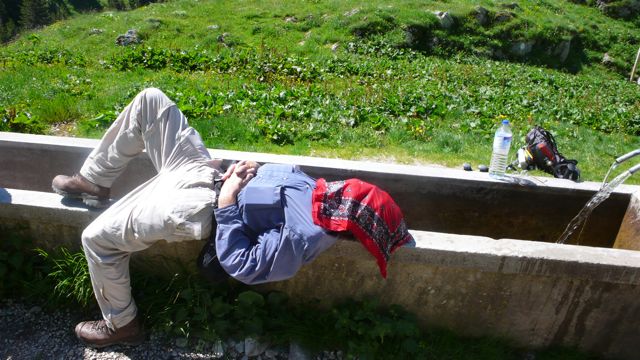
There was however a long concrete trough with two jets of cold water streaming into it, and here we rinsed our hands and soaked our head-scarfs and rested.

Now we were joined by a number of other walkers, solitaries, couples, and two or three families with children. The path splits here at the Chalet d'Oche, and we took the left, climbing through high pasture on a steep stony trail with many switchbacks.

Always we wondered how we would come to the day's goal, the Refuge du Dent d'Oche, always out of sight the other side of a prominent rock outcropping. Would we round that outcropping on the left or the right?

Neither, it turned out; there is a narrow way, a sort of chimney, in a cleft; and here we no longer walked, we scrambled, often hauling ourselves up hand over hand with the help of chains and cables thoughtfully pinned to the rock.

It was exhausting, but it led to a magnificently placed refuge, its small patio providing views over the whole of Lac Leman and the Alps, Mont Blanc a challenging distant mysterious white presence beyond all.

The Refuge accommodates 60 guests in three "dortoirs," big common rooms with box-beds, really only thin mattresses on the floors, set side by side in rows. There's one toilet, a Turkish affair; you hang onto a rope with your left hand to steady yourself and keep he door closed in front of you as you do your business.

There is no running water, though a bucket of cold water is thoughtfully provided just outside the toilet door for rinsing one's hands. Otherwise there is no way to clean up here.

But the view is splendid. Henry and I climbed to the summit, maybe twenty minutes away, and found a chamois there, grazing quite near the handful of visitors who seemed stunned and silenced by the view -- and inspiring it certainly is.

Dinner was soup, pasta, slabs of roast beef, cheese, and canned fruit cocktail, with a glass of red wine and many of cold water. And then, a little before ten, I retired, to sleep pretty well.

1 Bernex

Creusaz, Friday, June 20--

Definitely a difficult day today though a short walk, no more than twelve km I think. We landed in Geneve about ten am after a long afternoon walking perhaps five miles, a long evening eating a fine dinner, and a five-hour sleep, all in Amsterdam where we'd arrived yesterday morning on an overnight flight from San Francisco.

Train into Geneva, tram to the French train station at Eaux Vives -- a badly outmoded and ill-maintained place, but serviceable. Then an odd hour at Evian-les-Bains, making a reservation for tonight's bed and dinner and finding out how to walk here.

The walk was hard. No more than ten miles, but a considerable gain in elevation, from Evian at about 460 meters to here at 1170, or 3800 feet. Nothing compared to what we'll be doing, but hard given lack of sleep, jet lag, fairly high temperatures, and grades up to 20 percent.

The sleepy vacation resort town of Evian-les-Bains gave way to suburbs; these quickly becoming more rural. Our roads climbed and curved among fields and woods, often with surprising vistas over Lac Leman, always the distant mountains challenging us.

Now and then you come to a hamlet, with only a few of the old buildings to recall their original peasant economy; now nearly all buildings are from the last twenty years or so, in the prefab linconlog chalet style, nicely set about with gardens and potted flowers -- weekend or vacation houses, no doubt: this is ski country.

We are in Haute Savoie; the cows are wearing their delicious bells; the hills are incredibly green, the air soft and sweet. Our gite will not be terribly expensive and gave a decent dinner: trout, french fries (boy did we want that salt!), fresh crisp delicious lettuces, fine ice cream with magnificent whipped cream.

Tomorrow will be even harder than today, but we must do it -- and so to bed.

Friday, June 13, 2008

Travel

TO THE Iio.jpgMAGINISTS LAST NIGHT, there to see a production called Travel, conceived and produced by its entire cast. To the point, since I leave Wednesday for my Long Walk.
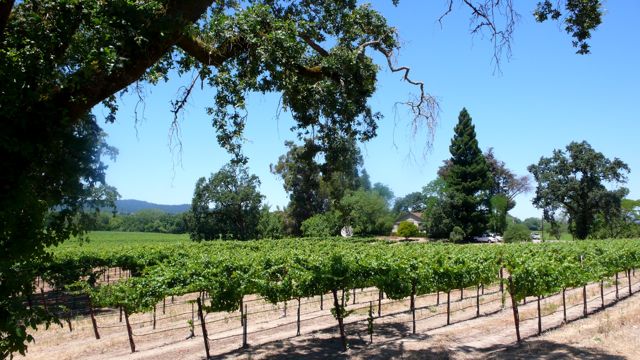
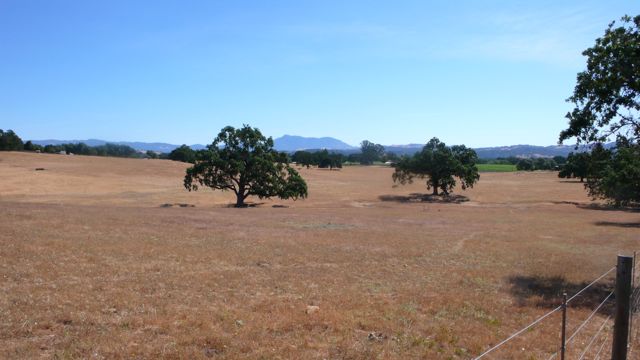
The Imaginists is/are an amazing group. I've written about them before here: among other things, we've seen them do a truly memorable Antigone, an intense, resourceful Crucible, a fascinating production of Pirandello's Tonight we Improvise, and, earlier this year, a magnificent Winter's Tale.

In between repertory like this, The Imaginists produce work conceived and developed collectively by the actors. Last night's Travel was in this line, and was particularly to the point, since the company itself is traveling -- leaving the loft workshop they've used for the last six years for a better, bigger, more flexible space a few miles south, in Santa Rosa. (Information about the new space here.) And while recent productions have been away from the loft, in parks or wineries or Healdsburg's own Raven Theater, Travel was produced in the loft itself, the audience on three sides.

The piece is choreographed theater, rarely verbal. I suppose it's somewhere between charades and tableau vivante. I think of it as living sculpture. These actors use their entire bodies sculpturally, expressing in gesture, movement, and even in static position a rich, complex, deeply human something -- something that I hesitate even to name or describe. You get an idea of this in the photo above: a representation of Io, seduced by Zeus and then given the form of a heifer. This Io is costumed, of course; costumes were not a part of Travel. But the kind of chthonic and ancient awareness Io represents, a knowledge-of-something-profoundly-human-but-certainly-not-verbally-expressible, was quite present in Travel, as it had been in Antigone several years ago, and was revealed to be in Arthur Miller's masterpiece The Crucible.

Have I mentioned that the cast is composed of school children? (As we used to call them: "children" comes increasingly resistingly to the vocabulary these days.) The Imaginists, directed by Brent Lindsay and Amy Pinto, have as their chief goal the development of strong and imaginative community theater; and they know the best way to build a theatrical future is to engage young people in the project. All the productions I've mentioned, including this Travel, have been performed by actors not yet eighteen. (Well, one turned eighteen last night.)

And they've absorbed their demanding repertory and developed the means to reproduce its revelations in their own collectively developed work. On one level, I suppose you could say Travel is no more than a series of skits, each the concept of one or another of the actors, all on the central theme of travel, strung together like the coaches of a passenger train, or the benches of a bus, whose occupants momentarily seem to have a common destination. (And that destination becomes all too apparent toward the end, when even members of the audience are involved in it.)

But "skit" suggests mere entertainment, and this work goes beyond that. There's something almost unnervingly profound about nearly everything these Imaginists do. The work is often abstract, but always meaningful, however elusive. Travel continues in the Healdsburg workshop tonight and tomorrow (June 13 and 14). The next production, Amos Tutuola's My Life in the Bush of Ghosts, opens later this month: I'm sorry my own travels will prevent my seeing it.

Wednesday, June 11, 2008

Another day, another walk

eastside.jpg

IT'S SO BEAUTIFUL HERE. We think about that every day, of course. Gratitude is increasingly the most pressing order of the day's business, and we have much to be grateful for. Here you see, in the distance, the house Lindsey grew up in -- well: that she lived in from aetat. 14 to 22, not counting time out while attending college. It's on Eastside Road about three and a quarter miles north of our mailbox. (If you have Google Earth you can pinpoint it: 38°33'40.92" N 122°50'47.52" W; 95 ft. elevation.)

Fifty-odd years ago, when I first saw the place, it was in mixed production: 300 head of dairy cows or so; extensive prune orchards; hay fields and pasture. No grapevines. The vines in the middle right in this photo occupy the space of the family orchard: apples, plums, apricots, peaches. There were oranges near the house (that may be one there, now I think about it, below the gable).

Ten years before that there was the remains of a tennis court behind the house, beyond that huge satellite dish you can see: for at the turn of the century, the last century I mean, this was the Hotchkiss Ranch, the home of Helen Hotchkiss's parents. What? You haven't heard of her? She was perhaps the pioneering woman tennis player, the first, as I understand it from reading her memoir, to have thought of "playing like a man": that is, aggressively. She was a champ, and changed her world.

I walked past the old ranch, as we call it, today, on an eight-miler from our house in to Healdsburg. Eight miles = kilometers, two and a half hours walking, maybe fifteen minutes resting. Not bad for ninety-five-degree heat, but my feet hurt...

Flower Alphabet

YESTERDAY I READ THIS POEM in a year-old annual brochure from the local Community Foundation and it knocked, as they say, my socks off:

lily.jpg
Flower Alphabet

Another flower
blossoms on the
coming of spring,
dandelions or
even roses, all
flowers starting to
gain beauty.
High above
I gaze down on
justice and nature,
kind and natural
lands filled with
majestic flowers.

No flower left
on Earth ugly,
pacing themselves, a
quilt of
roses even
sunflowers pace
toward the best
udder place.
Vegetables or fruit such as
watermelon. The hum of flowers like a
Xaxaphone.
Your flower white and black a
zebra's majestic flower.

--Mike Nicol

I confess it was only the word "udder' that woke me up and made me realize what was going on here; even the title hadn't alerted me. What a careless reader I can be! But "udder" isn't out of place, not here on Eastside Road, or in Windsor, either, where the poet was (at the time of writing the poet, last year) a sixth grade student at Cali Calmécac Charter School. Many of the fields hereabout are worked by cows, some of them dairy cows.

We have a field full of -- not cows, but Mariposa lilies, also known as Mariposa tulips, or golden nuggets. Calochortus luteus. I always thought they were named for Mariposa county, thinking they must have been particularly plentiful there: but it's simply named for the butterfly (mariposa in Spanish), which it resembles.

I don't know much about wildflowers. I don't know much about Cali Calmécac Charter School or, for that matter, Mike Nicol. I called the school; last evening Nicol called me to give me permission to reprint the poem here. I asked if he was still writing. Yes, he said, but not so much poetry these days; he's working on a novel.

This is the kind of thing gives one hope for the future. Justice and nature, kind and natural lands! What a line!

Sunday, June 08, 2008

A hard day's walk

sthelena.jpg
Mt. Saint Helena in the distance across the dry fields south of Windsor

UF: IT'S GETTING HOT, over ninety degrees today. I decided I needed to walk, though, so set out at about 9:40, walking over our hill and through the neighbor's vineyard, east about three-quarters of a mile to Starr Road, then north about the same and east about the same and north about a mile and a quarter to Windsor River Rd., then east maybe two-thirds of a mile to the local café, Café Noto.

It's Sunday, and nearly summertime, and there were a few joggers and cyclists out. At one point I was overtaken by a team of runners. How far you running? Oh, about sixteen miles. A few minutes later another runner came puffing along not really trying to catch up.

Well, I'd done four miles in 90 minutes, so I took a half-hour in the café, read my e-mail, and determined that I could not send any. Hmm: there are still obstacles to be overcome if I'm going to be blogging from the Alps later this month.

It was a nice rest, among more cyclists and runners; but then it got hot, and after another two and a quarter miles to Eastside Road I decided against going to Healdsburg & came home instead, another four and a quarter miles, arriving home totally exhausted at 2 pm. Totals, ca 10.5 miles in 4 hours. Going in to Healdsburg would have added another 3.3 miles, and then the same back, for a total of 17 miles! I'll save it for another day...

Wednesday, June 04, 2008

Guitar in the home

THE GUITAR, that ideal instrument: wood, steel, brass; a body famously like a woman's; a voice capable of insinuating melody or resonant depth. No other instrument, barring the human voice, is so chthonic.

And the place to hear it is in camera, in a room, where its subtle richness is uncompromised by artificial amplification. Last night we heard it thus: friends gave a dinner musicale for thirty guests or so, having received the opportunity to do so in turn as a Christmas present -- from people who had in turn received a similar gift at their wedding.

A gift that continues to give, like music itself or, for that matter, the guitar. Talk about added value!

The guitarist was Gyan Riley, of whom we've heard so much lately. The son of Terry and Ann Riley, his face mediating theirs and their sweet expressions of ggod humor and intelligence, he plays with authority undamaged by excessive pride or vittuosity. He's there to serve the music, whether a Bach suite or Bonfa's "Black Orpheus" -- which supported a thoughtful, idiomatic improvisation.

He played music of his own,too, fascinating etudes investigating various technical challenges. I liked tham; occasionally they suggedted things he must have been exposed to growing up in a sophisticated, globally aware family: much more often they were quite himself, imaginative, accomplished, beguiling.

Sunday, June 01, 2008

Walking in the woods

forest.jpg

ANOTHER SUNDAY HIKE, preparing for the long walk beginning later this month. Off we went, Mac and Henry and I, to a local state park, there to leave the car in a $4 parking lot and tackle a really nice hike. Much of it was among trees, Douglas fir for the most part. Since we were off in a distant end of the park, accessible easily only by paying to park, we had the trail pretty much to ourselves.

There was the occasional "mountain bike," which I confess to having gradually evolved a prejudice against; and two or three times we met a couple of equestrians. Somehow the horses, and their riders, are less irritating, less "unnatural," than the bikers. They're slower, for one thing, and considerably more visible.

We climbed and descended and strolled along fairly level stretches, among the forest, in open fields which would clearly have been marshland at other times, and conversed, and worked our feet. Lunch: bread, salami, apple, walnuts, dried apricots, cookies. Then more walking.

Turkeys, cougar scat, woodpeckers, Mariposa lilies, buttercups. Eight miles; four hours. A nice rehearsal.