Monday, September 15, 2014

String quartet: En balançant; Screen; Vie lactée

Score: En Balançant
En balançant, for two pairs of bowed instruments (first half of the score)
Score: Screen
Screen, for four to six bowed instruments
Score: Vie lactée
Vie lactée, for any four bowed instruments (first half of the score)
I HAVE WRITTEN ONLY one string quartet. ("So far," I suppose I should add; but I think it unlikely I will ever compose another, unless it is a re-notation of this one.) But even a simple statement like this is misleading, for my String Quartet is in three movements, each of which was originally written to stand alone, and was conceived for a different kind of instrumental configuration. The three movements were only gathered into a single unit a few years later, when I needed a string quartet: and the performance I heard on that occasion so pleased me that I now find it difficult to think of the three movements as separate entities.

Throughout the late 1960s I was concentrating on the quartet idiom of instrumental concert music. Conventionally this idiom has reached its apex in the string quartet, as it developed from Haydn through (at that time) Bařtók, Cage, and Feldman. What fascinated me, in the quartet, was the ability and the necessity of each of the four musicians to remain independent, focussed on his own material, but aware of each of the other three and of the evolving product of their simultaneous work.

As you see, the music is written out in "graphic notation," which was en vague in the 1960s. I was not particularly concerned with pitches at the time I composed them: I was thinking of representing the sounds of the music as elements in a spatial analogue of the psychoacoustical dimensions in which music is heard, freeing the music from the constraints of conventional melody and harmony as they are attached to a system of pitches, allowing them to become present as the musicians more or less intuitively are led to produce them.

As already noted, Screen was the first of these three movements to be composed. The title refers to the idea that the piece could be performed simultaneously with other compositions, and heard by the audience as a sort of acoustical screen through which the other music would be filtered. Although I intended the piece to succeed if standing alone, I did in fact combine it with other pieces; it appears as an aural ingredient in the early From calls and singing for chamber orchestra and in the opera The Bride Stripped Bare by her Bachelors, Even and with the Variations for harp with optional chimes in another chamber piece, Voie lactée.Screen was thought of as a string quartet, but I was drawn to the string sextet configuration as well, and from the beginning intended it to work for any four to six bowed instruments. The other two movements, though, were quite specifically written for four and only four instruments, though the specific instrumentation is not determined. (On the performance whose recording is linked to this post the three movements are played on violin, viola, cello, and contrabass.)

The titles of the outer movements refer to passages in Marcel Duchamp's great painting on glass, La mariée mise à nu par ces célibataires, même, which — together with the verbal notes Duchamp assembled to accompany the painting — form the subject of the opera alluded to earlier. En balançant describes the physical state of an important part of Duchamp's upper panel, which represents the Bride as a "pendue femelle"; Vie lactée was my unintentional pun on the voie lactée (Milky Way) which spreads across the top of his painting, representing the Bride's aura.

While Screen is quite free, its ten pathways playable in any order, left to right or reversed; the outer movements are more directed. They are to be played in sequence, left to right only. En balançant presents only two pathways, and is meant to be played as a canon, the second pair entering whenever they desire. The balancing act is meant to be performed by each pair, and by the pair of pairs.

Vie lactée is even more conventional, requiring the quartet finally to play in tight ensemble, free as to the specific pitches and the relative loudness and tempo but determined by attentiveness to the score. The three movements therefore represent a sort of catalogue of quartet possibilities, ranging from the equipoise of the opening movement, through the loose lyricism of the second, to the coherent expression of the third.

I have heard a number of performances of the quartet (though many more of Screen), and I've been pleased with all of them. My favorite, though, both for its performance and for its instrumentation, is the one linked to this post. It was in fact the first performance, played in 1971 I think. I no longer have a program from the performance, which probably took place in the Berkeley concert hall 1750 Arch; and I'm not even certain of the personnel. I know the late Nathan Rubin played violin; I think Ron Erickson played viola, Tressa Adams cello, and Jedediah Denman contrabass. Perhaps someone reading this will know.

I listen to this recording every night as I fall asleep, and am surprised at how often its sounds fall together in configurations that seem new to me. This was of course the intent: to provide notation that would allow musical sounds to develop, combine, separate, adopt changed configurations, and exist completely free from anyone's ego-expressive intent. Perhaps falling asleep to the music explains my fairly rich dream life.

You can listen to it too: just click on the titles under the score pages. Let me know if it puts you pleasantly to sleep.

Tuesday, September 02, 2014

That second sonata

Profiting from an early rise, while we still have unlimited bandwidth, I've uploaded sound files to my second piano sonata, Sonata compositio ut explicatio, to my website, and you can hear the whole piece now by streaming it.

It's an undertaking, for the sonata is an hour long. I've written about it here before, and won't add anything more here.

The three movements are available separately, but of course I'd prefer you listen to the whole thing, perhaps as background music…

First movement (32:15)
Second movement (5:21)
Third movement (20:04)

You're welcome.

Friday, August 29, 2014

Top Ten

A friend posts, on Facebook — yes, I spend some time there every day —
[A friend] tagged me, asking for a list of ten books that have stayed with me in some way, so here goes, off the top of my head, right this minute:

Paul Klee, Pedagogical Sketchbook
Lou Harrison, Lou Harrison's Music Primer
Vergil, Georgics
N.O. Brown, Closing Time
Thomas Pynchon, Against the Day
James C. Scott, Seeing Like a State
Benedict Anderson, Language and Power
Marshall G.S. Hodgson, The Venture of Islam
Lawrence Weschler, Seeing is Forgetting the Name of the Thing One Sees A Life of Contemporary Artist Robert Irwin
Edward Gorey, The Raging Tide, or the Black Doll's Imbroglio

"Rules: Don't take more than a few minutes and do not think too hard. They don't have to be the "right" books or great works of literature, just ones that have affected you in some way. Then tag 5 friends including me so I can see your list. Don't make fun of me. No particular order." So, on to:
and then, of course, he leads a list of five Facebook friends with me.

After nodding at three of his choices and agreeing with their worth I gave the matter a little thought, more than a few minutes, because it's in my nature to disregard direct instructions. So many books came to mind: Montaigne first, curiously; then Robert Nathan's One More Spring, of all things; Crime and Punishment, Shakespeare… would it be fair to consider the Encyclopedia Brittanica one of ten books? Even Brittanica Jr., which meant so much to me in my childhood?

Finnegans Wake. Tender Buttons. How restrict myself to only one Henry James novel, or one Austen? What about Tristram Shandy? Gulliver's Travels? The Great Gatsby?
How could I exclude Mallarmé, or the Tintin books, or Chekhov, or Turgenev? Pirandello?

Look at the relatively recent reading: Manzoni, Herman Bang, Harry Mulisch, Sebald, Walter Benjamin, Geert Mak, Woolf, Lady Murasaki, Vittorini, Levi, Patrick Leigh Fermor…

No, I'm sorry, Daniel; this is not a matter for the top of my head. Or, rather, this is the way the top of my head seems always to work — perhaps simply because, at my age, I have the leisure to take my time getting to the top.

In the end I think I've been honest: these are the — well, yes, eleven — books that have stayed with me in some way, over rather a long span. There's not a title here that hasn't been staying with me for at least twenty-five years, maybe thirty; and two or three of them made their first impression close to seventy years ago.

Are they in no particular order? No: they're in the order in which they occurred to me, in the course of the great sifting; and perhaps the last retrieved, of the eleven, were the first to make their impress…

Don't make fun of me.
R. H. Blyth: Zen in English Literature and Oriental Classics
John Cage: Silence
Christopher Alexander et al.: A Pattern Language
Wallace Stevens: Collected Poems
Francis Ponge: Le savon
W. A. Mozart: Letters
Georges Perec: W or the memory of childhood
Marcel Duchamp: Notes to the large glass
Homer: Iliad
Deems Taylor (ed.): A Treasury of Gilbert and Sullivan
Laura Ingalls Wilder: Farmer Boy
I've sent this on to five friends, of course, staying with Daniel's game. It'll be interesting to see if they join in…

Tuesday, August 26, 2014

Requiem with oboe

RequiemCoverThumbnail.jpg
•Charles Shere: Requiem with Oboe.
Healdsburg: Ear Press, 2014
Full study score, 6x9, 48 pages
Available at Lulu.com, $9.99
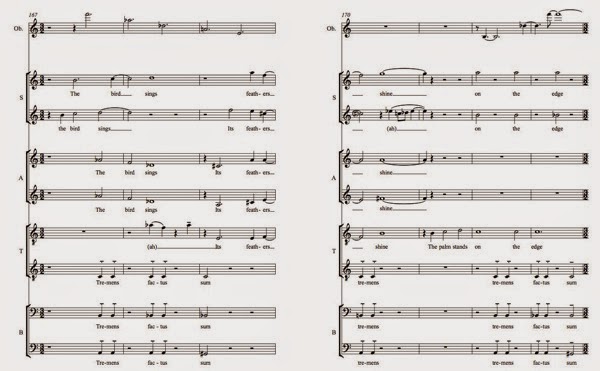
FINALLY PUBLISHED: the full score to my short Requiem Mass, with the interpolation of two poems by Wallace Stevens, set for eight solo voices (or double chorus) with obbligato solo oboe.

I composed the music in 1985, shortly after the death of my mother, just short of her seventy-fifth birthday. You see her there at the left, probably about eight years old, one sock up, the other down, in an old snapshot taken I suppose in Shanghai where she spent her first twelve years, the third of nine children born to a high-school teacher from Sonoma county, in China to avoid a mother-in-law who was apparently giving him trouble. (The family returned to Berkeley as soon as she died.)

My mother admitted freely that she had a tin ear, and I never heard her play the violin, or any other instrument. Or sing, now that I think about it. She recited poetry, sometimes in German, but she was not what you'd call musical. My father was: though he never finished grammar school, he was an intelligent man and a constant reader, and fond of singing, and could play any instrument put in his hands (though I never put a bowed instrument there). But my mother, no.

In her middle years, when she'd returned to college to get a teaching credential, she most improbably signed up for a music-appreciation course. She had her own way of memorizing themes she was supposed to recognize at exam time: I remember her chanting
see the hor-ses run-ning up and down and up… and… down
to a frisky tune in Tchaikovsky's 1812 Overture, for example. But she never really cottoned to the standard repertory. I can't recall her ever going to a concert. Dad did, once, when I was sick in bed, and couldn't get to a performance of the Santa Rosa Symphony; for some reason he went in my stead, and found it lengthy but occasionally rousing, and even brought me the program, autographed by the night's soloist; who, I don't recall. But my mother, no: she wasn't interested.

The only music I ever heard her approve was, for some reason, Arnold Schoenberg's Pierrot Lunaire. I had an ancient recording, conducted by the composer himself, with Erica Stiedry-Wagner sprechtstimming the solo part, and she used to listen to it every now and then, with a determined look in her eye. She said she liked it because it didn't fight with itself, by which I think she meant the lines were clear. I wonder how many of the lay public would have agreed with her. I never thought to ask precisely what it was in the piece that interested her: now that I think about it, it may have been the poetry, written originally in French, translated for Schoenberg's purpose into German — both languages she'd studied, how thoroughly I never really knew, in school, in China.

At any rate, my Requiem. It was commissioned (though no money ever changed hands — a common procedure in those days, at least in my experience) by Christopher Fulkerson, a composer of determinedly modernist bent himself, for his chamber chorus Ariel. This was a vocal octet, the conventional SSAATTBB configuration, but comprising eight very good singers with experience with modernist music, good ears, quite clear diction, and supple phrasing. Chris was a good conductor, too, shaping the lines well, maintaining the pitch, balancing the dynamics, bringing out the poetic heart of the texts.

(A few months earlier, Chris had been instrumental — vocal, I mean — well, no, he didn't talk all that much, he was in fact instrumental — in the production of about a third of my Duchamp opera, at Mills College: he found and rehearsed the chorus, some of whom came from Ariel, and took a solo line himself, very nicely.)


Chris had asked for a piece for a cappella voices, but for some reason I wanted to add the oboe. I wanted an aural emblem of a creature from another dimension, to bring the listener out of the contemplation of dying that any Requiem necessarily involves, and take the listener instead to a dimension we do not yet know, and an oboe in its highest register seemed appropriate.

Nor did I set all the usual text of the Roman Catholic Requiem Mass. The scary Dies Irae has become a cliché, and anyway death doesn't seem scary to me, in any case shouldn't be dwelled on, I think, as a thing to fear, since after all it is inevitable. And of course the parts about a personal savior don't comply with my own view of things, so I couldn't represent myself as agreeing with certain other components of the Ordinary.

For those parts I substituted two poems by a favorite of mine, Wallace Stevens, who I had reason to believe my mother had also liked, though like so much else his poetry was something we'd never talked about. Not Ideas About the Thing but the Thing Itself, with its window on "a new knowledge of reality," gave me a chance to introduce the high keening oboe, and "Of Mere Being," whose "palm at the end of the mind" seemed to promise a symbolic destination of sorts, provide me, at any rate, with a more spiritual, less sentimental, unearthly alternative to conventional ideas of afterlife.

I wasn't around for the rehearsals of the Requiem: as I recall, I first heard it at its premiere, oddly given in the old Vorpal Gallery in San Francisco's North Beach. I thought it went pretty well. I wish I had a better recording of it: the voices in the live recording made, I don't know whether at rehearsal or performance, seem a little off-mike.

I don't have a program of that performance, and I don't know who the eight singers were — a pity. The high soprano, whose coloratura takes her up to a high E, was really spectacular; the two basses were properly sepulchral; everyone in between negotiated the lines splendidly. And Marilyn Coyne — the one name I do know, apart from Chris Fulkerson's — handled a difficult oboe part with grace, drama, and total musicality.

And, while I agree with the painter Jack Jefferson, who told me once, about reviews, that if you agree with the good ones you've got to buy the bad ones too, I can't help liking the review that showed up a couple of days later in the newspaper:
A Program of Modern Works By the Ariel Choral Group


... The night's outstanding item was the premiere of Charles Shere’s moving “Requiem With Oboe” (1985). ...

Shere’s Requiem both uses and shuns the traditional Latin text. Two of its four sections use the Roman Catholic liturgy — “Requiem aeterna” and “Hostias et preces.” But the larger part of the work employs two Wallace Stevens poems: “Not Ideas About the Thing, but the Thing Itself” and “Of Mere Being.”

Shere’s Requiem begins with a trope, “Requiem (mater) aeternam” — “mater” being an insert. Bits of the Latin text turn up briefly within the Stevens poems as well. To all this, Shere added snippets of oboe solos (played by Marilyn Coyne — mostly in the high register) as a kind of genteel wailing (the piece is dedicated to his late mother).

Shere set all this in a devoutly simple style. The idiom strongly leans on 14th and 15th century principles of counterpoint. What is heard is something of the motet manner, only updated into a freely atonal idiom.

What emerged was a softly lamenting cantata, liberated from violence or threats. There is, for instance, no hint of the Last Judgment. Shere has produced a work of tenderness roughly comparable to the Faure Requiem in mood.
Heuwell Tircuit, San Francisco Chronicle
You can get a copy of the score from Lulu.com for a measly ten dollars plus postage. (Of course the postage is a little exorbitant: be careful the sale site doesn't default to a next-day delivery!) I think you might even be able to download the score as an e-book, though I'm not sure about that. If you don't read music, buy a copy for your local library. If you sing in a chorus, or know someone who does, give it a look. It's not my favorite of my pieces, but I like it. I wouldn't mind hearing it again, maybe even sung by a full chorus. Besides, I've been thinking a lot about my mother lately…
RequiemExcerpt.jpg

Technorati Tags:


Friday, August 08, 2014

Terry St. John: paintings

•Terry St. John: New and Recent Paintings and Drawings.
Dolby Chadwick Gallery, 210 Post Street, San Francisco
Exhibition continues through August 30
thaiwomanwithcup2012.jpg
Terry St. John: Thai Woman with Cup (2012), oil/canvas, 48x42 inches
WHAT A FINE PLEASURE to see these new and recent paintings by Terry St. John! For decades he has been a significant part of the Bay Area painting scene — a scene of international significance, profound, impressive, and vital. But he has been a quiet participant, working steadily in a community of neglected artists: I think of those three great underrated J's of the Bay Area abstract expressionism: Julius Hatofsky, Julius Wasserstein, and Jack Jefferson. I thought, too, looking at these new St. John paintings, of another J, certainly not underrated or neglected, the phenomenal Jay DeFeo.

St. John was born in Sacramento in 1934 but grew up in Berkeley — he was a schoolmate of mine at Garfield Junior High School in the late 1940s, though we weren't friends at the time. He came to painting only in his last year of college, when on seeing work a friend was doing, studying at the time with Richard Diebenkorn, he was struck by the clarity and presence of purpose the discipline offered. Frances Malcolm quotes him in her introductory essay in the catalogue to the current exhibition:
…above all else, I just wanted to paint paintings. Painting somehow gave me an opening to the future and a sense of hope… it was salutary.


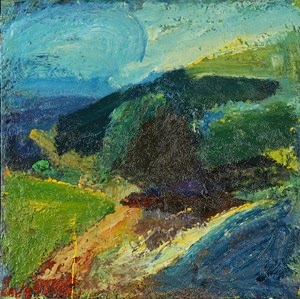
St. John worked among other painters in his early days. He was a great friend of Lou Siegreist, the youngest and last surviving of the legendary Society of Six early modern Bay Area painters, and of his son Lundy; the three often painted en plein air in the local landscape, particularly the slopes of Mount Diablo. St. John worked for years at a day job, curating modern painting at the Oakland Museum. He taught, too, at Notre Dame de Namur University in Belmont.

In spite of his sociability, though, he has always impressed me as a kind of solitary — a man who knows and keeps his own place and counsel. You have the impression it is the solitary discipline of painting that holds and informs him, that defines his address to life and to context. Whether working in the landscape or in the studio, it's the sense of the passage of time, as Malcolm suggests, that energizes his work, leaves traces of light and shadow, develops the evolving colors, finds the balance of recessive depth, spatial organization, visual meaning.

I have loved his work for years, and am pleased to have a small landscape. But I was unprepared for the new and recent work now on view. I had lost touch with both him and his work in the last ten years. His painting has developed great strength, depth, complexity, and certainty. As can happen this late in life, he has found a great sense of assurance — these paintings are vibrant and full of energy, God knows; but they are serene, objective, composed, competent.

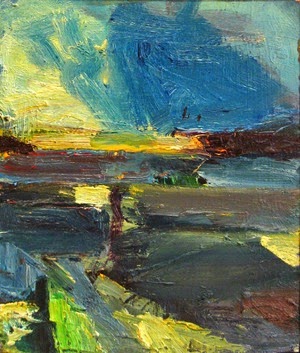
I like the way so much painting history, internationally and locally, is contained, even referred to, with knowledge and intelligence, on completely equal terms, without his work ever seeming the slightest bit derivative. Thai Woman with Cup, for example, is fully aware of Cubism; it makes me think of the CoBrA school too; its window recalls the Matisse behind Diebenkorn; the seated nude brings Elmer Bischoff to mind: but the complexity of the left third of the painting oddly balancing the cool window on the right is something new to me — and the red shoe!

The newest canvases here, from 2013. are exclusively paintings of the nude, mostly in interiors though occasionally ambiguously so, perhaps in tropical landscapes — for a number of years St. John was spending part of each year in Thailand. There are a few smaller landscapes, though, from not that long ago, showing the artist is loyal to the Bay Area, and that its views continue to ground the solidity and geometry of his vision, as well as the texture, color, and light.

WineHavenPtMolate2008.jpg
Wine Haven (Pt. Molate) (2008)
diablo2010.jpg
Diablo (2010)
womanwithgreenbottle2014.jpg
Woman with Green Bottle (2014)


I was asked, in the gallery, which painting I'd take home with me, if I could. (I couldn't afford any of them, of course; and in any case every one of them seems already to have been sold.) Woman with Green Bottle, I said. The strength and solidity of the others is here, but I like the comparative simplicity, the domesticity, the classical subtlety of its geometrical relationships, the relationship of bottle, drapery, and the painting on the wall. I like the sense of history. And most of all, I think, I like the humor pervading the entire vision. St. John seems to have arrived at a sense of unusually sure and engaged and bemused awareness of existence, and I'm glad for the opportunity he gives of sharing it.
Bay Area Expressionism
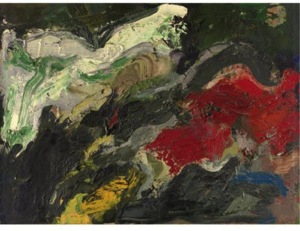
I leave him, and you, dear reader, with a quick survey of some of the painters I've mentioned above, to provide some context for this sumptuous show of a painter arrived at mastery:
Siegriest.png
Lou Siegriest
jefferson.png
Jack Jefferson
Hatofsky.png
Julius Hatofsky
juliuswasserstein.png
Julius Wasserstein

Tuesday, August 05, 2014

Reading (and not reading) Fermor

Christmas 2010: My dear daughter-in-law, the granddaughter of a Nobelist on the Berkeley faculty, brought up unconventionally in Berkeley (as was conventional in Berkeley), the owner of a feedstore in Mendocino county, gives me a copy of Patrick Leigh Fermor’s A Time of Gifts.

I read it the following spring, and by May 15 had also read its sequel, Between the Woods and the Water.

Then last month, July 7 to be exact, I read the final book in the trilogy, The Broken Road. I know these dates because I have the habit of writing the dates I begin (usually) and finish (nearly always) a book on the first and last page (respectively). I also tend to tick margins and write notes or at least page numbers down on the end-paper, though these days I’ll sometimes just photograph a relevant paragraph, either for posting here as a Commonplace, or for filing in a folder of Reading Notes someplace.

(Technical note: I convert the photo on my iPhone using an app called Pixter, and usually file the result in Evernote.)

A search of this blog finds Fermor mentioned only twice so far:
December 30 2011: So many books read this last year, so few of them commented on here. End-of-year reflections will haunt me for the next seven weeks, I'm sure — I'll be too busily distracted for them after that — so I won't anguish over my failure to share notes on Frederic Tuten, or Patrick Leigh Fermor, or Carolyn Brown, or Patti Smith, to cite only the most impressive of the authors I've learned from recently.

November 21 2012 (written in Australia): The shop reminded me of those of fifty years ago, a series of small rooms with crowded shelves, well enough organized but better suited to browsing than go-and-get shopping (except that my age and size make the necessary floor-crouching difficult between close-set bookshelves). I looked for a copy of something by Patrick Leigh Fermor to give to my brother, who's done his share of global wandering, but found only the new biography, which I must hasten to obtain. (It was far too large to carry on the airplane). What I did find was [Laurens van der Post’s] Venture to the Interior, in a dog-eared Penguin paperbound that must be thirty years old.

P. Leigh Fermor has been recalcitrant, mysteriously so. He’s considered one of the great travel writers. He began traveling in December 1934, only sixteen, by setting out on foot, with five pounds sterling in his pocket and another five promised monthly at waypoints, heading from his rural English home for Istanbul. December, 1934, crossing Germany on Foot! What was his mother thinking of?

He kept a journal, but lost it, later found it, lost it again. He met rich men and paupers, royalty, diplomats, shepherds, thieves. He supported himself for a while painting portraits of strangers. He fell, memorably, in love. He struck up amazing friendships.

And he walked — which is what excited me, in 2011, when my own recent walk from Geneva to Nice was still in my mind (as it continues to be; will always be).

A Time of Gifts appeared in 1977; it was later reissued by the New York Review of Books; I don’t know what brought it to my daughter-in-law’s attention. I read it hungrily, excited by the walk, but also impressed by Leigh Fermor’s wide-ranging intellectual curiosity (history, art, food, languages, high and vernacular culture) and his detailed, enthusiastic accounts. As soon as possible I went on to Between the Woods and the Water (1986; also reissued by NYRB). Since my grandson Henry, who’d accompanied me through the Alps, had already read the first book, I lent him the sequel as soon as I’d finished it.

Then I waited, impatiently, for the third and final volume. Trouble was, Leigh Fermor had not written it, and he was getting on, and it was likely it would never appear. But, of course, it has appeared, in a sense — posthumously, edited by Artemis Cooper. (It was Cooper's biography, Patick Leigh Fermor: An Adventure, that I'd neglected to buy in Australia; it too is now available from NYRB.)

No one would claim the result would have satisfied the author, who’d put the project aside decades before, then was talked into revisiting it in his final years. I’m sure his mind was sound to the end; but I think he may have lost interest.* It had been a long time since he’d finished the second volume; a much longer time since the events themselves had unrolled.

Still, *The Broken Road* is a wonderful book, vivid, interesting, a bit nostalgic. It made me want to see Bucharest again, and explore Bulgaria. It certainly makes me want to hit the trail again soon — I’d hoped to get up to the Sierra this summer, but that looks increasingly unlikely.

But here’s the reason I’m posting this: Lindsey finally got around to A Time of Gifts, and was as impressed as I, and wanted to go on immediately to Between the Woods and the Water. Would I find it for her? Sure, I said, it’s around here somewhere. (FERE ALIQVVBI HIC ILLVD SCIO, says Bhishma’s handsomely calligraphed note, pinned next to the computer.)

Trouble was, it was nowhere to be found. Then I remembered loaning it. Never do that with a book you love. Finally I ordered another copy, reasoning the loan had turned into a gift in its turn, and why not?

Immediately, of course, the first copy materialized — on the dining table, in plain sight.

This surpasses all rational reality, I said to Lindsey, who was not so sure. I’ve been reading (and tremendously enjoying Harry Mulisch’s The Discovery of Heaven these last few days, and the oddly erratic realities enveloping his characters may have begun to appear here…

*I may be projecting here. I've dropped more than one project after too many years of fussing…

Friday, July 18, 2014

On death

DEATH JUST MEANS YOU'RE NOT INVOLVED ANY MORE.
—Wendell Berry

Wednesday, July 09, 2014

Easy reading

•Célestine Vaita: Breadfruit.
New York and Boston: Little, Brown and Co., 2006
ISBN 978-0-316-01658-2
•Célestine Vaita: Frangipani.
New York and Boston: Little, Brown and Co., 2006
ISBN 978-0-316-11466-9
SUMMER IS THE TIME, they say, for light reading; now and then I get nostalgic for French Polynesia; and a favorite friend recently recommended the novels of Célestine Vaita. So before last month's road trip — yet to be documented here — I ordered two of them, used paperbacks, from sources online, hoping they'd arrive in time for the trip. They didn't, alas, but I made short work of them on our return.

I enjoyed them. I don't usually read things of this sort, and I'm not sure if they fall into some genre or other. I note that my copy of Frangipani ends with a "Reading Group Guide" including a short interview with the author and a series of suggested discussion topics — oh dear: is that what book groups do, sit around responding to publishers's suggestions? And my copy of Breadfruit turned out to be an advance copy, with odd typographical problems (double quotes for apostrophes, for example). So I suppose the novels are book-group fodder, and perhaps even Young Adult, and certainly directed toward women more than men.

In fact that may have lay behind my friend's recommendation: she feels one should read as many female authors as male, at least when it comes to recent and contemporary publications. Perhaps she's right: one of the things I very much enjoyed about these novels was their strong central character, Materena Mari, a fortyish woman living in a fiber shack in Faa'a, the town adjacent to the international airport outside Papeete. Materena.

Vaite was born there herself, and there may be a certain among of autobiography in these stories — Materena may have been modeled on her own mother. There are parallels, too, between events of Vaite's life and those of other characters, particularly Materena's daughter Leilani, a serious student.

Vaite's mother language was, I suppose, French, and she must have been frequently heard and occasionally spoken Tahitian as well; but these novels were written in English, in Australia, where the author settled with her Australian surfer boyfriend, later husband. A lot of the charm of the novels is in fact their language: breezy English, using the conventional French present tense regardless of the actual time being written about, occasionally translating French constructions in an awkward literal manner, occasionally sprinkling in a bit of Tahitian. The writing is constantly oral: you hear the voices of the characters, and through them, I imagine, that of the author. "Ah oui," they say, rarely simply "oui," and aue bof; statements are frequently preceded with "eh"; daughters are addressed as "girl."

And what does she write about? Daily life, which seems to be relatively easy. The ambience reminds me of Steinbeck's Cannery Row and Tortilla Flat, fondly recounting everyday incidents among ordinary but colorful people whose relatively simple pleasures and easygoing setting emerge from communal life, not upward mobility. Tahiti is depicted, probably accurately at least for the time period, as a comfortable blend of French structure, socialist humanitarianism, and easy weather. You could grow to like this kind of life.

It might not be a stretch to think of Célestine Vaite as a contemporary, female Marcel Pagnol, substituting today's commercial-based culture for his more agrarian one (thinking of his rural novels, not the Fanny trilogy set in Marseilles). The warmth, gentleness, humor, and inevitability common to extended families, and to relationships between men and their women, women and their children — those qualities are universal, both these authors remind of us, if you strip away the striving and yearning and ambition that so often distracts us from them. They are what finally counts, those qualities and the everyday rhythms of sleep and mealtime, love and irritation, work and pleasure and occasional sadness. It's a good idea to be reminded of this from time to time, and it doesn't hurt if the sermon is light-hearted if it's as deftly written as these books.


Tuesday, July 08, 2014

On translation

•David Bellos:Is that a fish in your ear? Translation and the meaning of everything.
New York: Faber and Faber, 2011; 978-0-86547-857-2


for Richard

DAVID BELLOS IS a professor of French and Comparative Literature at Princeton University, where he directs the Program in Translation and Intercultural Communication. Although he is a respectable, even a powerful presence in literature, having written biographies of Georges Perec, Jacques Tati and Romain Gary, and having translated a number of Perec's books — no mean feat.

I am a Perec enthusiast, though I confess I know his work only in English translation. For that reason I haven't read his best-known novel, La disparition. Perec was a member of Oulipo, the "experimental" workshop in litterature potentielle which is often written under arbitrary, amusing, and ennabling constraints; and La disparition, by no means a short novel, was written without using a single "e." Since the English translation respects that constraint — it's titled A void — I've determined to read it only in parallel with the original; and I'm afraid I've bogged down a number of times.

I read occasionally in other languages than English, which is of course my mother language. I can get by, by ignoring subtleties, slang, and jokes, in French or Italian or sometimes in Spanish or even in Dutch — but only with dictionaries, or the Internet, or best of all with a translation into English at hand. A couple of years ago, for example, I read the first book of Don Quixote both in Spanish and in a recent, well-received translation into English by Edith Grossman. It was easy to see that Grossman respected Cervantes's text, maintaining his slightly formal irony but also the fluidity of the narrative. (There's an interesting discussion of her translation, contrasted with John Rutherford's of two years earlier, online.)

Similarly I've worked my way through a few books by Geert Mak in both the original Dutch and English translation, and novels and stories by Moravia and Pirandello in both Italian and translation, always with the hope that one day this process will enable me to rely only on the originals — a hope as illusory as elusive.

(I'm also engaged on a publishing project, hoping to bring out the complete Skagen un roman de l'europe by the French author Jean Coqt, as translated into English by Charles Lunaire: but so far only the first two installments have been sent to me, and I can't say much more about this just yet.)

So translation is a matter often on my mind, and I looked forward to reading Is that a fish in your ear with a good deal of eagerness. In many ways I wasn't terribly disappointed: Bellos writes easily, interestingly, ranging over a number of my own enthusiasms; and there's plenty of humor in the book — beginning with the title, of course.

("Say — is that a fish in your ear?" No answer. "I said, Is that a fish in your ear?" Again no answer. Louder this time: "Hey! Mister! IS - THAT - A - FISH - IN - YOUR - EAR?" Pause; then "Sorry. You'll have to speak up. I have a fish in my ear.)*

But his book centers on the problem that lies in its subtitle: "The meaning of everything." In nearly every one of his short, engaging chapters — many of which sound like class lectures, approaching such individual subjects as dictionaries, dialects, vertical vs. horizontal translation, interpretation, and the like — he seems determined that translation is at bottom a matter of communication, of re-stating the content of a text in a like text in the second language.

The big question that's begged is of course the meaning of meaning. It's addressed in an early chapter, "Meaning is Not a Simple Thing," where Bellos writes "an adequate translation reproduces the meaning of an utterance in a foreign language," and goes on to investigate various kinds of meaning. Symptomatic meaning — "the kind of meaning that things have just by themselves": Jacques saying "bon jour" means, among other things, that he speaks French. Contextual meaning. Meanings latent in the very grammatical forms of the "utterance" in question.

And then, toward the end of the chapter: "No sentence contains all the information you need to translate it." You have to know the genre of the text, apparently — poem, novel, speech, timetable, movie title, for example — so that you can approach and frame your work appropriately.

Poetry is notoriously resistant to translation, at least, Bellos writes, in the popular mind. He denies that it is impossible. Last week a French friend asked me to translate a little poem from French into English, and the request triggered a short discussion in e-mail:
Amélie is convinced that it is impossible to translate Poetry : "you have got to respect the polysémie of the words and if you do one traduction litterale it doesn't work into the other language"
To which I replied
I agree with Amėlie you can't translate poetry

You can however translate poems

you can only translate a meaning and poetry tends as Amėlie points out to be polysėmique, perhaps there's an English word for that, I don't think so, "to have many layers of meaning"

So a true translation would be a number of versions perhaps

Then there s another big problem about translation, the fundamental one

The idea that it can exist presupposes the idea that you can kniw what a statement ( sentence, poem) means

With only a few exceptions (huis clos, sens unique, STOP) I think you cannot, can never
and then I went on to translate the poem. (I'll set the two versions at the end of this post. It is by the way not my first attempt at translating poetry: earlier this year I made an attempt at Horace's Diffugere nives, where the attempt was to preserve meter and formality of the original. But more about that another time.)

AT THE BOTTOM of my problems with Bellos's discussion of translation, the art of, is the assumption that one can know meaning, can extrapolate from an utterance — perhaps even simply an event, natural or artificial, but let's not complicate things even further, not just yet — can extrapolate from an utterance a meaning intended by the speaker. This seems to me to be a great leap of faith, involving taking an utterance at its word. Poetry, humor, irony, negotiation, and other everyday uses of language depend, I think, on a disparity between statement and intent, deliberate or casual.

The problem goes even further: Can we know what our own statements, even thoughts, "mean," even to ourselves? Does their "meaning" not unfold, over time, through contemplation and discussion, evolving as they conform — or don't — to their changing context? (Perhaps this is one reason for the frequent assertion that every generation needs its new translation of standard "classics," to "keep them fresh", relevant to a changed societal context.)

If meaning evolves, there must be aspects of the utterance — the text, the expression, the thought — that have yet to be known: ineffable, if only provisionally. Bellos addresses this:
Some people doubt that there are any affects or experiences that cannot be expressed, on the commonsensical grounds that we could say nothing about them and would therefore have no way of knowing if they existed for other people. The philosopher Ludwig Wittgenstein presumably meant to adopt an ag-nostic position on this issue in the famous last line of his Tractatus when he wrote, "What one cannot talk about must be left in silence." The infinite flexibility of language and our experience of shared emotion in reading novels and poems and at the movies must also cast doubt on whether there are any human experiences that cannot in principle be shared. On the other side of this thorny tangle is the intuitive knowledge that what we feel is unique to us and can never be fully identified with anything felt by anyone else. That inexpressible residue of the individual is ineffable—and the ineffable is precisely what cannot be translated.


Translation presupposes not the loss of the ineffable in any given act of interlingual mediation such as the translation of poetry but the irrelevance of the ineffable to acts of communication. Any thought a person can have, the philosopher Jerrold Katz argued, can be expressed by some sentence in any natural language; and anything that can be expressed in one language can also be expressed in another. What cannot be expressed in any human language (opinions vary as to whether such things are delusional or foundational) lies outside the boundaries of translation and, for Katz, outside the field of language, too. This is his axiom of effability. One of the truths of translation—one of the truths that translation teaches—is that everything is effable.


To which Wittgenstein would reply — the young Wittgenstein, anyway — well, you know. (And this is the problem with Wittgenstein's remark: we cannot remain silent, even (perhaps especially) confronted with that of which we cannot speak.)

Bellos ends this particular investigation with a breathtaking statement:
From infancy to the onset of puberty, children of every culture have always known that animals have things to say to them. There's no folklore in the world that doesn't similarly break the alleged barrier between human and other. But in our Western script-based cultures, growing up (which is so heavily entwined with formal education that it might as well be treated as the same thing) involves unlearning the instinctive childhood assumption of communicative capacity in nonhuman species. No wonder our philosophers and priests have long insisted that language is the exclusive attribute of humans. That self-confirming axiom makes children not yet fully human and in real need of the education they are given.
In other words, language is communication and must be effable. But is Bellos's final sentence, in the previous quotation, "meant" literally? Does meaning not lie in signals as well as statements?

——-
*Or does the joke go some other way entirely?

——-
The French poem and its translation:
Une main chemine dans mes cheveux
passe / arrache
devant les yeux
la mèche
rebelle-peroxydée
sous les franges des filles
coupe-coupe
pour tes regards sur le haut de mon dos
Ma nuque courbe l'échine
racines sèches
shampoing après shampoing soin
Ta kératine
coupe-coupe court
rase petit sabot
de près petit salaud
des bigoudis plein le front
j'ai mis de l'air dans mes cheveux
brosse à bout rond en poils de sanglier pour brushing "sans électricité statique"
blond vénitien roux flamboyant brun auburn blanc mort
perruques en authentiques cheveux de filles perdues
filez doux longues chevelures : le temps des crânes est revenu
jolie itsi bitsi tini ouini tête crépue
tu tournes en boucle bourrique
taille-taille
ton cuir est dur
vieille chevelure
On reprend la coupe?
                          —Emmanuelle De Baeck
A hand traces through my hair
through / and out again
before my eyes
the unruly bleached lock
of hair
under the girlish bangs
straightedge
The bones of my nape curve
that you may glance at it
dry roots
shampoo conditioner hairspray
your keratin
shave it short
with the close clipper
really close you little bastard
curlers over the forehead
i’ve put air in my hair
soft round brush, boar-bristles, to avoid static electicity
venetian blond flame red auburn brown dead white
wigs made of real hair from lost girls
away long hair it’s time for skulls again
pretty itsy bitsy teeny weeny frizzhead
you go round in circles like a mule
cut-cut
your scalp is leathery
old hairdo
shall we do it over?
Suggested improvements are welcome.

Wednesday, July 02, 2014

Robert Erickson: the quartets

robert_erickson.jpgTHIS IS HOW I like to remember Robert Erickson; he looked very much like this, as I recall, when I first met him, in 1963 or so.
He was then in his mid-forties, stocky, flaxen-haired, healthy though not particularly athletic, satisfied I think with his life, fully engaged with his metier. He was a composer, and a significant one, and I don't think he particularly cared, then or ever, about his place in history or even among most of his colleagues. He liked music of nearly every genre, and he liked much of the music being made around him, and he liked his own music.

He was recommended to me as a teacher of composition; but I don't think he ever had many illusions as to just what the teaching of musical composition could actually accomplish. He taught technical matters: the selection of pens and inks and rulers; the extent to which notation could be depended on; how scores might best be reproduced in those days before Xerox, and how they might be submitted in the hope of performance.

Most of all, at least in my case, he taught by example: staying with a project wherever it might take you; maintaining an open mind about your own work and prospects; not getting distracted by musical politics; not getting bogged down in taste — though on that last score he wasn't slow to announce his own tastes: he disliked tick-tick rhythms; he thought six-eight meter was particularly offensive; he especially disliked formula.

He'd been recommended to me by the composer Gerhard Samuel, with whom I was at the time pretending to study conducting — chiefly by attending every rehearsal of his Oakland Symphony, where I learned about orchestral balance, effective notation, the scaling of dynamics and tempo, and that sort of thing. Gary and Bob had known one another in Minneapolis, I think, and were part of what I've come to think of as the Minneapolis-California migration of the late 1950s and early 1960s, when they, and Will Ogdon, and Glenn Glasow, and Ernst Krenek all made that move.

I've written about Bob here several times, principally three years ago but most recently just last November, when I was pleased to hear his four string quartets performed in San Francisco and Berkeley, splendidly, by the Del Sol Quartet. They were then preparing to record all four quartets, and last night we were at the release party for the CD (New World Records 80753, two CDs), now available online or, I believe, through iTunes. You're better off with the physical CDs, of course, because then you'll get the liner notes, which I wrote.

The string quartet was an odd medium for Bob, I always thought; he loved innovation, thinking outside the box, and the quartet has a reputation for the hidebound. Listening to this survey, though, you see how he addressed the challenge. You witness the California "maverick" "avant-garde" sensibility engaging the great musical tradition: flirtation, then coming to terms; then finding entirely new purpose. As I wrote in the liner notes, the First Quartet (1950) is rather a conventional structure, though quirky and interesting and often, especially in the middle movement, quite melodic.


The Second Quartet (1956) is miles away from the First. From the very opening, even a casual listener will be struck by its greater openness, the ease and extent of its spatial dimension, the huge range of loudness, tone color, pace, texture. Where the conversations of the First Quartet had been contrapuntal, directed, like rational and logical disputations proceeding toward a logical outcome, those of the Second Quartet are fanciful, exploratory, playful but not according to so many rules.
Solstice and Corfu, the final two works for string quartet, are quite later, from the middle 1980s, and belong to Erickson's final period, when his music was oddly both expansive and innig, cosmic in outlook and scope yet intensely personal. They are, I think, valedictory pieces, and hearing Solstice again last night, in the immediate personal context of the matter of the previous post to this blog, was — not comforting, I don't feel comforting is anything I particularly need, but a reminder of eternal matters. I think Bob would smile, for a number of reasons, none of which he'd offer to bring up, if he heard me say, as I might, that I treasure these late pieces of his as participating with the late B**th*v*n. I'm sure he privately — very privately — aspired to that.

My biography, Thinking Sound Music: the life and works of Robert Erickson, is still in print. You can order a copy at the usual places online.

Saturday, June 21, 2014

Timothy Buckallew Shere

ShereTimothy3:4:12.jpg
Photo: Jim Shere, 2012
Eastside Road, June 21, 2014—
I HAD HOPED to report here on a fine road trip we have just taken, four thousand miles visiting old friends and relatives — but I came home a couple of days ago to find my youngest brother gravely ill, and find I am writing an obituary instead:
Timothy Buckallew Shere, a native of Sonoma County, died Friday morning in Petaluma of cardiac and pulmonary failure at the age of 66. He was born September 26, 1947, in Sebastopol, the youngest son of Charles Everett and Marjorie Crane Shere. He attended schools in Fort Ross and Santa Rosa before relocating with his mother and brothers to Berkeley, where he graduated from high school.

Gifted intellectually and a keen and amused observer, he was troubled from adolescence with an unstable hold on conventional realities. He never married or settled into normal employment, but lived in a succession of institutions, halfway houses, and board and care facilities. He loved reading, writing his poetry, and listening to the popular music of the 1960s.

He was grateful for his happy childhood, his family, and his memories. He is remembered for his gentle disposition, patience and forbearance.

In his last two years he was a resident at Windsor Care Center. He is survived by three brothers: Charles Shere of Healdsburg, Jim Shere of Santa Rosa, and John Shere of Warranwood, Australia; and by many nieces and nephews and their children.

TIM WAS TWELVE years younger than me and I never really knew him as a child. I was away living with my grandparents when he was born, and met him really only two years later; and I left home for college three years after that. Our parents had a troubled marriage which effectively ended with our mother's removal, with my three brothers, to Berkeley, about 1960; and perhaps to protect my own young marriage, already complicated with our own young children, she took care not to involve me in her problems, whether with her husband, soon to be divorced, or her younger sons.

Of them, Tim — I feel free to use his nickname, but he preferred to be called Timothy by those not closely related to him — Tim was the most vulnerable. He was born with a severe strabismus, was operated on in his early childhood, and never recovered the use of one eye. He was often teased by his father and, I'm sorry to say, one or another of his brothers. He seemed to me, at the time, not to understand the difficulties of daily life, whether at first, when we still lived on a broken-down "farm" in the country; or later, when Mom had moved out with him and his next older brother to teach in a remote country school; or after he'd been moved to Berkeley, where he must have been bewildered by the noise and distractions of urban life.

At some point in his early adolescence — I think he was fifteen or so — he was encouraged by a misguided church-going couple to leave his mother's home and move in with them. I can remember cycling up into the Berkeley hills to expostulate with them, urging them to return him to his mother. Our long-suffering grandfather, who'd been a prominent parishioner for forty years at least, actually left the church in disgust over the affair.

I never knew the circumstances of his finally returning. The other two brothers had left home by then in their turns, one into an early marriage, the other into the navy; and Mom continued to harbor Tim into his early twenties. Inevitably he too left, living at first with friends he met at the community college he occasionally attended, then in the series of residences I described above.

His life was a series of social-worker counsellors, psychiatry (badly misguided in my opinion), occasional commitments to serious institutions, and board-and-care facilities. Through it all, apart from a few frightening moments, he seemed to maintain a remarkably sanguine attitude. In conversation he dwelled on his happy recollections of childhood in the country and on the Sonoma coast; of road trips he'd taken with our mother; of the trip he and I took in 1987 to Tahiti and Australia, where we visited another brother.

When he was in better health, while I was still living nearby in Berkeley, we used to take walks together, sometimes long ones — once across the hills to Orinda; another time from San Francisco to Sausalito. I regret that on my moving away from Berkeley there were fewer of these meetings. I regret even more that his physical health began to decline badly ten or twelve years ago.

He had always suffered from an exaggerated tremor, worsened I'm convinced by the medications he'd been prescribed for psychological disorders. His gait and balance began to deteriorate in his early fifties, and his diet and regimen suffered from inattention, poverty, and personal decisions. He never lived "homeless" on the streets: the social-service offices of Berkeley and Alameda County found him relatively good housing and provided him with a certain amount of medical supervision. But two years ago my nearer brother and I decided to move him closer to us.

By then he was suffering from kidney failure, Parkinson's, and diabetic problems. In the last year he was no longer able to walk or even stand. Worse, in his opinion: his tremor had advanced to the point he could no longer write, either longhand or with his beloved manual typewriters. He considered himself a poet, and I am no one to argue the point. His writing was unsophisticated, artless, and focussed on gentle fantasy and nostalgia for his rural childhood and for the fancies of the flower children of the 1960s.

He was a unique man: I will never be able to comprehend his life, to visit the landscapes of his mind. I wish I could have; I wish I could now find a way to begin — but my realities are more grounded and more circumscribed. I would never have wanted to have lived his life, but I think I can imagine his eventual adjustment to it.

I had a good conversation with him a month or so ago, before beginning the long road trip we've just completed. He was confined to his wheelchair and unable to write, but spoke easily enough, about the old days for the most part, but also about Jack London and Steinbeck, whose books he enjoyed, and about Finnegans Wake, which we'd given him when it was clear his stamina for long-span attentiveness was slipping. He knew his health was deteriorating, but seemed realistic, not regretful.

Thursday, though — only day before yesterday! — when I spent half an hour with him at the care center we'd moved him to two years ago — I was shocked. He was almost unresponsive, slumped in his chair. He indicated that he wanted a Diet Coke, and fumbled his purse toward me: I extracted three quarters from it and got him the Coke, then a straw, and held the can for him.

I asked if he were in pain, or uncomfortable, and he indicated that he wasn't. I had the feeling his life was ebbing, that he knew it, and that on the whole he was ready. I asked if he wanted anything, and I'm almost certain the response was "no more books." As I left him he said something that sounded like "book… poems…"; then lapsed into silence. I told an attendant of my misgivings about him; then left.

Next morning I was awakened about six by a phone call asking my permission to have him transferred to a hospital, and an hour later was called by the emergency room, asking for my immediate attendance as it was unlikely he'd "get past this event."

My brother and I spent the morning at the hospital and the mortuary; then at the care center where we retrieved his belongings. There were three grocery bags filled with his clothes; two tote-bags sufficed for the rest of his estate: his iPad and a headset, a few pages of his own poems and drawings, his birth certificate, a few photographs, a small wooden bowl, two rocks, a postcard and a letter from me, and nine books.

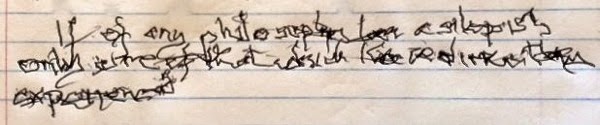
There was also a new notebook in which he'd only written on three or four pages, probably because his handwriting was completely giving out. This is the last entry:
note.jpg
Wovon man nicht sprechen kann, daruber muß man schweigen. Whereof one cannot speak, thereof must one be silent.
— Wittgenstein

Saturday, June 07, 2014

A rant on pronunciation

WE'VE BEEN ON the road for nearly two weeks, and blogging has suffered — both here and over at Eating Every Day. Most of my jotting has been longhand on scraps of paper, or short comments on Facebook.


But the other day The Huffington Post ran a blog post, "30 Commonly Mispronounced Food Words (and How to Say Them Correctly)," by Alessandra Bulow, which was mentioned by a friend on Facebook, leading to some contemplation on my part. 


(The article can be found at http://huff.to/1l6BHeZ )


My first remarks as posted to Facebook:


I find 7 of 30 agree with me, two more but only in one of two alternative, and one more I simply don't know the correct pronunciation: Huffington may well be right. 


Twenty, though, I think either wrong or misleading: I show my versions below. 


Note that no syllables should end with the usual (American) English "ee" diphthong, and that û is the French "u" (say "ooh" with mouth set for "ee", that "nh" stands for the French nasalization, not used in English except occasionally to express distaste, and that French almost NEVer stresses SYLlables as ENglish does. 


Lindsey says CARE-uh-mul, I say CAHR…


A) ree-SOUGHT-toh


1. Aïoli : eye-oh-LEE


2. Ambrosia : ahm-BROH-zyah


3. Ancho ("AHN-choh")*. ok


4. Anise ("AN-ihss")*  ok


5. Boudin : boo-DANNH


6. Bouillabaisse : bwee-yah-bess


7. Caramel : "KAR-ah-mehl" ok


8. Charcuterie : shar-kû-tree


9. Croissant : krwahss-sanh


10. Crudités : krû-dee-tay


11. Edamame ("eh-dah-MAH-meh")


12. Foie gras : fwah grah


13. Haricot vert ("ah-ree-koh VEHR") ok


14. Hummus ("HOOM-uhs") (oo as in book, not booze)


15. Jicama ("HEE-kah-mah") ok


16. Lichen : LIE-kun


17. Macaron : mah-kah-RONH


18. Mascarpone ("mas-kar-POH-nay; mas-kahr-POH-nay") ok


19. Muffuletta ("moof-fuh-LEHT-tuh") ok


20. Parmesan : PAR-muh-zun (it's English)


21. Prosciutto : pro-SHOOT-toe


22. Radicchio : rah-DEEK-k'yo


23. Rillettes ("ree-YEHT"; "rih-LEHTS") only the first


24. Raita : RYE-ita, where the "i" of the second syllable is slid past quickly


25. Restaurateur : ress-torah-TEUR, where the second syllable is slid past quickly


26. Sake ("SAH-kee"; "SAH-kay")* only the second


27. Sherbet : SHER-but


28. Tzatziki ("dzah-DZEE-kee") perhaps. I don't know. 


29. Vinaigrette : van-eh-GRETT


30. Worcestershire : WUS-ter-shear


After another person commented on the open Italian O in "risotto," and on English final diphthongs — or, if you prefer, diphthong finals — I added:


Savio's exactly right about the diphthong and I should have stressed the point more. And of course he's right about English lacking certain sounds extant in other languages (and vice versa).


"Risotto" is a great practice word. Being Italian, it should begin with a slightly trilled "r": say "HREE " and gently flip the tip of the tongue against the roof of the mouth just after the "h." 


The English word "sought" is almost exactly right as it lacks the diphthong, at least to my ear, probably because the "t" cuts it off. 


You pronounce both letters of a double consonant in Italian, so the final syllable is "toe." Pure "O": no slide into the W of "tow"!


By the way my daughter Giovanna hears her name mispronounced far too often : it's jo-VAHN-nah, not jee-o-va-nuh. 


Mispronunciation is mostly the result of inattention and, I think, a mark of laziness (unless impacted by genuine physical problems with hearing, or with palate, tongue, teeth, or lips —gosh, it's complicated!).


During her long tenure at Chez Panisse, one of Lindsey's jobs was to prepare pronunciation guides to certain food terms and menu items, so that floor staff might be saved from error. I don't know if that's still being done; perhaps it's no longer needed. 


My own pronunciation is of course far from perfect, so if you have corrections to make, they're welcome…

Tuesday, May 20, 2014

Horace: Diffugere nives

With profound thanks to Bhishma Xenotechnites


(Finished for now, and constructive comments welcomed below —)


( Well, then, here's the result. I'm not sure why I have bothered —
     translation's not my game, and
lord knows there are versions enough in our English language;
     most of them much the same. 
Still, I wanted to get inside both meaning and meter.
     Horace deserves no less. If
I have made an egregious error, I hope you'll forgive it.
     All I intend is a gloss
On this masterpiece from a time and a place quite removed from
     our more frenetic world, where
meditation on Nature's recurring cycles fell out of
     fashion — though now, as we've learned,
Her cards trump all we've tried to retain in our dealer's hands,
     grasping, we find, to no purpose. 
Horace addresses his song to his friend, Torquatus, and sings of
     others we no longer know—
Tullus and Ancus were kings who died more than five hundred years 
     Before Horace sat down to write;
Theseus we dimly know from legend, but few can remember
     Pirithous, rival and friend.
Still turn the seasons today as they did two millennia and more
     ago when these great lines were written;
Horace's moon is ours; our seasons obey the same law; like
     him, we will never return.)


All the snow vanished now, and the grasses back in the meadow

     foliage caps every tree ;

Earth goes through her familiar changes and banks are left bare by

     rivers whose waters are low ;


Grace, with the Nymph and her sisters, the twins, dares to go now, naked,

     leading them all in the dance. 

immortality isn't for you, warn the years that nourish those

     hours that steal the days. 


Cold gives way before breezes; Spring is trampled by summer;

     Soon herself to give way:

Autumn pours out her fruits; then Winter's lifeless fogs come

     Back, repeating the course. 


That loss, however, is quickly restored by the moon in the heavens.

   We, when we have gone down where

pious Aeneas, rich Tully and old King Ancus have gone, we'll 

   be just dust and shadow. 


Who knows whether the hours of this day will continue, increasing

   by those of days to come?

Everything will elude even greedy hands of your heirs, friend —

   All that your spirit will yield.


When you finally perish, Torquatus, and terrible Minos 

   makes his final judgement,

not your family, not your eloquence, piety —

   nothing will bring you back.


From that darkness not even the goddess Diana, though he's

   chaste, can free Hippolytus,

nor has Theseus the power to break Lethe's fetters, binding his

   dear friend Pirithous.


     —Horace, Carminum IV, 7 (my translation)

Sunday, May 18, 2014

Tribes

• Nina Raine: Tribes
Beth: Anita Carey
Billy: James Caverly
Daniel: Dan Clegg
Sylvia: Christine Albright
Ruth: Elizabeth Morton
Christopher: Paul Whitworth
Directed by Jonathan Moscone
Berkeley Repertory Theatre, seen May 14, 2014.

Eastside Road, May 18, 2014—

THE PRODUCTION HAS closed, but I want to write a little about this play anyway; it's had a considerable success since its 2010 premiere in London, with productions off-Broadway, at the Mark Taper Forum in Los Angeles, the La Jolla Playhouse, the Guthrie in Minneapolis, in Boston and Washington D.C., and now at Berkeley Rep.

I want to write about it, chiefly in order to investigate my reservations about it. I think it's a play well worth producing, performing, and seeing; it gives rise to all sorts of contemplation. If it fails, in some respects, most of its small failures are the inevitable result, I think, of the complexity, the magnitude, and the audacity of its ideas.

The "tribes" of the title are, first (in order of presentation), a loud, foul-mouthed, undisciplined family of academic intellectuals dominated by an overweening father (Christopher); second, the Deaf community with a capital "D," as I've learned from the playbill, which gathers around its sign language to participate in a kind of society we hearers can hardly imagine.

The family comprises the well-written mother, Beth, and three grown children all still living with parents: Ruth, yet to find her passions; Daniel, neurotic, wilful and damaged; and Billy, almost completely deaf since birth but raised to read lips rather than sign language — a misguided intention of the parents, who think thereby to give him place in society at large, rather than surrender to that of the "handicapped."

Into this stew walks Sylvia, the child of deaf parents, fluent therefore in sign, hearing herself, but quickly going deaf. She introduces Billy to sign language and to more than that, including employment and, of course, romance. This is a total assault on the overbearing Christopher and all his arrogant assumptions; further, it disrupts a fascinating dependency Daniel has evolved on his brother's place in the family. A true theatrical crisis results, and Raine's writing rises to her play's demands.

But not always. At least in this production, much of the time the audience is cajoled into participating in the subtle catastrophe through crude, sitcom-like badinage. The six characters are not evenly fleshed out, and some plot details seem arbitrary, introduced perhaps to illustrate some aspect of the hearing-versus-deaf problem, then dropped before they distract from the central onrush.

What Raines does accomplish in this play is present the huge gulf that apparently exists between those who hear, and who communicate largely through sound and hearing (and in this case fury), and those who do not, and who must communicate through touch and sight. Behind and below this, of course, there's the matter of awareness, awareness and sympathy.

There's also the matter of language. We always think language is what makes us express ourselves and understand others: but as this play points out, language is just as often what makes us misunderstand, equivocate, and mislead, and certainly distract ourselves from confronting reality and especially the reality of the completely different views of reality experienced by those around us.

There was a lot to like about this production. The entire cast rose to the occasion, though I thought among them some were more capable with their roles than others. James Caverly, himself deaf as I understand it, was stellar in the central role of Billy. Christine Albright stepped into the role of Sylvia, originally set on Nell Geisslinger: she was moving and authoritative in the part. Paul Whitworth and Anita Carey were enormously effective as the parents, and if Dan Clegg and Elizabeth Morton weren't quite their match as the two hearing children, I think this was more the fault of the writing than of the actors.

Nina Raine has bitten off too much in her play. A few weeks ago we saw Tom Stoppard's trilogy The Coast of Utopia in a single day: Tribes is almost as thick with ideas and drama, but in two quick acts: it might better have been two more thoughtfully paced and fleshed-out evenings.

Jonathan Moscone's direction seemed straightforward; Todd Rosenthal's set was persuasively detailed; Christopher Akerlind's lighting and, especially, Jake Rodriguez's sound design were sometimes subtle, sometimes dramatically effective. I'm glad I went; I'll be thinking about the play for quite a while. It puts narrative plot in service of abstract and far-reaching idea. It will be interesting to see where Raines goes from here: Tribes is only her third play. I'm curious to see the others, Rabbit and Tiger Country.

Monday, May 05, 2014

Barns, and a personal note

EastsideBarn.jpgPERSONAL NOTE first: I named this blog in a hurry, as one often names things, but with little or no subsequent regret. I live on Eastside Road, and the blog reflects my own view on a number of things. It's true I live on the west side of the country, a fifth-generation northern Californian, born in Berkeley with a mentality to match; but when I'm not looking out over the Pacific — and I'm not, as a general rule — my view is extended toward the east: over the USA, across the Atlantic, toward the European linguistic and cultural history that's so much a part of the American heritage.
My outlook is informed by sense of place, and you're looking at my place. Narrow country road, two-laned, bordered by hills on the right, a broad beautiful valley on the left. Here we're looking toward the north, maybe half a mile north of here, at something I'll never see again: a white barn silhouetted against a file of sycamore trees, adding focus to the valley.

I love vernacular architecture. This particular barn stood here for at least the last sixty years. It was made of redwood, very likely first-growth redwood from across the river: vertical siding painted white; and it was tall, twenty-five or thirty feet tall I imagine. I don't know its original purpose, but before this valley was vineyards it was prune orchards, and before that it was hopfields. The barn may have been built to protect hop-poles, but that's just conjecture.

Last Thursday the barn burned to the ground. It had been an unusually hot day here, nearly 100°. The fire broke out toward evening; there was no one in attendance. By the time the firemen got there the situation was hopeless. (You can read the local newspaper's account of the fire here; for once, the comments are worth reading as well.)

Calplans barn, Eastside Road
Photo: Greg Witmer


I stopped on Saturday to look at the site. Two men were standing under the blackened sycamore sadly looking at the ruins. They looked at me curiously and I explained that I was there to tell them how sorry I was for them on losing such a magnificent barn.

It was a beautiful barn, I said. It, and Hopkins's stand of poplars to the south, had always supplied a focus to the valley for me, it somehow completed the beauty of the area. I stopped, feeling a little awkward. I was talking philosophy and aesthetics; they were factory-farm workers.

I suppose some might say I have a romantic view of landscape and agriculture — a view formed by other values than mere productivity and profit. An important part of life, to me — my life, I mean — is finding and acknowledging and experiencing, as fully as possible, its place: origin, source, presence.

Always recognizing its presence is a matter of moment, transitional and fugitive.

The barn was a fine metaphor of what I'm talking about, and to me that metaphor was enhanced by its geometrical quality. There was something about its position, by the road, under the sycamores, at the edge of the valley, its straight edges (like those of the road and the rows of grapevines) expressing its man-made contribution to the soft fertility of the valley floor, the sinuous river beyond the low trees to the west, the soft hills beyond, where the redwoods grow.

To my great pleasure the two men knew exactly what I meant. You could tell that by their response, yes, it was a beautiful barn, and beautifully made; and very old, older than either of them. But you could also tell by their demeanor. It's no exaggeration to say that they were mourning, like me.

Over the years I've photographed the barn from time to time, and I hope others have as well. I suppose it can never be rebuilt as it was, but I hope its replacement is not a matter-of-fact industrial steel shed. Perhaps the owners are well-insured, and the policy will allow them to rebuild appropriately. Shape and color are important, as valuable, I think, as function.

Of course it would have been better had the original structure been made of stone — there are a few fine old stone buildings hereabouts, but redwood was cheap in those days, easily milled and easily nailed together. Today's steel, today's version of timber in this regard, can have durability similar to stone. I'm not asking for faux-history; all I want — perhaps already too much — is an equivalent to what was there.

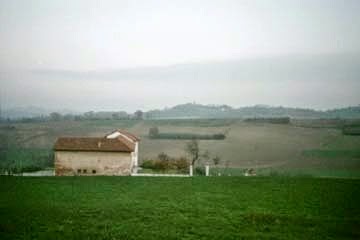
Since this post is in the nature of nostalgia, here's another photo — a farmstead in Piemonte, out northwest of Cuneo somewhere as I recall, cropped and zoomed from an inadequate image shot quickly as we drove past, at least a dozen years ago. It has been part of my fixed mental landscape ever since — like the beautiful white barn on Eastside Road.


ItalianBarn.jpg