Friday, September 19, 2008

Time-Based Art

LAST WEEK IN PORTLAND we attended three events in PICA's Time-Based Art festival. PICA is the Portland Institute for Contemporary Art; "time-based art" is, well, art whose perception requires the passing of time, I guess; what art would that not be?

Not to be snide: it is of course art whose point, or much of whose point, is the awareness of the passing of time. I think I first started thinking about this on learning about Japanese traditional art forms, especially the Noh theater; soon enough this was associated with the music of John Cage and, especially, Morton Feldman.
Well, anyway, PICA has been running a festival of Time-Based Art for a number of years now, and the festival was on last week while we were visiting that fascinating city. After more than twenty years of retirement I still prefer not to go to performances or galleries casually, and I hadn't planned on going to any of these. But three events were irresistible.

On Saturday we tagged along with Khris Soden on his Portland Tour of Tilburg. We and about thirty other people followed him as he led us, walking backward most of the time and holding a little paper Dutch flag aloft, along forty blocks or so through downtown Portland. Along the way he discussed the buildings, sculpture, fountains and streets we were "seeing" — "seeing" in quotes because while we were looking at Portland he was describing Tilburg, Netherlands.

Some of us had booklets of photos of the described places (some of them) in Tilburg. They were helpful, I suppose, but soon enough I was more interested in the cognitive dissonance between what I was actually seeing and what I was hearing being described. It helped, of course, that I'm quite familiar with the generic appearance of Dutch cities; their parks, traffic, cafés, shops, architecture, and the like — even though I am not at all familiar with Tilburg, a fairly large city in Brabant, the part of the Netherlands I know the least.

Today (Friday, Sept. 19) my granddaughter Grace is taking Soden's tour of Portland in Tilburg; I wish I could have been with her. What Soden does is part sculpture, part walking, part dance; wholly active, wholly contemplative. I'll be thinking about it for a while.

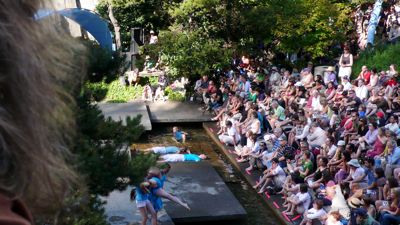
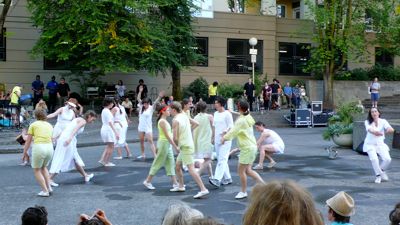
SUNDAY WE ATTENDED an event that was pure Dance, The City Dance of Lawrence and Anna Halprin, with choreographers Linda K. Johnson, Cydney Wilkes, Linda Austin, and Tere Mathern, writer Randy Gragg, and the Third Angle New Music Ensemble, a dozen or so musicians, playing music by Pauline Oliveros, Morton Subotnick, and Terry Riley.
P1040113.jpg
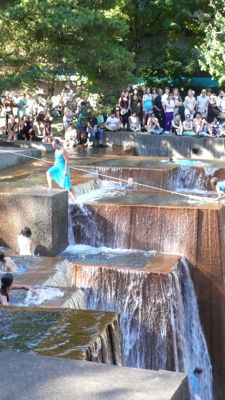
Probably a thousand people gathered at the first site to watch two corps of dancers in what amounted to a proscenium situation at Ira Keller Fountain Park. Morton Subotnick's electronic music surrounded the dancers and audience; many of us looked on from behind, or alongside. Toward P1040114.jpgthe end ropes were thrown down over the lips of the cascades and dancers climbed them to the lips of the upper fountains, where they threw themselves into the pools; dance and athletics have rarely been so beautifully, so strikingly combined — and in a setting that also includes terrain, plantings, and the audience awareness of itself as participant.


P1040118.jpg

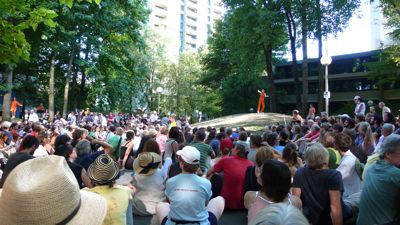
From here, a number of ushers quietly and tactfully guided the audience to the next stop, Pettygrove Park: three fairly small circular berms set among broad-leaved trees. No fountain; just quiet land and trees. Musicians — flute, clarinet, trumpet, French horn, violins, viola, cello, bass — were scattered widely within the landscape, and dancers appeared, holding positions, then coming to life. The music was by Pauline Oliveros, and it was delicious. Hearing unpredictable but logically appearing sounds, from conventional instruments conventionally played, in an outdoors public space, is one of the great pleasures of civic musical life: it binds the audience together with itself, its community, and the traditions of its culture. And seeing the music punctuated and "interpreted" — not only the music, but the park setting as well — knits all these factors together.

At Keller Fountain we'd been on the extreme margin of the audience, hardly able to see the dancers; here we were at the center, the dancers on their berms around us; Pauline's music, with occasional called-out words and phrases from writings of Lawrence Halprin, somehow both floating and focussing the audience into a gentle fabric of urban sound. Distant traffic and more local natural sound contributed, as did uncontrollable small motions within the audience.
P1040123.jpg
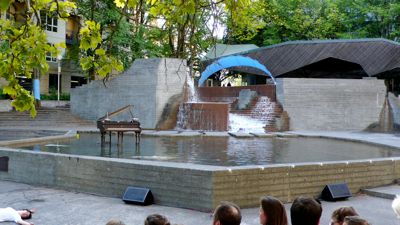
We were led next to Lovejoy park, where an ornate grand piano stood in water up to its ankles in a broad, flat pool. Once again the audience had moved into the arena before the dancers, but they soon appeared, by ones at first, then the entire company. As before, the choreography was an homage to Anna Halprin, the seminal San Francisco dancer whose "task" dances, like the great Parades and Changes, had rewritten dance history in the 1960s.

P1040127.jpg

The music here was Terry Riley's, and before it was over a musician had waded to that piano and begun to hammer out the familiar octave "C"'s that begin his equally groundbreaking In C. Before the act was over dancers had taken to the back wall of the fountain, methodically splashing cupfuls of water against the concrete wall, claiming Action Painting as just another part of the entire, integrated mise en scène.

I found the entire event absolutely exhilarating. The Modernism of the 1960s retains its vitality, its optimism, its freshness: it lacks utterly the cynicism and cool detachment of the postmodernism of the present day. I'm almost sorry I'm no longer reviewing art for a daily newspaper: but, since I'm not, let me refer you to this review online: I couldn't do it any better.

ONE EVENT REMAINED: a screening at the Portland Museum of Art of Zidane, un portrait du 21e siècle , the 2006 film by Douglas Gordon and Philippe Parreno. Ninety minutes long, it is nothing more nor less than the entirety of the soccer game between Real Madrid and Villareal of April 23, 2005, "entirely filmed from the perspective of soccer superstar Zinedine Zidane," in the description at imdb.com. I found the film utterly fascinating and somewhat frustrating: you never really see soccer; you focus entirely on the persona of Zidane, who naturally spends much of the game physically relatively inactive while mentally entirely focussed and committed. When he does move, of course, he's definitive. Athletics and Dance fuse completely in this film, as they did in the Halprin homage; and when we left the theater I couldn't help breaking and running. Gotta dance.

Shameless self-promotion

LISTENING TO CAGE, by way of his Thirty Pieces for Five Orchestras, made me think to check out Feldman, so I went to E-Music to download his Coptic Light. Hearing that made me think of my own Nightmusic, so I put it on next. I'd forgotten how nice it sounds.

Googling it I discover it's available from Audiophile, with the Oakland Symphony Youth Orchestra conducted by Kent Nagano — to my knowledge Kent's first recording. (It was released in 1982.)
07BBFF15-DDAA-4BFE-AEB8-CC31F41813DF.jpg


I wrote the piece forty-one years ago, I suddenly realize, on looking at my account of it over at shere.org. As recorded, it's a bit over 24 minutes long; quiet; mostly consonant.

Friday, September 12, 2008

Ashland 4: Two American Classics

Portland—

WE SAW SEVEN PLAYS in six days last week at the Oregon Shakespeare Festival in Ashland, only once having to squeeze in two performances on a single day. I've told you about the Shakespeare: here's a roundup of the remaining three. I won't go into details; click on the play-title links for OSF's webpages (casts are available there by clicking "Artists").

Thornton Wilder's Our Town is a classic, of course, stripping away all but the irreducible generic from its portrait of small town USA, turn of the previous century. There are those who no longer find it relevant; who think of it as simple-minded and sentimental. I'm not one of those; Chay Yew apparently was -- until he reread the play on being asked to direct it here in his OSF debut.

To my taste the overall success of this production is muted for much of its duration. Played in the outdoor Elizabethan Theater, it lacks two kinds of intimacy it would gain indoors: the stage is too apparent within its setting, but the audience, concentrating on that stage, loses contact among itself. I think Our Town is almost a community meeting; it profits from being shared by an audience aware of itself as part of the Grover's Corners community. Our Town, summoned up by its Stage Manager and playing almost entirely without props or sets, is meant to engage, even enter, the collective consciousness of its audience; for that to work, the audience needs to be aware of itself as a group. The darkness of the Elizabethan Theater audience makes that very difficult: the evening is like a nostalgic family snapshot, sixty years old, printed with far too much contrast, losing informative details in the dark.

But this production was evenly cast, beautifully narrated, nicely scaled; and it closes very effectively, melting away the specificity of individual life into the beautiful and reassuring inevitability and permanence of the future collective history that is death. I think it a magnificent play, and probably particularly one to see during a presidential campaign.

Arthur Miller's A View from the Bridge is another American classic, another essay on family and commmunity, another play with immediate political relevance. Staged in the (indoors) Angus Bowmer Theatre, it filled the wide stage with realism and action equally effective at presenting the exterior — dockside Brooklyn and its Italian-immigrant community in the late 1940s — and the interior — family life; psychological drama; challenge, defeat, and retribution.
Where Our Town is a philosophical romantic comedy, A View from the Bridge is a full-fledged Greek tragedy, lacking only the unity of time (it represents several months, not a single day, in the running its infernal machine).

For a number of years Miller's been consigned, I think, to a dusty corner of American theater. Setting his plays on specific American history — Italo-American Brooklyn, Puritan witch-hunt, middle-America traveling salesman — seemed to date him. But he wrote for his immediate present, couching the political issues that concerned him in parables his immediate audience would recognize. If the next generation lost interest, the one after that sees the universality, or rather the again timely, in this work. We continue to need it, alas.

Luis Alfaro's Breakfast, Lunch and Dinner is another matter. In Alfaro's words "a comedy about serious things," it concerns a woman who continues to eat, to inflate, finally to change utterly. Her own journey is set within the distractions of her family — a two-dimensional husband, a nymphomaniacal sister — and two rather undeveloped outsiders: her sister's cop boyfriend and an enigmatic Chinese woman met at a fat farm.

The production is well acted. (We saw an understudy, Kate Mulligan, in the lead role; she was absolutely first-rate.) In fact, I'd say the actors do more with the roles than the playwright has given them; credit has to go to Tracy Young's direction, too. But the production rides on a gimmick of stage mechanics* that ultimately becomes tiresome, turning Alfaro's "magic realism", I think, into bogus magic. I kept thinking there was a play here, somewhere, in fact; but that despite everyone's best intentions and efforts it never quite emerged; it floated away.

*Since writing this I've learned that the second act has been restaged and that "gimmick" — a flying harness — has been eliminated from the production. After two months, it became too much physical strain for the actress; presumably this is why we saw an understudy in the role.


at the Oregon Shakespeare Festival, Ashland:
Thornton Wilder: Our Town, running through Oct. 11
Arthur Miller: A View from the Bridge, through Nov. 1
Luis Alfaro: Breakfast, Lunch and Dinner, through Nov. 2

Thursday, September 11, 2008

That walk across the French Alps…

CS.jpgAS MANY OF YOU KNOW, I spent ten days in June and most of July walking from Evian-les-Bains to Nice with my grandson Henry and my friend Keith (Mac) Marshall. I'd intended to blog during that walk, but technology defeated me.
I have been writing about the walk, though, after the fact, in a third blog hidden until now. It's time to let it out: you can find it at Alpwalk.
It's a little rough around the edges, and like all blogs it has to be read from the most recent back to the beginning. Still, there it is, with a number of photos. Let me know if you like it.

Wednesday, September 10, 2008

Othello and Coriolanus in Ashland

Portland—

TWO DIFFICULT TRAGEDIES — difficult from the point of view of successful production, I mean, not posing intellectual difficulties for the audience — drew memorable stagings at the Oregon Shakespeare Festival this season. Unlike the two comedies this season, The Comedy of Errors and A Midsummer Night's Dream, Othello and Coriolanus were given fairly conventional, timeless and black-box settings; each served the text directly without overladen directorial interpretation, and each — like the comedies, for that matter — gained from quite strong casts.

Othello, staged in the outdoors Elizabethan Theater, was so powerful I decided, on leaving the performance, never to see it again. It just won't be necessary, not unless a personal friend's in the production. With no other stage décor than strip lights and an occasional prop (including Desdemona's all-important bed) the production seeemed to be nothing but situation and language: the text is truly brought to stage, to life.

I haven't been crediting actors on this blog recently, feeling your ability to consult the credits online is good enough (since the acting here, with minor exceptions I may get to, is consistently first-rate). But this Othello is so brilliantly set on its three principals, and they are so responsive to both Lisa Peterson's directing and Shakespeare's text, that it would be unusually irresponsible to omit them.

Peter Macon (another OSF debut) is utterly commanding in the title role, growing from the proud but engaging hero of the opening scene to the obsessed yet tragically and oddly sympathetic villain of the climax. Dan Donohue is unusually complex as Iago, thoroughly villainous yet oddly retaining a few misgivings, ultimately as tragic as Othello, because as trapped by his own decisions, by the workings-out of a situation spun completely out of control. And Sarah Rutan was interesting and engaging, not merely vulnerable and wronged, as Desdemona.

CORIOLANUS WAS EQUALLY effective (and affecting) at a different pitch. Staged in the round in the New Theater, lacking proscenium and distance, its production seemed to involve the audience more intimately: it didn't matter that the Roman tribunes and the Volscian army were so few; their ranks were swelled by the audience.

Remarkably, we saw an understudy (Brad Whitmore) in the role of Menenius; one can't imagine the regular player (Richard Elmore) would have owned the role any better. More to the point, Danforth Comins brought as much nuance and credibility as possible to the title role; Michael Elich scaled the antagonist Aufidius nicely, bringing out the parallels to the Iago-Othello opposition in that other tragedy.
Robynn Rodriguez was the Volumnia, and especially in the first act (and especially with help from Deborah Dryden's marvelous costume design) easily projected the obsessive pride and purposefulness that ultimately brings down both her son and the Roman Republic.

If I may never see another Othello, I certainly won't easily pass up another Coriolanus. I've seen two others relatively recently: a weak production, four years ago, at A Noise Within, down in Glendale; and a remarkably good production, by an all-female cast, in the Healdsburg Plaza a few summers back. The play is remarkably resilient: perhaps it's a mark of its imperfectness that a "definitive" production is less conceivable for it than for Othello.

Shakespeare: Othello and Coriolanus, running at the Oregon Shakespeare Festival, Ashland, through Oct. 10 and Nov. 2.

Ashland: A Midsummer Night's Dream

Portland—
WE ENDED OUR WEEK at the Oregon Shakespeare Festival in Ashland with an aftenoon performance of A Midsummer Night's Dream, one of four Shakespeare plays we saw last week. I wish I could say this was one of the best productions I've seen: it wasn't. Like The Comedy of Errors it was a "concept" production, and it suffered more: where Errors was an out-and-out adaptation, this was simply relocated to unspecified but post-Hippie America, nudged over the top by its director (Mark Rucker, in his OSF debut), and thrown out of balance by reducing the central romantic quartet to nearly the clown status of the rude mechanicals.

But, hey, there's lots to like here, once you accept the director's premise. It's silly to grouse about such things; we in the audience aren't seeing Shakespeare, we're seeing this one production of one of his plays; and there's no point complaining that this production isn't another.

The play opens with a coup de theâtre: the fairies are Cockettes, their familiar Shakespeare songs thrown defiantly across the footlights (when they're not in fact within the audience itself) in Punk attitude. Theseus is a rich bored dude, vaguely between arriviste Trump and Vegas operator; Hippolyta is amused and only slightly resentful. Egeus is Hermia's mother, not father, but one can get past that easily enough.

It's the quartet that's constantly annoying. The roles are well taken — I refer you to the cast roster — but they're directed to clown it up. This minimizes the distance between them and the genuinely funny Pyramus-and-Thisbe troupe, which is bad enough: Shakespeare has invented a brilliant four-layer world in this play, and to my mind each layer needs its own distinct landscape.

And particularly the lovers. Their lines are among Shakespeare's most poignant, most poetic; and far too many of those lines are distorted by oddly pitched accent, uneven dynamics, and pointedly contradictory sight-gags. Hermia is funny, no doubt, as an upscale valley girl, but that doesn't mean Helena has to be loutish.

The result of all this is a Dream that succeeds completely with Oberon and Titania (and Puck); with Peter Quince, Flute, Snout, Snug, Starveling, and a fine funny Bottom. Maybe that's enough: the audience loved it.
Shakespeare:A Midsummer Night's Dream, running at the Oregon Shakespeare Festival, Ashland, through Nov. 2.

Sunday, September 07, 2008

The Comedy of Errors in Ashland

Ashland, Oregon—

SATURDAY: TWO PLAYS yet to see, one of them a Midsummer Night's Dream to which I don't quite look forward, having heard it's a bit too, well, revisionist in its "concept" production — we'll see tomorrow.

We've already seen one concept production, but it was so "conceptual" — that is, dominated by the producers' determination to impose their own extraneous unifying perspective onto Shakespeare's text — that it is in fact and proclaimedly an adaptation, and to my mind a successful one: a musical version of The Comedy of Errors set in "a town west of the Pecos" in a vaguely late-19th-century period.

Adapted by Penny Metropulos (who also directed) and with a score by Sterling Tinsley and lyrics by both (and additionally by Linda Alper, who also takes an important supporting role), the result seems laid onto the Shakespeare Festival repertory like a glove on a hand. It draws on the Festival's acting ensemble, its outdoor theater, even its history of Shakespeare productions (both "traditional" and revisionist), plays with them, profits from them, in a complex and rewarding way I haven't seen in a theater company since Berkeley Rep's self-examination Rep which ran its course back in the early 1980s, in the then-new thrust-stage theater on Addison Street, and then unfortunately disappeared so successfully I can't now find its author or production history.

This Comedy of Errors is so engaging and energetic it's impossible to complain about it. Tinsley's score, like much else in the production, pokes fun at itself as much as at other musicals; it incoporates familiar old hymns and folk-songs seamlessly with occasional Broadway-type ballads.

The text is basically Shakespeare; the lyrics of some songs are apparently right out of the Folio. (Cole Porter's "I Am Ashamed That Women Are So Simple", from his Kiss Me Kate adaptation of The Taming of the Shrew, came often to mind; this Comedy of Errors was probably inspired partly by that example.) The plot remains Shakespeare's, too, though it's delivered in a raucous, movie-influenced Wild West setting.

I won't "review" the performances or cite the cast; OSF's webpage does that well enough: the cast was evenly matched, the two sets of twins remarkably persuasive physically; and even the addition of a sort of interlocutor, in the form of a Mexican troubador, and a Chinese merchant so stereotypical that any concern with political correctness is overcome by kitsch comedy — even these elements do much more to serve Shakespeare than to betray him. I'd see this production again.
Shakespeare:The Comedy of Errors, running at the Oregon Shakespeare Festival, Ashland, through Oct. 12.

Friday, August 15, 2008

Further on the long walk

on the trough.jpg
photo: Henry Shere


PRELIMINARY STATISTICS, slightly revised:

Elevation change: 51,300 meters, roughly, or about 167,000 feet, which is about five and three-quarters Mt. Everests. But this is pretty rough, and could range up to 20% off either way. The average is 1,500 meters/day (4,760 feet/day) (Mt. St. Helena is 4,344 feet, 1,323 meters)

Distance: roughly 725 kilometers, or 450 miles. Averages: 21 km (13.6 miles) per day; 3 km (1.875 miles) per hour (rests included)

Time: about 245 hours on the trail (rests included) in 35 days of walking; five rest days.
Average: 7 hours/day; but some days were twelve hours long.

Weight lost: about 12 pounds.

Other oddity: One shoelace stretched two inches in length over the other (unless the other shrank two inches for some reason).

I'm writing about the trip, but doing it day by day, perhaps with a photo book in mind, like the one I did last year of our Dutch walk (The Lingepad). But it's tough writing; notes are scattered among a number of places; photo times are problematic; etc., etc.

Thursday, August 14, 2008

Eating every one of those days

A TENTATIVE LISTING of the meals (chiefly dinners) eaten during our Long Walk, June 20-July 28, and the week or so following while on vacation in Nice and the Netherlands; and then, to bring us up to date, the last few days here at home:
June 19 Amsterdam dinner at Marius: vitello tonnato, duck breast with vegetables, fruit and ice cream
June 20 Creusaz hotel l’Alpage: trout, pommes frites, salad
21 Dent d'Oche refuge: soup, grey beef, chocolate pudding
22 Chalet de Bise restaurant: soup, biot (Savoie sausage) and polenta
23 La Chapelle d'Abondance hotel: guinea fowl
24 La Chapelle d'Abondance tartaflette
25 Bassachaux refuge: chicken soup, tartaflette, tarte à myrtilles
26 Mines d'Or gite: gazpacho, poulet Basquaise
27 Samoëns restaurant: tartaflette
28 Samoëns restaurant: salad, lamb, crème brulée
29 Chalet d'Anterne refuge: nettle soup, pork loin, mashed potatoes
30 Chamonix restaurant: salade Niçoise
July 1 Chamonix restaurant: grilled lamb chops, peppers, tomato
2 les Contamines restaurant: bad unmemorable “Italian” food
3 Croix de Bonhomme refuge: soup, polenta Bolognese
4 la Balme refuge: spare ribs Coca-cola
5 Landry hotel: paté, boeuf Bourgignon
6 Col du Palet refuge: soup, biot and polenta
7 Val d'Isère restaurant: biot and polenta
8 Bonneval gite: stuffed zucchini, steak
9 Lanlesbourg hotel: Savoyard dalad, blancs de volaille
10 Bramans hotel: rabbit
11 Modane hotel: pork loin, crudités
12 Susa, Bardonecchia lunch: Canitna del Ponte, Susa: what? restaurant, Bardonecchia: gnocchi
13 Thabor refuge: lasagne
14 Plampinet gite: jambon melon, tartiflette
15 Briançon hotel: Caprese, boeuf brochette, salad
16 Villar-San. Pancrace gite crudités, chicken, rice, cheeses
17 La Chalp refuge: "Niçoise" salad, chicken, potatoes Dauphinois
18 Ceillac refuge: soup, poulet Basquaise, cheese, salad, strudel
19 Fouillouse refjuge: soup, chicken, mixed vegetables, salad, linzertart
20 Larche hotel: quiche, salad, chicken tagine, cheese, fruit
21 St. Dalmas hotel: Maigret de canard, cote de porc
22 Roya refuge: potato-pea soup, boeuf daube with pasta
23 Vacherie de Roure thick vegetable soup, ham with pineapple, risotto with eggplant, cheese, flan
24 St. Dalmas en Valbore restaurant:cheese feuilleté, colin, white rice with pistou, salad
25 Utelle apartment-residence: rissoles, salmon steak, crème caramel
26 Nice restaurant: Salade Niçoise
27 la Gaude party: grilled steak, salad, cheese. Dinner, restaurant: fish soup
28 Nice restaurant: lunch: socca. Dinner, restaurant: fish soup, salad
29 Nice: lunch, Menton, what? dinner, Nice restaurant: assiette Niçoise, Salade Niçoise, socca.
30 Nice lunch, San Remo: sandwiches. Dinner chez McKee: chicken curry.
31 lunch, l"Orée du Port: fish soup, moules. Dinner, Rendezvous des Amis, Nice: artichoke terrine, chicken fricasee in pastis with rouille, prune clafoutis.
Aug. 1 lunch, Restaurant As, Amsterdam: Steak tartare; dinner, restaurant in Apeldoorn: broth, freshwater fish, complex dessert.
2 lunch Hoge Veluwe: pannekoek. Dinner chez Elfring, Apeldoorn: what?
3 dinner chez Elfring, Voorburg: lasagne
4 dinner, Piccola Italia, Middelburg: insalata, spaghetti carbonara
5 dinner, hotel 't Schouwse Hof, Aalsmeer: beef bouillon, slibtong, salad, vegetables, potatoes, ice cream and berries
6 dinner in airplane: chicken with rice
7 dinner at home: Salade Niçoise
8 dinner at home: Salade Niçoise
9 wedding dinner: pulled pork, rice, beans
10 lunch at home: cheese and salad
11 dinner at home: sole, lima beans, salad
12 dinner at home: grilled steak, lamb chops, salad
13: lunch: half a pan bagnat. Dinner, Café Chez Panisse: figs with mint and arugula in crème fraîche, duck confit with figs.
14: lunch, Willi’s Wine Bar, Santa Rosa: roast marrow bones.
Oh: and in this period I lost about ten pounds!

Tuesday, July 29, 2008

Ending the Alpwalk

WE WALKED INTO THE SEA yesterday, ending our long walk across the French Alps.

Well, not really, of course; the boots have been too good to me to treat them that badly. I contented myself with a slight touch of toe to surf; then turned round and walked the three blocks to the flat we're crashing in.

The last day was a surprise to me: I'd expected anticlimax and hours of urban walking; but it was much nicer than that. True: we'd already seen the Mediterranean, and Nice. But the walk from Levens to Aspremont, while tiring because of heat and steep climbing, was in hills and forest: and the walk from Aspremont to Nice took us through surprising country, open and wild, only at the very end dumping us into the top suburbs leading then quickly down to Jean Medecin and the beach.

I'm at another French keyboard so will cite only a few preliminary statistics here -- at my own keyboard; eventually, I'll try to make some sense of this trip, with photos. In the meantime:

Distance: roughly 725 kilometers, or 450 miles
Time: about 210 hours on the trail (rests included) in 33 days of walking; 5 rest days
Averages: 21 km (13.6 miles) per day; 3.4 km (2.14 miles) per hour (rests included)
Elevation change: Haven't worked this out yet; but I've read the walk is the equivalent of four times up and down Mt. Everest; and I don't doubt it.

I took 1,787 photographs during the 38 days of the walk, so some editing will have to be done...

Now we rest two more days in and around Nice, and then fly to The Netherlands to join Lindsey who I haven't seen for 35 days, the longest we've been apart in 52 years!

Saturday, July 26, 2008

Nice, provisionally

Well we are here in Nice, but not quite: we haven't really finished the walk. Increasingly we find it hard to find a bed; and after 20 miles of walking, much up and down, a bed is a nice thing to find.

Today we reached Levens without too much trouble, but found the hotels, gites, and so on all full. Horse show in town.

What about next town; I asked the bureau touristique: also full. It's July; Brits and Nederlanders have filled the beds.

So we took the bus to Nice and crashed in a friend's flat. To,orroz is q dqy of reposem you see hoz this french keyboqrd is zorking:

Monday we take the bus back to Levens and finish the walk legitimately. I'll let you kknoz detqils lqter zhen the keyboqrd speqks english:

Thursday, July 10, 2008

Day 21: Bramans

WELL, WE DIDN'T GET FAR today. It's hot and a little humid and I think somehow being down here in a valley instead of up there in the mountains has somehow made a difference. We walked about five miles altogether; stopped to investigate an archaeological museum, stopped for lunch; and decided to stay at the hotel-restaurant for the night, the alternative being six hours more of walking, to Modane.

An interesting conversation with the hotel proprietor at tea this afternoon. We'd been to the grocery-post office whose sign said it opened at 2:30; but by four it still wasn't open. He shrugged. Around here, signs, they don't mean anything, people open when they're ready to.

Are we in Italy, I asked, or Provence? Worse, he said, we're here in Bramans; around here no one really has to do anything, the houses are empty much of the time; people from Netherlands, England, Paris, wherever, come live here for a few months until they're bored; then they go to Morocco or wherever. The towns are rich, but empty.

And it's bad for the people who really are from here; they aren't rich, but the town is classified as rich; so they have to make the best of it.

So it all becomes clear. These towns on the Arc valley in the Maurienne are hyped in the tourist machinery as "authentic" villages in the past; cars are asked to park on the outskirts; there aren't any neon signs or for that matter much street illumination; all that is just fine with me, but it's pretty artificial.

Of course it isn't really artificial at all. It's a logical way for a village to be: tranquil, clean, pretty. We could all wish our own villages to be so; and if more were, this would be normal, and the nagging feeling something's simply been staged for the benefit of a tourist economy would go away.

Most of the towns these last three days, Lanslebourg excepted, have been pretty small potatoes -- one church; one cafe, one hotel if any. Not too many people in the streets; perhaps it's just too hot. Getting from one town to the next has been fine; dirt roads through fields and forests for the most part; often thankfully in the shade.

Tomorrow we'll hit Modane, and from there take a train to Chiomonte for the day. Then it's up and at 'em: climbing back into the mountains for the push to the next big town of the walk, Briançon. I'll be glad to be back up there.

Wednesday, July 09, 2008

Lanslebourg

FIRST, A CORRECTION to the previous blog: as Thérèse pointed out, a better URL for the photos is here.

We are now in Lanslebourg, in the valley of the Arc, working our way quickly enough toward Modane. This excites me a little; from Modane we can easily take a train on a day off and cross into Italy to visit the town Lindsey's father was born in. I haven't been there since the winter Olympics, which undoubtedly changed things greatly, and I'm eager to introduce Henry to the town his great-grandfather came from.

The Arc valley is a lower variant of the GR5 that we're taking from Geneva (Evian, actually) to Nice; in a way, perhaps we're cheating a bit. I don't feel too bad about that, since we've already had plenty of climbing: the other day we actually climbed 5,762 feet in one day.

The Arc is billed, in a guidebook I'm using, as particularly interesting historically, for its authentic vernacular architecture and all that. Last night's stop was Bonneval-sur-Arc: a twin city with Les Baux en Provence. Like that village it seems quite inauthentic to me, very much a museum piece, artificial. But pretty enough; and far from the quality of the upper Savoyard places we've been in up to now.

Today's walk was perhaps 20 km and mostly flat, through fields and forest on dirt roads, very comfortable. Tomorrow will be similar: then after the Italian interlude we tackle higher mountains again, and longer days since the distances between refuges will be further. We'll see how that goes.

Tuesday, July 08, 2008

photos

You can see a few photos taken a week or so ago at

http://www.flickr.com/photos/14329090@N04/sets/72157606041033930/

Bonneval sur Arc

Bonneval-sur-Arc

We crested the highest pass we'll be on on this entire walk today, and it was remarkably easy. The Col d'Iseran is 2770 meters high, and we started from Val d'Isere, nearly 900 meters lower; once cresting it, we dropped 900 meters again, to this town, where we spend the night.

The col itself was a little disappointing, crowded with daytrippers in cars and on motorcycles, with an expensive souvenir shop-cafe and an interesting but unmemorable stone chapel.

But the descent! It took us through a narrow gorge, the torrent far below us at first. At one point the path was only a foot or so wide, with quite a drop to the torrent. Then we came out into a beautiful valley set about with a number of ancient stone "chalets," some of them being refurbished apparently for vacation or weekend use.

There's a lot more I'd like to write, but this blog is getting so confused, what with delays in posting and confusions with keyboards, that I'll stop with this.

If this post works out iti proves that the folding keyboard, Palm web access, and wifi can do the job. If so, I'll try to put some order into this thing.

Monday, July 07, 2008

Day 14: Refuge de la Croix-Bonhomme

A DAY OF RAIN, our first. Oh well. We left a nice cheap hotel in Les Contamines aty about 8 am, walking a delightful road along the bonnant river which had done considerable damage the day before yesterday (all this written some days ago). It was misty but we were drey, walking under trees. In good time we reached the baroque Chapel of Notre-Dame de la Gorge where a number of miracles have apparently been done.

Then we were on a Roman road. XCould this be the Via Alpina? It was steep, for the gorge really strts here, and is well paved with stone, much of it native and undisturbed; and it features a Roman bridge with a fine arch over an amazingly deep and vicious gorge.

The road was a bit of a scramble, and though we were still under foliage th emist was getting heavy. In another 45 minutes we came to a chalet, though, a house featureing a sort of cafe in what might have been its salon or living room, and here a handsome fellow fluent in Italian as well as Frency served us a fine pot of tea, and we lingered over it for a half-hyour.

Oustide it had begun to rain seriously. I'd already put my backpack raincover on: now I drewe on my rain-pants, and we slogged on up the Roman road, finally into quite exposed alpage pastures, to the refute at la Balme, where we had another pot of tea and delicious little tartelettes a myrtille.

From there, though, the walking grew difficult. We were still ascending, across fields braide with freshets, losing our way at one point, finally scrampbling up to a small hut where we cowered with a couple of Brits and a couple of Australians for half an hour.

Chocolate was passed around, desuotorey conversation attempted, and then out again into the rain, walking a traverse now most of the time thakfully instead of climbing, to the true col and, after an hour, our Refuge.

It's big and full. wwe sti at a long table and nurse mulled wine and look out at the mountains which come and go under their mists. DInner will be served in a few minutes, at seven, so I soon stop.

This was our 11th day of walking, and we may have hit our stride: we seem to be keeping up with the guidebook timetable. Today we walked 22 kilometers, just short of 15 miles. We climbed 1280 meters . In the walk to date we have gained and dropped about 14,000 meters, which is to say about 44,000 feet -- it hardly seems possible. We are presently at 8100 feet. And a little tired, but not much, and we feel great.

That written a couple of days ago. Yesterday we climbed 5762 feet, from Landry to the Refuge Pas de Palet, in nine hours walking. Today we're in Val d#Isere; tomorrow Bonneval sur l'Arc: I'll try to post from there.

Wednesday, July 02, 2008

Day 8, Samoens

IMAGINE TWO LITTLE dots on the "e" in Samoens, whose final "s" is silent. (Like the "p" in "swimming," my father used to say.)

The town is an old one, once considerably larger, then fallen on hard times, now rebounding thanks to tourism. More sports and souvenir shops than bakeries, always a troubling sign. But a nice town nonetheless.

It was here that Marie-Louise Cognac-Jay was born. She founded the Paris department store La Samaritaine. She made a lot of money, as you can imagine; and she put a lot of that back into her native town.

Especially notable is the garden she endowed, la .Jaysinia, small but elegant, part botanical garden, part arboretum, climbing a hill behind the main street. (Practically the only street, when it comes to cafes and businesses.)

There yesterday we noticed a tall thin rather elegant man, say in his fifties, a typically French-looking man I thought with an aquiline nose and piercing dark eyes. He was accompanied by a beautiful Asian woman, very stylishly dressed but not at all excessively, and a very pretty little girl.

When I first saw them he was seated in an armchair that had been carved out of the stump of a failed tree, the girl on his lap reaching up to kiss him, the wife standing by, camera in hand.

We struck up a conversation and the woman admitted she has secretly photograPhed Mac and me, telling her husband that I was him in twenty years. "I hope your next twenty years are as happy as my last twenty have been, " I told him; "with a wife like yours, I'm sure they will be."

They turned out to be Chinese, living in Yunnan; he's here on a professional tour; he's an ethnobotanist working on a project pooling genetic material of useful plants from all over the world. I told him that my mother was born in Shanghai; Mac told him his wife Margery worked as an antropologist in China.

La monde est petite, the French say with their brilliant originality; it's a small world. As we entered Samoens yesterday, Henry and I, in our automobile (commandeered on the road at Les Allamands), who should we find sipping her green tea in the covered market (active only on Wednesdays) but our Austrian, who we first met in the refuge at Bassachaux a few days back.

She travels with a ten-kilo pack containing a little fireplace, utensiles, change of clothing, and notebooks. She always prepares her own food, cooking it over the metal-pot firepit.

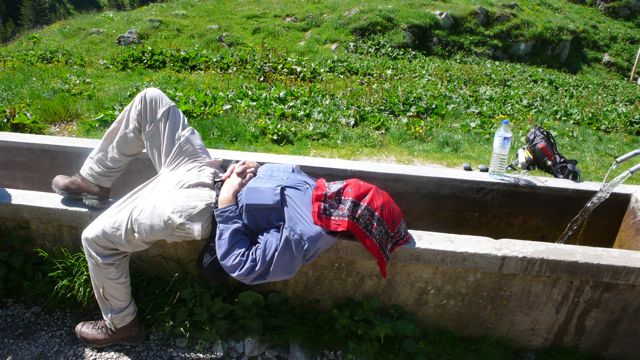
She doesn't carry water; just a wooden cup; and she never passes a source of water, trough or tap, without drinking a cup. She walks an hour and rests five minutes; walks four hours and rests one.

She can't weigh a hundred pounds, is slim, muscular, close-cropped, grey, just fifty, and incredibly strong and healthy. Also incredibly good-humored. She too had photographed us and promised to e-mail the result: when I gave her my card, "Oh, you're a writer," she said; "what do you write?"

"Whatever I like," I told her. "I write too," she said, "but books you wouldn't be interested in, about cats and dogs, and how to raise them, and such."

She should write about her walking, I thought; she has much to teach others.

We stay here today, resting up; our next day's walk apparently involves both snow and a ladder or two. I look forward to it.

Days 8-12, from Les Contamines

LONG TIME SINCE contact; sorry. And now once again I work on an unfamiliar keyboard at a slow connection.

The weather has been cooperative; the housing adequate. Today for example an easy walk of ca. 6 hours from Les Houche, reached by bus from Chamonix where we'd stayed two nights, to Les Contamines; a pretty tourist town: tomorrow we have a harder day to La Croix de Bonhomme.

Why two nights at Cha,onix; not my favorite town? Because the day before arriving there we walked a hard day: 10,000 feet of vertical displacement in twelve hours on the trail; two of which were resting.

There's so much to say about this trip: the people we meet, places we stay, the landscape which is truly splendid. Mostly, though, it's left foot, right foot; and I think often about verticality, and different ways of planting those feet, and different muscles, bones, and tendons. An anatomy lesson every ten minutes.

And how to walk on snow, wet stones, and so on; and the difference between walking on the level or down- or uphill; which you do up to about fifteen to twenty degrees; and climbing, which takes over next; and scrambling, my least favorite.

I'm sorry, too, that I'm not able to attach photos; not that photos would do this landscape justice. Much will have to wait for a more favorable technology. For now I just want to assure any who care that we are in as good health as before our beginning this walk; and undoubtedly stronger. But we have a way to go: we've only covered a fifth or so of the distance!

Friday, June 27, 2008

Day 5; 6; 7: Samoens

APOLOGIES FIRST: for the double send of the lqst dispqtch; qnd for the odd spelling here! I am using a French keyboard; and the sun is in my eyes:

From Chapelle dAbondqnce we walked rqther easily up through forest; past a fine waterfall; then scrambling up stony paths through woods and finally across snow patches to a col and down through alpages -- pastures peopled if that is the word by nice Abondqnce cows -- and ultimatlely to the Refuge de Bassachaux; where we had a nice roo, to ourselves overlooking the terrace: Good dinner; comfortable bed; fine breakfast.

Yesterday; day 6, oh; theres the commq*a; was a bit harder especially at the end. It began easily enough with a stroll along a flat dirt road leading to Switwerlqnd; cuckoos appropriqtely singing in the forests below the trail. Once across the frontier (nonexistqnt) we found a gite, alas not yet open; where a number of wo,en wwere preparing the opening twà dqys hence: wqshing tables (we were not allowwed to sit at them), wiping down telephone books (no kidding), and such. Uncomprehendingly we walked on past the Lac Vert and up to a col overlooking fine alpages; different cows here; flora too:

We met our Austrian *again, a young 50 very slender vegetariaqn and very strong and pleasant who hqs walked many trails and is preparing the aPPqlachian pacific crezt and rocky ,ountain: a brqve femme:

Then back into Franbce for q difficult descent through pasture on rutted stony trqil; stepping carefully and descending steeply; to the refuge mines dor - there really zere gold mines here: A fine room agqin and a nice dinner; also q ga,e of boules before dinner:

This ,orning rqther harder; cli,bing to a steep col; then dozn dozwn down to Samoens: where ze perhaps stay long enough to ,aster this da,n keyboqrd:

Donùt count on it

Tuesday, June 24, 2008

Day 4: Chapelle d'Abondance

Chapelle d'Abondance, June 24--

Let's see: where was I? Oh yes: up early yesterday to watch the cows brought in for milking. One man and three dogs invited them down from the flowery pastures to the milk-barn. All three dogs looked the same to me, black and white, border collies or whatever.

One was the one who always snapped at the water when you washed your handss or filled your bottle at the trough; very annoying. Another, apparently younger, was on a long rope held by the gardien; maybe he was in training.

The cows looked at me curiously, then turned back to their own path to the barn. They're red and white, short-horned, of the Abondance breed, established during the 19th century: there's a plaque telliing me all this here in town, with a nice statue in open ironwork of a cow.

Anyhow after breakfast we ascended the pasture without much trouble, stopping to rest now and then, and then came to Pas de la Bosse at 1816 meters. From there a fine view back over last night's chalet to the pass from which we'd descended yesterday -- I'm sorry I can't post photos from this folding computer! -- and a pleasant view forward: for there, in the distance, lay Chapelle d'Abondance and, I assumed, a hot bath.

But first the long descent, and just now those hurt far more than the climbs. At first it was easy enoough, on switchbacks on dirt cowpaths. Halfway down we made some kind of mistake and lost the path.

We had to bushwhack through vegetation reaching almost our knees, thick lush growth hiding stones and marmot-holes. This is hard on the ankles, but ultimately we rejoined the rutted switchback path, not that much better.

The vegetation! Dozens of varieties of wildflower: gentians, orchids, buttercups, trollius, wild rose, violets... and dozens more we don't identify. The fragrance is wonderful: it's like walking past a gigantic open honeyjar.

At the bottom of the steep descent we entered a forest of evergreens, leading to a place apparently being "developed" into summer chalet country; and then we walked down through a sort of educational nature reserve with panels describing tle local flora and fauna, finally coming to town.

We were hot, tired, footsore, and hungry, and stopped at th firs hotel: La Gentianette, I think. We showered and changed an went to the next hotel for lunch -- omelette fines herbes and a green salad for me -- and then relaxed. We have a swimming pool, a sauna, a Turkish bath, and a room with a nice balcony and A BATHTUB!

The town's a bit depressing to me; I see it as four or five fine old stone buildings surrounded by new stuff built in the last forty years, the transition from locally sustainable agricultural economy to globally dependent leisure industry. Judging by the number of cars in the lots, and the number of closed sporting-goods shops, the previous economy may return.

We're here for a rest day; tomorrow we resume the march. I've seen a number of GR5 walkers today, on our own stroll back from the supermarket a couple of miles down the road. There'll be company.