Saturday, October 29, 2011

Gordon Cook

Eastside Road, October 29, 2011—
IT'S TOO LATE to tell you about it; the show closed today; but the work of Gordon Cook has found its way to a new home in San Francisco's George Krevsky Gallery.

Born in Chicago in 1929, Cook came to San Francisco in his very early twenties, working at first exclusively as a realist printmaker specializing in botanical subjects, moving on to figure drawing, finally, after his marriage to the painter Joan Brown, developing his unique qualities as a painter.


It does him no disservice to mention that his paintings inescapably bring Chirico and Morandi to mind. His palette, lighting, edges, scale, and composition refer to their sense of dramatic realism, enigmatic statement, quasi-enchanted awareness; but the subjects — boats in the low Sacramento Delta light, gas tanks at the Richmond refinery, even the featureless Amish dolls — all convey a sense of specific place.

Guston is here too, in the curiously vulnerable, clearly humanistic content of his images, at first encounter utterly removed from subjective emotion, later growing in sympathetic resonance.

I once had a heated discussion with Cook: I was trying to persuade him of the possibility of painting from imagination, thinking up forms, even subject-matter, that didn't exist in fact. No, he said, That would be absolutely immoral; one can't legitimately paint objects that one hasn't actually seen.

So in order to paint his stick figures, men rowing boats, silhouetted kissing couples, he first actually made them, using thin wood, cardboard, glue, and paints of course. His sculpture is in fact maquettes made for posing for their portraits: he brings the concentrated gaze of the figure-painter (and, even more, draftsman) to the contemplation of the bulk, edge, directionality, even purpose of these three-dimensional inventions.

On another occasion, shortly before his early death in 1985, I sat in on a talk he gave to a number of graduate painting students at Mills College. One asked him about the repeated canvases depicting that gas tank in Richmond: why did he paint it over and over again?

My dealer asks me that too, Cook replied. Then, more seriously: I'm just trying to get it right.

What I love about the painting of the San Francisco Bay region, at its peak, among other things, perhaps most of all, is its morality, its ethics. Gordon Cook was among the most persuasively pure practitioners of any of them. His work, like his example, is haunting, and it's good to see it out there again. An artist of enormous presence and import, clear-thinking, poised, whose work has the compact kind of energy we usually call power. The exhibition has closed; images remain on view here.

Friday, October 21, 2011

Painting

Eastside Road, October 21, 2011—
The San Francisco Bay area has long been one of the most significant American locales for painting, certainly since the middle of the last century, in fact going back at least half a century before then. There are interesting cultural, geographical, and historical reasons for this; we needn't go into them here. Suffice it to point out that an unusual combination of pioneer spirit and genteel tradition was almost immediately at the center of the Northern California mentality (for a brilliant study on this theme, see William Everson's Archetype West: The Pacific Coast as a Literary Region); that relative isolation with occasional exposure to European Modernism allowed that mentality to respond to the local natural and societal stimuli; and that by the time of the post-world War II years, when the GI Bill allowed many gifted artists of other than rich backgrounds the time and setting for their own personal development, a génie de terroir, so to speak, had already been well developed.

My own years as an active observer of the scene, from the late 1960s on for twenty years, coincided with the tremendous expansion of the Bay Area art scene from a marginal, almost underground activity, treated seriously in the newspapers but hardly known to any but real devotees of the art, to its present amplitude, with galleries in shopping malls, art school campuses everywhere, and almost total neglect in the few remaining news outlets. Not surprisingly, perhaps, the painters who had attained their mastery in the late 1950s and early 1960s remain my heroes, artists who dedicated their lives to painting in a context of almost total neglect by all but their own colleagues.

Few of them are still living: Frank Lobdell is perhaps the last. Even among what I think of as the second generation, painters my own age, now in their late seventies, slip away with melancholy regularity. Nathan Oliveira, for example: a marvelous painter and teacher (Stanford for many years) and a very nice man. He died nearly a year ago — there's a fine obituary by John Seed on the Huffington Post website — but we saw the memorial exhibition at the John Berggruen Gallery a few days ago: it closes tomorrow, October 22, but the website will, I hope, continue to present its forty-two images of the paintings and sculpture on view for a few weeks to come.

The last works are striking: the familiar Oliveira figurative images isolated against glowing grounds in his characteristic warm but muted, sometimes even darkened oranges, reds, maroons, ochres. Many of these figures stand (or, occasionally, dance, or skate) next to a single line, an edge — shadow, or skin, or crack of light in a doorway? Others have auras, or long hair bending back from the head as if the essence of the figure is escaping toward an unknown (or, perhaps, being breathed into the figure from that unknown).

It's impossible to see these late works, I think, without musing on the painter's own death so soon after completing them. Yet earlier canvases here, going back to the 1980s, not to mention drawings and watercolors going back a further twenty years, reveal this haunting meditative quality to be Oliveira's fixation, his constant orientation to his work, as his work is apparently his constant orientation to life, to his own individualization of the human condition.

Even the work that seems to stray from this — the paintings and bronzes that seem to confront relics from neglected or abandoned civilizations, reminding me of pavements left over from ancient Mediterranean sites — even these merely extend the personal expression toward a more universalized one. Oliveira's work, like that of his friend the (still living, thank God) sculptor Manuel Neri, remind the viewer of the affinity of the Mediterranean sensibility with that of the Bay Area, as if the Californio years were not lost on our cultural inheritance, and continues to haunt if not energize this very moving work.
Last week we saw also another moving gallery exhibition, of drawings, drawings with collage, and a few paintings by Jay DeFeo, truly one of the great painter-heroes of our time. I knew her slightly; we taught together for a time at Mills College, where I sat in on her beginning painting class now and then. (Alas, I never learned to be a painter.) The current exhibition at the Hosfelt Gallery closes, unfortunately, tomorrow, like Oliveira's at the Berggruen; I'm sorry not to have been able to get to commenting on these shows earlier.

At the Hosfelt there's a particularly arresting painting, Bride, from 1986. The title has inescapable Duchampian overtones, of course; and thinking about that, and about Jay's unique intelligence which rests at the intersection of seeing and contemplation, goes a long way toward explaining the central position her life and work intuitively seem to occupy in the late-twentieth-century context of visual art, not only locally, but internationally.

Fortunately, the Jay DeFeo Trust maintains a fine website and works passionately to further awareness of this important artist whose early death — she was only sixty — otherwise threatened to leave her in obscurity in a cultural climate increasingly rewarding more trivial, flashier entertainers. The Whitney Museum will produce a major DeFeo retrospective next November; I hear it will travel to San Francisco; it will be a major, major event.

I don't like to snatch images from the Web and re-post them here; you never know what's copyright, what's freely offered for second-hand retailing. I urge any visitor here to follow up the links embedded here — even better, of course: get to the galleries tomorrow.
  • Nathan Oliveira Memorial Exhibition, John Berggruen Gallery, 228 Grant Avenue, San Francisco; (415) 781-4629; Mon-Fri 9:30am–5:30pm; Sat 10:30am–5pm; through October 22; catalogue available
  • Jay DeFeo, 430 Clementina Street, San Francisco;415-495-5454; Tue-Sat 11-5:30; through October 22
  • Sunday, October 09, 2011

    Steve Jobs

    Eastside Road, October 9, 2011—
    LOTS OF RESPONSE in the blogsphere, in the media, even in conversation, about the death last week of Steve Jobs. There's not much question but that in death as in life he was a touchstone, just as was his computer. It's odd how passionately people align themselves for or against certain forces, which is what I think he truly was. You were either a Mac person, or you were not. Apple or PC: like Fitzgerald or Hemingway, National League or American League, in my father's time General Motors or Ford.

    Since so many have had so much to say, I'll chime in, in three comments: personal, appreciative, more general.

    First: I'm a Mac man. My first computer was a Radio Shack Model 100, which let me see eight lines of type at a time, no matter how much copy I'd written, and then send it, marvel of marvels, over a telephone to the office. I taught myself a little Basic with that machine, too, to use it for various other things. I even began typing out Lindsey's book on it, saving sections to tape cassettes, but that quickly grew too clunky.

    So I graduated to a real desktop, a Morrow. Here I began dealing with arcane line-item entries, saving to drive A or drive B, always dealing with terminal commands. The rest of the book got typed out, and even printed, on one of those daisy-wheel jobs on paper with perforated tear-off margins. It was enough to drive you nuts.

    Then, in 1986 I think it was, I bought a Mac Plus. The primary reason for this was to take a class in computer composition. Instead of terminal commands, I was mousing, pointing, clicking. I could write music on five-line staffs; I could copy sections, transpose or augment or retrograde them, layer them. I could hear the music played back on an internal synthesizer. And of course I could print it out, too.

    Since I've always been intrigued by typefaces and page design, the Mac appealed to me. Soon I learned about Hypercard, and could give up Basic and design little applications of my own to handle other chores concerned with databases, calculation, design, and composition. It didn't hurt that I never had to think about computer viruses. I have remained loyal to Macintosh ever since, going through the AV series desktop, various laptops beginning with the first, and working now on an iMac, an iBook, and of course the iPhone and the iPad, which have served me well on travels abroad.

    So I am thankful to Steve Jobs for having had the vision to reify, in hardware and software, practical approaches to computer-based handling of music, graphics, text layout and so on, weathering the scorn of business- and science-oriented criticism that Apple was somehow "only" about games, or art, or hobbies.
    Second: Jobs himself was apparently inspired by two or three things that meant a lot to me, too (and I hasten to state that I'm not setting myself up as an unsung Jobs). He was brought up by parents who were skeptical of formal education, though in the end they helped him enter college. His own college career was similarly skeptical and cut short. (I finished, but took a number of years, and turns, before managing.) He was fond of tinkering and learned a lot about that from his dad. When he did go to college — Reed College, in Portland — he was particularly inspired by studying calligraphy.
    Reed College at that time offered perhaps the best calligraphy instruction in the country. Throughout the campus, every poster, every label on every drawer, was beautifully hand calligraphed. Because I had dropped out and didn't have to take the normal classes, I decided to take a calligraphy class to learn how to do this. I learned about serif and san serif typefaces, about varying the amount of space between different letter combinations, about what makes great typography great. It was beautiful, historical, artistically subtle in a way that science can't capture, and I found it fascinating.
    quoted from Jobs' 2005 commencement address at Stanford, as posted here
    In this context, Lindsey brought to my attention a comment made by Malcolm Margolin in the 2009-10 Annual Report of Save the Bay:
    …I think that at Save The Bay's root there was something else besides a concern for the environment — it was a concern for beauty. There was something about the fact that people looked out the window and realized the spectacular, poignant, transformative beauty of the Bay. This is what they wanted to preserve — the sense of living in a beautiful place that restored you on a daily basis — the respect for beauty. Today, Save The Bay is rooted in science, environmentalism, social concerns, social justice. But there is still the beauty that inspires this whole enterprise.
    "50 Years of Making Waves," 2009-2010 Annual Report of Save the Bay, as posted here, page 6
    I believe that Jobs's fundamental sensibility was that of an artist, a maker, a poet, a player; and that it was this that made him misunderstood and, to an extent, scorned by the mainstream worlds of business and the media.

    Obviously the history of Apple Computing after its early successes went mainstream in its turn; it's now famously one of the richest corporations in the country. Obviously critics are justified who decry the extent to which such success exploits cheap labor, oppressive working conditions, corporate secrecy and all that. But I think it's a mistake to extrapolate from those observations the idea that Jobs was simply a hypocrite. (Nor do I, or anyone I know, have any idea the extent to which Apple's corporate decisions concerning retained earnings, global marketing and sourcing, and the like were driven exclusively by Jobs, rather than his board of directors.)

    What I like about Steve Jobs is that his brilliance was fully in service of a consistent vision: the extension of technological tools to people who simply want them to work in applications concerned with art, entertainment, design, communication, and the like; rather than (more narrowly) statistics, mathematics, physics, and computation. I'm aware a number of people I know manage to use the Windows operating system, on their PC personal computers, to pursue their work in the liberal arts; I hope they realize the extent to which Apple pushed Microsoft in that direction.
    Third: All that said, the tremendous, global, across-the-classes outpouring of comment on Jobs's death was extraordinary. I doubt that Jobs would have liked it much, though he might have been wryly amused. As usual, the media reacted far too heavily, too quickly: but that's in the nature of the media.

    More interesting was the huge amount of popular expression of love, grief, thanks, and then to an extent repudiation. I think there are two basic reasons for this outpouring, one nationalistic, the other psychological. The nationalistic one is simple: at a time when America seems to be losing its storied leadership in can-do, inventive, meteoric entrepreneurship, it's great to be reminded of a recent personification of all that, and distressing to lose him.

    Psychologically, at a time when there's so little to pin your faith on, when governments and banks, corporations, the military, even Mother Nature herself seem to be letting us down at every turn, people the world over seek heroes who manage to counter such obstacles, who rise from little more than their own ideas and hard work, who embody a kind of optimism and drive.

    After Mozart it was impossible to go on composing like Mozart. Jobs was no Mozart: he was more like a Cage, a Duchamp, a Stein. He, and his work, challenged the assumptions, picked up neglected ideas and reconfigured them to useful approaches. In the course of this he attracted partisans and detractors; neither camp has much to do with the historical necessity and the eventual impact of what he imagined and achieved. What comes next, remains to be seen.

    Friday, September 23, 2011

    The Pleasures of Travel

    San Jose, California, September 23, 2011—
    WE VIRTUALLY NEVER visit this city, the largest in the Bay Area, the third-largest in California (after Los Angeles and San Diego, and well ahead of San Francisco). And so I always forget how different it is from our usual haunts. The climate and demographic are different. The difference sets in as you travel down the Peninsula, whose smaller cities and towns — San Mateo, Palo Alto, Redwood City — seem more like Southern California than the Bay Area.

    We're here for two nights, for entirely cultural reasons, as a friend wryly pointed out. Last night we saw Mozart's Idomeneo, a great opera all too rarely produced; tonight we go to the opening of an art exhibition for which I wrote a modest (very) catalogue essay. In between, a runout to Berkeley for an appointment; tomorrow, on our way home, a cruise on the Bay.

    Before I get to Mozart, a few comments on the hotel. I keep a list of restaurants we eat in, updating it every month or so; I haven't until now thought of doing the same with hotels. We generally use Priceline to reserve hotels, because we like our hotels cheap: we sleep cheap, in order to eat dear. Sometimes we book conventionally, but we often use the blind "bidding" process, by which one chooses area, star level, and names a price, content to take what's dealt.
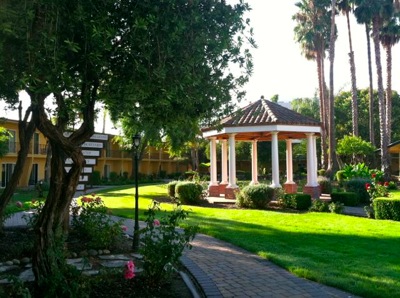
    gazebo.jpg
    That's what we did this time, and the result has been rather a delightful find, the San Jose Airport Garden Hotel. This is a cluster of five or six twostorey buildings, each on the order of an ordinary Motel Six I suppose, surrounding a complex of lawns, pool, exercise rooms and the like. The "gardens" are set about with fountains and statues, and the lobby and corridors are hung with dozens, scores, perhaps hundreds of framed prints and paintings, all collected by a single former owner, a Persian with a curious eye attracted to gods, goddesses, philosophers, birds, and botany.

    Statues, or at any rate reproductions of statues, reflect Greek, Egyptian, and Indian antiquity. One corridor boasts at least two dozen prints of good quality all of birds, and those on only one of the two long walls. Our own little bedroom boasts two original oil paintings, not particularly interesting: a Dutch or Belgian twostorey house by the side of a country lane and a vase of dahlias painted in high-relief impasto. But there is also quite a nice botanical print of anemones with leaves, flowers, and buds in various stages of maturity, nicely triple-matted and framed in plain oak.

    The hotel has a history: it was the first Hyatt hotel in Northern California, built in the early 1960s. (So I was told by the present manager here.) It's surprising to be reminded that Hyatt hotels have not always been everywhere, and have not always been the interchangeable manystoreyed metropolitan behemoths so familiar today; a lot has changed since the Eisenhower administration.
    squirrel.jpg
    We just came in from a decent Martini by the swimming pool. Although the cocktail hour, we were alone except for two jet-black squirrels and one grey one, tame enough to come when I called them by clack-clack-clacking tongue between teeth.
    On, this evening, to an opening at the Triton Museum of Art, where Kenjilo Nanao is being given a mini-retrospective, along with Jamie Brunson and Heather Wilcoxon. I'd met Brunson many years ago; she recalled tonight that I was one of the first to review her work in the press; I liked the work here a lot — meditative yet retinally jumpy painting with very strong colors, monochrome, setting up persistent after-images.

    I liked Wilcoxon's paintings too: in the Roy DeForest tradition, clearly post-Guston as well, intelligent and sassy and slyly organized behind their seemingly frenetic surfaces and subject-matter. (You can see this work at the Triton website.)
    nanao.jpg

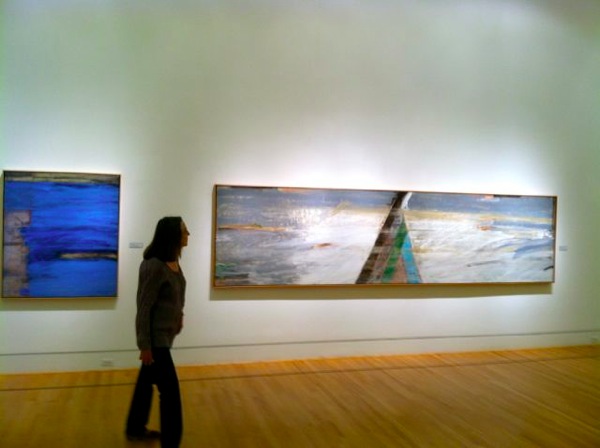
    But it was of course Kenji's painting that brought us here, and they are magnificent under the strong white light in the museum gallery. As Preston Metcalf points out in the catalogue, Nanao mediates, or rather transcends the differences between, Abstract Expressionism and color-field abstraction. As I point out, the work is essentially landscape, or at least can be so read. It is sumptuous, rich, allusive, and utterly egoless, serene yet full of energy.

    The main inspiration for this trip, though, was San Jose Opera's production of Idomeneo. Mozart composed it in 1780, just before his 25th birthday; it is his biggest opera, for a big orchestra, a huge cast; it is probably the last opera of its kind, to a libretto celebrating regal largesse — a piece that says goodbye to the Age of Kings.

    Idomeneo was himself the King of Crete: returning from the Trojan War, victorious, he runs into a terrible storm at sea; pleading with Neptune for clemency, he vows to sacrifice to the god the first person — or creature, accounts vary — he sees on landing safe on shore. The first creature turns out to be his own son, of course: this is a version of the Abraham-and-Isaac story.

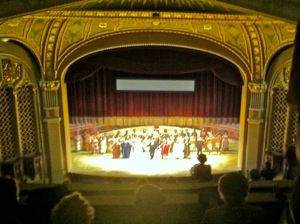
    The opera was beautifully conducted, by George Cleve; very well sung, by a young, ardent cast; effectively staged; and set within a production owing a great deal to David Packard, whose archaeological enthusiasms and considerable resources combined to stage the action in quite persuasive reconstructions of the extroardinary beauties of the Minoan culture. Last year's tour of Sicily (speaking of the pleasures of travel) prepared us for enhanced enjoyment of this production, which should certainly travel to other opera houses.
    opera.jpg

    As to the opera itself, it is a magnificent musical monument and, in a production like this, performed as credibly as this, a work full of matter for contemplation. We're reminded that in all ages the gods are narratives constructed by the human mind to personify natural impacts & influences on the human experience. They are organized according to the prevailing social structural needs & assumptions: i.e. tribal-pagan, regal-monotheistic, etc.

    Idomeneo is a transitional and decadent narrative: why was it appealing to a late 18th c. nobleman (Karl Theodor, Elector of Bavaria), who commissioned it for performance at a court carnival? The opera is about a king who errs (though through piety), but is forgiven and allowed to abdicate in favor of the son he was bent on but released from sacrificing: aren't there interesting subliminal correspondences between this and the plot of, for example, The Marriage of Figaro? What an interesting period this was, the fourteen years between the American War for Independence and the fall of the Bastille!

    Saturday, August 20, 2011

    Four Saints in Three Acts

    Eastside Road, August 20, 2011—
    WE SAW the Stein-Thomson opera Four Saints in Three Acts last night in San Francisco's Yerba Buena Center, where it was performed by Ensemble Parallele, about which company I wrote enthusiastically here a while back in connection with the Philip Glass opera Orphée. I don't have time at the moment to write more than that I think you should see this if you possibly can; it's one of the great operas not only of the 20th century but of any, and productions are rare, and this one is worth seeing. I'll have more to say about the production, and the opera, in a few days.

    Thursday, August 11, 2011

    Virgil Thomson on Audience Sensitivity

    FOR NO PARTICULAR REASON except that I just ran across it, while looking for something else, here's a piece I wrote for the Oakland Tribune on September 2, 1979:

    APTOS--"Why can't musicians compose what audiences want to hear?"

    The anguished question was directed toward a six-composer panel at the Cabrillo Festival here last week, and it stated a problem composers have faced for decades.
    There's a continual distrust of new music. It's a joke, or it's too abstruse, or ugly. "My kid could make noises like that."

    All six composers at the panel agreed that they didn't set out to compose music that audiences wouldn't want to hear. But it took 83-year-old Virgil Thomson to dissect the question with his scalpel-like intellect.

    "The trouble is, 'audience' is a collective noun. You have to be very careful when you throw that word around. Audiences respond as a group. (That's why record reviewing is spiteful; because it's solitary.)"

    At this point Garret List, a young trombonist-composer straddling new music and jazz, interrupted Thomson: "Who do you write for?" Thomson continued to elaborate his point:

    "An 'audience' figures as sociology and economics, not esthetics."
    Garret List wasn't listening. "Who do you write for, Virgil? Virgil?" He snapped his fingers to get Thomson's attention.

    "No one knows what an audience is going to like," Thomson continued. "Or what a management can sell to an audience. And audiences are bullied. And we can only know what an 'audience' liked last year.

    "There are fashions, trends--in orchestral tricks, or whatever--that follow unconscious folklore patterns. They are very hard to predict.'

    He never let on that he'd heard List, but suddenly answered him.

    "Gertrude (Stein) used to say, 'I write for myself and strangers."' List nodded agreement. So did the others.

    "I am the listener I puzzle over when I'm composing," Eric Stokes said.

    "Exactly," said Thomson. "And any passage that bores you a tiny little bit will bore others more. You can bet on it."

    Which brought up another question: did these composers aim at complex or simple music?

    "Simplicity," Lou Harrison said. "I always remember something Schoenberg told me when I studied with him: 'Nothing but the essentials."'

    "Depends on the music," Thomson elaborated. "If I aim consciously it's toward simplicity where possible; but if complexity is necessary, not to fear it. I tend to think music isn't finished if you can subtract anything without injury. Music is a complex affair; the more we can simplify it, maybe, the better."

    Some one asked about foundation grants.

    "I think we had a more independent attitude before," Harrison answered. "Post-Depression young people can't conceive of grubbing."

    The young composers disagreed. Foundation grants are "a lottery," List said. "There's not enough money."

    "There are more composers now," Stokes pointed out.

    But they allowed that they made a living somehow. How do composers make a living, someone in the audience wanted to know.

    "The answer to that question is that it's none of your business how we make a living," Thomson replied. "How we compose is another matter."

    There was laughter, then silence. Then, in a rare burst of emotion, Thomson summed it all up. He pointed toward something overhead; the small silent gesture galvanized the audience and panel.

    "Calling," he announced. "We're playing a game of life or death. We must find ways of answering the calling--or choose death."

    Friday, August 05, 2011

    Mount Tamalpais

    tam.jpg
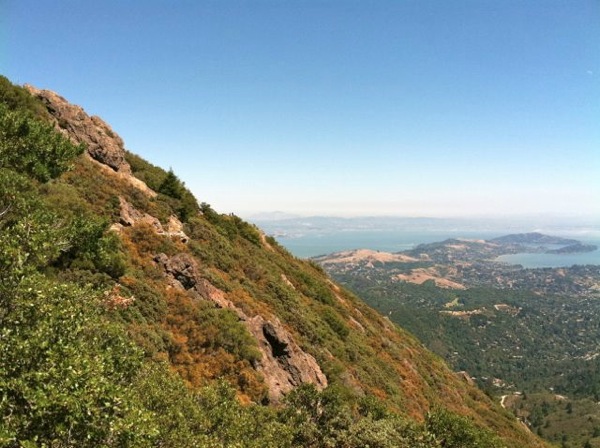
    Looking east from the Temelpa trail, Mt. Tamalpais
    THE FIRST STRENUOUS WALK of the year, far too long delayed: from Mountain Home, on Panoramic Highway in Mill Valley, up the old railroad grade past West Point Inn and on up to the East Peak; then down through the garrigue on the Temelpa trail to various fire roads and so back to the starting point.

    I think this took about four hours or so all told, plus a half hour nibbling and resting at the summit. Glorious views, but of course hardly any can really be photographed.

    The fire roads, and the old railroad grade, are comfortable but not terribly interesting walking: but they give fine views, especially over the luminous greys of fog out toward sea. There was too much haze to see much distance: in this photo you can barely make out Mt. Diablo to the east. The narrow Temelpa trail reminded me often of walking in Alpes de Provence, except that the smell is completely different. Is the oregano and thyme and lavender in the Provençal garrigue, I wonder, feral escapees from Greek gardens of 2500 years ago? Will the same happen here, a thousand years hence?

    Thursday, August 04, 2011

    Early August

    No moon. The crickets
    or whatever they are sing,
    mindful of Late Works.

    Monday, August 01, 2011

    Blue language

    Eastside Road, —
    I'VE BEEN THINKING ABOUT language lately. No surprise there; language is one of my constant preoccupations. But specifically I've been thinking about what we used to call blue language, bad language, and its greatly increased presence in our daily life. It may not surprise you to learn that it's the Internet, and in particular Facebook, that's brought the subject so to mind.

    Like many people my age, I suppose — I've long since entered my eighth decade — one of my main reasons for being on Facebook (and no, please don't look for me, the last thing I need is more Facebook “friends”) is to look in on the grandchildren. In the course of doing that, of course, I see comments posted by their friends. There are also the various nieces and nephews. And a number of them (not so much my direct descendants, I hasten to say) use language I find quite disturbing.

    Now there's no question I'm a prig. I use the occasional four-letter word myself, but not that often. It still startles me to hear a woman swear. My mother never did, and the only time I've heard my wife use a four-letter word was years ago when, pushed to the limit, she suggested I go to hell. (When she pronounced the word it sounded like a place name; you could hear the capital “H”.)

    I wonder as I read all these words what words these people use when they really need bad language. If they shut the car door on their thumb, for example: do they use the same word they use to describe a momentary annoyance?

    I know: what most people intend these days, certainly what younger people intend, by the use of such language, is not what people of my generation or my parents' generation meant. Language changes, shifts. Declines, in fact, I would say, at least in this case. (I meant no pun there: sorry, grammarians.) But it's as hard for me to hear these words as inoffensive as it was, in remote antiquity, to hear soprano saxophones substitute for high trumpets in recordings of Brandenburg Concertos.

    It's also true that people are more traveled these days, and different languages have different attitudes to this subject. The Dutch, for example, use what I think of as four-letter words to describe ordinary matters and events met in the course of daily life. They also use English four-letter words liberally, just as we Anglophones use a certain five-letter French word without really thinking about its literal meaning. I use le mot de Cambronne freely in English, but never in France, unless to say “break a leg” in French to a French performer about to go to work.

    The problem with blue language is what happens in cases of linguistic asymmetry, when one party to a verbal exchange has a more liberal or a more literal relationship to vocabulary than does the other. If you call me by a name, or word, that's been internalized as A Very Very Terrible Thing to Say — “liar,” for example, was grounds for a thrashing in my childhood — it's very difficult for me to consider that you may be simply exaggerating, or in fact mis-using the word. “You lie” is used so frequently these days to mean “You're mistaken,” or even “I don't agree with your view.”

    Saturday, July 30, 2011

    Shakespeare at the Oregon Shakespeare Festival

    Meaning is never monogamous.
                                  — Susan Sontag
    Eastside Road, July 28, 2011—
    WE SAW FOUR SHAKESPEARE plays this year at the Oregon Shakespeare Festival in Ashland; all they had scheduled. OSF runs through the entire Shakespeare canon, presenting the History Plays in historical chronological order, the Comedies and Tragedies in a less orderly fashion; and the Bard represents about a third of the entire OSF rep in any given year. (The complete production history of Shakespeare is listed here.)

    My college major was English Literature, but my college career was disorderly, to say the least. The last two courses I took to complete my degree were intense summer-session classes in required subjects, oddly postponed far beyond logic: English 1B, the required freshman course in composition; and a survey course in Shakespeare. The latter was taught, I remember, by a fine old-school professor. We read, discussed, and wrote about thirteen of the plays, a third of the canon, taking Charles Jaspers Sisson's edition as our text.

    In that class I learned that discussion of the plays and the playwright are endless and too often pointless; we can't be sure of the texts; establishing a chronology of the plays is problematic; and the language occupies what's now a no-man's-land between late Middle English and the standard English of the 19th Century, which is what we generally read and even spoke in class. And I learned that the plays themselves, individually and taken as a canon, are fascinating: not so much for their narratives, though those are often gripping; or their ideas or values, though those have much to give us; but for their elusiveness, complexity, surprise. The plays transcend, by far, their texts.

    Susan Sontag, in the essay “Writing Itself: On Roland Barthes,”
    …literature is first of all, last of all, language. It is language that is everything. … Barthes's view is irrevocably complex, self-conscious, refined, irresolute… He defines the writer as “the watcher who stands at the crossroads of all other discourses” — the opposite of an activist or a purveyor of doctrine…

    Barthes called the life of the mind desire, and was concerned to defend “the plurality of desire.“ Meaning is never monogamous.

                                —Susan Sontag: Where the Stress Falls (New York: Farrar, Straus and Giroux, 2001)
    We saw an early play and an early late play last week, and they both concern themselves literally with desire: the two history plays we saw, from about the same (middle) period, are more straightforward, but raise problems of polyvalence that proved insoluble, I think, in the OSF staging.

    As I've written in the previous three reports from Ashland, I'm not in the business here of ”reviewing“ these productions. I'm not going to go through the laborious and generally pointless (and thankless) motions of assigning adjectives to individual actors, stage designers, costumers. At the Oregon Shakespeare Festival you can take for granted the skill, range, and effectiveness of all such components; besides, OSF has a well-designed website that gives an ”overview,“ cast and production credit details, short videos about the productions, and more about each play; index webpages for each can be found by clicking on the bulleted, boldfaced •titles below.

    Instead, I'm afraid I'm going to be expressing my misgivings about the general approach that OSF seems to have adopted in its productions of the work that has for seventy-five years been, after all, its raison d'être.

    As I noted the other day, OSF began in the spirit of Chautauqua, that uniquely American movement of the post-Civil War period whose purpose it was to bring education and culture to relatively isolated populations. Chautauqua included speechmaking, music, religion, politics under what was often literally a big tent, which often moved from site to site throughout the summer. The movement continued throughout the first half of the 20th century in spite of more technologically advanced competition, as Wikipedia's entry notes:
    …by the turn of the century, other entertainment and educational opportunities, such as radio and movies, began to arrive in American towns to compete with Chautauqua lectures. With the advent of television and the automobile, people could now watch or travel to cultural events previously available only in urban areas, and the Chautauqua Movement lost popularity.
    Chautauqua still lives, though; the original Institution in the New York town that gave the movement its name still presents lecture series, musical and dance performances, opera, and theater. (A few minutes on its website make it look pretty damn attractive.)

    A Chautauqua building was erected, ”mostly by townspeople“ as OSF notes, in Ashland in 1893; it was enlarged twelve years later. ”Families traveled from all over Southern Oregon and Northern California to see such performers as John Phillip Sousa and William Jennings Bryan during the Ashland Chautauqua's 10-day seasons,“ continues the OSF archive, and by 1917 another building took its place, lasting until it was torn down in 1933. Soon thereafter a young teacher from the local teacher's college thought the remaining circular walls looked like sketches he'd seen of Elizabethan theaters, and proposed a production of two Shakespeare plays in conjunction with the city's Fourth of July celebration.

    So OSF is grounded not only in Chautauqua but also in the Normal School movement, which developed in this country, in the 19th century, into colleges designed for the training of teachers. In California, for example, normal schools became teacher's colleges, later the campuses of the State College system (now the State Universities).

    It's probably largely forgotten today how strong the liberal-arts ideal was in the generations leading up to 1957, when the Russian space satellite Sputnik awoke the United States to its relative complacency as to the teaching of mathematics, engineering, and the sciences. Until then the primacy of the liberal arts had been pretty much unquestioned. After the Eisenhower administration, though, arts and letters took a back seat in general education, not only in advanced education, but also in the earlier years.

    Where math and the sciences provide the knowledge and methodology by which society achieves its purposes and goals, however, it's the liberal arts that provide the knowledge and methodology that define and determine them. Science is knowledge: how. The arts are wisdom: why. Shakespeare's plays provide a particularly rich store of wisdom and stand, of course, at the center of English literature, perhaps of world literature, and therefore at the center of our liberal arts.

    (This is probably the place for another clarifier: by “liberal arts” I mean, as Wikipedia puts it,
    a curriculum that imparts general knowledge and develops the student’s rational thought and intellectual capabilities, unlike the professional, vocational, and technical curricula emphasizing specialization.
    “Liberal” because derived from Latin liber, “free”: the kind of education every free person was expected to have. This brings us inevitably to a consideration of social class; and perhaps a lingering reason the word “liberal” and the values of the liberal arts are questioned is the lingering notion that they are the province of snobs, of the idle rich, of an “elite” who consider themselves above the common man.)

    But we are far off track. My point is, there are those in the arts industries who recognize and lament the lack of appreciation for the arts, for the values represented by, say, Shakespeare and Mozart and let me add Velasquez, among the general American public; and those people — artistic directors especially — do what they can to bring culture to the masses. OSF, for example, produced this year's Julius Caesar as “part of Shakespeare for a New Generation, a national theatre initiative sponsored by the National Endowment for the Arts in cooperation with Arts Midwest, heavily adapting the play to “decontextualize” it, as an acquaintance pointed out, from its specifically historical moment.

    Other productions were similarly adapted or interpreted, often with interpolations meant to appeal to contemporary audiences by referring to elements assumed to be within their common awareness. As Shakespeare could count on his audiences knowing about the Gunpowder Plot, say, or the defeat of the Spanish Armada, so OSF counts on audiences responding to allusions to Broadway tunes, rock songs, and standup comedy acts.

    The danger here from my perspective is that by demystifying Shakespeare for today's high school students — and there are many of them at OSF productions — my own attention to the plays is distracted as I puzzle over the relevance of an interpolation referring to an item of pop culture of which I am utterly ignorant. But then, this presumably is the cross the younger audience hangs on as it deals with Shakespeare's original text. I'm seventy-five years old; I've read the plays; I've seen nearly all of them (Pericles, Timon of Athens and Cymbeline have eluded me, along with The Two Noble Kinsmen).

    Best of all, as no bad interpretation ever truly spoils Mozart, neither can it destroy Shakespeare. We can always return in our memory to a great production seen in the past, or turn in our imagination to a great one yet to be seen, latent in the script. For the meantime, here's what I think about this year's productions:

    •Love's Labor's Lost (1594): This early play seemed to me quite effective, set on the outdoor Elizabethan Theater stage, costumed in a vague late-20th-century style. Shana Cooper made her directorial debut at OSF in this production; she was Assistant director for Macbeth and Equivocation in 2009. A complex play, Love's Labor's Lost centers on the intention of the young King of Navarre, and three of his friends, to devote three years to study and sobriety. They are immediately distracted, however, by the visiting Princess of France and her three maids-in-waiting, and the oath is soon broken.

    Shakespeare provides several layers in this play, as he did in A Midsummer Night's Dream, written soon after. The trick in casting and directing this play is to individuate these layers — clowns, simpletons, rustics, wits, scholars, and the nobility — and to keep them in balance while bringing out the potential within each. Some of Cooper's concepts threatened to run away with the show, notably the entrance of Navarre and his men disguised as Russians. (They dance in, parodying the Russian Dance from the second act of Tchaikovsky's Nutcracker.) But the more outrageous such bits are, the more they succeed theatrically. Robin Goodrin Nordli, as Boyet, was memorable in a scene with a Martini. (Yes, Boyet is a woman in this production.)

    (Bay Area audiences can see Shana Cooper's work this fall: she directs the California Shakespeare Theater's production of The Taming of the Shrew, running September 21-October 16.)

    •Henry IV, Part Two (1598): None of us eight Ashlanders — four couples who spend a week together every year to see these plays — was happy with last year's production of Part One (my comments on that production here, and note particularly the comments), so we weren't looking forward to Part Two. In the event, though, it was more satisfying. Again, director Lisa Peterson stressed the comic scenes at the cost, I thought, of the serious ones. Too, casting and direction of the supporting nobility — Northumberland, Hastings, Prince John — seemed haphazard, un-integrated.

    As usual at OSF, the comic roles were often beautifully characterized, often through small details; but the Cheapside elements — Mistress Quickly and Doll Tearsheet — were pushed nearly to burlesque, and the induction scene, with Silence, Shadow, Feeble, and Bullcalf, drowned the poignancy of mustering in further burlesque. (Again, however, the acting was superb.) I can see how this approach will attract audiences looking for laughs, but I'm not sure I see those audiences made aware of the darker side of the play. We'll see what happens next year in the conclusion, Henry V, a particularly dark play if you look between the lines.

    •Julius Caesar (1599): like Shana Cooper and Lisa Peterson, Amanda Dehnert is a newcomer to OSF, having previously directed only All's Well That Ends Well here (in 2009). This was definitely a concept production, compressed and tightened to emphasize the muscles of betrayal and conspiracy; it reminded me of the similarly compressed Macbeth that opened this intimate New Theater back in 2002. That's fine: nothing wrong with adapting Caesar to such a concept. But setting the title role on a female actor seemed to present more problems than insights; and making her dream in Japanese seemed downright silly — why do this, if not simply because you have a dramatic Japanese actress on hand (the one-named Ako, memorable in last year's OSF Throne of Blood)?

    The intent seemed to be to contrast Caesar's dreamy eloquence with Cassius's brutality and Brutus's political pragmatism, inherently an interesting idea except that Caesar's military successes are thereby cast into some doubt — though here too if the intention is to show up the unthinking support the citizens give him/her, the play gains both complexity and relevance to the present day. But in the end concept seemed to me to outweigh integrated presence; I felt that I'd seen interesting conversations about Shakespeare's play, more than a persuasive production of the play itself.

    •Measure for Measure (1603): Disclaimer: I think this one of the greatest of all Shakespeare's plays, bringing to the familiar ideas and gimmicks almost a uniquely successful and persuasive degree of balance, thoughtfulness, and dramatic expression. You know the story: Duke, for motives never clearly stated (probably because they are complex and conflicting), absents himself, leaving his friend Angelo (never a name so ironically chosen) in charge; Angelo metes harsh justice, though himself both a past offender and a present hypocrite — possibly against his will. The play is a bookend to Merchant of Venice, with Isabela taking on Portia's role; and the oddly tangential ending recalls those of Love's Labor's Lost and The Winter's Tale.

    We saw Measure for Measure in the temporary tent-pavilion erected for productions scheduled in the Bowmer Theater, closed for emergency repairs, and it's perhaps really not fair to fault the production in these circumstances. But I was dismayed by director Bill Rauch's decision to let his concept — setting the play's underclasses in a contemporary Latino context — so run away with the serious implications of the plot. Had Mistress Overdone not been made the maîtresse of a particularly obnoxious strip club, and the interpolations of an admittedly first-rate all-girl mariachi ensemble not so often been too loud, and the distracting subtitles at one side of the stage been allowed to translate the Spanish-language songs composed (very effectively) for the show, the concept might well have worked better; and perhaps they will once the show returns to its proper stage.

    LIKE ALL CULTURAL INSTITUTIONS, Oregon Shakespeare is in a difficult spot. The economy; audiences; commercial entertainment; the historical moment; technology; politics — all these things intrude, oppress, distract, sideline, even attempt to trivialize the work that is at its core. But that was true in Shakespeare's day too; in fact, much of the power of his work consists precisely in his awareness of these things, in his grasp of their being both problems and subject-matter. I worry sometimes that OSF — and specifically Bill Rauch, its Artistic Director — too often thrashes about in conscious attention to methodologies designed to approach these matters, instead of basking in the riches of the literature, the company, and the place. The approaches being found to solving problems of audience and expense are too visible; they distract from the theater. But the successes continue to outweigh the shortfalls. We'll be back next year, perhaps sooner.
    •Oregon Shakespeare Festival, 15 S. Pioneer Street ,Ashland, Oregon 97520. 2012 season:

    •Shakespeare: Romeo and Juliet (dir. Laird Williamson), Troilus and Cressida (Rob Melrose), Henry V (Joseph Haj), As You Like It (Jessica Thebus)
    •Repertory: Chekhov's Seagull (Libby Appel); Kaufman & Ryskind Animal Crackers (Allison Narver)
    •Premieres: The White Snake (adapted by Mary Zimmerman, from the Chinese fable); Medea/Macbeth/Cinderella (ad. Bill Rauch and Tracy Young); Robert Schenkkan's All The Way (Bill Rauch); Universes'sParty People (Liesi Tommy); Alison Carey's The Very Merry Wives of Windsor, Iowa (Christopher Liam Moore)

    Friday, July 29, 2011

    Kenjilo Nanao

    Eastside Road, July 29, 2011—
    NanaoSketch.jpg
    ON NOVEMBER 8, 1986, I apparently visited the faculty exhibition of art at California State University, Hayward, as it was then known. My journal for that year contains the page reproduced at the left. I have difficulty deciphering the handwriting at this point, a quarter-century later:
                          8 NOV

    Rug.
        Formative look.

           stains (?) now gone suggest 2 books —
           children's .

     G A: “hybrid.”

                Merwah — shafen — palm; script


    And then the sketch of what is clearly a painting by Kenjilo Nanao, who we visited today, in his Oakland studio.


    Impossible to know at this remove what is meant by the enigmatic notations in that journal. The adjacent pages offer no help, at first, though now I think about it this was the time we were producing my opera, which helps elucidate the notes on the previous page:
              7 Nov

    •Finishing the production

    •Booking production : Franklin. V Jan ; photos.

    • Little version.
         Ch grinder (p 292 - 301 - sc. 5)
         [female section] ( from H-Martin )
         Military service - suffering


    10 45  M Fisher
    12  Geo Gelles
    2  J Butterfield
    3  R Friese
    4  A Rockefeller


    BUT THE POINT IS that today we visited Nanao's studio, where we saw really quite wonderful paintings, and soon I will be writing about him, and them… I have been thinking about his painting , seeing it in my mind, for twenty-five years…
    nanao.jpg

    Wednesday, July 27, 2011

    The Function of Poetry

    The Function of Poetry
    For Kathryn

    A man I didn't know died yesterday
    His wife the childhood best friend of my daughter.
    Forty years, three lives, two thousand miles
    Displaced from me. We practiced different arts
    And worshipped different gods; we might as well
    Never have both read Donne or loved women
    And children who, like Epicurean atoms,
    Swerved from time to time improbably
    Within a single delicate orbit. 

    The question is whether the conscious mind
    Transcends personal narrative in death,
    Whether an unknown life now completed
    Enlarges ours, its end informing ours
    With its own fullness through the common points
    Of unsuspected anecdotes. 
                                                          Narrative
    Is hardly more than random noted moments
    In an otherwise neglected life,
    Why are we here? Lou said, to tell stories,
    To keep each other entertained along
    The common road we travel through this life.
    —July 27 2012

    Sunday, July 24, 2011

    New American Theater at Oregon Shakespeare Festival

    Ashland, Oregon, July 24, 2011—
    IN SPITE OF THE IMPLICATIONS of its name, the Oregon Shakespeare Festival has long been a significant proponent of new and recnt plays, as announced in the organization's "mission statement":
    Inspired by Shakespeare’s work and the cultural richness of the United States, we reveal our collective humanity through illuminating interpretations of new and classic plays, deepened by the kaleidoscope of rotating repertory.
    This year, in addition to Tony Taccone's important premiere Ghost Light (discussed here a few days ago), the repertory includes Tracy Letts's August: Osage County (premiered 2007), Carlyle Brown's The African Company Presents Richard III (1987), Julia Cho's The Language Archive (2009) (which closed last month after a four-month run), Christopher Sergel's adaptation of Harper Lee's novel To Kill a Mockingbird (1990), and the site-specific collaboratively developed WillFul, which opens August 7.

    Of these, we saw Mockingbird and Language Archive four months ago, when the former impressed us greatly and the latter rather less. This week we've seen two others, in addition to Ghost Light — which, I'm afraid, throws a long shadow over them.

    The African Company Presents Richard III seemed to me particularly weak in the theater. Of course the specific theater was the temporary tent-pavilion installed in Lithia Park while the August Bowmer Theater is closed for emergency repairs, and allowances have to be made. The tent works reasonably well, and probably serves as a reminder of the Festival's early days, back when that uniquely American institution the chautauqua was still vital. (Indeed the chautaqua idea is still alive at OSF, and quite influential in its productions of Shakespeare; I'll write about this season's examples in the near future.)

    The biggest problem associated with this tent (once past the question of the discomfort of audience seating) is the acoustics: it's a dead house; after one production without amplifiction the actors were quickly fitted out with body mikes. I may be over-sensitive to the consequent problems, since I'm more an ear person than an eye one: microphone noise and imbalance of consonants and vowels to begin with. Worse, as far as I'm concerned, is the changed aural perspective: not only does the sound come from another location than the actor's, but intimacy and distance are confused. The result is dislocating, disorienting; and if that's only on a subconscious level it's nevertheless disturbing and ultimately fatiguing. (I can only imagine the effect on the actors themselves.)

    Beyond this, though, The African Company Presents Richard III seemed to me lightweight, a History Channel show brought to the stage. In portraying the difficulties encountered by a black theater company producing Richard III in New York City in the 1820s it was funny, informative, and politically correct; but it didn't seem to me to flesh out its characters, to investigate narrative elements that might have proved even more interesting and rewarding. It joins an intriguing subset of OSF plays, plays about Shakespeare plays: last year we saw Throne of Blood, a samurai version of Macbeth; the previous year's Equivication also considers The Scottish Play. (In 2008 we saw The Further Adventures of Hedda Gabler, another metadrama.)

    Much more successful, to my way of thinking, was August: Osage County. A realistic narrative drama is not the kind of play I'm drawn to aesthetically; it seems to me Ibsen, O'Neill, Miller, and Albee have pretty well exhausted the vein: but then along comes another brilliant work in the genre and you're held, in my case against your prejudices, by a writing, direction, and acting that can only be called masterful. (And the defects of the temporary tent-pavilion theater disappear.)

    It probably didn't hurt that as a child I lived a hard year not ninety miles from the bleak setting of the play (Pawhuska, Oklahoma). The accents, dress, even the food depicted in this realistic production were perfectly authentic and, to me, evocative. The dysfunctional family had different problems from those I knew: it's profane where mine was religious, pill-popping where mine tended toward alcohol. But the resulting repression, evasion, domination, manipulation, and cruelty, whether intended or not (I think not), was familiar.

    I recalled Aristotle's definition of tragedy the other day: I do think August: Osage County, more than, for example, Edward Albee's Who's Afraid of Virgina Woolf?, conforms to the classic definition. These characters fall for no flaw of their own making, though the means by which they fall may be self-inflicted; and the enactment of their tragedy leaves the audience exhausted but, I think, purged.

    I don't write these pieces as a theater critic. It's easy enough to find reviews of these productions online (though I haven't bothered this time), and cast lists and program notes are available on the well-designed OSF website. One of these days I may get around to writing about the impressive acting company OSF maintains: it's a real pleasure seeing such fine actors taking leads in one show, supporting roles in others, understudying elsewhere; and it's a pleasure seeing the results of productions with long and numerous rehearsals and runs long enough to develop fine-grained detail. This is not that day. Company information about these productions can be found on the links below:

    • Tracy Letts: August: Osage County , directed by Christopher Liam Moore, through November 5
    • Carlyle Brown: The African Company Presents Richard III, directed by Seret Scott, through November 5

    Saturday, July 23, 2011

    Molière at Oregon Shakespeare Festival

    Ashland, Oregon, July 20, 2011—
    MOLIERE'S COMEDIES ARE ALWAYS welcome, no matter the production. The jokes are always old, always funny. The politics are always old, always relevant. The productions, at least the ones I've seen over the years, are generally over the top, occasionally freighted with gimmickry, sometimes framed (in both senses of the word) with too much Concept, but Molière grits his teeth and plays right through, always triumphing in the end.

    We've seen our share of Imaginary Invalid lately: along with Tartuffe and The Miser, it seems to speak to the contemporary American sensibility, at least as viewed by theater producers. Of course many, probably most of these producers feel it necessary to help contemporary audiences make the leap to Seventeenth-century France, and so we get productions like the one we saw Tuesday night, with musical interpolations inspired by Motown, and jokes about death panels and public options.

    It won't surprise you to read that I have profound misgivings about these attempts at "updating." After all, Molière's relevant because he writes about eternal aspects of the human condition. I always have the nagging feeling that concentrating on the locally specific may detract from the universally constant, which is of course a greater value.

    (And there are the occasions when directorial concentration on one aspect, say the comic scenes in a Shakespeare history play, comes at the cost of attention to another, say the serious scenes; throwing the entire play out of balance. This happened last night in Henry IV, Part Two: but that's not the subject at hand; I'll touch on the Shakespeare plays here later on.)

    As it turns out, this Imaginary Invalid works beautifully. Molière provided his original play with intermèdes (entr'actes, interludes) and dance sequences, and the OSF production is probably right to think Aretha Franklin is closer to the contemporary sensibility than is Marc-Antoine Charpentier, who provided the original score. (And in any case, apparently only four songs have survived to our time.) Molière's comedies involve stock figures from the comic tradition stretching back centuries, and grow out of the commedia dell'arte tradition, which specialized in spicing material with topical jokes and allusions, blending the classical and vernacular — exactly as is the intention of such "updates" as this Imaginary Invalid.

    We saw the play in the temporary tent-pavilion that's been installed in Lithia Park, just down from OSF's outdoor Elizabethan Theater, to accommodate plays originally scheduled for the indoor Bowmer Theater, now closed for structural repairs. (The total cost to the festival of these emergency repairs is estimated at over $2 million, according to a story in the local newspaper.) The tent's acoustics require the cast to wear microphones: this has hurt other plays, in my opinion, but The Imaginary Invalid less than others. Every member of the cast seemed perfectly cast and evenly in command of the role, and given the need to relocate the production the technical and scenic aspects of the play were outstanding. (Full credits here)

    • Molière: The Imaginary Invalid, adapted by Oded Gross and Tracy Young, music by Paul James Prendergast, directed by Tracy Young: Oregon Shakespeare Festival, Ashland, through November 6, 2011.

    Wednesday, July 20, 2011

    Ghost Light at Oregon Shakespeare Festival

    Tony Taccone, the stage director, artistic director of Berkeley Repertory Theatre, has written a play, Ghost Light, which we saw yesterday in its premier production here at the Oregon Shakespeare Festival, where it is directed by Jonathan Moscone, who as a friend and associate worked with Taccone on the concept and development of the play.

    A psychological drama, Ghost Light centers on the unresolved relationship of a young man (Jon) and his memory of his father, the assassinated mayor of San Francisco, a champion of civil rights, including those we think of as "Gay Rights." That mayor was of course George Moscone, who was in fact Jonathan Moscone's father, making the "concept and development" of Ghost Light particularly complex and poignant — and, to a degree, inescapably irresolute and fluid.

    Add to these qualities the theater-referentiality Taccone brings to this, his first script — the plot centers on Jon's difficulties staging a production of Hamlet — and the time-space travel negotiated onstage, with its flashbacks and journeys beyond death — and you have a play that gives you a lot to think about. Within the context of Oregon Shakespeare Festival, for example, Ghost Light fits within a cycle of new plays on "the American Experience" OSF has been commissioning; but it also falls within another cycle, of plays about theater itself in one way or another.

    And within that, another sub-cycle, of plays about Shakespeare plays. Then there's the Play About Father(s), among which Hamlet stands out, of course: but so does Molière's The Imaginary Invalid, seen here last night. (I'll get to that later, perhaps.) Theater tends to be narrative; pre-Modernist theater tends to center on Search for Meaning. Aristotle famously defines tragedy:

    “A tragedy, then, is the imitation of an action that is serious and also, as having magnitude, complete in itself; in language with pleasurable accessories, each kind brought in separately in the parts of the work; in a dramatic, not in a narrative form; with incidents arousing pity and fear, wherewith to accomplish its catharsis of such emotions.” (Imgram Bywater: 35).

    “Tragedy, then, is an imitation of an action of high importance, complete and of some amplitude; in language enhanced by distinct and varying beauties; acted not narrated; by means of pity and fear effectuating its purgation of these emotions.” (L. J. Potts: 24).*

    and Taccone (and, implicitly, Jonathan Moscone) clearly set out to achieve a contemporary expression of Tragedy in these terms. Contemporary not only because the elements of the plot derive from our own immediate past, but also because they involve means and meanings from our own time, as well as from the universal and even mythic content of tragedy from the ancient Greeks through Shakespeare. Here's what happens in Ghost Light: a fourteen-year-old boy is in shock following the sudden murder of his father. The same boy, thirty years later, is to direct Hamlet. Personifications from the confused memory of the murder and of his childhood — notably the boy's prison-guard grandfather and a policeman who tries to console the boy at the funeral — materialize from nightmares; another semi-fantastic personification materializes from an erotic e-mail correspondence. A costume designer, apparently hopelessly in love with the director, represents both herself, the immediate problems of the Hamlet production, and an ultimately maternal, nursing combination of consolation and urge to get on with things. (This is particularly pointed, contrasting with the fatuous offstage psychologist who begins the play's action: Aristotle's famous "catharsis" is nothing other than move-on-and-get-on-with-things.)

    In a q-and-a session after the performance — such events are among OSF's many virtues — Peter Frechette, who plays a memorable (gay) film director in Ghost Light as well as the unseen psychologist, noted that the play changed a fair amount in the course of its development, and would likely continue to change as it moves through this first production. (It will travel to Berkeley Rep in January 2012, with much the same cast.) In much the same way, my take on the play has evolved greatly — and "evolution" is at the core of Aristotle's view of theater — since seeing the play, less than twenty-four hours ago.

    My first impressions were of the fine grain and extensive scope of the play: too many details, too much ambition. It was like a meltdown of Hamlet, Our Town, and Cocteau's Orphée, with a little Buster Keaton thrown in, and maybe Thorne Smith's Topper. I saw references to Ibsen. Christopher Liam Moore's fine portrayal of Jon, the central character, seemed a caricature of the director Peter Sellars. The play's two acts run two and a half hours, it's bright and colorful, gunshots are fired, actors take a number of roles in some cases.

    But my present impression is that this is an important play. Taccone has worked with a number of playwrights to help bring their ideas to the stage; here he seems to have worked through those experiences, and his close friendship with his collaborator Moscone, to achieve his own masterpiece, in the root meaning of the word; to effect a transition from director to playwright. I look forward to seeing the play again.

    I won't comment on the play's credits here; you can find them, along with program notes, here on OSF's excellent website. The actors were superb, the staging powerful, the design, costumes, and lighting both resourceful and effective.

    *These translations from Aristotle's Poetics are quoted from Ramón Paredes' essay "Aristotle's Definition of Tragedy".

    Thursday, July 07, 2011

    A Day with Picasso

    Eastside Road, July 7, 2011—
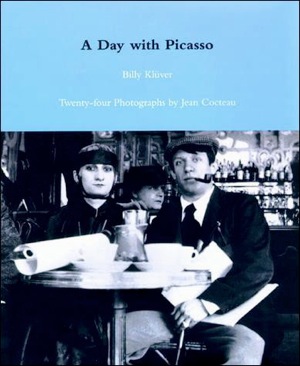
    IN THE SUMMER of 1916, ninety-five years ago, in Paris, Jean Cocteau took two dozen photographs of a number of friends. Sixty years later, in 1978, the Swedish-born artist Billy Klüver (1927–2004) (whose name is familiar to me from the Experiments in Art and Technology days), while he was researching documentation concerning the art community in Montparnasse in the early Twentieth Century, noticed that a number of photographs, found in various sources, fell into groups. Curious, he began investigating. Ultimately he was able to determine the sequence, location, date and time of the original exposures — and, of course, the identities of the people depicted.

    Reading the most recent publication of the result of Klüver's work reminded me of one of my childhood fascinations, the recurring feature Photoquiz in the old Look magazine, which for a time my grandparents apparently subscribed to — uncharacteristically, it seems to me. Or perhaps more buried recollections of photo-sequencing components in intelligence tests I was subjected to in those days: you look at a number of photos and try to figure out the chronological sequence in which they were taken.

    (Now that I think of it, these kinds of quizzes, along with the popular side-by-side “how do these differ” cartoons in the Sunday comics, all components of my childhood, are all examples, or instructions, in a preoccupation I've been developing lately concerning The Search for Meaning.)

    Klüver's research was published here and there: sections in the magazine Art in America in September 1986, then in book form in German (1993) and French (1994). The American English-language edition, A Day with Picasso, was published in a handsome edition by MIT Press in 1997, then in paper in 1999. I find it thoroughly fascinating.
    Klüver.jpg
    The book centers, of course, on the two dozen photographs, nicely reproduced — one can only wonder how much work went into restoring this ancient testimony to a summer day among friends. Eleven of the negatives survive in the Cocteau archives; another nine negatives are lost but original contact prints were also in that archive. Two photographs turned up in reproductions in old periodicals (Paris-Montparnasse, May 1929; Bravo, December 1930), and two others were found in other archives.

    Some of the people in the photographs are easily identified: Picasso, Max Jacob, Modigliani. Through a series of interviews with surviving friends and associates of theirs, Klüver was able to identify the others. With the help of old cadastres and maps, and the French Bureau des Longitudes, he was able not only to determine the places depicted, and the probable camera locations, but even the time of day. Interviews and other research had already isolated the only possible date on which all but two were taken: Saturday, August 12, 1916.

    (When recently did I read Ken Alder's The Measure of All Things, about that Bureau among other things, and why did I not write about it here?)

    The MIT Press edition of A Day with Picasso includes as well as the photographs themselves, with nice running commentary, chapters on the methodology of Klüver's research, the dating and timing, the means whereby the model of Cocteau's camerawas determined, biographical notes on the people photographed, the Paris of the time, and the Salon d'Antin, where Picasso's Les demoiselles d'Avignon (as it was then retitled) was first shown publicly — this particular group of friends and acquaintances were together to some extent because they were all involved with that exhibition.

    All this is extremely interesting. History, photography, research, methodology, and the essence of Community are the matter of Klüver's book, and he touched them all lightly yet thoroughly, and reveals how History is — not made, or written, but teased out.

    A Day with Picasso is still in print, as far as I can tell. Since its publication in English, editions have appeared in Japan, Korea, and Italy. Klüver's Montparnasse researches resulted also in Kiki's Paris, about the legendary artist's model Kiki (Alice Prin); it was published in the U.S. in 1989 and went on to editions in France, Germany, Sweden, Spain, and Japan. He also co-edited and annotated Kiki's own memoirs, which appeared in 1930 but was then refused entry into the U.S. If these books are as graceful, informative, and entertaining as A Day with Picasso, I want to read them.

    Monday, July 04, 2011

    "Writing is like the drug I abhor and keep taking"

    Found something new to read today here in the course of excusing myself for not having recently written. I've been not-reading Pessoa, that shadowy Portuguese master of a century ago, and this morning chanced on passage number
    152

    I’m astounded whenever I finish something. astounded and distressed. My perfectionist instinct should inhibit me from finishing it; it should inhibit me from even beginning. But I get distracted and start doing something. What I achieve is not the product of an act of my will but of my will’s surrender. I begin because I don’t have the strength to think; I finish because I don’t have the courage to quit. This book is my cowardice.

    If I often interrupt a thought with a scenic description that in some way fits into the real or imagined scheme of my impressions, it’s because the scenery is a door through which I flee from my awareness of my creative impotence. In the middle of the conversations with myself that form the words of this book, I’ll feel the sudden need to talk to someone else, and so I’ll address the light which hovers, as now, over rooftops that glow as if they were damp, or I’ll turn to the urban hillside with its tall and gently swaying trees that seem strangely close and on the verge of silently collapsing, or to the steep houses that overlap like posters, with windows for letters, and the dying sun gilding their moist glue.

    Why do I write, if I can’t write any better? But what would become of me if I didn’t write what I can, however inferior it may be to what I am? In my ambitions I’m a plebeian, because I try to achieve; like someone afraid of a dark room, I’m afraid to be silent. I’m like those who prize the medal more than the struggle to get it, and savour glory in a fur-lined cape.

    For me, to write is self-deprecating, and yet I can’t quit doing it. Writing is like the drug I abhor and keep taking, the addiction I despise and depend on. There are necessary poisons, and some are extremely subtle, composed of ingredients from the soul, herbs collected from among the ruins of dreams, black poppies found next to the graves of our intentions, the long leaves of obscene trees whose branches sway on the echoing banks of the soul’s infernal rivers.

    To write is to lose myself, yes, but everyone loses himself, because everything gets lost. I, however, lose myself without any joy – not like the river flowing into the sea for which it was secretly born, but like the puddle left on the beach by the high tide, its stranded water never returning to the ocean but merely sinking into the sand.

    —Fernando Pessoa, The Book of Disquiet, tr. Richard Zenith
    Penguin Books, 2003
    To write is to lose myself, yes, but everyone loses himself, because everything gets lost.

    Looking for anything anyone else might have had to say about these remarkable paragraphs of Pessoa's brought me to Vincent's blog A Wayfarer's Notes, which seems to be a gentle, graceful comtemplation of Nature, literature, and the human condition as lived in the English countryside. He mentions riding the bus:
    I was going to talk about a bus-ride. It provided an opportunity to scribble in my notebook, at any rate when it stopped for passengers or traffic lights. These buses judder and jolt with no inhibition, setting their fittings all a-chatter in a syncopated rhythm like loose dentures. Never mind, they serve as a Whole Body Vibration Therapy for the poor and dispossessed, especially those of us with free bus passes.
    We were in London for a couple of days a week or so ago, riding buses and the Underground as well as doing a few other things. Transportation in London is alarming. The noise on the Tube from Victoria to Heathrow was never less than 80 dB — we have sound meters on our iPhones — and a couple of hours in such noise and violence is enough to wear one out. (Of course the effect was heightened by contrast with Venice, where there is neither bus nor subway.)

    Pessoa, I recall reading somewhere, seems to enjoy riding the tram, as much as he enjoys anything; he observes the strangers around him — ah, here it is:
    I'm riding on a tram and, as usual, am closely observing all the details of the people around me. For me these details are like things, voices, phrases. …
    All humanity's social existence lies before my eyes.
    The Book of Disquiet, p. 253
    The last ten days have been spent re-entering our "normal" life, after that five-week interruption of London and Venice. Reading and writing, not to mention conversation, have been largely shouldered aside by unpacking, both literally and figuratively, and mowing and such, and by the fatigue inevitably associated with re-entry. And when I do pick up a book, or even a blog, my attention wanders, I'm back in Venice, or in Pessoa's Lisbon. And when I do write,
    I linger over the words, as before shop windows I don't really look at, and what remains are half-meanings and quasi-expressions, like the colors of fabrics I don't actually see…
    The Book of Disquiet, p. 138


    Saturday, June 18, 2011

    Venice Journal, 16: Biennale

    Venice, June 18, 2011—
    AN OLD GUY, apparently shakier than he looks, sits down on the bench to take off his shoes. There seems to be some problem with his shoelaces: he can't get them untied. Finally, with great effort, he pulls the still-tied shoes off his feet and stows them in the pigeonhole under the bench. He puts on one of the white cloth foot-covers provided, tries to open another for the other foot, fails, tosses it in the bin of dirty foot-covers, tries to open another, succeeds.

    Then he stands uncertainly in the unfamiliar shoe-covers and waits. Two people ahead of him are also waiting their turn to walk up a number of black-carpeted steps into a sort of theater at the back of which three other people gaze at a solid curtain of colored light.

    It's a long wait, so he bends over, retrieves a shoe, and begins to pick at the knot in the shoelaces. He can't see what he's doing: the light is dim. He takes off his glasses, awkwardly holding them by biting one of the temples, and peers at the knot. He looks out at the sea of people waiting behind a barrier, being let in only three at a time. He seems a little embarrassed, and why not? I would be too.

    The knot finally untied, the shoe back in its pigeonhole, he begins to pick at the other one, gives up, shelves it, and turns toward the waiting people. The attendant tells him he may join another couple in the theater. He steps uncertainly up the stairs, whose treads are two short for sure footing. The attendant warns him not to step too close to the light-curtain; there's a drop of several feet at the front end of the stage.

    The colors seem a little grainy, gauzy, with imperfections floating across, but they are very beautiful: a constant allover intensity, imperceptibly changing through indigos, blues, deep reds. After only a couple of minutes, though, he turns to leave, weaving a bit as he approaches the steps. He motions to the attendant, who reaches out offering his hand to steady him on the way down.

    Seated, he picks with irritation at the remaining shoelace, finally untying it. He puts on a shoe, begins to tie it, takes it off, removes the foot-cover and tosses it into the box, repeats the gesture with the other, puts on his shoes, manages to tie them in the dark, and walks out the exit, alone, and disappears.

    That's the James Turrell installation at the Biennale. I consider Turrell with mixed emotions. His work with color and light is as pure and magical as possible, I think: but it requires a degree of focus and concentration on the part of the viewer that can only be achieved, apparently, through a great deal of audience manipulation and even more tightly determined isolation from other simultaneous experience. You have to deal with Turrell on his own terms. There's nothing inherently wrong with this, and it's far from unprecedented: Richard Wagner comes to mind. But I've never been comfortable with Wagner's demands, either.

    (Speaking of Wagner, we toured La Fenice, the Venice opera house, the other day — an absorbing tour of a magnificent theater. The orchestra was on stage, rehearsing Das Rheingold, and we sat in the Royal Box for eight or ten minutes to listen. Yesterday on a vaporetto I was talking to a French woman; she said they were on their way to La Fenice for the tour. I told her about our experience, explaining that it was only an orchestra rehearsal, no singers. It's always better that way, she responded.)

    The Biennale — well, it's a mess, as everyone is saying; but it's inevitable. Scores of countries have fielded hundreds of artists of varying degrees of skill and persuasiveness, most of them, to my taste and receptivity, unsuccessful. By far the majority seem to be concerned with the same problems the rest of us have on our minds: injustice, war, environmental problems, cruelty, and the like. Unlike the rest of us, they bring these concerns to work, make of them the subject of their art. To this degree they seem to me to be politicians, or propagandists, or social critics, rather than artists. Nothing wrong with politicians, propagandists, and social critics; we need them; they often improve the quality of life: but you don't go to them for insights into transcendent expressions of visual or sonic or even textual interest and beauty.

    Final Cut Pro is apparently the acrylic paint of our time; a great many of these artists work in or with video, using found or stock imagery, or shooting their own, again for the most part in order to express reactions to prevailing social and political issues. I wrote the other day about having seen Passage, Shirin Neshat and Philip Glass's video of men, women, a girl, desert, death, and fire. I found it compelling: the majestic beauty of the sea and the desert, the colors, the fire all compelled visual response; the score, the rhythm of the direction and the gestures of the actors similarly rewarded the ear and one's sense of time; the theme — the inextricability of life and death in the rites of passage humans develop to confront their evanescence in the face of Nature — was just that, theme, not "message." It resonated with Quasimodo's marvelous poem, on my mind a lot during this Venice sojourn:
    Ognuno sta solo sul cuore della terra
    Trafitto da un raggio di sole
    Ed è subito sera.


    (Each alone on the heart of earth / transfixed by a ray of the sun / and suddenly it's evening)
    It's asking a lot of any artist to stand next to Quasimodo, or Turrell for that matter. One of these videos, when I happened on it, was displaying a scene from Hamlet: the actor — I'm ashamed I don't know who; I've never been much of a film buff, clearly an important and skillful actor — was delivering the "Alas, poor Yorick" soliloquy. It's brave to include Shakespeare in your video, I think, but foolhardy too.

    A lot has been said about the Italian pavilion; we can take it as representative of the entire Biennale. Literally hundreds of Italian artists were invited to participate, with a result reminding me of the "festivals" of "art" — photography, painting, sculpture, and other media — that used to be put on in outdoor venues by community organizations in the summertime. Or, the muses help us, of the exhibitions of amateur "art" at the county fair. There is good work here, and provocative commentary: but it tends to get lost in the jumble. And you can complain that the curator doesn't show a lot of respect for the art in the casual means employed to hang it: but perhaps respect itself is a red herring.
    RIDING AROUND ON BOATS in the constantly changing Venetian luminosity has a disorienting effect on me. (Scientists might attribute this to low blood pressure.) It takes a while for reality to regain its stability. Venice is a place of façades; veined marble; hypnotically rhythmic brickwork; subtly fading and peeling stucco. On empty streets one strolls; on busy ones one dances among the terriers, babies, umbrellas, backpacks, shopping-bags, photographers, lovers. On the Canal, whether on a vaporetto or a gondola (we do take the occasional traghetto), the motion is choppy in one direction, rolling in the other.

    Then there's the constant dialectic of grain and vista, detail and expanse; one's eye is constantly readjusting focus. And extend all this to an observation and contemplation of Time as well as Space — well, thinking about it is almost overwhelming. I find myself in the position I suppose many of these Bienniale artists are in, searching for elusive meaning, trying to render coherent a teeming multiplicity that threatens chaos.

    You can almost understand the drive to impose order, so constantly expressed in all these churches. How reassuring it must be — particularly if it assuages any compunctions you might have about the justice of your social actions — to be convinced of a divine purpose and a divinely imposed system. And how irresolute we are, how prone to anxiety and anger, lacking that kind of reassurance.

    photos from Venice (and a number of other places)

    Wednesday, June 15, 2011

    Venice Journal, 15: Further conversation

    Venice, June 14, 2011—
    AN INTERESTING CONVERSATION yesterday with the proprietor of a glass shop on Murano. Another couple was in the shop as we entered; with them, a ten-year-old boy who was carelessly bouncing something small and unseen in his hand, palm up, tossing it a foot or two into the air and then catching it, for all the world as if there weren't thousands of dollars' worth of fragility all around him.

    The couple seemed distracted and irresolute; the shopkeeper grumpy and watchful — though for some reason he hadn't noticed the boy's activity (he was at the other end of the shop). The couple left, and we greeted the shopkeeper, and it was then I described the boy's startling behavior.

    But where are you from, the shopkeeper asked; California, I said. Americani? Non sono Americani come tutti gli Americani, he responed, you aren't American like all the [other] Americans. I gave my standard explanation: we're not Americans, we're Californians. You're Italian, I went on, but you don't seem like a Roman, or a … and here I trailed off, not wanting to tread on any toes.

    He finally broke into a smile and the conversation was on, again in fractured and only half-comprehending Italian on my side, clear but sometimes too-quick Italian on his.

    He'd had a factory, he explained, but when it was time to get out of that his wife wanted him to open a shop for her, but she never sets foot in it, he's there all day. They never leave Venice, there are the grandchildren to stay near. In any case Venetians don't travel; until recently they didn't even go to Mestre, now of course they live in Mestre, but until recently they didn't even go there, going to Mestre was like going to America. (Mestre's a ten-minute train ride, a forty-five minute walk, from Venice, at least from the near end of Venice.)

    He cleared up for me the matter of the weekend's election. It was a national referendum, and as such needed a turnout of more than fifty percent of the electorate; this one cleared that requirement fairly handily.

    There were four items on the ballot: a shutdown of Italy's nuclear energy industry; two items restricting private ownership of and profit from water distribution; and a repeal (as I understand it) of various recent decisions granting exemption from prosecution to certain political leaders (read: Silvio Berlusconi).

    Well, as we were talking, it was pretty clear this was all going to pass, and this morning's news revealed the margin was stunning, over 95% of voters approving each of the four items. (BBC report on all this here.) Our Murano friend must be pretty happy about this, and our Veronese friends even more so; I can hardly wait to hear from R____ about this. (But he's spending the summer on a Greek island, pretty far from reality, so it may be a while before he gets to me.)

    Shopkeeper seemed to conform to an Italian temperament I've seen elsewhere: a little stoic, ironic, intelligent and informed. He banters easily once he feels it safe to do so. He's pessimistic about The Direction Things Are Taking: Venetians don't care about anything but money these days; everyone's stressed out; people spend too much time with gadgets. Yet he speaks easily about driving 225 kilometers an hour when he has to drive to Naples, getting there in four hours, in a car he describes as big and comfortable, to Rome.

    We were interrupted a second time: a short, chunky man, dark green heavy shirt, wearing an American Civil War slouch military cap, wanted Orange Horse. You have orange horse? (Picking up, examining, tiny glass horses, one by one.) Shopkeeper eyed him a little nervously, I thought: Careful, those are glass you know, break one and it's yours. (His English was quite good, I realized a little remorsefully; why had I been torturing him with my barbaric Italian?)

    Misinterpreting Shopkeeper's oddly intense gaze, Orange Horse pointed to a button on his cap. Union, he said. Union; it's Union. Shopkeeper looked at me meaningfully, his forefinger almost imperceptibly touching his temple, and I saw clearly in his eye: e pazzo, he's nuts. No orange horse, he said, with finality, and Union Cap turned and slouched out of the shop.
    THE OTHER DAY, another conversation, with a young man, French-born I think, in the Fortuny Museum. Museum: what a misnomer. This is an enchanting place: Fortuny's house, a good-sized ca' near the Rialto, probably at one time housing not only residence and studio but atelier as well.

    The first floor is housing a beautifully curated show of art of the last couple of decades, interspersed with some older pieces. Giacometti's Invisible Object, for example, stood at the entrance, for the show's theme and title is TRA, Italian for “between” — and, of course, a reverse spelling of “art.” Art, the implication is, is in that space between the hands of Giacometti's sculpture.

    Art pieces hung, dimly lit, carefully spaced, often close enough to begin little conversations of their own — about edges, volumes, lines, forms, rhythms, light, space. Certain pieces held their own private places: James Turrell's Red Shift, for example, a permanent installation on an upper floor.

    We watched a video, Passage — I didn't take note of the filmmaker, and the catalog is neither at hand nor on line — with music by Philip Glass. Normally my patience runs out during such films, but the physical location of this room, its seating, the preparation we'd been given in preceding galleries — all set the video up beautifully; it was mesmerizing.

    Soon after entering the museum this discreet young man pointed out a couple of pieces, and reminded us to take our time if we could. He popped up again, now and then, always discreetly, generally waiting for us to open a conversation about this piece or that.

    I gushed, I'm afraid, about the installation. Who curated this marvelous exhibition? Oh: it was — in fact, here he is, let me introduce you — Axel Vervoordt. I repeated my congratulations to Mr. Vervoordt, who was gracious and pleased and had every right to be.

    There are other aspects to the Museo Fortuny, of course, than TRA. The floor devoted to the master's own collection, with its two perfect little 17th-century Dutch paintings, its modernist pieces, fabrics and paintings and drawings by Fortuny himself, is just as beautifully installed. Instead of labels, there are pamphlets with outline drawings to guide you through what seems a private home.

    According to the iPhone Biennale app,
    The exhibition explores the transversal connections between history, heritage and universal wisdom, through Mariano Fortuny's rich and multidisciplinary heritage, Axel Vervoordt wabi* inspirations and the meditations of economist Bernard Lietaer, scientist Eddi de Wolf and architect Tatsuro Miki (Taro), which formed the initial basis for the series of exhibitions.
    That's rather a grand ambition, but I think it works. Much of this “wisdom” is completely nonverbal: meaning without words. You either get such communication or you don't: if so, you already know it; if not, no one's at fault.

    Rather like conversations in languages you don't really know.

    ———

    *Wabi-sabi, our discreet cicerone reminded us, is the Japanese esthetic, or philosophy, or (as I like best to think of it) realization that the beauty and truth of things consists in their imperfection, their existence as affected by natural forces, their transitoriness: a perfect theme for any visit to Venice.

    photos from Venice (and a number of other places)