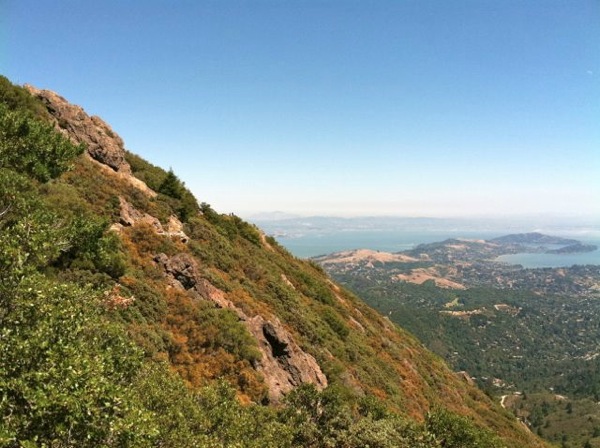
Monday, January 30, 2012

On the trail

Eastside Road, January 29, 2012—

LRStrail.jpg
Lindsey on the trail
ON THE ROAD AGAIN, as you see. The last week of January is so often a beautiful false spring here in the Bay Area; ornamental plum trees begin to blossom to everyone's consternation — So early! It's never happened before! (You hear this every year.) And our feet begin to itch, so I strap on the boots that have served me so well, and hoist a practice pack onto my back, and set the iPhone trail-tracker, and off we go.

Today's hike — it was a bit too strenuous to be called merely a "walk" — took us through oak hillsides above Lake Sonoma, the artificial lake formed a number of years ago when one of the last of the Corps of Engineers dams was built in the great Northern California water project. We protested the building of Warm Springs Dam at the time, to a great extent because it interfered with local rights to the environment that had been in place long before the coming of Europeans to the continent. And I'm sure we had ethics on our side: but I wasn't so sure, yesterday, that I wasn't selfishly happy we'd lost the fight.

The Visitors Center at Warm Springs Dam is closed at the moment — for renovation, the sign proclaims, but in today's economy you never really know why these facilities close. But the Corps of Engineers, which apparently maintains not only the dam but also the fish hatchery at its foot, maintains its own headquarters across the road from the Center; there you can get trail maps, and advice, and I suppose news of any recent threatening activity: poison oak, rattlesnakes, for all I know cougars.

We drove up Skaggs Spring Road to the South Lake trailhead; only three or four other cars were there on a warm and sunny Sunday afternoon. The trail leaves from the south end of the parking lot. For the most part it's a one-man-wide trail cut into contours on the hillside, which drops steeply from Skaggs Spring Road down to the lake: you never come near the water, though the trail drops and climbs frequently, quartering the contours, crossing narrow freshets at times. It had rained last week, and the trail was soft underfoot, muddy near the freshets: we saw footprints of people, dogs, raccoons, pigs.
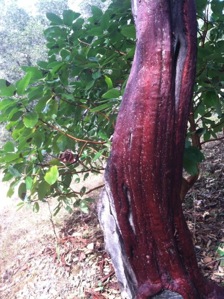
madrone.jpg
No animals to be seen, no birdsong. Soft air; fragrance — a sudden vanilla surprise, and the nearly constant scent of oak and duff. A few wildflowers — those tiny white ones we called filaree last weekend; and low-growing Baby Blue Eyes; and of course the magnificent madrone, some of them too in bloom.

Thanks to technology — MotionX-GPS on the iPhone — I can tell you we covered 4.84 miles in an hour and forty minutes, not counting rests, and that our altitude ranged from near 975 feet at the parking lot down to 650 feet, with a number of ups and downs along the way, for a total ascent of 943 feet, descent of 929. A good first workout for the year. Until July 27, you can see the map here.

Friday, January 20, 2012

Asides on an Ebay Oboe

oboe.jpgAS I KNOW I'VE mentioned before — ah yes; here it is — my instrument in high school was the noble bassoon — partly because as a young child I'd loved both Grandpapa in Prokofiev's Peter and the Wolf and the Sorcerer's Apprentice as brought to me by Walt Disney in his Fantasia, partly no doubt because the band teacher, Kenneth Knight of loving memory, has a bassoon at his disposal but no one willing to learn to play it.

One of my best friends at Analy Union High School was Merton Tyrrel, and he played the oboe. I always respected him for that, and for other things: he was handsome, self-controlled, well-spoken, intelligent; he seemed a good oboist, and of course he got a number of leading passages in the arrangements our concert band played at the annual spring concerts. (In the fall season we converted to a marching band, setting our double-reed horns aside in favor of sturdier things like saxophones.)

When I left home for college I no longer had the use of a bassoon, and I gradually lost interest in playing a musical instrument. For a while I made a scanty living giving private lessons in the recorder, but that didn't seem to count. Years later I played bass drum in a community orchestra organized with federal FEMA funds during one of the more enlightened recessions we had in those days, but that didn't last long. Nor did my participation in the Mills College orchestra put together by the late Sally Kell, for whom I played on the college bassoon, a wheezy instrument that I could barely negotiate through von Weber's Peter Schmoll Overture.

I always wanted to learn the oboe, but never did. Oh, I could play a C-major scale on it, faking it from bassoon fingerings, but that was about all. A few years ago we were in town killing time: Lindsey and our daughter Giovanna had gone on to the bookstore; I stopped off at a curious music store I'd never investigated, since gone out of business. I noticed an oboe in a display case and couldn't help betraying pleased surprise.

Oh, you play the oboe? the lady behind the counter asked. No, I answered, in a rare expression of incompetence. I used to play the bassoon, but that was fifty years ago.

Can you put it together, she asked. Yes, I can at least do that: and I carefully assembled the pieces, noting it seemed to be in good condition.

Can you at least show me what it sounds like, the lady asked; I've never heard an oboe. No, I said; I'd need a reed to do that. Well, here's a reed, she said, Go ahead and play it.

I moistened the reed in my mouth for a minute — it was a new one — and carefully fitted it to the oboe, fingered what I thought would be a G in the first, easy octave, and made a terrible squawk. Oh, the lady said, That's what it sounds like.

Well, not quite, I said, and continued to experiment a little. G, A, B. G, F, E. After a while I managed to play a scale, and continued up into the next octave a little way. I was surprised I could almost seem to play the thing.

If my wife were to come in here, I said to the lady, and hear me playing this thing, she'd turn around without saying a word and walk right out. I put the oboe back to my lips and played the scale again. Lindsey walked into the shop, looked at me, turned around without saying a word, and walked back out.

That must be your wife, the lady said; and I swabbed out the oboe, took it apart, and put it back in its case. How much, I asked. Oh, said the lady, I think I could let it go for seven hundred fifty.

Too much, I said as much to myself as to her, and left to rejoin Lindsey and Giovanna.
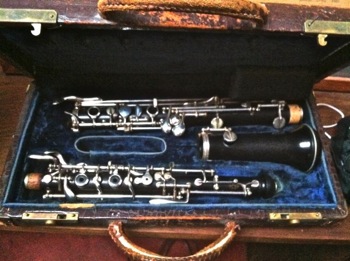
case.jpgFOR A FEW YEARS afterward, every month or two, if we happened to be walking past a music shop, I'd say to Lindsey I think I'll just step in here and see if they have an oboe I can afford. You'd better not, she'd always say: but I generally did. They never did, of course. You can't buy a decent oboe for less that a thousand bucks, and then you don't know what you're getting.

Then, last summer, I took the plunge and rented an oboe to see if in fact I really wanted one. I played scales; I played simple tunes; I made up simple tunes, always practicing, if you can call it that, when Lindsey was out of the house, aware the sounds were pretty painful to hear. At one point I decided to take a lesson.

The teacher looked at me dubiously: a man in his late seventies taking up the oboe. Can you make a sound with that thing, he wanted to know. I looked at him with a little bit of contempt, I'm afraid, and fitted the reed, and played a two-octave C-major scale.

Can you play it in tune, he asked next, trumping my contempt with a finer because more justified attitude of his own. No, I had to respond; but I can try to do better. But the cheap plastic oboe I'd rented was not much fun to play, and I was always fearful: if I crack it, or break it, it's going to cost me a lot of money, at least twelve hundred bucks, and I'll have this cheap plastic thing on my hands. My thoughts went back to the music shops.

Then, last Thanksgiving, when we were visiting Giovanna up in Portland, I took a look on Ebay and there was an oboe, as is, nearing the end of its auction period, with hardly a bid on it. It was a wood oboe, grenadilla to judge by the photos; the key mechanism seemed intact, and it was nestling in a battered leather-covered case that reminded me of the Linton bassoon-case I'd carried back and forth to school all those decades ago. I took the plunge, and was surprised, pleased, and a little ashamed and embarrassed when I won it, for only a couple of hundred dollars.

When it arrived it looked fine, just like the photos, but was of course unplayable: the pads covering the tone-holes nearest the reed all leaked. Nothing for it but take it into town to the repair shop, hoping for the best. It was early December, and I wouldn't know anything for weeks: the only local woodwind repairman was busy with all the fixes needed for local Messiahs and Nutcrackers and carolers. I tried to put it all out of my mind.

Then, day before yesterday, while we were on a hike in the hills near Sonoma, my iPhone rang: the oboe was ready for me. The remainder of the hike grew both easier and more tedious; I could hardly wait — to see what I had, and to learn what the price tag would be.

He'd had to replace nearly every pad. Made of leather, they're a favorite food of a common household insect. (I've learned they also like the horsehair on violin bows: you have to keep these things in the light, just like a woolen sweater, if you don't want them eaten away.) He'd also cleaned out all the keywork, whose bearings had gummed up over the years. No telling when it was last played. His work cost a little more than the oboe itself had: but for a relatively modest amount I had a fine, solid oboe, much more responsive than the plastic thing I'd been renting, more rewarding to play — and my own.

Now of course I have to play it, every day or nearly so, to justify the expenditure. I reason this will be good for me, physically, firming my breath control and of course my lips, exercising my fingers and wrists beyond the familiar constraints of the computer keyboard. Perhaps even training my ears to adjust to equal temperament as I learn to shade each of the thirty or so notes I'll be playing, each requiring a slightly different approach with fingers, lips, and throat to bring the oboe's instinctive sweet natural tuning into the one-interval-fits-all attitude that's constrained "classical" music for the last three hundred years.

It already has me thinking about music, and listening to it, with renewed ears. Last night, for example, we went to a high-school concert of chamber music. Students of varying degrees of competence played jazz, chamber music, wind transcriptions of varying degrees of competence. Perhaps because this was in Berkeley, it all seemed extraordinarily democratic, leveled. "Classical" music was dragged down from its pedestal; vernacular music was nudged out of the cashbox.

Four ambitious girls tackled the first movement of Schubert's "Death and the Maiden" quartet, and showed me for perhaps the first time just how dangerous and exciting the development section of a sonata-allegro movement is, with passages careering through remote keys, like an enormous cruise ship coasting too close the hidden reefs.

Another quartet, dressed in leather and hiding behind very dark glasses, stalked onstage carrying saxophones, acknowledged the audience with a bit of defiance, and proceeded to a stately, respectful rendition of Bach's "Air for the G-String."

We all too often experience music only through performances by professionals. Amateurs, even beginning students, when they play for us, remind us of the difficulties, the complexities, the intricacies of musical ensembles. Music of any culture fills a societal need, investigating co-operation, sensitivity, awareness of others while concentrating on one's own task, juggling understanding of received cultural inheritance with the "values" and imperatives of the cultural present.

Even my solitary exploration of my oboe enlarges my engagement with the other-than-me, as my brain and my breath and my fingers work the mechanics, the ratios, the sounds, trying to find a way to make the tone even, in tune, pleasing — in a word, just.

Sunday, January 15, 2012

Pirandello's ashes

For a little project I've been working on I turned to the remarkable story of the ashes of Luigi Pirandello, the great Italian novelist and playwright of the early 20th century. I present the story here, as written by Filcusum on the blog Il Mestiere di Leggere and put into English, after a fashion, by Google Translate:
When he died on December 10, 1936, the children found half crumpled piece of paper in which Pirandello had written: 'I. Both let pass in silence my death. Friends, enemies that prayer is not talking about newspapers, but it does not even mention. Neither preacher nor equity. II. Dead, I do not get dressed. I s'avvolga naked in a sheet. And no flowers on the bed and no lighted candle. III. Chariot of the lowest class of the poor. Nude. And no one accompanied me, neither relatives nor friends. The cart, the horse, the coachman stop. IV. Burn me. And my body just burned, or left disperse, because nothing, not even the ashes, I would like to advancing me. But if you can not do the cinerary urn is taken to Sicily, and in some rough stone walled countryside of Girgenti, where I was born. "

Points one, two and three were executed to perfection, with great scorn of the regime of Mussolini himself-says-he wanted to do a great funeral fascist regalia. Prior to respect the wishes expressed in the fourth point, instead, spent decades and adventures, mishaps and adventures, and worthy of Pirandello's own pen. Let's proceed in order.

FIRST FUNERAL-Two days after his death in a chariot of the lowest class of the lowest class, a case brought to the crematorium. But no one heard her to indulge his desire to spread the ashes to the wind, a practice unheard of in those days before it illegal and opposed by the Church. The ashes were then collected in an urn and taken to the Roman cemetery of Verano, where they remained for eleven years

THE SECOND FUNERAL-After the war, in 1947, the mayor of DC Girgenti, in the meantime become Agrigento, Lauricella, claimed the honor for his city to give Christian burial and funeral and solemn to the ashes of the illustrious countryman. He turned nothing less than the Democrat chairman of the board at the time, Alcide De Gasperi, who - despite the considerable difficulties still faced in transport - earned an American military plane for the transfer from Rome to Agrigento. To accompany the remains of the great dramatist was appointed Professor. Gaspare Ambrosini, known Pirandello and pirandellologo and future first President of the Constitutional Court. Place the ashes in a precious vase of the fifth century BC greek imballatolo well and good, shock-proof, in a wooden box, the plane was ready to go when a dozen people-all-came to Sicily ' plane shortly before takeoff is requesting a ride. The teacher, aware of the serious problems of displacement of the time talking to the pilots of the 'Air Force and obtained consent.

As they settled, someone asked what was in that box Ambrosini slung so well, having received an explanation and said: "Pirandello, what he had asked that his ashes were scattered to the wind? It is not that fate has decided to please him today ... .. "Calo an eerie silence, while the passengers were looking at each other, and under the seats got up forefinger and little finger of one hand. Then, as the propellers began to turn, one of them asked to get off. Ambrosini spoke with the pilots, they suspended the procedure and the passenger fell off. Needless to say, one after the other followed him also the other nine. At this point, the pilots are suspicious and asked the teacher explanations. These gave her, repeating several times the word superstitions, that the two drivers repeated as an echo, exchanging knowing looks. So it was that the two suspected ancestors were from Sicily, or Naples, claiming various reasons, refused to leave.

To Prof. Ambrosini, accompanied by his inseparable case, we have to get on a train was waiting for a full day of travel. Everything would have gone smoothly if awakened from a nap, he had not noticed that the cash was gone. The car tried to train and finally found it in the middle of four individuals who had used as a table to play cards. Unaware, of course, to make a game "with the dead", and dead: a Nobel Prize. Comunqe both recovered. Finally arrived in Agrigento, the Odyssey of the case was not over yet. The bishop of the city Giovan Battista Peruzzo refused to give his blessing to a greek vase. No blessing, no solemn funeral: all the propaganda and political organization set up by DC Mayor went up in smoke. At the last moment, when the waiver of the funeral seemed inevitable, the bishop was persuaded to promise the blessing if the box with the ashes had been housed in a coffin Christian. But Cassamortaro of Agrigento had coffins ready, we had to settle for a small white coffin, of those children. But the case did not fit there. Then it was necessary to extract the jar and secure it to fit inside the small coffin. And so it was that finally Luigi Pirandello had his second funeral. In full regalia, as he never wanted.

THIRD THE FUNERAL. The vessel greek and his ashes were kept in the birthplace of Pirandello, waiting for the planned memorial dedicated to him was made in the locality Chaos, just below the famous pine tree to which the playwright was so fond But you know how things go in Italy, the work was finished only fifteen years later, in 1962. And so it was that the ashes of Pirandello had their final arrangement, and their third funeral. These civil and religious authorities, and cultural figures such as Salvatore Quasimodo, Leonardo Sciascia, an aluminum cylinder which had been emptied the ashes was first blessed and then walled up inside the monument.

EPILOGUE. But there's more. It is said that the charge of the transfer, an employee of the town known as Dr. Zirretta, had to sweat seven shirts to complete the operation. After so many years, twenty-six to be exact, the ashes were calcified within the vessel. Armed with chisel Zirretta, helped by a couple of assistants, reduced them again and poured the powder in the metal container. But the container was too small. It advanced a fair amount. What to do? He must have a light bulb turned on in the mind of the employee of the town of Agrigento. A light bulb, brilliant. He took the ashes left, poured in a newspaper and headed for a cliff nearby, overlooking the sea. But did not have time to get there: a gust of wind carried away the ashes. And so it was that the last will of Pirandello - my body just burned, were both left-release (at least in part) compliance.

All's well that ends well, you say. But it is not over yet. Because in 1994 it was discovered that the famous greek vase of the fifth century, preserved in the Museum of Agrigento St. Nicholas, still contained some 'ash of Pirandello. Evidently Dr. Zirretta chisel had not worked through. It was decided to refer the remains of the remains of Don Luigi examination of DNA. And, surprise, it was discovered that only a small portion of those ashes belonged to the Master. The remaining, most of that is, to other bodies, non-identifiable, which evidently had been cremated with him in 1936
Comforted by the science we can now say, Pirandello, who are and are not those ashes of Pirandello. And that metal buried in the urn of Chaos, along with Pirandello there are many other unknown people, the nobodies. As one said, no one hundred thousand.

Which Google Translate might better have translated
Uno, nessuno e centomila
, the title of perhaps the master's greatest novel. But why quibble after such a marvelous story?

Monday, January 09, 2012

Back to the source

Eastside Road, January 9, 2012—
ALMOST EXACTLY TWO YEARS ago I posted an incomplete blog here. I was reminded of it today, when I got to thinking about exactly the same thing. Odd, that a profound feeling should emerge twice in the same season, two years apart. Then, it was because… well, you'll see. Today, perhaps it's because I'm thinking about a little trip we'll be taking in a few weeks, or maybe because suddenly there's been a raft of pop-journalism stories about Places You Should Visit. (One of them, according to one list, is Oakland, California. Well, why not.)

I'll begin by simply restating the two-years-ago post:

Sites
Eastside Road, January 29, 2010—
THERE ARE PLACES we have visited on various travels that have seemed very special, from a "medicine wheel" at 10,000 feet in Wyoming to the Fontaine de Vaucluse in Provence; from thestone-age city at Filitosa in Corsica to the Canyon de Chelley in Arizona. What all these places have in common is the not-verbally-articulable meaning they seem to offer to our visit: they speak to us, silently, about something we recognize without understanding, without even in any ordinary sense knowing.


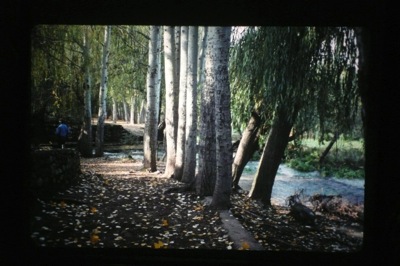
SuGologone.JPG


I think about these places a lot, under any circumstances; but I've been thinking about them especially recently since I began transcribing my journal of a trip we took through Corsica and Sardinia over twenty years ago, in 1988. Here you have a photo of the spring at Su Gologone, in Sardinia. As these places go, the places I'm discussing I mean, it's pretty well manicured, turned almost into a park, with carefully planted willows and — hmm; what are those white-barked trees in a row? — and stone retaining walls and carefully graded walks contained by concrete curbs. Turn away from this view, though, and look out across the pool toward a grassy clearing among the trees, and we feel we're looking at a site that's been here relatively uninflected by recent human attention. It might have looked much like this a thousand years ago, two thousand, ten. This may be merely sentimental: even so, the feeling's worth thinking about.

Why does the place seem familiar, though I've never been here before? There are sensations here common to other such places: the calm air within these trees; the sounds of the water; the soft feel of the calm air on my skin. The place conspires to distract me from more specific and immediate issues: the car I've left in the parking lot, the few

AND THERE the blog post stopped, mid-sentence, and I have no idea where it was headed. And I've learned over the years to abandon these things: you can't retrieve them, certainly not at this distance. But as I say I was thinking along the same lines today, more specifically about pools: it's interesting how many of these profoundly moving sites have been at pools. Let me add three more:
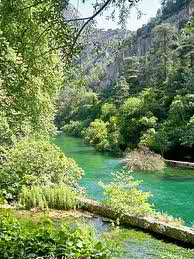
Vaucluse1.jpg
  • Fontaine de Vaucluse: we visited this place quite a number of years ago — I'd always wanted to see it, but had somewhat feared the experience. Would it be the romantic, isolated, poetic place I'd imagined, and I'd imagined Petrarch writing about? (For to tell the truth I've hardly dipped into the great Italian sonneteer.)

    The approach warned against this noble conceit. Many cars. Down-at-the-heels tourist cafĂ©. Worst of all, rock climbers hanging from ropes and things, directly over the source. But none of this cancelled the curiously atavistic quality of actually seeing this miraculous place, where a river — the aptly named Sorgue — pours out from a large, mysterious hole at the base of a granite cliff. You can see Moses at work here, if you're biblically oriented.

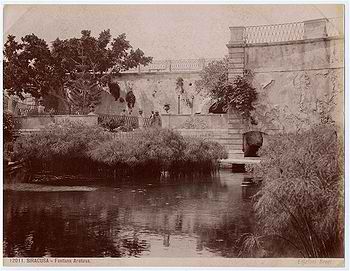
    Arethusa.jpg
  • The Fount of Arethusa: at the edge of Ortigia, the island just next to Siracusa, an improbable pool of fresh water not twenty feet from the salt Mediterranean, celebrated by poets from Virgil's time to ours. Like the Fontaine de Vaucluse, this is a much-visited site. The first day we saw it a woman was selling ices from her bicycle, and a group of high-school girls was listening to a lecture about the pool and its history and hydrology, in German, from a serious-looking young man in wire-rimmed glasses. As you see here, the site hasn't changed a lot in the last hundred years.
    StoricoAretusa.jpgcascade vaimahuta.jpg
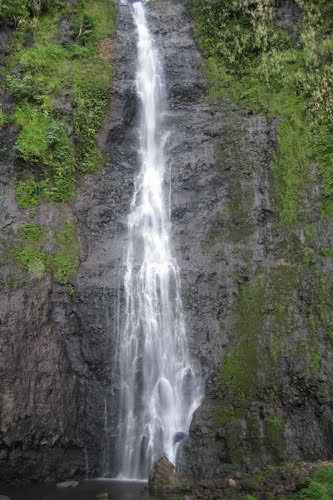
  • Cascade Vaimahuta, on the north coast of Tahiti Nui: Is it twenty years and more since we were there? Here's the journal entry:
    Took bus around past Point Venus to Papenoo to see waterfall, walking to it a couple of miles up a paved road past little farm-settlements, with small offerings of fruits or eggs on forlorn tables for sale to chance bypassers; walked back to blowhole Arahoho; then hitchhiked back to Arue, catching a ride on the back of a pickup, shared with a grinning urchin who got out halfway there; bus back to Papeete.
    It was our last day on the island, and the excursion could have cost us a lot: at the pool we remembered our plane would be taking off in a couple of hours. We were stunned to realize there was no return bus for many hours, and we were lucky to catch that ride.


  • Friday, December 30, 2011

    Nothing to be frightened of

    So many books read this last year, so few of them commented on here. End-of-year reflections will haunt me for the next seven weeks, I'm sure — I'll be too busily distracted for them after that — so I won't anguish over my failure to share notes on Frederic Tuten, or Patrick Leigh Fermor, or Carolyn Brown, or Patti Smith, to cite only the most impressive of the authors I've learned from recently.

    Instead I'll concentrate, for the moment, on a book uniquely appropriate to the season: Julian Barnes's Nothing to be Frightened Of (New York: Alfred A. Knopf, 2008). Barnes is better known as a novelist, I suppose, at the present moment at least, with his A Sense of Ending on the lists: I haven't read that yet, partly because I wanted to approach it through this earlier book, which is not fiction but memoir, meditation, and criticism — a conflation-medium I'm particularly attracted to these days. (One's late seventies launch an autumnal mood.)

    Barnes was the second son of two teachers of French and French literature, and that language and literature are central, it seems, to his address to life, its observation and discussion. Nothing to be Frightened Of is a contemplation of a selected history of man's meditations on death — not many women's such meditations, be it noted, though a few do turn up — as a way, no doubt, of pinning down his own view of the matter. A consummate writer, Barnes writes, I believe, as the best writers do, in order to discover (or at least approach) resolutions of his own confusions, or misgivings, or as a friend said this morning apprehensions, about the subjects at hand: and what greater subject than death?

    Death; dying; God; religion. Someone asked Thoreau, as he lay on his deathbed, if he had made his peace with God. "I hadn't realized we'd quarreled," he replied — at least that's how I recall the line. Googling it just now, I find it often quoted, but the source never cited.

    (I do, though, find two other nice deathbed lines: When Voltaire was on his deathbed, a priest abjured him to accept Christ and renounce Satan. Voltaire replied, "Father, this is no time to be making enemies!"
    As Talleyrand lay on his deathbed, he cried, "I suffer the torments of Hell!" A friend (I forget his name) sitting up with him replied, "Already?")

    Barnes loops gracefully through confrontations with these four principal themes (death; dying; God; religion; remember?) and more; interweaving funny stories about his childhood and his philosopher brother (who, oddly, lives at the near geographical center of France in order to teach in Geneva); and considering similar confrontations by a number of minds of the highest ranks. The book is not indexed, which is a major flaw — especially in a book with the imprint of Alfred A. Knopf! — but my endpaper notes will provide an idea:

    36 treacherous memory
    38 childhood memory
    40 Montaigne
    47 Renard
    54ff god out of art (art sans god)
    61 fear of death (thanatophobia)
    83 S. Maugham
    86 Daudet: adieu, moi
    95 Flaubert
    97-8 d. of Daudet; of Sand, Braque
    99 Title!
    107 either you or I
    108 Critics
    117 The dead appear to the dying
    121 Chabrier
    124 Wharton, James, Turgenev, Falukner
    132 Stravinsky
    134 Edm. Wilson
    138 memory is identity.
    166 last words. Hegel. Dickinson.
    185 meaning
    189ff problem of eternal life
    193 Rossini
    195 Goethe
    202 Shostakovich 14
    209 flux
    That last note, of course, sums it all up. There is nothing that is fixed, as Heraklitus famously noted. Acceptance of death, which is to say acceptance of life, is acknowledgement of flux. If it's true, as Emerson notes in his essay "Circles," that
    …this incessant movement and progression, which all things partake, could never become sensible to us, but by contrast to some principle of fixture or stability in the soul. While the eternal generation of circles proceeds, the eternal generator abides.
    —quoted by Ross Posnock in his review of American Nietzsche by Jennifer Ramer-Rosenhagen, The Nation, Nov. 21, 2011
    it is also true that these principles of fixture are site-specific to "the soul", are individual and unique and not fungible, are there for purposes of convenience only: and life (and its apparent extinction) are not there for convenience. Emerson goes on to note "Life is a series of surprises": those who yearn for stability, certainty, reassurance, are denying the essence of life.

    Barnes gives a good deal of attention to Jules Renard, "one of my dead, French, non-blood relatives," known to students of elementary French in my day (the 1950s, in this context) simply as the author of Poil de carotte but much more significant (and influential
    on literature) as a memoirist. Clearly Renard has been a muse for Barnes, providing him with both details for contemplation and a model for its practice and expression.

    Such influence or inspiration is linked, I think, to the subject at hand, for what Harold Bloom calls "the anxiety of influence" (in a book by that title, which I haven't yet read, perhaps fearing to be influenced by it) — the fear or apprehension that influence will dull individuality — is related to the apprehension of death. Both are rooted in a mistaken notion of identity, which notion is one of the most seductive, therefor sinister, of the "principles of fixture" Emerson concedes to us.

    I sometimes think we are, at best, like books. I bought this copy of Nothing to be Frightened Of at Title Wave, the deaccessioning outlet of the Portland (Oregon) Public Library, and I'm off this afternoon to lend it to an ailing friend. Human thought about existence and its consequences, from Epicurus to Shostakovich, go with the book, with Barnes. I'll print out a copy of this post and tuck it into the endpaper: perhaps it will be read, perhaps not. So it goes.

    Thursday, December 29, 2011

    Query

    Looking at what you've just done, the critics ask what's in it for them, for their immediate entertainment or information; and maybe -- maybe -- what's in it for their moment.

    The historians will ask how it continues what you've done before, and how it fits into your era.

    But you, why have you done it?

    Saturday, December 17, 2011

    Twelfth Night

    Pasadena, December 17—
    MY FAVORITE OF ALL Shakespeare plays — I know, it's a ridiculous formulation — is Twelfth Night. It has some of the most affecting poetry; its large cast includes some of his most memorable, complex characters; the narrative is interesting enough on its most literal level (even after all these viewings), and Is particularly rich with extended meaning. 

    Last night we saw a fine performance in A Noise Within's new theater here. Julia Rodriguez-Elliott set her production in a (probably) pre-Castro Cuba, which mostly worked just fine. (Short Cuban dance numbers replaced Shakespeare's songs.) Twelfth Night always suggests Sicily to me — Viola is from Messina, as I recall — and Cuba is our Sicily, in a way: exotic, free-wheeling, fantastic.

    I peck these comments out on my iPad keyboard without time for extensive discussion, so won't go into detail. anoisewithin.org will provide the credits, and I'll simply note here each actor seemed well cast and approached the assignment with intelligence, interest, skill, and sympathy; "small" roles were as beautifully and tellingly fleshed out as big ones.

    (This meant, for example, that Antonio was able to emerge, correctly, as the pivot on which so much extended meaning of this great play turns.)

    The company is still tuning its approach to this spacious yet cozy, beautiful new venue, but there's no doubt of the outcome. We like the hall, the company, the seriousness of purpose and the vitality and humor of approach and achievement. What will tonight's Desire Under the Elms be like?

    Wednesday, December 07, 2011

    Satyagraha

    Wow: Googling around while relaxing in that twenty minutes before bedtime I find this:
    Se Reich e' l'Haydn del minimalismo, Adams ne e' il Mozart, gia' teso ad un geniale, e talvolta irriverente, superamento del classicismo.
    The other night we went to the "Live TV broadcast" or whatever they call it from the Metropolitan Opera to the local charter-school auditorium, rather an ambitions building, of Philip Glass's opera Satyagraha. If Reich is the Haydn and Adams the Mozart, then Glass, at least in this opera, is the Verdi of minimalism. No: let me quickly amend that. In some scenes he's the Verdi; in others, notably the great closing scene, he's one of the Richard Strausses.

    We saw the opera once before, and can't remember where and when. Probably the San Francisco Opera production, though my visual memory of the event suggests a different house. This season's Met production is very different, what you might call second-generation Robert Wilson, tricked out with immense puppets and aerialists and such. It's hard to tell from the absurd film-as-cosmos style of these movie-theater broadcasts just what the impact in the real theater might have been: the film production alternates between close-ups, long shots, and side-to-side pans, sometimes in a tempo so quick and a sequence so unpredictable and chaotic as to leave at least this onlooker physically confused.

    I've railed so many times about these collisions of scale — the amplified string quartet as loud as three Wagner orchestras; the soprano's face as big as four billboards — that I hate to harp on it yet again. But this is a serious matter, folks: scalar confusions of this sort not only physically confound the audience's entrails, throwing them into a nauseated discomfort warning of impending doom; they also misrepresent the point of the message at hand — in this case, a very beautifully conceived and proportioned masque representing Ghandi's discovery of his purpose, the principle of nonviolent resistance, the forward-looking triumph of good sense and comprehension over stubborn authority and oppressiveness. Glass's opera is all sensitivity, grace, introspection, receptivity; this video production of his opera lurches, insists, moons, cajoles.

    The singing was mostly first-rate. I don't know if anyone could have bettered Richard Croft's performance as Ghandi; that closing scene, though long, floated beautifully; it was hard to let it go.

    But what must poor Phil have thought of the Met's including long excerpts of Wagner's Ring in the second intermission? I suppose you can argue there's historical precedent here; two centuries ago it wasn't uncommon to play comedies in the intervals of opera seria. But Wagner?

    Friday, December 02, 2011

    Recognizing the Midtone

    Berkeley, December 2, 2011—
    SITTING IN A CAFÉ over a cappuccino I have no time to write here properly, but I want to call attention to an important paper by my friend Douglas Leedy, who as well as being a composer of significant and often beautiful music is a scholar of the first rank.

    His area of specialization is of course music, and his knowledge of the subject extends far and wide. He has at various times and places been a player of French horn (including stints with symphony orchestras in Oakland, California, and Caracas, Venezuela); a keyboard player (chiefly harpsichord); a conductor (chiefly of music of the Baroque era); and of course a composer.

    He made extensive visits, often amounting to residencies, in Poland, India, and Venezuela. He has taught at Reed College and the University of Southern California in Los Angeles, where he founded the electronic music studio.

    In recent years he has pursued an intensive study of ancient Greek, which has led him to conclude that among the early Greek poets, certainly through Pindar, poetry and music are essentially synonymous; and that our fuller understanding (or, better, awareness) of their work requires an attempt to reconstruct the sound of their sung poetry.

    This has led him to a determined, highly disciplined, and to my limited understanding quite persuasive account, still evolving hence not yet publicly available, of exactly how to go about singing Homer today, accompanied by instruments readily available in our own time.

    Alas, I can't share his Reconstructing Greek Music yet. I can however announce that an example of Leedy's thorough scholarship and gracefully persuasive writing on another subject is available.

    Recognizing the Midtone addresses a musical interval important throughout history and across continents but lost to the familiar Western European "classical" tradition. Leedy presents an abstract of his essay:
    Recognized as a melodic interval in the musical scales of the ancient Greeks, the three- quarter tone, or so-called “neutral” second, is a fundamental melodic interval, along with the tone and semitone of the Western diatonic scale, in present-day musical cultures that extend eastward in an arc from northwest Africa along the Mediterranean to Egypt and the Near East, the former Burma, much of southeast Asia, and Indonesia. For this interval, which is incommensurate with the tone and semitone (and which is, for example, considered to exert a powerfully expressive effect in classical Arab melody), the more autonomous name of midtone is here proposed, along with a parallel renaming of other “neutral” intervals. An overview of the use and significance of the midtone in a number of musical cultures is presented, with references to recordings, published studies, and musical notation, as well as to its occasional, exotic appearance in Western classical music.
    I am pleased to have participated a bit in the presentation of this important essay, and I hope that its online publication will be followed by other papers of his.

    Saturday, November 26, 2011

    Charles and Lindsey Engage in Dialectic

    For no particular reason I recalled this little poem this morning:
    Charles and Lindsey Engage in Dialectic
    Grizzly bear and mountain lion at play —
    Crushing, his logic: cutting, her touchĂ©. 
    —Ray Oliver

    Monday, November 07, 2011

    For Daidie's Seventieth

    Eastside Road, November 7, 2011—
    A FEW DAYS AGO friends came to dinner and to discuss a little project we're working on together; I don't want to talk about it too much at the moment as it's in process.

    At one point one of them asked, point-blank, What are your three basic values? Quick, answer, don't think!

    And I said, quickly, Attentiveness, Reflection, Enjoyment.

    And then the other said And what are the real Indispensables?

    And I said Generosity and Gratitude.

    These have always seemed to me to be the minimum and necessary qualities for good life, but I was a little surprised at how readily I was able to express them. I think it was because I was already thinking, had already been thinking, if subconsciously, about the attributes I associate with a friend and colleague who had invited us to a birthday party — a seventieth. At the back of my mind I was probably contemplating the likelihood of proposing a toast to her.
    Poplars and canal.jpg

    We'd already prepared a card for her, with this photograph of a line of trees in our beloved Low Countries. It stands between the villages of Leuth and Zwyllich, not far from Nijmegen, almost exactly halfway along the Pieterpad, the walking path that crosses Netherlands from north to south, about 400 kilometers. I've walked past those poplars three times (Lindsey only once, that's another story), and each time they, and the path, and the canal they border, which runs along the Rhine at that point, move me tremendously. I suppose they represent for me the wonderful collaboration of man and nature, and of course they're a midpoint; they also happen to mark the boundary at that point between two nations, Netherlands and Germany. But the trees I think know nothing of that.

    The road offers the same length to everyone, though some choose to walk more or less of it than others do. It takes us where we want to go, and though we could very well turn round and take it back some distance few of us ever do, and then rarely for more than a little. The sky is open to all of us, to all of us equally; and the trees in their wisdom stand on the earth reaching into the sky, as far as they know to reach, that far and no farther, to nearly the same distance, all of them. They choose, I think, to know that much, finding it essential for some reason I don't know, and finding it inessential to know more.

    It was a wonderful party, and we were pleased and a little honored to have been invited.

    Wednesday, November 02, 2011

    Nearly Ninety

    Palo Alto, November 2, 2011–

    Extraordinarily rewarding, finally moving performance here last night of Merce Cunningham's Nearly Ninety2, the final work of the American choreographer whose career, I think, puts him in the category of Picasso, Joyce, Einstein, and his own partner John Cage among the greatest minds of his century.

    Cunningham died, at ninety, a few months after the premiere of this work, two years ago; and the Merce Cunningham Dance Company has been making a final memorial tour in the intervening time. (The curtain comes down permanently on the company on December 31, 2011.) The farewell tour has been unique among recent MCDC tours for its revival – "reconstruction" is their preferred and, in fact, more accurate word – of pieces from the repertory, going back to the 1950s. I think last night's performance gained from this retrospection. It's always hard to tell which of many factors is prominent in determining one's understanding, during the event, of as complex an observation of a work like Nearly Ninety2 , of course: scored for thirteen dancers, each of whom is a soloist at one time or another, its 24 sections unfold in eighty minutes, without an intermission, in a spellbinding sequence of solos, duets, quartets, and ensembles, fleetingly fast and glacially slow by unexpected turns, in a series of contemplations, I would guess, of the four elements; for this is an elemental ballet, going to the essence of what it is "about": the body in motion, which of course includes the body at rest.

    This is, also of course, a matter of life and death. And, not to be recursive, that makes retrospection, especially in the contemplation of this great body of work, now closed in one very important sense, an inescapable component of responding, as an onlooker, to this performance – as it happened, the final performance by MCDC of Merce's final work, though a number of performances of other pieces remain to be given in the next two months.

    I recently read Carolyn Brown's big, important, and rewarding memoir Chance and Circumstance (as felicitous a piece of writing as its intelligent title suggests), and that reading, so informative about Merce and John (and Rauschenberg and others) and about the early years of the Company, must be influential as well in responding to last night's performance. I thought I saw Merce himself, in flashes, in Raschaun Mitchell's strong, stately, athletic, intelligent performances, and Carolyn Brown in those of Andrea Weber, sober, graceful, lithe, and equally intelligent.

    Brown writes often, both directly and allusively, about the possible role of "meaning" in Merce's work. (These contemplations, usually either foolish or forbidden in other commentators, are among the historically significant aspects of her book.) A choreographer cannot evade consideration of the place of sex – I refuse the word "gender" – in setting his work on his dancers, and a big part of the impact of Merce's choreography, not to mention the dancers' realization of it, has to be the expression of that consideration. Sex and Life and Death, motion and stillness: big matters, to be returned to, the fates willing, in forthcoming visits here.

    Saturday, October 29, 2011

    Gordon Cook

    Eastside Road, October 29, 2011—
    IT'S TOO LATE to tell you about it; the show closed today; but the work of Gordon Cook has found its way to a new home in San Francisco's George Krevsky Gallery.

    Born in Chicago in 1929, Cook came to San Francisco in his very early twenties, working at first exclusively as a realist printmaker specializing in botanical subjects, moving on to figure drawing, finally, after his marriage to the painter Joan Brown, developing his unique qualities as a painter.


    It does him no disservice to mention that his paintings inescapably bring Chirico and Morandi to mind. His palette, lighting, edges, scale, and composition refer to their sense of dramatic realism, enigmatic statement, quasi-enchanted awareness; but the subjects — boats in the low Sacramento Delta light, gas tanks at the Richmond refinery, even the featureless Amish dolls — all convey a sense of specific place.

    Guston is here too, in the curiously vulnerable, clearly humanistic content of his images, at first encounter utterly removed from subjective emotion, later growing in sympathetic resonance.

    I once had a heated discussion with Cook: I was trying to persuade him of the possibility of painting from imagination, thinking up forms, even subject-matter, that didn't exist in fact. No, he said, That would be absolutely immoral; one can't legitimately paint objects that one hasn't actually seen.

    So in order to paint his stick figures, men rowing boats, silhouetted kissing couples, he first actually made them, using thin wood, cardboard, glue, and paints of course. His sculpture is in fact maquettes made for posing for their portraits: he brings the concentrated gaze of the figure-painter (and, even more, draftsman) to the contemplation of the bulk, edge, directionality, even purpose of these three-dimensional inventions.

    On another occasion, shortly before his early death in 1985, I sat in on a talk he gave to a number of graduate painting students at Mills College. One asked him about the repeated canvases depicting that gas tank in Richmond: why did he paint it over and over again?

    My dealer asks me that too, Cook replied. Then, more seriously: I'm just trying to get it right.

    What I love about the painting of the San Francisco Bay region, at its peak, among other things, perhaps most of all, is its morality, its ethics. Gordon Cook was among the most persuasively pure practitioners of any of them. His work, like his example, is haunting, and it's good to see it out there again. An artist of enormous presence and import, clear-thinking, poised, whose work has the compact kind of energy we usually call power. The exhibition has closed; images remain on view here.

    Friday, October 21, 2011

    Painting

    Eastside Road, October 21, 2011—
    The San Francisco Bay area has long been one of the most significant American locales for painting, certainly since the middle of the last century, in fact going back at least half a century before then. There are interesting cultural, geographical, and historical reasons for this; we needn't go into them here. Suffice it to point out that an unusual combination of pioneer spirit and genteel tradition was almost immediately at the center of the Northern California mentality (for a brilliant study on this theme, see William Everson's Archetype West: The Pacific Coast as a Literary Region); that relative isolation with occasional exposure to European Modernism allowed that mentality to respond to the local natural and societal stimuli; and that by the time of the post-world War II years, when the GI Bill allowed many gifted artists of other than rich backgrounds the time and setting for their own personal development, a génie de terroir, so to speak, had already been well developed.

    My own years as an active observer of the scene, from the late 1960s on for twenty years, coincided with the tremendous expansion of the Bay Area art scene from a marginal, almost underground activity, treated seriously in the newspapers but hardly known to any but real devotees of the art, to its present amplitude, with galleries in shopping malls, art school campuses everywhere, and almost total neglect in the few remaining news outlets. Not surprisingly, perhaps, the painters who had attained their mastery in the late 1950s and early 1960s remain my heroes, artists who dedicated their lives to painting in a context of almost total neglect by all but their own colleagues.

    Few of them are still living: Frank Lobdell is perhaps the last. Even among what I think of as the second generation, painters my own age, now in their late seventies, slip away with melancholy regularity. Nathan Oliveira, for example: a marvelous painter and teacher (Stanford for many years) and a very nice man. He died nearly a year ago — there's a fine obituary by John Seed on the Huffington Post website — but we saw the memorial exhibition at the John Berggruen Gallery a few days ago: it closes tomorrow, October 22, but the website will, I hope, continue to present its forty-two images of the paintings and sculpture on view for a few weeks to come.

    The last works are striking: the familiar Oliveira figurative images isolated against glowing grounds in his characteristic warm but muted, sometimes even darkened oranges, reds, maroons, ochres. Many of these figures stand (or, occasionally, dance, or skate) next to a single line, an edge — shadow, or skin, or crack of light in a doorway? Others have auras, or long hair bending back from the head as if the essence of the figure is escaping toward an unknown (or, perhaps, being breathed into the figure from that unknown).

    It's impossible to see these late works, I think, without musing on the painter's own death so soon after completing them. Yet earlier canvases here, going back to the 1980s, not to mention drawings and watercolors going back a further twenty years, reveal this haunting meditative quality to be Oliveira's fixation, his constant orientation to his work, as his work is apparently his constant orientation to life, to his own individualization of the human condition.

    Even the work that seems to stray from this — the paintings and bronzes that seem to confront relics from neglected or abandoned civilizations, reminding me of pavements left over from ancient Mediterranean sites — even these merely extend the personal expression toward a more universalized one. Oliveira's work, like that of his friend the (still living, thank God) sculptor Manuel Neri, remind the viewer of the affinity of the Mediterranean sensibility with that of the Bay Area, as if the Californio years were not lost on our cultural inheritance, and continues to haunt if not energize this very moving work.
    Last week we saw also another moving gallery exhibition, of drawings, drawings with collage, and a few paintings by Jay DeFeo, truly one of the great painter-heroes of our time. I knew her slightly; we taught together for a time at Mills College, where I sat in on her beginning painting class now and then. (Alas, I never learned to be a painter.) The current exhibition at the Hosfelt Gallery closes, unfortunately, tomorrow, like Oliveira's at the Berggruen; I'm sorry not to have been able to get to commenting on these shows earlier.

    At the Hosfelt there's a particularly arresting painting, Bride, from 1986. The title has inescapable Duchampian overtones, of course; and thinking about that, and about Jay's unique intelligence which rests at the intersection of seeing and contemplation, goes a long way toward explaining the central position her life and work intuitively seem to occupy in the late-twentieth-century context of visual art, not only locally, but internationally.

    Fortunately, the Jay DeFeo Trust maintains a fine website and works passionately to further awareness of this important artist whose early death — she was only sixty — otherwise threatened to leave her in obscurity in a cultural climate increasingly rewarding more trivial, flashier entertainers. The Whitney Museum will produce a major DeFeo retrospective next November; I hear it will travel to San Francisco; it will be a major, major event.

    I don't like to snatch images from the Web and re-post them here; you never know what's copyright, what's freely offered for second-hand retailing. I urge any visitor here to follow up the links embedded here — even better, of course: get to the galleries tomorrow.
  • Nathan Oliveira Memorial Exhibition, John Berggruen Gallery, 228 Grant Avenue, San Francisco; (415) 781-4629; Mon-Fri 9:30am–5:30pm; Sat 10:30am–5pm; through October 22; catalogue available
  • Jay DeFeo, 430 Clementina Street, San Francisco;415-495-5454; Tue-Sat 11-5:30; through October 22
  • Sunday, October 09, 2011

    Steve Jobs

    Eastside Road, October 9, 2011—
    LOTS OF RESPONSE in the blogsphere, in the media, even in conversation, about the death last week of Steve Jobs. There's not much question but that in death as in life he was a touchstone, just as was his computer. It's odd how passionately people align themselves for or against certain forces, which is what I think he truly was. You were either a Mac person, or you were not. Apple or PC: like Fitzgerald or Hemingway, National League or American League, in my father's time General Motors or Ford.

    Since so many have had so much to say, I'll chime in, in three comments: personal, appreciative, more general.

    First: I'm a Mac man. My first computer was a Radio Shack Model 100, which let me see eight lines of type at a time, no matter how much copy I'd written, and then send it, marvel of marvels, over a telephone to the office. I taught myself a little Basic with that machine, too, to use it for various other things. I even began typing out Lindsey's book on it, saving sections to tape cassettes, but that quickly grew too clunky.

    So I graduated to a real desktop, a Morrow. Here I began dealing with arcane line-item entries, saving to drive A or drive B, always dealing with terminal commands. The rest of the book got typed out, and even printed, on one of those daisy-wheel jobs on paper with perforated tear-off margins. It was enough to drive you nuts.

    Then, in 1986 I think it was, I bought a Mac Plus. The primary reason for this was to take a class in computer composition. Instead of terminal commands, I was mousing, pointing, clicking. I could write music on five-line staffs; I could copy sections, transpose or augment or retrograde them, layer them. I could hear the music played back on an internal synthesizer. And of course I could print it out, too.

    Since I've always been intrigued by typefaces and page design, the Mac appealed to me. Soon I learned about Hypercard, and could give up Basic and design little applications of my own to handle other chores concerned with databases, calculation, design, and composition. It didn't hurt that I never had to think about computer viruses. I have remained loyal to Macintosh ever since, going through the AV series desktop, various laptops beginning with the first, and working now on an iMac, an iBook, and of course the iPhone and the iPad, which have served me well on travels abroad.

    So I am thankful to Steve Jobs for having had the vision to reify, in hardware and software, practical approaches to computer-based handling of music, graphics, text layout and so on, weathering the scorn of business- and science-oriented criticism that Apple was somehow "only" about games, or art, or hobbies.
    Second: Jobs himself was apparently inspired by two or three things that meant a lot to me, too (and I hasten to state that I'm not setting myself up as an unsung Jobs). He was brought up by parents who were skeptical of formal education, though in the end they helped him enter college. His own college career was similarly skeptical and cut short. (I finished, but took a number of years, and turns, before managing.) He was fond of tinkering and learned a lot about that from his dad. When he did go to college — Reed College, in Portland — he was particularly inspired by studying calligraphy.
    Reed College at that time offered perhaps the best calligraphy instruction in the country. Throughout the campus, every poster, every label on every drawer, was beautifully hand calligraphed. Because I had dropped out and didn't have to take the normal classes, I decided to take a calligraphy class to learn how to do this. I learned about serif and san serif typefaces, about varying the amount of space between different letter combinations, about what makes great typography great. It was beautiful, historical, artistically subtle in a way that science can't capture, and I found it fascinating.
    quoted from Jobs' 2005 commencement address at Stanford, as posted here
    In this context, Lindsey brought to my attention a comment made by Malcolm Margolin in the 2009-10 Annual Report of Save the Bay:
    …I think that at Save The Bay's root there was something else besides a concern for the environment — it was a concern for beauty. There was something about the fact that people looked out the window and realized the spectacular, poignant, transformative beauty of the Bay. This is what they wanted to preserve — the sense of living in a beautiful place that restored you on a daily basis — the respect for beauty. Today, Save The Bay is rooted in science, environmentalism, social concerns, social justice. But there is still the beauty that inspires this whole enterprise.
    "50 Years of Making Waves," 2009-2010 Annual Report of Save the Bay, as posted here, page 6
    I believe that Jobs's fundamental sensibility was that of an artist, a maker, a poet, a player; and that it was this that made him misunderstood and, to an extent, scorned by the mainstream worlds of business and the media.

    Obviously the history of Apple Computing after its early successes went mainstream in its turn; it's now famously one of the richest corporations in the country. Obviously critics are justified who decry the extent to which such success exploits cheap labor, oppressive working conditions, corporate secrecy and all that. But I think it's a mistake to extrapolate from those observations the idea that Jobs was simply a hypocrite. (Nor do I, or anyone I know, have any idea the extent to which Apple's corporate decisions concerning retained earnings, global marketing and sourcing, and the like were driven exclusively by Jobs, rather than his board of directors.)

    What I like about Steve Jobs is that his brilliance was fully in service of a consistent vision: the extension of technological tools to people who simply want them to work in applications concerned with art, entertainment, design, communication, and the like; rather than (more narrowly) statistics, mathematics, physics, and computation. I'm aware a number of people I know manage to use the Windows operating system, on their PC personal computers, to pursue their work in the liberal arts; I hope they realize the extent to which Apple pushed Microsoft in that direction.
    Third: All that said, the tremendous, global, across-the-classes outpouring of comment on Jobs's death was extraordinary. I doubt that Jobs would have liked it much, though he might have been wryly amused. As usual, the media reacted far too heavily, too quickly: but that's in the nature of the media.

    More interesting was the huge amount of popular expression of love, grief, thanks, and then to an extent repudiation. I think there are two basic reasons for this outpouring, one nationalistic, the other psychological. The nationalistic one is simple: at a time when America seems to be losing its storied leadership in can-do, inventive, meteoric entrepreneurship, it's great to be reminded of a recent personification of all that, and distressing to lose him.

    Psychologically, at a time when there's so little to pin your faith on, when governments and banks, corporations, the military, even Mother Nature herself seem to be letting us down at every turn, people the world over seek heroes who manage to counter such obstacles, who rise from little more than their own ideas and hard work, who embody a kind of optimism and drive.

    After Mozart it was impossible to go on composing like Mozart. Jobs was no Mozart: he was more like a Cage, a Duchamp, a Stein. He, and his work, challenged the assumptions, picked up neglected ideas and reconfigured them to useful approaches. In the course of this he attracted partisans and detractors; neither camp has much to do with the historical necessity and the eventual impact of what he imagined and achieved. What comes next, remains to be seen.

    Friday, September 23, 2011

    The Pleasures of Travel

    San Jose, California, September 23, 2011—
    WE VIRTUALLY NEVER visit this city, the largest in the Bay Area, the third-largest in California (after Los Angeles and San Diego, and well ahead of San Francisco). And so I always forget how different it is from our usual haunts. The climate and demographic are different. The difference sets in as you travel down the Peninsula, whose smaller cities and towns — San Mateo, Palo Alto, Redwood City — seem more like Southern California than the Bay Area.

    We're here for two nights, for entirely cultural reasons, as a friend wryly pointed out. Last night we saw Mozart's Idomeneo, a great opera all too rarely produced; tonight we go to the opening of an art exhibition for which I wrote a modest (very) catalogue essay. In between, a runout to Berkeley for an appointment; tomorrow, on our way home, a cruise on the Bay.

    Before I get to Mozart, a few comments on the hotel. I keep a list of restaurants we eat in, updating it every month or so; I haven't until now thought of doing the same with hotels. We generally use Priceline to reserve hotels, because we like our hotels cheap: we sleep cheap, in order to eat dear. Sometimes we book conventionally, but we often use the blind "bidding" process, by which one chooses area, star level, and names a price, content to take what's dealt.
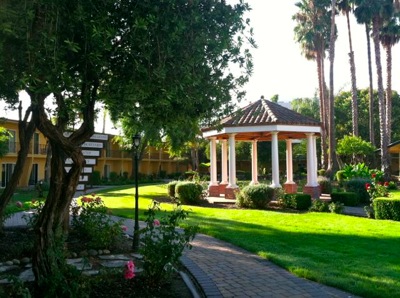
    gazebo.jpg
    That's what we did this time, and the result has been rather a delightful find, the San Jose Airport Garden Hotel. This is a cluster of five or six twostorey buildings, each on the order of an ordinary Motel Six I suppose, surrounding a complex of lawns, pool, exercise rooms and the like. The "gardens" are set about with fountains and statues, and the lobby and corridors are hung with dozens, scores, perhaps hundreds of framed prints and paintings, all collected by a single former owner, a Persian with a curious eye attracted to gods, goddesses, philosophers, birds, and botany.

    Statues, or at any rate reproductions of statues, reflect Greek, Egyptian, and Indian antiquity. One corridor boasts at least two dozen prints of good quality all of birds, and those on only one of the two long walls. Our own little bedroom boasts two original oil paintings, not particularly interesting: a Dutch or Belgian twostorey house by the side of a country lane and a vase of dahlias painted in high-relief impasto. But there is also quite a nice botanical print of anemones with leaves, flowers, and buds in various stages of maturity, nicely triple-matted and framed in plain oak.

    The hotel has a history: it was the first Hyatt hotel in Northern California, built in the early 1960s. (So I was told by the present manager here.) It's surprising to be reminded that Hyatt hotels have not always been everywhere, and have not always been the interchangeable manystoreyed metropolitan behemoths so familiar today; a lot has changed since the Eisenhower administration.
    squirrel.jpg
    We just came in from a decent Martini by the swimming pool. Although the cocktail hour, we were alone except for two jet-black squirrels and one grey one, tame enough to come when I called them by clack-clack-clacking tongue between teeth.
    On, this evening, to an opening at the Triton Museum of Art, where Kenjilo Nanao is being given a mini-retrospective, along with Jamie Brunson and Heather Wilcoxon. I'd met Brunson many years ago; she recalled tonight that I was one of the first to review her work in the press; I liked the work here a lot — meditative yet retinally jumpy painting with very strong colors, monochrome, setting up persistent after-images.

    I liked Wilcoxon's paintings too: in the Roy DeForest tradition, clearly post-Guston as well, intelligent and sassy and slyly organized behind their seemingly frenetic surfaces and subject-matter. (You can see this work at the Triton website.)
    nanao.jpg

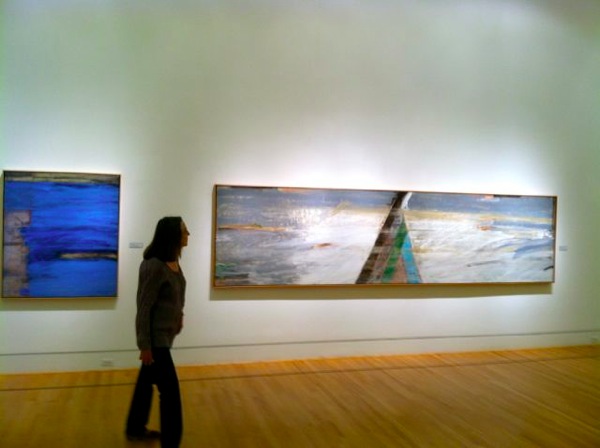
    But it was of course Kenji's painting that brought us here, and they are magnificent under the strong white light in the museum gallery. As Preston Metcalf points out in the catalogue, Nanao mediates, or rather transcends the differences between, Abstract Expressionism and color-field abstraction. As I point out, the work is essentially landscape, or at least can be so read. It is sumptuous, rich, allusive, and utterly egoless, serene yet full of energy.

    The main inspiration for this trip, though, was San Jose Opera's production of Idomeneo. Mozart composed it in 1780, just before his 25th birthday; it is his biggest opera, for a big orchestra, a huge cast; it is probably the last opera of its kind, to a libretto celebrating regal largesse — a piece that says goodbye to the Age of Kings.

    Idomeneo was himself the King of Crete: returning from the Trojan War, victorious, he runs into a terrible storm at sea; pleading with Neptune for clemency, he vows to sacrifice to the god the first person — or creature, accounts vary — he sees on landing safe on shore. The first creature turns out to be his own son, of course: this is a version of the Abraham-and-Isaac story.

    The opera was beautifully conducted, by George Cleve; very well sung, by a young, ardent cast; effectively staged; and set within a production owing a great deal to David Packard, whose archaeological enthusiasms and considerable resources combined to stage the action in quite persuasive reconstructions of the extroardinary beauties of the Minoan culture. Last year's tour of Sicily (speaking of the pleasures of travel) prepared us for enhanced enjoyment of this production, which should certainly travel to other opera houses.
    opera.jpg

    As to the opera itself, it is a magnificent musical monument and, in a production like this, performed as credibly as this, a work full of matter for contemplation. We're reminded that in all ages the gods are narratives constructed by the human mind to personify natural impacts & influences on the human experience. They are organized according to the prevailing social structural needs & assumptions: i.e. tribal-pagan, regal-monotheistic, etc.

    Idomeneo is a transitional and decadent narrative: why was it appealing to a late 18th c. nobleman (Karl Theodor, Elector of Bavaria), who commissioned it for performance at a court carnival? The opera is about a king who errs (though through piety), but is forgiven and allowed to abdicate in favor of the son he was bent on but released from sacrificing: aren't there interesting subliminal correspondences between this and the plot of, for example, The Marriage of Figaro? What an interesting period this was, the fourteen years between the American War for Independence and the fall of the Bastille!

    Saturday, August 20, 2011

    Four Saints in Three Acts

    Eastside Road, August 20, 2011—
    WE SAW the Stein-Thomson opera Four Saints in Three Acts last night in San Francisco's Yerba Buena Center, where it was performed by Ensemble Parallele, about which company I wrote enthusiastically here a while back in connection with the Philip Glass opera Orphée. I don't have time at the moment to write more than that I think you should see this if you possibly can; it's one of the great operas not only of the 20th century but of any, and productions are rare, and this one is worth seeing. I'll have more to say about the production, and the opera, in a few days.

    Thursday, August 11, 2011

    Virgil Thomson on Audience Sensitivity

    FOR NO PARTICULAR REASON except that I just ran across it, while looking for something else, here's a piece I wrote for the Oakland Tribune on September 2, 1979:

    APTOS--"Why can't musicians compose what audiences want to hear?"

    The anguished question was directed toward a six-composer panel at the Cabrillo Festival here last week, and it stated a problem composers have faced for decades.
    There's a continual distrust of new music. It's a joke, or it's too abstruse, or ugly. "My kid could make noises like that."

    All six composers at the panel agreed that they didn't set out to compose music that audiences wouldn't want to hear. But it took 83-year-old Virgil Thomson to dissect the question with his scalpel-like intellect.

    "The trouble is, 'audience' is a collective noun. You have to be very careful when you throw that word around. Audiences respond as a group. (That's why record reviewing is spiteful; because it's solitary.)"

    At this point Garret List, a young trombonist-composer straddling new music and jazz, interrupted Thomson: "Who do you write for?" Thomson continued to elaborate his point:

    "An 'audience' figures as sociology and economics, not esthetics."
    Garret List wasn't listening. "Who do you write for, Virgil? Virgil?" He snapped his fingers to get Thomson's attention.

    "No one knows what an audience is going to like," Thomson continued. "Or what a management can sell to an audience. And audiences are bullied. And we can only know what an 'audience' liked last year.

    "There are fashions, trends--in orchestral tricks, or whatever--that follow unconscious folklore patterns. They are very hard to predict.'

    He never let on that he'd heard List, but suddenly answered him.

    "Gertrude (Stein) used to say, 'I write for myself and strangers."' List nodded agreement. So did the others.

    "I am the listener I puzzle over when I'm composing," Eric Stokes said.

    "Exactly," said Thomson. "And any passage that bores you a tiny little bit will bore others more. You can bet on it."

    Which brought up another question: did these composers aim at complex or simple music?

    "Simplicity," Lou Harrison said. "I always remember something Schoenberg told me when I studied with him: 'Nothing but the essentials."'

    "Depends on the music," Thomson elaborated. "If I aim consciously it's toward simplicity where possible; but if complexity is necessary, not to fear it. I tend to think music isn't finished if you can subtract anything without injury. Music is a complex affair; the more we can simplify it, maybe, the better."

    Some one asked about foundation grants.

    "I think we had a more independent attitude before," Harrison answered. "Post-Depression young people can't conceive of grubbing."

    The young composers disagreed. Foundation grants are "a lottery," List said. "There's not enough money."

    "There are more composers now," Stokes pointed out.

    But they allowed that they made a living somehow. How do composers make a living, someone in the audience wanted to know.

    "The answer to that question is that it's none of your business how we make a living," Thomson replied. "How we compose is another matter."

    There was laughter, then silence. Then, in a rare burst of emotion, Thomson summed it all up. He pointed toward something overhead; the small silent gesture galvanized the audience and panel.

    "Calling," he announced. "We're playing a game of life or death. We must find ways of answering the calling--or choose death."

    Friday, August 05, 2011

    Mount Tamalpais

    tam.jpg
    Looking east from the Temelpa trail, Mt. Tamalpais
    THE FIRST STRENUOUS WALK of the year, far too long delayed: from Mountain Home, on Panoramic Highway in Mill Valley, up the old railroad grade past West Point Inn and on up to the East Peak; then down through the garrigue on the Temelpa trail to various fire roads and so back to the starting point.

    I think this took about four hours or so all told, plus a half hour nibbling and resting at the summit. Glorious views, but of course hardly any can really be photographed.

    The fire roads, and the old railroad grade, are comfortable but not terribly interesting walking: but they give fine views, especially over the luminous greys of fog out toward sea. There was too much haze to see much distance: in this photo you can barely make out Mt. Diablo to the east. The narrow Temelpa trail reminded me often of walking in Alpes de Provence, except that the smell is completely different. Is the oregano and thyme and lavender in the Provençal garrigue, I wonder, feral escapees from Greek gardens of 2500 years ago? Will the same happen here, a thousand years hence?

    Thursday, August 04, 2011

    Early August

    No moon. The crickets
    or whatever they are sing,
    mindful of Late Works.