Tuesday, January 29, 2013

HOC


Via Gaetano Sacchi, Roma, January 29, 2013—

THAT TITLE IS NOT Latin for "this" (or "that"), it is Russian for "nose." The three letters floated frequently in front of the stage tonight, at Rome Opera's production of Dmitri Shostakovich's first opera, performed here as Il Naso. Shostakovich composed it in 1927 and 1928, to a libretto based pretty straightforwardly on the Nicolai Gogol story
(1835) about a man whose nose leaves him — or perhaps a nose who leaves a man. Gogol's story is pure fantasy, and reminds me of fables by E.T.A. Hoffmann; the librettists of the opera have pushed the fantasy further in the direction of political satire.

Shostakovich's score is said to be influenced by Alban Berg's Wozzeck (1925), and I could hear that tonight in the writing for male chorus, in the contrapuntal devices, and occasionally in solo vocal writing. But the music is strident and busy, the orchestra almost wilfully eccentric. The large percussion section rarely lets up; xylophone, piccolo, and brass frequently assault the ear; and the orchestration goes everywhere — this must be the only opera whose orchestra includes two balalaikas and a flexotone.

Peter Stein's production leans heavily on clichés of Modernist slapstick, often suggesting silent cinema: a man descends from the flies in an elaborate useless machine composed of gears and tread-wheel, and you think of Charlie Chaplin and Modern Times; Keystone Kops chase hapless fugitives and one another; two men in a horse suit show up once or twice more often than really necessary. But the result is fun, if silly, and fills the time — better, in my opinion, than does Shostakovich's score, which too often seems to be turning the crank.

The cast was huge and I lack a program; I'll only mention the lead, who has an enormous role: Paulo Szot put it across very well indeed. Alejo Pérez conducted with all the energy needed, and managed a Russian style in the broader, more lyrical sections, welcome when they arrive. The chorus and comprimarii were effective, and the supporting cast: as you see in the photo, of the final curtain call, this was an enormous cast, easily sixty or seventy people often crowding the stage, and all directed very well.

The question remains, though, whether the opera's worth doing. It's a sad point to raise: Shostakovich is a central composer of his century, and all his music should be known by anyone interested in serious music. To my mind his work is flawed, like Aaron Copland's and Benjamin Britten's, by his felt need to be both modern and nationalistic; stylistics too often seem to be applied to his work, rather than his work evolving a persuasive individual style. But his is a special case, and familiarity with his work must involve awareness of the tragic ironies of his life, time, and place — and not many of his scores so directly confront, even define, these ironies as The Nose.

So, expensive though the tickets were; difficult as it was to balance the Russian text with the Italian supertitles (and particularly from a box far to the side of the house); strident as I found the score; I'm glad to have heard this performance. Particularly, I might add, a couple of weeks after seeing Einstein on the Beach again, for, odd as it may seem, the two events have certain things in common. I much prefer Einstein, partly because it's a more serious work of art. But art, like all of life, profits from slapstick and sarcasm as well as from seriousness. All work and no play makes Jack a dull boy, and Hoc is never dull.

Monday, January 28, 2013

Street theater


via Gaetano Sacchi Rome, January 28, 2013—

A FEW MORE WORDS on street theater, if you don't mind. Rome is nothing if not theatrical.

I just told you about the (apparently) twin fakirs occupying a piazza last night off the Via Corso. Here's the scene on the Corso itself, the Sunday evening passeggiata, pedestrians (and that one rebellious cyclist) cheek by jowl ambulating the length of what was once a racecourse (hence the name) and is now a shopping street. Not a bar or cafe to be seen on this street, but plenty of bling and blue jeans.

I've been reading Robert Hughes's history Rome, a satisfying introduction to the history of the great city. He writes of the entertainments and indulgences of Imperial Rome, describing the sculpture, the gladitorial combats, the poetry and the (legitimate) theater; the baths, the jewelry, the feasting. But he does not write about street theater, and there must have been plenty. Dancers, acrobats, perhaps even living statues imitating the many hundreds of real ones — they must have come from every corner of the empire, as they do today.

I like to walk along streets like this holding my iPhone at my hip, recording random video. Some day perhaps I'll stitch some excerpts together. The random faces passing by are often bright with expression, too often at other times merely focussed on an unseen mobile telephone, listening to an unheard voice, then suddenly and volubly answering in a torrent of syllables that may be Italian, Turkish, Arabic, or who knows what language or dialect.

When we landed at Amsterdam two or three weeks ago the first thing we did was walk the crowded Harlemsestraat, and the first thing to catch my eye was a fellow piloting his Dutch-style very upright black bicycle through the crowd, a twelve-year-old girl standing just as upright on the carrier behind his saddle, her hands lightly resting on his shoulders. They went by too quick to catch in a photo, but the image is still vivid in my mind's eye.

The other day we saw a show of paintings by various Breughels, many of them of course street scenes. Except for the technology not much seems to have changed over the centuries. People are still fascinating; people are still fascinated by people. I think that at bottom the fascination lies in mystery, enigma, unanswered questions. What are these cell-phone conversations about? How does that guy sit on that pole? How do these break-dancers spin on their heads? Why does that girl not fall off her father's bicycle?

I think, too, about my late friend George's Filipino physicist friend, the student of turbulence, who held that everything derives from turbulence, turbulence and the desire of the turbulent for rest, and the desire of those at rest, what few there are, to be turbulent. Nothing expresses this better than the passeggiata. And no one realized it more abruptly, I think, or with more persuasive results, than the wife of an acquaintance of mine.

He had taken a job running an American organization here in Rome, against his wife's wishes. She hated Rome. She liked New York, London, Paris; she had some irrational distaste for Italy, Italians, above all Rome. She said she found Rome chaotic and disorderly and unpredictable. She fretted continuously about being posted to Rome, and could hardly wait for the expiration of his term. But, he pointed out, he'd signed a contract for a number of years. Very well, she said; he could stay here if he liked; as for her, she hadn't signed anything — perhaps they hadn't married conventionally; I don't know; I never though to ask.

After six months in Rome the container arrived with all their household possessions, and their car. I'm going out for a drive, she said. He cautioned her about driving in Italy, particularly in Rome, but she insisted. She was gone a few hours, and he feared the worst: she'd driven to the airport and caught a plane home, or to Paris, or London, or New York.

But she was back by dinner time, full of enthusiasm. I love it here, she announced; now I finally understand it. There's all this apparent disorder, but everyone knows exactly what they're doing. You just go forward. You don't have to follow lines, or lights, or think about the people behind you; you don't even really have to worry about the ones to the left and right. Everything flows. When there's something in the way the flow parts and continues around it, then comes back together. Now I understand Roman life, Italian life, she said.

It's a little different when it rains, of course, as it is doing just now. You do have to look out for the umbrellas, whose spokes really ought to be festooned with eyeballs, the way the menacing things approach you on a crowded street. But even there, somehow, umbrellas tilt to the side, or rise or descend, missing your own, and sparing your faces. Turbulence, flow, crowds, cats, motorcycles, doorways, cobblestones; sidewalks and the frequent lack of sidewalks. Roman street theater.

Fakirs


Via Gaetano Sacchi, Rome; January 28, 2013—

HERE IN THIS not very clear photo you see a pair of street performers just off the Via Corso. We're used to seeing Living Statues by now, folks dressed as the Statue of Liberty or some other recognizable statue, standing absolutely motionless for long minutes at a time, waiting for passersby to photograph them, or better yet drop a coin or two into a box or a hat.

Last night, though, during the passaggiata, we saw this double living statue: identical twins, perhaps, in Buddhist-priest orange robes — saffron? — sitting motionless, one on the pavement, the other on a post held by his friend. Only rarely did one or the other twitch, betraying that yes, they do seem to be alive.

"Seem to," because on first glance, and even after a minute or so of watching them, the upper figure must surely not be real. He couldn't possibly balance motionless on that stick. Besides, he'd be far too heavy for the lower figure to sustain, absolutely still, on the top of a post held in his outstretched arm.

Furthermore, both figures had absolutely identical and featureless complexions. Are they plastic, or latex, or something? Then are the occasional twitches the result of some ingenious hidden mechanism?
We watched them for quite a while, among a number of other fascinated viewers. I thought about street theater. I don't think it existed in my childhood, at least not in the United States I knew. Break dancers came along in the 1980s, I think, but chiefly in the big cities: I met them only through television reports.

Picasso painted a number of Saltimbanques in his Rose Period: circus acrobats, I always thought. The word came into French from Italian: salta in banco, leap from (on) a bench (bank): and I imagine these saltimbancchi lept first from places set up not in circus tents but on the street.

But these saffron-robed fellows didn't seem to be acrobats. Far from leaping, they are motionless. At length a couple of assistants threw a black cloth over them and for a number of minutes they were hidden. Clearly, now, they are both real living people; we watched their heads and arms moving around under the cloth. What are they doing? Changing places, probably. Finally the cloth was removed, revealing them in exactly the attitude they'd been in before.

Real or fake? How does the fellow on top balance; how does the other hold up his weight? Lindsey figured it out, and I'm sure she's right: but I'm not about to tell you and spoil your fun.

They are not acrobats, but fakirs, I think, using that now-dangerous word somewhere between its original and its vulgar senses. Faqr: a poor holy man; faker: a hoaxer. These fellows are not what they first appear to be. And yet they are holy, in a sense, occupied with a completely impractical dedication whose only social utility is to awe, fascinate, ultimately entertain. We probably need more of them.

Tuesday, January 22, 2013

Dutch painting from the golden age


Via Gaetano Sacchi, January 22, 2013—
THE MOST MEMORABLE paintings, it seems to me, are like voicemail messages left by dear distant friends, full of substance, some conveyed literally, more by expression and association: the familiar voice, the shared experiences. Even the implied though mute acceptance of a momentarily awkward situation: you can receive the message, but you're not allowed to return the communication. Your response is for yourself alone.

Unless, of course, you're looking at the paintings with a friend intimate enough to share your enthusiasm, your unspoken responses.

Paintings can have one big advantage over voicemail: in an intelligent installation they can seem to have their own conversations, among themselves, repeating and adding to one another. The right paintings emerge from the confines of their frames, step away from the walls on which they hang, expand into the added dimensions of time and awareness. And having seen this occur, having participated in this gavotte of calm, methodical, deep, and graceful presences, one continues to profit long after leaving the exhibition. The most ordinary wall glows with unfamiliar luminosity; mundane corners become geometrical truths; colors usually overlooked glow with secret vitality.

The most recent exhibition to trigger these thoughts was Vermeer. Il secolo d’oro dell’arte olandese, which we saw Sunday at the Scuderie Quirinale here, on the last day of its run. (It had suggested an earlier flight here than otherwise planned, losing two days from our stay in Netherlands — regretted, but worth it.) We were afraid the show would be crowded, but it wasn't so bad: with very few exceptions we were able to have our own private minutes in front of every painting. (All but one: the "theme painting," Girl with the red hat, reproduced on the exhibition poster: a painting so energetic yet mute, so striking and memorable though small, that it hardly needed close inspection.)

In truth there were not as many Vermeers as one would like, and not all of them were really splendid examples of this (to me) greatest of easel painters. That girl in her red hat, and the equally celebrated The little street, were the two indisputable masterpieces: others paintings seemed too early or too late, too over-cleaned or left too unfinished, to quite hold their own with them.

But the company! Rarely does an installation so expertly and so enterprisingly assemble a collection of painterly semblables, paintings whose shared technique, palette, subject matter, and human insight greatly informs and expands your understanding of the issues involved, sometimes through similarities, at other times through contrasts.

At the beginning, for example, The little street hung in a small room with Jan van der Heyden's monumental The Amsterdam town hall with the dam, a striking study in forced angular perspective, suggesting that the Stadhuis, for all its imposing size, is justified by the great expanse of the city-state surrounding it. Vermeer's view of a quiet corner in Delft is about entirely different matters: the propriety of small spaces as they sit within public space; the sobriety of daily-life activities, the silence of occupation and contemplation.

If The little street contrasts with the nearby Amsterdam town hall, it speaks across several galleries to Pieter de Hooch's The bedroom, whose interior spaces are distributed in so similar a manner, with recession to a more distant background on the left, into a closer but reserved interior on the right. And again it's contrast of masonry, flat surfaces, oddly tilted planes, near shadow and distant light that suggests this invisible affinity.


Always the first things to hit me, in Vermeer's most impressive work, are the light and the geometry. Here, the empty rectangle of the upper left, where the white grey clouds somehow keep their place in the background, perhaps pushed back by the whiter whites of the masonry. In Vermeer the painting so often seems to mirror the apparent subject of the painting; the act of painting, slow, thoughtful, methodical, mirrors the contemplation of the subject, the wringing-out of the cloth in an alley sink, the embroidery being done in a doorway, even the manufacture, conveyance, and patient assembly of the thousands of bricks — by invisible bricklayers, and by the invisible Vermeer.

It's his invisibility draws me to Vermeer, makes him a more engaging, therefor more persuasive artist than, for example, van der Heyden or Rembrandt; just as I prefer Fitzgerald to Hemingway, Mozart to Beethoven, Austen to Dickens, Webern to Berg. Vermeer is not the only "invisible" painter of his time and place to haunt me: at their best, de Hooch, Metsu, ter Borch, and van Mieris almost keep abreast of him in their mastery of form, color, light, and human insight.


This conversation among invisible painters, through the expressive voices of their paintings, extends across galleries. Look for example at the affinity with The little street of Pieter de Hooch's The bedroom: the recession into deep distance on the left, nearer yet more obscure distance on the right; the curiously frozen poses of the figures, arrested in simple daily motion; the contrast of light at the back and from the side with dark seen from in front; the division of the picture into rectangles whose unseen centers seem to lie on a smooth invisible spiral.

You begin to feel you know some of the figures in these pictures.


The woman in the fur-trimmed red jacket, feeding her parrot, in Frans van Mieris's marvelously meticulous painting, shows up later wearing the same jacket, perhaps pregnant, perhaps lovesick, perhaps both, in his The doctor's visit. She is the same woman, but having seen the second painting, her portrait in the other is more revealing. You look more deeply into her profiled face; you read more significance (likely too much more) into her carefully positioned left arm.


So you begin to look more closely at everything. The family in de Hooch's Portrait of a family in a Delft courtyard, for example: the preening couple at the left; the stolid younger sons at and on the staircase; the mother of the family, looking with some concern at her aging husband seated at the right—a man who has seen more than he cares, at this point, to express, I think. The exhibition booklet helpfully informs us that the steeple of the Nieuwe Kerk, center background, is there to reveal the piety and law-abiding sobriety of this family: but I wonder if the odd placement of the group of figures higher in the picture plane that one might expect — with a greater expanse of brick in the foreground than absolutely necessary — doesn't suggest otherwise.

There's an X across this picture plane, the sky and two diagonals of foliage above reflected as bricks and two diagonals of figures below. Ultimately the painting, even this painting, on first sight so "about" its figures, is in fact about light and space and the gradation of permanence within light and space: foliage, flesh, carpentry, and brick describe an arc of vulnerability to a Time only apparently stopped for the moment. You can hardly help lingering over these paintings, and when you reluctantly move on to the next, the one you've been gazing at — observing; contemplating — seems somehow to have changed, almost visibly changed.

Wednesday, January 16, 2013

The Southernization of America

en route Amsterdam-Apeldoorn, January 16, 2013—
The Southernization of American life was an expression of the great turn away from the centralized liberalism that had governed the country from the Presidencies of F.D.R. to Nixon.
—George Packer, The New Yorker, Jan. 21, 2013.
For years I've railed about The Marlboro Man, whom I have always found emblematic of what Packer calls The Southernization of America:
…the Southern way of life began to be embraced around the country until, in a sense, it came to stand for the “real America”: country music and Lynyrd Skynyrd, barbecue and NASCAR, political conservatism, God and guns, the code of masculinity, militarization, hostility to unions, and suspicion of government authority, especially in Washington, D.C. (despite its largesse).
Packer writes about this in a concise piece meant mainly as a comment on — a contextualization of — the current obstructionist deep-red mentality which threatens any Congressional social legislation. On gun laws, for example, or debt-limit debate, today's example: but, further, on virtually anything approaching the kind of social engineering a dense, complex, and vulnerable society must rely on for its survival.
For a century after losing the Civil War, the South was America’s own colonial backwater—“not quite a nation within a nation, but the next thing to it,” W. J. Cash wrote in his classic 1941 study, “The Mind of the South.” From Tyler, Texas, to Roanoke, Virginia, Southern places felt unlike the rest of the country. The region was an American underbelly in the semi-tropical heat; the manners were softer, the violence swifter, the commerce slower, the thinking narrower, the past closer. It was called the Solid South, and it partly made up for economic weakness with the political strength that came from having a lock on the Democratic Party, which was led by shrewd septuagenarian committee chairmen.
I increasingly believe there is a synergy between the cultural values Packer refers to as "the Southern way of life" and an edgy, seemingly resentful attitude I can only think of as antisocial. We're living in a crack between two social orders, I think: the one that saw us through industrialization, urbanization, away from slave-labor, through a hundred years of social progress; and whatever is going to follow, if we can't moderate the two big present threats against intellilgently planned and maintained social structures: either despotic global technological, commercial and economic forces, or a new Dark Ages.

I know perfectly well there are many Southern traditions and values worth praising; I have Southern friends who embody them, with grace and sympathy and taste and patient courtesy. But younger generations seem to have lost connection to the gentility, the comity that characterizes this Southern civility.

Packer's piece closes rather ominously:
…At the end of “The Mind of the South,” Cash has this description of “the South at its best”: “proud, brave, honorable by its lights, courteous, personally generous, loyal.” These remain qualities that the rest of the country needs and often calls on. The South’s vices—“violence, intolerance, aversion and suspicion toward new ideas”—grow particularly acute during periods when it is marginalized and left behind. An estrangement between the South and the rest of the country would bring out the worst in both—dangerous insularity in the first, smug self-deception in the second.

Southern political passions have always been rooted in sometimes extreme ideas of morality, which has meant, in recent years, abortion and school prayer. But there is a largely forgotten Southern history, beyond the well-known heroics of the civil-rights movement, of struggle against poverty and injustice, led by writers, preachers, farmers, rabble-rousers, and even politicians, speaking a rich language of indignation. The region is not entirely defined by Jim DeMint, Sam Walton, and the Tide’s A J McCarron. It would be better for America as well as for the South if Southerners rediscovered their hidden past and took up the painful task of refashioning an identity that no longer inspires their countrymen.
Beware resentment, which can turn vicious, even at its own cost.


- Posted using BlogPress from my iPad

Sunday, January 13, 2013

Another Einstein

van Linschotenstraat, Amsterdam, January 13, 2013—

SO MANY THINGS to write about, so little time (and, just now, energy) to write. Well, I've written here three times before about the Wilson-Glass-Childs Einstein on the Beach, which we saw at the premiere of the new restoration last March in Montpellier, at its Berkeley stop at the end of last October, and now in what was originally to have been the final performance of the tour, at the Muziektheater in Amsterdam. (Since we bought our tickets two more bookings have been added.)

After the Montpellier premiere I was too knocked out to write much about it; you can see the result here. The opera is overwhelming, in my opinion; we determined immediately to see it again.

Later, in May, I returned to the subject at greater length here, while working on a book based on blog posts and travel notes, and perhaps thinking a bit to encourage Eastside View visitors to get their own tickets. That long blog post was an attempt also to answer the question "Well, what is the opera about? In a nutshell, it's about the Twentieth Century, the historical process from steam trains like those Einstein rode in his youth, when he profited from the experience to analogize his theories on the relativity of time for popular understanding, to the age of the space ship.

But I almost completely gave up on commenting on the main thing the opera is about, which is Theater. As the ancient Greek plays are about cosmic things, examining human dilemmas in cosmic contexts, so are Robert Wilson's. The opera is about Theater, and Time; and it uses theatrical time, and plenty of it — over four hours, in which the audience is free to roam if necessary — to examine those two notions.

It is an incredibly rich and detailed piece. The large cast does a number of things, sometimes collectively, sometimes individually, and between the fineness of grain and the slow pace you frequently miss items, and you blink your eyes and wonder how we've moved from that to this — a familiar exercise to those of us approaching our eighties in the first decade of the new century.

The Amsterdam production is spectacular, smooth, utterly persuasive. The next-final scene, portraying a frenzied control-center in a space ship undergoing launch, has power and inevitability I thought somewhat lacking in Montpellier and Berkeley. The sound was marvelous; the dancing as compelling and inerrant as ever.

The best single account I find, in a cursory look at the Internet, was written last September for The Huffington Post; it saves me the trouble of writing more. I was glad to see the subject of generosity mentioned. To me it's one of the most telling aspects of this opera, this production, this tour.

Even if only artist and himself are involved, art is a social contract. The entire cast and crew — and, of course, the creative team — have been incredibly generous with this effort, in their attempt to reveal truths and beauties about an entire century. The least we can do is participate.

Friday, January 11, 2013

Amsterdam, 1: <i>is het een bakkerij naarbij?</i>


Van Linschotenstraat, January 10, 2013—

A BEAUTIFUL MORNING here when it finally broke: we're so much further north than usual, it's hard to get used to daylight appearing only round nine o'clock. Some have asked us why on earth go to Amsterdam in January, and in truth the ride in from the airport yesterday was not promising: grey grey grey, drizzle drizzle.

And have I mentioned that it is c o l d , and that the colds we've been nursing for weeks, after riding an airplane with hundreds of sneezing passengers, are back with us again…

But, as I was saying, after a good night's sleep we woke at six, made coffee, read a bit, sneezed a little ourselves, and finally went out to look at the neighborhood and find, if possible, a bakery.

Even an ordinary bakery, in this country, is a cheering thing. Gezellig is the untranslatable Dutch adjective, often translated as "cozy," but meaning comforting, snug, cheerful, humane — to justify the word requires companionship, too, even if on rare occasions the companion's imaginary, or one's self. I think the concept of gezelligheid was born in Netherlands and is uniquely Dutch because of the typically ongezellig, not really very cozy or nice or pleasant, January weather.

And yet this morning looked fine, with pale blue sky, cottony white clouds, composed brick apartment-buildings greeting us when we finally opened the draperies covering our floor-to-ceiling window. (Not typical Dutch, those draperies.) So we put sweaters on over our sweaters, and jackets over those; and wound heavy scarves around our throats; and I snugged a wool beret down over the hair Hans will soon find too long; and out we went in search of a bakery.

I'd found one not too far away, say a twenty-minute walk if we don't get lost, on Google Maps: but of course I'd failed to note its name or address. I'd simply fixed its map location in mind, trusting my inerrant sense of direction.

Bad idea, of course. For one thing, I always get confused in Amsterdam, partly because of the nested horseshoes of canals — set out in one direction along one of them; before long you're walking in the opposite direction, because the canal has imperceptibly curved back on itself — partly because the whole city is laid out toward the northeast, not the north.

At least today there's sunshine, so south and east should be easy to keep in mind this morning. We set out northeast toward Van Diemenstraat, on the outer, harbor side of our island, and then turned west, crossing the Westerkanaal and ducking left from Tasmanstraat to Nova Zemblastraat. (Yes, all the streets hereabouts are named for explorers and their often ill-fated voyages.)

We hadn't seen anyone to ask is het een bakkerij naarbij?, the phrase I'd been rehearsing in my mouth and mind all morning. Is there a bakery nearby? Dutch is so often so close to English, but it needs practise in the mouth, and I don't often get the chance to use it. Finally, on Tasmanstraat, we saw a couple apparently about to drive away from a parking space: the stout wool-coated middleaged woman looked as if she were in no mind to truck with a stranger, though, and when we approached I saw she was busy suggesting better ways for her husband to extricate a big piece of furniture from the back seat… better save my language practice for later.

Down Tasmanstraat a well-dressed younger woman emerged from her front door, the front door of her apartment building I mean, these islands are uniformly set about with four-storey brick apartment buildings, and was setting off at a businesslike pace. No chance of catching up to engage her in conversation, but something told me she was likely on the same errand, off to the bakkerij for a loaf of bread, so we followed her down Bontekoestraat, into the heart of the residences, to Nova Zembla.

(Bontekoe was another 16th-century Dutch seafarer, an early explorer of the former Dutch East Indies: but bonte koe means, as far as I can determine, "parti-colored cow," or maybe, more prosaically, "brindled cow": but in any case why does the fellow have, why do so many Dutch have, so strange a surname?)

Nova Zemblastraat is perfectly straight, flanked by those evenly tall brick apartment blocks, and, today, windy, and cold as the island it's named for, the frozen north where poor Barentsz and his men spent nearly a year icebound; Barentsz did not survive. (The story is grippingly recounted by Wikipedia.) And there, finally, we stopped a young man who thought that yes there was a bakkerij nearby, on Spaarndammerstraat, a wide, well-trafficked street with a good many shops on it.

Here we met one of the many fragile old ladies you encounter in this city, slowly and effortfully, but with a resignedly good will, pushing her lean-on-me-I'll-carry-your-parcels contraption. Een bakkerij, she repeated wonderingly, and I realized I'd been falling back into my erroneous pronunciation of the digraph ij which is hardly different from the unstressed -y of "bakery" in English; not pronounced "eye" at all.

Verderop, she said, pointing up the street: "Further up." But further up there was no bakery, though at the end of the street we did find a nice café.

So we walked back down the length of the street, and came upon the Spaardammerstraat Bakery, where the countergirl moved effortlessly from unaccented (to my ear) Dutch to unmistakably Marin County English: she'd lived in California for years, and was only back to help out her sister with the bakery. Small world.

We continued on our circular walk, turning up Marnixstraat (hey there — promising used-book shop!) to the Zoutkeetsplein, where you can hardly resist taking a photo like the one included here, and then back to our apartment.

I like these Westelijk Eilanden, the "western islands" built up here in Amsterdam five hundred years ago. Quiet, sober, but under threat of development, they hint at the tension between change and continuity that Amsterdam so neatly represents. We'll continue our explorations of them in the next few days.


- Posted using BlogPress from my iPad

Monday, January 07, 2013

Bellavista's Middle Way

Eastside Road, January 7, 2013—
•Luciano De Crescenzo: Thus Spake Bellavista: Naples, Love, and Liberty. Translated from the Italian by Avril Bardoni. New York: Grove Press, 1989.

WHY HAS IT TAKEN over twenty years for me to find out about this marvelous book? Oh well, quit complaining, Charles, and thank you, Giovanna; my eyes are now open.

De Crescenzo is well enough known in Italy, I'm sure; I'll have to look him up in a couple of weeks when I'm haunting Feltrinelli. I have the provisional feeling that he may have made a big splash with this book when it appeared in 1977 (as Così parlò Bellavista, a best seller in Italy); he followed it up with a number of sequels, and a film of the same title appeared in 1984. (Gotta look that up, too.)

The book's an interpenetration of two: one, a series of funny anecdotes of life in Naples — misunderstandings, thefts, arguments, jokes, and the like, many of them funny enough to have caused me to laugh out loud in the reading. To cite only one, the epigraph to the seventh chapter:
"Put that cigarette out!" shouted the bus conductor.
"But I've only just had coffee."
"Ah, that's different."
A. SAVIGNANO


Two, a series of philosophical dialogues, Platonic style, in which the Socratic method, lubricated by bottles of decent rosso, explore a fascinating view of the good life, essentially based on Epicurus.

I don't think it's giving too much away to mention Bellavista's main argument, which doesn't appear until that seventh chapter, "The Theory of Love and Liberty": might there be some organizing principle that can guide us toward that good life based, as Epicurus taught, on the moderate pursuit of pleasure and the avoidance of pain?

Bellavista, a patient and good-natured fellow who discusses these things with a group of intelligent but relatively ill-educated and intellectually unambitions buddies, has just such an outlook, which he atributes to "a friend of mine in Milan, Giancarlo Galli, who may or may not be the journalist, writer, and economist profiled in Italian Wikipedia — another type to look up at Feltrinelli.

Bellavista's theory rests on the two basic human desires: for Love and Liberty. The first
is the feeling that impels us to seek the companionship of our fellows, and the acts of love are all the things we do in the attempt to share our joys and griefs with others. This reaching out to our fellow men is instinctive.
Thus Spake Bellavista, p. 41
Straightforward enough. Liberty is a more recalcitrant of definition, but Bellavista does pretty well:
For some people liberty means democracy, for others it means anarchy, so at this point I shall have to spend a couple of minutes explaining exactly what I mean by liberty… I would define liberty as the simultaneous desire not to be oppressed oneself and not to oppress others.
ibid., p. 107


Since both Love and Liberty have their opposites, Bellavista then lays his idea out on a coordinate system, as I mentioned here the other day, whose abscissa is a line from Hate to Love and whose ordinate is one from Power to Liberty. This results in four quarters, which I can't help but link to R.H. Blyth's four classifications of literature: objective objective, objective subjective, subjective objective, and — you guessed it: the worst of the lot, "wailing like a saxophone": subjective subjective.

Bellavista populates these quadrants with a number of familiar characters, depending on where they fall in these quadrants. The type fully committed to Love and neutral on the subject of Liberty (and it should be noted these qualities are necessarily in constant irreconcilable tension) is the Saint; his opposite is the Devil. The type fully committed to Liberty, on the other hand, and neutral on Love, is the Hermit; his opposite is the King. A "bad" King, who is driven by Hate, is the Tyrant; a "good" one is the Pope. Their opposites are the Sage and the Rebel.

In general of course we prefer those in the upper right-hand quadrant. The Scientist is a little more concerned with Liberty than with Love, the Poet reverses that tendency; both flank the Sage as nearly ideal types. What Bellavista argues for, in his sweet practical way, is a middle way, precisely the Sage's way, avoiding the complications attending the desire for Power and giving in to the seductions of Love, because, as Epicurus teaches us, one must love others if one is to be loved, and one must give others their way if one is to be allowed one's own.

I read Thus Spake Bellavista hard on the heels of What's the Economy For, Anyway?, by John de Graaf and Steven Batker, discussed here the other day. They make a perfect pairing: De Crescenzo supplies the theoretical element, entertainingly and persuasively; Batker and de Graaf the history of engineered society's attempt to institute (or, lately, evade) political approaches to achieving that element.

I increasingly believe the besetting problems with American society — from violence to pettiness — are grounded in an increasingly present antisocialism among individuals. Different people will supply different theories as to the reasons for this: breakdown of the family, institutionalization of education, defeat of organized labor, fractionalization of religious cults, glorification of individualism: the list can go on forever.

In the rage to find sources of this antisocialism, in order to institute corrective action, so far only De Crescenzo, in my experience, has brought the matter down to comfortable daily-life observations. It doesn't hurt that he leavens the investigation with a good deal of humor. I wish I could spend an evening with these two books, President Obama, Robert Reich, and a bottle of good red wine.

Saturday, January 05, 2013

Jay DeFeo; Jasper Johns

Eastside Road, January 5, 2013—
•Jay DeFeo: A Retrospective
•Jasper Johns: Seeing with the Mind's Eye

Exhibitions at San Francisco Museum of Modern Art, through February 3, 2013


WE LEAVE IN JUST a few days for distant parts; the last thing I should be doing this morning is writing. And the last thing I want to address, in writing, is painting; particularly the painting we saw a few days ago. Painting is ineffable. There are those who feel it absurd to address music with words; the whole point of music is that it dispenses with verbal language, even with the kind of conceptualization and cognition that is associated with verbal language. The same can be said about painting.

And, in a way, this paradox is among the most significant aspects of the two shows in question. But my complaint is that of a lazy writer: if these painters can address the objects of their contemplations with paint, a writer can investigate their work with his words. Alas, these exhibitions present, especially in the case of Jay DeFeo, the contemplation and work of a lifetime; I have only an hour or two. Well, that's journalism.

Jay DeFeo is best known for The Rose, the canvas she began in 1958 and left — one can't say either "finished" or "abandoned," "parted from" is perhaps the best way to put it — in 1966. The work began at the end of the Beat era, you might say, and ended during the flower-child generation. DeFeo was never anything remotely resembling a hippie, and one of the several "meanings" of this great icon of 20th-century art, to me, is its suggestion of independent, individual, uncontrovertible aloofness from the excesses of the 1960s. It almost stands as a caution against them, warning that in spite of all social (and pharmacological) evasions, certain forces of nature, certain undeniable truths will stand; they will even outlive human awareness of them.

The Rose stands at one end of the axis of the main room in this exhibition; The Eyes at the other — a huge drawing, graphite on paper, nearly four by seven feet, of a pair of eyes, the artist's own, I'm sure. The primary subject of DeFeo's work was always that unverbalizable thing that comes between the eyes and the physical object they look at, or see. You can look at seeing, Duchamp wrote, but you can't hear hearing. True: but can you see seeing? That's the question that I, um, see DeFeo contemplating throughout her career.

After The Rose, for various personal reasons having to do with living accommodations and so on, she either lapsed from art-making (in the sense of making physical objects) or worked in smaller formats. Among the fascinating things here is a collection of tiny sculptures the hoi polloi might think of as jewelry: they made me think of that wonderful Dutch artist, Onno Boekhoudt. They clearly record the same focussed and deliberate work — observing, seeing, contemplating, making — that had characterized her painting.

For a number of years she contemplated what others might think of as detritus: broken 78rpm shellac records; dental bridges; a photographer's tripod; lenses. What she saw in these items was something we cannot really see ourselves; she doesn't really depict them. She was seized, I think, by a purely visual (not at all visible meaning that lay within their contours, beyond their substance, behind their color. I'm certain that meaning amounted to a language of visual contemplations, a personal language, evolved, whether spontaneously or the result of long mental effort, to the end of finding another, more cosmic kind of meaning.

I'm sorry this is vague and mystical; journalism should probably never open this kind of door; it should capture facts and actions, not drive them into ineffability. Fortunately we have artists, among the most successful of them Jay DeFeo, to let them loose again, to soar beyond verbal language and join that cosmos.
Where DeFeo works to nearly a mystical effect, Johns, it seems to me, is more clearly what's generally thought of as "intellectual": in the lineage of 20th-century American art, I think of him as the continuation of Robert Motherwell. I quoted Johns here the other day, when I was ruminating over a show of Diebenkorn etchings:
Sometimes I see it and then paint it. Other times I paint it and then see it. Both are impure situations, and I prefer neither.
At the time I had read this as a dismissal of both actions; now I see it's merely a refusal to prioritize between the two. What Johns does, clearly, as Diebenkorn does come to think of it, is constantly adjust between seeing and doing, or rather adjust the record of the activity between seeing and doing. Perhaps this is a metaphor for the adjustments we all must make between our prior experience, and the mental and emotional stance we develop in the wake of that experience, and the new discoveries we make through new experience, especially those revealed by art and contemplation.

There's more to be said, but not today.

•Jay DeFeo: A Retrospective
•Jasper Johns: Seeing with the Mind's Eye

Exhibitions at San Francisco Museum of Modern Art, through February 3, 2013
151 Third Street, San Francisco; Friday-Tuesday 11am-5:45pm, Thursday 11am-8:45 pm, closed Wednesdays

Thursday, January 03, 2013

Open Letter to President Obama

Eastside Road, Healdsburg, California
January 3, 2013

The Honorable Barack Obama
White House
Washington D.C.

Dear Mr. President:

In their book What's the Economy For, Anyway?, John de Graaf and David K. Batker list 41 specific ideas, distributed among ten general areas, that would put our country on course toward the kind of enlightened society I am sure you agree with.

I write to ask you to provide a public response of your own to their specific points, indicating which you feel you might achieve through executive action, which should be remanded to Congress, and which might best be addressed at the State level, with Federal encouragement:

1: Give us time
a. Mandate three weeks of paid vacation time for every working American, prorate for part-timers.
b. Implement work-sharing systems, such as Kurzarbeit, to reduce unemployment without increasing working hours.
c. Require hourly pay parity and prorated benefits for part-time workers, as in Europe.
d. Ensure the right of workers to reduce their hours without losing their jobs, hourly pay, promotion opportunities, or health care, as in the Netherlands. Other benefits would be prorated.
e. Ban compulsory overtime and provide double-time pay for overtime, as in Finland.
f. Make federal holidays mandatory for all workers, or give greater compensation to those who must work on those holidays,
g, Provide tax credits and other incentives to allow small businesses to make these changes without suffering financially.

2: Improve life possibilities from birth
a. Provide prenatal and other care to aII parents-to-be.
b. Give six months of mandatory paid parental leave when a child is born, at a minimum of half the current salary levels, to be paid for by government, as in Canada, through small graduated payroll deductions rather than directly by the employer.

3: Build a healthy nation
a. Provide basic single-payer health care for aII Americans, with private insurance providing additional coverage, as in Canada.
b. Offer tax incentives for healthy behavior, while raising taxes on unhealthy foods and activities.
c. Carefully shift subsidies to encourage local, organic, and sustainable food production and away from unhealthy food and unsustainable agriculture,
d. Ensure physical education choses classes for students.
e. Protect children by banning television advertising aimed at those under twelve, as in Sweden and Québec.

4: Enlarge the middle class
a, Create a more progressive tax structure with fewer loopholes for the wealthy and corporations.
b. Establish a national living wage with variations for cost-of-living in different states and cities.
c. Restore limits on usury—restrict interest charged on loans to a certain percentage above the rate of inflation.
d. Provide greater government support to reduce the cost of education and make college tuition easily affordable.
e. Give more generous benefits to those losing employment while retaining business flexibility, as in Denmark.
f, Strengthen the Social Security system by ending the income limit for taxation and tax breaks for private pension programs, while increasing benefit levels to the European average.

5: Value natural capital
a. Change accounting rules and economic analysis to bring the value of natural capitaI into government and corporate investment decisions.
b. Adopt physical sustainability measures to inform decision making for air, water, land, and climate resources.
c. Set aside and restore sufficient natural lands for ecosystem services,
d. Use tools to identify, value, map, and model ecosystem services for land use planning and environmental impact statements, and create regional watershed investment districts to more efficiently invest in restoring natural systems and coordinate investment for potable water, flood protection, storm water, biodiversity, ports, navigation, and other water-related investments.
e. Reestablish the Civilian Conservation Corps to restore natural capital and our environmental commons and provide a portion of public works jobs.

6: Fix taxes and subsidies
a. Increase the marginal income tax rate to 45 percent for the highest tax bracket.
b. Make work pay by ensuring that money made from money (e.g., capital gains) is taxed at a rate at least as high as that made from employment.
c. Use the tax system la correct market distortions, with new taxes on "bads,"' which inflict externalized cost, on individuals, communities, or the environment, and by removing taxes on "goods" with positive social benefits.
d. Remove subsidies for consumers and producers of nonrenewable resources and move these subsidies to renewable and nonpolluting or non-climate-changing industries.

7: Strengthen the financial system
a. Reregulate the financial sector (and enforce those regulations),
b. Implement financial and currency transaction taxes to shift money from risky speculation into productive investment.
c. Restore the separation between savings and loans, commercial banks, and investment banks.
d. Break up the largest banks and investment firms to achieve greater competition and provide public savings institutions at the slate or local level--a public banking option,

8: Build a new energy infrastructure
a. Ramp up $1 trillion in public and private investments shifting to local, low-carbon, renewable energy and off fossil fuels, funded by a carbon tax.
b. Aggressively promote energy efficiency in policy and low-interest financing to improve existing and new infrastructure and products.
c. Utilize lower-grade energy (e.g., cooling steam from a data center to warm greenhouses or provide district heating).

9: Strengthen community and improve mobility
a. Tax sprawl (which requires the extension of public services) and excessive home sizes, while incentivizing green building, small homes, public transportation, and pedestrian/bicycle infrastructure.
b. Fund a modern railway system and increase the cost of driving autos to pay for it. Deprioritize road construction.
c. Electrify our transportation system with electric buses, trains, and other vehicles.

10: Improve governance
a. Ban corporate campaign contributions through an amendment to the U.S. Constitution. Limit television advertising in campaigns.
b. Require corporations to include codetermination policies, with at least one third of directors elected by the workers.

Yours,

Charles Shere
The Eastside View

I send this letter also to my representatives in Congress:
Senator Dianne Feinstein
Senator Barbara Boxer
Congressman Jared Huffman


Permission for the extensive quotation from John de Graaf and David K. Batker: What's the Economy For, Anyway? (Bloomsbury Press, 2011, ISBN 978-1-60819-510-7) kindly given by John de Graaf.

The Right Economy

Eastside Road, January 3, 2013—
•John de Graaf and David K. Batker: What's the Economy For, Anyway? (Bloomsbury Press, 2011, ISBN 978-1-60819-510-7>

This is a fine book, I think. It's entertaining, informative, and provocative: you can't ask for much more than that. The authors base their discussion on the assumption that a national economy exists to provide, in the words of one Gifford Pinchot,
the greatest good, for the greatest number, over the longest run.
This assumption is married quickly to another, found in the second paragraph of our Declaration of Independence:
…all men are created equal, … endowed by their Creator with certain unalienable Rights, that among these are Life, Liberty and the pursuit of Happiness. — That to secure these rights, Governments are instituted among Men, deriving their just powers from the consent of the governed, — That whenever any Form of Government becomes destructive of these ends, it is the Right of the People to alter or to abolish it, and to institute new Government, laying its foundation on such principles and organizing its powers in such form, as to them shall seem most likely to effect their Safety and Happiness.
No one, it seems to me, can deny that this means that the federal government is therefor under orders to provide our physical security and a social context in which we remain individually at liberty, free and enabled to pursue a happy life.

The objections will come quickly, and they have to do with definition, that cliché of a devil lurking in all details. "Liberty": I'll let Luciano De Crescenzo define that:
the simultaneous desire not to be oppressed oneself and not to oppress others.
Luciano De Crescenzo (tr. Avril Bardoni), Thus Spake Bellavista (Grove Press, 1989), p. 107

(I'll get to a discussion of De Crescenzo's equally fine book next time.)

But what did Thomas Jefferson mean by "the pursuit of Happiness," capital in the original? Maybe he was influenced by John Locke, whose formula was at various times "life, liberty, and estate"; or "life, liberty, health, and indolency of body; and the possession of outward things." (I find these quotes here.) Theories of the organization of civil society were much in the air in the last third of the 18th century, when monarchy was giving way to democracy, and intelligent, educated men — they were nearly all men, in those days — read, discussed, and reformulated their ideas concerning civil society and its government thoughtfully as well as passionately.

Far back in history, near the beginnings of such discussions, stands always the shade of Epicurus (341-279 BC), whose philosophy famously argues that a contented life depends on freedom from fear, absence of pain, moderation in pursuit of pleasure, and common sense in place of superstition. Epicurus's teaching was quickly given a bad reputation by the early Christians, because he directly attacked the idea of god-determined influences on human activity.

(The persistence of beliefs in the supernatural is one of the besetting evils of our time, like all other times; but that's a subject best left to another discussion.)

Locke, Rousseau, and Jefferson clearly considered Epicurus's teaching carefully in their own discussions of civil society, which led to the (literally) revolutionary idea that it should be governed not by divine right but by the people themselves, as stated famously in the preamble to the U.S. Constitution:
We the People of the United States, in Order to form a more perfect Union, establish Justice, insure domestic Tranquility, provide for the common defence, promote the general Welfare, and secure the Blessings of Liberty to ourselves and our Posterity, do ordain and establish this Constitution for the United States of America.
(or, as Lincoln later formulated it more concisely, "government of the people, by the people, and for the people".)

Tranquility, welfare, pursuit of happiness: they, it's argued, define the "good" component of Pinchot's formula; and a national economy exists to provide for it. Not to provide it; to provide for it, by regulating economic systems so as to allow individuals to engage in their own individual pursuits of happness.

De Graaf and Batker investigate the concept of societies directing themselves to providing for happiness, turning to Bhutan's implementation of Gross National Happiness rather than Gross National Product as an index of the state of the economy. GNH is measured, to the extent that as subjective a quality as "happiness" can be measured, by requesting individual citizens to respond to carefully written and weighted surveys.

The survey measures responses to thirteen "domains":
Overall Satisfaction With Life
Positive Affect
Mental Well-Being
Health
Time Balance
Community Vitality
Social Support
Access to Education, Arts & Culture
Neighborhood
Environment
Governance
Material Well-Being
Work
You can see one of these surveys, and take it yourself (thus contributing a tiny bit more to its statistical value), here. I took it: my own scores range between a low of 54 ("Governance") and 90 (Social Support), making me happier than the average U.S. respondent on all but two Domains (Access to Education, Arts & Culture and Neighborhood, probably because I live in a rural setting), but below the international average in only one Domain (Time Balance: a typical American complaint).

It turns out an individual's happiness, as defined by spontaneous definitions gathered from great numbers of people living in greatly differing societies, has a lot to do with security, health, freedom from stress, and availability of community. (De Crescenzo neatly lays this out on a coordinate system, whose abscissa is a line from Hate to Love and whose ordinate is one from Power to Liberty. But that's for another day.)

Now you can object that all this is subjective, unquantifiable; that the whole point of Economics is that it's the study of something inherently measurable, quantifiable. But the argument of this book is that to the extent that that is true it deals with only the materialistic aspects of organized society: while government should unquestionably address the organization (and, ahem, regulation) of quantifiable components of the public good, it must not neglect other ones less easily defined or measured.

The evolution of democratic society has been characterized by its address to the increasing complexity and opacity of the systems impinging on individual liberty and the public good. Technology, finance, corporate trading, transportation and communication have all contributed to this increased complexity and opacity, and the great increases in population and in the physical size of nations have contributed further.

This of course has led to a quandary: a society organized and governed for the greatest good for the greatest number, and over the long run, can only be achieved in so complex a context through a great deal of social engineering — engineering and maintenance of finance, health, housing, security, agriculture, occupation and leisure activity, education, the arts.

This can be achieved to an amazingly successful degree, though it has proved easier to achieve in relatively small and ethnically (or culturally) simple societies. Bhutan, the Scandinavian countries, and Netherlands do pretty well, de Graaf and Batker find.

The United States began to address these matters seriously in the early Twentieth Century, though you could argue that Lincoln's pursuit of the Thirteenth Amendment was an earlier declaration of "greatest good for greatest number" as a governmental obligation. President Taft, of all people, argued — in July 1910! — that
The American people have found out that there is such a thing as exhausting the capital of one's health and constitution, and that two or three months' vacation after the hard and nervous strain to which one is subjected during the Autumn and Spring are necessary in order to enable one to continue his work the next year with that energy and effectiveness which it ought to have.


It took the Great Depression to begin a real effort to train the national economy more toward GNH than GDP, through FDR's New Deal. The most compelling pages of What's the Economy For, Anyway? are its last three chapters: "When (or How) Good Went Bad," the first of these, traces the attacks on and erosion of the institutions of New Deal social engineering, singing the familiar litany of Senator McCarthy, Vietnam, the Kennedy and King assassinations, Watergate, Reaganism, and Clinton's misguided economic policies, and deregulation.

Chapter 12, detailing the crisis of 2008 in housing, banking, and finance, is pretty depressing reading, but as clear and at times even entertaining as these gifted popularizers can make it.

But the real value of What's the Economy For, Anyway?, I think, is that it ends with a practical and optimistic list of specific acts that could resolve both the present crisis and the continuous problem of instituting "an economic Bill of Rights," rights specifically listed by President Roosevelt in an address on January 11, 1944:
The right to a useful and remunerative job in the industries or shops or farms or mines of the nation;

The right to earn enough to provide adequate food and clothing and recreation;

The right of every farmer to raise and sell his products at a return which will give him and his family a decent living;

The right of every businessman, large and small, to trade in an atmosphere of freedom from unfair competition and domination by monopolies at home or abroad;

The right of every family to a decent home;

The right to adequate medical care and the opportunity to achieve and enjoy good health;

The right to adequate protection from the economic fears of old age, sickness, accident, and unemployment;

The right to a good education.

All of these rights spell security. And after this war is won we must be prepared to move forward, in the implementation of these rights, to new goals of human happiness and well-being.

America’s own rightful place in the world depends in large part upon how fully these and similar rights have been carried into practice for our citizens.


De Graaf and Batker list 41 specific actions, distributed among ten general areas*, that could and should be addressed by government. Some are simple, like mandating three weeks' paid vacation for every working American, ensuring physical education classes for students, banning corporate campaign contributions, funding railroads. (Simple to define and execute; not necessarily simple to arrive at through the political process.) Others are more complex, like rewriting the tax code. But all are simply and coherently stated, and should be addressed by everyone engaged in the political process.

Addressing these points will not only move the country to a more just and prosperous society; it will also provide employment and, ultimately, lower the financial cost of governance.

Some of the 41 points might be best addressed at the State or local levels of government, though with Federal encouragement and funding; but most need to be addressed wholly at the federal level. Given the current political situation there's not much chance these points would be negotiated; given our present Congress, there's not much chance many of its members would even read them — though it's only the work of a quarter hour.

Still, we have to make the attempt. I'm going to try to condense this post to something the size of an op-ed piece; and I'm going to write President Obama and my representatives in Congress to see what they think of these points. I'll post any follow-ups here in the future.

(Thanks, Thérèse, for bringing this book to my attention)
__________________

*The ten "general areas":
1: Give us time
2: Improve life possibilities from birth
3: Build a healthy nation
4: Enlarge the middle class
5: Value natural capital
6: Fix taxes and subsidies
7: Strengthen the financial system
8: Build a new energy infrastructure
9: Strengthen community and improve mobility
10: Improve governance

Tuesday, January 01, 2013

Richard Diebenkorn at Crown Point Press

Diebenkorn.jpg
Eastside Road, January 1, 2013—
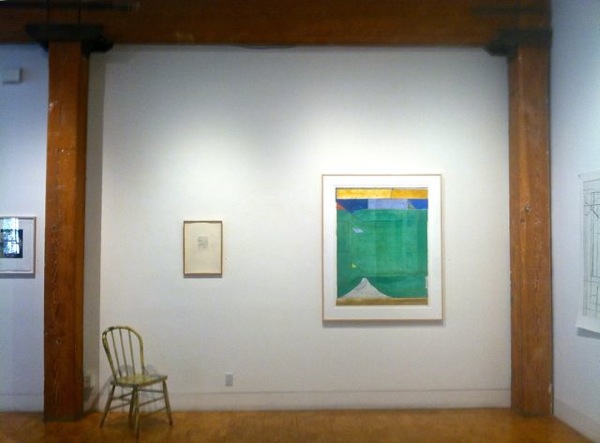
THIS ISN'T MUCH of a photo, I know; I snapped it quickly with my iPhone; I just want to give you an idea of the unique combination of intelligence, repose, and beauty to be seen for the next two weeks in the handsome Crown Point Press gallery in San Francisco. The Press is celebrating its fiftieth anniversary this year, and this is by way of the opening celebratory exhibition, and who more logical to feature than Richard Diebenkorn.

The first time I saw a Diebenkorn print it was one of the series of drypoint etchings he made at Crown Point when the studio was in Richmond. I'd driven out there to pick up one of the prints to deliver to KPFA-fm, where I was then volunteering, so this must have been before summer 1964 when I went on staff. The etching was to be photographed somewhere for use as the cover of the program guide, which in those days was a small-format biweekly. I remember the print was a tabletop still life with a pair of scissors.

These were, I think, among his first prints: until then he'd been almost exclusively a painter and draftsman, alternating between representational imagery and the marvelous spatial abstract "landscapes" of the Berkeley and Albuquerque series. Later still, of course, he famously left the Bay Area for Santa Monica, where he settled in Ocean Park and painted the magnificent geometrical abstracts that went by that name.

In this photo you see three objects (excluding the partially captured objects left and right): a chair Diebenkorn left behind in the Oakland studio he used for a few years, which Crown Point subsequently occupied before moving to its present San Francisco location; a small framed self-portrait; and "Green," a magnificent etching from 1986. The paper hanging on the right-hand side of the photo, only partially seen, is a working drawing for "Green." I find this installation truly arresting, yet serene. The empty chair — I'm sorry the idiotic Republican convention last summer has spoiled that phrase for the time being — the empty chair positioned under the self-portrait brings the artist himself into the gallery, in a ghostly way, sitting (rare for him: I always think of him as standing, with the slightly stoop-shouldered powerful stance of a tall, well-built man), contemplating the working drawing, then the finished print.

In March it will have been twenty years since Diebenkorn's death, just short of seventy-one, of complications from emphysema, according to the Wikipedia entry. He had recently moved from Ocean Park back to the Bay Area, to Healdsburg in fact, a few miles from our Eastside Road, and his painting was as usual undergoing a considerable change in mood and appearance with the move: had he lived, we'd have a Healdsburg series perhaps, probably with a considerably different palette and content from the Ocean Park abstractions.

Three disturbing, powerful, rather enigmatic aquatints from 1992 may suggest disturbances interrupting the tranquil though extraordinarily thoughtful work of Diebenkorn's last decade. Called (by the artist) "Flotsam," "The Barbarian," and "The Barbarian's Garden — Threatened," they can hardly avoid being seen as representational and symbolic. They hang close together at Crown Point, allowing a close scrutiny which encourages contemplation of the changing forms and images, alterations sometimes subtle, sometimes less so, as the artist discovers, encourages, or suppresses edges and contours, re-configuring the light-dark balances, once even turning the rectangle the other way up. (You can see reproductions of these prints, and others in this show, here.)

Throughout the exhibition you're reminded of the essentially performative nature of Diebenkorn's work. This comes through quite literally as he alters his plates between trial proofs, or draws on them, or glues strips of tape or cut-out scraps of paper to experiment with various shapes. But it also pervades the viewer's engagement with the artist's process: a real colloquy develops, in which the time required by each stage of his work, both for its creation and for the viewer's perception of the rich content which is sometimes slow to reveal itself, the time itself becomes a fourth dimension of the work (the third being implied in all his work, which can hardly avoid being seen as landscape).

There's too much to be said about Diebenkorn and his work; this contemplation has often completely overcome me. Toward the end of his life I visited him on an assignment from a magazine that had suggested I interview him on the occasion of his move north. He was clearly fatigued; I now suspect he knew he didn't have that long to live. We spent a delightful hour talking about things, but neither of us wanted to commit to the project, each of us for a different reason. He was gracious and appreciative and very thoughtful: he was always, I think, a profoundly thoughtful man.

(Years earlier, when he had a retrospective at the old San Francisco Museum of Art on Van Ness Avenue, I interviewed him much more superficially. I mentioned his use of diagonals in his abstracts, and pointed to the crossed legs of one of his Seated Woman paintings, and he shrugged, and pointed out that one always sees the same things, whatever one looked at.)

I noticed a quote from Jasper Johns at the present SFMOMA yesterday:
Sometimes I see it and then paint it. Other times I paint it and then see it. Both are impure situations, and I prefer neither.
I don't think Diebenkorn would agree with this: or, rather, I don't think Diebenkorn would find any impurity in the situation: or, rather, I don't think "situation" is a word you could bring to Diebenkorn's participation in the activity Johns is discussing. "Situation" implies stasis, and Diebenkorn's work is constantly undergoing development, or, rather, since "development" implies improvement of some kind, his work is constantly in motion, the slow, meaning-accreting motion of contemplation and adjustment, the minute and informed change we must all accept and embrace if we are to continue to live.

There's also a lot to be said about Crown Point, and about its director, Kathan Brown, who has just published a memoir, Know That You Are Lucky, that I look forward to reading soon. In the meantime, this wonderful Diebenkorn exhibition will be up another couple of weeks, and I urge you to see it if you can.

• Crown Point Press, 20 Hawthorne Street, San Francisco; 415.974.6273; open Monday 10-5, Tuesday through Saturday 10-6.

Thursday, December 20, 2012

The guns thing

I CAN'T HELP WANTING to add a few comments of my own to the gathering millions of paragraphs, though I know I can't really comprehend the problem, let alone comment on it rationally; and though I know whatever I write (or anyone says or writes, for that matter), reasonable people will find a way to find fault with it at best, with me even more likeley.

Still. Some points simply have to be addressed. I think the problem arises in three distinct areas — related, no doubt, but distinct enough they need to be considered and perhaps acted upon distinctly: Guns; Violence; "Mental Illness."

•GUNS: Whatever the "framers" may have had in mind with their Second Amendment, they made a mess of it. I've read and heard a number of explanations: that they were remembering the first battle for independence, which erupted over the British intent to seize weapons at the Concord militia armory (or was it Lexington?). That it was slaveholders who knew they needed their arms to prevent insurrection. That it was states-righters who feared the imposition of a tyrannical federal government which would have to be overthrown.

Whatever the reason for the drafting of the Second Amendment, it seems clear enough to English-major me that it expressly states that the right of the people to keep and bear arms will not be infringed, because a well-regulated militia is necessary to the security of the state.

Note that there's nothing here about individuals having the right to keep arms to secure their own individual security. It's all about the community. (It's possible, even likely, that the right of individuals to have arms for their own private protection was simply not at issue, of course.)

(I leave the question of hunting equipment out of the formula for the moment; and I suggest that the concept of "sporting firearms" would likely have been thought odd by most rational men in the late 18th century. Unless you count duelling, perhaps.)

In any case it seems clear the "framers" might not have had automatic or semi-automatic weapons in mind.

What I would do: 1) ban the manufacture, importation, sale, and holding of large clips or magazines, over, oh, say six shells, before reloading is necessary. Do this immediately, by executive action if necessary.

2) Begin a Congressional discussion, with input from panels and commissions, on the question of the manufacture, sale, export, import, and holding of automatic and semiautomatic firearms, and perhaps even nonautomatic firearms over a certain caliber.

3) Simultaneously, a similar investigation into hand guns, which are responsible for a great many killings every year.

•VIOLENCE: The United States is addicted to violence — real violence, symbolic violence, depicted violence. Playful violence and serious violence. Ours is an adolescent nation, impatient and impulsive; and it is also a nation devoted to a sense of entitlement, thinking itself exceptional and all-powerful. We need to simmer down. I have no idea how this can be done on an institutional level. Clearly we should scale back both our desire and our ability to engage other nations and societies in violent action. We should also stop using depictions of violence as entertainment and commercial advertising. But it's hard to see how legal action can address the latter, or how political action can address the former.

We can, however, address the problem individually and in small local groups. Nonviolence was a potent force in the advancement of civil rights. Perhaps the most basic civil right is the right to security, from violence of all kinds but especially human violence. We should demand this right.

•"MENTAL ILLNESS": I set the term in quotes, because I believe it's a bogus term: health and illness are a continuum, and what one person considers pathology another may well see as mere eccentricity. Clearly a murderer is pathological. But to turn immediately to a concern for mental or emotional or developmental "health" or "illness," in the wake of a monstrously violent assault, threatens to be merely a diversion from action that should be taken on immediate practical issues like ammunition control.

Furthermore, it is unfair to the vast majority of those who are thought to suffer some form of mental illness. Some are violent; most are not. Of those who are violent, some may turn to firearms; most cannot.

Further: many who take up arms in a violent fashion seem to me to do so in what many would consider a perfectly rational manner; or, if not rational, then merely impetuous. A violently angry person is not necessarily mentally ill.

AND THEN there are other questions: suicides; accidents.

There have been suggestions that the arming of good people will discourage the use of firearms by bad ones. I don't think we should ask innocent people, let alone the teachers of small children, to arm themselves and to kill intruders, not even armed ones. I think the current craze for the carrying of concealed weapons, even loaded ones, is antisocial on the face of it, and that any society that encourages such behavior is irrational at best, hypocritical in any case.

There. I feel better now.

Monday, December 10, 2012

Correction

I'M EMBARRASSED to have misspelt Brent Lindsay's surname yesterday — I plead fatigue at the time of writing; I know his name perfectly well. (It's not that far from my wife's, after all.) And I thank a reader for drawing my attention to the error.

While I'm here, let me enlarge a bit on my very cursory note on his performance (and those of his colleagues on the Hamelintown Council). Brent Lindsay is truly an amazing actor. His physical presence is unbelievable: even in a fat suit, he bends, weaves, preens, jerks, even melts with total conviction.

His voice is as impressive as his body. Speaking or singing, he can push a solid bass voice through an wide dynamic range, subtly inflecting vowels, clearly articulating consonants. And his sense of timing is no less masterful.

It seemed to me yesterday that Eliot Fintushel was acting better than I'd ever seen before, perhaps rising for the first time to Lindsay's challenge. And Amy Pinto, who alternates in her role with another actress, was equally in her element on that absurd, detailed, all too realistic caricature of a small-town legislature.

The Ratcatcher sprawls a bit, and the closer to the floor the younger actors are, the harder it is to make out just what it is they're saying. But the audience gets the point. And one of the points is, there's more here than is immediately apparent. I'm still thinking about it.

Sunday, December 09, 2012

Ratcatcher

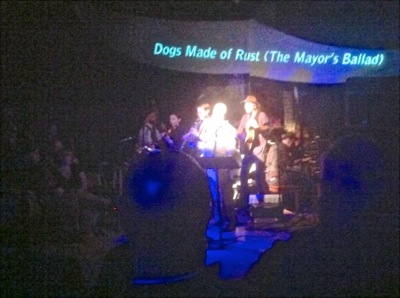
rustdogs.jpgIT'S NOT MUCH of a photo: I apologize to the reader for having nothing better, and to the Imaginists for sneaking the photo during tonight's performance. But I want to draw your attention to some arresting cabaret theater going on here in Santa Rosa, our provincial capital twenty minutes to the south of Eastside Road.

We've known and followed them for some time now, admiring their work, which stands among experimental, agitprop, local, improv, professional-and-student productions, sometimes drifting to the established repertory, sometimes apparently making things up as they go along during rehearsals.

And did I mention they are not paid? Well, they mentioned it a few times tonight. The Imaginists are getting national and statewide attention, but are not as well known or supported in their own community as they should be — a common problem, of course. So in this production they're addressing the situation quite confrontationally.

The Ratcatcher is cabaret theater centered on the story of the Pied Piper of Hamelin, who was hired by the town council to rid the town of rats, but was then stiffed. In revenge, he piped the town's children away as he had done their rats, and neither they nor he was ever seen again. The program credits, as sources, Wikipedia; Marina Tsvetaeva's play The Ratcatcher; workups of the tale by Robert Browning and by the Brothers Grimm; and Lewis Hyde's The Gift.

I'm not quite sure how that last item fits in, but clearly the story stings to a number of current issues: support for the arts; political economic agendas; exploitation. As the Imaginists generally do, they hinted at other issues. I was fascinated to discover, watching this show, that the Pied Piper story is an interesting commentary on the Orpheus myth: the power of music; the musician leading his audience; the musician understood by innocence but ignored and even feared by rational listeners.

The Ratcatcher weaves the town-council-versus-Piper story together with a subplot involving the mayor's daughter, who like all the town's children seems to have left town for more enticing, more fulfilling communities. Hamelin, after all, is interested only in promoting itself for the tourist dollar: it's a typical wine-and-cheese weekend destination. (Are you listening, Healdsburg?) The show also weaves together the town-council plot as acted by three professionals — Amy Pinto, Brent Livesay, Eliot Fintushel — with four student (or perhaps more accurately emerging) actors. Their scenes alternate, resulting in problems of scale, pacing, and clarity.

But for the most part the show is professional, powerful, and engaging. Pinto, Livesay and Fintushel are as good as I've ever seen them, which is saying a lot; and while the three young actors (whom I can't credit, as the program doesn't specify roles) seemed to relate more to one another than to their audience, their story emerged as ultimately both touching and persuasive. And Quenby Dolgushkin, in the final scene, found a high emotional pitch just under the top, just this side of hysteria; it reminded me of formal tragic acting I've seen on classical stages.

The instrumental music was provided by The Crux Ensemble, six musicians who among them play eighteen or twenty instruments, now improvising spooky sound effects, now merging in tight ensemble on written-out charts. As the spoken text was developed by the actors, the music is all the work of these performers.

Only four performances are left: December 13-16. Efforts are being made to record the sound track; I hope they succeed. The songs are marvelous, as just their titles suggest: Boskers; Onward Soldiers; The Cheese Song; Dogs Made of Rust — how can you go wrong with such titles? And they are sung (and accompanied) with intensity and a strange beauty. I'm glad I saw this show; I hope, somehow, it evolves to the printed page, and enters the repertory. (It would make a marvelous show for student productions.)

Wednesday, December 05, 2012

Dave Brubeck

I SUPPOSE I FIRST heard Dave Brubeck on a recording, undoubtedly an LP, in the fall of 1952, when I was beginning college. I think by then he'd played his epochal date in Eagle Rock, not far away, where (I think) his first big recording Jazz Goes to College was made. Already the big tune was "Take Five," the famous 5/4 piece.

The music is insinuating, clever, lyrical. Later it became significant to me intellectually, when I learned he'd studied with Milhaud at Mills College, and that his music was informed by his study of — gasp — serious music, Bach and so forth. (He loved Milhaud; he named his son Darius.)

Well, Dave Brubeck died this morning, as you must already know, a day short of his 92d birthday, having created, then lived, then survived a Legend. He was the cool intelligent supple patient well-adjusted avatar of West Coast Jazz, that indispensable alternative to Bop — a category that would have saved jazz for the next generation, would have made Rock a silly sidetrack, if only Bossa Nova had not intervened, and convinced the next generation that jazz, all jazz, anything referred to as jazz, was irrelevant, intellectual, over thirty.

The radio stations and the Internet today have made a lot of "Take Five" and, in some instances, of "Blue Rondo alla Turk." The latter especially, at least in the version I heard in the car this afternoon, said a lot about what Brubeck must have learned from Milhaud. Toward the end it almost sounds like Milhaud. There's a curious non-Parisian Frenchness here: wit and pleasure in intelligence without irony, and substance, substance, like something Schumann might envy.

I met Brubeck once, at the Cabrillo Festival, when a Mass of his was performed there — a piece that didn't do a lot for me, but so what. That was thirty-two years ago, August 1980; I don't recall a lot about it. We hardly exchanged three words, I think; though perhaps I interviewed him; I don't know.

I better recall going to the old Black Hawk in San Francisco in the late 1950s — once only; we couldn't afford such things often in those days — to hear him and his Quartet. I remember Paul Desmond put down his alto and took up a clarinet for a couple of tunes. I remember Brubeck was cool, very cool. It was a wonderful night.

There's one Brubeck recording that always sends me into another — what? another plane? It's the last track on an old jazz sampler LP that I got free from the Columbia Record Club in the late 1950s: I Like Jazz. It's true enough that Paul Desmond's alto is a compelling reason the recording's so memorable, has so completely taken over a corner of my synapses; but Brubeck's steady, subtle, modest, generous, knowing, authentic musicianship grounds and enables it. You can hear it here, and I hope you do: it's one of the most beautiful recordings I know..

Saturday, December 01, 2012

Seven for Andrew

            Seven Elevens for Andrew Hoyem
a beau présent on his seventyseventh birthday


                        1.


Ahem:
      drown ye no awe.  Rhymed dream,
                   yen: how
Read me?  Why on end, Worm?  Yeah! Wordy
He, mean…
         Hee! Own day, Mr.!

O hymned!  Wear, ye hard women, endow
My hare, my dear; he won.

                        2.

A mewed, horny nomad?
                  Why, ere day
When more random hew ye ear,
Deny whom warmèd honey hand, eye,
Worm, or whey.

                     Amend,
Ye hard women;
Endow my hare, my owned hare.


                        3.

And woe, rhyme! Need army,
Who drew home, nay, rend home,
Yaw enamored. Why, where Monday

Had women, rye — Oh my raw need!—
Yawned Homer, era demon.
             Why me? Wan, dry? Home?


                        4.

Amen. Redo.
Why no awed rhyme?
Dreamy, he won remedy. Ha! Now
End, hay mower. We harmed yon

Harmony weed. One dream:
Why,
                  Ye damn whore,
Eh? A wry demon-mad rye, now he…


                        5.


A dower hymen neared. Who? My day,
When more ran dewy — oh my end.
                  Oh me! Awry, whom deanery

Hard money we own;
Adhere, my yew and Homer.
Endear, who my mad rye hew. O.


                        6.

And O where my new road, he, my dawn;
O her, ye ready men, who enemy
Draw — Oh warmèd, homey,

Homeward yen; ore —
Why, maned yardmen? Oh we earned,
Who my many he rowed.


                        7.

      And he wore my
      Name, who, dyer,
      Dreamy now, he
      Read — woe, hymn —
      Earned how my
      Wand (ye Homer)

      Harden my woe
      Or he may wend
      Yawn, Homered, (
      Enemy word) — ah,
      My heron, wade…

THE BOOK I MENTIONED a few weeks ago, but have neglected until now to name, even, let alone discuss, is Levin Becker's Many Subtle Channels, a fascinating, engaging, rather prickly survey — personal, because based on personal engagement with the subject — of OuLiPo (as I prefer to spell it, with the internal caps clarifying the etymology): Ouvoir de Littérature Potentielle, the Paris-based Workshop for Potential Literature, writing, to put it over-simply, with self-imposed constraints, whether for inspiration or simply for amusement.

(Not that the experience of being inspired isn't amusing.)

Well, it's more than that:
“Potential literature,” Levin Becker explains, “is both the things that literature could be and the things that could be literature.”
And on the subject of inspiration, as I posted here on my birthday last,
Queneau's most quoted remark is probably his declaration, in the 1937 novel Odile, that the true artist is never inspired—he is always inspired. As a counterpoint, recall his dictum from an early Oulipo meeting that there is no literature but voluntary literature, and this begins to come into focus: meaning, such as it is, doesn't exist on its own. Someone has to find it, midwife it, present it to the world as more than just a coincidence. The real artist is always inspired not because he creates things that are unmistakably intentional, but because he is sensitive to the sorts of things that at first seem like accidents. He replicates them on his own terms, as an expression of his own preoccupations or sensibilities or desires, or he just sticks them on a gallery wall and calls them art; even when he's wrong, he's right.
—Daniel Levin Becker, Many Subtle Channels: In praise of potential literature, pp.297-8


I won't review the book here; Eastside Viewers will know by now my excuses, among which laziness counts most. There are plenty of reviews online: here's one that seems particularly useful. (The quote in the previous paragraph is taken from it.) I find, retrieving the book from its overlooked pile in the attic, that it is pristine: no annotations, no date of purchase, no owner's name on flyleaf — all very unusual. I know I bought it in Portland last summer, and was obviously reading it in August; I know I took a good many notes — where the hell are they?

Internalized, perhaps.

Thursday, November 29, 2012

Commonplace: the significance of local nations

THE THREE DOMINANT statesmen in the main member states [of the European Coal and Steel Community, the early predecessor formed in May 1950, which led ultimately to the European Union] — Alcide De Gasperi, Konrad Adenauer and Robert Schuman — were all from the margins of their countries: De Gasperi from the Trentino, in north-east Italy; Adenauer from the Rhineland; Schuman efrom Lorraine. When De Gasperi was born — and well into his adult life — the Trentino was part of the Austro- Hungarian Empire and he studied in Vienna. Schuman grew up in a Lorraine that had been incorporated into the German Empire. As a young man, like Adenauer, he joined Catholic associations — indeed the same ones that the Rhinelander had belonged to ten years earlier. When they met, the three men conversed in German, their common language.


For all three, as for their Christian Democrat colleagues from bi-lingual Luxembourg, bi-lingual and bi-cultural Belgium, and the Netherlands, a project for European cooperation made cultural as well as economic sense: they could reasonably see it as a contribution to overcoming the crisis of civilization that had shattered the cosmopolitan Europe of their youth. Hailing from the fringes of their own countries, where identities had long been multiple and boundaries fungible, Schuman and his colleagues were not especially troubled at the prospect of some merging of national sovereignty. All six member countries of the new ECSC had only recently seen their sovereignty ignored and trampled on, in war and occupation: they had little enough sovereignty left to lose. And their common Christian Democratic concern for social cohesion and collective responsibility disposed all of them to feel comfortable with the notion of a trans-national 'High Authority' exercising executive power for the common good.
—Tony Judt, Postwar, pp. 15-58

WE VISITED RATHER A TOUCHING memorial to the six founders of the ECSC last March, as we were walking through Belgium and Luxembourg. It's set in a small field on the Meuse, where Belgium, Germany, and Luxembourg meet at Trois-Frontières, as I recall. The ECSC was significant principally for being the breakthrough cooperative moment between France and (then West) Germany, and since it also included the Benelux countries and Italy it was truly international. It had been the brainchild of Jean Monnet, who was a Luxembourger, and brought to fruition primarily by Robert Schuman.

What I hadn't realized, until tonight in my return to Judt's magnificent history, was that Britain and Scandinavia's refusal to join the agreement was prompted in part by their mistrust of an accord that had been forged, after all, by Catholic political leaders. (Netherlands had also had its reservations, but was pulled along by Belgium and Luxembourg.) I suppose they were afraid of the possible return of the Holy Roman Empire.

There are lessons here. First: trust men from border regions, whose instinct it is to accommodate, not impose. Second: that Catholic-Protestant disagreement, which has spilled so much blood, just doesn't seem to want to go away. Are you listening, Shiites and Sunnis?