Showing posts with label Italy. Show all posts

Monday, January 07, 2013

Bellavista's Middle Way

Eastside Road, January 7, 2013—
•Luciano De Crescenzo: Thus Spake Bellavista: Naples, Love, and Liberty. Translated from the Italian by Avril Bardoni. New York: Grove Press, 1989.

WHY HAS IT TAKEN over twenty years for me to find out about this marvelous book? Oh well, quit complaining, Charles, and thank you, Giovanna; my eyes are now open.

De Crescenzo is well enough known in Italy, I'm sure; I'll have to look him up in a couple of weeks when I'm haunting Feltrinelli. I have the provisional feeling that he may have made a big splash with this book when it appeared in 1977 (as Così parlò Bellavista, a best seller in Italy); he followed it up with a number of sequels, and a film of the same title appeared in 1984. (Gotta look that up, too.)

The book's an interpenetration of two: one, a series of funny anecdotes of life in Naples — misunderstandings, thefts, arguments, jokes, and the like, many of them funny enough to have caused me to laugh out loud in the reading. To cite only one, the epigraph to the seventh chapter:
"Put that cigarette out!" shouted the bus conductor.
"But I've only just had coffee."
"Ah, that's different."
A. SAVIGNANO


Two, a series of philosophical dialogues, Platonic style, in which the Socratic method, lubricated by bottles of decent rosso, explore a fascinating view of the good life, essentially based on Epicurus.

I don't think it's giving too much away to mention Bellavista's main argument, which doesn't appear until that seventh chapter, "The Theory of Love and Liberty": might there be some organizing principle that can guide us toward that good life based, as Epicurus taught, on the moderate pursuit of pleasure and the avoidance of pain?

Bellavista, a patient and good-natured fellow who discusses these things with a group of intelligent but relatively ill-educated and intellectually unambitions buddies, has just such an outlook, which he atributes to "a friend of mine in Milan, Giancarlo Galli, who may or may not be the journalist, writer, and economist profiled in Italian Wikipedia — another type to look up at Feltrinelli.

Bellavista's theory rests on the two basic human desires: for Love and Liberty. The first
is the feeling that impels us to seek the companionship of our fellows, and the acts of love are all the things we do in the attempt to share our joys and griefs with others. This reaching out to our fellow men is instinctive.
Thus Spake Bellavista, p. 41
Straightforward enough. Liberty is a more recalcitrant of definition, but Bellavista does pretty well:
For some people liberty means democracy, for others it means anarchy, so at this point I shall have to spend a couple of minutes explaining exactly what I mean by liberty… I would define liberty as the simultaneous desire not to be oppressed oneself and not to oppress others.
ibid., p. 107


Since both Love and Liberty have their opposites, Bellavista then lays his idea out on a coordinate system, as I mentioned here the other day, whose abscissa is a line from Hate to Love and whose ordinate is one from Power to Liberty. This results in four quarters, which I can't help but link to R.H. Blyth's four classifications of literature: objective objective, objective subjective, subjective objective, and — you guessed it: the worst of the lot, "wailing like a saxophone": subjective subjective.

Bellavista populates these quadrants with a number of familiar characters, depending on where they fall in these quadrants. The type fully committed to Love and neutral on the subject of Liberty (and it should be noted these qualities are necessarily in constant irreconcilable tension) is the Saint; his opposite is the Devil. The type fully committed to Liberty, on the other hand, and neutral on Love, is the Hermit; his opposite is the King. A "bad" King, who is driven by Hate, is the Tyrant; a "good" one is the Pope. Their opposites are the Sage and the Rebel.

In general of course we prefer those in the upper right-hand quadrant. The Scientist is a little more concerned with Liberty than with Love, the Poet reverses that tendency; both flank the Sage as nearly ideal types. What Bellavista argues for, in his sweet practical way, is a middle way, precisely the Sage's way, avoiding the complications attending the desire for Power and giving in to the seductions of Love, because, as Epicurus teaches us, one must love others if one is to be loved, and one must give others their way if one is to be allowed one's own.

I read Thus Spake Bellavista hard on the heels of What's the Economy For, Anyway?, by John de Graaf and Steven Batker, discussed here the other day. They make a perfect pairing: De Crescenzo supplies the theoretical element, entertainingly and persuasively; Batker and de Graaf the history of engineered society's attempt to institute (or, lately, evade) political approaches to achieving that element.

I increasingly believe the besetting problems with American society — from violence to pettiness — are grounded in an increasingly present antisocialism among individuals. Different people will supply different theories as to the reasons for this: breakdown of the family, institutionalization of education, defeat of organized labor, fractionalization of religious cults, glorification of individualism: the list can go on forever.

In the rage to find sources of this antisocialism, in order to institute corrective action, so far only De Crescenzo, in my experience, has brought the matter down to comfortable daily-life observations. It doesn't hurt that he leavens the investigation with a good deal of humor. I wish I could spend an evening with these two books, President Obama, Robert Reich, and a bottle of good red wine.

Wednesday, February 04, 2009

Sinfonia Muta

Eastside Road, Healdsburg, February 4, 2009

SinfoniaMuta.jpg

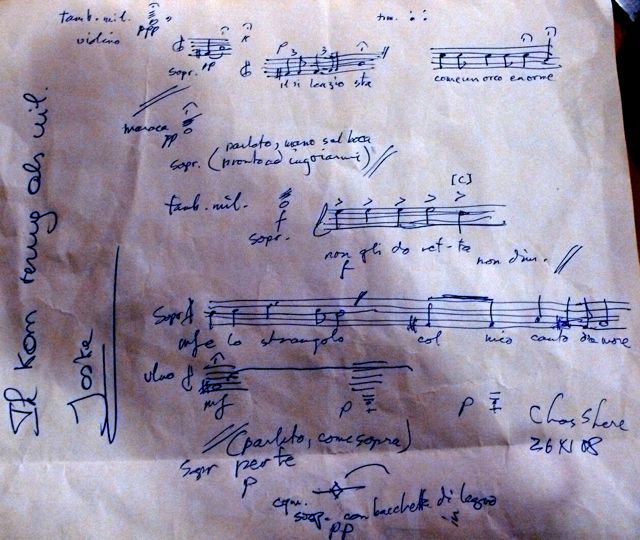
I POST THIS SONG here, not because it's particularly important, but because I hope thereby to get back in touch with the author of the poem, Nicu Lutan, who we met in a restaurant in Milan where he was waiting tables.

An engaging fellow, Nicu is anything but reticent. He saw to it that I had a broadsheet celebrating him and his poetry and, most of all it seemed, his connection to famous people. But I found him genuinely likable. And the more I looked at one of his short poems the more I liked it:
il silenzio sta
come un orco enorme
pronto ad ingoiarmi
non gli do retta
e lo strangolo
col mio canto d'amore per te
which my computer helpfully translates as
Hush it is like a orco enormous ready to swallow to me I do not take notice to it and I strangle it with my song of love for you
(I don't know why computer doesn't know that orco means "ogre, bogeyman".)

Well: Enjoying a grappa after dinner I sketched out a little musical setting of the piece on the table-paper. I left it for him, taking this photo with me. I've looked him up and found him here, but the e-mail link on the web page doesn't work any more. If anyone runs across him, will you put him in touch with me please?

Monday, November 10, 2008

Peace memorial

Via Corsini, Rome, Nov. 9—

arapacis.JPG
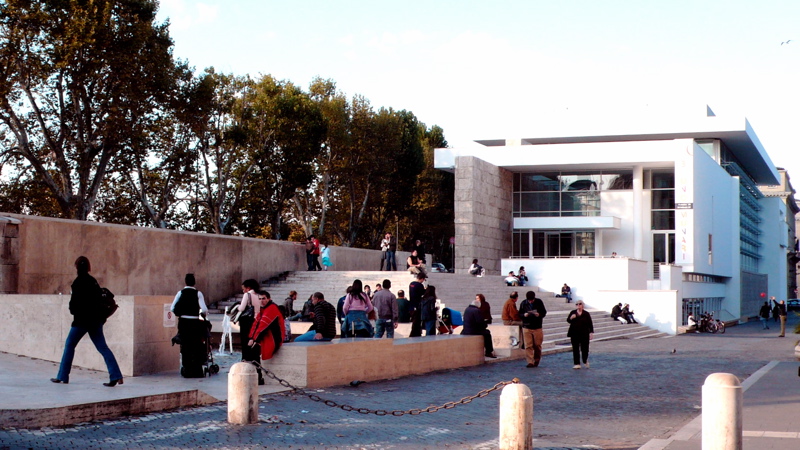
Richard Meier's building for the Ara Pacis

UPTOWN TODAY — I always think of upstream in Rome, toward the Piazza del Popolo, as "uptown", I don't quite know why — to see the first new building in central Rome in eighty years, or something like that: to my taste rather a nondescript flatroofed boxy thing of glass and concrete, next to the Tiber; set on a plaza and backed by a handsome travertine wall down which water sheets into a gutter leading to a clichéd square pool with four rows of four vertical jets. Some like this; I find it a little unsettling — it refers to Rome, of course, with her fountains and piazzas; but it's unlike anything else here, yet insufficiently arresting to justify its irrelevance.

Oh well: this container is interesting for the thing contained, the Ara Pacis as it's called — in fact not the Altar of Peace, apparently never found, but the cube of a roofless building that enclosed it. The Ara Pacis was erected a couple of thousand years ago to commemorate the Roman pacification of Spain and Gaul, as I understand it: I have no idea what the altar looked like, but its enclosure, say thirty feet square and nine or ten high (I'm guessing), is a thing well worth seeing, even worth commissioning a nondescript new building to protect.

Inside Meier's museum the first thing you notice is a scale model of the supposed original spatial context, very different from today's. The Tiber makes the same bend, but only three buildings are to be seen on the huge expanse that was then the champs-de-Mars, the training ground for young soldiers: the Pantheon, built in 27 BCE by Augustus Caesar's son-in-law Agrippa; Augustus's mausoleum, which he himself had built at about the same time; and, midway between them but considerably east of their axis, the Ara Pacis, dedicated eighteen years later. (Between the Ara Pacis and the center axis was an horarium, a paved rectangle serving as sundial whose gnomon was an obelisk.)

reconstruction.JPG
Reconstruction of the Campo Marzio, 9 BCE: at left, Augustus's Mausoleum; right, Pantheon; center distance, Ara Pacis beyond Horarium


Two things are immediately striking about this: first, the apparent emptiness of the zone, given more to Nature than to architecture; second, the location of the Ara Pacis, away from the river and oriented toward the sun — an orientation underlined by the Horarium, designed so that the gnomon's shadow will fall on the Altar at noon on the equinox, as I understand it.
The deliberate mirroring of the Pantheon, celebrating all the gods, and the Mausoleum, celebrating Augustus Caesar, is unmistakable. I think, too, that the openness of the plan, all that empty grassy field between, reinforces a sensibility that must have been oriented more toward Nature and her spaces, less to the city-dwelling system of "development" and its complex economic, political, and technological structures.
Augustus was passed off as a god himself, descended from Apollo: after the experiment of the Roman Republic failed it took divine intervention to restore a degree of order and impose a degree of "peace" on society. It must have been important for him to have been seen as something apart from the mass of humanity in the city that had built up to the south, in the harbor and the forum and the apartments and villas surrounding the Capitoline hill.

WELL, YOU CAN'T put things back as they were two millenia ago, and I suppose this new installation of what's left of the Ara Pacis is a good thing, though the point of the original setting is largely lost, and the Ara itself is missing, and its original enclosure turned 180 degrees from what was intended as I understand it. The fragments that have turned up so far are set into a concrete wall reconstructing the size and shape of the original; missing figures from the bas-relief sculptures are indicated in two dimensions; the entire surround is placed high on a podium. Walking up those steps and entering the enclosure is a solemn kind of experience, quite like entering the Pantheon.
There are plenty of explanatory panels, in Italian and English, identifying the figures in the reliefs, which portray a kind of parade celebrating the peace Augustus has imposed on those distant colonies. Considerable light falls from all sides, thanks to Meier's glass curtain walls. The sculpture itself is intensely interesting, both for its intrinsic qualities and for its historical significance. (It's hard to think of it colored, though, as it must have been when new; but that's a subject for another day.)

From the sublime to the ridiculous: We left the Ara Pacis and headed for the Spanish Steps, with the usual Sunday crowds jamming the streets. It was the hour of the passaggiata, that slow amble Italians and other latins, I think) love to take on a sunny Sunday afternoon. Something was heightening the effect, though, and as we neared the Corso we heard a marching band just stepping out of sight toward the Piazza del Populo, enthusiastic children marching along behind it; and then here flew nine fighter-jets low overhead, right up the airspace over the Corso, red, white, and green smoke trailing behind them to lay the national colors out across Apollo's sky. We've largely lost the Augustan context, but human nature continues to respond to his instincts. I suppose it always will.

Wednesday, July 25, 2007

Fernet Branca

photo: Rome, January 2004

AH, FERNET BRANCA. The first time we traveled in Europe, in 1974, we traveled with another couple, who we met in Chiomonte, whence we went on by train to Torino, where we rented a tiny car.

We drove to Milan, where we had a long long lunch—I must write about that one day—and then George (who drove very quickly) drove us all up to Bellagio, where we planned to stay a day or two. As the road climbed I began to suffer from that long long lunch. I rolled from one side of the back seat to the other as he careened around curves on the climb toward Como.

I was beginning to feel sick. Finally I insisted that he stop in the next village, at the next cafe. I staggered into the bar and bought a bottle of Fernet Branca. Back in the car, I took a swallow or two and felt better immediately.

When we got to Bellagio I was ready for dinner.

Since then I have never traveled without a small flask. Years ago Eric even made a wallet card for me, which I still carry always. It has a drawing of a pig on it, and nicely lettered across the drawing the legend
MANGIATORE
nel caso d'emergenzia,
Prego di Somministrare

FERNET
There's a good article on Fernet Branca on Wikipedia, with a surprising revelation about San Francisco. I can vouch for the fact that the American and Italian versions of Fernet Branca are different, and I much prefer the Italian version. (Fernet is much cheaper in Italy, by the way; I used often to buy a bottle there at the duty-free shop when coming home, but current restrictions have made this impossible.)

The combination of Fernet Branca and a very popular American cola beverage sounds unpleasant to me. On the other hand, a Fernetini—three parts gin, one part Fernet Branca, lemon-peel garnish—can be a pleasant thing on certain occasions.

And a shot-glass of Fernet Branca can make a good nightcap. I think I'll have one right now.
But first I opened W.G. Sebald's Austerlitz, and there near the very beginning was a description of an old man in the Antwerp train station drinking Fernet...