Thursday, October 03, 2013

A Winter's Tale

A Winter's Tale. By William Shakespeare, directed by Patricia McGregor. Orinda: California Shakespeare Theater; seen September 26, 2013.
Eastside Road, October 3, 2013—
COMPARISONS BEING ODOROUS, as Dogberry says, I won't bring up productions of Shakespeare recently seen in Ashland here: I'm writing today about a very different order of things.

A Winter's Tale, one of Shakespeare's more problematic plays, was formerly rarely given, but seems to have become popular: we've seen it now five times in the last six years. Two main difficulties may have been responsible for its long retreat from the stage: the unprompted and violent swings of mood in the principle character, Leontes; and the alternations of high tragedy and low comedy, which tend to tear the play apart in uncalibrated productions. Like Cymbeline, the play's an example of Shakespeare's idiosyncratic combination of realism and abstraction.

As so often, he examines in this play the effect of a sudden loss of reality: a rage, or a colossal error, or an unforeseen coincidence — a chance calamity that changes everything for everyone, bystanders as well as perpetrators, the innocent as well as (or even more than) the "guilty." But what are the perpetrators guilty of ? in most cases, they too are the victims of the kind of exception that follows when the natural order of things takes a sudden, inexplicable swerve. Everything in Shakespeare's world — his natural world and that of his society — is tenuous.

Patricia McGregor's direction of the play had its merits and its flaws. For me, on reflection, the flaws outweighed the merits: particularly the idea of involving the audience through direct address from the stage, even invitations to participate on the stage. As the play opened, a traveling band of players, acrobats, and fortune-tellers, looking vaguely medieval but with diction recalling Second City improv routines and accompanied by an Airstream-like camper-trailer, cajoled the audience into banter which recurred at the beginning of the second act and returned at the close. This seemed miscalculated in the outdoors amphitheater, colder than any Winter's Tale needs for its setting.

But another directorial concept worked amazingly well: the cast was collapsed onto a seven-actor ensemble with every role double-cast. This streamlined the scenes in Bohemia, which can lapse into irrelevant clowning, losing the play's drive toward its final stroke and resolution; it also very neatly underscored the schizophrenia at the heart of Shakespeare's vision.

Nowhere better than in the amazing performance of L. Peter Callender as both Leontes, who directs the abandonment of his infant daughter on a coastal rock in Bohemia, and the Shepherd who finds her and raises her as his own child. He found deep humanity in each of these roles, and nicely detailed individuality as well; but the two characters are so different it was hard to force myself to realize they were played by a single actor.

The same can be said for Omoze Idehenre, who played both the wronged queen Hermione and the lovestruck shepherdess Mopsa; and for Tristan Cunningham, both Perdita and Emilia; and Christopher Michael Rivera, who was a noble Antigonus, a conniving Autolycus. Aldo Billingslea, Margo Hall, and Tyee Tilghman round out the cast.

Most of the cast had played in a previous Cal Shakes production this season, Spunk: we didn't see that show (though it sounded promising), but apparently it too involved audience participation and an all or nearly-all black cast. It may have worked better, presenting material closer to the experience of today's audience.

On the other hand, having seen that production may have helped the audience at A Winter's Tale. I myself, knowing the play from its script and from previous more conventional productions, found the framing device irrelevant and distracting, even confusing at times. The reduced cast made it necessary to cut and collapse much of the fourth act, set in Bohemia; and to skip the first scene of the fifth act, since virtually Shakespeare's entire cast is assembled. Here again the traveling players try to explain matters to the audience; here again I find myself in a state of confusion.

I should concede that we saw the production in a preview; some production elements were clearly not completely resolved. In the last analysis, though, I think few modern adapters and presenters of Shakespeare calibrate the play-to-audience configuration better than does the Bard himself, and I wish more contemporary productions would trust his book.

But much of the time I was gripped by the rage, the jealousy, the love, the remorse, the understanding, and the forgiveness that animate this marvelous play. The reason for this is simple: the power of Shakespeare's words, and the clarity and conviction of the actors' speech. A number of moments will stay with me.

A Winter's Talecontinues at the Bruns Memorial Amphitheater, Orinda, through October 20, 2013.

Bonnie and Clyde

Bonnie and Clyde. By Adam Peck, directed by Mark Jackson. Berkeley: Shotgun Players; seen September 25, 2013.
Eastside Road, October 3, 2013—


A quick look at the calendar shows sixteen plays seen so far this year (and three operas), and recently I've been complaining a lot about what we've seen. I should make it clear, once again, that I post these notes not as serious critical reviews, merely as personal opinions. For years I worked as a critic on the staff of the Oakland Tribune, mostly on art and (concert) music but occasionally also covering theater. During that time I felt strongly that a part of a newspaper critic's responsibility is to suspend his own likes and dislikes.

I always liked Joseph Kerman's definition of criticism: "[T]he study of the meaning and the value of art works." (Contemplating Music: challenges to musicology, Harvard University Press, 1986). The newspaper employed me to do just that, but — I felt — to do it from a neutral perspective. My responses; my brain; the publisher's voice. I was paid, pretty well I thought; and I was provided with entrance to theaters, concert halls, museums; and even with entry to conversations with artists and performers I would normally never be able to meet as a private individual. The least I could do in return was to suppress my own ego and tastes, as much as possible while retaining presence.

But The Eastside View is not a newspaper: it's a personal blog, expressing my own viewpoint from here on Eastside Road, where I can read and write among my books and scores, journals and files — and, through the Internet, plenty of reference when I want it. And of course there's another matter: I'm pushing eighty; there's less time to waste; I need do and think and write only as I choose.

All that said — and it's been a lengthy and perhaps self-indulgent precede — what about last week's theater? Bonnie and Clyde, by Adam Peck, was a one-act, 90-minute scene for two actors, Megan Trout and Joe Estlack, cutting between intimate conversation between them and flashbacks and -forwards, dramatically isolated with light and sound, providing the context for the scene.

Is there anyone who doesn't know the story of Bonnie and Clyde, the small-town bank robbers who shot their way through Texas and Arkansas in Arthur Penn's movie (1967) burned them into a second generation's consciousness, and must remain for many the nearly official account of their career. When that movie came out I participated in a panel-discussion review on KQED, with David Littlejohn, Tony Boucher, and someone else. (In those days KQED was happy to give fifteen or twenty minutes of prime time to such a discussion; what a time that was!)

It was my view then that the movie was unspeakably violent; that in fact it promoted violence as beauty, and that ultimately that would not be a good thing. I still feel the cult of violence has led the American vernacular culture into a thicket, and that there can't help but be a connection between the omnipresence of violence, and of its beauty and power, in games, television, film, books, and popular music, and the gun mania, mass shootings, remote assassinations, and road rage that are so present in American life.

But the story of Bonnie and Clyde is a potent one, underneath whatever stylistic treatment it receives. And if Penn's film distracted me from that story, with its big-screen beauty and graphic final shootout, Peck’s play, in Mark Jackson’s direction for Shotgun Players, returned me to it. I was given a corrected view of its historical specificity: I kept thinking that Bonnie and Clyde were of my father’s generation, that they lived and died within a few dozen miles of his childhood home. My parents, in their twenties, undoubtedly read of Bonnie and Clyde’s exploits in the newspapers, saw the no less graphic black-and-white photos of their corpses in their pages; perhaps saw footage in the newsreels.

(Facsimiles of contemporary newspaper coverage were posted on the lobby walls at Shotgun, further enhancing this contextualization of the story.)

I came to see the story of Bonnie and Clyde as parallel to another American legend of nearly the same time, also seen recently in a theatrical version: The Grapes of Wrath. Once again I was reminded of the communitarian value essential in theater. At its best, public drama, from the time of the Greeks, exists to present, to examine, perhaps even to explicate the workings of Nature and Society for an audience often denied, by the distractions and pressures of daily life, the luxury of their own private meditations on the human condition.

I write these sentences eight days after seeing the play, and express views that have developed since leaving the theater. The performance itself was arresting — no pun intended — both for the acting and the setting. Megan Trout’s Bonnie was certainly reminiscent of Faye Dunaway’s, but it was no impersonation of that performance: it had depth and detail of its own, a wistful quality within the hardened realism enforced not only by the immediate situation but by the nature of the time and place that formed her character.

Joe Estlack was at first sight less imposing as Clyde Barrow, too diffident and meticulous to suggest the rogue murderer, and secondary to the strength of Bonnie’s role as written in the script. In retrospect, though, his enactment has grown in my mind, offering a credible complexity, revealing the (possibly misplaced) idealism and sense of failed justice that provoked his actions.

Robert Broadfoot’s set design worked fine for me: a no-fourth-wall anonymous barn, its timbers perhaps too new, isolated in a countryside that could be anywhere, spacious enough for the couple to split into individuals, claustrophobic enough to isolate them from the society that formed them and that, by rejecting, they enrich with their myth.

Ultimately it's that mythic quality of the story of Bonnie and Clyde that Adam Peck's play summarizes, in its unique crosscuts of immediate present detail with glimpses of the months-long action of the saga. Peck's play manages to hew to Aristotle's three unities (action, time, place) while tapping outside elements necessary to his contextualization, and Jackson's direction realized that aspect of the play effectively in Berkeley's Ashby Avenue theater.

Trapped in their barn, Bonnie and Clyde live in the moment, aware it is among their last moments. To my parents that moment was the present; to me it is both theirs and ours, and the figurative, metaphorical meaning of that moment is powerful and relavent to the present.

Friday, September 27, 2013

Recently (and currently) neglected

disuvero.jpg
ART
Sculpture by Mark Di Suvero. Crissey Field, San Francisco; September 23, 2013.

Richard Diebenkorn: The Berkeley Years, 1953–1966. De Young Museum, Golden Gate Park, San Francisco; through September 29, 2013.

BOOKS
From the Camarge to the Alps: A Walk Across France in Hannibal's Footsteps. By Bernard Levin. Chichester: Summersdale Publishers, 2009.

Hannibal's March: Alps & Elephants. By Sir Gavin R. DeBeer. Yardley, Pennsylvania: Westholme Publishing Company, 2010.

THEATER
Bonnie and Clyde. By Adam Peck, directed by Mark Jackson. Berkeley: Shotgun Players; September 25, 2013.

A Winter's Tale. By William Shakespeare, directed by Patricia McGregor. Orinda: California Shakespeare Theater; September 26, 2013.

Buried Child. By Sam Shepard, directed by Loretta Greco. San Francisco: The Magic Theater; September 27, 2013.

Eastside Road, September 27, 2013—
I've just been too busy doing things — reading, eating, seeing theater, conversing — to have had the time to think about those things very much, let alone write about them. I should be able to get back to work next week.

Friday, September 20, 2013

The Tenth Muse; A Midsummer Night's Dream

Ashland, Oregon—

I WRITE THIS POST unhappily, without enthusiasm. No one likes to be forever complaining. But this trip up to Ashland saddens and even alarms me. This afternoon's new play has its promising moments, but its flaws should have beem addressed in rehearsal. And tonight's production of a Shakespeare classic, here at the Oregon Shakespeare Festival, was unspeakably bad.

The new play, The Tenth Muse, by Tanya Saracho, is set on a fascinating plot: nuns and novices in an early 18th-century convent in Mexico discover a play written decades earlier, in more enlightened times, by a nun who ultimately was sent to the stake for her perceived godlessness. One aging sister, nearly blind, recalls the story; three young arrivals at the convent learn it, find the script, and play at playing it. 

Repression and artistic freedom, and gender politics to an extent, are the heart of the play, and are expressed through often incisive characterization. But the language is stilted, many details either implausible or perfunctory, and Laurie Woolery's direction encourages cartoonish amateurishness in the play-within-play at the center of the piece, which needs tightening and greater focus. 

A Midsummer Night's Dream is one of Shakespeare's early masterpieces and poses few problems. The structure is clear, the four levels of its large cast symmetrical and interesting, and the poetry remarkably beautiful. Nobles, young lovers, rustics, and the magical faerie element present a world view that ultimately resolves law and society, individual love, and Nature.

But the characteristic Shakespearian clownish humor lays a trap for many directors, who seem to feel it necessary to extend it to every corner of the play and its cast. That happens in Christopher Liam Moore's direction this year. The lines are rushed sing-song, often in broad Black American accents. (Why must black actors so often be asked here at OSF to speak like this? It seems disrespectful.) the magical element is swamped by lights, costume, sound. 

The Pyramus and Thisbe goes on and on, patodying itself. And Theseus and Hippolyta are transformed from Athenian nobles to a priest and nun who run a parochial high school, in a directorial concept quickly dropped after the opening scene, awkwardly returned at the close.

There seems to be no reason for such distortion unless to try to sell Shakespeare to audiences otherwise content with sitcoms and trash television. This of course patronizes audiences; it also is contemptuous of the plays. Many OSF productions are memorably good — this year's Streetcar Named Desire, for example. But the new plays given their premieres seem often to be given too much respect by their productions, the Shakespeare little or none, and the tendency seems to me to have been increasing in recent seasons. The audiences and the company deserve better.

Wednesday, September 18, 2013

Cymbeline; The Taming of the Shrew

Ashland, Oregon—

FOUR PLAYS this week, three by Shakespeare, and last night we saw the first of them, and I hope it's uphill from here. The play was Cymbeline, a late, difficult play, rarely produced — though, as it happens, we saw another production of it less than a year ago.

Ah, Cymbeline. As I wrote last November,
…O ye Muses, what a magnificent play!

Devices familiar from many other plays in the Canon — sleeping potions thought fatal, long-lost brothers, a disobedient daughter waking to love, the aging benevolent tyrant, woman disguised as boy, rustic horseplay, among others — are reworked here to what seems to me a completely new and finally completely total resolution. There seems no doubt Shakespeare wrote this, the characters and the lines are unmistakable; but the result doesn't feel like a Shakespeare play, its feet in the 16th century. This is modern, new, Baroque. … a sort of Pirandellian Modernism was going on three centuries avant la lettre.
Susannah Carson suggests reasons Cymbeline is so rarely produced:
Over the years, various terms have been used to take into account those of Shakespeare’s plays – Cymbeline, Measure for Measure, Troilus and Cressida, and sometimes The Merchant of Venice – that defy traditional classification. They are called “romances,” “dark comedies,” and, following F. S. Boas’s 1896 Shakespeare and His Predecessors, “problem plays.” Boas originally used the term to mean that these plays deal with moral problems, but the term also conveniently takes into account the fact that they are problematic to interpret and problematic to stage. Is the hero serious about killing the heroine? If so, then how can the heroine really forgive him at the end? Are we meant to laugh or cry?

Lingering behind such questions is the implication that the plays are no more than generic gallimaufries, that Shakespeare was simply overworked or bored, and that we must find it in us to forgive him since even the greatest of geniuses should be allowed to take a play off once in a while. There seem to be two ways of answering these intimations of mediocrity.

The first is to recognize that human psychology is complex, and that the course of human life is a mixture of good fortune and bad. Life, according to this reading, is a problem play. As a result, the interpretations of this first category delight in moral ambiguities, emphasize textual difficulties, and leave plots teasingly unresolved – all in the name of realism. The best of these readings illuminate the subtleties of the texts; the worst result in absurdist productions, agenda-based criticism, and textual deconstruction.

This first take on the problem plays is currently in fashion, and it has been in fashion for so long that it is easy to forget that there is another way of doing things – a way, moreoever, that seems to have been closer to Shakespeare’s way of doing things. This second take involves going back to a time before realism became the norm: before T.V. and film in the twentieth century, before the long, descriptive novels of the nineteenth and eighteenth centuries. When Shakespeare wrote Cymbeline, the theatrical experience had very little to do with flat description and presentation: It actively involved the audience in the imagination of another world. This communal conjuring has very little to do with realism; indeed, too much realism can impede the imagination.
I know comparisons are odorous, but find it impossible to respond to Bill Rauch's direction of Cymbeline this year, here in Ashland, without contrasting it to Bart DeLorenzo's take on it last year at A Noise Within, in Pasadena. DeLorenzo might have read Carson, or she have seen his production: the play was presented simply, matter-of-factly, following thee script, Shakespeare's text spoken — well, without winks or nudges — by players effectively yet moderately made up and costumed.

Rauch's actors, on the other hand, mug and mouth, overstate and interpret their lines, often encumbered by grotesque makeup and exaggerated costume. Rather than simply enact the play, he continually comments on it, mixing and confusing comic and dramatic styles to underscore Shakespeare's own ambiguities and complexities.

I'm sure this is well-intentioned, an attempt to engage audiences unfamiliar with the play, unsure about approaching any theater other than realistic narrative, musical comedy, or slapstick. But the audience has enough to do presented simply with Shakespeare; having to deal with the director's comments and readings and concepts into the bargain makes too many demands, and the result is hectoring, distracting, confusing — an often tedious mess, I'm afraid, finally relying on production values rather than the script for any audience favor.
THIS AFTERNOON things picked up with a cluttered but workable production of an easier play, The Taming of the Shrew. The action was set in a vaguely 1970s Jersey Boardwalk of a Padua, and featured a live onstage three-man rockabilly ensemble.

This is okay with me. After all, The Taming of the Shrew, unlike Cymbeline, owes a lot to commedia dell'arte. American television entertainment, from Jackie Gleason to South Park, is our equivalent to commedia dell'arte: if Bianca turns into a ditzy Barbie, and Petruchio has Elvis yearnings, and all this is fairly consistent throughout the show, well, why not, nothing damaged.

(You could write an interesting disquisition on the difference between Shakespeare plays acknowledging commedia dellarte, and those innocent of its influence. You'd probably wind up tracing the boundary between the "Romances" or Problem Plays and the Comedies. But I'm not getting started on anything that serious; not here.)

These days, of course, even The Taming of the Shrew presents a problem, and it was brought up at the after-the-performance conversation with one of the actors. "There's something troubling, for our time," a questioner noted, "about the treatment of women in the play." Well, of course, that's in large measure what the plays about.

We were told there are even theater companies who refuse to perform the play on this account — as if there's some reason "troubling" matters should be avoided; or as if in our time the exploitation and marginalization of women has been stopped, when women make half men's wages even in the enlightened First World, or are prevented from full participation in most of the Muslim world, or are raped by a quarter of the men in the Asian world.

I've seen perfectly persuasive and perfectly entertaining productions of this play have given us likable and credible Kates and Petruchios while yet confronting these issues. I'm not sure this production was among them. But it was a more successful attempt than Cymbeline had been, andwent a long way to setting things in balance. We'll see how A MidsummerNight's Dream goes, tomorrow.

- Posted using BlogPress from my iPad

Saturday, September 07, 2013

Rothko on stage

• Red, a play by John Logan, directed by caryn desai at International City Theatre, Long Beach, through September 15. 

IN LOS ANGELES for other reasons, we were able to see a friend, Tony Abatemarco, play the painter Mark Rothko in the demanding lead role of this serious, often intense two-man one-act play. In five scenes, running ninety minutes without an intermission, but so tense it felt like forty, Logan portrays the obsession, genius, and romanticism of the aging Abstract Expressionist confronting youth and a very different younger generation in the person of a young painter he has hired as a studio assistant.

I don't know enough about Rothko to know how faithful the action and dialogue are to any real events, but it all sounds credible. Ken, the young assistant, is hired to help Rothko with the celebrated canvases he painted for installation in the then-new Seagram Building, in the dining room of the equally celebrated  restaurant The Four Seasons. Rothko has begun his slide into an almost delusional, almost messianic belief in his own superhuman visionary myth, fueled by Nietzsche  and contempt.

Gradually, Ken realizes and formulates the central irony of the play: Rothko's infatuation with self and sublimity, which he thinks expresses the universal human condition, has in fact turned its back on community. Furthermore, in accepting his commission from Philip Johnson, who supervised the interiors for Mies van der Rohe's building, he was playing into the hands of an Establishment he preferred to reject, and his paintings would be rejected — or, worse, ignored — by the very bourgeoisie he wanted to browbeat with their transcendence. 

Finally, the play centers on the inevitable cycle of generations, the inescapable decline of any generation's individuality and greatness, its fated yielding to its successors. That, and mortality, symbolized — for symbolism is another thing this play is about — by Rothko's fear that the Black, latent though avoided in his paintings, will ultimately triumph over the Red.

All this sounds literary and abstract, but the lines and the architecture of the play are immediate and pressing, the pace and the interplay propulsive. I was glad, since he is a friend, to be utterly captivated by Abatemarco's portrayal, sardonic, brittle, pompous, angry, cruel, yet completely sympathetic. Patrick Stafford grew in the role of the assistant, as the role requires, ultimately to rise to near Abatemarco's level. The emotional and dramatic arc couldn't have been more effectively calibrated, I think; caryn desai's direction was skilful to the point of invisibility; the play and its performers were the thing. 

JR Bruce's scenic design was credible; the paints and canvases were redolent, you'd have thought you were in a New York loft. All we needed, in the audience, was Scotch and cigarettes of our own to become Irascibles ourselves. It was memorable theater.

Wednesday, September 04, 2013

Oy!

HALF A CENTURY ago or more I attended Santa Rosa Junior College for a couple of semesters, where my favorite teacher was undoubtedly Sidney Meller, a mainstay of the English department. I took at least two courses from him, one on The Modern Novel, the other on The American Novel. He was a patient, gentle man, widely read, quietly enthusiastic; the kind of teacher who inspired a young man to read, to contemplate, perhaps to teach in his turn.

He was also a novelist, though he never referred to his own work in class — neither to the novels themselves, nor to his experience as a novelist, whether as writer, grant-winner, negotiator with agents, editors, or publishers. In teaching the novel he dealt with the primary sources — Joyce, James, Conrad, Tolstoy, Dostoevsky, Faulkner, Dos Passos, Fitzgerald — and with E.M. Forster's Aspects of the Novel, which I haven't read since and had utterly forgotten, but which I now realize, having read a summary of the work online, has influenced me more than I ever knew:
Most importantly, Forster makes clear that this discussion will not be concerned with historical matters, such as chronology, periodization, or development of the novel. He makes clear that "time, all the way through, is to be our enemy." Rather, he wishes to imagine the world's great novelists from throughout history sitting side by side in a circle, in "a sort of British Museum reading room - all writing their novels simultaneously."
Years after studying with Meller, and after his lamented early death (1960, heart attack), I read his second novel, Home is Here, and I recalled it a few months ago while browsing the San Francisco bookshop The Green Arcade, whose owner mentioned an interest in republishing out-of-print books relating to that city.

I recall Home is Here as a tender and lyrical account of an Italian immigrant family on Telegraph Hill. I could be entirely wrong: I haven't read it since the late 1950s, I'm pretty sure, decades before forming the habit of entering the date read on the last page of a book. (I just took my copy down from the shelf, and found in it two letters from Meller, dated 1956.) I intend to re-read it soon, but that's not what I'm at today: today I want to report on his earlier novel, Roots in the Sky (New York: The Macmillan Company, 1938).

An ambitious novel, Roots in the Sky follows the fortune of an orthodox Jewish family in an unnamed west coast city, obviously San Francisco. It was written in the late 1930s, I think, and traces the family of Elchanan and Chana Drobnen from about 1900 — dates are I think deliberately unspecified in the novel — well into the Depression years.

Elchanan and Chana Drobnen, I write; but throughout the book they are Rabbi Drobnen and the Rebitzen — another way of distancing the reader, of presenting these two otherwise strongly delineated characters as Type as well as individual. There's no mistaking this intent in a novel whose opening paragraph reads
Now these are the children born to Elchanan Drobnen, the scholar, and Chana, his wife.
— virtually the last time their given names are mentioned.

The children are Miriam, David, Laib, Esther, Aba, and Irving. Miriam is born in the family Polish-Russian inn, but David, the result of "an unpleasant incident," was born after that incident forced a hasty emigration to America. There the tension begins, between a traditional orthodox culture and the distractions and temptations of the new country. Miriam quickly substitutes "Leo" for "Laib," and directs the midwife to record Esther's name as "Estelle," and finally finds "Irving" a suitable substitute for Yitzchak.

Through all this the Rebitzen protests, complains, then submits, and the Rabbi studies and prays: this will is their pattern. The children go to school and to shul; the Rebitzen maintains her household, her double kitchen artillery (meat and milk), and her traditions; the Rabbi prays and studies.

The six children are remarkably different from their parents and from one another, drifting under influences of friends and exploiters. Politics, boxing, retail sales, investments, even fruit-picking evolve as various employments. World War I, the Jazz Age, Prohibition, the Crash and the Great Depression all intrude on the family. Running subplots involve various members of the Rabbi's shul: the baker, the butcher, a real estate salesman; hyper-Orthodox, backsliders, do-nothings and schemers.

I know nothing about Jewish cultural traditions; there were no Jewish kids in my (country) grammar-school or, as far as I knew, at high school; I went away to a Christian college, and I don't think I knew a Jew personally until I was studying with Meller at Junior College in my early twenties. I find now, nearly sixty years later, that my slowly evolved interest in the tension between closed cultures and the greater world they inescapably confront, these days, extends even to this arcane and unfamiliar context, and I must say reading Roots in the Sky has suggested explanations for motivations and responses that have eluded me, sometimes even mystified me, over the years.

The book has a great deal of technical interest, too. It shows its author's reading, from Gertrude Stein's Three Lives to Wolfe, Faulkner, and Joyce; and it demonstrates his fascination with narrative rhythm, point of view, pattern, and — above — character.

Much about Roots in the Sky will strike a contemporary reader as dated. It's long, cool, occasionally remote; its vernacular is old hat; detailed political references — the NEA, for example — are ancient history. But I think the book is relevant now, when greed trumps community, subcultural purity is threatened, and many aspects of what we've come to think of as "American values" are showing their dark sides.

I find virtually nothing about Sidney Meller on the Internet, and of his two novels only the Kirkus reviews. I can't argue with the flaws Kirkus finds in Roots in the Sky; it's too good a book, in both senses of the word "good," to have been a commercial success. But I'm glad I read it, and I think it may have made me a better person, a little more like its author, though far short of his patience and, probably, tolerance.

Strong Women

• JEANETTE HAIEN: The All of It, a novel.
New York: HarperCollins Publishers, 2011.

A friend gave me this a couple of weeks ago, knowing I'd fall under its enchantment. The author was in her middle sixties when it was published to good reviews but few sales by David Godine. Harper's Perennial Library republished it in 1988; again it went out of print. Perhaps it's to the credit our country's advance in literacy that it was picked up again for this Harper Perennial paperback, two years ago, with a warm foreword by Ann Patchett, who likens its urgent, disciplined, fascinating package, running fewer than 150 pages, to that of The Great Gatsby; Miss Lonelyhearts; So Long, See You Tomorrow — "each… a world in miniature. I haven't read that third title; let me substitute Carson McCullers's The Ballad of the Sad Café.

To describe the plot is to "spoil it," but the author does that anyhow after the first sixth of the novel. It concerns Thomas and Enda Dunn, who have lived together as man and wife in Dennery, County Mayo, as hidebound Catholic a setting as imaginable for nearly fifty years, well respected for their simplicity and hard work, and sympathized with for their lack of progeny.


Tom dies having revealed the immediate reason for this but before getting to the proximate cause, persuading Father Declan, warm but strict, to file a customary death notice by promising his widow will provide it. When she does, on page twenty-seven, she has concluded an extraordinarily tense yet seductive short story, a psychological inspection of Father Declan and Enda as they draw the triple revelation into the light of day.

But that's not The All of It. That develops through the rest of the book, which you can hardly help continuing to read without once putting it down. It's a conventional story of abusive father, deprived children, utter poverty; then freedom, fear, flight; ultimately haven. Beyond these rather Brontëesque qualities lie late 20th-century views of the peasant life, the transcendence of Nature, and the virtues of work and frugality — written without sentimentality or nostalgia.

All couched in a literary style that's elegant, compelling, and — well, here's an example from a description of Father Declans trout-fishing through a downpour:
Trekking the lengthy distance back to the glide, he looked up once from the slippery shoreline and saw a kestrel sitting in the drench of the sky and thought of Kevin — or his tame, envying fondness for the wild, unlimited creature. The bird lingered above him, watching, interested: Ariel observing Caliban… The notion bestowed on him for the first time that day a sense of relationship to the immutable in nature, and, in the soothe of the perspective, he felt himself growing calm.
In the end you may be thinking of the form of this marvelous book, whose first sixth is the rest of the book in microcosm; or you may be reflecting on the two principal characters, fully three-dimensional and engaged in a relationship whose nature is never really revealed or resolved. Or you may, as I do at this moment, be reflecting on the inevitability of death in the opening chapters, and of Life through the rest. As Patchett says, it's "a tale of morality in which we are asked to examine our own judgment," yet also a tale of fidelity and acceptance that urges us to examine ours. "It's a marvel that anywone could accomplish so much in such a short space," but a reassuring marvel and a reminder of other examples in other genres.
• ÉMILIE CARLES: A Life of Her Own: a countrywoman in twentieth-century France. Translated, with an introduction and afterword, by Avriel H. Goldberger.
New Brunswick: Rutgers University Press, 1991; ISBN 0813516412

This book, for example, with its even more curious publishing history. Written in a series of short chapters, apparently throughout the 1970s, it was completed through dictation to Robert Destanque, who provided the introduction to the original small edition, Une Soupe aux herbes sauvages (A Soup of Wild Herbs), in 1978.

Une Soupe aux herbes sauvages immediately became a best-seller in France, according to the Introduction to this edition, and in the original French and translations into Italian and German in much of the rest of Europe. It was repubished in a "definitive edition" in Paris in 1988 (Éditions Robert Laffont). Yet this English translation didn't appear until 1991, and then in a university press listing, not under a commercial imprint.

Not hard to guess why. The author's tone careens from the colloquial to the philosophical; you can't be sure whether you're reading fiction or history; the structure; much of the content is in the context of French peasantry, local politics, and the curious French elementary educational system which has for nearly two centuries had the overriding motives of impressing centrist and secular values along with a modicum of literacy on children too often prepared with nothing but prejudice and localism by their parents.

Carles was born in 1900, and lived her nearly eighty years in the Alpine valley village where she was born: Val-des-Prés, on the scintillating Clarée river, a good day's walk north of Briançon. She spent short periods in Paris in school, and was assigned briefly to other villages in the Maurienne near Briançon, but much of the time was allowed to teach in the school where she herself had learned to read, the only one of her five surviving siblings to take it up with pleasure and continue it after the short école maternelle (elementary school) curriculum — basically, as few years as you could possibly contrive. It was, after all, a peasant life. One doesn't know if her mother read — she could hardly have had time to, with the children, the fields, the cooking, the household, and the early death, struck by lightning while haying, when Carles was four years old. Her father learned to read in his old age.

A marvelous preface opens the book, a lyrical, thoughtful page or two describing the setting:
The Clarée, that river blessed by the gods, runs by at my feet. Through the branches of the trees, I can make out the clear undulating waters, constantly shifting in color and intensity: tumultuous, calm, roaring, or monotonously quiet. All around me, birds are singing. I speak to them and they answer, and I arrogantly take this concert in as if it were meant for me alone. They are singing a hymn to the sun, the one Rostand speaks of in these words: "Oh sun, though without whom things would not be what they are." … Right before my eyes is the most beautiful place on earth.
I quote this at length, because it exactly matches my experience an hour or two's walk downstream, at Plampinet, hardly more than a month ago. It is still a remarkable paradise, at least if no thunderbolts threaten; and that it has remained so is in fact to a great extent Carles's own work.

Her book is arranged chronologically but artfully spun, leaving clarifications and fuller contextualizations of events seen in childhood, for example, to later in the book, when a richer accumulation of experience reveals relationships and motivations a child would not suspect. In the same way, the patient reader discovers the complex ramifications of the deceptively simple life of a paysan.

Private moments, intimate family moments, and public life are similarly juxtaposed. We see her improbable yet utterly credible meeting, in a railway coach, with her future husband, eleven years her senior — a freethinking bachelor exactly suited to her independent intelligence.

The narrative comprises both World Wars and the Depression between them, poignantly describing their effects on both her valley and the national temperament. Throughout those years Carles continued to teach, almost exclusively in small one-room schools, and to participate in the community, often negotiating villagers's resistance to her commonsense charity and political skepticism, generally prevailing through her obvious goodness of heart — about which she is modest! — and her dedication to work.

The life she describes will strike most readers today as incredibly restricted, devoid of comfort and entertainment, and hard. But between the lines of her book lies a persuasive hymn to frugality, generosity, tolerance, and dedication to the pleasures and the obligations of daily life. A Life of Her Own goes on my bookshelves next to Gillian Tindall's Célestine and Pierre-Jakez Helias's The Horse of Pride, Laurence Wylie's Village in the Vaucluse and John Berger's Pig Earth. These are books about terroir, but also about humanity. It seems to me they are particularly apposite at the present moment.

Thursday, August 29, 2013

Chemical weapons in Syria

THE USEFUL WEBSITE Democracy for America asks us where we stand on Syria, meaning of course where we stand on the question of military intervention in that sad country, and provides an opportunity to express our views. This is what I think:

The United States should take this opportunity to change the rules of the game completely, moving the rationale for maintaining a huge and expensive military toward its only possible moral purpose.

The president should immediately invite other nations to help enforce the Geneva Accords by seizing and destroying the chemical weapons.

This should be announced as the objective at home, making clear their danger even to American citizens domestically (remember the Tokyo subway?). It should be announced at the UN and at NATO. And it should be stated in clear terms to the Assad government and all rebel forces.

Then we should direct our forces to seize and destroy the weapons.

Of course I realize this is a difficult objective. It would require an operation similar to that that assassinated Osama bin Laden, writ immensely larger. But it would not be an Iraq War, let alone Afghanistan. It has a clear objective and end strategy. It has nothing to do with regime change or taking sides. It would not be directed against the Middle East or any of its nations, and would involve occupation only as long as needed to dismantle the weapons.

Neither China nor Russia would agree with the concept, aware of their own stockpiles. North Korea would bluster. Iran would likely take notice and further re-think her position within the global military context.

We would demonstrate that military force can be used for pacific goals, and that we and others are serious about WMD. Perhaps we could turn next to controlling and stopping their manufacture and sale.

Sunday, July 21, 2013

Events of the day

 Solnit on Snowden:

Privacy is a kind of power as well as a right, one that public librarians fought to protect against the Bush administration and the PATRIOT Act and that online companies violate in every way that’s profitable and expedient. Our lack of privacy, their monstrous privacy—even their invasion of our privacy must, by law, remain classified—is what you made visible. The agony of a monster with nowhere to stand—you are accused of spying on the spies, of invading the privacy of their invasion of privacy—is a truly curious thing.

Read more: A Letter to Edward Snowden | The Nation http://www.thenation.com/article/175339/letter-edward-snowden#ixzz2ZkRdnUFe 


And then Fahd Iraqi, writing about Egypt, at http://www.telquel-online.com/content/retour-vers-le-futur :

A notre petite échelle, nous vivons aussi ce choc des temps. Il y a un décalage entre le temps des citoyens, le temps de l’entreprise, le temps des politiques et le temps de la monarchie. Ils ne sont pas synchro et le risque de collision est omniprésent.

[On our local scale we too live in this shock of time-scales. There's a lag between the time-scales of citizenz, of business, of politics, and of monarchy. They aren't in sync, and the risk of collision is everywhere. ]

Al Gore, in his book The Future, points out that in the 1970s only 3% of retiring congressmen became lobbyists. Now, over 50% of retiring senators, and 40% of retiring congressmen, become lobbyists. Our representative democracy is evolving into an oligarchy of old and defensive insiders, themselves pawns of a Monarchy (money, status, entitlement) which has escaped its own royal house (CEOs, revolving corporate directors) and become enshrined in inertia. It will continue thus until like all objects spinning out of control it flies apart. That will be an interesting day. 

Thursday, July 04, 2013

Marginalia and loose ends

Villard St. Pancrace, France, July 4—

SEVEN AT NIGHT: a church bell is ringing, for vespers, I suppose. I am at loose ends, having just spent two easy days walking, first from Montgénèvre to Briançon, then to this hameau. The mountains have pretty well cleared my mind, apparently. It's a principal reason I do this, of course. 

My companion is reading about Oppenheimer on his Kindle, and reports he was able — Opp I mean — to quote verbatim the passage about Mlle. Vinteuil challenging her lover to spit on her father's portrait. Of course I have Proust here with me, along with Shakespeare and Moliere and Athena knows who else, but my e-reader search function is unsatisfactory, and I cannot find the passage.

I catch up on Curtis Faville's musings over at The Compass Rose: a fascinating pair of meditations on John Ashbury's marginal notes on Pasternak. It reminds me thAt a couple of years ago I thought I'd start a running commonplace book here: just one of many false starts. Really I feel more like Pessoa every day. 

I particularly liked a formula of Faville's: "the impenetrable idiomatic membrane which insulates separate languages from each other." That has been present these last few days, in spades. Translating and marginal annotation have much in common, I think. They both remind us that meaning, never monogamous as Sontag pointed out, is always elusive, provisional, fugitive, mythic.

Sunday, June 23, 2013

Summer vacation


The Eastside View will probably be silent for a few weeks. I'm in the French Alps with a friend, walking to Nice, and have just posted the first three days of the adventure to my blog Alpwalk:

http://sherewalking.blogspot.com

I'll try to maintain a running account there. Things will come to mind from time to time, of course: language, terrain, history, cultural differences and all that. But for a while no reading but schedules and maps, no music but marmots and songbirds, no art but what Nature provides, and why won't they suffice?

Friday, May 31, 2013

Brown, Bischoff, Fabritius, Vermeer

Carel_Fabritius_-_The_Goldfinch_-_WGA7721.jpg
Eastside Road, May 30, 2013—
I MADE A COMMENT over on Facebook the other day that I've been thinking about on and off since:
I think culture is primarily local — think Vienna in Mozart's day, or London in Johnson's (not to say Shakespeare's!), and Paris at various times. Some of the local cultures develop intense moments; others no doubt simply simmer along comfortably and sustainably. But entertainment as we know it today is global corporatism, like agriculture, and war, and any number of other disasters. Oddly, the Internet supports this global tendency to a degree, but it also facilitates the thing I'm calling local; there are "localities" uniting me [with my readers and] commentators though we live thousands of miles apart.
Yesterday we drove down to San Francisco to see two favorite paintings, here from the Mauritshuis in The Hague. Two of the finest paintings I know, painted within twenty years and ten or twelve years of one another, by painters who must have known one another. To Vienna and London and Paris, add Delft, where Carel Fabritius (1622-1654) and Johannes Vermeer (1632-1675) both lived toward the middle of the seventeenth century.

The Goldfinch (1654) seems to be one of the last of Fabritius's paintings, of which few have come down to us. Fabritius was killed, only 32 years old, in the great gunpowder explosion of October 12, 1654, which destroyed a quarter of the city of Delft, including his studio and paintings. Thirty-two years old! He was, you might say, the Schubert of painting. He had studied at Rembrandt's studio in Amsterdam before his unlucky decision to move to Delft. He was certainly taking painting into a new direction. I don't know why he painted this pet goldfinch; even whether it is in fact a finished painting as we see it, or a fragment of a larger work (it's about the size of a sheet of typing paper). I only know it is enigmatic, neutral in mood (to me), beautifully composed, and — seen in the flesh, not through reproduction — amazing for its application of paint to capture light, solidity, texture. The white highlights on the brass rails; the striking yellow-god on the wing, the delicate tracery of the chain… and the marvelous texture of the plaster wall, a triumph of abstraction…

Johannes_Vermeer_(1632-1675)_-_The_Girl_With_The_Pearl_Earring_(1665).jpgHardly anything need be said about The Girl with the Pearl Earring (ca. 1665). Hardly anything can be said with any certainty. It is most likely not a portrait, but what was called in its day, by the Dutch, a tronie, an unidentified model, usually costumed, painted half-length or, more often, as here, closer to, concentrating on the face and its expression.

It is possible that its painter, Johannes Vermeer, studied under Fabritius. He was known and respected by the members of the Delft guild of painters, serving as head of the guild on four occasions. He worked slow, experimenting with light in a number of interiors whose walls are often hung with paintings or maps, in which milkmaids or astronomers or ladies are engaged in enigmatic occupation or preoccupied with unknowable thoughts.

It's stupid to single out one Vermeer, so I'll single out two: The Milkmaid and The Girl with the Pearl Earring. The latter has become even more universally known, I suppose, since the publication of Tracy Chevalier's novel of the same title, and the 2003 film made from it. As I stood gazing at the painting yesterday two women behind me were discussing it, one of them helpfully explaining many details of its production, meaning, and setting; she apparently took novel and film for absolute fact. They are pure fiction: but the film has marvelous views of Delft, and some haunting imagery of the studio and, especially, the grinding of pigments. The blue of the turban is lapis lazuli ground to powder: these paintings are rare and beautiful partly because they are literally made of rare and beautiful things.
Upstairs from the paintings from the Mauritshuis (which remain on view only through June 2) there's a striking installation of three paintings by Joan Brown (1938-1990), a seated Swimmer by Manuel Neri (b. 1930), and a pensive Bather by Elmer Bischoff (1916-1991), all San Francisco Bay Area artists. (Neri is a sculptor; Brown and Bischoff were painters.) I have always felt the Bay Area of, say, the years since World War II has constituted a cultural energy-spot that can be ranked with the communities mentioned above, particularly in the visual arts but with literature and music not that far behind. IMG_8047.jpg

Joan Brown's painting of a girl, from about 1960, is an early canvas among her considerable output, but she was an early master. It was marvelous to contemplate this strong but muted painting with the enormous poster based on Vermeer's painting available simply by turning my head — and with the recent memory of the Vermeer to have for ready comparison. The similarity of mood, though not of execution, is unmistakeable, I think.

The degree of community here! Brown and Neri were married; Brown was the sitter to Neri's sculptor of the seated swimmer; their son Noel is depicted in her painting Noel and Bob, hanging nearby. Noel's eyes repeat Joan's, as Neri paints them on his plaster sculpture. Walking about Delft, by the canals, after dark, on a quiet night, you can be forgiven for thinking you know a little bit what the town may have been like in the 17th century. I know better, I think, what existed among Brown and Neri and Bischoff, and no doubt their work speaks more quickly to me because I knew them and their voices, let alone the streets they walked. They were — and Neri still is — deep, contemplative, yet sociable artists, living the experiences we all do, responding to them, and to their predecessors, with the greater insight gained through knowledge, discipline, patience, and commitment. We are all so incredibly lucky such men and women live and work among us.

• de Young Museum, through Sunday 9:30 to 5:15, Friday to 8:45 pm; Dutch Paintings from the Mauritshuis closing June 2; John Kennedy Drive, Golden Gate Park, San Francisco

Wednesday, May 15, 2013

RIP Kenji Nanao

Nanao.jpgTWO YEARS AGO or so I wrote briefly here about the painter and printmaker Kenjilo Nanao, whose studio I had visited that day, to get to know him and his paintings better, since he had asked me to write an essay for the catalog that would accompany the retrospective exhibition at the University of Santa Clara that September.

We hit it off immediately, Lindsey and I, Kenji and Gail. We didn't get together often, but we had dinner in their home — Kenji cooked at table, memorably — and again at Chez Panisse. Gail is an intelligent, deeply sympathetic woman; Kenji was a force of Nature. A samurai, as Gail says, big, bearlike, lusty, tender. Like all good painters, he sees things privately, attaching importance and poetic meaning to things you and I simply look at.

I cobbled together the essay quickly enough — there wasn't a lot of time — drawing on my memories of paintings I'd seen over the years. I had always cherished one particular painting of his, which I'd made a little sketch of in my journal when I first saw it in a San Francisco gallery. It seemed to me to be an ideal mediation of landscape and abstraction. It was almost entirely in white, and projected a kind of tranquility I associate otherwise, in works of art, only with the music of John Cage and Morton Feldman.

I reprinted the essay in my book The Idea of Permanence; it is not available, I think, on the Internet. I quote here only the final paragraph:
Comely and appropriate, searching and explorative, rooted in childhood, in youth, in maturity; traveling through time and space, tracking life energy to its most universal source, these paintings stand I think astride the Pacific, one foot in Japan, one in California, aware of the beauties and triumphs of the long history of the arts from Ancient Greece to the present, celebrating yet regretting our transient energies, always presenting, containing, suggesting the essential optimism of contemplation. There is nothing more beautiful, in all its generous modesty, than this mastery.
Kenji died on Monday. He'd been in hospital ten or twelve days, after a series of strokes culminating in cerebral hemorrhage. Gail e-mailed me quickly, asking me to write an obituary, which I set here:
Kenjilo Nanao, whose serene, lyrical paintings assimilated the sensibilities of his native Japan and his adopted California through a long and distinguished career, died in Berkeley on May 13, at the age of 84, of a cerebral hemorrhage.

Born July 26, 1929, in Aomori, in the far north of Honshu, over four hundred miles north of Tokyo — “the Oklahoma of Japan,” Nanao used to say — he arrived in San Francisco in 1960. He had wanted to study painting in France, but had trouble learning French. He became instead a Bay Area painter, influenced by the lyrical abstraction of Richard Diebenkorn and his own friend and teacher Nathan Oliveira.

He became known first as a printmaker, his erotic and realistic imagery similar to that of his friend Mel Ramos, but the Japanese sensibility, and an intrinsic love of seascape and marine light, led him to the uniquely spiritual, meditative quality of his mature paintings.

He was an influential and greatly loved teacher who contributed greatly to the growing reputation of California State University in Hayward, where he was considered a "consummate professional," Ramos says, adding "It was difficult to be an innovative Abstract Expressionist after the 1960s, but Kenji managed to dispel that myth by making wonderfully fresh paintings."

An inveterate traveler, Nanao was particularly drawn to Venice, Turkey, and his native Honshu. His work drew on these travels, on the light and space they revealed to him, and on the paintings he was able to study at first hand by such favorites as Cezanne and Titian; but it also speaks of transience and objectiviity, resolving the vulnerability of human life in the contemplation of the immaterial.

Nanao loved sweet things, colors, jokes, cooking, poker, and his family. His grandchildren adored him. He leaves, beside the fond memories of hundreds of students and friends and the beauty of his many prints and paintings, his devoted wife Gail, his son Max and daughter-in-law Chloe, and their children Zoe and Alexander.
I will miss him, but as I get older I seem to get more accustomed to these disasters. In a curious way Death draws us closer together. Some of us: those who have departed after affecting us deeply, deeply enough to have left a part of them behind in our hearts. Like Cage, Kenji affected me with his silence and his vision, his tender passion for life and his awareness of its limits and his dedication to the reconciliation that awareness demands of us. The essential optimism of contemplation.

There's a touching farewell to Kenji by Deborah Barlow on her blog Slow Muse, with a wonderful photo of him taken in his studio only a couple of weeks ago. And here's another, which I took on that studio visit nearly two years ago…
nanao.jpg

Iberia, 5: Fado

fado.jpg
Patricia Costa singing Fado in Porto, April 5 2013
photo: Lindsey Shere
Hotel Sao José, Rua da Alegria, Porto—
FADO IS THE TANGO, I suppose, of Portugal; the national vernacular music, commercial, not authentically in a folk idiom, that has come to represent a certain sad, nostalgic, existential quality that seems to me to permeate this enchanting city.

I like, though not unreservedly, what Wikipedia has to say about fado:
In popular belief, fado is a form of music characterized by mournful tunes and lyrics, often about the sea or the life of the poor, and infused with a characteristic sentiment of resignation, fatefulness and melancholia (loosely captured by the word saudade, or "longing"). However, although the origins are difficult to trace, today fado is regarded, by many, as simply a form of song which can be about anything, but must follow a certain structure. The music is usually linked to the Portuguese word saudade which symbolizes the feeling of loss (a permanent, irreparable loss and its consequent lifelong damage).
Fado — the word means "fate" in Portuguese, though apparently is rarely used in that sense — has fallen out of favor in some quarters, where it is criticized for having succumbed to commercial imperatives. No doubt it has; and it's as ubiquitous a tourism property in Portugal as is tango in Argentina or flamenco in Spain. That's no reason to avoid it.
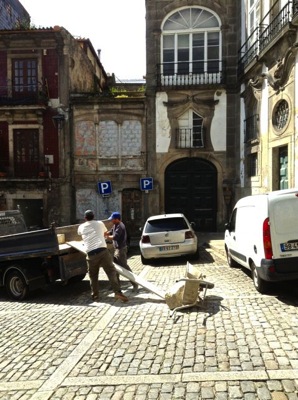
plaza.jpgOn our first afternoon here in Porto we were wandering the narrow, cobbled, hilly streets of the old quarter. Such a curious city: the façades, grey and dirty, often embellished with Baroque lintels over the windows; lots of ancient ironwork — railings, balconies, window-bars.

The façades on the plaza express everything Fado sings, I think; everything except the individual human content of the song. They represent the context: history; motionlessness; decay; outlived aspiration. Dignity. Within it all, reserved, somewhere, hope: what once was known may yet return.

Rounding a corner we saw two men straining to lift a heavy stone into a battered wheelbarrow. They joked with me about the weight of the stone, and its perverse presence in the way of whatever work it was they were about. It's everywhere, they said, this stone; you can never avoid it. The younger man then wheeled it, downhill fortunately, into a plaza, up a steep plank, into the back of a pickup truck parked casually in the midst of the plaza.


We turned back to our walk, immediately confronting a restaurant I'd been curious about: RESTAURANTE TIPICO O FADO, the individual blue-glazed tiles spelled out; and the same message was engraved on a bronze plaque right next to the tiles, framed by a lamp, an alarm-bell box, and the wiring supplying them; with a menu and a few snapshots in windows below. The haphazard care and symmetry of it all appealed to me, and we took note of the place.

We continued through the confusing narrow streets, down to the center, across and up to Sao Bento, the marvelous railroad station, its vast lobby walls covered with cazuelos, blue and white glazed tiles, depicting great moments of Portuguese history. Outside the front entrance, in the place where the restaurant had featured its menu-box, I was touched to see a bronze plaque in homage to Gago Coutinho and Sacadura Cabral, two great Portuguese aviators, the first to cross the Atlantic, in 1922. On it, addressed TO POSTERITY, there was a poem in two stanzas, only the second of which I am able to decipher from my notes:
A nossa alma, na sua trajetória

Para o supremo Bem, para a Beleza,
Tem desferido um canto de vitória
Nas amplidões de toda a natureza!
Em frente ao apogeu da nossa glória
Veja o mundo que a raça portugueza
Leventa sempre o génio criador
Para a luz, para a vida e para o amor.
which I translate, with the help of the indispensable Google:

To our soul, in its trajectory
to the supreme Good, to Beauty,
they unrolled a song of victory
greater than all nature!
Before the height of glory
see the world that the creative genius
of the Portuguese race will always lift
toward light, to life and love.


THAT EVENING OUR DESK clerk recommended two fado restaurants in town; each was represented by fliers in the local-hotspot display you see in most hotel lobbies these days. I asked about a third, which we'd noticed on our walk in the Rua São João Novo, in the heart of the old town. Oh, that's the best of them all, the clerk said, though in fact they're all good, they all give you professional singers, there really isn't any difference.

In the end, though, we went to the Rua São João Novo, precisely because they did not supply the hotel with a pamphlet — maybe that suggests they're less touristy. We reserved a table for the four of us at eight o'clock: a little early, I thought; but the Portuguese seem to dine earlier than do the Spaniards.

The dining room is a long rectangle. It was empty of diners save one table at the very end — on reflection, this may have been relatives of the restaurant staff. Our table was reserved, in the center of the room, directly opposite a small stage for the performers. As we ate dinner other diners showed up, and before too long the place was fairly full.

After an hour or so the host — clearly the restaurant owner — took the stage to welcome his guests and introduce the performers. He did this first in Portuguese, then in quite fluent English, getting a good deal of applause from the audience. Then he went through it again in French. The many Americans laughed and talked among themselves, as if the French announcement were nothing anyone needed to heed; next to us, a table of French tourists looked quite pleased and attentive.

Then the first singer appeared. Again, I was unable to catch the name: subsequent rooting around the Internet leads me to think she may be Patricia Costa, whose photo I find somewhere on the Internet. She had a clear soprano, bright, silvery, and she sang like a young woman, on the threshold of mature life, expecting her first child, aware of the difficulties of life but not at all overcome by them, harboring no sorrows, no angers. She sang about singing, about Lisbon, about life and love. She sang simply, affectingly but unaffectedly, directly, stepping aside at moments to allow the guitarist to supply his wordless comment on her song, stepping back naturally, without pretense or ego, to resume the song.

When she was finished, after perhaps fifteen minutes or so, she walked unaffectedly off her platform into another room, followed by the guitarists. We turned back to our table; a new course had arrived, and we enjoyed it and our conversation, and the energy of the dining room which had filled up and was clearly as pleased as we had been. We didn’t expect further entertainment, at least I didn’t: but our master of ceremonies returned to the stage to introduce another singer, a man this time, Antonio Laranjeira. Behind him the guitarists were taking their places again and tuning up, and soon Laranjeira appeared: a young man, late thirties perhaps, a little stocky, with a broad open honest face, very pleasant-looking, rather artless.

His singing was most direct and disarming. He had a clear tenor, supple, insinuating I suppose, light, inflected with perhaps more personal experience than the soprano had had. There was a wistful quality to his voice and his delivery; he reminded me at times of Luciano Pavarotti when he was young and was singing simply. He began, straight-forwardly, with
Este fado é de nós dois
Quero cantá-lo e depois
Vou levar-te pela cidade
De bairro em bairro à toa
Por esta velha Lisboa
Onde se canta a saudade


[This fado is for us two
I want to sing it and then
I'll take you through the city
Neighborhood by neighborhood aimlessly
For this old Lisbon
Where saudade sings…

[Saudade is famously untranslatable. Nostalgia, longing, melancholy are all involved. I first met the word in Darius Milhaud's marvelous piano suite Saudades do Brasil, composed in France after spending two years in Rio de Janeiro. Then, years later, but many years ago, we had a Brazilian exchange student with us for six months, and I observed a lot of saudade first-hand.

There's a long discussion of the word, the concept, the condition, on Wikipedia: "The state of mind has subsequently become a "Portuguese way of life": a constant feeling of absence, the sadness of something that's missing, wishful longing for completeness or wholeness and the yearning for the return of that now gone, a desire for presence as opposed to absence…"]


Again, the gravely smiling grey-haired man with the Portuguese guitar accompanied the voice, then played the interludes, accenting certain beats with a curious quick upward motion of his entire upper body, arms, and instrument, as if he were incapable of resisting the urgent insinuation of the music; his quieter, more retiring colleague supplied bass and afterbeat harmony with his conventional guitar.

Laranjeira gave us quite a number of songs — this was generous entertainment. And then, after another interlude devoted to conversation and the table, a third singer was introduced: an older woman, Leonor Santos, whose face and voice and styling were quite a contrast with the previous two singers. Where the first woman had the clear light soprano and the disarming innocence of, say, Doris Day, this woman made me think of Peggy Lee, if she'd only sung fado.

After her set the evening was pretty well over. We talked to the two female singers — a nice conversation, about fado and its history, about the irrelevance of such categories as popular or commercial or folk or vernacular. The singers were clearly artists, they'd given their art a lot of thought. I was struck, as I so often am, by their generosity, singing so artfully and sincerely in a restaurant to an audience of tourists. We took photos and bought a CD.

As we left the restaurant, just before getting to the door to the street, we passed through a sort of vestibule — it looked like the reception desk of a small hotel, though this was no hotel, as far as I could see. The restaurant host, who'd served as MC, was standing toward the back of the room. Antonio Laranjeira was leaning over the high counter; behind it the man with the Portuguese guitar — how I wish I could find his name! — was seated, with his instrument. Laranieira was singing to him, and he was playing guitar back to Laranieira — as if they were working up an arrangement, or refining a duet whose music each had long known but had perhaps not performed with the other.

I suddenly realized my iPhone could record this, and made a short video — the singing was extraordinarily beautiful, persuasive, engaging, direct; and the guitar supported it intuitively. It was late and time to go, but I couldn't tear myself away. Finally I had no choice: if you watch the little video I made you'll see what finally happened…
My latest book, Improvised Itineraries, is just out. In a little over two hundred pages it describes walking in Limburg and on the GR5 in Belgium and Luxembourg; driving across France; exploring cave art and cassoulet in the Perigord; seeing Einstein on the Beach in Montpellier; lunching with Lulu at Domaine Tempier; and a number of small hotels, country restaurants, and good times. A number of black and white photos. You can order it online, and I wish you would. $12.95 plus shipping.

Sunday, May 12, 2013

Two more plays in Pasadena

Pasadena, California, May 12, 2013—
QUICKLY NOW, BECAUSE it's late and we have a longish drive tomorrow, let me sum up the rest of the spring season here at A Noise Within, whose productions continue to impress us after all these years. Yesterday we saw Frank Galati's adaptation for the stage of John Steinbeck's novel The Grapes of Wrath, a work that perhaps means more to me than it will to you, since my father was born in Oklahoma, and lived through the Dust Bowl, the great Oklahoma migration, and all that.

I shouldn't have to write much here about the novel, which traces the eviction of the Joads from their Oklahoma farm, their travels across the Southwest to the migrant worker camps of the California Central Valley, the unspeakable poverty and hardship of the period, the injustice and inevitability of their exploitation at the hands of ranch managers, their brutal treatment by the establishment, and all that. You think the last few years have been tough in the USA: you have no idea how things were in the years before World War II.

It's a long time since I've read the book — I really should re-read it, I know — so I can't be sure: but this adaptation, while necessarily episodic, seemed faithful to me, fleshing out the main characters mostly through Steinbeck's words, organizing the high points of the lamentable narrative effectively, leavening what might otherwise have been overwhelmingly depressing deaths, disease, and failure with the finally irrepressable energy of the daily untutored will to live, and to live with dignity and decency.

Michael Michetti's direction was straightforward and effective. Matt Gottlieb, Steve Coombs, and Deborah Strang stood out in the large and effective cast as Casy, Tom Joad, and Ma, with Mark Jacobson a remarkable Noah and Lili Fuller growing through the course of the play as Rose of Sharon.

Many in the cast sang, danced, and played instruments — fiddle, guitars, bass, jug — with skill and vigor, contributing to a sense of authenticity. One would never want the country to return to such hard times, but it sure would be nice if people could once again be that good, that adaptable, that determined. This was a first-rate production. If it could travel the length and breadth of the land, Americans might learn something positive about their heritage, about the honesty and justice of workers and the out of work.
THEN THIS AFTERNOON we saw a rare production of The Beaux' Strategem, the 1707 comedy by George Farquhar, in an adaptation by Thornton Wilder that was abandoned, then finished recently by Ken Ludwig.

It's a Restoration Comedy, I suppose, about scoundrels: impoverished gentlemen, louche inkeepers, a highwayman doubling as a parson, a dotty old woman dabbling in surgery, and the like. Beatrice and Benedick meet commedia dell'arte, action gives way to direct address to the audience, jokes are made at Mr. Shakespeare's expense.

In Julia Rodriguez-Elliott's brisk direction, it was all great fun. Blake Ellis was superb as the blandly loveable Jack Archer; Freddy Douglas a good match as his sidekick Tom Aimwell. Abby Craden and Malia Wright were just under overwrought, good-looking and very funny as the young ladies Kate Sullen and Dorinda. Apollo Dukakis did his characteristic wide-eyed goof for the Boniface, and Deborah Strang defined demented zaniness as Lady Bountiful.

Best of all, perhaps, Robertson Dean portrayed Sullen. I don't think I've ever seen a more complex, longer, more utterly believable, and funnier drunk impersonation than his. He was absolutely hilarious. The whole show was. There are serious things here, comments on Science, on The State of Woman, on class warfare. (At one point, a gentleman masking as a servant declares they are all on the cusp of a great upheaval in such relations: and this is the early 18th century.)

One of the most remarkable things about this company, A Noise Within, is its record, its ability, with repertory, balancing serious drama with entertainment, looking in dusty corners of repertory, finding vehicles that stretch the company and its audience and that speak to one another, developing an intelligent conversation about the constant human condition through the theatrical entertainment that has been devised throughout the centuries, across boundaries of nation and language. This spring season has, in one sense, simply been one more example. In another sense, it has been exceptionally effective.

Friday, May 10, 2013

Eurydice

E282-1024x819.jpgJules Wilcox as Eurydice, with her recumbent Father (Geoff Elliott) and the menacing Lord of the Underworld (Ryan Vincent Anderson); three Stones in background
Pasadena, May 10, 2013—
SAW A PLAY down here last night that needed reseeing in my mind's eye this morning: Sara Ruhl's 2003 romantic comedy Eurydice. We're here for the spring season of a company we've followed for a number of years, A Noise Within: one of the things we like about them is their propensity for thoughtful repertory. (Tomorrow we see The Grapes of Wrath; next day, The Beaux' Stratagem.)

Sarah Ruhl is perhaps better known just now for a more recent play, Dead Man's Cell Phone, which we saw a few years ago up in Ashland. Like it, Eurydice is an entertaining and very contemporary play on verbal language, mindless American leisure, and Life and Death. I suppose her antecedents include the American novelist Robert Nathan, whose bittersweet fantasies were once bestsellers and produced hit movies — think Portrait of Jennie — but is now so neglected none of his thirty-eight novels now rate an individual Wikipedia entry. (I particularly loved One More Spring, which I try to re-read every ten or twelve years.)

I wouldn't be surprised if Eurydice is similarly forgotten in twelve or fifteen years: and that is not to its discredit. Theater must be of the moment. There are of course, and thank both Melpomene and Thalia for them, plays that manage to hold the stage for centuries, even millennia. A Noise Within offers them, usually two or three a year. It seems reasonable, though, given the limits of human activity, that for every one of those plays there must be hundreds and thousands that have shorter runs.

And there's no reason that among them there shouldn't be some whose short shelf life is due to their specific address to their specific audience, in its specific social context. One of my objections to Eurydice, during the ninety minutes I was actually watching its single long act, was that it trivialized the Orpheus myth. Myths owe their power to their ability to speak to the most basic concerns of their audiences, what you might call root level desire, fear, and comprehension. The higher you go (to use suspect spatial analogy) in the intellectual reception of the audience, conscious or subconscious, the more particular the appeal, the more delimited to a specific construct of social or psychological issues.

Eurydice opens with the two characters on a beach, apparently in the United States, apparently in the late 20th century. Orpheus is a glib, rather bland young man whose head is full of tunes. Eurydice, equally adolescent, prefers the books she reads. They prance and preen and prattle good-naturedly about their differences, and they seem not really all that passionate about one another.

They engage to marry, though — one's not sure why — but during the ceremony, or just short of it, she runs off to the apartment of a sinister fellow who has picked up a letter written to Eurydice by her dead father, who has some advice for her. After stealing the letter she rushes out of the apartment, falls down a flight of six hundred stairs (not "steps": Ruhl's language is occasionally oddly imprecise), and dies.

From there the play returns more or less to the standard myth, saving the presence in Hades of Eurydice's never named Father, who coaches her in verbal communication following Lethe's erasure of her intellect.

The cast is rounded out by a Greek chorus of three Stones, who comment on the action from time to time, more to remind us that Ruhl's play grows out of antiquity than to enlarge the effectiveness of her theater.

Looking back on the play this morning, a few hours after seeing it, I see its resonance — in terms of physical production, at least, but through that also in terms of suggestion — with such plays as Il Re cervo (King Stag), which Noise Within did ten years ago. If Ruhl's play looks back, consciously or not, to Robert Nathan, it also recalls, at least to me, the plays of Wallace Stevens: Three Travelers Watch a Sunrise, for example.

Geoff Elliott's direction of the play was consistent, a little subdued, sympathetic, and intelligent. (The same can be said of his portrayal of the role of Her Father.) He didn't flinch from the playwright's idea of anchoring, miring perhaps, the play in the specifics of bland American adolescence, and that speaks for the esthetically ethical respect he has for the script. In the other main roles, Jules Willcox found some wonder and depth in the title role; Ryan Vincent Anderson was often imposing as A Nasty Interesting Man and Hades. Graham Sibley was, I thought, weaker as Orpheus, but then in Ruhl's play this isn't a very rewarding role.

As the chorus, Abigail Marks, Jessie Losch, and Kelly Ehlert were perhaps a bit too indulged as Big, Little, and (especially) Loud Stone, sitting stolidly on the ledges of the back wall of the set, blue, comically ominous and eternal, enigmatic. These stones can't help but bring the dead in the closing pages of Our Town to mind. I like them, the more I think of them.

The physical production was effective and memorable, especially Meghan Gray's lighting design and Jeanine Ringer's scenic design. Indeed it was those components, abetted by Endre Balogh's offstage violin improvisations (if indeed they were improvised), that force me to rethink my immediate reaction to the evening, and to find considerable merit in the play. I'd see it again, especially in this production, if I lived down here: the production closes May 19.

Monday, May 06, 2013

Two Stoppard plays

FOR THE RECORD, whatever the record might be, we saw two plays by Tom Stoppard on Saturday, down in Berkeley. We caught them just in time; I'm sorry to tell you they've closed. Comments are justifiable, though, because one or another or, I hope, both might well be remounted next season: they constitute the first two-thirds of a trilogy, whose closing piece has been promised for next year.

The trilogy is The Coast of Utopia, which, as stated by Wikipedia, focusses on "the philosophical debates in pre-revolution Russa between 1833 and 1866." The trilogy runs nine hours, Wikipedia further states, and I can believe it: the two plays we saw, Voyage and Shipwreck, ran close to three hours each.

My experience with Stoppard is insufficient — not entirely my fault: his plays aren't given sufficient attention by the companies whose productions we visit. We've seen, let's see, Travesties, On the Razzle, Arcadia, maybe The Invention of Love. His translation of The Seagull, too, and of course the movie Shakespeare in Love, whose screenplay he co-wrote (with Marc Norman).

Nor have I read any of his plays. This will distress my reclusive friend in Corvallis, in the unlikely event he reads this: he lent me a copy of The Invention of Love months ago, and I haven't yet got to it.

It was Travesties that put me off Stoppard. I was a dedicated Joycehead for decades, and the idea of fooling around with historical fact, throwing Joyce and Tzara and Lenin together on stage simply because they happened to live for a short time in the same city where they might have met, seemed not only dubious in terms of ethics, but downright shameful. It seemed to my priggish standards an assault on the dignity of Joyce's accomplishments; certainly the dignity of the situations he suffered in those Zurich years.

Of course I've come to realize the absurdity, the ignorance, the uselessness, the short-sightedness of my outrage at Stoppard's "liberties." An outrage facilitated, by the way, by my not having actually read or seen Travesties at the time: it was only a few seasons ago that I first saw it, produced — brilliantly, I thought — by the Shotgun Players.

It was the same theater that brought us Voyage and Shipwreck the other day. They are truly a marvelous company, engaging, resourceful, enterprising. Their little Ashby Stage, a storefront theater with a steeply raked audience seating perhaps a hundred, is obviously limited in terms of facilities, but where other companies wallow in theatrical resources, Shotgun dances cleverly and gracefully in theatrical imaginativeness and enterprise.

I've complained here about certain productions in other theaters, where the urge to make Shakespeare, for example, "relevant" to today's audiences has sometimes resulted in compromises with what seems to me the intent and meaning of the script. The idea seems to be that the audience can't understand the complexity and seriousness of the play unless it's pushed at them in theatrical dress more current. The result is Troilus and Cressida, say, performed like an Iraq War movie. You alter the play to make your audience "understand" it, even though the result is not the play Shakespeare wrote.

What Shotgun did with Stoppard's complex and serious plays was alter the audience, not the scripts. The alteration was simple enough: a member of the company came out onstage a few minutes before curtain and explained a few details, in the course of which aspects of Russian art, philosophy, and society of 180 years ago — not to mention the French Revolution, the aftermath of the Congress of Vienna, Marx, George Sand, and a few other items — was easily and gracefully presented.

What a pleasure, to attend a theater whose audience is treated like a collection of intelligent men and women, interested in such things, and capable of following simple declarative sentences! And the printed program, too, was a masterpiece of clarity and precision, dispensing with the usual format and setting instead a timeline of the dramatic content of the two plays, another of the French Revolution, biographies of the characters Stoppard involves in his plays, and synopses of the action.

The plays are meaty, no question. Of the two, Voyage, the first of the trilogy, seemed to me the more fascinating, largely because of its structure. Act I, set on a Chekhov-like country estate near Moscow, presents nine scenes centered on the wealthy Bakunin family, four daughters and a son (Michael) and their parents, guests, and serfs.

Act II moves the action to Moscow and Petersburg, following the same characters (and a few new ones) through the same time period, 1833-1844, backfilling details and motivation and consequences.

The play is "about" the lassitude and hopelessness and uncertainty of the Russia of the period, mired in the serfdom economy, torn between fascination and envy for Europe (especially the freedom of France and the dedication of Germany) and an obstinate loyalty to the antiEuropean qualities of the eternal Mother Russia.

All this is slowly, carefully spooled out through conversation, with a few set pieces at critical junctures. The economy, agriculture, law, religion, literature or the lack of it — those are the subjects, ostensibly: but the real substance of Stoppard's play is the complexity, the inheritance, the philosophical difficulty and the eventual failure of a historical moment, reaching back to the Age of Reason and the French Revolution that followed it, and forward to the long night that would follow the events of this play, seventy more years before the Russian Revolution, then ninety more to our own time, when the Russian failure seems just as surely sealed.

Shipwreck follows Bakunin and his foil the literary critic Vissarion Belinsky to Paris, 1846-47. Where the first play introduced literati and liberals as guests of the Bakunin country estate, Bakunin himself is now seen as a guest in the cosmopolitan home of the wealthy Alexander Herzen, half German and half Russian, at home in neither society. In a similar structure, though much more linear in its chronology, Stoppard narrows his focus, drawing the net tighter around his characters, propelling us to the inevitable futility of the 1848 Paris revolution in the first act, then in the second dissolving the tension in the anticlimax of the Herzen household in Nice.

I can hardly wait to see the final play, Salvage. In fact I'll probably have to buy the scripts of all three and read them soon; the production can't come soon enough for me. If Shipwreck was less gripping than Voyage, it was probably because it is after all the centerpiece of the trilogy. The first play stands on its own; the second needs the first and, I'm sure, the third.

I can't say enough about the principles among the cast. Joseph Salazar was deep and changeable as Michael Bakunin; Nick Medina was smoldering and intense and brilliant as Belinsky; Jonah Rotenberg was sometimes meditative, sometimes quick and brittle as Herzen. It's a huge cast, and there were a couple of weaker actors in lesser roles, but for the most part I was persuaded throughout the afternoon and evening.

The director was Patrick Dooley, artistic director of Shotgun. I'm glad he's where he is; intelligent theater needs an intelligent and effective master in a community like Berkeley. But when I think what he might be able to do a few hundred miles north…