Showing posts with label sculpture. Show all posts

Friday, December 19, 2014

Schjeldahl on sculpture

Why I read Peter Schjedal, in the New Yorker:

"Sculpture is the hardest art. Unlike diffidently wall-mounted painting, it intrudes on an already crowded world: mediocre painting is easily ignored; mediocre sculpture is exasperating. To be tolerated, let alone welcomed, a sculpture must have immediate and persistent drama, often announced by a certain shock."

The New Yorker, December 22 & 29, 2014, p. 68

Wednesday, April 16, 2014

Alexander Calder in Los Angeles

Calder installation.jpg
Installation photograph, Calder and Abstraction: From Avant-Garde to Iconic, through July 27, 2014, Los Angeles County Museum of Art, © Calder Foundation, New York, Artists Rights Society (ARS), NY, photo © Fredrik Nilsen
Eastside Road, April 16, 2014—
HOW REFRESHING IT IS, to see an exhibition of an iconic artist, one whose work one knows well enough almost to take for granted, in an installation that restores all his energy, his significance, that reasserts his position within the most magical and optimistic areas of his century.

This is what happens in the current show of works by Alexander Calder, beautifully installed at the Los Angeles County Museum of Art. We devoted only an hour or so to the show: next time we're in town, we'll have to go back. Let the museum itself describe the exhibition:
One of the most important artists of the twentieth century, Alexander Calder revolutionized modern sculpture. Calder and Abstraction: From Avant-Garde to Iconic, with significant cooperation from the Calder Foundation, explores the artist’s radical translation of French Surrealist vocabulary into American vernacular. His most iconic works, coined mobiles by Marcel Duchamp, are kinetic sculptures in which flat pieces of painted metal connected by wire move delicately in the air, propelled by motors or air currents. His later stabiles are monumental structures, whose arching forms and massive steel planes continue his engagement with dynamism and daring innovation. Although this will be his first museum exhibition in Los Angeles, Calder holds a significant place in LACMA’s history: the museum commissioned Three Quintains (Hello Girls) for its opening in 1965. The installation was designed by architect Frank O. Gehry.
Yes, Frank Gehry, the architect. Installing all these works — from table-lamp sized stabiles to enormous mobiles, from small maquettes to huge stabiles — required unusual consideration, and the LACMA website describes The Challenge of Installing Calder in a fascinating and well-illustrated blogpost.
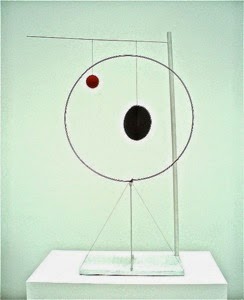
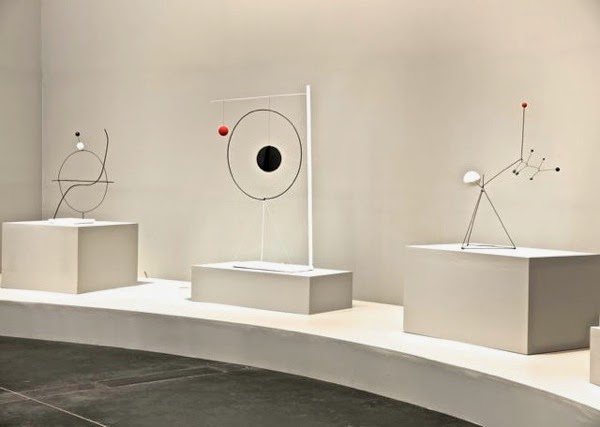
object-with-red-ball-1931.jpgYou see three of the earliest pieces in the photo above, with the fascinating Object with Red Ball (1931) at the center. This photo, from a different online source, demonstrates the piece's variability: the red ball and the black "sphere"— in fact two intersecting flat discs — can be positioned at various points along the horizontal rod from which they hang. The piece is a study in spatial relationship, implying motion. I like to look at it, with one eye or both, while walking slowly and smoothly past it, also varying the height of my eyes. No doubt this looks funny to other onlookers: I don't really care.

Object with Red Ball is as significant historically as it is on its own sculptural terms. It was in late 1931 that Calder began homing in on the idea with which he's most generally associated, the gentle movement of various components of his hanging sculptures as they respond to drafts and breezes. His friend Marcel Duchamp gave them the name that's stuck: mobiles. I think we tend to concentrate so much on these kinetic mobiles that we tend to forget their source; the three pieces in the photo above clearly put the Calder of the late 1920s and the first year or two of the next decade in a Surrealist context, particularly associating him with the Catalan painter Joan Miró.

It's easy to think of wit, even whimsy, as the primary effect of these pieces; but it's interesting, I think, to contemplate just what wit (and even whimsy) consists of, just why it should be a significant, even serious component of "abstraction." The beginning, for me, lies in the humor inherent in the sheer physical presence of these objects, made of shapes and substances that are familiar enough, that are combined and integrated in configurations never before seen, that contrast the frailty of their means and substance with the evident permanence of their purpose. These pieces mean to stay. They are here for a reason, however intuitive Calder's method may seem to be. Calder states (via one of a number of intelligent wall-readouts):
The basis of everything for me is the universe. The simplest forms in the universe are the sphere and the circle. I represent them by discs and then I vary them. My whole theory about art is the disparity that exists between form, masses and movement.
Demoiselle.jpg
Le Demoiselle, 1939
©2013 Calder Foundation, New York/Artists Rights Society (ARS)
Throughout the 1930s Calder developed a conversation, through an amazing amount of work, between stabiles and mobiles, relatively conventional free-standing sculpture and the continuously more graceful, floating kinetic pieces. The individual pieces making up these works increasingly drew inspiration, I think, from Nature: leaves, feathers, wings. Calder had joined the expatriate American movement in Paris in the 1920s, and, though he returned to Connecticut in 1933 and didn't open his French studio until thirty years later, he seems to have developed an intrinsically Gallic style. If his earlier work aligned him with Miró, it's hard not to see the work of the 1930s as somehow aligned to Matisse.

Calder's titles are almost always delightful, and delightfully apt. La Demoiselle (I don't know why LACMA's cut-line gives the word a masculine article) is redolent of the crisply feminine fashion-world of 1930s France; it is also both witty and graceful. A mobile hangs from the red stabile base, marrying the kinetic and the stationary — perhaps that's the reason for the hermaphroditic grammar of the title — but acknowledging, through its slender line and its improvised rear leg, the potential flight of even the stationary element.

The mobile had made Calder famous, rightly, and his primary colors, the wit and delicacy of his forms, the immediate pleasure of his work made it accessible. No one ever wondered what his work "meant." And if the man in the street could look at it and say "Why, my kid could do that," well, plenty of primary schools were quick to assign the production of construction-paper-and-coathanger knockoffs to children across the country — in the end only emphasizing Calder's apparently effortless mastery of what is, in fact, a rather tricky exercise in all kinds of balance.

After the war, commissions for large-scale public works began to rush in, and Calder worked away happily and productively into his sixties and seventies. This is the fiftieth anniversary of LACMA's commission of one of his most complex huge pieces, Three Quintains (Hello Girls), the grouping of three stabile-mobiles which for too long was relatively hidden at a corner of one of LACMA's signature ugly-Modernist buildings. I didn't see the piece last week, on our hurried visit to this exhibition; next time I'll be sure to say hello.

One of the most impressive of the big pieces is in fact "only" a maquette for an enormous work placed in Grand Rapids, Michigan: La Grande vitesse, over forty feet high, Calder red, massive, strong, yet lyrical. The maquette, also in plate steel, is only eight and a half feet high, eleven and a quarter feet long; but it crowds and dominates its room, inviting the onlooker to walk around and through it while allowing one to back off and take the whole thing in with one gaze. In the end, though it's forty years removed from Object with Red Ball, it similarly invites contemplation of changing configurations, and, through that, of its place — and the viewer's place — in the universe. Calder's universe, and ours.

Vitesse.jpg
Le Grande vitesse (intermediate maquette), 1969
©2013 Calder Foundation, New York/Artists Rights Society (ARS), New York, photo: Calder Foundation, New York/Art Resource, NY

Calder and Abstraction: From Avant-Garde to Iconic

Los Angeles County Museum of Art
5905 Wilshire Blvd., Los Angeles, California; 323 857-6000

Exhibition continues through July 27, 2014

Monday, November 10, 2008

Peace memorial

Via Corsini, Rome, Nov. 9—

arapacis.JPG
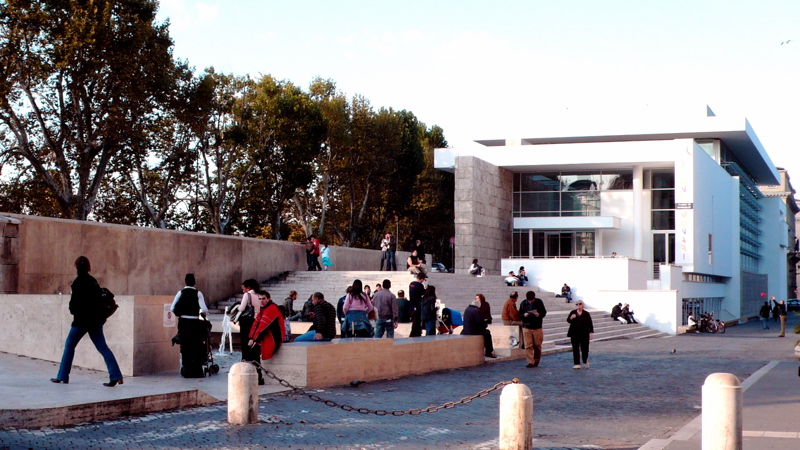
Richard Meier's building for the Ara Pacis

UPTOWN TODAY — I always think of upstream in Rome, toward the Piazza del Popolo, as "uptown", I don't quite know why — to see the first new building in central Rome in eighty years, or something like that: to my taste rather a nondescript flatroofed boxy thing of glass and concrete, next to the Tiber; set on a plaza and backed by a handsome travertine wall down which water sheets into a gutter leading to a clichéd square pool with four rows of four vertical jets. Some like this; I find it a little unsettling — it refers to Rome, of course, with her fountains and piazzas; but it's unlike anything else here, yet insufficiently arresting to justify its irrelevance.

Oh well: this container is interesting for the thing contained, the Ara Pacis as it's called — in fact not the Altar of Peace, apparently never found, but the cube of a roofless building that enclosed it. The Ara Pacis was erected a couple of thousand years ago to commemorate the Roman pacification of Spain and Gaul, as I understand it: I have no idea what the altar looked like, but its enclosure, say thirty feet square and nine or ten high (I'm guessing), is a thing well worth seeing, even worth commissioning a nondescript new building to protect.

Inside Meier's museum the first thing you notice is a scale model of the supposed original spatial context, very different from today's. The Tiber makes the same bend, but only three buildings are to be seen on the huge expanse that was then the champs-de-Mars, the training ground for young soldiers: the Pantheon, built in 27 BCE by Augustus Caesar's son-in-law Agrippa; Augustus's mausoleum, which he himself had built at about the same time; and, midway between them but considerably east of their axis, the Ara Pacis, dedicated eighteen years later. (Between the Ara Pacis and the center axis was an horarium, a paved rectangle serving as sundial whose gnomon was an obelisk.)

reconstruction.JPG
Reconstruction of the Campo Marzio, 9 BCE: at left, Augustus's Mausoleum; right, Pantheon; center distance, Ara Pacis beyond Horarium


Two things are immediately striking about this: first, the apparent emptiness of the zone, given more to Nature than to architecture; second, the location of the Ara Pacis, away from the river and oriented toward the sun — an orientation underlined by the Horarium, designed so that the gnomon's shadow will fall on the Altar at noon on the equinox, as I understand it.
The deliberate mirroring of the Pantheon, celebrating all the gods, and the Mausoleum, celebrating Augustus Caesar, is unmistakable. I think, too, that the openness of the plan, all that empty grassy field between, reinforces a sensibility that must have been oriented more toward Nature and her spaces, less to the city-dwelling system of "development" and its complex economic, political, and technological structures.
Augustus was passed off as a god himself, descended from Apollo: after the experiment of the Roman Republic failed it took divine intervention to restore a degree of order and impose a degree of "peace" on society. It must have been important for him to have been seen as something apart from the mass of humanity in the city that had built up to the south, in the harbor and the forum and the apartments and villas surrounding the Capitoline hill.

WELL, YOU CAN'T put things back as they were two millenia ago, and I suppose this new installation of what's left of the Ara Pacis is a good thing, though the point of the original setting is largely lost, and the Ara itself is missing, and its original enclosure turned 180 degrees from what was intended as I understand it. The fragments that have turned up so far are set into a concrete wall reconstructing the size and shape of the original; missing figures from the bas-relief sculptures are indicated in two dimensions; the entire surround is placed high on a podium. Walking up those steps and entering the enclosure is a solemn kind of experience, quite like entering the Pantheon.
There are plenty of explanatory panels, in Italian and English, identifying the figures in the reliefs, which portray a kind of parade celebrating the peace Augustus has imposed on those distant colonies. Considerable light falls from all sides, thanks to Meier's glass curtain walls. The sculpture itself is intensely interesting, both for its intrinsic qualities and for its historical significance. (It's hard to think of it colored, though, as it must have been when new; but that's a subject for another day.)

From the sublime to the ridiculous: We left the Ara Pacis and headed for the Spanish Steps, with the usual Sunday crowds jamming the streets. It was the hour of the passaggiata, that slow amble Italians and other latins, I think) love to take on a sunny Sunday afternoon. Something was heightening the effect, though, and as we neared the Corso we heard a marching band just stepping out of sight toward the Piazza del Populo, enthusiastic children marching along behind it; and then here flew nine fighter-jets low overhead, right up the airspace over the Corso, red, white, and green smoke trailing behind them to lay the national colors out across Apollo's sky. We've largely lost the Augustan context, but human nature continues to respond to his instincts. I suppose it always will.

Tuesday, August 07, 2007

Edges

Lindsey among the Matisses


THOUGHTS OF MORTALITY crowd the aging mind; I'm sorry; I can't help it. Not even an unusually distracting week seems to keep them away—not Molière thumbing his nose in Ashland, not the Boston Red Sox losing pathetically in Seattle, not the serenity of an hour's walk in Castle Crags, not the sweet pleasures of stone fruit at Andy Mariani's orchard, not the steely edge of a Martini with a newly discovered gin (made in Portland, I forget the name), not the pleasures of the table and good company at Incanto out on Church Street.

Especially not Matisse, whose bronzes anchor an oddly troubling exhibition at SFMOMA. You can't argue with these pieces; they're great articulations in the history of Modernist sculpture, only slightly damaged by comparison with a couple of greater Degas pieces in the same rooms. And I don't even cavil at the curatorship, eager though it is to explain things, to draw inferences, to assume certainties, to insist on linearities.

Years ago a tiny bright woman who was then a public relations officer at the University Art Museum gave me one of the great lessons in the laughably casual education I was piecing together in the visual arts when she mentioned even more casually that she always fastened on the edges in paintings. Edges; profiles; contours: they exist in only two dimensions, meaning they have no substantial existence at all; yet they define, link, and clarify.

Matisse was a fine draughtsman, like Picasso; his contour drawings are both masterly and affecting. It is a defiance to trace a line; the audacity of drawing is breathtaking. I think Matisse kneaded his clay in penance, denying himself the cruel pleasure of the pencil's inspired aggression, its cheeky assertion of his gifts.

Several times the wall narratives suggest these sculptures are best seen in the round, while traveling round them. A point hardly worth stating, you'd think: yet surprisingly few visitors seemed to be doing this while we were there. They seemed to spend about as much time reading labels as looking at sculpture—and those with headphones seemed often to be focussing on nothing, gazing into near space while listening to whatever secret sounds were thankfully theirs alone.

Walking around a sculpture is how I like to see it; often walking slowly around with one eye closed, concentrating on the constantly changing edge between the sculpture and its space. Walking around the sculpture I myself am drawing, or at least assisting in an act of drawing, dragging, pulling the constantly changing edge into a contour drawing in four dimensions, height, horizontal distance from the sculpture's center, constantly changing acceleration in the direction of my own footsteps; and time, of course. Drawing, contour drawing, in time.

If architecture is frozen music, as Goethe said, then sculpture is pregnant with music. It's a long time since I've kneaded any clay, but I think Matisse, and Degas, and the private Rodin, when they were shaping their dimensional drawings in clay, were occupying time in an essentially musical—better, composerly—way. By that I mean a non-teleological way: time occupied not in order to arrive at the conclusion of some premeditated process, but as reflection on experiences and productions that have gone before, as contemplation of the possibility of some unforeseen eventuality which will nonetheless turn out to take its place within an organically logical system, you might say, identifiable in some way with both the material and the person.

Music and the production of sculpture: constant reconfigurations of material: life and the passage of time. That's what I meant by "mortality." On the whole, as I told Lindsey the other day, I think mortality is a good idea. And in any case I have very little to say about it; it is a constant, a given.

Some of this thinking is probably triggered by the recent deaths of Ingmar Bergman and Michelangeo Antonioni; more by the recent deaths of two people I knew, not as well as I'd like to have: Ned Paynter, who was on the news staff at KPFA when I was there more than forty years ago, and Marvin Tartak, gentle and witty pianist and accompanist par excellence.

When death comes to mind—and death is never far from contemplations of mortality—I always think of three things. Mozart, of course:
As death, when we come to consider it closely, is the true goal of our existence, I have formed during the last few years such close relations with this best and truest friend of mankind, that his image is not only no longer terrifying to me, but is indeed very soothing and consoling!
and Duchamp:
Besides, when someone dies, it's always someone else...
and, to put beside these essentially Epicurean views of the subject, this poem by Lincoln Fitzell, which has quietly whispered to me for nearly fifty years:
PRAYER

Earth the mother, earth the death,
We owe to you this tragic breath,
And dark and wide if we should fall,
We pray that you may keep us all
More gently sleepers of your night,
Than we were children of your light.

Mozart: letter to his father, 4 April 1787, translation by Emily Anderson
Duchamp: aphorism, found also on his tombstone, as I recall and translate (probably faultily)
Fitzell: "Prayer," in Selected Poems (Denver: Alan Swallow, 1955)
gin: Cascade Mountain from Bendistillery (thanks, Giovanna)