Showing posts with label Road trip. Show all posts

Saturday, March 05, 2016

Back to the blog…

1  3

Eastside Road, March 4, 2016—
 

MARCH. TWO MONTHS into the new year, I resume. I was apparently temporarily frozen, the proverbial deer in the headlights, in the face of a return to this country after a pleasant and eventful European interlude, dismayed by the level of public discourse, discouraged by a number of unfinished projects left over from the old year, distracted by the stupid daily errands and repairs.

Distracted by further travels, too. A week after our return from Stockholm, January 11; we drove down to Los Angeles, returning via Reno (Nevada). Along the way we stopped at Manzanar. This is the site of one of the infamous relocation camps hastily improvised for thousands of Americans of Japanese ancestry, taken from their homes on the West Coast and held for the duration of World War II.

The site is ten miles north of Lone Pine, on the east side of the Sierra Nevada, the flat, windswept, arid desert at the foot of that remarkable range, near the highest peak in the contiguous United States, Mt. Whitney. The photo above will give you an idea: it shows the monument in the former cemetery, with a view of the Sierra — the “Range of Light” — in the background. In the foreground, desert.

I have dim memory of that relocation. In 1941 I turned six years old. I lived, with my parents, in a middle-class neighborhood in central Berkeley. A number of Japanese-American families lived in bungalows along Grove Street; I seem to recall the carp ponds in their back yards. One day these families were gone: rounded up, taken away.

The area around Manzanar had a long, complicated, troubled history. Native Americans hunted, gathered, and gardened it for centuries. They were edged out by pioneer whites in the 19th century, attracted by the climate and its agricultural potential, especially after the coming of the railroads, which facilitated marketing.

Manzana is Spanish for “apple.” It was given the name in the 20th century, when it had become an improbably prosperous fruit-raising area. Fairly rich soil, hot summers, cold winters, and abundant water, and the patient and skilful attention of a few hard-working families, produced hundreds of tons of fruit for the quickly growing Los Angeles market  until that city realized its water was even more crucial to its future, and diverted it all for its own use, quickly reducing the land to desert.

The farmers sold their water rights and were left with barren land. Fortunately for them, empty land, on a rail line but far from “sensitive” coastal areas, were exactly what was needed to house a hundred thousand “relocated” Americans — temporarily, of course, just for the duration of the war. 

1  4

This is what Manzanar looked like during World War II. The railroad stretches north and south along the eastern edge of the “camp,” whose neat, orderly blocks of bunkhouses are hygienically set apart to minimize the threats of fire and disease. Each array of eight or so bunkhouses has its own mess hall and two common lavatory-shower facilities, one for each sex. There were minimal recreational facilities — basketball court, baseball diamond — and, of course, the remnants of broken-down orchards, and chickenyards, and a factory where women could help make parachutes and other nonstrategic items needed by the war effort.

1Improbably, the prisoners —for that is what they were —made the best of things. They even made gardens. The federal government has installed an admirable explanatory center at Manzanar, and developed a self-guided tour of the facility. We drove the tour — with a few stops for photographs, and meditating, it took almost an hour. It took us, for example, to the cemetery, on the western edge of the site.

Along the way there were a number of explanatory panels. On one of these a faded color photograph recalls one of the traditional Japanese gardens these people managed to create:

“You are standing before San-shi-en, or 3-4 Garden. Water once flowed over these silent stones, soothing troubled spirits and easing the monotony of long mealtime lines. Designed and bilt by internees, mess hall gardens served as a source of block identity and pride.

“These and other gardens in Blocks 9, 12, and 22, share symbolic roots in ancient Japanese design. In each, you will find three distinct levels aligned north to south: a hill of earth represents the mountains from which water flows south to a pond, symbolizing an ocean or lake. Here, internees planted trees from the camp nursery and hauled stones from the rugged Inyo Mountains to the east."

1  2After the camp was abandoned in 1945 these gardens were gradually buried under windblown sand and the sediment left by springtime snowmelt. Archaeologists unearthed this one in 1999, and reconstructed the fence that had protected it. They have not reconstructed the garden itself; only its rocky bones, as you see in the second photograph here.

One of the mess halls, and one of the bunkhouses, has been restored and is left open for visitors to inspect. Here too welcome, fairly detailed, and sympathetic explanatory panels help the visitor understand just what life must have been like for these people. I couldn’t bring myself to photograph these interiors — it’s just too poignant, too intimate a glimpse into what may have been the most injurious aspect of this place: its theft of the dignity of its occupants.

A number of photographs show them as they were, in this place, at that time. They are surprisingly modern, lively, optimistic. They put on a good face, whether for their own morale, or for the benefit of whatever eventual onlooker they expected these photographs to find. They are well dressed, in the plaid pleated skirts and the sweaters and wide trousers of the early 1940s. You can be sure — there’s photographic evidence — that they jitterbugged to big-band swing; they played cards; they swapped stories.

Ultimately they survived, most of them, and returned, somehow, to a normal life. The war over, they were given twenty-five dollars and a bus ticket to Los Angeles. If they were lucky, a kind neighborhood might have looked after their homes and farms. They were a stoic lot, for the most part, and patiently endured their readjustment, as they had their confinement. Ultimately, during the Reagan administration, the government recognized its error, apologized, and paid a modest compensation.

The National Park Service has done a fine job recording all this, and making it available to visitors. They’ve done this, of course, in order to ensure that such an injustice may never be repeated. It’s something to consider during this presidential campaign. 
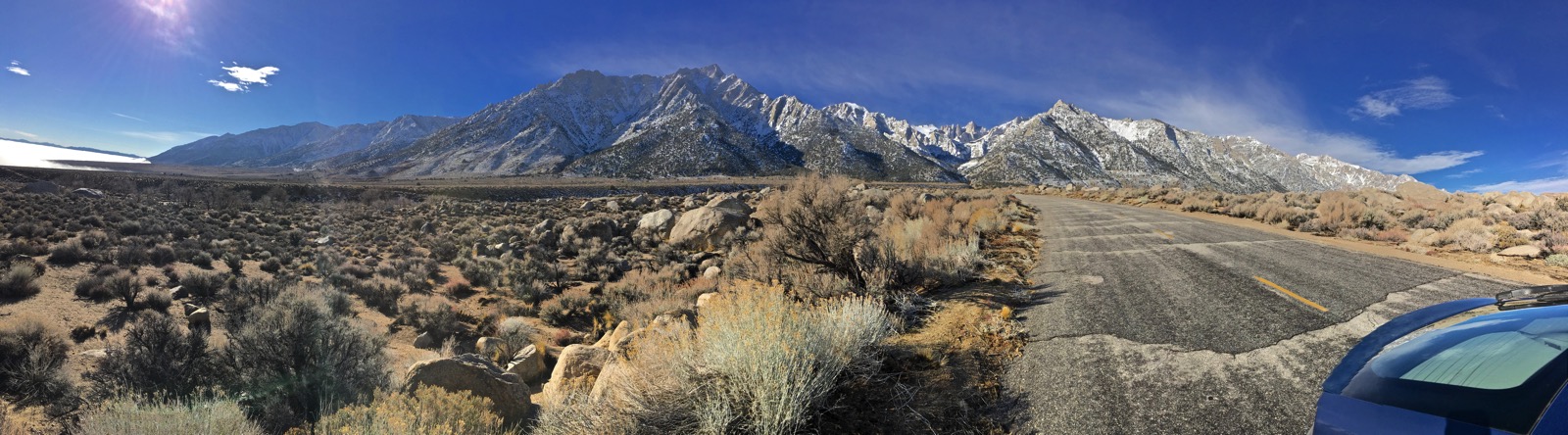
1  5

Looking west toward Mt. Whitney

Technorati Tags:

Thursday, April 26, 2012

Road trip

Eastside Road, April 25, 2012—
AS THE PREVIOUS POST indicates, we were down in Pasadena over the weekend, seeing plays at A Noise Within. Much as we like the company, and (for the most part) their productions, I look forward to the trip itself almost more. As Gertrude Stein notes someplace, Plays and Landscape have an elective affinity. (Actually what she says, as I recall, is that a landscape has no purpose other than providing a site for landscape or for battle: but cut me a little slack here.)

If I am religious, my religion is Landscape. Chekhov explains this better than I can:
The leaves did not stir on the trees, grasshoppers chirruped, and the monotonous hollow sound of the sea rising up from below, spoke of the peace, of the eternal sleep awaiting us. So it must have sounded when there was no Yalta, no Oreanda here; so it sounds now, and It will sound as indifferently and motonously when we are all not more. And in this constancy, in this complete indifference to the life and death of each of us, there lies hid, perhaps, a pledge of our eternal salvation, of the unceasing movement of life upon earth, of unceasing progress towards perfection. Sitting beside a young woman who in the dawn seemed so lovely, soothed and spellbound in these magical surroundings — the sea, mountains, clouds, the open sky — Gurov thought how in reality everything is beautiful in this world when one reflects: everything except what we think or do ourselves when we forget our human dignity and the higher aims of our existence.

—Chekhov: The Lady with the Dog, quoted in Janet Malcolm: Reading Chekhov
I found Malcolm's book interesting and useful. It combines, or better perhaps merges, literary criticism, travel, and first-person essay, all genres dear to my heart; and if she occasionally slips into a snippy mood she does not dwell there: with Chekhov at one's side, it's hard to remain scornful or overweening for more than a moment.

The quoted passage stands on the very first page of Reading Chekhov. Malcolm has gone to Yalta to visit Chekhov's home, and the seaside cottage that was his getaway; and what better way to set the scene than through the master's own words? She soon flashes back to earlier stages of her literary pilgrimage, visits to Petersburg and Moscow; and in those pages we're reminded that Janet Malcolm is a city-dweller; she doesn't take to the countryside as easily, I think, as Chekhov does. She writes about the stories more than the plays; she writes well about the letters (and quotes liberally from them, making me hunger to read them soon). She writes about Chekhov's rather surprising journey to Sakhalin, and the report he wrote on the lunatic asylum there.

I read Reading Chekhov quickly, in a borrowed copy no longer at hand — just as well, perhaps: I don't really want to write extensively about it here. Partly because of the speed, because it was read late at night in hotel rooms, and while seeing plays and driving through landscape, the book has gone into a vague and rather mysterious corner in the theater of my memory, taking on the quality of something W.G. Sebald might have written. I didn't take any notes while reading it, either: but I remember being particularly impressed with Chekhov's letter to his brother, urging him to put himself in order, and particularly to get some culture: to live well on this earth, among civil human society, one needs culture, which includes, Chekhov makes clear, discipline, kindness, modesty, and truthfulness.
You have only one failing, and the falseness of your position, and your unhappiness and your catarrh of the bowels are all due to it. That is your utter lack of culture. Forgive me, please, but veritas magis amicitia. You see, life has its conditions. In order to feel comfortable among educated people, to be at home and happy with them, one must be cultured to a certain extent…
—Malcolm, Reading Chekhov, p. 97 (I find the passage on Google Books)
Malcolm traveled by air and rail: Chekhov crossed Siberia, she points out, for the most part, in horse-drawn conveyances, on rutted and muddy roads. For most of us, at the beginning of the twenty-first century, landscape is experienced through glass and at speed. What Stein knew is that landscape divulges its content and its meaning only at slower tempo. Among the many differences between live theater and film or television perhaps the least discussed is tempo: theater is slower, even when it is punctuated, as are battles, by moments of violence and the violence of haste. I've noted here before that Bruckner's music is best appreciated by those who are accustomed to long walks: like Schubert, like Sibelius, Bruckner was accustomed to them.

(Mozart was I think not much of a walker; his awareness of landscape was formed during his childhood from the view of it receding from a coach moving as swiftly as possible — perhaps not very swiftly — as he sat next to his valet-companion on the rear seat, making up stories of reverse-motion worlds. I think that may be why his music often seems to have been conceived from the final moment forward to the beginning, guaranteeing all threads to converge and resolve at the conclusion.)

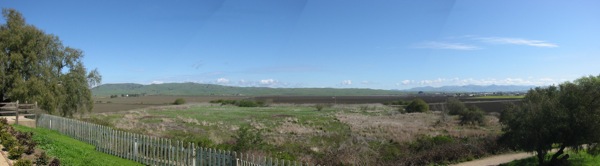
SanJuanBautistaPanorama.jpg
Looking north from Mission San Juan Bautista


As we like to do, we drove to Los Angeles with a friend, stopping to see another friend in Ojai on the way down, and dawdling in search of wildflowers on the way back. We stopped at Missions, too: I have my favorite sites and don't like to miss a chance to revisit them. One is at the edge of the little rose garden at Mission San Juan Bautista, where you gaze out over a flat expanse of farmland toward the eastern scarp of the San Andreas Fault. Last Thursday that view was spoiled a little bit by the extensive sheets of plastic covering the soil, which was probably being fumigated — one doesn't like to think about such modern industrial compromises with the higher aims of our existence, but there it is; and since it is there, it's good to be reminded of it.

(Others will be similarly discouraged by the thought of the hundreds of bodies in unmarked graves, just inside the wall in the "Indian Cemetery." It's politically fashionable to insist that the Mission movement was nothing but evil, exploitive, even cynical. You'll perhaps not be surprised to hear I think that's a bit simplistic: not only autre temps, autre moeurs, but also other truths, I believe.)

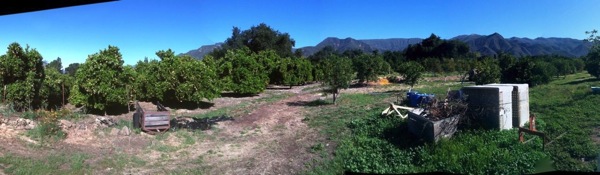
Then there was Ojai. Its valley was an inspiration, I believe, for James Nordhoff's Shangri-la; the writer lived in the Ojai valley. It is one huge citrus grove — citrus and avocados — relieved from time to time by the rather palatial residences of the rich who live quietly at the foot of the east-west range protecting them from north winds.

ChurchillOrchard.jpg
Churchill Orchard, Ojai


Malcolm points out that Chekhov writes of a Nature quite inflected by human activity; the natural beauty he contemplates is not wilderness but horticulture; and on this road trip I come to realize once again that I agree. The reassurance of the everpresent beauty — justice, even, I would say — derives from an intersection of natural context and human occupation or use. An appropriate use, of course, at the natural tempo and scale deriving from the natural energies: wind, water, gravity, animal and manpower.

I can never drive through California's Central Valley near Williams without thinking of old photographs my grandfather had, of enormous steam tractors big as small houses, standing out in mown and threshed wheatfields: they took the place of huge teams of horses, but likely moved not much faster. They opened a door, though, with the straining pull of an insatiable demand for ever faster, cheaper energy; and the result has been a widening of the gap between rich and poor, and a terrible cost to the environment. Demand for cheap labor, always related to willingness to exploit others for one's own comfort, always seems to result in some form of slavery.

The question arises inevitably on visiting California's Missions. We stopped at Mission San Miguel on the way back, after crossing the magnificent Figueroa Mountain in search of wildflowers — the blue and gold of lupine and poppy against sandstone and serpentine, enhanced by eddies of Kurosawa mists on an early afternoon troubled by changeable weather. The San Miguel sanctuary was badly damaged by the San Simeon earthquake of a few years ago, but the community and its parish rallied and somehow raised the funds necessary for a fine restoration. The cloister — wrong word, I'm sure, for the interior courtyard, originally little more than a stockyard — is nicely and modestly gardened; the cells left pretty much in the dark, furnished with the rawhide beds and crude tables and chairs.

Clearly the local population was worked in the vineyards and orchards, at the presses and ovens; and one can only wonder what they thought as they sat on the adobe floor of the church listening to sermons in Spanish and masses in Latin. The mental effort must have matched the physical, and they must have known they lived in a time of utter change, plunged from a preliterate hunter-gatherer society into one organized through the printed word, monetary exchange, and travel across great distances. I think California's Missions provide a glimpse into the Russian feudalism still living memory but soon to change utterly in Chekhov's day. I think, too, that we are utterly misled by sentiment when we try to apply contemporary concepts of social justice, themselves often based greatly on suspect assumptions of material needs and available energies, to a world now perhaps hopelessly distant from our ken.
align="left" cellpadding="0" cellspacing="5">

SanAntonio.jpg

SanAntonioFacade.jpg
Mission San Antonio


We drove from Bradley, on Highway 101, westerly through Lockwood to Mission San Antonio, one of the most isolated of the Missions. Much of the way we were driving through Fort Hunter Liggett, whose target ranges and airstrips are scattered discreetly among stately oaks in a broad, tranquil valley. The Mission itself is changed since I was last there, say twelve years ago. The Franciscans left, we were told; they'd pretty much let the place go to nature; Dominicans have taken over, the place is cleaned up, it's made available to groups for retreats, and Mass is again celebrated every Sunday for a local parish of three hundred souls or so.

The calla lilies were still standing in vases at the front of the sanctuary, their perfume mingling with that of candles and incense. God knows I am no Catholic, nor Christian either: but I respect the better instincts of those who are, and appreciate their places of gathering in devotion to the forces they think determine their nature and destiny. As I learned in my first week of college, in a required course on religion (I'd been sent to a Christian college in Los Angeles):
Religion is the serious and social attitude of individuals or communities toward the power or powers which they conceive as having ultimate control over their interests and destinies.
—James Bisset Pratt, The Religious Consciousness, page 2
From there we drove on to King City, where a county park features an interesting museum of local agriculture whose relics reminded me once again of my grandparents and great-grandparents; and then northeasterly to Highway 25, which runs north through the valley of the San Andreas Fault toward Hollister. This valley can not be photographed to any advantage; its physical impact on the visitor is spatial more than visual. The road runs between parallel ridges, the Pinnacles on the west, the mercury-bearing San Idria on the right. Apart from the asphalt the only human evidence is fencing and the occasional farmstead. The fields are grazed, of course; one wonders what the grasses would have been before cattle were introduced nearly two hundred years ago.


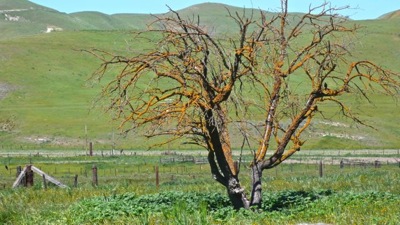
Highway25oak.jpg
Lichen-encrusted oak off Highway 25
(photo: March 2011)


When we entered Cold Creek Tavern on the Cuesta pass outside Santa Barbara, at 11:30, we were the only customers; when we left the place was nearly full. Twenty minutes later, when we left Highway Highway 154 to drive along Armour Canyon Road toward Figueroa Mountain Road, we were blissfully alone. We saw one or two cars on the mountain road. We saw none on the road from Bradley to Mission San Antonio, except for one slow tank truck whose driver obligingly signalled us to overtake him. We saw none on Highway 25. It continues to amaze me that on leaving the busy highways one can be alone for hours on these California back roads, even today, even after all the publicity their pleasures have produced.

Many more photographs from this road trip can be found here.


Wednesday, April 28, 2010

The Carrizo Plain

YOU CAN DRIVE from Los Angeles — well, Glendale, next thing — to Berkeley in nine hours and still take in the Carrizo Plain. I shouldn't tell you this. One of the great attractions of the Carrizo Plain is its emptiness: if all subscribers to The Eastside View decide to drive there next weekend there'll be a traffic jam.
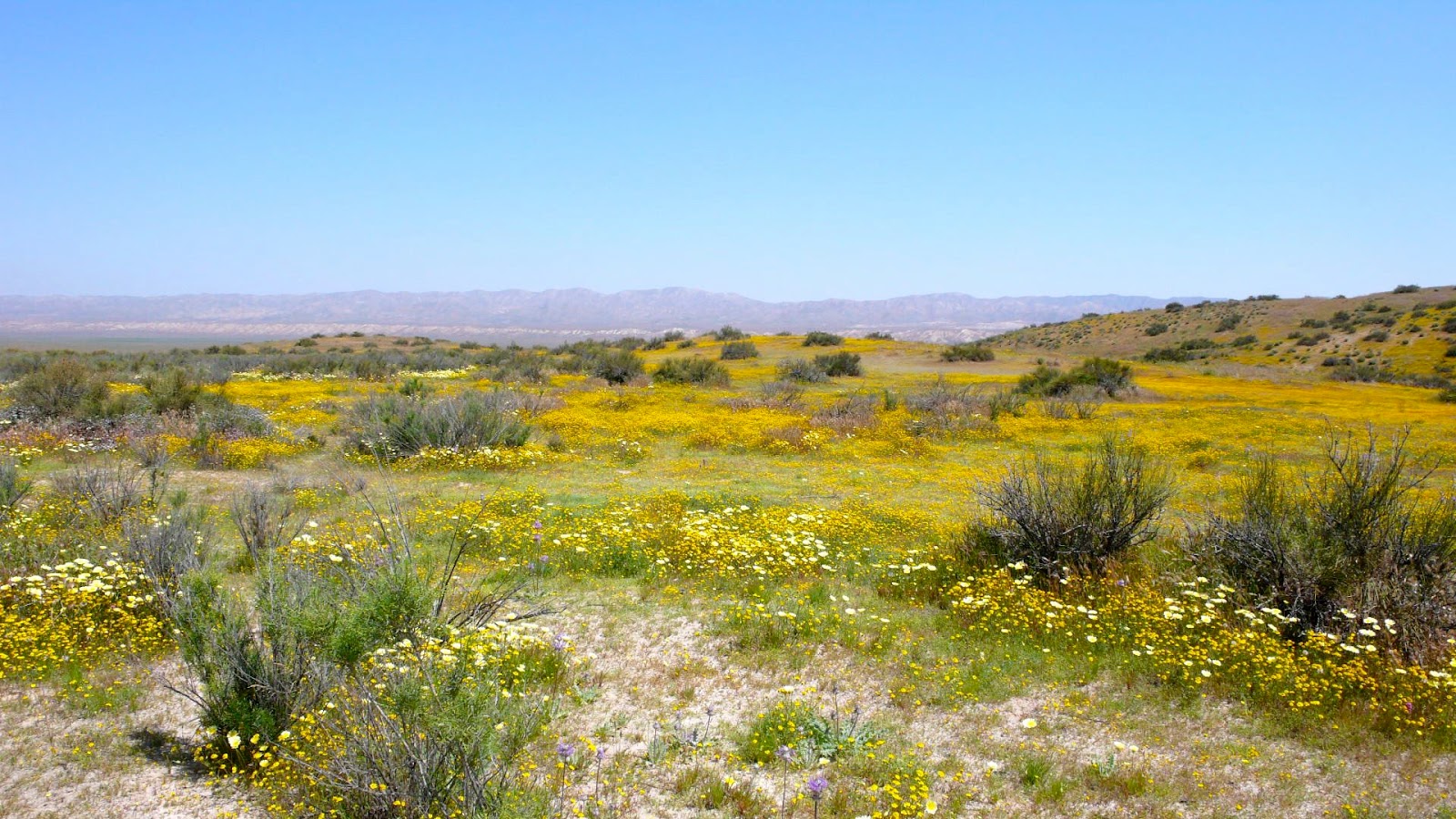
Carrizo.jpg

I've put a web gallery of photos up here; in the meantime you can make do with this shot — click on it and I think you'll get a bigger version. We were there perhaps a week too late for the peak of the wildflowers, but what we saw was well worth the drive.

We took the road south to north, driving up to the first ramp off Highway 5 north of the split from 99, then the long dreary road to Mariposa Maricopa, then on twelve miles through amazing country to the an abandoned gas station at a junction. There you turn north on Soda Lake Road, driving twelve or fifteen miles on unpaved road, through dry cattle ranches, miles of beautiful empty wide valley between low hills, finally coming to the federally protected National Monument lands.

We first drove through here quite a number of years ago, from north to south that time, also looking for wildflowers. Seems to me that was the time we caught them at their peak: the west-facing slopes of the hills above the San Andreas Fault, along the east side of the valley, looked like a Persian carpet of lavenders, roses, reds, yellows, and blues. What you see in the photo above is only a hint of what can happen here in exceptional years.

We took our time but covered the ground, driving 35 or 40 miles an hour up the road, stopping at the observation point on a low hill west of the road. We continued past the ghost town — actually the never developed town — of California Valley; then west on Highway 58 and up Shelby and O'DOnovan Roads toward Creston, and up Creston Road into Paso Robles where we joined 101 for the drive up to Berkeley. I'd never taken thoset 58-Paso Robles roads before; it's a beautiful drive, first through more empty wildflower country, then through vineyards, finally the unfortunate suburbs. Well, folks have to live somewhere, I guess. I'm glad they don't live on the Carrizo Plain.