Monday, March 05, 2012

Painting and pannekoeken


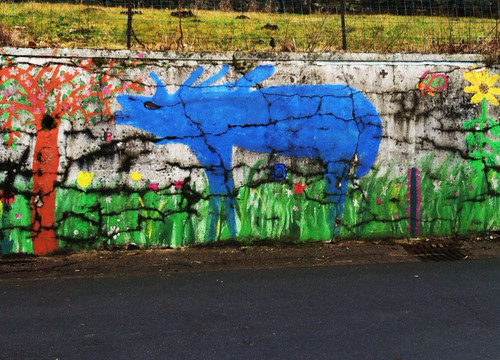
Evolution of stegosaur to elk:

Children's mural on retaining wall, Welchershausen, Germany

Oberhausen, Belgium, March 5, 2012—

WE STAYED IN today, for the most part. That's allowed: this game has no rules. I put on my coat at one point and sat outside the front door to clean the mud off my boots. The sky was light grey, as yesterday, and tiny snowflakes occasionally lit on my sleeves. A faint croaking turned my eyes skyward: scores of birds storks perhaps, quite distant and ungainly, flew determinedly north in three huge loose V's. it's cold: I quickly finish the boots and carry them back upstairs to wax them. 

Almost irrational, my fondness for these boots, bought four years ago for a trek across the French Alps, worn hundreds of miles, good as new. They treat me very well, so I respond in kind. Sharp rocks, persistent mud, even ankle-deep water don't faze them. Sometimes I think their cruelest assignment is to put up all day with my feet, and I often stuff them with cloth and leave them out overnight for air. Next morning, every morning, they're soft and supple in my hands, embracing and consoling on my feet, ready for another day of it, like a familiar animal, eager to ready me for another day of it.

After a late-lunch pannenkoek — these are among the best, perhaps the best, that I've eaten anywhere — we braved a cold wind to walk a kilometer into Germany, across a one-lane bridge over the fast, narrow ricer Oure, attracted by the promise of a unique museum. Welchenhausen is a tiny town, hardly more than four or five widely separated farmhouses, but its museum, advertised as the world's smallest, is open night and day, seven days a week. It's in a bus shelter, hardly needed for its original purpose since the bus doesn't come any more. 

The current show is a series of panels featuring engaging color photos and texts documenting the rebirth of village traditions attached to the calendar: Carnaval and Lent, Easter, May Day, Midsummer day, and so on. The texts and the installation are serious enough to persuade me that this is Anthropology, not merely Tourist Publicity: but of course everything was in German, which I do not read, so I may have been fooled. 

like the Germans, said Mevrouw van Steenbeeck the hotelkeep here yesterday, you have to admire their discipline. I'm sure you're right, I replied, but they seem to enjoy themselves, too. Oh they like to have a good time, she answered. They have their feasts and their holidays. An explanation struck me: They're Catholic, for the most part, no? Yes, she said, and they have their feast days. 

Mevrouw van Steenbeeck herself was born and grew up in Amsterdam, and bought this place with her husband thirty-five years ago, having fallen in love with both building and setting at first sight. Let's see: that would have been in 1977. I thought back to the Amsterdam I recall from those days, rather different from today's, and we agreed a little bit about the changes. Her own quarter, for example, was largely destroyed by the building of the huge theater complex at Waterlooplein, where the legendary flea market stood — I bought a wonderful serious raincoat there in 1974 for a mere five guilders, and it served well until a day when it rained in fact, and the coat dissolved into fistfuls of gooey wadding. 

As we were finishing our pannekoek this afternoon a fellow came in, looked around as if seeking someone… I told him Mevrouw van Steenbeeck was in the kitchen. (There's only her, today, and her husband, who seems to spend a lot of time reading the newspaper.) Ah so, he said, in German. Late sixties, I'd say, certainly Dutch, slim, rather muscular, balding, with curly white hair on each side. He was the only other person in the dining room tonight — yesterday there had been two other couples. 

He smiled at me encouragingly when I got up from table after the soup to stand a few minutes with my kidneys to the fire: I'm too old, I explained, in Dutch, He answered in German, and when I told him I didn't speak German said regretfully his only other language was Dutch — but said that in so thick a Limburgse accent it was very hard to understand. ultimately it began to lock in, or he reverted to the Dutch he'd learned in school.He was a painter, he said; he'd painted the three rather nice landscapes hanging in the dining room. A bit of van Gogh there, I said, in the geometry; I like them. 

He smiled in agreement: van Gogh, but not imitative. Painting like this, well done, shows not copying technique but learning from it, to turn it to something useful today. He's having a show of local landscapes in Reuland in April: I'll look for internet mentions. I come here for twenty years, he said, lapsing back into German. Has it changed in those twenty years, I asked; no, not at all. 

I asked Mevrouw van Steenbeeck later what his name is. Pierre Houden, she said, pronouncing it in the Limburgse manner, with a French "ou" making me misspell the name. That's now they talk in Roermond, she explained, resignedly. Yes, but "Pierre"? Not Piet? Well, she said, he's an artist, he's entitled. And he's nice, nose not in air.

Tomorrow, cold or not, we leave this wonderful spot foe a walk to Dasbourg. That's life, at least as I live it: find, enjoy, move on no regrets. Take the memories with you.


Sunday, March 04, 2012

Lost and found

From Google Earth: the forest in which we were lost today

Oberhausen, Belgium, March 4, 2012—

WE CHEATED A BIT yesterday — you see Curtis, we're not all that obsessed — and we paid for it today. The problem is, overnight accommodations along this stretch of the GR5 are few and far between; you have to plan carefully. Yesterday the shortest walk between our two endpoints would have been a good twenty-five kilometers, over our budget. So we cut nine kilometers by taking a taxi to bypass the first stage. At nine-thirty he was at our Vielsalm hotel, smiling and ready to go; we tossed the backpacks into the trunk and set off.

The ride took twenty minutes or so, partly because our taxiste was in no hurry. He pointed out sights along the way, telling us more about the incredibly evolved techniques for harvesting pulpwood, the mainstay of the local economy: giant robots, guided by remote control, climbing the hillside to clear-cut huge tracts, strip the branches, cut the trees into two-meter lengths, and stack them to be picked up after they've seasoned a bit.

We were curious about hunting. Deer, pigs, and wild goats are taken in November and December, but the trails are safe for us now; hunting is out of season pour la réproduction. The country we've been walking through seems very forest-oriented, particularly at table: venison, boar, and wild duck are often on the menus; forest berries accompany them, and flavor the spirits you take as a digestive, or to warm you on cold evenings.

Taxiste dropped us in Commanster, a pretty little town with a fine stone church, two or three houses, and the memory of an unsolved murder. In November 1955 Arsène Lecope, a man in his fifties who lived with his two spinster sisters on their small farm near the church, was set upon near the cemetery by a large man wearing a black hood as he was returning from his habitual Monday evening smoker with the other old boys in the neighborhood. 

He was strangled, but managed to beat off the assailant and drag himself to the nearest house. The doctor was summoned and reassured everyone that the victim's condition was not serious. He worsened, though, and died a few days later. This precipitated a police investigation, but the locals were apparently not very cooperative, and the case was never solved. I don't know much about World War II, but know of course the fighting was long and heavy hereabouts; I wouldn't be surprised if a long-simmering resentment concerning resistance or complicity were at the bottom of the case. 

The fields around Commanster are beautiful today; it's hard to think how much blood has sunk into them over the years. We walked through them, through patches of forest, through more fields; through the ghost embankment of the old railroad, long since disappeared otherwise, through the villages of Braunlauf and Schirm, always hopeful for a café, always disappointed.We left the GR5 after Schirm and walked down past another imposing farmstead into Grüfflingen, meeting the first human we'd seen since the taxiste, a pretty girl in her 'teens with a border collie at her heels. Bonjour, excusez-moi, est-ce qu'il y a un café dans la village? She looked a little surprised and amused and answered in excellent English, Oh no, no, I'm sorry…

Pourquoi parlez-vous anglais? Nosy me asked next. The answer came pertly, woth a light little laugh: Because I can! And on up the road she and her collie went.And we continued on ours, through more forest and fields, past a bunker and a huge agricultural operation, down into Burg-Reuland and our night's hotel. 

It had been an easy day, fifteen kilometers, not much climbing, but we were a little footsore. Still, after cleaning up and changing we went for a stroll around town. The ruins of a fine old fort, burned by the French in the 1790s. A fine city house painted a striking deep red. Houses with small orchards, chickenyards, dogs. From a barn next one of these village houses, the bleating of a hungry calf.


Today, though, ah, today was difficult. The climb up out of Reuland was one of the steepest I've walked, and soon after we'd leveled out and were enjoying a walk down a country road between fields we somehow missed a turn. I don't know how it happened; I think the balissage was missing, and I wasn't sufficiently attentive. The guidebook and its map both clearly show a right turn at a crossroads, but we came to none. 


Finally we came to a mud road leading off to the right, and there stood a huge oak with the only blaze we'd seen in quite a while: the X-shaped cross of red and white stripes that say Go No Further.So we took the mud road. No more balissage. Back to the country road and ignore the X. That way clearly is wrong, map and compass tell me: back to the mud. We follow this until we come to the forest; we enter the forest; we get completely lost. There'd been a heavy mist or very light rain all this time; even in the open it was hard to orient yourself by the light; in the woods I wasn't sure we could count on our GPS. 

Still, I trusted the compass. The right way was far too steep a descent in this terrain, badgerholes, fallen branches, leaves, our heavy packs: we went along the contour and even a little uphill. Finally we came to the clearing and I saw what must be the trail. A hundred meters down a grassy slope and we were on a dirt road; almost immediately we saw the welcome balissage: white stripe over red. From there it was a piece of cake, or nearly. 

We met our first co-walkers of the last four days, and they gave us both advice and a better map. We took a steep climb up to the edge of Luxembourg, then — following our new map — left the GR5 and walked a kilometer or so down an asphalt country road (rarely a car or tractor to be seen) into town. There, in front of us, our hotel, with its reassuring sign PANNEKOEKENHUIS; and there we are tonight — and, for all I know, tomorrow night too, as it may snow tomorrow. We've walked four days now, about sixty kilometers (thirty-eight miles), not bad, given the terrain.

Saturday, March 03, 2012

Why Belgium?


bunker in the distance, field near Burg-Reuland

Burg-Reuland, Belgium, March 3, 2012—
I'VE NEVER REALLY understood the point of Belgium. So small a country seems to me to make no sense unless it's to express a uniquely strong sense of unity. Denmark, for example, makes sense as a counter-statement to the rest of Scandinavia. Larger countries like Germany, France, Italy have made themselves nations by integrating smaller communities with the sheer weight of their size, even then not that easily. But how can Belgium justify nationhood, other than by refusing, fraction by fraction, to be subsumed by one neighbor or another?

It was partly in order to explore this that I thought of taking this trek across the Ardennes. The town we're sleeping in, tonight, numbers about 500 citizens, our barkeep-hotelkeeper tells me; yet it's quadralingual: French and Flemish, the two majority languages of the nation; German, which is perhaps grudgingly approved since Germany annexed this area temporarily a while back, and the local dialect, which seems to me to mediate among Dutch, German, and the peculiar language they speak in Luxembourg — a language which is, I think, like Alsatian, really a modern development of Gothic, not merely a dialect of German.

In the last few days I've opened conversations in French, and the usual immediate reply is in an incomprehensible kind of Dutch — Flemish, I suppose, spoken as a second language by people who are just trying to be polite. When I then explain that I don't speak Flemish my interlocutor responds in an almost equally incomprehensible French. This was until today, when in Spa and Stavelot and Vielsalm we were in the country of Wallonia, where the locals seem to prefer speaking, well, Walloon, a strange cousin of French.

English is spoken at hotel desks and to a limited extent in restaurants; it is never seen, not even on menus. When I asked a man in Stavelot for bus information — an old man sitting in the sun on a bench with his dog — he answered in Flemish at first, then switched to French. He asked where I was from: California, I told him. Oh, pas Australien? (I think my hat had misled him to that conclusion.) No, California, I said, in the west of the United States.

He formed his hands into pistols, not letting go the leash, and smiled, and said Wild West! Paf paf! I smiled and said Yes wild west, il faut après tout tuer les vaches, and he smiled, and I walked away.

Great as these linguistic differences are, I don't think they cause the fractionalization of Belgium. I think they rather are one of many results of a single cause, the intrusion of foreign structures on thitherto specifically local societies. Our friendly (not to say loquacious) hotelkeep in Vielsalm told us of a distant ancestor who was peacefully minding his own business in his workshop when Napoleon's army marched through town, informed him he was joining the troop as a sapper, and had no choice but to go with them as a noncombatant (perhaps not trusted with arms), on the Russian campaign, which he not only managed to survive, but even took advantage of to the extent of bringing back to Belgium (as it would become in another thirty years) with a Belorussian wife. Hence the improbable name Bérinzenne, a community outside Spa. These people butcher foreign languages worse than do the Brits.

The same hotelkeeper told us his grandfather had fought on the German side in World War I, having no choice, as after the Germans had annexed Belgium, after only twenty days of war, he was after all a German, and followed orders or else.

When his son received a similar notice a generation later, though, he told his mother he wouldn't obey, and instead left in the middle of the night, somehow making his way south across France and Spain to Gibraltar, where the British, impressed by his resourcefulness, took him in and sent him to Scotland to help train Commandos.

This southeastern part of Belgium belonged to the Royaume of Luxembourg, as I understand it, until those leaders of the free world the French, because 1789 made them republican and egalitarian, not monarchic, and intent on spreading the word Enlightenment everywhere, decided it should be French, and so it remained until the Council of Vienna, presumably not knowing what else to do about Flemings, Walloons, and other such non-belongers, decided to throw them all in together in one tiny buffer state with its own king.

Industrial savvy and a huge, rich African colony — don't ask me how they got that — made Belgium work, more or less, among modern post-Napoleonic countries up until the tragic 20th-century German expansions. Having walked three days through the country and talked to a handful of representative Belgians I feel pretty authoritatively that the country could be self-sufficient; there's good farmland, God knows plenty of trees, and that endless supply of Spa water.

Tourists like to come here for what they lack at home: the Dutch for hills; Germans for food closer to that of the French; the French no doubt to feel better about being French, not that they need reasons; people of all nations, sadly, to visit cemeteries. To me the people hereabouts seem relaxed and secure. The Vielsalm hotelkeeper, as if to explain why he stayed in this little provincial city, said Look, I'm forty-two, I was born here, I love my country, I know it rains a lot and the mud is terrible, but it's beautiful, it's not like anywhere else, and I'd never leave it.

(There must be something in his gene pool, though: he too has a Belorussian wife; I never found out why.)


- Posted using BlogPress from my iPad

Friday, March 02, 2012

Tramping in the Ardennes


Vielsalm, Belgium, March 2, 2012—
WALKING, STROLLING, RAMBLING: those are all very nice. But it occurs to me today that what we're doing here is none of those: it's tramping.

We had a couple of pleasant rambles in Zuid-Limburg with Hans and Anneke, walks of no more than five miles, in a loop beginning and ending in the same place, carrying nothing but our cameras. That's a ramble: an outing whose only purpose is to enjoy the day, the company, the out of doors, the views; the sounds of birds and the brooks; villages; a cup of tea; maybe an unexpected poem out in a pasture.

But yesterday and today we walked with a purpose: to move ourselves and our possessions from one resting-point to another. These trajects are linear. They have purpose. The only thing that redeems that, in my view, is that the purpose is utterly stupid. Today, for example, we walked ten miles, in three hours and forty-three minutes, climbing from 276 to 525 meters and back, much of the time on muddy trails and roads, to get from Stavelot to Vielsalm, when the bus would have got us there in about twenty minutes, for about ten dollars. And my back-pack weighs, I think, about forty pounds!

(I know the walking statistics in detail thanks to a wonderful iPhone app, MotionX-GPS, which records distance, speed, and elevation, and plots the results on a map. You can see the result, for today's trek, at this webpage, at least for the next few months.)

This kind of trekking has become one of my consuming passions. It began, as so many things do, with a chance encounter with a book: Walking Europe Top to Bottom, by Susanna Margolis with Ginger Harmon (Sierra Club Books, 1984).

This book challenged me instantly, and I determined to make the trip, retracing these steps on Europe's Grand Randonée 5 from Hoek van Holland to Nice. I quickly decided to modify the walk, though, substituting a walk on the Pieterpad, through the whole of The Netherlands, Pieterburen in the north to St. Pietersburg near Maastricht in the south, about four hundred miles in all, for the first part of GR5, across Flanders to Maastricht.

We began that walk in 1995, I think it was, Lindsey and I and did the first half that year, returning for the second half a few years later. With Lindsey, and occasionally with friends, or daughters, or both, we've taken other walks in that delightful country, point-to-point walks, carrying only one change of clothing for the evenings, eating picnic lunches, dinners in restaurants, and sleeping in provincial hotels or B&Bs.

All the time I kept thinking of the GR5. Finally I invited a grandson and a friend to join me on its final third, about four hundred miles from Geneva to Nice, an unforgettable four-week walk we took in 2008. (I blogged about it at http://sherewalking.blogspot.com, and later published a book about the walk, Walking the French Alps)

I felt a little remorse, though, at having skipped the dues you pay, so to speak, for this splendid conclusion to a long-distance trek, and that's why we've been slogging througih mud here in Belgium. Though even here I cheated quite a bit, beginning not at Maastricht but several stages (and kilometers) later, in Spa. The area around Liège just didn't look promising.

Yesterday we walked from Spa to Stavelot. The day began and ended badly: we got lost almost immediately, adding a kilometer and a half — and, worse, a fair amount of elevation lost and regained. The problem was lack of balissage, trail-marking, at a crucial point, where the trail crossed a quick-flowing stream: instead of crossing it, which I now see was the correct maneuver, we walked downhill alongside. By the time I realized the problem it was too late to retrace our path; better to take a parallel path and hope for a cut-across. It worked out, up on top of the hill south of Spa, a hill improbably crowned by an extensive marsh which is in fact the roof of the huge Spa water table.

Things worked out well enough the rest of the day, barring a fall apiece into the mud, thanks to treacherously slippery footing. At day's end, though, we discovered the hotel I'd booked was miles away from the day's endpoint. Fortunately, there was a bus. Unfortunately, the driver forgot to let us off, took us miles too far, then dropped us off to wait for a bus coming back…

Oh well, these things happen. Next morning — this morning —the woman working the hotel gave us a lift into town (Stavelot) and we set out on today's walk, arriving here in good time.

Logistics, logistics. Where to sleep next, and how to be sure the day's walk isn't too long. Tomorrow we'll take a taxi to bypass the first 8 or 9 kilometers; otherwise the day-stages get completely out of sync with the possible sleep-villages. There aren't that many, and much is closed for Lenten holiday.

Tuesday, February 28, 2012

Pleasures and proprieties

 Epen, February 28, 2012—

THIS HAS BEEN a particularly nice stay, the last couple or three days in our beloved Netherlands — as always, I look forward to leaving woth regrets. A lot has to do with the company, our even more beloved Elfrings. A lot has to do with the pleasures of rambling, too: but those will continue another week or so, as we make our way toward Luxembourg.

But a lot has to do with The Netherlands, a country that never fails to impress me with its improbable marriage of pleasures and proprieties. I wrote yesterday of a poem found in a pasture: I tried to include a photo with that  but the WiFi here failed: the only little disappointment here.

We drove across the border yesterday to check out Aubel, a Belgian town I'd thought might make a good first stop on our projected walk. It had seemed nice on the Internet, but proved bleak and heavy on our visit. The Belgian architecture is heavy and dour by contrast with the Dutch, as if to emphasize a temperamental difference suggesting the Belgians are withdrawn and individualists, the Dutch more open and communitarian. 


Today we walked across the border to the town of Teuven, where we had lunch — borrelhapjes (bits of cheeses and sausages, dipped into mustars or syrup) and beer. this was pleasant enough, and artisinal too: I think our walk will have its pleasures, especially in the countryside.


Hill and dale is what it is here, the dales descending to quick-moving streams, almost narrow enough to jump but rivieren nonethless, the Geul and the Gulp, the latter giving Limburg its Gulpener beer. Cattle and sheep; chickens; cornfields later, perhaps. The first snowbells and crocus are well up, the mists are soft and bracing. Tomorrow we take a bus to Maastricht, then a train to Spa. No definitive plans beyond that other than to shoulder our packs and walk toward Luxembourg, and that's how I like it.

All we like grass…

Epen, February 28, 2012

On yesterday's ramble through the fields along the river Geul we came upon a poem engraved on a tablet set out in the pasture:


MIJ, SCHAAP

Mij, schaap, overkomt niets dan wat de herder wil,
wat het gras wil, de lucht,
wat de dam en de groene overkant.

En ik tors mijn wol mee of het verlies van wol,
en ik kijk vol overgave uit mijn
vochtige ogen. Ik ben gelukkig met wat ik heb.

De tijd verstrijkt als gras, door mij,
en elk verzet is hol. De bomen ruisen zinneloos.

—MARK BOOG


Which I translate, with Google's help (or the other way round)


ME, SHEEP

Me, sheep, nothing happens than what the shepherd wants
what the grass, the air,
what the dam and the green beyond.

And I my torso with wool or loss of wool,
and I look diligently from my
moist eyes. I'm happy with what I have.

Time passes like grass, through me,
and any opposition is hollow. The trees rustle senseless.


Such an intelligent, enlightened country, Netherlands…


- Posted using BlogPress from my iPad

Monday, February 27, 2012

Dutch interior

Epen, Feb. 27,2012—


WE VISITED AN ACQUAINTANCE yesterday in her twostorey brick bungalow set among oaks, beeches, and birches in a semirural suburb of Eindhoven, where she has lived for over twenty years with her cat, her tastes, her enthusiasms, her regret for her witty, good-natured husband who died suddenly twelve or fifteen years ago…

Among her enthusiasms: running a series of readings by significant authors in many fields: fiction, poetry, history, science. Saturday our friends Hans and Anneke had gone to hear Dick Swaab discuss his Wij zijn ons brein: van baarmoeder tot Alzheimer (Uitgeverij Contact, Amsterdam 2010), and spent the night, and we had gone yesterday to meet them, and renew acquaintance with Mevrouw W.

What a fine, rather elegant, composed woman she is, and what a fine sensibility! Her home is beautifully curated, as Lindsey pointed out… in the entry hall, for example, a painting apparently from the Seventeenth century, a sober, handsome man looking out over your left shoulder, hangs above a low three-legged stool on which was centered a bowl of fragrant apples.

Directly as you enter the large, low-ceilinged main room, if you turn to look back, you see a fine white tapestry covered with those geometrical toches of primary colors that unmistakably announce Bart van der Leck. On the wall at the right a massive oak armoire, from the Eighteenth I'd guess, and looking northern, from Drente perhaps; nearby, hanging just a bit askew, a fine pendulum- clock probably from the same time and place.

The far side of the room is a series of floor-to-ceiling windows looking out to the garden, a lawn surrounded by borders, then the woods. At one end, a pond with a discreet fountain and dormant lily-pads. Curled up on the doormat just outside the door, tail carefully wrapping him, a black-and-grey tortoiseshell cat whose folded triangular ears make you think of Leck again, and sure enough, when you turn back in the hall to thank her for the visit, you catch sight of his signature painting of a folded-ear cat hanging in the upstairs hall.

One doesn't pay such a visit without accepting coffee and a little something. The coffee was enriched with Amaretto and topped with slagroom, sweetened whipped cream; alongside, a delicious white cake with buttercream filling.

Everything here was in its place, and every place was right. This is a life, you sense, that isn't distracted by irrelevancies, or by things that don't count for something, don't hold their place and give their weight to a continuing conversation, among books, furnishings, paintings, friends, memories, and of course the cat; a conversation that fills the time, investigates questions that may arise, entertains its participants, and keeps that devil boredom out the door.

Sunday, February 26, 2012

"Heureusement, je fume"

Puiflijk, February 26—

 I QUIT SMOKING in 1968, after sixteen years of mostly pipe-smoking. It wasn't too hard, though I'd been a serious smoker, the equivalent of a pack a day. The pipe was a great pleasure, partly for all the accoutrements, partly for the physical pleasures of manipulating pipes, pouches, lighters, cleaning-spoons and the like, partky of course for the glorious taste and smell of the tobacco itself. Over the years I'd graduated from the cheap rustic satisfaction of the Grainger brand, rather a bland but edgy Pale Virginia leaf, to the deep rich 796B, blended to my own specification, with lots of Latakia, by the venerable Berkeley firm Druquer's, of fond memory.

In 1968 Anthony Boucher died. He was a magnificent man, a fine writer of mysteries ans fantasy, a specialist in pornography, canon law, and liqueurs which he used to study on annual cruises to Europe and back on the ols steamer lines. I knew him only slightly: he'd produced programs on opera and  mysteries for KPFA, where I was music director; and he joined John Rockwell and me on critics' panels there and, later, at KQED, where I helped produce another such weekly round-up, Culture Gulch. I'd admired him for years, and was saddened by his final months, and I'd visited him in hospital, where the shock of his greatly altered appearance, lessened and divested of his usual regality (amiable, though), revealed the ravages of lung cancer, making it much easier for me to quit smoking.

Other strategies helped. I took up a more serious attitde toward drinking. I enjoyed a subtler sense of taste. I promised myself I'd resume smoking, if I wan ed to, on my fiftieth birthday, which was only seventeen years off. Oh: and I was thinking of my wife and kids, whose life would be made more pleasant without ashtrays and smoke, not to mentiion the money saved. And I made a pact with my oldest daughter: if she stopped biting her nails, I would give up smoking.

So I did, cold turkey. Since then I've only smoked once, twenty years ago I think, an after-dinner cigar, a very good one I was promised, at the very soigné wedding of a couple of acquaintances, held at Francis Ford Coppola's estate, hardly a routine drop-in on our calendar. The cigar left me pale and queasy and I abandoned it halfway in.

Until last night, when Erik brought out a box of cigars after dinner, and Krijn tempted me to join them, telling an anecdote involving a tobacconist in Den Haag, who knew how to set broken merchandise aside for his own later delectation…

I thought of something I'd read in the airplane a couple of days ago, an appreciation of the pleasures of tobacco, la pipe, by Stéphane Mallarmé:

 Jetées les cigarettes avec toutes les joies enfantines de l'été dans le passé qu'illuminent les feuilles bleues de soleil, les mousselines et reprise ma grave pipe par un homme sérieux qui veut fumer longtemps sans se déranger, afin de mieux travailler…

And when Erik responded to my regretful demurral that an entire cigar would be far too much for me to attempt — really an excuse more than a demurral — by offering instead a miniature cigar, from P.G.C. Hajenius, in Amsterdam — and I reflected that after all the Dutch had been aficionados of and expert in tobacco for centuries — i gave in, held the tip of my cigarillo over the candle-flame a few moments, and drew in a half-mouthful of calming after-dinner solace, as my grandfather had done the last eighteen thousand evenings, give or take, of his long life.

I thought of my oboe teacher, if I may call a man I've visited only twice such an intimate, who'd advised me to smoke if I were to dry my mouth in order to play the thing more comfortably: aha: perhaps that's why Nelson, excellent horn player, had become such an adept of the pipe. I remembered how to roll the smoke around in my mouth, tonguing it as a dog noses sheep through the fold, and I practiced taking smaller amounts, so as neither to cough nor to inhale it into the lungs. 

It's more complicated than it looks, smoking — many seemingly automatic activities are, even the pleasurable ones. I recalled my beother, whose cigarette pack had yielded up a critically needed but if tinfoil at a moment when, stranded in an isolates village on an outer island in French Polynesia with a blown fuse on our rented motor-scooter, suddenly and surprisingly providing an inspired comment as I recounted the adventure to oue hotelkeeper:

Heureusement, je fume. Happily, I smoke.

Fortunately, I no longer do: but I'm glad to have been reminded of the pleasures…

Saturday, February 25, 2012

Back on the long road…

In flight, February 23, 2011—

THIRTY IN THE New World, including two in Baja California. Twenty-six, I think, in Europe; seven in the Pacific.  That makes sixty-three airports flown into or out of so far. I mention it partly because others have made comments that might be interpreted as suggesting we travel rather easily, ma douce femme and I: and in fact I've lost count of the transatlantic crossings, which I used to tot up in my mind on each lift-off toward Europe.  1973, '74, '76, '77, '80… lost in antiquity. 


 This trip is more ragged than most. I mean, the itinerary is ragged, improvised and imprėvu, unlike others we've taken. As I grow older I want more and more to do everything: recapitulate earlier experiences for myself; share them with others; find new experiences. So today we fly to Amsterdam, there to join old friends at a favorite restaurant; then we spend a few days in a less-familiar quarter in a very familiar land (my second home, in fact, Nederland); then we walk for I hope nine days across unfamiliar country… 


 We have one checked bag, which I will carry on my back, as I did four years ago across the Alps; and one carry-on, which Lindsey will carry on hers, as we have done often before. They will take us through the next two weeks.  At that point we rent a car, and perhaps accumulate more baggage. I rather hope not.  Along the way we visit our extended family: our Dutch siblings and their children and their children's now and former wives; our Swedish-Luxembourgish daughter and her three children, our French daughter and her husband and daughter. 


All these people — twenty or so — we think of as family, very nearly as close as our own blood: but, like our direct blood relatives, as dear friends also, people whose lives, experiences, interrelationships, enthusiasms, achievements, pleasures and occasional sorrows shade and illuminate our own, and those of our immediate family, and the close friends — not so many!— they have not yet encountered. 


 I find these last few months that these things matter more and more. A walk taken the other day with Oldest Daughter and a friend of hers — close friend of hers, more occasional friend of mine —  was strangely moving: nine miles altogether up two thousand feet, then back again, in chaparral on old lava country, putting me in mind of Provence and Corsica, though we were hardly an hour from home, near Calistoga. 


The silence of such hours, when shared with friends and family, overrides the ego's noise. I merge into the landscape, that eternal context I was born from: it was a mistake ever to have tried to set it aside, to make my way without it. It will win in the end, when I melt back into it, physically, as emotionally now I merge into the collective life of all these friends I contemplate. 


I've outlived my mother now by a couple of years. I used to wonder why she traveled so much, in her retirement: China, Australia, the trans-Siberian railroad and the Silk Road, Peru, the Nile… I thought she must be distracting herself from her usual daily life on these voyages to exotic places, hoping perhaps to shake mortality off the trail. I see now I was dead wrong: she was traveling into herself, back into her real state of relationship to Life and Being. At such extended moments, I think, we live most fully, because least wilfully. We are more than usually authentic, at home with ourselves and with our setting, and learning, perhaps, to be away from our selves.

Tuesday, February 14, 2012

St. Valentine's Day


LRS70.jpg
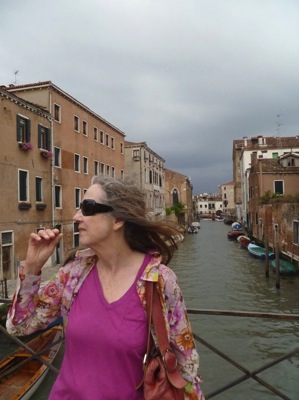
My Valentine, on her 76th birthday in Venice
(photo: Francesca Źivny)
Eastside Road, February 14, 2012—
I DON'T CARE what Pope Paul VI says, I like St. Valentine's Day.

He took it off the general calendar back in the 1960s, complaining that, after all, nothing was known about any of the two or three Saints Valentinus, or their doings, or any of that. Typical of the administration of the Catholic Church, to care more about an abstract authenticity of origin than the events and experiences of daily life and lives that contribute to the greater reality of immediate meaning.

The first poem written to mark Feb. 14, I read this morning, was by Charles (!), duke of Orleans:
Je suis desja d'amour tanné,
Ma tres doulce Valentinée,
Car pour moi fustes trop tart née,
Et moy pour vous fus trop tost né.
Dieu lui pardoint qui estrené
M'a de vous, pour toute l'année.
Je suis desja, etc.
Ma tres doulce, etc.


alas he wrote from The Tower, imprisoned by the dastardly Brits after Being taken at Agincourt.
I am already sick of love,
My very gentle Valentine,
Since for me you were born too soon,
And I for you was born too late.
God forgives he who has estranged
Me from you for the whole year.
I am already, etc.
My very gentle, etc.

The source for all this is, of course, Wikipedia, which also says it was Chaucer, Brit of blessed memory, who first popularized St. Valentine's Day through a reference in his Parliament of Birds. I begin to note stirrings of amour among birds hereabouts, and I'm ready; I've cleaned out the bluebird houses…

Sunday, February 12, 2012

The Great Gatsby


Marco Pannucio, Susannah Biller, Julienne Walker, Jason Detw.jpg
Marco Pannucio (Gatsby), Susannah Biller (Daisy), Julienne Walker (Jordan), Jason Detweiler (Nick), Daniel Snyder (Tom)

(photo: Steve DiBartolomeo)

LET'S STIPULATE AT THE OUTSET: a novel is one thing, an opera quite another. This observation is irrelevant to comments on one or the other, but not to the subject at hand, for in my opinion the most absorbing thing about last night's performance of John Harbison's opera on F. Scott Fitzgerald's The Great Gatsby was precisely that: the adaptation of a great novel to the lyric stage. And the adaptation was entirely Harbison's, as I understand it: scenario, libretto, and music all conceived and executed by a single mind.

Malcolm Cowley, in his introduction to an edition* of Fitzgerald's three great mature novels (Tender is the Night and The Last Tycoon being the other two), suggests the method Harbison uses in his adaptation when he notes that
Each chapter consists of one or more dramatic scenes, sometimes with intervening passages of straight narration. The "scenic" method is one that Vitzgerald probably learned from Edith Wharton, who him turn learned it from Henry James…
Harbison makes a very straightforward compression of the novel, choosing pivotal scenes for (mostly) ensemble portrayals and linking them with orchestral interludes whose dual purpose it is to move the action (often literally, by car, driving from Long Island to Manhattan) and to "portray," through instrumental music, an emotional response to Fitzgerald's novelistic purpose.

Two problems immediately arise here. One is general, and is suggested in those scare quotes around "portray": can instrumental music suggest the profundity and the vague richness of emotional and (dare I say) philosophical speculation of the kind The Great Gatsby attains? Only, I think, when said music can borrow the already present allusiveness audiences find in musical genres whose language and literature they are familiar with, and only when the music itself is composed with a masterly consistency of style and technique. It's not Harbison's fault that these qualities are lacking at the present cultural moment: and it's certainly possible that his opera will be able to draw on them in some future.

The other problem is specific to The Great Gatsby, which Cowley goes on to put
in the Jamesian tradition… having the story told by a single observer, who stands somewhat apart from the action and whose vision "frames" it for the reader. In this case the observer plays a special role. Although Nick Carraway doesn't save or ruin Gatsby, his personality in itself provides an essential comment on all the other characters.
In the novel, Cowley suggests, "Nick stands for the older values that prevailed in the Middle West before the First World War"; the other characters "belong to their own brief era of confused and dissolving standards". Cowley's is an economist's construction of the novel; his introduction also deals with Fitzgerald's essentially straightforward relationship to money, and to Marxian positions on literary criticism. But economics is more than money and social class: it's a system of discussing value and "values" in more general and more pervasive terms than those centered merely on lucre.

And the success of Fitzgerald's novel, to me at least, is its way of propelling its surface brilliance and fascination — the brittle seductive opulence of its drives and desires — with an engine whose power is generated through the weight, the mass of entire generational and geocultural forces. One deft comment of Nick Carraway's, omitted from Harbison's opera, sums this up for me: he describes Jordan Baker taking a seat at the dinner table as if she were getting into bed. You don't know what this means, exactly, but you see it happen. The line makes you think of Noël Coward; it precisely defines the irony of Fitzgerald's style.

I think this important, as it distinguishes Fitzgerald from James, moves The Great Gatsby away from "the Jamesian tradition", whose complexity had threatened the utility of prose fiction as social commentary. The Great Gatsby is in the Austen-Flaubert-Chekhov tradition: "scenic," but ironic. It is for us twentieth-century Americans what Madame Bovary was for the late nineteenth-century French; it reveals the lassitude and debility and, finally, tragedy that follows a nation's lapse from those traditional values — call them moral if you like — that focus a community on practical means of meeting communal dangers.

It may be pointed out that an opera is after all only a night in a theater, singing and staging; one doesn't go to an opera for a disquisition on social or moral or economic justice. There are exceptions, of course; Le nozze di Figaro comes to mind: but it's never fair to mention Mozart in such a discussion; he's always the great exception proving the rule.

But the brooding, almost Wagnerian qualities of much of Harbison's writing in the orchestral interludes makes me suspect their "portrayals" reach toward these kinds of concerns. And among the most powerful of the purely instrumental pages in the score are those in the final interlude, "Day Through Night," moving toward Gatsby's funeral; and those in the epilogue, which finds Nick Carraway gazing out across the water toward the Buchanans's green light, contemplatively singing the magnificent final sentence of the novel, which completely seals the interpretation of The Great Gatsby as much more than a story of love, adultery, superciliousness, inevitable tragedy.
Harbison's vocal music persuades me less. The opera is high-pitched, and among the least convincing music is that for Daisy and Jordan — especially their duet (soon set within a quintet) expressing their reaction to the stifling summer heat. It's not just that the words, whether Fitzgerald's or Harbison's, get lost in the high tessitura: it's that the melodic contours follow some incomprehensible directive, neither tonal nor not, perhaps meant to express the result of the mind-numbing heat, but unfortunately not ultimately engaging this pair of ears.

I mentioned Wagner earlier: much of the opera's score lacks air, crispness, definition. "Endless melody" no longer convinces me of deep or distant vision; perhaps it never did. The lack of clear key relationships, of sections distinguishable from one another by key, tempo, and instrumentation, encourages this listener's mind to wander, and that's a danger when there are so many things in the otherwise faithful adaptation of this great book to contemplate.

I have no complaints about the reorchestration of Harbison's score, reduced by Jacques Desjardins from the original large orchestra with winds in threes to a smaller but still considerable one with pairs of woodwinds and French horns, single brass, and reduced strings. I've never heard this opera before; I don't know if other musical adaptation was involved. The style of the onstage dance orchestra seemed perfectly authentic to the period (the Roaring Twenties, of course).

Nicole Paiement conducted with the precision, the attention to detail, and the grip on the long line that I've come to expect from her. I've heard her conduct operas now by Lou Harrison, Philip Glass, and Virgil Thomson: in every case she works for the composer, not imposing interpretation but respecting the composer's style. Her orchestra played well.

Matthew Antaky's physical production was quite effective, with Austin Forbord's mood- and place-setting rear projections of still and moving images of the water and the iconic Valley of Ashes — how many today realize the extent of ash-heaps in the coal-burning time of steam heat and transportation? — and effective suggestions of opulence conveyed through careful lighting, colors, and properties. Christine Cook's costumes were elegant, evocative, and character-defining.

I liked Brian Staufenbiel's directing, too. Each character, with the possible exception of Meyer Wolfshiem, seemed to have stepped out from the pages of the novel, fully fleshed out, with complex pasts and present needs; and all of them, even Tom Buchanan, were ultimately sympathetic. The party scenes were handled well for the most part; much of Tom Segal's choreography seemed deft and authentic, though long freezes and slow motion in backgrounds sometimes made longer soliloquies awkward: the intimacy available only in large crowds, which Daisy (or was it Jordan) mentions at one point, wasn't always at hand when needed.

You see the principal cast in the photo above: all sang well, I thought, on pitch, clearly when tessitura allowed, and acted well, both individually and in relationship to one another: this seemed like a well-prepared, well-rehearsed repertory production.


*Three Novels of F. Scott Fitzgerald: The Great Gatsby; Tender is the Night; The Last Tycoon. New York: Charles Scribner's Sons, 1953
  • The Great Gatsby: opera by John Harbison, after the novel by F. Scott Fitzgerald. Ensemble Parallèle Opera, Yerba Buena Center for the Arts, San Francisco; Feb. 10-12, 2012
  • Monday, January 30, 2012

    On the trail

    Eastside Road, January 29, 2012—

    LRStrail.jpg
    Lindsey on the trail
    ON THE ROAD AGAIN, as you see. The last week of January is so often a beautiful false spring here in the Bay Area; ornamental plum trees begin to blossom to everyone's consternation — So early! It's never happened before! (You hear this every year.) And our feet begin to itch, so I strap on the boots that have served me so well, and hoist a practice pack onto my back, and set the iPhone trail-tracker, and off we go.

    Today's hike — it was a bit too strenuous to be called merely a "walk" — took us through oak hillsides above Lake Sonoma, the artificial lake formed a number of years ago when one of the last of the Corps of Engineers dams was built in the great Northern California water project. We protested the building of Warm Springs Dam at the time, to a great extent because it interfered with local rights to the environment that had been in place long before the coming of Europeans to the continent. And I'm sure we had ethics on our side: but I wasn't so sure, yesterday, that I wasn't selfishly happy we'd lost the fight.

    The Visitors Center at Warm Springs Dam is closed at the moment — for renovation, the sign proclaims, but in today's economy you never really know why these facilities close. But the Corps of Engineers, which apparently maintains not only the dam but also the fish hatchery at its foot, maintains its own headquarters across the road from the Center; there you can get trail maps, and advice, and I suppose news of any recent threatening activity: poison oak, rattlesnakes, for all I know cougars.

    We drove up Skaggs Spring Road to the South Lake trailhead; only three or four other cars were there on a warm and sunny Sunday afternoon. The trail leaves from the south end of the parking lot. For the most part it's a one-man-wide trail cut into contours on the hillside, which drops steeply from Skaggs Spring Road down to the lake: you never come near the water, though the trail drops and climbs frequently, quartering the contours, crossing narrow freshets at times. It had rained last week, and the trail was soft underfoot, muddy near the freshets: we saw footprints of people, dogs, raccoons, pigs.
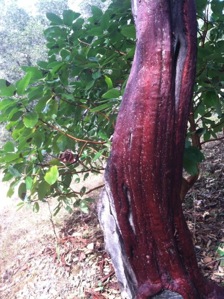
    madrone.jpg
    No animals to be seen, no birdsong. Soft air; fragrance — a sudden vanilla surprise, and the nearly constant scent of oak and duff. A few wildflowers — those tiny white ones we called filaree last weekend; and low-growing Baby Blue Eyes; and of course the magnificent madrone, some of them too in bloom.

    Thanks to technology — MotionX-GPS on the iPhone — I can tell you we covered 4.84 miles in an hour and forty minutes, not counting rests, and that our altitude ranged from near 975 feet at the parking lot down to 650 feet, with a number of ups and downs along the way, for a total ascent of 943 feet, descent of 929. A good first workout for the year. Until July 27, you can see the map here.

    Friday, January 20, 2012

    Asides on an Ebay Oboe

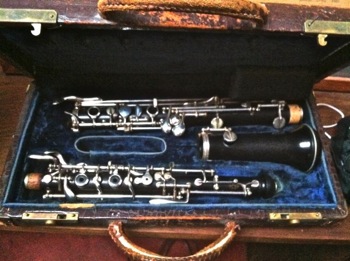
    oboe.jpgAS I KNOW I'VE mentioned before — ah yes; here it is — my instrument in high school was the noble bassoon — partly because as a young child I'd loved both Grandpapa in Prokofiev's Peter and the Wolf and the Sorcerer's Apprentice as brought to me by Walt Disney in his Fantasia, partly no doubt because the band teacher, Kenneth Knight of loving memory, has a bassoon at his disposal but no one willing to learn to play it.
    One of my best friends at Analy Union High School was Merton Tyrrel, and he played the oboe. I always respected him for that, and for other things: he was handsome, self-controlled, well-spoken, intelligent; he seemed a good oboist, and of course he got a number of leading passages in the arrangements our concert band played at the annual spring concerts. (In the fall season we converted to a marching band, setting our double-reed horns aside in favor of sturdier things like saxophones.)

    When I left home for college I no longer had the use of a bassoon, and I gradually lost interest in playing a musical instrument. For a while I made a scanty living giving private lessons in the recorder, but that didn't seem to count. Years later I played bass drum in a community orchestra organized with federal FEMA funds during one of the more enlightened recessions we had in those days, but that didn't last long. Nor did my participation in the Mills College orchestra put together by the late Sally Kell, for whom I played on the college bassoon, a wheezy instrument that I could barely negotiate through von Weber's Peter Schmoll Overture.

    I always wanted to learn the oboe, but never did. Oh, I could play a C-major scale on it, faking it from bassoon fingerings, but that was about all. A few years ago we were in town killing time: Lindsey and our daughter Giovanna had gone on to the bookstore; I stopped off at a curious music store I'd never investigated, since gone out of business. I noticed an oboe in a display case and couldn't help betraying pleased surprise.

    Oh, you play the oboe? the lady behind the counter asked. No, I answered, in a rare expression of incompetence. I used to play the bassoon, but that was fifty years ago.

    Can you put it together, she asked. Yes, I can at least do that: and I carefully assembled the pieces, noting it seemed to be in good condition.

    Can you at least show me what it sounds like, the lady asked; I've never heard an oboe. No, I said; I'd need a reed to do that. Well, here's a reed, she said, Go ahead and play it.

    I moistened the reed in my mouth for a minute — it was a new one — and carefully fitted it to the oboe, fingered what I thought would be a G in the first, easy octave, and made a terrible squawk. Oh, the lady said, That's what it sounds like.

    Well, not quite, I said, and continued to experiment a little. G, A, B. G, F, E. After a while I managed to play a scale, and continued up into the next octave a little way. I was surprised I could almost seem to play the thing.

    If my wife were to come in here, I said to the lady, and hear me playing this thing, she'd turn around without saying a word and walk right out. I put the oboe back to my lips and played the scale again. Lindsey walked into the shop, looked at me, turned around without saying a word, and walked back out.

    That must be your wife, the lady said; and I swabbed out the oboe, took it apart, and put it back in its case. How much, I asked. Oh, said the lady, I think I could let it go for seven hundred fifty.

    Too much, I said as much to myself as to her, and left to rejoin Lindsey and Giovanna.
    case.jpgFOR A FEW YEARS afterward, every month or two, if we happened to be walking past a music shop, I'd say to Lindsey I think I'll just step in here and see if they have an oboe I can afford. You'd better not, she'd always say: but I generally did. They never did, of course. You can't buy a decent oboe for less that a thousand bucks, and then you don't know what you're getting.
    Then, last summer, I took the plunge and rented an oboe to see if in fact I really wanted one. I played scales; I played simple tunes; I made up simple tunes, always practicing, if you can call it that, when Lindsey was out of the house, aware the sounds were pretty painful to hear. At one point I decided to take a lesson.

    The teacher looked at me dubiously: a man in his late seventies taking up the oboe. Can you make a sound with that thing, he wanted to know. I looked at him with a little bit of contempt, I'm afraid, and fitted the reed, and played a two-octave C-major scale.

    Can you play it in tune, he asked next, trumping my contempt with a finer because more justified attitude of his own. No, I had to respond; but I can try to do better. But the cheap plastic oboe I'd rented was not much fun to play, and I was always fearful: if I crack it, or break it, it's going to cost me a lot of money, at least twelve hundred bucks, and I'll have this cheap plastic thing on my hands. My thoughts went back to the music shops.

    Then, last Thanksgiving, when we were visiting Giovanna up in Portland, I took a look on Ebay and there was an oboe, as is, nearing the end of its auction period, with hardly a bid on it. It was a wood oboe, grenadilla to judge by the photos; the key mechanism seemed intact, and it was nestling in a battered leather-covered case that reminded me of the Linton bassoon-case I'd carried back and forth to school all those decades ago. I took the plunge, and was surprised, pleased, and a little ashamed and embarrassed when I won it, for only a couple of hundred dollars.

    When it arrived it looked fine, just like the photos, but was of course unplayable: the pads covering the tone-holes nearest the reed all leaked. Nothing for it but take it into town to the repair shop, hoping for the best. It was early December, and I wouldn't know anything for weeks: the only local woodwind repairman was busy with all the fixes needed for local Messiahs and Nutcrackers and carolers. I tried to put it all out of my mind.

    Then, day before yesterday, while we were on a hike in the hills near Sonoma, my iPhone rang: the oboe was ready for me. The remainder of the hike grew both easier and more tedious; I could hardly wait — to see what I had, and to learn what the price tag would be.

    He'd had to replace nearly every pad. Made of leather, they're a favorite food of a common household insect. (I've learned they also like the horsehair on violin bows: you have to keep these things in the light, just like a woolen sweater, if you don't want them eaten away.) He'd also cleaned out all the keywork, whose bearings had gummed up over the years. No telling when it was last played. His work cost a little more than the oboe itself had: but for a relatively modest amount I had a fine, solid oboe, much more responsive than the plastic thing I'd been renting, more rewarding to play — and my own.

    Now of course I have to play it, every day or nearly so, to justify the expenditure. I reason this will be good for me, physically, firming my breath control and of course my lips, exercising my fingers and wrists beyond the familiar constraints of the computer keyboard. Perhaps even training my ears to adjust to equal temperament as I learn to shade each of the thirty or so notes I'll be playing, each requiring a slightly different approach with fingers, lips, and throat to bring the oboe's instinctive sweet natural tuning into the one-interval-fits-all attitude that's constrained "classical" music for the last three hundred years.

    It already has me thinking about music, and listening to it, with renewed ears. Last night, for example, we went to a high-school concert of chamber music. Students of varying degrees of competence played jazz, chamber music, wind transcriptions of varying degrees of competence. Perhaps because this was in Berkeley, it all seemed extraordinarily democratic, leveled. "Classical" music was dragged down from its pedestal; vernacular music was nudged out of the cashbox.

    Four ambitious girls tackled the first movement of Schubert's "Death and the Maiden" quartet, and showed me for perhaps the first time just how dangerous and exciting the development section of a sonata-allegro movement is, with passages careering through remote keys, like an enormous cruise ship coasting too close the hidden reefs.

    Another quartet, dressed in leather and hiding behind very dark glasses, stalked onstage carrying saxophones, acknowledged the audience with a bit of defiance, and proceeded to a stately, respectful rendition of Bach's "Air for the G-String."

    We all too often experience music only through performances by professionals. Amateurs, even beginning students, when they play for us, remind us of the difficulties, the complexities, the intricacies of musical ensembles. Music of any culture fills a societal need, investigating co-operation, sensitivity, awareness of others while concentrating on one's own task, juggling understanding of received cultural inheritance with the "values" and imperatives of the cultural present.

    Even my solitary exploration of my oboe enlarges my engagement with the other-than-me, as my brain and my breath and my fingers work the mechanics, the ratios, the sounds, trying to find a way to make the tone even, in tune, pleasing — in a word, just.

    Sunday, January 15, 2012

    Pirandello's ashes

    For a little project I've been working on I turned to the remarkable story of the ashes of Luigi Pirandello, the great Italian novelist and playwright of the early 20th century. I present the story here, as written by Filcusum on the blog Il Mestiere di Leggere and put into English, after a fashion, by Google Translate:
    When he died on December 10, 1936, the children found half crumpled piece of paper in which Pirandello had written: 'I. Both let pass in silence my death. Friends, enemies that prayer is not talking about newspapers, but it does not even mention. Neither preacher nor equity. II. Dead, I do not get dressed. I s'avvolga naked in a sheet. And no flowers on the bed and no lighted candle. III. Chariot of the lowest class of the poor. Nude. And no one accompanied me, neither relatives nor friends. The cart, the horse, the coachman stop. IV. Burn me. And my body just burned, or left disperse, because nothing, not even the ashes, I would like to advancing me. But if you can not do the cinerary urn is taken to Sicily, and in some rough stone walled countryside of Girgenti, where I was born. "

    Points one, two and three were executed to perfection, with great scorn of the regime of Mussolini himself-says-he wanted to do a great funeral fascist regalia. Prior to respect the wishes expressed in the fourth point, instead, spent decades and adventures, mishaps and adventures, and worthy of Pirandello's own pen. Let's proceed in order.

    FIRST FUNERAL-Two days after his death in a chariot of the lowest class of the lowest class, a case brought to the crematorium. But no one heard her to indulge his desire to spread the ashes to the wind, a practice unheard of in those days before it illegal and opposed by the Church. The ashes were then collected in an urn and taken to the Roman cemetery of Verano, where they remained for eleven years

    THE SECOND FUNERAL-After the war, in 1947, the mayor of DC Girgenti, in the meantime become Agrigento, Lauricella, claimed the honor for his city to give Christian burial and funeral and solemn to the ashes of the illustrious countryman. He turned nothing less than the Democrat chairman of the board at the time, Alcide De Gasperi, who - despite the considerable difficulties still faced in transport - earned an American military plane for the transfer from Rome to Agrigento. To accompany the remains of the great dramatist was appointed Professor. Gaspare Ambrosini, known Pirandello and pirandellologo and future first President of the Constitutional Court. Place the ashes in a precious vase of the fifth century BC greek imballatolo well and good, shock-proof, in a wooden box, the plane was ready to go when a dozen people-all-came to Sicily ' plane shortly before takeoff is requesting a ride. The teacher, aware of the serious problems of displacement of the time talking to the pilots of the 'Air Force and obtained consent.

    As they settled, someone asked what was in that box Ambrosini slung so well, having received an explanation and said: "Pirandello, what he had asked that his ashes were scattered to the wind? It is not that fate has decided to please him today ... .. "Calo an eerie silence, while the passengers were looking at each other, and under the seats got up forefinger and little finger of one hand. Then, as the propellers began to turn, one of them asked to get off. Ambrosini spoke with the pilots, they suspended the procedure and the passenger fell off. Needless to say, one after the other followed him also the other nine. At this point, the pilots are suspicious and asked the teacher explanations. These gave her, repeating several times the word superstitions, that the two drivers repeated as an echo, exchanging knowing looks. So it was that the two suspected ancestors were from Sicily, or Naples, claiming various reasons, refused to leave.

    To Prof. Ambrosini, accompanied by his inseparable case, we have to get on a train was waiting for a full day of travel. Everything would have gone smoothly if awakened from a nap, he had not noticed that the cash was gone. The car tried to train and finally found it in the middle of four individuals who had used as a table to play cards. Unaware, of course, to make a game "with the dead", and dead: a Nobel Prize. Comunqe both recovered. Finally arrived in Agrigento, the Odyssey of the case was not over yet. The bishop of the city Giovan Battista Peruzzo refused to give his blessing to a greek vase. No blessing, no solemn funeral: all the propaganda and political organization set up by DC Mayor went up in smoke. At the last moment, when the waiver of the funeral seemed inevitable, the bishop was persuaded to promise the blessing if the box with the ashes had been housed in a coffin Christian. But Cassamortaro of Agrigento had coffins ready, we had to settle for a small white coffin, of those children. But the case did not fit there. Then it was necessary to extract the jar and secure it to fit inside the small coffin. And so it was that finally Luigi Pirandello had his second funeral. In full regalia, as he never wanted.

    THIRD THE FUNERAL. The vessel greek and his ashes were kept in the birthplace of Pirandello, waiting for the planned memorial dedicated to him was made in the locality Chaos, just below the famous pine tree to which the playwright was so fond But you know how things go in Italy, the work was finished only fifteen years later, in 1962. And so it was that the ashes of Pirandello had their final arrangement, and their third funeral. These civil and religious authorities, and cultural figures such as Salvatore Quasimodo, Leonardo Sciascia, an aluminum cylinder which had been emptied the ashes was first blessed and then walled up inside the monument.

    EPILOGUE. But there's more. It is said that the charge of the transfer, an employee of the town known as Dr. Zirretta, had to sweat seven shirts to complete the operation. After so many years, twenty-six to be exact, the ashes were calcified within the vessel. Armed with chisel Zirretta, helped by a couple of assistants, reduced them again and poured the powder in the metal container. But the container was too small. It advanced a fair amount. What to do? He must have a light bulb turned on in the mind of the employee of the town of Agrigento. A light bulb, brilliant. He took the ashes left, poured in a newspaper and headed for a cliff nearby, overlooking the sea. But did not have time to get there: a gust of wind carried away the ashes. And so it was that the last will of Pirandello - my body just burned, were both left-release (at least in part) compliance.

    All's well that ends well, you say. But it is not over yet. Because in 1994 it was discovered that the famous greek vase of the fifth century, preserved in the Museum of Agrigento St. Nicholas, still contained some 'ash of Pirandello. Evidently Dr. Zirretta chisel had not worked through. It was decided to refer the remains of the remains of Don Luigi examination of DNA. And, surprise, it was discovered that only a small portion of those ashes belonged to the Master. The remaining, most of that is, to other bodies, non-identifiable, which evidently had been cremated with him in 1936
    Comforted by the science we can now say, Pirandello, who are and are not those ashes of Pirandello. And that metal buried in the urn of Chaos, along with Pirandello there are many other unknown people, the nobodies. As one said, no one hundred thousand.

    Which Google Translate might better have translated
    Uno, nessuno e centomila
    , the title of perhaps the master's greatest novel. But why quibble after such a marvelous story?

    Monday, January 09, 2012

    Back to the source

    Eastside Road, January 9, 2012—
    ALMOST EXACTLY TWO YEARS ago I posted an incomplete blog here. I was reminded of it today, when I got to thinking about exactly the same thing. Odd, that a profound feeling should emerge twice in the same season, two years apart. Then, it was because… well, you'll see. Today, perhaps it's because I'm thinking about a little trip we'll be taking in a few weeks, or maybe because suddenly there's been a raft of pop-journalism stories about Places You Should Visit. (One of them, according to one list, is Oakland, California. Well, why not.)

    I'll begin by simply restating the two-years-ago post:

    Sites
    Eastside Road, January 29, 2010—
    THERE ARE PLACES we have visited on various travels that have seemed very special, from a "medicine wheel" at 10,000 feet in Wyoming to the Fontaine de Vaucluse in Provence; from thestone-age city at Filitosa in Corsica to the Canyon de Chelley in Arizona. What all these places have in common is the not-verbally-articulable meaning they seem to offer to our visit: they speak to us, silently, about something we recognize without understanding, without even in any ordinary sense knowing.

    SuGologone.JPG


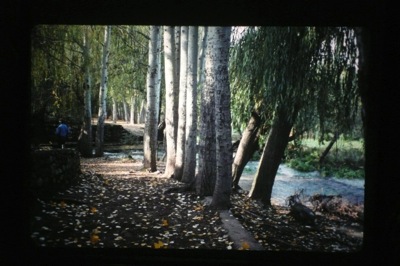
    I think about these places a lot, under any circumstances; but I've been thinking about them especially recently since I began transcribing my journal of a trip we took through Corsica and Sardinia over twenty years ago, in 1988. Here you have a photo of the spring at Su Gologone, in Sardinia. As these places go, the places I'm discussing I mean, it's pretty well manicured, turned almost into a park, with carefully planted willows and — hmm; what are those white-barked trees in a row? — and stone retaining walls and carefully graded walks contained by concrete curbs. Turn away from this view, though, and look out across the pool toward a grassy clearing among the trees, and we feel we're looking at a site that's been here relatively uninflected by recent human attention. It might have looked much like this a thousand years ago, two thousand, ten. This may be merely sentimental: even so, the feeling's worth thinking about.

    Why does the place seem familiar, though I've never been here before? There are sensations here common to other such places: the calm air within these trees; the sounds of the water; the soft feel of the calm air on my skin. The place conspires to distract me from more specific and immediate issues: the car I've left in the parking lot, the few

    AND THERE the blog post stopped, mid-sentence, and I have no idea where it was headed. And I've learned over the years to abandon these things: you can't retrieve them, certainly not at this distance. But as I say I was thinking along the same lines today, more specifically about pools: it's interesting how many of these profoundly moving sites have been at pools. Let me add three more:
    Vaucluse1.jpg
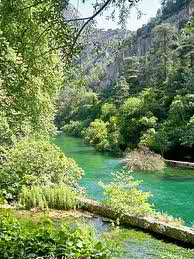
  • Fontaine de Vaucluse: we visited this place quite a number of years ago — I'd always wanted to see it, but had somewhat feared the experience. Would it be the romantic, isolated, poetic place I'd imagined, and I'd imagined Petrarch writing about? (For to tell the truth I've hardly dipped into the great Italian sonneteer.)

    The approach warned against this noble conceit. Many cars. Down-at-the-heels tourist café. Worst of all, rock climbers hanging from ropes and things, directly over the source. But none of this cancelled the curiously atavistic quality of actually seeing this miraculous place, where a river — the aptly named Sorgue — pours out from a large, mysterious hole at the base of a granite cliff. You can see Moses at work here, if you're biblically oriented.

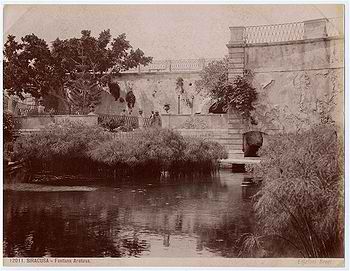
    Arethusa.jpg
  • The Fount of Arethusa: at the edge of Ortigia, the island just next to Siracusa, an improbable pool of fresh water not twenty feet from the salt Mediterranean, celebrated by poets from Virgil's time to ours. Like the Fontaine de Vaucluse, this is a much-visited site. The first day we saw it a woman was selling ices from her bicycle, and a group of high-school girls was listening to a lecture about the pool and its history and hydrology, in German, from a serious-looking young man in wire-rimmed glasses. As you see here, the site hasn't changed a lot in the last hundred years.
    StoricoAretusa.jpgcascade vaimahuta.jpg
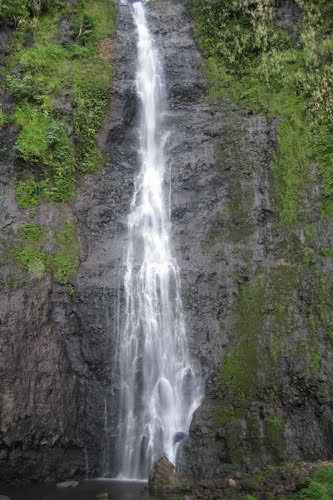
  • Cascade Vaimahuta, on the north coast of Tahiti Nui: Is it twenty years and more since we were there? Here's the journal entry:
    Took bus around past Point Venus to Papenoo to see waterfall, walking to it a couple of miles up a paved road past little farm-settlements, with small offerings of fruits or eggs on forlorn tables for sale to chance bypassers; walked back to blowhole Arahoho; then hitchhiked back to Arue, catching a ride on the back of a pickup, shared with a grinning urchin who got out halfway there; bus back to Papeete.
    It was our last day on the island, and the excursion could have cost us a lot: at the pool we remembered our plane would be taking off in a couple of hours. We were stunned to realize there was no return bus for many hours, and we were lucky to catch that ride.


  • Friday, December 30, 2011

    Nothing to be frightened of

    So many books read this last year, so few of them commented on here. End-of-year reflections will haunt me for the next seven weeks, I'm sure — I'll be too busily distracted for them after that — so I won't anguish over my failure to share notes on Frederic Tuten, or Patrick Leigh Fermor, or Carolyn Brown, or Patti Smith, to cite only the most impressive of the authors I've learned from recently.

    Instead I'll concentrate, for the moment, on a book uniquely appropriate to the season: Julian Barnes's Nothing to be Frightened Of (New York: Alfred A. Knopf, 2008). Barnes is better known as a novelist, I suppose, at the present moment at least, with his A Sense of Ending on the lists: I haven't read that yet, partly because I wanted to approach it through this earlier book, which is not fiction but memoir, meditation, and criticism — a conflation-medium I'm particularly attracted to these days. (One's late seventies launch an autumnal mood.)

    Barnes was the second son of two teachers of French and French literature, and that language and literature are central, it seems, to his address to life, its observation and discussion. Nothing to be Frightened Of is a contemplation of a selected history of man's meditations on death — not many women's such meditations, be it noted, though a few do turn up — as a way, no doubt, of pinning down his own view of the matter. A consummate writer, Barnes writes, I believe, as the best writers do, in order to discover (or at least approach) resolutions of his own confusions, or misgivings, or as a friend said this morning apprehensions, about the subjects at hand: and what greater subject than death?

    Death; dying; God; religion. Someone asked Thoreau, as he lay on his deathbed, if he had made his peace with God. "I hadn't realized we'd quarreled," he replied — at least that's how I recall the line. Googling it just now, I find it often quoted, but the source never cited.

    (I do, though, find two other nice deathbed lines: When Voltaire was on his deathbed, a priest abjured him to accept Christ and renounce Satan. Voltaire replied, "Father, this is no time to be making enemies!"
    As Talleyrand lay on his deathbed, he cried, "I suffer the torments of Hell!" A friend (I forget his name) sitting up with him replied, "Already?")

    Barnes loops gracefully through confrontations with these four principal themes (death; dying; God; religion; remember?) and more; interweaving funny stories about his childhood and his philosopher brother (who, oddly, lives at the near geographical center of France in order to teach in Geneva); and considering similar confrontations by a number of minds of the highest ranks. The book is not indexed, which is a major flaw — especially in a book with the imprint of Alfred A. Knopf! — but my endpaper notes will provide an idea:

    36 treacherous memory
    38 childhood memory
    40 Montaigne
    47 Renard
    54ff god out of art (art sans god)
    61 fear of death (thanatophobia)
    83 S. Maugham
    86 Daudet: adieu, moi
    95 Flaubert
    97-8 d. of Daudet; of Sand, Braque
    99 Title!
    107 either you or I
    108 Critics
    117 The dead appear to the dying
    121 Chabrier
    124 Wharton, James, Turgenev, Falukner
    132 Stravinsky
    134 Edm. Wilson
    138 memory is identity.
    166 last words. Hegel. Dickinson.
    185 meaning
    189ff problem of eternal life
    193 Rossini
    195 Goethe
    202 Shostakovich 14
    209 flux
    That last note, of course, sums it all up. There is nothing that is fixed, as Heraklitus famously noted. Acceptance of death, which is to say acceptance of life, is acknowledgement of flux. If it's true, as Emerson notes in his essay "Circles," that
    …this incessant movement and progression, which all things partake, could never become sensible to us, but by contrast to some principle of fixture or stability in the soul. While the eternal generation of circles proceeds, the eternal generator abides.
    quoted by Ross Posnock in his review of American Nietzsche by Jennifer Ramer-Rosenhagen, The Nation, Nov. 21, 2011
    it is also true that these principles of fixture are site-specific to "the soul", are individual and unique and not fungible, are there for purposes of convenience only: and life (and its apparent extinction) are not there for convenience. Emerson goes on to note "Life is a series of surprises": those who yearn for stability, certainty, reassurance, are denying the essence of life.

    Barnes gives a good deal of attention to Jules Renard, "one of my dead, French, non-blood relatives," known to students of elementary French in my day (the 1950s, in this context) simply as the author of Poil de carotte but much more significant (and influential
    on literature) as a memoirist. Clearly Renard has been a muse for Barnes, providing him with both details for contemplation and a model for its practice and expression.

    Such influence or inspiration is linked, I think, to the subject at hand, for what Harold Bloom calls "the anxiety of influence" (in a book by that title, which I haven't yet read, perhaps fearing to be influenced by it) — the fear or apprehension that influence will dull individuality — is related to the apprehension of death. Both are rooted in a mistaken notion of identity, which notion is one of the most seductive, therefor sinister, of the "principles of fixture" Emerson concedes to us.

    I sometimes think we are, at best, like books. I bought this copy of Nothing to be Frightened Of at Title Wave, the deaccessioning outlet of the Portland (Oregon) Public Library, and I'm off this afternoon to lend it to an ailing friend. Human thought about existence and its consequences, from Epicurus to Shostakovich, go with the book, with Barnes. I'll print out a copy of this post and tuck it into the endpaper: perhaps it will be read, perhaps not. So it goes.

    Thursday, December 29, 2011

    Query

    Looking at what you've just done, the critics ask what's in it for them, for their immediate entertainment or information; and maybe -- maybe -- what's in it for their moment.

    The historians will ask how it continues what you've done before, and how it fits into your era.

    But you, why have you done it?

    Saturday, December 17, 2011

    Twelfth Night

    Pasadena, December 17—
    MY FAVORITE OF ALL Shakespeare plays — I know, it's a ridiculous formulation — is Twelfth Night. It has some of the most affecting poetry; its large cast includes some of his most memorable, complex characters; the narrative is interesting enough on its most literal level (even after all these viewings), and Is particularly rich with extended meaning. 

    Last night we saw a fine performance in A Noise Within's new theater here. Julia Rodriguez-Elliott set her production in a (probably) pre-Castro Cuba, which mostly worked just fine. (Short Cuban dance numbers replaced Shakespeare's songs.) Twelfth Night always suggests Sicily to me — Viola is from Messina, as I recall — and Cuba is our Sicily, in a way: exotic, free-wheeling, fantastic.

    I peck these comments out on my iPad keyboard without time for extensive discussion, so won't go into detail. anoisewithin.org will provide the credits, and I'll simply note here each actor seemed well cast and approached the assignment with intelligence, interest, skill, and sympathy; "small" roles were as beautifully and tellingly fleshed out as big ones.

    (This meant, for example, that Antonio was able to emerge, correctly, as the pivot on which so much extended meaning of this great play turns.)

    The company is still tuning its approach to this spacious yet cozy, beautiful new venue, but there's no doubt of the outcome. We like the hall, the company, the seriousness of purpose and the vitality and humor of approach and achievement. What will tonight's Desire Under the Elms be like?

    Wednesday, December 07, 2011

    Satyagraha

    Wow: Googling around while relaxing in that twenty minutes before bedtime I find this:
    Se Reich e' l'Haydn del minimalismo, Adams ne e' il Mozart, gia' teso ad un geniale, e talvolta irriverente, superamento del classicismo.
    The other night we went to the "Live TV broadcast" or whatever they call it from the Metropolitan Opera to the local charter-school auditorium, rather an ambitions building, of Philip Glass's opera Satyagraha. If Reich is the Haydn and Adams the Mozart, then Glass, at least in this opera, is the Verdi of minimalism. No: let me quickly amend that. In some scenes he's the Verdi; in others, notably the great closing scene, he's one of the Richard Strausses.

    We saw the opera once before, and can't remember where and when. Probably the San Francisco Opera production, though my visual memory of the event suggests a different house. This season's Met production is very different, what you might call second-generation Robert Wilson, tricked out with immense puppets and aerialists and such. It's hard to tell from the absurd film-as-cosmos style of these movie-theater broadcasts just what the impact in the real theater might have been: the film production alternates between close-ups, long shots, and side-to-side pans, sometimes in a tempo so quick and a sequence so unpredictable and chaotic as to leave at least this onlooker physically confused.

    I've railed so many times about these collisions of scale — the amplified string quartet as loud as three Wagner orchestras; the soprano's face as big as four billboards — that I hate to harp on it yet again. But this is a serious matter, folks: scalar confusions of this sort not only physically confound the audience's entrails, throwing them into a nauseated discomfort warning of impending doom; they also misrepresent the point of the message at hand — in this case, a very beautifully conceived and proportioned masque representing Ghandi's discovery of his purpose, the principle of nonviolent resistance, the forward-looking triumph of good sense and comprehension over stubborn authority and oppressiveness. Glass's opera is all sensitivity, grace, introspection, receptivity; this video production of his opera lurches, insists, moons, cajoles.

    The singing was mostly first-rate. I don't know if anyone could have bettered Richard Croft's performance as Ghandi; that closing scene, though long, floated beautifully; it was hard to let it go.

    But what must poor Phil have thought of the Met's including long excerpts of Wagner's Ring in the second intermission? I suppose you can argue there's historical precedent here; two centuries ago it wasn't uncommon to play comedies in the intervals of opera seria. But Wagner?

    Friday, December 02, 2011

    Recognizing the Midtone

    Berkeley, December 2, 2011—
    SITTING IN A CAFÉ over a cappuccino I have no time to write here properly, but I want to call attention to an important paper by my friend Douglas Leedy, who as well as being a composer of significant and often beautiful music is a scholar of the first rank.

    His area of specialization is of course music, and his knowledge of the subject extends far and wide. He has at various times and places been a player of French horn (including stints with symphony orchestras in Oakland, California, and Caracas, Venezuela); a keyboard player (chiefly harpsichord); a conductor (chiefly of music of the Baroque era); and of course a composer.

    He made extensive visits, often amounting to residencies, in Poland, India, and Venezuela. He has taught at Reed College and the University of Southern California in Los Angeles, where he founded the electronic music studio.

    In recent years he has pursued an intensive study of ancient Greek, which has led him to conclude that among the early Greek poets, certainly through Pindar, poetry and music are essentially synonymous; and that our fuller understanding (or, better, awareness) of their work requires an attempt to reconstruct the sound of their sung poetry.

    This has led him to a determined, highly disciplined, and to my limited understanding quite persuasive account, still evolving hence not yet publicly available, of exactly how to go about singing Homer today, accompanied by instruments readily available in our own time.

    Alas, I can't share his Reconstructing Greek Music yet. I can however announce that an example of Leedy's thorough scholarship and gracefully persuasive writing on another subject is available.

    Recognizing the Midtone addresses a musical interval important throughout history and across continents but lost to the familiar Western European "classical" tradition. Leedy presents an abstract of his essay:
    Recognized as a melodic interval in the musical scales of the ancient Greeks, the three- quarter tone, or so-called “neutral” second, is a fundamental melodic interval, along with the tone and semitone of the Western diatonic scale, in present-day musical cultures that extend eastward in an arc from northwest Africa along the Mediterranean to Egypt and the Near East, the former Burma, much of southeast Asia, and Indonesia. For this interval, which is incommensurate with the tone and semitone (and which is, for example, considered to exert a powerfully expressive effect in classical Arab melody), the more autonomous name of midtone is here proposed, along with a parallel renaming of other “neutral” intervals. An overview of the use and significance of the midtone in a number of musical cultures is presented, with references to recordings, published studies, and musical notation, as well as to its occasional, exotic appearance in Western classical music.
    I am pleased to have participated a bit in the presentation of this important essay, and I hope that its online publication will be followed by other papers of his.