Saturday, February 16, 2008

In Circles

show.jpg
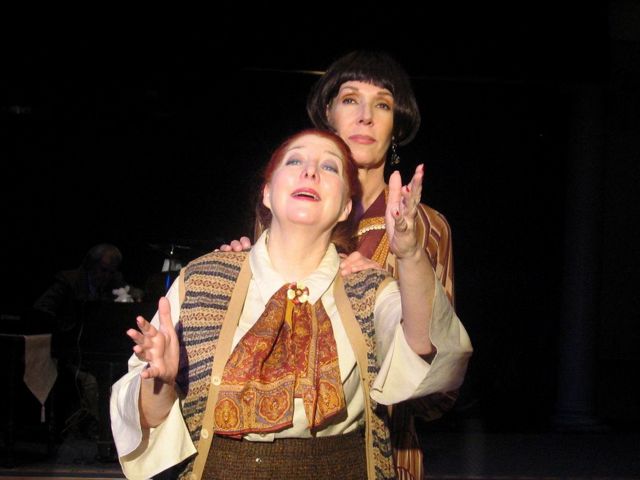
Noelle McGrath (Mildred), Robin Manning (Mabel) (looking very like Stein and Toklas)
in current production of
In Circles. Photo: John Sowle


A FRIEND, JOHN SOWLE, HAS DIRECTED a production of Al Carmines's musical setting of Gertrude Stein's A Circular Play (1920: and included in her Last Operas and Plays). In Circles is a marvelous piece of musical theater, full of entertainment and surprises, sentiment, humor, enterprising in the extreme in its musical mix of high art, klezmer, soft-shoe and show-tune.

And quite faithful to Stein. What do I mean by that. Well, her "play in circles," like almost everything else she wrote, is rooted in the real world and the domestic world, from its opening description of a moment in the Stein-Toklas household
Papa dozes mamma blows her noses.
to its close a dozen pages later, with the writer reflecting on the work just finished
Fourteen circles.

Fifteen circles.

I wonder if I have heard about those circles.
The way to read Stein is to hear Stein, and In Circles makes her audible, and thus provides a marvelous introduction. More than an introduction, though; In Circles is also an enlargement of Stein's original play. Carmines expands it to a full-evening production, weaving, yes, circles around Stein's motifs, lifting a once-only chance remark — Mrs de Monzy has adopted a child — into full-out production number; or assigning lines to one or another of the four boys and four girls in the cast ("boys" and "girls" in the theatrical sense) and returning to them, re-investigating them in new contexts and ensembles, and thus revealing new depth and meaning.
Can you say the page to-day can you say the pages.
In the original cast recording (I know it's around here somewhere) many of Stein's lines thus broken and assigned develop into approximations of the reasonably intoned dialogue Stein no doubt transcribes in her play
He was a disappointment to me. I could not understand the reason for the waiting.
We had our photographs taken, not intentionally but we happened to have seats in the front row near the arena and so when a photograph was taken we were in it.
The result is Cubism, the isolation and consideration of various apparently different aspects of a given event (phrase, character, face) in a manner to enlarge its meanings. This is criticism at its best. So many of the best examples of Criticism are, in fact, works of art themselves, and Theater is the public location of this par excellence.

I wish I could see this production. I can't: it's playing at Judson Church in New York, the place of the premiere of In Circles forty years ago; and it closes this next Friday, Feb. 22.. In the meantime I have to be content with reading the reviews and seeing the cast photos.

And looking forward to another intelligent literary musical, the 1954 Shinbone Alley (book by Joe Darion and Mel Brooks, lyrics by Darion, and music by George Kleinsinger). It's getting a local production by the Camp Rose Players, and I can hardly wait.

Friday, February 15, 2008

Self-promotion

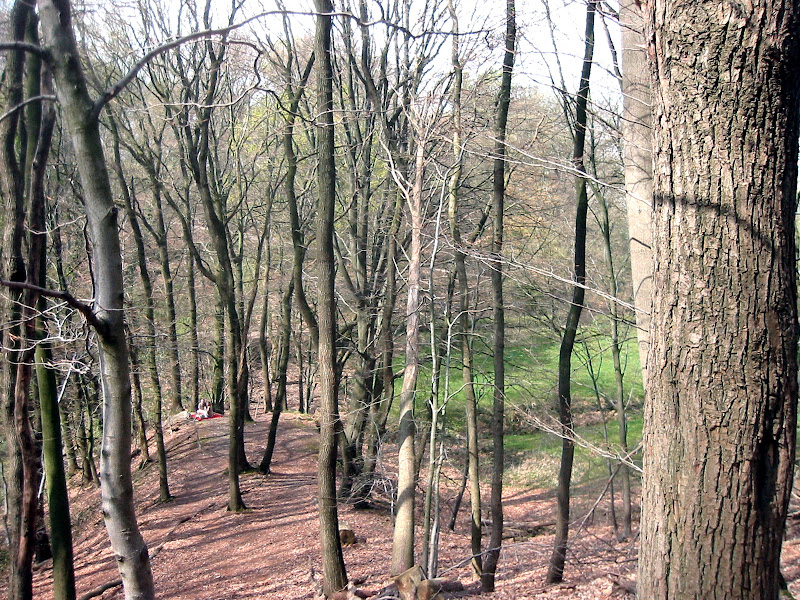
duivelsbos.JPG
Woods near Beek, Netherlands, from The Lingepad


STILL PREOCCUPIED WITH THE FLU and not ready to blog seriously, but I do want to mention two ongoing bits of business:

Walking in The Neth...
By Charles Shere

1) a new book, The Lingepad: Walking in The Netherlands, April 2007. Square format paperbound, 7x7 inches (18x18 cm), 176 pages, published February 10, 2008. Almost no text (surprise!), this is a sequence of photographs taken during our 100-mile walk across the center of The Netherlands last April.

2) my food blog Eating Every Day continues through thick and thin, sugar and salt, sickness and health...

Wednesday, February 13, 2008

The Fourth Symphony

orchestra.JPG

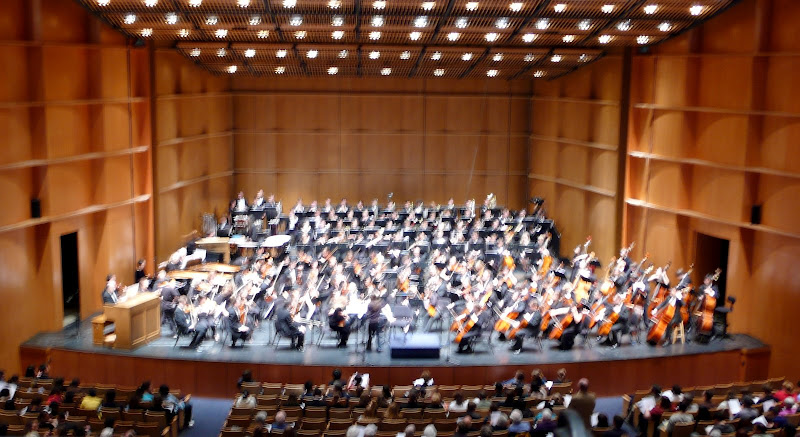
THAT'S A DOZEN DOUBLE-BASSES in that blurry photo (taken without flash), a dozen cellos, fourteen violas, thirty-six violins, fifty-four winds. I forgot to count the percussionists and keyboarders, and of course the photo doesn't show the extra instruments up balcony left, or the chorus behind us.

To me Fourth Symphony will always mean Ives, and I try not to miss a performance. I first heard it in December 1967, when the Oakland Symphony played it under Gerhard Samuel, whose programming in those days was remarkable — the standard repertory plus Ives, Stockhausen, Harrison, Terry Riley: a string of several years of enterprise which has never been given its due. (This performance of the Fourth Symphony, surely the west coast premiere, is undocumented on the Internet, as far as I've been able to determine.)

Whereas once the Fourth had been an impossible vision, unperformed until 1965 partly for its complexity and instrumental demands, it has now become more commonly heard. I've heard the San Francisco Symphony played it under Seiji Ozawa and its present music director Michael Tilson Thomas. There have been a number of recordings, amply described by Scott Mortensen here.

There are four movements, composed between 1910 and 1916 (but Ives dates are almost always very slippery), each of so idiosyncratic a character as to require rather different performing forces and, more important, different psychological approaches. The Prelude states the speculative, one can't avoid the word "spiritual" nature of the program, with a group of violins, a viola and a harp in the distance, and a chorus singing, in unison until the close, the old hymn Watchman ("tell us of the night...").

In 41 measures (for most of the orchestra: the "distant choir" travels at another pace) and about three minutes the Prelude runs through an almost ungraspable number of details which all weave together into an ultimately calming resolution. The genius of Charles Ives is his persuasive ability to display and demonstrate the power of music to contain at a given instant and in a given sonic event an enormous number of possible interrelationships and consequent meanings: this Prelude is a locus classicus .

The three remaining movements investigate various ways of responding to the speculative Prelude: a sprawling "Comedy" (this scherzo is not a joke), Allegretto, alternating among raucous brass-band marches, sentimental parlor-songs, hymn-tunes, and machine sounds; a stately Fugue again based on hymns, and the slow Finale, Largo, which returns to the idea of spatially separated instrumental forces, the addition of the chorus, and a quiet, speculative, appreciative mood.

Where the Prelude is less than four minutes long, the other three movements run about twelve, eight, and eight minutes. Recordings and performances vary, but the entire piece won't take more than thirty-five minutes: Ives is efficient, laconic, in his discursiveness.

Sunday's performance was by the combined orchestras of the University of California, Davis, and the University of the Pacific, whose conductor, Nicolas Waldvogel, presided over the affair, with assistants conducting the various outlying ensembles. The orchestra was a little too large for the Mondavi Center's Jackson Hall, but the acoustics were forgiving, and the music was revealed with considerable clarity.

Ives's music is always significant. Passages in the Fourth refer to the sinking of the Titanic, Pilgrim's Progress, Nathaniel Hawthorne, camp-meetings and church services, marching bands and public holidays, barroom and salon music, and other, earlier pieces of Ives's: the First Quartet, the Concord Sonata, and The Unanswered Question, among others.

More necessarily than most composers, and more successfully, Ives worked at the difference between public and private music. A symphony is public: which means, among other things, that it is not necessarily coherent, or resolved, or unified. Ives has his musicians playing at different speeds, in different places, some quietly, others drowning them out; some reflective or thoughtful, others assertive or brash.

A glance at the AMP version of the score, the only one yet published, suggests the confusion this complexity can produce. Only the second movement was set in type; the others are notated in hand, and in three different hands. Even the second movement, based on the New Music Edition (San Francisco) of 1929, is amended and annotated in handwriting. The instrumentation is uncertain: horn or trombone, piano if trumpet is unavailable, and so on.

Politics is the art of what is publicly possible, and the Fourth Symphony is politics, hence appropriate to the season. Ives himself was intensely involved with politics; he was later, after having composed the Fourth, to correspond with presidents, and to propose amending the Constitution to permit direct popular input to each year's Congressional agenda.

Listening to a public performance of the Fourth bears this out: one's attention moves from those string-players in the balcony to the unseen chorus behind to the enormous orchestra, and among the orchestra from the formidable double-basses to the many busy keyboard players (solo piano, piano four hands, celeste, organ, quarter-tone piano). Waldvogel conducted with long-armed sweeping gestures, maintaining the steady underlying pulse but allowing individual phrases their own version of line. The musicians concentrated intensely and performed stalwartly.

And then it was over. The concert had begun with what might be called the pocket-version of the Fourth, The Unanswered Question: a big string orchestra (from UOP) playing almost soundlessly, a lone trumpet in the upper right balcony plaintively repeating a single phrase over and over, four flutes in the upper left retorting with increasingly irritable flurries. Nick Antipa was the trumpeter; all played well.

Dan Flanagan was the soloist in the Sibelius Violin Concerto, with D. Kern Holoman leading the UC Davis orchestra: not finally a fully polished professional performance, perhaps, but a touching and fascinating one, with fine detail and drive. (Flanagan walked on in one movement of the Fourth for a cameo, to great effect).

The Fourth came last, as it should, and was over in what seemed a minute. So much to hear, so much to think about, so much to be grateful for, so little time to enjoy it. I asked one of the violinists afterward, seeing him mixing with the audience in the lobby, how many rehearsals there'd been: Oh, sixteen, I think, he replied. Well, it was a beautiful performance, I said; it's amazing that you did it at all, but that it was so beautiful...

Yes, he said, there were some misgivings among the orchestra about doing it, we never did really hear it all...

Impossible to "hear it all." That's the point. It's a major major piece; recordings are poor black-and-white still photos of it; even a live performance, while in color and motion, loses the impact of the Fourth in its transitoriness. Ives tries repeatedly to do the impossible, to mediate Quest and Arrival. His effort is ultimately both comic and tragic and always, always, human.

Northern California history, performances of Charles Ives's Fourth Symphony:

1967, Dec. 6,7,8; Gerhard Samuel, Oakland Symphony Orchestra
1968, Feb. 14, 15, 166: Seiji Ozawa, San Francisco Symphony Orchestra
1973, May 9,10,11: Seiji Ozawa, SFSym (subsequently on tour in Brussels, Florence, St. Petersburg, Vilnius, and Moscow)
1991, November 20,21,22,23: Michael Tilson Thomas, SF Sym
1999, Sept. 30, Oct. 1 (third movement only): Michael Tilson Thomas, SF Sym (recorded live for cd)
2000, June 9: MTT, SFSym (toured in September to Baden-Baden, Lucerne, Cologne, Dusseldorf)
2002, Jan. 31, Feb. 1,2,3: MTT, SFSym (toured in February to New York and Ann Arbor)

Saturday, February 09, 2008

Over at his blog, Ron Silliman has begun answering a questionnaire "intended to “inform discussion and debate at a Poetry Foundation-Aspen Institute conference' sometime in the future. It is very straightforward with six open-ended questions."

Thinking a similarly serious consideration of another neglected area might be useful, I'm prompted to invent a similar process re. the composition of music:

1. What is your connection with music (read, write, teach, buy recordings and scores, publish, etc.)?

I have composed music since the early 1950s, and began listening to it much earlier. Looking back, I seem to have listened to the landscape — having grown up as much in the country as in cities — as one listens to music. My first "real" job was running the music programming at KPFA, the Berkeley noncommercial radio station; by then, I'd already been giving recorder lessons to make an occasional dollar. I taught music (20th-century music history, Beethoven, John Cage) at Mills College for fifteen years, and I reviewed music for a daily newspaper, the old Oakland Trib une, at about the same time, 1973-1987.

2. What are the most pressing needs of music and the music community?

A) of music: first, to be allowed to sound; second, to be given its due as a basic and central component of human expression, more basic than verbal language even, more central than politics or economics. As such, music -- as both a process and a literature -- must be taught, both formally in the schools and informally in the home and the community.

Silliman writes "I am not at all certain that any MFA program should admit a student who cannot name a minimum of 100 books of contemporary poetry – published in the past 25 years – and say a little about each." Similarly, any college graduate should be familiar with a basic canon of music, and that canon should be carefully considered to include the past century, and music of other cultures.

B) of the music community: first, to be acknowledged, perhaps even to be created. To my ear the strongest pieces composed in the last thirty years have been those that are aware of the widest world of music: vernacular music, commercial music, "world music," and the leading edge of the music of the twentieth century. I wrote about such a piece the other day, Steven Mackey's Indigenous Instruments. Such music contributes to the coherent accumulation of repertory, an accumulation comparable to the great storehouses of literature and painting and sculpture and architecture. Those are pretty well taken for granted among the cultural observers of our society; the musical repertory is not. When considered at all it tends to be shamefully constricted: to recent commercial music, or to an absurdly narrow area of European history.

(Think of a society whose libraries and bookstores contented themselves with only those texts written in German between 1725 and 1900, and a few plays from the Italian theater of the nineteenth century!)

For an individual musician to develop and maintain this kind of broad awareness is rare and difficult and certainly unrewarding; for a number of such musicians to become acquainted, to discuss individual discoveries and common interests -- that is virtually unheard-of. Of course there are faculties and new-music organizations, chamber-music groups and orchestras: but generalized "music communities" are few and far between.
They exist, though; they exist in the blogosphere. I've only recently begun to understand the range of this community, through a few blogs which, web-like, lead occasionally to others:
Renewable Music
Boring Like a Drill (I particularly like his "Please Mister Please" compendium)
listen (new to me)
aworks (ditto)
Nico Muhly's blog, self-promotional but why not? Interesting beyond that…
Of Sound Mind, which actually gets into the practical mechanics of music
Roger Bourland
Sequenza 21/, a forum which in fact constitutes the kind of "musical community" that can exist on the blogosphere
Soho the dog
Tears of a clownsilly (the recent entry on Boulez and combover alone is worth the trip!)
New Music Reblog which is just what the name implies, a sort of digest of individual blogs, a form I've yet to investigate

and, finally,

blognoggle, which bills itself as "Shadowing the Top 100 Classical Music Blogs" and is therefore useful as a locus of such eveen though the emphasis seems to be on what is sometimes called dead white men's music.
The flu has struck, and I probably won't get around to finishing this before Tuesday.

Wednesday, February 06, 2008

Composition as Explanation


IN JUNE 1996 WE SPENT a couple of weeks in this house outside of Dabo, in the hills in Alsace, and there I worked on two compositions: a long piece for solo piano which managed to get completely sketched, then completely stalled; and, a more pressing concern, a trio for violin, piano, and percussion, which had been commissioned and was to be performed later that year. Over the years I've written much of my music in Europe; we used to spend a month or two there every other year in the years we were working, taking leaves of absence and dividing our time between touring and staying put.

This turned out to be my last European composing stay, however. The Trio seemed so valedictory when I heard it performed — so remote, objective, and phenomenological; so devoid of ego-expression, at least to me — that I couldn't turn from it to anything else. It seemed like a farewell piece.

But the piano piece nagged at me: it had its own right to existence, whether or not I wanted to associate with it. So I kept at it, getting it out from time to time, printing it out, shoving notes around, carving it up and pinning it down. I thought it had been finished in Portland two years ago, and I ran it through the synthesizer and put it on my iPod and listened to it a lot. But I knew I hadn't really come to terms with it.

Now, though, it's finished. I've been through it a final time, sprinkling the dynamics indications in, adjusting peculiarities of notation, trying to make the damn thing playable. It's a very strange piece, an hour long, eventful I think but not insistent. Like the slow movements of the Trio, it's music as landscape. For a long time western european music, the kind of music I deal with, was either song or dance, "lyric or choric," in Virgil Thomson's schema; the Romantic era added to this what he called, unfortunately, I think, 'spasmic," music whose human-body source of energy was not in the larynx or the feet but somewhere between.

The Twentieth Century found a fourth way, dissociating the musical process from those of the human body. My own music tends toward landscape, I think, though I could be wrong. There's a program to this long piano sonata — I've decided to call it my second Sonata; it's in three movements, so that qualifies it — but the program doesn't have to be revealed. It's pretty abstract, this piece. I hope it finds a performance.

Hooray! It's finished!

Tuesday, February 05, 2008

Contemporary Music in Evolution

THAT WAS THE TITLE of a series of radio programs prepared by Gunther Schuller back in the 1950's; I used to listen to it every week on KPFA — it was virtually my only exposure to any coherent view of the fascinating panorama of concert music that opened out after Brahms.

Schuller simply presented the major pieces as they'd been composed, year by year, in sequential order, using what recordings he could then find (and he was amazingly resourceful!), and talking, as I recall, very little about them. It was enough to hear each score in the context of its contemporaries. The rich awareness of this music of its antecedents and its context; the logic of continuity that survived even the temporary dislocations of reaction and "revolution"!

For Schuller was concerned to point out the evolution, not revolution, described by this brave repertory, stretching from Schoenberg's Second Quartet, as I recall, up to John Cage's String Quartet in Four Parts. What a fine string of monuments, living monuments, to the musical and intellectual activity of these composers; what a testament to the optimism and enterprise of their work!

I thought of this last night at a concert by the San Francisco Contemporary Music Players, where we heard a performance of Steven Mackey's Indigenous Instruments, a piece he wrote in 1989 (neary twenty years ago!) for the SFCMP, and which bowled me over then, and did again last night. Mackey wrote for the "Pierrot ensemble": flute, clarinet, violin, cello and piano, the instruments Schoenberg accompanies his Sprechstimme with in Pierrot Lunaire (1912).

Pierrot was a revelation, not a revolution, though it broke a number of social rules in its day, and resulted in considerable changes of attitude among the composers who listened to it closely (Ravel and Stravinsky among them). Indigenous Instruments is another, perhaps almost as startling, though it has its own sources in world-music explorations by such other composers as Kevin Volans and Peter Sculthorpe, whose music I know only from pieces recorded by the Kronos Quartet.

The Pierrot ensemble is in some ways the string quartet of the (late) twentieth century, but already Mackey was intent on nudging it into new territory, de-tuning the winds, extending the techniques of the strings. The intent, I think, and certainly the effect, to me at least, was of rediscovering the uses to which these instruments can be put: as if they'd been dropped into a society until then never aware of them, and had been picked up by gifted but "untaught" musicians who immediately set about exploring their potential.

This is by its nature anti-conservatory. I refer to the music-school, but "conservatory" has its bigger implication.

I listen to Indigenous Instruments with fresh ears and an open mind each time it comes along, which is infrequent, though I do have a recording around here somewhere. It puts me in the mood I associate with being somewhere where intelligent, interesting people speak an unknown language, freeing that part of the mind which conventionally is required to "understand."

I wondered, last night, if Mackey knew the music of Niccolò Castiglioni, whose Tropi (1959) for Pierrot ensemble with added percussion fascinated me when I first heard it, at about the time of its composition. I wondered, briefly, if the radio were playing this chattering treble-clef piece at the correct speed, and I've heard it more than once taken down an octave and doubled in length: but one day I found the score, and that's right, nothing in it below middle C. (Here's the score: bought on Ground-hog's day 1963, while JFK was in the White House, for $3 new! Those were the days.)

I'm sure Mackey knows Castiglioni; certainly the indigenes who play the sounds in his mind know him. That's one of the things that Evolution revealed by Schuller, among others, reveals in turn to us: all these sounds, imaginings, and revelations are known in some mysterious way to one another.

To compose, as Stockhausen said, is to make the world one.

* * *


There were other things on the program, notably Morton Feldman's 1981 Bass Clarinet and Percussion, but I'll think about them more before reporting.

Friday, February 01, 2008

Mountains

a FRIEND WRITES (well, actually a grandson)
One of the things I love so much about mountains is how much character they have, even though they are just geological formations. It's so strange how we can recognize different mountains just by glancing at them, while it would be much harder to do so for rivers, deserts, plains...
Mountains are events; rivers, deserts, and plains are processes, I think. Of course when you're actually climbing the mountain it's a process: but when you see it from a distance it's an object, an event at most.

Rivers of course are fluid and dynamic; even an apparently quiet one has great force. (Think of Charles Ives's Housatonic at Stockbridge.) Deserts and plains and broad river-valleys, like the one here with Eastside Road at its margin, are processes; they invite our motion as participant; one wants to move within them, to explore or, better, experience. But mountains are ambivalent: to an extent (and an extent that varies from one person to the next!) they invite our active participation; at the same time they warn us of their difficulties and dangers.

I haven't explored (!) the history of mountaineering; it's never been a subject of great interest to me. But my understanding is that it's a relatively recent history, at least within my eurocentric concept of history. It seems to date from about the time of the Enlightenment, when the spirit of scientific exploration, the advent of greater leisure (for some), and the suspension of superstitions (formerly regarding mountains and deserts sinister) coincided.

My own interests have tended more to the ambulation than effort, and at this point I doubt I'd have either the strength or the endurance for true mountaineering. There's not much I like better than walking through a landscape; we've walked hundreds of miles, Lindsey and I, contentedly carrying our necessities on our backs while counting on civilization for beds and meals. Climbing seems to me like an imposition of the self on the terrain, though I'm sure the true climber finds it much more a collaboration than an imposition.

Walking is a way of losing ego and mindfulness. Well, that's not quite right: it's a way of being mindfully mindless, to paraphrase John Cage ("purposeful purposelessness"): walking in Dutch forests or the French garrigue conduces full alertness to the pleasures of the environment while enabling near-total suspension of alertness to the physical process. Climbing introduces a new note, the awareness of effort. Ca grimpe, say the French: That's a climb.

Time to go to the gym and prepare a bit more! And then to add one more book to the pile awaiting reading (or in this case re-reading): Réné Daumal's Mount Analogue.

Thursday, January 31, 2008

We shall never be able to do anything like that!

MOZART: CONCERTO IN C MINOR, K. 491.

James Keller repeats the old story in the program booklet of the San Francisco Symphony:
Once, walking with the pianist-composer Johann Baptist Cramer, [B**th*v*n] heard an outdoor performance of the Mozart concerto. He stopped, called attention to a particularly beautiful motif, and exclaimed, with a mixture of admiration and despondency, “Cramer, Cramer! We shall never be able to do anything like that!”
Many years ago my own first experience of the piece live was in a performance by the school orchestra at U.C. Berkeley under James Senturia: the soloist was, of all people, Ian Underwood, later of The Mothers of Invention. At the time he was a student at UC and a music assistant at radio KPFA, where I was then also on staff. He had prepared his own cadenzas for the concerto, and as I recall they were appropriate to Mozart's style while still probing and expressive of our own day; nothing academic at all about them.

Another time, at the Cabrillo Festival in August 1964, it was Ludwig Olshansky at the keyboard, and this was where I learned that it is in measure 329 (or thereabouts) that the greatest stress must be placed, on what seems an impossibly low note but is in fact only two octaves below middle C, a note that sounds and resounds and brooks no demurral. I don't recall whether it was Olshansky who did this, or Gerhard Samuel, who conducted; I only recall that it was the pivotal note of the movement, and has remained one of my favorite aural landmarks.

Friday, January 25, 2008

Initialisms

January 25, 2008

FROM THAT FASCINATING WEBLOG Language Log :
LOWER-CASED INITIALISMS
It is a small but not insignificant recent change in written English that in Britain the newspapers have started spelling acronyms in lower case with capital initial instead of all in caps. The Universities and Colleges Employers Association and the the Department for Environment, Food and Rural Affairs are not UCEA and DEFRA, but (at least fairly often) Ucea and Defra. And in Times Higher Education magazine, the Higher Education Funding Council for England is now Hefce. This only applies to one of the two subclasses of what The Cambridge Grammar of the English Language chapter on lexical word formation (chapter 19) calls initialisms: it applies to the acronyms, not the abbreviations. Nobody calls the Science and Technology Facilities Council "Sftc", because you don't say "sftc" (could anyone?), you say "S F T C". Acronyms are more like words than abbreviations are, and the developing convention recognizes that.

Posted by Geoffrey K. Pullum at January 25, 2008 10:38 AM
That's been the style in Italy for a number of years, and I have to say I like it. Strings of caps, even small caps, shout out too loud from the printed page.

(The last three sentences confuse me, though. Surely many, reading aloud a sentence like "Call the Sftc," would say call the sefftsee.)

In any case what's happening is a confusion of language seen and heard, and any such synesthesia can only be a good thing. Well, "synesthesia" isn't the right word, of course; that refers to sense impressions; what I mean is an intellectual impression formed by two fairly distinct sensory impressions working in tandem. There must be a word for such a concept...

Thursday, January 24, 2008

The Winter's Tale

SHAKESPEARE WAS IN a retrospective mood when he wrote that problematic play The Winter's Tale: just about every theme he ever visited ends up in it, from Romeo and Juliet to The Tempest. It's a curious play, because however retrospective it is it seems unresolved, resolutely so. It ends happily, I suppose, but with lingering sadness. And however unlikely its plot may be, however distant from our own experience, it's one of those plays that always leaves me thinking Yes. That's how it is, all right. Nothing to be done about it.

Last weekend we saw it for the third time in eighteen months: Ashland in July '06; Glendale (A Noise Within) six weeks ago; Healdsburg last Saturday. In many ways the Healdsburg production was the most affecting.

It was staged by the Imagination Foundation, a Healdsburg company whose chief activity is the production of community theater using children and teen-aged actors for the most part. We've followed them pretty closely over the last few years, as one of our granddaughters has been with them from their beginning (this was the first production she has not appeared in. We've seen Pinocchio, The Tempest, Antigone, an adaptation of Alice in Wonderland, The Crucible, Tonight we Improvise! (Pirandello), and an adaptation of Animal Farm, just to list the more or less standard repertory; along the way there have been imaginative and resourceful productions of other pieces often generated through collective improvisation in rehearsals.

These "Imagineers" have produced some strong theater — work whose strength comes from its return of theater to its community responsibility. Theater is more than entertainment; at its best it presents its audience with a kind of collective awareness, expression, and even resolution of urges and events that are general and immediate. Last September, for example, IF presented The Division/La DivisiĂłn, a piece that cast children and seniors from the Healdsburg community in an investigation of both the separateness and the togetherness that can characterize its "anglo" and "hispanic" subcommunities. A short documentary of that production is available on YouTube.

The Winter's Tale was staged, literally, on the stage of Healdsburg's Raven Theater, a community theater that's been carved out of a former movie theater, a place with problematic acoustics and not terribly good sightlines. IF overcame these problems by ignoring the audience space: instead we sat in chairs on the stage, providing the three walls of a theater-within-a-theater, with the cast right in our faces, no sets or props and minimal (though effective) costuming.

The play is really two plays, as I blogged last month. In the first Leontes, king of Sicily, goes completely insane with jealousy, causing the death of his son and queen and forcing a trusted retainer to expose his infant daughter to her death. In the second "play," usually done as the second act, we're suddenly transported from Sicilian courtiers to Bohemian country-bumpkins; Time has skipped sixteen years or so; and the plot begins to play itself out through the usual unravellings.

The play is about anger, comprehension, atonement, and forgiveness; that is, it's about fundamental human qualities that resist rational explanation but drive most human situations, whether court or country. And the play's effectiveness, apart from Shakespeare's splendid language, rests on the abilities of its major characters. Here the Imagineers came through: though minor characters had trouble with memory, clarity, and comprehension — not surprisingly, given their assignment! — the principals were amazingly effective. They may be students, or barely out of school, but they show an astounding degree of understanding: of the text, of their craft; of the emotions and urges that drive this troubling play.

There were only three performances. Imagine: young actors in their teens memorizing and rehearsing this play, all of it, this well, for only three performances. It was a gift to the community, another in a long line of such gifts. I do believe the Imagination Foundation is one of the most significant theatrical organizations in the Bay Area.

Monday, January 21, 2008

Music honest and dishonest

THE QUESTION OF "dishonest music" is raised on the blog On An Overgrown Path

A lazy search took me to three sites. The first turned out to be addressing commercial entertainment music — that is, what used to be called pop — and here the phrase made some sense, applied as it was to the practice of lip-synching.

The second, Jonathan Newman's Composer's Notebook, has an arresting opening:
Honesty
It's as good a term as any ("Truthfulness" works, too), and whatever we decide to call it, for me it is the most defining feature of a composer's work. A piece can have as much craft as humanely possible (Greetings to you Mr. Diamond! How are you, Sir?) but if the composer doesn't LOVE every note that he or she is writing down then it isn't worth diddly.
He ends by referring to Roger Sessions, and that brings me to my third webfind.

This turned out to be a paper by Michael R. Brown, Chair of the Division of Fine Arts at Indiana Wesleyan University. "The Musical Offering: a question of honesty" quotes "The renowned American composer, Roger Sessions, [who]once said that there was no good or bad music, only honest and dishonest music."

I didn't read Brown's paper too closely; it's a discussion of music now being used in various Christian churches, not a topic of great interest to me — though I was surprised to read that many of these churches are apparently using technology to fill out their acoustical worship:
Many evangelical churches have readily accepted the use of accompaniment tapes for music offerings. This use of "trax" allows the amateur to supposedly "sound just like" the commercially successful star of the moment. Indeed, the sales of the "trax" add to the commercial success of many of these stars or, at least, their record company. The pseudo-sophistication of attempting to sound like someone else, to sing with an unseen orchestra, to be bigger than life, can amount to hero worship and not the worship of God.


THERE'S A BLUR HERE between "dishonest" and "inauthentic," I think, but no matter; they amount to much the same thing in today's atmosphere of imprecision. The real question is what is authentic music, and Brown and Newman, from their various viewpoints, address that question.

I've always been impressed by a long and complicated passage in Peter Yates's book Twentieth Century Music (Pantheon Books, 1967):
A composer's idiom is his own manner of speaking as creative thinker, original as the sound of his own voice. His content is his esthetic consistency, saying what he has to say. A composer is not uniformly aware of the forces which make him what he is; they are a part of him. The consistency he must achieve ifhe is to become a composer, instead of[merely] a practitioner of his art, will be under his control exactly to the degree that he is able to direct his intuitive conditioning to its creative purpose .... The consistency, as it is achieved, matures within the composer as his content, what he has to say. The subject, not yet married to content, grows within the composer as an irritant, putting him to work; his manner of disposing of it will be his style for that work or that period .... Style follows content, the outward sign of the composer's growing inner consistency; the achieved consistency of the artist extrudes the idiomatic consistency of his style. Together they evolve. (pp. 40-41)

Consistency of style: as good an explanation of musical authenticity as we need, I think. Critics need to keep it in mind. Years ago one critic, a friend, called another friend's music "meretricious," not really thinking I believe of the meaning of the word. It's a useful word, and it goes right to the root of the question of honesty and dishonesty of intent; and there, I think, we can leave discussion of that curious phrase, "dishonest music."

Thursday, January 17, 2008

Mahler's Ninth

STANLEY FISH, I read somewhere online today, has announced the end of the humanities. I thought we were through with that sort of thing, that The End Of History had pretty well put paid to such business. I guess not. Were there any doubt, a pretty decent performance of Mahler's Ninth on television tonight, with Simon Rattle beaming his way through it with the Berlin Phil,

     and afterward, a short documentary on the amazing goings-on in Venezuela, where we were told a quarter of a million young people are playing in orchestras, more than play sports; and where a young conductor in his mid-twenties, Gustavo Dudamel, is said (by Sir Simon) to be likely to be the most important conductor of the twenty-first century.

We watched him lead the SimĂłn BolĂ­var National Youth Orchestra in the last two movements of BartĂłk's Concerto for Orchestra, and we were pretty well persuaded. What must it be like to be a youth in Venezuela, to be aware of the looming power of the United States, and to hear that music is not taught in our schools, music, which does so much to civilize the human spirit?

It was the first time I've heard the Mahler Ninth in many years, twenty at least. Fifty years ago it was a favorite; Bruno Walter's Columbia Masterworks recording was the first stereo recording I owned. Hearing it afresh tonight I was startled by the modernity of the first movement, so nearly incoherent at times; delighted by the fond Ländler; disturbed by the Scherzo, which so rarely really works; convinced, once again, by the rightness of the Finale.

Fifty years ago I learned most of what I then new about symphonies from the Penguin Book of the Symphony, edited by Ralph Hill. I'm startled to see you can still buy copies used online. As I recall he was pretty dismissive of Mahler, whose music was apparently still thought in 1949 to be infra dig. Now, of course, I listen to the piece thinking of the Nineteenth Century that had just died, and the Twentieth that was about to burst forth; marveling at Mahler's nostalgia and prescience in his Ninth. Will my grandson's children listen thus, I wonder, to Atlas Eclipticalis?

(If the Humanities will not, indeed, have ended...)

Tuesday, January 15, 2008

How does x understand the impulse that motivated y?

A FRIEND GAVE ME a copy of Alfred Schnitke's Choir Concerto last week. After listening to it I wrote him "Oddly it recalls Feldman, whose music is very different, but gets to the same place." Tim responded
Yes, maybe like you, I am all about "how does a work understand the impulse that motivated Feldman's composing" these days.  I have a new release of and by Boulez and the EC which I think would fit into your listening… Feldman and Cage and Ligeti are pertinent…
This kind of thinking is what I had in mind yesterday.

How does x understand the impulse that motivated y?

The intent is always toward the synoptic, toward a comprehension of where we are (since an understanding of it seems unlikely).

Certain of these thinking creators—these composers, writers, painters, artists—have synoptic views themselves, but use them to push through to new understandings; among them the people I listed yesterday.

To take just one case: John Cage said, somewhere, that while he rejects Beethoven (and, I think, the rest of the 19th century), he attends to Mozart, because there is so much going on at the same time in Mozart. How does Cage understand (and that also means "interpret") the impulse that motivated Mozart?

How did the second half of the 20th century understand the impulse (or impulses) that motivated the first half? (Geert Mak's In Europe is "about" that question, among other things.)

Let's list those visionaries, and gather their work as Silliman suggested, and begin a synoptic critical survey with Tim's question in mind.

Monday, January 14, 2008

Let's begin to focus…

What we really need, ultimately, is the Complete Jackson Mac Low, a multi-volume multimedia project on the scale of the works, say, of Walter Benjamin or Charles Olson or Gertrude Stein. Thing of Beauty is a good first step in the direction of creating that broader picture, but it’s only the tip of a far more vast canon on the part of the most broadly brilliant innovator of – at the very least – the last half century.

--Ron Silliman, Silliman's Blog, Jan. 14.


STILL THINKING of Geert Mak's In Europe and Alex Ross's The Rest is Noise, I'm struck by Ron's comment this morning. Those histories are impressive and useful, but one of their most important functions is their encouragement that we return to primary sources. Ron's begun a list of significant bodies of sources documenting the building of our time in literature; here's a beginning toward extending it into other fields:
  • Jackson Mac Low
  • Walter Benjamin
  • Charles Olson
  • Gertrude Stein
  • (for I accept Ron's list as inspiration)
  • Geert Mak
  • John Cage
  • Luigi Nono
  • Giacinto Scelsi
  • …
  • These are the writers and composers whose work I'll be attending to in the near future. There will be others, of course, speaking from earlier ages, figures like Vermeer and Franz Kline, Proust and W.G. Sebald.

    I've addressed only literature, music, and painting here, which raises questions:
    Of the last fifty years, Who are the philosophers whose work is of the scope and scale suggested by Silliman?
    Who are the painters and sculptors?
    Who the composers? the dancers?
    The lists must be defensible and persuasive; there's less and less time left to attend to them…

    Friday, January 11, 2008

    "The snow is general..."

    (to be read while listening to "Winter," in John Cage's String Quartet in Four Parts)

    START THE YEAR getting back in touch with the ground, remembering that you live where your roots are, that's what I told myself a week ago, housebound after a manner of speaking with all my family: wife, three children, their spouses, their children. (Well, all but one: I'll get to that in a minute.)

    We were in a good-sized house on the south flank of Mt. Ashland, just over the state line into southern Oregon. The last of us managed to drag in about midnight Thursday; there'd been snow delays for several of us. We got to bed late and awoke Friday to find the power out. No electricity; therefore, since we were in the country, no running water.

    The day was bright, thanks to snow everywhere, and we had candles for suppertime. The kids played board games, many of the rest of us joining in; there was a jigsaw puzzle; there were the many conversations as cousins and in-laws got reacquainted. Lindsey and the other women worked at the household; I basked in the pure pleasure of a large family of intelligent good-hearted people interacting in civil social discourse and mutual entertainment.

    The power came back on late Friday night; some went skiing Saturday; snowballs were thrown and a snowman built; there was a fine half-hour walk down the lane. By Sunday noon we'd chained up the tires and loaded the trunks and were out -- me a little bit regretfully.

    THE SILENCE OF SNOW is a magical effect; the silence and the cleanliness. A few fenceposts and of course the various outbuildings poked up out of the general whiteness: otherwise nothing we saw out those windows was man-made. I hear snow fell on Baghdad the other day, for the first time in living memory. I wonder if there's not a powerful lingering effect on the human mind of the seasonal erasure of man-made detritus and disorder by winter snows: but I suppose that while these will inspire some to clean up their surroundings, others will marvel at the unusual beauty, if they aren't preoccupied with inconveniences of transportation and such, shrug it off, and go on as usual.

    I need orderliness more and more, but desire to attain it only when driven to it, particularly in January, the month of good intentions. The snow, the short family gathering, the hundreds of miles of driving in good weather and bad -- all these were reminders of moments within motion; periods of repose, some of them fairly long, within the constant change of our lives.

    I think it is Matt Matsuda who writes, in The Memory of the Modern, that every civilization eventually accelerates itself to death. The "death" of course is the ultimate collapse into order, the order of stasis. The acceleration he writes of is a spin into disorder; I thought of this a few times as I carefully drove across frozen pavements.

    The missing grandchild is in South America for a year, learning Spanish and developing adult social skills. He's a composer and a musician, and intuitively expresses himself through those rhythms of complexity and repose that constitute music. Families, I reflect, are another locus of such rhythms, and their expression of order and disorder, of outward exploration in many directions controlled (for lack of a better word) by the centripetality of common roots and experience, reinforces the intuitive human social method of ordering our activities, containing their otherwise probable damage.

    We are modern social citizens, but before that tribal animals, and before that families of individual creatures, oddly curious and busily expressive creatures. Our conversation in moments of repose can explore the implications of this; winters and snow and music assist in their various seasons.
    A Winter Album is an online collection of thirteen piano pieces (so far) in score, by Dennis Báthory-Kitsz, Jon Brenner, Steed Cowart, Elaine Fine, Hauke Harder, Ben Harper, Jeff Harrington, Steve Hicken, Aaron Hynds, Lloyd Rodgers, Jonathan Segel, Daniel James Wolf and myself. It was gathered and edited by Daniel, whose blog Renewable Music is another joy of active contemplation in moments of repose.

    Monday, December 31, 2007

    May it be small!

    INTO HEALDSBURG THIS MORNING for a little last-minute shopping. A book at Levin & Co., a fine local bookshop. Rolls at the Downtown Bakery & Creamery and a conversation with Kathleen. A wedge of good Parmaggiano at The Cheese Shop, as good a cheese shop as anyone needs.

    These are all fairly small locally-owned businesses. You can trust them. They give back to the community. And they make me think that perhaps the Next Big Thing that everyone seems to be wondering about on the radio today, perhaps the Next Big Thing will be Small.

    Take Café St. Rose, for example, a perfectly wonderful 24-seat restaurant I wrote about the other day. Mark Malicki runs close to a one-man kitchen, far as I can see; and one serving-person takes care of the dining room. Mark can shop, think, prepare, and cook as he likes, and that means locally, among other things.

    Joe Stewart runs a similar operation at the Downtown Bakery, fixing breakfast and lunch, cooking the menu he likes. The clientele is mostly locals. Fine.

    I've written before, too, about Marius, Kees Elfring's restaurant in Amsterdam. No more than thirty diners. Kees in the kitchen, with a part-time assistant-cum-plongeur.

    Levin & Co. is a mother-and-son operation for the most part, and they know what I might want to read next. If they don't have it, they can order it, of course.

    Big box stores have their place, I'm beginning to think; it makes sense to buy a case of typing paper (as we used to call it) or a refrigerator or a dozen sacks of cement at one of them; why would you want stuff like that downtown? It should be out by the highway, where the trucks can unload all that stuff.

    But Small is Beautiful. Small specialty shops and restaurants can respond to their communities while keeping their owner-workers interested. So I predict we'll see more of this in 2008, and I hope I'm right.

    And a Happy New Year to all of us!

    Sunday, December 30, 2007

    Nearing the end of the year

    WITH ONE DAY LEFT in a dying year, I re-read notes in the margin of Rebecca Solnit's A Field Guide to Getting Lost (Penguin Books, 2005).

    She writes about landscape, the road, deserts, country music, Cabeza de Vaca, solitude, Alfred Hitchcock, Yves Klein, language, transience.

    Among her pages I note the following passages. (Passages: an appropriate word to apply to this book of hallucinated footsteps. An appropriate word at a moment of passage.)
    Meno: "How will you go about finding that thing the nature of which is totally unknown to you?"

    It is the job of artists to open doors and invite in prophesies, the unknown, the unfamiliar; it's where their work comes from, although its arrival signals the beginning of the long disciplined process of making it their own.

    Cities are built by men (and to a lesser extent, women), but they decay by nature, from earthquakes and hurricanes to the incremental processes of rot, erosion, rust, the microbial breakdown of concrete, stone, wood, and brick, the return of plants and animals making their own complex order that further dismantles the simple order of men.

    What is the message that wild animals bring, the message that seems to say everything and nothing? What is this message that is wordless, that is nothing more or less than the animals themselves — that the world is wild, that life is unpredictable in its goodness and its danger, that the world is larger than your imagination?

    It is in the nature of things to be lost and not otherwise.

    More is known; there is less to know; we lose both what we know and what we don't. … At any given moment the sun is setting someplace on earth, and another day is slipping away largely undocumented as people slide into dreams that will seldom be remembered when they awaken. Only the continuation of abundance makes loss sustainable, makes it natural.

    Friday, December 28, 2007

    W.G. Sebald: Austerlitz

    AT THE END OF THE YEAR I look back over the books read, the theater seen, the meals eaten, the travels made in the last twelve months. There the books are, still waiting in many cases to be written about: for it is in writing about things that I come to understand what they mean; what they mean to me; what things mean to me.

    I have written here about some of them, notably (at tedious length) Alex Ross's survey of the music of the Twentieth Century, The Rest is Noise; and Geert Mak's fine history of the Twentieth Century minus its music, In Europe. Many other titles should have been mentioned but were not: among them:
    Ken Alder: The Measure of All Things
    Diamond, Jared: Guns, Germs, and Steel
    Freeling, Nicolas: The Village Book
    Lermontov, Mihail: A Hero of our time
    Lewis, Norman: Naples '44
    Solnit, Rebecca: A Field Guide to Getting Lost
    Swafford: Charles Ives
    But none more, I think, than W.G. Sebald's magnificent Austerlitz. I read it last August, and subsequent travels and travails shouldered it aside. Austerlitz, perhaps more than any other book I've read recently, is a book I wish I had written, is the book I try to write. It so often so exactly relates experiences I have had, and draws the conclusions I have fumbled after. Unlike The Rings of Saturn, a somewhat easier book to read, Austerlitz lacks such help to the reader as chapter breaks and running heads; like other books by this writer, and like André Breton's memorable Surrealist novel Nadja, its pages contain enigmatic monochrome photographs whose presence somehow fills out the narrative.

    I will not review Austerlitz: I simply transcribe the running heads and marginally checked passages my pencil left in the book. Perhaps some coherent view will Sebald-like divulge. Sebald's words are italicized.

    P. 51: The drowned village p. 53 Ghosts p. 55 Moses p. 59 School (at twelve) p. 61 reading p.. 62 Tale p. 64 Gwendolyn's death p. 67 Adoption revealed p. 69 Napoleon p. 70 Austerlitz P. 71: Hilary could talk for hours about the second of December 1805, but nonetheless it was his opinion that he had to cut his accounts far too short, because, as he several times told us, it would take an endless length of time to describe the events of such a day properly… All of us, even when we think we have noted every tiny detail, resort to set peices which have already been stated often enough by others. [Longer to describe than to experience.]

    P. 72: Our concern with history, so Hilary's thesis ran, is a concern with preformed images already imprinted on our brains, images at which we keep staring while the truth lies elsewhere, away from it all, somewhere as yet undiscovered. Pp.76-77: From the outset my main concern was with the shape and the self-contained nature of discrete things, the curve of banisters on a staircase, the molding of a stone arch over a gateway, the tangled precision of the blades in a tussock of dried grass.

    P. 91 Moths p. 97 Guillotine p. 100 Time p. 103 Greenwich p. 114 Flying P. 119 Photographs p. 120 (~ Arcades Project) p. 121 (Laboring past the work) P. 123 Disintegration: I already felt in my head the dreadful torpor that heralds disintegration of the personality, I sensed that in truth I had neither memory nor the power of thought, nor even any existence, that all my life had been a constant process of obliteration, a turning away from myself and the world. … the panic I felt on facing the start of any sentence that must be written, not knowing how I could begin it or indeed any other sentence, soon extended to what is in itself the simpler business of reading, until if I attempted to read a whole page I inevitably fell into a state of the greatest confusion. If language may be regarded as an old city full fo streets and squares, nooks and crannies… then I was like a man who has been abroad a long time and cannot find his way through this urban sprawl anymore…

    P. 125 Relinquishment p. 126 Noctambulation p. 128 Liverpool Street Station p. 136 Time …as if the black and white diamond pattern of the stone slabs beneath my feet were the board on which the endgame would be played, and it covered the entire plane of time. p. 138 Liverpool Street Station → recognition p. 139 Dream p. 1141 Radio p. 143 Prague p. 151 Recognition of things seen in childhood p. 165 Disembodied (radio) voices P 175 Acceleration: When I look back at the two years following the outbreak of the war, said Vera, it is as if at that time everything was caught in a vortex whirling downwards at ever-increasing speed. Bulletins came thick and fast… read … in a curiously high-pitched tone of voice, as if forced out of the larynx…

    P. 185 Time: I feel more and more as if time did not exist at all, only various spaces interlocking according to the rules of a higher form of stereometry, between which the living and the dead can move back and forth as they like, and the longer I think about it the more it seems to me that we who are still alive are unreal in the eyes of the dead… P. 201 → South: As so often when one is traveling south, I had the impression of going steadily downhill… p. 202 Casanova p. 206 Marienbad p. 214 Schumann p. 217 Prague station p. 219 Leaving Prague p. 222 NĂĽrnberg p.225 The Rhine p. 230 Hospitalization p. 233 Adler p. 252 Return to Prague p. 254 Paris p. 260 Bibliothèque Nationale p. 268 Memory p. 269 la SalpĂŞtrière. Stations de MĂ©tro p.272 Le cirque p. 273 Sa musique

    P. 281 Complexity & Entropy …I came to the conclusion that in any project we design and develop, the size and degree of complexity of the information and control systems inscribed in it are the crucial factors, so that the all-embracing and absolute perfection of the concept can in practice coincide, indeed ultimately must coincide, with its chronic dysfunction and constitutional inability. p. 282 Balzac P. 283: …the border between life and death is less impermeable than we commonly think…

    The Rest is Silence

    TO FINISH THIS LONG LOOK at Alex Ross’s The Rest is Noise:

    Part Three: 1945-2000

    The Rest is Noise is formally symmetrical: the third and final section, like the first, is cast in six chapters; they span something like two hundred pages; Richard Strauss presides over the first pages as he had at the outset; once again, one of the six chapters is devoted to a single rather surprising figure: Benjamin Britten this time.

    But where Part One covered the first third of the century, Part Three must deal with more than half of it: the years following World War II. And while Ross is more than dutiful about “covering” the many “styles” of postwar concert music (always concentrating on the music of Western Europe and the United States), he does not leave the impression that he has really understood the extent to which that Twentieth Century ended having seen a profound change in the nature, the intention of that music.

    But before complaining that The Rest is Noise is not some book other than the one its author had in mind, let’s look at what it actually is in this third part. The story resumes in Garmisch-Partenkirchen, where a Jewish lieutenant meets Richard Strauss in his villa, intending to occupy it as a command post. It is the morning of April 30, the day of Hitler’s death. In three poignant paragraphs Ross describes the wartime experiences of Stockhausen, Henze, Zimmermann, Berio, Xenakis, and Britten. Strauss had not had a bad time of it in his Alpine villa.

    Germany was ruined; “a primitive society such as Europe had not known since the Middle Ages,” Ross notes; and he devotes a fair number of pages to documenting the American effort at reconstruction. It’s not widely known the part music played in this, specifically in the de-Nazification of the country. The American occupation was headed by General Lucius Clay, whose
    background combined strict West Point training with a whiff of New Deal idealism… The military governor wanted to reshape and lift up Germany as Roosevelt had reshaped and lifted up America. At a conference in Berchtesgaden, near Hitler’s old redoubt, Clay said, “We are trying to free the German mind and to make his heart value that feedom so greatly that it will beat and die for that freedom and for no other purpose.”

    The project of freeing the German mind went by the name ‘reorientation.’ The term originated in the Psychological Warfare Division of the Supreme Headquarters… Psychological warfare meant the pursuit of military ends by nonmilitary means, and in the case of music it meant the promotion of jazz, American composition, interational contemporary music, and other sounds that could be used to degrade the concept of Aryan cultural supremacy.
    Strauss and Pfitzner, whose careers during the Third Reich had made them problematic under the Occupation, were downplayed; Sibelius too: “likely to reawaken feelings of Nordic supremacy.” Mendelssohn was returned to the German concert platform, and there was “great emphasis on American music… major works of Aaron Copland, Roy Harris, and Virgil Thomson…”

    One of the most significant undertakings of the Occupation’s “psychological warfare” through musical re-orientation was its support of the International Summer Courses for New Music at Darmstadt. The idea was to allow young composers to become familiar with the music that had been banned by the Third Reich. There, in 1949, Schoenberg’s 75th birthday was observed with performances of three major orchestral pieces and two late chamber works. More significant for what was to come, Olivier Messaien presented his Mode de valeurs et d’intensitĂ©s, whose scales of durations and loudnesses may have been inspired by the complex structures of pitches in Indian ragas, but went on to inspire the young Stockhausen and Boulez to experiment with the total “precomposition” of all aspects of instrumental music: pitch, duration, loudness, instrumentation.

    Ross does not confront those implications here, though: instead he closes this chapter, “Zero Hour: The U.S. Army and German Music, 1945-1949”, with the opposition of two composers who had stood for diametrically opposed “schools” of musical thought, Anton Webern and Richard Strauss.

    Ross recounts the accidental killing of Anton Webern, shot by mistake in the dark by a nervous G.I. cook. To my taste Ross’s description of Webern sounds scornful:
    Webern had long languished as the most obscure and arcane of the Second Viennese School composers, the one who made Berg sound like an over-the-top Romantic. After death, Webern acquired a saintly, visionary aura, the super-refined surfaces and intricate design of his works foreshadowing avant-garde constructions to come… When Webern’s Piano Variations were performed at Darmstadt in 1948, young composers listened in a quasi-religious trance. That Webern had been possibly the most avid Hitlerite among major Austro-German composers was not widely known, or went unmentioned.
    Scornful, and provocative: this charge of “avid Hitlerism” is not supported by any evidence elsewhere in Ross’s book, and his otherwise copious annotations do not account for it. Berg was perfectly capable of making his own music sound as it does, of course; and one wonders also about the source of the knowledge of the mood of the audience of the Piano Variations.

    The Strauss ending is gentler. He had opened The Rest is Noise with his discordant Salome; he closes this chapter with his valedictory Four Last Songs and nostalgic Oboe Concerto, which unaccountably remind Ross of “the fleet-figured, Mendelssohnian scores that the composer had written in his youth before he fell under Wagner’s spell.” To my ear it is tender and regretful, closer to the Marschallin’s soliloquy in Rosenkavalier.


    ROSS TURNS NEXT to “Brave New World: The Cold War and the avant-Garde of the Fifties,” and this is where I came in, so this is where I sat up and paid attention. He begins with two paragraphs of challenge, quoting Morton Feldman (that most intelligent of avant-gardists) quoting Charles PĂ©guy, of all people — “everything begins in mystique and ends in politics” — and leading next to a brilliant if cursory prĂ©cis of the entire first half of the century, which
    began with the mystique of revolution, with the mind-bending harmonies and earthshaking rhythms of Schoenberg and Stravinsky. The process of politicization was already under way in the twenties, as composers competed to stay ahead of changing trends and accused one another of complicity in regressive tendencies. In the thirties and forties, the entire Romantic tradition was effectively annexed by the totalitarian state. But nothing could compare to what happened when the Second World War ended and the Cold War began.
    In rapid succession (and a single sentence) Ross touches on twelve-tone composition, total serialism, chance music, “a music of free-floating timbres”, “neo-Dada happenings.” But what chiefly fuels Ross’s survey in this chapter is “The dominant aesthetic, in European and American music alike,… one of dissonance, density, difficulty, complexity.” Schoenberg, of course, is the figurehead here, elevated by the “[politican] of style” Theodor Adorno.

    A couple of pages follow, describing the exceptional premiere, in 1941, of Messiaen’s Quatuor pour le fin de temps in the prisoner-of-war camp in which the composer was then incarcerated; and this leads naturally enough to the introduction of Pierre Boulez, “a kind of intellectual dreamboat”at first glance but one who was “angry with the whole world,” in Messaien’s words, one whose First Sonata is marked by “jabbing, crashing, keyboard-spanning gestures, who takes violence as the leitmotif in Le Visage nuptial and Le Soleil des eaux, and for whom above all nuance is to be avoided, abruptness to be paraded, in his polemical essays as well as his music.

    (Oddly, the quality that struck me most on first hearing Messaien’s music — Le Marteau sans maĂ®tre, in a performance in 1963 or thereabouts — was its nuance, poise, and lyricism.) [Jan. 11, 2008: of course this is a slip: for "Messaien's" read "Boulez's," and thank you, John Whiting.]

    It is in this context that Ross elaborates on Messaien’s pathbreaking Mode de valeurs et d’intensitĂ©s, describing its working well enough for a lay reader to understand. Ross is very good at this kind of program-note writing; he has a gift for narrating abstract musical lines in English sentences.

    Oddly, though, he seems to find it necessary to turn to subliminal metaphor with Boulez, whose
    early works, notably the two sonatas, Structures, and Le Visage nuptial, are perhaps best understood not as intellectual experiences but as athletic, even cerebrally sexual ones. Michel Foucault, the great theorist of power and sexuality, seemed almost turned on by Boulez’s music, and for a time he was the lover of Boulez’s fellow serialist [Jean] BarraquĂ©. “They represented for me the first ‘tear’ in the dialectical universe in which I had lived,” Foucault said of the serialists. What drove Boulez’s own rage for order remains unknown.
    Ross turns almost relievedly to John Cage, “capable both of great violence and of great tenderness,” whom he writes about in three generally sound and sympathetic pages only occasionally marred by lapses into journalese and shorthand. (“For Cage, the classical tradition was worn-out kitsch ripe for deconstruction, in the manner of his intellectual hero, the conceptual artist Marcel Duchamp.”

    The chapter then takes up the New York School: Feldman, Christian Wolff, and Earle Brown; Happenings; the silent 4’33”, and the beginnings of tape music. Here Ross is capable of penetrating (if familiar) but frustratingly undeveloped insights — Earle Brown’s “open-form pieces imported some of the energy of bebop”; “certain of Cage’s chance pieces ended up sounding oddly similar to Boulez’s total-serialist pieces.”

    Ross follows Copland and Stravinsky into their twelve-tone essays, noting that in Stravinsky’s late sacred works “the rows are stacked in favor of consonant chords: triads flicker like shafts of light in a darkened church.” But a more impressive passage returns to Darmstadt, with good basic coverage of the emergence of Stockhausen and Xenakis. I think he misses a point in his interpretation of Stockhausen’s Gruppen:
    What separates Gruppen from its monumental Romantic predecessors [Ross had cited Mahler, Strauss, and Wagner] is its relative emotional neutrality; it lacks the grandeur and sorrow that Thomas Mann identified with Wagner. German music was renouncing its ‘“special path,” its Faustian urge, and joining the cosmopolitan frenzy of the postwar world.


    THAT’S NOT BAD: but the renunciation of “Faustian urge” can also be read as transcendence of ego. The question of Stockhausen and Ego is a vexing one; no one could call him egoless, but his music certainly tends to egolessness. Alex Ross, in The Rest is Noise, does not: his book is personal.

    This is no fault; indeed it contributes to the book’s appeal and persuasiveness. There are drawbacks, of course: Ross lapses, now and then, into the pathetic fallacy, attributing emotions to musical events, as in a discussion of Xenakis’s Metastaseis: “The string clusters are soon inflitrated by sneering trombone glissandos and other razzing brass sounds.”

    Perhaps this reveals a writer who reads human motivations and interpretations into historical processes; perhaps it is his humanistic bent, his human-centered reading of the history of music, as apart from the humans and human forces that produce it, that veils his view of music as it evolved in the course of the Twentieth Century.

    As if fatigued by the confrontation with the profound changes wrought (or, better, witnessed) by Cage and Stockhausen, Boulez and Feldman, Ross retreats next to studies of the careers of Benjamin Britten and Olivier Messaien, finding their operas easy subjects for his descriptive gifts.

    Another chapter breezes past the American avant-garde, with proper (if insufficient) attention to the West Coast. Ross is unpersuaded by the music, falling back on journalistic put-downs: “Ingrained in [Lou] Harrison’s personality was a love of musical merriment, of hummable song and rollicking dance.” (His strong, sweet, elegiac component is not mentioned.)
    “[Morton Feldman] insisted that composition could not actually be taught, and in his classes he meandered all over hee map — one eccentric assignment being to analyze Sibelius’s Fifth.” (But Feldman understood the significance of Sibelius’s musical landscapes to the long lines of “Minimalist” structures.)
    The West Coast gives place to New York Minimalism; Terry Riley leads to Steve Reich; Ross works to find coherence in the increasingly pluralistic scene, but quite rightly expresses reservations about the process:
    As with most A-B comparisons between music and other arts, the linkage [between the music and the painting scenes in New York] is partly a matter of intellectual convenience. Minimalist painting and sculpture remained arts of abstraction. Minimalis music, with its restoration of tonality, rejected abstraction…
    Ross closes with a chapter centered on John Adams, whose music, after an early mastery of repetitive-structure process (Phrygian Gates, for example) settled into a serious, methodical construction of a healing return of concert music to the long tradition that ran from Monteverdi through Schoenberg.
    This has been a book about the fate of composition in the twentieth century. The temptation is strong to see the overall trajectory as one of steep decline. From 1900 to 2000, the art experienced what can only be described as a fall from a great height.…

    Perhaps… classical composition is being sustained past its date of expiration by the stubborn determination of those who perform it, those who support it, and, above all, those who write it. More likely, though, a thousand-year-old tradition won’t expire with the flipping of a calendar or the aging of a baby-boom cohort. Confusion is often a prelude to consolidation; we may even be on the verge of a new golden age.
    This is revealing: Alex Ross, The Rest is Noise, institutions like The New Yorker are the guardians of these thousand-year traditions. (The phrase is uncomfortably reminiscent of Hitler’s Thousand-Year Reich.)

    But why not entertain the notion that this tradition, despite the truly heroic work of such composers as John Adams, may have run its course? That happens repeatedly throughout history. If art forms have clear beginnings, as opera and the novel and easel painting certainly do (however specialists may argue as to specifics), why may they not have endings?

    There is a kind of sentimentalism in views of history that insist on immunity to reversals. One of the most significant aspects of the work of composers like Satie, Webern, Cage, and Feldman is their cheerful acceptance of the relative inconsequence of the ego-expressive component of music, their methodical and disciplined search for the “abstraction” that frees music — sounds and silences observed and appreciated for their own sake — from the tyranny of convention, that restores it to its original purpose, according to John Cage’s well-known description:
    "The purpose of music is to sober and quiet the mind, thus making it susceptible to divine influences." (Elsewhere, the second clause is replaced with “so that it is in accord with what happens.")
    Understanding things as they are begins with accepting them on their own terms. I appreciate Alex Ross’s writing and his book: but we still need a history of the process of the Twentieth Century as it led, not to a continuation of history since the Renaissance, but to the succession to that history of a new moment in human awareness, a moment whose arrival the great Twentieth-Century composers did much to achieve.
    Wednesday, December 26, 2007

    Stockhausen again

    A PARTICULARLY MOVING ACCOUNT of the funeral of Karlheinz Stockhausen by the Chicago-born, francophone, Lithuanian-allied painter, poet, and composer Paul Dirmeikis on the web — I learned of it on Alex Ross's blog.