Tuesday, April 17, 2012

Snake and Seagull

The two short-season plays at the Oregon Shakespeare Festival this spring are Chekhov's Seagull and Mary Zimmerman's The White Snake, both of which we saw last Saturday. (We return to Ashland in late July to see the rest of the eleven-play cycle.)

Not that much need be said here about Seagull, adapted and directed by Libby Appel in a production designed minimally but effectively by Christopher Acebo in the New Theater. We saw this "adaptation" a little over a year ago, when it ran in Mill Valley at Marin Theater in a different production. I set the word in quotes: at the time Appel's new version, based on Allison Horsley's literal translation of Chekhov's text, seemed to me more a restoration than an adaptation, redirecting the audience's response from the picturesqueness of an exotic, long-ago society to the social and philosophical questions at the heart of Chekhov's play, always relevant, now perhaps more than fifty years ago.

I wrote about that production here.The current production is less physically detailed than Marin's, narrowing the focus onto the text, the dialogue. Since so much of Chekhov's dialogue is always interior and unspoken, revealed by inference through the otherwise apparently irrelevant comments of characters who don't really attend to one another, this can be hard on the audience.
 
It has its value, though, rightly extending the effectiveness of the play beyond the evening of its performance. It's as if Kostya's avant-garde play, quickly shut down by its anguished young author at the beginning of Chekhov's play, begins to continue in one's mind after the abrupt yet laconic conclusion of Seagull. " Conclusion": what an inconclusive ending this is, for all but poor Kostya himself: the contemplation remains, will remain among Chekhov's characters, remains for those of us fortunate to have seen this fine production.

The White Snake is also an "adaptation", this time of an ancient Chinese story, and also a restoration os sorts, in that it returns its audience to the blend of entertainment and instruction, goofy comedy and poetic contemplation — there's that word again — that propels Chinese opera. (And commedia dell'arte, and Mozart-da Ponte, and…)

Story: Snake studies philosophy, yearns to learn human experience, disguises self as beautiful woman, seduces innocent tradesman, is exposed by Buddhist monk, returns to her mountain.

Zimmerman's script, developed from the plot sketch during the course of rehearsals, contains the vivacity of commedia improvisation within the voice of a thoughtful and studious playwright. There is one element I found jarring: the ensemble in the pit — flute, cello, and percussion — relied heavily on foursquare structures and conventional Western tonal harmony for the collectively generated musical chinoiserie that helps articulate the entertainment's progress. Where Zimmerman's direction and script adapt Chinese opera to the American stage, the musicians, I thought, seek to imitate it, constantly distracting my attention.

Still, there's a lot to like here. There is real poetry, pathos, and philosophy in Snake's predicament, ably and beautifully projected by Amy Kim Waschke (new to OSF), and poignancy in the role of Xu Xian, nicely taken by Christopher Livingston; and Tanya McBride and Jack Willis find just the right amount of brashness in the comic-relief roles of Green Snake and Fa Hai, the villainous monk.

Zimmerman's White Snake often made me think of Michael McClure's wonderful Gargoyle Cartoons of forty and fifty years ago. It's sad that neglect of the breakthroughs of that period has occasioned so much ignorance and the occasional re-invention, but it's reassuring, I suppose, that artistic truth will now and then, as here, bring a historically imperative notion back to contemporary life and relevance. Something else for that superbly enlightened serpent to contemplate, back on the eternal mountain she shares, I'm sure, with Konstantin Gavrilovich Treplyov.
 

Friday, March 30, 2012

Only a Messenger

Eastside Road, March 30, 2012—
BACK FROM A TRIP to find in the mail a new novel by an old friend whom we see too rarely, Sumner Carnahan. I have always liked her writing, but am surprised by her novel: in it she sets aside her post-Burroughs deconstructed style for a fascinating and subtle alteration of a more conventionally narrative approach, weaving together two dissimilar but fluid points of view, touching on the conflict of two quite different cultural mentalities, to deal with matters of environmental and economic urgency, while in fact toying imaginatively with the genre of detective fiction.

Reading it, all kinds of things come to mind while I'm simultaneously caught by the effortless onward flow of the narratives. An intelligent, diffident young American man, David Ambrose Gentry, maintains notebooks in which he records meditations on the names of things, on nature and procreation, and on relationships — particularly one that develops in the course of the novel with an observant, spiritual, utterly believable young Mexican woman, of strong Mayan heritage, whose own diaries are intercut to form the structure of the novel.

An example:
We discuss mining. C. doesn’t believe in removing things from inside the earth. Says that metals and chemicals can be retrieved gently off the surface using simpler techniques.

I explain that civilization would not exist without mining. We wouldn’t be riding in this fine green four-speed half-ton truck just now without the mining of metals and petroleum. And the airplane we will board for San Diego:

"You want it to be made of cardboard and tree sap?"
That made her laugh. She laughed and laughed, almost hysterically, her thick dark hair falling in waves across her face. Then, abruptly, knotting her hair over one shoulder, she stared straight ahead in that way she has of keeping still..

…I see the indigena in her… Mixtec, Mayan? Her heritage is confused. (Whose isn't?)…

op. cit., p. 44-5
I still think of William Burroughs from time to time: also E.T.A. Hoffmann, Carlos Castaneda, Gertrude Stein, Sebald— perhaps because I've already associated some of them with Carnahan's earlier work. She has been an attentive reader as well as an inventive and methodical writer, and if these are influences they seem fully internalized.

Her more avant-garde style frequently used vernacular and commercial styles ironically; here I think she has found a perfect balance between stylistic, even linguistic (taken in a broad sense) universes, producing an apparently artless straight ahead whodunit, with satisfyingly surprising twists, giving the reader subtle esthetic pleasures on top of the entertainment of the plot and the substance of the social and political issues it involves. I like this book; I like it a lot, and I'm glad to say so. I hope she writes more novels: I think she makes an important contribution to the form.

• Sumner Carnahan: Only a Messenger, Burning Books (The Quadrant Series), 2011; ISBN 978-0-936050-34-8

Sunday, March 18, 2012

Hotel blues

Park & Suites Ëlegance la Ciotat, La Ciotat, France, March 18, 2012—

WE HAVE DRIVEN, in the last week or so, about 1500 kilometers, crossing France from northeast to southeast, back up a little toward Lyons, then back down to the Mediterranean. There was a time when I was astonished to hear from a friend, stated almost as a fault of mine, that I was a francophile. I don't think I am. I love Italy and Netherlands first, I think, and my own dear California, I think. My fondness for la douce France is more intellectual than corporeal. When I looked into the bookstore on the Place de Comédie in Montpellier, for example, I was reminded of the considerable intellectual life, at least the vie intellectuale potentielle, of the French, and I was of course envious; I even bought a book. But I am truly not a francophile, to the extent that I would be a citizen of France if I had to change my citizenship tonight.

As I may. We are currently (five p.m.) without a place to sleep tonight. I booked a room, using bookings.com, at an inexpensive hotel in La Ciotat, choosing the town because we've never stayed there, and I recalled the name from the history of Picasso; and the hotel because it was recommended by previous users of bookings.com, and was inexpensive. But when we arrived, about four o'clock, delayed by street closings due to a Sunday market — unknown to Our Lady of the Dashboard, about whom another blog, another day — there was no one at the reception.

We weren't the only ones flummoxed. There were two Italian businessmen there, looking all around for some way to get into their room. We all looked around, walked up the street, back down the street. Finally I noticed a, well, notice, posted at the door, with two or three phone numbers. The first didn't answer. The second did, at length, but the woman spoke only French. She asked my name and how and when I'd booked, and then whether I noticed a coffret anywhere nearby. At length I found it, and she gave me its code.

Inside there were a great many envelopes, each with a key inside and a person's name on the cover. One belonged to the Italians, who were pleased with me for having let them into their room. None belonged to us. I mentioned this to the lady on the phone, who said she had taken note of my telephone number, and would look into all this, and would then call me back with further instructions.

Oh well. We walked the few yards down the street to the Quai Mitterand and the Best Western Hotel, verified there was a room there if we needed it (double the cost of the one we'd booked), and gave its bar a try. Three parts gin, I told the boy who seemed the only staff in the huge empty café, one part Lillet, shaken with lots of ice. Oui mussieu, he said with what seemed to me a little hesitation. In a little while we heard frantic cocktail-shaking and soon he was back with Lindsey's glass of white wine and a huge shaker glass full of what turned out to be quite an acceptable Martini, garnished with lemon peel.

Finally I called the lady who spoke only French back. Ah I tried to reach you, she said unpersuasively, look again in the coffret. Wait, I said, I'm in a bar, waiting for you to phone me. Trudged back to the hotel, imploring her not to hang up, looked around, found the coffret, opened it with the numbercode she again provided, no envelope with my name.

Not important, she said (c'est pas grave sounds so much, well, graver), do you see one envelope on the top shelf. Yes, but the name is Carpet, my name is not Carpet. I started to add, Though I've often been called on the carpet, but realized in time this would only complicate matters.

Pas grave, she said, use that envelope. So we did, and finally got into the room, very nice, hot water, bathtub, no wi-fi — that would have to wait for the morning. There were other adventures, of course, involving bewildered machinists from Detroit, two vivacious young maids who spoke no English but were very helpful in French (ou Arabe, mussieu?), and the gouvernante who clarified a few things — again, French only. Well, after all, we're in France. Other adventures, but they'll have to wait.

Saturday, March 17, 2012

Einstein at the Berlioz

Montpellier, March 17, 2012—

My old friend John Rockwell said it well, years ago:

“Einstein was like nothing I had ever encountered. For me, its very elusiveness radiated richly, like some dark star whose effects we can only feel. The synergy of words and music seemed ideal. … Einstein on the Beach, perhaps, like Einstein himself, transcended time. It's not (just) an artifact of its era, it's timeless ... Einstein must be seen and re-seen, encountered and savored ... an experience to cherish for a lifetime."

I quote that from the Nonesuch Records website (Google nonesuch einstein montpellier, I can't readily embed links with Blogger on iPhone).

To John's remarks I merely add: the opera is as mesmerizing and transporting now. We saw it last nearly thirty years ago, at BAM; we saw it last night from similarly placed seats — center, nearly as high as possible.

Montpellier's Berlioz Theater is incredibly high, a postmodern version of a traditional European jewel-box theater. Perhaps our seats underscored this opera's unique effect: it was as if we were witnessing the coherent but often enigmatic proceedings of a distant and foreign society, at the same time re-acquainting ourselves with knowledge we'd somehow internalized, perhaps years ago, of the inexplicable yet reassuring meaning of it all.

There were little technical glitches along the way — opening curtain was delayed an hour. But the performances were superb: singing, instrumental, dance, acting, lighting, stagework.

The audience mostly remained seated the entire nonstop four and a half hours, though they were encouraged to come and go at will. They gave the piece a fine ovation, and they were right to do so. I think even Berlioz would have been struck with the beauty, the artistic truth, and the significance of the event.

Wednesday, March 14, 2012

Where we've slept recently

Hôtel Du Puy d'Alon, Souillac, March 14, 2012—
 
IT OCCURS TO ME I've written nothing about the hotels. We've stayed in a lot of them, these last three weeks, and there wasn't a one I wouldn't go back to, though one or two would have to adjust its price first. Nearly all of them offer wi-fi, though not always dependably in the room; nearly all have websites. Except for the first, which was chosen for us — and splendidly!— I booked most of them through bookings.com, which has a good iPhone app but also works well online. For information on the nearby restaurants we chose, see Eating Every Day (http://eatingday.blogspot.com). If you don't mind, I'll just mention them in the order we found them:

•Hotel Herberg & Appartementen De Smidse, Molenweg 9, 6285NJ Epen, Netherlands; +31(0)43-4551253. A fine old-fashioned place, two storeys, no elevator, on the outskirts of a village across the road from open fields; good rambling all around; decent simple food in a pleasant dining room, efficient, pleasant staff. Great for a three-day stay with friends.

•Hotel-Restaurant Le Relais, Place du Monument 22, 4900 Spa, Belgium; +32 087 77 11 08. Very pretty spacious room up a flight or two, old-fashioned, okay breakfast, well situated, cheap.

•Hotel Val de la Cascade, Petit-Coo, 1 - 4970 Stavelot, Belgium; +32(0)80/68.40.78. Well off the beaten track and at an amusement park-like development set next to a cascade, I can't imagine staying here except in the depth of off-season, unless you have kids to entertain. Still, the room was big and comfortable, the dining room almost snug and romantic.

•Hotel Ardenne Les Myrtilles, Rue du Vieux Marché 1, Vielsalm, 6690 Belgium; +32 (0) 80 67 22 85. Recently affiliated with the Best Western chain, right in the middle of town, surprisingly good restaurant, comfortable room.

•Hotel Burg Hof, Burg Reuland 43, Burg-Reuland, 4790 Belgium; +32 80 32 98 01. We stayed in a clean comfortable bare-bones room in a new building across the road from the big old hotel-restaurant on the edge of the village, goats and chickens in the yard just outside our window. Nice bar, decent restaurant.

•Hotel Oberhausen, Oberhausen 8, Oberhausen (Burg-Reuland), 4790 Belgium; +32 80 32 94 97. One of our favorite places, partly for the delicious pannekoek, partly for the sweet, airy, comfortable room, greatly for the lusty, good-humored, helpful mevrouw running the place. In a country setting in a tiny border village, another great post for rambles.

•Hotel Daytona, Hauptstrasse 3, 54689 Dasburg, Germany; +49 65501530. The only place for a number of kilometers, this was basically a make-it-work choice. Run by a Dutch couple, it's oriented to motorcycle tourists, and the town itself doesn't have much to offer. Still, the staff were very helpful and pleasant, the room clean and comfortable, and a bus runs right past, two or three times a day, most days anyway.

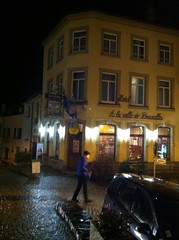
•Café Hotel de Ville de Bruxelles, 15 Grand-Rue Vianden, L-9410 Luxembourg; +35 2621186547. Don't ask me why a small old-fashioned hotel owned and operated by a couple immigrated from Portugal has a name like this; its not important anyway; what counts is the ingratiating warmth of the people, the pure heart of their work, and the truly excellent bacalhau they gave us. Quiet, comfortable, on the main street of a very picturesque town.

•Hotel Bristol, 11, rue de Strasbourg, Luxembourg-Ville, L-2561 Luxembourg; +352 48 58 29. Small quiet clean room, elevator, decent breakfast, nice (but smoky) bar, easy one-block walk from the train station, cheap. Oh: and friendly.

•Hotel Central, 2, rue Victor Millot, Beaune, 21200 France; +33 0380247724. Another very old-fashioned hotel with a pretty, quiet room overlooking a quiet street just off the central place and close to good cafés and a quite good restaurant (Ma Cuisine), with a nice bar and a friendly staff.

•Hotel Restaurant Le P'tit Monde, 54 Rue Du 4 Septembre, 24290 Montignac, France; +33 0553513276. Perhaps the grimmest of the hotels we've slept in lately, but clean enough. The price seemed unnecessarily high and the staff a little cool, but there's a fine restaurant (La Chaumière) right down the street.

•Hôtel Du Puy d'Alon, 1 Rue De Pressignac, Souillac, 46200 France; +33 0565378979. A kilometer from the center of town, thus the nearest café, bar, or restaurant; a pleasant room with stenciled wallpaper; quiet; comfortable.
 

Sunday, March 11, 2012

Localinguists

Hotel Bristol, Luxembourg, March 11, 2012—


Historical Luxembourg. Red: present-day Luxembourg; two blue areas at bottom: lost to France; blue upper right: lost to Germany (and now in German-speaking Belgium); mauve: lost to French-speaking Belgium.

Walking through rural Belgium and Luxembourg I've been thinking about Small Local in the context of International Community, as evidenced by language, gesture, adaptation to terrain, and such things. And I've been thinking about these things in the context of History, because it is so present here; and in the context of some provocative comments made by a funds manager to a journalist writing about global economy:

Daniel Arbess, quoted in "Magic Mountain," a fascinating article describing the scene at the Davos gathering of the World Economic Forum, written by Nick Paumgarten and published in the March 5, 2012 of The New Yorker:
"Kids who are twenty or thirty years younger than we are have a totally different experience in and manner of absorbing and processing information," he said. "How will this generation make decisions? How will they understand the big, looming debate about the legacy of entitlements and debt left by their elders? How do they understand the economy?" It was his suspicion, from his conversations here and elsewhere, that they may not understand it very well, or at least that polarizing rhetoric fostered by social media, amplified by a cynical political class may be corrupting their ability to discuss it in terms their elders can understand or abide.

"There's a lot of intellectual confusion about the causes and culprits institutionally of the mess that we are in," he said. "The language and the thinking that have evolved after the financial crisis have had an impact on the way young people think. All this talk that companies need to change, and so on — it's a misconception of the role that companies play. Shareholders risk capital. Banks intermediate capital. This is what keeps an economy going." He went on, "The root cause of everything we're experiencing is a failure of holistic thinking in a world of increasingly complex, fragmented, and ubiquitous information."
Then today I was told that one of the fundamental assumptions about the Luxembourg state, as it was determined by William II, was that it would be officially bilingual, in French and German. And yet the country people spoke Luxembourgish among themselves, as they still do. Luxembourgish was not recognized until the 1980s, as I understand it, when suddenly linguist took an interest in it, declared it endangered, and began promoting its retention and even expansion.

It was declared a third official language, and began finally to be taught in the schools, which had until then not only not taught it but had actively discouraged it. A problem immediately arose: it had never been a written language, and orthographical rules had to be invented for it.

As I've mentioned, we've run into people in both Luxembourg and Belgium who spoke only the local language, Belgian German or Luxembourgish. They've been older people and country people, for the most part, who perhaps never did learn French or German as well as they might have, and who have lost it through years of neglect. They seem to me to be speaking Luxembourgish.

I've always thought of language-speaking as a fairly simple affair: one's monolingual, like me and most other Americans, or one's functionally bi- or multilingual, like most of the Dutch. I see now it's not that simple. Languages are intrinsically complex mediations of divergent individual and social urges and demands, always in flux, always compromising between intent and the possible. How often I've wound up saying not what I wanted to say but what I could (or thought I could).

There are monolinguists, and polylinguists, and localinguists, those who speak only a small local language, enough to converse with the neighbors about matters of local import, but at considerable disadvantage when it comes to communicating with other nations, or cultures, or times.

Charting the use of language in three dimensions, the X and Y coordinates are simple enough; language follows human social geography. In this land between Meuse and Rhine, Germanic (and Gothic) sounds prevail in the east, French (and Romance) in the west. As we've traveled south from Zuid-Limbourg, the Dutch corner east of Maastricht, our lips and tongues have moved from Dutch to French and back more than once, though, because of the third dimension of time, as many of these territories have been moved politically from one sovereignty to another. (For a long time, in fact, Luxembourg was ruled by Spain.)

And as lands move back and forth politically and, more reluctantly, linguistically, so does each of us. I once asked my father-in-law, who was born in a small mountain town in northwest Italy, near Torino, whether his parents, who settled in the United States in 1914 or so, spoke English or Italian at home when he was a child, and he seemed surprised: Italian! Why, I didn't learn Italian until I went to school! We spoke what we spoke. (Most speakers of this particular form of Italian Piemontese think of it as a dialect; I've recently come to realize that in fact it is a language, Langedocian, fairly widely spoken across southern France from the Pyrenees east to his valley in Piemonte.)

Speaking and thinking seem so closely connected that argument continues whether they are mutually necessary. (I think not, but then I think instrumental music is a form of speech, recording nonverbal thoughts of its composers.) The deliberate national decision to recognize and encourage the teaching of Luxembourgish is the recognition — belatedly! — that the Luxembourgish desire, stated in the nation's motto, "We wish to remain as we are," is a national social value worth respect.

Until a generation ago Luxembourg was one of the poorest nations in Europe; now it is one of the richest in the world, its per capita income surpassing that of the United States, surpassed only by a few oil-rich emirates on the Persian Gulf. To remain as one was, in the face of so sudden a change, seems impossible and misguided, if perhaps understandable: but then one remembers the Council of Vienna, and the Treaty of Versailles, and that of Maastricht, and one realizes these cataclysmic nation-changing events are in fact fairly regular, hardly a normal human lifetime doesn't see two of them.

And in fact as Daniel Arbess points out the fact that we see iPhones in use everywhere we go is the sure indication of another social (therefor linguistic and economic) cataclysm, in which the three dimensions of social interaction house what seems a complete jumbling of local and national, class- and subcultural-based strands, often thought fairly separate and identifiable — erroneously, it's evident.

Even in the age of archery such moments have made changes faster than their natures could have become evident: how much more urgent is such comprehension now. Lacking such comprehension one can only shake one's head, as the old lady I was "conversing with" in Rodeshausen the other day, and agree de welt ist kaput. I can't help thinking that she lacks the language to investigate and consider that world; it has largely eroded away. On the other hand, she seemed cheerful, happy with her lot, content to remain as she is.


- Posted using BlogPress from my iPad

Thursday, March 08, 2012

Le Château

Vianden, Luxembourg, March 8, 2012
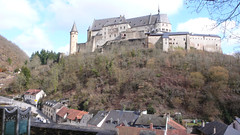
UP PAST THE WALL and to the Château today. The Romans built a fort up there late during their Empire, and throughout the Dark Ages its ruins stood as a reminder I suppose of the good old days. by the time the early Middle Ages rolled around civic pride and perhaps an enhanced local economy led to improvements, and by the 15th century the place had become quite palatial, near what you see above.
 
Then hard times set in again. Vianden had been the capital of its fiefdom, but times changed. By the middle of the 19th century — odd:how recently I would have written that "the last century" — the two main gates in the town walls had been pulled down and the château itself had lost its roofs and interior carpentry. How, I don't yet know: fire, I should think. In any case, it was again a ruin, this time not Roman but Romantic.
 
In the 1980s, though, miraculously, the enthusiasm, technique, and above all money was found to restore the place. The result seems quite persuasive to me. There were of course plenty of descriptions and sketches and engravings to go on, and, I suppose, analogous buildings elsewhere (though not many of this caliber, I would bet). We spent an hour or so wandering the galleries, the huge rooms, the kitchen, the residence — I took thirty photos or so: masonry, carpentry, fascinating photodocumentation, scale models of the building at three different epochs. And we were entirely alone.
 
Lindsey read in a travel website that Vianden is to be avoided on summer weekends, when the town is overrun with Dutch, Belgian, and German tourists. I can believe it. But in these early days after Ash Wednesday most of the hotels are closed and the town is given back to its 3,000 or so residents. Curiously, many of these seem to be Portuguese. Our hotelkeep is, for example; my other blog will soon report on a bacalhau.

Four men were roofing one last part of the Château when we were up there, in beautifully fish-scaled overlapping curves, cutting each rectangular tile with a mason's hammer against an anvil spiked anew into the wood substrate as each course advanced. I thought the material must surely be synthetic ti be so even, but when I asked the crew flunky what it was, C'est ardoise, monsieur. I knew that was slate, but then asked sythethique? Ah non, monsieur, c'est naturelle.

Is it from here, then, I pressed. Ah non, monsieur, il vient d'espagne. I looked at him a little more closely: Como Usted, creo. Ah si, Señor, he responded, smiling.
 
Spanish slate, Spanish skill. Portuguese inn (Auber would be pleased). European community at work. Not so different, I'm sure, from what obtained during Roman times.
 
We had walked up to the château following an itinerary outside the town walls, laid up four feet thick and quite high of local flags of shale, I think — I'm no geologist. Towers are placed every thirty feet or so, an easy arrow-shot apart, close enough that no sentry-walk was needed for further protection. The towers are curious: often four or five stories high, they're open toward the town side: no infiltrators would have hidden in them! It's a shame the main gates were pulled down a century and more ago, but a greater wonder the walls themselves are nearly intact. They anchor the medieval taste the entire town seems to maintain, with its lack of permanent signage, sidewalks, asphalt, visible wires…
 
And yet I write this in a café-bar-club devoted to cinema; Sinatra and Billie Holiday and Jo Stafford provide the background music; my Martini is to my specifications, and very good…


Back to the bus

 Hotel de Ville de Bruxelles, Vianden, Luxembourg, March 8, 2012

YESTERDAY , AFTER HAVING WALKED eighty-five kilometers on the GR-5 from Spa to Oberhausen — not bad, about what I'd hoped to cover, given that I'm carrying a heavier pack than usual, and developed a nasty cold along the way — yesterday we walked a mere three kilometers, down the steep hill from our German hotel to the bridge across the river Our, then along the river, on a national road, to Rodershausen.

There we waited a little over an hour for the thrice-daily bus — morning, noon, and night -— that would take us to Vianden. It was quite cold, a little above freezing, but there was a bus shelter with a bench. I read the latest New Yorker — I'm so glad I broight the iPad on this trip; it's useful for much more than writing these reports! — and stomped about a bit. National road or no, there was no traffic. Next to the bus shelter stood a small church, locked up tight, curiously low, sunken into its plot of land behind a retaining wall, as if the entire country had risen around it by eight feet in the centuries since it had been built.

Across the road, a single row of connected houses, then a vacant spot or two, then, a little further down, another building incorporating two or three attached houses. In the larger of these two rows there was a café-restaurant, closed in spite of its posted hours. We saw a woman's face in her window directly opposite us; she seemed intent on ignoring us. After a while an old lady emerged from one of the houses down the road, looked at us curiously — the curiosity of old-timers seeing strangers in their villages — dumped a jar or pitcher, I wasn't sure which, and went back inside. Birds sang in the bare branches of a tree behind our shelter, in the green field stretching down to the river.

The café-restaurant continued to be closed; its proprietor must be away. The old lady stood out in front of her house again and I went down to say hello. She was small and pert, missing a few teeth but beautifully smiling, wearing black stockings, a patterned apron, a dark knit sweater, her thin grey hair close to the skull. She seemed to speak only German, and that in a dialect, but with gestures and my poor Dutch we managed the courtesies, the banalities about the weather, and reassurances that yes, the bus would come, half before one o'clock.

Later, say twenty minutes before the bus was to come, the younger woman whose face we has seen earlier was out in front of her house, barefoot, putting trash in her rubbish-can, and the old lady hailed her in a surprisinly healthy voice. Clearly they were used to familiar conversations called acoss the eighty meters or so separating their doorsteps. I couldn't make out a word; their language was completely unfamiliar to me. After a time, though, Younger Woman stepped out her door and addressed us, in Dutch: would we like a cup of coffee, or tea?

Yes indeed, thank you very much, it's rather cold today, isn't it; how can you be standing there without shoes?

She smiled and indicated that she was used to it, and indeed her pretty feet seemed completely free from the disfigurements so often caused by years of wearing shoes. We stepped into her kitchen, a small square room whose door opened directly onto the street. A small table, two stools, and an ironing board completely filled the room. We were offered three choices of tea: rooiboos, camomile, rose-hip. The woman seemed to be in her late forties, rather pretty, blonde. The room was warm; she was lightly dressed and barefoot. 

She apologized that she spoke only Flemish — she'd come here from Belgium a number of years ago — and a little "what they speak here." The ironing board was big and sturdy, and seemed to have a built-in steamer: at one point she murmured an apology, leaned past, and turned something off, and the padded cover of the board gave a little sigh and visibly relaxed, as if it had been stetched above continually blowing air. Ah: that's why the kitchen's so warm, and she can work barefoot all day. Her iron was a huge affair with a steam-hose apparently connected to the table, and a big laundry-basket nearby was filled with what looked like sheets and pillowslips. I complimented her on her professional setup, and she smiled and said her husband had bought it for her a couple of years ago.

The bus came, empty, driven by a smiling little man who maintained an occasional telephone conversation while guiding the bus around tight curves. Gradually the landscape changed until suddenly we were next to serious operations that seemed at first to have something to do with mining: wide galleries had been drilled horizontally into the rock to our right, the Our still running fast on our left. The driver explained that this was not mining: it was a huge hydroelectric operation, profiting from reservoirs on the plateau high above us, and it was being considerably enlarged.

He dropped us in the center of Vianden, where the Grand-Rue rises west from the river Our, ultimately to the huge fortified palace above the town. Our hotel is just up the street to the right. We set our packs down in its café, explain that we've reserved a room, and settle into a cappuccino. Before we know it someone's carried our heavy bags up to our room, a cheerful one on the second floor, its windows looking out across to grassy terraces below spruce forest across rooftops on the Rue du Ruisseau.

It's such a pleasant little town, with so many curious corners, that after visiting the Victor Hugo Museum we decide to stay an extrra night, giving us a full day to explore. We go out for a stroll, a Martini, ultimately for dinner, and return to our little hotel happy with the choice. The WC and shower are down the hall, but there are nice new terrycloth bathrobes — from Ikea!— in our closet, and we're the only guests in the hotel. It seems like we've lost thirty years.


Monday, March 05, 2012

Painting and pannekoeken


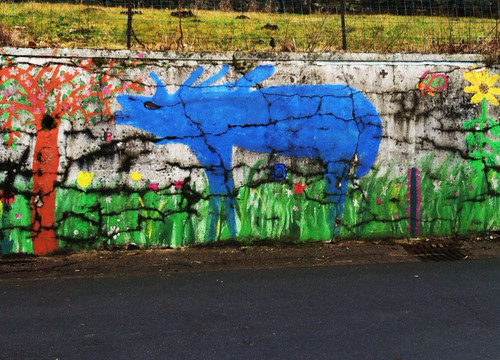
Evolution of stegosaur to elk:

Children's mural on retaining wall, Welchershausen, Germany

Oberhausen, Belgium, March 5, 2012—

WE STAYED IN today, for the most part. That's allowed: this game has no rules. I put on my coat at one point and sat outside the front door to clean the mud off my boots. The sky was light grey, as yesterday, and tiny snowflakes occasionally lit on my sleeves. A faint croaking turned my eyes skyward: scores of birds storks perhaps, quite distant and ungainly, flew determinedly north in three huge loose V's. it's cold: I quickly finish the boots and carry them back upstairs to wax them. 

Almost irrational, my fondness for these boots, bought four years ago for a trek across the French Alps, worn hundreds of miles, good as new. They treat me very well, so I respond in kind. Sharp rocks, persistent mud, even ankle-deep water don't faze them. Sometimes I think their cruelest assignment is to put up all day with my feet, and I often stuff them with cloth and leave them out overnight for air. Next morning, every morning, they're soft and supple in my hands, embracing and consoling on my feet, ready for another day of it, like a familiar animal, eager to ready me for another day of it.

After a late-lunch pannenkoek — these are among the best, perhaps the best, that I've eaten anywhere — we braved a cold wind to walk a kilometer into Germany, across a one-lane bridge over the fast, narrow ricer Oure, attracted by the promise of a unique museum. Welchenhausen is a tiny town, hardly more than four or five widely separated farmhouses, but its museum, advertised as the world's smallest, is open night and day, seven days a week. It's in a bus shelter, hardly needed for its original purpose since the bus doesn't come any more. 

The current show is a series of panels featuring engaging color photos and texts documenting the rebirth of village traditions attached to the calendar: Carnaval and Lent, Easter, May Day, Midsummer day, and so on. The texts and the installation are serious enough to persuade me that this is Anthropology, not merely Tourist Publicity: but of course everything was in German, which I do not read, so I may have been fooled. 

I like the Germans, said Mevrouw van Steenbeeck the hotelkeep here yesterday, you have to admire their discipline. I'm sure you're right, I replied, but they seem to enjoy themselves, too. Oh they like to have a good time, she answered. They have their feasts and their holidays. An explanation struck me: They're Catholic, for the most part, no? Yes, she said, and they have their feast days. 

Mevrouw van Steenbeeck herself was born and grew up in Amsterdam, and bought this place with her husband thirty-five years ago, having fallen in love with both building and setting at first sight. Let's see: that would have been in 1977. I thought back to the Amsterdam I recall from those days, rather different from today's, and we agreed a little bit about the changes. Her own quarter, for example, was largely destroyed by the building of the huge theater complex at Waterlooplein, where the legendary flea market stood — I bought a wonderful serious raincoat there in 1974 for a mere five guilders, and it served well until a day when it rained in fact, and the coat dissolved into fistfuls of gooey wadding. 

As we were finishing our pannekoek this afternoon a fellow came in, looked around as if seeking someone… I told him Mevrouw van Steenbeeck was in the kitchen. (There's only her, today, and her husband, who seems to spend a lot of time reading the newspaper.) Ah so, he said, in German. Late sixties, I'd say, certainly Dutch, slim, rather muscular, balding, with curly white hair on each side. He was the only other person in the dining room tonight — yesterday there had been two other couples. 

He smiled at me encouragingly when I got up from table after the soup to stand a few minutes with my kidneys to the fire: I'm too old, I explained, in Dutch, He answered in German, and when I told him I didn't speak German said regretfully his only other language was Dutch — but said that in so thick a Limburgse accent it was very hard to understand. ultimately it began to lock in, or he reverted to the Dutch he'd learned in school.He was a painter, he said; he'd painted the three rather nice landscapes hanging in the dining room. A bit of van Gogh there, I said, in the geometry; I like them. 

He smiled in agreement: van Gogh, but not imitative. Painting like this, well done, shows not copying technique but learning from it, to turn it to something useful today. He's having a show of local landscapes in Reuland in April: I'll look for internet mentions. I come here for twenty years, he said, lapsing back into German. Has it changed in those twenty years, I asked; no, not at all. 

I asked Mevrouw van Steenbeeck later what his name is. Pierre Houden, she said, pronouncing it in the Limburgse manner, with a French "ou" making me misspell the name. That's now they talk in Roermond, she explained, resignedly. Yes, but "Pierre"? Not Piet? Well, she said, he's an artist, he's entitled. And he's nice, nose not in air.

Tomorrow, cold or not, we leave this wonderful spot foe a walk to Dasbourg. That's life, at least as I live it: find, enjoy, move on no regrets. Take the memories with you.


Sunday, March 04, 2012

Lost and found

From Google Earth: the forest in which we were lost today

Oberhausen, Belgium, March 4, 2012—

WE CHEATED A BIT yesterday — you see Curtis, we're not all that obsessed — and we paid for it today. The problem is, overnight accommodations along this stretch of the GR5 are few and far between; you have to plan carefully. Yesterday the shortest walk between our two endpoints would have been a good twenty-five kilometers, over our budget. So we cut nine kilometers by taking a taxi to bypass the first stage. At nine-thirty he was at our Vielsalm hotel, smiling and ready to go; we tossed the backpacks into the trunk and set off.

The ride took twenty minutes or so, partly because our taxiste was in no hurry. He pointed out sights along the way, telling us more about the incredibly evolved techniques for harvesting pulpwood, the mainstay of the local economy: giant robots, guided by remote control, climbing the hillside to clear-cut huge tracts, strip the branches, cut the trees into two-meter lengths, and stack them to be picked up after they've seasoned a bit.

We were curious about hunting. Deer, pigs, and wild goats are taken in November and December, but the trails are safe for us now; hunting is out of season pour la réproduction. The country we've been walking through seems very forest-oriented, particularly at table: venison, boar, and wild duck are often on the menus; forest berries accompany them, and flavor the spirits you take as a digestive, or to warm you on cold evenings.

Taxiste dropped us in Commanster, a pretty little town with a fine stone church, two or three houses, and the memory of an unsolved murder. In November 1955 Arsène Lecope, a man in his fifties who lived with his two spinster sisters on their small farm near the church, was set upon near the cemetery by a large man wearing a black hood as he was returning from his habitual Monday evening smoker with the other old boys in the neighborhood. 

He was strangled, but managed to beat off the assailant and drag himself to the nearest house. The doctor was summoned and reassured everyone that the victim's condition was not serious. He worsened, though, and died a few days later. This precipitated a police investigation, but the locals were apparently not very cooperative, and the case was never solved. I don't know much about World War II, but know of course the fighting was long and heavy hereabouts; I wouldn't be surprised if a long-simmering resentment concerning resistance or complicity were at the bottom of the case. 

The fields around Commanster are beautiful today; it's hard to think how much blood has sunk into them over the years. We walked through them, through patches of forest, through more fields; through the ghost embankment of the old railroad, long since disappeared otherwise, through the villages of Braunlauf and Schirm, always hopeful for a café, always disappointed.We left the GR5 after Schirm and walked down past another imposing farmstead into Grüfflingen, meeting the first human we'd seen since the taxiste, a pretty girl in her 'teens with a border collie at her heels. Bonjour, excusez-moi, est-ce qu'il y a un café dans la village? She looked a little surprised and amused and answered in excellent English, Oh no, no, I'm sorry…

Pourquoi parlez-vous anglais? Nosy me asked next. The answer came pertly, woth a light little laugh: Because I can! And on up the road she and her collie went.And we continued on ours, through more forest and fields, past a bunker and a huge agricultural operation, down into Burg-Reuland and our night's hotel. 

It had been an easy day, fifteen kilometers, not much climbing, but we were a little footsore. Still, after cleaning up and changing we went for a stroll around town. The ruins of a fine old fort, burned by the French in the 1790s. A fine city house painted a striking deep red. Houses with small orchards, chickenyards, dogs. From a barn next one of these village houses, the bleating of a hungry calf.


Today, though, ah, today was difficult. The climb up out of Reuland was one of the steepest I've walked, and soon after we'd leveled out and were enjoying a walk down a country road between fields we somehow missed a turn. I don't know how it happened; I think the balissage was missing, and I wasn't sufficiently attentive. The guidebook and its map both clearly show a right turn at a crossroads, but we came to none. 


Finally we came to a mud road leading off to the right, and there stood a huge oak with the only blaze we'd seen in quite a while: the X-shaped cross of red and white stripes that say Go No Further.So we took the mud road. No more balissage. Back to the country road and ignore the X. That way clearly is wrong, map and compass tell me: back to the mud. We follow this until we come to the forest; we enter the forest; we get completely lost. There'd been a heavy mist or very light rain all this time; even in the open it was hard to orient yourself by the light; in the woods I wasn't sure we could count on our GPS. 

Still, I trusted the compass. The right way was far too steep a descent in this terrain, badgerholes, fallen branches, leaves, our heavy packs: we went along the contour and even a little uphill. Finally we came to the clearing and I saw what must be the trail. A hundred meters down a grassy slope and we were on a dirt road; almost immediately we saw the welcome balissage: white stripe over red. From there it was a piece of cake, or nearly. 

We met our first co-walkers of the last four days, and they gave us both advice and a better map. We took a steep climb up to the edge of Luxembourg, then — following our new map — left the GR5 and walked a kilometer or so down an asphalt country road (rarely a car or tractor to be seen) into town. There, in front of us, our hotel, with its reassuring sign PANNEKOEKENHUIS; and there we are tonight — and, for all I know, tomorrow night too, as it may snow tomorrow. We've walked four days now, about sixty kilometers (thirty-eight miles), not bad, given the terrain.

Saturday, March 03, 2012

Why Belgium?


bunker in the distance, field near Burg-Reuland

Burg-Reuland, Belgium, March 3, 2012—
I'VE NEVER REALLY understood the point of Belgium. So small a country seems to me to make no sense unless it's to express a uniquely strong sense of unity. Denmark, for example, makes sense as a counter-statement to the rest of Scandinavia. Larger countries like Germany, France, Italy have made themselves nations by integrating smaller communities with the sheer weight of their size, even then not that easily. But how can Belgium justify nationhood, other than by refusing, fraction by fraction, to be subsumed by one neighbor or another?

It was partly in order to explore this that I thought of taking this trek across the Ardennes. The town we're sleeping in, tonight, numbers about 500 citizens, our barkeep-hotelkeeper tells me; yet it's quadralingual: French and Flemish, the two majority languages of the nation; German, which is perhaps grudgingly approved since Germany annexed this area temporarily a while back, and the local dialect, which seems to me to mediate among Dutch, German, and the peculiar language they speak in Luxembourg — a language which is, I think, like Alsatian, really a modern development of Gothic, not merely a dialect of German.

In the last few days I've opened conversations in French, and the usual immediate reply is in an incomprehensible kind of Dutch — Flemish, I suppose, spoken as a second language by people who are just trying to be polite. When I then explain that I don't speak Flemish my interlocutor responds in an almost equally incomprehensible French. This was until today, when in Spa and Stavelot and Vielsalm we were in the country of Wallonia, where the locals seem to prefer speaking, well, Walloon, a strange cousin of French.

English is spoken at hotel desks and to a limited extent in restaurants; it is never seen, not even on menus. When I asked a man in Stavelot for bus information — an old man sitting in the sun on a bench with his dog — he answered in Flemish at first, then switched to French. He asked where I was from: California, I told him. Oh, pas Australien? (I think my hat had misled him to that conclusion.) No, California, I said, in the west of the United States.

He formed his hands into pistols, not letting go the leash, and smiled, and said Wild West! Paf paf! I smiled and said Yes wild west, il faut après tout tuer les vaches, and he smiled, and I walked away.

Great as these linguistic differences are, I don't think they cause the fractionalization of Belgium. I think they rather are one of many results of a single cause, the intrusion of foreign structures on thitherto specifically local societies. Our friendly (not to say loquacious) hotelkeep in Vielsalm told us of a distant ancestor who was peacefully minding his own business in his workshop when Napoleon's army marched through town, informed him he was joining the troop as a sapper, and had no choice but to go with them as a noncombatant (perhaps not trusted with arms), on the Russian campaign, which he not only managed to survive, but even took advantage of to the extent of bringing back to Belgium (as it would become in another thirty years) with a Belorussian wife. Hence the improbable name Bérinzenne, a community outside Spa. These people butcher foreign languages worse than do the Brits.

The same hotelkeeper told us his grandfather had fought on the German side in World War I, having no choice, as after the Germans had annexed Belgium, after only twenty days of war, he was after all a German, and followed orders or else.

When his son received a similar notice a generation later, though, he told his mother he wouldn't obey, and instead left in the middle of the night, somehow making his way south across France and Spain to Gibraltar, where the British, impressed by his resourcefulness, took him in and sent him to Scotland to help train Commandos.

This southeastern part of Belgium belonged to the Royaume of Luxembourg, as I understand it, until those leaders of the free world the French, because 1789 made them republican and egalitarian, not monarchic, and intent on spreading the word Enlightenment everywhere, decided it should be French, and so it remained until the Council of Vienna, presumably not knowing what else to do about Flemings, Walloons, and other such non-belongers, decided to throw them all in together in one tiny buffer state with its own king.

Industrial savvy and a huge, rich African colony — don't ask me how they got that — made Belgium work, more or less, among modern post-Napoleonic countries up until the tragic 20th-century German expansions. Having walked three days through the country and talked to a handful of representative Belgians I feel pretty authoritatively that the country could be self-sufficient; there's good farmland, God knows plenty of trees, and that endless supply of Spa water.

Tourists like to come here for what they lack at home: the Dutch for hills; Germans for food closer to that of the French; the French no doubt to feel better about being French, not that they need reasons; people of all nations, sadly, to visit cemeteries. To me the people hereabouts seem relaxed and secure. The Vielsalm hotelkeeper, as if to explain why he stayed in this little provincial city, said Look, I'm forty-two, I was born here, I love my country, I know it rains a lot and the mud is terrible, but it's beautiful, it's not like anywhere else, and I'd never leave it.

(There must be something in his gene pool, though: he too has a Belorussian wife; I never found out why.)


- Posted using BlogPress from my iPad

Friday, March 02, 2012

Tramping in the Ardennes


Vielsalm, Belgium, March 2, 2012—
WALKING, STROLLING, RAMBLING: those are all very nice. But it occurs to me today that what we're doing here is none of those: it's tramping.

We had a couple of pleasant rambles in Zuid-Limburg with Hans and Anneke, walks of no more than five miles, in a loop beginning and ending in the same place, carrying nothing but our cameras. That's a ramble: an outing whose only purpose is to enjoy the day, the company, the out of doors, the views; the sounds of birds and the brooks; villages; a cup of tea; maybe an unexpected poem out in a pasture.

But yesterday and today we walked with a purpose: to move ourselves and our possessions from one resting-point to another. These trajects are linear. They have purpose. The only thing that redeems that, in my view, is that the purpose is utterly stupid. Today, for example, we walked ten miles, in three hours and forty-three minutes, climbing from 276 to 525 meters and back, much of the time on muddy trails and roads, to get from Stavelot to Vielsalm, when the bus would have got us there in about twenty minutes, for about ten dollars. And my back-pack weighs, I think, about forty pounds!

(I know the walking statistics in detail thanks to a wonderful iPhone app, MotionX-GPS, which records distance, speed, and elevation, and plots the results on a map. You can see the result, for today's trek, at this webpage, at least for the next few months.)

This kind of trekking has become one of my consuming passions. It began, as so many things do, with a chance encounter with a book: Walking Europe Top to Bottom, by Susanna Margolis with Ginger Harmon (Sierra Club Books, 1984).

This book challenged me instantly, and I determined to make the trip, retracing these steps on Europe's Grand Randonée 5 from Hoek van Holland to Nice. I quickly decided to modify the walk, though, substituting a walk on the Pieterpad, through the whole of The Netherlands, Pieterburen in the north to St. Pietersburg near Maastricht in the south, about four hundred miles in all, for the first part of GR5, across Flanders to Maastricht.

We began that walk in 1995, I think it was, Lindsey and I and did the first half that year, returning for the second half a few years later. With Lindsey, and occasionally with friends, or daughters, or both, we've taken other walks in that delightful country, point-to-point walks, carrying only one change of clothing for the evenings, eating picnic lunches, dinners in restaurants, and sleeping in provincial hotels or B&Bs.

All the time I kept thinking of the GR5. Finally I invited a grandson and a friend to join me on its final third, about four hundred miles from Geneva to Nice, an unforgettable four-week walk we took in 2008. (I blogged about it at http://sherewalking.blogspot.com, and later published a book about the walk, Walking the French Alps)

I felt a little remorse, though, at having skipped the dues you pay, so to speak, for this splendid conclusion to a long-distance trek, and that's why we've been slogging througih mud here in Belgium. Though even here I cheated quite a bit, beginning not at Maastricht but several stages (and kilometers) later, in Spa. The area around Liège just didn't look promising.

Yesterday we walked from Spa to Stavelot. The day began and ended badly: we got lost almost immediately, adding a kilometer and a half — and, worse, a fair amount of elevation lost and regained. The problem was lack of balissage, trail-marking, at a crucial point, where the trail crossed a quick-flowing stream: instead of crossing it, which I now see was the correct maneuver, we walked downhill alongside. By the time I realized the problem it was too late to retrace our path; better to take a parallel path and hope for a cut-across. It worked out, up on top of the hill south of Spa, a hill improbably crowned by an extensive marsh which is in fact the roof of the huge Spa water table.

Things worked out well enough the rest of the day, barring a fall apiece into the mud, thanks to treacherously slippery footing. At day's end, though, we discovered the hotel I'd booked was miles away from the day's endpoint. Fortunately, there was a bus. Unfortunately, the driver forgot to let us off, took us miles too far, then dropped us off to wait for a bus coming back…

Oh well, these things happen. Next morning — this morning —the woman working the hotel gave us a lift into town (Stavelot) and we set out on today's walk, arriving here in good time.

Logistics, logistics. Where to sleep next, and how to be sure the day's walk isn't too long. Tomorrow we'll take a taxi to bypass the first 8 or 9 kilometers; otherwise the day-stages get completely out of sync with the possible sleep-villages. There aren't that many, and much is closed for Lenten holiday.

Tuesday, February 28, 2012

Pleasures and proprieties

 Epen, February 28, 2012—

THIS HAS BEEN a particularly nice stay, the last couple or three days in our beloved Netherlands — as always, I look forward to leaving woth regrets. A lot has to do with the company, our even more beloved Elfrings. A lot has to do with the pleasures of rambling, too: but those will continue another week or so, as we make our way toward Luxembourg.

But a lot has to do with The Netherlands, a country that never fails to impress me with its improbable marriage of pleasures and proprieties. I wrote yesterday of a poem found in a pasture: I tried to include a photo with that  but the WiFi here failed: the only little disappointment here.

We drove across the border yesterday to check out Aubel, a Belgian town I'd thought might make a good first stop on our projected walk. It had seemed nice on the Internet, but proved bleak and heavy on our visit. The Belgian architecture is heavy and dour by contrast with the Dutch, as if to emphasize a temperamental difference suggesting the Belgians are withdrawn and individualists, the Dutch more open and communitarian. 


Today we walked across the border to the town of Teuven, where we had lunch — borrelhapjes (bits of cheeses and sausages, dipped into mustars or syrup) and beer. this was pleasant enough, and artisinal too: I think our walk will have its pleasures, especially in the countryside.


Hill and dale is what it is here, the dales descending to quick-moving streams, almost narrow enough to jump but rivieren nonethless, the Geul and the Gulp, the latter giving Limburg its Gulpener beer. Cattle and sheep; chickens; cornfields later, perhaps. The first snowbells and crocus are well up, the mists are soft and bracing. Tomorrow we take a bus to Maastricht, then a train to Spa. No definitive plans beyond that other than to shoulder our packs and walk toward Luxembourg, and that's how I like it.

All we like grass…

Epen, February 28, 2012

On yesterday's ramble through the fields along the river Geul we came upon a poem engraved on a tablet set out in the pasture:


MIJ, SCHAAP

Mij, schaap, overkomt niets dan wat de herder wil,
wat het gras wil, de lucht,
wat de dam en de groene overkant.

En ik tors mijn wol mee of het verlies van wol,
en ik kijk vol overgave uit mijn
vochtige ogen. Ik ben gelukkig met wat ik heb.

De tijd verstrijkt als gras, door mij,
en elk verzet is hol. De bomen ruisen zinneloos.

—MARK BOOG


Which I translate, with Google's help (or the other way round)


ME, SHEEP

Me, sheep, nothing happens than what the shepherd wants
what the grass, the air,
what the dam and the green beyond.

And I my torso with wool or loss of wool,
and I look diligently from my
moist eyes. I'm happy with what I have.

Time passes like grass, through me,
and any opposition is hollow. The trees rustle senseless.


Such an intelligent, enlightened country, Netherlands…


- Posted using BlogPress from my iPad

Monday, February 27, 2012

Dutch interior

Epen, Feb. 27,2012—


WE VISITED AN ACQUAINTANCE yesterday in her twostorey brick bungalow set among oaks, beeches, and birches in a semirural suburb of Eindhoven, where she has lived for over twenty years with her cat, her tastes, her enthusiasms, her regret for her witty, good-natured husband who died suddenly twelve or fifteen years ago…

Among her enthusiasms: running a series of readings by significant authors in many fields: fiction, poetry, history, science. Saturday our friends Hans and Anneke had gone to hear Dick Swaab discuss his Wij zijn ons brein: van baarmoeder tot Alzheimer (Uitgeverij Contact, Amsterdam 2010), and spent the night, and we had gone yesterday to meet them, and renew acquaintance with Mevrouw W.

What a fine, rather elegant, composed woman she is, and what a fine sensibility! Her home is beautifully curated, as Lindsey pointed out… in the entry hall, for example, a painting apparently from the Seventeenth century, a sober, handsome man looking out over your left shoulder, hangs above a low three-legged stool on which was centered a bowl of fragrant apples.

Directly as you enter the large, low-ceilinged main room, if you turn to look back, you see a fine white tapestry covered with those geometrical toches of primary colors that unmistakably announce Bart van der Leck. On the wall at the right a massive oak armoire, from the Eighteenth I'd guess, and looking northern, from Drente perhaps; nearby, hanging just a bit askew, a fine pendulum- clock probably from the same time and place.

The far side of the room is a series of floor-to-ceiling windows looking out to the garden, a lawn surrounded by borders, then the woods. At one end, a pond with a discreet fountain and dormant lily-pads. Curled up on the doormat just outside the door, tail carefully wrapping him, a black-and-grey tortoiseshell cat whose folded triangular ears make you think of Leck again, and sure enough, when you turn back in the hall to thank her for the visit, you catch sight of his signature painting of a folded-ear cat hanging in the upstairs hall.

One doesn't pay such a visit without accepting coffee and a little something. The coffee was enriched with Amaretto and topped with slagroom, sweetened whipped cream; alongside, a delicious white cake with buttercream filling.

Everything here was in its place, and every place was right. This is a life, you sense, that isn't distracted by irrelevancies, or by things that don't count for something, don't hold their place and give their weight to a continuing conversation, among books, furnishings, paintings, friends, memories, and of course the cat; a conversation that fills the time, investigates questions that may arise, entertains its participants, and keeps that devil boredom out the door.

Sunday, February 26, 2012

"Heureusement, je fume"

Puiflijk, February 26—

 I QUIT SMOKING in 1968, after sixteen years of mostly pipe-smoking. It wasn't too hard, though I'd been a serious smoker, the equivalent of a pack a day. The pipe was a great pleasure, partly for all the accoutrements, partly for the physical pleasures of manipulating pipes, pouches, lighters, cleaning-spoons and the like, partky of course for the glorious taste and smell of the tobacco itself. Over the years I'd graduated from the cheap rustic satisfaction of the Grainger brand, rather a bland but edgy Pale Virginia leaf, to the deep rich 796B, blended to my own specification, with lots of Latakia, by the venerable Berkeley firm Druquer's, of fond memory.

In 1968 Anthony Boucher died. He was a magnificent man, a fine writer of mysteries ans fantasy, a specialist in pornography, canon law, and liqueurs which he used to study on annual cruises to Europe and back on the ols steamer lines. I knew him only slightly: he'd produced programs on opera and  mysteries for KPFA, where I was music director; and he joined John Rockwell and me on critics' panels there and, later, at KQED, where I helped produce another such weekly round-up, Culture Gulch. I'd admired him for years, and was saddened by his final months, and I'd visited him in hospital, where the shock of his greatly altered appearance, lessened and divested of his usual regality (amiable, though), revealed the ravages of lung cancer, making it much easier for me to quit smoking.

Other strategies helped. I took up a more serious attitde toward drinking. I enjoyed a subtler sense of taste. I promised myself I'd resume smoking, if I wan ed to, on my fiftieth birthday, which was only seventeen years off. Oh: and I was thinking of my wife and kids, whose life would be made more pleasant without ashtrays and smoke, not to mentiion the money saved. And I made a pact with my oldest daughter: if she stopped biting her nails, I would give up smoking.

So I did, cold turkey. Since then I've only smoked once, twenty years ago I think, an after-dinner cigar, a very good one I was promised, at the very soigné wedding of a couple of acquaintances, held at Francis Ford Coppola's estate, hardly a routine drop-in on our calendar. The cigar left me pale and queasy and I abandoned it halfway in.

Until last night, when Erik brought out a box of cigars after dinner, and Krijn tempted me to join them, telling an anecdote involving a tobacconist in Den Haag, who knew how to set broken merchandise aside for his own later delectation…

I thought of something I'd read in the airplane a couple of days ago, an appreciation of the pleasures of tobacco, la pipe, by Stéphane Mallarmé:

 Jetées les cigarettes avec toutes les joies enfantines de l'été dans le passé qu'illuminent les feuilles bleues de soleil, les mousselines et reprise ma grave pipe par un homme sérieux qui veut fumer longtemps sans se déranger, afin de mieux travailler…

And when Erik responded to my regretful demurral that an entire cigar would be far too much for me to attempt — really an excuse more than a demurral — by offering instead a miniature cigar, from P.G.C. Hajenius, in Amsterdam — and I reflected that after all the Dutch had been aficionados of and expert in tobacco for centuries — i gave in, held the tip of my cigarillo over the candle-flame a few moments, and drew in a half-mouthful of calming after-dinner solace, as my grandfather had done the last eighteen thousand evenings, give or take, of his long life.

I thought of my oboe teacher, if I may call a man I've visited only twice such an intimate, who'd advised me to smoke if I were to dry my mouth in order to play the thing more comfortably: aha: perhaps that's why Nelson, excellent horn player, had become such an adept of the pipe. I remembered how to roll the smoke around in my mouth, tonguing it as a dog noses sheep through the fold, and I practiced taking smaller amounts, so as neither to cough nor to inhale it into the lungs. 

It's more complicated than it looks, smoking — many seemingly automatic activities are, even the pleasurable ones. I recalled my beother, whose cigarette pack had yielded up a critically needed but if tinfoil at a moment when, stranded in an isolates village on an outer island in French Polynesia with a blown fuse on our rented motor-scooter, suddenly and surprisingly providing an inspired comment as I recounted the adventure to oue hotelkeeper:

Heureusement, je fume. Happily, I smoke.

Fortunately, I no longer do: but I'm glad to have been reminded of the pleasures…

Saturday, February 25, 2012

Back on the long road…

In flight, February 23, 2011—

THIRTY IN THE New World, including two in Baja California. Twenty-six, I think, in Europe; seven in the Pacific.  That makes sixty-three airports flown into or out of so far. I mention it partly because others have made comments that might be interpreted as suggesting we travel rather easily, ma douce femme and I: and in fact I've lost count of the transatlantic crossings, which I used to tot up in my mind on each lift-off toward Europe.  1973, '74, '76, '77, '80… lost in antiquity. 


 This trip is more ragged than most. I mean, the itinerary is ragged, improvised and imprėvu, unlike others we've taken. As I grow older I want more and more to do everything: recapitulate earlier experiences for myself; share them with others; find new experiences. So today we fly to Amsterdam, there to join old friends at a favorite restaurant; then we spend a few days in a less-familiar quarter in a very familiar land (my second home, in fact, Nederland); then we walk for I hope nine days across unfamiliar country… 


 We have one checked bag, which I will carry on my back, as I did four years ago across the Alps; and one carry-on, which Lindsey will carry on hers, as we have done often before. They will take us through the next two weeks.  At that point we rent a car, and perhaps accumulate more baggage. I rather hope not.  Along the way we visit our extended family: our Dutch siblings and their children and their children's now and former wives; our Swedish-Luxembourgish daughter and her three children, our French daughter and her husband and daughter. 


All these people — twenty or so — we think of as family, very nearly as close as our own blood: but, like our direct blood relatives, as dear friends also, people whose lives, experiences, interrelationships, enthusiasms, achievements, pleasures and occasional sorrows shade and illuminate our own, and those of our immediate family, and the close friends — not so many!— they have not yet encountered. 


 I find these last few months that these things matter more and more. A walk taken the other day with Oldest Daughter and a friend of hers — close friend of hers, more occasional friend of mine —  was strangely moving: nine miles altogether up two thousand feet, then back again, in chaparral on old lava country, putting me in mind of Provence and Corsica, though we were hardly an hour from home, near Calistoga. 


The silence of such hours, when shared with friends and family, overrides the ego's noise. I merge into the landscape, that eternal context I was born from: it was a mistake ever to have tried to set it aside, to make my way without it. It will win in the end, when I melt back into it, physically, as emotionally now I merge into the collective life of all these friends I contemplate. 


I've outlived my mother now by a couple of years. I used to wonder why she traveled so much, in her retirement: China, Australia, the trans-Siberian railroad and the Silk Road, Peru, the Nile… I thought she must be distracting herself from her usual daily life on these voyages to exotic places, hoping perhaps to shake mortality off the trail. I see now I was dead wrong: she was traveling into herself, back into her real state of relationship to Life and Being. At such extended moments, I think, we live most fully, because least wilfully. We are more than usually authentic, at home with ourselves and with our setting, and learning, perhaps, to be away from our selves.

Tuesday, February 14, 2012

St. Valentine's Day


LRS70.jpg
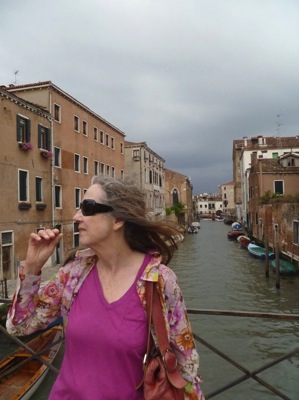
My Valentine, on her 76th birthday in Venice
(photo: Francesca Źivny)
Eastside Road, February 14, 2012—
I DON'T CARE what Pope Paul VI says, I like St. Valentine's Day.

He took it off the general calendar back in the 1960s, complaining that, after all, nothing was known about any of the two or three Saints Valentinus, or their doings, or any of that. Typical of the administration of the Catholic Church, to care more about an abstract authenticity of origin than the events and experiences of daily life and lives that contribute to the greater reality of immediate meaning.

The first poem written to mark Feb. 14, I read this morning, was by Charles (!), duke of Orleans:
Je suis desja d'amour tanné,
Ma tres doulce Valentinée,
Car pour moi fustes trop tart née,
Et moy pour vous fus trop tost né.
Dieu lui pardoint qui estrené
M'a de vous, pour toute l'année.
Je suis desja, etc.
Ma tres doulce, etc.


alas he wrote from The Tower, imprisoned by the dastardly Brits after Being taken at Agincourt.
I am already sick of love,
My very gentle Valentine,
Since for me you were born too soon,
And I for you was born too late.
God forgives he who has estranged
Me from you for the whole year.
I am already, etc.
My very gentle, etc.

The source for all this is, of course, Wikipedia, which also says it was Chaucer, Brit of blessed memory, who first popularized St. Valentine's Day through a reference in his Parliament of Birds. I begin to note stirrings of amour among birds hereabouts, and I'm ready; I've cleaned out the bluebird houses…

Sunday, February 12, 2012

The Great Gatsby


Marco Pannucio, Susannah Biller, Julienne Walker, Jason Detw.jpg
Marco Pannucio (Gatsby), Susannah Biller (Daisy), Julienne Walker (Jordan), Jason Detweiler (Nick), Daniel Snyder (Tom)

(photo: Steve DiBartolomeo)

LET'S STIPULATE AT THE OUTSET: a novel is one thing, an opera quite another. This observation is irrelevant to comments on one or the other, but not to the subject at hand, for in my opinion the most absorbing thing about last night's performance of John Harbison's opera on F. Scott Fitzgerald's The Great Gatsby was precisely that: the adaptation of a great novel to the lyric stage. And the adaptation was entirely Harbison's, as I understand it: scenario, libretto, and music all conceived and executed by a single mind.

Malcolm Cowley, in his introduction to an edition* of Fitzgerald's three great mature novels (Tender is the Night and The Last Tycoon being the other two), suggests the method Harbison uses in his adaptation when he notes that
Each chapter consists of one or more dramatic scenes, sometimes with intervening passages of straight narration. The "scenic" method is one that Vitzgerald probably learned from Edith Wharton, who him turn learned it from Henry James…
Harbison makes a very straightforward compression of the novel, choosing pivotal scenes for (mostly) ensemble portrayals and linking them with orchestral interludes whose dual purpose it is to move the action (often literally, by car, driving from Long Island to Manhattan) and to "portray," through instrumental music, an emotional response to Fitzgerald's novelistic purpose.

Two problems immediately arise here. One is general, and is suggested in those scare quotes around "portray": can instrumental music suggest the profundity and the vague richness of emotional and (dare I say) philosophical speculation of the kind The Great Gatsby attains? Only, I think, when said music can borrow the already present allusiveness audiences find in musical genres whose language and literature they are familiar with, and only when the music itself is composed with a masterly consistency of style and technique. It's not Harbison's fault that these qualities are lacking at the present cultural moment: and it's certainly possible that his opera will be able to draw on them in some future.

The other problem is specific to The Great Gatsby, which Cowley goes on to put
in the Jamesian tradition… having the story told by a single observer, who stands somewhat apart from the action and whose vision "frames" it for the reader. In this case the observer plays a special role. Although Nick Carraway doesn't save or ruin Gatsby, his personality in itself provides an essential comment on all the other characters.
In the novel, Cowley suggests, "Nick stands for the older values that prevailed in the Middle West before the First World War"; the other characters "belong to their own brief era of confused and dissolving standards". Cowley's is an economist's construction of the novel; his introduction also deals with Fitzgerald's essentially straightforward relationship to money, and to Marxian positions on literary criticism. But economics is more than money and social class: it's a system of discussing value and "values" in more general and more pervasive terms than those centered merely on lucre.

And the success of Fitzgerald's novel, to me at least, is its way of propelling its surface brilliance and fascination — the brittle seductive opulence of its drives and desires — with an engine whose power is generated through the weight, the mass of entire generational and geocultural forces. One deft comment of Nick Carraway's, omitted from Harbison's opera, sums this up for me: he describes Jordan Baker taking a seat at the dinner table as if she were getting into bed. You don't know what this means, exactly, but you see it happen. The line makes you think of Noël Coward; it precisely defines the irony of Fitzgerald's style.

I think this important, as it distinguishes Fitzgerald from James, moves The Great Gatsby away from "the Jamesian tradition", whose complexity had threatened the utility of prose fiction as social commentary. The Great Gatsby is in the Austen-Flaubert-Chekhov tradition: "scenic," but ironic. It is for us twentieth-century Americans what Madame Bovary was for the late nineteenth-century French; it reveals the lassitude and debility and, finally, tragedy that follows a nation's lapse from those traditional values — call them moral if you like — that focus a community on practical means of meeting communal dangers.

It may be pointed out that an opera is after all only a night in a theater, singing and staging; one doesn't go to an opera for a disquisition on social or moral or economic justice. There are exceptions, of course; Le nozze di Figaro comes to mind: but it's never fair to mention Mozart in such a discussion; he's always the great exception proving the rule.

But the brooding, almost Wagnerian qualities of much of Harbison's writing in the orchestral interludes makes me suspect their "portrayals" reach toward these kinds of concerns. And among the most powerful of the purely instrumental pages in the score are those in the final interlude, "Day Through Night," moving toward Gatsby's funeral; and those in the epilogue, which finds Nick Carraway gazing out across the water toward the Buchanans's green light, contemplatively singing the magnificent final sentence of the novel, which completely seals the interpretation of The Great Gatsby as much more than a story of love, adultery, superciliousness, inevitable tragedy.
Harbison's vocal music persuades me less. The opera is high-pitched, and among the least convincing music is that for Daisy and Jordan — especially their duet (soon set within a quintet) expressing their reaction to the stifling summer heat. It's not just that the words, whether Fitzgerald's or Harbison's, get lost in the high tessitura: it's that the melodic contours follow some incomprehensible directive, neither tonal nor not, perhaps meant to express the result of the mind-numbing heat, but unfortunately not ultimately engaging this pair of ears.

I mentioned Wagner earlier: much of the opera's score lacks air, crispness, definition. "Endless melody" no longer convinces me of deep or distant vision; perhaps it never did. The lack of clear key relationships, of sections distinguishable from one another by key, tempo, and instrumentation, encourages this listener's mind to wander, and that's a danger when there are so many things in the otherwise faithful adaptation of this great book to contemplate.

I have no complaints about the reorchestration of Harbison's score, reduced by Jacques Desjardins from the original large orchestra with winds in threes to a smaller but still considerable one with pairs of woodwinds and French horns, single brass, and reduced strings. I've never heard this opera before; I don't know if other musical adaptation was involved. The style of the onstage dance orchestra seemed perfectly authentic to the period (the Roaring Twenties, of course).

Nicole Paiement conducted with the precision, the attention to detail, and the grip on the long line that I've come to expect from her. I've heard her conduct operas now by Lou Harrison, Philip Glass, and Virgil Thomson: in every case she works for the composer, not imposing interpretation but respecting the composer's style. Her orchestra played well.

Matthew Antaky's physical production was quite effective, with Austin Forbord's mood- and place-setting rear projections of still and moving images of the water and the iconic Valley of Ashes — how many today realize the extent of ash-heaps in the coal-burning time of steam heat and transportation? — and effective suggestions of opulence conveyed through careful lighting, colors, and properties. Christine Cook's costumes were elegant, evocative, and character-defining.

I liked Brian Staufenbiel's directing, too. Each character, with the possible exception of Meyer Wolfshiem, seemed to have stepped out from the pages of the novel, fully fleshed out, with complex pasts and present needs; and all of them, even Tom Buchanan, were ultimately sympathetic. The party scenes were handled well for the most part; much of Tom Segal's choreography seemed deft and authentic, though long freezes and slow motion in backgrounds sometimes made longer soliloquies awkward: the intimacy available only in large crowds, which Daisy (or was it Jordan) mentions at one point, wasn't always at hand when needed.

You see the principal cast in the photo above: all sang well, I thought, on pitch, clearly when tessitura allowed, and acted well, both individually and in relationship to one another: this seemed like a well-prepared, well-rehearsed repertory production.


*Three Novels of F. Scott Fitzgerald: The Great Gatsby; Tender is the Night; The Last Tycoon. New York: Charles Scribner's Sons, 1953
  • The Great Gatsby: opera by John Harbison, after the novel by F. Scott Fitzgerald. Ensemble Parallèle Opera, Yerba Buena Center for the Arts, San Francisco; Feb. 10-12, 2012