Thursday, February 28, 2008

Blood on the Dining-Room Floor

DETECTIVE STORIES are not my favorite genre, though in remote antiquity I raced through the Dorothy Sayers list, and there was a time, forty years ago, when we enjoyed watching Perry Mason, god save us.

Going through the Stein shelves, though, I reflected that I'd never read Blood on the Dining-Room Floor, and got it down to look it over. It's a curious book, written in 1933 after a six-month writer's block, an extraordinarily rare even in Stein's life. I read it because I had just read Monique Truong's novel The Book of Salt, whose central figure is the Vietnamese cook Stein and Toklas employed for years at about that same time.

Blood on the Dining-Room Floor is "about" a couple of mysterious events, one involving the unexplained death of a local hotel-keeper, in and around the town of Bilignin, where Stein and Toklas had taken a country house for their summers. We visited that house in the summer of 1974, when it was empty. The gates were unlocked, so we simply walked into the property, not daring to enter the house of course, but walking around behind to a terrace overlooking a magnificent view west across the valley below; to the north in the distance a hilltop castle.

It's a quiet village, hardly more than a few farmsteads and a cemetery to the south, and here, in 1933, Stein and Toklas settled into the country summertime routine you may know best from Wars I Have Seen, which recounts daily life there. Recently the Bilignin house has taken on a darker side: Stein apparently obtained the lease through the assistance of Bernard Faÿ, later a collaborator in the Vichy government; somehow she and Toklas, hardly Aryan, were left alone there throughout World War II.

But that's in the future: at the time of Blood on the Dining-Room Floor Stein was undergoing a writer's crisis. Having begun writing relatively conventionally in 1903 and '04 with Q.E.D. and Fernhurst,, unpublished and unknown until 1950, she moved to her more ruminative style in her first early masterpiece, Three Lives, finished in 1906. In the next two years The Making of Americans finished off any conventional fictional narrative interest in her writer's mind, and her immersion in Cubism, as it was being evolved by her friend Pablo Picasso and his colleague Georges Braque, permanently influenced her own work. The first published examples of this were her portraits of Picasso and Matisse, in Alfred Stieglitz's review Camera Work, in 1912; Tender Buttons, written that year and published in 1914, is perhaps the early peak of this style.

Stein continued the style through the plays and portraits of the 'teens and '20s, gathered in Geography and Plays(1922) and Operas and Plays(1932), but continued to meditate in her writing on writing itself, in Useful Knowledge(1929) and How to Write(1931).

Then came the interruption of the celebrated Autobiography of Alice B. Toklas(1933), which made her popular and led to her return to a lecture tour of the United States in 1934 and 1935. I think this sudden fame and popularity combined with her dedication to her craft and her awareness of the lasting significance of the Cubist moment — which precipitated a deep divide between abstraction and representationalism among writers as well as painters and composers — had something to do with the crisis that resulted in Blood on the Dining-Room Floor.

In any case, in that book Stein returns to a Cubist sort of interpenetration of two planes: one of meditation on the act of writing; the other the observations, seen and overheard, of ordinary events of daily life — in this case, in a small village in the French countryside.

Blood on the Dining-Room Floor is probably best read twice: once quickly through, on its own terms; then again with thought given to various annotations. The edition I have was published by the Creative Arts Book Company (Berkeley) in 1982 in an edition with a helpful afterword by John Herbert Gill; it has been made available on the Internet. The first time through you'll perhaps be irritated and/or bored; this is a frequent response to Stein's writing. One reads a new book (new to the reader, I mean) burdened with the experience of all that prior reading, and most of that prior reading is pretty commonplace. Not the content of the texts, perhaps; but certainly the form or style. Even Henry James remains "difficult"; not that many readers go past, say, Mrs. Dalloway.

But I find Blood on the Dining-Room Floor a charming book, read not terribly closely, say in bed. The crime, if it was a crime, let alone its perpetrator, never really appears; the entire affair's presented as if a matter of village gossip, narrated through innuendo and arched eyebrow, certainly not laid out in at-first-and-then sequential narrative.

A closer reading introduces two major matters of interest: Stein's technique — what you might call composition as composition — and the significance of that technique as a witness to the intellectual revolution of her time, a revolution that is still proceeding and has yet to be noticed, let alone understood, by the vast majority of readers.

Among the other Internet annotations of Blood on the Dining-Room Floor, Craig Dworkin's Five Words In A Stein, addresses the first of these matters. I like it, partly because I'm drawn to language-play. Dworkin makes a case, and the pun's intended, for reading Blood as a text influenced by Stein's early family language, presumably as German as it was English; and he's alert, perhaps too alert, to subtle implications of the words and phrases that occupy Blood on the Dining-Room Floor, as restless guests occupy a country hotel. (Or refugees occupy an occupied zone.)

The second matter is the subject of Joan Retallack's Writers – Readers – Performers / Partners in Crime (published in How2, vol. 1 no. 6, Fall 2001), a paper given within a colloquy on "The Politics of Presence: Re-reading the Writing Subject in “Live” and Electronic Performance, Theatre and Film Poetry." Where Dworkin concentrates on a reading, even a deciphering of Blood on the Dining-Room Floor, though, Retallack goes much further, using Stein's book as a launch pad for an interesting sketch of a proposal, that while
…literature is an engagement with possible forms of life — as all language games (written or spoken or performed) must be
the fact remains that
…the explosion of forms that we've seen throughout the 20th century… poses difficulties for traditionalists — e.g., narrators of coherency, tidy story-tellers as guardians of logics of identity and convention.
The next sentence is crucial:
Ther narrator of continuity is (albeit often unawares) at odds in a world whose vulnerabilities have more to do with contiguity. Contiguity is the spatial dimension of coincidence.
Stein's crisis, in the months before Blood on the Dining-Room Floor, was born of the mutual incompatibility of "narrative coherence" and awareness of contiguity, particularly of the dislocating Cubist appearance of contiguity. Blood on the Dining-Room Floor is a meditation on the disruption of daily life that is a constant characteristic of daily life. (It's tempting to consider the dialectic between Toklas as daily life and Stein as meditation; Stein's nightly writing "miracle" as quotidian and Toklas's morning typing as a completion, almost a repair, of the interruption which is Stein's work.)

The Moment of Cubism, to use John Berger's apt and memorable formula, was a historical moment on the scale of the Enlightenment, the expression of a handful of visionaries who refused to let convention or authority (and the two are politically synonymous) cloud their eyes as they looked at a world of human consciousness (and subconsciousness) that had changed. Language, whether verbal, pictorial, or musical, always reflects the "interruptions" of such moments. ("Interruption" in quotes, because it's an interruption that connects.) A fascinating example of this was posted the other day on Mark Liberman's Language Log: time and distance themselves have changed in the human consciousness, as is testified by the history of our words.

I can't think of a more pleasant way of entering a contemplation of all these matters than a reading of Blood on the Dining-Room Floor. It's already led me to Useful Knowledge, and soon back via Geography and Plays, I suspect, to the Geographical History of America. In which case I'll report back here.

Monday, February 25, 2008

The Book of Salt

NO, NOT THAT KIND OF BOOK OF SALT. Years ago I did find somewhere a book in French called Le livre du sel; it's around here somewhere -- a fragile, old, small book; I think it's in an envelope somewhere -- and I mean to read it when it turns up. And in the meantime there have been books by Mark Kurlansky, whose Cod I found interesting, and Pierre Laszlo; both of them look worth digging into.

But The Book of Salt that I read last week was the novel by Monique Truong, which appeared five years or so ago. An acquaintance (the sister of a daughter's husband, if you want to know) brought it, along with a number of other books, to Christmas dinner -- apparently a habit she's developed over the years, and an ingratiating one: get rid of accumulating books you've read and don't particularly want hanging around by trading them around to your acquaintances. (I'm not likely to get rid of books, though, unfortunately.)

I hadn't been terribly interested in Truong's novel when it appeared, even though it is connected to a subject in which I am interested. The novel's in the first person, narrated by a Vietnamese cook who goes to work for Gertrude Stein and Alice B. Toklas in the late 1920s and stays with them for an unspecified but lengthy number of years; certainly up to their 1934 departure for the United States. The book's not in fact "about" the Stein-Toklas ménage, though that subject is treated sympathetically and interestingly; it's about Binh, his formative years in Saigon, the desires he seeks to satisfy on his Sundays off.

And it's especially about a rich confusion of Paris and the colonies, the Nineteen-Twenties and 'Thirties, households stable and fleeting. Virtually nothing here about cooking, alas; this isn't a book for foodies, any more than it's one for Stein adepts. A small, quiet, pensive kind of book, perhaps a woman's book, it reminds me irrelevantly of Tracy Chevalier's Girl with a Pearl Earring; perhaps it will one day make, as that novel did, a movie with a lingering impression of modest truth and beauty.

Saturday, February 23, 2008

The Half-Eaten Angel

I'VE WRITTEN ABOUT ALVARO CARDONA-HINE here before (most recently last August): an elegant, graceful man, an artist, writer, and composer, who we met some years back at his gallery in Truchas, New Mexico. Truchas is a small town on the fine old Taos road between Santa Fe and Ranchos de Taos; when I last saw it, ten years or so ago, it seemed just on the point of emerging from unchanged centuries, to become something of an artist colony. I hope it's not spoiled.

Alvaro's gallery was full of colorful paintings when we found it, fifteen years ago -- representational paintings, landscapes primarily, in Matisse-like areas of color of relatively flatly applied paint. Modernist they weren't, and aren't: at most, you could call them postimpressionist. I won't describe them further; you can see them at Alvaro's website. I will say that I like them very much; twenty years of retirement from daily art criticism has taught me to value paintings on their own terms, apart from any historical significance we might want to read into them.

When we met Alvaro he was keeping to a steady schedule, painting in the morning, then changing out of his painting clothes and writing or perhaps reading or composing in the afternoons. I admire that discipline; it's not my way, however tempted I am to try to adopt it. It's steady, undistracted, and it gets things done. According to a 2006 interview with Elizabeth Glixman he has published seventeen books, and I have heard more than one ambitious piece of music (most recently an impressive thirty-minute violin sonata): one doesn't produce like that without dedication.

I recently re-read his childhood memoir The Half-Eaten Angel (Minneapolis: Nodin Press, 1981), a pair of small (hundred-page) books the first of which, Agapito, was originally published in 1969. They record a blessed childhood in Costa Rica, a "memory of Paradise" in the author's words. The writing is full of wonder, very much from a child's point of view, although, again in the author's words,
the voice of the protagonist could never be the pure voice of a child. It is both child and childhood's memory, sun and shadow. The accent, or tone, comes from the man inherent in the child; the man this child will someday become and so, in a way, future impinges on the past. I would like this reverse enjambement to represent our triumph over time. Memory is nothing else.
Alvaro has let early reviews of Agapito stand on the back cover, and two of them collide delightfully, one suggesting the book be read in one sitting (though a sitting of "infinite enjoyment"), the other sating "This is not a book to breeze through..." but one to "be read in bits, meditated upon...". Both are correct, and I found myself reading in both modes simultaneously: it's a perfect bedside book.

The books are written in short chapters, a single page or only a few lines, each of them a poignant note, directed to one or the other of the two enigmatic older men who stand as both mysteries and familiars to the observant but constantly wondering child. Agapito is a peasant neighbor; Tuna, whose name provides the title of the second book, is a great-uncle. The reports describe a life teeming with detail, set among extended family; a childhood in nearly always pleasant and rustic surroundings, but full of reference to an unimaginably huge outer world, the world of adults, of Mozart, Quijote, Krishnamurti, distant wars and history.

And always the language: sentences marked by a painter's eye for texture, form, and color; a composer's ear for cadence, line, and sonority. One can only quote:
My father's mother, Agapito, that handful of wheel-chair silver, brittle and illustrious as a river-washed pebble, has come visiting with her jar of home-grown tobacco and her brown slips of paper with which she rolls her own little puffs of pleasure...

An ancient fragrance travels with her, a pressed aroma of petals and Mediterranean linen, of honey and figs, of forests of laurel and chests of oak. She sleeps with a classical book beneath her pillow and her death is a tall and stately girl about to marry.
Or:
In the evenings I sit by the brook listening to the speed with which it stays he same. The sky, almost solid with stars, pretends loose yardage and lets its print hang low...
Or:
And that deathless instant of Mozart, who is dead and didn't know us, Agapito, manages to come alive and invade our senses. We are mellowed and made wise through magic and astounding ways, without a word, in the midst of play.


This is what I learn once again from Alvaro's books and his painting: that observation, memory, and expression, combined with the skills that come from discipline (and, let's face it, innate talent) produce phrases and images whose immediacy and universality transcend time and history. Just as each petal of each blossom is new for the first time, every detail lovingly considered is another necessary reminder of the continual renewal that makes Time and History possible.

And I'm made to recall, once again, as so often happens, a line attributed (by Hendrik Willem van Loon, in his Lives) to Emily Dickinson:
beauty crowds me 'til I die…

Saturday, February 16, 2008

In Circles

show.jpg
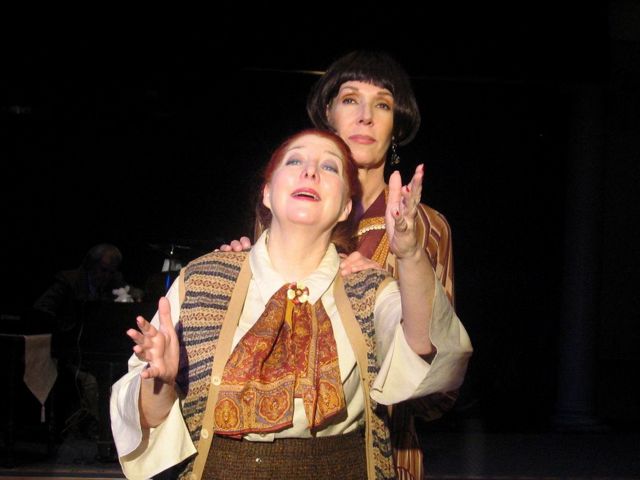
Noelle McGrath (Mildred), Robin Manning (Mabel) (looking very like Stein and Toklas)
in current production of
In Circles. Photo: John Sowle


A FRIEND, JOHN SOWLE, HAS DIRECTED a production of Al Carmines's musical setting of Gertrude Stein's A Circular Play (1920: and included in her Last Operas and Plays). In Circles is a marvelous piece of musical theater, full of entertainment and surprises, sentiment, humor, enterprising in the extreme in its musical mix of high art, klezmer, soft-shoe and show-tune.

And quite faithful to Stein. What do I mean by that. Well, her "play in circles," like almost everything else she wrote, is rooted in the real world and the domestic world, from its opening description of a moment in the Stein-Toklas household
Papa dozes mamma blows her noses.
to its close a dozen pages later, with the writer reflecting on the work just finished
Fourteen circles.

Fifteen circles.

I wonder if I have heard about those circles.
The way to read Stein is to hear Stein, and In Circles makes her audible, and thus provides a marvelous introduction. More than an introduction, though; In Circles is also an enlargement of Stein's original play. Carmines expands it to a full-evening production, weaving, yes, circles around Stein's motifs, lifting a once-only chance remark — Mrs de Monzy has adopted a child — into full-out production number; or assigning lines to one or another of the four boys and four girls in the cast ("boys" and "girls" in the theatrical sense) and returning to them, re-investigating them in new contexts and ensembles, and thus revealing new depth and meaning.
Can you say the page to-day can you say the pages.
In the original cast recording (I know it's around here somewhere) many of Stein's lines thus broken and assigned develop into approximations of the reasonably intoned dialogue Stein no doubt transcribes in her play
He was a disappointment to me. I could not understand the reason for the waiting.
We had our photographs taken, not intentionally but we happened to have seats in the front row near the arena and so when a photograph was taken we were in it.
The result is Cubism, the isolation and consideration of various apparently different aspects of a given event (phrase, character, face) in a manner to enlarge its meanings. This is criticism at its best. So many of the best examples of Criticism are, in fact, works of art themselves, and Theater is the public location of this par excellence.

I wish I could see this production. I can't: it's playing at Judson Church in New York, the place of the premiere of In Circles forty years ago; and it closes this next Friday, Feb. 22.. In the meantime I have to be content with reading the reviews and seeing the cast photos.

And looking forward to another intelligent literary musical, the 1954 Shinbone Alley (book by Joe Darion and Mel Brooks, lyrics by Darion, and music by George Kleinsinger). It's getting a local production by the Camp Rose Players, and I can hardly wait.

Friday, February 15, 2008

Self-promotion

duivelsbos.JPG
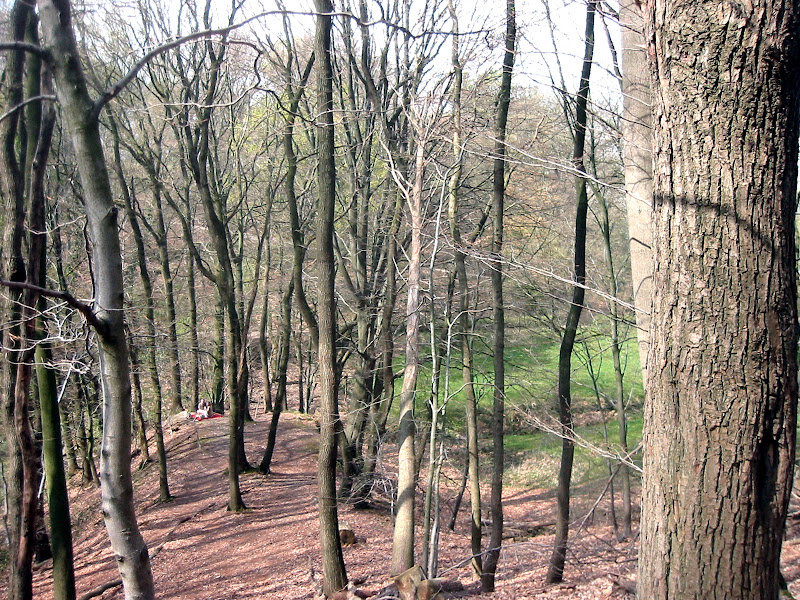
Woods near Beek, Netherlands, from The Lingepad


STILL PREOCCUPIED WITH THE FLU and not ready to blog seriously, but I do want to mention two ongoing bits of business:

Walking in The Neth...
By Charles Shere

1) a new book, The Lingepad: Walking in The Netherlands, April 2007. Square format paperbound, 7x7 inches (18x18 cm), 176 pages, published February 10, 2008. Almost no text (surprise!), this is a sequence of photographs taken during our 100-mile walk across the center of The Netherlands last April.

2) my food blog Eating Every Day continues through thick and thin, sugar and salt, sickness and health...

Wednesday, February 13, 2008

The Fourth Symphony

orchestra.JPG

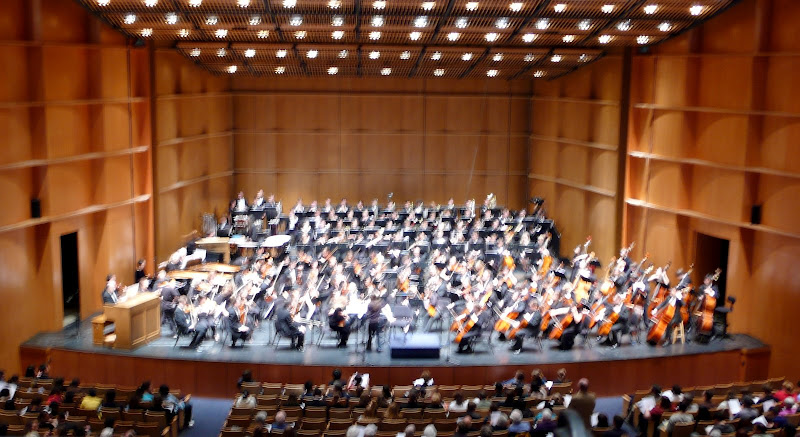
THAT'S A DOZEN DOUBLE-BASSES in that blurry photo (taken without flash), a dozen cellos, fourteen violas, thirty-six violins, fifty-four winds. I forgot to count the percussionists and keyboarders, and of course the photo doesn't show the extra instruments up balcony left, or the chorus behind us.

To me Fourth Symphony will always mean Ives, and I try not to miss a performance. I first heard it in December 1967, when the Oakland Symphony played it under Gerhard Samuel, whose programming in those days was remarkable — the standard repertory plus Ives, Stockhausen, Harrison, Terry Riley: a string of several years of enterprise which has never been given its due. (This performance of the Fourth Symphony, surely the west coast premiere, is undocumented on the Internet, as far as I've been able to determine.)

Whereas once the Fourth had been an impossible vision, unperformed until 1965 partly for its complexity and instrumental demands, it has now become more commonly heard. I've heard the San Francisco Symphony played it under Seiji Ozawa and its present music director Michael Tilson Thomas. There have been a number of recordings, amply described by Scott Mortensen here.

There are four movements, composed between 1910 and 1916 (but Ives dates are almost always very slippery), each of so idiosyncratic a character as to require rather different performing forces and, more important, different psychological approaches. The Prelude states the speculative, one can't avoid the word "spiritual" nature of the program, with a group of violins, a viola and a harp in the distance, and a chorus singing, in unison until the close, the old hymn Watchman ("tell us of the night...").

In 41 measures (for most of the orchestra: the "distant choir" travels at another pace) and about three minutes the Prelude runs through an almost ungraspable number of details which all weave together into an ultimately calming resolution. The genius of Charles Ives is his persuasive ability to display and demonstrate the power of music to contain at a given instant and in a given sonic event an enormous number of possible interrelationships and consequent meanings: this Prelude is a locus classicus .

The three remaining movements investigate various ways of responding to the speculative Prelude: a sprawling "Comedy" (this scherzo is not a joke), Allegretto, alternating among raucous brass-band marches, sentimental parlor-songs, hymn-tunes, and machine sounds; a stately Fugue again based on hymns, and the slow Finale, Largo, which returns to the idea of spatially separated instrumental forces, the addition of the chorus, and a quiet, speculative, appreciative mood.

Where the Prelude is less than four minutes long, the other three movements run about twelve, eight, and eight minutes. Recordings and performances vary, but the entire piece won't take more than thirty-five minutes: Ives is efficient, laconic, in his discursiveness.

Sunday's performance was by the combined orchestras of the University of California, Davis, and the University of the Pacific, whose conductor, Nicolas Waldvogel, presided over the affair, with assistants conducting the various outlying ensembles. The orchestra was a little too large for the Mondavi Center's Jackson Hall, but the acoustics were forgiving, and the music was revealed with considerable clarity.

Ives's music is always significant. Passages in the Fourth refer to the sinking of the Titanic, Pilgrim's Progress, Nathaniel Hawthorne, camp-meetings and church services, marching bands and public holidays, barroom and salon music, and other, earlier pieces of Ives's: the First Quartet, the Concord Sonata, and The Unanswered Question, among others.

More necessarily than most composers, and more successfully, Ives worked at the difference between public and private music. A symphony is public: which means, among other things, that it is not necessarily coherent, or resolved, or unified. Ives has his musicians playing at different speeds, in different places, some quietly, others drowning them out; some reflective or thoughtful, others assertive or brash.

A glance at the AMP version of the score, the only one yet published, suggests the confusion this complexity can produce. Only the second movement was set in type; the others are notated in hand, and in three different hands. Even the second movement, based on the New Music Edition (San Francisco) of 1929, is amended and annotated in handwriting. The instrumentation is uncertain: horn or trombone, piano if trumpet is unavailable, and so on.

Politics is the art of what is publicly possible, and the Fourth Symphony is politics, hence appropriate to the season. Ives himself was intensely involved with politics; he was later, after having composed the Fourth, to correspond with presidents, and to propose amending the Constitution to permit direct popular input to each year's Congressional agenda.

Listening to a public performance of the Fourth bears this out: one's attention moves from those string-players in the balcony to the unseen chorus behind to the enormous orchestra, and among the orchestra from the formidable double-basses to the many busy keyboard players (solo piano, piano four hands, celeste, organ, quarter-tone piano). Waldvogel conducted with long-armed sweeping gestures, maintaining the steady underlying pulse but allowing individual phrases their own version of line. The musicians concentrated intensely and performed stalwartly.

And then it was over. The concert had begun with what might be called the pocket-version of the Fourth, The Unanswered Question: a big string orchestra (from UOP) playing almost soundlessly, a lone trumpet in the upper right balcony plaintively repeating a single phrase over and over, four flutes in the upper left retorting with increasingly irritable flurries. Nick Antipa was the trumpeter; all played well.

Dan Flanagan was the soloist in the Sibelius Violin Concerto, with D. Kern Holoman leading the UC Davis orchestra: not finally a fully polished professional performance, perhaps, but a touching and fascinating one, with fine detail and drive. (Flanagan walked on in one movement of the Fourth for a cameo, to great effect).

The Fourth came last, as it should, and was over in what seemed a minute. So much to hear, so much to think about, so much to be grateful for, so little time to enjoy it. I asked one of the violinists afterward, seeing him mixing with the audience in the lobby, how many rehearsals there'd been: Oh, sixteen, I think, he replied. Well, it was a beautiful performance, I said; it's amazing that you did it at all, but that it was so beautiful...

Yes, he said, there were some misgivings among the orchestra about doing it, we never did really hear it all...

Impossible to "hear it all." That's the point. It's a major major piece; recordings are poor black-and-white still photos of it; even a live performance, while in color and motion, loses the impact of the Fourth in its transitoriness. Ives tries repeatedly to do the impossible, to mediate Quest and Arrival. His effort is ultimately both comic and tragic and always, always, human.

Northern California history, performances of Charles Ives's Fourth Symphony:

1967, Dec. 6,7,8; Gerhard Samuel, Oakland Symphony Orchestra
1968, Feb. 14, 15, 166: Seiji Ozawa, San Francisco Symphony Orchestra
1973, May 9,10,11: Seiji Ozawa, SFSym (subsequently on tour in Brussels, Florence, St. Petersburg, Vilnius, and Moscow)
1991, November 20,21,22,23: Michael Tilson Thomas, SF Sym
1999, Sept. 30, Oct. 1 (third movement only): Michael Tilson Thomas, SF Sym (recorded live for cd)
2000, June 9: MTT, SFSym (toured in September to Baden-Baden, Lucerne, Cologne, Dusseldorf)
2002, Jan. 31, Feb. 1,2,3: MTT, SFSym (toured in February to New York and Ann Arbor)

Saturday, February 09, 2008

Over at his blog, Ron Silliman has begun answering a questionnaire "intended to “inform discussion and debate at a Poetry Foundation-Aspen Institute conference' sometime in the future. It is very straightforward with six open-ended questions."

Thinking a similarly serious consideration of another neglected area might be useful, I'm prompted to invent a similar process re. the composition of music:

1. What is your connection with music (read, write, teach, buy recordings and scores, publish, etc.)?

I have composed music since the early 1950s, and began listening to it much earlier. Looking back, I seem to have listened to the landscape — having grown up as much in the country as in cities — as one listens to music. My first "real" job was running the music programming at KPFA, the Berkeley noncommercial radio station; by then, I'd already been giving recorder lessons to make an occasional dollar. I taught music (20th-century music history, Beethoven, John Cage) at Mills College for fifteen years, and I reviewed music for a daily newspaper, the old Oakland Trib une, at about the same time, 1973-1987.

2. What are the most pressing needs of music and the music community?

A) of music: first, to be allowed to sound; second, to be given its due as a basic and central component of human expression, more basic than verbal language even, more central than politics or economics. As such, music -- as both a process and a literature -- must be taught, both formally in the schools and informally in the home and the community.

Silliman writes "I am not at all certain that any MFA program should admit a student who cannot name a minimum of 100 books of contemporary poetry – published in the past 25 years – and say a little about each." Similarly, any college graduate should be familiar with a basic canon of music, and that canon should be carefully considered to include the past century, and music of other cultures.

B) of the music community: first, to be acknowledged, perhaps even to be created. To my ear the strongest pieces composed in the last thirty years have been those that are aware of the widest world of music: vernacular music, commercial music, "world music," and the leading edge of the music of the twentieth century. I wrote about such a piece the other day, Steven Mackey's Indigenous Instruments. Such music contributes to the coherent accumulation of repertory, an accumulation comparable to the great storehouses of literature and painting and sculpture and architecture. Those are pretty well taken for granted among the cultural observers of our society; the musical repertory is not. When considered at all it tends to be shamefully constricted: to recent commercial music, or to an absurdly narrow area of European history.

(Think of a society whose libraries and bookstores contented themselves with only those texts written in German between 1725 and 1900, and a few plays from the Italian theater of the nineteenth century!)

For an individual musician to develop and maintain this kind of broad awareness is rare and difficult and certainly unrewarding; for a number of such musicians to become acquainted, to discuss individual discoveries and common interests -- that is virtually unheard-of. Of course there are faculties and new-music organizations, chamber-music groups and orchestras: but generalized "music communities" are few and far between.
They exist, though; they exist in the blogosphere. I've only recently begun to understand the range of this community, through a few blogs which, web-like, lead occasionally to others:
Renewable Music
Boring Like a Drill (I particularly like his "Please Mister Please" compendium)
listen (new to me)
aworks (ditto)
Nico Muhly's blog, self-promotional but why not? Interesting beyond that…
Of Sound Mind, which actually gets into the practical mechanics of music
Roger Bourland
Sequenza 21/, a forum which in fact constitutes the kind of "musical community" that can exist on the blogosphere
Soho the dog
Tears of a clownsilly (the recent entry on Boulez and combover alone is worth the trip!)
New Music Reblog which is just what the name implies, a sort of digest of individual blogs, a form I've yet to investigate

and, finally,

blognoggle, which bills itself as "Shadowing the Top 100 Classical Music Blogs" and is therefore useful as a locus of such eveen though the emphasis seems to be on what is sometimes called dead white men's music.
The flu has struck, and I probably won't get around to finishing this before Tuesday.

Wednesday, February 06, 2008

Composition as Explanation


IN JUNE 1996 WE SPENT a couple of weeks in this house outside of Dabo, in the hills in Alsace, and there I worked on two compositions: a long piece for solo piano which managed to get completely sketched, then completely stalled; and, a more pressing concern, a trio for violin, piano, and percussion, which had been commissioned and was to be performed later that year. Over the years I've written much of my music in Europe; we used to spend a month or two there every other year in the years we were working, taking leaves of absence and dividing our time between touring and staying put.

This turned out to be my last European composing stay, however. The Trio seemed so valedictory when I heard it performed — so remote, objective, and phenomenological; so devoid of ego-expression, at least to me — that I couldn't turn from it to anything else. It seemed like a farewell piece.

But the piano piece nagged at me: it had its own right to existence, whether or not I wanted to associate with it. So I kept at it, getting it out from time to time, printing it out, shoving notes around, carving it up and pinning it down. I thought it had been finished in Portland two years ago, and I ran it through the synthesizer and put it on my iPod and listened to it a lot. But I knew I hadn't really come to terms with it.

Now, though, it's finished. I've been through it a final time, sprinkling the dynamics indications in, adjusting peculiarities of notation, trying to make the damn thing playable. It's a very strange piece, an hour long, eventful I think but not insistent. Like the slow movements of the Trio, it's music as landscape. For a long time western european music, the kind of music I deal with, was either song or dance, "lyric or choric," in Virgil Thomson's schema; the Romantic era added to this what he called, unfortunately, I think, 'spasmic," music whose human-body source of energy was not in the larynx or the feet but somewhere between.

The Twentieth Century found a fourth way, dissociating the musical process from those of the human body. My own music tends toward landscape, I think, though I could be wrong. There's a program to this long piano sonata — I've decided to call it my second Sonata; it's in three movements, so that qualifies it — but the program doesn't have to be revealed. It's pretty abstract, this piece. I hope it finds a performance.

Hooray! It's finished!

Tuesday, February 05, 2008

Contemporary Music in Evolution

THAT WAS THE TITLE of a series of radio programs prepared by Gunther Schuller back in the 1950's; I used to listen to it every week on KPFA — it was virtually my only exposure to any coherent view of the fascinating panorama of concert music that opened out after Brahms.

Schuller simply presented the major pieces as they'd been composed, year by year, in sequential order, using what recordings he could then find (and he was amazingly resourceful!), and talking, as I recall, very little about them. It was enough to hear each score in the context of its contemporaries. The rich awareness of this music of its antecedents and its context; the logic of continuity that survived even the temporary dislocations of reaction and "revolution"!

For Schuller was concerned to point out the evolution, not revolution, described by this brave repertory, stretching from Schoenberg's Second Quartet, as I recall, up to John Cage's String Quartet in Four Parts. What a fine string of monuments, living monuments, to the musical and intellectual activity of these composers; what a testament to the optimism and enterprise of their work!

I thought of this last night at a concert by the San Francisco Contemporary Music Players, where we heard a performance of Steven Mackey's Indigenous Instruments, a piece he wrote in 1989 (neary twenty years ago!) for the SFCMP, and which bowled me over then, and did again last night. Mackey wrote for the "Pierrot ensemble": flute, clarinet, violin, cello and piano, the instruments Schoenberg accompanies his Sprechstimme with in Pierrot Lunaire (1912).

Pierrot was a revelation, not a revolution, though it broke a number of social rules in its day, and resulted in considerable changes of attitude among the composers who listened to it closely (Ravel and Stravinsky among them). Indigenous Instruments is another, perhaps almost as startling, though it has its own sources in world-music explorations by such other composers as Kevin Volans and Peter Sculthorpe, whose music I know only from pieces recorded by the Kronos Quartet.

The Pierrot ensemble is in some ways the string quartet of the (late) twentieth century, but already Mackey was intent on nudging it into new territory, de-tuning the winds, extending the techniques of the strings. The intent, I think, and certainly the effect, to me at least, was of rediscovering the uses to which these instruments can be put: as if they'd been dropped into a society until then never aware of them, and had been picked up by gifted but "untaught" musicians who immediately set about exploring their potential.

This is by its nature anti-conservatory. I refer to the music-school, but "conservatory" has its bigger implication.

I listen to Indigenous Instruments with fresh ears and an open mind each time it comes along, which is infrequent, though I do have a recording around here somewhere. It puts me in the mood I associate with being somewhere where intelligent, interesting people speak an unknown language, freeing that part of the mind which conventionally is required to "understand."

I wondered, last night, if Mackey knew the music of Niccolò Castiglioni, whose Tropi (1959) for Pierrot ensemble with added percussion fascinated me when I first heard it, at about the time of its composition. I wondered, briefly, if the radio were playing this chattering treble-clef piece at the correct speed, and I've heard it more than once taken down an octave and doubled in length: but one day I found the score, and that's right, nothing in it below middle C. (Here's the score: bought on Ground-hog's day 1963, while JFK was in the White House, for $3 new! Those were the days.)

I'm sure Mackey knows Castiglioni; certainly the indigenes who play the sounds in his mind know him. That's one of the things that Evolution revealed by Schuller, among others, reveals in turn to us: all these sounds, imaginings, and revelations are known in some mysterious way to one another.

To compose, as Stockhausen said, is to make the world one.

* * *


There were other things on the program, notably Morton Feldman's 1981 Bass Clarinet and Percussion, but I'll think about them more before reporting.

Friday, February 01, 2008

Mountains

a FRIEND WRITES (well, actually a grandson)
One of the things I love so much about mountains is how much character they have, even though they are just geological formations. It's so strange how we can recognize different mountains just by glancing at them, while it would be much harder to do so for rivers, deserts, plains...
Mountains are events; rivers, deserts, and plains are processes, I think. Of course when you're actually climbing the mountain it's a process: but when you see it from a distance it's an object, an event at most.

Rivers of course are fluid and dynamic; even an apparently quiet one has great force. (Think of Charles Ives's Housatonic at Stockbridge.) Deserts and plains and broad river-valleys, like the one here with Eastside Road at its margin, are processes; they invite our motion as participant; one wants to move within them, to explore or, better, experience. But mountains are ambivalent: to an extent (and an extent that varies from one person to the next!) they invite our active participation; at the same time they warn us of their difficulties and dangers.

I haven't explored (!) the history of mountaineering; it's never been a subject of great interest to me. But my understanding is that it's a relatively recent history, at least within my eurocentric concept of history. It seems to date from about the time of the Enlightenment, when the spirit of scientific exploration, the advent of greater leisure (for some), and the suspension of superstitions (formerly regarding mountains and deserts sinister) coincided.

My own interests have tended more to the ambulation than effort, and at this point I doubt I'd have either the strength or the endurance for true mountaineering. There's not much I like better than walking through a landscape; we've walked hundreds of miles, Lindsey and I, contentedly carrying our necessities on our backs while counting on civilization for beds and meals. Climbing seems to me like an imposition of the self on the terrain, though I'm sure the true climber finds it much more a collaboration than an imposition.

Walking is a way of losing ego and mindfulness. Well, that's not quite right: it's a way of being mindfully mindless, to paraphrase John Cage ("purposeful purposelessness"): walking in Dutch forests or the French garrigue conduces full alertness to the pleasures of the environment while enabling near-total suspension of alertness to the physical process. Climbing introduces a new note, the awareness of effort. Ca grimpe, say the French: That's a climb.

Time to go to the gym and prepare a bit more! And then to add one more book to the pile awaiting reading (or in this case re-reading): Réné Daumal's Mount Analogue.

Thursday, January 31, 2008

We shall never be able to do anything like that!

MOZART: CONCERTO IN C MINOR, K. 491.

James Keller repeats the old story in the program booklet of the San Francisco Symphony:
Once, walking with the pianist-composer Johann Baptist Cramer, [B**th*v*n] heard an outdoor performance of the Mozart concerto. He stopped, called attention to a particularly beautiful motif, and exclaimed, with a mixture of admiration and despondency, “Cramer, Cramer! We shall never be able to do anything like that!”
Many years ago my own first experience of the piece live was in a performance by the school orchestra at U.C. Berkeley under James Senturia: the soloist was, of all people, Ian Underwood, later of The Mothers of Invention. At the time he was a student at UC and a music assistant at radio KPFA, where I was then also on staff. He had prepared his own cadenzas for the concerto, and as I recall they were appropriate to Mozart's style while still probing and expressive of our own day; nothing academic at all about them.

Another time, at the Cabrillo Festival in August 1964, it was Ludwig Olshansky at the keyboard, and this was where I learned that it is in measure 329 (or thereabouts) that the greatest stress must be placed, on what seems an impossibly low note but is in fact only two octaves below middle C, a note that sounds and resounds and brooks no demurral. I don't recall whether it was Olshansky who did this, or Gerhard Samuel, who conducted; I only recall that it was the pivotal note of the movement, and has remained one of my favorite aural landmarks.

Friday, January 25, 2008

Initialisms

January 25, 2008

FROM THAT FASCINATING WEBLOG Language Log :
LOWER-CASED INITIALISMS
It is a small but not insignificant recent change in written English that in Britain the newspapers have started spelling acronyms in lower case with capital initial instead of all in caps. The Universities and Colleges Employers Association and the the Department for Environment, Food and Rural Affairs are not UCEA and DEFRA, but (at least fairly often) Ucea and Defra. And in Times Higher Education magazine, the Higher Education Funding Council for England is now Hefce. This only applies to one of the two subclasses of what The Cambridge Grammar of the English Language chapter on lexical word formation (chapter 19) calls initialisms: it applies to the acronyms, not the abbreviations. Nobody calls the Science and Technology Facilities Council "Sftc", because you don't say "sftc" (could anyone?), you say "S F T C". Acronyms are more like words than abbreviations are, and the developing convention recognizes that.

Posted by Geoffrey K. Pullum at January 25, 2008 10:38 AM
That's been the style in Italy for a number of years, and I have to say I like it. Strings of caps, even small caps, shout out too loud from the printed page.

(The last three sentences confuse me, though. Surely many, reading aloud a sentence like "Call the Sftc," would say call the sefftsee.)

In any case what's happening is a confusion of language seen and heard, and any such synesthesia can only be a good thing. Well, "synesthesia" isn't the right word, of course; that refers to sense impressions; what I mean is an intellectual impression formed by two fairly distinct sensory impressions working in tandem. There must be a word for such a concept...

Thursday, January 24, 2008

The Winter's Tale

SHAKESPEARE WAS IN a retrospective mood when he wrote that problematic play The Winter's Tale: just about every theme he ever visited ends up in it, from Romeo and Juliet to The Tempest. It's a curious play, because however retrospective it is it seems unresolved, resolutely so. It ends happily, I suppose, but with lingering sadness. And however unlikely its plot may be, however distant from our own experience, it's one of those plays that always leaves me thinking Yes. That's how it is, all right. Nothing to be done about it.

Last weekend we saw it for the third time in eighteen months: Ashland in July '06; Glendale (A Noise Within) six weeks ago; Healdsburg last Saturday. In many ways the Healdsburg production was the most affecting.

It was staged by the Imagination Foundation, a Healdsburg company whose chief activity is the production of community theater using children and teen-aged actors for the most part. We've followed them pretty closely over the last few years, as one of our granddaughters has been with them from their beginning (this was the first production she has not appeared in. We've seen Pinocchio, The Tempest, Antigone, an adaptation of Alice in Wonderland, The Crucible, Tonight we Improvise! (Pirandello), and an adaptation of Animal Farm, just to list the more or less standard repertory; along the way there have been imaginative and resourceful productions of other pieces often generated through collective improvisation in rehearsals.

These "Imagineers" have produced some strong theater — work whose strength comes from its return of theater to its community responsibility. Theater is more than entertainment; at its best it presents its audience with a kind of collective awareness, expression, and even resolution of urges and events that are general and immediate. Last September, for example, IF presented The Division/La División, a piece that cast children and seniors from the Healdsburg community in an investigation of both the separateness and the togetherness that can characterize its "anglo" and "hispanic" subcommunities. A short documentary of that production is available on YouTube.

The Winter's Tale was staged, literally, on the stage of Healdsburg's Raven Theater, a community theater that's been carved out of a former movie theater, a place with problematic acoustics and not terribly good sightlines. IF overcame these problems by ignoring the audience space: instead we sat in chairs on the stage, providing the three walls of a theater-within-a-theater, with the cast right in our faces, no sets or props and minimal (though effective) costuming.

The play is really two plays, as I blogged last month. In the first Leontes, king of Sicily, goes completely insane with jealousy, causing the death of his son and queen and forcing a trusted retainer to expose his infant daughter to her death. In the second "play," usually done as the second act, we're suddenly transported from Sicilian courtiers to Bohemian country-bumpkins; Time has skipped sixteen years or so; and the plot begins to play itself out through the usual unravellings.

The play is about anger, comprehension, atonement, and forgiveness; that is, it's about fundamental human qualities that resist rational explanation but drive most human situations, whether court or country. And the play's effectiveness, apart from Shakespeare's splendid language, rests on the abilities of its major characters. Here the Imagineers came through: though minor characters had trouble with memory, clarity, and comprehension — not surprisingly, given their assignment! — the principals were amazingly effective. They may be students, or barely out of school, but they show an astounding degree of understanding: of the text, of their craft; of the emotions and urges that drive this troubling play.

There were only three performances. Imagine: young actors in their teens memorizing and rehearsing this play, all of it, this well, for only three performances. It was a gift to the community, another in a long line of such gifts. I do believe the Imagination Foundation is one of the most significant theatrical organizations in the Bay Area.

Monday, January 21, 2008

Music honest and dishonest

THE QUESTION OF "dishonest music" is raised on the blog On An Overgrown Path

A lazy search took me to three sites. The first turned out to be addressing commercial entertainment music — that is, what used to be called pop — and here the phrase made some sense, applied as it was to the practice of lip-synching.

The second, Jonathan Newman's Composer's Notebook, has an arresting opening:
Honesty
It's as good a term as any ("Truthfulness" works, too), and whatever we decide to call it, for me it is the most defining feature of a composer's work. A piece can have as much craft as humanely possible (Greetings to you Mr. Diamond! How are you, Sir?) but if the composer doesn't LOVE every note that he or she is writing down then it isn't worth diddly.
He ends by referring to Roger Sessions, and that brings me to my third webfind.

This turned out to be a paper by Michael R. Brown, Chair of the Division of Fine Arts at Indiana Wesleyan University. "The Musical Offering: a question of honesty" quotes "The renowned American composer, Roger Sessions, [who]once said that there was no good or bad music, only honest and dishonest music."

I didn't read Brown's paper too closely; it's a discussion of music now being used in various Christian churches, not a topic of great interest to me — though I was surprised to read that many of these churches are apparently using technology to fill out their acoustical worship:
Many evangelical churches have readily accepted the use of accompaniment tapes for music offerings. This use of "trax" allows the amateur to supposedly "sound just like" the commercially successful star of the moment. Indeed, the sales of the "trax" add to the commercial success of many of these stars or, at least, their record company. The pseudo-sophistication of attempting to sound like someone else, to sing with an unseen orchestra, to be bigger than life, can amount to hero worship and not the worship of God.


THERE'S A BLUR HERE between "dishonest" and "inauthentic," I think, but no matter; they amount to much the same thing in today's atmosphere of imprecision. The real question is what is authentic music, and Brown and Newman, from their various viewpoints, address that question.

I've always been impressed by a long and complicated passage in Peter Yates's book Twentieth Century Music (Pantheon Books, 1967):
A composer's idiom is his own manner of speaking as creative thinker, original as the sound of his own voice. His content is his esthetic consistency, saying what he has to say. A composer is not uniformly aware of the forces which make him what he is; they are a part of him. The consistency he must achieve ifhe is to become a composer, instead of[merely] a practitioner of his art, will be under his control exactly to the degree that he is able to direct his intuitive conditioning to its creative purpose .... The consistency, as it is achieved, matures within the composer as his content, what he has to say. The subject, not yet married to content, grows within the composer as an irritant, putting him to work; his manner of disposing of it will be his style for that work or that period .... Style follows content, the outward sign of the composer's growing inner consistency; the achieved consistency of the artist extrudes the idiomatic consistency of his style. Together they evolve. (pp. 40-41)

Consistency of style: as good an explanation of musical authenticity as we need, I think. Critics need to keep it in mind. Years ago one critic, a friend, called another friend's music "meretricious," not really thinking I believe of the meaning of the word. It's a useful word, and it goes right to the root of the question of honesty and dishonesty of intent; and there, I think, we can leave discussion of that curious phrase, "dishonest music."

Thursday, January 17, 2008

Mahler's Ninth

STANLEY FISH, I read somewhere online today, has announced the end of the humanities. I thought we were through with that sort of thing, that The End Of History had pretty well put paid to such business. I guess not. Were there any doubt, a pretty decent performance of Mahler's Ninth on television tonight, with Simon Rattle beaming his way through it with the Berlin Phil,

     and afterward, a short documentary on the amazing goings-on in Venezuela, where we were told a quarter of a million young people are playing in orchestras, more than play sports; and where a young conductor in his mid-twenties, Gustavo Dudamel, is said (by Sir Simon) to be likely to be the most important conductor of the twenty-first century.

We watched him lead the Simón Bolívar National Youth Orchestra in the last two movements of Bartók's Concerto for Orchestra, and we were pretty well persuaded. What must it be like to be a youth in Venezuela, to be aware of the looming power of the United States, and to hear that music is not taught in our schools, music, which does so much to civilize the human spirit?

It was the first time I've heard the Mahler Ninth in many years, twenty at least. Fifty years ago it was a favorite; Bruno Walter's Columbia Masterworks recording was the first stereo recording I owned. Hearing it afresh tonight I was startled by the modernity of the first movement, so nearly incoherent at times; delighted by the fond Ländler; disturbed by the Scherzo, which so rarely really works; convinced, once again, by the rightness of the Finale.

Fifty years ago I learned most of what I then new about symphonies from the Penguin Book of the Symphony, edited by Ralph Hill. I'm startled to see you can still buy copies used online. As I recall he was pretty dismissive of Mahler, whose music was apparently still thought in 1949 to be infra dig. Now, of course, I listen to the piece thinking of the Nineteenth Century that had just died, and the Twentieth that was about to burst forth; marveling at Mahler's nostalgia and prescience in his Ninth. Will my grandson's children listen thus, I wonder, to Atlas Eclipticalis?

(If the Humanities will not, indeed, have ended...)

Tuesday, January 15, 2008

How does x understand the impulse that motivated y?

A FRIEND GAVE ME a copy of Alfred Schnitke's Choir Concerto last week. After listening to it I wrote him "Oddly it recalls Feldman, whose music is very different, but gets to the same place." Tim responded
Yes, maybe like you, I am all about "how does a work understand the impulse that motivated Feldman's composing" these days.  I have a new release of and by Boulez and the EC which I think would fit into your listening… Feldman and Cage and Ligeti are pertinent…
This kind of thinking is what I had in mind yesterday.

How does x understand the impulse that motivated y?

The intent is always toward the synoptic, toward a comprehension of where we are (since an understanding of it seems unlikely).

Certain of these thinking creators—these composers, writers, painters, artists—have synoptic views themselves, but use them to push through to new understandings; among them the people I listed yesterday.

To take just one case: John Cage said, somewhere, that while he rejects Beethoven (and, I think, the rest of the 19th century), he attends to Mozart, because there is so much going on at the same time in Mozart. How does Cage understand (and that also means "interpret") the impulse that motivated Mozart?

How did the second half of the 20th century understand the impulse (or impulses) that motivated the first half? (Geert Mak's In Europe is "about" that question, among other things.)

Let's list those visionaries, and gather their work as Silliman suggested, and begin a synoptic critical survey with Tim's question in mind.

Monday, January 14, 2008

Let's begin to focus…

What we really need, ultimately, is the Complete Jackson Mac Low, a multi-volume multimedia project on the scale of the works, say, of Walter Benjamin or Charles Olson or Gertrude Stein. Thing of Beauty is a good first step in the direction of creating that broader picture, but it’s only the tip of a far more vast canon on the part of the most broadly brilliant innovator of – at the very least – the last half century.

--Ron Silliman, Silliman's Blog, Jan. 14.


STILL THINKING of Geert Mak's In Europe and Alex Ross's The Rest is Noise, I'm struck by Ron's comment this morning. Those histories are impressive and useful, but one of their most important functions is their encouragement that we return to primary sources. Ron's begun a list of significant bodies of sources documenting the building of our time in literature; here's a beginning toward extending it into other fields:
  • Jackson Mac Low
  • Walter Benjamin
  • Charles Olson
  • Gertrude Stein
  • (for I accept Ron's list as inspiration)
  • Geert Mak
  • John Cage
  • Luigi Nono
  • Giacinto Scelsi
  • These are the writers and composers whose work I'll be attending to in the near future. There will be others, of course, speaking from earlier ages, figures like Vermeer and Franz Kline, Proust and W.G. Sebald.

    I've addressed only literature, music, and painting here, which raises questions:
    Of the last fifty years, Who are the philosophers whose work is of the scope and scale suggested by Silliman?
    Who are the painters and sculptors?
    Who the composers? the dancers?
    The lists must be defensible and persuasive; there's less and less time left to attend to them…

    Friday, January 11, 2008

    "The snow is general..."

    (to be read while listening to "Winter," in John Cage's String Quartet in Four Parts)

    START THE YEAR getting back in touch with the ground, remembering that you live where your roots are, that's what I told myself a week ago, housebound after a manner of speaking with all my family: wife, three children, their spouses, their children. (Well, all but one: I'll get to that in a minute.)

    We were in a good-sized house on the south flank of Mt. Ashland, just over the state line into southern Oregon. The last of us managed to drag in about midnight Thursday; there'd been snow delays for several of us. We got to bed late and awoke Friday to find the power out. No electricity; therefore, since we were in the country, no running water.

    The day was bright, thanks to snow everywhere, and we had candles for suppertime. The kids played board games, many of the rest of us joining in; there was a jigsaw puzzle; there were the many conversations as cousins and in-laws got reacquainted. Lindsey and the other women worked at the household; I basked in the pure pleasure of a large family of intelligent good-hearted people interacting in civil social discourse and mutual entertainment.

    The power came back on late Friday night; some went skiing Saturday; snowballs were thrown and a snowman built; there was a fine half-hour walk down the lane. By Sunday noon we'd chained up the tires and loaded the trunks and were out -- me a little bit regretfully.

    THE SILENCE OF SNOW is a magical effect; the silence and the cleanliness. A few fenceposts and of course the various outbuildings poked up out of the general whiteness: otherwise nothing we saw out those windows was man-made. I hear snow fell on Baghdad the other day, for the first time in living memory. I wonder if there's not a powerful lingering effect on the human mind of the seasonal erasure of man-made detritus and disorder by winter snows: but I suppose that while these will inspire some to clean up their surroundings, others will marvel at the unusual beauty, if they aren't preoccupied with inconveniences of transportation and such, shrug it off, and go on as usual.

    I need orderliness more and more, but desire to attain it only when driven to it, particularly in January, the month of good intentions. The snow, the short family gathering, the hundreds of miles of driving in good weather and bad -- all these were reminders of moments within motion; periods of repose, some of them fairly long, within the constant change of our lives.

    I think it is Matt Matsuda who writes, in The Memory of the Modern, that every civilization eventually accelerates itself to death. The "death" of course is the ultimate collapse into order, the order of stasis. The acceleration he writes of is a spin into disorder; I thought of this a few times as I carefully drove across frozen pavements.

    The missing grandchild is in South America for a year, learning Spanish and developing adult social skills. He's a composer and a musician, and intuitively expresses himself through those rhythms of complexity and repose that constitute music. Families, I reflect, are another locus of such rhythms, and their expression of order and disorder, of outward exploration in many directions controlled (for lack of a better word) by the centripetality of common roots and experience, reinforces the intuitive human social method of ordering our activities, containing their otherwise probable damage.

    We are modern social citizens, but before that tribal animals, and before that families of individual creatures, oddly curious and busily expressive creatures. Our conversation in moments of repose can explore the implications of this; winters and snow and music assist in their various seasons.
    A Winter Album is an online collection of thirteen piano pieces (so far) in score, by Dennis Báthory-Kitsz, Jon Brenner, Steed Cowart, Elaine Fine, Hauke Harder, Ben Harper, Jeff Harrington, Steve Hicken, Aaron Hynds, Lloyd Rodgers, Jonathan Segel, Daniel James Wolf and myself. It was gathered and edited by Daniel, whose blog Renewable Music is another joy of active contemplation in moments of repose.

    Monday, December 31, 2007

    May it be small!

    INTO HEALDSBURG THIS MORNING for a little last-minute shopping. A book at Levin & Co., a fine local bookshop. Rolls at the Downtown Bakery & Creamery and a conversation with Kathleen. A wedge of good Parmaggiano at The Cheese Shop, as good a cheese shop as anyone needs.

    These are all fairly small locally-owned businesses. You can trust them. They give back to the community. And they make me think that perhaps the Next Big Thing that everyone seems to be wondering about on the radio today, perhaps the Next Big Thing will be Small.

    Take Café St. Rose, for example, a perfectly wonderful 24-seat restaurant I wrote about the other day. Mark Malicki runs close to a one-man kitchen, far as I can see; and one serving-person takes care of the dining room. Mark can shop, think, prepare, and cook as he likes, and that means locally, among other things.

    Joe Stewart runs a similar operation at the Downtown Bakery, fixing breakfast and lunch, cooking the menu he likes. The clientele is mostly locals. Fine.

    I've written before, too, about Marius, Kees Elfring's restaurant in Amsterdam. No more than thirty diners. Kees in the kitchen, with a part-time assistant-cum-plongeur.

    Levin & Co. is a mother-and-son operation for the most part, and they know what I might want to read next. If they don't have it, they can order it, of course.

    Big box stores have their place, I'm beginning to think; it makes sense to buy a case of typing paper (as we used to call it) or a refrigerator or a dozen sacks of cement at one of them; why would you want stuff like that downtown? It should be out by the highway, where the trucks can unload all that stuff.

    But Small is Beautiful. Small specialty shops and restaurants can respond to their communities while keeping their owner-workers interested. So I predict we'll see more of this in 2008, and I hope I'm right.

    And a Happy New Year to all of us!

    Sunday, December 30, 2007

    Nearing the end of the year

    WITH ONE DAY LEFT in a dying year, I re-read notes in the margin of Rebecca Solnit's A Field Guide to Getting Lost (Penguin Books, 2005).

    She writes about landscape, the road, deserts, country music, Cabeza de Vaca, solitude, Alfred Hitchcock, Yves Klein, language, transience.

    Among her pages I note the following passages. (Passages: an appropriate word to apply to this book of hallucinated footsteps. An appropriate word at a moment of passage.)
    Meno: "How will you go about finding that thing the nature of which is totally unknown to you?"

    It is the job of artists to open doors and invite in prophesies, the unknown, the unfamiliar; it's where their work comes from, although its arrival signals the beginning of the long disciplined process of making it their own.

    Cities are built by men (and to a lesser extent, women), but they decay by nature, from earthquakes and hurricanes to the incremental processes of rot, erosion, rust, the microbial breakdown of concrete, stone, wood, and brick, the return of plants and animals making their own complex order that further dismantles the simple order of men.

    What is the message that wild animals bring, the message that seems to say everything and nothing? What is this message that is wordless, that is nothing more or less than the animals themselves — that the world is wild, that life is unpredictable in its goodness and its danger, that the world is larger than your imagination?

    It is in the nature of things to be lost and not otherwise.

    More is known; there is less to know; we lose both what we know and what we don't. … At any given moment the sun is setting someplace on earth, and another day is slipping away largely undocumented as people slide into dreams that will seldom be remembered when they awaken. Only the continuation of abundance makes loss sustainable, makes it natural.