Friday, January 29, 2010

Sites

THERE ARE PLACES we have visited on various travels that have seemed very special, from a "medicine wheel" at 10,000 feet in Wyoming to the Fontaine de Vaucluse in Provence; from the stone-age city at Filitosa in Corsica to the Canyon de Chelley in Arizona. What all these places have in common is the not-verbally-articulable meaning they seem to offer to our visit: they speak to us, silently, about something we recognize without understanding, without even in any ordinary sense knowing.
img052.jpg

I think about these places a lot, under any circumstances; but I've been thinking about them especially recently since I began transcribing my journal of a trip we took through Corsica and Sardinia over twenty years ago, in 1988. Here you have a photo of the spring at Su Gologone, in Sardinia. As these places go, the places I'm discussing I mean, it's pretty well manicured, turned almost into a park, with carefully planted willows and — hmm; what are those white-barked trees in a row? — and stone retaining walls and carefully graded walks contained by concrete curbs.

Turn away from this view, though, and look out across the pool toward a grassy clearing among the trees, and we feel we're looking at a site that's been here relatively uninflected by recent human attention. It might have looked much like this a thousand years ago, two thousand, ten. This may be merely sentimental: even so, the feeling's worth thinking about.
img053.jpg

Why does the place seem familiar, though I've never been here before? There are sensations here common to other such places: the calm air within these trees; the sounds of the water; the soft feel of the calm air on my skin. The place conspires to distract me from more specific and immediate issues: the car I've left in the parking lot, the few…

to be continued

Thursday, January 28, 2010

Small Concerto


THE EARLIEST PIECES of mine that I still like to think of, Three Pieces for Piano, were written in October and November, 1963, and February 1964. At the time we were living on a small grant from Edith Fitzell, a gentle, enthusiastic widow who took recorder lessons from me, and who volunteered at KPFA, the listener-supported radio station in Berkeley. She sensed my need to devote an unbroken year to musical study, and enabled me to quite my day job. (I was then a laborer for the City of Berkeley, working mostly on the sidewalk crew, breaking up old sidewalks and laying new ones.)

I spent that year studying composition with Robert Erickson and conducting with Gerhard Samuel, and listening to as much music as possible — much of it on the radio, for KPFA broadcast a great deal of new music in those days.

The first and last of the three pieces were written slowly and intuitively, at the piano. They are centered on soft dynamic levels and smoothly phrase lines, and meant to be played very softly. The middle piece was added later, for contrast, pitched on a much louder level, and alternates violent and rapid gestures with ringing sonorities. It uses only pitches omitted in the outer movements; otherwise the composition follows only intuitive principles of structure, not conventional tonal or serial concepts.

Much of the music is essentially unmeasured and meant to be played quite freely, and the third movement ends with a performer's choice between two possible approaches to the close.

In 1964 I orchestrated the music as a Small Concerto for Piano and Orchestra. No new material was added; I simply assigned some of the notes to rather large orchestra, including a harmonium in the wings, a pair of Wagner tubas, and alto flute among the more usual instrumentation. In this form the music was premiered in August 1965 at the Cabrillo Music Festival, with Nathan Schwartz as soloist and Gerhard Samuel conducting. It was the first time I heard my music played by an orchestra: a very delightful experience.

(The solo pieces waited for their premiere until March 1993, when the late Rae Imamura played them at Annie’s Hall, Berkeley, on an instrument tuned not in equal temperament but to Kirnberger 3.)

The orchestral score of the Small Concerto for Piano and Orchestra is available now, either in print (8.5x11, 8 pages, saddle-stapled) for $12 or as a free download, at Lulu.com. The Three Pieces for Piano are available at Frog Peak Music.

Listen to the second movement of the Small Concerto for piano and orchestra

Tuesday, January 19, 2010

Form is how memory works

FROM THE CODGER in Corvallis comes today an envelope with a number of clippings. He pretends it's his way of cleaning off his desk; I know it's his way of keeping me au courant. In a recent phone call I mentioned my appreciation of Peter Schjeldahl's art criticism in The New Yorker, one of a great number of magazines to which we do not subscribe; this envelope contains a number of recent ones.

Schjeldahl's such a fine, fine writer. A fine critic, of course; a man who really knows how to look at art with his eyes, and then attentively follow the information that travels along his optic nerves back into a brain clearly jammed with experience, trained to consider, and allowed to reflect. You feel, reading his reviews in a magazine my west-coast taste finds often a little frenetic, a little peremptory — a curious pairing perhaps available only to an insecure culture-capital, that he's somehow above and beyond that fray. There's a mandarin ease to his writing, drawing as much from his wide and not entirely uncritical reading as from his first-hand art-looking: in both cases, his own sensibility is speaking, but with authority he's earned by closely studying that of so many others.

His sentences are beautifully formed, tending to stop just a little sooner than you'd expected. Where it is descriptive it is breathlessly, ingratiatingly evocative, and amply detailed:
Sensational colors, in particular, strain the scene of a husky young servant pouring milk, in a careful dribble, from an earthenware pitcher into an earthenware bowl on an odd-shaped table laden with a wicker basket, a loaf and fragments of crusty bread, and a stoneware beer jug.

When it adduces hypothesis it is forthright:
Echt biennial art is critic-proof, because it eschews formal engagement with past art, providing no basis for comparative evaluation.
These sentences develope cogent paragraphs whose purpose is to consider the event of the moment — a Vermeer in New York, a biennial exhibition in Istanbul — within a complex context triangulated by the conflicting, urgent, mindless demands of our own time, the long slow cultural history unfolding since ancient time, and the ample contents and motives of the critical sensibility.

I tend to read these reviews twice: once for their content; once for the sheer enjoyment of the writing. And I'm rewarded by any number of insights, usually at least one per review. The one at the head of today's blog is one of them:
Form is how memory works.
What clearer statement can there be, and what more beautifully self-illustrative? Will I ever forget how to explain the utility of form, the next time a grandchild asks?

One of the powerful engines of Schjeldahl's machinery is his insatiable curiosity as to what art is, how art works.
[Luc Tuymans] told Artnet that in his initial hours of work, "until I get to the middle of the process—it's horrific. It's like I don't know what I'm doing but I know how to do it, and it's very strange."
A lesser critic would have heard this as a comment in passing, perhaps registered it, and moved on. Schjeldahl registers it, considers it, and sets it in parallel with a thought of his own, leading the reader to an insight:
Now, that — uncertain ends, confident means—is about as good a general definition of creativity as I know. It illuminates and justifies Tuymans's eccentric work rule, with its distant redolence of Jackson Pollock's odd decision to paint in the air above a canvas.
In the air above a canvas. Schjeldahl deftly moves his paragraph away from the foreground, while keeping the foreground in view; he lifts the discussion above the present, while keeping it pertinent. His criticism fully achieves Joseph Kerman's memorable, terse definition of the practice: "the study of the meaning and the value of art works." (Contemplating Music: challenges to musicology , Harvard University Press, 1986). And it is elegant.
Oh: I want to add one thing to the comments on D.H. Lawrence, a delicious comment he makes in Etruscan Places, summing up all his attitude about the evils of Rationalist and Industrialist displacement of the vital, intuitive values of unrestrained humanity:
We have lost the art of living: and in the most important science of all, the science of daily life, the science of behaviour, we are complete ignoramuses. We have psychology instead.
The science of daily life. What a great blog title that would make!

Monday, January 18, 2010

Lawrence on Italy

DAMN IT ALL, Richard, you’ve finally got me to read through D.H. Lawrence’s Twilight in Italy, and finally I see what you see in him — though I must say I see it only through the haze of my own close-held prejudices. Let’s begin with the easiest to overcome, the inadequacy of the book qua book. It’s a gathering of three travel books:

Twilight in Italy, 1916, recording a trip made a few years earlier, mostly on foot, from somewhere south of Munich to Lake Garda, and impressions of the villages on that lake;

Sea and Sardinia, 1921, recalling a trip that January from Taormina to Palermo, thence by boat to Cagliari, by train to Sorgono, bus to Terranova, boat to Civitavecchia, train to Naples, and boat back to Sicily; and

Etruscan Places, 1932, a collection of musings on visits, in 1927, to the remains of Etruscan life found in Tarquinia, Volci, and Volterra.

In the course of those sixteen years Lawrence matured a bit, from the brash, often contemptuous, always opinionated young man curling his lip at the lack of intelligence he finds everywhere, to the informed, still opinionated, occasionally generous fellow who contemplates Etruscan antiquity. It is his judgmentalism, constant in the first book, frequent in the second, that gets under my skin: he’s so quick to insist on his own comfort — good English bacon and tea, for example, even in the mountains of Sardinia — that he only slowly, over the course of those sixteen years, comes to acknowledge the possible appropriateness of the beefsteak and red wine he’s offered in its place.

You’re a Joyce man or a Lawrence man, I decided fifty years ago (and then some), as you choose either Picasso or Matisse, Fitzgerald or Hemingway, Mozart or Beethoven: and I fall on the side of the first in each of those pairings. I can’t disagree with Lawrence’s fundamental points, that freedom and energy and instinct are superb qualities and that they’re in danger of utter destruction at the hand of the 20th century. But I can’t overlook the anger this arouses in the poor Englishman, caught in the misery of being a son of the society responsible for much of that destruction. Don’t take it personally, David Herbert!

I picked the book up to begin a four-month project of reading on Italy, wanting to read English for relaxation; but also in the spirit of New Year’s do-it-it’s-good-for-you resolution; and I’m glad I did. Even the first book, irritating as it mostly is, has its surprising flashes:
It is better to go forward in error than to stay fixed inextricably in the past. (p. 53)

…the cypress trees poise like flames of forgotten darkness, that should have been blown out at the end of the summer. For as we have candles to light the darkness of night, so the cypresses are candles to keep the darkness aflame in the full sunshine. (p. 81)

…the whole organism of life, the social organism, is slowly crumbling and caving in … is seems as though we should be left at last with a great system of roads and railways and industries, and a world of utter chaos seething upon these fabrications: as if we had created a steel framework, and the whole body of society were crumbling and rotting in between. (p. 165)
References to the paperback edition of 1972: New York: The Viking Press

Sea and Sardinia was the only book of the three I’d read earlier, a little after our own travels through Sardinia, in November 1988. I’m thinking of this trip again, transcribing my own journal, partly to get into the mood of journal-keeping, partly to satisfy an acquaintance who’s contemplating her own tour of the island in May.
Some of you may know of my own travel musings, “dispatches” I call them; I used to e-mail them out from the road to a number of friends, and have published three collections of them — you can look them up here.

Alas in the last few years I’ve got out of the habit of journal-keeping, as various pocket computers have replaced the notebook and pen. I can re-read journals from the 1970s and ’80s with great pleasure, once again vividly seeing the places and people they describe: but more recent long walks — on the Pieterpad, the Lingepad, across the Alps — are much more sketchily recorded. We’re thinking of a walk in Sicily in a few months, and I’m dreaming of a long walk in Tuscany and Umbria: it’s time to get back to journaling!

Yet Anthony Burgess writes, in his Introduction to this Viking paperback, that
A single week’s visit was enough for him to extract the very essence of the island and its people, and six weeks were enough to set it all down in words—without a single note as an aide-mémoire.
This may explain the feeling I get that Lawrence saw, on his miserable ride across Sardinia, only what his prejudices put in front of him: that is, he continually looks to the people he meets — for he rarely mentions the landscape, only the people, the hotels, the dining-tables — for confirmation of opinions he’s already formed, attitudes he’s already struck.
Sardinian seems open and manly and downright. Sicilian is gluey and evasive, as if the Sicilian didn’t want to speak straight to you. As a matter of fact, he doesn’t. He is an over-cultured, sensitive ancient soul, and he has so many sides to his mind that he hasn’t got any definite one mind at all. He’s got a dozen minds, and uneasily he’s aware of it… The Sardinian, on the other hand, still seems to have one downright mind. (pp. 80-81)

In this book Lawrence is at his best when he does describe the landscape:
The hillsides tilt sharper and sharper… The oxen lift their noses to heaven, with a strange and beseeching snake-like movement, and taking tiny little step with their frail feet, move slantingly across the slope-face, between the rocks and tree-roots…
There is a stream: actually a long tress of a waterfall pouring into a little gorge, and a stream-bed hat opens a little, and shows a marvelous cluster of naked poplars away below. They are like ghosts. They have a ghostly, almost phosphorescent luminousness in the shadow of the valley… a grey, goldish-pale incandescence of naked limbs and myriad cold-glowing twigs, gleaming strangely.
(p. 88)

Such is our antipathy, Lawrence and I, that he on his travels saw only that part of Sardinia that I on ours did not, and vice versa; and yet between us we saw nearly every corner of the island. Perhaps that explains Lawrence’s otherwise astonishing total lack of reference to the nuraghi, those timeless, enigmatic, powerful stone towers, some sixty feet high and more, that are scattered almost throughout the island. Many of them were perhaps not yet known at the time of Lawrence’s tour: a magnificent example, Su Nuraxi di Barumini, was only discovered in the 1940s, even though its three-storey nuraghe is attended by an entire village of circular foundations, whether of residences or merely storerooms is apparently not yet fully understood.

What would Lawrence have written about Barumini? He gives us an idea:
This is what is so attractive about the remote places, the Abruzzi, for example. Life is so primitive, so pagan, so strangely heathen and half-savage. And yet it is human life. And the wildest country is half humanised, half brought under. It is all conscious… Wherever one is, the place has its conscious genus. Man has lived there and brought forth his consciousness there and in some way brought that place to consciousness, given it its expression, and, really, finished it. The expression may be Proserpine, or Pan, or even the strange “shrouded gods” of the Etruscans or the Sikels, none the less it is an expression… Strange and wonderful chords awake in us, and vibrate again after many hundreds of years of complete forgetfulness. (p. 123)

Etruscan Places is much the shortest of these three books, much the best. Lawrence’s anger, in the face of the destruction of humanity by the industrious society humanity has created, has given way to something more like bitter resignation. Contemplation of the evidence of the utterly vanished Etruscan culture, not to mention the stupidity of the greedy expropriation of the Etruscan remains by those Lawrence considers the chief villains — the British Museum, the Vatican — such contemplation can hardly avoid replacing anger with resignation. It’s there; there’s nothing to be done.
If only we would realise it, and not tear things from their settings. Museums anyhow are wrong. But if one must have museums, let them be small, and above all, let the be local. (p.27)

But there’s something engagingly lyrical about his bitterness, something graceful about the philosophy he's developed to replace, or at least succeed, the incessantly masculine body-worship that (to my mind) disfigures much of his earlier writing. The dialectic between the Etruscans and the Romans who defeated them — and the imperialist 20th-century powers that so readily bring Roman imperialism down to our own period — is the dialectic between a graceful living-in-the-moment, in a society evolved toward an essentially Epicurean adjustment of human life to natural needs and events, and a constant straining-for-the-ideal, in a society geared toward constant growth, development, control, and profit.

In a remarkable passage, Lawrence concedes that we moderns are no longer, like the Etruscans, capable of Etruscan innocence — rather, uniquely Etruscan expression of innocent awareness:
But one radical thing the Etruscan people never forgot, because it was in their blood as well as in the blood of their masters: and that was the mystery of the journey out of life… Man moves naked and glowing through the universe. Then comes death: he dives into the sea, he departs into the underworld. (pp.52-53)
In a striking figure Lawrence considers the dolphin, “a creature that suddenly exists, out of nowhere. He was not: and lo! there he is!” We, however, are merely ducks, warm-blooded, but with no “subaqueous nature”; we dive in, but return to preen. The Etruscans, the reader feels, lived at the moment of awareness of the difference.

Etruscan Places is elegiac, because Lawrence contemplates the lost, and thinks it superior to the present. Throughout these three books he vacillates between admiring intelligence (or at least condemning stupidity) and lamenting consciousness. He attempts a resolution of this difficulty in his admiration for divination.
An act of pure attention, if you are capable of it, will bring its own answer. And you choose that object to concentrate upon which will best focus your consciousness. Every real discovery made, every serious and significant decision ever reached, was reached and mae by divination. The soul stirs, and makes an act of pure attention, and that is a discovery.

The science of the augur and the haruspex was not so foolish as our modern science of political economy.
(p.55)

Lawrence has made me more curious than ever about the Etruscans: too bad, as I’ll never know much more than I do now. Further acquaintance with their towns and tombs will only increase this curiosity, not satisfy it. The day will perhaps come when my hunches are proved (or disproved): a fortunate race, they remembered in their cultural subconscious the journey out of Africa, through Asia Minor, to their home in one of the most fortunate climes ever settled, early enough to have escaped the disadvantages of conscious thought, late enough to have music and language and comfort and beauty. One could think of this as a true Golden Age, and a sustainable one too until the invaders came.

Friday, January 08, 2010

Mercè Rodoreda

Christmas surprised me with a copy of Death in Spring, a poetic novel by the Catalan writer Mercè Rodoreda, a writer I'd not heard of until a couple of months ago, when I read a review by Natasha Wimmer in The Nation. It's not the kind of novel I'd normally be drawn to: a little too close to Magic Realism, perhaps. Yet now that I've read it I find much of it oddly staying with me. Wimmer's review will tell you much more than I will, here, about the content of the novel — plot, characters, setting and all that. I think she's a little unfair in calling the book "a clumsy expressionist painting" (in contrast to the Vermeer represented by Rodoreda's earlier novel The Time of the Doves).

Nor am I sure Wimmer's on point referring to Death in Spring as Symbolist. The pages are full of color, literally: birds, butterflies, aprons, leaves; the very dust with which the mouths of the dead are cemented closed; all these colors vibrate with an intensity that brings Rimbaud's vowels to mind. But the book is solidly grounded in elements: wind and water, wood and dirt. And throughout the book the reader's immersed in narrative, as the characters in the book are haunted by and compelled to their own narrative.

Rodoreda was born in Barcelona in 1908, married rather badly, wrote fairly early but retired from publication in her thirties, when she participated in the short-lived autonomous government of Catalonia until the Spanish Civil War ended with the Franco regime, which led to a self-exile in France and, later, Switzerland. She returned to Catalonia in the 1970s; just when, I'm not quite sure.

You won't find much about her in this Wikipedia article, but on a hunch I typed her full name — Mercè Rodoreda i Gurguí — into Google's search box and hit the much fuller article in the Catalan Viquipèdia. Here we read of the influence on her writing of such European psychological writers as Woolf, Proust, and Mann "except for the mytho-symbolic works of the last period of her life": but I think there's much of Woolf's most experimental kind of writing in Death in Spring — particularly such short prose pieces as "The Mark on the Wall."

In fact, Death in Spring seems to form a bridge springing from Woolf to Calvino, a span I'd never thought of before — how to characterize the stream below? Perhaps it's like the fatal, violent, necessary river running below the town in Rodoreda's novel, at once a Lethe and an Oceanus; a powerful yet essentially aloof stream Heraklitus would recognize. Perhaps she's a Symbolist after all.

Thursday, January 07, 2010

Michener: Caravans (The end of the world as we know it)

BHISHMA'S RECLUSIVE ACQUAINTANCE up in Oregon recently recommended to me James Michener’s novel Caravans, published in 1962 but set in the Afghanistan of the years immediately following World War II.

I read it in the days following New Year’s Eve, when another old friend announced his view — I’d heard it before — that the world as we know it was about to end, if not in our lifetimes, then in those of our children. “Our” children, I type: but this old friend has no children, and it was at first to that that I attributed his pessimism.

Soon, though, another idea occurred to me: “the world as we know it” has ended many times, and will end many times again. It’s always doing that, ending, then evolving into the world as another society knows it, only to end again. The world as the Roman Republic knew it ended, and the world as the Roman Empire. The world as Chief Joseph knew it. The world as two protagonists of this book, Nazrullah and Zulffiqar know it: Nazrullah, a civil engineer who believes in a future Westernized Afghanistan, enlightened and developed and comfortable; Zulffiqar, a nomadic chieftain who knows such an Afghanistan will be attempted, will destroy his way life, and must be prepared for.

I was impressed with another of Michener’s books, Iberia, and am equally so with this. Michener seems at ease alternating between fiction and philosophy, between active participation and objective contemplation. I suspect his books are very different to varied readers. I find reassurance, in the face of my friend’s pessimism, in the constancy Michener finds in human behavior, always alternating between instinct and education, reality and idealism, love (and jealousy) and reason, things as they always are and as they always, we are apparently doomed to feel (though differently, according to the values in fashion at the moment), should be.

Caravans makes me wish I were fifty (and the world eighty) years younger and a good horseman. It made me think, too, of my mother, who in her young and middle years wondered about Tashkent and Samarkand, and in her later years managed to visit them, which I shall almost surely not. And it makes me worry that perhaps my next read will be Frederick Prokosch's The Asiatics or Seven Who Fled — though either would be a real self-indulgence, for I read them over twenty years ago, and there are unread books to visit…

Tuesday, December 22, 2009

Dostoevsky on stage

WELL, YES, I seem to have left a few things hanging. I'll try to be concise, and catch them up in turn, starting tonight with comments on
  • A Noise Within
  • We saw three plays down in Glendale last month, rather an odd set but one nicely showing off the abilities of this repertory company we've followed now for years. We saw an effective if somewhat conventional Richard II, which distressed me considerably for the first few minutes as I was quite irrationally convinced, in the previous few days, looking forward to it, that it was Richard III that was scheduled: a play I very much like. Alas, no: the misshapen villain looked me in the eye and began lecturing about the winter of our discontent and I was in for it.

    Four evenings later it was a very different matter: Michael Frayn's Noises Off is a very funny play, fast and funny, about a theater company falling apart during the performance of a fast and not terribly funny farce called Nothing On, whose first act is performed in each of the play's three acts: first as seen by an audience, but in rehearsal; next seen from backstage, where the actors have begun succumbing to jealousy, anxiety and drunkenness; finally on stage again, a few weeks later, when the company is in a state of total collapse. Of course this is a marvelous vehicle for a true repertory company whose actors are used to working together, developing a play through a number of performances over a period of weeks: the performance was superb.

    I had looked forward to the theatrical adaptation of Dostoevsky's Crime and Punishment with considerable curiosity. I hadn't read the book in over fifty years, so got down my old Penguin paperback and devoured it in a week. What a book! Absolutely riveting in its suspense; teeming with detail; intellectually and morally provocative. Since my first reading I'd been to Petersburg — Leningrad it was, then — and knew those scents and streets first-hand. ¶ The adaptation, by Marilyn Campbell and Curt Columbus, was fascinating, narrowing the plot almost exclusively to the cat-and-mouse between Raskolnikov and the police inspector (Michael A. Newcomer and Robertson Dean, respectively), with just enough allusion to other plot elements to involve Holly Hawkins as Alyona, the old-lady pawnbroker; Dunya, Raskolinikov's sister; and Sonia, the girl who ultimately ... but I won't put any spoilers here. ¶ Newcomer was magnificent, memorably so, onstage virtually throughout the 90 minutes unreleaved by intermission. He'd clearly studied the novel carefully and thought about its implications quite extensively; you could believe his mind capable of quite absorbing both Raskolnikov's careful philosophical deliberations and his intellectual methodology. Dean and Hawkins were quite up to his level; Craig Belknap's direction was thoughtful and balanced; and Michael Smith's design is both authentic in its realism and subtle in its psychological effect. As is everything about this play and the novel it draws on: and, alas, it's all too topical still.

    Sunday, November 22, 2009

    Music in Los Angeles

    TWO CONCERTS HEARD last Saturday in the Frank Gehry-designed Disney Hall, the home of the Los Angeles Philharmonic, have given me much to think about. We were particularly eager to hear Gustavo Dudamel conduct Mozart: he's a known quantity with contemporary music and with big colorful Romantic works, but what would his Mozart be like? The occasion was an intriguing concert on the regular season: the "Prague" and "Jupiter" symphonies (nos. 38 and 41) flanking Alban Berg's Violin Concerto, Gil Shaham the soloist.

    It turns out that Dudamel's as fine a conductor of Mozart as of anything else. He seated first and second violins opposite one another, as is certainly right with this repertory, and reduced the strings to 14-12-10-8-6. He took all the repeats and moderated the tempi. He made the music serious, quite serious, minimizing interpretation, clarifying the scores. The "Prague" symphony revealed its essentially operatic, expressive quality, connecting to Don Giovanni and, even more, Le Nozze di Figaro; the "Jupiter" emerged on the other hand as the abstract, architectural masterpiece it is, enjoying its counterpoint as decorative line while revealing it even more as structural fabric.

    We sat above and behind the first violin section, slightly skewing the aural perspective but getting a fine view of Dudamel's address to his orchestra — his face as well as his stick technique. For a young man (28) he's remarkably mature, completely assured, yet engaging. In so many ways he makes me realize orchestral music, all the standard Eurocentric concert music, has moved into a new era. There seems to be a relaxed, egalitarian relationship between him and his band (and his scores, for that matter): the work is done jointly; conductor and instrumentalists commit equally to the effort.

    There were occasional problems resulting from this: first bassoon tends to rush his quick patter in the "Prague"; upper winds reveal occasional uncertainty as to the precise location of a downbeat. But I only noticed such things four or five times in the entire program; and they were more than offset by the beautifully precise tuning of octaves, the fine balance of dynamics.

    The Berg concerto was remarkably detailed. Berg's orchestration always works on paper, but rarely in the hall; he's a sort of 20th-century Schumann in that respect; conductors must study the intent his scores reveal and guide their musicians in rehearsal to a clear expression of the details that make up Berg's complex, sometimes weighty, but always lucid music. Here Dudamel absolutely triumphed: you felt your ears were hearing the printed score as well as the delicious sounds. (Shaham seemed to me a perfect collaborator, playing effortlessly, dramatically, authoritatively, leaving nothing further to be desired.)

    What the program finally amounted to was a perfect coupling of Berg and Mozart. Both composers emerged as living, breathing, important, humane, utterly contemporary creators of music that is significant, affecting, brilliant, and intelligent.
    Saturday night we attended quite a different affair, the opening concert of the LA Phil's "West Coast, Left Coast" festival of, well, west-coast new music. The Kronos Quartet opened the late-night concert (it began at 9:30) with a suite of three pieces whose titles were unstipulated in the program booklet.

    Drew Daniel and M.C. Schmidt, who perform as Matmos, followed, presenting a loose but steady stream of electronically processed sounds, as often from amplified physical objects as from synthesizers. Suzie Katayama then led a string-and-guitar ensemble through a three- or four-movement piece by Michael Einziger; and then Terry Riley joined Kronos and Matmos in what seemed a group improvisation grounded on a notated structure.

    The long evening ended with Riley's solo improvisations at the keyboard of the fine Disney Hall pipe organ, a magnificent instrument. Singing occasionally, Riley moved effortlessly through a global range of musical expression, from blues and barrelhouse to Indian ragas. I had been discouraged by the music that preceded him: it seemed thin, routine, graceless, dutiful. Matmos, for example, seems to repeat mechanically and joylessly the kinds of sounds John Cage and David Tudor found so much more expressive, witty, and graceful in Cage's Variations series, forty years ago.

    Riley, though, brings the spirituality, intelligence, and sensuousness of that period right down to the present, because of course he was there. He did in his own performance at that organ just what Dudamel had done with Mozart and Berg, found a way to project everything that's human and humane in music, while casting aside all the merely theoretical and historical and routine.
    Dudamel has taken Los Angeles by storm, and tickets to his concerts are extremely hard to come by. I'm grateful to the Los Angeles Philharmonic for providing our seats to his concert.

    Tuesday, November 10, 2009

    Gertrude Stein: two plays, part one: What Happened

    WE DO LIKE TO GO to the theater, Lindsey and I. We see all the plays in Ashland at the Oregon Shakespeare Festival; we see nearly all the plays in Los Angeles (Glendale, actually) at A Noise Within. We catch occasional plays closer to home, in Berkeley or San Francisco or even up here in Sonoma county, in Santa Rosa or Sebastopol.
    We like the standard repertory; we like new plays; we like the classics; we like drama originally in other languages. We'll be in Glendale in a week or ten days to see Shakespeare, an adaptation of Dostoevsky, and Michael Frayn's wonderfully funny Noises Off (confusingly, perhaps, at the repertory company called A Noise Within, playing its last season this year in Glendale before moving next season to a new house in Pasadena).

    I have a lot of favorite playwrights: Chekhov, Shakespeare, Euripides, Moliere, Pirandello, to name five who come quickly to mind. Behind them come dozens more — I won't go into that now; maybe some day I'll draw up a list of Top Hundred. (I did that years ago for composers, listing them by nationalities; it was an amusing little exercise.)

    Right now, though, my irreducible Favorite Playwright is Gertrude Stein. I met her dramatic work over fifty years ago, through Virgil Thomson's setting of her Four Saints in Three Acts. This began an enthusiasm that's never ended — you can read its history in my little book Why I Read Stein. I've set two of Stein's plays as little operas myself, and would love to finish the trilogy if someone would only promise to produce it. (Ladies Voices and I Like It to Be a Play have been produced; What Happened A Play remains to be composed.)

    Well. When I heard the Department of Theater, Dance, and Performance Studies at UC Berkeley was producing a number of one-act plays, and that among them would be two of Stein's plays, I was absolutely delighted and made plans to drive down to see them, and Sunday we saw two of the three programs, one with What Happened A Play, the other with Three Sisters Who Are Not Sisters.

    I wish I could be more enthusiastic about what we saw. Each program opened with Eugène Ionesco's Salutations: five actors, hundreds of adjectives, recited in alphabetical order, in two quite different physical productions. The afternoon production continued with Suzan-Lori Parks's Devotees in the Garden of Love in a strikingly beautiful physical production, with impressive acting by Jessica Charles, Kelly Strickland, and Dekyl Rongé, but delivered so stridently (as was much of the Ionesco) that the intelligibility of the lines was all too frequently lost completely.
    After the intermission the program promised What Happened. What we got was that play, in all its textual beauty, with interpolations of perhaps improvised, perhaps written-out lines having little to do with Stein's play, sometimes in Spanish, nearly always mundane.
    A director's note may explain this:
    …I initially intended to clarify at some length Stein's approach towards language and art with the hope of assisting the audience in "understanding" this admittedly challenging yet beautiful text. But, in the end, I realized that such definitive understanding is exactly the opposite of what she intended. Therefore, please just sit back and watch, hear, think, and feel. Sometimes we push too much for a singular meaning.

    Scott Wallin is right to reject singular meaning, but wrong, I think, to multiply it unnecessarily. He is particularly wrong, in my opinion, to let his audience assume everything heard here was Gertrude Stein's. Her plays are famously overheard conversation, but they have an integrity, stylistically and theatrically, that comes from a single observer's point of view (far-reachingly intelligent though it be), filtered through a single writer's editorial and expressive technique.

    Stein herself discusses this better than I can. (She's as redoubtable a critic as she is a playwright.) I quote from Jason Fichtel's useful discussion 'When this you see remember me': The Postmodern Aesthetic of Gertrude Stein's Drama, posted at time-sense, an on-line quarterly I'm going to have to explore:
    I think and always have thought that if you write a play you ought to announce that it is a play and that is what I did. What Happened. A Play. . . . I realized then as anybody can know that something is always happening. Something is always happening, anybody knows a quantity of stories of people's lives . . . everybody knows so many stories and what is the use of telling another story. What is the use of telling a story since there are so many and everybody knows so many and tells so many. . . . So naturally what I wanted to do in my play was what everybody did not always know or always tell.
    [from Stein's Lectures in America (Boston: Beacon Press, 1959), p. 207]


    What Happened, Fichtel writes,
    becomes a cubist experiment in playwriting. As she does in Tender Buttons, Stein continues to experiment with cubism in literature—trying to describe the world around her in varying, complex, and indirect ways.


    Well, okay, this kind of thing is said all the time. I reject the notion of "experiment" here; the word has too useful a primary meaning to go on using it in this vaguely condescending way; the "experimental" Modernists didn't develop art theory and then write or paint or compose experiments to try it out; it's the critics and academics who make "experiments" of the primary sources they grapple with. Nor do I like the word "trying" in Fichtel's last sentence. Stein damn well does express (not "describe") "the world around her in varying, complex" (but not "indirect ways"; she does that because it is in fact a varied, complex world, and her brilliant decision was to distill and reproduce it, not narrate or "describe" it.

    I suppose you have to be a Modernist, or at least an aware member of one of the Modernist generations, to enjoy Stein qua Stein; and I suppose we have to be patient with the critics and stage directors who, not being of the Modernist moment themselves, almost invariably come to her — when they do, with any degree of seriousness — through a postmodern sensibility. And I suppose we should be grateful for productions like this one: at least they bring Stein's plays to the attention of the audience; perhaps that will lead one day to closer attention to the texts themselves.

    And, of course, one of the banes of the postmodern moment is the director elevating his own craft to a position equal, if not superior, to that of the author whose work he presents. I'd like to see this the Department of Theater, Dance, and Performance Studies, and Dramaturgy, taking the dramaturge to be a spokesman for the author, not an explicator or interpreter.

    As before intermission, the performance of What Happened was hurt by rushed and shouted lines, helped by quite beautiful visuals — colors, lighting, gesture. Dramatic theater is enlarged by bringing to its preparation concepts from dance and performance art: but it's too bad rhetoric and vocal expression is apparently denied equal consideration. My guess is, though, that the vocal problems will be dealt with in subsequent performances; and in spite of all the reservations expressed here I'd go back for a second sight if I weren't going to be out of town.
  • Salutations, by Eugène Ionesco, directed by Charlotte McIvor; Devotees in the Garden of Love, by Suzan-Lori Parks,directed by Godfrey Plata; What Happened, by Gertrude Stein, directed by Scott Wallin; Durham Studio Theater (Dwinelle Hall), UC Berkeley; repeats Fri. Nov. 13 (10pm), Sat. Nov. 14 (3pm), Thurs. Nov. 19 (7pm), Fri. Nov. 20 (10pm), Sat. Nov. 21 (7pm)


  • Since writing the above, I've run across the complete text of What Happened: A Play online, with an intelligent description of its origin, here. O wondrous Internet!

    Thursday, October 29, 2009

    The Duchamp Opera

    largeglass.jpg

    I'M THINKING ALOUD, or rather my fingers are, mulling over what on earth I'm going to say for half an hour this evening about my Duchamp opera. Marcel Duchamp worked on his Large Glass, La Mariée mise à nu par ses célibataires, même, for twelve or fourteen years, definitively abandoning the project in 1923. It's two things: 1) a painting on glass, say two meters high, painted in mixed media (oil paint, lead foil, lead wire, dust, varnish) on two panes of glass; 2) a collection of notes, memos, and drawings that accumulated over the years he was working on the thing and was subsequently published in at least three different collections.

    One of those collections, The Green Box, was published in a typographical version by the English artist Richard Hamilton, translated into English by George Heard Hamilton, in the early 1960s; this was my introduction to Duchamp. Soon afterward, the first retrospective of Duchamp's work was given by the Pasadena Museum; Lindsey and I borrowed Mom's car and drove down to see it. I was hooked.
    bookpage.jpg

    two pages of The Green Box

    I'd already begun setting some of those notes and memos to music, working right in my copy of Hamilton's book; before long it became clear I was thinking of an opera. The Large Glass seemed to me to be a deep, detailed, resonant and serene landscape, and as Gertrude Stein says landscapes are suitable for only two things, battlefields and plays. We mostly all prefer plays, and I prefer my plays with sound.

    That was 1964-1965. Two years later an early version of the music was performed in Berkeley, in October 1967. The next May Duchamp died. I was then working at KQED, and I wrote and produced a 40-minute obituary program, describing the evolution of Duchamp's work from his earliest paintings through to a guided tour of the Large Glass. For that purpose I made a fullsize replica of The Glass, paintings its elements on sheets of acetate.

    In the meantime I'd been reading the growing number of books about Duchamp and his work, learning enough French and Italian to handle some of the best, and translating about half of Jean Suquet's Le Miroir de la mariée. And when in the middle 1970s we were able to begin traveling in Europe one of my first projects was to make a sort of pilgrimage of the places Duchamp had lived in, photographing them. On one occasion I even met his widow, Teeny Duchamp: Why didn't you visit us, she asked; I didn't want to intrude on you, I answere; The ones you want to visit always feel that way, she answered.
    stageset.jpg

    portable cardboard model stageset

    I made a traveling kit of things related to The Large Glass and to my projected opera: a collapsible cardboard model stageset, with flying or detachable set-pieces, some repeating Duchamp's imagery, others things of my own — that's the score to Variations, for harp and percussion, on the back wall stage left. With it of course went the Hamilton edition of The Green Box and my steadily growing collection of manuscript pages and drawings.

    In 1980, I think it was, the first scene of the first act was staged in San Francisco, with a young John Adams conducting the Conservatory New Music Ensemble. Somewhere I have a grainy black-and-white video of the event, which was not entirely successful. By then I was teaching part-time at Mills College, and in 1984, there, the entire first act was staged, in a wonderful mise-en-scène by the dancer Margaret Fisher, and the first three scenes of the second act were performed in concert form.
    12.jpg

    Margaret Fisher's model stageset
    We were working toward a complete production, to be given a year or two later at the San Francisco Museum of Modern Art, but the funding was lost.

    There exists an audio recording of the Mills College performance, though the original recording was lost in the Oakland Hills fire. The video of the Mills College performance is unfortunately only of archival interest. When the full production in San Francisco was scuttled I lost interest in the opera and turned to other things. I don't know if I'd want to have to work on a complete production, in the unlikely event one ever becomes possible. Some things are best left mythic.
    Okay. Get to work on the talk!

    Friday, October 23, 2009

    Bride concerto

    IMG_0744.jpg
    HERE WE ARE again, revisiting old work instead of doing new work. I think it's one of the great drawbacks of technological improvements: the greatly enhanced ability to revisit, review, revise, Lou Harrison's motto was Cherish. Consider. Conserve. Create. Mine seems to have devolved to Revist. Review. Reconsider. Revise.

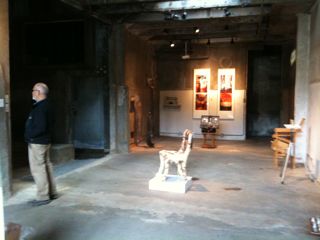
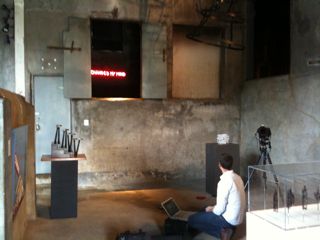
    The project at hand is honorable, though, because it's attached to an event by its very nature retrospective: the Duchamp show in Healdsburg at the Slaughterhouse Space. This installation, which closes November 7, gathers visual work by XXX artists — painting, sculpture, video, installation — in the haunting and endlessly beautiful atmosphere of a former slaughterhouse. (These four photos give only a rough idea of the space.) Recorded music from or associated with my Duchamp opera runs continuously as you investigate the exhibition.
    IMG_0745.jpg

    IMG_0747.jpg IMG_0746.jpg

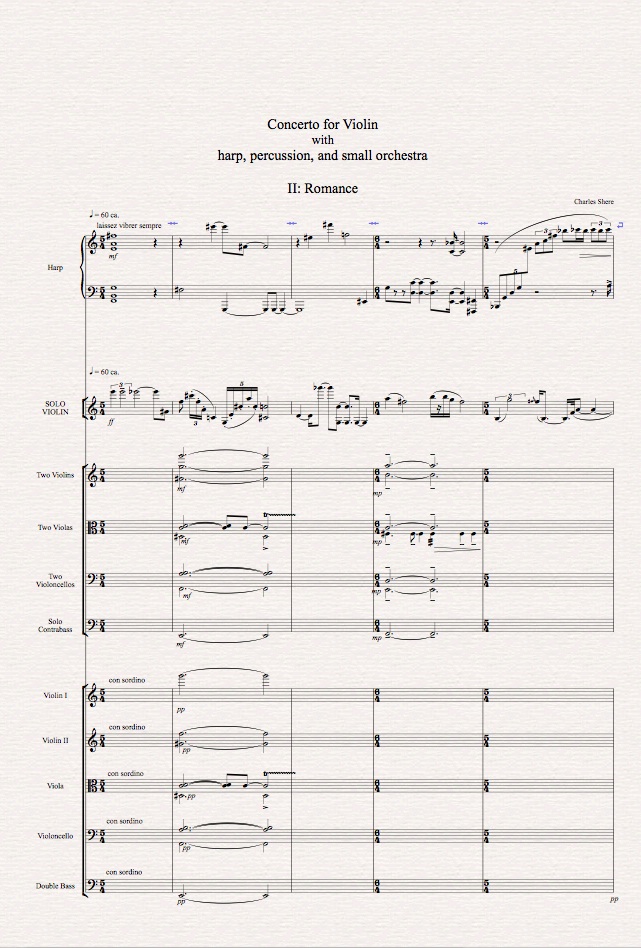
    Among the events associated with the exhibition is a short talk I'll be giving next week, describing the translation of Duchamp's painting to the rather different medium of staged opera. I've written about this before on this blog; today, since I just finished re-notating its first movement, I'll introduce you to my concerto for violin with harp, percussion, and small orchestra, one of two solo concerti concealed within the long fourth scene of the second act of the opera. There a solo piano often represents the Bachelors; the violin represents the Bride. Both have prominent roles in a Ballet with chorus and vocal soloists in that scene, and much of the music can be extracted, stripped of its vocal material, and performed as purely instrumental works. The piano concerto has yet to be realized, though a version of it has appeared as a solo work, the Sonata: Bachelor Machine of 1989.
    VcA.jpg
    For that matter the Violin Concerto has not yet been fully realized, even though it, like the rest of this long scene, was completed in 1985: the opening movement, which contains a number of passages written in non-standard “graphic” notation, has yet to be transcribed and performed. In 1989 I extracted the second, third, and fourth movements of the concerto for the Cabrillo Music Festival, where it was performed on a concert of works in progress. I was told the Concerto was particularly interesting to the program committee because of its many silences and light texture, and there was some dismay when I mentioned that I hadn’t yet finished putting notes in.

    One small joke in the score is its snare drum: the part was lifted literally, and without permission, from Lou Harrison’s Concerto for Violin with Percussion Orchestra (1959). After the concert, when I asked what he thought of my concerto, he suggested that I transpose the whole thing up an octave. When I told him that I’d lifted his snare drum part, he suggested that I should have taken the solo violin part.

    There remains the question of what this Violin Concerto is “about.” Beni Shinohara, who played the piece beautifully, asked that very question while the piece was in rehearsal, and I told her about one of the underlying themes of Duchamp’s painting — its ironic erotic atmosphere, in which the Bride, always swaying out of the Bachelors’ reach, remains in a constant state of unrelieved excitement. “I thought it was something like that,” Beni replied, and played it beautifully.

    I've entered these notes, a snapshot of the opening measures of the score, a .pdf of the Romance which served as the opening movement, and an .mp3 of the opening of the performance of that movement on my website.

    Thursday, October 22, 2009

    Food, art, community

    I WROTE ABOUT last Saturday's Futurist Banquet over at Eating Every Day, but find I have more to say about it; and comments more general than my eating blog is meant to convey. Over there I simply record the day's intake, really, though of course I hope there's occasionally something more interesting than the daily inventory. There I list and describe; here I usually intend something more speculative or fanciful. There I hew to discipline: I may go a day without posting, but never three. Here I would like to publish frequently, but more frequently, especially lately, find reasons to abstain.

    But this Futurist Banquet — now there was something to experience, to celebrate, to consider, to think over. And the more I think about it, the more I discuss it, the deeper and more complex, even dense and manifold, it becomes.

    I can't give the event justice; that would be a scholar's work, certainly a critic's. I've only seen two other discussions of the event so far, here and here; each has better photographs than mine, the first of them has video as well. Each of them steered me further to the webpage describing the San Francisco Museum of Modern Art's series of events connected to its show Metal + Machine + Manifesto = Futurism's First 100 Years, among which this banquet was the only event I attended. (If I lived closer to San Francisco I'd have attended others.)

    (Since writing that paragraph — this blogging sometimes spans a couple of days — I've found much the best account, written by Marcia Gagliardi for her Tablehopper blog, here, complete with links to a number of YouTube videos and Flickr still photos.)

    Here's what SFMOMA promised us:
    Feeding on Futurism's appetite for destruction, OPENrestaurant revisits F. T. Marinetti's provocative Futurist Cookbook from 1932 — which combined polemics with actual recipes designed to transform society — and realigns the movement's arguably fascist palate with a more sustainable approach to life. Look for cyclists delivering a locally sourced "wild beast" and a women-only kitchen carving edible sculptures against a backdrop of stadium seating, emergency sirens, and spinning walls. Guests attending this clamorous banquet can expect to exalt in sounds, smells, and constant motion, and delight in, among other things, beef ice-cream cones, avocado cocktails, and flying panforte.
    All this added up to a sort of closing bookend to a mute conversation I've been having with myself (and, in my imagination, with Curtis Faville) about the position of cuisine among the items generally though of as making up a culture. The opening of that conversation has to do with the significance, now in the early 21st century, of cuisine as an "art," whatever that is. This close is not about art; it's about rite. (I'm aware of Walter Benjamin's comments on the links between the two.)

    The Futurist Banquet was given, after all, in the context of "high art"; the locally much-vaunted SFMOMA building was intended as its architect to be a sort of contemporary cathedral, a great public space offering refuge, reflection, but also social and even commercial activity, just as did the great buildings of the European age of cathedrals (and, though he didn't say so, the earlier one of the great Mediterranean-basin mosques). (I write this from memory: I interviewed Mario Botta a number of years ago, when his design for the building was first announced.)

    I disliked the building when it was completed. It's too small, physically, for its ambitions; it keeps changing its mind about its materials; its reliance on artificial light and materials greatly compromises its evident (though vague) yearning for transcendence. It doesn't make me think of Chartres, or Winchester, or Cordoba; it makes me think of the Greyhound bus station in Oakland.

    But the engineers of this Banquet overcame all this with one simple, elemental, authentic stroke, bringing in the fragrance of fennel and flesh. The Futurists of Marinetti's day were in many ways a bunch of dilettantes, men (no women) of independent means, well-read; brain workers. They meant to replace backward, peasant- or bourgeois-based, complacent society with industry, war, discipline, above all energy.

    To their credit, the engineers of this Banquet — I'm not sure exactly who they were, though OPENrestaurant clearly played the central role — went a big step beyond the Futurists. Relegated them to the past, in fact: with respect no doubt; with charity; but still with recognition that the Futurist moment is well behind us. What we need now is to replace a complacent industry- and war-based society with one more holistically grounded in a more natural economy.

    That smell of burning flesh and fennel galvanized the crowd, immediately summoning instinctual responses. And by doing that it brought many of us out of our individual preoccupations — fashion, tech, art, whatever it was motivated our curiosity to attend in the first place — and knit us into an impromptu community. All around me, as the 1200 feet of aluminum foil was stripped from the carcass (I thought of Duchamp's "Halo of the Bride"; others thought of the Shroud of Turin), as the women carved the steer (I thought of avenging Furies; others thought of vestal virgins), I saw facial expressions, heard involuntary vocalizings, that revealed surprise and awe and utter focussed awareness — you can see this too, in the YouTube videos — that can only be compared to religious experiences.

    By a lucky coincidence we'd already planned a trip to a Portuguese community in the Central Valley, Thornton, where we'd see a bullfight, two evenings after the Futurist Banquet. The Portuguese end their bullfights with a line of eight forcados challenging the by now spent but still dangerous bull. At an invisible signal the lead forcado suddenly runs headlong at the steer, leaps over his head and between his horns, and grabs the animal around the neck; his companions rush to follow him, the last of them grasping the bull's tail; after quite a tussle the animal is brought to the ground.

    That leap between the bull's horns always makes me think of the Cretan bull-vaulters. The bullfights, even the bloodless Portuguese bullfights, are of course illegal in California, as I understand it; but because they are associated with the religious celebration (in Monday's case the celebration of Our Lady of Fatima) they are exempt from this ban. In spite of Walter Benjamin, the component of RItual (and awe) are still associated with art, for bull-dancing, even bull-fighting, like cuisine, is an Art, an art enduring from less sophisticated societies, whose communities gathered around fundamental needs and instincts.

    The smell of flesh and fennel must have permeated the fires on the beach before Troy, the sacrifice of Abraham, the underground temples of Rome, and the forecourts of the mosques and cathedrals. They finally made an honest woman of Mario Botta's temple to modern art, and I was very lucky and grateful to be there. Proud, too, that so much of the inspiration and the work and the spirit of the event is attributable to the community that has evolved through the years at Chez Panisse.

    Thursday, October 15, 2009

    There is too much to think about.

    AMONG THE BLOGS I follow, using Google Reader, one of my favorites — once past the truly wonderful blogs my daughter and granddaughters maintain* — is Languagehat. The author of this blog has two enthusiasms I share: language, of course, and hats: but the latter rarely find their way into his blog, more's the pity.

    I'm particularly taken by his recent entry, which refers to and includes his own translation of a short text — texticle? — by Ivan Bunin, Kniga ("Book"). Because if there's a subect besots me more than hats and language, it's books; Languagehat wrote pithily on this a few days ago. So to get back to this blog of my own, neglected these past two weeks when too many other things crowded it off my front burner, here's a gentle suggestion that you might well enjoy reading Book, and Languagehat in general.

    And, speaking of books, there's Curtis Faville's assay of Powell's Books, over on his Compass Rose.

    *Giovanna Zivny: Giovanna's Trifles, mainly on food and drink and life in Portland.
    Grace Zivny: Grace on the Go, on life as a graduate student in The Netherlands, and food and drink, and baseball, and other matters.
    Francesca Zivny: A Casa a Caserta, on life as an exchange high-school student in Italy: the food, the family, the classes, the driving…
    Emma Monrad: Emma Goes to College, on life as an art-school student, photographer, and bonne vivante in Portland.
    Toute la famille (Zivny): Baseball Without Borders, on, well, baseball, as it looks and is in the world beyond these United States.
    Do look in on these; I think you'll enjoy them.

    Sunday, September 27, 2009

    Out of business

    THE TIMES ARE NOT good. The nice Greengrocer in the nearby town of Windsor is closing at the end of the month. It was too good to make it, I suppose, in this bedroom community of nearly 30,000 souls, few of whom probably cared enough about what they were eating. The Greengrocer was a locavore's shop: wine, meats, dairy, and produce all came from within 150 miles. It was the only place in Windsor where we could buy local organic milk. We'll still get it, but we'll have to go to Healdsburg, two or three miles farther away. And I don't know where we'll be able to get dependable meat, except at the farm market.

    Even worse in a way, Sawyer's News Agency in Santa Rosa is closing. When I was in the sixth grade and spent an occasional day in town, riding in with Dad but spending the day not at his sheet-metal shop but strolling the streets and parks, Sawyer's was one of the first places I'd enter. There I'd gawk at forbidden comic books and mysterious paperbacks and maybe, if I had a quarter, pick up a copy of Model Railroading.

    A few years later I was buying New World Writing and Discover and novels by William Faulkner and pop-science books by George Gamow. Sawyer's was, quite literally, my first bookstore. It was so good, and so early, that when I got to Berkeley and saw the openings of Moe's Books and then Cody's Books, neither was much of a surprise to me.

    Sawyer's is closing, I read in the local paper, for the same reason that Cody's did: the double whammy of high rent and competition from big-box stores and the Internet. Here's what we need: town and city governments must provide legislation for low-income retail space, analogous to low-income housing. Our civil system depends on an informed citizenry, just as our economy requires frugality; and neither newsstands nor shoe-repair shops can survive landlords concerned only for short-term bottom lines.

    And if you think you can console yourself with a decent drink, don't get too complacent about that either: the popular Upper Fourth bar, near Sawyer's, is another recent shut-down. This story seems a little more complicated, though, to judge by some hilarious but also sad and pathetic accounts here. Ah, Internet, how cruel you can be at times.

    Saturday, September 19, 2009

    Exposition, Development, Recapitulation

    I think there's something to be said for the idea that Modernism stands at the beginning of the third of three great ages of human existence: the one preceding the awareness of consciousness, which Julian Jaynes puts at about the time of Homer; then a long age which is characterized by the long slow crescendo of human consciousness; and then a third age that begins with the awareness of the awareness of consciousness.

    Well, perhaps Modernism is really best understood as a logical development of the Renaissance, whose “moment” is the true beginning (as if a single moment can define it) of this third age. But if you draw a rough analogy to the development of an individual human, maybe it would be:
    1: Human life unaware of consciousness. Infancy-childhood: human history up to the Renaissance. (Sorry, Age of Pericles; I know you really belong later; you jumped the gun.) Prehistory.

    2: Human life aware of consciousness. Adolescence: human history Age of Pericles-Modernism. History.

    3: Human life aware of the consequences of the awareness of consciousness. Adulthood: Modernism on. Will there be an early senescence? Probably. Metahistory, or Historicism.


    This looks like college-student late-night talk, I know. And it’s influenced by a book many think of as dubious, Julian Jaynes’s The Origin of Consciousness in the Breakdown of the Bicameral Mind (Houghton Mifflin Company, 1977). Jaynes, an American psychologist who published no other book, held consciousness to be a cultural construct, not an autonomous function of the individual human “mind.” (Those are precautionary quotes; let’s not take up the question of “mind” here.) As I recall — I read the book a long time ago, and haven’t revisited it — he takes care not to fix an exact date or cultural “moment” at which this construct appears; but he does identify it, in the Mediterranean context, with the Homeric age, arising between the composition of the Iliad and the Odyssey.

    Jaynes cites evidence for his hypothesis in linguistic and economic models, among others, and finds in psychological evidence of our own time parallels to the historical (and prehistorical) patterns of unconsciousness, consciousness, and their interfaces. I found his discussions persuasive; and am particularly interested now to read scientists arguing for the abrupt big changes that can determine human behavior, collectively (politically) as well as individually. Nassim Taleb, in The Black Swan, discusses such cataclysms in the economic sphere; the research geologist Dave Wahl, in the current issue of Terrain, discusses them with respect to climatological changes. (Taleb; my earlier blog on Taleb ; Wahl.)

    Historicism is inevitably recursive. I’ve always loved Francis Ponge’s description of recursive irony — he cites Maurice Ravel's La Valse — as typical of periods "when rhetoric, dying, examines itself.” (Lane Dunlop's translation, in Soap [London: Jonathan Cape, 1969]; in the original Ce genre est particulier aux epoques ou la rhetorique est perdue, se cherche: [Le Savon: Paris: Gallimard, 1967]). [Cited in my article “What's the Matter with Today's Experimental Music? Organized Sound Too Rarely Heard,” Notes, December, 1993.]

    To continue woolgathering: there may be a parallel between all this and the inevitable process which finds "art" declining from Religion to Art to Entertainment. (See Walter Benjamin: The Work of Art in the Age of Mechanical Reproduction ; and see also Wikipedia on Walter Benjamin. Come to think of it, Benjamin himself should be added to Jaynes, Cage, Duchamp, and many others as a seminal organizer of aware-or-consciousness consciousness.)


    Wednesday, September 16, 2009

    Duchamp: Étant donnés…

    JUST FOR THE hell of it, and because Marcel Duchamp's final work Given: 1st the waterfall; 2nd the illuminating gas is in the news these days, and because I'm working up thoughts on Duchamp for an exhibition to open next month at the Slaughterhouse in Healdsburg,

    here's a short piece I wrote about after seeing the Duchamp centennial exhibition in Philadelphia in 1987. I apologize to those who know all this perfectly well. This is, after all, only journalism.

    [first published in the Oakland Tribune, Dec. 13, 1987]

    Marcel Duchamp: Centennial Exhibition

    By Charles Shere

    PHILADELPHIA— The two indispensable masters of 20th-century art were Pablo Picasso and Marcel Duchamp. The Picasso centennial, in 1981, was marked by festivities around the world, including an epochal exhibition at the Museum of Modern Art in New York.

    The Duchamp centennial was observed this year — in a low-keyed manner that would doubtless have pleased the iconoclastic, relatively egoless master. The only notice taken among the larger American museums is on view in Philadelphia, where his three great masterpieces are on permanent exhibition.

    The big news for Duchamp fans is Philadelphia’s publication of the last remaining major Duchamp text, the “manual’" he provided for the installation of his controversial posthumous masterpiece, Given: 1st the Waterfall; 2nd the illuminating gas.

    This is a sculptural installation, dramatically lit, viewable (by only one onlooker at a time) through a pair of peepholes in a weathered wooden door in a dim alcove in the Philadelphia Museum of Art.

    In the 45 years before his unexpected death in 1968, Duchamp had been assumed to have given up all art activity. His greatest work was the unfinished painting on glass, accompanied by a collection of written notes and memoranda, The Bride Stripped Bare by Her Bachelors, Even (the “Large Glass"), abandoned in 1923, broken in 1926, laboriously pieced back together in the mid-1930s.

    But from 1946 to 1966 he worked secretly on his last grand project, a shockingly erotic yet characteristically enigmatic installation about which opinion is still divided.

    Duchamp’s relatively small output — a handful of mature paintings, the Bride, Given... — has been held up as a reproach to the endlessly prolific Picasso. The two artists were opposites in many ways, though they agreed on the central role of the libido in their creative and personal lives.
    •   •   •

    The third son in a family of six children, four of whom became artists, Duchamp was born in a small town in Brittany. He moved in with his older brothers, in their Paris studio, when he was old enough to leave home.

    At 25 he painted his masterpiece, Nude Descending a Staircase. The Cubist establishment in Paris objected to its title and he withdrew it from that year’s exhibition, but the following year it created a scandalous success in the famous Armory show of modern art in New York.

    Ironically, he had already abandoned painting. For a few months he worked as a librarian in Paris; then he evaded World War I by traveling to New York, where he joined a brilliant circle of eccentrics and modernists gathered around the pioneering photographer Alfred Stieglitz.

    Here he continued work on the “Large Glass,’" the tantalizing depiction in abstract shapes of an arcane mechanical tableau on two sheets of glass totaling nearly six feet wide by nine feet high.

    The “Large Glass’" is analogous to James Joyce’s final novel Finnegans Wake as a monument of extreme modernism. Together with the prose notes Duchamp took during its elaboration — a body of texts that assume poetic depth and dimension — it provides a bottomless source of philosophical and esthetic speculation and commentary by subsequent generations of artists and critics.

    Whether deliberately or not, by 1923 — his 36th year — Duchamp had forged a modern mythology. Its significance has yet to reach the man in the street, but it has influenced generations of fellow artists, from the Surrealists of the 1920s through the conceptualists of 50 years later.

    It’s hardly surprising that Duchamp went underground after this startling achievement: how could he follow it? Yet the posthumous installation, whose realistic theatrics achieve the promise of the full title of the “Large Glass" in what amounts to a continuation and inversion of that earlier work, is hardly less complex, resonant and challenging.

    Except that it is a closing parenthesis, a work that completes rather than commences a great individual creative gesture.

    The ironic secrecy of its conception and execution, the lurid realism of its situation, above all its willful stylistic irrelevance in the context of late-20th-century art — these put Given... outside the realm of the art of its time, again challenging conventional assumptions of the methods and the meanings of 20th-century art.

    Duchamp’s centennial is hard to do justice to. Most of his work is in the one museum, and two of his greatest works are unmovable by their very nature. The critical world continues to be embarrassed by his laconic open-mindedness, his challenging intellect, mis deft, virtuosic modesty.

    Philadelphia was right to honor the occasion with a deceptively low-keyed celebration: a tidying of its Duchamp gallery and a gathering of significant sketches, maquettes and notes for the “Large Glass" and Given....

    Duchamp’s honor and celebration belong to the future. A mainstay of modernism, he is yet to be fully comprehended even by postmodernists. His work will always stand somewhere off the center of the long tradition of visual art, from cave painting through Leonardo to our own time.

    But it will continue to challenge and stimulate the best artists and thinkers, propelling new work that gradually filters its bright spirit down into the common culture. It is particularly appropriate that his work should be housed, and his centennial observed, in Philadelphia, the city that gave birth to the United States in a superb merging of reason and revolution.

    Monday, August 17, 2009

    Handler of Gravity

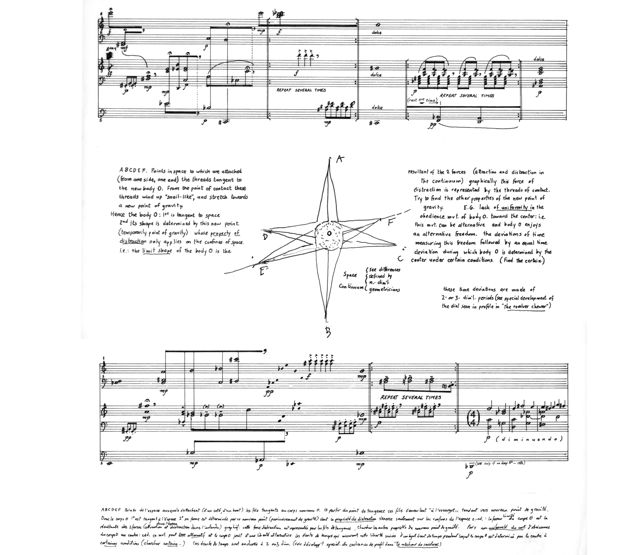
    In 1971 I wrote a piece of music called Handler of Gravity as the centerpiece of a concert of instrumental music from an opera, then in progress, based on Marcel Duchamp's painting La Mariée mise à nu par ses célibataires, même (usually translated as The Bride Stripped Bare by Her Bachelors, Even). Duchamp provided his painting with an extensive "commentary" in the form of notes, sketches and memos; and Handler of Gravity is based on one of these.

    Page2 copy.jpg


    The complete score is available as a PDF on my website, but it'll take a long time to load!

    The "handler" was to influence the Bride's decisions by responding to changes in a sort of gravitational field — the details are unclear, and in any case the handler was ultimately left out of the painting. Duchamp's note is accompanied by a sketch of a six-pointed star-shape surrounding a spheroid body; the six points represent points from which threads would stretch toward the central body, defining its location and shape by their tension.

    Six systems of music, each lasting about a minute, were conceived as both linear and textural analogues of these threads. The unsynchronized repetitions and reinforcements in the music was meant to represent the variations and displacements of physical bodies caused by gravitational disturbances.

    Much of this was suggested by the curious rhythmic disturbances which frequently characterize organists — or, rather, their performances. The result is a rather different kind of organ writing, a sort of comporomise between standard notation and a kind of tablature; the hope is to ensure an idiomatic organ character by harnessing the little clumsinesses of the instrument.

    The organist must be the central body who determines but also is subject to these disturbances — by realizing the music as accurately as possible (with respect to dynamics and pitch) while altering "rhythm" by responding to the difficulty of fingering (and footing), to the acoustical circumstances of the room, to the registration possibilities (themselves determined by octave location and dynamic), etc., etc.

    Handler of Gravity was premiered in the Chapel on the campus of Mills College on March 13, 1971. I think the organist's name was Ted Ashford; I can't find any of my concert programs at the moment. (When I looked for them just now, though, I did find my good pair of glasses, missing a number of months.) I wish I had a recording of the concert: it lasted an hour or so, and involved simultaneous performances of Handler of Gravity (with someone — David Smith, I see, now I look at the score, and, yes, it was Ashford — playing the optional chimes and glockenspiel), three graphic pieces for string quartet; and occasional overlays of Bachelor Apparatus, for four pairs of trumpets and trombones (they were stationed outside the chapel).


    There have been three quite different adaptations of the original score, each about eight minutes in duration:

    Five Pieces after Handler of Gravity, for solo piano (premiere: Nathan Schwartz; Jan. 17 1976, Oakland Museum). Each of these pieces was provisionally dedicated to one or another of the five music critics on the three major daily newspapers in the San Francisco area at the time, since Duchamp sometimes referred to his Handler as a "Juggler of Gravity."
    score: FP she03, 12 pp., available from Frog Peak Music
    Tender of Gravity, for nine instruments (fl-pic, o-eh, cl-bass cl, bn, harmonium, vn, vla, vc, cb) (premiere: Irene Pruzan, Lenore Sleeter, Tom Rose, Cyrle Perry, Beth Anderson, Nathan Rubin, Ron Erickson, Teressa Adams, Jedediah Denman; 9 May 1974; 1750 Arch Street, Berkeley)
    score: FP she04, 14 pp., available from Frog Peak Music
    Ballet: Handler of Gravity, for full orchestra (3-2(eh)-2-2(cbn)/4-2-3-1/pno/hrp/1perc/timp/strings) (premiere: Shere, Contra Costa Symphony, Kensington, Calif., 28 Oct. 1976), as part of a compilation provisionally called Music for Orchestra). This version also stands at the end of the second act of the full-length opera The Bride Stripped Bare by Her Bachelors, Even.
    score: Ear Press, 14 pp.,available from Frog Peak Music

    Thursday, August 06, 2009

    Recently read… four quick summertime books

  • Kate Walbert: A Short History of Women. New York: Scribner, 2009
  • A novel about five generations of women, from Dorothy Trevor (married name: Townsend), born 1880, died in London of self-imposed starvation in protest of the denial of voting rights to women, to her great-great-granddaughter Dorothy (later Dora, in honor of Dora Maar) Barrett-Deel, born 1989, enrolled at Yale where she is busy with, apparently, Women's Studies.

    The novel unrolls through the central intelligences of seven of these women, beginning with Evelyn, the only one to speak in the first person:
    Mum starved herself for suffrage, Grandmother claiming it was just like Mum to take a cause too far.
    Immediately the reader's thrown into a group of interesting people, the more interesting because slow to be developed. Walbert's particularly good, I think, at balancing her characters and their settings — local, political, historical, psychological. Some of the characters, particularly the males, are shadowy indeed: but that doesn't make them the less present. Grandmother, particularly, while virtually never present on the scene, emerges as a strong, laconic, iconic presence.

    I thought occasionally of Dorothy Richardson while reading this Short History, but I thought very often of Virginia Woolf, particularly of The Waves and The Years. (Amusingly, Dora mentions those of "V. Woolf" among her favorite books, "even the last two indecipherable ones." One of these days I must get to Between the Acts.) Walbert learned a lot from Woolf's discursive yet curiously elliptical way of covering long years of human lives, even generations, in expressive yet teasingly veiled pages.

    I found the characters and the events of their lives absorbing, both for themselves and (perhaps especially) for their role in Walbert's artful historical allusions. Whether describing a late Victorian lecture hall or a beginning blogger a century later, her eye and ear seem sensitive and accurate. And there's an undercurrent of good humor here; everyone's too well grounded in the grain of daily life, privileged or not, to cultivate a drily doctrinaire view of the human condition.

    There are plenty of reviews online: here, here, here, and here. All four of these correctly note the double value of the novel: as it is written, evolving through a complex of characters, settings, locales, and points of view; and for what it considers: "the woman question." That latter aspect is responsible for the online review I most enjoyed, here, because it most misses the point, ignoring the more basic matter: the novel for what it is.
    Linda Hirshman writes
    What happens when a history of women gets presented as a novel? Well, it finally gets such a history onto the cover of the Times Book Review. But, I would argue, something is lost. Presenting history as fiction immunizes it from just the kind of analysis and criticism women’s history desperately requires. …
    To tell a story of five generations of women, from the hunger striking vote-seeker to the bisexual Yale freshman, is to stand next to historians of the social and political movement we call feminism, unmodified.

    It is a fraught stance.

    Though Hirshman does not really explain just what the stance is fraught with, she refers to Plato, and seems to be complaining that, being a novel, A Short History of Women cannot function honestly as history. Of course that was never Walburg's intention. Novels are not history; they simply enable us to understand the human condition within historical events.


  • Richard Hughes: A High Wind in Jamaica. New York: New American Library, 1961

  • Why had I never read this before? I heard someone raving about the book on NPR a month or so ago, while driving up to Portland, and determined to read it as soon as possible. The very next day this ancient Signet paperback jumped into my hands in a used book store, and I read it the day after that, and re-read it a week or so later.

    It's an amazingly beautiful book, full of striking physical description of both natural and human actions and events. Children from two families, of rather different classes, are sent home to England following terrific storms in Jamaica; they fall into the hands of pirates; ultimately they arrive safely to participate in a horrific trial.

    Hughes seems to me to have discovered exactly the nature of the child's mind. Not the adolescent's: the child's. It is a strange and scary thing, strange because we rarely think much about it, scary because it is the kernel of our adult mind. I won't say more about this, except that it would be very nice indeed to spend an evening in the company of Richard Hughes and Robert Louis Stevenson.

  • Deborah Madison and Patrick McFarlin: What We Eat When We Eat Alone. Salt Lake City: Gibbs Smith, 2009

  • Here's a delight, a sparkling, breezy book full of wisdom and humor, in a nice small package, with Pat McFarlin's hilariously accurate and insouciant drawings. The author's voice comes through so true and characteristic that you never doubt the accuracy of her interviews and quotes, and she records the confessions of a fascinating number of people.

    They simply tell us what they eat when they eat alone. It's not what you might think. True, some — especially men — seem to take the easy way out: a sardine sandwich, say, accented with a bit of lemon juice; or fried polenta and cheese. Or fried cheese without the polenta. Others, though, cook imaginative and sometimes fairly complex dishes, perhaps returning to them for several consecutive meals.

    Madison has two agendas here: to entertain and instruct her readers with workable recipes for dishes one might not think of otherwise; but also to investigate the resourcefulness and, through that, the human nature of the lucky friends who warm to her queries. There's more than a little philosophy and psychology here, but there's nothing dry or theoretical. As I said: a delight.

  • David Lebovitz: The Sweet Life in Paris: Delicious Adventures in the World's Most Glorious - and Perplexing - City. New York: Broadway Books, 2009

  • I'll call him David: like Deborah Madison and Patrick McFarlin, he's a friend, and it's hard to stick to the professional surname style. David is a very funny man, and has grown over the years, through a number of books, to be an admirable writer. In this book he deals with more than just the food, though he does that very well indeed: he investigates his adopted city and its natives, their manners and methods, above all the insights into things more profound or complex that develop out of chance and trivial encounters.

    There's a bit of Connecticut Yankee as Innocent Abroad here, though you'd never think of Mark Twain while actually reading Lebovitz. The history-fraught layers Paris imposes on the simplest transactions, so foreign and "indecipherable" to the caricature American tourist, really begin to divulge themselves on closer (and longer) acquaintance, and this book gives Paris and Parisians credit and respect for the subtlety, complexity, and above all pure quality of the delights they offer.

    In short, more to this book than appears on its surface — yet a quick and very entertaining read. Everyone I know who's read it has been delighted with it. Me too.

    Monday, July 27, 2009

    Yet another obituary

    MICHAEL STEINBERG 1929-2009
    44713383-D1B9-4E27-A486-668CF62202EF.jpg
    Michael Steinberg, music critic and musicologist, died yesterday, peacefully a mutual friend tells me, in hospice, in Edina, Minnesota, of cancer; he was eighty years old. He was a thoughtful, intelligent, rather good-humored man, was my impression. I didn't know him well.

    I have seen only two obituaries so far, one by Mark Swed in the Los Angeles Times, available online here; the other by Keith Powers, in the Boston Herald, here.

    Born in Breslau, Steinberg came to the United States by way of England, one of the fortunate Jewish children saved from the Third Reich by the Kindertransport. To me he was a New Englander with a core that was consummately European, even German. He was careful, even impeccable in thought and speech, quick to observe, eager to consider, a little slower to conclude, almost reluctant to announce the inevitably resulting opinion.

    Mark Swed mentions me in his obituary, and I want to set his mention in context. I met Steinberg in August 1975 at Tanglewood, where I was participating in a workshop got up by the Music Critics Association for the improvement of young critics. Just a couple weeks shy of my fortieth birthday, I shouldn't have been there, though I had in fact been writing daily music criticism only a couple of years at the time. The workshop was run by Bernard Rosenberg, who writes about it a little bit here; it was only when I find his citation online while writing this that I recall other "teachers" in the conference included Robert Morgan, David Hamilton, and Ray Blount.

    After the sessions we generally repaired to a local bar to continue talk in a less formal setting, and there I felt free to converse on equal footings over brandy-and-sodas. (It was very warm; but I've never liked gin-and-tonics after sundown.) And it was at one of those sessions that … but let Steinberg tell the story himself:
    That's an awfully damn East Coast thing to say!" That scornful remark was addressed to me by the composer and writer Charles Shere. I no longer remember what terrible thing I had said that elicited Shere's words. I do remember that he spoke them at Tanglewood in the summer of 1974 [sic] at a workshop on music criticism and that it came as a shock to me that there could be an "East Coast thing to say" or, by obvious inference, a "West Coast thing." I was the Boston Globe's music critic then, and we on the East Coast though of our "thing" as central and normative, and of everything else as eccentric and peripheral.
    Steinberg printed that as the lead paragraph in a program note to performances of music by Lou Harrison by the San Francisco Symphony; it is reprinted in the compilation For the Love of Music, available here. Presumably this is where Mark Swed found the reference he alludes to in his obituary. The error of date — "1974" for "1975" — is Steinberg's error, uncharacteristic but significant, for by 1975 he was no longer a music critic for the Boston Globe.

    I liked Michael Steinberg as a person and respected him as a scholar and a writer. The paragraph I quote above is characteristic. His intelligence, thoughtfulness, and intuitive fair-mindedness were always present in his work, and he was always able to grow beyond his formative "normatives," and that is rare and admirable.

    Merce Cunningham 1919-2009

    IT IS VERY SAD to hear about the death of Merce Cunningham, surely one of the most remarkable men I ever had the pleasure to meet. What I associate with him, what characterized him most of all to my eye, was the best qualities of humanity: Intelligence, Strength, Grace, Humor, and Invention. He was observant, quick, disciplined, and dedicated. He made great demands, seemed unfailingly courteous, and had that strange ego that is fundamentally egoless, because while aware of his own agenda and skills in meeting that agenda he could simultaneously stand outside it looking on.

    I only met him a few times over the last twenty years or so, but he always seemed to recognize me and to be ready, even willing I hope, to continue a conversation. I was drawn to him of course via his companion John Cage, who I knew somewhat better because we were both interested in sounds and silences, a musician's parallel to the movements and stillnesses of a dancer. My memories of their apartment in New York fasten on a number of details: Merce's drawings are among the most persistent.

    We were lucky to see a number of pieces of Merce's, mostly thanks to his many appearances in Berkeley, sponsored by Cal Performances. Biped, premiered ten years ago (how can it have been so long ago?), was a superb late piece, both nostalgic and forward-looking. Even more lasting is the impression of Ocean, which we saw in its Berkeley premiere in 1994, and which I then had the privilege of seeing three times running in New York the following year: a two-hour piece full of surprise, familiarity, certainty and unpredictability.

    His choreography always seemed to me to duplicate the ultimately unknowable motion of Life. Unknowable, I mean, in that while the physical qualities that facilitate that motion can be seen, studied, understood, and discussed, the inherent questions of purpose and origin and meaning always remain both ineffable and enigmatic.

    To that extent Cunningham was, like so many of the great Modernists of the 20th century, a moral philosopher. I see in both the man and his work a Modernist, but also a Romantic and a Classicist. The cliché is always that there are not many left like him: but then, there never were.