Showing posts with label sound file. Show all posts
Showing posts with label sound file. Show all posts
Thursday, January 28, 2010
Small Concerto
THE EARLIEST PIECES of mine that I still like to think of, Three Pieces for Piano, were written in October and November, 1963, and February 1964. At the time we were living on a small grant from Edith Fitzell, a gentle, enthusiastic widow who took recorder lessons from me, and who volunteered at KPFA, the listener-supported radio station in Berkeley. She sensed my need to devote an unbroken year to musical study, and enabled me to quite my day job. (I was then a laborer for the City of Berkeley, working mostly on the sidewalk crew, breaking up old sidewalks and laying new ones.)
I spent that year studying composition with Robert Erickson and conducting with Gerhard Samuel, and listening to as much music as possible — much of it on the radio, for KPFA broadcast a great deal of new music in those days.
The first and last of the three pieces were written slowly and intuitively, at the piano. They are centered on soft dynamic levels and smoothly phrase lines, and meant to be played very softly. The middle piece was added later, for contrast, pitched on a much louder level, and alternates violent and rapid gestures with ringing sonorities. It uses only pitches omitted in the outer movements; otherwise the composition follows only intuitive principles of structure, not conventional tonal or serial concepts.
Much of the music is essentially unmeasured and meant to be played quite freely, and the third movement ends with a performer's choice between two possible approaches to the close.
In 1964 I orchestrated the music as a Small Concerto for Piano and Orchestra. No new material was added; I simply assigned some of the notes to rather large orchestra, including a harmonium in the wings, a pair of Wagner tubas, and alto flute among the more usual instrumentation. In this form the music was premiered in August 1965 at the Cabrillo Music Festival, with Nathan Schwartz as soloist and Gerhard Samuel conducting. It was the first time I heard my music played by an orchestra: a very delightful experience.
(The solo pieces waited for their premiere until March 1993, when the late Rae Imamura played them at Annie’s Hall, Berkeley, on an instrument tuned not in equal temperament but to Kirnberger 3.)
The orchestral score of the Small Concerto for Piano and Orchestra is available now, either in print (8.5x11, 8 pages, saddle-stapled) for $12 or as a free download, at Lulu.com. The Three Pieces for Piano are available at Frog Peak Music.
Listen to the second movement of the Small Concerto for piano and orchestra

Sunday, January 04, 2009
For Piano
Eastside Road, Healdsburg, January 4, 2009
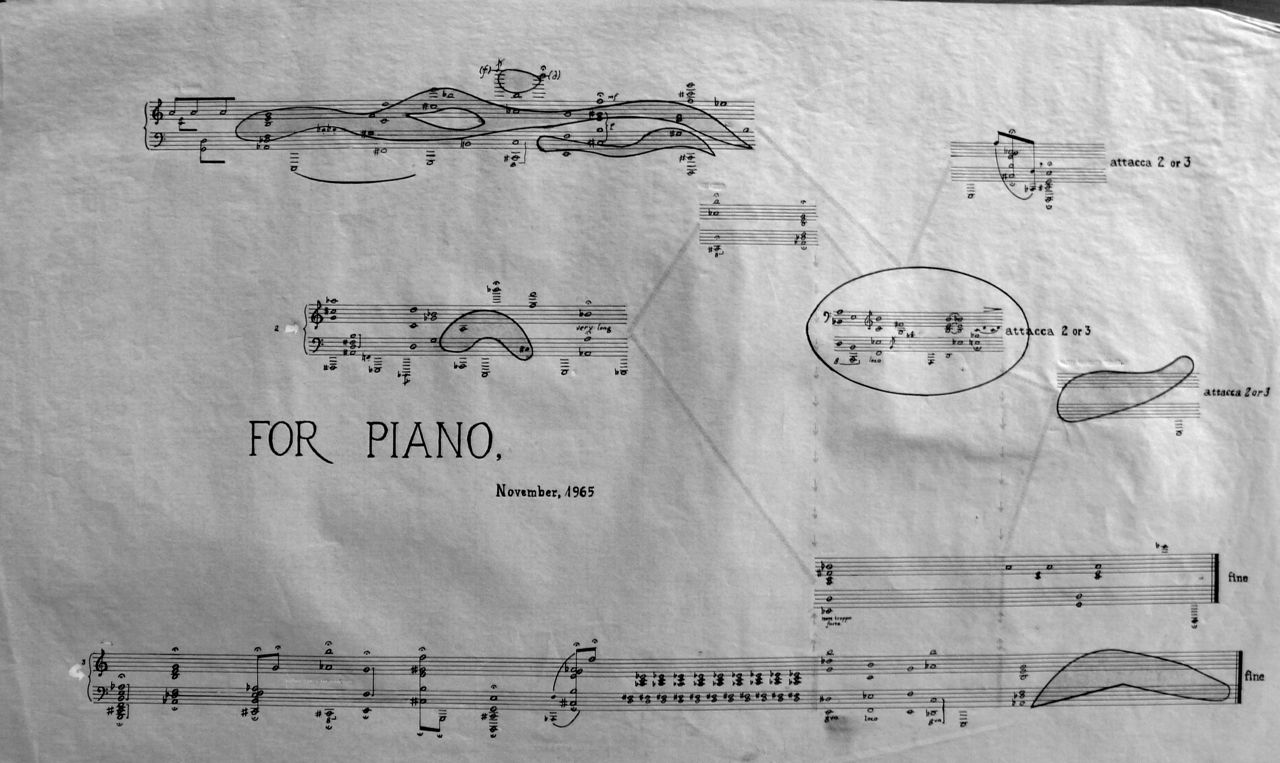
I taped a sheet of 14-by-24-inch paper down on the drafting table and drew eight systems in varying lengths, using a very fine Rapidograph and India ink. Oh, the pains we took in those days.
The piece is in "open form" but otherwise mainly fixed: the ptches definitely fixed, the durations and dynamics relatively so. I wanted a degree of improvisation, however, so I added six overlays of screen-dotted paper, determining their shapes with a French curve and intuition. Within those areas I would ask the pianist to add any material that might come to mind. Other overlays, of rows of dots, connected certain systems to indicate the pianist's route through the score.
Influences: Karlheinz Stockhausen's Refrain and various pieces by Earle Brown. Model railroads, now that I think of it, and gardens, on the concept of a pianist (and thereby his listeners) wandering a route through a piece of music, often returning to a central area, before finally ending the couse at a predetermined destination.
The premiere was played by the late Julian White, a very sensitive and wise pianist who went to the intrinsic humanity of whatever he played, refusing to worry about absolute fidelity to the score. I still have a recording from a subsequent performance, also Julian's; you can listen to it here.
Friday, December 19, 2008
Screen with Variations
SCREEN WAS AMONG my first and remains, I think, my most successful “graphic” score: notation which relies completely on drawn elements, rather than conventional musican notation. It was one in a number of “quartets” conceived as a series of experimental pieces investigating the concept of string-quartet playing, not as the playing of stringed instruments, or even the interpretation of that marvelous repertory of music from Haydn down through Lutoslawski, but as the act of listening to others and one’s self, playing in the moment while considering the long span, hearing and being in several places simultaneously, focussing consciously while leaving the intuitively expressive gesture free.
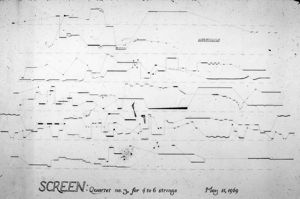
I made the piece on May 11, 1969, on my drafting table, dividing the page into six horizontal bands demarcated with dashed lines; then drew thick lines to indicate sounds (placed high or low to indicate pitch, of varying thicknesses to indicate loudness, of varying length to indicate duration), and connected these with thin straight lines to indicate voice-leading, two melodic lines to each band.
The instrumentalists can play from left to right or from right to left; when any system is completed, they pause or do not before beginning any other. The performance begins and ends as seems right.
Screen is intended as a sound-curtain through which something else might be heard — another composition or two, or ambient sounds, or internal songs. Screen should therefore not be too insistant. It should be fairly slow and quiet. Not too much needs to be made to happen. It is unassertive, like any linear statement. It is cool, a little formal, rather conservative, but not plain or cold. The several systems can be played forward or backward, each taking about a minute. I prefer Screen played by three to six instruments, weighted more toward violas than violins, including contrabasses too if possible. (I would like to hear it performed by a capella chorus one day, or by an ensemble of trombones.)

Variations was composed six years later, in 1975, again a graphic score, this time based on a star map that had been used on a poster advertising an exhibition at the Oakland Art Museum. Here again I relied on an intuitively pleasing visual appearance to guide me to a pleasing sonic resolution; this time the size of the circles indicated loudness; the placement on the page indicated pitch; and since I was thinking of nonsustaining instruments like harp and percussion there was no reason to extend the lines to indicate duration.
I'm sorry the scores do not reproduce better here. You can hear Variations played on the harp, superimposed on a performance of Screen by a string quartet, here, as recorded in a live concert thirty-two years ago in San Francisco.
I made the piece on May 11, 1969, on my drafting table, dividing the page into six horizontal bands demarcated with dashed lines; then drew thick lines to indicate sounds (placed high or low to indicate pitch, of varying thicknesses to indicate loudness, of varying length to indicate duration), and connected these with thin straight lines to indicate voice-leading, two melodic lines to each band.
The instrumentalists can play from left to right or from right to left; when any system is completed, they pause or do not before beginning any other. The performance begins and ends as seems right.
Screen is intended as a sound-curtain through which something else might be heard — another composition or two, or ambient sounds, or internal songs. Screen should therefore not be too insistant. It should be fairly slow and quiet. Not too much needs to be made to happen. It is unassertive, like any linear statement. It is cool, a little formal, rather conservative, but not plain or cold. The several systems can be played forward or backward, each taking about a minute. I prefer Screen played by three to six instruments, weighted more toward violas than violins, including contrabasses too if possible. (I would like to hear it performed by a capella chorus one day, or by an ensemble of trombones.)
Variations was composed six years later, in 1975, again a graphic score, this time based on a star map that had been used on a poster advertising an exhibition at the Oakland Art Museum. Here again I relied on an intuitively pleasing visual appearance to guide me to a pleasing sonic resolution; this time the size of the circles indicated loudness; the placement on the page indicated pitch; and since I was thinking of nonsustaining instruments like harp and percussion there was no reason to extend the lines to indicate duration.
I'm sorry the scores do not reproduce better here. You can hear Variations played on the harp, superimposed on a performance of Screen by a string quartet, here, as recorded in a live concert thirty-two years ago in San Francisco.
Subscribe to:
Posts (Atom)