Sunday, April 28, 2013

Three Plays in Ashland

FOR A NUMBER of years, since September 2001 in fact, we've been attending the Oregon Shakespeare Festival productions in this southern Oregon town. Until last year, in fact, we'd be in residence for a solid week, sharing a rented house with three other couples, friends we've come to know pretty well in the course of attending plays, discussing them, agreeing, disagreeing, persuading, failing to persuade.

Alas, tempus fugit; that social habit has run its course, though we remain good friends back home in California. For some of us the Ashland experience has lost some luster. I've complained my own share, God knows, about a number of the productions. And for the first time in years, we're not seeing everything this year, not even close to everything.

We are making two trips on our own this year, returning in October for Cymbeline, A Midsummer Night's Dream, and two new plays. And this weekend we've seen three others, with varying degrees of success — ending, I'm happy to say, on an almost unqualifiedly high level.

Friday night we saw August Wilson's play Two Trains Running. We've now seen more than half his ten-play "Centennial" cycle of plays centering on the black experience in Pittsburgh, PA, one play set in each decade of the 20th Century. This is of course a significant cycle of plays, and some of them — notably Fences and Ma Rainey's Black Bottom — strike me as unequivocally successful, plays that deserve to stay in the active repertory.

To judge from the current OSF production, Two Trains Running is secondary. The sixth play in terms of order of completion, it's set rather statically, in a down-at-the-heels restaurant threatened with condemnation for an urban redevelopment project. It's 1969, and the bleak coalition of real-estate development and misguided cultural do-goodism has begun the final assault on the flourishing if marginalized black culture that flowered in the Harlem Renaissance and in other American cities from Baltimore to Portland.

In spite of one of OSF's major actors, Kevin Kenerly, who brought detail and energy to the role of Sterling, and Bakesta King's unforgettable portrayal of the waitress Risa, something seemed flat about the performance we saw Friday night. I think the fault lies in the script, which is oddly formulaic and abstract, lacking the memorable characterization of other Wilson plays. Tyrone Wilson was quite moving as the holy fool Hambone, and the rest of the cast did what they could with their lines and direction.

Lou Bellamy makes his OSF debut with this production: he's specialized in Wilson, directing more productions than any other director. He notes that Two Trains Running is true ensemble theater: "it refuses to allow the isolation of any one character." I see this as Wilson's most Chekhovian play; the ensemble depends on the "isolation" or, better, the detailing of each of these characters as they weave through the fabric of the dramatic situation. I suppose I should see another performance.

A FEW YEARS AGO OSF began a new annual feature: a musical is to be done on each year's program. The first out was Enter the Guardsman, and it was triumphant. So was She Loves Me, another neglected standard (based on the Molnar comedy The Shop Around the Corner). Other attempts have been less successful, including The Music Man and a disastrous vulgarization of The Pirates of Penzance.

This year's musical is an adaptation of the Lerner and Loewe masterpiece My Fair Lady. I didn't want to see it, as it's being given with two pianos rather than the marvelous original orchestration, but I was roped into it. In the event, the piano transcription was reasonably successful (though the violin added every now and then was problematic, being flat far too much of the time). The real problem was the direction.

Amanda Dehnert apparently specializes in mistreating scripts. Last year she cast a woman in the title role of Julius Caesar, throwing in a Kabuki actress for good measure. This year — well, let her make her own case:
While there is something tidy in the relationship of the alive-ness of the theater (risk and reward) and the experience of Eliza Doolittle and Henry Higgins (what they risk, lose, and gain), this tidiness bothers me. Life isn't neat and theatre isn't clean. Life is messy, so should theatre be…
But of course George Bernard Shaw's plays are the epitome of well made plays, and Lerner and Loewe's adaptation of Pygmalion into My Fair Lady is notoriously impeccable. The play is about artifice, and makes its point brilliantly by being artifice itself. It is never vulgar, or slapstick, or in our face, not even — perhaps not especially — in the sections depicting the, ahem, lower classes. Alfred P. Doolittle is, as Higgins says, a philosopher, not a clown.

The Alfred in this production wrestles with direction that belongs in a Vegas club, not an intelligent theater; and to his credit Anthony Heald salvages his role at the end of the night. David Kelly finds a sympathetic Pickering, too; and when he's not made to do incredibly stupid things, Ken Robinson gets more sympathy than the role of Freddy Eynsford-Hill usually deserves.

Otherwise, the women provide the best moments in this production. I thought Rachael Warren was an unusually deep and thoughtful Eliza. The marvelously named Chavez Ravine was delightful as Higgins's mother; so was Kjerstine Rose Anderson as Freddy's.

Jonathan Haugen seemed miscast to me as Henry Higgins. Of course anyone in that role has to deal with the specter of Rex Harrison, whose inimitable way with the script and whose authority as an irascible charmer are virtually unique. Haugen enjoyed the role, and often found real character in it, but seemed smaller than this production, noisy and violent throughout, demanded.

O UR VISIT ENDED with a first-rate production and performance of another masterpiece, Tennessee Williams's 1949 A Streetcar Named Desire. Here, Christopher Liam Moore completely trusted the script, directing a performance relying on its insight and poetry and on the fine individual and ensemble acting of the four principals.

Danforth Comins, as dependable a trouper as OSF has, was a magnificent Stanley, balancing the pure animal with mental intensity. Nell Geisslinger was sympathetic throughout as Stella. Kate Mulligan grew throughout the performance as Blanche DuBois, propelling the fragility and fatigue of the opening scene toward the madness and overwhelming tragedy of the close. Jeffrey King found plenty of detail in the role of Mitch, elevating it to a level of dramatic importance almost as high as the other three.

There were problems: the music was too loud and demanding; the set a little unfocussed and fussy; the supporting roles of neighbors and poker-players a bit too strenuous. But the rest of the production, and the portrayals of the central quartet, were so well done those problems receded almost out of memory.

Moore's direction of Cat on a Hot Tin Roof, in 2010, was haunting, powerful, and beautiful. This Streetcar was nearly as triumphant. I hope his work points the OSF future, and Miller's proves to be a momentary detour.


- Posted using BlogPress from my iPad

Saturday, April 06, 2013

Iberia, 4: three encounters in Zamora

WE WERE LOOKING OUT over the river Douro, subsiding from last week's high water but still boiling along carrying a fair quantity of soil with it, brown and busy, though under fair blue skies and scudding clouds, when we heard a lot of shouting and carrying on behind us up the street.

Three boys, ten or twelve years old, came charging around a corner and down our way, too much involved in their own importance to recognize ours, or even, at first, register our presence at all. Our world was charged with distance and contemplation, memories and detail; theirs was apparently filled only with their own noise, and the immediacy of their moment, their presence.

It was funny, I thought; not that long ago, back at our hotel, watching with some relief as a busload of touring American teen-agers pulled away, we'd reflected that it was only the American youngster who was noisy and unheeding. In our comfortable hotel bar the Americans sat in twos and threes at tables meant for four, leaving us four to sit at the bar. Worse, imstead of comversing quietly at their tables, they called to one another at several tables' distance, making it impossible for us to talk among ourselves.

Spanish young people seemed brought up to be considerate, judging by those we saw in museums and restaurants. Removed from the presence of their elders, though, apparently, they are as rambunctious as any of ours. These three on a quiet street in Zamora, for example suddenly, though, they realized we were watching them, and they fell into a momentary confused and perhaps even embarrassed silence. Quickly, though, they had to save face.

The boldest of them addressed me, in Spanish, using the familiar tu: Turista! Are you German? No? Well, English then?

I told him politely that I came from California, but that my brother was Australian. They seemed to find that strange and amusing. They backed off and eyed us speculatively, heads at a bit of an angle. It felt like a moment out of Penrod and Sam, or Tom Sawyer.

Then the leader addresses me again: Do you want to see a strange thing, one of the local customs of Zamora? He broke into a fast shuffling dance-in-place for a couple of beats, then amazingly turned his back, dropped his pants, and looked at me from between his legs for an instant, before running full speed, pants hitched back up again, to the end of the street up the hill.

Bravo, I called to him, you looked just like one of the devils carved on a capital in the cloister! He seemed not to like that, for he picked up a stone about the size of a walnut and launched it at me quite accurately, hitting me on the leg.

I picked it up and made to throw it back at him, but all three had disappeared.

We turned back to our prospect, then walked on. After a few minutes, though, when we rounded a corner at another street, there they were again, coming our way. There were other men and women on this street, locals it seemed, and when they saw us they immediately turned tail and ran away, without making a sound. We never saw them again.
§ § §
NEXT MORNING we decided to visit the Museo de Semana Santa, to learn more about the Holy Week processions of penitents we'd been seeing, and to marvel at the huge, intricate, sumptuous, and amazingly lifelike sculptural groupings on the carros — "floats" being far too trivializing a word for them — that are carried through the crowded streets by up to forty men, all hidden from view beneath the platforms, also intricately carved, on which they stand.

Seeing a well-dressed rather purposeful man on the street as we walked in the general direction of the museum I asked for directions. I do this even on the rare occasion when I already know the route; I like the opportunity to hear the language, and to practice brutalizing it a bit myself.

It's just up the street a bit, he said, I'll show you; come with me, I"m going there myself. And so he was, and so we did; and then we spent an bour or so with perhaps fifty enormous carros, taking in the entire story of Holy Week, from the triumphant Palm Sunday entrance into Jerusalem, through the Garden, the Betrayal, the Crucifixion and ultimately the Ascension.

It's a long time since I studied these stories, sixty-five years at least, but they seem to have stuck with me. It was amazing how many details came back, and how much significance they could suggest, if I forgot about some of the other things I've learned since. The function of these tableaus and rituals was immediately clear: not only was I reminded individually of the religious teaching I'd received; I was also cemented, so to speak, into the society of all the Christians, lapsed or faithful, gathered around me.

And it wasn't only the carros and the penitents that had this effect. Paintings and sculptures in the churches perform the same office. I was never a very good student of the Bible, but a surprising amount of even the Old Testament comes back to me as I look at these paintings of Noah or Abraham or Lot and his daughters or Judith and her servant, just as the tapestries we saw elsewhere, rich depictions of Hector and Achilles, say, trigger recollections of long-forgotten details in the Iliad.

Several hours later, on our way back to the car, we met our helpful guide again. He called out something I didn't catch, and as we drew closer I apologized that I don't understand Spanish. Yes, you speak Spanish, he said. No, I said, I speak a very little Spanish, but I don't understand it. no comprendo Español.

Sí, comprende, he insisted, and went on, always in Spanish, asking us if we'd see, the Castillo, if we'd enjoyed it, if we didn't agree that his city was a very beautiful one.

Yes, I tried to say, we enjoyed everything about Zamora. Well except that there were some boys — jovenes — who seemed a little…

But Spanish failed me utterly at that point. incivil? he asked helpfully. Sí incivil, un poco, I answered, aand was glad I couldnt emember the words for "throw" and "rock."

Oh, well, los jovenes, theyre the same everywhere, the mn said; I'm glad you enjoyed our city; do come again…
§ § §
NEXT MORNING, on our way out of town, we stepped into a yardage-goods shop, attracted by the unusual fabrics displayed in the shop window. There was a faint and agreeable fragrance of good cigar in the air; I thought how nice a jacket cut from one of his woolens would be.

He seemed amused. That four tourists, obviously traveling without a sewing machine, would be so interested in his wares, and, smiling, asked us if we'd liked Zamora. I told him I was struck by the elegance of so many of the women we'd seen in the city; he seemed happy I'd noticed.

Somehow the subject of flamenco came up, and he quickly disavowed any local Interest in the art. The local dance was more a quick shuffle, first one foot, then the other, in place, without actually moving the upper body, exactly as the naughty boy had demonstrated, though with considerably more dignity. The man was a little hefty, in a sober, well-dressed way, and shuffled rather seriously; then smiled indulgently at himself, and self-deprecatingly at us.

The dance originated in imitation of the footwork of the torero, he explained. Ah, I said, is the bullfight still important here in Zamora?

He was a little incredulous. Yes, señor, of course, it is what makes us Spaniards. He expounded further, answering further questions. Yes, it is important to nearly all Spaniards, young, old, poor, well-to-to. Of course, there are some who object, there is the occasional demonstration, but it is a very small minority. He shrugged. There will always be some who refuse to belong, who reject their culture.

The corrida is central to our culture, he continued, it is what makes us Spaniards, has always been at our center and our roots. In every city there is the Plaza de Toros, and everyone can go there.

We got in the car and drove to the border, through beautiful heath in bloom, and thin pine forest that made me think of Arizona. I thought about Christianity, and the saints, the stories, tauromachia, cultural history, national pride and identity. The Spaniards sometimes speak of going to Europe on holiday. The Roman Empire, some of the time, seems more Spanish, or at least Iberian, than European. I think it best if all these cultures, and the cultural and historical moments that define them, are allowed their distinctions, allowed to coexist in mutual enrichment, like the differences in climate and terrain, from which they spring.


- Posted using BlogPress from my iPad
Location:Rua da Alegria,Porto,Portugal

Sunday, March 31, 2013

Iberia, 3: Ávila


Avila, March 31, 2013—
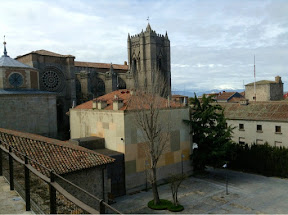
A FAVORITE CITY of mine, Ávila, accent the first syllable, please, is a small old city, still entirely encircled by its great and beautiful medieval wall, only an hour or two from Madrid, but much higher — one of the highest cities in Europe, in fact — and therefore cool, even cold, and rather sober. A perfect place to be at Easter.

It is the home town of Teresa of Avila, of course. Her convent is an impressive site, but we will not visit it again this trip; we content ourselves with a single Sunday and the two contiguous nights, in a very pleasant hotel on the cathedral square. Today we walked the ramparts, which takes two or three hours if you rest and dawdle along the way, as well you might at our age, as the steps are high and shallow and often uncertain.

And, more to the point, the views are enticing. At every step there's something so interesting, or beautiful, or arresting, that you're compelled to take yet a other photo. There's the wall itself, of course, massive, forty or fifty feet high, ten or twelve thick, with its crenelated parapet and its frequent lookouts. The stone is limestone, I suppose, a soft warm beige color, cut into massive blocks, and the details — the triangular caps of the crenellations, for example, which are infilled with brick tile; and the huge corbels, beautifully sculpted with softly rounded edges — are repeated with a precision suggestive of great discipline and thoughtful planning.

Clearly a master architect was at work here, whether an individual or a committee or, very likely, a succession of individuals; the work must have extended over centuries, and involved, as my brother remarked, evolving additions and improvements.

One of the things that pleases me most is the playfulness of the geometry. Watchtowers are often set at surprising angles; staircases climb to them steeply nearly always with fifteen risers, but at angles that are both practical and, to my eye at least, refreshing. No doubt it had to be possible to use these details with alacrity, even in the dark, the rain, in freezing weather: but I can't help thinking even rushing defenders — and for that matter the laborers carrying stones and baskets of mortar or pails of water — must have appreciated the physical beauty of the public work they were defending.
Geometrical beauty like this has a civic function. Its clarity of purpose, its solidity and perdurance, express moral clarity and rectitude. And containing the city it defines its relationship to the resources beyond the walls, the fields and groves, the river and the distant mountains whose grains and fruits, snows and quarries contribute so much to a society organized to common benefit.

The low mountains define a horizon not really that far away. Everything here feels high: the air is cool, clean, crisp; the plains undulate easily, rising to that skyline. The light is utterly clear and transparent but, oddly, soft and luminous. Gazing out from these ramparts over the fields one can't help feeling the kind of certainty, order, and tranquility that must have informed Teresa, whose fine mind resolved sensual and moral sensibilities with so little trouble.

Last night we stood among the rather small, respectful group of onlookers along the street just outside the wall, watching the Holy Saturday procession. It felt very similar to the one in Madrid I described in my previous post, but also very different. For one thing, it was not dark, not at the beginning. And we were much closer to the marchers, more aware of their individual faces and manner.

Again, I was impressed, moved, by the determination they express; by their sobriety and dedication amd purposefulness. Avila was a city before the Romans came; she has seen cults and cultures come and go, and doubtless will see more. The procession reminded me of the slow and generalized relationship of communities and their undertakings to the contexts they inherit from the mountains and the fields and from the great works left to them by their predecessors — whether physical, like the cathedral, the walls, the chapels; or intellectual, like the songs and the literature and the enigmatic sculpture from archaic times.

We live, learn, flourish, and fail, we individuals and the societies and cultures we make; and around us the light and the open skies and the mountains do the same, at their vastly different paces; and I find something hugely comforting in all that.

- Posted using BlogPress from my iPad

Iberia, 2: Processions, buskers, tooth

Hotel Zurbano, Madrid, March 29, 2013—


B
ACK DOWN TO THE CENTER of town last night, about eight o'clock, to find the streets devoid of automobiles and given over instead to throngs of Madrileños. One didn't know which way to go: from the Plaza de San Luis, some groups strode purposefully down toward the Puerta del Sol, others charged up the dubious Calle de Hortelleza; yet others moved off down the Gran Via toward the Plaza de España.

I think I've never seen so many people massed in streets, all clearly about some very public matter, but none in groups of more than would constitute an immediate family. Parents and children; young couples; grandparents with extended families; sometimes two couples, clearly friends: all went about their ways, purposeful and often intent, but free of any collective partisan or political issue. They weren't demonstrators, or pickets, or even football fans.

If it reminded me of anything, it was the passeggiata you see in Italian cities in the hour or two before dinner on a fine Sunday evening. But this was Madrid, and Thursday, and not particularly fine: in fact, rain had been threatening, and the air was damp as well as cool.

We joined those continuing down the Gran Via but soon veered south toward the Plaza Mayor. The crowds grew thicker. It was Holy Thursday, and four processions were scheduled through the city streets; one would proceed right through the Plaza Mayor, and we didn't want to miss it.

We took up a station at a likely-looking corner of the plaza where the crowd had left a wide pathway open for the procession, whenever it should appear. There were no monitors, few police, no barricades. No one had folding chairs. We all stood fairly silently, some conversing, one woman in front of us quietly talking to someone at another position on the route, keeping track of where the procession might be.

Finally we heard drums; we saw distant lights; the procession entered the Plaza Mayor. It moved incredibly slowly, often stopping. There were hooded men, brass bands, drummers, sober women in traditional black mantillas and modest, elegant dresses. Some were barefoot.

Walking, all seemed to sway slightly from side to side. Standing, they were still, looking straight ahead, expressionless — or, rather, expressive of profound sobriety and dignity. We couldn't help but feel moved.

At length a great golden altar arrived, borne along by forty-eight men, eight on each of the three poles fore and aft. The figure of a black-garbed Virgin stood atop the float, which halted just in front of us. Men lit the many candles along the sides, further heightening the gleaming apparition against the prevailingly dark night — for there was little light in the Plaza, only a few lamps at the distant side.

The gold altar was finally lifted again and carried through the arch. After a time another huge float was carried in, paused, and then was carried out; you see it photographed, as well as I could do it, above.

Finally the procession was completely past us. Eleven o'clock: we had been standing in one spot for three hours. People nodded to one another, murmured goodnight, and drifted out of the plaza; voices gre more normal as we entered the surrounding shopping streets; the passeggiata resumed.
There is more secular street entertainment to be found, but all of it reminds me of vignettes familiar from Goya and, later, Picasso. There is of course the occasional beggar, but much rarer than in Venice, for example, or, for that matter, San Francisco.

There's the occasional street musician: a lone accordionist or violinist — occasionally, these days, unfortunately accompanying himself (he is inevitably male) with a boom-box. I prefer them when they play unaccompanied. Now and then there'll be one with very little talent, surprisingly little, but you have to give them grudging credit for at least trying. More often they're pretty good; now and then there's one who's really good, and you feel he may be playing for himself, because he's a musician and can't help it, though the case will be open on the pavement, for whatever thanks may fall into it.

Then at some of the handsome plazas on the Paseo Castillana, when automobile traffic is stopped for a minute or two by the traffic lights, jugglers will run out into the middle of the street, often wearing amusingly colorful clothes; they'll bow or curtsy (for some of these are women), tip their hats, and begin juggling their Indian clubs, throwing them high in the air, picking up the occasional fallen one daintily with an instep and kicking it back into action.

Somehow they know just when to stop, and walk between the lanes of traffic, clubs in one hand, cap in the other; and I'm glad to report a number of windows are opened, and coins dropped into the caps.

We don't contribute. There seems to be a convention at work here: it's car and taxi passengers whose money is sought, perhaps to atone for their vehicular presence. Returned to the sidewalk while thee traffic lights are green, thee jugglers talk among themselves, and smile at us pedestrians and say Good Afternoon, friendly and polite. We feel conspiratorial; there's a bond among us.
My own entertainment on Good Friday was, wouldn't you know, a broken tooth. Nothing to be done but ask the desk clerk where the nearest emergency dentist might be found.

As luck would have it, only a few blocks away, a Clinica Dentista in a white building on Calle Breton de Herramentos. I telephoned and made an appointment for eleven-thirty. I was a little early; his bell didn't answer. Right on the second, though, there he came a shaggy-haired man in his early thirties. He looked at me questioningly; I nodded; he beckoned me to follow.

He put a white coat on over his street clothes and, I noticed, changed his black shoes for a pair of white ones. I took my seat in his dentist's chair and watched him meticulously wash his hands before drawing on gloves. He spoke no English, and my Spanish is barely rudimentary, but both problem and solution were pretty obvious, and soon he'd put things right.

I told him not to run, as he dashed between the operating room and the counter serving as his office, but he pointed at the clock, and said there'd be three more patients arriving at noon. I liked him, his work, and his manner. The operation was not cheap: the handsome jacket I'd been thinking of splurging on was now moot. But it's nice to have my tooth back, and the experience was, well, interesting.

Location:Madrid

Thursday, March 28, 2013

Iberia, 1: Chez Nick revisited

Hotel Zurbano, Madrid, March 28, 2013—


A GOOD MANY YEARS ago we found a marvelous restaurant on the Rue Taylor in Paris, Chez Nick. They served only bouillabaisse and a Grand Aïoli, nothing more, and each was superb. The restaurant was very modest and inexpensive, with a bar down the left as you enter, a few tables, the kitchen at the back. Nick, a Marseillais, presided over the kitchen; his wife, whose name I never knew, over the bar and dining room.
We ate there two or three times, then skipped Paris for a number of years. When we finally returned I insisted on stopping at Chez Nick. It's probably gone, Lindsey said, as she always does, throwing cold water on my fondest plans. Nonsense, I said, Chez NIck has always been utterly reliable.
We walked up and down the Rue Taylor but could not recall exactly where it had been — nor did it jump out at us.
Finally, way down the street, I spied an ancient woman with a cane, a young woman helping her at her elbow, slowly hobbling toward us. I fixed my eye on her: obviously a local resident. She must know.
As she drew nearer she eyed me suspiciously, as well she might: bearded, long-haired, not particularly well dressed, and huge compared to her, I might have been trouble, even though I was accompanied by a clearly decent and well-behaved lady.
Pardon, madame, connaissez-vous un restaurant qui s'appelle Chez NIck, I asked in my flawless non-Parisian French. Her look of anguished misgiving dissolved into an expression of sweet nostalgia.
Ah, mussieu, Chez Nick, c'etait un restaurant, c'etait si bon… non, mussieu, je regrette, c'est fini Chez Nick.
So Lindsey was for once right, one couldn't go home again, the snows of yesteryear were melted well and truly. And today we were at Chez Nick again.
In years past we've liked La Fuencisla, in Madrid, on the Calle San Mateo, no. 4. Naturally I looked it up yesterday, our first day here, only to find it was in some question, with only a few references on the Internet. The first included a glowing description, falling in with what I remembered of the place, but was followed by three troubling and enigmatic comments:
Gerardo, 12:34 pm: There was a time I wanted to reserve, but no one answered the telephone. Is it still open?
Anonymous, 1:21 am: It's closed Señora Teresa died and it closed
Anonymous, 12:53 pm: She isn't dead and functions perfectly
Now that last entry is ambiguous, No esta muerta could conceivably refer to either Señora Teresa or the establishment itself, if you stretch a grammatical point. So today we simply stopped by to see for ourselves.
Well, not so simply; I had described the location imperfectly in my book Mostly Spain, which I was ill-advisedly using as a source. Down one street and across to another we went, asking in at shops and apartment-house doorways, finally closing in on the location, where we found a hot-dog-and-hamburger joint-cum-cocktail-lounge, where a young man was perched on a ladder at the front door, washing the transom.
Is this La Fuencisla, I asked, doubtfully. Yes and no, he answered, La Fuencisla was here, but it changed four years ago. It changed, I said, did it change a lot?
Go in and have a look, he said, it's not the same. I peered inside. No, it was not the same at all. No old men playing cards at dusty tables, a bottle of wine at the elbow; no promising dining room beyond. No Señora Teresa of the delicious eponymous soup.
Another traditional Madrileño location has given way to Americanization. Chez Nick at least had the decency simply to disappear; La Fuecisla has not dried up, but been quite polluted. Oh well: there was a perfectly acceptable Asturiana place not far away…
- Posted using BlogPress from my iPad

Location:Madrid

Wednesday, March 06, 2013

A Time in Rome

bridge.jpgNOT LONG AGO we spent two weeks in Rome, first a few days with one couple of old friends, then ten days with another, finally a weekend with a third. I meant to write more about the visit, but in the end only came up with three posts, two on street performers, another on Shostakovich's opera Nose.

I may revisit that visit. Looking at the dozens of photos, many impressions come back to mind. Of course many are old friends of impressions, by now; this was our third extended visit to the city, and previous impressions were written up at the time — January and November, 2004 — and subsequently found their way into my book Roman Letters.*

My way of visiting Rome is essentially irresponsible and self-indulgent. We've avoided most of the museums and failed to explore the Vatican. Of course we've been to the major sites, and return to some regularly: I wouldn't visit Rome for a day without stopping in at San Giorgio in Velabro, for example, or crossing the Ponte Sisto into Trastevere. But on the whole we prefer trams to tourguides, back streets to boutiques, cafés to cathedrals.

The perfect illustration of this attitude, and these preferences, jumps out at me in this week's reading. I'm still bogged down in Robert Hughes's history Rome; I may never finish it, and will write about it later, if ever. But I just finished Elizabeth Bowen's marvelous A Time in Rome (New York: Alfred A. Knopf, 1960), and can't wait to share it with you.

It is neither guidebook nor history. It's a meditation on Rome, by a gifted observer and writer spending three months there, mid-January to mid-April, mid-20th century. There are extended passages descriptive of streets, quarters: the Forum of course; the via Giulia; the cemeteries. At other times a paragraph or two will be enough to suggest Testaccio, say, or Ostia Antica, or what she still refers to as "1942," Mussolini's architectural fantasy projected for an international exposition, now known as EUR.

There are lengthy explorations of historical periods and the personalities behind them: the Julio-Claudian emperors and then the Flavians; Benvenuto Cellini; Pope Sistus V; a contemplation of Augustus's wife Livia; a detailed account of the end of St. Paul's career.

There are wonderful little insights, often witty in their expression: On political correctness, evidently as irritating mid-century as now:
I am sick of the governessy attitude of our age, which is coming to be more genuinely presumptuous, nosier, and more busybody than the Victorian. Deplore the past if you wish; you cannot do anything about it, other than try to see it does not recur.

or poetic: the description of a
great ripe Sicilian blood orange … in a class by itself: the peel, mottled satin outside, white velvet in, curls away under digs from the thumbs, gladly; the delicate-membraned sections fall asunder like petals, firm flesh not spilling one drop of crimson juice till one bites into them. Such oranges deserve to be eaten as I ate them, in infiltrated sunshine, with wine to finish.

Often of course she contemplates Art. On ancient wall-paintings, for example, like those at Pompeii and Herculaneum (though she does not write about those sites):
Nothing about these paintings, minute and sensuous, releases one into the air of art: if anything, their effect might be claustrophobic. The aim was not to enlarge existence but to flatter it.
Later she touches again on the ineffable enlargement of existence art can engender:
While I stand and regard it, the indifference to myself shown by a work of art in itself is art. In Rome, I was more drawn to statues than to paintings. But, whether it was a statue or a painting, I came to recognize first a disturbance and then a lessening of the confusion within me as I beheld. Partly there was a liberation from the thicket of the self…

She doesn't flinch from facing the difficulty of writing about Rome:

Attempts to write about Rome made writers rhetorical, platitudinous, abstract, ornate, theoretical, polysyllabic, pompous, furious… Language seldom fails quietly, it fails noisily.
or about the fugitive essence of much of its population — especially its ancient population:
'Average' existences, at whatever level, are probably the hardest to conceive of, when they are other than one's own.
Yet some of her most fascinating insight is trained on the underclasses of ancient Rome: slaves, mechanics, women.


She writes about her approach to a description of the Forum:
My route, I have so far found, does not correspond with any recommended by an authority… Mine corresponds with my sense of order: the taking of things as one comes to them, one by one, placing them by their relation to one another. My approach to the Forum was visual rather than historic — even though 'seeing,' the greater part of the time, had to be an act of the mind's eye (or better, that of directed imagination.
and reveals thereby her greater intention: to direct that mind's eye (a particularly penetrating one, I think) to the entire scope of Rome, spatial and temporal, enlarging the reader's existence through her art, not with mere factual information but with gentle encouragement to the reader's own mediations.

Writing about Rome, she necessarily mediates on time and memory:
I wanted to establish the Forum monuments' nearness to or distance from one another in time as well as in space. Clearly some are the seniors, other he juniors. Many of them were one another's contemporaries — for how long, and when, did they share the same term of time?

We are drawn to Rome and its past because, unlike the past we studied as children in history class, fixed with precise dates and determined by sequence and succession, the Roman past attested by its living ruins is a continuum. Wars, assassinations, births, and treaties are momentary affairs, however long the moment may be: but the past that is Ancient Rome encompasses a thousand years; where the Coliseum was built in Hadrian's day (CHECK THAT), and stands still today, swans floated on Nero's lake a century or so earlier.

In the face of such contemplation a certain elegiac note is hard to evade.
The Forum, I said, leaves one with little to say — I could have as easily said, with nothing. Silence seems the only possible comment on finality. I do not think you or I feel less, but we feel, because more resignedly, more calmly.
(One thinks of Wittgenstein: "Of that we cannot speak, we must be silent.")
Though certainly not intending to write a History of Rome, she is mindful of her responsibility to History:
One must be on guard against misconceptions, when trying to grasp the movement of the history of Rome — untruths are thieves, robbing us of a birthright.

Yet she is willing to abstract, to generalize, to interpret; often through the novelist's method of construction from observation. She recalls an April in 1939, when she was enjoying an afternoon on the Palatine:
The idle yet intense air smelled of honey; Rome shimmered below with hardly a stir, and bluer than the sky were the Alban hills. There was a harmony between the distances. I was sitting on a broken ridge, reading and sometimes not reading a book. Low but clear voices, coming across the irises, told me that a couple who had been wandering ad set down behind me — students, by their serious young tones; friendly lovers or loving friends, familiar with one another as with the Palatine. If not born Romans, they had acclimatized. They talked metaphysics, for whose discussion the lucid Italian language is so perfectly framed. 'This beautiful house of sensation in which we live…' he said.
('Questa bella casa di sensazione in qualie viviamo…') The words made me their neighbour: I looked round, to see, stamped on the air, his profile intently turned, her full face abstract and calm with thought. Since, what has become of him? I must not forget him. Killed in the war against us? (Soon after that April, the war came.) If he still lives, I hope he still finds the house fair. It is still here. Is there so great a gap between the pure in sense and the pure in heart?It is a haunting book, A Time in Rome, and I'm grateful to Giovanna for directing me to it.

__________
* Roman Letters: available at Lulu Press as a paperback or an e-book; it is also available at the iTunes bookstore.

Friday, March 01, 2013

Death and the oboe

1951-Band.jpg
February 28, 2013—
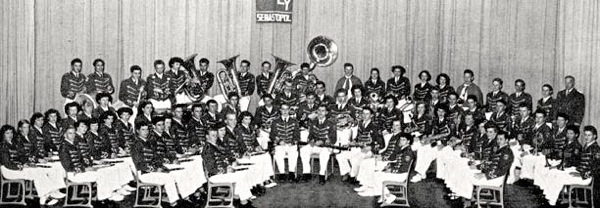
MY BEST FRIEND in high school, from 1949 to graduation in 1952, was Merton Tyrell. We were bandmates together: in this photo we sit in the front row center, me with my bassoon across my knees, Merton with his oboe sitting on my right.

Merton — I don't think anyone called him "Mert" — was intellectual, rather formal, quite elegant, his dark hair slicked back from a high forehead, a lively eye but a rather cautious expression on his face. He played oboe, as I've said, and excelled at math and science. He drew the single “A” in our physics class, when the rest of us all got “C”s, except for one poor fellow who failed in order to establish a perfect bell-shaped curve when the final grades were posted.

I only visited Merton’s home once, when I think I was dropped off to be taken to some event together with him. It was a small but very neatly maintained cottage on a gravel driveway, neatly clipped shrubbery in place, a smiling mother in an apron. And Merton, as I recall, never visited my home; I was probably too embarrassed to suggest such a visit.

In fact I held him in considerable awe. I spent far more time with my other friend, Richard, who played French horn. All three of us lived in the country, miles from town and our high school, but Richard lived on the same bus route as I, and Merton did not. And Merton was socially well above me, better dressed, better educated, much better spoken; and a year older, too; whereas Richard lived in rather a squalid shack with poorly educated parents, and was a year behind me. And then there's the difference between the oboe and the French horn, especially in a band. (Now that I think of it, the bassoon can often be heard mediating between the other two.)

I saw Merton only once after high school. At graduation he announced that he was going to become a rich man, and would study geological exploration to that end; I on the other hand was sent to Los Angeles to a religious college, where I went seriously awry for a few years. I thought of him often over the years, but never looked for him. By the time I did, after the Internet made such searches fairly simple, I found he had died, just 65 years old, in Ukiah, only an hour's drive north of me. I know nothing else about him: whether he'd made his million, whether he left a widow and children, whether he'd kept his oboe.

Although my instrument was the bassoon, it was the oboe to which I always aspired. The oboe has always struck me as the supreme woodwind, perhaps because of my awe of the elusive, intelligent, handsome, super-cool Merton Tyrell. Played well, it is focussed, clean, present. It lacks the wide range of the clarinet, which can play much more quietly in the low register, more shrilly in the high. The oboe can't reliably play more than two and a half octaves, the most restricted range of any of the major woodwinds. But there is something in its sound that suggests intelligence, wit, authority. Wallace Stevens would not have written Asides on a Flute, or a Clarinet: only Asides on an Oboe makes sense.

My first attempt at a composition of any ambition was a concerto for oboe, French horn, and strings, imagined and partly written in my first year of college, when I was seventeen. I didn't get far, of course. I'm sure it was Merton and Richard I had in mind, them and the lovely pastoral Vaughan Williams oboe concerto.

images-1.jpeg
William Bennett
THIS MORNING ANOTHER OBOIST died, William Bennett, principle oboist of the San Francisco Symphony Orchestra. He joined that orchestra in 1979, when he was only 23, and became principle eight years later, succeeding Marc Lifschey. His death was particularly tragic: he was stricken by a cerebral hemorrhage in the Symphony concert Saturday evening, toward the end of the opening solo of the Richard Strauss oboe concerto.

The concerto opens with a couple of beats of quiet rustling in the strings, then a long unbroken phrase for the soloist, over two minutes long with few opportunities to breathe. The oboe is a peculiarly difficult woodwind in that the player generally has too much air in his lungs, not too little; lungs and sinuses can suffer from the resulting pressure. Of course Bennett was a master of the instrument and well used to these problems. Furthermore, he had played the concerto the previous night, and the afternoon before that. It would be presumptuous to blame his attack on the oboe, the concerto, or the concert.

But, much as I have always loved this concerto, it will be hard to hear it in the future — especially that long, graceful, pensive opening phrase — without a kind of regret. Strauss composed four masterpieces in his last four years: Metamorphosen for 23 solo strings, from August 1944 to March 1945; the Oboe Concerto, 1945; the Duett-Concertino for clarinet and bassoon with string orchestra, 1947; and the transcendent Four Last Songs of 1948. He was in his eighties when he composed these pieces; his country was in ashes and its culture nearly as extinct; his music, which had been extravagant, then discordant forty years before, had finally come to terms with, had nearly mastered, its surrender to the rueful lyricism of Mozart.

It's notable, I think, that he followed the funereal Metamorphosen, composed for solo strings — with its transtion, at the end, into a quote of the "funeral march" of Beethoven's Eroica Symphony — with two major scores for solo woodwinds. The story of the Oboe Concerto's composition is well known: an oboist, John De Lancie, was one of the American soldiers directed to occupy Strauss's villa at the end of the war; he asked Strauss why he had never written a concerto for his instrument, and the aging composer responded favorably.

The Duett-Concertino is less well known, perhaps because it is somehow less autumnal in character. Its solo clarinet and bassoon seem to me to represent a Zerbinetta kind of mentality in response to the Ariadne of the solo oboe in its concerto. Together, though, the two works sum up Strauss's fully mature, rather remote expression of the range of human emotions: playfulness, wit, amour, awareness, maturity, age, regret.

By all accounts William Bennett was the emblematic oboist. Those who knew him mention his intelligence, his intellectual curiosity, his good humor. Joshua Kosman's obituary in the San Francisco Chronicle and his predecessor Robert Commanday's remarks in a story in the online San Francisco Classical Voice hint at the admirable man Bennett apparently was.

I lost Merton, and I never knew Bennett. I heard him many times, of course, but rarely as principle oboist; he took on that appointment the year I retired from music criticism. Perhaps that makes my mourning particularly poignant.

Radio station KDFC broadcasts San Francisco Symphony performances on Tuesday nights, and the concert including William Bennett's performance of the Strauss concerto is scheduled for this next Tuesday, March 5, at 8 pm. Yan Pascal Tortelier is the conductor; the Strauss is flanked by Debussy's Petite Suite and Mendelssohn's early Symphony no. 1. I don't know whether the entire concert will be broadcast, but no finer farewell could be imagined than hearing this gifted, complete musician repeat his last public gesture for an even wider and certainly more fully engaged audience.

Wednesday, February 27, 2013

Kathan Brown: Know That You Are Lucky

Lucky.pngTHIS IS AN IMPRESSIVE book, and I don't say that merely because it has forced me to rethink a number of opinions I've held for a number of years — though that alone is something of an accomplishment.

Kathan Brown is the founder of Crown Point Press, the San Francisco press that has for fifty years now been printing and publishing etchings, engravings, aquatints, photogravure, woodcuts, and occasionally monotypes by some — perhaps most —- of the most significant artists working during that period, ranging from Wayne Thiebaud and Richard Diebenkorn to John Cage and Sol Le Witt.

She is also an accomplished writer. In 1976 she published her first book, Voyage to the Cities of the Dawn, a strangely moving, evocative meditation, through words and photographs, on time and perception, suggested by a trip she had taken to ancient sites in Yucatan and Central America. A number of titles followed that related more directly to various of the artists and the methods occupying her attention at the press: of those titles I know only the ones relating to John Cage.

In 2004, though, she published The North Pole, perhaps a companion to Voyage to the Cities of the Dawn: a description, with copious photographic illustration, of a voyage she took across the Arctic Ocean on an icebreaker. And now she has given us Know That You Are Lucky, her memoir of the years at Crown Point Press; of the method and mantra, you might say, of printmaking; of the exceptional men and women with whom she has worked.

In a little over three hundred pages, divided into twenty chapters, Know That You Are Lucky is a quick and compelling read: it proceeds mostly chronologically, looping occasionally when a subject warrants further consideration, then resuming the narrative. The book reads at times almost like a novel, whose characters — the artists — are sympathetic, entertaining, delightful even; and whose plot — the constant change, growth, consolidation, removals, and adjustments of the business that is Crown Point Press — is a constantly intriguing parallel to the author's speculations on art, the making of art, and the significance that surrounds it.

The book is itself a sort of metaphor of the printmaking process, which — done well — transcends distinctions of art and craft, inspiration and dedication. She quotes the psychologist Mihaly Csikszentmihalyi,
who talks about the "flow" of doing something "with intense concentration on the present," so much so that you are "too involved to be concerned with failure." … "getting into the flow" is satisfying because, once you are in it, you overcome obstacles gracefully. Obstacles enhance the possibility of flow, and eventually of creativity, which flows from "flow."
Know That You Are Lucky, p. 97


This is a good description of the printmaking process, of course; it also describes the effect of Brown's writing. The first two artists she considers at length are Cage, whose method always seems so fluent, and Diebenkorn, whose method always seems so procedural. Each in his way fully represents Csikszentmihalyi's point, intensely concentrating on the present — the moment, in Cage's case — and on the procedure, with uniquely graceful results.

Among the many dialectics in Know That You Are Lucky, which is often a very philosophical book, is one involving energy and tranquility. Again, the concept flows naturally out of consideration of Diebenkorn and Cage; but also out of the nature of printmaking, of contemplation of the Zen gardens in Kyoto, of meditations on the nature of Mayan pyramids. Brown often seems to be mulling over object, context, impingements, and extension, literally when discussing imagery or methodology, figuratively when discussing the significance and the value of art — which she does always with great circumspection, never dogmatically.

She rarely writes about critics or criticism; she rarely makes what you might call critical judgments. She follows a reference to the editor Minna Daniel, who worked with both Cage and Elaine de Kooning:
I must have mentioned that I wanted someday to write about the artists I had been working with, because later I got a letter from her with advice: "Don't, for heaven's sake, ramble," she wrote. "And, if possible, avoid evaluations, which you may want to make, but they are bound to get you into a peck of trouble."
ibid., p. 172
and then goes on to reveal, through a delicious anecdote revealing her personal knowledge of biographical information clarifying the matter, that Willem de Kooning's late work, painted when his mind was compromised, nonetheless "reflected the person I met at dinner in 1985: open, smiling, graceful, glowing, without the bitter, desperate edges shown in his paintings from earlier times."

On the next page she quotes Elaine de Kooning, who "felt a tremendous identification" with Paleolithic cave painters because they proved that "art was a very important part of the thought processes of the human race" before "we did go off into the left brain, codified, rationalized."

Twenty-five pages later we are in China, where Crown Point artists are working with Chinese printmakers, and we are thinking about rocks.
Rocks like the one in the hotel garden were considered enchanted in ancient China, I read later. Currents of favorable forces were thought to run through the earth and escape through places of beauty, which focused luck on those who were in contact with them. The Sung dynasty… hen the Chinese invented printing by creating the first woodblock prints, was also a time of high intellectual and aesthetic refinement that included the building of many rock gardens.
ibid., p. 201
Brown is slowly, imperceptibly building a persuasive argument that the making of art involves a process through which we connect to basic sources of energy and awareness that pre-exist ourselves, our society, our culture. The argument took a surprising turn, for me, when it turned to Robert Bechtle for its evidence. A characteristic image of his, of a suburban residential street, painted with Chinese watercolor on silk, was turned over to Chinese printers to translate into a wood-block print.
To the Chinese printers, not only was this an unfamiliar scene, but also Bechtle had used unfamiliar ways of placing forms tight together and unfamiliar flat brushes to paint the forms. The craftsmen at Rong Bao Zhai had carved forty-two blocks, and they were piled up on the printer's table when we walked into the shop. We handled the blocks as if they were toys, finding a bit of a tree here, a car taillight there. We couldn't keep our eyes off the proof, it was so lively. To see the cars sitting so securely at an angle on the street, to find the light on the tree so naturally rendered — the whole thing was a real achievement. The printers and carvers stood waiting. There was nothing to do but extend our congratulations.

"I really couldn't think of anything that could make it better," Bob told me later. "I found the whole thing rather emotional. There was such a powerful sense of place, and the character of the people was so strongly present."
ibid., p. 205
I quote this at length partly to present Brown's graceful narrative voice, but more particularly to explain the rethinking it has caused me to undertake. Until now I've been unimpressed with Robert Bechtle's work: the technique, color, lighting, and composition are unarguably masterly, but the imagery — the "subject matter" — had always seemed inert. Same objection to another Crown Point favorite, Sol Le Witt. But when Brown returns to John Cage — whose work I have always found meaningful and inspiring — she brings me up short, forces me to confront my prejudice.
He named [the print Smoke Weather Stone Weather ] for the weather, which, as he said, "remains the weather no matter what is going on." He said he "didn't want to have an image that would separate itself from the paper."
ibid., p. 241
Exactly. It's not a matter of imagery, of subject matter, of personal judgments about energy or relevance or inertness. The taillight, the banal street, have the intelligence and the energy of the Chinese rocks — or the rocks, for that matter, that Cage uses in so many of his prints. A few pages on Brown is telling us about the Danish artist Per Kirkeby, a geologist incidentally as well as painter, sculptor, printmaker, and writer, who
has said that painting is "the real reality" behind the "so-called reality" of our everyday experience. "We only see it in glimpses."

I understand the notion of seeing reality in glimpses, and I like the idea that Per Kirkeby (like John Cage and a few other artists we have published) has been successful in more than one line of work. But I am not sure that any one reality is more real than any other. I like looking at art, and the realities I absorb from art influence the life that I, myself, live.
ibid., p. 257
The life that Kathan Brown, herself, lives, has been devoted to both Art and Business, and her accounts of the articulating moments in the fifty-year history of her business are of great interest. Earthquake, renovation, staffing crises, national prosperity and recession, the foibles and fashions of the retail art business — these have an important place in her narrative, tethering speculations on perception and philosophy and aesthetics to "real-world" considerations of employment and compensation and community.

And no narrative of the second half of the twentieth century can neglect significant changes in the way we deal with art, reality, business, perception.
I told [the artist Brad Brown, born in 1964] Cage's story of an argument he once had with de Kooning in a restaurant. There were bread crumbs on the paper-covered table and, drawing a line around them, de Kooning said, "That isn't art."

"But," John explained to us, long ago at Crown Point Press, "I would say that it was." In his eyes, de Kooning had made the bread crumbs art by selecting them and framing them, but in de Kooning's eyes he had made a point, not art. I said to Brad that to me Cage and de Kooning are essentially incompatible. Brad said he hoped to adapt both of them to his own ends. This is different from how my generation learned to pursue knowledge. Ideas come now in bits and pieces, not in a continuum where one idea leads to another or is necessarily compatible with another.
ibid., pp. 290-91
Brown refers to Tom Marioni's idea of "a collective reality," and, a few pages later, to
The Diamond Sutra, the world's oldest printed book, [which] was found in a cave at Dunhuang. It was printed in 868. Here is a stanza from it:

This fleeting world is like a star at dawn, a bubble in a stream, a flash of lightning in a summer cloud, a flickering lamp, a phantom, and a dream.
ibid., p. 301
She quotes the photographer John Chiara, who says of his long-exposure work with a huge camera he invented and built for himself, "There's a noise in the process that I think is revealing and meaningful… It's like the failure of memory."

She wonders, near the end of this haunting book,
In 2012 we are only slightly into our new century. What does each of us need to know in order to survive as long as possible, however tenuously? Is three a common denominator that artists are searching for? If so, could it be, as Laura Owens has said "an aura of acceptance of whatever has happened"? Could it be hopefulness?
ibid., p. 307
which returns us to a quote she presents near the very beginning of her book, from Montaigne: "The most manifest sign of wisdom is continual cheerfulness."

I have quoted very extensively here from Know That You Are Lucky; this is less a "review" than a "reading through," and I hope Kathan Brown won't mind. The book contains much that I haven't touched on, of course. To me it deserves a place next to Carolyn Brown's magnificent memoir Chance and Circumstance, which I touched on a year or so ago here but have yet to deal with properly. (Perhaps one day.) Memoir is by its nature retrospective and even, in these two books, a little bit valedictory — though I wish these authors long futures; they still have things to tell us.

As I've said in other contexts, one of the most impressive things about their work is its great generosity. Long careers, full lives, great dedication, methodical application, vision, insight. Wisdom beyond words.

•Kathan Brown: Know That You Are Lucky. 376 pages; index; forty-seven color plates.
San Francisco: Crown Point Press, 2012; ISBN 978-1-891300-24-0

Saturday, February 23, 2013

The Sense of an Ending — and of momon, irony, and recursion

WHAT IS IT with all those online reviews of Julian Barnes's novel The Sense of an Ending, anyway? Is it simply that "irony," so much in the air these days, is so often used erroneously (hence the scare quotes), that Barnes's recursiveness escapes these quick-to-comment readers?

The book is a novel, told first-person, whose plot hinges on the narrator's attempt to understand, forty years on, the events set in motion by an early love affair as it intersected with youthful friendships. Both the point and the method of the narrative are described in a jocular definition of "history," offered by one of those friends in a history class:
"'History is that certainty produced at the point when the mperfections of memory meet the inadequacies of documentation.'"
—The Sense of an Ending, p. 18
History — from Greek ἱστορία - historia, meaning "inquiry, knowledge acquired by investigation," ever-helpful Wikipedia tells us — is a particular example of "understanding": an approach to an awareness of the significance of past events as they relate to one another and thereby to the present (including, by extension, the future as it may be inflected by the present).

The Sense of an Ending is a parable of the historical process, written three years after Barnes's memoir-contemplation Nothing to be Frightened Of, which meant a great deal to me when I read it a year ago, as my blog post at the time indicates:
Barnes loops gracefully through confrontations with these four principal themes (death; dying; God; religion; remember?) and more; interweaving funny stories about his childhood and his philosopher brother (who, oddly, lives at the near geographical center of France in order to teach in Geneva); and considering similar confrontations by a number of minds of the highest ranks.
["Loops"; "memoir-contemplation." I have always enjoyed Francis Ponge's mediation on what he calls momon."Texte qui inclut sa propre critique," says Larousse;
…toute œuvre d'art comportant sa propre caricature, ou dans laquelle l'auteur ridiculiserait son moyen d'expression. La Valse de Ravel est un momon. Ce genre est particulier aux époques où la rhétorique est perdue, se cherche.
says Ponge (Le Savon (Paris: Editions Gallimard, 1967), p. 42-3.)*

The momon, a concept significant enough to be incorporated into English, hence no longer to be italicized here, is the intellectual attitude of our time, which is reeling still from the discoveries of Modernism, which depended on dispersal, acceleration and dispersal; and so lapsed into the kind of apparent chaos every generation perceives in its own context. Earlier generations found refuge in such chaos in religion, in Enlightenment, in mechanics; my generation found it in the momon.

And I just notice now that "loops" is "spool," backward: it is not true, ironically, that no loops spool on.]


The method of The Sense of an Ending involves momon, and recursion; it is a literary form of what Wikipedia calls "Droste effect" and heraldry refers to as mise en abyme, where abyme means not really "abyss' but something closer to "vortex": in fact, center. I first noticed this effect when I was a little boy, seeing the label of an evaporated-milk can, whose picture reproduced itself. Later, of course, another version of mise en abyme struck me in the barber shop.

I think every observant child, and aren't they all, discovers mise en abyme, and that the event and its effect are significant in the shaping of the growing consciousness. (Interesting to speculate on the result of the delay of such awareness in societies lacking mirrors or evaporated milk.) And as the first awareness of this kind of recursion comes early in life, the particular sort of reflection on its significance often comes late in life… "when rhetoric, being lost, seeks itself," as Ponge says (or "dying, examines itself," in Dunlop's thoughtful translation).

Many of the online detractors of The Sense of an Ending fixate on the personalities of the principal characters and overlook the meditation Barnes centers on them — they don't see the label for the cow, the mirrors for the image reflected by them. Of course the danger of any rhetorical figure, whether or not perdue, is that it will distract its audience from the meaning the figure is intended to convey. I suppose it's the irony of our time that so many no longer understand the meaning of "irony," and take it to mean merely a state of being hiply flippant.


_____
*"…any work of art including its own caricature, or one in which the author was to ridicule his means of expression. The Waltz of Ravel is a momon. The genre is peculiar to periods in which rhetoric, dying, examines itself." Ponge: Soap, tr. Lane Dunlop (London: Jonathan Cape, 1969), p. 33.

Monday, February 18, 2013

Ainadamar revisited

OSVALDO GOLIJOV'S OPERA AINADAMAR, a public rehearsal of which I wrote about here last week, turns out, on seeing it staged yesterday at San Francisco's Yerba Buena Center, to be a study in temporizing; and it's tempting to temporize in discussing it further. As I wrote last week, the score is full of beauty, and hearing the composer's often striking orchestration added a huge dimension to the already often compelling sounds of the rehearsal piano.

The vocal writing is effective, idiomatic, gratifying; and I was particularly struck by Golijov's investigation of tessitura: he explores every available area of his performers' pitch ranges, for musical, expessive, and dramatic purpose, and in virtually every case these performers responded willingly and — again; sorry to turn so often to the word — beautifully.


Lorca_(1914).jpg
Garcia Lorca in 1914
The dramatic premise of the opera is interesting and relevant, hinging on the 1936 execution of the Spanish poet Federico Garcia Lorca by Nationalist forces shortly after the outbreak of the Spanish Civil War. Lorca was a Surrealist poet, gay, and an outspoken supporter of the Popular Front, as well as the brother-in-law of the leftist mayor of Granada: any of these might have put him on the wrong side of the Nationalist firing squad. His body has never been found, and details of the execution are uncertain; the event has attained mythic proportion.

This makes it a perfect subject for opera, of course; and Golijov — and his librettist, David Henry Hwang — take myth further by framing it within two time perspectives. The first of its three "images" introduces the actress Margarita Xirgu, who premiered the title role in Lorca's early (1925) play Mariana Pineda, an early 19th-century Andalucian heroine executed for refusing to betray rebels against tyrannical forces in Granada.

In this first scene Margarita, in the last month of her long life (April 1969), reflects on her relationship with Garcia Lorca, their meeting in a Madrid bar, and the content of the play Mariana Pineda, which clearly foreshadowed the curve of Lorca's own life. Composer and librettist frame this scene further, casting it as a duet for Margarita (soprano, written for Dawn Upshaw, compellingly taken yesterday by Marnie Breckenridge) and her favored student Nuria (high soprano, well sung by Maya Kherani).


Marnie Breckenridge and Lisa Chavez by Steve DiBartolomeo.jpg
Marnie Breckenridge as Margarita Xirgu; Lisa Chavez as Lorca
photo: Steve DiBartolomeo
The second scene or "image" in this one-act opera introduces Lorca himself, cast as a trouser-role for mezzosoprano and memorably performed yesterday by Lisa Chavez — effectively costumed and made up, by the way, as comparison of the two photos here indicates*. In this scene Margarita, whose theater company is about to leave for a tour to Cuba, tries unsuccessfuly to persuade Lorca to come with her. He refuses, is arrested, arraigned with two other prisoners (a fearful teacher, a rebellious bullfighter), and led offstage for the execution.

The third scene returns to Margarita, dying, unable to go onstage in her role of Mariana Pineda, passing on her example, her charge, to her student Nuria.

Such is the dramatic structure of the opera, which is in fact more a scenic cantata. Opera Parallèle did what it could to bring visual interest to the work. Each scene was introduced with Flamenco-inflected dance performed by five women led by La Tania. Like them, the large chorus of girls and women represented The People, and were effectively directed by Brian Staufenbiel, who also found dramatic ways of negotiating the arrest and arraignment. Christine Crook's costumes were outstanding, I thought, and Jeanna Parham's wigs and makeup, as already noted, contributed to the veracity of the production.

But the libretto and the score resist the stage. Golijov's music, however beautiful and resourceful in its detail, depends too much on drones and drumming, too little on development or variation. The most successful moments are the public ones — Flamenco tenor Jesus Montoya's keening as the arresting officer Ramón Ruiz Alonso; bass John Bischoff's sympathetic portrayal of the officer-priest sent to confess the prisoners; above all, Lisa Chavez's expostulations as the fiercely patriotic Lorca.

The less successful moments were the private ones — to the cost of the excellent Marnie Breckenridge. Her character is given essentially a series of laments, at the end even recalling Purcell's Dido; and laments can only go on so long, and so often, before they begin to exhaust an audience's attentiveness.

Staufenbiehl tried to offset this problem with visual and aural imagery: prerecorded sounds of hoofbeats and dripping water refer to images in Lorca's poems, to Spanish machismo, to the "Fountain of Tears" where Lorca is said to have been shot, and whose name, curiously in Arabic translation, is the title of the opera. (Arabic influences the score, too, in its drumming patterns and the sinous near-pitch vocalization against drones.)

Matthew Antaky was the scenic and lighting designer: he provided a double stage, one above the other, to clarify the distinction of the public and the private moments I've alluded to; and to nestle within a larger frame, the entire proscenium, on which projections by the video artist Austin Forbord attempted a contextualization: film imagery from the Spanish Civil War; repeated sightings of the statue of Mariana Pineda which stands in Granada, and by which Lorca claims, in this opera, to have been obsessed and inspired in his childhood, foretelling the events of his life and times.

I'm afraid the result of all this, in spite of brilliant performances by the singers and by the conductor Nicole Paiement, is to suggest the difficulty, impossibility even, of turning a complex, detailed, extensive, essentially public subject into an effective evening in the theater. The theater has been the place for public contemplation of epochal moments since ancient Greek tragedy, of course, and the responsibility of theater to public understanding of public events has continued down through Shakespeare, the realist theater of Ibsen, and the provocative social-awareness theater of Lorca. It has been a major thread in the history of opera from Verdi (and before him Auber!) to John Adams.

But the last three operas I've seen — Einstein on the Beach, The Nose, and now Ainadamar — have revealed the very present problem of bringing intellectual complexity and scope to theatrically persuasive production. Einstein works, because the production that's been touring has had a chance to be perfected in its integration of sound, scene, lighting, music, and performance. Shostakovich's Nose foundered, in my view, for its director's shrinking from the opera's essential anger and bitterness. And this Ainadamar, while earnest, well-intentioned, and beautifully performed, didn't quite overcome the difficulties inherent in its author's approach to their subject.
I saw Ainadamar from a very nice seat on the aisle, provided by Opera Parallèle's publicity office. I'm told the Federal Trade Commission requires us bloggers to reveal this sort of "gift," in theory in order to reveal possible sources of conflict of interest.

The issue of free tickets for reviewers is an interesting one. In my years as a music and art critic for the Oakland Tribune I never paid for a ticket, and rarely did the newspaper either. While it's true that a few journals, with deep pockets, have made it a point to pay for their writers' tickets, critical discussion being considered a necessity by the organizations that put on public performances, they have traditionally provided free admission to writers.

So too do publishers send free copies of books to reviewers, and other institutions, film companies for example, offer travel and entertainment. My first trip to Europe was paid for by a consortium of an airline, a national travel office, and a foreign governmental group. Soon after that trip, in 1973, the Tribune adopted a policy of refusing such junkets.

I don't want to resume the career of critic. For one thing, no one's going to pay me to write criticism; for another, I don't like the responsibility it entails. I will therefore rarely accept free tickets to events in the future, as I have rarely until now. This presents a personal problem, of course, because these events are expensive. I bought my tickets to Einstein on the Beach, three times in the last twelve months; and to Nose, as I buy the books I occasionally write about here, and the meals I describe over at Eating Every Day.

Lewis Hyde wrote an important bookThe Gift: Creativity and the Artist in the Modern World — in which he discusses, as Google Books puts it, "the argument that a work of art is essentially a gift and not a commodity." I can't whole-heartedly recommend the book; I find its second half, a discussion of Ezra Pound and Walt Whitman, both tedious and somehow distasteful. But the first half is brilliant.

Hyde outlines three types of economy: the profit-based economy we all live within, in which some value is subtracted from any commodity and kept as profit by everyone trading it; the barter-based economy in which commodities are exchanged in a zero-sum system; and a gift-based economy in which value is actually added to any commodity as it is handed on by one person or organization to another.

Where has there ever been a gift-based economy? Well, among certain "primitive" societies, Hyde points out, like that of native Americans in the northwest, until the custom led to their exploitation by newly arrived Europeans. But also among scientists, whose journal articles grow in value as they are published, reviewed, and re-framed.

And among the artistic community, which freely takes existing work, changes it, adds to it, and selflessly hands it on. This I think is what true criticism does too, and nowhere more than on the Internet, where most of us do considerable work for no compensation whatsoever. Of course our work may not deserve compensation: but do not suspect us of corruption. My seat on the aisle, and the one next to it for my patient companion; even the home-made cookies sweetly offered with my press packet, have not corrupted me. Not yet.


__________
*Also indicated: the influence of Wikipedia, whose article on Garcia Lorca is the source of the historical photo; and whose articles on other subjects linked in the above comments inform both this and other reviews of Ainadamar. A contemplation of the ubiquity of Wikipedia references, and their influence on journalism, would be worth exploring.

Monday, February 11, 2013

Ainadamar


rehearsal.jpg
Jesus Montoya and Nicole Paiement in rehearsal
AT ITS BEST, theater is invigorating, marvelous, and meaningful for its negotiation of individuals, cooperation, and context; and rehearsal can be its most telling moment. In rehearsal you find extreme individual concentration, commonality of purpose, gradations of authority, focus on intent and the inflections of accident and spontaneity. Theater is life; rehearsal is — again, at its best — life most fully lived.

There are few experiences as gripping. Last Thursday, the day after the twenty-four hours that brought us from Rome to San Francisco, we were sitting in a big, beautiful rehearsal space a few blocks from City Hall. To my right, on the flat floor of what must have been designed a century ago as a ballroom, Keisuke Nakagoshi sat with his back to me at a closed grand piano, the condensed score of an opera on its music rack. Beyond the piano Nicole Paiement sat on a wooden stool behind a music desk, the full score in front of her. A Spanish tenor was keening, Flamenco-style; he had just arrived from Europe.

Everyone was wearing black except for a big contingent of young girls in red tee-shirt uniform standing in block formation, upstage right, patiently waiting. With them, a smaller group of older girls, young women in fact, forming another chorus; and, stage left, three female soloists stood in silent concentration. In twenty minutes or so, after more seemingly random individual rehearsing and coaching, we were joined, Lindsey and I, by other audience members; and at six-thirty a young man who had been conferring with the performers individually and in groups introduced himself and the business at hand to us.

Marnie Breckenridge and Lisa Chavez by Steve DiBartolomeo.jpg
Marnie Breckenridge as Margarita Xirgu; Lisa Chavez as Lorca
photo: Steve DiBartolomeo


This was a rehearsal for Ainadamar, an opera by the Argentine composer Osvaldo Golijov, which Opera Parallèle is presenting late this week at Yerba Buena Center in San Francisco. I must admit to not knowing the composer or his work, a testament to my own reclusiveness in the last twenty years or so: Ainadamar has a long and respectable performing history; its recording won two Grammy awards; and Golijov has been commissioned for another opera by the Metropolitan. I found the rehearsal persuasive: this looks like an opera that has to be seen.

The young man was the stage director, Brian Staufenbiel, who quickly described the physical structure of the staging, quite absent in this rehearsal: two horizontal planes or stages, one above the other, configured side by side on a single floor this evening. He introduced the general theme of the opera, the confrontation of the poet Federico García Lorca (and his muse Margarita Xirgu) with the fascist regime during the Spanish Civil War. In performance there will be supertitles in English, but at rehearsal we heard only Spanish, and the boxy acoustics of this ballroom made it difficult to understand more than generally what was actually being said (sung).

But three things were clear. First, the music is both interesting and beautiful, even in piano reduction. (A glance at the score shows brittle, resourceful use of rather a large theater orchestra.) Second, the dramatic content is powerful, its issues of individual and society, and the political and too often violent nature of their intersection, still all too relevant. (The librettist of Ainadamar is David Henry Hwang, well known for M. Butterfly and, more recently, Chinglish; a writer well qualified to portray cultural and political collision.)

Third, this performing group is gifted, disciplined, intense, and completely dedicated to its own role, a role analogous to that emerging from the social forces at the heart of the story of Ainadamar. They negotiate between Golijov's score and the audience, equally responsible to each, clarifying the artistic issues, loyal to the composer, respectful of the audience.

I was very much impressed with the singing we heard. Mezzosoprano Lisa Chavez brings a dark beauty, vocally and physically, to the role of Lorca. The sopranos Marnie Breckenridge and Maya Kherani were similarly even in range, accurate in pitch, and compelling in tonal beauty, and the John Bischoff sounded sympathetic and solid.

Representing the Spanish people, apparently, are Flamenco elements composed into the score and the production. Here I thought Jesus Montoya a particularly expressive and artful tenor: he's sung the role in European productions, and brings authority to this production — while working with an easy and practical cooperation with Staufenbiel's direction and, especially I thought, Paiement's intelligent, sympathetic, and very practical musical authority.

(There will also be three dance interludes, performed by an ensemble led by the Flamenco performer La Tania; they were not included in this rehearsal.)

The choruses work responsively and sound effective. Nakagoshi's contribution, at the rehearsal piano, was a joy to behold, quick and resourceful, always musical, always helpful — and, as seemed to be true of everyone else involved, self-effacing, respectful, cooperative.

I hadn't originally planned on seeing the opera itself, for various personal reasons; but find two reasons to change my mind. One is the interest in thinking of this opera after having recently seen Einstein on the Beach and Shostakovich's opera Nose: like Ainadamar, they are "about" individual and society, politics and history, and are contemporary reflections on significant aspects of the century we have recently lived through.

The other, though, is the beauty of the score, and of the performance this team is bringing to it, judging by the rehearsal we saw a few days ago.*
• Osvaldo Golijov and David Henry Hwang: Ainadamar. Opera Parallèle; Nicole Paiement conducting, Brian Staufenbiel directing; with Marnie Breckenridge, Lisa Chavez, Maya Kherani, John Bischoff, Jesus Montoya, Andres Ramirez, Ryan Bradford, members of the San Francisco Girls Chorus and members of the SFCM New Music Ensemble.
At Yerba Buena Center for the Performing Arts’ Lam Research Theater, San Francisco; 8 p.m. February 15 and 16; 2 p.m. February 17.
*A third reason is a new-found interest in this controversial composer, whose (current, February 2013) Wikipedia biography raises some points worth considering for what they reveal of current musical economics, politics, and ethics.


Tuesday, January 29, 2013

HOC


Via Gaetano Sacchi, Roma, January 29, 2013—

THAT TITLE IS NOT Latin for "this" (or "that"), it is Russian for "nose." The three letters floated frequently in front of the stage tonight, at Rome Opera's production of Dmitri Shostakovich's first opera, performed here as Il Naso. Shostakovich composed it in 1927 and 1928, to a libretto based pretty straightforwardly on the Nicolai Gogol story
(1835) about a man whose nose leaves him — or perhaps a nose who leaves a man. Gogol's story is pure fantasy, and reminds me of fables by E.T.A. Hoffmann; the librettists of the opera have pushed the fantasy further in the direction of political satire.

Shostakovich's score is said to be influenced by Alban Berg's Wozzeck (1925), and I could hear that tonight in the writing for male chorus, in the contrapuntal devices, and occasionally in solo vocal writing. But the music is strident and busy, the orchestra almost wilfully eccentric. The large percussion section rarely lets up; xylophone, piccolo, and brass frequently assault the ear; and the orchestration goes everywhere — this must be the only opera whose orchestra includes two balalaikas and a flexotone.

Peter Stein's production leans heavily on clichés of Modernist slapstick, often suggesting silent cinema: a man descends from the flies in an elaborate useless machine composed of gears and tread-wheel, and you think of Charlie Chaplin and Modern Times; Keystone Kops chase hapless fugitives and one another; two men in a horse suit show up once or twice more often than really necessary. But the result is fun, if silly, and fills the time — better, in my opinion, than does Shostakovich's score, which too often seems to be turning the crank.

The cast was huge and I lack a program; I'll only mention the lead, who has an enormous role: Paulo Szot put it across very well indeed. Alejo Pérez conducted with all the energy needed, and managed a Russian style in the broader, more lyrical sections, welcome when they arrive. The chorus and comprimarii were effective, and the supporting cast: as you see in the photo, of the final curtain call, this was an enormous cast, easily sixty or seventy people often crowding the stage, and all directed very well.

The question remains, though, whether the opera's worth doing. It's a sad point to raise: Shostakovich is a central composer of his century, and all his music should be known by anyone interested in serious music. To my mind his work is flawed, like Aaron Copland's and Benjamin Britten's, by his felt need to be both modern and nationalistic; stylistics too often seem to be applied to his work, rather than his work evolving a persuasive individual style. But his is a special case, and familiarity with his work must involve awareness of the tragic ironies of his life, time, and place — and not many of his scores so directly confront, even define, these ironies as The Nose.

So, expensive though the tickets were; difficult as it was to balance the Russian text with the Italian supertitles (and particularly from a box far to the side of the house); strident as I found the score; I'm glad to have heard this performance. Particularly, I might add, a couple of weeks after seeing Einstein on the Beach again, for, odd as it may seem, the two events have certain things in common. I much prefer Einstein, partly because it's a more serious work of art. But art, like all of life, profits from slapstick and sarcasm as well as from seriousness. All work and no play makes Jack a dull boy, and Hoc is never dull.

Monday, January 28, 2013

Street theater


via Gaetano Sacchi Rome, January 28, 2013—

A FEW MORE WORDS on street theater, if you don't mind. Rome is nothing if not theatrical.

I just told you about the (apparently) twin fakirs occupying a piazza last night off the Via Corso. Here's the scene on the Corso itself, the Sunday evening passeggiata, pedestrians (and that one rebellious cyclist) cheek by jowl ambulating the length of what was once a racecourse (hence the name) and is now a shopping street. Not a bar or cafe to be seen on this street, but plenty of bling and blue jeans.

I've been reading Robert Hughes's history Rome, a satisfying introduction to the history of the great city. He writes of the entertainments and indulgences of Imperial Rome, describing the sculpture, the gladitorial combats, the poetry and the (legitimate) theater; the baths, the jewelry, the feasting. But he does not write about street theater, and there must have been plenty. Dancers, acrobats, perhaps even living statues imitating the many hundreds of real ones — they must have come from every corner of the empire, as they do today.

I like to walk along streets like this holding my iPhone at my hip, recording random video. Some day perhaps I'll stitch some excerpts together. The random faces passing by are often bright with expression, too often at other times merely focussed on an unseen mobile telephone, listening to an unheard voice, then suddenly and volubly answering in a torrent of syllables that may be Italian, Turkish, Arabic, or who knows what language or dialect.

When we landed at Amsterdam two or three weeks ago the first thing we did was walk the crowded Harlemsestraat, and the first thing to catch my eye was a fellow piloting his Dutch-style very upright black bicycle through the crowd, a twelve-year-old girl standing just as upright on the carrier behind his saddle, her hands lightly resting on his shoulders. They went by too quick to catch in a photo, but the image is still vivid in my mind's eye.

The other day we saw a show of paintings by various Breughels, many of them of course street scenes. Except for the technology not much seems to have changed over the centuries. People are still fascinating; people are still fascinated by people. I think that at bottom the fascination lies in mystery, enigma, unanswered questions. What are these cell-phone conversations about? How does that guy sit on that pole? How do these break-dancers spin on their heads? Why does that girl not fall off her father's bicycle?

I think, too, about my late friend George's Filipino physicist friend, the student of turbulence, who held that everything derives from turbulence, turbulence and the desire of the turbulent for rest, and the desire of those at rest, what few there are, to be turbulent. Nothing expresses this better than the passeggiata. And no one realized it more abruptly, I think, or with more persuasive results, than the wife of an acquaintance of mine.

He had taken a job running an American organization here in Rome, against his wife's wishes. She hated Rome. She liked New York, London, Paris; she had some irrational distaste for Italy, Italians, above all Rome. She said she found Rome chaotic and disorderly and unpredictable. She fretted continuously about being posted to Rome, and could hardly wait for the expiration of his term. But, he pointed out, he'd signed a contract for a number of years. Very well, she said; he could stay here if he liked; as for her, she hadn't signed anything — perhaps they hadn't married conventionally; I don't know; I never though to ask.

After six months in Rome the container arrived with all their household possessions, and their car. I'm going out for a drive, she said. He cautioned her about driving in Italy, particularly in Rome, but she insisted. She was gone a few hours, and he feared the worst: she'd driven to the airport and caught a plane home, or to Paris, or London, or New York.

But she was back by dinner time, full of enthusiasm. I love it here, she announced; now I finally understand it. There's all this apparent disorder, but everyone knows exactly what they're doing. You just go forward. You don't have to follow lines, or lights, or think about the people behind you; you don't even really have to worry about the ones to the left and right. Everything flows. When there's something in the way the flow parts and continues around it, then comes back together. Now I understand Roman life, Italian life, she said.

It's a little different when it rains, of course, as it is doing just now. You do have to look out for the umbrellas, whose spokes really ought to be festooned with eyeballs, the way the menacing things approach you on a crowded street. But even there, somehow, umbrellas tilt to the side, or rise or descend, missing your own, and sparing your faces. Turbulence, flow, crowds, cats, motorcycles, doorways, cobblestones; sidewalks and the frequent lack of sidewalks. Roman street theater.