Monday, March 03, 2014

Third Annual Festival of the Avant Garde

subject17.jpg
Shin-ichi Matsushita: Subject 17
THE RECENT CONCERTS by Other Minds brought an earlier festival to mind: the Third Annual Festival of the Avant Garde, which I wrote about in EAR, a monthly newsletter I published in the 1970s. Herewith that article, much edited:


The Third Annual Festival of the Avant Garde took place at 321 Divisadero St., San Francisco, in April 1965, sponsored by KPFA and run by myself, Peter Winkler and Robert Moran. Looking back on it I don't know how we had the guts: later endeavors have since convinced me of the enormity of such an undertaking. But we did, and it worked for the most part.

It was a sort of celebration of having the hall at all. KPFA and Ann Halprin’s Dancers’ Workshop joined the Tape Music Center in renting it. KPFA put on three concerts in the Festival, which was of course the first Third Annual. (There was a second one the following year, of which the less said the better.)

Opening Concert: April 2, 1965, 8 pm

Earle Brown: Four Systems     Robert Moran, piano; Georges Rey, violin; Gwendolyn Watson, cello
Robert Moran: Interiors     Third Annual Ensemble
Peter Winkler: But a Rose     John Thomas, countertenor; Peter and Judy Winkler, piano
Joshua Rifkin: Winter Piece     Robert Moran, Georges Rey, Gwendolyn Watson
John Cage: The Wonderful Widow of Eighteen Springs     John Thomas; Peter Winkler
Ian Underwood: The God Box     Nelson Green, horn.
Douglas Leedy: Quaderno Rossiniano for flute, clarinet, violin, cello, bassoon, piano, horn, cymbals and bass drum.
     Third Annual Ensemble
Soft Concert: April 3, 1065, 11 pm


Roman Haubenstock-Ramati: Decisions I     Robert Moran; with prerecorded tape.
John Cage: three pieces for solo piano
Sylvano Bussotti: Piano Piece for David Tudor 3     Robert Moran
LaMonte Young: 42 for Henry Flynt     Peter Winkler, gong
Shin-ichi Matsushita: Hexahedra     Third Annual Ensemble
Morton Feldman: Durations 1 for piano, violin, and cello
                           Durations 3 for piano, violin, and tuba
Charles Shere: Two Pieces for two cellos
     Ed Nylund, Gwendolyn Watson, cellos
Closing Concert: April 4, 1965, 8 pm


Shinichi Matsushita: Hexahedra     Third Annual Ensemble
Shere: Accompanied Vocal Exercises     Linda Fulton, soprano; Peter Winkler, piano
Galen Schwab: Homage to Anestis Logothetis
Moran: Invention, Book I     Robert Moran, piano
Anestis Logothetis: Centres
John Cage: Variations II     Third Annual Ensemble


Third Annual Festival of the Avant Garde Ensemble:

John Thomas, voice; Nelson Green, horn; Arthur Schwab, Robert Moran, Ian Underwood and Peter Winkler, piano; Linda Fulton, soprano; Georges Rey and John Tenney, violin; Ed Nylund, Gwendolyn Watson, cello; Jim Basye, tuba; Charles Shere, bass drum and cymbals; William Maginnis, percussion; Judy Winkler, door and piano interior

I don't recall who played flute or bassoon in Quaderno, or who played piano and violin in the Feldman pieces. I do remember the hall was pretty well full for the opening concert, say 150 people. We scheduled the Soft Concert — so called because it was generally rather quiet — late, because a big Ernst Bloch memorial had been scheduled for that night in Marin county, and we knew a lot of our audience would be playing in it, so we scheduled the Soft Concert late, starting at 11 p.m. to give people a chance to get to 321 Divisadero. In the event, we had a full house.

Jim Basye had never played solo tuba before, it was his 16th birthday and the performance was gorgeous. The Japanese composer Shinichi Matsushita had never been heard in San Francisco before. 42 for Henry Flynt almost brought me and Bob Hughes to blows, in a disagreement which was finally healed later when he heard the piece again, a few years later, played just for him at a symposium at Esalen. Peter Winkler's performance at this Festival was much better, as can be heard online.

When I last wrote about the Festival, in 1975, I concluded with a Where Are They Now paragraph. Many are gone from this realm entirely, alas. All the composers were living when their music was programmed; of them Brown, Cage, Haubenstock-Ramati, Matsushita, Feldman, and Logothetis have left us, and I don't know about Galen Schwab, who seemed ephemeral even at the time.

Commonplace: the uses of history

WHAT HAS TRADITIONALLY set historians apart from all other commentators on the past is their conviction that the past has both the ability to elucidate itself and a right to do so. This has meant respecting the past and recognizing that it knows as much about human nature as we do. The trick has always been not to make the past more amenable to us in our terms, but to make ourselves more able to think in its terms. Historians who do their job well know how to vanish before their subjects. Their readers put down their books believing that they have gotten to know intimately not the mind of the historian but the people of another age, and that they have had their own values challenged in the process.

Because of the bias of much new history against literate people with means, there has been a tendency to lose sight of sources that best preserve the voice of the past. As historical subjects, voiceless people without means have admittedly proven more amenable to confirming the truths about human nature that modern historians hold to be self-evident. But having means and being literate do not necessarily preclude ordinary experience or make one incapable of exemplifying ordinary life. By the sixteenth century it is certainly common to find literate people from good families whose lives are ordinary to the point of impoverishment. And unlike the voiceless masses whose human experience and culture they share, these people are also able to speak for their age. They explain as well as act. They not only have experiences typical of their time but do so self-consciously. They enable the historian to interpret the past with evidence from contemporaries. As a result historical study becomes a genuine dialogue between past and present.

- Steven Ozment: Three Behaim Boys: Growing Up in Early Modern Germany
(New Haven: Yale University Press, 1990), p. xii

Friday, February 21, 2014

Ubu Roi in San Francisco

Alfred Jarry: Ubu Roi
translated from the French by Rob Melrose
Directed by Yury Urnov
The Cutting Ball Theater
277 Taylor Street, San Francisco;
415-292-4700

Extended to March 9, 2014
A FRIEND, WHO IS an actor himself, posts (on Facebook) a link to this blogpost by Mike Lew, whose work I do not know. The post offers more for thought than its unfortunate heading, "Arts Education Won't Save Us from Boring, Inaccessible Theater", might indicate. (Of course this is the usual nature of headings and headlines.)

Lew writes that theater, to reassert itself in a time of declining attendance (which I'm not sure is true in San Francisco), should undertake the following "fixes":
•To attract a young, diverse audience, present work that’s reflective of a young, diverse audience.
•Widen the perspectives being presented onstage.
•Place more faith in the artists.
•More funding for artists, less funding for buildings.
•Make the theater a more friendly and welcoming place.
•Make seeing theater easier on working parents.
•Lower the barrier of entry by lowering ticket prices.
All of this is welcome comment, and much of it is being addressed in the San Francisco Bay Area. Last week we saw two plays whose theaters, productions, and acting seemed to me to address Lew's points. Perhaps the ticket prices did as well: I'm not too attentive to the prevailing costs of other kinds of entertainment. (On my fixed income, though, I must admit that our budget is strained by our theater attendance, running to a dozen or two plays in the course of a year.)

I do have a problem, though, with one paragraph in his post — the one which presumably suggested the heading:
In truth theaters have a serious curatorial problem when it comes to choosing plays that a young, diverse audience can get behind. The fantastic documentary Miss Representation introduces the concept of symbolic annihilation in the media, and it applies exceedingly well to the theater. Why would young people (or people of color, or women) bother coming to the theater when they’re so rarely depicted onstage, and when they're so rarely in command of the artistic process? Is our dwindling audience truly a reflection of the educational landscape, or is it a reflection of a chronic homogeneity onstage exacerbated by an attendant homogeneity in our staffing?
[His links]

It seems to me this paragraph is predicated on the notion that one attends theater in order to verify one's own, or one's group's, existence. Surely one's existence is not in question, so this must stand for something else: a verification of one's relevance to one's context — social, historical, natural. I understand the contemporary anxieties that contribute to the generally felt need for this kind of verification, but I'm not sure I agree that theater companies have a curatorial responsibility to supply it.

I do think, pace Mike Lew, that "arts education" can address the problem of theatrical relevance: the problem is that we think of "education" as synonymous with "schooling"; that we've delegated education almost exclusively to the public and private schools. I often see parents with children in restaurants: these kids are being "taught" to attend restaurants, to observe social conventions concerned with dining in public, to appreciate diverse cuisines. I wish I more often saw children accompanying their parents in the theater.

It will be argued that the subtleties and references in the theater will elude them, that they won't "understand" the play. It's in the nature of childhood not to "understand"; children are used to it. I suspect they even enjoy it; I know I did: I still do. Theater is not boring or inaccessible because its literature is subtle, arcane, or referential. If it (or anything) is boring, that's the fault of an attendee who is demanding; if it (or anything) is inaccessible, that's because the means of access have not been provided.

Last week we saw two plays full of reference, both foreign, both complex, both with the added layer of difficulty that they depended, some of the time, on irony. I've already written (here) about Jerusalem, by the British playwright Jez Butterworth; the play and its production have increased in my appreciation since writing that post. (This often happens, and is one of the reasons I don't really like to be thought of as a "critic".) Let me tell you now about the second play we saw.

Over the years we've seen a number of productions of Alfred Jarry's absurdist masterpiece Ubu Roi. This is one of the best of them. The translation seemed to me to be very close, yet practical for American actors, audiences, and the stage. (I haven't re-read the play, either in French or English, for many years.) Yury Urnov's direction is inventive, consistent, always pressing forward though allowing frequent changes of pace and moments for the re-gathering of stage energy.

David Sinaiko is a marvelous Father Ubu: greedy and impetuous, childish and charming, vicious and hilarious. Ponder Goddard provides an opulent, intelligent Mother Ubu. It was she who nailed the play's references to Macbeth: one truly wants to see this pair in the Scottish Play, preferably in a similarly enterprising production.

The remaining cast — royalty, soldiers, crowds, armies, peasants, a bear, and so on — are ingeniously collapsed onto an ensemble of four: Marilet Martinez, Andrew P. Quick, Nathaniel Justiniano, and William Boynton, each and all of whom provide flashes of individuation, of articulation, of brilliance. The entire cast is completely engsging, and engaged in the play.

The function of theater, I've often thought, is to provide community — a shared understanding of shared experience in the human condition, subject to Nature, Society, History, not to mention Comedy and Romance. I think it's true that many of us make too Serious A Thing. One comment on my friend's Facebook link to Mike Lew's blogpost conveys a common response:
My pet peeve with "serious" movies, and somewhat with theater, is the makers' desire to be taken seriously, which is always fatal. I call it medicinal art — choke it down, it's good for you.
Ubu Roi is "serious," but pretends to demand to be taken as pure satirical entertainment; I can't imagine anyone responding to it peevishly. Shakespeare, I think, would have loved it, and would have appreciated this production. I'd happily see it again.

Friday, February 14, 2014

Jerusalem

WHAT TO SAY ABOUT Jez Butterworth's play Jerusalem, seen last night at San Francisco Playhouse? We sat center, first row mezzanine, through the long first act; then moved back a few rows — there were only two or three other playgoers up there, though the orchestra seemed well populated — for the remaining two (long) acts. I mention this because Jerusalem is, if nothing else, talky, and depends on being understood, and between the acoustical properties of the house, and the thick accents put on with varying degrees of consistency and success, and the extent of British slang, I wasn't always able to follow just what the hell was going on.

We'll have to read the play, my companion said later. I'm not so sure I'll bother. The play is laudable in its intent: to transfer the traditional English reverence for the powers of Nature to our own time, when paganism is no longer taken seriously except as it typifies antisocial behavior. Much of the time the play reminded me of Michael Tippet's opera Midsummer Marriage, of all things, and I even wondered if the playwright might perhaps be related to another British composer, George Butterworth (1885-1916), remembered primarily for his pastoral setting of Houseman's A Shropshire Lad. The pastoral tradition runs through the English sensibility from Chaucer on, and more than once this Butterworth, in Jerusalem, seems to be glancing sidelong toward As You Like It. But it is very much of our time, bringing town council enforcers out to the woods to lean on "Rooster" Byron, a middle-aged motorcycle acrobat hanging out in a house-trailer squatting on Council land in the woods.

Here he plays host to underaged girls, drifters, and assorted social misfits who hang about for free booze and pills, entertaining  them with unlikely stories, linking himself to the English mythical and Romantic tradition. "What's an English forest for?", he asks pointedly, when it's pointed out he's harboring fugitive teen-agers.

As is so often the case, the relentless back and forth of dialogue and the constant narrative imperative of the play distract me from the playwright's real purpose, which is verifying the continued vigor and relevance of this pagan interplay of Man and Nature within the political and commercial corruptions of today's society. Apart from the vocal production, this performance has a lot to be said for it: a persuasive set, enterprising costuming, good blocking, detailed though not fussy stage direction. 

The cast seemed to me to wrestle with Butterworth's demands, which are considerable. Brian Dykstra has a particularly difficult role in Rooster Byron, and manages it persuasively if not commandingly. The rest of the large cast fit in well; I was particularly taken with Richard Louis James as the Professor, Ian Scott McGregor as Ginger,, and Courtney Walsh as one of the enforcers, a small but telling part.

•Jez Butterworth: Jerusalem. San Francisco Playhouse , through March 8

Tuesday, February 11, 2014

Rusalka

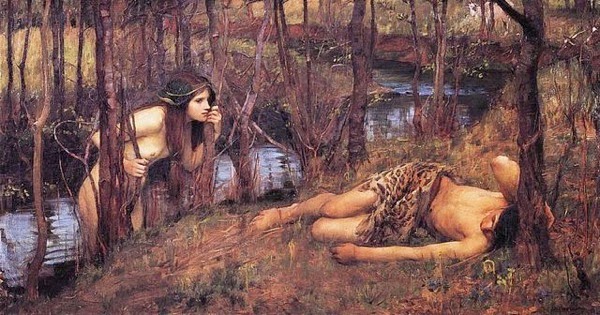
220px-John_William_Waterhouse_-_Undine.jpg
John William Waterhouse: Undine (1872)
WE SAW DVOŘÁK'S OPERARusalka Saturday, as sent "live" from the Metropolitan Opera to a movie theater in a nearby town, its audience quite full, heads of white hair everywhere — it was the matinée. Ten o'clock in the morning is an odd time to begin seeing an opera, but before long, in spite of my many misgivings, we were swept up in the thing.

Misgivings first, to get them out of the way. Operas are written and generally produced to be seen and heard in a theater, the audience removed from the action. The voices, the expressions and gestures, the sets and costumes are designed to overcome the softening and "blossoming," you might say, that comes with distance. In the opera house the sound engulfs me. But in the movie theater it comes at me very clearly from loudspeakers front left and right. I see too clearly the mesh of the nets to which stage decor is attached. Closeups, no matter how beautiful the subject and how persuasive his expression, rob me of glances at the supporting actor standing just out of sight.

Still it must be said this Rusalka was beautifully and persuasively sung, acted, cast, and for the most part directed; and were surprised to hear the mistress of ceremonies, Susan Grant, seem to apologize for the physical production: we thought it remarkably apt.

One of my biggest complaints about these broadcasts-into-the-movie-theater is the treatment of the intermissions. Those interviews, well-meaning and "educational" as I suppose they are, intrude on my experience of the integrated work of art that is the opera. But it was amusing to watch the stage crew laboring at the complex and ambitious change of scene before the third act; and I was interested to hear the conductor, Yannick Nézet-Séguin (French-Canadian, bio here) talk about the opera with his youthful enthusiasm.

I thought the principals well cast and in good form: Renée Fleming in the title role; Piotr Beczala as the Prince; Dolora Zajick as the witch Ježibaba; John Relyea as the Water Gnome; Emily Magee as the Foreign Princess. The orchestra played well, with a good central European sound, I thought.

It's startling to consider that Rusalka is, technically, a twentieth-century opera, having been completed in 1901. There's no doubt about certain Wagnerian influences; you are reminded of the "Forest Murmurs" from Siegfried for example: more deliciously, Dvořák actually parodies Wagner from time to time — notably in the three ladies ho-jo-to-ho'ing about friskily at the opening. In the end, though, it's not Wagner but Janáček, of all people, who I think about on leaving the theater, Janáček of The Cunning Little Vixen.

This is not entirely because of the sound of the opera, of course: it's the opera in its entirety that does this. To me, this production of Rusalka is a totally integrated success: visual production, score, libretto and the performances merged into a serious and profound presentation of the water-nymph narrative — which is well worth contemplation.

THE MEME OF THE NAIAD goes back to prehistory, when everyone must have known the primal significance of water, without which life is impossible. Nothing more sacred than a spring — how many such mysterious, resonant, sacred places there must have been, articulating the wanderings of early nomadic humans, anchoring settlements as they began to appear.

And nothing more mysterious, I suppose, than the underground movement of water, rivers appearing out of nowhere and, occasionally, disappearing into the ground for no apparent reason, perhaps to re-emerge elsewhere. And, always, the vitality of the water, whether flowing animatedly or profoundly still yet somehow pregnant with sustenance.

And, mercurial and capricious, the waters can be dangerous and sinister as well as sustaining and nourishing. This is particularly true of the still forest pools, sometimes surprisingly, even unknowably deep, often with marshy edges, sometimes edged with treacherous quicksands. To this day there are sinkholes, filled with stagnant water, that are dreaded by the folks living nearby — I remember one we visited in the Var, in Provence, said to have been inhabited by a spirit who lived on the bodies of babies snatched from its edge.

On getting home from the opera Saturday I fetched down from the shelf a book I hadn't looked at in a number of years but remembered fondly, a child's edition, in English, of Undine, written in 1811 by the German Romantic novelist Friederich de la Motte Fouqué. (The edition I have is "retold" by Gertrude C. Schwebell, illustrated by Eros Keith, and was published by Simon and Schuster, New York, ISBN 9780671651602: I see there are a number of copies available inexpensively online, here for instance. Project Gutenberg has three earlier, less cut translations available for free download, and I'm glad to see scores of people have been getting them recently.)

Undine was set as an opera almost immediately on its appearance, by E.T.A. Hoffmann; thirty years later by Albert Lortzing; then quickly by the Russian composer Alexi Lvov (1846), followed by Tchaikovsky (1869). Nor was Dvořák's the last musical treatment: Hans Werner Henze composed music for a ballet with choreography by Frederick Ashton, first produced in 1958 by the Royal Ballet, with Margot Fonteyn in the title role. (The score was recorded in the 1990s with Oliver Knussen conducting; I'd like to hear it.) And I remember being fascinated by the inscrutably expressive sounds of Akira Miyoshi's radio opera on Ondine, composed in 1959, produced in Italy that year, winner of the Prix Italia in 1960, and issued on Time Records not long afterward.

Undine, to revert to the German spelling, is what seems to be called these days, often dismissively, a "fairy tale." The genre has dropped out of favor, replaced by science-fiction often set in a future, or "fantasy" set in some unspecified present. As it developed as folk literature, though, such tales performed an important function, I think. They are often cautionary, reminding the listener — not always a child, by the way — of the truth and certainty of proper forms of address humans should take toward Nature, toward essentials, toward limits on human ambition, social or individual.

In this particular story a knight-errant falls in love with the adopted daughter of a poor woodcutter and his wife. She turns out to be an Ondine, of course, a water-nymph, who miraculously appeared to the couple soon after the accidental and mysterious drowning of their own daughter. He takes her to his castle, ignoring his already arranged impending wedding to another (foreign) princess. Ondine, in assuming mortality in order to marry, guarantees the tragic outcome.

The rusalka is the Slavic form of the naiad; other forms are called, by their various communities, nixies, or sirens. The Italian willii are similar: the restless ghosts of women who have died of a broken heart, usually on the doorstep of the church when their groom has failed to turn up. From them, the expression: they give me the willies.

The Greeks were right, I think, to believe there were underground streams connecting, for example, the fountain of Arethusa in Sicily (at water's edge, in Siracusa), with an ultimate source somewhere in the Peloponnese. La Motte Fouqué's Undine travels easily between the pool of Dvořák's first act to the fountain of his second, presumably by swimming along one of these underground streams. The English painter John William Waterhouse, perhaps inspired (or cursed!) by his surname, painted at least two versions of a similar naiad, in similar settings.

800px-Naiad1.jpg
John William Waterhouse: A Naiad or Hylas with a Nymph (1893)
DVOŘÁK'S OPERA, as I say, strikes me as having contemplated all these poetic and philosophical implications, and having translated them admirably into musical theater; and the Met production is unapologetic in presenting the result with great respect for the composer and his milieu. Andrew Porter once wrote, in one of his otherwise admirable essays on music in The New Yorker, that the course of [western European "classical"] music would not have been changed had Dvořák never have been born: but music would be poorer, I think. Like Tchaikovsky, Dvořák was less successful, to my mind, when he wrote a symphony, than when he wrote unabashedly "poetic" program music. I think he was a bit of a pagan. If so, Rusalka is among his finest achievments.

Sunday, January 19, 2014

Four books of love and anger: Bang, Crane, Nesi

•Herman Bang:Tina, translated from the Danish by Paul Christophersen (London and Dover N.H.: The Athlone Press, 1984, ISBN 0-485-11254-X)
•Stephen Crane: Maggie: a girl of the streets; The Red badge of courage (in Stephen Crane: Prose and Poetry, The Library of America, 1984, ISBN 0-940450-17-8)
•Edoardo Nesi: Story of my people, translated from the Italian by Antony Shugaar (New York: Other Press, 2012, ISBN 978-159051354-9)
FOUR BOOKS HAVING one fundamental thing in common: they’re about individuals seen in communities. A chance discovery while looking up something else on Wikipedia brought Herman Bang to my attention, and a good thing too: Tina is one of the most affecting novels I’ve ever read. Set in Slesvig, on the island of Als, off the southeast corner of Jutland, it portrays villagers during the horrible events of the Dano-German war of 1864, when Denmark lost that area known to Germany as Schleswig-Holstein.

Herman Bang (1857-1912), who wrote as a journalist and critic in the second half of the 19th century, was reasonably well known to his public but has been little read in English. (The Danish Wikipedia page presents him as an "author, journalist, columnist, essayist, stage director, presenter, lecturer and critic".) He published a half dozen novels, of which Tina (published as Tine in the original Danish in 1889) is the third. Claude Monet is said to have remarked that Tina, which he read in French translation, was an Impressionist novel, the best of any he knew, and the description is apt — if it makes you rethink just what constitutes Impressionism, who better to lead you to this than Monet?

Bang’s prose style is a little dry, lapidary, extraordinarily visual: you see virtually every hill, road, room, character in the novel. It is also incredibly frugal: the book is, in English, 174 pages long, though every corner of the events, the characters, the settings is fully presented, and you feel as if you’d lived through these tumultuous days and their deceptively tranquil context with every nerve.

The central character, whose name is the novel’s title, is young, modest, intelligent; an observer; a young woman, preoccupied with her aging parents, aware of and to an extent intrigued by the greater world beyond her rural village, a schoolteacher immersed in the sleepy village life. There’s something Ibsenish about her, but she is not angry or sullen: one of Bang’s gifts is his sympathetic portrayal of what others might turn into tragedy as, instead, simple resigned reality.

For me, beyond the events and the characters, it is the social distribution within the village that the author particularly illuminates. Almost every layer of class is presented, sympathetically, as occupying position beyond any question of fairness or egalitarianism. No one is resentful; each person has a role, a position. Bang’s presentation of the justice and the social practicality of this distribution is touching and tender, and if his characterization, in measured accounts of conversation and of internal thought, made me think of Henry James, his depiction of Tina and others of her class brought Gertrude Stein’s Three lives to mind.

The English translation, by Paul Christophersen, seems to have been made at least thirty years ago, and is hard to find. The original Danish is available as a free download from Project Gutenberg, and a quick glance at it suggests the translation is reasonably accurate but presented to quite a different effect, the original laconic short sentences and paragraphs formed into a more conventional narrative style. Even so, this slender novel was a perfect pendant to the recently read I Promessi Sposi, and is likely to prove as memorable.
TINA TOOK ME NEXT to a re-reading of Stephen Crane (1871-1900), who I haven't looked at in sixty years or so. Something I read somewhere suggested the battle descriptions in the Danish novel resonated with those in Crane's masterpiece, and I can see the point, but it's misleading. The two authors have completely different agendas, as different as their national mentalities. Contemporaries, they were both prodigies; they both worked in journalism, fiction, and poetry; and they both developed styles that stood between naturalism and an arresting sort of objective lyricism.

Crane, in fact, is thought to have inspired such Objectivist poets as William Carlos Williams, a fellow New Jerseyite, as well as such novelists as Ernest Hemingway; Herman Bang's poetic style makes me think more of the quieter phenomenalism of, say, Francis Ponge. Why is this? It is the difference between a European (and particularly a cisalpine european) mentality and an American one: the European is more noncommittal and readier to look back toward historical precedent; the American is more urgently expressive and inventive. Tina may make me think of Three Lives, but in style and method it reaches back to Jane Austen; Crane looks forward toward Scott Fitzgerald and Hemingway.

Another thing: Bang was born into a village mentality; Crane quite definitely into a city one. Rural Denmark in the 1860s, war or no war, was a very different situation than urban New Jersey-New York in the 1870s. The difference between the authors is represented by the difference between their heroines: Tina is quietly competent, thoughtful, relatively secure in her self-awareness; Maggie is insecure, reactive, apparently inept. If they come to the same end, they arrive at it for very different social reasons.

Maggie doesn't read nearly as well as Tina today, in my opinion, but it's a fascinating look into the formative period of Crane's career, recording the dialect and slang of the Lower East Side of the 1890s and probing the effect of poverty and other social insecurities on the lives of his characters — who are otherwise not introduced nearly as sympathetically or in such detail as you'll find in Tina.The Red Badge of Courage, though, holds up quite well. Crane writes like a poet as often as he does like a novelist; his sentence structure and vocabulary are often studied and shaped; his physical descriptions are often arresting, if perhaps a bit mannered:
In the eastern sky there was a yellow patch like a rug laid for the feet of the coming sun; and against it, black and patternlike, loomed the gigantic figure of the colonel on a gigantic horse.
The moon had been lighted and hung in a treetop.
The white-topped wagons strained and stumbled in their exertions like fat sheep.
and, famously,
The red sun was pasted in the sky like a wafer.
Much of the time Crane's hero is portrayed in interior monologue though seen objectively, from an observant narrator's viewpoint:
It seemed to the youth that he saw everything. Each blade of the green grass was bold and clear. He thought that he was aware of every change in the thin, transparent vapor that floated idly in sheets… And the men of the regiment, with their starting eyes and sweating faces, running madly, or falling, as if thrown headlong, to queer, heaped-up corpses — all were comprehended.
The book is justly celebrated as the great Civil War novel, and to my mind it has the requirement of every great war novel: it portrays the absurdity, the injustice, the uselessness of war — and the possibility that it can be fascinating. While its horrors are evident among fallen soldiers, its effect on civilian life are rarely present — another contrast with Tina. Nor does Crane look at political or social history, the causes and consequences of war or that particular war. He is concerned with its impact on his maturing central figure.
EDOARDO NESI IS AN Italian novelist, born in 1964 into a well-to-do industrial family, owners and operators of textile mills in Prato. His entry in the Italian Wikipedia lists eleven titles he has published, beginning in 1995, but Story of my people is the only one I have seen. (It appeared as Storia della mia gente. La rabbia e l'amore della mia vita da industriale di provincia (Milano: Bompiani Overlook, 2010) and immediately won the significant Strega Prize.)

The book is part memoir, part socioeconomic criticism, for Italy's textile industry fell victim to globalization in the early years of this century, and in 2004 Nesi sold the family industry, founded by his grandfather and great-uncle in the 1920s. He was never really an industrialist himself; he always wanted to write; he was drawn to literature and to American culture; but he'd stepped into the direction of the firm — Lanificio T.O. Nesi & Figli S.p.A. — when it became his generation's turn, sharing it with his cousin Alvaro.

Story of my people easily and efficiently gives all this background, the facts set out clearly and objectively, and the context too: the great Italian art-and-industry of textile design and weaving, whose history reaches back centuries. The implications of Nesi's book, however, go much further. Between the lines the reader intuits the social justice and meaning of artisanal, family-owned, community-minded industry and commerce. The loss of the "values," the world really, associated and expressed by such an economy — necessarily local, however distant its sources and customers — is poignant, probably even tragic.

This justifies and explains the subtitle of the Italian edition: Anger and love in my life as provincial industrialist. Nesi's writing is understated, colloquial, reasonable. It reminds me of the style of a curiously similar book, Gianfranco Baruchello's How to imagine: a narrative on art and agriculture, (New York: McPherson & Co., 1983), co-written with the American Henry Martin. Baruchello, a painter and conceptualist influenced by Marcel Duchamp, turned to what you might call agricultural conceptualism on the outskirts of Rome in 1973, as How to Imagine and later Why Duchamp explains. There's something about the folksy, clear, patient, reasoning, yet principled and even partisan writing in both Baruchello and Nesi that I find immensely persuasive.

But Baruchello withdraws from the decadent and probably soon failing context of avant-garde art in the 1970s to find solace in local sustainability, guerrilla though its action may be; and Nesi has turned from Story of my people to political engagement, elected last year to the Chamber of Deputies as a representative of Tuscany.

Why, apart from the curiosities of their surnames, have I grouped Bang, Crane, and Nesi? The three books have a tenderly regretful note in common, a regret born of the fault they find with their socio-historical milieu — anger, muted or implied, at the failure of their time to pursue the humanitarian values they once loved. Some may suggest that nostalgia is the common thread, but I don't think so. I have to believe that the function of these books, of their authors' writing, is to get the reader to thinking about the aspects of human social living that have been eroding, and the possibility of returning many of them to viability even in the greatly more dense and complex world we have created for ourselves. The material of Crane's books represents the cataclysmic moment between past and future; we will certainly have to endure such cataclysms on our way to a more sustainable life on earth — if in fact it is not already too late, as I have just read at The Nation.

Monday, January 13, 2014

Einstein on the Beach

VERY SPECIAL NEWS:

The Chatelet production of the Wilson-Glass opera Einstein on the Beach can be seen in its entirety — four and a half hours — streaming on line:


Many thanks to Daniel Wolf for bringing this to my attention.

Saturday, January 11, 2014

Manzoni: I Promessi sposi

Alessandro Manzoni: I Promessi sposi, translated as The Betrothed by Bruce Penman. Penquin Books, 1986.
CHRISTMAS WEEK is for reading, as far as i’m concerned, and last month I gave that week to a book I’ve long meant to get to, Alessandro Manzoni’s I Promessi sposi.

What a book! On the first level simply a long, somewhat rambling historical novel about Milan and its surroundings in the seventeenth century, written two hundred years later, the book — virtually Manzoni’s only extended prose work — admirably integrates historical scholarship, personal observation of character and place, and political philosophy.

The “promised spouses” (the Italian formula for “affianced”) of the title, Renzo and Lucia, are peasants living in a village on Lake Como, near Lecco. Their marriage is prevented by one of the local nobles who has his own designs on Lucia. After a failed attempt to circumvent that, the couple separate: Renzo goes to Milan, is caught up in bread riots resulting from poverty and drought, and escapes to his cousin in Bergamo; Lucia takes refuge in a convent, is abducted…

But enough of plot: I do hope you’ll read the novel, and part of its interest of course is in the suspense. Only a small part, though: those reading the book as a romantic historical novel about a pair of lovers may lose patience with what I think is its true subject-matter, and its intricate interest and importance.
Manzoni begins with a foreword it would be wrong to skip, opening in flowery archaic language purportedly quoting an ancient author:
History may truly be defined as a famous War against Time; for she doth take from him the Years that he had made Prisoner, or rather utterly slain, and doth call them back into Life, and pass them i Review, and set them again in Order of Battle.
After a page of this sort of stuff, set in italics, the author lays down his ancient text and speaks for himself, noting that History too often loses sight of the ordinary men and women who lived through the eras historians deign to consider. He notes, too, the turgid style of the original, alternating between lofty rhetoric and crude dialect. He gives up reading the thing, but quickly thinks
“Why not take the sequence of fact contained in this manuscript,” I thought, “and merely alter the language?” There were no logical objections to this idea, and I decided to follow it. And that is the origin of this present work, explained with a simplicity to match the importance of the book itself.
So immediately Manzoni’s book takes up a number of contexts:
• it was written in 1820-1825 about events of 1620-1630, nearly two centuries earlier (and I read it in 2013, nearly two centuries later)
• It attempts to re-introduce the common man into a context generally restricted to elevated historical figures
• it attends to appropriate language and style


And underneath these evident and acknowledged contexts there is another agenda, not particularly well hidden. The book’s action takes place in a politically eventful moment, when Milan and its duchy are controlled by Spain; Bergamo is part of the Venetian Republic; Austria is threatening from the north and northeast; and France has designs on Monferrato in neighboring Piemonte. Furthermore, the action involves the closing years of the long wars between Catholics and Protestants. And, most importantly, the close of the feudal era when lawlessness and exploitation was an accepted aspect of daily life, and the poor but generally honest and respectable contadini and villager was at the mercy of the rich, powerful “nobleman” in his castle on the hill, and his band of thugs and stooges — the “bravos” who do his dirty work.

I was drawn into the book first by Manzoni’s marvelous description of its physical setting, the mountains and riverbanks to the south and east of Lecco, country not that different from terrain I’ve spent weeks walking in, fifty or a hundred miles to the west., A poor man, Renzo walks when he must go from Lecco to Milan, from Milan to Bergamo. The parish priest rides a mule; ladies are carried in litters; noblemen ride coaches. In every case the tempo is quite different from ours in the 21st century, and climate, physical nature, and observation of the faces and characters of those one meets are taken more slowly, more contemplatively, and therefore more objectively, at a pace giving time to correct immediate impression, prejudice, and habit.br>'

The book should be read at a similar pace, I think; and should be considered while reading and afterward, letting the book bloom in the mind, responding to our time and its own, as a good wine is allowed to bloom in the glass and the mouth, and afterward in sensual memory.


The characters in the novel are memorable and attractive, even the villains — stock characters, all of them (young lovers, parish priest and his housekeeper, Cardinal, ruffians, evil nobles), but individuated through description and dialogue. The settings are evoked sometimes through meticulous description, sometimes arresting observation — the Milan cathedral, for example, seen from miles away, at a time when the city was still contained within its walls.

The historical events are exciting and resonant: war, famine, plague, all recounted with both mesmerizing immediacy and resonance that inescapably suggests World War II, the Balkan wars, today’s events in Africa and the Middle East.

And then there’s the language. Manzoni published the novel in 1827, but within a dozen years revised it out of its original dialect of Italian into the Tuscan dialect centered on Florence — thereby cementing that dialect as standard contemporary Italian. The revision seems to involve mostly simply substitutions of vocabulary, with a few additions or clarifications of text, and virtually no cutting.

I haven't yet found what exactly the dialect of the original version is called: it's not Piemontino, though it shares with that dialect certain leanings toward French. "Equal," for example, is eguale in the first version, uguale in the revision. I know this because I found a fascinating edition of the novel online, a facsimile (not e-text or digitized text) of an edition (Milano: Domenico Briola, 1888) of the revised version, with the original text inserted in smaller size between the lines.

Years ago I bought a fine copy of an old edition of I Promessi sposi, and it turns out to have an interesting history of its own. It was published at Firenze in 1845 by Felice Le Monnier, who based the text on the 1832 edition by David Passigli e soc.. Le Monnier was noted for his contempt for author's rights, and merely pirated the Passigli edition, heedless of Manzoni's subsequent revision into the definitive text. Manzoni sued and was eventually awarded a substantial award. I don't know how large the 1845 edition was, or how the copy I have came to whatever used-book store I bought it in — though a recent New Yorker article on such matters does give me some pause.

I read Penman's translation with both the Le Monnier and the interlinear edition at hand, comparing often enough to get the distinct impression that this is a fine translation, idiomatic in English, respectful to the original style, and faithful to the text.

Some have characterized the book as a romantic epic, along the lines of Tolstoy's War and Peace — a book I'm embarrassed to say I haven't (yet) read.  It would be wrong, though, and perhaps disappointing, to think of it as primarily a narrative about the betrothed Renzo and Lucia: instead, it is — as another reader suggested the other day — an epic, a narrative description of the general state of the soul of a nation. I'm hard pressed to think of another prose example, and I wonder if Manzoni weren't channelling such older epics as Aeneid or Chanson de Roland or Orlando furioso. Whatever, I Promessi sposi is essentially Italian; it speaks from an honest and good heart; it is ample, intelligent, poetic, philosophical, evocative, good-humored, and inventive, and I consider it one of the greatest novels I have ever read.

Tuesday, January 07, 2014

More

Next day's play, back home:


TONY

Also from Cuba, this menu: tuna, pork paté, bean soup…

(Zulu nods.)

…corn — take four ears, Dane. 


DANE

Nope. Don't like that junk. 


TONY

Don't like corn? What, can't give corn room? Take tuna, then. Four cans. 


FINN

Open four cans, chop kale — don't cook them, mind! Let's take them over…


ZULU (chanting)

They stay here, fast with fury, lean with love,

Afar from Goa's sand they ever rove

With foul lung, shut eyes, blue lips, mean claw,

None sees that emir, king, even that shah

Iran sent with pale hope, with fair thin face,

Part hope, part fear, part sent well high, part base.

Even them boys that Cuba sent feel well

Upon fast part from Goa's inky Hell.


TONY

Poet! Well come here, Zulu! Let's clap, gang, 

Fair rime, that foul pros ever said they sang.  


DANE (hops with FINN: slow jive time)

Uggh. Stop, Finn, lest your toes turn down with mine… look away, boys… drop, fast, when Zulu says that oboe ends…

TONY

What oboe, Dane? They hear dogs bark, with keen ears, ever pert. What oboe tune hear thou, fine zany Dane? What wood wind sang from over that long vale?


DANE (fury with TONY)

When they take bird meat, song will stop fast. Keep back!


(Fast fade)

Monday, January 06, 2014

News from Lumaire

ON THE WAY BACK from our Christmas holiday in Portland I finally got in touch with Charles Lumaire, who I've known until now only through occasional correspondence. (Snail-mail: he steadily refuses modern technology.)

For a few months, since returning from France last July, I've been toying with the idea of publishing his series of translations of short narratives written in French by the elusive Jean Coqt, apparently a Franco-American who settled in Grenoble or its environs sometime after the end of World War II — perhaps a veteran of that war; I'm not sure.

(One of the attractions of the Coqt-Lumaire project in fact is the obscurity of Coqt, whose improbable surname raises suspicion that he may be nothing more than an invention of the almost equally elusive Lumaire.)

I enjoyed conversation with Lumaire, a slightly goofy, complacent fellow, perhaps sixty years old, a bachelor who lives with his nervous, intelligent white poodle. I can't explain the affinity I felt for him: we have nothing in common beyond our first names and our fondness for the writing of Gertrude Stein.

We spent a couple of hours over a glass of wine in a pleasant little sandwich-shop in Eugene, and he sent me off with a sample of his own writing — apparently excerpted from an adventure yarn he's working at, called, tentatively, Near Peru.

It's very different from the two installments he's given me of his Coqt translation, which I hope to publish either here or elsewhere in this new year.

Should we take Lumaire's writing seriously? Dunno. It makes me think of Abish, though he reaches, more likely, toward the Mathews model. In any case, here he goes:

"ONCE," TONY SAID, "nine guys flew back from Cuba; then they were here: Scot, Dane, Finn, five wops, Zulu.

"They knew hope; they knew fear more. They said many fell. Wops have seen many fall: snow, rain, sand, bogs."

Alps were hard ― sere, Scot said. Finn took more time with that:

"Were Alps ever hard! Most boys find home flat, calm, snug. Alps seem like Mars."

Dark Zulu, brow knit, fell into rage.

"Puny guys! Girl!" (Howl.)

"Look here: when Girl naps, boys swim away, fast. Then lope back home over sand." Eyes shut, Zulu adds: "Also, wops stay back with girl."

"Let's stop over here." Tony said. "When they come with boys, we'll bark like dogs. What goes with tuna?"

"Buns," Dane said. "Warm herb teas," Finn adds.

"Thin been soop," said Zulu.

(That calm, cool, easy frog Jean Coqt isn't with them, lest the next day's pale moon fade dead away.)

.  .  .  .

Look, Finn! What evil gale wind blew that foul ship upon that hard dark rock? Warn Tony! Fast! Yell, Finn!

Tony sees. "Haul away, Zulu! Hard port! Left, fool! Left side, hard! Haul away!"

.  .  .  .

Whew. What next?

Day's work over, cold moon rose over pale blue seas. Soft wind blew: then, dead calm. Zulu naps. Won't wops wake with waxy wine, when warm? Wink, Jean Coqt, thou cold, cool, cozy frog! They need your calm mind here!

Further from Lunaire here, perhaps, as he deigns to send it to me…

Tuesday, December 10, 2013

André Lurton, vignoble

Autour d'une bouteille avec André Lurton
by André Lurton with Gilles Berdin
ISBN 978-2-35639-039-4
Bordeaux : Elytis, c2010.

“ANDRÉ LURTON, born 1924, is a French winemaker and winery owner,” states the English-language Wikipedia. Curiously there seems to be no page for him at French-language Wikipedia, and this little book, nicely edited from seven conversations between Lurton and the French wine journalist Gilles Berdin (b. 1962), indicates that there certainly should be.

Before turning to Lurton himself, a few words on Berdin’s intentions are in order. This is one of a series of eleven such books introducing significant personalities in the world of French winemaking to their audience. (So far only one has appeared in English: Conversations Over a Bottle With Denis Dubourdieu.) Berdin describes his intent:
“These conversations, which are not biographies, result from the observation that there are extraordinary people in our landscape of French wine; a most diverse, amazing, exciting group: the owners, winemakers, cellar masters, and tasters. It seemed urgent to collect their words, especially if, as some fear, the vignoble is increasingly passing into the hands of what we call “les institutionnels: " banks, insurance companies, multinationals, investment companies.
I want all these enthusiasts to share their passion and experience, and transmit some of their memory to future generations: their knowledge, their skills, their emotions ...
As the charm of conversation lies in its imperfections, digressions, repetitions, silences, contradictions, onomatopoeia, paradoxes, laughter ... I'll open their words as is, without settling, aeration or dressing them up in a decanter. ”

(My translation.)

So the book, while short, is charmingly discursive. It does have a logical structure, though, basically chronological; and it begins, notwithstanding Berdin’s apology, with a bit of biography.

Lurton’s mother, née Denise Recapet, died in 1934 when Lurton was only nine years old. His father, who worked for a British commercial group, never remarried, and it was his mother’s parents who were apparently most influential in the boy’s upbringing. The grandfather, Léonce Recapet (1858-1943), must have been an imposing presence in the boy’s life. Léonce took up his own father’s distilling business after his four years of military service — he must have seen the Franco-Prussian War — and built it into a considerable success; then went on into the wine industry, buying his own Château Bonnet in 1897, later adding other properties.

Lurton saw service himself, of course, during World War II and the German occupation; some of the most moving pages in this book describe the difficulty of those days, and then of the actual battle he saw after the return of the Free French, when he fought the retreating Germans in eastern France.

The first fifty pages bring us from these biographical accounts — scanty but suggestive of the influences that molded the man — to the years after demobilization, lean years of returning to normal. The grandfather was gone, and he worked alongside his father until an uncle helped him take own his place in the vignoble, at Château Bonnet. He learned to be not only a vineyardist but a farmer as well, raising corn and potatoes, providing for a young family, as he’d married shortly after the war.

Succeeding conversations provide insight into the Bordeaux vinification methods as they slowly evolved in the years after the war, from relatively haphazard production to much more carefully calculated techniques. There are marvelous pages on the complex regulations concerning real estate, appellations controllées acreages, and financing: French readers will follow these pages more closely, but we Americans find here hints at the baroque intricacies of the French bureaucratic mind, which trains the French to master subtlety and patience.

Lurton discusses degustation, the tasting of wine; its vocabulary; its variability from one expert to the next. He discusses screw-caps, which he favors for white wines. He discusses the problems of press reviews. There are a couple of delicious pages on the subject of Robert Parker, the American writer whose ratings have so greatly influenced the production and marketing of wine in its international market. Berdin asks if Lurton thinks Parker has truly influenced methods of wine-production:

Lurton: Oh yes! Everybody wanted to make Parker’s wine. Where it had the most influence, though, was on the techniques of sampling. (He laughs.) … Each time he comes [to the vignoble], a couple of weeks or a month before there’s a tripotage in the cellars to prepare the samples. There’s a visit to this cave, that barrique… he knows about it, but there’s nothing he can do.

Lurton has things to say about regulation: he has little patience for the labeling laws, or for the current concern for safety and security in general. “The media are partly responsible for this propensity to fear everything.” And then there are his observations of journalists: “I’ve rarely met an informed or an objective journalist… it’s extraordinary how inept they can be, what stupidities and errors they can write… there are many who know nothing at all about a probem and who want to try to discuss it.”

Lurton emerges as an opinionated, hands-on veteran of the long and fascinating transition from the last decades of traditional winemaking, through the interruption of World War II, through the emergence of scholarly and theoretical approaches to the art, through the political and corporate domination of its industrialization, always with a pragmatic and, it must be said, often surprisingly patient long view of his metier.

He’s unhappy with the world as he finds it now, globalized and regulated by bureaucrats; but then what reasonable man over sixty is not. “France is a unique country which can do fantastic things,” he summarizes, on the closing page, “but which always criticizes itself, destroying itself. That’s what worries me for my children and grandchildren. But I hope they’ve had a minimum of training not to go too far wrong and to dare to act, to have some dynamism…

"A rich laborer, feeling his death coming on, gathered his children together, and said to them…”
[He laughs…] “Work; take pains; that’s the approach that misses least!” (Travaillez, prenez de la peine: c'est le fonds qui manque le moins! )

Ultimately these conversations over a bottle with André Lurton suggest the possibility there will always be a few wise old men (and women too), who have known hunger and hard work, who aren't fooled by fashion; and that that's enough to get humanity through a rough patch and back to basics. I'll lift a glass to that!

Saturday, December 07, 2013

Einstein, Poincaré, and the drift toward Relativity

Einstein's Clocks, Poincaré's Maps: Empires of Time. By Peter Galison. New York: W.W. Norton & Co., 2003.

MOM ALWAYS LISTENED to a radio program on weekday mornings — some kind of news commentary, I think it was. It came on at nine o'clock sharp, and always began with the stentorious announcement that "It's High Noon In New York." Hearing that, I'd always look at our clock, which would read something between 8:45 and a few minutes past nine. It always fascinated me, this difference in times. I knew that anything said on the radio must be true, especially if it came from far away, yet my brain told me that it was nine o'clock, though our clock was rarely so sure.

Local time, Daylight Savings Time, Standard Time. Growing up in the country even a kid was aware of all these things, with that dim awareness kids have of such things. Except for school days, time was measured by sun and stomach: but school required promptness, and you wouldn't want to get there too early but you couldn't be late, and it was, oh, a good forty-minute walk.

These uncertainties prevailed even among urban adults until well into the 19th century. In spite of its title, chosen I think more for merchandising than for accuracy, Peter Galison's book is about the history of the synchonization of clocks in the Western World — as that history affected the gradual emergence of Einstein's theory of relativity, it is true. A photograph in this sometimes maddening book shows the Tower of the Island, in Geneva, which about 1880 had three prominent  clocks indicating the time(s): 10:13 here in Geneva, 9:58 in Paris; 10:18 in Bern. Six years later two of the clocks had been taken down, as time was now sychornized all the way from Paris to Bern, and beyond.

The problem, of course, is that the earth rotates on its axis (which is on the whole a very good thing). I look up at noon: the sun's as high as it will climb today, though probably in the southern sky. In New York, though, that happened three hours ago. 

There were a number of reasons the 19th century wanted to standardize time and synchronize clocks. It was a logical concomitant of the Industrial Revolution, of the Enlightenment. And therefore its history is grounded in that of England and France. Galison's hero, in this book, is certainly Henri Poincaré (1854-1912), the French polymath, graduate of the École Polytechnique, that quintessentially French institution born of the Revolution.

One forgets the essentially Rational nature of the Revolution, which replaced the superstition- and religion-obsessed Monarchy (which was positioned on  the Great Chain of Being, leading between the lowest worm and God,  just below God Himself) with a Republic grounded in the principles of Liberty, Equality, and Fraternity. One of the major points was to replace arbitrary verities emanating from divine revelation or regal whim with equally arbitrary verities determined by groups of scientist-philosophers. The Metric System, for example, was developed by the Polytechnique, for the practtical reason of facilitating trade throughout the nation through standared weights and measures: a bolt of cloth woven in Nîmes should be measured the same as one woven in, say, Paris. 

(Another factor: the importance of bringing every corner of the nation under the administration of a central authority in Paris. The history of local-versus-capital tension is long, complex, and fascinating.)

Galison's story is significant and absorbing, but his editors and publisher have not done him many favors. There are odd lapses in grammar and even odd errors — in one case, for example, a confusion of starting and ending positions in an account of signaling between positions. The book is rich with detail, ranging from Poincaré's forensic investigation of a coal-mine explosion to the survey of meridians in Africa and the Andes. The poltics of scientific research would be a rich enough subject for a history all its own, and Galison valiantly brings it in, as well as the comic-opera argument between England and France over the decimalization of time measurement (France lost) and their joint research into the precise distance between the Greenwich meridian and that of Paris (England seems to have yielded). 

Galison's study is a chapter in the history of ideas, and a measure of the difficulty of writing such a chapter is itself a central aspect of his book. Early on, he describes the nature of this complexity, calling it "critical opalescence." He is so fond of the metaphor, and the reader needs so much to keep it in mind, that it's worth a long quote to show his method:

Imagine an ocean covered by a confined atmosphere of water vapor. When this world is hot enough, the water evaporates; when the vapor cools, it condenses and rains down into the ocean. But if the pressure and heat are such that, as the water expands, the vapor is compressed, eventually the liquid and gas approach the same density. As that critical point nears, something quite extraordinary occurs. Water and vapor no longer remain stable; instead, all through this world, pockets of liquid and vapor begin to flash back and forth between the two phases, from vapor to liquid, from liquid to vapor—from tiny clusters of molecules to volumes nearly the size of the planet. At this critical point, light of different wavelengths begins reflecting off drops of different sizes—purple off smaller drops, red off larger ones. Soon, light is bouncing off at every possible wavelength. Every color of the visible spectrum is reflected as if from mother-of-pearl. Such wildly fluctuating phase changes reflect light with what is known as critical opalescence. 
This is the metaphor we need for coordinated time. Once in a great while a scientific-technological shift occurs that cannot be understood in the cleanly separated domains of technology, science, or philosophy. The coordination of time in the half-century following 1860 simply does not sublime in a slow, even-paced process from the technological field upward into the more rarified realms of science and philosophy. Nor did ideas of time synchronization originate in a pure realm of thought and then condense into the objects and actions of machines and factories. In its fluctuations back and forth between the abstract and the concrete, in its variegated scales, time coordination emerges in the volatile phase changes of critical opalescence.
(Einstein's Clocks, Poincaré's Maps, pp. 39-40)

Galison's discussion traces the development of time standardization and coordination through a fascinating period, the century-plus leading from the French Revolution (1789) to the publication of Einstein's first papers on time and space — in the history of ideas, from the disastrous triumph of Rationalism to the cubist fragmentation of Relativity; from the displacement of divine and regal authority by that of republican committees to the eventual triumph (or disaster) of unbridled democratic individualism and the provisional, negotiable structures that follow.

The only hope for truth or certainty, given the "critical opalescence" of the philosophical, political, and even scientific landmarks along this historical path, lies in some kind of reasoned abstraction defining an intellectual framework within which to negotiate the numbers assignable to the objects we contemplate: time, distance, justice, value, administration. It's too much to hope for a clear presentation of this problem, let alone a clear discussion of the concepts and illuminations brought to the party by such minds as Poincaré and Einstein — and a number of others mentioned in passing in Galison's book. 

I wish he'd had better copy editing. I wish someone had asked him to resolve repetitions, to clarify arguments, to provide timelines. I wish the index were more detailed. But I thank him for giving us a book worth setting next to Ken Alder's The Measure of All Things, and for including copious notes and drawings and photos and an extensive bibliography. Written toward a popular audience, it's a book worth keeping and ruminating over. 


Tuesday, December 03, 2013

Remembering Judy Rodgers

WE HAVE LOST another major presence — in our extended family, in our profession, in our community. Judy Rodgers, who was always so focussed, intelligent, committed, and fine in every way, died yesterday, only 57 years old, after a particularly nasty year dealing with a late-discovered cancer.

Judy was the age of our oldest daughter, and she lived a couple of years with her; she came young to "our" restaurant; she lived in our house one summer while we were away; she traveled a few weeks with us another summer, when we took lodgings together for a couple of hot weeks in Firenze.

I have always loved her, though we saw little of her after our move to the country. I've always thought of her as a honorary daughter and a friend. Now of course I regret the missed opportunities to spend more time with her: but like most restaurateurs who happen to have families she was either at work or at home, and we didn't like to distract her at work, or intrude on precious time with her family.

Judy somehow managed to merge or mediate France and Missouri, Stanford and Berkeley. Here's what I mean: she was born in St. Louis Missouri into a family not particularly interested in food. She spent a year as an exchange student in Roanne where she happened to be placed in the home of Jean Troisgros, one of the great three-star chefs in France, co-proprietor of Les Frères Troisgros in Roanne.

She majored in art history at Stanford, but hung out at Chez Panisse in Berkeley. Alice Waters recognized her gifts and her skills quickly and put her in charge of lunches there.

She spent a few weeks in our house on Curtis Street, while we were in France and Italy; there she read virtually all our cookbooks, cover to cover.

In my mind's eye I see a photo Lindsey took in Chiomonte, the Italian Alpine village her father was born in: she's standing in the road, gesturing exuberantly to Lindsey's distant cousin Ernesto and Rosa.

I see her on the staircase in our Pensione Orchidea in Firenze, flaming red hair, very short miniskirt, color everywhere. She and Lindsey had been spending another day in museums and galleries. (I'd been at my desk.)

I see her in the house she and Peter shared with Thérèse and Eric: one or two of our overflow prints or posters are on the walls, but the most striking decor is the dozens of pairs of shoes, hanging by their high heels from the picture molding around the tops of the walls in the living and dining rooms.

She was tall and lanky, lanternjawed, beautiful in a Katherine Hepburny way. She introduced us to Dan McCleary, whose huge painting of a menacing wolf hung for years in her Zuni Café. She knew books, paintings, cooks and cooking.

I remember the Crawfish Dinner she put on at the Union Hotel in Benicia: as we pulled up to park I saw an escapee scuttling down the sidewalk toward the bay. Let him go, Judy said, He's earned a reprieve.

I remember the street dinner she arranged outside Zuni. We ate at temporary tables on the alley on a balmy night, and a soprano sang opera arias from a window in the second story.

I remember the duck dinners at Zuni, repeating things she'd learned from her mentor Pepette Arbulo in her restaurant in the Landes. She used all of the duck, and duck went into all of the meal, which ended with merveilles, pastries fried in duck fat. (On the last day of the duck marathon, when nearly everything had been eaten, we feasted on roasted duck bones. Delicious.)

Judy was what we used to call, in days more innocent of correctness, a man's woman: a woman who was anyone's equal, who knew that her place in the world was precisely wherever the hell she wanted it to be. I think of her and Catherine Brandel and Marion Cunningham and Barbara Tropp, gone all of them now; it would be nice to think they're at a case of Champagne in a very special Elysian Fields.

There are a lot of touching tributes to Judy online at the moment: here and here and very usefully here, where I found the photo I've used here, and where another shows her in front of the oven Eric built for her at Zuni.

I particularly like David Lebovitz's tribute here. He mentions celery and anchovies as an example of the specificity of her work; and he recalls her clogs and her cotton skirt billowing out as she turns quickly to face her kitchen. She was always both deft and certain, her hair and skirts always seemed airy and light-hearted yet her address to work or conversation or friendship seemed always direct and crisp and right on target. She was graceful though lanky. She was demanding and perfectionist and suffered no fools, but loyal and generous with her friendship.

She was a magnificent woman, dedicated to la nourriture, scholarly and practical, zesty and forthright.

Her best memorial will probably always be her superb book, The Zuni Café Cookbook (New York: W.W. Norton & Company, 2002). When we brought our copy home I immediately made her Caesar salad from it, and the result tasted exactly like a Caesar salad at Zuni. Her writing is engaging, clear, enthusiastic, and persuasive. The book was given the James Beard Award for Cookbook of the Year in 2003; Zuni was named Outstanding Restaurant in the country; and the following year she was named Outstanding Chef of the year.

And now she's gone, and there's nothing to be done but be thankful for having known her, and for the generosity of her work. Next time we're in town we'll have a Martini at the bar at Zuni, and maybe some anchovies and celery, or dates and Parmesan. She'll be there, of course; but it won't be quite the same.

Tuesday, November 26, 2013

Turrell, Francis, Hockney

James Turrell: A Retrospective. Through April 6, 2014.
David Hockney: Seven Yorkshire Landscape Videos, 2011. Through January 20, 2014.
The Los Angeles County Museum of Art,
5905 Wilshire Boulevard Los Angeles; 323 857-6000
Sam Francis: Five Decades of Abstract Expressionism from California Collections. Through January 5, 2014.
Pasadena Museum of California Art, 490 E Union St, Pasadena, California; (626) 568-3665.
WE FINALLY MANAGED to catch the James Turrell show last week while we were in Los Angeles. We'd tried to see it in September, but discovered it was expensive, and you had to book a time. This time we were prepared: we booked a convenient hour for the visit, and bought a year's membership in LACMA, which got us in free — and will get us in free to other exhibitions over the next year.

I have to confess to mixed feelings about Turrell's work. I was fascinated, years ago, when someone described to me a piece he'd made for the legendary Baron Panza: a special telescope tracked the full moon, sending its image down a polished Lucite tube which split into four tubes, each leading to a disc in a rectangular network of discs in a ceiling, above which, in a dining room, a table stood, each of its polished Lucite legs carrying the image to the table's surface, where the four full moons then appeared as optical inlays in the glass surface. 

Astounding! A work of art worthy of Raymond Roussel. Of course I don't know if it ever actually existed; but it hardly matters; one can see it perfectly in one's mind. And it is just so that I "see" Turrell's magnum opus, Roden Crater, an ancient volcanic crater north of Flagstaff, Arizona, where over the last thirty years or so the artist has been perfecting and installing a network of galleries, tunnels, windows and openings all of which are designed to mediate the viewer and the cosmos.

I visited Roden Crater a number of years ago, shortly after Turrell had bought it and begun the preliminary work of "perfecting" its contours. At the time this seemed to me a shame: one had only to walk to the rim, then down the pumicey surface of the extinct crater toward its center, to understand man's relationship to cosmos. The Arizona desert can have a magic reddish-ochre glow; the ineffable blue of the sky overhead becomes solid, forbidding, magisterial; and space, color, light, and one's physicality — one's posture and breathing — all merge into a contemplation and an awareness of infinite space, form, and weight. 

To finance his work Turrell took to making prints of his working drawings, and a number of them are on view in the LACMA exhibition. More importantly, he has made a number of installation pieces. I liked a number of the corner pieces, in which geometrical shapes seem to be projected onto the adjacent walls in a corner, their single, blinding color fields tricking the eye into seeing dimensionality that isn't really physically there.

Other pieces are huge expanses of a single color, generally unarticulated but in at least one case subtly  mottled. We sat on a bench to contemplate a few of them for several minutes: gradually you wear out your eye's receptors to that particular color, and it fades, going a curious lavender grey, but also lifting away from the plane it physically occupies and coming nearer the viewer.

There are two particularly important pieces here, but we skipped them: one involves entering a sphere in which one's completely shut off from external reality, as if in an MRI chamber, in order to be overwhelmed by Turrell's optical magic. This seemed just a bit too claustrophobic to us; besides,participation in it was sold out for the remainder of the exhibition.

The other was a large piece, a room really, which one enters in one's stocking feet, to contemplate light and color at the edge, it seems, of a yawning abyss which suggests the Cosmos itself. This does in fact work quite dramatically and viscerally, but we'd seen it at the Venice Biennale a couple of years ago, and didn't want to repeat the experience on this visit.


ALSO AT LACMA we were able to take in a a number of David Hockne'y's Cubist videos, odd films made with an array of eight or nine cameras mounted to a rack fixed to a car driven slowly through the English countryside Hockney's visited in the last few years to record the changing seasons — not only in video: also in paint, drawing, and printmaking.

If Turrell's work and vision seems touchingly Sublime-yet-innocent, Hockney's, to me, seems touchingly aspirational-for-historical-importance. Both artists seem consumed with staking a place in history, and being remembered for their discoveries and their work. Both are undoubtedly disciplined, gifted, and productive; but ultimately each seems to have been laboring at something that's obvious, that need only be mentioned for its conceptual effect to be made known. They remind me again of something Gertrude Stein once said: "If it can be done, why do it." Once the discovery is revealed, why repeat the demonstration.


Sam Francis, Sketch for Chase Manhattan Bank Mural [Study for Chase Mural]

[Untitled Sketch], 1959. Gouache on paper, 21 x 99 1/4 inches. The Museum of Contemporary Art, Los Angeles; Gift of the artist and the Sam Francis Art Museum, Inc. 93.29. Artwork © Sam Francis Foundation, California / Artists Rights Society (ARS), New York.


IN PASADENA WE SAW a retrospective of paintings by Sam Francis, and it was immediately obvious that he foreshadowed, in these canvases full of space and brilliant color, the effects Hockney and Turrell have worked at. But Francis was of an earlier generation, content merely to paint. He was introduced to painting as a therapy, while he was flat on his back for months at a time, suffering from spinal tuberculosis, looking at the white ceiling of a hospital room. I've always thought the threads of color streaking across his often otherwise empty canvases had something to do with the spots and threads you see behind your closed eyelids.

In Francis, as in Turrell, the effects of light and color seem internal as much as external; and when things really work — as they nearly always do in Turrell, but only perhaps half the time in these paintings of Francis's — internal and external merge. Or, perhaps, the distinction between them is transcended. In any case the viewer loses his sense of individuality; ego dissolves; the fact and awareness of one's individual being is dissolved in a sudden realization that it's the light and color that surround one that contains the energy and life in which, submerged, we're allowed to participate.

But Sam Francis was an Abstract Expressionist, and his best canvases have a darting, pulsing, almost violent energy that animates them with a muscularity quite lacking in Turrell and Hockney. One contemplates Hockney. and meditates in front of Turrell; one dances with Francis. There's nothing like looking at one of these big, vibrant paintings with one eye, quickly walking backward away from it at an angle, then crossing in front of it, always with the eye fixed on the painting. You're engaged by these things, they call and sing. To see the three exhibitions on adjacent days is a rare opportunity to experience an immense range of visual pleasure, but also to understand, intellectually, the inevitable 20th-century process leading from the art of painting to the art of pure light.

Sunday, November 24, 2013

Et in Arcadia ego

WELL, JUST DOWN THE ROAD from Arcadia, in Monrovia. California, not Liberia, thank Hermes. We are here to see the fall season of A Noise Within, the repertory company whose plays we've attended for ten or twelve years now — convenient, since in four days we can see three plays.

Along the way of course we take in a few restaurant meals, which I describe at my other blog Eating Every Day; and a few museum shows — I'll get to the James Turrell and Sam Francis retrospectives in another post here.

First, though, the plays. Thursday night we saw Ferenc Molnár's The Guardsman (1910), a well-made play on the old theme of a man testing his wife's fidelity by flirting with her in disguise — a device made a tiny bit more probable since the husband is, after all, a professional actor.

This is material for farce, but in this production, translated by Frank Marcus, intelligently directged by Michael Michetti, and pointedly acted by Freddy Douglas (the Actor), Elyse Mirto (the Actress), and Robertson Dean (the Critic), the play made surprising reaches toward the speculative, sometimes philosophcal drama of a Pirandello. 

Douglas opened the play acting very broadly indeed, and I expected the play to be merely broad comedy. I was struck by the care and finesse that went into the dramatic curve of the performance, which moved effortlessly, seductively, toward a conclusion that leaves the audience and even, I think, the cast) quite up in the air, unresolved. Of course you don't see this play without thinking of the Mozart-da Ponte Così fan tutte, where the disguised-lover-testing-fidelity idea is actually doubled, and Don Antonio takes the role of Molnár's Critic (and the soubrette maid gets a much richer part).

Così, too, plays to mixed response. Beethoven famously though it too immoral to be allowed a production.  But the point of these plays is the equivocal nature of Ethics itself when brought to the service of Moralism. Any sting operation presents an ethical quandary, and the victim of any sting operation can plead Not-Quite-Proven simply by questioning the propriety of the enforcer having been deceitful himself. If virtue is its own reward — since to reward virtue is to bribe it — so to test virtue is to engage a procedure that inevitably punishes itself: any sting, growing out of deceit, can only falsify its own finding.

There's a second layer of complexity in The Guardsman, which is a play written for the theater. There, the other night, we saw actors play the role of actors who were playing roles; and tan ultimate question, actually investigaged aloud by the audience and cast in a talkback after the production, is, where does make-believe start, where does it stop? It's a serious squestion, because it raises the ultimate question of what Theater is, societally, for.

NEXT WE SAW a fine performance of Samuel Beckett's very hard play Endgame, with company co-artistic director Geoff Elliott directing and taking the lead role of Hamm; Jeremy Rabb as Clov, and Mitchell Edmonds and Jill Hill  in the garbage cans as Nagg and Nell.

I call it a hard play because itt is, well, stony, flinty. It's not difficult to understand. As Beckett once wrote, No symbols where none intended. Hamm is blind, old, decrepit, motionless in his chair, apparently dying. Clov tends to him, as one's life must attend to its approaching end. The play can seem almost unbearably bleak: hopelessness is often thought Beckett's chief subject. And indeed he wrote Endgame partly, I think, as an externalization, on the stage and in public, of the transactions in his three great novels Molloy, Malone Dies, and The Unnamable, novels so reductive in spite of their length and so bleak in spite of their almost decoratively Baroque word-spinning that they were found very few readers.

Endgame lacks the popularity of Waiting for Godot, which is Chaplinesque in contrast to Endgame's Keatonism. But the language is superb. At the beginning of the performance I was concerned: Elliott seemed mannered, stilted. But the play proceeded just as The Guardsman had, moving from an opening — well, an opening gambit, I suppose — quickly into a middle game of great strength and intelligence and not a little grace. 

It's hard to find much to say about the play. I once loved Beckett's work, and nearly every poem, novel and play of his are still on the bookshelf in my study — way up high, since the books are arranged by author; so high as to be easily neglected. For a while Beckett seemed to have beome datedd, so logically does he proceed from the anxieties of World War II, the Bomb, Existentialism. Now, of course, in this century that threatens in so many ways to be even worse than the previous one, he demands our attention again. He's the Shakesperian Fool to today's demented despots. I wish I could see this Endgame again, and I wish our elected leaders and their assistants could be made to watch it over and over.

IWRITE THIS FRESH from seeing Noise Within's third play of the fall season, Shakespeare's Pericles, Prince of Tyre — a play I'd never seen before. It's one of the four late Romances, with The Tempest, A Winter's Tale, and Cymbeline (the last-named having been produced here last season). These plays extend Shakespeare's oeuvre out of the Elizabethan renaissance toward the Baroque; I think they look forward to Corneille (whose L'Illusion was produced here a year or so ago) and further, even, toward Gozzi, for example (whose Il re cervo was done here, as King Stag, quite a few seasons back).

At the talkback one of the first questions came from a man behind me who sounded a little out of sorts: Why have you chosen to perform this play? Pericles was the most popular of Shakespeare's plays during his lifetime, but has fallen into disfavor and has rarely been performed in my lifetime. The playwright is associated with his greatest hits: Romeo and Juliet, Twelfth Night, perhaps As You Like It; A Midsummer Night's Dream; maybe Hamlet and Macbeth. Those are the Shakespeare the crowds want to see: but Shakespeare wants to be Shakespeare, and branch out, evolve, even though the result is in a direction seeminly at odds with the better-known corpus.

One objection to these late romances has been their unbelievability. They depend on sudden rages, incest, redemptions, coincidence, chance natural cataclysms. Pericles begins with a hero who discovers a father-daughter incestuous relationship, and who can believe that? Later, it shows a young virgin abducted and sold into sexual slavery, and who can believe that? Yet in recent years these stories have become commonplace. No matter how theatrical and arbitrary his plots — most of them stolen from sources much older, of course — Shakespeare seems unable to escape contemporary relevance.

Asked, after the play, how she would sum it up, the director said that she thinks of it as a man's journey toward grace. In spite of every calamity, Pericles finds resolution. Wife and daughter, each long thought dead, are returned to him. Perseverance is rewarded. 

  • A Noise Within, 3352 E Foothill Blvd. Pasadena, California
  • Thursday, November 21, 2013

    Robert Erickson: the quartets

    I HAVE BEEN remiss in not recording a few observations here about the four compositions for string quartet by Robert Erickson. I feel a little odd posting them, as I am definitely parti pris. I studied composition with Bob, a bit, back in the middle 1960s. I suspect I partly owed it to him that I was hired as music director at KPFA in 1964: he'd occupied the position ten years earlier, was on the KPFA Board of Directors for a few years, and chose my two predecessors in the position.

    Then, in the late 1980s, I wrote a biography of Erickson, with a survey of his music. Thinking Sound Music was published in 1995 by Fallen Leaf Press, and is still in print, now distributed in paperback, cloth, and as an e-book by Scarecrow Press. 

    Furthermore, the Del Sol Quartet, who have been commissioned to record all four works for New World Records, invited me to sit in on rehearsals for the performance they gave last Sunday in Berkeley. I can hardly pretend any objectivity in my response to that concert.

    But I've convinced myself that it would be unfair to Bob and the Quartet to withhold that response, so here it is. I thought they really got into the scores, found out how to make them their own, and put the pieces across far more persuasively than I would have believed possible. I've heard them played by other performers, and thought that performance powerful and interesting: but Del Sol went further, finding a logical and utterly musical progression from the earliest to the latest, connecting Erickson's quartet thinking to Berg and Schoenberg but more importantly to his own time as new musical values were being defined and developed by the avant garde.

    The First Quartet was composed in 1950, shortly after or perhaps partly during a composition seminar the 33-year-old composer had taken at UC Berkeley with Roger Sessions. It has always struck me as rebarbative, intellectual, a bit labored; clearly referring to Berg's Quartet Op. 1 but also to late Beethoven, full of imitation and  thematic transformations of small melodic motives. 

    The Second, composed at UC Berkeley six years later, when Erickson was briefly on the music faculty there, represents a big step forward but is still clearly in the academic modern style for the most part. Late in the piece, though, the first violin is given an extended solo clearly reaching toward a different kind of music. I was reminded, hearing Del Sol play this piece Sunday, that Beethoven similarly reaches toward a more transcendant kind of music in his late quartets. Erickson's Second Quartet doesn't do more than state the idea; he returns to earth after that solo. But each member of the Quartet relates as a highly individuated soloist to his or her part, connecting Erickson to Ives and, I think, in an odd way, Elliott Carter, while still integrating the independent and individual vision to the combined context of the four instruments. 

    In 1985, nearly twenty years later, Erickson returned to the medium in two final pieces for quartet, Solstice and Corfu. During those tweenty years he had explored writing virtuoso solo pieces, assembling tape-music scores, composing game structures, and further devloping his keen ear for both timbres and structural embodiments of sound. All that blossoms in these two final works for string quartet, which are rooted in drones, recurring tonal bases, octaves and fifthes, but which soar out of those roots in hypnotic melodic writing, melismatic and fanciful, often recalling Arabic music.

    Somehow the Del Sol Quartet made a logical and persuasive case for these four pieces presenting an integrated, connected statement, beginning with the mid-20th century fascination with the relationships of melodic motives and their manipulation, ending with late-20th-century iminimalism and mysticism. Two extraordinarily ethical disciplines combined to make this happen: Erickson's intelligence and creative discipline and Del Sol's attentive and very skilful adaptation of the music to their instruments. The dynamic range was huge, the rhythms and tempi exact and careful, the phrasing expressive. I was tremendously impressed, and look forward to the release next year of their recording.

    Friday, November 08, 2013

    Diebenkorn; Erickson

    Eastside Road, November 8, 2013—
    I PROMISED NOT to write this month, I know, but I'd be remiss not to mention two Bay Area events worth considering. Diebkorn collage

    The College of Marin is showing a beautifully installed little exhibition of a number of works on paper by Richard Diebenkorn, many of them previously not exhibited publicly: gouaches, drawings, and collages both abstract and figurative, mostly from the late 1950s and early 1960s but a few from later in his life. The work is absorbing, of course, and the gallery invites comfortable, relaxed, sustained viewing: plenty of natural light, room to step back, see several pieces at once, or step in for very close examination. I can't recommend this show highly enough.


    • College of Marin Fine Arts Gallery,
    835 College Avenue, Kentfield, California
    September 30 – November 14, 2013
    Gallery Hours: Monday through Friday, 10 a.m. to 5 p.m. and Thursdays, 10 a.m. to 8 p.m.

    LAST NIGHT WE HEARD the Del Sol String Quartet play Robert Erickson's last quartet, Corfu, an expansive, eventful, ultimately very serene single-movement piece full of drones and hockets, Arabic melisma, Mahlerish introspection, and Erickson's own unique immersion in sounds. The quartet then discussed their view of the music, what it "means" to them and how they approach its performance; and they asked members of the audience to participate in the discussion.

    Also participating was the artist Kimetha Vanderveen, who showed a number of small panels painted in deeply glowing pastel colors whose surfaces were rubbed and layered, investing them with a contemplative energy inspired, as she told us, by Erickson's music.

    And then the Del Sol generously repeated their performance of Corfu, finding even more energy, more serenity in the work. Erickson would have been pleased with this performance, I know.

    This was at the Center for New Music, a casual storefront room with good acoustics right downtown in San Francisco (and close to a good casual eatery, Show Dogs). Best of all, though: the Del Sol is preparing all four of Erickson's quartets for recording, and will present all four in concert in Berkeley's Hillside Club in a couple of weeks. I can vouch for the considerable commitment they have to the music, the care with which they're preparing it, and the skill and musicality of their performance, and I wouldn't miss this concert. Beware the webpage linked here, which contains some misleading dates and misleadingly presented information: the correct location and dates are:

    • The Berkeley Hillside Club, 2286 Cedar Street, Berkeley, California; information: 510-845-1350;
    Sunday 17 November 2013 at 7:00pm

    Thursday, October 31, 2013

    Take some time off!

    THERE ARE OTHER THINGS to be said: another novel of Frederic Tuten's just read (Tallien: A Brief Romance, which made me think of Georges Perec's W, or the Memory of Childhood more than once. The Met "live-in-theater" production of Shostakovich's opera Nose, which in spite of William Kentridge's mise-en-scene, or perhaps because of it, seemed less diverting to me than the production seen last January in Rome, and reported here. (Search it if you like in the little box up at the left.)

    Mark di Suvero's marvelous sculpture at Crissy Field. The fabulous road across the mountains from Buttonwillow to Ojai. The big exhibition of Richard Diebenkorn's Berkeley paintings.

    And in the next month, a show of paintings by the late Kenjilo Nanao; a hearing of Robert Erickson's marvelous string quartet Corfu, and three plays to be seen down in Pasadena: The Guardsman, Endgame, and Pericles.

    But this next month is November, and I've decided to dedicate it to a completely different project. So let's all take a break, and I'll be back December 1, maybe with a cursory retrospective catch-up.