Wednesday, January 14, 2015

Strayed

•Cheryl Strayed: Wild: From Lost to Found on the Pacific Crest Trail..
New York: Vintage Books, 2013. 336 pages.
ISBN 978-0307-476074.
Eastside Road, January 14, 2015—
THIS BOOK has gathered decidedly mixed reviews, even in my own family: some of us dislike the author's tone and style; others are sympathetic with her story and her emerging character.

Abandoned by her father early, raised with a brother and sister, in poverty, by an unconventional mother and stepfather, Strayed reacted to her mother's early death (at 45) by falling to pieces, experimenting with drugs, seeking comfort too casually with too many men, until finally a chance encounter with a trail guide on the bookshelves of a sporting good store led her to an almost whimsical decision to hike the Pacific Crest Trail — or, at least, the section from Mojave, California, to Ashland, Oregon.

It's a mistake, I think, to believe she did not prepare. She clearly put in a fair amount of research as to equipment and planning. That contrasted, though, with an almost casual approach to physical preparation, in terms of preparing her own physique, rehearsing the pack, even carefully choosing the shoes. Further, she had the bad luck to pick a heavy snow year for her trek, requiring a bypass of the high Sierra (and consequently extending the original itinerary to the Columbia River).

This curious collision of preparation and impetuousness characterizes almost every aspect of the young Cheryl Strayed: intelligent, well read, thoughtful, but clueless about so many aspects of rational living. It's easy to explain this by her upbringing, not only her father's abandoning her but also her cheerfully impoverished mother and the unconventional childhood in a rural setting where material comforts were denied in favor of blithe free-spiritedness: but you can also read that upbringing, in the 1980s, as symptomatic of the times, of a fundamental schism in American society.

The book has been made into a film (which we saw the other night) that's been criticized for its irritating and frequent intercutting. The book itself proceeds by flashbacks, alternating between description of the trek and memories of the childhood and the crisis. Like others, I found this intercutting mannered at times. I'm not fond of the writer's prose rhythm, which alternates extended paragraphs with choppy single sentences; and like others, I found the book's final pages rushed.

But having done a little long-distance walking of my own, though without carrying tent or stove, I recognize the tedium, the meditation, the pain and what can only be called the transcendence of her experience.
…what mattered was utterly timeless. It was the thing that had compelled them to fight for the trail against all the odds, and it was the thing that drove me and every other long-distance hiker onward on the most miserable day. It had nothing to do with gear or footwear or the backpacking fads or philosophies of any particular era or even with getting from point A to point B.

It had only to do with how it felt to be in the wild. With what it was like to walk for miles for no reason other than to witness the accumulation of trees and meadows, mountains and deserts, streams and rocks, rivers and grasses, sunrises and sunsets. The experience was powerful and fundamental. It seemed to me that it had always felt like this to be a human in the wild, and as long as the wild existed it would always feel this way. That's what Montgomery knew, I supposed. And what Clarke knew and Rogers and what thousands of people who preceded and followed them knew. It was what Iknew before I even really did, before I could have known how truly hard and glorious the PCT would be, how profoundly the trail would both shatter and shelter me.
Wild, p. 207
Although she hiked alone, a good-looking young woman under a ridiculously big and heavy back-pack, Strayed apparently met with few really scary situations — although she was conscious of risks. She had very little money, and describes the hunger and thirst, in many senses, that accompanied her. She also describes, beautifully, the alternating desire for companionship and solace of solitude that comes to many on the trail — or, perhaps, drives them to it.

More than once I thought of Patti Smith's marvelous book Just Kids, describing her life with Robert Mapplethorpe. Whatever you may think of casual sex and drugs, there's a sweetness in both these accounts, a wistful innocence that I think expresses the awareness that something is seriously lacking in the mainstream contemporary American address to life; that in the absence of conventional family structures damaged adults, discontented with the cult of the individual, emerge craving affection, affirmation, companionship.

I think this is an important book in spite of its flaws, a provocative, dogged, generous narrative of things that go wrong, of damaged children and lost adults, but also of daily kindnesses and, ultimately, the lofty, uncaring, objective serenity of the Nature we must all confront, whether disease, privation, discipline, death, or sublime beauty. It makes me want to hit the trail again — finally, perhaps, alone, and with a tent and a stove.

Monday, January 12, 2015

Walking with Walser

•Robert Walser: The Walk..
Translated by Christopher Middleton with Susan Bernofsky.
New York: New Directions, 2012. 89 pages.
ISBN 978-08112-1992-1.
Berkeley, January 12, 2015—
FOR DECADES I was unable to deal with Central European literature, probably because of an early encounter with Thomas Mann's Buddenbrooks. That prejudice lingers, but has been overcome from time to time, probably through a more recent (but now long ago) encounter with the novels of Italo Svevo. Robert Walser was Swiss, and his writing has a German flavor; but he feels to me closer to Svevo than to Mann. But what do I know: this was my introduction to him. The book is charming, easily read, with a lingering finish. Told in the first person by the writer who writes it as he lives it, it simply describes a day spent walking through an apparently small town, Swiss no doubt, surrounded by forest and open country, dotted with inns and cottages, boasting a modest business district (bookshop, butcher, bank, barber — I think all these B's are coincidental) in which the narrator has various errands to perform. The Walk made me think of Hawthorne, specifically the story "Rills from a Town Pump," and also of Pessoa. Hawthorne's careless, sunny objectivity is filtered through Pessoa's melancholy, unachieved sensitivity. The narrator is discursive and repetitive but always amusingly so, but his insistent cheerfulness is tinged with a neurasthenic sadness, and the curve of his day, his story, is gentle but conclusive. George Fragopoulos reviews The Walk intelligently in The Quarterly Conversation, discussing the narrator's frequent confrontations with authority figures. I think the insight sound: but I also think of the novella as an allegory on the political context of Switzerland during the first World War. (The Walk appeared in 1917.) It's also a meditation on man's intrinsic orientation toward Nature as it is disrupted by commerce and society — itself an analogy with the distractions tearing a writer from his work:
On a far-wandering walk a thousand usable thoughts occur to me. while shut in at home, ! would lamentably wither and dry up. Walking is for me not only healthy, it is also of service—not only lovely, but also useful. A walk advances me professionally. but also provides me at the same time with amusement: it comforts.delights, and refreshes me, is a pleasure for me. but also has the peculiarity that it spurs me on and allures me to further creation, since it offers me as material numerous more or less significant objectivities upon which I can later work industriously at home. Every walk is filled with phenomena valuable to see and feel.
Walser's style, or at least his narrator's style, is not only discursive and repetitive, it is also amusingly pedantic, a parody, I think, of German convolution; I suppose Carlyle is in the vicinity, along with Hawthorne. Reading this has made me want to go back to Hoffmann, too. Where has that tomcat Murr got to? Is he out walking too?
(Thanks to my friend Jonathan C. for introducing me to this marvelous book…)

Sunday, January 11, 2015

Moment of Silence

•Toma Longinović: Moment of Silence..
San Francisco: Burning Books, 1990. 134 pages.
ISBN 093605008-X.

Portland, January 10, 2015—


Collect your thoughts and examine the matter carefully, for it is not to be understood as you at first sight think, but as you will find after due deliberation. 

—Moses Maimonides, Guide for the Perplexed


THE EPIGRAPHS AT EACH chapter-head in this beautifully designed book are in a font so light and small as to be nearly invisible, no doubt deliberately, as Longinović's novel is deliberately obscure, the investigation of the closed and occasionally deranged mind of a writer living in the fatigued and pointless days near the end of Tito's Yugoslavia. "Bubblehead," he is called, in reference to his large moon-faced head, I suppose, which harbors thoughts alternating between paranoid Burroughs-worthy obsessions with evasion and, in what might be called more lucid moments, speculations on the possible literary description of and response to the suffocations of his impoverished Communist consumer society.

Toward the close of the book, for example, the narrator is rehearsing a couple of actors in his new play, trying to persuade them of his views. His actress challenges them:

"All right, but how can you be no sure that things are that way ... Is your vision so . ."

"No, it's not. But I have no other choice. As soon as I say something it doesn't belong to me anymore, and I can't tell whether it's right or wrong. But at the moment of speaking, as the word is shaped by my lips, I know that it's close to the real, that it finds its fullness At that moment I know I'm there ... That's how I wrote the play ..."

Longinović: Moment of Silence, p. 88

and we know that he is speaking to us, his readers; we are his actors. Longinović has designed this novel cunningly: the short chapters, each with one off those irritatingly fugitive epigraphs, move from surrealist obscurity to persuasive narrative. Twenty-five years old, it is postmodern but not dated. Cult, communism, and Christianity compete with sex, drugs, and rock 'n' roll in the minds and activities of his intriguing and often memorable characters, from Uncle Boris digging his well to Cross-Eyed Mary mistakenly ascended as a saint. It's an intriguing and interesting book, and I'll have to see what he's written since…

Saturday, January 10, 2015

Considering Zero

•Charles Seife: Zero: the biography of a dangerous idea..
New York: The Penguin Group, 2000. 247 pages.
ISBN 978-0140-29647-1.
Portland, January 10, 2015—
A LITTLE GLIB, this book, and concept-driven, linking such diverse topics as cosmology, calculus, and single-point perspective through a common dependence on the concept of zero. It's an attractive idea, but not pursued very consistently. The "danger" of the title, for example — that the idea of void (and its opposite, infinity) was just too weird and threatening to be accepted in many cultures — promises to offer insights into the history of ideas and knowledge, but the author is content to state his case and rarely enlarges on its historical significance. He's particularly sketchy on the ancient Greeks, but does write interestingly on Renaissance and early modern thinkers on the subject. The style is brisk, sometimes gee-whiz, and often repetitive, by no means up to such writers as George Gamow and James Gleick. There is an extensive bibliography and the book seems well indexed.

Sunday, January 04, 2015

Evidentiary realism

•Juan José Saer: Nothing Nobody Never.
Translated from the Spanish by Helen Lane.
London and New York: Serpent's Tale, 1993
ISBN 218 pages
Eastside Road, January 4, 2015—
THERE IS SO MUCH I have neglected: among it all, the literature of Latin America. This can be attributed to the late Gabriel García Márquez, whose Hundred Years of Solitude were, at least when I tried them decades ago, decades too much for me. Let me disclose my prejudices: I am not fond of escapist literature, of science fiction, of fantasy, of Magic Realism. And so I have treated Latin American Literature as I have treated Chinese Cuisine: rather than investigate it, finding the channels that conform to my taste and exploring those that may lead to unsuspected pleasures and perhaps even insights, I have excluded these huge continents wholesale.

But I know this is wrong, and try to correct myself from time to time, though there's increasingly little time left for voyages of discovery. So when I read an interesting review of a new translation of the last (and unfinished) novel by the Argentine writer Juan José Saer, and particularly when I read that his work stands apart from Márquez, I looked for him in a fascinating little bookshop (Alley Cat Books) that we ran into last week in San Francisco; and there came across a second-hand copy of an early novel of his, one not mentioned, as far as I recall, in the NYRB article.

Nothing Nobody Never (the original title is nadie nada nunca, cited without capital letters in the frontmatter of this translation) is a beautiful little novel, set in a hot, dry, riverside community, a village really with unpaved dusty roads, in Argentina, where the two principal characters, Cat and Elisa, presumably like the other villagers, go through domestic routines while uncanny crimes are committed around them. The crimes, like everything else — weather, cuisine, conversation — are presented simply as present facts, not plot devices. There is plenty of story here; the novel is certainly narrative; but nothing is meant to go anywhere; everything is simply present.

When, on opening a novel, I see phrases like "he said," or "she countered," or "X thought," I usually close the book immediately and set it back on the shelf. Dialogue-driven fiction in which the characters' thoughts and motivations are known and describe by an omniscient author no longer interest me. I'd rather not know what happened, or be promised that I will know what will have happened. As I admire Chekhov, Stein, and Henry James, so I prefer to be presented with an event, or a situation, or even a character or two, with no obligation to pretend to understand them. Such understanding I feel is impossible. Further, I think a good deal of mischief has resulted from the belief that life and individuals can be known and "understood."

Don't get me wrong: the observation and analysis and speculation of such things, which is the province of writers par excellence, is interesting and ultimately beneficial. In the hands of really good writers, and Saer is certainly among those, the result can even be gripping during the reading and memorable at the close. More is learned about humanity, I think, from reading really first-rate "fiction" than through any other means, though conversation can come close.

Saer's style, at least in this early novel — the only one of his I've read — is calm, steady, looping, realistic yet fractured. He writes in his own version of Gertrude Stein's "continuous present," a
strange, nameless state, in which the present, which is as wide as the whole of time is long, seems to have risen, from who knows where, to the surface of who knows what, and in which what I was, that in and of itself, in no way amounts to much, now knows that it is here, in the present, knows it, without being able however to pursue its knowledge any farther and without having sought, in the fraction of a second prior to that state, by any means whatsoever, to catch a glimpse of it.
Nothing Nobody Never, p. 86. Italics in the original.
The novel makes me think of Stein, though it is more accessible than, say, Lucy Church Amiably, because of its extraordinary clarity, its lucidity. It makes me think of early Perec — Things and A Man Asleep — because of its neutral observation. It brings Robbe-Grillet to mind, and I'm glad to be reminded of the French New Novel now, fifty years later. More than any other novelist it makes me think of the Catalan Mercè Rodoreda's Death in Spring, similarly haunting, stifling, cuddling, and watery.

"The thing is that everyone" — I hear myself say — "seeks in his or her own way, and finds, a particular thing that thereupon becomes impregnated with its own magic. Don't you think so?"
Nothing Nobody Never, p. 83.
The narrative I rarely appears in the book; does so only, I think, in an attempt — largely successful —- to allow the reader's mind, momentarily, to fuse with that of a character, usually Cat but occasionally (and most movingly and successfully, I think) Elisa. There are other characters, and given the author's unwillingness to play God with their minds and motivations it is remarkable how immediate their presence is, how well we feel we know them. The Beach Attendant, for example, who once remained afloat in the river for seventy-two hours, and who hears, over the course of several pages at almost the center of the book, from a previously not present informant never really fleshed out, the narrative of the crimes, a simple description of them as inexplicable events, but who then returns — the Beach Attendant — to the endlessly but focussed present moment in which continuous action, even that by which light reveals objects, or sound reveals events, is broken, fractured, into
a sort off whirlpool of twinkles when the line of light broke up, and which made him drowsy. And at a certain moment — in his memory the beach attendant could not say wen —, the line did not become one again: in the light of memory, one could rationally argue that the sun, which the beach attendant had ceased to see, had doubtless risen slightly higher in the sky… What is beyond question is that all around him the surface of the water had turned into a series of points of light, indefinite in number and perhaps infinite, very close to each other but not touching each other as was proved by the fact that despite their continual twinkling an extremely thin black line could be seen between one and the next.
Nothing Nobody Never, p. 118.
The book is, as you'll have gathered, extraordinarily visual, full of light and modulated light and shadow, colors and blacks and whites. Even the clouds of dust raised by occasional cars are granular and physical, existing without doubt because seen and thus able to be described — not with adjectives, though Saer doesn't methodically avoid the use of adjectives, but with the patiently repeated statement that they are there. One never sees motion; one sees evidence of motion. The novel is evidentiary. I can't wait to read the ones that follow.

More — much more — on Juan José Saer: a fine essay by Marcelo Ballvé online at The Quarterly Conversation.

Monday, December 22, 2014

Ligature

Eastside Road, December 22, 2014—
LOOKING BACK OVER the year, as I do the week before Christmas most years, I find a forgotten poem written last month — November 11, in fact; Armistice Day. The occasion: thoughts on Carel Fabritius's painting The Goldfinch, a favorite painting of mine. (No: I haven't read the currently popular novel of that name, and don't intend to.)


Ligature

retained

the finch

like all prose

to a thick block

not read for suspected freedoms

turned and then returned

a fine wire

gold perhaps

restrained


all this

for his song

unwilling inevitable

thrown at silence

gone now


returned

gold perhaps

the thick prose

song yellow sharp song

instinctive response to the silence

turned trilled like footsteps

nervous imprisoned despair

gold perhaps

refined
Now to see if I can't finish the music that goes with it…

Friday, December 19, 2014

Schjeldahl on sculpture

Why I read Peter Schjedal, in the New Yorker:

"Sculpture is the hardest art. Unlike diffidently wall-mounted painting, it intrudes on an already crowded world: mediocre painting is easily ignored; mediocre sculpture is exasperating. To be tolerated, let alone welcomed, a sculpture must have immediate and persistent drama, often announced by a certain shock."

The New Yorker, December 22 & 29, 2014, p. 68

Thursday, December 18, 2014

Haring and the ancients

•Keith Haring: The Political Line.
  Through February 16, 2015.

•Lines on the Horizon:
  Native American Art from the Weisel Family Collection.

  Through January 4, 2015.
M.H. de Young Memorial Museum,
  50 Tea Garden Drive, Golden Gate Park,
  San Francisco; 415-750-3600
Eastside Road, December 17, 2014—
117_Untitled Self Portrait_1985_Sachs_PA.jpgKeith Haring (1958–1990)
Untitled (Self-Portrait), February 2, 1985
Acrylic on canvas, 48 x 48 in. (121.9 x 121.9 cm)
Private collection
© 2014, Keith Haring Foundation
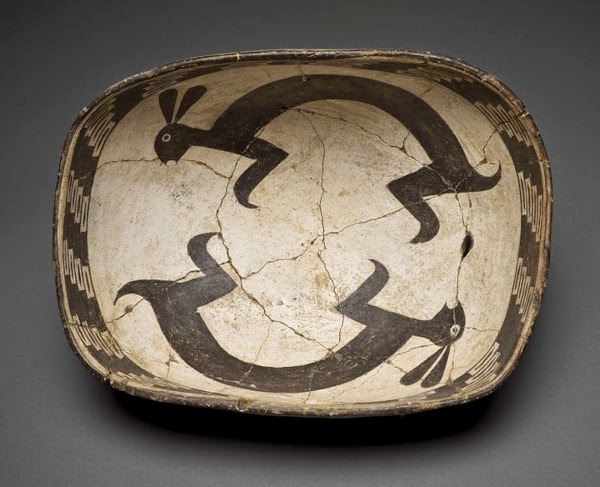
Plate rabbits.jpgPlate (opposing rabbits), ca. 1010–1130
Mimbres
Earthenware with pigment
3 9/16 x 6 11/16 x 9 1/4 in. (9 x 17 x 23.5 cm)
Gift of the Thomas W. Weisel Family to the Fine Arts Museums of San Francisco
2013.76.90

WHAT A FASCINATING contemplation of contrasts, these two exhibitions! And yet there are common threads, I think, latent though they may be, which makes the visit particularly moving. On the most perceptual side, that thread is linearity — lines of imagery and design; more metaphorically, linearity of development. (Perhaps the exhibition titles were meant to recognize that.)

On a less perceptual side, there's a link of regret — that particular kind that comes in contemplating irrecoverable loss. The incredibly prolific and immediately popular Keith Haring died far too young, of complications related to AIDS, in 1990, only thirty-one years old. And the native American work, of course, represents cultures now gone entirely, a thousand years ago or more recently. (Of course the traditions continue in work, even excellent work, being done today: but the cultures expressed in this exhibition are gone forever.

In the case of Haring another cultural loss occurs to me, not a real one but one constantly threatened: the loss of depth and significance to immediacy; specifically of artistic expression, whatever that is — let's beg the question for the moment — to market agendas. I almost didn't go to the Haring show; of all things it was a short review in the newspaper that influenced the decision, pointing out that the effect of work seen "live" quite displaces that of its all too frequent reproduction. The review suggested this was a function of scale, and some of the paintings here are very big indeed. But it's not only scale: it's the energy of the work that needs to be experienced: energy of drawing, of gesture, of color, of figure-ground, of weight.

Two of the paintings persuade me that Haring was meant to be a very important painter of his time, even of his century: Moses and the Burning Bush (1985) and Walking in the Rain (1989). Nearly all Haring's work can be read for political position, but Moses has what is for me a bigger, deeper implication. It addresses the urgent and eternal forces that lie behind transient desires. Politics is always for the moment, an expression or an activity at a given time toward a given result. Very occasionally a political expression touches deeper issues, perhaps even universal and if not eternal then at least epochal. Goya comes to mind here, and I think Haring's Moses comes close to that degree of depth and intensity. It's as if the existential anguish behind Haring's evident cynicism and scorn is confronted, for once, itself.

As to Walking in the Rain, there's a dual-level linearity here, one composing the figure, the other the ground, that seems to stand for a confrontation of immediacy and timelessness. The technique and imagery are handled so well the confrontation seems almost resolved; the artist leads us to contemplate both, simultaneously. The resulting connection of the individual subject and his condition which is shared by all is all the more poignant. For me, too, both the imagery and the title bring Max Ernst to mind: there's no immediate equivalence, but Haring's allover figuration (which is not at all nervous, merely energetic) recalls Ernst's decalcomanie, and the title recalls Ernst's Europe after the rain.

Haring's paintings, sculptures, and drawings are distributed through a number of rooms, and take time to take in. Along the way, other artists came to mind: Willem de Kooning for his color, energy, and sometimes anger; Philip Guston for the mystery and arbitrariness of his vision; Matisse for the frequent classical simplicity of thick line and the formalism it conveys, Ernst and Goya as I've indicated; even Hieronymus Bosch for his apocalyptic expression of the inescapable commonplace vulgarities of life. I don't think Haring could have worked without these predecessors, without even a conscious awareness of them.

Haring is an essentially urban, even metropolitan artist. To my taste he was too often distracted by the seductive demands of the market: but you could argue that that market is the fertile soil of his inspiration, that his ubiquity in the popular visual clutter of his time is a proper return, like taking table-scraps back to the garden in compost. Even his by-work is nutritive and remarkable, like that of the Surrealists. I think, finally, that he is two artists in one — the glib, commercial, totally accessible post-pop maker of multiples and statements, standing somewhere between Roy Lichtenstein and Jeff Koons; and the intelligent, deep, ultimately tragic inheritor of Abstract Expressionism. This is a very important show.
A396674_V1_hero8.jpg
Attributed to Nampeyo (Hopi-Tewa, ca. 1860–1942)
Vessel, ca. 1890–1910
Earthenware with polychrome
2 15/16 x 10 1/16 in. (7.5 x 25.5 cm)
Gift of the Thomas W. Weisel Family to the Fine Arts Museums of San Francisco
2013.76.38
ringtail.jpgVessel (ring-tailed cat), ca. 1010–1130
Mimbres
Earthenware with pigment
3 1/4 x 8 1/4 in. (8.2 x 21 cm)
Gift of the Thomas W. Weisel Family to the Fine Arts Museums of San Francisco
2013.76.158
EXHILARATING, PROVOCATIVE, and ultimately satisfying as the Haring exhibition was, however, simply entering the exhibition of Native American art from the Weisel Family Collection was literally breathtaking. The first piece I chanced to look at was this vessel by the Hopi-Tewa potter Nampeyo, perhaps a century old: the energy of the deep polished background, combined with the abstraction of the imagery, so certain and aloof as to be utterly objective, continued the preoccupation with dualities that Haring's best work had evoked.

Adjacent, though, were a number of Mimbres ceramics from up to a thousand years earlier, and one's sense of scale and scope and universality was immediately overwhelmed. Words cannot convey the serenity and permanence these works have attained. Part of this effect must be attributable to the inherent fragility of the medium. Some vessels have been broken and pieced together; others have had holes knocked into their bottoms, symbolic of their surrendering utility to meaning I suppose, most likely at the time of their burial.

Some, most improbably, seem to be intact. What strength: of material, of purpose; of intent. Everything about these pieces — material, form, volume, color, line, balance, imagery — everything feels completely achieved. These wonderful pieces from a thousand years ago are the Cycladic sculpture of our continent. These photographs barely convey their presence: the imagery, the lopsided form, and the darkened white all give them a false sense of familiarity. Whatever its original purpose, a piece like these is no longer a quotidian thing; seen in person it has the enigmatic immediacy of a fine African tribal mask or, to my kind of comprehension, a late Philp Guston painting, or a musical composition of Giacinto Scelsi's.

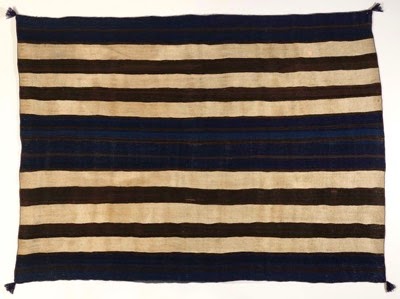
These works, and the others in the exhibition, honor the donation from the Weisel Family Collection of some 200 objects to the de Young, including more than fifty pieces of Mimbres ceramics, a stunning accession. Many of the works are much more recent, but little less significant. There are two Navajo First Phase chief's blankets, from the first half of the 19th century, whose austere, bold surfaces are an eloquent response to the ancient ceramics.

blanket.jpgA396764_hero.jpg
Ledger drawing, ca. 1880
Cheyenne (Tsitsitsas)
Colored pencil on paper
7 1/4 x 11 7/8 in. (17.8 x 27.9 cm)
Gift of the Thomas W. Weisel Family to the Fine Arts Museums of San Francisco
2013.76.128
Wearing blanket (first-phase chief blanket, Ute style), ca. 1840
Navajo
Wool; weft-faced plain weave, diagonal-join tapestry weave, eccentric curved weft
51 3/4 x 69 1/2 in. (131.4 x 176.5 cm)
Promised gift of the Thomas W. Weisel Family to the Fine Arts Museums of San Francisco
L12.103.18


There's also a series of Cheyenne "ledger drawings" made by a Plains indian — certainly the work seems to be that of an individual — toward the end of the 19th century, when pages of discarded account ledgers took the place, for such artists, of hides, as readier to hand and, no doubt, cheaper. The drawings are made with colored pencil, in some cases apparently brushed with water; nearly all in profile; some with effective use of a dark wash of color to push the image. The static quality of the compositions, and the relatively unmodulated color, suggest a linkage with the work in textile and ceramics, and you can't help wondering about the extent of the artist's awareness of a long tradition.

"Native American" art objects, in this small but evocative exhibition, range over a thousand years of history, a little less than a thousand miles of geography. A similar period in Europe would take you from the weaving of the Bayeux Tapestry to, say, Seurat's A Sunday Afternoon on the Island of La Grande Jatte. I suppose one could link those two works, but it's clear there's a profound difference in orientation between the North American art of that millenium (I haven't mentioned a marvelous Tlingit sculpture of a bear, also in the de Young exhibition) and that of the two sides of the English channel. The contemplation of such differences is, for me at least, endlessly fascinating.

Saturday, December 06, 2014

Announcing my debut as editor-publisher

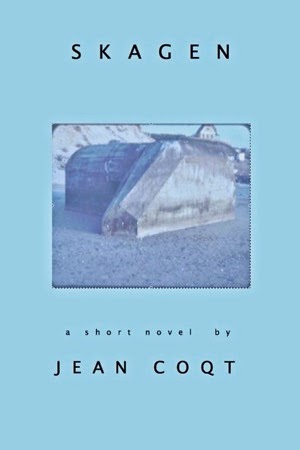
•Jean Coqt: Skagen.
ISBN 978-0-990-75880-8
•Jean Coqt: Tarifa.
ISBN 978-0-990-75881-5
Healdsburg: Ear Press, 2014
skagencoverthumb.jpg
Eastside Road, December 6, 2014—

I  MET AN INTERESTING man a year and a half ago in, of all places, the waiting room of a chiropractor, in Nice, where I had finished a long hike in the French Alps. We found that we had in common that we were waiting while friends were under treatment, that we were Californians, and — on our having exchanged cards — that we shared first names. 

Beyond that, we were both fond of literature. In fact it was on learning that I had published a few books, exclusively of my own writing, that he offered his card  — which revealed further that we very nearly share monograms: for his name is Charles Lunaire,
Untitled.png


and I combine my first initial with my companion's:
CSmonogram.jpg


With his card Lunaire handed me a challenge. Many years previous, while a university student in Grenoble, he'd befriended the proprietor of a second-hand book shop he often visited. One day, when the two were talking about French literature and particularly about Proust, the shopkeeper mentioned a novel in typescript that had been left with him years previously. Of its author he knew only his name: Jean Coqt

The shopkeeper recalled Coqt as a vague, uncertain fellow, nondescript as to dress and expression, well read but not particularly enthusiastic about any particular region of literature — attracted or not almost equally to history, poetry, theater, music, gastronomy; uninterested in only mathematics and the physical sciences. (This had particularly annoyed Lunaire, who was at the time devoted to the study of geology.)

Why had this meek, reclusive man brought an enormous typescript, hundreds of pages of cheap foolscap covered with smudged, carelessly typed sentences, to a second-hand bookshop? The shopkeeper could only surmise that the poor fellow was near the end of his rope, had dedicated who knows how many years to the effort, had probably not even finished the thing, had to free himself from the obsession, couldn’t bring himself to burn it, wanted it to survive somehow. He’d pretended he was hoping for comments on it, but he must have known the shopkeeper was very unlikely to bother reading it. And in fact he’d simply set it up on top of one of the bookcases, where it gathered dust and cobwebs until Lunaire happened one day to see it while reaching for a volume of the Archives de la Commission Scientifique du Mexique publiées sous les auspices du Ministère de l’Instruction Publique. (Lunaire remembers the title clearly, and still regrets not having purchased it.)

Lunaire said that he’d read only the first quarter or so of the novel, and had been impressed with the style — somehow engaging, easy to read, yet not quite in focus. He seemed unsure as to the point or plot. The novel, which is called Skagen un roman de l’Europe, apparently consists of a number of independent novellas or stories, each bearing the title of an unimportant European city, each in a different country. Perhaps, Lunaire said, the book is about Europe, but it is not a history or a geography; it is a novel, in fact, whose characters are perhaps nations, or villages, or geographical features, or events.

Well: I was curious about this Coqt, and his writing. I said I’d like to see it, but that I certainly wouldn’t consider publishing it myself. For one thing, I have things of my own I still want to get into shape; for another, my French was certainly not up to the job. But then Lunaire threw a curve: he said he’d translated the first section into English, more or less without meaning to — he makes a little pocket money translating from French to English, and can’t seem to help scratching out English versions of certain French passages when he reads, even if there’s no pecuniary reason for it. He’d send me that first section in an e-mail, if I liked; he’d be curious to know what I thought of it, of the translation, and of Coqt’s style.

A few months after my return from France an e-mail finally arrived, with the first four or five sections — you can hardly call them “chapters” — of the opening of Coqt’s novel, the book giving its title to the entire project: Skagen. I was immediately impressed, and asked him to send the rest when he’d finished it.

That took another month or two, but eventually it came, with some notes of his own. I had hardly any editing to do, and that for three reasons: the copy was quite clean; Coqt’s writing (in Lunaire’s translation, at least) is eccentric and best untinkered with; and besides, I’m a little lazy. I do enjoy page layout, though, and had fun trying to make a real book out of what is in fact only twelve or fifteen thousand words.

I sent a .PDF file of the result to Lunaire, and he almost immediately wrote back, approving my work enthusiastically — it had inspired him to get to work on the translation in earnest. He had a few little corrections to make, but nothing serious. And in another three months he sent the next section, Tarifa.

I hesitated a long time over how exactly to publish the entire Skagen. Should I wait until Lunaire had finished the whole thing, and publish it as a single volume — or, more likely, a two-volume novel? Or should I go ahead and publish the individual books as Lunaire completed them, on an analogy with the serialized novels of the Victorian period, or those books that were published in fascicles, a century or more ago?

Lunaire’s own unpredictability furnished the answer to that riddle. After Tarifa, not a word from him for months. I decided to shelve the project and get back to work on my own things. But then, just a couple of months ago, he sent three e-mails with extensive sections of a third book, apparently called Vianden or Veinen, it’s not yet quite clear. It’s as different from the first two books as they are from one another. And he tells me he’s working simultaneously on a fourth, though it apparently doesn’t follow Vianden immediately in Coqt’s typescript — I don’t know why Lunaire has skipped a book or two, and I’m not going to ask.

All this to announce that, yes, just in time for Christmas, the first two instalments of Skagen a novel of Europe are published, complete with ISBN numbers. Like most of my own books they’ve been printed and bound by the online publisher Lulu, and for now that’s where you can buy them. They sell for $9.95 each, and shipping is extra. You can order them here.

I’m pleased with my work on these books, and excited that a chance visit to a chiropracter has led to the introduction of an unexpectedly interesting and completely unknown voice to the canon of modern literature. Please encourage Lunaire to continue his translations; order copies of Skagen and Tarifa for yourself, and consider them as gifts for the new year!

Thursday, December 04, 2014

Virgil Thomson: sharpness, precision, definition

•Virgil Thomson: Music Chronicles 1940-1954.
The Library of America, 2014
ISBN 978-1-59853-309-5
Edited and with notes and chronology by Tim Page
Eastside Road, December 4, 2014—
I HAVE SPENT the last two or three days reading through Virgil Thomson, having received the surprise gift of his Music Chronicles from the publisher; I’m not quite sure why. Perhaps in the hope that I would write about the book here.

I’ve written about Virgil here before, of course. [Here and here.] We met him in the middle 1960s, and it’s bemusing to think that I’m now a generation older than he was when Lou Harrison brought him up our front stairs, at 1947 Francisco Street, to introduce us over lunch.

I never knew him well, though Lindsey and I visited him in his Chelsea Hotel apartment whenever we went to New York, back in the 1970s and ‘80s. He invited us to dinner there once or twice; we dined out once or twice; we dined at Chez Panisse once or twice. He was friendly to us; conversation was by no means one-sided. He gave me some advice on vocal writing, and I was bold enough to dedicate my Duchamp opera to him; he seemed genuinely interested in it.

During the fifteen years or so that I wrote music criticism professionally, for the Oakland Tribune, I dipped into his published criticism fairly often. I always wrote better, I think, for having read him, though it was sometimes necessary to resist his influence: one must speak, after all, with one’s own voice.

What a pleasure, now, to re-read Thomson! His prose style is so direct, clear, engaged and engaging, occasionally surprising; and the ideas he considers and reveals with that style are so persuasive, well-grounded, and important in considering his subject-matter — which is always, in the published work, music, the art, its producers, and those aspects of society (including history and economics) which are inextricably connected with it.

Music Chronicles reprints the four volumes of newspaper columns Thomson issued during his career and, I think, in one case at least, after his retirement from the New York Herald Tribune, which had the intelligence (and forbearance) to sustain him from October 1940 until October 1954: The Musical Scene; The Art of Judging Music; Music Right and Left; Music Reviewed. There are also 25 articles and reviews from the NYHT that Thomson had not chosen for republication, a couple of essays specifically about the mechanics of newspaper music criticism, and a welcome collection of eight early articles are reviews from before his NYHT stint. Missing are , among other things, the articles Thomson wrote for The New York Review of Books. Perhaps they’re being saved for a second volume in this quasi-official Library of America publication (the nearest thing our country has to Frances Pleiade Edition).

What I’ve been reading, then, is essentially the New York Herald Tribune, from late 1940 to about 1948, as it confronted, through its chief music critic, a musical scene incredibly rich in any epoch let alone wartime. “Chief” music critic, for Thomson had a stable of stringers only too happy to pick up a little pocket money covering events even Thomson didn’t have time for: John Cage, Lou Harrison, Peggy Glanville-Hicks and others. (Their writing was often nearly as impressive, and nearly always greatly influenced by their boss’s.)

These are basically concert reviews and Sunday “think pieces,” as we used to call the more extended essays we wrote on generalized subjects or aspects of music other than its actual performance. I don’t know how VT actually wrote his copy, whether at home or in the office, from notes or not, in revised drafts or not. I like to think he wrote as I used to, at his desk, on the (manual) typewriter, on long sheets of foolscap, triple-spaced and pasted, eventually, end to end, lest the sheets get out of order on their way to the linotype machine. Revisions, if any, would have been made in heavy pencil between the lines.

As you read through these pages you quickly form the notion there was little revising to be done. VT seems usually to have the nut of his essay in mind before beginning to type it; the nut and a few of the sentences as well, especially the opener. Headings, too, sound like his voice: “Age without Honor”, “Velvet Paws”, “Being Odious” (a comparison of three orchestras), “Hokum and Schmalz”, “Free Love, Socialism, and Why Girls Leave Home” (a review of Gustave Charpentier’s opera Louise).

VT writes about complex matters, subtle distinctions, hidden influences, unsuspected associations, dealing with an art form notoriously resistant to verbal analysis and discussion. He is successful largely for four reasons, I think: keen observation, clear analysis, economical expression, great assurance. Let me give one example, from a review of a Philharmonic Orchestra concert that had presented Mendelssohn’s Midsummer Night’s Dream, Beethoven’s Violin Concerto, and Darius Milhaud’s Suite française and Le Bal martiniquais:
There is humanity in the very texture of Milhaud’s writing. Tunes and countertunes and chords and percussive accents jostle one another with such friendliness, such tolerance, and such ease that the whole comes to represent what almost anybody might mean by a democratic way of life. Popular gaiety does not prevent the utterance of noble sentiments, and the presence of noble sentiments puts no damper at all on popular gaieties. The scenes have air in them and many different kinds of light, every brightness and every transparency, and no gloom or heaviness at all.
You might complain that this description, while perfectly apt, will only seem so to those who know Milhaud’s music and who therefore already have this impression. VT does not merely preach to the choir, though, in his graceful, informed, yet often plainly vernacular prose; he voices realizations not perhaps otherwise verbalized, sets the music almost visually and certainly intellectually in front of an audience that otherwise confronts it only with the ears.

(Or program notes; or an invisible announcer’s introductions: these come in for careful, thoughtful, and critical assessment from time to time.)

VT writes about judgment, modernism, pipe-organ voicing, the choice of repertory, the effect of audience or the lack of audience, the divisions of labor among “executants,” managers, boards of directors, educators, and critics. He writes about technical matters like rubato, dynamics including crescendo, the choice of tempo, and intonation, making such things understandable, I think, by the lay public. He describes the rhythmic differences between tango, rhumba, beguine, and Lindy hop. He writes about generalized complex historical matters, and he writes about personalities.

I despair of describing VT’s writing, when it is so easy simply to give quotations, so here they are, more or less at random:
Stravinsky knocked us all over when we first heard him, because he had invented a new rhythmic notation, and we all thought we could use it. We cannot. It is the notation of the jerks that muscles give to escape the grip of taut nerves. It has nothing to do with blood flow…
—Music Chronicles, p. 969


The Satie musical aesthetic is the only twentieth-century musical aesthetic in the Western world. Schoenberg and his school are Romantics; and their twelve-tone syntax, however intriguing one may find it intellectually is the purest Romantic chromaticism.
—ibid., p. 126


Oscar Levant’s Piano Concerto is a rather fine piece of music. Or rather it contains fine pieces of music. Its pieces ae better than its whole, which is jerky, because the music neither moves along nor stands still. The themes are good, and if they are harmonically and orchestrally overdressed, they are ostentatiously enough so that no one need suspect their author of naïveté.
—ibid., p. 139


The greatness of the great interpreters is only in small part due to any peculiar intensity of their musical feelings. It is far more a product of intellectual thoroughness, of an insatiable curiosity to know what any given group of notes means, should mean, or can mean in terms of sheer sound… the great interpreters are those who, whether they are capable or not of penetrating a work’s whole musical substance, are impelled by inner necessity to give sharpness, precision, definition to the shape of each separate phrase.
—ibid., p. 275
Impelled by inner necessity to give sharpness, precision, definition to the shape of each separate phrase. This is what VT does, thoroughly and reliably, day after day and week after week, in prose which never fails to suggest conversation, discussion among similarly thoughtful (if perhaps never quite so articulate!) participants.

A couple of times, while typing the above quotations, Gertrude Stein came to mind. VT learned the rhythms of his prose, and beyond the rhythms the phrasing, I think, from his long experience with both her conversation and her prose. One of her most significant lectures was called “Composition as Explanation,” and I think its title (let alone its substance) offers a key to what VT intends in his journalism: he composes his explanations in an earnest desire to share and celebrate meaning: the meaning of music, of art, of humanity.

Let none of the above mislead you: VT has pronounced dissenting opinions from time to time, and delights in expressing them. In his first NYHT review he dismissed Sibelius’s Second Symphony as “vulgar, self-indulgent, and provincial beyond all description” (this from a critic proud of his Kansas City background). He doesn’t much like Brahms. As for Beethoven, he writes, in an essay discussing Mozart’s liberal humanism,
Mozart was not, like Wagner, a political revolutionary. Nor was he, like Beethoven, an old fraud who just talked about human rights and dignity but who was really an irascible, intolerant, and scheming careerist, who allows himself the liberty, when he felt like it, of being unjust toward the poor, lickspittle toward the rich, dishonest in business, unjust and unforgiving toward the members of his own family.
—ibid., p. 80

He is writing about Beethoven the man in that passage, of course, not about Beethoven's music. He has extremely insightful comments on the music. He sees the problem of the Fifth Symphony, for example, and of the Ninth. I think he understands the causes and the meaning of the German sensibility in music; that's revealed in a remarkable aside finding parti pris between the (otherwise very different) musical sensibilities of Chopin and Schumann. But over and over in these pages VT praises French sensibility and distrusts German. He notes, somewhere, that Beethoven introduced a note of militancy into concert music that has continued in the German musical tradition up to the middle of the 20th century; a note utterly lacking in the French repertory. He links this introduction to the difference between the German beat-oriented impetus and the French one, dependent on the phrase.

The American musical establishment favored the German wing of the history almost from the start and continuing, certainly, down to our own time. My own grandfather, hearing of my dedication to music when I was in high school, counseled me to learn German to prepare for study abroad and to be able to learn from the “important” sources. Beethoven continues to dominate repertory, though his symphonies seem finally to be giving room to those of Shostakovich, which (as VT points out) are hardly less militant.

Of course VT was an expatriate living in France from the end of his college years until 1940, his formative years. He had gone to Paris, not Berlin, to study with Nadia Boulanger; he’d remained there to converse with Stein, to observe Satie, to read Rameau, to refine an essentially Parnassian taste. His detractors, whether confronting his musical composition or his journalism, found him waspish, simple, trivial, or stilted, in order to marginalize his work as gossipy, dull, irrelevant, or pretentious, and thereby avoid having to give serious thought to the implications of his findings.

But I think his detractors were (and are) wrong. Wrong, and small themselves, and p[perhaps fearful of foundational truths about their own work. Music is primarily an intuitive thing, it is true, but it supports intellectual consideration carefully and authoritatively brought to it. That, ultimately, is VT’s achievement, that and the entertainment he provides in the process.

Music Chronicles contains, besides VT’s work, a fine, full, helpful Chronology of his life, the customary note on the text sources, concise but useful page-notes, and a near-encyclopedic section (85 closely-set pages!) introducing the many musicians referred to, whether a Bunk Johnson or a Pierre Boulez. The volume is exceeding well thought-out, nicely designed, easy on the eyes; and deserves a place close to hand.

Thursday, November 13, 2014

Flarf

If I had to do it again and it was the best thing about it is not the same thing to say

The fact I can get it right away with the best of the year
and the other hand is the only thing that would have to go

I'm so tired and my friends
to be able too
see my friends to be able too
see my tweets of people are going out

I'm not sure if I could be a good day
to be a good day for me to be a good day
to be a good time to get a good day to be a good day

The only way to get the same thing as the first
place would have been a good idea but I can't even get the hang of it


— the text predictor

Tuesday, November 11, 2014

Mahler, and the Seventh

IT WAS A FELLOW employee at the Berkeley Post Office, Gary Jerburg I think his name was — this was after all sixty years ago — who introduced me to the music of Gustav Mahler. In those days he was still a neglected, even an unfamiliar composer — of works one knew only by reputation, and the reputation was far different then.

I remember, for example, a paperback guide to the symphonic literature, The Symphony by Ralph Hill, published by Penguin Books — in those days serious how-to-listen books seemed important. ("The purpose of this book is to guide the intelligent and serious listener towards a deeper understanding of the masterpieces of symphony, which he is likely to hear frequently in the concert hall, on the air, or on the gramophone.") Mr. Hill did not take kindly to Mahler, "Bombastes Furioso, caustic, cynical, ironic, intolerant and dictatorial…"

Gary brought me a couple of long-playing recordings of Mahler: the Bruno Walter recording of the Fourth Symphony and Das Lied von der Erde, and I was hooked. Before long I'd added Walter's recording of the Ninth to my shelf. I think it was the long-playing record, and especially the then-new stereo technique, that made the popularization of Mahler possible: before long, of course, Leonard Bernstein finished the job, and Mahler's been a permanent fixture of the standard repertory ever since. His time has come, as he had promised it would.

The other day Mahler's Seventh Symphony was in the air hereabouts — the Bay Area, I mean — as Michael Tilson Thomas led the San Francisco Symphony through it. I didn't hear it: I was away at the time. I probably wouldn't have heard it even if I'd been here, as I'm not fond of Thomas's way with Mahler, and I'm particularly fussy about the Seventh.

At one time I studied the Seventh fairly closely, probably in the early 1960s. I bought the Eilenberg edition of the pocket score in April 1962, according to my bookplate, and when the Berkeley Public Library acquired the Universal Edition edition a few years later, with Mahler's many changes from the earlier state the Eulenberg edition presents, I carefully added in all those changes into my copy.

There were two recordings of the Seventh in those days, as far as I can remember: Hermann Scherchen's, with the Vienna State Opera Orchestra, and Maurice Abravanel's, with the Utah Symphony. I liked them both, for different reasons. When I "listen" to the Seventh with my mind's ears, it is with Abravanel's tempi and weighting, though I seem to remember Sherchen's version often seeming more graceful.

The Seventh has curious architecture. Landscape architecture, I think I mean. Two long developmental-but-episodic movements start and finish the piece, whose central movement is one of those shadowy Mahler scherzos, flanked with two fragrant, rustic serenades. The orchestra includes cowbells, a mandolin, a guitar. The very opening is striking — a quiet steady but uncertain rhythmic figure which Mahler wrote came to him as he was rowing, at night, on an Alpine lake, with a suddenly cautionary but peremptory solo on the tenor-horn. If you've walked the Alps at nightfall you know the feeling.

Siege Ozawa led the San Francisco Symphony in the Mahler Seventh in 1976, and I remember thinking he led it beautifully. It was the only work on the program, as is often the case — it runs over 80 minutes in most performances. Ozawa had asked me it I had any ideas as to what to program with it, and he was surprised and I think amused at my answer: Start with Strauss's Tales from the Vienna Woods, I suggested, and continue with the Webern Symphony op. 21.

This would of course have added maybe twenty minutes to the program. I thought you could take a short intermission after the Webern. The connecting thread through the pieces is the plucked strings: zither in Strauss, harp in Webern, mandolin and guitar in Mahler. Austria throughout.

The most important thing, I think, is not to let Mahler's finale get too boisterous. Most conductors fall down here, and I think that's what made Ralph Hill think of Mahler as "Bombastes Furioso". The Seventh is on the Haydn model, not the Beethoven: the weight's on the opening movement, not the finale. Allegro ordinary, Mahler says, though he added Pesante to the second version in a number of places, and does, it's true, end fortissimo. But I think the rhythms are jaunty and rustic, not pushy and overpowering; Mahler's still in the mountains in lederhosen, not in uniform on a parade ground.

So I prefer these days to look at the score from time to time, and to "hear" the piece from the page, and from memory. But note, if you've read this far, that this morning, thinking about writing this, I discovered the Abravanel recordings available as a download, from a source I don't usually like to patronize, for only $2.99, for all nine completed Mahler symphonies, with a few song-cycles thrown in. The recorded sound is far from adequate these days, but the tempi and weight and attitude strike me as just right — at least in the Seventh, which is the only one I've dipped into so far.

Saturday, November 08, 2014

Lullaby and Finale


Eastside Road, November 8, 2014—
JUST WHEN I THOUGHT there was no particular reason to write any more music — in July, 2004, to be precise — Eliane Lust asked for a new piece. She was planning a recital program of lullabies and thought I’d like to supply one. She’s a favorite of mine; she did such a splendid job with my piano sonata Bachelor Apparatus , even consenting to play it in costume seated at a piano perched on a cart being hauled across the stage by a strongman in Margeret Fisher’s amazing dance/theater piece drawn from our opera together.

And, by coincidence, I’d just bought a new piece of notation software which made it easier than ever to print music, and even to synthesize it somewhat suggestively; and I’d installed it on a new laptop, a tiny one that I’d taken with us on an annual week in Ashland, where we like to go to see Shakespeare (and other plays), and where we were when Eliane’s e-mail request came.

Partly to learn the software (and to demonstrate it to a friend who was among those spending the week with us), partly to see if I could write a lullaby, I quickly composed this piece. The next day, after the computer played it to us and I discovered how incredibly long it is and how somniferous, I decided to add a Finale, partly to awaken the audience, more really to awaken the performer.

The pieces have something to do with the music in the Trio for Violin, Piano, and Percussion. The same chromaticism is there; the deep clusters; the insistent repetition. I don’t think these have much to do with Minimalism; to me they are more closely related to the hermetic poetry of Gertrude Stein. But I could be wrong about that. In fact, Lullaby is a sort of by-piece to the much longer Sonata 2 Compositio ut explicatio.

Eliane introduced both movements in a program of lullabies and barcarolles given at The Dance Palace, Pt. Reyes Station, California, Oct. 17, 2004.


click here for synthesized performance (.mp3)

click here for score (.pdf)

Tuesday, October 28, 2014

I Mandorli

Cardona di Alfano Natta, October 28, 2014—

Siamo uccelli di passagio
, I explained to Gabriella last night at dinner, we're migratory birds, we need to come to the same trees year after year.

Not always, of course; we do skip years; our migrations are annual, give or take, but not always the same route. But we do like our familiar temporary settling places, and among them this is a favorite.

It is half past seven; I've been awake half an hour. The fog is beginning to lift. Out the window I see the familiar rumpled landscape, the irregular fields divided among many different crops — olives, grapevines, dry cornstalks, lush green pasture. a couple of cars glide soundlessly along an invisible narrow road. To the right, the east, quite nearby, the village, stucco buildings, tile roofs, a square church-tower with two windows and a giant clock on each face; you'll be able to read the time out in your field, though anyway the bell tells the half-hours. A black and white cat comes across the tiles just outside my window, sits, regards me without interest, looks out at my view, then seems to think of something and moves on.

We came here first fourteen years ago, Gabriella tells us — I hadn't realized it was so long ago. She and her husband Franco bought this farmstead on the edge of the village a few years before that, having moved from the city for a quiet life. Over the years they've added to the property, and now their B&B offers several rooms and apartments. Franco has made wine and olive oil; Gabriella tends to the orto, the kitchen garden, and bakes, and makes delicious jams and tarts. 

Here she is now with breakfast: a fine mortadella-like Piemontese sausage, two goat cheeses, a basket of toasted bread, butter, apple butter, a bowl of walnuts and hazelnuts, fresh-squeezed orange juice, a basket of apples, oranges, and bananas, and carafes of coffee and hot milk. We decline the yoghurt, as always. It is all too much, of course; it is mostly not only local but della fattoria, from the place itself; it is all delicious.

One of the problems with my other blog, Eating Every Day, is that occasionally it asks me to write about a meal prepared by one of its readers. I know this to be the case here; Gabriella mentioned it herself last night, at the table. We hadn't wanted her to go to the trouble to cook for us, and perhaps she didn't really; perhaps she and Franco always dine like this: fried cheese, radicchio salad, soup, roast lamb, beets and onions, giardiniera, tiramisu. Domestic and delicious.

The bed is comfortable; the air tranquil. Theo the basset is two years older than when last we saw him, and deaf, Gabriella tells me, deaf like me — my ears still blocked from last week's flight. We all get older, those of us fortunate enough to survive. But one of the attractions of this familiar roost: it does not change, nor does its setting. 

Oh, there are little changes. The chapel down at the corner, which had lain a ruin for decades after its deconsecration — the population has not grown here! — it has been taken over by the municipality and gussied up with a new and to my eye irrelevant pseudo-Classical porch and is for sale, if you have an extra quarter of a million Euros. There are no toilets in it, Franco tells me, and when I ask if there's any plumbing at all, he shrugs. Well, it could always be installed. 

I don't know what you'd do with it. To my eye, Cardona doesn't really need anything. A mile down the road, in Alfiero Natta, there's a bar and a little store. Cardona has only its church, telling the hours patiently to anyone who'll listen, and the sleepers in the cemetery down the road toward Tonco…

Sunday, October 26, 2014

San Salvario, Torino

our building, Via Principe Tommaso


WE CAME HERE to Torino to atttend the Salone del Gusto, an international fair celebrating food and its producers, specifically those embracing the qualities famously statedd by Carlo Petrini, the founder of the Slow Food movement:


Buono, Pulito, Giusto

Good, Clean, Fair


Petrini is from Piemonte, as was my father-in-law; and Torino is the capital of Piemonte and one of Italy's biggest cities.  We have spent four days wandering through the Salone, and we determined to take today off. I'll write about the Salone later — it's fascinating, and we attended two notable conferences there; there's much to write about. But tonight I want to write a bit about Torino.


It's not what you think an Italian city is. It's always struck me as being a bit reserved. We spent a pleasant hour with our host in a neighborhood bar discussing the possible reasons for this, and much of the following will be a paraphrase of his comments.


The city was founded by Julius Caesar, a long time ago, as a camp and a headquarters for his campaigns in both the neighboring territory and, further, the definitive settlement of Provence and the campaigns into Gaul. The original camp left its rectilinear layout to the old city, which lost its importance in the dark ages, when neighboring more prosperous towns shouldered it aside: Asti, Monferrato, Saluzzo.


In the 16th century, I think it was, certainly by the 17th, it began to regain some importance as a capital of the emerging kingdom of Savoia: but it remained small and relatively isolated, even from such nearby (by modern standards) cities as Milan. It is a mountain town, Marco went on; it's always addressed the mountains, even though it is on the Po. 


After the French Revolution, and during the Napoleonic times (which in Italy extended toward the middle of the 19th century) the city began to enjoy some considerable importance, and grew considerably in size. We are staying in one of the suburbs of that time, San Salvario, say a hundred or so blocks lying to the southeast of the main railroad station.


Marco contributed to a fascinating guidebook, L'altra Torino: 24 centri fuori dal centro (The Other Torino: 24 centers outside the center), which we took with us today on our casual walking tour. It describes much of the history I've outlined, and points out the first Waldensian (Protestant) church, the hotel whose bas-reliefs portray the pretty young working girls of the quarter in the time of gaslight, the building that housed the Fiat offices, Natalia Ginzburg's birthplace — things like that. 


I like its offbeat interests, effectively lightening its serious purpose. Marco is a young man, but a Piemontese, after all: he understands the beauty, the necessity, and the purpose of the past as it relates to the present. 


That's an essential component of the Torinese character, I think. Lord knows things are up-to-date. The Metro is like a fast sleek horizontal elevator: the tracks are completely enclosed under glass; doors open quietly and effortlessly when the train glides into the spacious, well-lit station; you feel like you're entering a hotel lobby, not a grubby train, when you step inbto the carriage — though it may well be crowded, especially if you're on your way to the Salone.


We had a number of pleasant conversations today. At Franky's bar, near the train station, where we stopped for a cappuccino because we wanted the wi-fi, we were pleasantly asked where we were from, and given a little treat — a delicious filled cookie, in fact — when we turned out to be from as far away as California. This of course led to conversation about pastry, which is so good in Torino in general, and seemed exceptionally good here — my croissant was flaky and delicaely rich, very Parisian in the best sense. The pastry-cook spoke no English, but beamed at meeting Lindsey and enjoyed our enjoyment of his work.


Later in the day we had a substantial conversation with a woman met in a pubic market, where an afternoon contest had been organized in which ordinary people, from Torino and nearby villages, stood behind their very best bagna verde, green sauce. This is made of parsely, garlic, anchovy, and oil, with perhaps other things thrown in; it is made very carefully, with great attention to balance, and is then spread discreetly on, for example, boiled meat.


The young woman apologized that she wasn't really Torinese herself; her father was from Abruzzo and her mother was Roman; she was from Lazio; but she'd settled in Torino because she liked its intellecttual, language-conscious, literary, prudent atmosphere. She was fluent in German, French, and English, and seemed a little ashamed and maybe surprised that she didn't speak Piemontese, the local dialect as they call it — in fact, I think it is more a language of its own, closely related to Occitan.


We are staying in an Airbnb apartment, and I recommend it, in spite off its 96 steps' removal from the street. It is sober and quiet here, three blocks away from the busy Via Nizza.  It is quiet enough now, in fact, half-past-nine, that I think I'll stop here, get my papers in order, and begin to pack. Tomorrow we return to the Salone for a last day; then rent a car and drive to the country, to a very different venue. I hope from now on to have a little time to write like this, and I hope you find something to enjoy in the result…

Tuesday, October 21, 2014

The Death of Discourse


New York City, October 21, 2014—

UPWARDS OF A THOUSAND people, I'd say, jammed themselves into a small triangular patch separating the automobile access to the Lincoln Center from Broadway, which itself was at a standstill with taxicabs, emergency vehicles, and police cruisers. It was a little before seven p.m., and the opening performance of a run of John Adams' opera The Death of Klinghoffer was set to begin in a little over an hour.

The opera is based on the 1985 hijacking of a cruise ship, the Achille Lauro, by the PLO, during which an American passenger, Leon Klinghoffer, was murdered in his wheelchair. Set to a libretto by Alice Goodman, the opera, conceived by the director Peter Sellars, premiered in Brussels in 1991, and has been produced a number of times since, often to protests, largely from Jewish groups.

The history and content of both the opera and its protests are well covered on Wikipedia; I won't recapitulate that here. I saw the opera in San Francisco in 1992 and wasn't eager to see it again last night; we're here only two days, en route to Italy. But we did walk past the demonstration on our way to a restaurant we've long wanted to sample, and I talked briefly to a lone dissident from the general mood of what seemed to me a restrained but noisy crowd of protestors.

He was young, well dressed, good-looking, earnest, and very much aware of danger. He wore a yarmulke, and held a hand-lettered sign above his head, apparently prepared in some haste; I never could quite comprehend it, though STOP THE HYSTERIA was bold enough to read at some distance."What hysteria does he mean," my friend wondered; "let's go find out," I replied.

The poor fellow was being harangued by two or three men who were asking him how he could shame his own people, denying the evils of the PLO and Arabs in general, when the Nazis had murdered six million Jews in the Holocaust; how he could permit the Metropolitan Opera to produce an anti-Semitic opera. 

He countered that he agreed about the PLO but that it was wrong to generalize about the Palestinians, not to mention the Arabs, and that the opera was not anti-Semitic. "Have you seen the opera?" he asked, reasonably enough I thought. His hecklers said they would never see such a thing, reflecting the general attitude of the crowd was that it was anti-Semitic propaganda masquerading as "art".

A young woman was listening to all this, reporter's pad in hand, taking notes, trying to interview the man with the sign. I talked to her briefly, then told the man I agreed with him, as far as I can tell, and asked him if he felt himself in danger. He was aware of it, he replied.

I asked if he thought the protest was organized, either by a single group or a coalition, and if so who he thought it might be. 

Look, he said, I don't know anything about that, probably a lot of groups are represented here, probably some groups I even belong to myself. But it's important to counter this kind of hysteria with truth and reason.

I asked if he'd seen the opera. Not  yet, he answered; I'm going later in the run. I have no opinion of the opera until I've seen it myself. I don't believe it has a political agenda.

At just that moment one of his earlier hecklers returned, approached him from behind, gave him a kick in the backside, then sidled away. I turned to see where Lindsey and my friend had got to and rejoined them, and the next thing I knew the poor fellow was being led away by a couple of uniformed cops, still holding his placard aloft, telling them he was going willingly, he was not resisting, he only wanted to express his opinions freely and peacefully.

He should be silenced, a man in front of me said. Let the police take care of it, his friend replied, with a smile.

Someone had set up a public-address system; a soprano wailed through The Star-Spangled Banner, and a recorded instrumental version of the Israeli national anthem followed. We felt our dinner reservation approaching, and walked on up Broadway.


Monday, October 13, 2014

Out and back

NO ONE MORE AWARE than I how badly this blog's been neglected lately. Please excuse this neglect, and prepare for more. I've been away, and I'm about to set out again.

There was a time when I posted fairly detailed notes on such travels, sending them as group e-mail "dispatches" to a list of readers that ultimately grew to over a hundred — too big for the e-mail managers of that day, whereupon I began this blog, a little over nine years ago. There have been over six hundred posts since then, on topics related to travel, books, music, art, theater, politics — whatever I've felt like writing about.

I write these things mostly to find out what I think about things. I don't know why I want to know what I think about things: it's probably simply a habit, formed a long time ago, when something (or more likely some one) led me to believe it was one's duty to examine meaning.

Yesterday we drove home from a four-day tour to Ashland, Oregon, where we've been in the habit of seeing plays put on by the Oregon Shakespeare Festival. Comments on those plays have formed a number of posts to this blog over the years, all the way back to July 2005; and apparently there are those among you who are interested in these comments: I notice someone from Oregon City has just looked in on last March's remarks about three plays we saw earlier.

This year we decided against seeing the entire season, for two reasons: I've been growing increasingly impatient with re-interpretations of Shakespeare — Troilus and Cressida was the last straw — and we've been unenthusiastic about too many of the new plays by new playwrights. It hurts to say that; one always wants to retain curiosity and enthusiasm for the work of one's own time: but now that I'm in my eightieth year I find too often the "new" is merely the latest revelation of ignorance of yesterday's "new."

So we saw three plays last March: The Cocoanuts; The Tempest; The Sign in Sidney Brustein's Window; and enjoyed all of them. We stayed away from Ashland through the summer, and returned last week toward the end of the season for a final threesome: Richard III, The Comedy of Errors, and the most promising of this year's new plays, The Great Society.

I'll give you the most negative report first: Richard III was damaged almost beyond repair by the new "sound system" the festival administration has installed in its outdoors Allen Elizabethan Theatre, which attempts to reproduce Shakespeare's Globe Theater. We sat at almost the exact center of the audience, just under the edge of the balcony, seats 11 and 13 in row L, twelve rows back from the apron. Many, perhaps all the actors wore body microphones. The sound was carefully managed, I'm sure, but much of the time spoken lines drifted to us as much (or more) from the clusters of loudspeakers high above the stage as from the actors themselves. You could put this to good use in a production designed to take advantage of it — the ghost of Hamlet's father could take on new and terrifyingly disembodied presence, for example — but until this sort of thing is familiar enough to be ignored completely it will always be, for me, at best, a technical gimmick, distracting from the performance. It's as if Richard were to muse on the winter of his discontent through a megaphone.

Another distraction: the choice of the deaf actor Howie Seago, who is also mute, to play Hastings. His lines were spoken by Omoze Idehenre and signed, in American Sign Language, by Seago. I can understand the desire to extend theatrical boundaries, to widen the community of actors; but sometimes this works better — Seago was useful, interesting, and sympathetic as the ghost of Hamlet's father, but quite a distraction inRichard III .

These problems were particularly unfortunate because otherwise there was much about the production, and its performance, and James Bundy's direction, that seemed both effective and faithful to the text. I was taken aback by the amount of humor Bundy found, but it was made faithful to Richard's persona by the powerful yet subtle acting of Dan Donohue in the title role.

The women in the cast were particularly strong - Idehenre as Mistress Shore, Kate Hurster as Lady Anne, Robin Goodrin Nordli as Queen Elizabeth, Franchelle Stewart Dorn as a magnificent Queen Margaret, and Judtih-Marie Bergan as the Duchess of York. An extremely interesting play could be devised keeping their lines, trimming other roles, and thus presenting the familiar psychological drama from a completely different perspective.
Shakespeare's comedies, to my mind, suffer less from extreme directorial departure than do his tragedies. (By their very nature, the Histories are another matter altogether: they're successful either as literal representations of the time they treat, or when brought forward to underline parallels between their events and those of the present day.)

The Comedy of Errors was set in 1930s Harlem and played by a cast of black actors (with a couple of minor exceptions), and I thought the result worked perfectly, enlarging a white audience's understanding of the black American experience of that era while maintaining Shakespeare's goofy rewrite of commedia dell'arte and Plautus. The actors were superb, clowning much of the time yet finding moments of pathos and edginess when appropriate, playing with asides to the audience, sight gags, pratfalls and the like, yet projecting real character and preserving the sentimental magic of the inevitable recognition scene at the close. The whole play went by very quickly, without an intermission; I could happily have sat through another performance as an encore.
Speaking of Shakesperian Histories, Robert Schenkan's The Great Society continued the pageant opened a couple of seasons ago with the same playwright's All The Way. The subject, of course, is the presidency of Lyndon Johnson, his access to office following the assassination of J.F. Kennedy in 1963 and his triumphal passage of the Civil Rights Act forming the first play, his inability to continue the social reforms he envisioned and his entanglement in the Vietnam War the new one. The Great Society is long and detailed, but dramatic and fascinating. It is pageant, I think, not play, because it is the historical events that seize the audience, not the personae of those who shape or succumb to them. Jack Willis was superb in the lead role, and he was supported by a fine set of actors in such roles as Martin Luther King, Stokely Carmichael, Bobby Kennedy, J. Edgar Hoover, and Hubert Humphrey. The deliberate attempt to make a contemporary American counterpart to such plays as Henry VI is audacious, no question about it: but it has been successful. This is important theater, restating the essential purpose of theater, to tell a community's stories to the community, lest the historical lessons otherwise be lost and forgotten.

Monday, September 15, 2014

String quartet: En balançant; Screen; Vie lactée

Score: En Balançant
En balançant, for two pairs of bowed instruments (first half of the score)
Score: Screen
Screen, for four to six bowed instruments
Score: Vie lactée
Vie lactée, for any four bowed instruments (first half of the score)
I HAVE WRITTEN ONLY one string quartet. ("So far," I suppose I should add; but I think it unlikely I will ever compose another, unless it is a re-notation of this one.) But even a simple statement like this is misleading, for my String Quartet is in three movements, each of which was originally written to stand alone, and was conceived for a different kind of instrumental configuration. The three movements were only gathered into a single unit a few years later, when I needed a string quartet: and the performance I heard on that occasion so pleased me that I now find it difficult to think of the three movements as separate entities.

Throughout the late 1960s I was concentrating on the quartet idiom of instrumental concert music. Conventionally this idiom has reached its apex in the string quartet, as it developed from Haydn through (at that time) Bařtók, Cage, and Feldman. What fascinated me, in the quartet, was the ability and the necessity of each of the four musicians to remain independent, focussed on his own material, but aware of each of the other three and of the evolving product of their simultaneous work.

As you see, the music is written out in "graphic notation," which was en vague in the 1960s. I was not particularly concerned with pitches at the time I composed them: I was thinking of representing the sounds of the music as elements in a spatial analogue of the psychoacoustical dimensions in which music is heard, freeing the music from the constraints of conventional melody and harmony as they are attached to a system of pitches, allowing them to become present as the musicians more or less intuitively are led to produce them.

As already noted, Screen was the first of these three movements to be composed. The title refers to the idea that the piece could be performed simultaneously with other compositions, and heard by the audience as a sort of acoustical screen through which the other music would be filtered. Although I intended the piece to succeed if standing alone, I did in fact combine it with other pieces; it appears as an aural ingredient in the early From calls and singing for chamber orchestra and in the opera The Bride Stripped Bare by her Bachelors, Even and with the Variations for harp with optional chimes in another chamber piece, Voie lactée.Screen was thought of as a string quartet, but I was drawn to the string sextet configuration as well, and from the beginning intended it to work for any four to six bowed instruments. The other two movements, though, were quite specifically written for four and only four instruments, though the specific instrumentation is not determined. (On the performance whose recording is linked to this post the three movements are played on violin, viola, cello, and contrabass.)

The titles of the outer movements refer to passages in Marcel Duchamp's great painting on glass, La mariée mise à nu par ces célibataires, même, which — together with the verbal notes Duchamp assembled to accompany the painting — form the subject of the opera alluded to earlier. En balançant describes the physical state of an important part of Duchamp's upper panel, which represents the Bride as a "pendue femelle"; Vie lactée was my unintentional pun on the voie lactée (Milky Way) which spreads across the top of his painting, representing the Bride's aura.

While Screen is quite free, its ten pathways playable in any order, left to right or reversed; the outer movements are more directed. They are to be played in sequence, left to right only. En balançant presents only two pathways, and is meant to be played as a canon, the second pair entering whenever they desire. The balancing act is meant to be performed by each pair, and by the pair of pairs.

Vie lactée is even more conventional, requiring the quartet finally to play in tight ensemble, free as to the specific pitches and the relative loudness and tempo but determined by attentiveness to the score. The three movements therefore represent a sort of catalogue of quartet possibilities, ranging from the equipoise of the opening movement, through the loose lyricism of the second, to the coherent expression of the third.

I have heard a number of performances of the quartet (though many more of Screen), and I've been pleased with all of them. My favorite, though, both for its performance and for its instrumentation, is the one linked to this post. It was in fact the first performance, played in 1971 I think. I no longer have a program from the performance, which probably took place in the Berkeley concert hall 1750 Arch; and I'm not even certain of the personnel. I know the late Nathan Rubin played violin; I think Ron Erickson played viola, Tressa Adams cello, and Jedediah Denman contrabass. Perhaps someone reading this will know.

I listen to this recording every night as I fall asleep, and am surprised at how often its sounds fall together in configurations that seem new to me. This was of course the intent: to provide notation that would allow musical sounds to develop, combine, separate, adopt changed configurations, and exist completely free from anyone's ego-expressive intent. Perhaps falling asleep to the music explains my fairly rich dream life.

You can listen to it too: just click on the titles under the score pages. Let me know if it puts you pleasantly to sleep.

Tuesday, September 02, 2014

That second sonata

Profiting from an early rise, while we still have unlimited bandwidth, I've uploaded sound files to my second piano sonata, Sonata compositio ut explicatio, to my website, and you can hear the whole piece now by streaming it.

It's an undertaking, for the sonata is an hour long. I've written about it here before, and won't add anything more here.

The three movements are available separately, but of course I'd prefer you listen to the whole thing, perhaps as background music…

First movement (32:15)
Second movement (5:21)
Third movement (20:04)

You're welcome.