Sunday, January 10, 2016

Dutch interiors

Staircase
Prinseneiland, January 7, 2016—

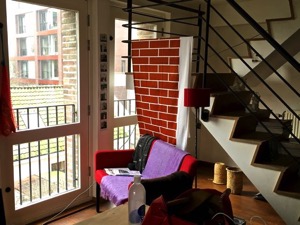
ONE OF MY FAVORITE Dutch painters is Pieter Jansz. Saenredam (1597 - 1665), who specialized in the depiction of whitewashed church interiors. He did not, of course, paint the image you see here: I photographed it a few days ago in a friend's house in Voorburg, where we were staying a few nights.

I took it, in fact, the moment we stepped inside the front door, before even taking off my coat. The light was extraordinary, as it so often is in this country — can something so frequently observed really be called extraordinary?

The staircase is quite steep and narrow, and its treads are quite shallow: these staircases are dangerous to those unaccustomed to them. There isn't room to spare in Dutch cities. The house is in a long row of similar houses, all attached in the row. It rises three storeys and quite likely has a loft above the third.

Before stepping through that door you can barely see, on the right, let me remark on the paint. I think the Dutch make the best paint in the world. I don't know whether it's available in the United States — I seem to recall environmental regulations have forbidden its import, but perhaps that's changed. It's glossy, hard, and rich-looking; there's really nothing like it. That's what's on that door; and you'll see it in other photos here.
Voorburg

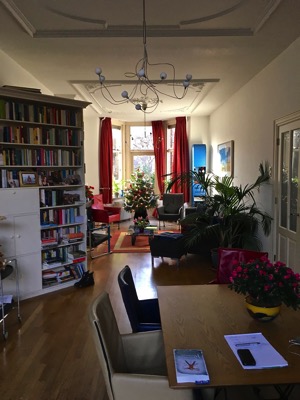
Stepping through that door on the right side of the entry hall we find a fine, spacious sitting room. Narrow, I suppose, but graceful for its high ceiling, filled with balanced light from large windows on the two ends. It was originally two rooms, as suggested by the ceiling panels; the bookcase bay recalls the original arrangement and separates the sitting area, at the far end of the photo, from a more worklike area with a table seating six and, out of the photo, a small upright piano.

Study

Upstairs a bathroom and a bedroom have been joined and reconfigured as a home office, with two desks, floor-to-ceiling bookshelves, a conference table, armchairs and a studio couch. At the back of this second floor, the master bedroom and bath.

The third floor contains three smaller bedrooms and a half-bath. The kitchen is tucked into the ground floor at the back of the sitting room, and has also a breakfast table capable of seating four or five easily in a glassed-in room, a sort of conservatory, that leads to the long, beautifully planned back garden.


A VERY DIFFERENT HOUSE always pleases and surprises us a couple of hundred kilometers north, in Friesland, in a village so small it lacks church, cafe, gas station — nothing but residences, a bridge over the canal, and the beautiful Frisian skies.

Rien1

Here you're looking through one of a pair of doors separating sitting room from entry hall and, beyond it, kitchen, with its tiled wall. The house is small, brick, and a national monument; the outside looks as it must have a century ago and more; and the interior, while modified for up-to-date appliances and technology, respects traditional visual and intentional configurations.

Like the Voorburg house, this cottage boasts its dramatic staircaseRiensteps leading to the sleeping loft, where there is also room for a small desk, laundry appliances, and storage.

The house belongs to a professional chef, and the open kitchen, filling one end of the ground floor, is one of its most impressive features.

Rienkitchen

Tiled walls, a huge French range, a capacious wooden sink, and under-the-cabinet refrigeration, as well as a large island countertop separating the kitchen from the dining table, facilitate preparation and service of anything from an omelet to a major culinary undertaking. The hood handles any ventilation problems readily — and silently, with a remotely located motor.

IMG 3566 IMG 3565

At the other end of the house, even though it's right on the road, the mood is calm. Paintings on one wall, books and windows on the facing one, comfortable settees and chairs express the ever-present Dutch quality of gezelligheid, usually translated as "coziness" but in fact so fundamental a value it transcends specification.


EntryDRIVE SOUTH a couple of hours and you'll come to the heart of the Dutch orchard country, the land between Maas and Waal, two broad rivers embracing flat country that's been generally overlooked by industry and tourism.

Here friends of ours have transformed a century-old farmhouse, which had also contained the office for the farm's steadily growing poultry operation, into a spacious, comfortable, orderly home.

Here the staircase has room to be spacious and public, though it leads from the public floor to the bedrooms above. In fact this is a second entry hall, a good idea in country prone to rain and mud in the winter. I was particularly impressed with the hugee solid wooden door you see on the right-hand wall: it extends floor to ceiling, wall to wall when swung shut. It usually stands open to bring outside light into the kitchen beyond.
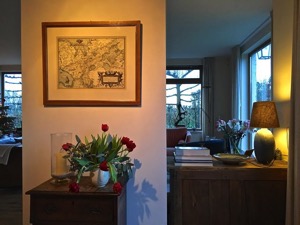
MapDeferring to the owners, I won't show you the kitchen itself, always a hub of activity. We're standing in it, our back to the stove, and looking past a display wall into the main sitting room beyond. I tried repeatedly to photograph the map on the wall, which is quite old, putting east at the top, and which nearly centers on this neglected corner of Gelderland, sometimes flooded delta country.

Our host explained the isolation formerly characterizing this country. The rivers run swift, and in the time before automobiles it wasn't easy to get off this island; people lived isolated even from nearby Nijmegen, twelve miles as the crow flies.

A few years ago we walked through the area, on the Lingepad, one of those marvelous Dutch long-distance walking routes. We stopped at a restaurant on the edge of the Waal. A fence around its terrace had provisions for boards to be inserted between posts, then caulked with straw and horse manure, to keep floodwaters out.

Our host is a poultryman; he and his brother inherited the business from their father, but then, when it grew too big for this tranquil countryside, relocated to Bulgaria. It's an interesting story: they dismantled the huge feed mill their business needed, loaded it on a barge, and sent it up the Rhine, then down the Danube to its new location. The whole trip was carefully planned, but heavy rains caused river levels to rise, threatening passage underneath bridges.
Sittingroom

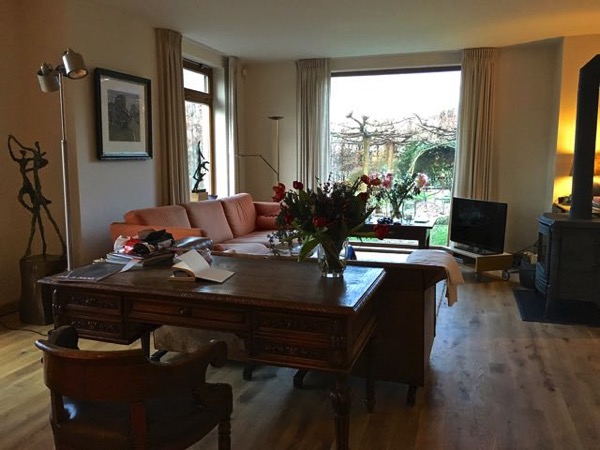
Here's a look into the less formal sitting room, where you could do some serious writing if you liked, resting your eyes gazing out into the winter garden; or yu could watch a little television, or simply meditate on the fire burning in the stove.
Chairs

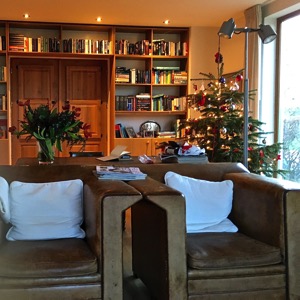
Another sitting room offers bookshelves and a pair of the most beautiful leather club chairs I've ever seen — I'd ship these chairs home in a minute, if I could pry them away from their owner. This is Christmas season, or was when we were there, so there's a small tree at the window. The doors between bookshelves have hinged panels, closed here, readily opened to let yet more light in. I don't know when I'e seen an interior so thoughtfully lit.

City row-house; provinicial cottage; country farmhouse. I hope our hosts in these places — and others I haven't mentioned: A small-town apartment; a big Amsterdam canal apartment — I hope they'll pardon this intrusion into their spaces. I share them with the blogsphere with a feeling of affection and approval; it seems to me they portray taste and modesty in a manner most instructive in this age of excess and commodity…

Modes of transportation

On train
photo: Grace Zivny
Hammarby, Stockholm, January 10, 2016—

WE BEGAN THE LAST leg yesterday, leaving our delightful Amsterdam apartment on Prinseneiland for a small but perfectly comfortable room in a cut-rate hotel in a Stockholm suburb.

And in the course of the move we use nearly every form of transportation we've handled so far — only the bus and the metro are missing.

First, since there are now three of us, I call a taxi to take us, our visiting granddaughter, and six pieces of luggage to Amsterdam's Centraal Station. The taxi app I use doesn't work in this country, I'm told, so I call the first number that turns up from a Google search.

Plunged immediately into a pit of phone-ladders. Negotiable, and soon I think I have actually ordered a cab — but then I have to enter a credit card number, and I back away.

The next phone number belongs to Electric Taxi, and is answered by a human being, who — like every telephone voice I'ver encountered here — speaks English. She sends a cab right over. We barely have time to get downstairs.

The cab is beautiful, shiny, solid-looking, spacious and comfortable — a Tesla. Forty percent of our cabs are Teslas, the driver explains; the rest are Leafs. (Charmingly, he pronounces it "leaves.") Too bad you're only going to Centraal; I could take you out on the highway so you can see what it's capable of…

After some serious discussion we stay with the original plan. The ride is direct and speedy. He takes my credit card with a little machine. One does not tip taxis here. We're out on the sidewalk, under the station overhang, with a pleasant experience fresh in mind.

Other taxi rides here have been just as pleasant but sometimes more interesting. Twice we've taken cabs that turned out to be minivans — I don't know why they're so popular here. Both times it was late and dark and we were in a hurry. Once it was raining heavily, the only rain we've encountered on this trip.

In the dark, and especially in the rain, taxi rides can be interesting. Amsterdam is a crowded city, especially the part we traverse. Bicycles and pedestrians everywhere, nearly all of them in Calvinist black. In my many weeks in Netherlands I've only seen one accident, and that inexcusable: a tram grazed a bicycle. The tram had not left its track to do this, so it was clearly the cyclist's fault. That didn't make him the less an object of outraged sympathy among some onlookers, but most clearly looked at him with near contempt.

That was in The Hague, many years ago. Cyclists — I know, I'm generalizing — have if anything grown more self-righteous since. (Hasn't everyone, other than us, of course?) They have their own lanes, of course, and they have the right of way. But most of them don't ride with lights, and in the rain their heads are down, and they seem to count on drivers' skill and intuition to a foolish degree.

OUR TRAIN to Schiphol, Amserdam's international airport, has been cancelled. This doesn't really matter: there seem to be eight trains an hour, this time of day. We head for information to find out which platform the next train will leave from, though I know perfectly well it's track fourteen, it's always been track fourteen, the furthest from the entrance to the station — in the old days: now Centraal has been given a splendid new shop-and-cafe-heavy entrance on the north side, where a lot of development has been going on.

Our fallback train is a local, of course, so the trip takes a few minutes longer than usual. Again, it doesn't matter; we barely have time to settle ourselves on the fold-down seats near the doors — preferable for us, with our luggage — before we're there.

Trains arrive and depart right from the Schiphol terminal, which has one big concourse-lobby. It will be the same in a couple of hours at Arlanda, Stockholm's airport, but that will be another trip altogether. The commute train there takes an hour to get from airport to our station, and isn't quite as comfortable.

The best train trip of the last few weeks was in Finland, where we went from Rovaniemi in the north to Helsinki in the south mostly in our sleep. Our little compartment was snug but comfortable: I handled the ladder to my top bunk with my customary grace and good humor, and my companion found her lower bunk perfectly comfortable.

Best of all, I thought, was the cunning lavatory. On opening its door you're greeted with the two appliances you want first: commode on the right, a little out of sight when you stand in the doorway; sink just ahead, well lit, with a good mirror above. I don't shave, of course, but if I did it would all be quite practical, with an electric outlet handy. (They're at the heads of the bed, too, so you can charge your phone overnight.)

Over the sink, though, there was a shower-head. How the devil would that work? Do you have to stand in the sink and crouch to use it?

No: a chrome lever turns out to be the handle on the problem. It releases a catch allowing the entire room to swing around, revealing a shower stall. I haver the uncomfortable idea, for just a moment, that perhaps the entire installation is shared with the next compartment — but careful inspection shows there's room on the shared wall for two of these ingenious affairs.

TIME TO CONSIDER our flight. At Schiphol, if you have time, there arer plenty of shopping, dining, and drinking facilities, on each side of security. Our plane has been delayed by half an hour. Still, security looks uncrowded at the moment; let's go through.

After the x-ray, an attendant wants to look in my carry-on. I have too large a tube of toothpaste: it should have been in a little Ziplock bag. Don't worry about it, he says, happens all the time. Lindsey has had to take her boots off; otherwise the procedure is unremarkable.

We take the long long moving-sidewalks to our end of the terminal and find our gate. No one is there: not surprising; we have almost two hours before takeoff. It'll be late when we arrive at our hotel, whose restaurant will be closed — let's have something to eat.

There used to be a quite acceptable pannekoek way upstairs in a sort of observation tower, and we head for the elevator. But everything's been revised here recently, just as it had at Centraal Station, and a food court has taken over, with the internationally predictable leases. We return to our gate and find a sandwich shop with a Spanish theme. We make do with jamon Serrano and a glass of Spanish beer. There will be nothing said about this over at Eating Every Day.

The flight, on SAS, is remarkable for only one reason: there is no explanation of safety precautions. A little odd, since the captain asked us to listen to them, in his announcement. I did see the attendants talking pleasantly to people sitting in exit rows, so I suppose they got their instructions; the rest of us will just have to follow them if there's a problem.

There isn't a problem, of course, and I promptly go to sleep, to wake up shortly before landing, probably from the change in engine noise, or maybe cabin pressure.

We took one other internal European flight on this trip, about three weeks ago, on Air Baltic, or whatever it's called this week, from Helsinki to Amsterdam, changing planes at Riga. Had we more time, we'd have spent a few days in Riga. I remember it fondly from a stay in 1983, when times were quite different. Baltic Air, or whatever it's called this week, is a cut-rate airline, like Norwegian Airlines, on which we'd flown nonstop from Oakland (California) to Stockholm for $190. (Dinner was an extra $40 or so, but then that's what dinner cost, at the least; and our suitcases paid another $25 for their seats down in the hold, but at least they didn't eat dinner.)

There's no passport control for us — we've flown between Schengen countries — and as usual we simply ignore the option to declare stuff at customs. We don't have anything to declare at any rate. It's a long wait for the baggage, but that's my fault; I seem not to have recognized our bags. Once again I regret not tying a little colored ribbon to the handles. Will I ever learn to travel?

At tram

AFTER THE LONG train ride to our station we step out carefully onto a platform paved with ice. We walk with extreme care to the lift and emerge in a little vestibule I recall from a month ago: the turnstiles on the side we want to use are not available; a uniformed man in the ticket window cautions us to go the other way.

Last time we took the tram here in the wrong direction: I know better now, but have forgotten the quickest way to cross to the correct platform. It's snowing. We watch our tram leave the platform; then gingerly drag our wheeled suitcases across the tracks.

I've heard it said that the wheeled suitcase is responsible for the democratization of travel, for better or worse — it has eliminated the need for porters. Could be, but it's made our life a little easier. Though not in Venice, much of the time, with all its steps at bridges; and not on ice and snow. A few weeks ago I saw a young woman pulling her suitcase in a little sledge, apparently made for the purpose: but that was at the Arctic Circle, where such a procedure must be much more routine.

The next tram arrives in due course, in eleven minutes, as the automatic sign you see at every tram-stop had promised, and we ride with pleasure to our new hotel -- new to us, and only the sixth (and last) hotel in the five weeks of this trip. Much of the time we've stayed with friends, and their homes may (or may not) be the subject of another post. One of them was a luxury hotel booked by our friends for their anniversary party; the others have been the cheapest decent hotels we could find at Booking.com, our current fallback website.

I'll write about hotels another time. First, to get to tonights's, we havre to walk a couple of blocks up a gentle hill from our tram-stop. It's past ten o'clock now, quite dark, and quite cold. The streets and sidewalks are covered with ice and snow. Parked cars have a foot of snow on their roofs. Our shoes are leather-soled. We'd thought of getting little crampon-like attachments for them, but it seemed silly.

We did fall once, in Rovaniemi, when we were out late at night in search of the elusive aurora borealis. (Have I mentioned that we finally saw it, when least expected, rounding a corner in Helsinki?) My foot simply slid out from under me. Unfortunately, we were walking arms linked, for mutual support, and I pulled my sweetheart down on top of me. No harm done, and a little laughter.

But a fall could be disastrous, particularly impeded by all this luggage. We pick our way carefully.. Thankfully there are no careening bicycles, no trotting athletes, no rowdy teenagers cutting in front of us. Only the still cold dark night and the magical white of snow.

We've done a lot of walking on this trip, averaging about three and a half miles a day, my iphone tells me, perhaps truthfully. It remains the best way to see things. Trams and buses, yes, we've made good use of them, buying city-cards that you simply top up with your credit card when necessary: they do a good job of concealing from you how much you're actually spending on each trip.

Trams and buses are frequent and easy to use in Stockholm, Helsinki, Amsterdam, and The Hague. You do have to remember that stops are frequently far apart, though — and so you walk. Thankfully, we still can, relatively easily, even on the snow.

Thursday, January 07, 2016

Three photos from the window

Prinseneiland, January 7, 2016—

IMG 4463

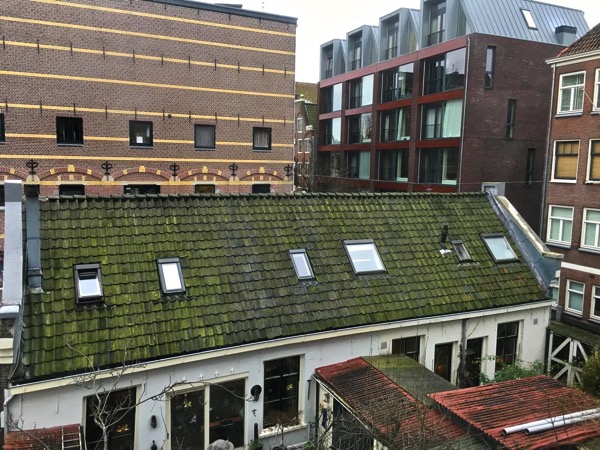
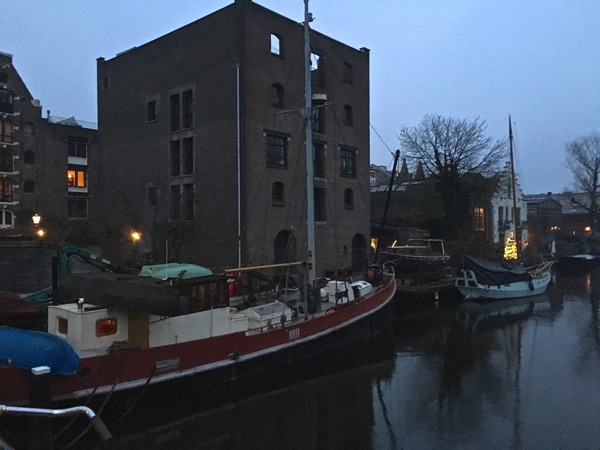
I HAVE BEEN WRITING here recently about the pleasures of orderliness and clarity. The opposite has its attraction too, of course — in fact the greatest pleasure may come from the tension between, or the mediation of, both: disorder and clarity. And so I give you three snapshots out the side window of the room I have been working in. IMG 4537

It's a big, comfortable work room, well lit by this window and another, to my left, on the adjacent end wall. I sit at a long table, six feet of it desk, another six feet bare worktable; in front of me and behind me, on the long walls, rows of bookcases.

But I'll write another day about this apartment, and other places we've stayed in on this visit to The Netherlands. Dutch interiors are interesting enough for their own post. For one thing, they exhibit that kind of orderliness I've been taken with recently. Today let's look out these windows.

I think this is my favorite corner of Amsterdam: the Westelijke Eilanden — "western islands" — built beween 1610 and 1615 to extend the Amsterdam harbor, in those days on the Zuider Zee.

Look at the back of your left hand: the thumb is curling toward Amsterdam's Centraal Station; the index finger is a thin peninsula to the west of what remains of Amsterdam's harbor on the IJsselmeer (the former Zuider Zee); the little finger is another peninsula. The short ring-finger is our island, Prinseneiland. To the north of it, spanning the tips of the middle two fingers, is Bickerseiland, named I suppose for Gerrit Pietersz Bicker (1554-1606, since his son Andries was living when the islands were raised, and it would have been inappropriate to name one for a living person.

The far island, at the north end, spanning the three fingers, is Realeneiland, "island of the reales", named for the Spanish coins: for the Bicker family sent plenty of silver to Spain, and other supplies too, and were paid I suppose in reales. The name of the restaurant De Gouden Reael, housed in a 1648 building on this island, records this.

For centuries these islands housed small warehouses and workshops related to the shipping trades, according to Wikipedia. They stored products coming from the middle East and the Baltic: grain, tobacco, wine, salt, herring, anchovies, tar. By the late 19th century, though, ships had grown too big to harbor here, and the islands were all but abandoned. Map1

In the housing crisis following the end of World War II they were discovered by artists and intellectuals; a new wave of gentrification has begun in the last few years.

But the three small islands retain their character, as can be gathered from these photographs. The canals are lined with old sailing ships, barges, and skûtsjes in varying degrees of decrepitude. Some have been converted to residences, their decks and canalside terraces often gardened. Old architecture stands next to newer buildings: in the third of the large photos here you can just see a 17th-century warehouse between the high brick building on the left and the new town houses on the right.

The canal at left in the top photo is the Bickersgracht, and the street leading from the bridge (unseen to the right of the photo) is the Galgenstraat, "Gallows Street," which bisects our island. In the old days, if you stood on this street and looked east, you'd see corpses hanging like laundry, apparently on that index-finger peninsula. They were the bodies of criminals executed on Amsterdam's main square, the Dam, and "then brought by boat to Amsterdam North, where they were hung, visible to everyone as a deterrent… left hanging until the ropes were destroyed or damaged, pecked by crows." (I don't recall where I got this quote.) There was a movement to rename the street after this practice was abandoned, but "Middle Street" never caught on.

The only other street is Prinseneiland, which encircles the island. IMG 4464

THE OTHER DAY I looked out the window to see a figure at one of these skylights, apparently a woman struggling with a stepladder. Inside the building, I mean. She finally got it into position and carefully climbed it to wipe the skylight clean. She looked in my direction, but I don't know if she caught me watching her or not. It's a Dutch thing to sit by the window and watch whatever happens. In many windows you'll see lace cloths stretched in carved wooden frames, set into the window to hide the observer from the observed. Most Dutch windows are left uncurtained, though: it wouldn't do to look as if you were hiding something.

As bad as the weather can be, the Dutch like outdoor life. The table and chairs under the rusting iron roof are probably used at lunchtime even in the rain. The other day we walked past a park-cum-playground on Bickerseiland, and saw, at dusk, about four o'clock, two couples, in their fifties I'd say, sitting around a bonfire they'd made, conversing over tea or coffee.

Since smoking has been prohibited in bars and restaurants you'll see tables and chairs outside most cafe doorways. There'll be an improvised roof against rain, perhaps, and often there'll be blankets on the chairs. Amsterdam in January is one of the coldest places I've ever visited, almost as cold as the arctic circle, because the cold is damp, and there's often a stiff breeze. Good sailing climate.

IMG 4462

I love looking at the complex disorder of these buildings. Buildings, ships, streets. On the "mainland," among the famous five horseshoe-shaped canals defining old Amsterdam, especially on the five canals, the rows of houses are proud, clean, and orderly. Each was built quite consciously, I think, to take a proper position among its neighbors, apparently modest yet clearly intent, often, on showing up the others: a gable a little more baroque, a stoop a little more ostentatiously plain, sober decorations just a tad eccentric. But here on the western islands pride gives way to practicality, and things have been built, and continue to be built, more as they must, for whatever architectural or economic reason, than as they might.

Well: I titled this post "Three photos from the window." Here, to close, is a fourth photo, of the building I've called elsewhere "our Einstein-on-the-Beachy blocky building" on the Bickersgracht. The window I've been looking out is on the left side of the building, second floor (third floor American style). It's twilight, just before five o'clock, and perfectly still; time for an apéritif…

IMG 4548

Tuesday, January 05, 2016

Clothing

12311142 1126511297361654 1513474408686793908 n
Prinseneiland, January 4, 2016—
THE PEACOAT has served me well. I bought it at least fifty years ago, in the mid-sixties, when peacoats and paisley shirts and corduroy trousers were all the rage. I bought it used, furthermore, in the Berkeley flea market. I don't recall what I paid for it; probably no more than ten dollars. I've never seen any reason to replace it.

I have other cold-weather gear, and I brought just about all of it with me on this trip. Two other jackets, for example, to wear under the peacoat if necessary. Even at minus twenty degrees (Celsius: equivalent to minus four Farenheit), and in a biting wind, I've yet to put one of those jackets on. I'll probably leave one of them here: I'm sure someone will put it to good use.

This photo was taken in Stockholm three weeks ago; it wasn't particularly cold, and the coat is unbuttoned. Now I'm wearing it buttoned; sometimes all the way up to the neck. Made of finely woven Melton wool broadcloth, it turns the wind perfectly. Under it I wear the proverbial layers: a sleeveless wool sweater my talented companion knitted for me, also wool; a tightly woven cotton dress shirt; a synthetic tee shirt of some sort.

At the neck, a mink throat-cozy my daughter knitted for me. Sometimes a dress scarf from a street merchant in Rome. Always, and in this photo, a marvelous alpaca scarf my talented granddaughter made for me.

I nearly always wear a hat — this photo is misleading in that department. In the frozen north I wore a knit stocking cap pulled down over my ears; since coming to the Netherlands the wool beret has been sufficient. And then there are the gloves: I brought a favorite pair of tight-fitting synthetic ones, but of course I lost one in Helsinki, the right one: I'd pulled it off to use the phone, and my numb fingertips must not have noticed its sudden surrender to gravity.

For a few days I walked around awkwardly, scrunching the cuffs of the peacoat sleeves and thrusting them, along with my cold dead hands, into the pockets. Pockets: iPhone, extra iPhone battery, its cable, another iPhone battery, hat when inside and too lazy to fold it under my belt, tramcard if I'm careless, handkerchief, neckband if it's warm: amazing what these pockets will hold — handy when going through security, by the way — but the already heavy peacoat becomes pretty unwieldy, especially when that long scarf is threaded through its sleeves preparatory for the garderobe at museum, the coatrack in the restaurant…

IMG 3027Oh, yes: below the belt. Usual undershorts; long johns; long knit socks (also family-knit), normal walking shoes. In Rovaniemi, on ice and snow, I noticed the locals mostly wore trainers. My leather soles were treacherous, of course, but I only slipped and fell once.

My companion the Contessa dresses similarly, though she persists in avoiding hats. It's one of the few sources of continual domestic discord, and I think, privately until now, that her distaste for hats has been aggravated by my fondness for them. In Lapland she did go so far as to wrap her scarf around her head to protect her ears. I was surprised to find myself developing a new attitude toward hijab — I wonder, for example, if the presence of sand in the air may not have had something to do with its development. There was no sand in Lapland.

IMG 4038 How do the locals dress? A photo taken in the Gemeente Museet in The Hague may, um, address the question. They've all checked their outer garments at the garderobe, of course. (This is one of the reasons you don't stay in a museum until closing time: the crush at the counter is good-humored but time-consuming.)
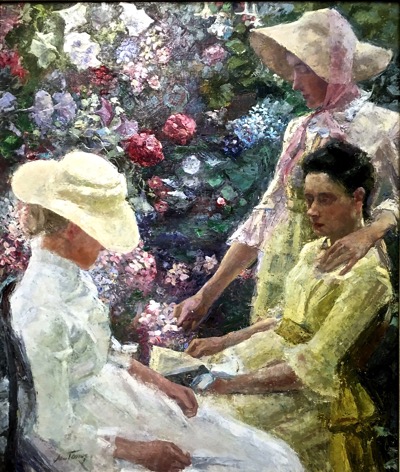
These people are in a gallery devoted to a major temporary exhibition, Kleur Onketend (Color Unleashed), truly a marvelous exhibition of paintings (and a few surprising very early color photographs!) by European masters, many neglected, working between say 1880 and 1930, and they — the museum-goers, I mean — are dressed like the intelligent, leisurely, complacent people they (and we) are. IMG 4035 They contrast, of course, and not only because of the season, with the three ladies in Jan Toorop's delicious Trio fleuri (1885), with their sunbonnets and light frocks. Reminding me that summer does exist in these countries, even in Lapland I suppose. IMG 4072

Returning to the present, another exhibition in the Gemeente Museet was devoted to the flourishing and often startling Dutch fashion industry. A brilliant example of curatorship, this Ode to Dutch Fashion provides fascinating notes on aspects of Netherlandish clothing, even beginning with distinctions among the more than fifty shades of black in 17th-century Dutch portraits (crow black, coal black, glossy black, etc.).

The show culminates, in the playful Dutch manner, with a room inviting you to take a selfie behind a full-size photo of one or another of the (much) more recent fashions. I forgot to take note of the designer of the natty white suit I seem to be wearing here; I'm pretty sure it's Viktor and Rolf, and I wish I'd had it for the anniversary party we attended in the provinces a few days before Christmas.

The ubiquity of camera-phones — here in Netherlands, almost exclusively the iPhone, it seems — has apparently led to museums throwing up their hands and dropping the no-photography rule. (Disable your flash, of course.) So I happily snap away, usually taking care to photograph the label as well as the painting. This blog post is not about art or museums; it is about clothing; so I won't go further into the frequently disturbing subject of photography at the moment.

Instead I'll end with the juxtaposition of three parades of clothing. The first is of course from Ode to Dutch Fashion: five of what must be over one hundred striking ensembles, almost any of which could be worn on the street — though perhaps not in this weather. IMG 4063 IMG 3390

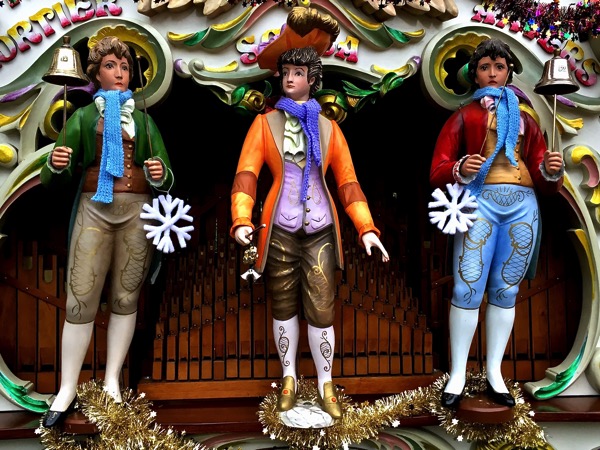
The second is of a trio of dandies from the 18th century, I suppose, carved in wood I hope, though, who knows, closer inspection might reveal them to be plastic reproductions. They stand stiffly but gracefully on the front of a draaiorgel, a street-calliope, and rhythmically and discreetly strike their bells at certain points in the performance.

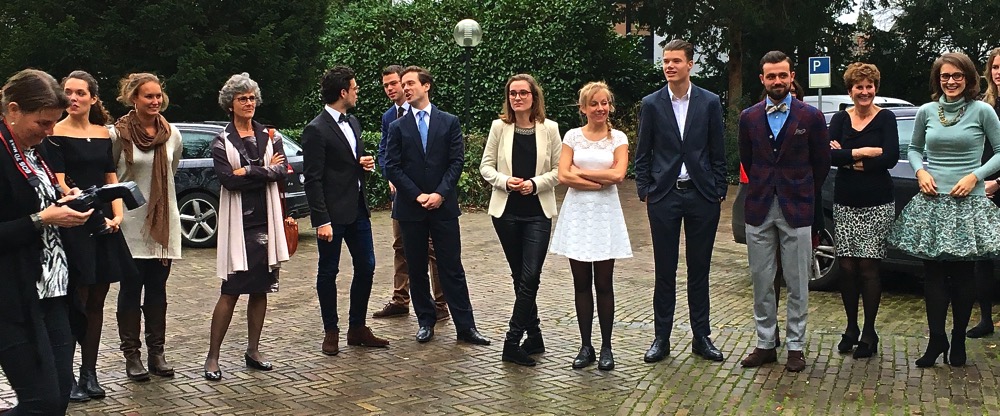
Finally, there is a group of contemporary Netherlanders standing out in a parking lot across from the draaiorgel. They are waiting to have their photograph taken by the professional photographer who is standing at the left, checking her camera. The group family photo is for an important occasion, and they are dressed carefully, with the casual perfection (and, in some cases, playfulness) I've come to associate with the Dutch in general — partly through my very grateful forty-year relationship with a remarkable family. I hope they will not mind my revealing them here. IMG 3378

Monday, January 04, 2016

Alvar Aalto

IMG 4360
Prinseneiland, January 4, 2016—
HERE YOU SEE, rather stretched horizontally in a desparate attempt to fix a perspective problem, one of the most affecting sights I saw last month in Rovaniemi. It's a small corner of the Rovaniemi City Library, one of three central public buildings designed in the late 1950s by the great Finnish architect for the rebuilding of the northern Finnish city, the provincial capital of Lapland, left in near-total destruction at the end of World War II.

The rolling table, the armchair, and the lamp are Aalto's designs. The books on the shelves and the table are about him, and you're welcome to sit in this comfortable chair under this practical reading light and browse through them. Everything is calm and orderly. I think it must be difficult to harbor disorderly thoughts in such a setting. The function of visual clarity and orderliness in public settings is the encouragement of civic and civil ease and order.

I like the statements in the website linked above:

The principle of free design is one of Aalto's trademarks and the predominant theme of his library design is social equality. Aalto designed his libraries as low-lying, people-sized buildings with unadorned entrances.
IMG 2984 IMG 2988
The ancient amphitheatre theme of the Rovaniemi Library is metaphorically transformed into a fanlike open book.

In the libraries designed by Aalto the lending department is divided into two levels. The reading bays offer peaceful places for study with natural light from the skylights. The common service desk in located on the upper level.

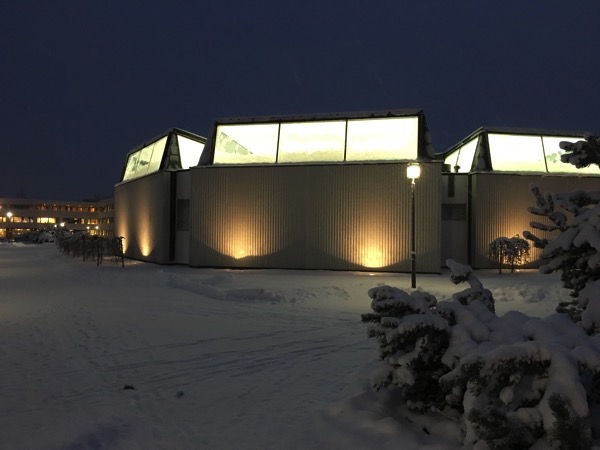
IMG 3044From the outside, the skylights resemble blocks of ice. Inside they join the lowered ceiling with an elegant arch that reflects the natural light. The indirect light is gentle and does not produce shadows.
The library serves some 180,000 people, a third of whom live in Rovaniemi. (Finnish Lapland, the northern half of the country, is very sparsely populated.) We spent a fair amount of time in this library, investigating its various departments, staying out of the cold, waiting for our night train to Helsinki. The library is not wheelchair-friendly: various reading bays and specialized shelving are at different levels, three or four steps up or down, reinforcing the feeling that while one can concentrate undistracted on one's reading — or writing, or studying — one remains connected to the entire system.

IMG 3200

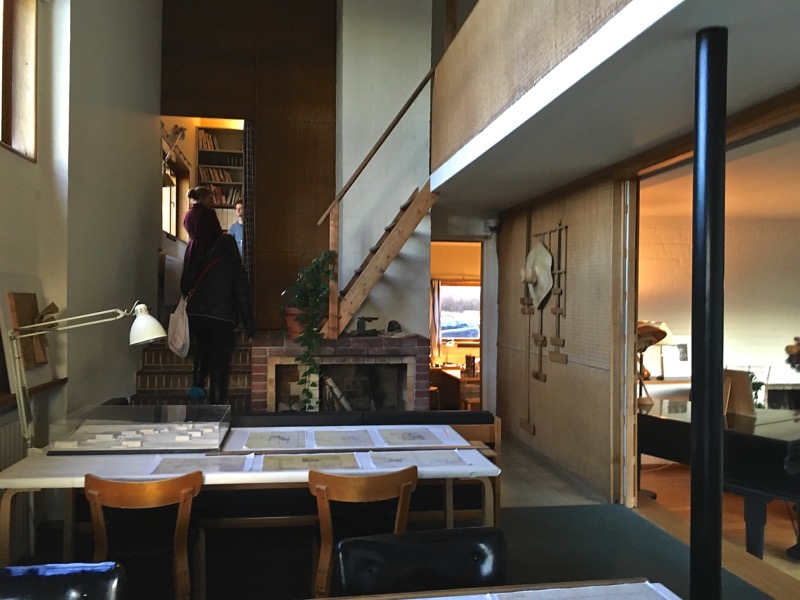
Here is the living room in Alvar Aalto's house in Helsinki, built in 1936. The house is surprisingly small, but includes four components: a studio-office with drawing tables for eight draftsmen and Aalto himself (separated from the living room by the large sliding panel at the back of the photo); the semi-public living room, for gatherings of friends and perhaps close associates; the more private sitting room and bedrooms upstairs, also now open to the public; and perhaps two servants' rooms and the small kitchen, which we were not able to tour.

IMG 3199 The studio, seen here from Aalto's desk, has its own entrance, through a small office seen at the back of this photo, behind the silhouetted standing figure. There's also a small library, attached to the office. The high windows face northwest. The steep ladder-staircase at the back of the photo rests on an open woodburning fireplace; it gives access to a narrow gallery along the top, perhaps for observation of the draftsmen; perhaps display of drawings…

We were particularly taken with the private rooms, upstairs: two or three bedrooms, a guest bedroom with a small couch, and a small sitting room with two armchairs, a settee, a credenza, a small table, and a low brick fireplace.

IMG 3210 IMG 3211 IMG 3207

The house is open to public tours; it's located at 23 Riihitie. Google Street View shows the house beautifully, softened by lilacs and vines, and featuring an interesting detail: the garage door, slightly popped out, I suppose to accommodate a car longer than the one originally owned…

We didn't make a concerted effort to seek out further Aalto experiences; there wasn't enough time. You could profitably spend a month or two studying architecture in Helsinki alone. What particularly interests me, at my age and in these times, is the extent to which rationalist planning and architecture can contribute to a well-ordered civil society operating smoothly on the technological level — including transportation, communication, and distribution — while encouraging both such public arts as opera, theater, music, and museums and private opportunity for cultural, intellectual, and physical development.

Clearly there's something in the Northern European mentality that leans in that direction, and there's something in the American mentality leaning away.

Wednesday, December 30, 2015

Rovaniemi

IMG 2924
The view out our window, Gasthaus Borealis
Puiflijk, December 31, 2015
LONG TIME no blog; sorry: you can do, or you can write about doing; recently we've been doing a lot of doing. Nearly two weeks! Landscape; cities; languages; museums; transportation…

And I think I have been enchanted by Rovaniemi. We spent only three days there, and two nights, and we left three days ago now, but it seems more present in my mind than does Helsinki, which is not exactly short of impressions itself.

Rovaniemi is the capital city of Lapland — the northern half of Finland — with a population of about sixty thousand. About six miles south of the Arctic Circle, it's a bit of a tourist destination even in the winter: it's near Santa Claus Village, which didn't interest us; and it offers viewings of the Aurora Borealis, which did.

Or it should offer such viewings. In fact the town is very brightly lit, and our only serious attempt, walking about in -20° (Celsius: -4° Farenheit) weather for an hour or so, in relative dark, on snow and ice, turned up nothing but a frozen nose.

IMG 2928
IMG 3012
IMG 2933
IMG 2937
IMG 2934

But there were compensations. For one, the museum Arktikum, where this aerial photo of reindeer on the move suggested to me a completely different way of looking at, for example, cave paintings of groupings of animals. Distortion, gathering, orientation, direction — and recalling that the climate of the cave painters was very different from ours, and was undoubtedly glacial-marginal…

You can think about such things forever; there are so many things to see and to think about. The white canvas of the snow helps this, of course, bringing color out more vividly. More to the point, the snow covers all kinds of visual distractions. You can't tell the sidewalk from the street. And there is much less traffic outside; hardly anyone on the sidewalks; very few cars, and they slow.

Then there's the effect of the short day. We knew all about this, of course, intellectually, but it's another thing to experience it actually. Daylight begins to take hold at ten in the morning; by two-thirty it's definitely fading. In compensation, the twilight hours are long, and the darkness itself is bluer than black, and offset by the nearly full moon and the reflective white of all that snow.

Of course we only experienced three of those short days, though the last week had gradually got us used to the idea as we settled in Stockholm, then moved our way over two or three days toward the north end of the Gulf of Bothnia. I'd love to spend a couple of solid weeks here, preferably when the moon is dark, to get a better idea of it; and I regret that Rovaniemi is so much lit, though I understand the desire of its citizens to do so.

I'd like, too, to spend a few weeks this far north in the summer, though I imagine that would be more fatiguing for lack of sleep. The point is, I can't really begin to imagine how formative the radical swings in daylight length are among the influences on the arctic mentality. To what extent does it encourage a desire for sociability, for example; to what extent does it produce a pragmatic kind of fatalism, a sense of human vulnerability in the face of natural elements.

Arktikum is a very impressive museum, with a wide variety of material, whose curatorial presentation encourages this kind of contemplation. The main hall combined artifacts and reconstructions, two- and three-dimensional exhibits, and explanatory panels (in English, thankfully, as well as Finnish) to present a fine introduction to the Arctic life. It included nature, with stuffed bears and muskrats and these three swans flying overhead; and climatology, with clear explanations of the patterns of wind, temperature variation, and daylight; and botany; and anthropology.

The latter included what seemed to me a thorough and very sympathetic overview of the Sami, the indigenous migratory people we used to call Lapps, for centuries reindeer herders but now mostly apparently settled into residential communities of various kinds. We were told later on, in Helsinki, rather dismissively, that only perhaps ten percent of the Sami still herd reindeer, and they do that using helicopters; that there hasn't been an undomesticated reindeer for over a century; that the Sami now live mostly on the dole or by producing handicrafts. I'm sure this is all true from the perspective of the person who was explaining it all to us; but I doubt it is true from the Sami point of view, and I can only reserve my judgment.

As I say, the Arktikum presentation was sympathetic, reconstructing the Sami way of life before "civilization" began to settle the extreme North but also following them into the present. One affecting diorama, for example, showed a meeting of three or four apparently unemployed men in a rural gas station-cafe; they could have been in Nevada or Wyoming.

Another presented the life and career of an itinerant photographer, Valto Pernu (1909-1986), the last market photographer in Finland, who traveled with a wagon studio and a big camera of his own making for years before settling in Rovaniemi for his last twenty years, still photographing in the summertime in a studio tent.

We were dumbstruck confronting one portrait he'd made, I suppose in the 1930s, of an adolescent boy in a visored cap reseting on his bicycle in front of a cabin. He looked exactly like me at sixteen. I know my haplogroup (I-M253) represents peoples who migrated out of Africa eventually through Hungary to northern Europe, with a particular concentration in Scandinavia, so perhaps the proud, sober, rather grumpy teenager posing somewhat self-consciously on his bicycle really is me in an alternative universe; the light, cold, and hours here encourage this kind of thinking.

There's also a quite scientific component of exhibits in the museum, explaining winds, the earth's tilt, glaciology, and all that sort of thing — including, of course, the Northern Lights, still eluding us. But recently it's human history that's interested me the most, and I wanted to linger longer than we could afford over a temporary exhibit relating to the German occupation of Finland during World War II.

When I was a boy it seemed to me we took a dim view of Finland. World War II was on, and in Berkeley shop windows there were lots of propaganda photos and posters. On the maps, Finland was clarly a part of the Axis — I always confused "axis" and "axle," and wondered at the long stretch of black on the maps indicating the enemy, from Finland on the north south through Germany, Austria, Czechoslovakia, Romania, Greece… All those territories were The Enemy, Finland included. It's disturbing that the prejudices formed so long ago, if not confronted and examined, tend to remain influential.

Finland was a part of Sweden from the 12th century until 1809, when it was granted a degree of autonomy as part of the Russian Empire. During the Russian Revolution, in 1917, Finland declared her independence, then plunged into civil war between the leftist "Red" Finns and the German-supported anti-communist "Whites." The war lasted only three months, thanks to the intervention of the German army; but it was brutal, involving murders and starvations and the conscription of boys as young as fourteen.

The new Republic of Finland knew peace only until 1939, when the Soviet Union moved against its southeastern coastal and agricultural land. Three wars followed in quick succession: the Winter War, 1939-40; the Continuation War, with Germany now occupying much of the country and continuing war against the Soviets; then, from 1944 to 1945, the Lapland War, when Finland turned against its former Nazi ally. Enraged, the Germans left nearly total destruction behind their retreat.

Rovaniemi was devastated. Two large relief maps in the Arktikum museum present the city as it was before and after that destruction; the photographs and narrative panels in the temporary exhibition brought more immediate and personal insight to the fury of the betrayed Germans, who during their occupation had grown quite intimate with the Finns.

(Finland was important to the German war effort as a beachhead against the Soviet Union, a supply center for the Norwegian campaign to cut off supplied shipped around the North Cape, and for the supply of minerals and lumber.)

After the final defeat of the Axis in 1945 Finland rebounded rather quickly. Unlike western Europe she did not participate in the Marshall Plan, as she also did not join NATO: proximity to the Soviet Union dictated a prudent course. Likewise, though, apart from severe reparations paid to the USSR, she was not completely dominated by Russian authority.

The Finnish architect Alvar Aalto was commissioned to design the rebuilding of Rovaniemi, and submitted a plan based on the main existing lines: the railroad right-of-way (all rails seem to have been ripped up), the river, and the tracks of the main roads. Taken together and viewed from above these suggested the outline of the head and antlers of a reindeer, symbolically underscoring Rovaniemi's importance to the northern province.

As an administrative and cultural capital for all of Lapland, the city needed major public buildings. Of Aalto's project, three were realized — administrative center, library, and concert hall. But Aalto and his work will be described here another day…

IMG 3048

Monday, December 14, 2015

Bus to Luleå

IMG 2775
Hotel Amber, Luleå, December 14, 2015—
ON PAPER it didn't seem much could go wrong. After a long night's sleep in a comfortable bed in the home of an old friend's expatriate son and his companion, and a morning lazing about the center of town, and a delicious long lunch (described here), we had nothing to do but charge up the iPhones, write up a few notes, and hop the bus to Luleå, continuing our northward trek in search of the elusive aurora borealis.

I'd already booked the next hotel, this comfortable, inexpensive, pretty little place a couple of blocks from the bus station. True, their dinner closed down at 7:30, but it had been a fine, filling lunch; besides, there'd be a bar or café nearby for a nightcap. There was free wifi on the bus, and I have plenty of reading matter. So we joked a bit with the alternate driver — these long-distance buses apparently routinely carry two drivers — and settled into our seats, mine by the window so I could peer out for the aurora.

The bus went hardly ten minutes, then stopped by the side of the road. I was engrossed in George Packer's engrossing profile of Angela Merkel in The New Yorker and paid no attention for a fair while, but it began to seem we were sitting for an awfully long time…

Finally an announcement was made, but of course in incomprehensible Swedish. We sat and waited. No serious problem here; we aren't making a connection to another bus or train or anything; we just want to get to our hotel.

The alternate driver appeared with a can of ginger cookies and a tray containing cups of coffee — I don't know where he'd found them. We asked what was happening. Problem with the compressed-air supply, he said; when the bus is turning, or the door is opening, it needs compressed air, and there doesn't seem to be enough; he doesn't want to drive the 265 kilometers to Luleå without enough compressed air.

In that case, I suggested brightly, it might be a good idea to get another bus.

Just what we're doing, he said; when there's enough air pumped up, we return to the barn and switch buses.

And so, finally, we did; but the barn was to the south of Umeå, and we lost about an hour. I finsihed the Merkel profile. (I very much recommend it; you'll get some insights into the national mentality of her nation.) Fine, I thought; I'll just get some Internet stuff done. But the wifi did not work on this bus, apparently it does not run on compressed air. We drove through the night, stopping at a few towns and one minor city along the way.

There was a movie, but it was on a screen at the front of the bus, some distance away, and I didn't have headphones. In truth I prefer to watch movies on airplanes with the sound off, making up my own story, and I thought I'd just do that here, too — but it turned out the movie was subtitled, so it began to make some kind of narrative sense.

But the subtitles were in Swedish, and appeared only sometimes — when the cast was communicating in Sign. When they actually spoke to one another there were no subtitles. Well, yes, sometimes there were. Was the cast speaking some of the time in Swedish, so no subtitles would be needed for most of us on the bus, and at other times in some other language? French, perhaps — two of the characters were apparently named Nicolette and Quentin.

And why would a pianist be playing music to a young woman who communicates only in Sign? And why were people on a dairy farm? And why so much angst?

Ultimately we pulled into the Luleå bus station, a good hour late. The streets and sidewalks were covered with snow. We walked  v e r y    c a r e f u l l y  to our hotel, which was locked up tight. We were prepared: they'd sent us the front door code. An envelope on the desk had my name on it, and our room number and key inside. There was even a refrigerator in the lobby with free sandwiches and fruit.

Two details remained: to buy tomorrow's bus ticket to Haparanda, and the one from Tornio, across the river from Haparanda in Finland, up to Roviniema. Not much problem with the first, but the second eluded me after much trial: Finnish; then find a translated site; then discover the bus is sold out; then look for the next one; then fill out all sorts of blanks; then find our credit card rejected for lack of some code I never knew existed…

Oh well, it will all come out right tomorrow, I'm sure. We'll get up at 8 or so, have a nice breakfast here, and catch the 10:15 bus to Haparanda. I hope its air compressor works.

Thursday, December 10, 2015

Stockholm diary

December 10,2015: up at 8:15, after false start at 7:15. Looks like weather as yesterday. At breakfast (sk170) set agenda: for me, Medieval Museum; Fotografiska; Moderna Museet; concert at Berwaldhall. After breakfast in hotel, took tram, then Metro, then bus to Fotografika, walking wrong way at first up interesting path, then down to the museum. Moving refugee children; interesting huge portraits; nostalgic re-surrealist fashion photography. Then to Master Andre for late lunch; to Central Station to get train tickets to Umea; to Berwaldshallen for tickets to tomorrow night's concert; then back to hotel for the evening. A fine, sober, silver-grey day, most of it indoors, with much use of public transportation. (I'm getting the hang of the apps.)

A thought-provoking set of inputs. The photos, and accompanying captions, and a short accompanying film interviewing a young girl, all centered on the emotional damage done to these poor refugee children, left me holding my head between my hands on a chair in the lobby. Then a 40-minute documentary, Two Hungry Horses, about ex-methheads in Montana, and the isolated but strongly communitarian life they need. Then of course the excesses of the fashion industry.

In the evening we watched live coverage of the Nobel dinner, on tonight, trying to understand the thread of the Swedish commentary and thankful for occasional English when a guest might be being interviewed; and then I watched an hour-long documentary on the history of Swedish armament and defense during the Cold War and afterward — also in Swedish, of course, but some of it understood. Sweden's had a major arms industry for centuries, and faces a crisis of conscience economics, as well as an uncertain place between NATO and Russia. I think the Gun Problem in the US is a parallel of the larger War Problem of the human race, and I increasingly believe it true that you cannot simultaneously work for peace and prepare for war.

Sweden, or Stockholm at any rate, is quite different. The Swedish mentality (I have no right to have any impressions of it) seems to be thoughtful but fatalistic, educated and informed but detached, optimistic but a little tense. The commute hour on the metro is stressful.

And I continue to have trouble dealing with the modernity of technology, the ubiquity of consumer items, the mindlessness of the pop culture, and the complexity of finding my way. I feel older here than I do at home. I look forward to smaller cities and to countryside next week.

I stopped a couple on the street to ask directions today (in fact I've stopped scores of people to ask directions), beginning as I always do with the apologetic "I'm sorry, I don't speak Swedish": "Neither do we," the wife answered with a pronounced accent. Why not, I asked; you seem to live here. Yes, we live here, but we're Finns.

They helped us find our way. Our first Swedish Finns. This is a cosmopolitan city; lots of asians, a few muslims, a few gypsies even. No Sami yet that I've been able to identify, but I've perhaps missed them. Virtually everyone I've talked to speaks English, and good English; only one bus driver today didn't.

Saturday, December 05, 2015

Handler of Gravity, iii

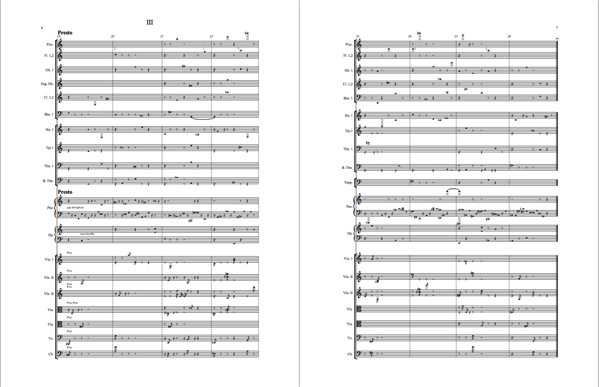
PERHAPS YOU'D LIKE to hear the third movement of my Ballet: Handler of Gravity. If so, click here. It's only eleven seconds long.

HG3.png

Handler of Gravity was composed in 1971 as the centerpiece of a concert of instrumental music from an opera, then in progress, based on Marcel Duchamp’s painting La Mariée mise à nu par ses célibataires, même (usually translated as The Bride Stripped Bare by Her Bachelors, Even). Duchamp provided his painting with an extensive “commentary” in the form of notes, sketches and memos; and Handler of Gravity is based on one of these.

The “handler” was to influence the Bride’s decisions by responding to changes in a sort of gravitational field ó the details are unclear, and in any case the handler was ultimately left out of the painting. Duchamp’s note is accompanied by a sketch of a six-pointed star-shape surrounding a spheroid body; the six points represent points from which threads would stretch toward the central body, defining its location and shape by their tension. NewImage.pngSix systems of music, each but the third lasting about a minute, were conceived as both linear and textural analogues of these threads. The unsynchronized repetitions and reinforcements in the music was meant to represent the variations and displacements of physical bodies caused by gravitational disturbances.

Much of this was suggested by the curious rhythmic disturbances which frequently characterize organists — or, rather, their performances. The result is a rather different kind of organ writing, a sort of compromise between standard notation and a kind of tablature; the hope is to ensure an idiomatic organ character by harnessing the little clumsinesses of the instrument.

The organist must be the central body who determines but also is subject to these disturbances — by realizing the music as accurately as possible (with respect to dynamics and pitch) while altering “rhythm” by responding to the difficulty of fingering (and footing), to the acoustical circumstances of the room, to the registration possibilities (themselves determined by octave location and dynamic), etc., etc.

The score was written on 10 March 1971 for a concert given three days later, when it was given its premiere by Ted Ashford, organ, with David Smith, chimes and glockenspiel, in a performance superimposed on other music associated with the opera: Screen, En balançant, and Vie lactée for string quartet and Bachelor Apparatus for brass quartet; 13 March 1971; Mills College Chapel, Oakland California. The second of the three pages is reproduced here.


I LIKED THE MUSIC so much I set it in three other versions:

•Five Pieces after Handler of Gravity, for solo piano (premiere: Nathan Schwartz; Jan. 17 1976, Oakland Museum). Each of these pieces was provisionally dedicated to one or another of the five music critics on the three major daily newspapers in the San Francisco area at the time, since Duchamp sometimes referred to his Handler as a “Juggler of Gravity.”
     score: FP she03, 12 pp., available from Frog Peak Music

•Tender of Gravity, for nine instruments (fl-pic, o-eh, cl-bass cl, bn, harmonium, vn, vla, vc, cb) (premiere: Irene Pruzan, Lenore Sleeter, Tom Rose, Cyrle Perry, Beth Anderson, Nathan Rubin, Ron Erickson, Teressa Adams, Jedediah Denman; 9 May 1974; 1750 Arch Street, Berkeley)
     score: FP she04, 14 pp., available from Frog Peak Music

•Ballet: Handler of Gravity, for full orchestra (3-2(eh)-2-2(cbn)/4-2-3-1/pno/hrp/1perc/timp/strings) (premiere: Shere, Contra Costa Symphony, Kensington, Calif., 28 Oct. 1976, as part of a compilation provisionally called Music for Orchestra). This version also stands at the end of the second act of the full-length opera The Bride Stripped Bare by Her Bachelors, Even. It is the version whose third movement is shown above, and can be heard here.
     score: Ear Press, 14 pp.,available from Frog Peak Music

Tuesday, December 01, 2015

Perfection, explanations, and …

WE LIVE IN A WORLD, it seems to me, that believes in explanations, yet more and more of our circumstances defy explanation.

So wrote a person making a comment on a previous blog post, written eight months ago, a world ago, a continent or two ago. It was an obituary post, and there have been deaths since that have affected me, a brother, two colleagues, a cousin… another friend just Friday… but I'm already off the point.

In the last three Sundays, more or less, we've subjected ourselves to three brushes with a different kind of immortality. On November 15 it was Shakespeare's Much Ado About Nothing, performed by a touring company from the Globe Theatre, no less. This was performed on an improvised thrust stage, with a simple façade backdrop, in a huge room, a former brandy aging warehouse in the second floor of Greystone, the culinary school just outside Saint Helena in the Napa Valley.

We found out about it late and were lucky to get any seats at all. Sightlines were not good. The floor, at least where we sat, was reverse raked, because of shallow drainage channels built into it; further, giants in pompadours, some wearing hats, were seated in the rows ahead of us. But the production and its performance were so perfectly fine we didn't really mind. The Globe has been experimenting, I've read, with Shakespeare declaimed in an accent thought to be that of his time (and place) — "Original Pronunciation," this has come to be called, "OP" for short, and there's lots online about it. I don't think this Much Ado was "in" OP, but I think it may have been influenced by the idea: the dialogue seemed faster and clearer than usual, even given the somewhat resonant acoustics of the stone-and-concrete building.

Eight actors made up the cast, half ot them taking two or three roles apiece; even Beatrice had a double job, filling in as Verges. As if that's not enough, they all play musical instruments, most of them more than one: violin, guitar, trombone, and less likely things; and they sing, and dance, and clown — to the point of interfering at least once with the story: when Benedick says he'll do anything for Beatrice, just name it, and she says, shockingly and chillingly, Kill Claudio — that line unfortunately drew laughs.

It's a line I always look forward to, and am always surprised by — shocked, even, in a good performance. Like so many pivotal moments in Shakespeare it is unpredictable beforehand, perfectly inevitable once met. It's pure energy and no substance; the flash accompanying the destruction of matter, the shock of recognition.

Perhaps because the audience was — well, less sophisticated, less theater- and Shakespeare-adept than those we're used to, at dedicated theaters like Oregon Shakespeare and California Shakespeare and, in Pasadena, A Noise Within. Those companies, though, would do well to book in this Globe touring company from time to time. They were a reminder of how effective the master's plays remain when you just play them, simply and directly, engaging the audience with the words and the situations, and letting symbols and relevance and meaning simmer on a burner well to the back.


A WEEK AGO it was another timeless genius's turn: we went to a marvelous performance of the Mozart Requiem. This too was a local, small-town production, by the Sonoma Bach Choir and the Live Oak Baroque Orchestra (playing in period style, at A=430), directed by Robert Worth. The inspired idea here was to play the piece twice: first the score as Mozart left it on his deathbed, only a few parts fully composed and orchestrated, others present only via chorus and the first violin line, or a little basso continuo. This is of course heartbreaking: clearly Mozart knew he was dying, that the piece would be left incomplete. And this was disastrous for more than merely artistic reasons: the piece was a commission, and his widow would need the money — which would not be paid for an unfinished torso.

NewImage.png
Mozart: Requiem, K 626, Kyrie, last page.
Mozart's hand in black, Freystädtler's in top five staves;
Süssmayr's in the trumpet and drum staves
As is generally known, the torso was of course completed, by Mozart's friend and occasional student, the composer Franz Xaver Süssmayr. What is not known, and probably never will be known, is how exactly this was accomplished. Wikipedia has an insightful comment on the reason for this:
The confusion surrounding the circumstances of the Requiem's composition was created in a large part by Mozart's wife, Constanze[citation needed]. Constanze had a difficult task in front of her: she had to keep secret the fact that the Requiem was unfinished at Mozart's death, so she could collect the final payment from the commission. For a period of time, she also needed to keep secret the fact that Süssmayr had anything to do with the composition of the Requiem at all, in order to allow Count Walsegg the impression that Mozart wrote the work entirely himself. Once she received the commission, she needed to carefully promote the work as Mozart's so that she could continue to receive revenue from the work's publication and performance. During this phase of the Requiem's history, it was still important that the public accept that Mozart wrote the whole piece, as it would fetch larger sums from publishers and the public if it were completely by Mozart.

It is Constanze's efforts that created the flurry of half-truths and myths almost instantly after Mozart's death. According to Constanze, Mozart declared that he was composing the Requiem for himself, and that he had been poisoned. His symptoms worsened, and he began to complain about the painful swelling of his body and high fever. Nevertheless, Mozart continued his work on the Requiem, and even on the last day of his life, he was explaining to his assistant how he intended to finish the Requiem.

Nor is Süssmayr's the only current completion, though it remains the most frequently performed (copyrights and licensing fees may have something to do with that). There's plenty of interesting comment about all this on line: I recommend Peter Gutmann's note, the source of the image reproduced here; and another, by the conductor Kenneth Woods, particularly attractive for me for its reference to my late teacher Gerhard Samuel, whose performance of the Requiem with the Oakland Symphony, forty-odd years ago, was the first live performance I heard, and remains in memory.

But, again, I'm distracted. The point just now is that we heard the Requiem twice: as Mozart left it; then, after intermission, as Süssmayr completed it. It was a very good performance indeed: the soloists (Dianna Richardson, Karen Clark, Kyle Stegall, Ben Kazez) were well matched, nimble, earnest, modest, accurate, and possessed of beautiful voices. The chorus was also light on its feet, negotiating fast fugal passages easily, pious in the presence of Mozart if not necessarily of the Christian God. And the orchestra was wonderful: six violins, two each violas and celli, one contrabass, two basset horns, two straight (unkeyed) trumpets, three trombones, two bassoons, timpani, and harpsichord continuo.

Süssmayr's oft-noted errors of voice leading and orchestration were, I think, somewhat cleaned up, though occasional passages clearly reveal his less inspired imagination. But the Requiem succeeds to such an extent! Mozart seems to have been reaching beyond himself — occasionally recalling previously composed material, but relying often on counterpoint clearly inspired by, and learned from, Bach and Handel. His orchestration, for those marvelous dark winds, especially as revealed by these period instruments, presents a sonic world no successive composer save Berlioz could match for a hundred years. (Well, the von Weber of Freischütz, maybe: an isolated case.)


THE PERFECTION OF Mozart and Shakespeare, of course, defies explanation; when attempted, such explanation is necessarily dull. The lesser genius of a figure like Giacchino Rossini, the lesser perfection of a work like Il barbiere di Siviglia — that can be explained. In Rossini was inspired by Mozart's example, more adeptly than was poor Süssmayr; Rossini's bright melodic invention, rhythmic precision and interplay, certainty in writing for the voice, and orchestral enterprise and expertise — all that can be explained by his knowledge of Mozart, both Mozart's composition and his example as a hands-on opera collaborator.

We saw Il barbiere yesterday, at San Francisco Opera; again, an afternoon matinée. The performance was satisfactory in every respect. I thought Daniela Mack, as Rosina, took a few minutes to lock into voice; when she did, she was fine, a true coloratura mezzo with a low range that bordered on contralto and pinpoint accuracy at the high end of the range. Her Almaviva was René Barbera, a light coloratura tenor with ringing top notes and an affable, very pleasant demeanor. Lucas Meachem was perfectly adequate as Figaro, though hardly the central character on the stage; Alessandro Corbelli was nicely detailed and vocally secure as Bartolo; Andrea Silvestrelli was a commanding Basilio; Catherine Cook a winning Berta.

Llorenç Corbella's physical production is striking, the most striking visual staging I've seen here since Pierre Luigi Pizzi's bizarre Semiramide back in 1981: a white, two-storey, vaguely Art Deco Seville house, with grillwork and a second-floor window in lieu of balcony, angling away dramatically from downstage left to upstage center, raked, and fronting on a black street, also disappearing at a parallel angle. The building was so Sevillian I missed millstones set into the plaster along the street. The period seemed timeless; bicycles were featured; the ballet danced faux-flamenco; the happy couple left the opera at final curtain in a sports-car coupe de théâtre.

For all the striking staging, or maybe even because of the physical concept, this was the most static Barbiere I've ever seen, accentuating Rossini's nearly isolated, formal arias and set-piece choruses. This is neither classical opera nor Romantic: it's bel canto, revealed here as the late-stage Baroque form it essentially is. It's a type of theater I particularly love; I live always with memories of Racine's Bajazet, stunningly staged at UC Berkeley forty years ago or so, and of Last Year at Marienbad, and of the Hippolytus in Italian in the Greek Theater in Siracusa.

The Hippolytus in Siracusa.jpg
Hippolytus in Siracusa, May 2010

At their best these theatrical moments — extended through the forced perspective of heightened emotions voiced with restraint, whether in song or architecture, dance or verse — these moments are inexplicable. When things happen to us in daily life we want to know why; much of the time we cannot. Deaths, departures, dislocations — we attribute reasons for them, causes, agencies, primarily I think so we can then absorb them in order to dismiss them. We know, much of the time, that we're deluding ourselves. We search for meaning but frequently we're thunderstruck,

Freddo ed immobile
come una statua…
and it's funny — Guarda Don Bartolo! — because if we're not laughing, we don't know what to do. Which reminds me of a Duchamp anecdote I just read somewhere. He was touring an art school in San Francisco (I hope it was the old California School of Fine Arts) and saw a young man flailing away madly at a canvas. What are you doing, Duchamp asked. I don't know what the … I'm doing, the young man answered. Duchamp patted him on the shoulder: Keep up the good work!

Wednesday, November 11, 2015

Stockhausen at the Concertgebouw, 1980

Eastside Road, November 9, 2015—
FOR VARIOUS REASONS there's no reason to go into here I've been re-reading a journal from thirty-five years ago, from which I have pulled thoughts on a production we saw at the Concertgebouw on June 14, 1980:
STOCKHAUSEN: Michaels Jugend / Michaels Heimkehr

The house was pretty well full, but one took the seats one wanted. Stockhausen was at his mixer in the center of the Concertgebouw. The concert began pretty well on time. Michael is the protagonist of Donnerstag, the (third?) of a seven-opera cycle called Light. “Michael’s Youth” is the first act, “Michael’s Legend” is Act III scene 1.

It’s hard to get an idea of the effect of the finished work, of course — except that it’s Teutonic, long and rambling, introspective (fictionally autobiographical), philosophical but not intellectually so. It made me think, often, of Hitler: a film from Germany: intelligent bricolage spun out. Stockhausen ran the whole show, credited with regie, costumes, choreography, everything in Heimkehr (save Mary Bauermeister’s “lichtcomposities”), the texts in both included traditional Hebrew texts, but were otherwise — therefore mostly — by Stockhausen.

Michaels Jugend was for very small forces and developed a sort of childhood-of-Siegfried narration. Three protagonists, each represented by three performers: singer, instrumentalist, dancer-mime: Michael (Robert Gambill, T; Markus Stockhausen, trumpet; Michèle Noiret); Ea (Annette Merinweather, S; Suzanne Stephens, bassethorn; Elizabeth Clarke); Lucifer (Matthias Hölle, B; Mark Tezak, trombone; Alain Lonati). Three continuous scenes: Childhood, Mondeva, Examen.

So: music began with a drone from the loudspeakers — a dozen or so — surrounding the audience. Drone largely electronic (and vocalized chorus?), one pedal, [illeg.] a mosaic of various overtones. House lights dim; Soprano, then Tenor enter; she sings the fifth of the pedal, he the sixth below her. Two or three times in the course of the act the pedal rose or fell a alf-step, and it [pedal] wasn’t always present, but it defined the “tonality” of the piece throughout: and tonal relationships began to dominate — even including Picardy thirds! — by the end of the act. The loudspeaker music was very quiet most of the time. The singers’ music was well written for voice — idiomatic and very effective, both solo and ensemble. Instrumental music was not like the vocal, but not as arbitrary as, e.g., Zeitmasse. A prominent piano part played by Majella Stockhausen served obbligato in scene 3. (Se program for further notes on articulation of scenario.)

IN GENERAL: mostly through-sung in traditional vocal technique, the three instruments often doubling voices. Harmonically tonally grounded, though approaching conventional major-minor tonal practice only at end. House loudspeakers very subtle reinforce, or counter, or punctuate, or accompany stage sound. Very simple, naïve; a childlike masque. Rather well received.

“Festival” (sc. 1) from Michaels Heimkehr (Act III). Full orchestra on Concertgebouw stage, with five eight-voice choruses. Soloists as in Michaels Jugend, but Michael Rosness replacing Robert Gambill. Musical material as in Jugend, but greater resources (still including the house loudspeakers) lead to more complex sound. Still, music is much more conservative than [for example] Aus dem sieben Tagen, often recalling Momente, Mixtur, Klavierstücke.

The melodic material was the organic result of a montage — mélange of tonal phrases, a process similar to Hymnen. And the “Biblical” sound often derived from parallel clusters, a rather Messiaenic sound. “Festival” more developed, varied, episodic than Jugend. The action more varied, with more subsidiary roles, and articulated by arbitrary activities: devil-mime [emerging] from globe, old lady with cane from audience (the rhythm of her stick leading the orchestra into a new “moment”), toy tank up inclined board, the three film segments (camera panning across Mary Bauermeister paintings, occasionally finding childlike drawings of a face, a figure). The music is clearly retrospective, and the action recalls Originale: Stockhausen seems bent on summing up his musical life in an operatic version, cosmically ambitious, of the late [Beethoven] quartets.

The performances were superb. A violist told me they rehearsed it for three weeks — too much, but Stockhausen insisted. The vocalists were magnificent, not only technically, but tonally too. “Heimkehr” got an extended ovation, with some ostentatious booking. Stockhausen directed the bows, pushing out various soloists from the lineup!

Stockhausen looks older, slacker, heavy, otherwise much the same. We talked some after the performance; he gave me his address. He seemed, well, a little spacey, but the evening must have been exhausting — and he’d been nervous as a cat before “Heimkehr,” which had been given its premiere.

What about the music? Interesting; slow; naïve; often uneventful; a little soft. Reserve judgment for the full piece until next year’s Milan premiere.


WELL, I NEVER got to the Milan premiere. I don't recall, now, if I was on the job at this performance; perhaps I took these notes in order to write a review for the Oakland Tribune, which actually paid me to attend occasional out-of-town performances — Carmel Bach Festival, Santa Fe Opera, even the Holland Festival if I paid my own transportation and per diem, while otherwise on leave or vacation. Imagine a local daily newspaper doing that today!

Monday, November 02, 2015

Inez Storer

Inez Storer: Allow Nothing To Worry You. Gallery 16 Editions, 2015. 104 pages. ISBN 98-0-9827671-5-3
Paintings by Inez Storer are on view at the Seager/Gray Gallery, 108 Throckmorton Avenue, Mill Valley, through November 8.

Eastside Road, November 1, 2015—
IS_Greta at Gatchina,40x48_press (1).jpg A CORNER OF THE BLEAK Gatchina Palace, outside St. Petersburg, as painted earlier this year by the California artist Inez Storer. And this is just a corner of the painting, too — or, rather, a detail taken from nearly the center of the painting, the entirety of which I'll set at the end of this post.
Before going further I should mention that I've known Inez for more than forty years, and that over that period she and her husband Andrew Romanoff have become friends. We don't see them often: They live in their corner of the area, we in ours; we're all busy; we all travel … but they're good friends, the sort with whom there can be silences, even quite long ones, and then the conversation resumes.

I met Inez in 1974, when she participated in a group show at the Mills College Art Gallery. In those days I taught a course in music history at Mills as an adjunct instructor, and I wrote cultural criticism, especially art criticism, for the Oakland Tribune. I was particularly struck with Inez's work. Reading the stuff that Charles Shere wrote can sometimes make me cringe now, but here's what I had to say:

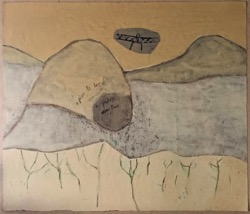
A real find In this show is a painting by Inez Storer: "How to Land a Plane on a Painted Mountain.” The title may actually read "Pointed Mountain": the calligraphy is ambiguous, and so is the painting itself. Flatly executed in the lusciously “crude” style associated with Joan Brown, Fred Martin and Richard Diebenkorn, the picture is intelligent and sumptuous.

Storer's corner of the show is rich in many respects. There's a considerable variety to her work. expressed in paintings, drawings and assemblages. Her work is idea-oriented, but not merely cerebral: it always gives the eyeball its own rewards.

Many of the assemblages seem to parlay a methodical, almost compulsive rhythm, generated by continuingly accumulating details, into a fearful expression of emptiness and domesticity. "House Plans and Diagrams" is a three-level shallow wall-hung box, " each of the three “floors" strewn with glass marbles, each with a figure: a clock-gear-bellied, headless representation of pregnancy on the top; a doll's head on the middle; the beheaded doll standing on the lower level. Photos of a woman suddenly thrust out of the walls. The total picture is unnerving.

IMG_1750.jpg
How to Land a Plane on a Painted Mountain
A series of drawings and paintings on the subject of dreams shows how introspective this painter is. "Dreams" presents a drawing of a bed, its headboard collaged in fabric scraps, a photograph of a sheep on the bed, a fragment of an old letter in sepia copperplate ink leading off the bed to an old-time group photo of a bunch of men in a campsite out West.

"Mountain Dream" incorporates a picture postcard into a painted landscape which turns into a bed somehow. The intellectual, "conceptual” aspect of the composition is underlined by two indications of size in the margins, making the final work part a painting, part its own sketch.

I liked How to Land a Plane on a Painted Mountain so much that I bought it. I bought a number of paintings during the years I worked as an art critic. I never ran the idea past my publisher: I wouldn't be surprised if he would have objected, citing the appearance of conflict of interest — an objection I generally disagree with: I think community of interest is closer to the mark. In any case since I've never sold, or wanted to sell, any work of art I've bought, no "interest" is really present.

I bought paintings because living with them continually reminded me to look, and taught me, I think, how to try to understand, and to make use of, the things I saw. This is the great gift of painters, of artists: they respond to the world for us. "The highest function of music," J.W.N. Sullivan writes, "is to express the musician's experience and his organization of it." (Beethoven: His Spiritual Development (Alfred A. Knopf, 1927), p. 34.) True of all the arts: he goes on to say "art is not superfluous… it exists to convey what cannot be otherwise conveyed."


LET'S COME BACK to the painting at hand, Greta at Gatchina Palace. Like How to Land a Plane on a Painted Mountain, it incorporates painting and collage on the technical level, and personal memory and meaning when it comes to the content. Inez's father was a pilot and an art director in Hollywood; he had emigrated from Germany to evade the Third Reich. Her husband's family, the imperial Romanovs, were deposed and indeed executed during the Russian Revolution. The Gatchina Palace was, I understand, one of their residences, and Inez and Andrew toured it recently.

There of course they took a number of photographs. Inez makes prints at Magnolia Editions in Oakland, and there, on their huge flatbed scanner, she was able to make digital photocollages; one result was layered on gesso on canvas to serve as the ground for the painting.

I think of many levels of meaning emerging from this technique, whose layers of both image and technical handling are like the layers of significance latent in our personal memories and experiences. Again, and forty years later, the final work is part a painting, part its own process. And as the viewer's eye explores it, particularly when the eye is informed by awareness and knowledge of the personal meaning within the work, the viewer repeats the painter's journey into and through the work.

I spent a fair amount of time with Greta at Gatchina Palace. (For me, that is: I'm an impatient attendant, always in a rush to experience more.) I investigated it close to; I crouched near the floor to look up at it; I backed slowly away from it; I approached it in a spiraling trajectory, with one eye closed, focussing on one detail or another. (Fortunately my patient companion was the only other person in the gallery at the moment.) I found a favorite focal point: the stanchion that can barely be made out in the corridor beyond the doorway in the corner of the room. You may be able to see, in the detail reproduced above, a white rope supported by that stanchion. You cannot see, unfortunately, the amazingly true depiction of the metallic shine at the base of the stanchion.

Inspected this actively, many aspects of the painting jump into relief. The lintel above the doorway thrusts away from the wall, and the marble lining the doorway jumps back and forth, now holding the picture plane, now flipping into perspective, helping to draw the eye through the passageway into that corridor.

This alternation is helped, of course, by the collision of the photorealist perspective of the walls and corner with the arbitrary flat grid of the checkerboard floor. Again the viewer, like the painter, is poised between two ways of interpreting what is seen. This is what contemplation leads to: the fuller understanding of what is seen, resulting from the superimposition on objective reality (if any such there be) of accumulated layers of meaning brought in from memory, from learning, perhaps from misleading commentary, certainly from interpretation. INFORMATION.

To look actively at a painting, both physically as I've described my gymnastics in the gallery and intellectually as I've suggested through the consideration of supplementary information — this is one of the great pleasures. It recapitulates one's confrontation of life itself. It's an indispensable part of criticism, and criticism, I'm afraid, is an indispensable aspect of my own approach to life. Criticism: "the study of the meaning and the value of art works." (Joseph Kerman: Contemplating Music: challenges to musicology, Harvard University Press, 1986.)

Inez and Andrew's personal experiences draw on Europe and America, the Third Reich and the Russian Revolution, Hollywood and Buckingham Palace, the events of the 1960s, the art and social setting of the San Francisco Bay Area, teaching, family, and the usual vicissitudes that accumulate in eighty or ninety years of life. By turns funny, absurd, sad, nostalgic, improbable, these experiences of course inform their work. In a sense their work is incomplete without the experiences, though of course the work also, contradictorily and fortunately, stands perfectly well without one's knowing of them.

Fortunately, an attractive, small, coherent, copiously and well illustrated book has just been published, presenting a fair number of Inez's paintings and prints, together with short but useful (and entertaining!) accounts of her life and work. Allow Nothing to Worry You is a small-format book, 8-¼ inches square, 104 pages, case-bound in hard covers, with texts by Bonnie Gangelhoff, Timothy Anglin Burgard, Bill Berkson, Maria Porges, Barbara Morris, and Inez herself, along with the expected lists of exhibitions and biographical notes.

I particularly like Berkson's comments, with its final paragraph:

Storer has spoken of her vistas as having "no perspective, no beginning or end." Even so, seeing what happens within them, the viewer knows the size and distance appropriate to any detail, and the scale of the territory at large. Props — a ladder, a dinghy, a family of chairs, a cap, a monkey dropped on a Parisian thoroughfare — lend leverage, both graphic and psychological. That fabulations so thoroughly nuanced can come across as declarative throughout, so all-there at a glance, is a measure of Storer's commitment. Poise, the work invites us think, amid the indignities of human self-awareness, is no soulless window dressing, but a wonder regained by turns.

BUT LET'S LOOK, finally, at the painting we started out with, Greta at Gatchina Palace.
IS_Greta at Gatchina,40x48_press.jpg
Inez Storer: Greta at Gatchina Palace (2015). Mixed media on panel, 46x46 inches
The room is seen as it is, abandoned and in disrepair, and as it was or might have been, opulent in its rococo decoration. Hollywood, and things not being as they seem. An improbable blue kitchen chair (Berkson felicitously refers to it as "perennially talismanic"). A painting of Greta Garbo, recognizably in Inez Storer's style. The inevitable red carpet, leading inexorably to that doorway, and the passageway to an unintended destination out of sight around a corner. A large window illuminating the interior while concealing the world beyond, and its source of light. Vermeer's incessant and obsessive tilework floor.

Hans Hofmann would recognize the "push-pull" of the planes of color and pattern, though he'd be unlikely to approve the possibly narrative implications of the imagery containing them. Even on my computer screen I fall into this painting as I gaze at it; my gaze is itself a passageway leading me into it. Seen with one eye, while my head moves slowly before the image, or quickly approaches, then backs away from the screen, the perspectives change and develop. Somehow the contradictions of planes and perspectives enter into a kind of conversation, exploring various possible arrangements, of resolutions.

Storer's work has been called "magic realism" — the term comes from literary criticism, specifically describing such Latin American authors as Borges — but I think this painting disdains questions of category. It doesn't matter, either, that the work involves so many techniques. Since Picasso and Braque glued newspaper clippings to their paintngs, a century ago and more, painting has meant more than the application of colored pastes to flat expanses of cloth or paper. Painting is the act of bringing color and texture to a visual consideration or expression of meaning.

A painting like this, a life like Inez's, can instruct us in the possibilities, perhaps even the methods, of resolving apparent contradictions; of enlarging meaning; of expanding our awareness, not only of a painting, but of our own lives, and of the world they engage.