Tuesday, August 04, 2015

West Edge Opera

•Alban Berg: Lulu.
Jonathan Khuner, music director;
Elkhanah Pulitzer, stage director
seen July 25 and Aug. 2, 2015.
•Laura Kaminsky: As One.
Bryan Nies, music director;
Mark Streshinsky, stage director;
film by Kimberly Reed
seen July 31, 2015.
•Claudio Monteverdi:
Il Ritorno d'Ulisse in Patria
.
Gilbert Martinez, music director
Mark Streshinky, stage director
seen Aug. 1, 2015.
Eastside Road, August 3, 2015—
IF OPERA AS WE (I) know it has a future in our country, the oligarchic United States of America, then I think West Edge Opera, headquartered in the culturally forward San Francisco Bay Area of California, is showing the way. The repertory is exploratory; the means are practical and well scaled; the artistic direction is secure and expert. Productions are mounted in various venues, chosen for cost effectiveness, marketing value, and I believe appropriateness to the work in question.

West Edge is an outgrowth, I believe, of Berkeley Opera, founded in that enlightened city some years ago by the Berkeley conductor Jonathan Khuner, a musical genius (in my opinion), heir to a great musical tradition, seasoned opera worker (coach, prompter, conductor), a graceful intellect and a true enthusiast of musical modernism. I've known him, though not well, for many years. I played bass drum in Ravel's La Valse under his direction, many years ago in a community orchestra. I narrated, as a sort of compère, a production of Beethoven's Fidelio under his baton more recently (but again a number of years back). And I recall running into him after a San Francisco Symphony performance of Gurrelieder : when I enthused at the accuracy and spirit of the performance of the long and complex piece he agreed, but noted that a flute note had been transposed an octave in a chord in a loud tutti passage. Khuner is attentive, observant, quick-witted, and utterly modest; his musicians enjoy working with him.

Earlier this year we saw a West Edge concert production of Rossini's Zelmira (reported on this blog in February), and I've already reported here on this month's Lulu, which impressed us so much we bought tickets for a repeat performance yesterday. The result was that we saw the entire summer season, three operas, in three consecutive days, each time driving an hour each way for the experience. And I retain my enthusiasm for the company, and look forward to next year.

That's not to say I thought the run an unqualified success. Laura Kaminsky's As One is not really an opera, I think, but a dramatic song-cycle, cast on two singers and accompanied visually by a film projected onto panels behind them, musically by a string quartet playing busily throughout. The lyrics, by Mark Campbell, in English, are basically a series of more or less dramatic monologues in which the protagonist of the piece evolves from a twelve-year-old boy to a mature woman. The subject matter is gender identity, and in my opinion the most valuable aspect of the subject and its treatment here, after of course the matter of tolerance for individual means of coping with identity and society, is the awareness that in most of us there are moments, awarenesses, and attitudes that are both masculine and feminine as our society has conventionally typified such things.

The two singers who together portrayed the protagonist, Hannah Before and Hannah After, were winning, persuasive, musically secure: mezzosoprano Brenda Patterson and baritone Dan Kempson looked similar enough (stature apart) to portray a single character, and their voices blended seamlessly in the occasional duet and more frequent overlapping solo lines. Their physical acting, too, handled Mark Streshinsky's low-keyed staging persuasively.

There are however two problems with As One : the libretto is pedestrian, more a description of an individual's character than a portrayal; and the music too often lacks — well, edge and character. Not always: I was intrigued by the Janáček-meets-minimalism quality of the opening scene; and the long aria toward the close, rhapsodic in its confrontation at last with Nature (the Norwegian fjords) rather than Society, seemed finally to get off the ground, to soar in vocal skies I normally associate with Richard Strauss and Mahler. In the intervening hour, though, the music was mostly vocal cantilena accompanied by literally descriptive and rhythmically busy string-quartet writing, tonal, consonant, and to my ear aimless.

Il Ritorno d'Ulisse in Patria, known to its Oakland audience simply as Ulysses, is a very different kettle of fish. Premiered in Venice in 1641, it is with the same composer's L'Incoronazione di Poppea one of the oldest operas in the working repertory but not, of course, frequently produced. West Edge proved the error of this, as it was entertaining, often moving, often very funny, and always both interesting and refreshing.

Where As One had been produced in a sort of warehouse nightclub setting (though with conventional row seating and without table service, which would have improved things), Ulisse was mounted on a platform thrust stage, its runways embracing the improvised pit, in an immense former steel-mill in industrial Oakland. This is a long way from the splendors of Renaissance theater, of course; but it did point up the stock theatrics which underlie more evolved theater. Strashinsky's staging made me think from time to time of Shakespeare's mechanicals' production of Piramus and Thisbe; of commedia dell'arte; even of traditional Italian puppet theater.

Opera is classically defined, by Italians at least, as dramma per musica, drama through music. Every member of this cast moved and expressed himself physically with real acting skill, whether dramatic or comic: but the success of the event was above all musical. Monteverdi's vocal lines are superficially not that far from Kaminsky's: cantilena, consonant, generally conservative in dynamic and pitch range. They are very different though in terms of definition, structure, variation of tempo and dynamic; and melodically they have character and contour, steering one's attention rather than lulling it. And the accompaniment, while similarly string-oriented, modest in number, and steady in its support, is refreshing and supple.

Music director Gilbert Martinez, who directs the Berkeley organization MusicSources, Center for Historically Informed Performance, led the pit band from one of its two harpsichords, turning also to a small reed-organ to accompany the angry sea-god Neptune in his two appearances. Otherwise the instrumentation comprised two violins, two violas, a viola da gamba, and most prominent of all harp and theorbo: plucked instruments whose range and resonance supported the singers with great resonance and rich color. (The theorbo, especially the bass theorbo, must be one of the most eloquent inventions of all time.)

Monteverdi's libretto, by Giacamo Badoardo, is generally faithful to Homer's Odyssey, but reduces Penelope's many suitors to three comic characters, their protracted and relentless slaughter to a momentary burlesque. Ulysses's emotional return to his homeland shore, however, and Penelope's poignant constancy and suffering, are quite moving both in Monteverdi's (and Badoardo's) treatment and in this production's performance. Baritone Nikolas Nackley's Ulysses was secure, melodic, often tender; mezzo Sara Couden's contralto-directed voice gave Penelope a grave, innig quality that was very affecting.

One of the most intriguing aspects of the opera is its depiction of the gods, whose interference in human affairs portrays in theatrical terms the inner weaknesses, proclivities, desires, and ambivalences our own time explains through psychology and, increasingly, politics. In this performing edition the action is framed by discussions in which Jupiter, as god in chief, acting at the urging of Minerva, protectress of the Greeks and especially Ulysses, persuades Neptune, who'd favored the Trojans and punished Ulysses for the last twenty years, to let the poor man go home.

Of the three, Minerva is by far the most important, appearing at pivotal moments throughout the drama. The role was brilliantly sung and effectively acted by soprano Kindra Scharich; tenor Gary Rushchman was a pleasant Jupiter; Aaron Sørensen an effective Neptune. Those two were also two of the three suitors, Pisandro and Anationoo, and Sørensen's bass voice was as strong as a buffo as it was dramatic in the villainous role.

Michael Desnoyers was sympathetic as the shepherd Eumete; Johanna Bronk supportive as Telemaco; Jonathan Smucker effective as Anfinomo; Charlotte Goupille Lebret affecting as Melanto. The Leandra Watson's costumes were simple for the most part, decorative in the case of the gods.

Of the three productions, though, it was that of Lulu that was especially impressive. Complex, big in every way, daring in every way, Berg's opera and West Edge's production seemed logical, effortless, inevitable. Both audiences I saw were moved, gripped by the opera and its performance. West Edge is a company to watch, not only for fascinating entertainmemnt for its local audiences, but for what it suggests for the future and for other communities. The great heritage of music theater can be adapted to present needs and resources: it requires nothing more than nerve and talent.

Tuesday, July 28, 2015

Lulu

•Alban Berg: Lulu.
West Edge Opera,
Jonathan Khuner, music director;
Elkhanah Pulitzer, stage director
seen in Oakland, California,
July 25, 2015.
repeat performances:
Aug. 2, 2 pm; Aug. 8, 8 pm
information online:
Lulu First Scene Hi Res.jpg
Philip Skinner as Dr. Schön, Emma McNairy as Lulu; Act I of Alban Berg's Lulu.
Photo: Lucille Lawrence
Eastside Road, July 28, 2015—
We saw Alban Berg’s opera Lulu the other night, produced by the East Bay’s West Edge Opera in the abandoned Southern Pacific railroad station in Oakland (California). I can only say the event was phenomenal: we were so impressed we immediately bought tickets for a return hearing, this coming Sunday (August 2).

Berg wrote the opera, his second, between roughly 1930 and 1935, leaving it unfinished at his death. For years it was known only by its first two acts though the third act was virtually complete in short score and much of its orchestration had been completed for the suite Berg had extracted from the opera for concert purposes. Berg’s widow refused access to the manuscript, however, and it was only on her death, in 1976, that advances could be made toward realizing a complete performing version of the opera.

The opera is scored for twelve singers and large orchestra: woodwinds in threes plus saxophone; four horns, three trumpets, three trombones, and tuba; an active six-performer percussion section including vibraphone; important harp and piano parts; and a full string ensemble; a 16-piece off-stage jazz band including banjo (most of these can come from the pit orchestra).

Many of the vocal roles are quite demanding; the music is written in Berg’s version of Schoenberg’s “twelve-tone” system and is often dissonant, wide-ranging, and precise; the subject-matter of the opera is dark, violent at times, and discomforting; and Berg’s stage directions are carefully calculated and expressed in detail.

The result, certainly here in California, has been a very limited number of performances and productions, and those I’ve seen (San Francisco Opera, 1965 with Evelyn Lear; 1971 with Anja Silja) were truncated, rather routine in their staging, and frustrating.

A pity, because Lulu is one of the great operas of its or any century. On the first level, it’s arresting, fascinating, with a “story” that speaks to both its and our time and a score that resourcefully exploits the most fascinating and athletic possibilities of its voices and instruments.

This first level will leave many of us confused and either fatigued or exhilarated, possibly both. It’s a pity many do not go on to explore the work further, as Lulu is as fascinating intellectually — both as a historical document and as a work of art — as it is telling emotionally.

Perhaps it will become better known now, as in 2009 the Eberhard Kloke, one of two or three composers who have tackled the problem of orchestrating the third act, completed a reduction of Berg’s orchestration. West Edge used an orchestra of only twenty musicians: single winds (two clarinets), one percussionist, harp, piano, and nine strings.

I can think of few opera performances I’ve seen as impressively rewarding as this Lulu. Every member of the cast brought real intelligence to his role, projecting character and drama both physically and vocally, and looking the role perfectly persuasively. In addition, the voices themselves were marvelous: accurate, the vocal lines nicely phrased, the leaps landing persuasively on pitch, the dynamic contrasts well managed, ensemble singing (and fast-intercut interpolations, which Berg’s often conversational style requires) thoughtfully and effectively handled.

The opera centers of course on its title role, and I can’t imagine a better Lulu than Emma McNairy, who sings and acts with utter conviction and fabulous technique. But the rest of the cast is equally successful: Philip Skinner suave and controlling as Schön; Alexander Boyer as the warm, sympathetic, vulnerable Alwa; Buffy Baggott as a tender, at times uncomprehending Geschwitz; Bojan Kneževič as the sinister, shadowy Schigolch; Zachary Altman strutting and cynical as the Animal Trainer, strutting and stupid as the Athlete; and lesser roles were equal, taken by Erin Neff, Joseph Raymond Meyers, Michael Jankosky, Michael Crozier and Audrey Douglass.

The entire effort was Jonathan Khuner’s baby, and he conducted it not only well but apparently effortlessly — having, I’m sure, rehearsed and coached it with precision, economy, and persuasion. His orchestra supported the production with impressive élan.

And nearly as welcome, in some ways perhaps even more: Elkhanah Pulitzer’s stage direction, on Chad Owens’s economical and resourceful set (and with Christine Crook’s admirable costumes), respected Berg’s indications almost to the letter. Opera is supposed to be a total art form, appealing to eye, ear, heart, and brain with an integral, focussed event. Too often stage directors (and the producers who engage them) are willing to subvert the composer and librettist — in the case of Lulu, Berg is both — by superimposing a third artistic vision on an already complex work.

That did not happen at West Edge, and the result was a Lulu its composer would recognize and, I think, approve enthusiastically. The lagniappe to all this perfection and authenticity was the setting, a huge, brooding, used-up railroad station that seemed to be — visually, architecturally, even acoustically — a metaphor for the ruined first half of the twentieth century; the worn-out, no longer appreciated or maintained shell of what was once an elaborate, beautiful, and even practical accommodation of men and women of all classes of society.

There’s much more to say. I haven’t mentioned the admirable film, for example, cunningly structured by Jeremy Knight to accompany Berg’s ingenious centerpiece interlude, a forerunner of Robert Wilson’s “knee play” device articulating the drama’s exposition and calamitous resolution. I haven’t mentioned the intelligently translated supertitles, alas too frequently fading out against the buff concrete walls on which they’re projected (can the text-stye be changed to “outline”?)

I haven’t made an attempt at presenting the opera itself, which Wikipedia will do for me; and, beyond, George Perle’s fine book on the opera; and, for those who can use it, Erwin Stein’s masterly piano reduction of the first two acts, available for the downloading online.

Most unhappily of all I haven’t sufficiently sung the praises of conductor, crew, and cast; I don’t think I can rise to the task. This was a superb evening of theater, a magnificent interpretation of a masterpiece, a provocative and absorbing performance with what will be, I know, a long-lasting finish.

Monday, June 08, 2015

Hotels in Italy

Eastside Road, June 7, 2015—

IN A MONTH in Italy, May 6 through June 3, we stayed in thirteen different apartments, hotels, and agriturismi, relying on four sources for suggestions: Airbnb; Booking.com; Agriturismo.it; and previous knowledge. During that time the euro hovered at about $1.20. The most expensive lodging we found was €77, for an apartment with kitchen; a couple of other places were in the neighborhood of $75 to 80 a night; many others were significantly less. I list all below:


Naples and vicinity: 

IMG_9701.jpg

•Parco Eva (Corso Vittorio Emanuele, 167/6, Naples). We were here seven nights, 6-12 May 2015. It is a comfortable apartment with a good-sized sitting room, an almost equally large bedroom, with a small, efficient kitchen separating them. We found the place through Airbnb ("Spacious Apartment in 1900s Palazzo"), and the hosts were charming, helpful, and attentive. The apartment is on the second floor of its building, which is reached from the top (fifth) floor of another building in front; both have elevators, though a few steps must be climbed to get to the first. The building entrance is perhaps a fifty-meter walk up a fairly steep driveway leading from a guarded gate on the busy Corso Vittorio Emanuele, but the apartments are very quiet.
While the buildings are a good way from the center of the old city — a half hour's leisurely walk, I'd say — one of the three Naples foniculare is a five-minute walk from the gate; it leads down to the Chiaia area, with its shops and restaurants, and up to the rather staid but very rewarding Vomero quarter, from whence another funicular will drop you quickly into the heart of the old city.

A half hour's drive south of Naples will bring you to •La Vecchia Quercia (Via Montevetrano 4, Località Cantina di Campigliano, 84099 San Cipriano Picentino (Salerno); http://www.lavecchiaquercia.it/). We spent one night there, May 13, having remembered it from a stay five years ago; and we found it all we'd recalled and then some: a fine, spacious bedroom with its own little terrace, on a farmstead out in the country, with an excellent dinner and a copious breakfast provided by a gracious, intelligent, cosmopolitan hostess.

Basilicata:

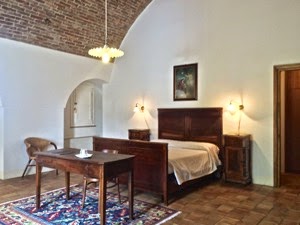
Here we stayed in two agriturismi and one apartment. Nothing could have been more different than the two agriturismi, lodgings on working farms, found through the Italian website Agriturismo.it, which offers a useful iPhone app. •BioAgriturismo Tenuta Montenuovo (Contrada Montenuovo, 85030 Calvera (PZ); +39 0973 198 5022) offered a comfortable but rather bare-bones room, WiFi only in the restaurant dining-room and on its terrace, but an absolutely marvelous dinner and a fine breakfast. (14 May 2015) •Masseria Cardillo (SS 407 via Bassentana km 97.5, 75012 Bernalda (MT); +39 0835 748992; http://www.masseriacardillo.it), on the other hand, gave us a stunning room — huge, with a vaulted brick ceiling, elegant furnishings, and a private terrace with table and chairs. And a public sitting room big as a soccer-field and much more elegant, with fireplaces and groupings of sofas; as well as huge lawns, a pergola, a swimming pool and tennis court. Dinner was good though not as exciting as Tenuta Montenuovo’s; and the Roman ruins at Metaponto were conveniently close. (15 May 2015)

In the touristy town of Matera we stayed in •Apartment Casa Tonia (Vicolo Fornaci 7, Matera, 75100; +39 331 1541555), an apartment carved out of a storefront, with a kitchen, sitting room, and bath downstairs, bedroom-loft upstairs — rather an awkward arrangement for an extended stay, I’d think, but reasonably comfortable for a short one. We had trouble finding the place, as our GPS insisted on taking us to Vico Fornaci Vecchi, and we never could determine whether the apartment was on a Vico or a Vicolo. Whatever it is, it’s a pedestrian street, but a covered parking garage is nearby. (16 May 2015; Booking.com)

Puglia:

Just when we were wondering where we’d spend the night we noticed a roadside sign advertising •Agriturismo La Crianza (SP per Torchieroto, km. 3, 73018 Squinzano; +39 328 2487622; http://www.agriturismolacrianza.it), not far from Lecce. Our room was so comfortable and the farm so quiiet that we spent two nights here, using the place as a base from which to explore Lecce and even Gallipoli. The breakfast was nothing to write home about; we dined out; I didn’t notice any swimming pool in the extensive olive grove; but the people were very nice and our room pleasant and comfortable. (17-18 May 2015)

Lazio and Rome:

On the drive from Puglia to Rome, encouraged by a Slow Food restaurant recommendation, we drove by way of Campobasso, where Booking.com provided us with the •Cascina Garden Hotel (Contrada Tappino 61, Campobasso, 86100, Italy; +39 087 498024). The hotel’s high in a hilltop suburb, with parking in its courtyard, a reasonably good breakfast, WiFi in the room, and a comfortable bed. (19 May 2015)

Outside of Rome, not wanting to deal with parking issues, we stayed at another Booking.com suggestion: •Villa Del Patrizio (via di Castelfusano 21, Ostia Antica 00124; +39 06565.57386). The place looked pretty sketchy to me at first, a little like Santa Monica in the 1950s, raffish and unkempt from the outside, with parking on the shoulder of the street; but the one-flight-up room was very nice, with its own little outside terrace, a comfortable bed, clean bath, and good WiFi, and there was a pleasant, cheap little trattoria next door. (20 May 2015)

In Rome itself we had a room from Airbnb ("Bright Room With Balcony Up vatican") in the quiet, primarily residential quarter of Monteverde (Viale di Villa Pamphili, 132 Int. 4, Rome), a big bedroom with balcony, two bathrooms shared with the other three bedrooms (one of which is occupied by the host), with a fine cafe across the street for breakfast but also a well-equipped kitchen for providing our own (and even a simple supper of pasta and salad when we wished). Our host, a young actor, was charming, intelligent, and very helpful, and I’d spend another week here any time. Parking on street; a city bus stop in front of the building. (21-27 May) 

Tuscany:

The provincial capital Grosseto provided a convenient overnight on the several-hour drive from Rome to Monferrato, and there we spent the night at the •Grand Hotel Bastiani (Piazza Gioberti 64, 58100 Grosseto;  +39 056 420047). This was a real bargain found on Booking.com. The deskclerk told us we’d booked perhaps the most beautiful room in the hotel, a very well maintained and updated old hotel a two-minute walk from the main square and the cathedral in this quiet, walled old city. The room was utterly quiet and very comfortable, handsomely furnished, and had windows on two sides, overlooking the quiet streets. Parking is outside the city wall, a block away except on market day, when you have to park farther off. Fine breakfast, but WiFi didn’t reach to our room. (27 May)

Piedmont:

Arriving in Monferrato, near Asti, the day before our extended booking, we crashed in the •B&B La Riviera, via Orlassolo 18, Arignano, Castelnuovo Don Bosco 10020; +39 3332263640) near the small city of Chieri. Our room was again quiet and comfortable, the breakfast decent, the WiFi acceptable, and parking no trouble at all on what seems to be a horse-training estate run by a handsome and intelligent young man who couldn’t have been nicer. (28 May, Booking.com)

IMG_0814.jpg

Our mainstay in Monferrato, though, is the •B&B I Mandorli (Via Troglia 1/3, Cardona di Alfiano Natta; +39.335.6197718; www.imandorli.it). We first stayed here fifteen years ago and have returned several times since. (You can read more about it on my website.) The proprietors, Gabriella and Franco Rampi, are a delightful, thoughtful, humane couple dedicated to an ethical country life. The rooms are quiet, comfortable, beautiful; and the setting is one of the most enchanting landscapes I know. Breakfasts are copious and delicious, and the countryside abounds in good, authentic, traditional restaurants. This will always be one of our favorite places in the world for a relaxing sojourn. (29 May-2 June)

The evening before flying from Torino’s airport we stayed in the •Hotel Cascina Di Corte (Via Castellamonte 2, Venaria Reale 10078; +39 01145932783), found through Booking.com and chosen for its location, ten minutes or so from the airport and fifteen minutes or so from a remarkable restaurant. The hotel turned out to be right around the corner from Venaria’s amazing Reggio, perhaps Piedmont’s equivalent to Versailles, with beautiful, huge gardens. Our room was, again, quiet and comfortable, with a fine bath, quick WiFi, enthusiastic and helpful desk service, and a fine breakfast. (3 June)

Notes on restaurant dining can be found here

Tuesday, June 02, 2015

Placeholder…

Via Toglia, Cardona, June 3, 2015—

A WEEK NOW since I've posted here, and I knew it would be thus: we've been in this hamlet in a tranquil corner of Monferrato, rather a backwater of Piemonte, for a family gathering; twenty-six of us at one point, and there's been neither time nor inclination to ruminate on things.

This morning, though, everything's packed away. We have this one more day in Italy; then fly home. Such transitional moments always leave me… not sad, exactly; I know the best moments will return, and that if they don't I most likely won't know it. Nor are emotions mixed. Such transitional moments put me in a suspended state of mind, observing and experiencing detachedly. I don't enjoy the present, for the most part; I bask in it, as I sit in the sun. To enjoy is to take: to take enjoyment used to be a common phrase, when English-speakers were perhaps both more honest and more discerning than they often are today. To bask is to participate, to merge.

Well, these dozen posts from Italy will have to do for now. I suppose I'll take up the thread again in a few days; I hate to leave you in a Roman tomb, when so many more contemporary conversations are to be shared. Sixteen thousand words isn't bad, if I may congratulate myself; and if you want to know where the last two weeks have taken us, you can find out at Eating Every Day… or by watching Dominique's video…

Monday, May 25, 2015

11: More Ruins

Hera
Viale di Villa Pamphili, May 25, 2015
I  WROTE THE OTHER day about the Roman ruins out at Ostia Antica — what must have been quite a big seaport town a couple of thousand years ago. As I noted, I have a fondness for ruins, which resonate with my innate melancholy.

Ten days ago — it seems longer — we visited Metaponto, now a sleepy beach community on the instep of the Italian boot, but in its day a similarly important Greek seaport. In those days, before the rise of the Roman republic, Magna Graecia — “greater Greece” — extended well beyond the present-day Greek peninsula and islands; it included much of coastal Sicily and Italy. Five years ago we visited the imposing ruins at Paestum, an hour or so south of Naples, again on the coast — I wrote about that visit here. Metaponto was perhaps a similar outpost, possibly not as extensive.

I don’t know anything about ancient history, and it’s too late for me to take it up now with any degree of seriousness. This doesn’t keep me from meditating, and speculating. These Greek settlements sprang up on the coasts, of course, because the first Greek visitors came by boat, hugging shorelines when possible for any number of reasons.

The earliest colonizing must have been closest to present-day Greece, on the heel of the Italian peninsula. A couple of days after visiting Metaponto we touched another site, Egnazia, again a seaport. The Greeks apparently never settled very far inland on the Italian peninsula, though they must have profited from mining that went on in the mountains. (The Apennines extend along the length of Italy as far south as Basilicata, which reaches the instep.)

Were those early Greek settlers of the Italian peninsula anything like the English colonists in New England, I wonder, and were the local Italic people anything like the Mohicans and the Iriquois? I doubt it. The Greeks certainly had an evolved culture, society, and technology; but I think their “values” must have been closer to those intrinsic to Italy than the Pilgrims’ were to the native Americans. I don’t know how uneasily the Greek within the coastal cities they built, but I doubt that they were raided from the interior. I don’t know how they treated the locals who kept to the interior, but they seem not to have the organization or the desire to enslave them. But I could be dead wrong about all this.

We first visited the ruins at Metaponto about sunset, after the gates to the archaeological park had been locked, and we were disappointed, though we enjoyed the light, the romantic twilight of both the day and the Greek civilization. Next morning the park was open and we walked freely among the exposed ruins. It’s a curious place, still a project of active archaeology though at a very slow pace dictated, I suppose, by governmental money.

Apart from the site itself there isn’t a lot to see. A part of the theater has been reconstructed, and a viewing platform allows a modest aerial view from what may have been the height of the highest seats. Part of the façade of one temple has been reconstructed in a curious way, omitting the height of its columns, bringing the lintel (which must have been sixteen or twenty feet above ground level) down to eye level.

We walked around the site in the morning light, looking at the ground-plans of the temples, at the alignments of what must have been streets, and enjoying the brekkek kekkek of the frogs. We’d been to the small but very interesting museum on site the previous day, where among the sculpture, the ceramics, and the suppositions of the wall-labels I was particularly moved by a pair of dividers, two bronze pointed legs hinged together. Dividers

Pythagorus is said to have spent his last years in retirement here; perhaps this instrument was used by a follower. A curious aspect of the ruins is that at least one temple was clearly laid out slightly out of alignment with other, later ones. I didn’t think to check my own compass; my impression is that the temples are generally east-west in position. The surviving grids here, as elsewhere — certainly in Paestum — suggest architects and town-planners greatly concerned with proportion and ratio: they intuited, I’m sure, that an orderly town plan contributes to an orderly civil mentality, something our own developers don’t seem overly concerned about.

But where were the fifteen columns still remaining from the Temple of Hera, so prominently displayed in the museum in a series of enlarged engravings and photographs demonstrating the history of archaeological tourism? Nowhere in sight. We walked in some disappointment and confusion back to our car, to find another had just parked next to it. Its driver turned out to be a German-born Canadian, touring such ruins with his wife — they’d just driven all the way from Messina.

We had a nice long conversation, and he explained that the Temple of Hera was a mile or two away, invisible from this site but not from the highway leading to Taranto. We thanked him and drove out to see it. It too stands completely unprotected on its hilltop — fenced off from adjacent farmland, it’s true, but vulnerable, I’d think, to the vagaries of mischievous visitors. An explanatory panel somewhere suggested the site was important in its day as marking the border of the Greek-dominated coastal area, on a road which even then traced the route of the present highway. From this hilltop you look inland toward the mountains, across fields which three thousand years ago yielded crops of wheat and barley.

It’s a melancholy site now, and must have been rather enigmatic even in its day. It reminded me of another such site, Segesta, in Sicily, where a temple and amphitheater look out over coastal farmland much like this. What were the means, I wonder, by which these architects and builders knew of one another, carried the codified plans of these temples, ordered up the stone and scaffolding they needed. How was their society ordered, and how did hoi polloi feel about that ordering.

WE LINGERED QUIETLY a half hour or so, enjoying these musings, the warm air, the scent of eucalyptus and sea air; and then we drove north to Matera, subject of another dispatch. A day or two later we were on the east-facing coast at Egnazia, an unpleasant modern form of the no more pleasant Greek name Gnathia (the word apparently means “Jaw”, and drives from the two points or moles extending into the Adriatic to contain the ancient port). Had we more time I’d have lingered here too, a day or two or three, to investigate; but at present the site seems to be once again abandoned, overgrown, a large expanse of walled-in grassland bordered by endless grove of enormous, ancient olive trees.

A relatively small area is open for a stroller’s inspection, but it is not Greek: it’s the Roman necropolis, the area of tombs developed apart, I suppose, from the residential and commercial areas of the city that once was here. The tombs were all raided years ago, of course; their stone ceilings have, most of them, round openings broken through, just big enough for a small man to drop through, with a lamp no doubt, and hand up whatever vases and other objects he can readily lay his hands on.

Egnazia tomb A few of the tombs can actually be entered now, thanks to steel staircases thoughtfully provided. They are empty, of course; but there are still traces of paint on the stone walls, and niches where vases containing ashes had been placed. You can just stand erect in these tombs, and your head is six feet at least below grade; but light comes in through openings here and there, revealing the sandy beige of the local stone, and the green of moss and lichen where there is moisture.
A relatively small area is open for a stroller’s inspection, but it is not Greek: it’s the Roman necropolis, the area of tombs developed apart, I suppose, from the residential and commercial areas of the city that once was here. The tombs were all raided years ago, of course; their stone ceilings have, most of them, round openings broken through, just big enough for a small man to drop through, with a lamp no doubt, and hand up whatever vases and other objects he can readily lay his hands on.

A few of the tombs can actually be entered now, thanks to steel staircases thoughtfully provided. They are empty, of course; but there are still traces of paint on the stone walls, and niches where vases containing ashes had been placed. You can just stand erect in these tombs, and your head is six feet at least below grade; but light comes in through openings here and there, revealing the sandy beige of the local stone, and the green of moss and lichen where there is moisture.

You can only — I mean, I can only deal with so much melancholy. I like the musings these visits encourage; I like the idea that certain human values, certain ways of living daily life, cotinue unbroken from the seaports of three thousand years ago to the corporate fattorie of our own time. But it’s time, now, to move from Pythagoras to the present.

Sunday, May 24, 2015

10. Agriturismo 3°

Salon
Viale Villa Pamphili, Rome, May 24, 2015—
TO CONTINUE WITH notes on agriturismi, farm holidays in Italy. Our third, also chosen from agriturismo.it, was again very difficult to find, and this time the problem was, I think, Google, whose map led us to a very unpromising building out in the countryside outside the hill town (but they seem all to be hill towns here in Basilicata) of Bernalda. There we had dutifully driven, and found nothing; we drove on through Bernalda, thinking it might lie outside of town a little further up into the hills; but again found nothing.

Finally Google Maps brought us to this ugly building, quite close to its dusty country road, with a locked cancello through which we say a dooryard littered with broken-down motorbikes, an old car or two, perhaps an abandoned refrigerator, an abandoned washing machine, bits of agricultural junk. No one in sight; not even a dooryard dog.

We had driven in to Bernalda on an errand: Lindsey wanted an Italian SIM chip for her telephone. Oddly, my telephone rang as we drove into Bernalda: a woman spoke quickly to me in Italian, saying we’d driven too far and had to turn back to get to tonight’s agriturismo. How did she know we’d driven too far? How did she know where we were? A total mystery, a vaguely creepy one.

But it gave me the opportunity of telephoning back. A man answered and described exactly what we must do: return to the main road toward Metaponto, on the coast; follow it to its first fork, turn left there, look for a little blue car…

So we did that: we found the main road toward Metaponto and took it for what seemed too long a time. Finally we pulled into one of those little roadside pull-outs where drivers stop for a moment to answer the telephone, or a call of Nature, or, in some places, negotiate a service with a professional woman. I noticed a little blue car in this pull-out, and was a little surprised to see it pull away slowly as we began to park. Could this be our little blue car?

A man’s arm appeared through the driver’s window, beckoning us to follow, and we did, of course, soon turning across the main road to turn into an unpaved road that led, before long, to a graveled driveway up a hill between forest and olive grove; and then there we were, parking in front of an imposing, handsome, huge, manorial building.

A smiling man jumped out of his little blue car and gestured to the front door, welcoming us as if we were his best friends, and we stepped into … a mansion. The vaulted brick ceiling arched very high overhead. Big fireplace. Many many leather sofas, arranged for the most part in threes. At the other end, probably sixty feet away, a wall of glass doors leading out to a terrace, then a pergola, then a lawn.

Bedroom We were shown to our bedroom, an enormous room under its own vaulted brick ceiling, furnished in beautifully polished dark wood, with a big matrimonia double bed, a writing-table and chair, another table at which to have a glass of wine if the weather is inclement — but it isn’t, so we take it out on our own private terrace, comfortably seated in wicker chairs.

Bathroom, of course; armadio, refrigerator. Beautiful linen sheets. Good wi-fi. This is a kind of luxury we are not used to at all, and seems more like a country spa than an agriturismo. Later we are taken up to the swimming pool and tennis courts: if I were forty years younger…

And it is, in fact, an agriturismo; the tenuta produces wine and olive oil; the salon was in former days a tobacco-drying barn, that’s why the iron rings in the ceiling. Vincenzo, the smiling man who’d so helpfully guided us in is a farm worker in the off season, an assistant to the ospiti, the guests, during the tourist season. He is a perfect gentleman, always ready with a smile, patient, sympathetic, helpful, clearly a man who loves his situation.

Much of this information comes a little at a time, some from Vincenzo himself, some from the rather brisker but still friendly woman who seems to be boss. A few old black-and-white photographs show workers proudly grouped in front of agricultural machinery from, I’d guess, the 1950s; Vincenzo’s grandfather and father among them, apparently. Agriturismi, like trattorias, seem to maintain long family histories. I think of the old saw about the down-at-the-heels British squire who takes turns at master and man with his butler; perhaps something like that obtains now in Italy. Fattorie — the word means “farms,” but usually, I think, in the sense of largish farms producing not only fruit, vegetables, wheat, olives, grapes, but also jams and conserves, bread, oil, and wine; the value-added products derived from the raw agricultural products from fields, groves, and vineyards — fattorie perhaps have moved from privately owned farms to corporate ownership, to a fair extent subsidized I’m sure, and subsisting on tourism now as much as agriculture, as tourism has become second only to agriculture in the global economy.

Men like Vincenzo are, then, perhaps a modern equivalent of a bondsman, in a good sense, bonded not by slavery or indenture but by the practical value of having a good job, a fairly secure one, that allows you to enjoy a beautiful and tranquil setting, one you’d never be able to afford as a guest. I suppose the hours are long, but the work does not seem to be grueling.

There seem to be only four other guests, two women apparently traveling with one man and another who (I overhear this at dinner) is a local agent of some kind, taking them through this part of Italy, showing them sites, hotels, agriturismi, which they will then sell to their own customers, for they are apparently tourist agents of some kind.

I take you next to _____, I overhear him say in fluent English, in what seems a conspiratorial voice, you know the film ____, it is where it was filmed, there is a hotel accommodates sixteen guests, yo will have it all, no one else has the opportunity, but we must act quickly or we will lose the chance, I show it to you tomorrow, yes?

There’s something vaguely unpleasant about the guy and about his profession; I silently congratulate myself that we move around from hotel to agriturismo more or less blindly, at the mercy of Google and Waze and the iPhone, wasting a lot of time no doubt, missing out on important sites, museums, works of art; but always fascinated by what we find, and at least in my case preferring our own undoubtedly erratic and even mistaken idea of what we’re seeing to the overly detailed and commercial interpretation of a professional.

TwilightBut I will have things to say later about professors and tourguides, The dinner itself was, alas, while authentic to local cuisine, not as compelling as was the previous night’s (which had been, admittedly, a little too rich). You can read about if on the other blog, of course. But the evening, before dinner, had been marvelous; a romantic 19th-century landscape painting of an evening at the site of the Greek ruins at Metaponto, and then our own blue hour from the lawn beyond the pergola…
•Masseria Cardillo, SS 407 km 97.5, Bernalda; +39 0835 748992

9: Agriturismo, 2°

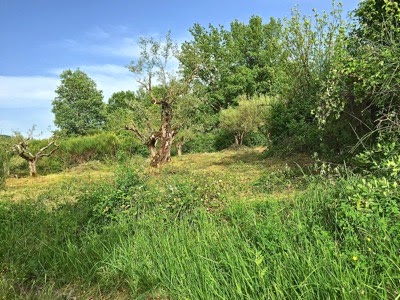
Olive trees
May 14-24, 2015—
A CLOSED IRON GATE; no doorbell to push. Three or four meters to the side, though, I notice a piece of paper posted to the mailbox, with a telephone number. By the time I call, though, we’ve been noticed; I see a man a hundred feet or so down the road at what must be the gate-opening sensor; the gate swings open, we drive down the smoothly graded gravel road, swing to the left along the oval turnaround, park as indicated in front of a long low row of guest rooms attached to a handsome stucco building with a fine rosebush covering part of the wall.

Couldn’t differ more from yesterday’s agriturismo. Where La Vecchia Quercia was serene and stately, Tenuta Montenuovo is clearly a work in progress, and a working farm. We’ve driven in through the olive grove, some of the trees severely cut back and thinned out recently. The house is halfway down hill from the gate in what seems to be a gentle hollow protected by forest from prevailing winds and the noise of the road (not that there’s any traffic); it faces away from its driveway, ninety degrees left, and down the slope in front of it I see a couple of horses standing peacefully near their quarters, one tethered, the other at liberty.

We’re shown into a big darkened dining room — interiors in this country seem always to be dimly lit, perhaps to save electricity, perhaps to keep cool in a climate given to heat. I suppose you could seat forty or fifty diners at these tables. There’s a short bar down the left side; the man who showed us in immediately offered us a coffee, making it in one of those new-fangled capsule espresso machines. He borrowed our passports for a few minutes — Italian hotels still have to register their guests with the government — and then gave us the key to room 4.

A nice enough room: double bed; armoire; writing-table; bathroom with shower. Enough sockets to power the laptop and telephone chargers. (I always carry a three-outlet adapter.) No view, though; strictly utilitarian. What do all the guests do, during what must be a busy enough season to reward all these accommodations? Well, I see a swimming pool, obviously not used at the moment; there’s a big flat area intended presumably for campers and tents. We learn later there are many walking trails in the area. Apparently Basilicata is developing a tourist economy; its hills and mountains a welcome respite from the heat of Campania and Puglia.

The room is quite basic but comfortable, and there’s a picnic table out in front of the dining room that finds the promised WiFi. (Wireless connectivity is increasingly important to us, and almost never present in rooms, only in lobbies, dining rooms, and the like.)

Getting here, now that had been a problem. We chose the place from an Internet site, agriturismo.it, which has a very handy iPhone app. Both show very clearly that the Tenuta is in the country, just outside the località of Carbone, but they also give Calvera as the site; so there we drove, up a steep road through a couple of switchbacks to the town, which had that rather closed aspect so many back-country villages project — not unfriendly, but a little bit guarded. We parked on the town square and walked to the only bar-café that was open. Three men in their forties, in work clothes, sat on the terrace between the doorway and the street; they’d been talking among themselves, but broke off as we approached. Salve, I said, the usual Italian for “hello”, and they nodded back, then resumed their loud conversation.

Inside a tired-looking (or possibly merely harassed) woman was cleaning something up behind the bar. We ordered coffees,, then returned to the terrace, where I pulled a plastic chair off a pile of them, nested together, and set it at the one table that had a chair. Before long another fellow came along, limping up to the terrace with a dog on a leash, and yanked his own chair free from the pile. The other men acknowledged him but showed no interest in him. A man drove a very noisy tractor up the street. Five o’clock hung heavily in the air. We drank our coffee and consulted our iPhones.

The tractor came back down the street, now pulling a trailer filled with what looked like compost. It sounded like the engine was about to throw a connecting rod. The clanking was really ominous. I looked at the man with the dog, who looked back at me, barely moving a facial muscle to show he knew what I was thinking. He looked toward the tractor, back at me, almost invisibly shook his head right, then left, and touched an earlobe.

We finished our coffee and paid; I replaced the chair I’d taken; we checked our information more closely, and drove down out of Calvera toward the river. Soon enough we saw a pannello advertising the Tenuta, and we followed its pointer, past a locked gate and up the road toward Carbone. On one side of the road, vineyards just leafing out, each vine with its wooden stake crowned with a rusty upside-down tin can, to protect it from the rain I suppose or to discourage perching birds. On the other side, olive groves, many of the trees very severely cut back. Before long we realized that locked gate must have been our evening’s hotel, and we turned back.

Giovanni told me the next day — I’m so nosy; I ask so many questions — that the place was ten years old; that that was his father-in-law working in the garden. Oh ho: so he married into the place. Well, why not. I asked how it was going. Well enough, he said. You don’t get rich, but it’s a good life. I was in Florence a few years, he added, I made more money there, but who wants to live like that?

His wife Carmela cooked our dinner and brought it to our table. A small but substantial woman with a full round face and dimples and a ready smile, she was dressed in whites and always, every time we saw her, wore a professional white cook’s cap, not a toque but a close-fitting brimless cap like those that gas-station attendants used to wear, when they weren’t slipped under their belts.

And what a cook she turned out to be! I write about most of our dinners on my other blog, and this year I started maintaining a list of restaurants we’ve been to. I decided not to attempt to assign “grades” to restaurants, partly in the spirit of equality, partly to evade the responsibility, mostly because one’s taste in restaurants is inescapably subjective — but some of them are so memorable, for one reason or another, that I single them out. That’s likely to happen with this one.

Dig Next morning, after a solid night’s sleep, Giovanni was on a back-hoe, leveling a good-sized garden site already protected from the elements by an enormous canopy. This would supply tomatoes, zucchini, and eggplants, he explained. I looked around the place a little more, and discovered a good-sized swimming pool I’d overlooked the previous evening, not that I have a suit with me. I think in season this must be well attended, this place. People come for cycling and walking, Giovanni said; many come from Puglia, where they don’t have hills and forests of their own. As we would discover, in the next few days… •Bioagriturismo Tenuta Montenuovo, 85030 Calvera (PZ), Italy; +39 338.6368133
Saturday, May 23, 2015

8: Don’t worry. No problem.

Viale di Villa Pamphili, May 21, 2015
YES, A LITTLE BIT behind in the dispatches. And even in the private journal, if you want to know. Been busy. Yesterday, for example, we arrived in the city of Rome, in Monteverde, a nice residential quarter vaguely southwest (as I believe, but I’ll check that out sometime later) of Trastevere, about ten in the morning, in plenty of time, as I thought, to return the rental car to the Hertz office at the main train station.

The very nice fellow at our apartment counseled me against that attempt. E tutto bloccato in centro città, he said; the center of the city is completely blocked. So I thought I’d return it to another office. The fellow who rented me the car a week ago, in Naples, said I could return it to any Rome office. So let’s do it.

But which office, and where would it be? There must be one in Trastevere, I thought, but looking up the addresses of the various offices on the internet turned up no answers. Many possibilities for clicking into an endless help loop, but no addresses. Phone numbers, but all of them answered by machines, most of them babbling away in melodious lilting Italian impossible for a non-native-speaker to comprehend.

Finally I followed Google Maps to the nearest office, on the Via Pellegrino Matteucci, over in the Ostiense district, near the Ostiense train station, where the improbable Piramide is. I’ll flesh this out later, I suppose, when I’m home, and have little else to do. The Piramide is very interesting; I’d like to tell you about it. But just now we’re driving up the Via Pellegrino Matteucci looking for — ah, there it is — the familiar Hertz yellow, no doubt copyright — no place to park — but there’s a truck double-parked, its four-way flashers going; I’ll just stop behind it, leave the engine running, set my own four-way flasher —

And I dodge through traffic across the street to the Hertz office, to find it locked up, obviously closed. But careful inspection reveals a piece of paper in the window: they’e merely moved a few doors down the street. I run down there: it too is closed, locked tight, no one in evidence, even though it’s a good half hour short of noon, and they’re supposed to be open until 12:30.

But here again is another piece of paper, advising me that I can return the car to a parking garage up the street. I run back to the car, punch the address of the garage into Waze (thank Hermes I’ve noted the address; thank Hermes Waze is always ready for another chore), and off we go, up the street a long way, sharp right, up another street, sharp right over a very unlikely modern viaduct across I don’t know what, sharp right down the Ostiense, ah, there it is, a shabby entrance to a nondescript parking garage, no one in sight, no signs, certainly no familiar Hertz yellow.

Nessuno? I call, Italian for Anybody here? And finally a man answers, walking slowly over toward us. I explain everything to him in my very much broken Italian: the car is due at noon, at the cenrtal office at the train station; the central city is completely blocked; the man in Naples told me I could return it to any Rome Hertz office, here it is, what more must I do.

He looked at me impassively. Do you have a contract? I hand that question to my secretary-consort, who hands me a paper, which I hand him, though I see, my heart sinking, that it is not a contract, merely a printout of an e-mail from the second-party online car-rental I use. This is not a contract, the man points out, in beautiful, clear Italian, though he is certainly not a native Italian, he obviously has a good component of Japanese ancestry. Rome is a cosmopolitan city.

No, I said, but it is what I give you. I look at my secretary. That’s all we have, she says. That’s all we have, I tell him.

He has begun walking around the car in that familiar pace, looking for dents and scratches. It’s perfect, I say, just as we rented it. Yes, he says, No problem. Don’t worry. Was the wheel cover like that? I don’t know, I say; I’m sure it was.

Fine, he says, that’s all, thank you. What, I ask: do’t I have to sign something, or perhaps you should sign something for me? Don’t worry, he says; everything is fine. No problem.

So we walk out of the garage, me carrying a pair of shoes we’d forgotten to unload from the car back at our apartment, and think about what to do next, while at the front of my mind the gears are turning: there was no sign that that was Hertz; I have nothing signed; the paper with the address of the parking garage — was that taped to the inside of the Hertz office window, or the outside? How simple it would be to tape notices like that to windows of closed offices, wait for people to bring cars to you, and then drive to, say, oh, I don’t know, Istanbul, or Moscow, or Brussels, or any other European city, maybe sell the car along the way…

The hell with it. As I’ve already told my other blog, we stopped in at Perilli for lunch, which made everything a whole lot better, and then took a bus to a piazza near our apartment, and walked the rest of the way, and sacked out for the afternoon.

The first half of this month in Italy has run its course; the second half will be quite different. We will no longer be alone, just the two of us; we will be with friends and relatives. Tomorrow we attend the graduation of a granddaughter from the American University in Rome; her parents are here as well. In a few more days we’ll rent another car, if Hertz hasn’t thrown us in jail, and drive up to Piemonte for a festive weekend with many friends and relatives. My Italian will get evern worse for lack of need for it; I’ll be hearing English everywhere.

The Roman episode will be odd, too. We’re almost not in Rome; Monteverde is quite a different quarter from Trastevere, where we’ve stayed before, not to say the historic center on the other side of the river. I feel restless. My son-in-law messages me: he’s getting a haircut: would I like to go along? Well, yes, I need one. I walk up to meet him; then we walk down to Trastevere to a shop he’s been told about — but, predictably, it’s closed.

But I have my own favorite shop, where I’ve twice had very good haircuts, at 44, Piazza del Teatro di Pompeo, near the site of Julius Caesar’s assassination — these few yards of street mean so much to me, from just a few visits but over so many years.

We settle into the shop. The barber looks familiar, He tells me he’s been there thirty years. I first came here for a haircut, I tell him, in 1988; I remember a boy who swept the floor meticulously…

The owner’s son, he said; yes, not completely… well…

That’s the one, I say. And is he…

Oh he’s fine, the barber tells me. The owner is retired; I own the shop now. I was second barber then. And the boy? He’s, well, retired, too, living in a home…

Pavel and I emerge a half hour later, both looking like George Clooney. Well, I look like Clooney’s father, and Pavel looks like a friend of Clooney’s, I tell him. We walk back across the Ponte Sisto, across Trastevere the short way, up the Janiculum to Fran’s apartment. I buy a couple of bottles of wine and a bottle of grappa, and we have dinner in her apartment, three generations of us, us oldtimers who in our twenties would never have dreamed we’d ever be in Rome, our daughter and her husband who grew up in a prosperous, secure world; our granddaughter and her boy friend who are questing their way in a world none of us could have imagined.

Wednesday, May 20, 2015

7. Dignity in futility

Melancholy
Ostia Antica, May 20, 2015
THE INTENTION WAS GOOD: to make this a journal of a month in Italy, posting every day or two, writing about the roads, the hotels, the mood, the people we meet, the landscape, whatever comes to mind. But any loyal reader there may be will have noticed I’ve been silent for the last five days, and that this brings the total number of posts up to seven though we’ve been here twice that many days. And, worse, as far as I’m concerned, I still haven’t brought you up to date on the agriturismi visited.

It’s certainly not because there’s been nothing to write about. We’ve visited three or four Greek and Roman ruins, any number of fascinating buildings, and the three agriturismi. We’ve seen the trulli of Alberobello and the cave-houses of Matera. We’ve driven across the heel of the Italian boot twice, and today drove through another part of Italy we’ve never seen. I’ve taken, let’s see, eleven hundred photos, and that doesn’t count today.

For a long time I’ve noticed that you can either experience things or write about things; it’s hard to do both simultaneously. I do keep a journal of sorts, but it’s mainly a record of hotel addresses, expenses, the occasional note on a thing or person seen. I rely on my increasingly unreliable memory and, of course, the photos, which function as an aide-memoire and, thanks to the iPhone’s GPS, a record of when we were where. Or where we were when.

For the moment I”ll just write a bit about today, since, tired though I am, it’s fairly fresh in my mind. Last night’s hotel was a pleasant one, a couple of kilometers out of town and above the city (Campobasso), but its breakfast was one of the least adequate we’ve had: no bread, only cake and jam-tarts (though I have to say I do like those apricot jam crostate), and about the worst coffee we’ve had, with far too much milk and that, I suspect, the long-playing kind. So we got out fairly quickly and hit the road, using the iPhone app Waze to guide us to tonight’s digs.

Waze works amazingly well here in Italy, though it’s a good idea to verify the address before you enter it. In another post I’ll try to remember to tell you what happened when we relied on it to get us to our quarters in the Basilicata. I set it to avoid toll roads, which adds an hour to a three-hour drive, and takes you through any number of roundabouts and sharp turns, and small towns and industrial areas: but you drive slower, saving fuel; and you save a lot of money in tolls.

I’ve always liked driving in Italy — whether in cities or in the country. You make use of all the road, and so do the other drivers. You’ll come up behind someone driving 40 kilometers per hour in a 90 kmh zone, usually though not always because that’s all his wretched car will do on the climb. It’s a two-lane road, and someone’s probably coming toward you from the other direction. But the slow guy moves over toward the shoulder and you pass, knowing the fellow coming at you will also move over to crowd the shoulder, and everyone agrees this makes the world better for both fast drivers and slow ones.

The countryside after Campobasso was really beautiful; rather wild at first, with hardly any villages or buildings, just forest, occasional patches of snow lingering on the peaks of the Appeninines, now and then a manicured field. There are red poppies everywhere, and surprising pinkish morning-glories, and miscellaneous other flowers and thistles decorating the landscape. I forget who it was that said flowering plants prove the existence of God: I don’t agree, out of principle, but I know what he meant. Evolution could have come up with something else, and I suppose it might have been nearly as nice; but I’m happy there are flowers.

We stopped at a little roadside bar in Cervaro, near Frosinone, just over the border from Molise in Lazio, for our second coffee, to subdue the lingering taste of the breakfast coffee. The croissants were surprisingly good, and the cappuccinos were too. I listened to the incomprehensible conversation of two or three guys lounging in the doorway behind me, and took a picture of the view and my companion at the table; and posted the photo to Facebook, where now seventeen people have “liked” it — and then, before you could say Jack Robinson, came a “friend” request from someone I’d never heard of (I always ignore such requests) and it turned out to be the proprietor of the place!

Facebook and TripAdvisor, like Waze, have changed the way we travel. Word gets out about things much quicker now, and while the “critics” and “reviews” on TripAdvisor, to take only one example, are often far from reliable (and too often downright crude or snarky), Facebook, since it lets people one really knows trade information and comments and photos, can be very helpful. (It’s also a quick way to show people what you’ve been seeing, which I find, so far, a blog is not very good at.)

We drove through the Rome suburbs, some of them, and the increasing traffic, nosing our way through merges that would be impossible at home, finding our way across highways and the tangenziale, finally parking right in front of tonight’s bed-and-breakfast. Only to find it closed, and a sign on the door saying it would be open between six and ten pm. So we drove out to the beach, reasoning there’d be something there to eat even though it was nearly three o’clock; and sure enough there was a fish-and-chips shop that was quite adequate — you’ll be able to read about it over at my other blog, if you like.

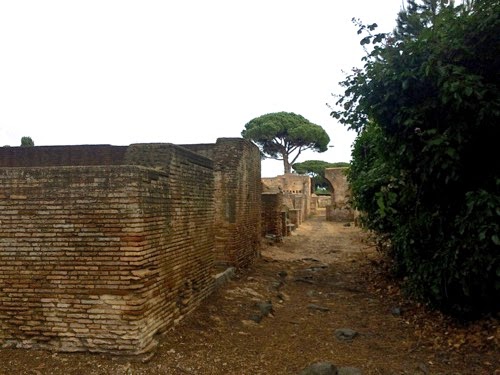
And then we turned to the real purpose of tonight’s stay in this implausible town: the ruins of the Roman port city. I had no idea how extensive they were, and how easily the visitor (once he’s paid a healthy admission, which must keep out the careless) can walk at liberty amont the tombs and streets and ruins of apartments and public buildings. I’m attracted to these ruins because I like daily life, I like the sense that apart from technology humans seem always to have the same desires and the same approach to satisfying them, I like the confirmation ruins give that nothing lasts least of all human aspiration, and that there is a real dignity in futility. Ruins confirm in me my innate melancholy.

But all the time we were walking among the pines and junipers of Ostia Antica, eavesdropping on French and Dutch and Italian tourists, conversing with a clutch of schoolchildren from Normandy implausibly dressed (and so were there adult teachers) in Roman tunics and sandals and headgear — all that time at the back of my mind I was worrying about tonight’s lodging. The place had looked pretty sketchy when i parked there first.

We returned at six-thirty, and the iron gate outside the compound was still locked. A note permanently pasted nearby gave a phone number; I called it; a man said Ten Minutes! Ten Minutes! Yes? and I looked at the time and sat back and relaxed, well, a bit. And within ten minutes he was there, and led me through the gate, through a cluttered driveway sort of affair, and up a flight of outside stairs to the entrance of what had at one time apparently been a private home.

And you know? Our room is really nice, with the necessary bed and chairs, the armoire, good and fast WiFi, a perfectly adequate bathroom, and our own balcony, where I sit at a table typing out this dispatch. It’s twilight now; friendly dogs are barking about the end of their day; a blackbird is uncoiling his liquid song. I’m about ready for something to eat and a good night’s sleep before turning in our car tomorrow and resuming my engagement with Rome.

Friday, May 15, 2015

5. Agriturismi: La Vecchia Quercia (Salerno)

Quercia
Metaponto, Basilicata, May 15, 2015—
YOU MAY HAVE NOTICED, constant reader, if you’re there, that there was until today no chapter five in this series of travel dispatches from Italy. I had intended to write it four days ago, on the subject of Churches and Castles; but one thing and another. Not to bore you with excuses.

(I had intended a Chapter Seven, as well, on the subject of Flâner; and that too has gone by the wayside, though it will doubtless emerge when I least expect it.)

So, as Lucky says in Beckett’s indispensable play, I resume. We have spent the last three days driving from one place to the next, settling for the night in an agriturismo, eating dinner, sleeping, and then recapitulating the next day. This has taken us from Napoli to, so far, Metaponto, on the northernmost point of the Gulf of Taranto, the instep of the Italian boot.

The three chosen agriturismi have been quite different from one another, though all with two things in common: unforgettable, personable, helpful, truly sympathetic personnel; and settings close to the agricultural terrain. I begin, then with the first of these.

We first found the B&B La Vecchia Quercia in a travel article in, I believe, the New York Times&thinsp, when we were touring around by car for a few days from Caserta to Erculaneo to Paestum to the Amalfi cost. We decided more or less impetuously, as we tend to do, to give it a try, and we found it delightful. The setting is quite a few kilometri off the beaten path, back up in the woods at the edge of a regional park, wooded and hilly, though still agricultural — in fact on the edge of an apparently important vignoble, Montevetrano. (I have yet to taste their wines: a tribute to the more ordinary house wines offered at this table.)

We were back day before yesterday, five years later almost to the day. The woman in charge, Anna Imparato, looked at me closely but apparently did not recognize me: but she remembered my companion instantly. And warmly.

We were shown to our room: large, comfortable, with its own little terrace, and adjoining the lawn under the lemon grove. Beyond the structure containing our suite and the adjacent one, much the same as I recall since we stayed in it five years ago, and containing also an apartment on an upper storey, there’s a stretch of garden dominated by an amazing old mulberry tree, certainly a meter in diameter at the base, the trunk hollowed out, but the canopy full and thriving.

Our view looks west over agricultural land, and truth to tell it is a workaday landscape, but everything here is so well tended, planted and distributed with so astute and gifted an eye, that every detail confirms a kind of spirituality, a graceful marriage of idea and achievement, concept and realization. I love the place, because I love the values and intent of its direction.

I won’t discuss dinner — I’ve done that over at Eating Every Day. But I must discuss our hostess, which is something I don’t often do here; I don’t like writing about real people; they are always so much bigger, more complex, more interesting than I can convey, and then there’s always the fear one won’t please them with one’s report. But, fact is, such people have chosen a public life, and for better or worse (probably the latter), I am by training and, I suppose, by nature a journalist; I like to write about what I see, if only to fix it in mind…
Signora Imparata is perhaps seventy, well-built, handsome. She carries herself well: her posture is elegant but not stiff; her gestures are gentle but expressive. When she listens to you she looks at you frankly and directly, with interest; she has an impressive way of focussing on what you intend to say. Every part of her bearing is quiet, well regulated. When her well-formed hands move gently and gracefully apart, turning at the wrists to let the palms face one another, her fingers spread just a little, as if instead of punctuating a statement as to how something is she is carrying a small invisible but probably beautiful and fragile container of fact.

My mother was a very good women, but very strict, she said. I was sent to a religious school in Rome, where we learned to hide our attractions to things that were forbidden. I was very unhappy, not because of that, but because I could never learn to turn the sheet under properly when making the bed. It was a very strict upbringing: we walked with pieces of wood on our shoulders, and our heads, and another piece of wood thrust down behind the neck, to teach the proper way to carry ourselves.

My sister was a gifted musician; she practiced the piano ten or eleven hours a day; she lived for music and the piano. But when she asked if she could be a concertista, No, she was told, young women do not do that. We weren’t taught anything about money, about business. A frl lived on her parents’ income until she married, and of course she did marry; then she lived on her husband’s money. She was taught to run a household, to be cultural, to manage that side of life; no more.

But we knew the kitchen, the garden; plants; everything about the household. We knew sewing. When a double sheet — which was always very fine, highest quality — when there was a thin place coming, or it split; then we cut it and made it into single sheets. Then still smaller: serviettes; bandages. Finally it was only big enough for blowing the nose. But it was used as long as possible.

This was not because we were poor; far from it. It was simply the way things were done; it was a respect you paid to the things you had, to their quality. It was a completely different way of living. Can that way of living come back? No; I don’t think so. And yet, who knows, perhaps it will. Perhaps in the cycle of things it will come back; we will lose interest in life as it is lived now, we will realize the fullness of life consists in work, in attention, in appreciation of things as they are, of life as it comes to us.

When we began here, the people who help us asked why there were so many forks at the table; why does everyone at the table have two glasses, that is not the way we do, we have one fork, we need only one glass, but we quietly continued to put the proper number of forks and glasses at the settings because that is how we were taught things are done, and now I notice the people who help us they too at home have one glass for water another for wine; they too have the correct forks.

Signora Imparato — few people can be so well named: imparato means “taught” — speaks passable English and, I think, fairly fluent French, as well as Italian. The night we were there there was a Dutch couple, say twenty years younger than us, staying there; she and they spoke English together, and got on well. Her sister — perhaps the former pianist, perhaps another — has become an apparently well-recognized winemaker, and lives next door. There’s another woman who, I believe, cooks and certainly serves the breakfasts, which are copious and tasty. I suppose we will return; I can’t imagine driving past Salerno without stopping; the bed is so comfortable, the room so delightful, the dinner so rewarding, the conversation so pleasant.

The morning we left a young man was mowing the lawn under the lemon trees. Another couple of workmen were getting the small swimming pool ready for the season. Everything here is in order, calm, reassuring, pleasing. Nothing is out of balance. The contrast with the busy city that is Naples couldn’t be bigger — and yet Anna loves Naples, it has heart, as she says; it’s a performance; one forgives it its faults for its warmth and generosity and spectacle. These are exactly the virtues of La Vecchia Quercia, minus spectacle I suppose: but there comes a time one wants tranquility, even gentility, to enjoy the emergence of utilitarian sufficiency into beauty and order..

•La Vecchia Quercia, Via Montevetrano 4, Località Cantina di Campigliano, San Cipriano Picentino (Salerno)

Writing like this appears in three of my books: Roman Letters, two month-long stays in Rome; Mostly Spain, a month touring Madrid and Andalucia; Venice: and the idea of permanence, reflections on a couple of month-long sojourns in that city. Look for them in iBooks or simply by clicking on the title.

Wednesday, May 13, 2015

6. Pizza e gelato!

IMG 9827
Antica Pizzeria da Michele
Corso Vitt. Emanuele, Napoli, 12 May 2015—
OF COURSE I WRITE about our meals just about every day; I’ve been doing that for years, at Eating Every Day. And so I rarely write about eating here, on the theory that this blog is reserved for really consequential matters, requiring really serious attention on my part, and even more dedication from you, gentle reader, if you’re there.

But it’s time to record the results of our short but scientific survey of pizza and gelato, matters of considerable significance to certain members of my family and therefore perhaps of more general interest. Naples is considered, I’m not sure why, the origin of pizza. I think this may be partly because of its importance as a center of Allied occupation in 1944, after the first Allied invasion of the European mainland, at Anzio, not that far from here. Pizza was of course already well established in Naples at that time, a staple at a time when foodstuffs were in short supply, and very tasty to the American G.I., who was heartily tired of G.I. fare by then, I’m sure.

Pizza is of course nothing more than flatbread, and flatbread’s been around for millenia. There isn’t a Mediterranean cuisine that lack it; hasn’t been since recorded culinary history. (You can probably find pictorial representations of it from prehistoric times, if you’re academically inclined.) It’s absurd to think that Naples “invented” pizza, any more than China “invented” pasta, pace Marco Polo.

But Naples is proud of its pizza, proud and even a bit purist. At Da Michele, for example, two large signs on the walls present literary — well, poetic — admonitions on the subject:

           Don Michele
cu l'aglio, l'uoglie e arecate      
oppure a pummarola
pare na cosa facile
ma a pizza e' na parola

n'ce vo na pasta morbida
s'adda sape' n.furna'
o gusto i chi a prepare
pe nun ve n'tusseca'

a pizza e' nata a napule
ma poche indo' mestiere
ve ponne da' o' piacere
i farvela mangia'

surtanto don michele
che' fino pasticciere
ve fa na pizza spendida
ca ve fa cunzula'
      —A. Galante

      A Margarita
a quanto sta' o benessere
a gente penza a spennere
e mo' pure o chiu' povero
o siente e cumanna'

voglio una pizza a vongole
chiena i funghette e cozzeche
cu gamberetti e ostriche
d' ‘o mare e sta citta'

al centro poi ce voglio
‘n'uovo fatto alla cocca
e co liquore stok
l'avita annaffia'

quando sentenne st'ordine
ce vena cca na stizza
pensanne ma sti pizze
songo papocchie o che'
ca se rispetta a regola
facenna a vera pizza
ch'ella ch'e' nata a napule
quase cient' anne fa

questa ricetta antica
se chiamma margarita
ca quanno e' fatta a arte
po gli ‘n'anza a nu re

percio' nun i cercate
sti pizze cumplicate
ca fanne male a sacca
e u stommaco pati’

—G. Esposito
A. Galante’s poem is little more than an ode to Michele, the eponymous original pizzaiolo of one of the most highly touted pizzerie in Naples: “pizza was born in Naples, but few are given the mastery… above all don Michele, whose pastry skill developed that splendid pizza…”

But G. Esposito’s lines, from what little I can make out from the napolitano dialect, go further into the question. It’s not pizza that the Neapolitans invented, but authentic pizza, which has only four ingredients: the dough, the tomato sauce, the garlic, the oregano. When you’re poor, you may dream of clams, mushrooms, oysters, shrimp; a cooked egg, salt-doc broth, and all that: but you make do with what you have, and what you have, if you’re lucky, is tomatos, garlic, and oregano. And just as well: because those complicated pizzas will only wreck your bladder and leave your stomach swollen.

Well: I’m a little confused here. Esposito is writing about Pizza Margherita, and it’s aready unnecessarily complicate, secondo me, in my opinion, because it adds cheese to the classic Pizza Marinara, the tomato-garlic-oregano pizza. There’s a story there, too, of course: Queen Margherita was slumming one day in Naples, and wanted a pizza: the pizzaiolo, thinking she deserved something special, entirely new, added dollops of mozzarella to the classic (and in fact only) version, thus adding white to the otherwise red and (barely) green colors. Red, white, and green are of course the national colors of Italy; Margherita was the first queen of the newly unified nation; the result was as patriotic as Verdi. (Vittorio Emanuele Re d’Italia; get it?) So jingoism interferes with the true course of cultural necessities, like opera and cuisine.

In any case while my companion reached into other corners of menus, even as far as salt-cod-and-mushroom pizza, I remained true to scientific principle, comparing apples only with apples, oranges with oranges. I have tasted only pizze Marinara, and when it’s come to gelato, I’ve been loyal to fior di latte (crema when there is no latte) and limone. And the results have been absorbing.

•7 May: Pizzeria da Michele, Via Giuseppe Martucci, 93; +39 081 1957 6887: The pizza menu here begins with Marinara and Margherita, and while there are other, more complicated combinations listed, we of course went no farther. We split a Marinara "Maxi", about twenty inches across says my Contessa, beautifully leopard-spotted on its bottom side, a little soupy in the Neopolitan style, edgy and pointed with good tomato flavor and delicate oregano and garlic. Oh: there was basil involved too. Not authentic.

•8 May: Starita, Via Materdei 27,28; +39 081 5573682: This one was perhaps just a tad better. I think the reason was the nicely cooked little basil leaves — okay, maybe that is authentic — and the sweet thoughtful tiny chunks of garlic. The tomato was a little mellower than yesterday’s, which is nice, though I did also like, just as much, the assertiveness of yesterday’s: each version is first-rate, smooth, rich, nicely balanced.

My Contessa, always fond of baccalà, ordered the "stock" pizza: stockaffisa, the Italian version of dried cod, black olives, capers, garlic, chopped parsley, and cherry tomatoes. It was very very good, delicious in fact, an inspired combination. The cod, or baccalà, or brandade, or whatever you like to call it, was very smooth, deep-flavored, set off nicely by the perfect tomatoes. The waiter told me it was strictly local, made here in Naples from locally caught merluzzo. I want to believe that, and I think I do.

•11 May: L’Antica Pizzeria da Michele, Via Cesare Sersale, 1/3; +39 081 553 9204: Here there are only two pizzas: Marinara, which is tomato sauce, a little garlic, and oregano — no basil! — and Margherita, which adds mozzarella to the mix. And there are three sizes: small, medium, large. To drink you choose Coca-Cola or beer or water. The pizza arrived almost immediately. I think perhaps it arrives too quickly, and while I’m no pizzaiolo I think the pizza may  not have been cooked long enough. The bottom of the crust is nicely blackened, but the spots are too big, leaving whiter spots that also seem too big. I’m sure the oven was up to temperature, but as we left I watched the pizzaoli at work: there were two working the one rather large oven, one shoving uncooked pizzas in, the other dragging cooked ones out. It’s probably a mistake to go to da Michele during rush hour.

The tomato sauce was fine, though perhaps not as dense as at Starita. The dough was very hard to cut with the table knives we were given. (I should explain: in Naples one eats one’s pizza with knife and fork, and they arrive at table innocent of any kind of pre-cutting: you don't lift a wedge already cut and eat it from your hand. Non si fa: it isn’t done.)   Anywhere else this would be a marvelous pizza. In my opinion, here in Naples, it wasn’t quite up to its closest competitor — and I do like a glass of red wine with my pizza!

Fabio, whose restaurant Partenope we went to one evening, up in Vomero, has an uncle who is a pizzaiolo. They were both horrified when I admitted that we’d had our first pizza here. Yes, Starita and the real (Antica Pizzeria) da Michele, they’re competent enough. But Fabio says, reasonably since it’s in the family, the best pizza in Naples is made by his uncle, at Acunzo Pizzeria Vomero (via. B. Covenzio 4/6; Vomero Napoli; +39 081.0491868). Unfortunately for one reason or another we never got there. Next time.
ON THE SUBJECT of gelato I’ll have less to say. In spite of our best intentions, I only sampled four or five gelaterie, maybe six; and so irresponsible am I I took proper note of only four, and even then misplaced the name of one — which is of little consequence.

We’ve been sampling gelato for years, and I have developed my own approach, which is to taste the simplest flavors, some might say the blandest, if I’m intent on making comparisons. I love certain other, bolder flavors and textures. Perhaps my favorite is riso, gelato based on rice custard, but that is now very rarely found. It used to be common: I recall delicious ones in Venice and in the small southern Tuscan town Capalbio. Those days are apparently gone.

I like chocolate, of course, and some nut-based gelati, and licorice, and some really odd ones like the tobacco-flavored and whisky-flavored gelati you can find on Rome, where we’ll be in a week or so. But when I’m on a scientific errand I stay with two flavors: Crema and Fior di latte. Crema is what Americans might think of as “French vanilla,” except that there’s little if any vanilla, and it isn’t French. It’s simply a cream-based custard, and it can be absolutely wonderful.

Fior di latte — well, I’ve never been sure what that is. It’s lighter than Crema, of course; it’s undoubtedly flavored with a bit of vanilla; but principally it is milk. My companion could tell me a lot more about this, if I asked her, but she’s reading the newspaper. In Naples I never saw Crema, so I abandoned my usual procedure and substituted Limone for it, thinking of Carlo Ponti and his marvelous song “Gelato a limon.”

We began the survey our second day in Naples, at a shop that came readily to hand after our pizza at Starita. Gelosità, like most of the other gelaterie sampled, is a chain of shops; a franchise in fact: but we’d happened upon the mother ship, you might say, and the young woman who served me said, when I asked, that the gelati were all made on the spot.

I had Fior di latte and Limone, and thought them both good, but not exceptional. The flavors were clean and direct, the textures smooth with no graininess at all; but the finish seemed short to me — but then, I’d just eaten a very good pizza.

The next day we put my new friend Fabio to the test. We’d read that one of the best shops in Naples was Fantasia Gelati, but when I mentioned that to him on our walkabout in Vomero, he said — quietly and without contradiction, as is his style — yes, many people like it; personally, I prefer (and he pointed to it, across the street) Casa Infante.

Both are on the Piazza Vanvitelli, and there we were: so we went first to Casa Infante, where I had Fior di latte and Limone, and my companion substituted the Nocciole (hazelnut) for Limone.. Then to Fantasia for the same, my companion by now abstaining altogether. She thought the Limone slightly better at Fantasia, but I disagree: it was less intensely flavored at Casa Infante, but it was also deeper, less superficial, and had a cleaner finish. And the Fior di latte was much creamier at Casa Infante. I have to agree with Fabio.

A couple of days later we found ourselves walking past the one shop on everyone’s list that is apparently one of its kind, not a chain, not having opened a branch office anywhere. On the other hand, Gay-Odin is not simply a gelateria; it is primarily a cioccolateria specializing in chocolate candies of various kinds, running its gelato operation on the side.

Nothing marginal about its quality, though. I thought the Fior di latte more or less average, but the average is very high; it was easily up to those I’d had earlier. And the Limone was smooth, clean, rich; a very beautiful thing; a semi-frozen lemon custard managing the difficult marriage of citrus and cream and egg with no awkwardness at all.

As I say, the average in Naples is high. We stopped at an ordinary run-of-the-mill commercial gelateria with no pretensions to artigianalità that I could see, across the street from the Duomo — strange that no art gelateria had staked out real estate here; perhaps it’s simply too expensive — where my two gelati, you can guess what flavors, were as good as anyone could decently demand. Not breathtakingly superb, perhaps, as I think Casa Infante and Gay-Odin can achieve. But very very good.
Writing like this appears in three of my books: Roman Letters, two month-long stays in Rome; Mostly Spain, a month touring Madrid and Andalucia; Venice: and the idea of permanence, reflections on a couple of month-long sojourns in Venice. Look for them in iBooks or simply by clicking on the title.

Tuesday, May 12, 2015

4: Gates and gatekeepers

Hillside
Corso Vittorio Emanuele, May 12, 2015—
OUR BUILDING is on the right in the photo, to the right of the entrance to the funicular: the second-highest, just below the rounded one. The more handsome because somewhat older one just in front of it, with rounded bays at its corner, is the one we take the elevator through, bottom floor to top, to get to the front door of our building. Each of these palazzi, as the Italian quaintly calls apartment buildings, has its concierge, and at the cancello at the street, where the residents drive in, there’s another, a guard really, not a concierge, who sees to it, presumably, that none but residents and visiting professionals come in through the gate.

Well, not the gate, really. There is a gate, but it seems always to be open; instead, the vehicular entrance is barred by a simple barrier, a pole hinged at one end that lifts from its crutch when someone needs to drive in. What the Dutch call a slagboom, a striking pole, like those you see in parking garages. There’s a pedestrian gate there at the cancello as well, also perpetually open as far as I can see, though I haven’t been out late at night.

Our concierge is a woman who sits at the window of the front door of her apartment on the ground floor next to the elevator. It’s the only apartment front door with a window. She is visible from the waist up, and she is always on the telephone, but she always takes not of our arrival or departure, usually with a smile. If she doesn’t smile she must be preoccupied with her telephone convesation; perhaps the news isn’t so good. It can’t be terribly bad, though, because her default expression seems relaxed and benign.

The day we arrived everyone cautioned us on the proper use of the elevators. The cage has a door, of course, on each level, to prevent one’s falling into the slevator shaft; and the car has a door, split into two leaves vertically, I suppose to keep one’s limbs from harm while the car’s in motion. If all these doors aren’t closed quite shut, the elevator does not operate. If we were to leave a door the slightest bit ajar when leaving on the top level, a person at the bottom would have to climb a number of flights to get the elevator. By the time she got there she wouldn’t need it, of course, but she’d be in a temper.

I knew that, of course, I wasn’t born yesterday. Nevertheless the elevator was stuck on our floor shortly after our arrival. I know it couldn’t have been my fault, but the concierge wasn’t convinced. I heard her toiling up the stairs and calling out, and opened our front door, just three steps from the elevator, and saw the problem immediately, and clicked the door shut shut shut. She began lecturing me, in Italian of course, and I countered that since I knew perfectly well how the whole thing worked it couldn’t possibly have been me who left the door ever so slightly not completely shut. But she wasn’t buying.

Still she smiles now when she sees us. I’ve never seen the concierge in the front building, and there is no window on any apartment door on its ground floor; but I know she’s there, probably looking at a video monitor while making her telephone calls. Perhaps she isn’t presentable, and the apartment direction — a committee, I think — prefers to keep her hidden; or perhaps the idea is to keep residents and visitors in a state of uncertainty. But we all know she’s there, and act accordingly; though I never know in which direction to smile as I enter; the camera, if present, is well hidden.

I like the men in the little cabin at the cancello. Their big front window is always open and they frequently stand in the roadway in front of their cabin. They’ll call a cab for you, if you seem incapable of doing it yourself even though they’ve provided you with the number. They aways say Buon giorno or Buona sera, to let you know they’ve seen you and recognized you as permissible. Usually there’s only one man, but sometimes, especially apparently at noon and the next couple of hours, there are two, perhaps to keep one another company at lunchtime.

The other day as we walked out an alarm was going off somewhere, a particularly annoying one, and they were discussing this between themselves, and with anyone who chanced by. The question was, where was the offending alarm? One of our buildings, here at Parco Eva, Corso Vittorio Emanuele 167, or one of the buildings in the adjacent park, whose name I do not know and whose number has escaped my attention? If one of ours, clearly it was their responsibility; and clearly this troubled them; it would be very nice if we could determine the alarme was going off next door.

An old man, even older than I I think, was convinced the alarm was coming from one of our buildings, perhaps even his own. He kept pointing up and to the left. I walked up the roadway, cupped hands behind my ears, and slowly turned my head from side to side as I walked, like a traveling radar antenna; and I was certain the irritating warble came from next door. Hard to be sure, I admitted; there were many surfaces reflecting the sound; the place is full of echoes. It’s a bit like wandering among rocky landscapes in the Alps, where sometimes you must listen very intently to figure out which direction a voice is coming from, or a distant cowbell; and sometimes you begin to understand the irritation a peasant must have felt at the mischievous ventriloquy practiced by local gnomes and sprites.

We were standing there waiting for a taxi we’d called — we’d called the one at 8888, and while we waited many 2222s and even a 545 or two drove past, empty. Surely, I thought, only four 2222s would come by in the time one 8888 would take, but it wasn’t that simple; no arithmetical processes here. And in fact a 545 picked us up, and when I told hm we’d called an 8888 he said it didn’t really matter; he was going by anyway.

By then the alarm had begun to weaken, as if realizing no one was going to take it seriously, it was a bore and an annoyance, nothing more. And when we returned, hours later, it was quiet.

Lst night, though, just as I’d fallen asleep, there was a tremendous series of explosions down the hill in front of our building. I went to the window to see an amazing display of fireworks, nothing going very high into the sky, but many things going off nearly at once, say three storeys above the street. It reminded me of the scene in Les vacances de Hulot, when all the fireworks in a storage shed are accidentally set off at once. I actually saw that happen a number of years ago at a private party in the French countryside on Bastille Day, when as night fell the host was so drunk he decided to set off all his feux d’artifices simultaneously, with the result that it was soon over and everyone was laughing at the consequent anticlimax.

Today I asked the watchman at the cancello what it had all been about, and he shrugged: some Saint’s day, he speculated, or perhaps a wedding. If a wedding, I said, the bride must have been a little nervous. They always are, the watchman replied.
Writing like this appears in three of my books: Roman Letters, two month-long stays in Rome; Mostly Spain, a month touring Madrid and Andalucia; Venice: and the idea of permanence, reflections on a couple of month-long sojourns in Venice. Look for them in iBooks or simply by clicking on the title.