Saturday, November 11, 2006

Budapest 5: St Martin’s Day


Tabáni plébániatemplom, Szarvas té


ST. MARTIN’S DAY is the day you eat goose, at least here in Budapest; so it was a lucky thing that we had postponed until today a visit to my cousin Roxanne’s favorite Budapest restaurant, Aranyszarvas, just across the “Elizabeth Bridge.” She had described it as just across the bridge and a little north, maybe on Atilla Út; and the fold-out guidebook I bought a few days ago happened to list it too, a little more specifically as at Szarvas tér 1. The tourist-office lady helpfully told us how to get there from our hotel, on the black bus number 7, do not take the red bus number 7, it will not help you; and get out just after the bridge, and then walk.

And so, in general, we did, and it all worked out. The Elizabeth Bridge is in fact a high-speed road bridge; it ends in swooping ramps not at all conducive to pedestrians; and there’s virtually nothing — if fact, literally nothing — by way of signs helping pedestrians figure out what to do next. But we knew it was upstream from the place we got off the bus, and the book suggested it was near a baroque church, and the Tabán Church was clearly visible and nicely lit, so we headed for it, and there was the restaurant.

We had reserved earlier in the day at the tourist office, and a good thing too: a few parties showed up without reservations, and were sent away with regrets. Last night we ate at a very upscale restaurant further upstream on this Buda side of the Danube, and there was only one other party there by the time we left, quarter to nine. Here at Aranyszarvas there were only a couple of empty tables when we arrived, promptly at eight.

Our guidebook describes it as specializing in game, and the menu confirmed this. The menu mentioned venision cottles, dear, and a number of other things; but we forwent the English-language menu in favor of the daily special — St. Martin’s goose menu. We had
goose broth with potato dumpings
goose neck farci
goose breast with potatoes and a crèpe stuffed with something
an untranslatable Hungarian dessert involving egg and custard
and with this we drank
as an aperitif, Jagermeister, and (for me) a typical Hungarian cocktail involving Tokay
new Hungarian “Beaujolais”
special house-made prune snapps


Everything about this place was memorably pleasing. The rooms: two of them, the furthest the largest, with perhaps seating for forty, one of whom was a middle-aged man who set about playing a synthesizer in rather an unintersting fashion; the other of which — the first as you entered — held only three tables, one of which was ours. The walls were a pleasant pastel green, set about with antlers and such, and the room was broken up with pots of ferns and, as I recall though it seems odd now I think about it, poinsettias.

The staff: friendly but professional and maintaining a professional distance. English-speaking, fluently so, without any dancing about as to what language you’d prefer to speak. Perfectly at ease explaining the special St. Martin’s Day menu, even though it was entirely in Hungarian, and — some of it, anyway — apparently untranslatable.

The aperitifs: Jagermeister for three of us, but I was interested in a special item, a puszta koktél involving, I later learned, dry Tokay, apricot brandy, and a “sweet brandy,” a Hungarian specialty otherwise never explained or described. In it were floating a couple of small ice cubes and a black olive, and it was really quite delicious.

The wine: this may have been a Hungarian version of Beaujolais, but it lacked any component of headache. The wine was crisp, fruity, a little complex, with a good acid balance. I couldn’t identify the grape, but the waiter said it was a green Portuguese. Well, it was red, of course, with a fine tobacco-red color and a bit of oak on the nose, and we drank nearly two bottles of it.

The broth: salty, deep, flavored with minced parsley, deeply colored. The goose neck stuffed with a bread-based stuffing laced with goose-reduction flavor. The goose breast slices as thick as slices of prime rib of beef, but with no fat at all, dark and complex, tender and perfectly sliced across the grain, nothing stringy about it.

The dessert: Lindsey had never met anything like it. It was a square of a sort of cake, but what was it made of? It had a texture recalling fine shreds of coconut, but there was no coconut flavor at all. I myself think it was egg-custard cooked firm, then somehow shredded and re-configured, lidded with an extremely fine layer of crèpe. But I’m no pastry chef.

WE LEFT THE RESTAURANT FULL AND HAPPY and tried to find the place to board our bus back to our hotel. We took the first bus we saw, which was headed the wrong way: but a pretty slender tall young woman who spoke excellent English told us to stay with it, she’d show us where to get out to catch the right bus going back in the other direction. We stayed with her, needless to say. She turned out to be a Budapest native, a student of Sociology and the Contrabass; she’d played that afternoon in a performance of the Mozart Requiem; we traded tunes and jokes about violas and condutors, and she showed us the right bus, and we were easily back to our motel.

Earlier today we went out to the fabled Budapest flea market, which reminded me of the Paris flea market in the old days — porcelain, glass, old furniture, salvaged army mementos, amateur paintings, old clothes, bricabrac, more violins than you could shake a stick at, a few steel-engravings and ceramic busts of composers (chiefly Beethoven), auto-repair tools, watches, coffeepots, mortars and pestles, fake leather jackets, hats and helmets, swords, corkscrews, eyeglasses, and (as Burl Ives used to sing) things too fierce to mention.

I’ll write later, if I feel like it, about the bus ride out there, the suburbs, the shopping plazas, the paranoid changed bus schedules, the old ladies and young lovers, the shoppers coming back from Auchan with plastic bags of sausage and onions.

We also went today, surpise, to another concert: the Buda county orchestra playing the overture to Don Giovanni, the d minor piano concerto, and the “Prague” Symphony — an entire Mozart program in D, minor and major. Who could resist such a program? The main Budapest concert hall, on Ferenc Liszt Square, is a fine building from the turn of the 19th century, roughly a short shoebox seating about 1200, with splendid acoustics. The concert was sold out, so we bought standing tickets which allowed us to take unsold seats in the first row. We sat in front of the cellos, and didn’t see violins until after intermission, when the piano was rolled away. Nevertheless the sound was splendid. The orchestra was perhaps not fully professional, and there were missteps: but what a pleasure to hear this key so splendidly explored, and the “pa-pa-pa-pa-pa-pa-ge-no” theme so nicely varied, and Mozart so entitledly sure of himself, and making such fine friends and productive allies of every instrument in the orchestra.

Friday, November 10, 2006

Budapest 4: A little louche, but fun


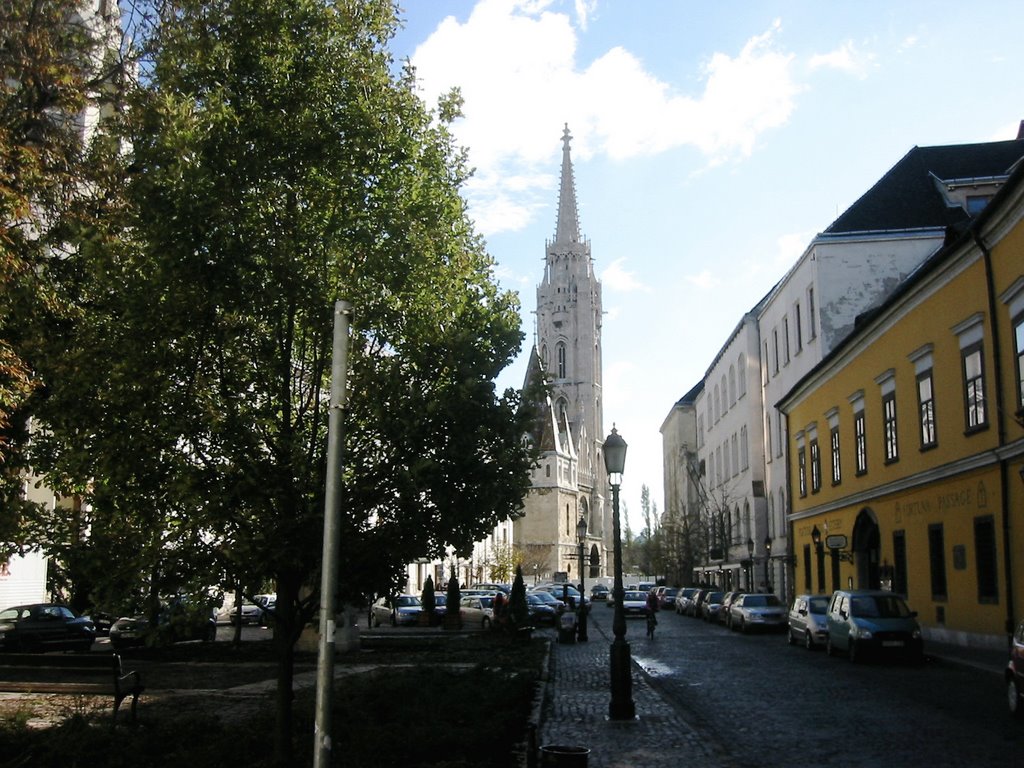
Buda: Hess András tér, toward the Matthias Church


THIS IS HOW YOU CAN spend your day in Budapest:

Up a little before eight to check out CNN’s fourth reprise of the news. Nancy Pelosi, we’re proud of you.

Breakfast: a big bowl of granola with chocolate chips in it and two cappuccinos from the push-button machine on the hotel breakfast-buffet table. There are two of these machines, and this morning for the first time the one I’ve been using didn’t work, so I used the Nescafé machine next to it. The result was virtually undrinkable. Fortunately the waiter poured a pitcher of water into the other one, Dallmayr it’s called, and I could overcome the Nescafé taste with what I’ve been drinking these mornings; machine-made but acceptable.

By Metro then across the river — under the river, in fact — to Buda for the first time. Until now we’ve been in Pest. You’ve seen how we’ve felt about Pest: re-reading these quick accounts, we seem to have reservations; to be less than completely besotted with the city. Today I finally threw off all these reservations and simply gave in to the experience, and it helped that we started the day on the other side of the river.

We did that by first visiting a church which was closed, of course; and then visiting a promising covered market which had been turned into a shopping mall upstairs, a supermarket downstairs. (But, as was pointed out to me, the result was to save the structure from demolition. And the project suggests another: perhaps one day supermarket buildings in our own country will be preserved from destruction by converting them into covered markets.)

Then we walked up the Fö utca — I do love these street names — to leave a reservation for dinner tonight at Kacsa, pronounced Kotcha, which means “duck,” on the corner of Kacsa ut. For six-thirty, we said, knowing it was an absurdly early hour, but we had our reasons. And then I asked the host if there were another restaurant we should try in Budapest — it’s a ploy that sometimes works. We’re the best restaurant, he said. Yes, I said, but where might we eat tomorrow? We’ll still be the best restaurant tomorrow, he said.

Then we walked back south a few blocks and then turned southwest to climb the hill to the old city, up flights and flights of steps — I have no idea how many they eventually were; I usually count steps somewhat compulsively, but neglected to this time, out of pure joy with the day, the air, the weather, the trees above us, and the quiet. Behind us was the Danube; across it, the unbelievably gothic Houses of Parliament; on it and spanning it, the anchored tour-boats and the series of bridges.

Up and up we climbed, stopping to sit a minute or two on a bench, nodding to a young woman pushing a baby-stroller, nodding again to a fellow with a number of plastic bags and baskets of domestic items — he seemed to live on one of the benches. Finally we reached the top, a sort of castle surrounded by walls easily penetrated and then revealing a village of two- and three-storey buildings housing shops, restaurants, little museums, perhaps an apartment or two, all in neat repair, painted in fetching pastel colors and facing streets whose sparse furnishings of street-signs and the like could, or can, easily be struck should anyone want to shoot a movie here.

The effect is a bit unreal — hyper-clean, unnaturally calm and attractive. But it’s pleasant as hell, and a contrast with what we’ve been dealing with on the Pest side of the river — a big city full of traffic, run by internal combustion engines lacking the anti-smog devices we’re used to, and endlessly cluttered with signs, advertisements, sculpture, electric wires, lamps and lamp-posts, streetcar lines, and block after block of repairs involving scaffolds, wheelbarrows, piles of sand, paving stones, bricks, fences, and the like.

We visited the Matthias Church, a magnificent building contrasting greatly with the St. Stephen Basilica across the Danube. The Basilica is only a century or so old, Victorian-baroque, stuffy in its stony way; the Matthias Church has Gothic bones under Art Nouveau clothing, for it was entirely painted inside in the late 19th century with geometrical patterns and representational figures, and is marvelously lit by a combination of stained-glass windows worth comparing to Chartres and clear glass windows cunningly directing sunlight into the interior.

We had tea and pastry at Ruszwurm, the best pastry in Budapest I’d been told, and my sour-cherry strudel was in fact absolutely delicious (though Lindsey’s Dobos Torte wasn’t the best she had tasted). We walked back past the now closed restaurant museum I mentioned the other day — I mean past its previous site, a fine 18th-century hotel — and then caught a series of buses down-river to the other end of the old city of Buda to investigate the famous baths.

Our first choice, the Rudas gyógyfürdö (God, what a language), was off-limits unless we were bathing, so we walked on to the Hotel Gellért, stuffy and uninviting, and then to the adjacent Baths, where for 800 forints apiece we could walk around the lobby and peek into the capacious room where the main swimming pool was to be seen. There it was among its pillars and marble, about the size of the Berkeley YMCA pool but considerably more sumptuous, with a score or so men and women slowly moving counterclockwise around the perimiter of the pool.

We looked at the Soviet-realism statues of female nudes, done in the 1960s and apparently celebrating the ideal feminine tractor driver; and we walked upstairs to look at things from above, and then back down to take another look from that level; and then we walked across the Szabadság Bridge — a handsome Paris-green steel affair that might have been designed by Gustav Eiffel — to the huge Central Market, where we had a late lunch at a workman’s cafe upstairs.

I had a plate of dill pickles and a glass of prune schnapps; Lindsey had a plate of potatoes and a small bottle of water. It was all quite delicious and I’d do it again in a minute.

We went home to the hotel for a short rest and then set out again. Dinner at Kacsa was, well, mixed but good. It’s a self-absorbed restaurant. The bar cart came by first, and though Gordon’s gin and Martini & Rossi dry were in evidence, along with olives, I bypassed my Friday Martini for another prune schnapps — this one much tenderer and friendlier. Then I had pheasant-stock broth with a goose-liver-filled dumpling floating in it, and then grilled duck with a rice timbale, a single steamed potato, and a glass or two of decent local Merlot tasting as if it had a fair amount of Cabernet sauvignon in it.

During dinner we were serenaded by a violinist and a pianist — csardases, but also The Yellow Rose of Texas, and The Tulips of Amsterdam, and Oh Susanna, and bits and pieces of many other things. The violinist mentioned to me, in an undertone, without a moment’s hesitation in his bowing, that he had a CD if we wanted to buy it.

And then we took a cab to the Operetta House, only slightly larger than the Opera House — seating 1400 or so, I’d say — to hear a short one-act “operetta gala,” a succession of solos, duets, dance routines and the like from German and Hungarian operetta of the 1920s and ’30s.

I dearly love this music; it is among the earliest music I recall hearing, from 78 rpm recordings my parents had before World War II. Gypsy Baron, Countess Maritza, Fledermaus — it’s all beautiful. There were a dozen dancers and another dozen singer-dancers, and they did all the old routines, Charlestons, shimmies, vaudeville stuff, sentimental love-songs; and a send-up of the Three Tenors.

What a contrast with the previous night’s Mayerling! That had been neurotic, convoluted, stifling; this operetta was healthy, direct, and fresh. Sex and Life is so much more attractive than Sex and Death, I always think. And then the music is so much more engaging than Franz Liszt’s. I sang along, internally for the most part, and snapped my fingers quitely, and called Bravi to the tenors; and hummed Du bist mein herz allein to myself in the cab home; and we had a last beer, and so to bed.

Thursday, November 09, 2006

Budapest 3


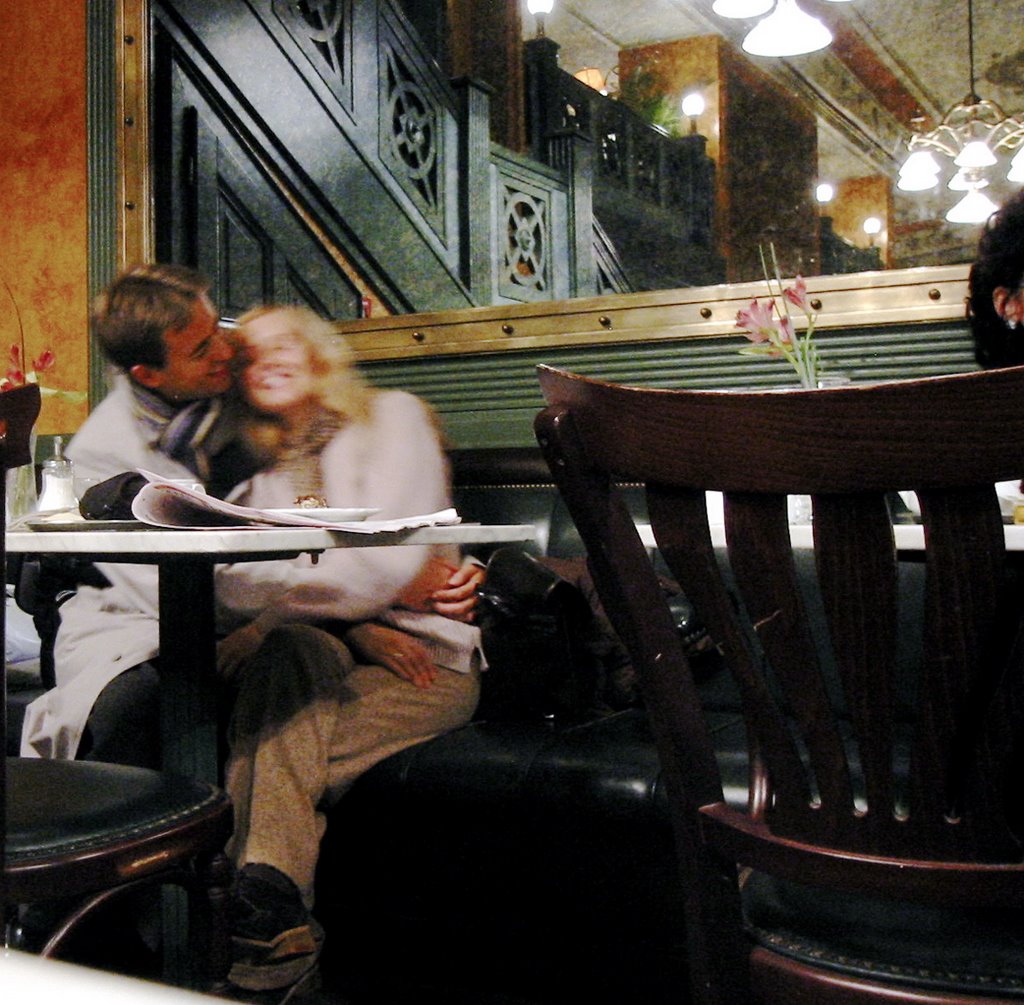
Lovers, Central Café

OKAY, EATING. We’ve had four dinners here now, none extraordinary, none particularly Hungarian, none unfortunate. The first was in our hotel: we arrived so wound up that it was time to wind down, and we just stayed in our hotel for dinner.

The Hotel Veritas is on an outlying ring road near a big stadium — the Nepstadion, or “People’s Stadium”: but, as Hans says, they seem to be slowly removing the “Nep” from the name, perhaps because it’s too much a reminder of the communist days here, and it’s slowly becoming simply the Stadion.

It’s not an attractive part of town, of course. We walk a short block down the street to a very wide fast avenue that forms the ring, with a sign pointing to Ikea sixteen kilometers away in one direction, the Stadion across the avenue, a couple of grimy restaurants, and, down a somewhat longer block, the metro station.

But we didn’t explore any of that our first day: we simply stayed in the hotel. The menu was in three languages as I recall, and I had a big salad and chicken-and-bacon on skewers, which was quite tasty. Lindsey had a pork fillet that turned out to be twice as much as she could eat, and we heard the cook pounding away at it, so it was prepared to order. With dinner, local Rizling, as they spell it.

The next day, Tuesday, our friends Hans and Anneke arrived, and we ate at home again. This time, still suffering from too much meat in Italy (I am too old now to eat meat twice a day for ten days), I settled for a Greek salad, an old favorite of mine from college days, and it was good. Someone had told us there were no vegetables in Hungary: that is not true.

Yesterday we ate at one of the places on a list of some kind, the Central Café. We got there early enough to have a glass of wine while waiting for our friends, and to watch the room; and for the first time in Budapest we saw style, youth, smiles. Across from us a pretty girl sat with her telephone, wearing a head of hair the most amazing colors of blonde, red, and strawberry blonde, certainly natural; no one would dye each hair a different color.

Hans and Anneke showed up before long, and I found a grilled duck breast on the menu to follow my obligatory green salad. The duck came with “cabbage noodles,” which turn out to be square noodles with caramelized cabbage-scraps, a very delicious thing; and with crisp-fried thin strips of leek for texture. It was a nicely thought-out dish, and I’d order it again in a minute.

We lingered a bit over the dinner, long enough to see a guy turn up to join the blonde across the way. The young people here seem to be nearsighted for the most part; they hold their faces very close to one another when they meet, often keeping them that way for several minutes. It’s sweet.

Today we found ourselves next to the first restaurant on the Zagat list — first by virtue of its name: Abszinte. The menu wants to be primarily Provençal, and succeeds pretty well; but on the wall was a blackboard with daily specials, and leading the list was rumpsteak with mushrooms for only Ft 1895. Hungarian forints are an easy exchange, you think of them as pennies and halve them, so this was $9.50: even after lots of Italian meat, I couldn’t resist. The steak was cubed and long-braised; it came with lots of brown gravy and nice morels, and enough roast-fried potatoes to smush up with my fork to sop up the gravy. Not at all bad.

TODAY’S AMUSEMENT consisted of a museum and the ballet. The museum was another disappointment: the museum of applied arts, much of which was closed for repairs. Only a few items from the permanent collection were on view, to provide a chronological history not of applied art but the accession activities of this museum — which collected assiduously in the last half of the Nineteenth Century, then slowed down for a variety of reasons.

I’m not nuts about old furniture, but I like five-century-old faience as well as the next man, and there were enough keys and clocks and glasses to keep me interested. There isn’t enough Art Nouveau on exhibit, though there’s a fine Josef Hoffmann side-table and quite a bit of Tiffany glass. There was one startling explanatory label pointing out that in the “difficult days” of the second world war many people, who had to leave their homes, had to leave many of their possessions behind; some of them somehow came into this museum’s collection. Sobering.

The ballet was Mayerling, choreographed by Sir Kenneth MacMillan to John Lanchbery’s arrangment of Franz Liszt music, very well produced and performed at the Budapest Opera House. I’ll have more to say about the house itself later; we’re seeing Butterfly there in a couple of days. Mayerling is hokey, long-winded, and boasts a story plot so complex and arbitrary it can only have been translated from fact: no one could have invented it. But it lends itself well to both costume story and the thinly dramatic music of Liszt, who since he was Hungarian is a national hero here.

The audience loved it, and I applauded too; and then we went out into the cold clear night to catch the metro home. Once again the Rakoczy metro, undergoing repairs, was replaced by a shuttle bus; once again some of us were unsure where to catch it. I asked half a dozen different people where Rakoczy Street was, and not one of them could tell me. One guy said But hey, I can speak English, and he was right, he spoke English quite well: but even though he was a local he did not know where Rakoczy Street was.

Years ago we were in Prague, driving to an apartment house where we would be crashing for a night or two. The street signs were wrong, off by a block and then turned ninety degrees; and when we asked about it we were told they’d been deliberately moved to confuse Russian tank drivers. I think they do that here, too.

Speaking of tanks, during the demonstrations here a couple of weeks ago someone commandeered a tank. Apparently it was prepared ahead of time, as a few locks had to be broken. A guy jumped into it and drove it straight down the avenue toward the demonstraters, then swung around at the last minute and headed for the police. Bystanders said he seemed like a guy old enough to have learned to drive a tank in the war, or perhaps in the 1956 uprising.

The tank only had enough fuel to go 150 meters, so no harm was done.

12 Budapest


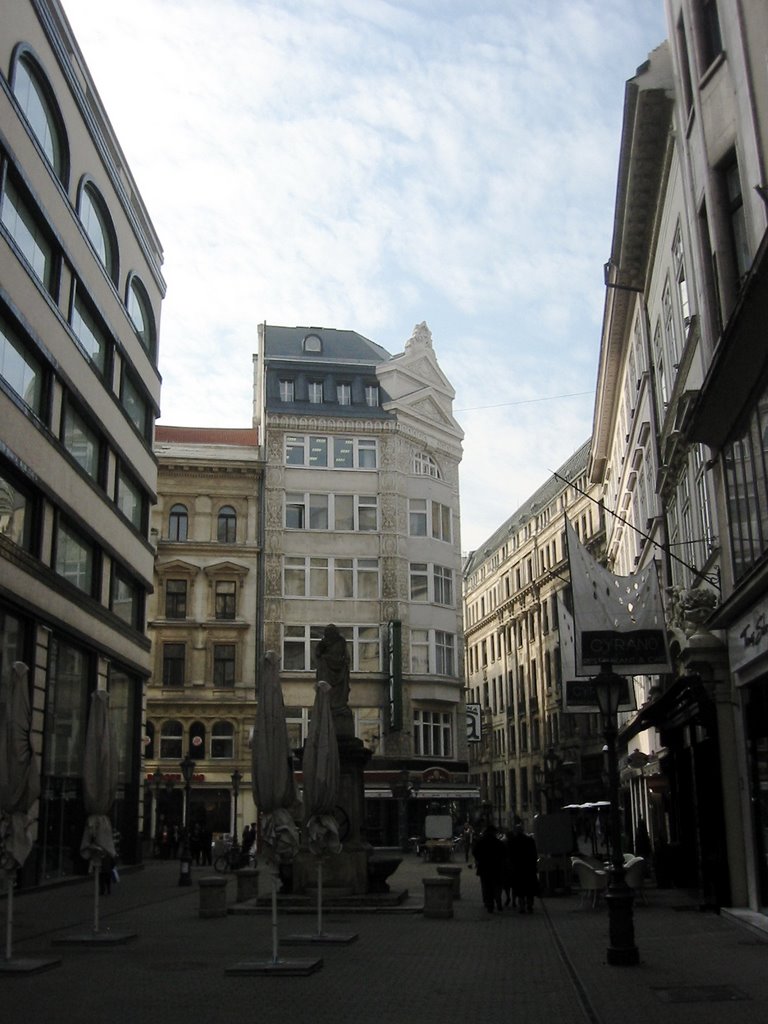
other photos of Budapest streets here


OUR FIRST IMPRESSION of the city: subdued. We spent an hour on what’s said to be the main shopping street, a pedestrian street, and in mid-afternoon on a Tuesday there were few people abroad. And they were for the most part not young; and they were for the most part not fashionably dressed. I was reminded of Bucharest, Romania, which I visited in 1983; but Budapest, at least here, is more tightly built, with uniform five- and six-storey buildings fronting rather narrow streets.

After two more days I still don’t have a feel for the city. It is not a western European city, I think, though I hardly know German cities at all; it certainly feels quite unlike a Spanish or French or Italian city. There’s a fine variety of goods on sale — Italian clothes, hand-made luxury albums and journals, many bookstores and music stores, quite a number of shops selling cameras, laptops, and the like.

It’s a pleasure to walk into a music store and find shelves of miniature orchestra scores — something that hasn’t existed in San Francisco or Berkeley for many years, to my knowledge. But most of the scores are to standard repertory compositions, and the prices are as high here as anywhere. When I recall that fifty years ago I could buy a score of a piece by Enesco, for example, in a shop on Hollywood Boulevard, for three dollars... But let’s not go there.

We’ve been to two concerts so far. The first, two days ago, was very interesting: a small string orchestra playing a very early suite by Janacek, the Martinu harpsichord concerto, a strange flute concerto by Pavoi Simai (a contemporary Slovakian composer), and Dvorak’s A-major sextet arranged for string orchestra. I’m not sure what the ensemble is called — as noted previously, my Hungarian is totally nonexistent. But Gabor Takacs-Nagy was the conductor, and a pert, active, engaging fellow he is, especially seen from only a couple of yards away.

We were in a studio at the Hungarian Radio, an amazing studio with honey-colored walls and ceilings made of bent and angled panels perforated in many patterns and decorated by a scrap-metal Socialist Realist Abstract (yes, there is such a thing) mural over the on-the-air lights and control-panel windows. There were perhaps a couple hundred in the audience, in seven or eight long rows of seats, and the music was bright and lively.

It contrasted greatly with last night’s “Repríz koncert” at the Museum of Commerce and Catering. Here we heard six pieces for varying combinations of synthesizer (a Yamaha SY77), trumpet, flute, and cello, with some live electronic processing — mostly tape-loop pulse effects. The music was surprisingly old hat; there was nothing you wouldn’t have heard forty years ago in San Francisco — but maybe that’s what the “reprise” signified: a look back at early postwar modernism. The composers and performers seemed very serious yet somehow disengaged; they went about their work like professionals, but also tradesmen. Someone introduced each piece to the small audience, who looked like relatives and colleagues, but of course we understood nothing.

MUSEUMS: two so far, one exceedingly absorbing, one quite disappointing. The Hungarian National Museum turned out to be a survey of Hungarian history, from about the Roman times until the fall of the Berlin Wall. There was a sufficient number of English-language summaries on the wall panels to keep us oriented, and room after room of paintings, armor, weaponry, maps, china, jewelry and the like, together with a few installations of period rooms.

We were astounded at the number of vellum manuscripts on view, many with elaborate initials or miniatures, fading away under the light. It was a pleasure to be able to read passages, where my Latin rose to near comprehension, in beautifully written letters and deeds dating back across the centuries; and it was fascinating to watch the ebb and flow of the Hungarian national confines from post-Roman times to the present.

Alas we were spent long before the collection ran out, so gave less attention that we should have to the twentieth-century rooms. Here, though, even a quick survey reveals the reason for the Hungarian joylessness reported here yesterday. Hungary was a proud country and a rich one for centuries, but the Austrian empire, the horrible wars of the 20th century, and the communist administration took a lot of the joy out. We left the museum a bit dispirited.

The promising-sounding Museum of Commerce and Catering boasts a fine collection of historical items pertaining to the trades and industries and particularly those of the restaurant business, and we looked forward to seeing it. A chance conversation with a tourist-office clerk, though, revealed that it had recently moved to new quarters just across the street from the Basilica, and when we went there we found only a few advertising posters on exhibit; the permanent collection is not yet re-installed.

Much remains, of course, and we’re out now to get tickets to opera and ballet, to see art and history, and no doubt to eat. I see I haven’t reported on that yet. Tomorrow.

Wednesday, November 08, 2006

11 Budapest


AT SOME POINT EARLY in the nineteenth century a big German printing firm, finding itself with an absurdly huge inventory of typographical conventions, sold them to the Hungarian Academy here in Budapest. Umlauts, accents aigu, and dots made up by far the greatest amount of the shipment, and the Academicians set about happily strewing them through their dictionary. Here you see one example of the result: a sign decorating the corridor in our hotel for no apparent reason other than typographical exuberance.

Today on a little shopping expedition downtown we bought a Hungarian-English dictionary, and in it I find that the first word, száraz, means “dry.” Since tüz means “dry,” I suppose the sign refers to a concealed dry standpipe for the use of firemen, should they find themselves on the third floor of a hotel with a need to empty their hoses. I have no way of finding out, just now, what ivízvezeték might mean, but “standpipe” seems logical. Probably I won’t need to know the truth of the matter. I hope not.

We flew from Venice’s Marco Polo airport, a nice little airport with a great many shops, on Sky Europe, a cut-rate airline based, I think, in Bratislava. The onboard announcements having to do with safety, the purchase of peanuts and beer, and the weather and course were all in Hungarian and rather thick English; there was no attempt made to do anything in Italian, even though the plane left from Italy. It was a nice flight, though unfortunately above clouds; we’d have liked to have seen Croatia and Slovenia, or at least Lake Balaton, but it was not to be.

The first thing we noticed was the lack of smiles. This is the land of operetta, I’m told, and one of the best is by a Hungarian composer: Franz Léhar, who wrote The Land of Smiles. But the Land in question was not Hungary but China. Whether it’s inbred or the result of decades of oppression — Lindsey favors the latter explanation — no one at service desks in the Budapest airport seemed happy to see us. Or to be there at all, for that matter.

It’s a small, serviceable airport, with the obligatory Bancomat (since Hungary is not on the euro, retaining instead its forint, currently an easy mental exchange at 200 to the dollar) and a number of possibilities for getting into town. There is a “minibus,” for example, which goes to your door for ten dollars apiece; but the woman at the desk shrugged that there wouldn’t be another for an hour, so we should take the taxi. The woman at the taxi-rank in front of the terminal took our address and wrote it on a sort of ticket which she handed the next driver, and he delivered us to the Hotel Veritas for seventeen dollars — cheaper than the minibus would have been. Go figure.

Yes, Hotel Veritas. Those of you with our itinerary will be surprised: we had rented an apartment for the week, near the center of town, to share with our friends Hans and Anneke. But the day before we left Verona we got an anguished e-mail: the heating had broken down in our flat, repairs were slow in coming; we’d have to find alternative accommodations. Our Budapest landlord came up with two ideas: his sister’s flat, which sounded cramped, and rooms in a hostel downtown, which sounded uncomfortable. The Venere website found us this hotel, which is comfortable and only ten or twelve minutes from the city center by foot and metro.

The Venere website offered a number of customer reviews, all quite positive — though one person did suggest that someone needed to teach the hotel-restaurant waiter to smile. He reminds me of the leading man in Last Year at Marienbad, except that he doesn’t seem to play Nim. He’s competent and quick, but he does not smile — his face is utterly expressionless. That’s okay with me; I’ve always though Americans are a little too given to the toothy grin. But it is, certainly, a contrast with the waiters we’ve met in Italy over the last ten days or so.

The people on the street, especially the café customers at the end of the workday, look happy enough. Even on the crowded subway-bus at the end of the night — the bus that’s taking over these nights for the metro that’s closed for repairs at night — even they seem expressive and outgoing.

And it’s interesting: if you can’t hear them talking, or if you manage to ignore the sounds of their voices, these Budapesters, the young ones anyway, look pretty much like people anywhere. Facial expressions, eyebrows, the play of hand gestures — all that would lead a deaf man to believe they were conversing in English, or French, or perhaps Italian.

But the language! The punctuation makes it look bristling, in print; the language seems to love polysyllables; and the inclination of the spoken language to put the stress at the beginning of each word, and to slide off the word at the end in a sort of vague soft semivowel — all that makes the spoken language quite hard to follow. And the unfamiliar punctuation, the huge number of z’s and y’s, the alternations of “sz” and “zs” — all that makes the printed words somehow fugitive: you try to recall the name of the street you’re on, or the dish you’ve decided to order at lunch, but it’s gone in a minute, and you resort to English, vague gestures, and a certain amount of hope.

I was glad, yesterday, that I’d decided not to cheat on the subway: we bought tickets, even though Hans and Anneke were able to ride on their passports, as over-sixty citizens of a European Community nation. We Americans are not so lucky; we have to pay. Maybe this will change now that the House has changed hands, Budapesters seem as happy about that as we are; but I won’t bank on it. We were stopped, and I was lucky to have my validated ticket in my hand. The penalty is a twenty-dollar fine, to be paid on the spot.

We’ve been to museums, of course, and to two concerts; and you can be sure we’ve done our share of eating. I’ll catch you up on all that tomorrow.

Tuesday, November 07, 2006

10 Verona


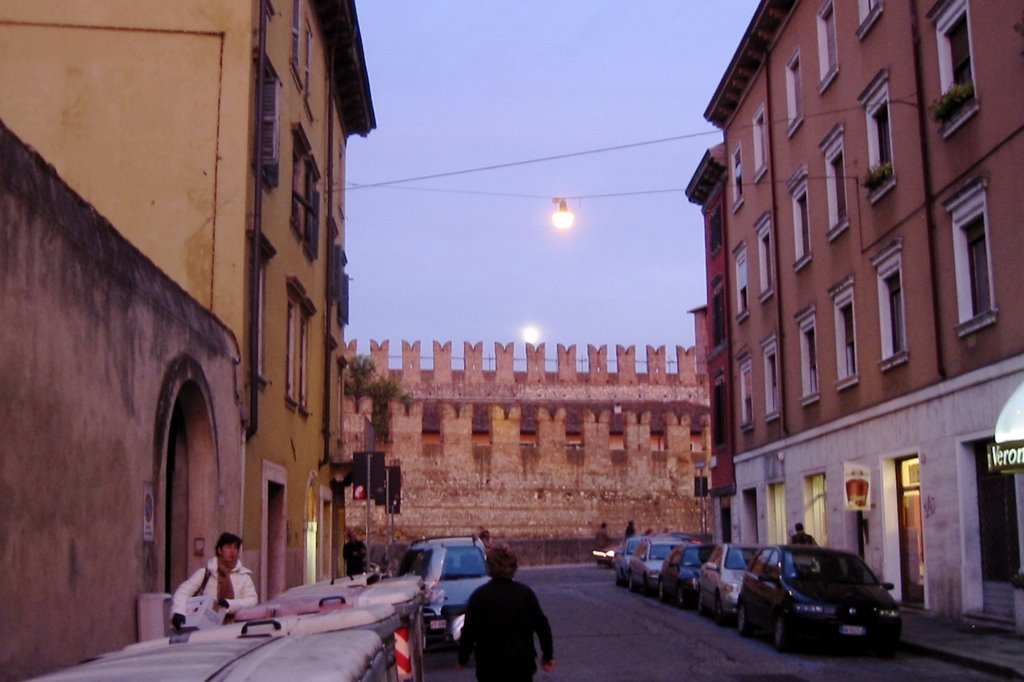
Moon over the castle wall, Verona

WHAT A CONTRAST A FEW MILES make, crossing Italy from Piemonte to the Veneto. We left from Vercello, a city we’d never seen before, sprawling and not all that attractive, a bit like a Stockton (California) holding down its farm country — where half the rice in Europe is grown; the rice indispensable to a good risotto.

We took the train, a fast train stopping only briefly at Milan, Brescia, and one or two other stations before pulling in to Verona, a city we’ve visited often enough to feel at home in — and to notice changes.

Torino, in Piemonte, has changed in the last two years — not surprising, since the Winter Olympics were centered there less than a year ago. But it seemed unchanged, except for a few details. The tempo hasn’t changed; the sort of people you see on the streets; the feel of daily life.

Verona, though, seems busier, glitzier, more heavily touristed — and that’s saying a lot, as it’s always been oddly tourist-heavy. You don’t think first of Verona when you think of tourist destinations in Italy: Venice, Florence, Rome form the eternal triangle. But Verona is the setting of Shakespeare’s most romantic play, and signs everywhere remind you of Romeo and Juliet; and the buses discharge hordes of tourists, with their cameras, at the end of what I always think of as Richard’s Bridge.

That’s the bridge leading from our friend Richard’s apartment, on the Lungadige Re Teodorico (and aren’t you glad you don’t have to give that as your street when you fill out a form!), across to the city center near the post office. The post office itself is now bunkered behind that horrid red-orange plastic web-fencing you see around construction sites these days, as they’re trying to make another underground garage.

Those garages are a good idea in general. They’ve made them all over Spain, and in a good many French and Dutch and Italian towns and cities. Find a plaza, place or plein, dig it up, install a many-level parking garage underneath, and replace the cobblestones: it’ll look no different once you’re done, and it’ll be empty, for the first time in a century, of parked cars; the people will reclaim it, with their benches, lovers, little dogs, jugglers, mimes, pickpockets, markets, and three-card-monte sharks.

Verona, though, is rich in archaeological treasures, and when they dig here they run across them; and then the work has to stop for a while; the officials scratch their heads and think things over; no doubt meetings are held; projects fall behind schedule. So it is at the post office.

(I remember once years ago asking a supervisor on an archaeological dig in a city in Sardinia how they know when to stop. Ah yes, he said, that’s the problem all right, there’s always something a little further down, it’s just a question of how many layers you want to remove.)

We spent only two days and three nights in Verona this time, visiting our friends Richard and Marta. Richard’s an American expatriate; he’s been in Verona forty years or so, supporting himself with translation and editing while postponing for many years his true calling, which is sculpture. Three or four years ago, though, that call could no longer be ignored, and I’m happy to say that he is now in fact a sculptor. He has a few shows under his belt: but what is more important, he makes sculpture nearly every day; he’s prolific and disciplined; and the work continues to grow and at the same time to focus.

What artists do as they mature is narrow in on their true selves as they are expressed in their medium. This is hardly an original idea; I learned it first from the musicologist Peter Yates, who I suspect distilled it from writings of Gertrude Stein, who wrote Slowly there is in them something that is coming out of them, or something of that nature, when writing a poetic portrait of Picasso. That is what Richard has been doing.

We visited his studio, out near the city wall across the Piazza Bra I think it is, the one with the arena. The studio’s on the ground floor of a fine old 15th century palazzo — the word means simply “apartment building” in Italian, but those buildings often seem grander because of their great age — you step through doorways under wonderful carved lintels, and open a wooden door, and find yourself in a room with a couple of windows onto the street, a small kitchen-shower sort of room off the back, and sculpture everywhere: on stands, on tables, on shelves; in plaster, terra cotta, plasticine.

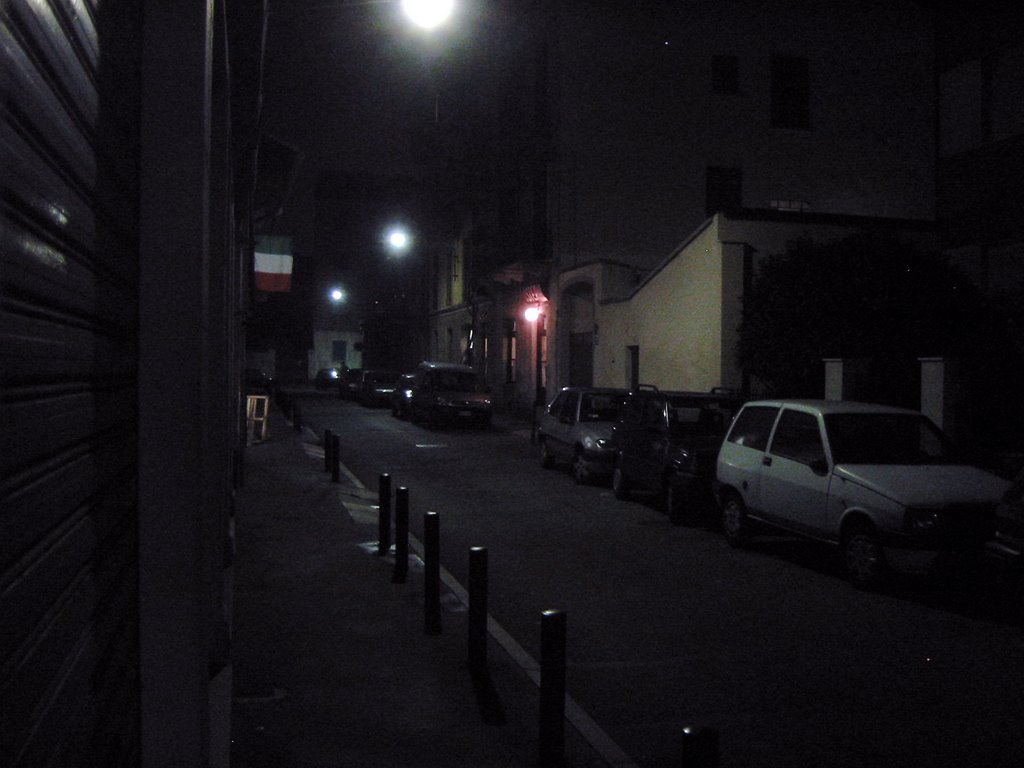
I won’t write further about the work here: when I get a chance I’ll make a webpage. (In fact you can already see a primitive version of one on my website.) What I want to tell you right now is that when we left his studio we stepped out into a particularly lovely evening, the sky going rose overhead, electric wires etched against the darkening blue sky, and from somewhere came the unmistakable sound of swifts. I looked back the other direction toward the Castello. Toward me, as I lifted my camera, came a lady in a dark sweater carrying a plastic bag of garbage.

The Italian streets are furnished with many public garbage-dumpsters. I suppose there aren’t garbage collectors of the sort we have; one simply makes a garbage run every day to leave the day’s refuse in one of these public bins — another item in the Catalog of Appropriate Methodology, like the unpaved streets in Mexican towns, where the climate is so dry asphalt is hardly needed. I waited until she’d made her deposit and turned her back, and then snapped a photo of the Castle, hoping to catch the swarm of swifts noisily going to nest in the one green tree to be seen, there toward left center.

Only later did I realize I should have captured her, too, in the act of getting rid of her garbage; and only later did I see that the full moon rising was conversing with a street lamp.
And now we’re in Budapest, of all places; a very different city, country, and people.

Monday, November 06, 2006

9 Monferrato


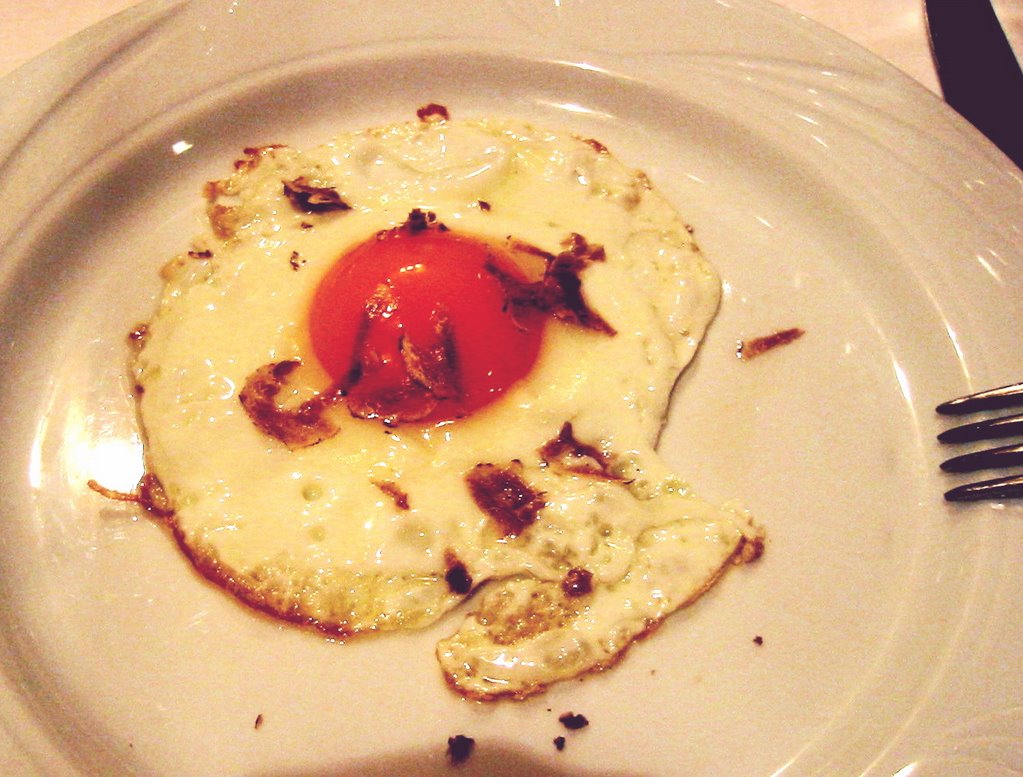
Fried egg with truffle, Tuais

Cardona di Alfiano Natto, Nov. 1—
Rob was driving too fast, the sharp right was unforeseen (though clearly marked, with a 20km limit), and the car spun 180 degrees and slid backward down a sandy driveway. He avoided scraping against the house wall, and no one was hurt, but the car would not run.

While he and Eric looked critically at the broken rear axle, and someone else dealt with the owner of the house who was pointing out the carefully laid and tamped sand, its brick paving only begun that day; we’d rutted it deeply.

ONLY A DREAM, of course, and Bill doesn’t drive like that; he’s an excellent driver, and a good thing to, for we’ve been crisscrossing Monferrato, by day to enjoy the visual beauties, by night to forage, nocturnal primates in search of fodder.

We are here at a favorite place, I Mandorli, an agriturismo or farm B&B in Monferrato. We found it six years ago and have been back every two years, in the course of which Gabriella and Franco Rampi have enlarged the B&B which now has at least five rooms; and Franco has systematically diversified his production.

We’re in a fine big room with a fine big bed, our own bathroom with shower (but no tub, and we do love our tub), and a magnificent view. Of course technically that’s not quite true; I wrote the previous sentences several days ago; we’re now in a perfectly acceptable room with a view of a building across the driveway; we’re not in Cardona di Alfiano Natto, we’re in a country we’ve never seen before; it’s not Nov. 1; it’s five days later. But I’m getting ahead of myself.

Let’s go back to Monferrato. What you see above is simply a fried egg wiith some bits of white truffle on it, and it — and a number of other fine things we’ve eaten — is one of the three or four reasons I’ve got behind myself. (The others are: Conversation. Absence of internet hookup. Lovely country. And the cumulative effects of eating.)

We left Torino on Monday, after pretty much sloughing off this year’s Salone de Gusto. Well, we’ve been there, done that, three times before; and to tell the truth it’s getting repetitive. I’m not complaining: the food show, in the enormous Lingotto exhibit hall, is a joy to walk, though not on Saturday; and the “laboratories of taste” remain absorbing and worthwhile, but we’ve done most of them in the last three outings.

I’m sure Terra Madre, the biennial gathering of farmers, producers, fishermen, butchers, and (this time out) cooks and marketers was fascinating and productive — but I didn’t have a pass to get in, so I can’t really speak to that this time round. (I was deeply impressed last time.)

So we left Torino on Monday filled with City and longing for Country, riding with our friends Bill and Judy out through the countryside to I Mandorli, the agriturismo we like so much that we’ve come here every other year for six years now — the last three times with friends to share it with.

I’ll list the menus we ate at the end of this edition of the blog. The list will be provisional: I’ll have to flesh it out later, with addresses and such — we didn’t eat anywhere I wouldn’t willingly go back to.

But eating, you’ll be shocked to read here, is not everything. I wanted to re-visit some places we’d already seen on this trip, partly to show them to our friends, partly to see how they’re coming along, partly (I suspect) to reassure myself that there is some degree of Continuity in this life. So Monday, en route to I Mandorli, we stopped in Moncalvo to see its astonishing baroque brick church, and have a snack at the café, and admire its oval piazza.

And then we drove on to our B&B where we settled in before being surprised by our friends Franco and Gabriella with an invitation to dinner: she’d been simmering a bollito misto all afternoon, on the outdoors stove, and we had to accept, and to tell the truth didn’t mind doing so, for she’s a fine cook, their table is generous and friendly, and Franco’s wines are worth drinking.

Tuesday morning after Gabriella’s fine breakfast (orange juice, fruit macedonia, applecake, biscuits, bread and jam, cereal if we want it, yoghurt ditto, and plenty of coffee and hot milk) we set out in no particular direction, soon ending up in Odalengo Piccolo where, it already being noon or so, we put in at a country inn called Serra — no menu; nice pretty girl, only men at the tables eating. Then we drove on to Casale Monferrato, a town we’d visited a few years back but only briefly. This time we were on an errand: to buy some laundry soap.

Casale seems to be a worthwhile town, fairly prosperous, with fine shops (I bought a nice Basque beret, having come away without one) and the typical Piemontese portici, arcades under overhanging apartment buildings, with polished wood and immaculate glass storefronts thereby shaded from the sun.

But our real destination was nearby, in Rosignano: the Istituto Agrario Luparia, a boarding school for honor students from tutt’Italia who come here to study not only agriculture but also the preparation of agricultural products and, along the way, the value of traditional methods (as well as that of scientific and up-to-date ones, of course).

Here Franco Rampi, our host at I Mandorli, was seeing his third olive harvest crushed. It’s still a tiny production, but up this time from a few liters to fifteen or so. The olives go into the hopper of a self-contained machine about the size of a couple of refrigerators lying on their sides; complicated hoses deal with compressed air and water; the olives are eventually ground up (pits and all) and spun at high speed, and in the end a thin stream of beautiful emerald-green oil pours slowly out a tap on one side of the machine, while an unappetizing-looking paste, pinkish maroon in color and the consistency of things you’d rather not consider, is extruded out the other.

(This refuse is taken by commercial presses to another step to produce a more industrial grade of olive oil, which no doubt has its usefulness. Here it is simply taken out into the vineyard and spread on the ground. But I sneaked a taste, poking my finger in and trying it out, and it wasn’t bad.)

We congratulated Franco and went back to our rooms for a rest; then on to the evening’s restaurant, Tuais — so called, I’ve been told, because it’s not the first restaurant its owner has opened.

Our food was delicious, a celebration of the white truffle now in season, gravely weighed out and set on a little plate on the table to smell while dinner goes on — we chose four rather small ones, which seemed to be at their peak. The dinner proceeded beautifully. After our pasta we didn’t really want any meat; the truffle had been substantial enough; and when the chef suggested a simple fried egg it seemed exactly the right note to end on.

Unfortunately, though, after dessert he was back to deliver a lecture — I would almost call it a rant. He railed at the government, the taxes, the cell phones, the tourists, the regulations, the economy. Italy has no future, he assured us; he was in despair for the future of his own children. Twice I assured him that while this was all true, and universal to boot, we were tired and wanted to go home. This only seemed to annoy him further.

There were aspects of the Salone, back in Torino; and of conversation at Franco’s table, that reverberated with Fabio’s rant. I don’t see much of a future either; global problems seem overwhelming; governments are unjust; international corporations are ruining everything. But the dinner had been so good, and daily life here is so pleasant (though admittedly we are pensionati and don’t have to think about making a living) that the outrage seemed misplaced as well as futile. Finally we disengaged ourselves and drove off on wrong crooked roads through the night.

WEDNESDAY WE DROVE OUT to another fondly recalled site, the Abbey at San Vezzolano, last visited four years ago. Its restoration has proceeded in the meantime; the two or three frescos are cleaned and heightened; stones are cleaned, the cloister both better organized and somehow more natural — I mean, seeming to be more like what it must have been when in daily use as first intended.

This is a small Romanesque complex, one of a series of abbeys whose purpose was to provide hospitality, at about a day’s journey apart (much like the California missions), for people making their pilgrimage from Paris or thereabouts to Rome.

In what had been the winter barracks, now an exhibition hall, there was an installation with photos nicely portraying the many other such buildings throughout Monferrato — chapels and churches, one of which we’d visited en route to Casale the previous day. And there was an absorbing display of research into the astronomical basis of the orientation and plan of the Abbey, which is laid out on lines saluting the equinox and solstice, the rise and set of the moon. All this bears further investigation and consideration.

From there to a museum Gabriella had recommended in a small town across the street from a dusty railroad station — in an impressive old stone and brick building that had been an important factory and warehouse for Martini & Rossi, in fact; and which celebrated through its collection a sort of history of wine.

But what a collection! There are ancient Hellenic, Etruscan, and Roman drinking vessels; Attic red-and-black ware; marvelous old glass; huge wooden presses and crushers and wagons and hoists; a number of lovely stills; a collection of bottles and flasks... all with just the right amount of wall-label explanation, nicely lit, well laid out in a succession of rooms, subtly and effectively lit.

Then another rest, and dinner at the Osteria del Castello, da Dirce when we first met the operation six years ago, now moved to magnificent quarters in the town hall of a hill town just north of Asti.

Finally, Thursday, another day of driving about — I may have some of this a little mixed up by now — and a visit, with Franco and Gabriella, to a painter-sculptor-printmaker who lives in a chateau in Villadeaiti, who showed us a unique and priceless collection of ancient printing presses, all of them restored and working, as well as his own hyperrealist paintings; and then dinner at da Maria in Zanco, the next town to the Rampi’s Cardona; and here we had a wonderful expression of casalinga cooking prepared by a woman who’d been at the stove here for forty years, and knew what she was up to.

And now I’ll close with the week’s

Menus
Monday: lunch, Cafe di Roma, Moncalvo: gnocchi in tomato sauce, Grignolino. Dinner, I Mandorli: Quiche with zucchini, cheese, white truffles; agnelotti in brodo; bollito misto; cheese. Grignolino; Barbera; Barbera riserva.

Tuesday: lunch, Serra: tartini pomodoro; vitello arrosto; Dolcetto. Dinner, Tuais: artichoke and bagna cauda mayonnaise; carne cruda; tajarin; egg; pear in red wine. Freis.

Wednesday, Il Castello: tajarin with arrosto; capretto; zucotto; Nebbiolo.

Thursday, da Maria: lardo with chestnuts in caramel; carne cruda; vitello tonnato; polenta saracena with mushrooms; soup with ceci; agnolotti with porcini; veal; green salad; materrasa pear in wine; Barolo.
You can see photos of some of this week at dotmac

Sunday, October 29, 2006

8 A Day in Torino


Piazza Castello at twilight


Six point four miles today on foot: that ought to walk off some of the cheese, meat, pasta, wine, pizza, grappa, bonet, and the like; and it’s sure as hell left memories in my knees.

Our hotel is a ten-minute walk to what I think of as the heart of Torino: the Piazza Carlo Felice, Happy Charles Plaza. Happy indeed am I there in general, and was today when we sat at a sidewalk table to take our breakfast — a croissant apiece, two cappuccinos for me, a latte macchiato for Lindsey — at the Caffè Roma già Talmone, before walking on up through the elegant Piazza San Carlo and on to the enormous Piazza Castello.

This succession of outdoor civic living rooms defines a sort of spinal column of the city, running due north from the main train station toward the sinuous river Dora Riparia which at one time formed the northern boundary of this ancient city. The buildings lining the piazzas, and the streets connecting them, were erected in the 19th century, and are all of the same height, furnished with the same sets of windows, and finished in the same stucco.

They also all project out over the wide sidewalks, leaving fine arcades underneath, with shops and cafés on one side, traffic on the other, separated from us pedestrians by the thick columns sustaining the storeys above — columns which like as not contain within them display windows for nearby shops.

At the Piazza Castello we turn left and walk another three quarters of a mile westward along the Via Garibaldi, a pedestrian street its entire length, similarly edged with uniform 19th-century architecture and furnished with shops and cafés, the occasional chapel punctuating the uniformity. Along the way there was a flutist in full 18th-century costume; a trumpet-and-guitar jazz duo, and a hopelessly inept player of the musical saw. (Or, better, unmusical saw.)

We were en route to the Diffuse Museum of the Resistance, the Deportation, War, Human Rights and Liberty. Diffuse it was not, today: it was incredibly focussed on an exhibition documenting Torino under bombardment in the second world war. We descended into a bomb shelter installed very deep in the ground under the museum, formerly a building housing offices and production facilities of a newspaper company which had built the shelter for its employees and their families.

We were fortunate to have our own guide who explained the entire setting to us, who led us into the long narrow barrel-vault chamber fitted with benches along one side, a tiny latrine at the end, air piped in somehow, and electricity furnished by a bicycle-rigged generator; and then we climbed back upstairs to take seats in a number of galleries where we sat face to face with life-size screens of people who spoke their memories of those terrible years. These were of course for the most part people our age. They described what daily life was like, the privations, the fears, the anxieties.

One woman told of finding a precious bit of butter somehow on the black market, being told by her mother to hide it in her room to save it for a special day, and looking for it to fry eggs for her father one morning, only to discover it missing; and seeing her mother weep for the first time when she discovered the butter had melted away.

Another told of the liberation, when she and others simply walked out of the prison camp in Bolzano, not knowing if this was a trick and they would all be shot, but the Germans had run away; and she got somehow back to Torino, and talked Fiat into giving her an ambulance so she could bring wounded Piemontese home from Bolzano, and finding her brother on her tenth and last trip, six feet tall and ninety pounds and recognizable only by his eyes. All the wounded she brought back died within days, and their deaths were meaningless, the woman said; we need not years but centuries to overcome the evils of those days, if we ever manage to overcome them at all.

Another man talked about the excitement and hard work of setting up the new government, when people of every political persuasion had to cooperate on drafting a new constitution. Every article, he said, required days of discussion; he was the one who took the minutes, and each article took hundreds of pages of them — except for one: an article which repudiated war.

It’s a hard word, he said, a “sculptural” one. It’s not We reject war, or we disapprove of war: we repudiate war. And it was unanimously agreed; there were six and a half pages of minutes. It was very quickly agreed. And you may say, well, you have to have a military for defensive purposes. But if you have a military you have soldiers and orders. What will you do if you are ordered to kill civilians, to drop bombs on their houses? What if you are ordered to use bacteriological or nuclear weapons? What if you are told to kill prisoners, or to torture them? We were all agreed: we repudiate this.

I was nearly in tears by the end of this, and wrote a note to add to the hundreds already posted by previous visitors in the exit lobby: Yes, and now it is all happening again, Amiericans are dropping bombs on civilians, people are being held without defense or trial, we can only hope that you Italians who remember so vividly that Second World War will be able to teach us something over the next generations, so that perhaps one day governments will all be truly civilized and will work not for death and destruction but for life and health.

And then we walked back along the Via Garibaldi — named for the uniter of Italy — to the Piazza Castello with its curious huge castle-building, dark and brick and Gothic behind, male and militant; and white and Baroque and stucco in front, feminine and beautiful. And then a pizza at a small restaurant, a good one; and then back to the Castello and its Biblioteca Reale for an exhibition of Dutch drawings from the time of Rembrandt.

What a library this is! Another barrel-vault of a room, but elegant, spacious, and well lit by natural light, and filled with books containing the history of Savoia, that wonderful mountain-and-piedmont kingdom now split between France and Italy, its fertile self-sustainability harnessed to two centrist governments which seem uninterested in the glorious culture that is here.

So once again a dialectic: bomb shelter and library. I read in the paper the other day something about the assumptions of the West concerning “developing nations,” that a kind of socio-political evolution will bring them inevitably (if slowly and at times against their wills) to the kind of culture and economy that obtains in Western Europe and North America.

It’s hard for us to believe, harder to understand, but there are places and peoples in the world who really don’t want to participate in this kind of engineered evolution. “We respect your position, but you must therefore respect ours.” And so it goes, on and on.

And tomorrow we break camp once again and go to I Mandorli in Monferrato, where the Internet may or may not connect. In the meantime there are more photos at dotmac.

Saturday, October 28, 2006

7 Antiche Sere


via Cenischia, Torino


AT THE CENTER OF THE PHOTO, there, behind the doorway under that bright circle of light, is a restaurant we’ve always wanted to try: Antiche Sere, whose name translates, I suppose, to “Evenings of Yesteryear,” except that such translations always sound forced, formal, old-fashioned in American English, though they are perfectly ordinary everyday expressions in French, Italian, Dutch, Spanish.

The guidebooks have always listed it as a perfect place to find the traditional cuisine of Piemonte, that interesting province in the northwest of Italy — an analogue, I suppose, geographically at least, of the Pacific Northwest in the United States. (Bearing in mind the huge difference between the areas of the United States and Italy, which is less than twice as big as California.)

Lindsey’s father was born in a mountain village in a remote valley in the northwestern corner of Piemonte, and we — Lindsey and I — have always felt an affinity for this province. We are in Torino, the capital city of the province, not sixty miles from Chiomonte, where her father was born. And I firmly believe a taste for certain foods is inherited in the genes. In this case, potatoes cooked a certain way; peas of a certain texture; bagna cauda, gnocchi, agnolotti, Castelmagno, bonnet... the list goes on and on.

So tonight, after a hard day (I explained that earlier), we took a taxi out to Anitche Sere for dinner with an old friend, Nancy from Hawaii; and a newer friend, a friend of hers, Ellen from San Francisco; and an older friend, Deborah from Galisteo, or let’s say Santa Fe. All of them are here for the same reason we are: to attend the biannual meeting of Slow Food, involving the Salone del Gusto which is a quasi-commercial (or much of the time even a quite commercial) exposition of Food Products, and Terra Madre, which is a meeting of producers, farmers, fishermen, herders, and chefs who intermediate between chthonic, Slow, authentic, minimally interfered-with food products and the city-dwelling, evolved, civilized, often unaware people who enjoy those food products.

And here is what I ate (I won’t try to list the other items at the table):
white wine as an aperitif
gnocchi in pomodori
nave e finocchia in salata
arrosto di vitello con patate
bonet
and with these,
a liter of red wine
a bottle of Grignolino 2005
a glass or two, tiny ones, of grappa di Moscato.

The others had things like agnolotti, coniglio, insalate miste, and so on; and other desserts.

The bill, if you want to know, was a total of 138 euros, for the five of us.

And how was it? Well, it was really quite good; indeed it was like eating at your grandmother’s house if your grandmother was or is Piemontese. Or Italian in general; or, probably, either European from south of the Rhine-Danube. The point of this food — the point of all true Slow Food — is that it is Clean, meaning that it avoids ingredients that are purely chemical and manufactured; Frugal, meaning that it uses all of everything available to its place, and very little brought in, and Good, meaning that, well, it tastes so good that whether you are hungry or not you use the bread to mop the plate before it’s gone. Pulito, giusto, e buono.

We took a cab which even though the ride seemed circuitous got us there in just a few minutes, so we took a walk in the neighborhood in order not to arrive before eight. No one dines before eight o’clock in Italy. We walked past cafés, furniture stores, one of those imported-gifts-from-third-world-country stores, a shop that cleans furs, a couple of clothing stores — that sort of thing. Clearly none of them were on the street in the photo: that’s a small side street.

Then we were in, to find Americans everywhere at table — Americans eat early here — and among them our friends, and we tucked in. And how was it? Well, it was really quite good. But as you may have gathered by now \p\pnostante how good it was, it was something like Lindsey’s cousin Rosa prepares on the rare visits we make to her in Chiomonte (and I take this opportunity to apologize for not visiting her this time; we’ll surely be there next time).

The gnocchi were tender little cubes of mashed potato in a nice tomato sauce with a dusting of grated Parmesan and a grinding of black pepper. The tunips and fennel continued the idea of eating in bianco, all white things; simply delicious turnips (which I usually find too strong) and fennel bulbs quartered, blanched in boiling water no doubt with lemon juice, then dressed with a light olive oil. The slice of veal was a modest one, off the bone, say three-quarters of an inch thick and about as big as my hand; it had been roasted with a bit of garlic and salt and came thinly covered with a thick reddish-brown gravy and a good supply of small quartered roasted potatoes. Again, oil, salt, and very discreet garlic were the flavors.

As for bonet — the word is Piemontino, the local dialect which is often closer to French than to italian — this is a difficult dessert to describe; I generally call it “chocolate pudding,” but that’s misleading. It came as a thick slice of a loaf of pudding, a sort of firm custard, like an Indian pudding, but with a layer composed of soaked ground-up almond macaroons, substantial and deeply flavored with chocolate and amaretto but somehow going beyond that, suggesting chestnuts and molasses somehow... it’s a dessert we like very much, but not, I think, for everyone.

We like Piemonte for its individuality; it is a state within a nation, with a distinct culture rooted in tradition and independence tempered by its cosmopolitanism. It reminds me of Savoy in France, and in fact Torino — Turin in France, and therefore England — was the capital city of the former kingdom of Savoia. I think Piemonte is also like northern California, with an economy that includes agriculture, manufacturing, commerce, and tourism; and gifted with a geography that could make it almost self-sufficient.

Like northern California, Piemonte is composed of separate regions each with its own mentality. Lindsey’s father was born in the Valsusa, fifty miles or so west of here; he didn’t learn Italian until he went to school, for the family spoke Chiomontino, the local dialect of the provincial dialect. Well to the south is the fine city of Cuneo, with its own surrounding valleys, orchards, vineyards, and pastures. To the southeast is the Langhe, famous for its red wines; to the northeast another area producing that fine arborio rice so necessary for Italian risotto dishes. And just north of the Langhe is Monferrato, which I think of as the Sonoma county of Piemonte except that it’s a bit more rumpled and much less given to that current agricultural fallacy Monoculture.

We go to Monferrato tomorrow and I’ll write more about it later. It’s time now to go out for breakfast...

6: Ancora in Italia

Outside our room, Ca’ Rossa, Bergamo

Not that long ago, not a week ago in fact, a fellow I hadn’t met before looked at me appraisingly and said, after some reflection, I think you’re Dutch.

I was pleased. I’d rather be Dutch than almost anything. He was sitting at the next table at Marius, when we had dinner there last Saturday; we’d struck up a conversation; then been introduced (by Kees, the chef, who’s known both of us for many years). In the course of the conversation I’m sure I’d revealed my enthusiasm for the Dutch at great and possibly boring length. I’d also revealed my insatiable curiosity about words and languages; and he was a little surprised at all this, and asked whether I was Dutch. No, I said, I’m from California.

I never identify myself as an American when traveling in Europe, especially not these days. I just don’t identify with that many aspects of American life that distinguish my country from European ones. Besides, there’s always the secret desire for California’s secession, for its reversion to a California Republic with room for Easterners, Mexicans, Native Californians, and the return of the original wild life. So I call myself a Californian, for that is what I think I am.

But though I am a sixth-generation Californian on my mother’s side, I am of unspecified origin on my father’s. My father’s father was adopted; his own father — whom I dimly recall having met when I was five or six years old — was a man by the name of Charles Smith, or so he said; and the family legend is that no one knew where he came from: he just showed up one day, a full-grown man with the surname Smith, and a manner that discouraged questions about his origin.

The family has always assumed he was Irish or English, but I don’t know that there’s any real reason for that. Clearly he wasn’t particularly Asian or African, and I doubt he was Mediterranean. One day perhaps I’ll have one of those DNA tests and find something out, but it doesn’t seem worth the trouble and expense.

Particularly now that I know on good authority that I am Dutch. The guy at the next table would have known: he knows the Dutch, and he looked pretty hard at me.

But yesterday we flew in a little over an hour from Amsterdam’s Schiphol airport across the dark Bavaria and Switzerland to land at Bergamo, in northern Italy; and when we got out of the plane and heard the Italian and saw the people and sensed the warm air and saw palms and olive trees and especially when we checked into our B&B and saw out our bedroom window the walled garden and beyond it the dark forested hillside climbing up north into a midnight blue sky I thought to myself: come siamo beati, essere qui in Italia; how blessed we are to be here in Italy.

What is it? Something in the air, I suppose, that I associate with Pleasure. Our landlady was there to greet us at the airport and drive us to our B&B, the Ca’ Rosso, a couple of kilometers outside Bergamo. We stopped to pick up some laundry and have a chat with a friend or two, then drove right through the old Città Alta, the fine old stone heart of the city perched on a hill; then down the other side and into the country.

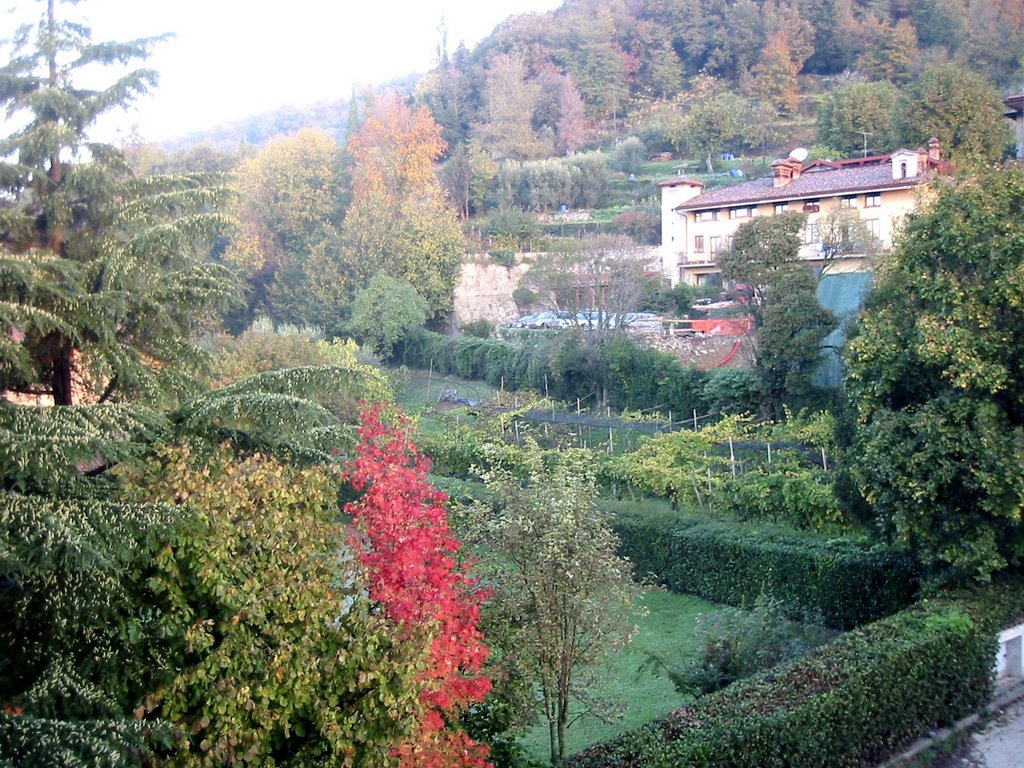
The house was casalinga, as the Italians say; “homey.” A big sitting room, where we had breakfast the next morning — yesterday morning — featured an enormous fireplace and hearth occupying an entire end of the room; paintings on one long wall; a series of French doors giving onto a narrow balcony on the other, with a view of the Città Alta. Our bedroom with its large private bathroom was off to one side, its window looking toward the hills toward the north, black and mysterious when we went to bed, the many colors of autumn foliage when we got up yesterday morning, for the hills are covered with oaks and other deciduous trees; I can imagine the hunting is good in there.

Our landlord took us to the bus station next morning, where it was easy and convenient to get a bus back to the airport. From there another easy and convenient (and inexpensive!) shuttle-bus took us the 50 kilometers to the Milan train station; and there we bought tickets on a fast train to Torino, and a taxi got us easily to the next hotel.

So far, so good. I’d been able to give advice to a young English couple on the bus to Milan: there’s a nice hotel on such-and-such street; try to make lots of use of the trams; be careful of pickpockets around the train station. I’d been able to get by in Italian with our landlady, whose English was rudimentary. Transportation went easily and comfortably. I’d even hooked onto someone else’s wireless in our Bergamo bedroom.

But there is a dark side and a light side to everything, even Italy. I’ll get right to the point: this afternoon I made another of my infrequent unwilling contributions to the more just redistribution of property. We were riding the number 35 bus to the Salone, about noon on Saturday, standing on a terribly crowded bus, and when at one point I looked down at the canvas shoulder-bag in which I carry too much stuff I noticed it was unzipped, and my handheld computer was gone. This is very annoying and has put me in malumore, into a bad mood.

The thing was old and obsolescent anyway, a Palm Tungsten T that I bought a couple of years ago, on sale because it was being discontinued, to replace an earlier one that I’d similarly lost in Italy — through my own fault, when I left it on a seat in the Rome subway. I’ve been wanting to replace it. But I count on it daily for address book, journal, expense journal, dictionary, and any number of things.

Fortunately, as luck had it, I’d backed it up completely just this morning, so no information is lost to me. But for the next three weeks I’ll have to make due with pen and paper, and I’m long out of that habit. And I have that soiled and stupid feeling one has when one’s been robbed or violated: how could things have been different; why did we get on so crowded a bus; why wasn’t my hand on the bag (because one was on my wallet, and the other was hanging onto the bus-stanchion as we negotiated the bumpy streets and abrupt changes of speed and direction).

THIS MORNING ON THE TELEVSION that brash silly toothy Englishman on Saturday Morning CNN was interviewing some supercilious ranting art critic about the relevance of contemporary art, and then he had the uncommon decency to speak for a few minutes to someone with a different point of view, a practicing artist in fact, who struck me as calm and reasonable in his defense of abstraction and such.

I don’t mind, the artist said, if such establishmentarians think what we do is rubbish and has no right to exist, that’s their opinion and I respect it as such, but they have to give us our place and our right to a different point of view, and sometimes it takes a pretty accurate slingshot to deal with the Goliaths of the establishment.

Then I turn to a recent copy of The Nation and read Katha Pollitt’s “Single-Issue Solipsism,” arguing against “non-partisan” single-issue commentators who back Republican nominees who seem to favor that single issue against Democrats who perhaps don’t — even though, as Pollitt points out, that single issue will go nowhere as long as the Republicans maintain control of congress, because the exceptional candidates these commentators like are mavericks in their own party.

And here we are at the Salone del Gusto, which is good-humoredly excoriated in La Stampa for its commercial exhibits featuring walls of plastic facsimiles of wheels of Parmesan cheese and whole prosciutti. Not to mention the inclusion of more than one AutoGrill in the cavernous exhibit hall at Lingotto, for the AutoGrill is the perfect symbol of Fast Food: it’s the place you duck into when you pull off the freeway in Italy, intent on another quick espresso, or a ham-and-cheese panino to stave off hunger, or perhaps a teeny shot of grappa to soothe the highway nerves.

This is our fourth Salone del Gusto, I think, and perhaps our last. We are as enchanted as ever with the exhibits: oils and vinegars, honeys and marmalades; cheese of every description, ditto sausage, ditto bread and pastry; sweets; pastas; beer, cider, stout and perry; wines from every corner of the globe. But we’ve seen this all before, and the Salone is for the younger. It gets more crowded every year, for one thing: this time we made the mistake of coming for the last two days, not the first two; and the combination of press attention and weekend leisure has made the floor extraordinarily crowded, hard to move through, and of course noisy.

Nor did we choose this year to attend any of the wonderful “taste laboratories,” for in the last three incarnations of the Salone we’ve pretty well done them all, studying most of the categories listed above in considerable detail.

But we have enjoyed ourselves, and tasted some very wonderful things — a fine liquore from Croatia, flavored with hips of the dog-rose and wild plums and who knows what else; a magnificent Castelmagno cheese from a nearby alpine pasture; subtle lemon products from Sicily; exotic grains from the Andes; an exceptional ice-wine made from apples, of all things, in Quebec, of all places.

Best of all everyone at the Salone seems to be in a good mood. The producers are proud of their work, and rightly so; and pleased with the response they get, and little wonder. The man who made the apple ice-wine said, when I asked where I might find it, Oh, just about anywhere, Whole Foods, and Costco, and...

All those terrible places? I asked, with a smile, and then added Well why not, there’s no point making it if people can’t get it; and he said Well, I just sell it to my distributor, and he finds places for it; I have to sell it if I’m going to be able to go on making it.

I think the more cynical criticisms of the Salone and of Slow Food generally, that it is sleeping with the enemy, that it’s going too “commercial,” are misplaced criticisms. If you’re going to improve the world well then you have to work with the parts that need improving, that’s obvious enough.

And most of these guys seem to have accurate slingshots, and a lot of patience. My money’s on their side of the equation. I just wish my handheld computer hadn’t switched sides.

Friday, October 27, 2006

NL5: Museums


Bergamo, Oct. 26—

A DAY IN APELDOORN with our friends Hans and Anneke always involves bicycles; it can’t be helped, and to tell the truth we wouldn’t have it any other way. For seventy years that’s how they’ve made their daily rounds of their town and environs: op fiets. It’s one of the sweet peculiarities of the Dutch language that the usual word for bicycle is fiets. The “correct” word is, or was,rijwiel, and you still see that word occasoinally, but it sounds both formal and quaint, as “automobile” does to American ears. Everyone says fiets; and nearly everyone rides one.

So yesterday we set out about eleven in the morning, by auto at first, to the town of Otterloo, or was it Hoenderloo, I always get them confused even though the memory of ancient 78rpm Beethoven recordings conducted by Willem van Otterloo ought to serve as an aide-memoire, to spend a few hours at the Kröller-Müller Museum, one of my favorite in the world. The Museum, named for the married couple whose fortune collected its contents, is in the center of the national park of the Hoge Veluwe, a high heath-and-forest on ancient dunes in country that has been grazed, farmed, abandoned, hunted, and now cycled over the millennia.

It was a bracing day: the air soft but cold enough that we wished we’d brought gloves. We parked at the entrance and helped ourselves to free white bicycles for the few miles to the museum, riding an asphalt fietspad between forest and heath, admiring the colors, enjoying the air, amused by the frequent signs of rooting wild pigs, for the acorn crop is heavy this year. (The rooting of pigs, I decided, is The Invention of Agriculture: surely the first farmers got the idea of ploughing the soil from their observations of the results of rooting pigs.)

The Kröller-Müller is spectacular for four reasons: its architecture, which is modest but first-rate; its setting, which couldn’t be bettered; its collection, which features dozens of masterpieces and hardly a clinker; and the fact that the work was collected by and for a single pair of eyes. The only museum I know of that rivals it is the deMenil Foundation, but it has the disadvantage of being in Houston. Mrs. Müller (or was it Mrs. Kröller?) had better taste in husbands, or at least in the settings they can provide. And she had the advantage of living in a more exciting age, the first third of the Twentieth Century, when she could buy Braque and Picasso, Rysselbergh and Mondrian, Seurat and Monet; and when she was astute enough and quick enough to pick up the very best of Vincent van Gogh’s paintings.

I first visited this museum in the spring of 1973, when (as I mentioned earlier) I was on a press junket to cover the opening of the Vincent van Gogh Museum in Amsterdam. We art critics and travel writers were herded through a number of Dutch museums, but the Kröller-Müller was not one of them, and I think I know why: its collection puts the Amsterdam van Gogh Museum quite in the shade. (I was lucky to have been taken to the Kröller-Müller by Scott Keech, a friend and former colleague then in The Hague on a journalism grant.)

We were here last December with another couple of friends, Richard and Marta: at that time the museum building was being re-roofed and many of the galleries were closed. (One benefit was the temporary hanging of the van Goghs in very close and crowded installations, double- and triple-hung at times; the pictures set up quite a noisy conversation among themselves. On this visit they were much more sedate, keeping their distance from one another; but there was still plenty of energy in that vast hall.)

Since we’d been here so recently there was no need to take a lot of time. This visit was like seeing a bunch of old friends at a big party; you’d talked to them recently; you knew you’d be seeing them again when there’d be a better chance of deep conversation; it was more a matter of nodding to them agreeably in passing, mentioning a familiar shared memory or two, reassuring yourself that there was no real change either in them or in yourself.

There are a couple of standouts, of course: Seurat’s La chahut, Cranach’s Venus and Adonis, the entire high cubism room, the pointillist masterpieces. But there is also “M. Jacques,” the café named for a charming life-size realistic bronze of a complacent Belgian man in an overcoat, holding his hat in his hands behind his back, gazing up appreciatively but a bit critically at the sky. I like both the sculpture and the café.

And then it was time for a walk in the sculpture garden, to the two pavilions, one by the cubist Gerrit Rietveld and one by Aldo van Eyck, a more recent architect whose structure nicely nestles a number of stone and bronze sculptures meant perhaps to be touched, since the pavilion is dedicated to the physically handicapped; and then we found four different bicycles for the ride back, for the point of these white bicycles is that you take them where you want and leave them there — though only in the park, of course; the famous white bicycle experiment failed in Amsterdam, back in the 1960s, perhaps because too many people were amused at the splashes they made in the canals.

Among the van Goghs at the Kröller-Müller was The Potato-Eaters, which I mentioned the other day. The painting’s as ugly as I remembered, and smaller; and I didn’t recall having seen it last December. It was one of four van Goghs stolen back in the early 1980s: they were held for ransom, rolled up in the trunk of a car out in the parking lot, though they didn’t turn up for a couple of years; I’m not sure why. Security’s a bit tighter at the Kröller-Müller these days: I wouldn’t advise trying that again.


TODAY WE WENT FOR A WALK in the garden of Het Loo, the royal summer palace, the Dutch equivalent of the palace of Versailles. (Or, I suppose, though it pains me to make the analogy, of the ranch at Crawford, Texas.) It’s an amazing garden, designed in the high French baroque style, drastically changed in the early 19th century (it was buried in several feet of sand), then rediscovered forty years ago and set back in order.

This is a perfect time to see it, as it has just received its semi-annual clipping. The box-hedges are crisp and even, and the cypress and yew, formed into bullets as tall as me alternating with spheres about three feet in diameter, guard the edges of the generous parterres like so many complacent chess-pieces. The purpose of such geometrical precision, I read many years ago in a landscape-architecture article (in that marvelous periodical Pacific Horticulture, if you want to know), is not to impress the viewer with the gardener’s virtuosity, but to quiet the viewer’s mind with abstract formality; and this is particularly the case in a setting like this, where the more natural groupings of huge elms, oaks, and beeches — some of them three hundred years old — is seen beyond the garden walls; and where the entire installation is an exercise of national, even governmental intent to instruct the citizenry, to offer to it an example of discipline, restraint, and co-operation.

It was odd, later today, to contrast that with a new museum-library-conference facility the municipality has erected near its commercial center. CODA — the name stands for cultuur onder dak something-or-other starting with “a,” culture united under [one] roof — is an exercise in civil generosity, I suppose; its heart is in the right place; it has a nice little café, a series of conference rooms for public use, a computer lab, and the town library; as well as the obligatory rather large gift shop offering engaging, attractive, and generally useless dinggetjes as the Duch say — “thingies.”

Well, you can see where this is headed. The substance of century-old groves, of formal gardens that work their way through generations of changing taste, of a plain but elegant and quite large palace, can’t help but contrast with the plate glass, plastic curves, computer screens and rows and rows of historical novels. I keep thinking something crested a few decades back and has in many ways — not all, I certainly grant you! — has declined a bit in the years since. But who knows, the pendulum may swing back: let’s preserve what’s left of the best for future generations to cherish and consider.

and now we are in Torino, in a nice hotel for the next three days, and off soon to the Salone del Gusto...

Thursday, October 26, 2006

NL 4: Brabant; Maastricht


Apeldoorn, Oct. 25 2006—

HOW TO DECIDE where to go next? That’s the recurring question when traveling as we do, with broad goals but details not quite filled in. Particularly true, for us, in The Netherlands. We have seen quite a bit of many of the Twelve Provinces, having walked the length of the country, bicycled other out-of-the-way corners, and toured by car and by train often enough over the years.

But we do not know the southernmost province, Noord-Brabant. We were cautioned many years ago — by a northern Dutch, to be sure — that we would not like it: it is dirty, or at least unkempt; it is licentious, or at least non-Protestant. It is to be sure in many ways un-Dutch: there are hills; canals are often lacking. I’m not sure why it didn’t go along with Belgium, when that country seceded from the Twelve Provinces in the 1830s, or whenever it was. But it didn’t, and there it is like a buffer zone between Belgium and the rest of the Netherlands, waiting for us to explore it.

In fact I first penetrated Noord-Brabant quite a while ago, in 1973, while on a press junket covering the opening, in Amsterdam, of a new museum wholly dedicated to the work of Vincent van Gogh. A side trip took us to Nuenen, where the hapless young van Gogh grew up in a miserable hovel of a house, near a water-mill, not far from the village church where his father was pastor. We visited that shack, now a shrine; it looked exactly like the setting of The Potato-Eaters.

(The same side trip took us to EIndhoven where a then-new building housed the Van Abbé Museum, dedicated to the latest painting and sculpture. Eindhoven is the home of one of the greatest Dutch industries, Philips Electronics, and being up-to-date was important, good for the corporate image. Potato-eaters are not the way to sell computers and video.)

In addition to further explorations of neglected terrain we have other, more idiosyncratic sieves for deciding where to go next. I have a penchant for enclaves, for example; those curious places which belong to one administration but are wholly surrounded by another. There’s one in Noord-Brabant: it’s called Baarle-Nassau, and it’s a gemeente or municipality completely administered by Belgium though entirely surrounded by the Netherlands — by Noord-Brabant, in fact.

We drove there many years ago, not having to go far out of our way since we’d landed in Brussels and were driving to Apeldoorn. We drove through the open fields that seem to lie far too high above sea level to be Dutch, through villages decorated with the omnipresent espaliered trees, on country roads smoothly paved and easy to drive, lined by pollarded willows; and then suddenly we were in a town whose architecture was all wrong — faux-French rather than Dutch — and whose streets were too wide — and, worst of all, disfigured by all sorts of commercial signs and billboards, many of them advertising some sort of lottery or gambling facility.

Cluttered, licentious, un-Dutch: Belgian, in fact.

(On another occasion, when we were very far south in Limburg but still in a very Dutch town, I asked the hotelkeeper what that smoke was across the river. Oh, she said, that’s Belgium. It’s terrible: The Belgians just burn all their garbage out in the open, in great fires; it stinks, the smoke fills the sky, it’s polluting. And what do you Dutch do with your garbage, I asked. Oh, she said, we send it across the border to the Belgians.)

Then there’s the desire to visit places with odd or memorable names. I like Bra, in Italy’s Piemonte; we’ll likely be there next week. I like Zutphen, not far from where I write this; and I’ve always wanted to walk from Alphen to Zutphen, it seems such an alphabetically satisfying thing to do. (Our walk the length of the Netherlands took us from Pieterburen to Pietersberg: that’s why it’s called the Pieterpad.)

And so it was on Monday night we found ourselves in Oss. I’d thought to find a hotel in Den Bosch, which is itself an odd name for a city — The Bush, I suppose, though the Dutch word is in fact “bosje,” “little forest.” (By way of South Africa that diminutive has given us “bush” in the sense of “back country.”) And Den Bosch is particularly odd for it’s the familiar form of “ ’s Hertegenbosch,” which I think means “the Duke’s bush,” or something of the sort.

(In the same way “Den Haag,” the usual spoken form of the nation’s capital — or one of its two capitals, for nothing is ever allowed to be too simple in this country — is really a simplification of “ ’s Gravenhage,” “the Count’s hedge.”)

But on driving through it Den Bosch seemed unpromising, full of buildings and cars and streets but not particularly ingratiating, and I thought a smaller town down near the river would be more, well, gezellig, that peculiarly Dutch combination of cozy, comfortable, snug, and accommodating, So we left the highway and took to a secondary road, still straight and fast, well marked and smoothly paved, through regimented forests of alders and lampposts, and drove for nearly an hour through roundabouts and traffic lights, soon quite within a new town of shopping districts separated by neat rows of newish detached houses and apartment blocks, and finally inside an older town lacking only a hotel to justify the amount of space it occupied.

We did find one, ultimately, but it cost two hundred dollars a night, I can’t imagine why. Then we were directed to another, the City Hotel, less than half the price but still expensive by our standards, but comfortable enough. And so we had dinner — guinea-hen and a salad for me — and slept soundly.

THE NEXT MORNING TOOK US to Nijmegen, a city that’s always attracted me, but remains to be fully explored. We were there to revisit its Valkhof Museum, seen only rather hurriedly a couple of years ago. Nijmegen is literally at the end of the world, from the point of view of the Roman empire: it stands at the northern limit of Mediterranean expansion into Europe (not counting the island colony of Anglia), high on a bluff overlooking the wide Waal river beyond which camped the undefeated and surly Batavians.

The Romans were in town quite a long while, and left a good many souvenirs behind, and the Valkhof is happy to let you have a look at many of them. Coins, armor, weapons, tools, hardware, sculpture, jewelry; all the things that were too durable to rot away, too lost in garbage dumps (or worse) to have been melted down for further use. (I wonder, sometimes, about the successive forms taken by metals as they’re cast and re-cast into hinges, safety pins, helmets, frying pans and the like. When I was a boy the iron fences in the neighborhood were given to the government to be melted down for the war effort; and now scrap metal, mostly in the form of abandoned automobiles, is one of America’s greatest exports, along with waste paper and, lamentably, topsoil.)

The Valkhof presents all these artifacts in a series of fine, spacious, open rooms, well labelled if you have the patience to work out the Dutch; there are particularly absorbing displays of jewelry, coins, ceramics, and glass. That Roman glass! Drinking vessels and bottles, for the most part, of course, much of it elegant in form and both luminous and fragile — the clear greenish cast having often taken on various milky qualities as various minerals have reacted to light and age. Glass is something like petrified flesh, I think; it is fragility made immortal though still frighteningly vulnerable.

You move from these contemplations into more recent times: the Middle Ages and the rise of mercantile modernity; the taking up of Art as a major preoccupation. Portraits and furnishings, the souvenirs of pride: like so much of history, and particularly the history revealed in museums devoted primarily to Art, the poor and the downtrodden are taken for granted; it is the wealth and the enterprise that is celebrated; mere survival — which is what most of human activity has been — is rarely to be seen.

(And so ugly as it is, van Gogh’s Potato Eaters is significant beyond itself, and though it cost him his life van Gogh’s tragic sympathy for the poor, in the face of the ironic dependency of much of Art on the charity of the idle rich and leisure-class, is among the noblest aspects of the beginnings of Modernism.)

And after the Middle Ages and the Baroque and the rise of colonial empire and the age of industrialism and the beginning of Modernism here, in the final rooms of the Valkhof, is the triumph of Twentieth Century art: Pop. Art began to celebrate mediocrity in the 1960s or so; and fifty years later has taken the next logical step and become, from my point of view as an aging resentful ex-critic, mediocre itself. We took in a survey of current production in this province (for we are now in Gelderland, having left Noord-Brabant behind us with Oss): conceptual and technological and committee-made visual art, mixed-media of course, the best of it ironic; and I thought again of the French poet Francis Ponge, who wisely remarked that irony is the earmark of a decadent age when rhetoric, dying, turns to itself for its subject.

And we had a cappuccino and a piece of “industrial-cake,” a very dense, heavy, surely healthful cake full of sunflower seeds and pine nuts and whole-grain meal baked in the form of a heavy gear; and went down into the parking garage for our car and drove through the familiar Hoge Veluwe, the forest and heath at the heart of the Netherlands, to Hans and Anneke and a day or two of relaxation with old friends.


later: And now we’re in another airport, waiting for another plane, this time to fly to Italy, whence more tomorrow...