Friday, July 18, 2014

On death

DEATH JUST MEANS YOU'RE NOT INVOLVED ANY MORE.
—Wendell Berry

Wednesday, July 09, 2014

Easy reading

•Célestine Vaita: Breadfruit.
New York and Boston: Little, Brown and Co., 2006
ISBN 978-0-316-01658-2
•Célestine Vaita: Frangipani.
New York and Boston: Little, Brown and Co., 2006
ISBN 978-0-316-11466-9
SUMMER IS THE TIME, they say, for light reading; now and then I get nostalgic for French Polynesia; and a favorite friend recently recommended the novels of Célestine Vaita. So before last month's road trip — yet to be documented here — I ordered two of them, used paperbacks, from sources online, hoping they'd arrive in time for the trip. They didn't, alas, but I made short work of them on our return.

I enjoyed them. I don't usually read things of this sort, and I'm not sure if they fall into some genre or other. I note that my copy of Frangipani ends with a "Reading Group Guide" including a short interview with the author and a series of suggested discussion topics — oh dear: is that what book groups do, sit around responding to publishers's suggestions? And my copy of Breadfruit turned out to be an advance copy, with odd typographical problems (double quotes for apostrophes, for example). So I suppose the novels are book-group fodder, and perhaps even Young Adult, and certainly directed toward women more than men.

In fact that may have lay behind my friend's recommendation: she feels one should read as many female authors as male, at least when it comes to recent and contemporary publications. Perhaps she's right: one of the things I very much enjoyed about these novels was their strong central character, Materena Mari, a fortyish woman living in a fiber shack in Faa'a, the town adjacent to the international airport outside Papeete. Materena.

Vaite was born there herself, and there may be a certain among of autobiography in these stories — Materena may have been modeled on her own mother. There are parallels, too, between events of Vaite's life and those of other characters, particularly Materena's daughter Leilani, a serious student.

Vaite's mother language was, I suppose, French, and she must have been frequently heard and occasionally spoken Tahitian as well; but these novels were written in English, in Australia, where the author settled with her Australian surfer boyfriend, later husband. A lot of the charm of the novels is in fact their language: breezy English, using the conventional French present tense regardless of the actual time being written about, occasionally translating French constructions in an awkward literal manner, occasionally sprinkling in a bit of Tahitian. The writing is constantly oral: you hear the voices of the characters, and through them, I imagine, that of the author. "Ah oui," they say, rarely simply "oui," and aue bof; statements are frequently preceded with "eh"; daughters are addressed as "girl."

And what does she write about? Daily life, which seems to be relatively easy. The ambience reminds me of Steinbeck's Cannery Row and Tortilla Flat, fondly recounting everyday incidents among ordinary but colorful people whose relatively simple pleasures and easygoing setting emerge from communal life, not upward mobility. Tahiti is depicted, probably accurately at least for the time period, as a comfortable blend of French structure, socialist humanitarianism, and easy weather. You could grow to like this kind of life.

It might not be a stretch to think of Célestine Vaite as a contemporary, female Marcel Pagnol, substituting today's commercial-based culture for his more agrarian one (thinking of his rural novels, not the Fanny trilogy set in Marseilles). The warmth, gentleness, humor, and inevitability common to extended families, and to relationships between men and their women, women and their children — those qualities are universal, both these authors remind of us, if you strip away the striving and yearning and ambition that so often distracts us from them. They are what finally counts, those qualities and the everyday rhythms of sleep and mealtime, love and irritation, work and pleasure and occasional sadness. It's a good idea to be reminded of this from time to time, and it doesn't hurt if the sermon is light-hearted if it's as deftly written as these books.


Tuesday, July 08, 2014

On translation

•David Bellos:Is that a fish in your ear? Translation and the meaning of everything.
New York: Faber and Faber, 2011; 978-0-86547-857-2


for Richard

DAVID BELLOS IS a professor of French and Comparative Literature at Princeton University, where he directs the Program in Translation and Intercultural Communication. Although he is a respectable, even a powerful presence in literature, having written biographies of Georges Perec, Jacques Tati and Romain Gary, and having translated a number of Perec's books — no mean feat.

I am a Perec enthusiast, though I confess I know his work only in English translation. For that reason I haven't read his best-known novel, La disparition. Perec was a member of Oulipo, the "experimental" workshop in litterature potentielle which is often written under arbitrary, amusing, and ennabling constraints; and La disparition, by no means a short novel, was written without using a single "e." Since the English translation respects that constraint — it's titled A void — I've determined to read it only in parallel with the original; and I'm afraid I've bogged down a number of times.

I read occasionally in other languages than English, which is of course my mother language. I can get by, by ignoring subtleties, slang, and jokes, in French or Italian or sometimes in Spanish or even in Dutch — but only with dictionaries, or the Internet, or best of all with a translation into English at hand. A couple of years ago, for example, I read the first book of Don Quixote both in Spanish and in a recent, well-received translation into English by Edith Grossman. It was easy to see that Grossman respected Cervantes's text, maintaining his slightly formal irony but also the fluidity of the narrative. (There's an interesting discussion of her translation, contrasted with John Rutherford's of two years earlier, online.)

Similarly I've worked my way through a few books by Geert Mak in both the original Dutch and English translation, and novels and stories by Moravia and Pirandello in both Italian and translation, always with the hope that one day this process will enable me to rely only on the originals — a hope as illusory as elusive.

(I'm also engaged on a publishing project, hoping to bring out the complete Skagen un roman de l'europe by the French author Jean Coqt, as translated into English by Charles Lunaire: but so far only the first two installments have been sent to me, and I can't say much more about this just yet.)

So translation is a matter often on my mind, and I looked forward to reading Is that a fish in your ear with a good deal of eagerness. In many ways I wasn't terribly disappointed: Bellos writes easily, interestingly, ranging over a number of my own enthusiasms; and there's plenty of humor in the book — beginning with the title, of course.

("Say — is that a fish in your ear?" No answer. "I said, Is that a fish in your ear?" Again no answer. Louder this time: "Hey! Mister! IS - THAT - A - FISH - IN - YOUR - EAR?" Pause; then "Sorry. You'll have to speak up. I have a fish in my ear.)*

But his book centers on the problem that lies in its subtitle: "The meaning of everything." In nearly every one of his short, engaging chapters — many of which sound like class lectures, approaching such individual subjects as dictionaries, dialects, vertical vs. horizontal translation, interpretation, and the like — he seems determined that translation is at bottom a matter of communication, of re-stating the content of a text in a like text in the second language.

The big question that's begged is of course the meaning of meaning. It's addressed in an early chapter, "Meaning is Not a Simple Thing," where Bellos writes "an adequate translation reproduces the meaning of an utterance in a foreign language," and goes on to investigate various kinds of meaning. Symptomatic meaning — "the kind of meaning that things have just by themselves": Jacques saying "bon jour" means, among other things, that he speaks French. Contextual meaning. Meanings latent in the very grammatical forms of the "utterance" in question.

And then, toward the end of the chapter: "No sentence contains all the information you need to translate it." You have to know the genre of the text, apparently — poem, novel, speech, timetable, movie title, for example — so that you can approach and frame your work appropriately.

Poetry is notoriously resistant to translation, at least, Bellos writes, in the popular mind. He denies that it is impossible. Last week a French friend asked me to translate a little poem from French into English, and the request triggered a short discussion in e-mail:
Amélie is convinced that it is impossible to translate Poetry : "you have got to respect the polysémie of the words and if you do one traduction litterale it doesn't work into the other language"
To which I replied
I agree with Amėlie you can't translate poetry

You can however translate poems

you can only translate a meaning and poetry tends as Amėlie points out to be polysėmique, perhaps there's an English word for that, I don't think so, "to have many layers of meaning"

So a true translation would be a number of versions perhaps

Then there s another big problem about translation, the fundamental one

The idea that it can exist presupposes the idea that you can kniw what a statement ( sentence, poem) means

With only a few exceptions (huis clos, sens unique, STOP) I think you cannot, can never
and then I went on to translate the poem. (I'll set the two versions at the end of this post. It is by the way not my first attempt at translating poetry: earlier this year I made an attempt at Horace's Diffugere nives, where the attempt was to preserve meter and formality of the original. But more about that another time.)

AT THE BOTTOM of my problems with Bellos's discussion of translation, the art of, is the assumption that one can know meaning, can extrapolate from an utterance — perhaps even simply an event, natural or artificial, but let's not complicate things even further, not just yet — can extrapolate from an utterance a meaning intended by the speaker. This seems to me to be a great leap of faith, involving taking an utterance at its word. Poetry, humor, irony, negotiation, and other everyday uses of language depend, I think, on a disparity between statement and intent, deliberate or casual.

The problem goes even further: Can we know what our own statements, even thoughts, "mean," even to ourselves? Does their "meaning" not unfold, over time, through contemplation and discussion, evolving as they conform — or don't — to their changing context? (Perhaps this is one reason for the frequent assertion that every generation needs its new translation of standard "classics," to "keep them fresh", relevant to a changed societal context.)

If meaning evolves, there must be aspects of the utterance — the text, the expression, the thought — that have yet to be known: ineffable, if only provisionally. Bellos addresses this:
Some people doubt that there are any affects or experiences that cannot be expressed, on the commonsensical grounds that we could say nothing about them and would therefore have no way of knowing if they existed for other people. The philosopher Ludwig Wittgenstein presumably meant to adopt an ag-nostic position on this issue in the famous last line of his Tractatus when he wrote, "What one cannot talk about must be left in silence." The infinite flexibility of language and our experience of shared emotion in reading novels and poems and at the movies must also cast doubt on whether there are any human experiences that cannot in principle be shared. On the other side of this thorny tangle is the intuitive knowledge that what we feel is unique to us and can never be fully identified with anything felt by anyone else. That inexpressible residue of the individual is ineffable—and the ineffable is precisely what cannot be translated.


Translation presupposes not the loss of the ineffable in any given act of interlingual mediation such as the translation of poetry but the irrelevance of the ineffable to acts of communication. Any thought a person can have, the philosopher Jerrold Katz argued, can be expressed by some sentence in any natural language; and anything that can be expressed in one language can also be expressed in another. What cannot be expressed in any human language (opinions vary as to whether such things are delusional or foundational) lies outside the boundaries of translation and, for Katz, outside the field of language, too. This is his axiom of effability. One of the truths of translation—one of the truths that translation teaches—is that everything is effable.


To which Wittgenstein would reply — the young Wittgenstein, anyway — well, you know. (And this is the problem with Wittgenstein's remark: we cannot remain silent, even (perhaps especially) confronted with that of which we cannot speak.)

Bellos ends this particular investigation with a breathtaking statement:
From infancy to the onset of puberty, children of every culture have always known that animals have things to say to them. There's no folklore in the world that doesn't similarly break the alleged barrier between human and other. But in our Western script-based cultures, growing up (which is so heavily entwined with formal education that it might as well be treated as the same thing) involves unlearning the instinctive childhood assumption of communicative capacity in nonhuman species. No wonder our philosophers and priests have long insisted that language is the exclusive attribute of humans. That self-confirming axiom makes children not yet fully human and in real need of the education they are given.
In other words, language is communication and must be effable. But is Bellos's final sentence, in the previous quotation, "meant" literally? Does meaning not lie in signals as well as statements?

——-
*Or does the joke go some other way entirely?

——-
The French poem and its translation:
Une main chemine dans mes cheveux
passe / arrache
devant les yeux
la mèche
rebelle-peroxydée
sous les franges des filles
coupe-coupe
pour tes regards sur le haut de mon dos
Ma nuque courbe l'échine
racines sèches
shampoing après shampoing soin
Ta kératine
coupe-coupe court
rase petit sabot
de près petit salaud
des bigoudis plein le front
j'ai mis de l'air dans mes cheveux
brosse à bout rond en poils de sanglier pour brushing "sans électricité statique"
blond vénitien roux flamboyant brun auburn blanc mort
perruques en authentiques cheveux de filles perdues
filez doux longues chevelures : le temps des crânes est revenu
jolie itsi bitsi tini ouini tête crépue
tu tournes en boucle bourrique
taille-taille
ton cuir est dur
vieille chevelure
On reprend la coupe?
                          —Emmanuelle De Baeck
A hand traces through my hair
through / and out again
before my eyes
the unruly bleached lock
of hair
under the girlish bangs
straightedge
The bones of my nape curve
that you may glance at it
dry roots
shampoo conditioner hairspray
your keratin
shave it short
with the close clipper
really close you little bastard
curlers over the forehead
i’ve put air in my hair
soft round brush, boar-bristles, to avoid static electicity
venetian blond flame red auburn brown dead white
wigs made of real hair from lost girls
away long hair it’s time for skulls again
pretty itsy bitsy teeny weeny frizzhead
you go round in circles like a mule
cut-cut
your scalp is leathery
old hairdo
shall we do it over?
Suggested improvements are welcome.

Wednesday, July 02, 2014

Robert Erickson: the quartets

robert_erickson.jpgTHIS IS HOW I like to remember Robert Erickson; he looked very much like this, as I recall, when I first met him, in 1963 or so.

He was then in his mid-forties, stocky, flaxen-haired, healthy though not particularly athletic, satisfied I think with his life, fully engaged with his metier. He was a composer, and a significant one, and I don't think he particularly cared, then or ever, about his place in history or even among most of his colleagues. He liked music of nearly every genre, and he liked much of the music being made around him, and he liked his own music.

He was recommended to me as a teacher of composition; but I don't think he ever had many illusions as to just what the teaching of musical composition could actually accomplish. He taught technical matters: the selection of pens and inks and rulers; the extent to which notation could be depended on; how scores might best be reproduced in those days before Xerox, and how they might be submitted in the hope of performance.

Most of all, at least in my case, he taught by example: staying with a project wherever it might take you; maintaining an open mind about your own work and prospects; not getting distracted by musical politics; not getting bogged down in taste — though on that last score he wasn't slow to announce his own tastes: he disliked tick-tick rhythms; he thought six-eight meter was particularly offensive; he especially disliked formula.

He'd been recommended to me by the composer Gerhard Samuel, with whom I was at the time pretending to study conducting — chiefly by attending every rehearsal of his Oakland Symphony, where I learned about orchestral balance, effective notation, the scaling of dynamics and tempo, and that sort of thing. Gary and Bob had known one another in Minneapolis, I think, and were part of what I've come to think of as the Minneapolis-California migration of the late 1950s and early 1960s, when they, and Will Ogdon, and Glenn Glasow, and Ernst Krenek all made that move.

I've written about Bob here several times, principally three years ago but most recently just last November, when I was pleased to hear his four string quartets performed in San Francisco and Berkeley, splendidly, by the Del Sol Quartet. They were then preparing to record all four quartets, and last night we were at the release party for the CD (New World Records 80753, two CDs), now available online or, I believe, through iTunes. You're better off with the physical CDs, of course, because then you'll get the liner notes, which I wrote.

The string quartet was an odd medium for Bob, I always thought; he loved innovation, thinking outside the box, and the quartet has a reputation for the hidebound. Listening to this survey, though, you see how he addressed the challenge. You witness the California "maverick" "avant-garde" sensibility engaging the great musical tradition: flirtation, then coming to terms; then finding entirely new purpose. As I wrote in the liner notes, the First Quartet (1950) is rather a conventional structure, though quirky and interesting and often, especially in the middle movement, quite melodic.


The Second Quartet (1956) is miles away from the First. From the very opening, even a casual listener will be struck by its greater openness, the ease and extent of its spatial dimension, the huge range of loudness, tone color, pace, texture. Where the conversations of the First Quartet had been contrapuntal, directed, like rational and logical disputations proceeding toward a logical outcome, those of the Second Quartet are fanciful, exploratory, playful but not according to so many rules.
Solstice and Corfu, the final two works for string quartet, are quite later, from the middle 1980s, and belong to Erickson's final period, when his music was oddly both expansive and innig, cosmic in outlook and scope yet intensely personal. They are, I think, valedictory pieces, and hearing Solstice again last night, in the immediate personal context of the matter of the previous post to this blog, was — not comforting, I don't feel comforting is anything I particularly need, but a reminder of eternal matters. I think Bob would smile, for a number of reasons, none of which he'd offer to bring up, if he heard me say, as I might, that I treasure these late pieces of his as participating with the late B**th*v*n. I'm sure he privately — very privately — aspired to that.

My biography, Thinking Sound Music: the life and works of Robert Erickson, is still in print. You can order a copy at the usual places online.

Saturday, June 21, 2014

Timothy Buckallew Shere

ShereTimothy3:4:12.jpg
Photo: Jim Shere, 2012
Eastside Road, June 21, 2014—
I HAD HOPED to report here on a fine road trip we have just taken, four thousand miles visiting old friends and relatives — but I came home a couple of days ago to find my youngest brother gravely ill, and find I am writing an obituary instead:
Timothy Buckallew Shere, a native of Sonoma County, died Friday morning in Petaluma of cardiac and pulmonary failure at the age of 66. He was born September 26, 1947, in Sebastopol, the youngest son of Charles Everett and Marjorie Crane Shere. He attended schools in Fort Ross and Santa Rosa before relocating with his mother and brothers to Berkeley, where he graduated from high school.

Gifted intellectually and a keen and amused observer, he was troubled from adolescence with an unstable hold on conventional realities. He never married or settled into normal employment, but lived in a succession of institutions, halfway houses, and board and care facilities. He loved reading, writing his poetry, and listening to the popular music of the 1960s.

He was grateful for his happy childhood, his family, and his memories. He is remembered for his gentle disposition, patience and forbearance.

In his last two years he was a resident at Windsor Care Center. He is survived by three brothers: Charles Shere of Healdsburg, Jim Shere of Santa Rosa, and John Shere of Warranwood, Australia; and by many nieces and nephews and their children.
TIM WAS TWELVE years younger than me and I never really knew him as a child. I was away living with my grandparents when he was born, and met him really only two years later; and I left home for college three years after that. Our parents had a troubled marriage which effectively ended with our mother's removal, with my three brothers, to Berkeley, about 1960; and perhaps to protect my own young marriage, already complicated with our own young children, she took care not to involve me in her problems, whether with her husband, soon to be divorced, or her younger sons.

Of them, Tim — I feel free to use his nickname, but he preferred to be called Timothy by those not closely related to him — Tim was the most vulnerable. He was born with a severe strabismus, was operated on in his early childhood, and never recovered the use of one eye. He was often teased by his father and, I'm sorry to say, one or another of his brothers. He seemed to me, at the time, not to understand the difficulties of daily life, whether at first, when we still lived on a broken-down "farm" in the country; or later, when Mom had moved out with him and his next older brother to teach in a remote country school; or after he'd been moved to Berkeley, where he must have been bewildered by the noise and distractions of urban life.

At some point in his early adolescence — I think he was fifteen or so — he was encouraged by a misguided church-going couple to leave his mother's home and move in with them. I can remember cycling up into the Berkeley hills to expostulate with them, urging them to return him to his mother. Our long-suffering grandfather, who'd been a prominent parishioner for forty years at least, actually left the church in disgust over the affair.

I never knew the circumstances of his finally returning. The other two brothers had left home by then in their turns, one into an early marriage, the other into the navy; and Mom continued to harbor Tim into his early twenties. Inevitably he too left, living at first with friends he met at the community college he occasionally attended, then in the series of residences I described above.

His life was a series of social-worker counsellors, psychiatry (badly misguided in my opinion), occasional commitments to serious institutions, and board-and-care facilities. Through it all, apart from a few frightening moments, he seemed to maintain a remarkably sanguine attitude. In conversation he dwelled on his happy recollections of childhood in the country and on the Sonoma coast; of road trips he'd taken with our mother; of the trip he and I took in 1987 to Tahiti and Australia, where we visited another brother.

When he was in better health, while I was still living nearby in Berkeley, we used to take walks together, sometimes long ones — once across the hills to Orinda; another time from San Francisco to Sausalito. I regret that on my moving away from Berkeley there were fewer of these meetings. I regret even more that his physical health began to decline badly ten or twelve years ago.

He had always suffered from an exaggerated tremor, worsened I'm convinced by the medications he'd been prescribed for psychological disorders. His gait and balance began to deteriorate in his early fifties, and his diet and regimen suffered from inattention, poverty, and personal decisions. He never lived "homeless" on the streets: the social-service offices of Berkeley and Alameda County found him relatively good housing and provided him with a certain amount of medical supervision. But two years ago my nearer brother and I decided to move him closer to us.

By then he was suffering from kidney failure, Parkinson's, and diabetic problems. In the last year he was no longer able to walk or even stand. Worse, in his opinion: his tremor had advanced to the point he could no longer write, either longhand or with his beloved manual typewriters. He considered himself a poet, and I am no one to argue the point. His writing was unsophisticated, artless, and focussed on gentle fantasy and nostalgia for his rural childhood and for the fancies of the flower children of the 1960s.

He was a unique man: I will never be able to comprehend his life, to visit the landscapes of his mind. I wish I could have; I wish I could now find a way to begin — but my realities are more grounded and more circumscribed. I would never have wanted to have lived his life, but I think I can imagine his eventual adjustment to it.

I had a good conversation with him a month or so ago, before beginning the long road trip we've just completed. He was confined to his wheelchair and unable to write, but spoke easily enough, about the old days for the most part, but also about Jack London and Steinbeck, whose books he enjoyed, and about Finnegans Wake, which we'd given him when it was clear his stamina for long-span attentiveness was slipping. He knew his health was deteriorating, but seemed realistic, not regretful.

Thursday, though — only day before yesterday! — when I spent half an hour with him at the care center we'd moved him to two years ago — I was shocked. He was almost unresponsive, slumped in his chair. He indicated that he wanted a Diet Coke, and fumbled his purse toward me: I extracted three quarters from it and got him the Coke, then a straw, and held the can for him.

I asked if he were in pain, or uncomfortable, and he indicated that he wasn't. I had the feeling his life was ebbing, that he knew it, and that on the whole he was ready. I asked if he wanted anything, and I'm almost certain the response was "no more books." As I left him he said something that sounded like "book… poems…"; then lapsed into silence. I told an attendant of my misgivings about him; then left.

Next morning I was awakened about six by a phone call asking my permission to have him transferred to a hospital, and an hour later was called by the emergency room, asking for my immediate attendance as it was unlikely he'd "get past this event."

My brother and I spent the morning at the hospital and the mortuary; then at the care center where we retrieved his belongings. There were three grocery bags filled with his clothes; two tote-bags sufficed for the rest of his estate: his iPad and a headset, a few pages of his own poems and drawings, his birth certificate, a few photographs, a small wooden bowl, two rocks, a postcard and a letter from me, and nine books.

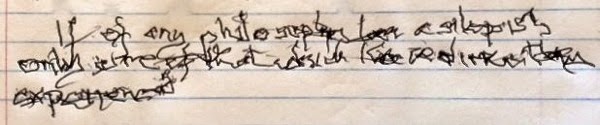
There was also a new notebook in which he'd only written on three or four pages, probably because his handwriting was completely giving out. This is the last entry:
note.jpg
Wovon man nicht sprechen kann, daruber muß man schweigen. Whereof one cannot speak, thereof must one be silent.
— Wittgenstein

Saturday, June 07, 2014

A rant on pronunciation

WE'VE BEEN ON the road for nearly two weeks, and blogging has suffered — both here and over at Eating Every Day. Most of my jotting has been longhand on scraps of paper, or short comments on Facebook.


But the other day The Huffington Post ran a blog post, "30 Commonly Mispronounced Food Words (and How to Say Them Correctly)," by Alessandra Bulow, which was mentioned by a friend on Facebook, leading to some contemplation on my part. 


(The article can be found at http://huff.to/1l6BHeZ )


My first remarks as posted to Facebook:


I find 7 of 30 agree with me, two more but only in one of two alternative, and one more I simply don't know the correct pronunciation: Huffington may well be right. 


Twenty, though, I think either wrong or misleading: I show my versions below. 


Note that no syllables should end with the usual (American) English "ee" diphthong, and that û is the French "u" (say "ooh" with mouth set for "ee", that "nh" stands for the French nasalization, not used in English except occasionally to express distaste, and that French almost NEVer stresses SYLlables as ENglish does. 


Lindsey says CARE-uh-mul, I say CAHR…


A) ree-SOUGHT-toh


1. Aïoli : eye-oh-LEE


2. Ambrosia : ahm-BROH-zyah


3. Ancho ("AHN-choh")*. ok


4. Anise ("AN-ihss")*  ok


5. Boudin : boo-DANNH


6. Bouillabaisse : bwee-yah-bess


7. Caramel : "KAR-ah-mehl" ok


8. Charcuterie : shar-kû-tree


9. Croissant : krwahss-sanh


10. Crudités : krû-dee-tay


11. Edamame ("eh-dah-MAH-meh")


12. Foie gras : fwah grah


13. Haricot vert ("ah-ree-koh VEHR") ok


14. Hummus ("HOOM-uhs") (oo as in book, not booze)


15. Jicama ("HEE-kah-mah") ok


16. Lichen : LIE-kun


17. Macaron : mah-kah-RONH


18. Mascarpone ("mas-kar-POH-nay; mas-kahr-POH-nay") ok


19. Muffuletta ("moof-fuh-LEHT-tuh") ok


20. Parmesan : PAR-muh-zun (it's English)


21. Prosciutto : pro-SHOOT-toe


22. Radicchio : rah-DEEK-k'yo


23. Rillettes ("ree-YEHT"; "rih-LEHTS") only the first


24. Raita : RYE-ita, where the "i" of the second syllable is slid past quickly


25. Restaurateur : ress-torah-TEUR, where the second syllable is slid past quickly


26. Sake ("SAH-kee"; "SAH-kay")* only the second


27. Sherbet : SHER-but


28. Tzatziki ("dzah-DZEE-kee") perhaps. I don't know. 


29. Vinaigrette : van-eh-GRETT


30. Worcestershire : WUS-ter-shear


After another person commented on the open Italian O in "risotto," and on English final diphthongs — or, if you prefer, diphthong finals — I added:


Savio's exactly right about the diphthong and I should have stressed the point more. And of course he's right about English lacking certain sounds extant in other languages (and vice versa).


"Risotto" is a great practice word. Being Italian, it should begin with a slightly trilled "r": say "HREE " and gently flip the tip of the tongue against the roof of the mouth just after the "h." 


The English word "sought" is almost exactly right as it lacks the diphthong, at least to my ear, probably because the "t" cuts it off. 


You pronounce both letters of a double consonant in Italian, so the final syllable is "toe." Pure "O": no slide into the W of "tow"!


By the way my daughter Giovanna hears her name mispronounced far too often : it's jo-VAHN-nah, not jee-o-va-nuh. 


Mispronunciation is mostly the result of inattention and, I think, a mark of laziness (unless impacted by genuine physical problems with hearing, or with palate, tongue, teeth, or lips —gosh, it's complicated!).


During her long tenure at Chez Panisse, one of Lindsey's jobs was to prepare pronunciation guides to certain food terms and menu items, so that floor staff might be saved from error. I don't know if that's still being done; perhaps it's no longer needed. 


My own pronunciation is of course far from perfect, so if you have corrections to make, they're welcome…

Tuesday, May 20, 2014

Horace: Diffugere nives

With profound thanks to Bhishma Xenotechnites


(Finished for now, and constructive comments welcomed below —)


( Well, then, here's the result. I'm not sure why I have bothered —
     translation's not my game, and
lord knows there are versions enough in our English language;
     most of them much the same. 
Still, I wanted to get inside both meaning and meter.
     Horace deserves no less. If
I have made an egregious error, I hope you'll forgive it.
     All I intend is a gloss
On this masterpiece from a time and a place quite removed from
     our more frenetic world, where
meditation on Nature's recurring cycles fell out of
     fashion — though now, as we've learned,
Her cards trump all we've tried to retain in our dealer's hands,
     grasping, we find, to no purpose. 
Horace addresses his song to his friend, Torquatus, and sings of
     others we no longer know—
Tullus and Ancus were kings who died more than five hundred years 
     Before Horace sat down to write;
Theseus we dimly know from legend, but few can remember
     Pirithous, rival and friend.
Still turn the seasons today as they did two millennia and more
     ago when these great lines were written;
Horace's moon is ours; our seasons obey the same law; like
     him, we will never return.)


All the snow vanished now, and the grasses back in the meadow

     foliage caps every tree ;

Earth goes through her familiar changes and banks are left bare by

     rivers whose waters are low ;


Grace, with the Nymph and her sisters, the twins, dares to go now, naked,

     leading them all in the dance. 

immortality isn't for you, warn the years that nourish those

     hours that steal the days. 


Cold gives way before breezes; Spring is trampled by summer;

     Soon herself to give way:

Autumn pours out her fruits; then Winter's lifeless fogs come

     Back, repeating the course. 


That loss, however, is quickly restored by the moon in the heavens.

   We, when we have gone down where

pious Aeneas, rich Tully and old King Ancus have gone, we'll 

   be just dust and shadow. 


Who knows whether the hours of this day will continue, increasing

   by those of days to come?

Everything will elude even greedy hands of your heirs, friend —

   All that your spirit will yield.


When you finally perish, Torquatus, and terrible Minos 

   makes his final judgement,

not your family, not your eloquence, piety —

   nothing will bring you back.


From that darkness not even the goddess Diana, though he's

   chaste, can free Hippolytus,

nor has Theseus the power to break Lethe's fetters, binding his

   dear friend Pirithous.


     —Horace, Carminum IV, 7 (my translation)

Sunday, May 18, 2014

Tribes

• Nina Raine: Tribes
Beth: Anita Carey
Billy: James Caverly
Daniel: Dan Clegg
Sylvia: Christine Albright
Ruth: Elizabeth Morton
Christopher: Paul Whitworth
Directed by Jonathan Moscone
Berkeley Repertory Theatre, seen May 14, 2014.

Eastside Road, May 18, 2014—

THE PRODUCTION HAS closed, but I want to write a little about this play anyway; it's had a considerable success since its 2010 premiere in London, with productions off-Broadway, at the Mark Taper Forum in Los Angeles, the La Jolla Playhouse, the Guthrie in Minneapolis, in Boston and Washington D.C., and now at Berkeley Rep.

I want to write about it, chiefly in order to investigate my reservations about it. I think it's a play well worth producing, performing, and seeing; it gives rise to all sorts of contemplation. If it fails, in some respects, most of its small failures are the inevitable result, I think, of the complexity, the magnitude, and the audacity of its ideas.

The "tribes" of the title are, first (in order of presentation), a loud, foul-mouthed, undisciplined family of academic intellectuals dominated by an overweening father (Christopher); second, the Deaf community with a capital "D," as I've learned from the playbill, which gathers around its sign language to participate in a kind of society we hearers can hardly imagine.

The family comprises the well-written mother, Beth, and three grown children all still living with parents: Ruth, yet to find her passions; Daniel, neurotic, wilful and damaged; and Billy, almost completely deaf since birth but raised to read lips rather than sign language — a misguided intention of the parents, who think thereby to give him place in society at large, rather than surrender to that of the "handicapped."

Into this stew walks Sylvia, the child of deaf parents, fluent therefore in sign, hearing herself, but quickly going deaf. She introduces Billy to sign language and to more than that, including employment and, of course, romance. This is a total assault on the overbearing Christopher and all his arrogant assumptions; further, it disrupts a fascinating dependency Daniel has evolved on his brother's place in the family. A true theatrical crisis results, and Raine's writing rises to her play's demands.

But not always. At least in this production, much of the time the audience is cajoled into participating in the subtle catastrophe through crude, sitcom-like badinage. The six characters are not evenly fleshed out, and some plot details seem arbitrary, introduced perhaps to illustrate some aspect of the hearing-versus-deaf problem, then dropped before they distract from the central onrush.

What Raines does accomplish in this play is present the huge gulf that apparently exists between those who hear, and who communicate largely through sound and hearing (and in this case fury), and those who do not, and who must communicate through touch and sight. Behind and below this, of course, there's the matter of awareness, awareness and sympathy.

There's also the matter of language. We always think language is what makes us express ourselves and understand others: but as this play points out, language is just as often what makes us misunderstand, equivocate, and mislead, and certainly distract ourselves from confronting reality and especially the reality of the completely different views of reality experienced by those around us.

There was a lot to like about this production. The entire cast rose to the occasion, though I thought among them some were more capable with their roles than others. James Caverly, himself deaf as I understand it, was stellar in the central role of Billy. Christine Albright stepped into the role of Sylvia, originally set on Nell Geisslinger: she was moving and authoritative in the part. Paul Whitworth and Anita Carey were enormously effective as the parents, and if Dan Clegg and Elizabeth Morton weren't quite their match as the two hearing children, I think this was more the fault of the writing than of the actors.

Nina Raine has bitten off too much in her play. A few weeks ago we saw Tom Stoppard's trilogy The Coast of Utopia in a single day: Tribes is almost as thick with ideas and drama, but in two quick acts: it might better have been two more thoughtfully paced and fleshed-out evenings.

Jonathan Moscone's direction seemed straightforward; Todd Rosenthal's set was persuasively detailed; Christopher Akerlind's lighting and, especially, Jake Rodriguez's sound design were sometimes subtle, sometimes dramatically effective. I'm glad I went; I'll be thinking about the play for quite a while. It puts narrative plot in service of abstract and far-reaching idea. It will be interesting to see where Raines goes from here: Tribes is only her third play. I'm curious to see the others, Rabbit and Tiger Country.

Monday, May 05, 2014

Barns, and a personal note

EastsideBarn.jpgPERSONAL NOTE first: I named this blog in a hurry, as one often names things, but with little or no subsequent regret. I live on Eastside Road, and the blog reflects my own view on a number of things. It's true I live on the west side of the country, a fifth-generation northern Californian, born in Berkeley with a mentality to match; but when I'm not looking out over the Pacific — and I'm not, as a general rule — my view is extended toward the east: over the USA, across the Atlantic, toward the European linguistic and cultural history that's so much a part of the American heritage.

My outlook is informed by sense of place, and you're looking at my place. Narrow country road, two-laned, bordered by hills on the right, a broad beautiful valley on the left. Here we're looking toward the north, maybe half a mile north of here, at something I'll never see again: a white barn silhouetted against a file of sycamore trees, adding focus to the valley.

I love vernacular architecture. This particular barn stood here for at least the last sixty years. It was made of redwood, very likely first-growth redwood from across the river: vertical siding painted white; and it was tall, twenty-five or thirty feet tall I imagine. I don't know its original purpose, but before this valley was vineyards it was prune orchards, and before that it was hopfields. The barn may have been built to protect hop-poles, but that's just conjecture.

Last Thursday the barn burned to the ground. It had been an unusually hot day here, nearly 100°. The fire broke out toward evening; there was no one in attendance. By the time the firemen got there the situation was hopeless. (You can read the local newspaper's account of the fire here; for once, the comments are worth reading as well.)

Calplans barn, Eastside Road
Photo: Greg Witmer


I stopped on Saturday to look at the site. Two men were standing under the blackened sycamore sadly looking at the ruins. They looked at me curiously and I explained that I was there to tell them how sorry I was for them on losing such a magnificent barn.

It was a beautiful barn, I said. It, and Hopkins's stand of poplars to the south, had always supplied a focus to the valley for me, it somehow completed the beauty of the area. I stopped, feeling a little awkward. I was talking philosophy and aesthetics; they were factory-farm workers.

I suppose some might say I have a romantic view of landscape and agriculture — a view formed by other values than mere productivity and profit. An important part of life, to me — my life, I mean — is finding and acknowledging and experiencing, as fully as possible, its place: origin, source, presence.

Always recognizing its presence is a matter of moment, transitional and fugitive.

The barn was a fine metaphor of what I'm talking about, and to me that metaphor was enhanced by its geometrical quality. There was something about its position, by the road, under the sycamores, at the edge of the valley, its straight edges (like those of the road and the rows of grapevines) expressing its man-made contribution to the soft fertility of the valley floor, the sinuous river beyond the low trees to the west, the soft hills beyond, where the redwoods grow.

To my great pleasure the two men knew exactly what I meant. You could tell that by their response, yes, it was a beautiful barn, and beautifully made; and very old, older than either of them. But you could also tell by their demeanor. It's no exaggeration to say that they were mourning, like me.

Over the years I've photographed the barn from time to time, and I hope others have as well. I suppose it can never be rebuilt as it was, but I hope its replacement is not a matter-of-fact industrial steel shed. Perhaps the owners are well-insured, and the policy will allow them to rebuild appropriately. Shape and color are important, as valuable, I think, as function.

Of course it would have been better had the original structure been made of stone — there are a few fine old stone buildings hereabouts, but redwood was cheap in those days, easily milled and easily nailed together. Today's steel, today's version of timber in this regard, can have durability similar to stone. I'm not asking for faux-history; all I want — perhaps already too much — is an equivalent to what was there.

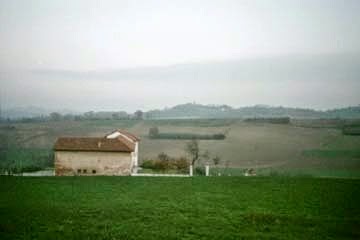
Since this post is in the nature of nostalgia, here's another photo — a farmstead in Piemonte, out northwest of Cuneo somewhere as I recall, cropped and zoomed from an inadequate image shot quickly as we drove past, at least a dozen years ago. It has been part of my fixed mental landscape ever since — like the beautiful white barn on Eastside Road.


ItalianBarn.jpg


Sunday, April 27, 2014

Three photos from Facebook

I MAKE NO APOLOGIES for spending time on Facebook, where I "follow" a great many "friends" (and, of course, family) scattered across much of the world. Nearing eighty, spending much of my time either relatively secluded in the country or relatively adrift traveling, I frequently hunger for intelligent conversation. I have never much liked talking on the telephone, which entered my life rather late, when habits had been set. I would like to commune with my books like Montaigne. Facebook has enabled a new kind of intelligent conversation. It has its failings, principally difficulty with subtlety and irony; but it has its virtues: the conversation can be interrupted for hours or days at a time, allowing recourse to reference material or the slow ripening of ideas in the back of the mind while doing various little errands and repairs.

Yesterday, for example, three different "friends" posted three different images, each of which then drew comments from other Facebookers; and in responding to these — images and comments both — I found myself contemplating, once again, the uses of irony. But let's just look at the images in turn, and see what develops.

photo 1.jpgThe first is the cover of the current issue of The New Yorker, originally posted with a comment by PETA but reposted by an online acquaintance with whom I share interests in nature, health issues, and literature, among other things. PETA's original comment on the photo was
The cover of this week's The New Yorker magazine says it all: Anyone who has a heart knows: it's time to BanHorseCarriages for good.

My comment: Um, that's not what the cover says to me…

Friend: Fair enough, Charles. To you, what does it say?

Me: Things are in a muddle.
It turns out that the artist who provided the cover, Bruce McCall, objects to horse-drawn carriages in New York City not only on the basis of "animal rights" but also for traffic-related reasons. (Find PETA's summary of this here.)

I feel strongly that horse-drawn carriages do contribute to the urban, not to mention metropolitan, experience. Of course they should not be forced to negotiate busy motor-vehicular traffic: but they are useful for negotiating the strip of sanity between the rush of taxicabs and the benignity of pedestrianism. Jane Jacobs was right, in her indispensable book The Death and Life of Great American Cities, to divide humanity between "car people" and "foot people." I am unabashedly a foot person; I think of my car — which we've driven 145,000 miles in the last five years or so! — chiefly as a way to get between my chair and an urban walk.

But the presence of horse-drawn carriages does more than ease that jarring gap between speed and tranquility. Let me mention two points.

First, humans have suffered, I think, from having removed themselves from the society of other animals. I think the sudden appearance of all those terriers — Yorkshires, Jack Russells — in the arms and at the feet of all those young flâneurs in Healdsburg is a {perhaps subconscious) acknowledgement of this. The society of other species is another bridge between states, the state of Nature and that of human invention; it reassures us that we are, fundamentally, only another species of animal, adjusting to an ecology badly damaged by our own doing it is true but governed by laws of Nature which really should be considered as they are likely to prevail.

When boys and girls attend daily to the needs of animals — I'm thinking, for example, of my own experience feeding pigs, tending the milk cow, dealing with ducks and chickens and rabbits — they develop a sensitivity to the needs, the fragilities, and the occasional threats coming from sentient creatures with whom verbal communication is tenuous at best. The difference between saddling a horse and adjusting a carburetor, or milking a cow and driving to the supermarket for a quart of milk, is the difference between a natural life and a mechanistic one.

(Interesting that the Internet will easily supply me with 48 synonyms for "mechanistic," and only two antonyms, neither of which works here: "nonmechanical," "handmade." An indication of the extent to which we've adopted a mechanistic mind-set.)

Second, horse-drawn carriages are by their very nature nostalgic. Nostalgia gets a bum rap these days (it ain't what it used to be, I'm tempted to write), because it's thought of as a distraction from the pressing matters of the present. But a full engagement with the present moment demands, I think, simultaneous contemplation of the past that has led to it. It's too easy to think of the city — our man-made ecology — as merely its present statement, rather than a living organism with a past and inevitable future as well as its present moment. In appealing to a nostalgia the carriages, the horses, even the driver, remind us of a historical source for the enlightened acknowledgement of the need for a Central Park.

I could go further. Economy, for example: the dollar value of what a "developer" might put in the place of a Central Park, versus the human value — ugly term, but nothing better comes to mind — of having its tranquility and, yes, its historicity. Kindness: the lesson implicit in the care of the handler for his horses, and by extension the sympathy between the riders and the handler (and the horses). Aesthetics: the sight of these handsome animals, so unlike us; the scent of health and life; the sound of the hoofbeats and the gentle murmur of the tires, so unlike the noise of the taxicabs…

Francis Ponge, from Trois petits écrits:
Pour la ruée écrasante
De mille bêtes hazardes
Le soleil n'éclaire plus
Quún monument de raisons

Pourront-
ils, mal venus
De leur sale quartier
La mère, le soldat,
Et la petite en rose,

Pourront-ils, pourront-ils
Passer? Ivre, bondis,
Et tire, tire, tue,
Tire sur les autos!
Because they rush and smash,
These thousand wild beasts,
The sun won't shine again
But a monument of reasons.

Will they — unhappily come
Alas, from their poor slums —
A mother, and a soldier,
A child, dressed in pink —

Will they, will they be able
To cross? Drunk now, I leap,
And fire, fire, kill,
Shoot, fire on the cars!
ponge3.jpg

THE SECOND ILLUSTRATION is another magazine cover — Facebookers are nothing if not attuned to the present moment. Since I began writing this interminable essay the page has disappeared from Facebook — one of the annoying persistent features of that universe is its unpredictable evanescence. So I have to work from memory here.photo 3.jpg

The photograph is of the singer and actress Beyoncé Giselle Knowles-Carter, who goes by only her first name. The image was posted by a Berkeley friend with a laconic comment noting that it shows the woman in her underwear, while the article inside the magazine refers to her as a feminist.

Thinking he was criticizing Time for cynical exploitation, I commented that there were multiple levels of irony here; whereupon another friend, an American expat in London these forty years, commented that there was "no inherent virtue in irony", which cheap politicians had been practicing for years.

Setting aside the question as to whether an essentially British mentality can ever appreciate the essentially Mediterranean device that is irony — after all, Brits, like Yankees, pride themselves on their plain-spokenness (which is itself ironic, n'est-ce pas? — I was taken aback by the concept that irony, or indeed any rhetorical device, might have inherent virtue. (Or, for that matter, vice.)

As I wrote here a little over a year ago, in a comment on Julian Barnes's The Sense of an Ending, I suppose it's the irony of our time that so many no longer understand the meaning of "irony," and take it to mean merely a state of being hiply flippant. (I don't mean to imply that my London and Berkeley friends make this error: they know the meanings of words.)

Such societal positions as Animal Rights and Feminism (and I don't mean to imply they are of equal value or significance) are problematic when they intersect with political action, because law and regulation are societal tools most practical when directed to specific actions and events, while positions — and affinity-group organizations whose motive is to focus those positions on political action — are necessarily concerned with larger and more vaguely defined issues, issues which connect to other issues. Society is like a brain; one doesn't attempt corrective re-wiring with a broadaxe or even a butcher knife.

In short, what I've called societal positions — one's position on such questions as "race," "gender," the rights of animals, public health and welfare — are collections of attitudes that tell us how to think of things, how to form and express our own opinions. They begin to lose value, I think, when they are asked to harden into matters of doctrine — precisely when they most reach toward irony.

Again, Ponge had a word for this, as I wrote in that post about Barnes: momon, "Texte qui inclut sa propre critique," says Larousse; and Ponge expands on this:
…toute œuvre d'art comportant sa propre caricature, ou dans laquelle l'auteur ridiculiserait son moyen d'expression. La Valse de Ravel est un momon. Ce genre est particulier aux époques où la rhétorique est perdue, se cherche.

…any work of art which includes its own caricature, or in which the artist ridicules his own means of expression. Ravel's La Valse is a momon. The genre is peculiar to periods when rhetoric, having lost its way, looks for itself.
says Ponge (Le Savon (Paris: Editions Gallimard, 1967), p. 42-3.)*

The momon, a concept significant enough to be incorporated into English, hence no longer to be italicized here, is the intellectual attitude of our time, which is reeling still from the discoveries of Modernism, which depended on acceleration and dispersal; and so lapsed into the kind of apparent chaos every generation perceives in its own context. Earlier generations found refuge in such chaos in religion, in Enlightenment, in mechanics, ultimately in Romanticism — Fernando Pessoa has things to say about this; my generation found it in the momon.

(Pessoa:
Beginning in the mid-eighteenth century, a terrible disease progressively swept over civilization. Seventeen centuries of consistently frustrated Christian aspirations and five centuries of forever postponed pagan aspirations (Catholicism having failed as Christianity, the Renaissance having failed as paganism, and the Reformation having failed as a universal phenomenon), the shipwreck of all that had been dreamed, the paltriness of all that had been achieved, the sadness of living a life too miserable to be shared by others, and other people's lives too miserable for us to want to share — all of this fell over souls and poisoned them. Minds were filled with a horror of all action, which could be contemptible only in a contemptible society. The soul's higher activities languished; only its baser, more organic functions flourished. The former having stagnated, the latter began to govern the world.

Thus was born a literature and art made of the lower elements of thought — Romanticism. And with it, a social life made of the lower elements of action — modern democracy.

[The Book of Disquiet, translated by Richard Zenith. New York: Penguin Classics, p. 212-13]

photo 2.jpgWHICH BRINGS ME, finally, to our third image, not a magazine cover this time but a snapshot taken in Amsterdam on Konigsdag, King's Day, when the entire city turns into a marvelous party and not a motor vehicle is to be seen (except, of course, the boats).

You should know, first, that Willem-Alexander, whose slender young frame you see here, sashed and bemedalled, was the first man to occupy the Dutch throne since the death of William III, in 1890. (William was succeeded by Queens Emma, Wilhelmina, Juliana, and Beatrix; he and his wife Queen Máxima have three daughters but no sons, so the Dutch tradition of gynarcy is likely to resume one day — but lang zal hij leve! )

The photo was posted by a friend who lives in Amsterdam. The comments soon appeared:
Do you need to bow and scrape?

Hip hip! Hoera!

Very convincing (minus the cheap sash!)

I thought that you made the sash just for him

But I think that one of the features that really makes the photo is the sash, and I can't understand why one would call it "cheap." Note that "The King" is in English, not Dutch. (I assume his left hand conceals the English word, not the Dutch "Konig.") The people around him must certainly be Dutch; they certainly look Dutch.

His sash is an exercise in humility, the opposite of irony; it recognizes the king's need of identification, even of explanation, in the contemporary Dutch context. The Dutch love their monarchy for the most part, much more good-naturedly (and generally!) than the British love theirs; but — it's a part of the Dutch temperament — they smile at their little indulgence, just as the king's sash is smiling at those medals.

Humility and a little bit of self-caricature, but without irony. And note: these are foot people, not car people. Like Facebook, they have a lot to tell us, if we only pay a little attention.

Wednesday, April 16, 2014

Alexander Calder in Los Angeles

Calder installation.jpg
Installation photograph, Calder and Abstraction: From Avant-Garde to Iconic, through July 27, 2014, Los Angeles County Museum of Art, © Calder Foundation, New York, Artists Rights Society (ARS), NY, photo © Fredrik Nilsen
Eastside Road, April 16, 2014—
HOW REFRESHING IT IS, to see an exhibition of an iconic artist, one whose work one knows well enough almost to take for granted, in an installation that restores all his energy, his significance, that reasserts his position within the most magical and optimistic areas of his century.

This is what happens in the current show of works by Alexander Calder, beautifully installed at the Los Angeles County Museum of Art. We devoted only an hour or so to the show: next time we're in town, we'll have to go back. Let the museum itself describe the exhibition:
One of the most important artists of the twentieth century, Alexander Calder revolutionized modern sculpture. Calder and Abstraction: From Avant-Garde to Iconic, with significant cooperation from the Calder Foundation, explores the artist’s radical translation of French Surrealist vocabulary into American vernacular. His most iconic works, coined mobiles by Marcel Duchamp, are kinetic sculptures in which flat pieces of painted metal connected by wire move delicately in the air, propelled by motors or air currents. His later stabiles are monumental structures, whose arching forms and massive steel planes continue his engagement with dynamism and daring innovation. Although this will be his first museum exhibition in Los Angeles, Calder holds a significant place in LACMA’s history: the museum commissioned Three Quintains (Hello Girls) for its opening in 1965. The installation was designed by architect Frank O. Gehry.
Yes, Frank Gehry, the architect. Installing all these works — from table-lamp sized stabiles to enormous mobiles, from small maquettes to huge stabiles — required unusual consideration, and the LACMA website describes The Challenge of Installing Calder in a fascinating and well-illustrated blogpost.
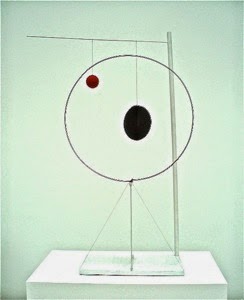
object-with-red-ball-1931.jpgYou see three of the earliest pieces in the photo above, with the fascinating Object with Red Ball (1931) at the center. This photo, from a different online source, demonstrates the piece's variability: the red ball and the black "sphere"— in fact two intersecting flat discs — can be positioned at various points along the horizontal rod from which they hang. The piece is a study in spatial relationship, implying motion. I like to look at it, with one eye or both, while walking slowly and smoothly past it, also varying the height of my eyes. No doubt this looks funny to other onlookers: I don't really care.

Object with Red Ball is as significant historically as it is on its own sculptural terms. It was in late 1931 that Calder began homing in on the idea with which he's most generally associated, the gentle movement of various components of his hanging sculptures as they respond to drafts and breezes. His friend Marcel Duchamp gave them the name that's stuck: mobiles. I think we tend to concentrate so much on these kinetic mobiles that we tend to forget their source; the three pieces in the photo above clearly put the Calder of the late 1920s and the first year or two of the next decade in a Surrealist context, particularly associating him with the Catalan painter Joan Miró.

It's easy to think of wit, even whimsy, as the primary effect of these pieces; but it's interesting, I think, to contemplate just what wit (and even whimsy) consists of, just why it should be a significant, even serious component of "abstraction." The beginning, for me, lies in the humor inherent in the sheer physical presence of these objects, made of shapes and substances that are familiar enough, that are combined and integrated in configurations never before seen, that contrast the frailty of their means and substance with the evident permanence of their purpose. These pieces mean to stay. They are here for a reason, however intuitive Calder's method may seem to be. Calder states (via one of a number of intelligent wall-readouts):
The basis of everything for me is the universe. The simplest forms in the universe are the sphere and the circle. I represent them by discs and then I vary them. My whole theory about art is the disparity that exists between form, masses and movement.
Demoiselle.jpg
Le Demoiselle, 1939
©2013 Calder Foundation, New York/Artists Rights Society (ARS)
Throughout the 1930s Calder developed a conversation, through an amazing amount of work, between stabiles and mobiles, relatively conventional free-standing sculpture and the continuously more graceful, floating kinetic pieces. The individual pieces making up these works increasingly drew inspiration, I think, from Nature: leaves, feathers, wings. Calder had joined the expatriate American movement in Paris in the 1920s, and, though he returned to Connecticut in 1933 and didn't open his French studio until thirty years later, he seems to have developed an intrinsically Gallic style. If his earlier work aligned him with Miró, it's hard not to see the work of the 1930s as somehow aligned to Matisse.

Calder's titles are almost always delightful, and delightfully apt. La Demoiselle (I don't know why LACMA's cut-line gives the word a masculine article) is redolent of the crisply feminine fashion-world of 1930s France; it is also both witty and graceful. A mobile hangs from the red stabile base, marrying the kinetic and the stationary — perhaps that's the reason for the hermaphroditic grammar of the title — but acknowledging, through its slender line and its improvised rear leg, the potential flight of even the stationary element.

The mobile had made Calder famous, rightly, and his primary colors, the wit and delicacy of his forms, the immediate pleasure of his work made it accessible. No one ever wondered what his work "meant." And if the man in the street could look at it and say "Why, my kid could do that," well, plenty of primary schools were quick to assign the production of construction-paper-and-coathanger knockoffs to children across the country — in the end only emphasizing Calder's apparently effortless mastery of what is, in fact, a rather tricky exercise in all kinds of balance.

After the war, commissions for large-scale public works began to rush in, and Calder worked away happily and productively into his sixties and seventies. This is the fiftieth anniversary of LACMA's commission of one of his most complex huge pieces, Three Quintains (Hello Girls), the grouping of three stabile-mobiles which for too long was relatively hidden at a corner of one of LACMA's signature ugly-Modernist buildings. I didn't see the piece last week, on our hurried visit to this exhibition; next time I'll be sure to say hello.

One of the most impressive of the big pieces is in fact "only" a maquette for an enormous work placed in Grand Rapids, Michigan: La Grande vitesse, over forty feet high, Calder red, massive, strong, yet lyrical. The maquette, also in plate steel, is only eight and a half feet high, eleven and a quarter feet long; but it crowds and dominates its room, inviting the onlooker to walk around and through it while allowing one to back off and take the whole thing in with one gaze. In the end, though it's forty years removed from Object with Red Ball, it similarly invites contemplation of changing configurations, and, through that, of its place — and the viewer's place — in the universe. Calder's universe, and ours.

Vitesse.jpg
Le Grande vitesse (intermediate maquette), 1969
©2013 Calder Foundation, New York/Artists Rights Society (ARS), New York, photo: Calder Foundation, New York/Art Resource, NY

Calder and Abstraction: From Avant-Garde to Iconic

Los Angeles County Museum of Art
5905 Wilshire Blvd., Los Angeles, California; 323 857-6000

Exhibition continues through July 27, 2014

Tuesday, April 15, 2014

Three plays in Pasadena: Tartuffe; Macbeth; Come Back, Little Sheba

•Molière:Tartuffe, translated by Richard Wilbur.
In repertory through May 24

•Shakespeare: Macbeth.
In repertory through May 11
•William Inge: Come Back, Little Sheba

In repertory through May 17
A Noise Within, 3352 E. Foothill Blvd.,
Pasadena, California; 626.356.3100
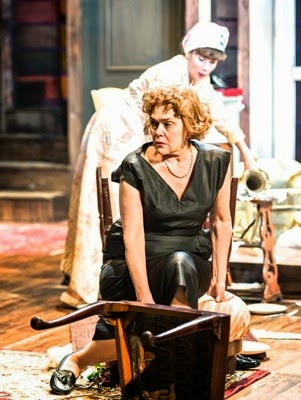
Sheba.jpg
Front: Deborah Strang (Lola); Back: Jill Hill (Mrs. Coffman)
in Come Back, Little Sheba at A Noise Within
Eastside Road, April 15, 2014—
THE THREE PLAYS currently in repertory at A Noise Within, the Pasadena theater company we've attended for the last ten years or so, make a strange trifecta on paper, I think: but taken together they are probably the most consistently successful half-season we've seen here, and that's saying quite a bit.

We like the company, partly for its casting, direction, and productions, partly for its enterprising choice of repertory. Shakespeare, of course, on every season, usually with two vehicles. A classic from the European theater, usually French. And a classic from the American stage, often a neglected one. New plays are rarely produced; there are plenty of other theater companies working at that.

Molière's Tartuffe isn't exactly neglected — without going out of our way, we've seen four productions in the last nine years, as I wrote on this blog back in 2010:
The country's second-favorite play
This year? Moliere's
Tartuffe, they say.
Second most frequently produced,
That is, and now its wit is loosed
On Ashland's public, and they see
That lust and greed, hypocrisy,
And false religion can be fun.
Depends on where and when they're done.
Heroic couplets, stylish sets,
Elegant costumes—no regrets
At seeing Moliere's play once more.
Trenchant satire's never a bore.
Otherwise, I've written enough about the play I don't want to repeat myself here. This production is a little zany, with over-the-top costumes (though often quite elegant) and some fine comic acting (Deborah Strang's Dorine especially) interestingly balanced by the sometimes soberly befuddled Orgon (Geoff Elliott) and the very sympathetic, sensible Cléante (Stephen Rockwell).
The title character was unusually sinister in Freddy Douglas's creepy impersonation of a Caravaggio sensualist, and the direction, by Julia Rodriguez-Elliott, sped along with clarity and good humor.
THE SCOTTISH PLAY — twice now I've made the horrendous mistake of speaking its real title aloud in Noise Within's classy Pasadena theater — received a streamlined, effective, often gripping production, thoughtfully directed by Larry Carpenter, who explained, in a talkback after the show, that he wanted to present it as ritual, removed from its legendary setting, timeless and immediately relevant.

Apart from cuts, the only novelty was the setting of the three weird sisters on male actors, whose black featureless costumes combined with heightened gestures and vocal delivery and with effectively manipulated puppetlike props to bring a Kabukilike quality to the show. Elijah Alexander was an interesting, often powerful Macbeth, and Jules Willcox surprisingly both hypnotic and retiring as his Lady; the rest of the numerous cast were quite up to their assignments. Only Feodor Chin, as Malcolm, gave me a moment's pause; his catalog of self-deprecation interrupts the action toward the close of this play: but that's the fault of the text, which always gives editors and directors a lot to chew on.

It's a disgusting, ghastly, ghostly, powerful play. You pretty much have to believe in the existence of unmotivated Evil as a concrete presence to buy its thesis, and Shakespeare is pretty persuasive on that score. It's not a play I like to see often. But it should and must be performed, and this is one of the best productions I've ever seen.
COME BACK, LITTLE SHEBA is another play that deserves a place in the repertory, though it's probably better known as the movie adapted from it lo these many years ago. It can be bleak and depressing in its treatment of a sad narrative — the lapse back into drunkenness of a reformed alcoholic, tipped past his margin when his idealized view of youth inevitably meets reality.

Geoff Elliott was really magnificent as the doomed Doc, tightly buttoning up his repressions through the first act, alarmingly releasing them in the second. The Lunt-like precision of his technique as an actor, especially his vocal technique, which can be distracting when he works with a verse play (though this was not the case in Tartuffe), was beautifully focussed on his character — both in itself, and in its relationship to his wife Lola and their roomer, the young Marie.

Whether speaking or silent, active or hesitant, Deborah Strang was a fabulous Lola. Face, voice, body, gesture — all seemed perfectly integrated in this characterization. Best of all, the role grew throughout the two hours of the play, finally overwhelming this member of the audience. It is her humanity, in its vulnerability, its insights, its hope and fear, that makes the production so telling.

I liked Maya Erskine's depiction of the flighty little Marie; Miles Gaston Villanueva did what he could as her boyfriend Turk, and Paul Culos similarly dealt with the role of her fiancé Bruce — but Inge is clearly out of his range trying to depict their affairs. Fortunately, that's not important. Perhaps it even underlines the major quality of the play, its portrait of the terribly repressed atmosphere of postwar America.

Ed Anderson, Doc's sponsor at Alcoholics Anonymous, is the focus of this portrait; and Mitchell Edmonds played the part beautifully. The character is patient, sympathetic, somewhat patronizing, ultimately futile, just like the American desire to return to some kind of sheltered small-town homogenous quiet after the tumult of World War II, after learning of the dangers and desires of sex, drink, and foreign ideas.

I think Edward Albee wrote a gloss on Come Back, Little Sheba in his (currently) better-known play Who's Afraid of Virginia Woolf. By then, though, the bittersweet innocence and the explosive loss of that innocence that Inge deals with has become utterly unthinkable. Come Back, Little Sheba, like Inge's other plays Bus Stop and Picnic — both of which Noise Within has produced recently — is pivotal in the history of 20th-century American theater, significant for its position between O'Neill, say, and Albee; but important beyond that for its accurate portrayal of what we were, where we've come from.

And, as directed by Geoff Elliott and Julia Rodriguez-Elliott and performed by this admirable cast, in an evocative setting by Stephen Gifford and costumes by Leah Piehl, Come Back, Little Sheba is gripping, exciting theater. If it weren't hundreds of miles away I'd go back to see it again. Bravo to all involved!