Thursday, October 26, 2006

NL 4: Brabant; Maastricht


Apeldoorn, Oct. 25 2006—

HOW TO DECIDE where to go next? That’s the recurring question when traveling as we do, with broad goals but details not quite filled in. Particularly true, for us, in The Netherlands. We have seen quite a bit of many of the Twelve Provinces, having walked the length of the country, bicycled other out-of-the-way corners, and toured by car and by train often enough over the years.

But we do not know the southernmost province, Noord-Brabant. We were cautioned many years ago — by a northern Dutch, to be sure — that we would not like it: it is dirty, or at least unkempt; it is licentious, or at least non-Protestant. It is to be sure in many ways un-Dutch: there are hills; canals are often lacking. I’m not sure why it didn’t go along with Belgium, when that country seceded from the Twelve Provinces in the 1830s, or whenever it was. But it didn’t, and there it is like a buffer zone between Belgium and the rest of the Netherlands, waiting for us to explore it.

In fact I first penetrated Noord-Brabant quite a while ago, in 1973, while on a press junket covering the opening, in Amsterdam, of a new museum wholly dedicated to the work of Vincent van Gogh. A side trip took us to Nuenen, where the hapless young van Gogh grew up in a miserable hovel of a house, near a water-mill, not far from the village church where his father was pastor. We visited that shack, now a shrine; it looked exactly like the setting of The Potato-Eaters.

(The same side trip took us to EIndhoven where a then-new building housed the Van Abbé Museum, dedicated to the latest painting and sculpture. Eindhoven is the home of one of the greatest Dutch industries, Philips Electronics, and being up-to-date was important, good for the corporate image. Potato-eaters are not the way to sell computers and video.)

In addition to further explorations of neglected terrain we have other, more idiosyncratic sieves for deciding where to go next. I have a penchant for enclaves, for example; those curious places which belong to one administration but are wholly surrounded by another. There’s one in Noord-Brabant: it’s called Baarle-Nassau, and it’s a gemeente or municipality completely administered by Belgium though entirely surrounded by the Netherlands — by Noord-Brabant, in fact.

We drove there many years ago, not having to go far out of our way since we’d landed in Brussels and were driving to Apeldoorn. We drove through the open fields that seem to lie far too high above sea level to be Dutch, through villages decorated with the omnipresent espaliered trees, on country roads smoothly paved and easy to drive, lined by pollarded willows; and then suddenly we were in a town whose architecture was all wrong — faux-French rather than Dutch — and whose streets were too wide — and, worst of all, disfigured by all sorts of commercial signs and billboards, many of them advertising some sort of lottery or gambling facility.

Cluttered, licentious, un-Dutch: Belgian, in fact.

(On another occasion, when we were very far south in Limburg but still in a very Dutch town, I asked the hotelkeeper what that smoke was across the river. Oh, she said, that’s Belgium. It’s terrible: The Belgians just burn all their garbage out in the open, in great fires; it stinks, the smoke fills the sky, it’s polluting. And what do you Dutch do with your garbage, I asked. Oh, she said, we send it across the border to the Belgians.)

Then there’s the desire to visit places with odd or memorable names. I like Bra, in Italy’s Piemonte; we’ll likely be there next week. I like Zutphen, not far from where I write this; and I’ve always wanted to walk from Alphen to Zutphen, it seems such an alphabetically satisfying thing to do. (Our walk the length of the Netherlands took us from Pieterburen to Pietersberg: that’s why it’s called the Pieterpad.)

And so it was on Monday night we found ourselves in Oss. I’d thought to find a hotel in Den Bosch, which is itself an odd name for a city — The Bush, I suppose, though the Dutch word is in fact “bosje,” “little forest.” (By way of South Africa that diminutive has given us “bush” in the sense of “back country.”) And Den Bosch is particularly odd for it’s the familiar form of “ ’s Hertegenbosch,” which I think means “the Duke’s bush,” or something of the sort.

(In the same way “Den Haag,” the usual spoken form of the nation’s capital — or one of its two capitals, for nothing is ever allowed to be too simple in this country — is really a simplification of “ ’s Gravenhage,” “the Count’s hedge.”)

But on driving through it Den Bosch seemed unpromising, full of buildings and cars and streets but not particularly ingratiating, and I thought a smaller town down near the river would be more, well, gezellig, that peculiarly Dutch combination of cozy, comfortable, snug, and accommodating, So we left the highway and took to a secondary road, still straight and fast, well marked and smoothly paved, through regimented forests of alders and lampposts, and drove for nearly an hour through roundabouts and traffic lights, soon quite within a new town of shopping districts separated by neat rows of newish detached houses and apartment blocks, and finally inside an older town lacking only a hotel to justify the amount of space it occupied.

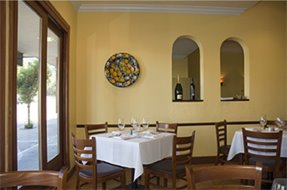
We did find one, ultimately, but it cost two hundred dollars a night, I can’t imagine why. Then we were directed to another, the City Hotel, less than half the price but still expensive by our standards, but comfortable enough. And so we had dinner — guinea-hen and a salad for me — and slept soundly.

THE NEXT MORNING TOOK US to Nijmegen, a city that’s always attracted me, but remains to be fully explored. We were there to revisit its Valkhof Museum, seen only rather hurriedly a couple of years ago. Nijmegen is literally at the end of the world, from the point of view of the Roman empire: it stands at the northern limit of Mediterranean expansion into Europe (not counting the island colony of Anglia), high on a bluff overlooking the wide Waal river beyond which camped the undefeated and surly Batavians.

The Romans were in town quite a long while, and left a good many souvenirs behind, and the Valkhof is happy to let you have a look at many of them. Coins, armor, weapons, tools, hardware, sculpture, jewelry; all the things that were too durable to rot away, too lost in garbage dumps (or worse) to have been melted down for further use. (I wonder, sometimes, about the successive forms taken by metals as they’re cast and re-cast into hinges, safety pins, helmets, frying pans and the like. When I was a boy the iron fences in the neighborhood were given to the government to be melted down for the war effort; and now scrap metal, mostly in the form of abandoned automobiles, is one of America’s greatest exports, along with waste paper and, lamentably, topsoil.)

The Valkhof presents all these artifacts in a series of fine, spacious, open rooms, well labelled if you have the patience to work out the Dutch; there are particularly absorbing displays of jewelry, coins, ceramics, and glass. That Roman glass! Drinking vessels and bottles, for the most part, of course, much of it elegant in form and both luminous and fragile — the clear greenish cast having often taken on various milky qualities as various minerals have reacted to light and age. Glass is something like petrified flesh, I think; it is fragility made immortal though still frighteningly vulnerable.

You move from these contemplations into more recent times: the Middle Ages and the rise of mercantile modernity; the taking up of Art as a major preoccupation. Portraits and furnishings, the souvenirs of pride: like so much of history, and particularly the history revealed in museums devoted primarily to Art, the poor and the downtrodden are taken for granted; it is the wealth and the enterprise that is celebrated; mere survival — which is what most of human activity has been — is rarely to be seen.

(And so ugly as it is, van Gogh’s Potato Eaters is significant beyond itself, and though it cost him his life van Gogh’s tragic sympathy for the poor, in the face of the ironic dependency of much of Art on the charity of the idle rich and leisure-class, is among the noblest aspects of the beginnings of Modernism.)

And after the Middle Ages and the Baroque and the rise of colonial empire and the age of industrialism and the beginning of Modernism here, in the final rooms of the Valkhof, is the triumph of Twentieth Century art: Pop. Art began to celebrate mediocrity in the 1960s or so; and fifty years later has taken the next logical step and become, from my point of view as an aging resentful ex-critic, mediocre itself. We took in a survey of current production in this province (for we are now in Gelderland, having left Noord-Brabant behind us with Oss): conceptual and technological and committee-made visual art, mixed-media of course, the best of it ironic; and I thought again of the French poet Francis Ponge, who wisely remarked that irony is the earmark of a decadent age when rhetoric, dying, turns to itself for its subject.

And we had a cappuccino and a piece of “industrial-cake,” a very dense, heavy, surely healthful cake full of sunflower seeds and pine nuts and whole-grain meal baked in the form of a heavy gear; and went down into the parking garage for our car and drove through the familiar Hoge Veluwe, the forest and heath at the heart of the Netherlands, to Hans and Anneke and a day or two of relaxation with old friends.


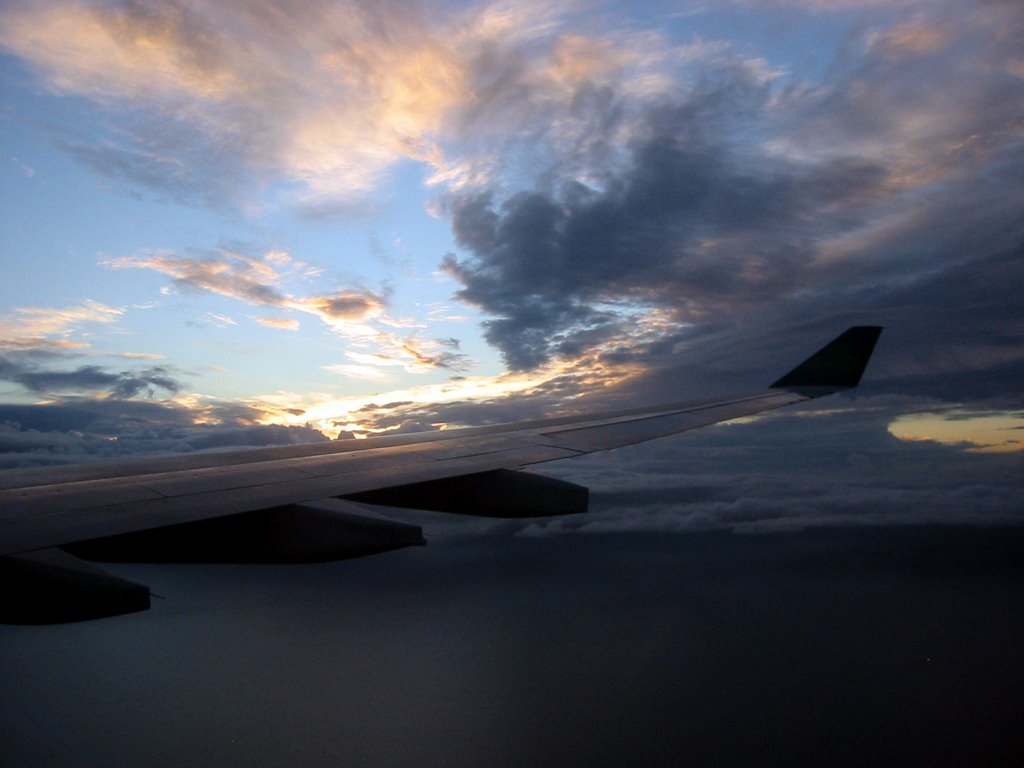
later: And now we’re in another airport, waiting for another plane, this time to fly to Italy, whence more tomorrow...

Tuesday, October 24, 2006

Walcheren


Veere


MY MOTHER, WHO IN MANY WAYS I never really knew or understood, gave me among other things a copy of Desiderius Erasmus’s The Praise of Folly as a parting gift when I went off to college. I’m not sure why she chose that text; probably she hoped to inculcate a sort of liberal intelligence. I found it confusing, as was all of life, particularly when regarded in a context including family.

But it followed logically another book I’d already come to love, Henrik Willem van Loon’s fanciful history-biography anthology Van Loon’s Lives, which on recent re-reading reveals itself a fine production of propaganda in defense of European (and especially transalpine) values in the face of the brutalities of the Third Reich.

Van Loon’s megillah was his unexplained ability to invite someone from the past, often quite a remote past, to dinner every Saturday night. His first guest was Erasmus, and he was so helpful he became the constant mediator between van Loon and his romantic-historical project.

There were memorable evenings. Emily Dickenson hid in the attic, sliding slips of paper with short poems written on them between the cracks of the ceiling; they fluttered down to Chopin, who played the old spinet in the parlor. Mozart and Hans Christian Anderson came; Queen Elizabeth and the Empress Theodora came; Robespierre and Torquemada came. There were great explorers and scientists, writers and artists. One Saturday afternoon the town square was taken over by dozens of Bachs whose improvisations entertained an equal number of Breughels, all busy at their sketch-pads.

All this took place in the town of Veere on the island of Walcheren in the Dutch province of Zeeland, relatively safe from the early days of World War II. In fact, however, a couple of years later, the island’s chief city Middelburg was badly hit by German bombs. Van Loon wrote his book largely in New York, and it was published quickly and circulated by the Book-Of-The-Month Club as a part of America’s industrious patriotism in those days.

We were in Middelburg Sunday night returning Grace to her apartment; she’s studying at the Roosevelt Academy there, in a program attached to the University of Utrecht, Erasmus’s alma mater. The Roosevelt Academy, as I understand it, is a three-year college with an international student body; the classes are in English, and all students are required to be fluent in English, to learn Dutch, and to follow a course in the liberal arts.

The school’s main building is in the fine old city hall, where van Loon slipped his dinner invitations underneath one of the stone lions (but he never told which one) on the steps to the front door. That building is now known as Franklin; another school building, across the street, is called Eleanor. (I suppose there’s a third named Theodore.)

The Roosevelt family ascended, of course, in the Netherlands, and personified the liberal intelligence so keenly espoused by Erasmus, and so necessary to a civil society in difficult times; and I’m happy to think of these youngsters from scores of countries all coming together to study linguistics and statistics, language and literature (Grace’s subjects this semester), and particularly to study one another, and the forces that prevail in family and society, in history and the present day, that have made them what they are, and enabled them to become what they will. Grace has schoolmates from Iraq and China, England and Australia, Finland and France; from Pacific Island kingdoms and African states; dozens of languages are represented; and all these young people have to get along, and for the most part do.


WE WOKE UP MONDAY MORNING in our second-floor (in the European way of counting, which starts above the main floor) after a very quiet night. The carillon began playing the quarter-hours only at eight in the morning, I think; I hadn’t noticed it earlier. Our hotel, the Kaepstander, was across the street from the abbey, Lange Jan (is it named for the woolly underwear?), and the carillon was on Long John’s spire. So were the deep bells striking the hour. Other than that it was dead still; hardly anyone about — for most shops don’t open on Mondays until after noon. We had our breakfast in the jazz club that forms the Kaepstander’s morning-room, and set out to explore.

The abbey is astonishing, like so many Dutch religious buildings. No idea how old it is. The church roof is twenty-four meters off the ground, the length of two boxcars. It’s lit naturally through towering narrow windows composed of small panes of clear glass: Calvinism is not consistent with stained-glass. It dominates the small city of Middelburg, which is centered on it, and so forced to set its imposing city hall and market-square off to one side.

At the center of the abbey is a cloister, filled with a fine herb garden tended, the day we were there, by women volunteer gardeners who were giving it a last clipping and cleaning before leaving it to the winter. Yes, Middelburg used to be quiet, one agreed, but not now that all these students are here. But I like having them, it is fine to have youth and energy and optimism. We had a chance to have a university once before, in the sixteen-hundreds, but it would have meant higher taxes, and we chose not do do it. And now we have a second chance, and we don’t reject it.

We’d had dinner with Grace the evening before, at the Cafe-Restaurant de Vriendschap (Friendship), where I’d had an enormous bowl of mussels nicely cooked in white wine with carrot and onion and celery to give them crunch and aroma; and we had a coffee this Monday morning on the porch of the Brooklyn Cafe, overlooking the great Marktplein; and then she went to class and we drove to Veere. We had a haringbroodje — a raw herring with chopped onion, a slice of pickle and a leaf of lettuce in a soft roll, a Dutch delicacy we’re particularly fond of — at a stand in the parking lot and then ambled into town.

I hadn’t been there in years, and in the meantime it’s become quite the tourist town, its own small marktplein bordered with boutiques and cafe-restaurants; and here, finally, at the reception desk in the city hall now turned into a museum, was someone who’d heard of Henrik Willem van Loon, who seems otherwise to be not only neglected but quite unheard-of. (It’s time, I think, to republish that book, perhaps with an introduction explaining its historical context and perspective — for our own age, with its urge to political correctness, seems impatient with and therefore unresponsive to other points of view.)

Veere is small and compact, snug beside its tiny harbor: but on its outskirts, a five-minute walk from the marktplein, is one of the hugest churches you’ll ever hope to find, a true architectural folly begun in the 15th century as I recall, squat and ugly for all its enormity, clearly a defensive building looking remarkably like the concrete bunkers still to be seen in places along the Netherlands shoreline. And in fact the history of this building is more military than spiritual; Napoleon’s troops used it for stables and bunkhouses. Today it’s used for, what else, concerts of popular music — though I noticed a poster for a concert of ancient Chinese music, too, whatever that might be.

Veere was overrun with German tourists when we first saw it, in June 1974, and German’s much to be heard there today. But there are plenty of Dutch and Belgian tourists as well, and if it’s the tourist economy that’s to conserve such a lovely place, more power to it. We had a cup of tea and a nice appeltaartje and headed off across southern Netherlands to find another hotel.

More photos at dotmac

Monday, October 23, 2006

Netherlands 2: Slacker, sluggard, slakker.


Leaving Dublin


Oss, Oct. 23

I AM A BIT OF A SLACKER, not really that much of one, for having waited so long to post a few words about this trip. There are two reasons, one technological, the other personal. The technological one is of course the inconvenience of going online, which in my case means also the difficulty of going online without paying.

The personal reason is that second word up there: sluggard. We flew Thursday to JFK, waited over an hour for our baggage, then took a shuttle to our Day’s Inn. JFK is a poor excuse for an international airport. Those who use the word “airport” to describe some postmodern totally global erasure of all things nationally distinctive have only to contrast JFK with, say, Schiphol Airport in the Netherlands to throw serious doubt on their case. If you fly to JFK you arrive at a miserable third-world country lacking conveniences and character. Perhaps this is not true if you bring great quantities of money: I don’t know about that: I don’t.

We flew Thursday to JFK, checked into our Days Inn (a miserable third-world excuse for a hotel, but clean, I suppose), spent the next morning there having lost many hours of sleep, spent the next afternoon in the “food court” at the airport catching up with a dear friend who lives in New York, and then flew the next segment of our trip.

”Food Court.” I love the expression; it suggests that your food is on trial. We ate at the best possible place, I believe, Sbarro. Guilt not proven, as the Scots say. A big salad lacking e. coli and a bigger plastic platter of spaghetti and “meatballs.” I asked the server if they had any red wine. “No: they don’t let us drink on the job,” she responded. Ah, Noo Yawk.

We flew on to Shannon, where we sat on the tarmac for nearly an hour waiting for a place to dock our airplane. Because of that we were quite late getting to our next airport, Dublin — did you know Dublin has its own little airport? We raced across the terminal to our next gate, checking in and out and in again at the antiterrorism headquarters, doffing and donning our shoes, to find that our next flight was itself delayed by an hour because of some unspecified emergency at Manchester, where it had been most recently.

The trip took two days all told, of which perhaps four hours were spent in bed at the Days Inn. We landed nearly an hour late at Schiphol, met Grace, got our car, and drove to our hotel in Akersloot, just short of Alkmaar. Why there? Much cheaper than Amsterdam, that’s why.

Nap; cold water on face; change shirt; drive in to...

A FAVORITE BAR IN AMSTERDAM:, de Oude Dock (the old dock), across Kadkjiksplein from a recently trendy Italian restaurant called A Tavola. Amsterdam is famous for its bruincafes, bar-cafes which are brown partly for their varnished wood fittings, partly for the tobacco-tars accumulated over the years. You don’t smoke in them any more, and the noxious effects of the tobacco are quite gone, but the character remains.

It’s fashionable to lament the disappearance of these bruincafes, but I think nearly every quarter of Amsterdam retains at least one. We’ve been in a few. I particularly like this one, and I wanted to introduce Grace to it; it’s the kind of place she’ll take her grandchildren to, and perhaps mention us to them, fifty years from now.

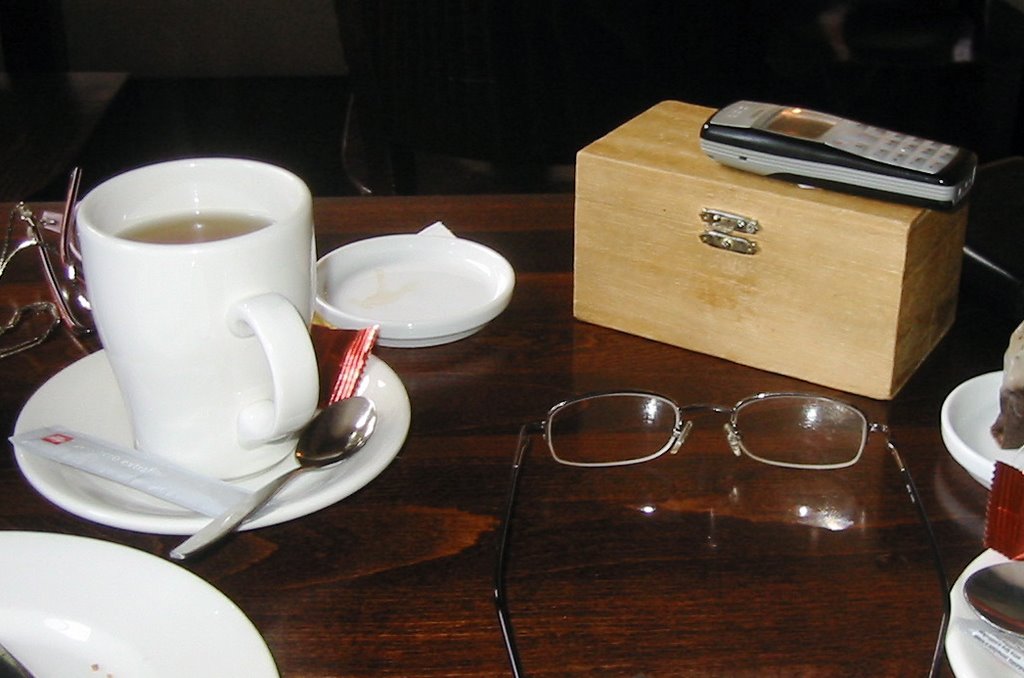
The ceiling is covered with bar coasters, like close-set scales on a fish; the room is dim; the recorded music is cool jazz; the drinks were bessengenever for Grace, sherry for Lindsey, a Corenwijn for me — that delicious, slightly cut “old Genever” gin you can get only here, unless BevMo stocks it now; I never go there.

One began to revive. The actual flights, the five airports, the four ascents and landings, the endless baggage-waits and bumpy cumulus and disreputable snacks — they were all behind us. It was catchup time: Grace is in her first year of college, her first year of independent living in Europe; she’s nineteen, full of fun and intelligence, tired from a fall break four-day trip to Paris, a little apprehensive about the schoolwork awaiting her day-after-tomorrow, but living completely in the moment, which her grandfather has suggested is the proper way to live.

And I, of course, am ecstatic to be once more in the Netherlands.

AND THEN WE FOUND OUR WAY, not without difficulty, to Marius, one of the Five Great Restaurants in the world (Chez Panisse, the Café Chez Panisse, Marius, Your Favorite Place, My Other Favorite Place) (let’s make it JoJo just now), where we had a Fabulous Meal:
chicken, warm spinach salad, mushrooms
octopus stew with tomatoes and other things
venison with puree of potato, pumpkin and apple
cheese
chocolate nemesis
with the appropriate wines, of course.

I apologize, sluggard that I am, for not having recorded this any better: I can plead fatigue. But it was delicious. You can read about Marius to your heart’s content at http://www.chowhound.com; and you can look for it several months back on this blog. I will say further only that the chef, Kees Elfring, exemplifies to me a perfect balance of the four components of serious cooking: Truth to the soil; Generosity of sensual delight; Healthfulness; and Intelligence. He knows his food from the farm, through the eye and nose and palate, to the nourishment of the body, never forgetting awareness of history, tradition, innovation, culinary analysis, perfect synthesis.

He does not do all this merely instinctively, though he is in fact an instinctive cook. He studies and thinks about these things, and works at Getting Things Right. This reflects his Dutch Calvinist background, perhaps. But he also lets go of theory and doctrine; at the last minute he knows it’s a matter of Getting It On The Table. The restaurant was full; everyone was happy.

NEXT MORNING, YESTERDAY, we got up at ten, having slept eight hours, and drove a few miles to Alkmaar for breakfast. Ham-cheese tostis for the girls, a three-egg-and-roast-beef uitsmijter with a small beer for me. Then it was on across the straight severe Afsluitdijk, which keeps the North Sea way from the interior of the Netherlands, and into Friesland, to visit Kees and Irma at home, and drive on to Jorwerd.

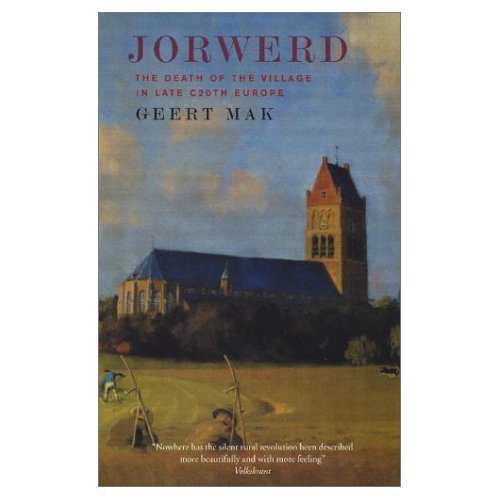
I wrote about this town here a month or so ago. I read about it in the book of the same name by Geert Mak, a Dutch journalist-historian: an account of the changes wrought on this agrarian town, between 1955 and 1995, by the revisions in the agrarian economic plans encoded and enforced by the Dutch national government. It’s a touching story, rather sad and nostalgic to those of us who grew up in and live in the country; but it’s not sentimental, it’s simply The Way Things Are.

We found much to reassure us. The Pastor’s House has just been purchased; its new occupants will no doubt maintain it in a romantic, newly comfortable, utterly clean version of the major house it’s always been. I found the bronze military cap on the fence-post next the mailbox touching: I hope it is maintained.

The Jorwerd church was open to visitors — clean, spare, straightforward, forthright; with an organ nicely maintained (though we weren’t able to hear it) and a back room full of books spilled willy-nilly on a big table: a book sale, perhaps; or is it the town lending-library? Dubious.

The notary’s house still has its huge back garden where, Irma assures me, the annual village theatrical is still put on — the old Frisian customs are maintained in a number of these towns; she’s on the committee of the one her own town puts on, and puts in her time at the bar in the local Village House.

The Jorwerd bar-café, Het Wapen van Bardersdael (and I’m sure I have the name wrong: it refers to the coat-of-arms of the local sub-province, Bardersdael) is still functional: we had a hot chocolate or so there, seated at tables furnished with the old-fashioned pile table-carpets; the billiard-cues stood comfortably but attentively in their rack; the proprietor left us nicely to ourselves after bringing us what we wanted.

And then it was time to go. We drove for hours across the Dutch countryside: Friesland with its lakes and canals and sheep and sails; Overijssel with its glimpses of distant hills; Gelderland and its national foest and heath; Utrecht where the suburbs grow; Noord-Brabant where the air begins to think of Belgium; and finally Zeeland where the rain, which had developed somewhere in Gelderland, let up completley, and the skies began to clear, and the air took on the salt-and-herring smak as the Dutch say, and we dropped Grace off in her room, and checked into our own room, up two flights of improbably steep steps.

YOU CAN SEE PHOTOS of some of this stage of our trip on my dotmac page. I’ll try soon to post an account here of our day in Walcheren, a place full of resonance for me — I think a stray comment made by a fellow at the next table at Marius may explain this resonance; at least it begins to for me. Interesting, to learn these things after seven decades.

Oh. And the slakkers? That’s the Dutch word for “snails”, which I asked the girl to leave out of my green salad tonight. I like it that the Dutch refer to that slimy animal by its slow pace.

Netherlands, 1


I WROTE ABOUT JORWERD here about a month ago, and I’ll write about that enchanting town again in a few days, when I’ve had time to catch my breath. In the meantime, you can see photos from the last couple of days on my dotmac page.

And here is what woke me up this morning:

An acquaintance, I might almost call him a friend, formerly engaging and sympathetic, let’s call him Ehrhard, had a few months ago suddenly become increasingly morose, spending long moments in a moody kind of distraction, silent and withdrawn, though given to occasional outbursts of apparently irrelevant excitement you might even call wild; certainly uncontrolled.

This made his company increasingly unpleasant, and I saw him less often — particularly as he now rarely sought me. Or, as far as I could tell, anyone else; though to tell the truth he’d never been one to spend an hour with more than one other person at a time. One didn’t know how he supported himself: he was bookish, talked on a number of subjects, was well informed but not particularly opinionated, and pursued a few curious interests with enough expertise and dedication to make use of public and institutional libraries, which was where I first met him. His showed little desire to entertain himself, but did occasionally seem to need an hour or two in a cafe where we met as if by chance, sitting at a corner table over a bottle, spending time in quiet conversation about history or poetry, music or theater.

But it had been some time since one of those chance meetings, and even they had grown uncomfortable, beset by moody silences and odd interruptions; and for months I’d only caught glimpses of him on the street where he’d be walking faster than usual, his eyes on the sidewalk, purposeful.

One day though I found myself in his rooms. He was seated at a small round table, a white cloth spread on it, its edges hanging down revealing an embroidered figured border, the window behind his left shoulder throwing a soft light, filtered by gauze curtains, on a curious box or chest centered on the table. The room was otherwise dim, its features indistinct. I sensed the presence of another person seated on the second chair at the table, but did not actually see him: only the chair was there, a plain wooden chair with a thin cushion in broadly striped sateen. I stood as if unseen a little distance from the table, invited I think but somehow irrelevant to whatever scene it was involving my friend.

He was very melancholy, sighing occasionally, now and then resting his chin on his cupped hands, his elbows on the table in front of him; or leaning back in his chair, extending his arms and laying his hands palms down on the tablecloth, not quite reaching and certainly not touching the chest which remained the focal point of the tableau.

I’ll never know what the chest contained. Whatever it was it was clearly significant, the only thing that mattered to my friend, or had mattered for months past. It had nothing to do with the interests I’d come to associate with him, with literature or history or landscape or the arts. It was something of intense personal meaning, and we had never discussed such things. Perhaps they were incapable, whatever they were, of being put into words: but they were clearly of great importance to him: perhaps the more so by virtue of their never having been discussed.

At some point recently whatever they were had become intrusive. It was as if they’d been dormant, inactive, immaterial to one’s daily life and the pursuit of one’s interests; matters of only limited interest. But within them lay some mechanism which, once set in motion, would evolve with slow but inexorable force, involving my friend’s entire person in a process quite apart from his own normal life and activity, involving him in what I can only call a narrative, a relationshi, approaching a psychological theatrical plot. I had no idea what lay at the bottom of this turn of events, but clearly something in that chest was key to its force; his eyes were by now burning with a sullen, resentful kind of intensity as they stared at it, locked on it, you might say, as if something within it were similarly fixed on him.

I could see him growing desperate, potentially violent, and it became a matter of the greatest importance to convince him that I myself had nothing to do with whatever had so seized him. In only a minute or two, in fact, the situation was so intense that I cried out, quite involuntarily, subconsciously hoping I suppose to break the spell, to interrupt this terrible hold that chest, or whatever it contained, had on my friend; I could see he was about to something terrible, something irreversible, perhaps some terrible violence on me, for I saw no other person or thing, other than the chest, that might be the object of this passion.

I saw that my exclamation had no effect on him, however. But then I quickly saw that I myself had no interest for him at all; I might have been quite invisible. His attention had lifted above and beyond the chest; he was staring into the space beyond the table, between it and the doorway through which I had stepped only minutes before. There was no one there, at least not visibly: but I felt a presence there, perhaps only because his fixed and intense gaze suggested someone. And he was about to destroy that person, and I cried out again; and then the entire scene dissolved, and I slept quite peacefully.

Sunday, October 15, 2006

Apples

WE WERE DOWN AT FILOLI last weekend, there to do the annual judging.

Filoli Center, off Highway 280 down in Woodside, is many things — among them, one of the most beautiful large gardens I know. But it is also a demonstration orchard, and every year celebrates the harvest with an impressive show of fruit from its trees. As a part of this there’s an annual competition for amateur cooks and bakers, and Lindsey is often one of the judges.

This time I didn’t taste anything. Sixty-odd desserts were just too daunting, and anyway it wasn’t my job. There was one item I couldn’t resist, a ricotta lemon tart whose pastry was made with olive oil — too unusual, and too promising, to pass up: and in fact I found it delicious. But I wasn’t a judge, and the tart didn’t make the finals.

But after hanging out with a friend in the cafe, and after a fine stroll through the grounds, I was fascinated to discover a tastable demonstration of apples and pears. A number of volunteers sat at long tables, cutting sample apples and pears into slices for a sizable crowd to try. On other tables there were exhibits of grapes, quinces, and other fall fruits along with the pears and apples, all carrying identification badges.

Here was an opportunity, I thought, to identify some of our own trees. We have a row of eleven apple trees, all of them different. We know what they are, but not which is which — some idiot cut off all their identifying labels while pruning them years ago, thinking his wife had recorded not only the names but also the locations of the varieties. (He has not been allowed to prune fruit trees since.)


(Here’s a box of our apples: Arkansas Black on the left, Rosebrook Gravenstein on the right. Our little apple trees aren’t much taller than I am, and last spring was so cold and rainy several didn’t set blossoms; still, we picked several boxes like this, probably sixty pounds of crabapples alone from one little tree in the middle of the garden.)

Filoli’s orchard puts ours to shame; it boasts more than ten times as many varieties. There sliced and available for tasting were a good twenty-five varieties, from American Summer Pearmain to York Imperial; and on the side table, wearing their names on little pennants of paper flying from toothpick staffs, were another hundred or so, from Albemarle Pippin to Yellow Bellflower. And indeed some looked much like our own apples. Apples are apples, of course, one’s much like another to a certain point. But there’s a lot beyond that point, and that’s where life begins to be really enjoyable.

All good apples (this sentence will be an example of circular logic) are aromatic, with reminders on the palate of their fairly close relationship to roses. Beyond the flavor, of course — or perhaps before it — there are the important qualities of looks and feel. Like all primates, we respond most quickly to red fruit: this has hampered California’s orchardists for nearly two hundred years, as apples rarely redden “properly” in our warm climate. On the other hand the russeting that characterizes a number of varieties has become unfamiliar and for that reason undesirable among many supermarket shoppers as old-fashioned varieties have fallen by the wayside.

Feel presents a different set of values. An apple, not to mention a pile of them, is a lovely sight, but the sense of sight has always seemed a little abstracted to me; it’s a sense one can be objective about, it’s the expression of the existence of an object with its own separate qualities and characteristics quite unconcerned with one’s own. Mouth-feel, on the other hand, even considered apart from the almost inseparable qualities of taste and smell, is intensely personal. You can’t get much more intimate.

Apples are prone to unpleasant mouth-feels: no one is attracted to mealy, cottony, mush, or rocky apples. And to tell the truth a good many of the old varieties of apple fall short here: they weren’t really selected for the pleasure of their mouth-feel. (Lord, can’t we have a better word in English than “mouth-feel”?) But that’s for a simple reason: many of these apples were selected for their keepability or their usefulness in the production of cider.

And in fact outside the tasting rooms the Filoli staff were busy cranking a fine cider-mill, and cups of the stuff were available for quaffing. When I was a kid this was an annual routine. We were allowed the windfalls at an orchard across the road, and spent an afternoon every fall picking them up by the hundreds, dumping them into a hopper, and watching the cloudy juice run from the basket-press. I was aware, of course, of the bugs, the rot, the leaves, and the worms that entered the process, and of the danger of stings by yellowjackets as interested in the apples as we were; but the cider was still a very good thing, and the chemistry involved in Dad’s experiments with brown sugar and raisins, in Mason jars of cider placed on window-sills and covered with cheesecloth, provided diversion in the weeks following.

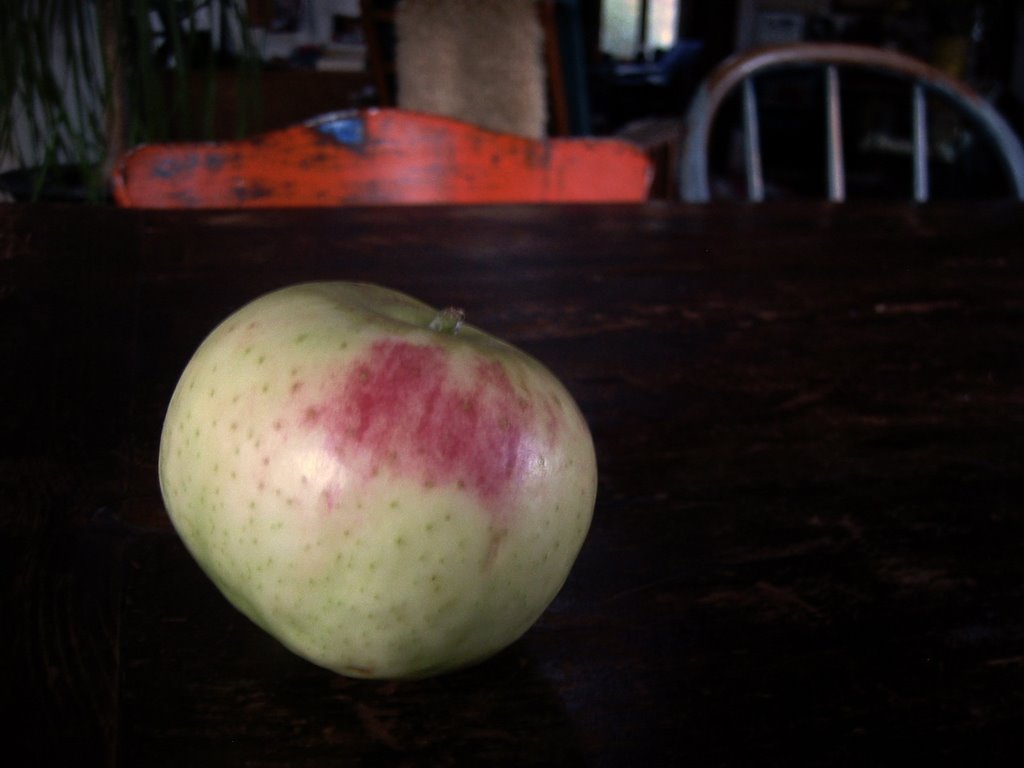
At Filoli last weekend three apples jumped out among the two dozen I tasted: Cox’s Orange Pippin, Ashmead’s Kernal, and Skinner’s Seedling. Cox and Ashmead seemed to have cider in mind, but Skinner, whose seedling was the only truly local apple on hand — having been found right next door in San Mateo, some decades ago — was a classic eating apple, and provoked such vocal enthusiasm from me that the very nice lady slicing them said You enjoy it so much I’m going to give you one. And she did, and I put it in my pocket, and it still stands on our dining table because it is such a beautiful thing.

I don’t know when I’ve seen an apple whose skin is so wonderfully white, and yellow, and red. The white is somewhere between milk and ivory and shows only in a few places, probably where the fruit had been shaded from the sun; the yellow suggests sunshine and hay; the red blushes faintly in direct light, but in one patch — where the afternoon sun was probably strongest through an opening in the tree’s foliage — streaks and slightly spreads with the bluish undertone I associate with “Chinese red,” a color you don’t see that often in edible fruit. And all over the apple there’s a pattern, neither random nor immediately meaningful, of darker freckles.

Skinner’s Seedling is crisp and juicy on the tongue, and floral and complex on the palate, with a perfume that seemed to combine all its other qualities and go right to whatever part of the brain it is that simultaneously is overcome with sensual pleasure but busily analyzes and records all that information. And I’m sure it’s as good for your health as it is enjoyable.


Skinner Seedling

LATER THIS WEEK we fly to Amsterdam, where we almost certainly trade today’s fog for some persistent rain. On the other hand we’ll dine chez Marius, and see friends and grandddaughter, and go on to the Salone del Gusto. I hope there’ll be reports here on a frequent schedule.

Friday, October 06, 2006

Mangiamo all’italiana

Divino, Ralston Avenue, Belmont California


TWO ITALIAN RESTAURANTS off the beaten track, both in shopping-mall locations, both perfectly fine.

Thursday night we were in Petaluma, there to see what turned out to be rather an impressive performance of Oscar Wilde’s fine play An Ideal Husband, about an idealistic and noble member of parliament who made his entry into politics via a particularly corrupt act. This was produced by Cinnabar Theater, and you should see it if you can. (Never mind. I see it’s closed already.)

We had dinner at Cucina Paradiso, whose menu and kitchenwork seem perfectly authentically Italian. I had a good salad follwed by a sole poach-braised with artichokes, and with this a bottle of one of my favorite wines, a Ceretto Arneis (shared, I hasten to point out, with three friends).

Tonight we’re in San Carlos, of all places, and Lindsey remembered, on scanning the restaurant listings in the Yellow Pages, that Divino was a place that had sounded good when we read about it.

It’s associated with a neighborhood Italian we've been to once or twice in San Francisco, Bacco — a place I always want to go back to.

Here again the menu was interesting, particularly the specials. Again a perfectly nice mixed salad, followed by well-made gnocchi in tomato sauce. Lindsey had fettucine with shrimp and mushrooms, and with these we tossed off glasses of a remarkable Sicilian white, Depranum bianco Inzolia e Grillo — complex and rich.

I particularly enjoyed Divino. Not only the menu and the kitchen, but an engaging waiter, efficient bussers, a pleasantly plain Italian-style room, and tables filled with families, kids at their parents’ elbows. This, to me, is what dining is about. We’ll be back.

Wednesday, October 04, 2006

Stars in our eyes


MUCH TALK ABOUT RESTAURANTS and eating these days, what with the new guides to San Francisco Bay Area restaurants from both Zagat and Michelin. We eat out a lot, though not so much in this area as when we’re traveling. We use both those guides, though of course we haven’t yet used Michelin’s San Francisco guide; it just appeared.

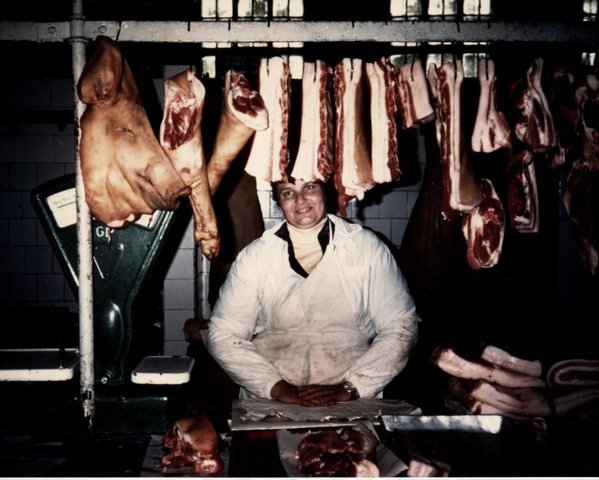
My attitude toward eating, I’m afraid, is signalled by the photo you see up there. It’s a misleading photo for it suggests plenty, both because of those hanging porcine pieces and because of the fetching butcher-lady herself, who clearly has not been starving. But the photo was not taken in a place of plenty: I took it on June 18, 1983, Saturday, in the market in Riga, Latvia. (I was there traveling with the ROVA Saxophone Quartet who were touring the then Soviet Union and Rumania.)

The market was given a large space, but there was little being sold. Quite a few enormous beets; a few tomatoes; some baskets of mushrooms, perhaps a few heads of lettuce. And, in a large covered area, a few stalls offering meat. This lady caught my eye as I went past: she was pretty and pleased to have a whole pig to sell, and when I lifted my camera and raised my eyebrows to ask if I might take her picture (for I know neither Russian nor Latvian, and knew it unlikely she knew English) she put her pretty hands together and tilted her head demurely and smiled.

I found the photo a couple of days ago while going through a few books. It was a 35 mm. slide originally, but I had two prints made a number of years ago, and misplaced this one. The other is at Chez Panisse, where I took it when a new butchering room was installed behind the kitchen, years ago. Like our Latvian lady’s stall, the room at Chez P. is tiled; but the carcasses hang in a walk-in cold room, and are brought out only when the actual butchering is being done.

(That last paragraph has just sent me to the dictionary. Butcher and slaughter, when I was a kid, meant two different things: you slaughtered a live animal (the word is cognate with “slay”); then you butchered the carcass, cutting it into manageable pieces. But though we were rustic enough to slaughter our own pigs, then butcher them out (for I think I recall the verb requiring its postposition), we were sophisticated enough even in those days to quibble over verbal precision: so maybe this distinction between slaughter/butcher was idiomatic to the Shere household.)

When you go through a period of butchering, not to mention slaughtering your own meat, you develop a pretty basic attitude toward eating. In fact you eat rather than dine. And that distinction is I think a significant one, and one addressed by those two guides, Zagat and Michelin. Zagat is a compendium of restaurant reviews — or, rather, a comparison of restaurants in terms of food, decor, service, and price — based on information sent in by large numbers of (usually) anonymous informants. The ratings run from 0 (or, more likely, 8 or so) to 30 in each of these categories.

The Michelin guide, on the other hand, is a list of restaurants grouped among only four levels of quality: three stars, two, one, or none. (True, there are qualifiers signalled by numbers of knives and forks, or the occasional red R rewarding a place offering unusual quality for the price. But these qualifers are far from the thrust of the ratings.)

Zagat is for eaters; Michelin is for devotees of fine dining. And, let me add, fine dining of a particular type: for Michelin takes the Zagat trinity of Food, Decor, and Service as a single item, and insists, I believe, on a certain kind of decor and service if it is to award anything beyond a single star.

Now I must point out that I’ve been associated with Chez Panisse since its opening, thirty-five years ago; and I do not pretend to any degree of objectivity when I write or talk about it — or, by extension, when I discuss any of the many establishments run by what you might call alumni of Chez Panisse.

On the other hand I do have decided opinions as to what constitutes not only Good Food (in the sense of Good Cooking), but also Good Eating — and even Good Dining. And as luck would have it just a day or two before the new Michelin appeared, scattering stars for the first time among Northern California restaurants, Lindsey and I ate for the first time at the one restaurant it rewarded with three of them: the French Laundry in Yountville.

I can well understand the Michelin rating, for the French Laundry reminded me of other three-star restaurants I’ve been to over the years — two in particular: the Auberge de l’Ill in Alsace and Girardet in Switzerland. Both those visits were years ago, of course; we no longer go to three-star restaurants — and that statement alone tells the story. We could go to them, I suppose; the only real reason we don’t is that we don’t enjoy them enough to pay the price.

We were taken to the French Laundry by a generous friend, and I hope he won’t find the rest of today’s blog ungrateful. We enjoyed the experience on several counts. We should know the place first-hand, of course; since we’re somewhat in the restaurant business we should experience every corner of it. Then too many of the dishes we had were quite delicious and all of them were technically absolutely first-rate (well, maybe one or two courses slipped just a bit).

And the wines we had — seven of them, to accompany the ten or so courses we managed — were really quite superb. Lindsey and I don’t drink this kind of wine; we can’t afford it. We discovered, though, that there are indeed California wines whose taste and finesse are at the top of their class: for example, Renard Roussanne from Santa Ynez, Selene Sauvignon blanc from the Carneros, and Martinelli Pinot Noir “Blue Slide Ridge” from a few miles out at the coast.

But — and you knew the “but” was coming — imposing and interesting and compelling as all this was, I didn’t leave thinking I’d had dinner. The French Laundry’s menu (you can see at example online) offers not a meal but a succession of events, each fascinating to see. (There are some splendid photos at the Bunrab blog — a fascinating blog to browse if you’re a foodie.) The events are wonderful and artistic, but to me it’s more like watching a gifted magician pulling rabbits out of hats than tucking into dishes prepared by a caring cook. It’s art, but art of a different order from the one I want at the table.

I wrote some time ago, in an introduction to my friend John Whiting’s Through Darkest Gaul, a friend’s guide to Paris bistros,
The art form of our time, the final thirty years of the twentieth century, has been the preparation of food. What the sonnet was to Elizabeth’s London, the Lied to Schubert’s Vienna, the easel painting to Impressionist Pontoise, the movie to the nineteen-thirties; that, to many of us, is the meal.

And I see that even this is out of date; it is no longer the meal but the individual course that is the art form. The hell with it, I say; let’s eat.

Friday, September 29, 2006

Mt. Diablo


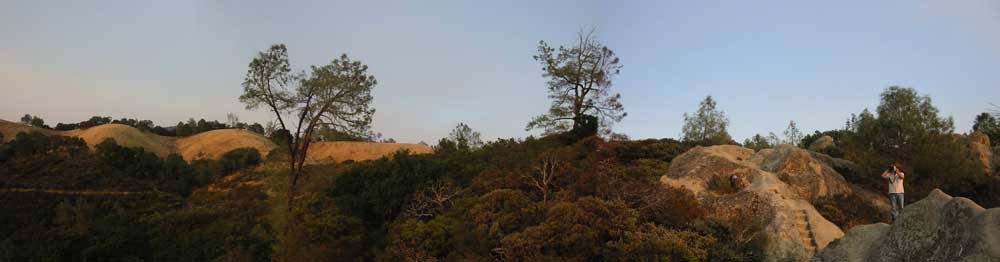
THAT’S MY FRIEND MAC over there with the binoculars, on the right; I’m afraid you can’t see him very well, as this is a pretty big photo much shrunk. (Click on it to see it bigger; and thank you, Photoshop merge.)

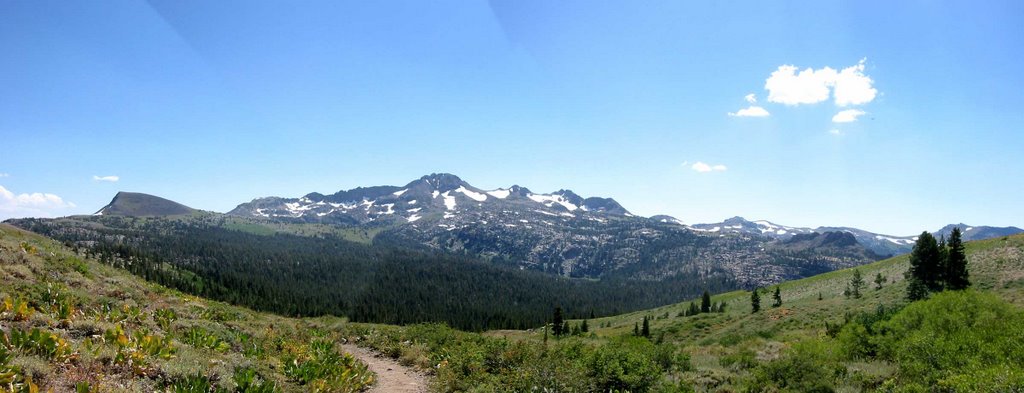
We’re up at the Live Oak campsite on the southwest flank of Mount Diablo, the highest mountain in the San Francisco Bay Area, where we slept before taking a trek over to the North Peak the other morning. In late September, on a weekday, the park is pretty well unpopulated — perhaps partly because one of the two access roads, the one from the north, was closed for repaving.

We saw almost no one except for bicyclists. Curiously, many of them were veterans, grizzled and tough, and riding alone. You can’t help wondering what motivates these guys (the few women cycling were younger): are they riding up into the sunset? It’s not an easy climb, and the descent is worse: I did it once, at least thirty years ago, and can still remember my aching hands from the constant braking on the way down.

Those days are over, but walking’s still in the mix, and Mac and I have a very undisciplined program of getting to the area’s high points. We began this a year ago with a stroll up the fire road leading to the top of Mount St. Helena, our local mountain. That’s 4344 feet high, the highest peak in the area, and it was a clear evening when we did it, and the views were extraordinary.

Mount Diablo is lower, at 3849 feet; but its isolated position makes it seem higher. Like Mount St. Helena it sports not one but two peaks, making them seem to be volcanic in origin, though they are not: they’re both upthrusts through older volcanic-origin rock — but also sedimentary stuff.

(A few months ago I said to myself and whoever was listening, probably no one, Thank God I’m not interested in geology. The very next day Therese presented me with a birthday gift: Doris Sloan’s Geology of the San Francisco Bay Region. Discovering it in its wrappings I couldn’t help exclaiming Oh wonderful! How fascinating! And of course it is fascinating, that’s why I’ve resisted geology all these years, there’s only room for so much fascination in one lifetime...)

We camped, Mac and I, at a low-elevation site in what’s called Rock City, which is not a city at all but a site about the size of a village, studded with interesting sandstone formations — Mac’s standing on one in the photo, and stair-steps were cut into another beyond him by the Civilian Conservation Corps back during the Depression, I guess, in a better time, when Government helpfully paid the unemployed to improve the public facets, physical and cultural, of the country we all live in.

We’d had a fine big lunch in Berkeley, so after our late-afternoon explorations of the rocks we contented ourselves with bread and cheese and chocolate for dinner, chasing away the occasional hopeful raccoon, and turned in about ten o’clock of a fine starry night.

Next morning after coffee and camp-breaking we had a visit from the park ranger, an affable man about fifty who had a lot to say about the park... we ran into him twice more, at the ranger station halfway up to the summit, then again at the summit. He’s a self-described Marxist, and was apologetic about the closed summit museum, blaming the anti-tax mood of the public as much, I think, as the priorities of the state government. Hard to argue with that.

On his advice we parked at Devil’s Elbow, a mile or so short of the summit, and set out on foot for the North Peak. This is a short hike, only a mile and a half, but involving a six- or eight-hundred change in elevation — downhill to a junction, then uphill to the summit. At its steepest the trail is on scree, and the last hundred yards or so was quite steep, approaching a twenty-degree climb, I’d say — hard enough going up; harder still descending.

Alas the sky was not clear. We saw further the previous evening at twilight, when we could make out Mount St. Helena, Mount Tamapais, Mount Hamilton and Copernicus Peak, as well as Grizzly Peak and Round Top among the Berkeley Hills.

The day began with fog in the valleys below us; we were on one of many islands of hilltop above this huge sea of fog — perhaps how things will be once the polar ice caps have melted and the sea level has risen. The fog burned off, but smoke from the Day Fire, and perhaps another up near Auburn somewhere, hid the Sierra and even nearer mountains — we never saw St. Helena, for example.

But we were compensated by the colors and textures of the slopes. All the wildflowers were gone except a number of patches of bold red California fuschia (Zauschneria californica) at their peak, and scraggly fleabane (Erigeron divergens) well past theirs.

Many of the south-facing slopes were covered with what I call chaparral, and Mac, more accurately but completely casually, calls chamise — a word which, curiously, appears in none of my English-language dictionaries. Adenostoma fasciculatum is what it is, commonly called greasewood, a wonderful fuel for the sort of fire now raging in Ventura county. It must have been magnificent when in bloom a few months ago, but it’s equally beautiful at the moment, glowing red-green in the evening sky, and forest green in the late morning, and adding a fine deep layer of texture to the gold of the dry grass, the feathery Coulter pines, and the occasional groupings of blue oaks.

Like the summit of Mount St. Helena, that of the North Peak is disappointingly crowded with communications towers bristling with relay parabolas and various radio and cell-phone antennae. It’s amazing to think of the energy and money responsible for installing and maintaining these things. It’s fun, though, to think of them as carrying on the tradition of Olympian energy-distribution from mountaintops known to all people close enough to the earth to be aware of the mysterious power of peaks.

People say the Indians were superstitious because they worshiped Mount Diablo, our ranger friend told us; That’s ridiculous; they worshiped it because it is sacred. It’s a very special place, and it’s the center of this part of the world.

I couldn’t argue with him. Mount Diablo is to the Bay area what Mount Shasta is to its area; it dominates the land around it, presses it down flat, but reaches up to mediate land and sky. And when you sleep on its flank, and walk or hike its trails, you appreciate the quantity and diversity of the forms of life it sustains — including, for a few fine hours, us ourselves.

Photos of our day on Mount Diablo can be seen by clicking here.

Friday, September 22, 2006

Farm Art

IN THE NINETEEN-SEVENTIES, I think it was, it was Jock Reynolds who made art that told me how much my seven years on the farm had to do with preparing me for conceptual art. In a show at the old Hansen Fuller Gallery, in San Francisco, he showed sculpture that was in fact jars of canned tomatoes, or sheaves of corn, or in one case a long box made of clear acrylic, filled with soil, planted with seedlings just leafing out.

I’m working from memory here, so I may have some of the details wrong. But I remember covering the show for KQED, and working at persuading my editor that this was indeed art. Color, texture, manipulation of light and space — no question: the removal of these items from their normal context, and of course especially their relocation into an art gallery, made them art. Marcel Duchamp, I knew, had won that point fifty years earlier with his readymades.

Twenty years later I was writing a catalog essay for Ann Hamilton, who was in residence at the Marin Headlands Center for the Arts, where she’d been commissioned to create a dining room — they called it a “mess hall” — and kitchen. Ann’s work is rich and complex, and while its most immediate effect on a viewer is through the eyes, its real appeal is to the mind. It involves memory, history, awareness. It was no surprise to me that she was widely read in areas already of great interest to me: Raymond Roussel and Marcel Duchamp, relating her to the French intellectual avant-garde of the early twentieth century, but also Wes Jackson and Wendell Berry, relating her to the late-twentieth-century return to the earth that feeds our bodies. (You can find the Hamilton essay on my website.)

In the arts as elsewhere the Twentieth Century presents, among many other things, this fascinating pendulum-swing: Modernism took us into abstraction, the intellect, theory, invention; but something that followed — and it is not postmodernism, which is only a late form of Modernism — returned us to a contemplation of First Concerns: sustenance and sustainability, nourishment and wellness, community.

Where is Art in all this, a friend wants to know, and that’s an interesting question. I’ve always thought that Art is a sort of transitory step in a process that begins in Mystery, moves to Religion, degenerates into Art, and winds up as either Entertainment or Criticism.

But a shorter answer is, Well, these days, if you don’t see what else to call it, it’s Art.

ALL THIS COMES TO MIND TODAY in the wake of seeing a show at the Sonoma County Museum, in Santa Rosa’s fine old post-office building. The museum is one of those uneasy combinations of Art and History — I mean that it’s obliged to give equal consideration to both, and given the nature of Art these days, and the potential volatility of History even, there’s a good chance any given exhibit or installation is going to rub someone the wrong way.

The current show, Hybrid Fields, is billed “a group exhibition of contemporary artists exploring our food systems,” and that pretty well describes it. Some of the work is toward the conceptual; some is close to conventional. The best of it, to my mind, sits firmly in the Art-As-Societal-Investigation pigeonhole, and it sits there pretty.

I particularly respond to the humor of an installation documenting The Sonoma County Mammalian Enology Experimental Pasturelands, with a detailed map of the pastures dedicated to wine-lactating rhinos, giraffes, and cows. Each wine is exhibited in sample bottles whose labels comment rather acidly on some of the enological absurdities already present on labels in your neighborhood shop. Funny: but also a little biting.

I respond also to Laura Parker’s Taste of Place, whose wine-glasses of soil samples from various Sonoma county farmsites remind the viewer that the terroir of our unique wines is literally an expression of the soil. You can sniff at these glasses, and some of, in doing so, are reminded of the heavenly scent of earthy aromas from our past.

There are a number of other intriguing works, like Steve Shada and Marisa Jahn’s Swan Song, a musical instrument played by ripe apples dropping from a tree — it’ll be interesting to see if it makes it to the end of the year, when this show closes — and a couple of outdoor installations: Susan Leibovitz Steinman’s pentangle of apple trees in stock tanks, recalling the star-shaped seed core of the familiar Malus, and Matthew Moore’s Green Roof, ten hop vines, each planted in a plastic bucket of grey water hanging alongside a low building west of the vacant lot to the left of the Museum entrance, eventually to form a pergola of vines over the roof.

Hybrid Fields helps, one hopes, to bring the agricultural past (and present!) of our county to urbanized art-happy visitors to the Museum, and to that extent it’s a successful expression of that troubling mandate to serve both Art and History. (Further anchors to the county’s ag history are in the continuation of the exhibit on the upper floor: don’t overlook them.) I hope Moore’s hopyard and Steinman’s mini-orchard suggest a permanent integration of Nature as well, when the new building approaches its final achievement.

Sunday, September 17, 2006

Jorwerd


GEERT MAK IS A POPULAR Dutch journalist who is also a historian — a combination perhaps more common in a small well-educated nation than here, though a friend of ours, Gaye LeBaron, has made a half-century career of exactly the same kind of thing not twenty miles away, in Santa Rosa.

The combination results in more than simply popular history, though there’s nothing wrong with that. The lessons of history are learned more successfully, one would think, when they’re taught through readings that are interesting, immediate, and clearly relevant. Popular history, when documented and informed, seems more likely to remain in the reader’s mind than academic history.

Journalistic history has a special advantage, I think, in that the journalist is himself (or, as in Gaye’s case, herself) doubly involved. It’s the professional intent to observe and describe the events, and their meaning: but in doing this he’s inescapably involved in the very processes under investigation.

I was drawn to Geert Mak’s writing a couple of years ago when I read his Amsterdam (Harvard University Press), a fascinating account of the development and maturity of that marvelous city. (The book is apparently now reissued as Amsterdam: the Brief Life of a City. Since the book itself is not particularly brief, and the City’s life has run so far to seven centuries, the sub-title may be there simply to distinguish the reissue from the original publication.)

Amsterdam is one of those cities I want to live a year in: it’s full of delight and instruction, with a history involving economics, urbanity, architecture, political structure, the arts — everything one needs to study if one’s to approach the complexities of contemporary life. And I can’t imagine spending even a week in Amsterdam with having read Mak’s book — or, preferably, having a copy at hand. (Memo: buy a copy, Charles: that was one book you shouldn’t have read from the library.)

But perhaps one of the reasons Amsterdam so fascinates me, both the city and the book, is that I’m not a city person; my perspective on the world is from the country, even though I lived half a century in a suburb well integrated into a modern metropolitan agglomeration. My first nine years, if you want to know, were spent in the same suburb for the most part (Berkeley), but it was a different place in those days. I turned ten years old on the edge of a small town in northeastern Oklahoma, where our family had spent a dusty year mediating poverty and desire in my father’s homeland.

But from then until I left for college seven years later I lived in the country, without electricity at first, where we subsisted on our garden and scruffy orchard, our chickens and Jersey cows, our pigs and woodlot, while Dad commuted to town to work as a tinsmith. Those were formative years, and now that I think about it they formed much of my outlook on the nearly six decades since.

In those days one of my favorite books was by Laura Ingalls Wilder, of all people: Farmer Boy, the account of the rural New York State childhood of her husband Almanzo Wilder. It was, and remains, a fascinating account, merging folklore, even myth, with the rich detail and compelling narrative of fiction and its best — the kind of story-telling that has delighted and instructed humanity ever since Hesiod and probably for millenia before.

In Jorwerd Geert Mak has followed his study of the City with an examination of the Village, and in so doing has confronted the major event of our lifetime, an event so climactic we tend not to notice it: a farewell, perhaps the final one, to the way nearly all of humanity had lived until the last half of the twentieth century.

This was a type of social accommodation permitting families to cooperate while competing, no doubt evolved to facilitate a continual refreshing of the gene pool, enabling human survival in the environmental context providing food and shelter. Of course this took somewhat different forms in different environments, and in the changing economies that followed human evolution from hunter-gatherer to agriculture to mixed-economy. But those differences evolved slowly and, you might say, naturally as they dealt with the different demands and resources of the places humanity chose in its slow inexorable campaign out of Africa ultimately to nearly every corner of the earth.

In Jorwerd itself, a small Frisian town about halfway between Sneek and Leeuwarden in the Dutch province of Friesland, this social accommodation had taken the form of a small village: a church, a school, a pub, a grocery, a blacksmith… a few houses belonging to a few professionals and tradesmen: but above all a sort of center for the many farm families surrounding it.

There have been a few such places here in Sonoma county: Hessel (where I went to school), Jimtown, Freestone, Valley Ford, Bloomfield, Two Rock. Like Jorwerd, these places have lost their original function, and with that their character — they’re little more than bedroom communities. They’ve fallen victim to two chief enemies: the motor vehicle, which attacked them in the first half of the twentieth century, and the economic drift toward centralism, gigantism, and now globalism, which finished them off in the second half of that century, the period Geert Mak describes.

It’s all of a parcel, I think, and it all involves a decline of individual care and attention, and with that the deferral of individual attentiveness and responsibility to some often nameless Thing which (it is assumed) will handle all the complexities of modern daily life for us. Mak shows, in Jorwerd, how insidious and irreversible this is, as farmers accept the security of governmental quota systems, but at the cost of much of their independence.

The worst of this is the gradual but inexorable loss of meaning, value, comprehension in matters of daily life. This is something that city-dwellers probably experienced much earlier; and to a great extent they’ve found solace in a range of distractions readily supplied by the urban culture that’s taken the place of Nature, natural time-cycles, and labor whose purpose is immediately understood, since it directly produces food and shelter.

Of course it’s easy to be distracted by the romance and nostalgia of the life whose disappearance Mak documents. But the crisis has immediate relevance. It lies behind the unrest of the farmers who have recently balked the World Trade Organization talks, for example. And it informs such collisions of labor and management as will inevitably result from inevitable collapses of production grown too big, complex, and detached to be able to sustain themselves — in this week’s news, Ford Motors, and the overextended agribusiness responsible for the spinach crisis.

This morning, having closed Jorwerd, I realized suddenly that it belongs on a special shelf in my mental bookcase, among other books I’ve found particularly meaningful. They’re an odd lot, I suppose: next to Farmer Boy there are three studies of French village life as it has disappeared in the last century or so; an account of a thirteenth-century community of dissidents, and a couple of novels and short-story collections involving peasants in the French alps:

Pierre-Jakez Helias: Horse of Pride: Life in a Breton Village
Laurence Wylie: Village in the Vaucluse
Gillian Tindall: Celestine: Voices from a French Village
E. Le Roy Ladurie: Montaillou, the Promised Land of Error
John Berger: Pig Earth; Once More in Europa
To these books I’d add, also, Ermanno Olmi’s 1978 film The Tree of Wooden Clogs, like the books I’ve listed a lyrical, bittersweet, regretful celebration of the drives and desires that have stood for millenia at the center of what it is to be human, and that seem, too often, to be taken from us by our own inventions of ease, entertainment, and organization.

Sunday, September 10, 2006

Ici is here!


AMONG OUR FAVORITE PEOPLE are Paul and Mary Canales. Paul's the chef at Oliveto Restaurant in Oakland; Mary -- until a few months ago one of the pastry chefs at Chez Panisse -- is a co-owner and the muse, I would say, of Ici, an ice-cream shop that opened a week ago on College Avenue, in Berkeley's Elmwood District, just north of Ashby Avenue.

We stopped in at Ici yesterday, after a drive up from Los Angeles, arriving in Berkeley a little after five in the afternoon and definitely ready for some ice cream. And what wonderful ice cream it is! I had an affogato, only recently rather an exotic item but now becoming commonplace -- a cup of espresso surrounding a scoop of vanilla ice cream.

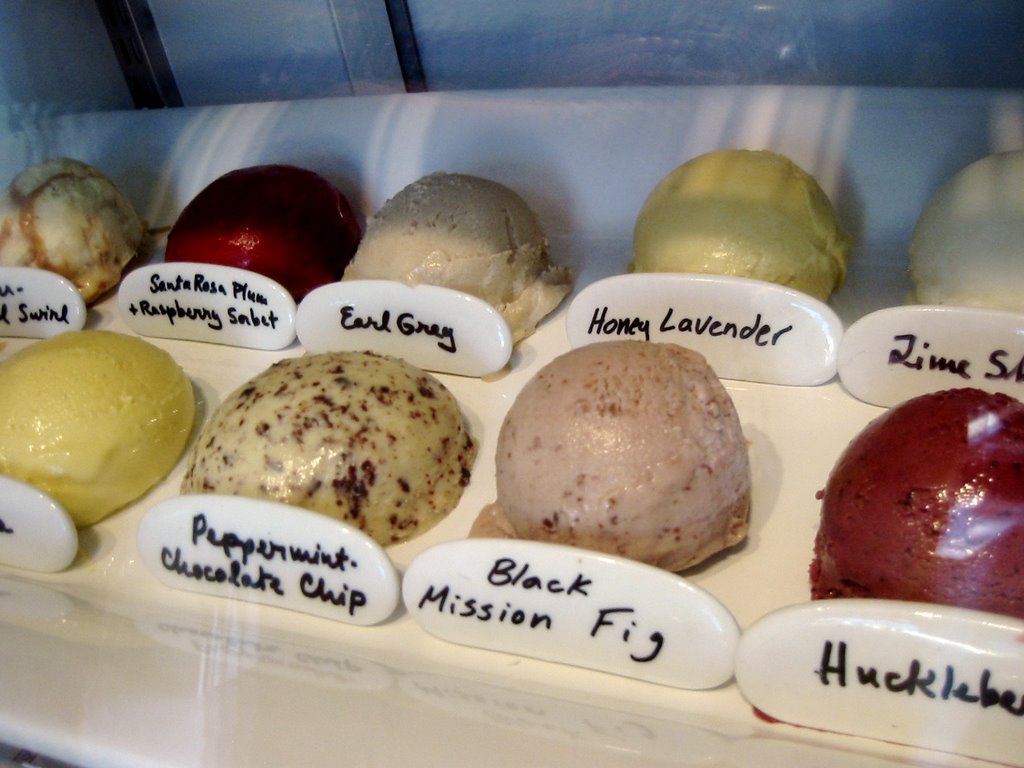
That sounds prosaic. But at Ici the coffee is from Blue Bottle, and the ice cream, like all the ice creams here, is fresh from a machine a dozen steps away from the display case, with its shelves of bombes and ice-cream sandwiches and fruit displays...


...and in its own room off the immaculate and roomy kitchen, where the shop's own waffle cones come off the griddle.

The first thing that struck me, even before tasting anything, was the Chez Panisseness of the flavors. After all, I have a long acquaintance with these ice creams; I remember Lindsey working out a number of them, back when she used a wooden-tub White Mountain freezer to make them for the restaurant. Now here they are in a shop, just as enticing as when she made them thirty years ago and more.


The shop's already attracted notice on a number of blogs, as Google will quickly reveal. Some people have referred to a feminine quality of its decor: I don't understand that at all. The interior is styish, even elegant, with panelling of recyled elm -- this is the Elmwood, after all -- and well-chosen typefaces for the placards announcing the flavors of the day, each hanging by a ribbon from the wall.

Berkeley's College Avenue has a fine tradition of ice cream, reaching back to Bott's, long gone and until now still lamented. Mary's ice cream, organic of course, subtle and authentic, is generations beyond Bott's. We've come a long way. And for all its subtlety, its artisinal authenticity, it seems definitely to have its audience. The place was packed when we visited it, and I can't imagine we'll ever be in the neighborhood without dropping in.

And my ice cream? Exactly the right consistency, weight, degree of sweetness. It could have been Lindsey's. And I'd have thought so even if I hadn't known the thoughtful, experienced, serious, personable, dear friend who'd made it.

Saturday, September 09, 2006

Racine's Phaedra

Glendale--

PERHAPS FORTY YEARS AGO we saw a performance of Racine's great tragedy Bajazet performed in a grand production at the University of California, Berkeley -- a production which has literally haunted me ever since. Not so much for the play itself, which I hardly recall, or for the performances, though I do recall one actress -- Roxane, probably -- frequently placing the back of her hand to her forehead as she declaimed:
But, Ah! ...
It was the physical production that so tremendously impressed me. The direction and the design were by Henry May, as I recall; one of the two or three members of faculty of the University's department of Dramatic Arts at the time. The play was on the stage of the then-new Zellerbach Playhouse, an improbably wide, shallow stage; and the stage was virtually filled, again as I recall it, with a single striking scenic invention: a shallow pool containing real water; and the entire production was black and white, starkly beautiful.

A little earlier we'd been captivated by Alain Resnais's film Last Year at Marienbad, with its re-creation of a piece of baroque French drama in a garden theater, featuring forced perspectives. Looking back, now, I see that these two impressions reinforced one another to create a kind of mental configuration central to my then-developing sense of theatrics, by which I mean the use of public space, gesture, and declamation to express artistic intention. And ever since I've yearned for classic French theater, rarely available.

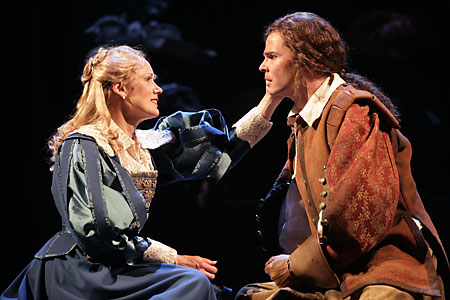
TONIGHT WE SAW a performance of Racine's Phedre, ably translated by Richard Wilbur, beautifully set by the Glendale rep company A Noise Within, respectfully and properly directed by Sabin Epstein, and amazingly well performed; and my admiration for this theatric is redoubled. I've written before, somewhere on this blog, about the function of Theater in defining and celebrating that necessary human quality Community: here is a perfect example. I'd worried, a bit, in advance, as to how the dramatic arbitrariness of this plot would be received by a contemporary audience: no need to worry.

A Noise Within marvelously captures this essentially communitarian quality, as Racine did in his 17th-century poetry, as Euripides did in the original version, written when a smaller community, at a time just after the emergence of conscious awareness of society, still found it necessary to work out the meaning of blood lines, of family, of the succession of leadership, of the necessity to subordinate passion, especially sexual passion, to social propriety.

Much of what I admire in French style is classical: poise, balance, clarity, discursiveness. All these qualities are at their peak in Racine. His play was of course written in rhyming alexandrines, in a French limpid and direct enough to make sense even to my imperfect comprehension of the language -- though the subtleties of its elegance of course escape me quite, and I require critical apparatus, like that in the old Random House edition of Samuel Soloman's translations, to reveal such niceties as Racine's mastery of those ineffable French tenses.

Richard Wilbur is a poet, and his rhyming pentameter seems both conversational and poetic, both realistically sudden and introspectively discursive -- in other words, true to Racine. And in this production it is these words that hold center stage. The great role that is Phaedre grows from the person and (especially) the situation of the woman herself; but it's Racine's expression that lifts it into something really quite exceptional.

I suppose I shouldn't really tell you about this performance, as it hasn't officially opened yet: we saw the first public preview of the run, because it's the only night we're able to see the show -- it closes before our next trip down here, in early December. But I'm going to break the rule that one doesn't review previews, because it would be irresponsible to conceal this magnificent evening of theater.

Like Henry May's Bajazet, this production uses a single set: a formal rectangle within a low wall on the deeply thrust stage in this small theater. The costumes, quite effective, depict no particular time, once you get past Hippolytus's grungy tee-shirt and Levis. The language, of course, alludes constantly to Greece and Crete, the Greek gods (by their Latin names) and the fate of the house of Theseus; but the action of the play can be anywhere or nowhere or, most likely, wholly within a mental state, whether Phaedra's, or Hippolytus's, or ours.

We thought the cast superb. Jenna Cole rose to the title role with a considerable range of emotion without ever losing dignity; J Todd Adams was a methodical, believable Hippolytus; Robertson Dean an outstanding Theramenes; Mark Bramhall an effective Theseus; June Claman an edgily sympathetic Oenone; Dorothea Harahan a credible Aricia. (Sarah Rincon and Charlotte Miserlis complete the case capably in minor roles.)

The play runs in repertory until a day or two before Thanksgiving. It's a highlight for us in a year already generous with memorable theater.

Friday, September 08, 2006

Shun Fat


-Monterey Park

PARDON, MADAME, mais est-ce que vous etes francaise?


We were at a rest stop, the third I think, on the way down Highway 5, and I was addressing a slim, rather elegant young woman with a short upswept reddish hairdo and, on a long leash, an equally elegant blue-haired terrier.

Un petit peu, she replied with a smile, do you speak french?

Qu'un petit peu, I apologized; it's that my wife pointed you out and said she had seen you at each of the rest stops, and she thought you were french, and I asked how on earth she could tell, and she said She looks french, so I thought I'd ask.

I'm very flattered, she said, but no, maybe a very little bit somewhere way back; we're just driving south to see my parents, and we break the trip often...

As one will, I said with quick gallantry, when traveling with livestock.

Yes, she said, but then we like to break the trip, too.

And now we're in a Best Western across the street from Shun Fat. I haven't explored Shun Fat yet, and am not likely so to do: there are too many other things to be done down here. We're here for a conference, and I don't have anything yet to say about that, and perhaps never will. But we are also here to eat, of course, and to see a play -- Racine's Phaedra, which I am greatly looking forward to.

But that's tomorrow. Today we drove 440 miles, a dozen of the last through dense smoke -- dramatic flames burning on mountainsides beyond Pyramid Lake, to the north of Los Angeles, dramatic as any coup de theatre Racine might ever have wanted. And then, after checking in, a quick drive to Trader Joe's on the way to dinner.

Why? Because our destination, Bistro K in South Pasadena, may be a bistro, but it serves no wine. You have to bring a bottle.

My wine-merchant friends (not to mention our winemaker friends) will be shocked to hear that we know Trader Joe's list pretty well. Our everyday wine used to be our own naive domestic Zinfandel, one of our own manufacture, but that was years ago; now much of it comes from Italy or, occasionally, Spain, by way of Trader Joe. And we make it a point of honor not to pay more than five bucks a bottle.

Well, you don't take a bottle of cheap wine to a restaurant, at least I don't. So tonight we splurged with a Pommard '04 from Sebastien Roux. It tasted pretty austere at first, I thought, but married well to the soft cheese that came as an amuse-guele, not to mention the hanger steak that came afterward.

Bistro K has an amusing menu which you can see by looking the restaurant up at Zagat.com. Sea urchins, monkfish osso buco, beef cheeks, lamb's hearts, things like that. Even something as straightforward as a Caesar salad is tricked out -- it's served rolled up in a flour tortilla. Don't ask me why.

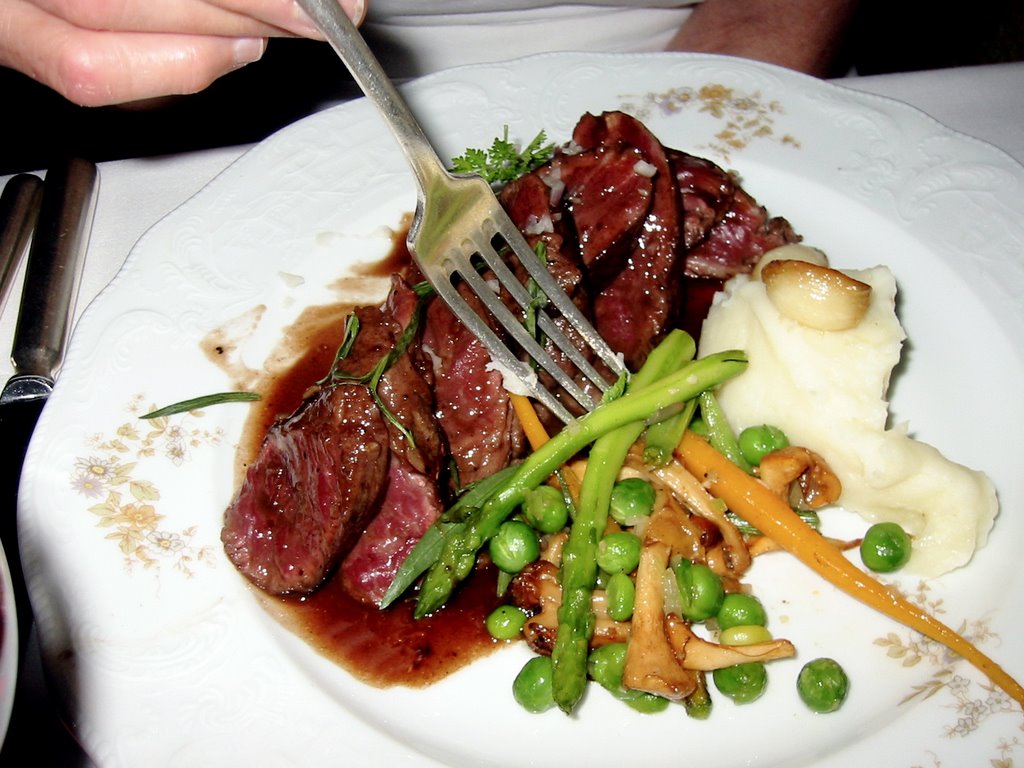
But buried there at the end of a long long list of dishes each of which seemed to contain within itself enough different ingredients to supply the index of a fair-sized book of nouvelle cuisine californienne, buried there at the end was the hanger steak. It came with mashed potatoes, a couple of roasted garlic cloves atop, and a serving of mixed vegetables: peeled asparagus, carrot, chanterelle, leek, peas. Quite delicious.


Bistro K is at the corner of Fremont and El Centro in South Pasadena, in a building called, of course, Fremont Center Theater; a building that used to be a funeral parlor; a building it shares with a small theater where, last May, we saw a number of one-acts by Ray Bradbury, of all people. Everything here is a little bit weird. It's Los Angeles.

Sunday, August 27, 2006

Restaurants


TODAY CHEZ PANISSE is thirty-five years old, and what do you see here but a photograph of... not Chez Panisse, but Jojo, a favorite restaurant of ours in Oakland.

At risk of political incorrectness, let's consider that most organisms, by the time they're 35, have begun to contemplate Continuation Of The Species. Jojo is just one of many "children" of Chez Panisse. Both Curt Clingman, who is facing the stove in this photo and so can't be seen, and Mary Jo Thoresen, who seems to be sighting across a glass of blood-orange juice, did time at Chez Panisse: he on the line upstairs, she as Lindsey's sous-pastry-chef.

They opened Jojo in 1999, right next to Bay Wolf, on Piedmont Avenue. It's a wonderfully inviting place, always comfortable, the food always dependably fresh and delicious. "Unpretentious" food, to use an adjective I loathe (why would food "pretend" to anything?): what I think of as Paris-bistro-cooking, things like mussels and paté and steak-frites. You should go there: you'll go back.

Any day now another Chez Panisse alum will open: Mary Canales's Ici, up in the Elmwood district, on College just north of Ashby in Berkeley. Mary's another pastry-kitchen alumna; she was co-pastry chef for many years after Lindsey's retirement, and I for one hated to see her leave Chez P. -- but it's an old story; many of the best inevitably feel the need to go on to their own things.

Last year someone interviewed Lindsey and asked, in the course of things, for a list of such people. We began it, but it seems to exhaust our resources; I mention Curt and Mary Jo and Mary only because they've been recent events -- we looked in on Ici last week, and ate at Jojo the week before. There are so many others that I'd best stop now -- but wait, I must mention Kees Elfring's Marius in Amsterdam! We'll be there in six weeks!

And now on down the road to Berkeley for a birthday feast...

Tuesday, August 22, 2006


MOZART INHABITS A MIDDLE WORLD where beauty surges in and ebbs away, where everything is contingent and nothing pure, where, as Henry James’s Madame Merle says, an envelope of circumstances encloses every human life.


(That’s Alex Ross writing, in the July 24 (2006) issue of The New Yorker, which I read online.)

The quote’s been on my mind for a long time. I ran into it up in Ashland, three weeks ago, about the time I last blogged here. It describes perfectly the last few weeks, unusually social for us. First there was the week in Ashland with three other couples, friends with whom we do this for a week every summer, staying in a house a comfortable walk away from the three theaters, seeing nine plays in six days, four of them by Shakespeare.

Then there was a week in Portland with family, partly to see Grace before she went off to University — in a favorite city of mine, Middelburg, where she’s enrolled in a special campus of the University of Utrecht, and will soon add Dutch to her English, French, and Spanish. What an amazing world this has become!

And most recently we’re back from a long weekend up to the Sierra, as you see above, where we walked to the site of a friend’s husband’s ashes, thinking all the way of transition and such, as one tends to do on such occasions, particularly when accompanying a family group ranging from toddlers to old-timers like us.

(And particularly, I might as well say it, when contemplating one’s own seventy-first birthday.)

“Counterpoint and dissonance are the cables on which Mozart’s bridges to paradise hang,” Ross points out — I would be quick to add consonance to his mix.

Living intensively with three other friends, particularly other couples and families, is a practice of that contingent “middle world,” and getting together with them, especially annually and for occasions like these, is a reminder of that “envelope of circumstances [that] encloses every human life.”

Friday, August 04, 2006

Ashland: further theater notes


Robin Goodrin Nordli, Rex Young: Roxane and Christian

LAST TIME AROUND I wrote about the four Shakespeare plays we saw last week in Ashland; now let me report on the five other pieces.

Cyrano de Bergerac: pretty damn good, we thought. A first-rate Cyrano and a fine physical production, housed out-of-doors in the Festival Theater, easily offering a balcony for the famous scene in which Cyrano supplies romantic poetry to the tongue-tied young Christian who is wooing Roxane, a scene owing a great deal to Lorenzo da Ponte’s libretto to Don Giovanni.

The stage was even better as the camp at the siege of Arras, in the bitter night and the violent battle that follows. Laird Williamson directed in fact a cinematic production of this romantic warhorse, alternating easily between public brawl and intimate conversation. Marco Barricelli was a magnificent Cyrano; Robin Goodrin Nordli a fine and affecting Roxane; Rex Young a sympathetic Christian; and the many other roles were well fleshed out, often in more senses than one.

The only slight cavil might be with the text. The translation, in Anthony Burgess’s rhyming meter, is not up to the familiar one by Brian Hooker, used in the 1950 Jose Ferrer movie. It works well enough in such ironic passages as Cyrano’s famous tribute to his grotesque nose, but in the romantic passages the need to rhyme often shoulders aside the better word.


Dr Jekyll and Mr. Hyde: a revised earlier piece by the British playwright David Edgar, last represented in Ashland (and Berkeley) by his problematic diptych Continental Divide, this was effective and compelling and featured fine acting and production.

Based, of course, on the novella by Robert Louis Stevenson, the play is as much a commentary on the original, and the society in which it’s set, as it is a transferral to the three dimensions of the stage. Edgar adds important roles for women and for servants, because he wants to condemn the narrow Victorian male view of their roles in society.

Further, he identifies Mr. Hyde’s violent eccentricities (and by implication his evil amoral nature) as the accompaniment of Tourette’s syndrome, and implies that that condition was inherited from Dr. Jekyll’s father, both genetically and by childhood conditioning. This aspect, political and Freudian, seems to me utterly unnecessary to the play. If it was indisputably necessary to Edgar’s inspiration to stage Stevenson in the first place I grudgingly accept it, but I think the play would profit from some further re-writing to make these themes a little subtler.

Penny Metropulos was the director, finding smooth and very quick transitions and penetrating characterizations; William Bloodgood designed the striking set, whose quick turntable-enabled changes underlined the nervous alternations basic to Stevenson’s fable.

James Newcomb, last year’s amazingly powerful and evil Richard III, was both Dr. Jekyll and Mr. Hyde; Laura Morach was moving, intelligent, and convincing as the servant-girl Annie Loder; Vilma Silva was subtle and rich as Jekyll’s sister Katherine; Robert Sicular was a fine, sympathetic butler.

The Importance of Being Earnest did not draw the best production I’ve seen — stylish but a little flat, it lacked the brittle quality that makes Wilde just a bit menacing under the surface. This may have been partly the fault of the Angus Bowmer Theater, comfortable and resourceful but too wide, I think, for this most parlorish of plays.

Here, as in a number of other cases, color and lighting were major players in the production. At a noontime lecture the playwright of Dr. Jekyll and Mr. Hyde referred to his piece as the reverse of Earnest, and this was perhaps underlined by the choice of William Bloodgood as designer of each. (Come to think of it, it may be the reason for the soft-pedalling of that menace I mentioned: there was just too damned much of it in Jekyll and Hyde.)

Kevin Kenerly, as adaptable an actor as you’d ever want, was a fine, saucy Algernon; Jeff Cummings, often a clown in Shakesperian roles, was the soberer Jack Worthing. Heather Robison and Julie Oda were Gwendolen and Cecily; Judith-Marie Bergan an imposing Lady Bracknell; Dee Maaske a fey Miss Prism; Jonathan Haugen a willing but somewhat miscast Chasuble.

Bus Stop, William Inge’s sentimental play of the 1950s, drew one of the strongest productions of the year. Staged in the small New Theater, for this given a modified in-the-round configuration, the stage gave Libby Appel’s direction a chance to zoom in on each of the eight characters, individually and in their relationships to both other individuals and the ensemble.

Set in a small-town Kansas hash-house, the story concerns four passengers and a Greyhound bus driver waiting out a blizzard, intersecting with the wisecracking cafe proprietor, her adolescent waitress, and the sheriff. The atmosphere verges on claustrophobia as some of these come to grips with their urges and others sit laconically by. The Bridge of San Luis Rey and Sartre’s No Exit aren’t far from Inge’s writing-desk, but he marries those exotic sources to a home-town prairie sensibility that aches with nostalgia for anyone who, like me, spent time in Kansas in the 1940s.

Since I made the mistake earlier on of citing actors, let me just reproduce the cast list here:
Bo Decker: Danforth Comins; Cherie: Tyler Layton; Virgil Blessing: Mark Murphey; Grace: Shona Tucker; Dr. Gerald Lyman: Robert Sicular; Will Masters: Jeffrey King; Elma Duckworth: Nell Geisslinger; Carl: Tyrone Wilson
They were all beautifully matched, true to their parts, as persuasive when simply sitting by silently as when engaged in the drama and the pathos of their roles.

Finally, Intimate Apparel: another new play, this one by Lynn Nottage, about Esther Mills, a black seamstress from the South who settles in ragtime New York in a desparate attempt to make something of herself. She winds up working as a seamstress, to fancy whores and (white) society ladies; and embarks on a strange correspondence with a black laborer working on the canal then a-building in Panama.

The correspondence blossoms into a courtship, of course; the man comes to New York; the end of the first act finds them coming together as bride and groom in as achingly sweet and tender a theatrical passage as I’ve seen anywhere.

So far, so good: Nottage’s lecture on the inequalities and injustices of the early Modern period are subtler than those of David Edgar’s Jekyll and Hyde, because they are perfectly embedded in the developing story of his perfectly believable characters.

After the intermission things go awry, for Esther and for the play, apparently based on events in the lives of the playwright’s own antecedents. The plot begins to plod, and the surprise ending is curiously both abrupt and pat.

But the play is a success — both because you get the feeling it’s an early piece in what will turn out to be a distinguished career, and because the acting is superb. Gwendolyn Mulamba is amazingly deep yet accessibly sympathetic in the lead role; Erik LaRay is a perfect match as her pen-pal George; and the four supporting roles are precisely balanced.

IT’S HARD, THEN, to recommend two or three plays from the season at the expense of others. I’m very grateful for the opportunity to have seen this King John, Winter’s Tale, and Bus Stop. I wouldn’t miss Cyrano or Jekyll and Hyde or Intimate Apparel. True, I have left three comedies out of this running: but if your schedule permits one of them, and no other play, then go ahead to it; only a prig or a pedant would really object.

Thursday, August 03, 2006

Ashland: Theater notes

WE SAW NINE PLAYS last week, in our annual trip to Ashland with three other couples:

. King John
. Two Gentlemen of Verona
. The Winter’s Tale
. The Merry Wives of Windsor
. Cyrano de Bergerac
. Dr Jekyll and Mr. Hyde
. The Importance of Being Earnest
. Bus Stop
. Intimate Apparel

So it was four Shakespeare plays, the first three in two days (for we often see matinees and evening performances on the same day); three classics; two new plays — rather a representative Ashland season.

(Two other plays, The Diary of Anne Frank and UP, had been given earlier in the year.)

Let’s take a look at the Shakespeare plays first, since this is, after all, the Oregon Shakespeare Festival. The Bard’s plays are the centerpiece of every season, and many of the productions are given out of doors in a theater meant to suggest the Elizabethan Globe.

Further, OSF gives Shakespeare’s history cycle in historical order (not the chronological order of their writing). This tends to mediate between two views of the cycle: as Shakespeare; as history. Since by now, well over four hundred years after his birth, Shakespeare himself (not to mention his plays) is history, these productions offer an absorbing contemplation of historicity, of what history is; and thereby of what our own time stands for in relation to history. Not, I’m afraid, a very pleasant contemplation, much of the time.

Shakespeare may well have written King John after his three Henry VI plays, but its subject is the earliest historical material he treated. OSF presented the play this year for the first time in twenty-one years, so it was a production not to be missed: if you’re seriously interested in Shakespeare, or theater, or Ashland’s festival, you’ll want to see this.

It’s housed in the small, technologically savvy New Theater, where the director, John Sipes, has set the production in the period of World War I, projecting film sequences from that war on the backdrop and even the floor to take the place of Shakespeare’s battle scenes; costuming the cast in the formal clothing of heads of state and diplomats of a century ago; and letting a generic 19th-Century-Monumental public building stand throughout the production as its backdrop.

A program note suggests this was done to make the substance of the play more relevant to our own time by bringing it closer in time. I’m not sure this was achieved: much of what goes on today seems closer to King John’s Dark Ages than it does to the beginnings of Modernism. In any case the play is relevant enough and then some, as seems always to be the case with Shakespeare; and the visual aspect of this production doesn’t hurt, for Shakespeare is resilient.

(This is itself an interesting point. I remember being discouraged twenty years ago by Patrice Chereau’s similar updatings of Wagner’s “Ring” cycle. Wagner’s theater is apparently more easily damaged by directorial fiddling. Why is this?)

The play is “about” three problems: succession to the throne; England’s resistance to the Pope; and the resistance of the English nobility to an autocratic King — all three still relevant, if you substitute our troubled electoral process for succession; the collision of national and global concerns for the struggle between London and the Vatican; and Congress (and for that matter the electorate) for nobility.

The cast seemed to me very even, quite up to both the subtleties and the stamina required by this intricate yet most direct drama.

We saw King John in the afternoon; that evening we saw Two Gentlemen of Verona. Here too was a period update, for the two gents were Amish, or something close to the mark, off from a country-bumpkin Verona to test their moral clarity on a rumspringa (a vacation free from all family and community restraints) to a rich and pleasure-loving Milan.

It’s an early play, probably his second comedy, and no more substantial than his first (Love’s Labours Lost, performed here last season, in a similarly fast-paced, “contemporized” version. Seen outdoors at the Festival Theater it worked quite well, with fine costumes and lighting, vocal clarity, and an engaging cast — quite upstaged by an utterly enchanting Jack Russell terrier named Terwilliger and his somewhat absent-minded master, Launce, ably played by David Kelly.

Next came The Winter’s Tale, set in its original period and place (unspecified mythical times, improbably fanciful Sicily), in a stark but beautiful production in the broad, capacious Angus Bowmer Theater. Three Shakespeare plays, three theaters, three views; History, Comedy, Problem Play.

I’ve seen the play before. OSF performed it fairly recently; and we’ve seen it elsewhere. But, whether because we’d heard its director discuss the play in a lecture earlier in the day, or because of fine performances from the cast, I’d never before felt the depth and complexity of the play so beautifully expressed. The Winter’s Tale was apparently written at about the same time as The Tempest, and only the neglected (and disputed) The Two Noble Kinsmen and Henry VIII, neither of which I’ve ever seen, postdate them; and The Winter’s Tale plays, at least in this production, as a mirror twin to The Tempest .

And as a more interior twin. Where Prospero’s actions and preoccupations take place in the context of his family (I include Ariel and Caliban among them) and his court, Leontes’s precipitate and fatal jealousy, and his subsequent remorse, seem utterly un-understandable, completely private. The play centers on him, and he’s a powerful figure (as William Langan’s performance proves); but while he has our sympathy we see the play through the others in the cast. Shakespeare seems on the brink of a new geometry of his affects, finding a new role for his audiences to play in their response to his genius.

And yet another matter: this Winter’s Tale connected back to King John. Twenty years of play-writing seems to come full circle. History has become Myth, but continues to center on individuals and their private demons.

Our final Shakespeare play was The Merry Wives of Windsor: while the production and the performance were sound enough, the play is perhaps Shakespeare’s least. Elizabethan Englishmen have no business trying what French farce does so much better. I liked virtually every aspect of the production, and recommend it to anyone who likes the play; but it was, for me, the least of the nine plays we saw.

I’ll try to get to the remaining five plays here soon, but in case I don’t, here’s a concise discussion:

. Cyrano de Bergerac: pretty damn good, we thought. A first-rate Cyrano and a fine physical production; but the Burgess translation not up Brian Hooker’s, used in the 1950 Jose Ferrer movie.
. Dr Jekyll and Mr. Hyde: effective and compelling and fine fine acting and production, though production a little busy, and play a little overworked. Relatively new, by David Edgar, based on Robert Louis Stevenson. Worth seeing.
. The Importance of Being Earnest: not the best production I’ve seen — stylish but a little flat, lacking the brittle quality that makes Wilde just a bit menacing under the surface.
. Bus Stop: a fine performance of William Inge’s sentimental play. One of the strongest productions of the year.
. Intimate Apparel: a new play, by Lynn Nottage: an interesting attempt; a charming first act, too politicized and ambitious a second act; couple of brilliant and moving performances in the lead roles.